INFORMATION GUIDE FOR INCOMING ERASMUS STUDENTS 2017-2018 - Bristol University
←
→
Page content transcription
If your browser does not render page correctly, please read the page content below
INFORMATION GUIDE FOR INCOMING
ERASMUS STUDENTS
2017-2018
Contents page

                                                         Page

Contact details                                           2

The School of Economics, Finance and Management           3

School Registration                                       4

The Academic Year 17/18                                   5

Language Requirements                                     7

Bristol Credit Points and ECTS                            8

Workload and timetable                                    8-9

Units of Study                                            10-15

Open Units                                                16

Assessment, Examinations and Marking                      17-19

Library and Computing Facilities                          20

Useful Web Addresses                                      21-22

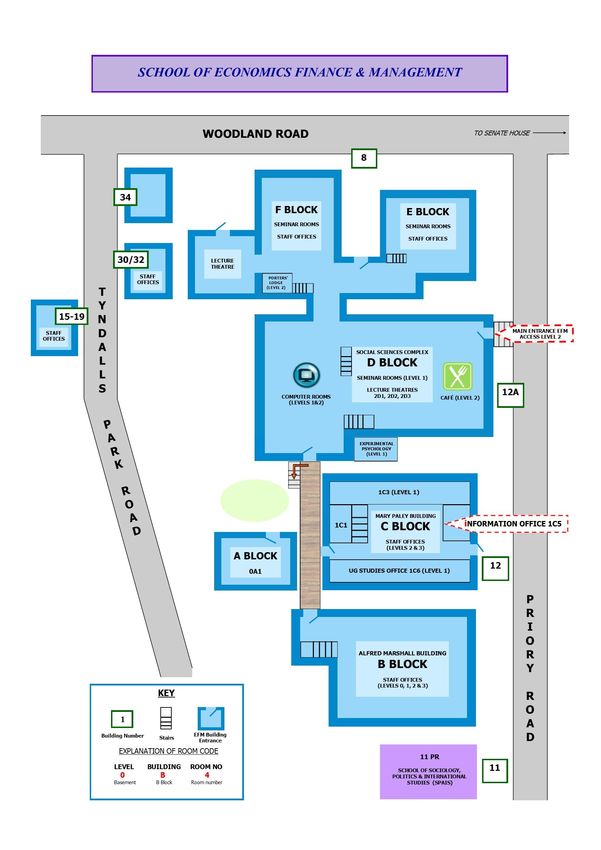
Map of the School of Economics, Finance and Management    23

Disclaimer                                                24

                                                                  1
CONTACT DETAILS

School of Economics, Finance and Management

Information Office
School of Economics, Finance and Management
Priory Road Complex
Priory Road
Bristol
BS8 1TU

T: + 44 (0)117 331 0500
F: + 44 (0)117 928 8577
E: efim-info@bristol.ac.uk
W: http://www.bris.ac.uk/efm

Erasmus Administrative Co-ordinator

Nina Bunton (Room 1C6)
T: +44 (0)117 331 0503
F: +44 (0)117 928 8577
E: efim-erasmus@bristol.ac.uk

Erasmus Academic Co-ordinator and Personal Tutor

Dr. Leandro De Magalhães (Room 0B7)
T: +44 (0)117 928 8418
E: Leandro.DeMagalhaes@bristol.ac.uk
Office hours: To be confirmed

http://www.bristol.ac.uk/efm/courses/undergraduate/courses/studyabroad

Global Opportunities team

Global Opportunities
3rd Floor (street level entrance)
31 Great George Street
Bristol
BS1 5QD

T: 0117 394 0207
E: global-opportunities@bristol.ac.uk
W: http://www.bristol.ac.uk/international/ug-study/erasmus
                                                                         2
THE SCHOOL OF ECONOMICS, FINANCE AND MANAGEMENT
The School of Economics, Finance and Management (EFM)
consists of three departments: Economics, Accounting and
Finance, and Management.
All departments within the School have international
reputations both for their teaching and their research.
High Quality Teaching
Students rate the quality of our teaching as among the best in the country. Classes are given by
leading researchers and dedicated teaching staff who incorporate the very latest ideas into their
teaching. The result is a lively and challenging educational environment.
Contact Hours
As an Erasmus student at the School of Economics, Finance and Management you will benefit
from excellent teaching and learning support. We provide small-group classes as well as large-
group lectures, clinics and exercise lectures. The amount and nature of contact time varies from
one unit to another, depending upon what works best for different subjects. Feedback on your
progress is provided throughout the year and help is always there when you need it.
Blackboard
All undergraduate units in the School make use of an online learning environment called
'BlackBoard', from which you can download course materials, practice questions online and
make use of discussion boards. Blackboard will help you keep track of unit announcements,
communicate with other students taking the unit, receive news about the latest developments in
the unit and review lectures.
There is also a special site on Blackboard dedicated to the School’s Erasmus & Study Abroad
exchange scheme. All Incoming Erasmus students are automatically enrolled on this site upon
arrival. The site also contains useful documents (such as this information guide) and will be used
by the Erasmus Administrative Co-ordinator to contact you with important announcements.
University of Bristol Email account - keeping you informed
The School will keep in touch with you throughout the year with important information and
announcements so remember to check your University of Bristol email account regularly!
3School Registration
As well as registering with the Global Opportunities team, EFM Erasmus students must also
register with the School of Economics, Finance and Management.
Registration for the 2017-2018 academic year will take place in Welcome Week (week 0)
commencing Monday 18 September 2017. The final date, time and venue will be confirmed
closer to the time.
When you register with the School you will be enrolled and timetabled for all the units listed on
your Learning Agreement. The School cannot register you for units offered by other
departments; you must register direct with the department offering the unit and ensure that the
lecture times do not clash with your EFM lectures.
It is usually possible to change the time of an EFM tutorial class as there can be several tutorial
groups for each unit but lecture times are fixed and cannot be changed.
If there are any problems with your learning agreement we will endeavour to contact you or your
home Erasmus Co-ordinator before you arrive.
If you want to change any of your units before you arrive please contact the Erasmus
Administrative Co-ordinator via efim-erasmus@bristol.ac.uk
Personal Tutor
Every student is allocated a personal tutor; an academic member of staff. The EFM personal
tutor for all Incoming Erasmus students is Dr. Leandro De Magalhães.
You are required to see your personal tutor at the beginning of each teaching block. Dr De
Magalhães is available to discuss any matters with you – academic or personal. Do not hesitate
to contact your tutor if you encounter any problems, no matter how small or insignificant these
might seem.
We hope that your time in the School will be a happy and productive experience. However,
students at university can occasionally experience difficulties apart from academic problems:
these may involve your health, financial or family circumstances. Personal tutors are usually the
first people to approach if such problems do arise. Where appropriate, your tutor can put you in
touch with other members of School staff or with specialist advisors. On rare occasions, illness
or other types of problems may have a detrimental effect on your academic work. If this
happens you should contact the EFM Information Office or the EFM Erasmus Administrative Co-
ordinator as soon as possible. You can be assured that confidentiality will always be strictly
observed.
Your contact details
We may need to contact you individually during the year so it will be important for you to keep
your current contact details up-to-date on your personal Student Info page:
https://www.bris.ac.uk/studentinfo/
4THE ACADEMIC YEAR 17/18
The academic year is split into two teaching blocks - Teaching Block 1 and Teaching Block 2 and
each teaching block is followed by an assessment period:
Welcome Week (Week 0)
Monday 18 September 2017 – Friday 22 September 2017
There is no teaching in this week.
Teaching Block 1 (TB1)
Monday 25 September 2017 (Week 1) – Friday 15 December 2017 (Week 12)
TB1/January assessment period (JE)
Monday 8 January – Friday 19 January 2018
Teaching Block 2 (TB2)
Monday 22 January 2018 (Week 13) – Friday 4 May 2018 (Week 24)
Summer Revision Week (RE1)
Monday 7 – Friday 11 May 2018
TB2/Summer assessment period (SE)
Monday 14 May – Friday 1 June 2018
5Vacations
Christmas vacation: Monday 18 December 2017 to Friday 5 January 2018
Easter vacation: Monday 26 March to Friday 13 April 2018
Summer vacation: Monday 4 June to Friday 21 September 2018
University Closure
The University as well as all Government Offices, banks etc. will be closed on Bank Holidays. This
will also affect timetables for public transport and postal deliveries.
2017
25 & 26 December Bank holidays
27 - 29 December University main buildings closed
2018
1 January Bank holiday
2 January University main buildings closed
30 March Good Friday (Bank holiday)
2 April Easter Monday (Bank holiday)
3 April University main buildings closed
7 May May Day Holiday (Bank holiday)
28 May Spring Bank Holiday
See http://www.bristol.ac.uk/university/dates/ for further information on key dates
6LANGUAGE REQUIREMENTS
All courses are taught and assessed in English. The minimum required level is at least B2 level
English (or equivalent). Students with less than this will experience difficulties in studying and
passing exams.
English language courses for Erasmus students are available from the University of Bristol’s
Centre for English Language and Foundation Studies (CELFS). Erasmus students may register for
any of the following units:
Academic Listening and Speaking (LANG10007) 5 ECTS
English-language units specifically focusing on supporting you with academic listening and
speaking.
Academic Reading and Writing (LANG10008) 5 ECTS
English-language units specifically focusing on supporting you with academic reading and writing.
Advanced English Language Studies (LANG14011) 10 ECTS
For post intermediate level students who wish to develop their competence in the analysis and
communicative use of English.
These units are all credit-bearing and students must ensure they do not exceed their credit
allocation when registering for these units.
You must register directly with CELFS to take these units. Please visit the CELFS website for
further details of these units and up-to-date registration details:
http://www.bristol.ac.uk/english-language/study/current-students/open-units/
7BRISTOL CREDIT POINTS AND ECTS
Bristol Credit points
The credit points listed with each unit description are University of Bristol Credit Points. Most
units have a 20 Credit Point value. University of Bristol students are required to complete 120
Credit Points per academic year.
European Credit Transfer Scheme (ECTS)
The ECTS has been implemented throughout Europe to facilitate the recognition of your work
while you are here.
Credits are awarded only when the course has been completed and all required examinations
taken and/or coursework completed (formative and summative).
Practical placements and optional courses, which do not form an integral part of study, do not
receive academic recognition.
20 University of Bristol Credit Points = 10 ECTS
WORKLOAD AND TIMETABLE
Workload
Full-year students will be expected to study 120 University of Bristol credit points (60 ECTS).
Students here for teaching block one only will be expected to study 60 University of Bristol credit
points (30 ECTS).
A full list of units available to Incoming Erasmus students can be found from page 11 onwards.
You must be able to attend all of the lectures and tutorial classes for each unit of study. Please
note that mixing units from different years/departments may cause timetable clashes. In this
event, you will need to decide which unit to keep as it will not be possible to keep both/all units
involved in the clash. You will be advised of any timetable clashes as soon as possible.
Please note that attendance at class tutorials and submitting required written work is
compulsory. Failure to do so will mean credit points may not be awarded.
8Unit choice and unit weighting
It is your responsibility to ensure your unit choices are approved by your home university, and to
confirm that you are doing the correct number of credit points according to your degree
requirements.
Full-year students are advised to take an equal number of ECTS in each teaching block in order to
have a balanced timetable.
Study Spaces
There are numerous study spaces for students across the University. See the Study Space
website for details: http://www.bristol.ac.uk/students/study-spaces/
Timetable
Online personalised student timetables are available under the Timetable tab on the
MyBristol portal, accessed via www.bristol.ac.uk/mybristol and available in the week prior
to week 0.
Required Reading
Suggested textbooks are included in the unit description. Some lecturers will expect students to
read everything on the list while others will expect students to make their own reading choices
from an extensive list of possibilities.
If you are at all unsure about what reading you should be doing please contact the relevant unit
lecturer for assistance.
Past exam papers
Past exam papers are available to current students to download from the School’s webpage:
https://www.bris.ac.uk/efm/currentstudents/examinations/pastpapers/
Staff Availability – Office Hours
All academic teaching staff have office hours when you can call in during term time to see them
without prior appointment. Office hours are posted on staff office doors and the EFM website:
https://www.bris.ac.uk/efm/currentstudents/office-hours/
If you cannot see an academic member of staff during their office hours then you should
contact them by email regarding your query and the possibility of arranging an alternative time
to meet.
9UNITS OF STUDY
Pages 11-15 list the units of study offered to Erasmus students in the School of Economics,
Finance and Management (with hyperlinks to full unit descriptions). Please note that, depending
on staff availability, some of the options listed may not run in 2017/18 or may cover different
material within the subject.
Each unit has a director who is in charge of it. Usually s/he does most of the lecturing. The
associated tutorial classes will be shared with those colleagues in the School who also have a
specialist interest in the topics covered by the unit.
Teaching on all units is through a combination of regular lectures and a series of class
tutorial/exercise classes.
We do not impose requirements on what units students should choose. Students should make
their unit choices in consultation with their home university and ensure that their choices are
appropriate and worth a sufficient amount of credits. We would, however, advise students to
think carefully and research thoroughly before choosing units.
Sometimes it is not possible to guarantee students their first choice of units as some options are
over-subscribed or there may be timetable clashes. Timetable clashes usually occur when
students take a mixture of different level units. We therefore suggest you make a reserve choice
in case one of your preferred units is full. If at all possible the Erasmus Co-ordinator will notify
you of any timetable clashes before you arrive. The Erasmus Academic Co-ordinator will also
discuss with each student their programme of study during the registration process.
Changes can only be made to unit enrolments during the first week of term. After this date
students can be removed from units but not enrolled on to new units. Students deciding to drop
a unit later than week 4 will have a mark of zero recorded on their transcript for that unit.
Unit Descriptions
For detailed descriptions of each unit please visit the School’s website:
http://www.bristol.ac.uk/efm/courses/undergraduate/units/
Each unit description provides:
• a general description of the unit including required pre-requisite knowledge;
• the unit’s director, lecturers and tutors;
• the unit’s learning objectives;
• the unit’s teaching and assessment methods;
• course texts;
• credit point value and
• teaching block.
10Pre-requisite knowledge
Several of the unit descriptions indicate pre-requisite units. We understand that Erasmus
students will not have taken these units, however this information indicates the knowledge that
will be assumed and so will help students to make appropriate unit choices. Please choose
carefully, some units involve a fair amount of quantitative skills and presume good background
knowledge.
Students are advised to read the unit description and syllabus content carefully for each unit
before making their selection, including those for any pre-requisite units
as this prior knowledge will be assumed.
Units available to students coming for the ACADEMIC YEAR 17/18
First Year Units – teaching block one
Pre-requisite Method of
Unit Code Unit Title ECTS
knowledge Assessment
Fundamentals of Accounting and Finance 1 Grade A in
EFIM10005 Students taking this unit cannot also take 10 A Level Exam
ACCG10052 Introduction to Accounting. Mathematics
Globalisation and Development Grade A in
ECON10053 Students taking this unit cannot also take 10 GCSE Exam
ECON20023 Growth and Development. Mathematics
EFIM10015 Introduction to Management 10 N/A Exam
First Year Units – teaching block two
Pre-requisite Method of
Unit Code Unit Title ECTS
knowledge Assessment
Fundamentals of Accounting and Finance 2
FAF1 is a pre-requisite unit for FAF2. If you have not
EFIM10006 also studied FAF1 in teaching block one, you must 10 FAF1 Exam
ensure that you are confident with the subject
matter.
EFIM10012 Global Business Environment 10 N/A Exam
Introduction to Accounting Grade A in
ACCG10052 Students taking this unit cannot also take EFIM10005 10 GCSE Exam
Fundamentals of Accounting and Finance 1. Mathematics
EFIM10013 Organisation Theory 10 N/A Exam
11Second Year Units – teaching block one
Pre-requisite Method of
Unit Code Unit Title ECTS
knowledge Assessment
Corporate Finance
Prospective students should be familiar with basic
discounted cash flow techniques of investment
MSM1 and
appraisal and the concept of relevant costs for
either FAF1 or
EFIM20006 decision making, including opportunity costs and sunk 10 Exam
Intro to
costs. They should also be familiar with and able to
Accounting
discuss concepts taught in introductory
undergraduate Economics, Statistics and Accounting
courses.
Econometrics MSM 1 &
This is a general econometrics unit for students who MSM 2
have already studied some statistics and some
preliminary econometrics. It could also be suitable for or
EFIM20011 students who have studied statistical theory but little 10 Probability 1 Exam
applied statistics. Maths of at least A-level grade A or
equivalent is assumed. Students are advised to or
consult the past exam paper before selecting this unit
to check the mathematical level. Statistics 1
Financial Accounting
Prospective students should have good prior knowledge of
accounting and be confident with the following aspects of
accounting:
• Cost of Capital; FAF1 & FAF2
• Depreciation;
• Double-entry bookkeeping; or
EFIM20007 • Inventories measurement (FIFO, LIFO and weighted 10 Exam
average);
• Net Present Value calculations;
Introduction
• Profit and loss on disposal of Property, Plant and to Accounting
Equipment;
• Relevant costing; and
• Total Absorption Costing
Growth and Development
Students taking this unit cannot take ECON10053
Globalisation and Development.
ECON20023 10 EP 1 & EP2 Exam
Prospective students should be familiar with
differentiation and algebra, and confident in their
mathematical ability.
EFIM20008 Intermediate Economics 1 10 EP 1 & EP 2 Exam
100%
EFIM20003 International Business Management 10 N/A
Coursework
EFIM20013 Marketing 10 N/A Exam
20% Group
Assignment
EFIM20015 Project Management 10 N/A
80% January
Exam
EFIM20019 Public Management 10 N/A Exam
12Second Year Units – teaching block two
Pre-requisite Method of
Unit Code Unit Title ECTS
knowledge Assessment
100%
EFIM20018 Analysis in Management 10 N/A
Coursework
Applied Microeconomics
The courses analyses real world issues (the minimum
wage, road pricing, competition policy) drawing on
simple micro-principles and available evidence from
EFIM20002 10 N/A Exam
academic studies. Students will be required to read
and discuss papers that use econometric methods
and so should have taken introductory micro and
econometrics courses.
EFIM20010 Applied Quantitative Research Methods 10 MSM 1 Exam
Economic History
Required reading will include applied economics Intermediate
EFIM20017 10 Exam
articles. Students should be confident with core Economics 1
theory and have knowledge of basic econometrics.
History of Economic Thought
This unit requires an ability to understand difficult 100%
ECON20021 10 N/A
abstract concepts and has a significantly higher Coursework
reading load than other EFM units.
Intermediate Economics 2
Students are advised that this unit will assume a
knowledge of macroeconomics similar to
Intermediate
EFIM20009 Blanchard’s Intermediate Macroeconomics text 10 Exam
Economics 1
book. And it will use extensive mathematical tools
throughout (including constrained optimisation and
ordinary differential equations).
Introduction to
Management Accounting
Accounting &
Only if an introductory course in Accounting has
ACCG20011 10 MSM 1 Exam
been completed. A Level Mathematics, or
or
equivalent, is required.
FAF1 & MSM1
EFIM20005 Management Science 10 MSM 1 Exam
Taxation FAF 1 & FAF2
Prospective Taxation students should be confident in plus Economic
the following subject areas: Principles 1 or
Economics: Principles of
• Budget constraints and indifference curves Economics
• Consumer and producer surplus
Or
• Demand and supply
EFIM20012 10 Exam
• Income and substitution effects
50% in
Accounting:
Introduction to
• Depreciation
Accounting plus
• Inventories measurement (FIFO, LIFO and Economic
weighted average) Principles 1 or
• Profit and loss on disposal of Property, Plant Principles of
and Equipment Economics
13Third Year Units – teaching block one
Pre-requisite Method of
Unit Code Unit Title ECTS
knowledge Assessment
Advanced Financial Reporting
Prospective students should have undertaken at least one
year of accounting studies and covered topics such as
accounting for:
• Leases
• Provisions, contingent liabilities and contingent 20%
Financial
EFIM30033 assets 10 Coursework
• Property, Plant and Equipment
Accounting
80% Exam
• Intangible assets
• Impairment of assets
• Group accounts
• Economic concepts of income
• Valuation in financial reporting
60%
Management Coursework
EFIM30013 Advanced Management Science 10
Science 40%
Exam
EFIM30006 Applied Econometrics 10 Econometrics Exam
Current Economic Problems This is a very applied IE 1 and either
ECON30065 topic-based unit. Students should be confident with core 10 Econometrics or Exam
theory and basic econometrics. AQRM
Financial Crises Classes involve students reading and
EFIM30018 5 N/A Exam
presenting selected articles.
Corporate
EFIM30019 Financial Markets 5 Exam
Finance
International Economics Required reading consists of
IE 1 and either
research papers that rely on econometrics and
ECON30074 10 Econometrics or Exam
mathematical models. Students taking this unit cannot
AQRM
also take International Macroeconomics.
Management
30% Case
/Analysis in
Study
EFIM30024 International Human Resource Management 10 Management/
70%
Organisation
Exam
Theory/IBM
International Macroeconomics Students taking this
EFIM30029 5 EP 1 & EP 2 Exam
unit cannot also take International Economics.
Labour Economics IE 1 and either
ECON30075 This unit is a mixture of problem solving and answering 10 Econometrics or Exam
questions. AQRM
Third Year Units – teaching block two
Advanced Corporate Finance Corporate
Prospective students must be confident in their ability to
Finance &
EFIM30020 read, analyse and interpret academic journal articles in 5 Exam
Financial
finance, i.e. Journal of Financial Economics etc. Essay-
based exam. Markets
Auditing FAF1
Knowledge of accounting terminology and financial or
EFIM30016 10 Exam
statements is required (further information can be Introduction
provided upon request). to Accounting
14Behavioural Economics This builds on economic theory IE 1 and either
in the second year and also requires students to read
EFIM30027 10 Econometrics Exam
applied economics articles. Students should be confident
with core theory and basic econometrics.
or AQRM
Corporate Social Responsibility and Sustainability Management or
100%
EFIM30012 Prospective students must have experience of writing 10 Organisation
Theory
Coursework
discursive essays and engaging with philosophical theory.
Financial
Markets &
EFIM30028 Derivatives 5 Exam
Corporate
Finance
Economics of Developing Countries IE 1 and either
ECON30071 Required reading consists of research papers that often 10 Econometrics Exam
rely on econometrics models or AQRM
Environmental Economics
A particular feature of the course is that it is IE 1 and either
EFIM30004 analytically rigorous, making extensive use of 10 Econometrics Exam
mathematical models and applying this analysis to or AQRM
real-world environmental problem-solving.
Financial Statement Analysis
Financial
EFIM30025 In this unit, theoretical material is applied to 5 Exam
Accounting
practical financial problems.
Industrial Economics IE 1 and either
ECON30076 This unit is a mixture of problem solving and essay 10 Econometrics Exam
questions. or AQRM
International Finance
Prospective students must be confident in their ability to
Corporate Summer
EFIM30026 read, analyse and interpret academic journal articles in 5
Finance Exam
finance, i.e. Journal of Finance, Journal of Financial
Economics etc.
Macroeconomic Theory and Policy Required reading IE 2 and either
ECON30077 consists of research papers that rely on econometrics and 10 Econometrics Exam
mathematical models. Essay-based exam. or AQRM
Operations Management Students are strongly 40%
advised to read the syllabus content of Mathematical and Individual
EFIM30014 10 MSM 1
Statistical Methods 1 and 2 to ensure that they are Assignment
familiar with these topics before selecting this unit. 60% Exam
Corporate
Finance &
EFIM30021 Portfolio Management 5 Exam
Financial
Markets
Public Economics IE 1 and either
This unit requires a solid knowledge of intermediate
EFIM30034 10 Econometrics Exam
microeconomic theory. Basic knowledge of the theory of
adverse selection and screening will be useful.
or AQRM
Organisation
20% MCQ
Theory or IBM
EFIM30030 Strategy 10 80% Portfolio
or Management
of work
Accounting
The Practice of Management This unit is ONLY
30% Group
available to those studying a Management programme.
Report and
EFIM30007 Students should have good knowledge of strategic 10 N/A
Presentation
management and a good understanding of organisational
70% Exam
behaviour or management studies.
15Please note that units are subject to change both in their availability and content.
Due to potential timetable conflicts we are not able to guarantee your first choice of units.
Unit suitability
It is important you thoroughly research the units you would like to take. You can check whether
a unit will be suitable by:
• Carefully reading the unit description;
• Checking the pre-requisite unit knowledge that will be assumed;
• Checking the past exam papers of pre-requisite units and
• For second and third EFM year units, watching the ‘option briefing’ presentations via the
EFM Information Office Blackboard site.
Open Units
The University operates an Open Units scheme to allow undergraduate students the opportunity
to take a number of units in subjects outside their main degree subject. Incoming Erasmus can
choose one or two units outside the School of EFM (subject to approval from the student’s home
university).
Units offered by the School of Sociology, Politics and International Studies, School for Policy
Studies, Centre for English Language and Foundation studies, School of Mathematics and the
University of Bristol Law School may be particularly relevant to your chosen field of study.
A full list of Open Units is available to view on the University’s online unit catalogue.
By clicking on the unit descriptions you can find out the level of the unit, how many credit points
it is worth and in which teaching block it is taught.
Please note that the lectures for your Open Unit must fit in with your EFM lecture timetable. If
there is a clash, you will have to find an alternative Open Unit so it is a good idea to have some
reserves in mind. If a lecture for your chosen unit clashes with an Economics tutorial class then it
is usually possible to move you into a different tutorial group.
Erasmus students from other Departments
Erasmus students from other departments who would like to take a unit within the School of
Economics, Finance and Management are permitted to take our open unit: EFIM10050 Principles
of Economics.
Postgraduate Students
Please note we do not offer Masters level units to Erasmus students.
16Assessment, Examinations and Marking
For each unit of study, Erasmus students are required to undertake both formative and
summative assessment.
Formative assessment e.g. Tutorial class essays and exercises.
All incoming Erasmus students do the same number of formative pieces of work during the
teaching block as Bristol students.
Summative assessment – Final grade
The final grade for each unit will be determined by the mark achieved in the summative
assessment for that unit:
This will usually be either be an end-of-unit final exam, a combination of exam and summative
coursework or summative coursework alone. N.B. Summative coursework that contributes to
your final grade is separate from formative coursework undertaken throughout the teaching
block(s).
Exam Periods – Summative Assessments take place in the January Exam Period for TB1
units and in the Summer Exam Period for TB2 units. You must ensure that you are available to
attend all assessments held within the following exam periods:
January Exam Period (JE) Monday 8 January – Friday 19 January 2018
Summer Exam Period (SE) Monday 14 May – Friday 1 June 2018
All assigned work and examinations are written in English. Erasmus students sit exactly the same
exams as home students and all papers are marked anonymously. All assessments are based on
written work; there are no provisions for oral examinations.
Exam information
Provisional examination timetable information will be made available to view on
www.bris.ac.uk/studentinfo towards the end of each teaching block.
The Examinations Office will send you an email when your timetable is available to view. You
17should check your University of Bristol email account regularly for exam information. For all
general examinations queries please email the exams office via exams-office@bristol.ac.uk
Past exam papers are available to current students to download from the School’s webpage:
https://www.bris.ac.uk/efm/currentstudents/examinations/pastpapers/
Prior to each exam period, the EFM Erasmus co-ordinator will contact you with information on
how to request permission to take a translation dictionary into your examinations.
Plagiarism, Referencing and Cheating
Plagiarism is a serious academic offence. It is the presentation of someone else's work as though
it were your own. Plagiarism can take several forms, including:
· Obtaining an essay, for example from the Internet or another provider, and submitting it as
your own work either in part or in full.
· Stealing another student’s work and submitting it as your own work or colluding with another
student to produce work together.
· Copying, or electronically cutting and pasting, sections (i.e. a whole sentence or more) of
someone else’s work, without using quotation marks to clearly mark what is not yours.
· ‘Borrowing’ the structure of an argument from another writer and following this too closely,
presenting it as your own, without acknowledgement.
The penalties for plagiarism are severe.
If you are in any doubt at all about whether what you are doing constitutes plagiarism,
don’t do it. Ask a member of staff for guidance.
More information about plagiarism can be found both in the EFM UG handbook and at:
http://www.bristol.ac.uk/esu/studentlearning/plagiarism
Referencing
There are no set rules for referencing (though the Harvard Referencing System tends to be the
most commonly used). The most critical thing is to acknowledge all arguments, ideas, facts, etc.
which are not your own.
Examination Regulations
Examination Regulations can be found in the section ‘Academic Matters’ (point 7) at:
http://www.bristol.ac.uk/secretary/student-rules-regs/
It should be obvious what cheating is but if you are in any doubt you should ask the exam
invigilator. A precise definition of cheating is given in section 2.9 of the University Examination
Regulations. The University of Bristol may have different rules to your home university e.g. use
of correction fluid in exams is not allowed, so make sure you know the rules!
18Marking of Assessments
Summative assessments are marked and moderated. Once marks have been agreed, a transcript
of results is sent to the Erasmus co-ordinators at each university. A copy of the transcript will
also be sent to each individual student.
Marking conventions
Work is graded in one of two equivalent ways:
1. A mark out of 100, expressed as a percentage.
2. A grade.
The following equivalencies apply:
Percentage Range UoB Grade ECTS equivalent
70 + 1st Grade A
60 – 69 2.1 Grade B
50 – 59 2.2 Grade C
40 – 49 3rd Grade D
Less than 40 Fail Grade E
Most written work, including summative assessment, will normally be marked out of 100. Such a
mark will correspond to a class in the Faculty's undergraduate degree classification i.e. a First, a
2.1 (upper second), a 2.2 (lower second), a third, or a Fail.
The Faculty’s Marking Criteria for First, Second and Third Year Units can be found under
‘Guidelines and Policies’ at:
https://www.bris.ac.uk/fssl/current-students/fssl-undergraduates/index.html
In exercises and exam questions which require a mathematical answer, you will be assessed on
both the methods you have used and the extent to which your solution is correct. For a first class
mark, your answer should include both a detailed description of the correct method and the
correct (or very nearly correct) solution. Full marks require the correct solution.
Marks are deducted both for failure to obtain the correct solution and for failure to provide
details of the methods used. If you are in doubt as to what you are required to do in any
particular exercise, you should consult your tutor or unit director.
19LIBRARY AND COMPUTING FACILITIES
Arts and Social Sciences Library
Most of the texts you will need for your classes are
housed in the Arts and Social Sciences Library which is
the main University library and the largest academic
library in the South West of England. It is situated in
Tyndall Avenue, about a 5 minute walk from the
School. In term time, the library is open for reading
late at night and during the weekends. Opening times
are given on the library’s website
(http://www.bris.ac.uk/library) and on the main door.
The library’s website provides access to the library catalogue and other useful user information.
If you have any serious problems getting books, you should report this to your class tutor.
For help or queries about central Library services contact:
The Library Help Desk
E: library-enquiries@bristol.ac.uk
T: (0117) 928 8000 (internal 88000)
E-Journals
The University of Bristol Information Services Department pays a subscription to thousands of
online journals making them free to students with a valid University of Bristol username and
password. Many of the articles on class reading lists (especially recent articles) are available to
download from this system. The eJournals catalogue can be found on the following link:
http://www.bristol.ac.uk/library/resources/eresources/ejournals
Computing Facilities
The University has extensive computing facilities managed by Information Services. The main
Computer Centre is located on Tyndall Avenue. The Computer Centre computer room can be
accessed 24 hours a day and is located on the first floor of the Computer Centre.
Students can use the computer rooms within the Social Sciences Complex when they are not
being used for teaching.
For help and information about central IT services please see:
http://www.bristol.ac.uk/it-services/info/students.html
20USEFUL WEB ADDRESSES
A – Z Glossary for students http://www.bristol.ac.uk/students/study/glossary/
Academic Quality and Partnerships http://www.bristol.ac.uk/academic-
Office quality/facultyadvice/policy/
Accommodation Office http://www.bris.ac.uk/accommodation
http://www.bristol.ac.uk/students/services/welfare/
Big White Wall (student support)
big-white-wall/
Blackboard https://www.ole.bris.ac.uk
Careers Service http://www.bris.ac.uk/cas
Disability Services http://www.bristol.ac.uk/disability-services
Examinations Office http://www.bristol.ac.uk/exams
http://www.bristol.ac.uk/secretary/student-rules-
Examination Regulations
regs/
Faculty of Social Sciences and Law http://www.bristol.ac.uk/fssl
International Office http://www.bristol.ac.uk/international
IT Services http://www.bristol.ac.uk/it-services
Library Service http://www.bristol.ac.uk/library
Maps and travel information http://www.bristol.ac.uk/maps
MyBristol https://mybristol.bris.ac.uk/
Rules & Regulations for Students http://www.bris.ac.uk/secretary/studentrulesregs
School of Economics, Finance and
http://www.bristol.ac.uk/efm
Management
http://www.bristol.ac.uk/securityservices
Security Services
24 hour EMERGENCY ONLY - 0117 33 11 22 33
(internal 112233)
Sport, Exercise and Health http://www.bristol.ac.uk/sport
21Student Counselling Service http://www.bristol.ac.uk/student-counselling
Student Funding Office http://www.bristol.ac.uk/fees-funding/
Students’ Health Service http://www.bristol.ac.uk/students-health
Student Services http://www.bristol.ac.uk/students/services/
StudentInfo https://www.bris.ac.uk/studentinfo
Students’ Union http://www.ubu.org.uk
Study Spaces http://www.bristol.ac.uk/students/study-spaces/
A University of Bristol Precinct map is available at:
http://www.bristol.ac.uk/maps/google
2223
Disclaimer

   The University reserves the right to make changes from time to time both in relation
       to individual programmes of study and the facilities and services available.

Please note: This information guide should be read in conjunction with the current EFM Undergraduate
Handbook which can be downloaded from the EFM web site in PDF format:

              https://www.bris.ac.uk/efm/currentstudents/undergraduate/handbook.pdf

The EFM Undergraduate Handbook holds detailed information relating to:

   •   Illness and Absence;
   •   Plagiarism and Cheating;
   •   Giving a Tutorial Class Presentation;
   •   Writing Assessments and
   •   A wealth of other information also of relevance to students studying with us from overseas.

                                                                                                     24
The University of Bristol
School of Economics, Finance and Management
Priory Road Complex
Priory Road
Bristol
BS8 1TU
http://www.bristol.ac.uk/efm
T: 0117 331 0501
F: 0117 928 8577
E: efim-erasmus@bristol.ac.uk
W: http://www.bristol.ac.uk/efm/courses/undergraduate/courses/studyabroad
25You can also read


