Women's Empowerment in Global Value Chains - A Framework for Business Action to Advance Women's Health, Rights, and Wellbeing - BSR
←
→
Page content transcription
If your browser does not render page correctly, please read the page content below
RESEARCH REPORT

Women’s Empowerment
in Global Value Chains
A Framework for Business Action to Advance
Women’s Health, Rights, and Wellbeing
Women’s Empowerment in Global Value Chains: Framework for Business Action                                                1

                  About This Report
                  Women are an essential part of global value chains. As raw material producers, small-business owners,
                  executives, retail workers, and consumers, women help businesses succeed and grow. Yet women
                  continue to face barriers to achieve their full potential at work, in the marketplace, and in many other
                  aspects of life. This not only holds women back, it impairs the growth of businesses, economies, and
                  communities. Empowering women in global value chains presents a unique opportunity to create
                  business value and strengthen women’s health, rights, and wellbeing.

                  This report aims to help unlock business opportunities that advance the health, rights, and wellbeing of
                  women in global value chains. It highlights the benefits of investing in women along the value chain and
                  provides a framework for action and practical guidance for companies to identify and strengthen value-
                  chain investment opportunities that deliver positive returns to business, women, and society. This report
                  is not an exhaustive analysis of the ways companies impact women’s empowerment, or the way women’s
                  empowerment impacts businesses. Rather, it should serve as an inspirational guide to help both new and
                  experienced companies develop effective approaches to women’s empowerment. While the report is
                  designed for a diverse industry audience, some examples and recommendations may be more relevant to
                  consumer products companies with a strong manufacturing supply chain than service companies.

                  This report builds on a number of studies that emphasize the importance of a holistic and integrated
                  approach to women’s empowerment, including a recent report on building effective women’s economic
                  empowerment strategies published by BSR and the International Center for Research on Women and
                  commissioned by the Oak Foundation.1 It also draws on a review of the latest literature on corporate
                  engagement in women’s empowerment and a series of interviews with companies to test the framework
                  and gather insights on key gaps, opportunities, and solutions. It also incorporates feedback and
                  perspectives from participants at the private sector pre-conference held prior to the global Women Deliver
                  conference in May 2016. For more information, please contact Indiana Vieljeux (ivieljeux@bsr.org).

                  ACKNOWLEDGMENTS
                  This report was researched and written by Jessica Davis Pluess and Peder Michael Pruzan-Jorgensen,
                  with input from Aditi Mohapatra, Cecile Oger and Indiana Vieljeux of BSR, Katja Iversen and Susan Papp
                  of Women Deliver, and Louise Anten of the Task Force on Women's Rights and Gender Equality at the
                  Ministry of Foreign Affairs, the Netherlands. This report was sponsored by Women Deliver, the Dutch
                  Ministry of Foreign Affairs, and Novo Nordisk. The authors wish to thank stakeholders consulted for this
                  paper, including Njeri Jensen, Brit Larsen, and Rikke Fabienke of Novo Nordisk; Neil Barrett and Satu
                  Heschung of Sodexo; Eva Kindgren de Boer of KappAhl; Jan-Willem Scheijgrond of Royal Dutch Philips;
                  Claudine Zukowski and Greg Icenhower of Procter & Gamble; and Mikkel Vestergaard and Alison Hill of
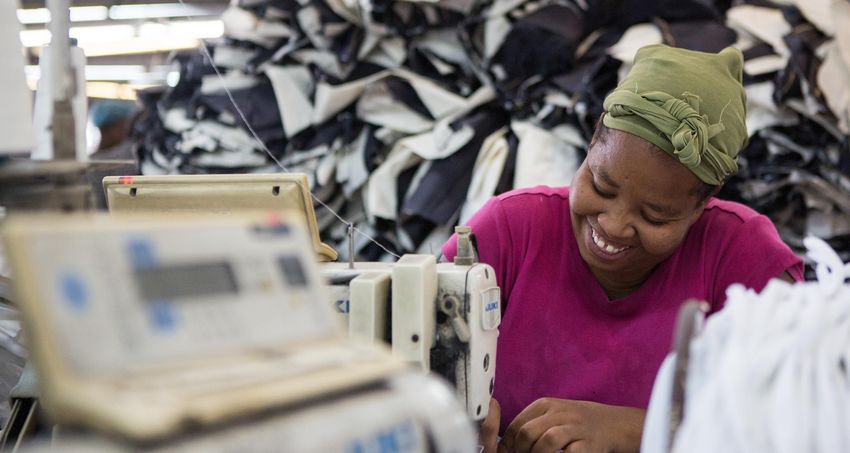
                  Vestergaard. The cover photo is courtesy of Better Work Programme.

                  DISCLAIMER
                  The writers of this report maintain a policy of not acting as representatives of the companies mentioned in
                  this report, nor do they endorse specific company policies or standards.

                  1
                      BSR and ICRW, 2016.
Women’s Empowerment in Global Value Chains: Framework for Business Action        2

                  Contents

                  Executive Summary                                         3

                  Introduction                                              7

                  Key Principles: Holistic, Integrated, and Strategic       15

                  Framework for Action: Act, Enable, and Influence          21

                  Guidance for Business: From Ambition to Action            31

                  Way Forward                                               39

                  References                                                41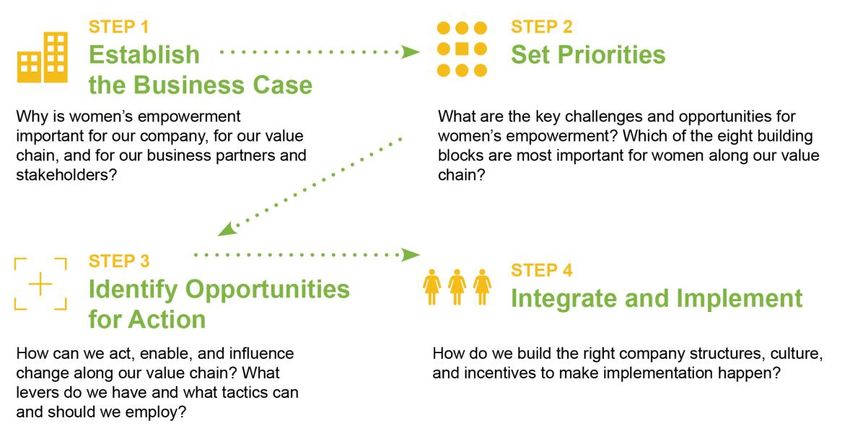
Women’s Empowerment in Global Value Chains: Framework for Business Action                                                    3

                  Executive Summary
                  In 2015, world leaders put gender equality and the empowerment of girls and women squarely at the top
                  of international and development agendas. The 17 Sustainable Development Goals (SDGs) agreed upon
                  by world leaders raised global ambition levels and added fuel to the momentum that has been building
                  over the last decade to achieve major improvements for people and planet, and not least the world’s
                  women. This is seen not only as important in its own right, but also as an essential ingredient for
                  eradicating poverty.

                  The business community has joined the chorus of government and civil society leaders calling for change.
                  More than 1,000 business leaders have signed the Women’s Empowerment Principles, committing to
                  empower women in the marketplace, workplace, and community. The UN HeforShe campaign has
                  engaged 10 male CEOs as impact champions to incubate innovation and serve as role models for gender
                  equality, and more companies across industries are setting goals on diversity, equality, and opportunity in
                  boardrooms and on factory floors.

                  The message is loud and clear: Every sector benefits when women are empowered, and every sector
                  must do its individual and collective part if there is to be any chance of a sustainable future.

                  In the first years of the new Sustainable Development agenda, there is a need to translate the ambitious
                  goals and business commitments into practical actions and tangible results. This report is intended to be
                  an inspirational and practical guide for companies to capture opportunities to promote gender equality
                  and accelerate women’s empowerment in global value chains through a holistic, integrated, and strategic
                  approach. It includes a series of case studies and practical examples showcasing how companies apply
                  the concepts and recommendations in diverse contexts.

                  Business Benefits of Investing in Women’s Empowerment
                  For most companies, their starting point for investing in women’s empowerment is a fundamental
                  commitment to gender equality. Women’s rights are human rights; not only do companies have an
                  obligation to respect those rights, but that respect also aligns with core company and individual values.

                  Gender equality and women’s empowerment are also essential to building healthy and resilient
                  businesses. Holding back half the population from achieving their full potential at work and in other
                  aspects of life does not make good business sense. When women do not have access to family planning,
                  lack proper prenatal care, or suffer from intimate partner violence, this results in lost productivity and high
                  rates of absenteeism or turnover, all of which affect companies. When laws restrict women’s access to
                  financial services, the market misses out on new entrepreneurs and companies lose out on potential new
                  consumer markets. When women face barriers to professional advancement, companies limit
                  opportunities for product and process innovation. Unequal opportunities for women can also affect
                  company reputations with employees and consumers, with consequences for efficiency and growth. This
                  report describes the three business benefits of empowering women as cost savings and productivity,
                  innovation, and market growth.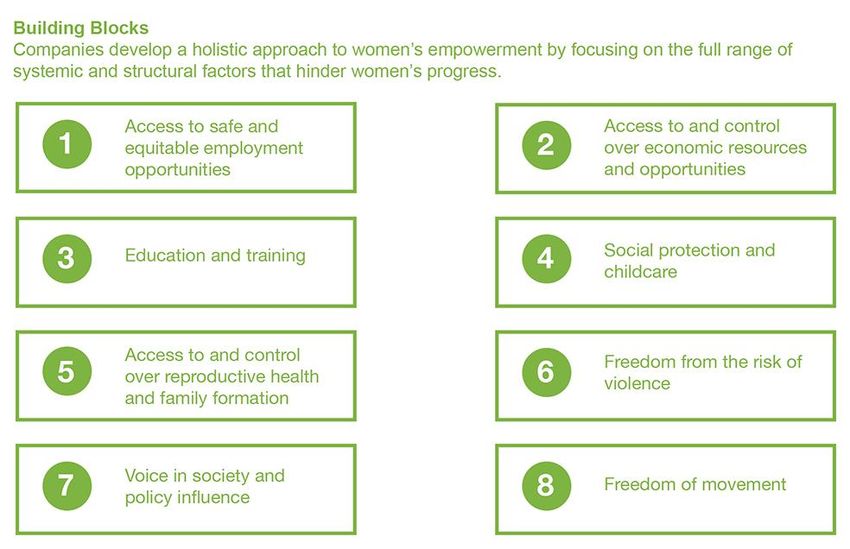
Women’s Empowerment in Global Value Chains: Framework for Business Action                                                4

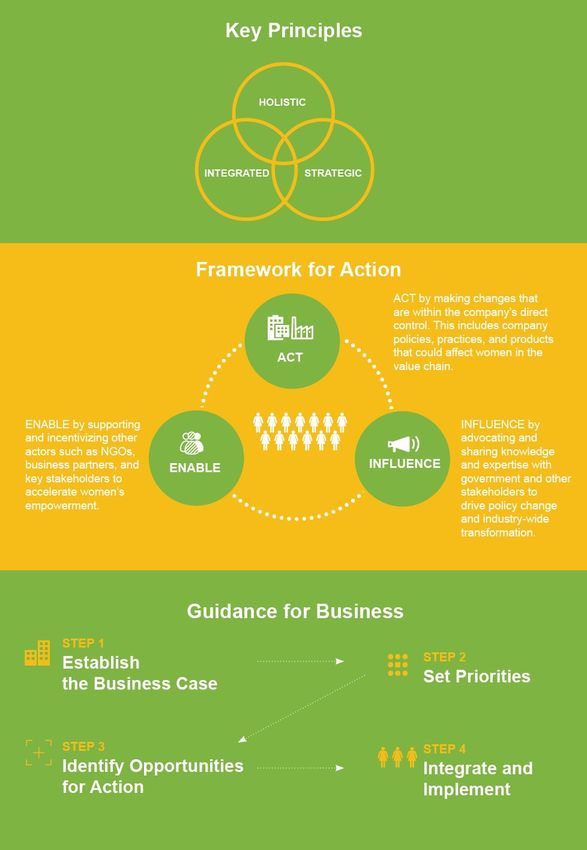
                  Key Principles
                  To be effective at both advancing the health, rights, and wellbeing of women and also generating benefits
                  for business, companies need to develop an approach grounded in three key principles: holistic,
                  integrated, and strategic.

                  » A holistic approach means that companies look at the full scope of economic, social, cultural, and
                  political factors that affect women’s access to information, opportunities, and agency. It also means
                  looking at the range of actors, including male figures, who impact women directly and indirectly through
                  their influence on community perceptions and societal expectations of women.

                  » An integrated approach requires embedding gender considerations throughout company functions,
                  processes, policies, values, and relationships across the company value chain. It also means that
                  opportunities for women’s empowerment are not housed in isolated silos of different departments. Rather,
                  they are considered in different decisions along the value chain, prioritized by company leadership, and
                  reiterated in company values and mission statements.

                  » A strategic approach takes into account feasibility, business drivers, and long-term investment, as well
                  as a company’s own competitive advantages based on its expertise, resources, tools, and networks. It
                  seeks to prioritize issues that, from the company’s perspective, have the greatest potential to improve
                  opportunities for women to contribute to the value chain. A strategic approach also recognizes that there
                  are times when companies cannot and should not be leading efforts to advance women’s empowerment
                  on their own.

                  Framework for Action
                  Based on these key principles, there are many different ways companies can drive change. Every
                  company can take action in areas under its direct control to benefit women in its own operations and
                  throughout the value chain. They can also enable and influence other companies, partners, individuals,
                  and policymakers by incentivizing, partnering, and communicating with others in their industries and
                  supply chains—thereby influencing the broader market. This report presents a framework for action that
                  recognizes the different levers and roles companies play in gender equality and women’s empowerment:
                  act, enable, and influence.

                  » Act: Taking action within a company’s direct control is an essential starting point for promoting women’s
                  empowerment. This includes adjusting company policies, practices, and investments that impact women
                  along the value chain.

                  » Enable: Investing and partnering to enable NGOs, community organizations, and business partners to
                  promote women’s empowerment along the value chain is another component of effective business action.
                  This could include investments in women’s funds or NGOs, collaboration with other businesses to
                  advance women’s empowerment, and the creation of products and services that allow other actors to
                  support women’s health, rights, and wellbeing.

                  » Influence: Engaging in research, advocacy, and communications campaigns to build an environment
                  that promotes gender equality and opportunities for women is the third component of effective women’s
                  empowerment approaches. This can include company dialogues with policymakers on changes to health
                  and safety standards or minimum wage laws that affect women workers, as well as the use of marketing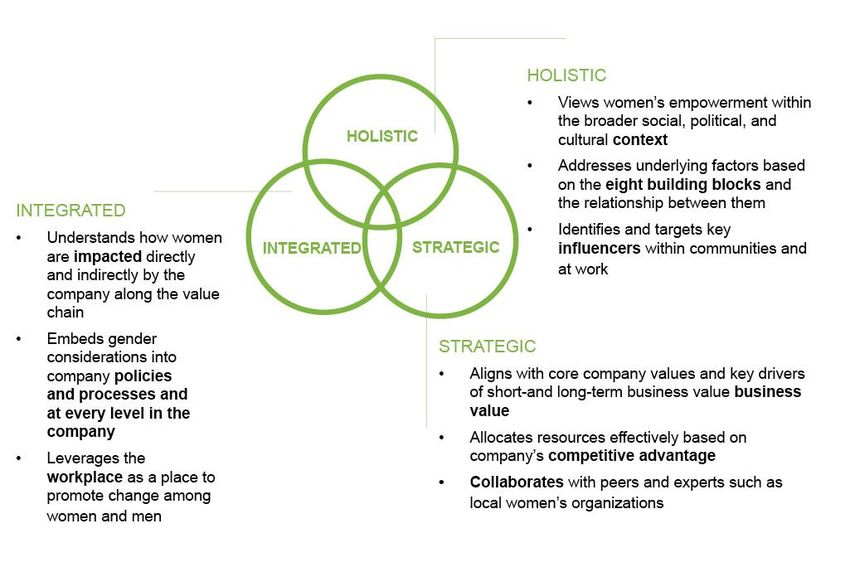
Women’s Empowerment in Global Value Chains: Framework for Business Action                                                 5

                  and engagement with customers and the general public to promote greater investment in and awareness
                  of key issues facing women.

                  Guidance for Business
                  This report aims to help translate the principles and framework for action into an effective agenda for an
                  individual company through four steps: Establish the business case, set priorities, identify opportunities
                  for action, and integrate and implement.

                  1. Establish the business case: Companies need to understand why women’s empowerment is
                     important for their mission, activities, value chains, and stakeholders. This includes understanding
                     how the company impacts women along the value chain and how women’s contributions drive
                     business value. It also includes understanding the socioeconomic context that drives business action
                     and affects women’s ability to achieve their full potential.

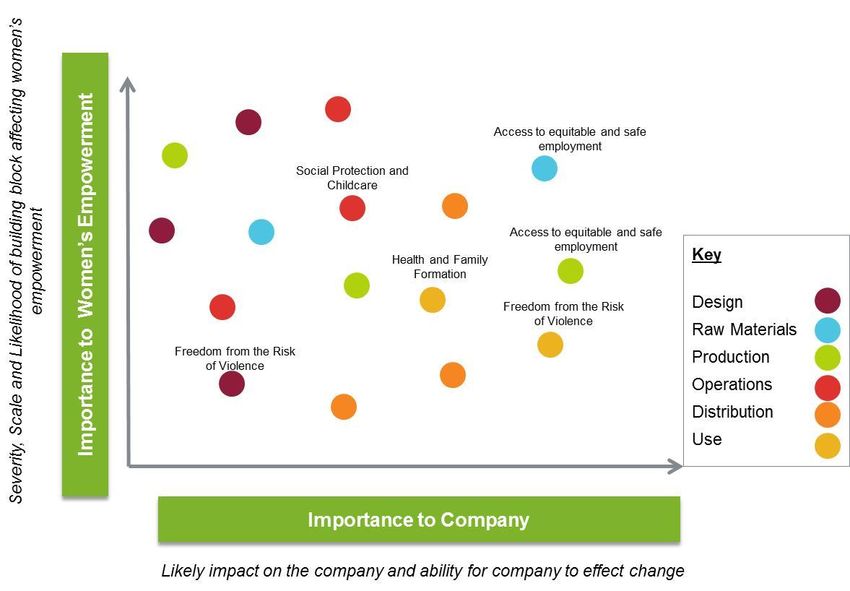
                  2. Set priorities: Companies should prioritize issues that have the greatest potential to improve
                     opportunities for women to contribute to the value chain, given the company’s sector, geographies,
                     and operations. Companies can adapt their strategic materiality analysis approach to incorporate the
                     importance and relevance to business of key women’s empowerment issues, as well as the scale,
                     severity, and likelihood of issues affecting women in the value chain.

                  3. Identify opportunities for action: Once companies have identified areas of high and low
                     importance, they can develop a strategic plan for action. This means identifying areas where the
                     company can act, enable, and/or influence.

                  4. Integrate and implement: Implementing the opportunities for action requires a supportive
                     governance structure, culture, and measurement systems within the company. This can be
                     accomplished by creating a culture of inclusion, aspirational goals, realistic targets, and clear
                     accountabilities, as well as the measurement and reporting of meaningful gender-disaggregated data
                     and outcomes.

                  These steps are not intended to be a prescriptive set of recommendations; but rather to assist companies
                  with practical guidance, best practices, sample tools, and questions to provoke dialogue and action inside
                  companies.

                  Collaboration is essential to mobilizing the resources and catalyzing the solutions needed to achieve
                  major change in our lifetime. Fortunately, more decision-makers in public and private spheres see the
                  value in bringing diverse voices and interests together. Women Deliver’s Deliver for Good campaign aims
                  to engage different sectors to promote 12 investments in girls and women that will have positive ripple
                  effects on social, political, and economic progress for all. BSR and the Dutch Ministry of Foreign Affairs
                  have launched a new collaboration to drive industry-wide change in a number of global industry supply
                  chains, and create a global company platform to support greater awareness as well as practical tools to
                  catalyze and scale action in a number of key countries.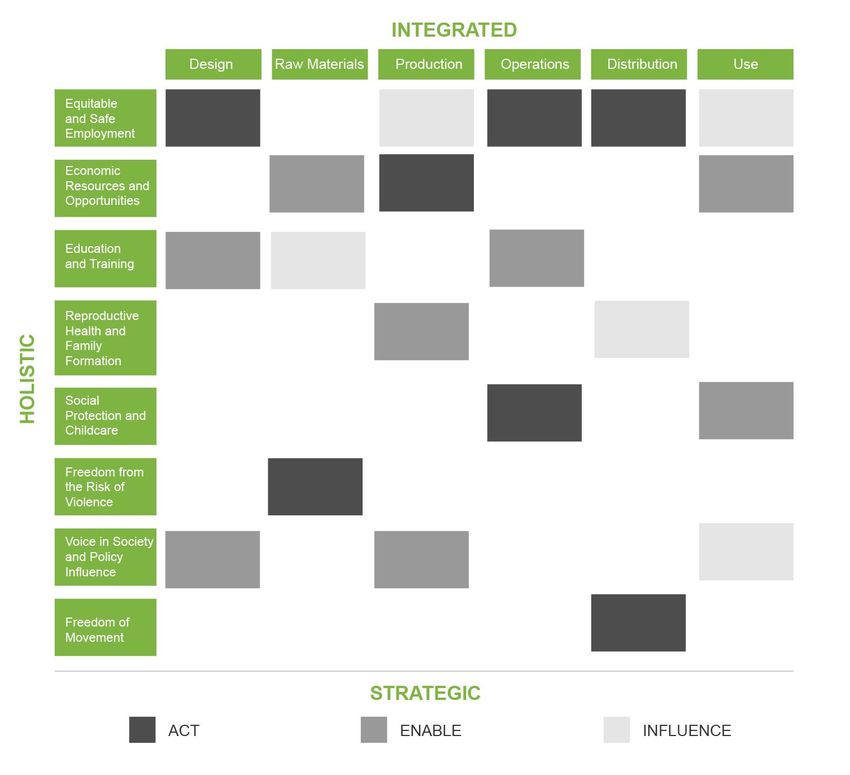
Women’s Empowerment in Global Value Chains: Framework for Business Action 6
Women’s Empowerment in Global Value Chains: Framework for Business Action                                                7

                  Introduction
                  Achieving gender equality and empowering girls and women is a global
                  health, development, and business imperative. Every country and every
                  sector benefits when women are healthy, educated, empowered, and can
                  participate fully and equally in all aspects of life. Business is no exception.

                  No company can get ahead if half of the population is left behind. If women participated in the economy
                  equally to men, it would add as much as US$28 trillion to the annual global GDP, according to the
                  McKinsey Global Institute2—equal to the combined GDP of the world’s two largest economies, the United
                  States and China. More studies demonstrate the powerful multiplier effect of women’s empowerment on
                  families, communities, and economies. Greater control over household income by women increases
                  investments in children’s health and education, with positive effects on economic growth.3

                  Research confirms that companies that are committed to gender equality outperform peers. A recent
                  study of 21,980 global, publicly traded companies in 91 countries found that having women occupy at
                  least 30 percent of leadership positions adds 6 percent to net profit margin.4 Another study by McKinsey
                  found that companies in the top quartile for gender diversity are 15 percent more likely to have financial
                  returns above their respective national industry medians.5

                  Although the business and societal benefits of promoting women’s empowerment are increasingly clear,
                  women remain far from equal at work and in many aspects of life. Women earn less, own less, and have
                  more limited access to essential products and services. They also face a range of barriers—from laws
                  that prevent them from opening bank accounts and owning property to social norms that prevent them
                  from attending school and push them into lower-paying, less secure jobs. For instance, more than 70
                  percent of women in non-agricultural jobs are engaged in informal employment in South Asia and sub-
                  Saharan Africa.6

                  Around the world, women also do a disproportionate amount of unpaid work—on average, almost two
                  and a half times as much as men.7 This causes many women to pursue part-time or informal work that
                  can be combined with these unpaid responsibilities. This work is often undervalued and overlooked by

                  2
                      Woetzel et al., 2015.
                  3
                      World Bank, 2012.
                  4
                      Noland, Moran, and Kotschwar, 2015.
                  5
                      Hunt, Layton, and Prince, 2015.
                  6
                      Vanek et al., 2014.
                  7
                      World Bank, 2012.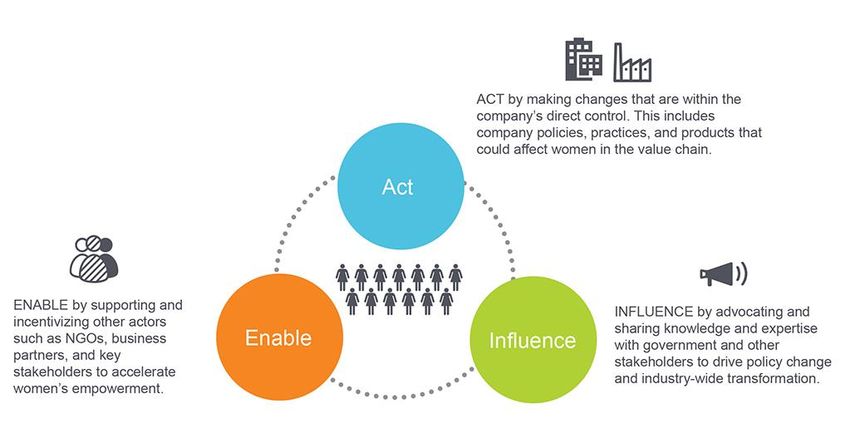
Women’s Empowerment in Global Value Chains: Framework for Business Action                                                            8

                  governments, even though it is estimated that unpaid work could contribute up to 50 percent of GDP if it
                  were assigned a monetary value.8

                  More business and government leaders recognize the urgent need to bring about major improvements for
                  the world’s women. The recently adopted Sustainable Development Goals (SDGs) raised global ambition
                  levels to achieve gender equality, and more business leaders have made bold commitments on diversity,
                  equality, and opportunity in boardrooms and on factory floors.9

                  It is now widely accepted that achieving these ambitious agendas will require more than a series of siloed
                  investments. Rather, they require a holistic, integrated, and strategic approach that focuses on the
                  underlying factors holding girls and women back—one that is embedded in the way companies do
                  business and their longer-term value systems. This approach is rooted in eight building blocks that seek
                  to drive improvements in women’s economic opportunity and equality at work, in health and wellbeing,
                  and through their voice and participation.10 This approach is also intimately tied to the way companies
                  directly and indirectly impact women across the entire value chain, from the upstream design and
                  manufacture of products and sourcing of raw materials to downstream activities including the marketing,
                  distribution, and use of products and services by the consumer.

                  Gender equality and women’s empowerment are mutually reinforcing goals. Gender equality—including
                  equal rights, responsibilities, and opportunities—is a necessary foundation for empowerment. As
                  explained by the United Nations Millennium Project Taskforce on Gender Equality, the core of

                  8
                      UN Women, 2013.
                  9
                      UN Women, HeforShe campaign.
                  10
                   These eight building blocks were developed by the International Center for Research on Women and Dalberg Global
                  Development Advisors and have been endorsed by BSR, the Dutch Foreign Ministry, and the Win-Win Coalition.
Women’s Empowerment in Global Value Chains: Framework for Business Action 9
empowerment lies in a woman’s ability to control her own destiny. This means that it is not enough for
women to have equal capabilities and access to resources; “they must also have the agency to use those
rights, capabilities, resources, and opportunities to make strategic choices and decisions.”11
Report Objectives and Structure
This report aims to help companies translate the ambitious development agenda and business
commitments into practical actions and tangible results. In particular, it provides an inspirational and
practical guide to capture opportunities to accelerate women’s empowerment in global value chains
through a holistic, integrated, and strategic approach.
It supports Women Deliver’s Deliver for Good campaign that seeks to rally multisector allies, influence the
narrative about girls and women and SDGs implementation, and fuel concrete political and practical
action at the global and country levels. (See www.DeliverforGood.org for more information about the 12
Deliver for Good investments.)
The report is divided into three core sections:
Key Principles: Business’ contribution to women’s empowerment is most effective when it is holistic,
integrated, and strategic; grounded in a solid business case; and when it recognizes business’ human
rights obligations and is embedded into corporate values. This section explains these core principles.
Framework for Action: Companies can drive change in many ways, through individual actions
focused on areas within their direct control, or by enabling and influencing actors in their value chains
and wider society. This section presents a framework for action that includes three elements: act,
enable, and influence.
Guidance for Business: Translating the principles and framework into an actionable agenda for an
individual company requires a systematic approach to prioritization and implementation. This section
outlines four steps companies can use to implement the framework.
“In Practice” examples are used throughout the report to showcase how the concepts and
recommendations have been applied in diverse company contexts. In addition, there are four longer case
studies of companies employing innovative approaches to women’s empowerment in their value chains.
Business Benefits of Investing in Women’s Empowerment
Women are present in every part of global value chains—as producers and business owners, executives
and employees, distributors, and consumers. With globalization and advances in communications
technologies, value chains have helped unlock opportunities for women around the world to participate
more fully in formal labor markets and access products and services to improve their wellbeing.
Yet the reality is that value chains have also left the journey to gender equality unfinished. Women make
up half the world’s population, but their access to education, healthcare, and opportunities are far from
equal.
11
UN Millennium Project, 2005.Women’s Empowerment in Global Value Chains: Framework for Business Action 10
Women represent a significant portion of workers in many supply chains, but they often occupy some of
the lowest-paid and most vulnerable jobs. For example, women represent around 80 percent of Vietnam’s
700,000 light manufacturing workers, but they tend to be in lower-paid positions as seamstresses and
helpers, while men are in higher-paid occupations such as cutters and mechanics. Women also tend to
work longer hours than men and are less likely to be promoted or receive training. 12 In healthcare, up to
75 percent of health workers in some countries are women, but doctors and upper management are most
often men.13
Women also make most of the household health decisions, yet they lack access to basic medicines and
high-quality sexual and reproductive health services. More than 800 women die from childbirth every day
from preventable causes including massive bleeding, high blood pressure, infections, unsafe abortions,
and complications during delivery.14 Many of the more than 225 million women who want to avoid
pregnancy are not using safe and effective family-planning methods because they lack support from
partners or communities or access to information and services.15
Long gone are the days when companies focused solely on the actions and impacts within the four walls
of their headquarters or operations. Today, companies have both a responsibility and an incentive to
address social and environmental issues along their value chains and increasingly aligning their corporate
values with social missions and sense of purpose.
For many companies a key driver for investing in women’s empowerment is the fundamental belief that
every employee, supply chain worker, and customer should be treated with respect and able to achieve
their potential. Women’s rights are human rights, and companies have an obligation to respect these in
their operations and throughout their value chains. In most cases, though, the drivers go far beyond
mitigating risks. Many companies believe that women’s empowerment is essential to fulfilling core
company and individual values.
Women’s empowerment is also a business opportunity. Empowering women in the value chain presents
an incredible opportunity not only to improve the lives of people making, selling, and buying products, but
also to ensure more stable and efficient supply chains, draw on a diverse pool of talent, and reach new
consumer segments—all of which impact financial performance and long-term business resilience. There
are three key business benefits of investing in women’s empowerment: cost savings and productivity,
innovation, and market growth.
COST SAVINGS AND PRODUCTIVITY
Women’s empowerment is essential to a well-functioning value chain. The resilience of global supply
chains is intricately linked with the status of women on farms and in factories that manufacture and
develop products. In many industries, including agriculture, healthcare, apparel, and toys, women make
up a majority of the workers.16 Yet when women’s health, wellbeing, and access to opportunities are
compromised, companies lose out on their contributions to productivity and efficiency. For example, if
female farmers had the same access as men to resources such as fertilizer and farm equipment, their
12
Fontana and Silberman, 2013.
13
WHO, 2008.
14
WHO, 2015.
15
Guttmacher Institute, 2014.
16
Pruzan-Jorgensen, 2016.Women’s Empowerment in Global Value Chains: Framework for Business Action 11
productivity could increase by 20 to 30 percent.17 This represents a significant increase in potential
income for women and positively impacts the quality and quantity of supply.
BSR’s HERproject, a workplace-based women’s empowerment program, found that investments in
improving women’s health knowledge and access to goods and services can provide a 4:1 return on
investment through cost savings from reduced absenteeism and staff turnover. 18 Similar benefits can be
seen when improving wages, benefits, and work schedules for women—particularly for working mothers
in retail operations in the United States. Women assume the majority of unpaid work and family
caregiving responsibilities, and it is difficult to juggle care for children or ill family members with erratic
schedules and low wages. This impacts the ability for women and their families to escape poverty and
directly affects worker productivity, engagement, and absenteeism.19
Investments focused on equipping women with the skills and confidence to succeed and lead offer
significant payoffs to companies. Although women make up less than 5 percent of CEOs of the Standard
& Poor’s 500, studies show that companies with female leaders tend to perform better financially. 20 The
benefits of gender diversity are not exclusive to senior-level leadership. Walmart’s Women in Factories
program in China, which offers both work and life-skills training to factory workers, has shown
improvements in communications between workers and supervisors and improvements in business
competitiveness. More than 70 percent of the 26,000 workers who participated in the training say that it
helped them solve problems in their personal lives and at work, and it helped them adapt to factory
work.21
At the same time, ignoring gender gaps and inequities can leave companies exposed to production and
delivery disruptions, bottlenecks, and inefficiencies. More studies demonstrate the economic costs of
intimate partner violence due to absenteeism and productivity. In Bangladesh, where rates of intimate
partner violence are higher than 30 percent, productivity loss costs the economy US$262 million, or 1.28
percent of the GDP.22 Women’s unequal status in many societies also means that women suffer
disproportionately from natural disasters, which could have ripple effects on companies’ sources of
supply.23 In Pakistan, 74 percent of working women 15 years and over are employed in agriculture. 24 Poor
resilience in the face of major floods in 2010 and 2011 had devastating effects on cotton production,
causing prices for cotton to rise sharply. 25
17
FAO, 2011.
18
Chowdhury, Wofford, and Dupont, 2007.
19
Traub, 2014.
20
Fairchild, 2014.
21
BSR, 2015.
22
Meiers, 2013.
23
Girl Effect Team, 2015.
24
World Bank data portal.
25
Thorpe and Fennel, 2012.Women’s Empowerment in Global Value Chains: Framework for Business Action 12
IN PRACTICE BUSINESS BENEFIT: COST SAVINGS AND PRODUCTIVITY
Gap Inc.
Gap Inc. initiated the P.A.C.E. (Personal Advancement & Career Enhancement) workplace education program
to teach women managerial, interpersonal, and other practical skills needed to advance at work and in
society. The program is a natural fit for a company where women make up 74 percent of its employees and 70
percent of its senior leadership team. In addition to creating a workforce with more skills, P.A.C.E. improves
the productivity and performance of the company’s suppliers and reinforces the company’s values and
purpose with employees.26 A study of the program by the International Center for Research on Women found
greater work efficacy among participants, such as the ability to take initiative and demonstrate their abilities,
as well as greater influence in the workplace through stronger relationships, effective communication, and
other skills. Supplier research on how P.A.C.E. impacts their business found lower absenteeism, increased
efficiency, and higher productivity. In Cambodia, for example, retention rates were 66 percent higher for
P.A.C.E. participants than other workers. At a factory in India, productivity was 15 percent higher for P.A.C.E.
participants.27 W
INNOVATION
Women’s empowerment also goes hand-in-hand with the diversity and inclusion that are essential for
business product and process innovation. When women can speak freely and openly in all contexts, they
bring forward new ideas and contribute to problem-solving, especially when faced with diverse
stakeholder needs. This finding is supported by studies that show gender-diverse boards improve
financial performance for organizations where innovation and creativity are critically important. 28
Innovation is not only the result of diverse teams, but also the best talent. When women workers or
business owners are consistently placed at a disadvantage for opportunities, companies narrow the talent
pool. With many industries facing talent shortages, addressing the needs and barriers facing women
along companies’ value chains will be a key differentiator in the marketplace. Although women now make
up the majority of university graduates, it is getting more difficult to attract and retain women in certain
professions. This is due to a range of reasons, including limited parental leave policies, concerns about
health and safety, lack of mentorship, and actual and perceived barriers to advancement. 29 Women leave
the tech industry at double the rate of men, and more than half leave before they reach mid-level
management.30 It does not come as much of a surprise that the proportion of women in technical roles
has stubbornly remained at 21 percent for the past five years.31
26
Gap Inc., 2016.
27
Nanda, 2013.
28
Chen, Leung, and Evans, 2015.
29
World Bank, 2012.
30
Gammal and Simard, 2015.
31
Leahy, 2015.Women’s Empowerment in Global Value Chains: Framework for Business Action 13
While the links between women’s empowerment and innovation are traditionally considered in relation to
direct employees at all levels in a company, there is growing evidence that greater engagement of female
business owners is essential for innovation. Promoting opportunities for women to create and grow
businesses supports supplier diversification and enables companies to tap the “best in class” suppliers.
This is particularly true in the case of small and medium enterprises (SMEs), 10 million of which have full
or partial female ownership, representing more than 30 percent of registered SMEs in emerging
markets.32 These companies tend to be more agile and may operate in niche markets, allowing them to
deliver a service that cannot be matched by large providers.33
MARKET GROWTH
Investing in women also unlocks new market opportunities by increasing access to goods and services
for women at different ends of the income spectrum. Women create and control an increasing share of
wealth in many parts of the world, making them an important investor group and powerful consumer
demographic. Globally, it is estimated that women already control more than US$20 trillion in spending
and make upwards of 80 percent of household purchasing decisions worldwide. 34
At the same time, there are many missed opportunities to expand markets for essential goods and
services for low-income women. Women have only 84 percent of the access of men to the internet and
mobile phones.35 Reducing the gender digital divide by connecting another 600 million women to the
internet could unlock a market opportunity of between US$50 billion and US$70 billion in new sales of
platforms and data plans. It could also contribute an estimated US$13 billion to US$18 billion annually to
developing countries’ GDPs.36
Women are also a large and growing market for financial products and services. Women own more than
30 percent of registered businesses worldwide,37 but only 47 percent of women have an account at a
formal financial institution, compared with 55 percent of men.38 In emerging markets, women-owned
SMEs have unmet financial needs of an estimated US$300 billion every year.39 Access to financial
services such as credit, savings, and insurance are considered one of the major barriers to growth for
women-owned businesses.40 A lack of financial education, as well as laws that restrict women from
opening a bank account, such as requirements for a male family member’s permission, all play a role.41
Capturing these opportunities will require understanding the needs of women and addressing critical
barriers to access, such as unsupportive laws and policies. Studies show that women report a lack of
products and services that meet their needs, as well as marketing and communications that patronize
rather than inspire confidence.42 A Boston Consulting Group survey of 12,000 women in 21 countries
32
IFC and Global Partnership for Financial Inclusion, 2011.
33
Sodexo Supplier Inclusion Program.
34
Silverstein and Sayre, 2009.
35
Woetzel et al., 2015.
36
Intel Corporation, Dalberg Global Development Advisors, and World Pulse, 2012.
37
World Bank, 2014.
38
World Bank, 2015.
39
International Finance Corporation, 2013.
40
World Bank, 2014.
41
Ibid.
42
Silverstein and Sayre, 2009.Women’s Empowerment in Global Value Chains: Framework for Business Action 14
found that 73 percent of women were dissatisfied by financial services and 71 percent were dissatisfied
with their financial provider’s product offering. In insurance, those figures were 75 percent and 74 percent,
respectively.43 Many of these women felt that gender was a key factor contributing to the way they were
treated.
Companies that are best positioned to capture these opportunities have workforces that are more
reflective of and responsive to their customer base. 44 They engage women in the design, development,
and sale of products and services so that they are “by women, for women.” They consider gender in
product design, and see gender-sensitive sales, marketing, and distribution as drivers for customer
loyalty, brand reputation, and growth.
IN PRACTICE BUSINESS BENEFIT: MARKET GROWTH
Vodafone
Around 300 million fewer women than men own a mobile phone.45 Vodafone estimates that 91 million of these
women live in markets where the company operates, which represents a substantial unfulfilled market, a
window for business, and incredible potential to improve the lives of women, their children, and communities.
To capture this opportunity, the company is using its mobile technology and services to help connect women
to education and skills training, job opportunities, and health services. In 2013, Vodafone Turkey launched the
Vodafone Women First program, which helps women use mobile technology, access information, acquire new
skills, and increase their incomes. The Women First Advertisement Service, a key part of the program,
enables women with little experience with mobile technology to sell their handicrafts on one of Turkey’s
biggest online marketplaces. The service also provides promotional offers and information services on topics
such as child health and wellbeing. In its first nine months, the program attracted 75,000 women customers,
15 percent of whom were new customers for Vodafone.46
43
Silverstein, Kato, and Tischhauer, 2009.
44
Pax World Investments, 2016.
45
Vital Wave Consulting, GSMA Fund, and the Cherie Blair Foundation, 2013.
46
Vodafone, 2014.Women’s Empowerment in Global Value Chains: Framework for Business Action 15
Key Principles: Holistic, Integrated, and
Strategic
Tapping the full potential of value chains to advance the health, rights, and
wellbeing of women—and to drive business benefits—requires a holistic,
integrated, and strategic approach. This means understanding the
underlying systemic factors that serve as barriers to gender equality and
women’s empowerment along the value chain and aligning the approach
closely to a company’s own value drivers and capabilities.
This is not about companies addressing every dimension of women’s empowerment in every part of the
value chain. However, the fact is that many well-intentioned efforts to advance women’s empowerment
fail to acknowledge the broader context that women live in, and how every part of their business affects
women. This can lead companies to miss opportunities or risks that can impact successful interventions.
In this section, we describe the three principles of holistic, integrated, and strategic in more detail. The
graphic below provides a snapshot of these principles and recommendations for applying them to
promote women’s empowerment in global value chains.Women’s Empowerment in Global Value Chains: Framework for Business Action 16
Holistic
Women in the workplace face complex challenges that cannot be addressed by one set of solutions.
Rather, they require attention to a range of economic, social, and political factors that affect women’s
access to information, opportunities, and agency. A holistic approach understands all of the building
blocks and how they interact to strengthen women’s empowerment. For example, lower-skilled work in
garment factories has offered a route out of poverty for many women, but many women face new
challenges, such as increased risks of violence and harassment from superiors or male family members
who feel threatened by their independence. 47 Similarly, lack of access to women’s reproductive
healthcare and contraception may not only be the result of physical barriers to access, but also due to
limited awareness and education alongside policies or practices that restrict women’s access to family
planning.48 This affects a woman’s ability to achieve her potential at work due to increased absenteeism
and childcare demands, among other factors that affect productivity and retention.
For companies to advance women’s empowerment along the value chain, they must develop and
respond to a more holistic picture of the barriers to and opportunities for women’s progress at every level
of the company. Without doing so, companies could find that investments in strengthening women’s skills,
for example, achieve limited success if they are not coupled with efforts to remove restrictions on
women’s ability to own property or access critical inputs like fertilizer. Companies may find that their
efforts to provide a platform for women to express their views and shape debate could easily be
undermined by women’s increased risk of violence, harassment, or abuse. Companies could find that
their commitments to integrate more women into the supply chain will never produce results if women lack
basic education and access to health services.
Holistic also means looking at the full scope of actors influencing women’s empowerment. It is about
understanding how important support from male figures, such as fathers and husbands, is to women’s
ability to attend school or go to work freely. It is also about understanding how community perceptions
shape women’s sense of self-worth and interest in or fears about working outside the home. It is also
about understanding how the time and effort of fetching water and wood or caring for children and ill
relatives impacts women at work. It is also about looking at ways in which women cultivate leadership, a
sense of agency, and decision-making skills earlier in life through activities such as girls’ participation in
sports and community programs. A holistic approach demands a conscious effort to understand and
address the norms, behaviors, and laws that help or hinder women’s empowerment.
47
Fair Wear Foundation, 2016.
48
United Nations Population Fund, 2016.Women’s Empowerment in Global Value Chains: Framework for Business Action 17
CASE STUDY
Vestergaard: Value Chain Innovations for Healthier and Empowered Women
Vestergaard is a family-owned global health company dedicated to providing innovative solutions that
contribute to a healthier, more sustainable planet. Vestergaard’s model is based on the conviction that doing
good is good business. Accordingly, the company devotes its entire innovation platform to producing
breakthrough products and solutions that improve the lives of vulnerable people, most of whom live in
developing countries.
For more than two decades, the company has helped more than 1 billion people through a focus on health
products like PermaNet® long-lasting insecticidal bed nets that prevent malaria, and LifeStraw® water filters
that prevent waterborne diseases by converting contaminated water into clean, safe drinking water. The
company has just launched a new food-security business, using its expertise in vector control to develop
products that improve livestock productivity and reduce post-harvest loss.
The company considers gender dynamics and women’s empowerment in all of its work, in light of the
important role women play in family health decisions and the multiplier effect that improved opportunities for
women have on family wellbeing and sustainable development. What follows are three ways Vestergaard is
translating the principles into action:
Holistic: Vestergaard learned early on that safe drinking water is not just an end in itself, but also a means to
improve health, wellbeing, and economic opportunities. Access to safe water helps prevent diarrhea and other
water-related diseases, enabling women to participate more fully in economic activity. It also has indirect
effects, enabling girls to attend school by reducing the amount of time they spend fetching water or taking care
of sick family members. Clean water is also essential for protecting maternal and newborn health and, in turn,
supporting future generations. The company has learned that the provision of its CarePack ® of health
interventions, including a LifeStraw® Family water purifier and a PermaNet® bed net, distributed through
maternal health clinics, not only helps reduce under-5 child mortality and maternal mortality, it serves as an
incentive for mothers to attend prenatal care and deliver in health facilities. More than one in 10 deaths among
children under 5—around 1 million deaths every year—is due to diarrhea. Mothers and children are at high
risk, particularly in the first days after childbirth. Taking a holistic approach that addresses the interconnected
and systemic nature of challenges facing women helps the company develop effective solutions.
Integrated: Engaging women at every stage of the value chain is an important part of ensuring that products
and their delivery methods meet the needs of women as end-users and translate health interventions into
health impact. This means seeking women’s leadership in overall business strategy, concept development,
product design, manufacturing, program design, and program implementation. For example, women play an
important role in managing safe water and sanitation programs in schools in Kenya. Vestergaard is also
tapping socially conscious consumers, many of whom are women, to help finance the provision of clean water
products in developing countries. Gender dynamics and women’s empowerment are integrated in how the
company makes decisions at every stage of the value chain.
Strategic: Women make up a significant portion of the world’s poor, so improving women’s wellbeing helps
Vestergaard fulfill its mission as a purpose-driven company. The company is currently undergoing a strategy-
development process to align its business objectives with the SDGs. This allows Vestergaard to accelerate
successful programs and identify other areas of opportunity, including advancing environmental sustainability.
This process of prioritization helps the company align its areas of expertise around health, water, and food-
security innovations; product development; and program implementation with national and global development
agendas.
Source: Vestergaard, http://www.vestergaard.com/. CarePack® for Maternal and Infant Health,
http://www.vestergaard.com/component/zoo/item/maternal-health. Interview with Vestergaard CEO Mikkel Vestergaard and
Alison Hill, Managing Director of Vestergaard’s water business.Women’s Empowerment in Global Value Chains: Framework for Business Action 18
Integrated
An effective approach also requires embedding gender considerations throughout company functions,
processes, corporate values, and relationships across the value chain. This means, for example, ensuring
women’s empowerment is a part of procurement and sourcing decisions, R&D protocols, brand
strategies, and contracts with new distribution partners. It requires companies to incorporate women’s
empowerment into community investment decisions as well as its own policies and practices to advance
women’s empowerment along the value chain.
Integration also means that the opportunities for women’s empowerment are not just viewed in isolated
silos of different departments, but considered in different decisions along the value chain. This could
include how downstream decisions on distribution and sales affect women in production, or how women’s
participation in R&D affects female consumers. For example, including women in clinical trials ensures
that any harmful effects of medicine on women are taken into account during development stages.
Developing products and services tailored to women’s needs demands more than simply labeling
products specifically for women. It requires training retail staff to be sensitive to women’s needs, or even
redesigning retail outlets so that women feel safe and comfortable accessing products and services. Such
an approach that would look at expanding access to products for women can also create new economic
opportunities for women entrepreneurs in retail channels.
Such an approach also acknowledges that workplaces present opportunities to establish new approaches
to advance women’s empowerment. As protected environments, workplaces can help shift norms and
behaviors, enable mentorship, provide education and economic opportunities, and strengthen
relationships with stakeholders. They can help break down barriers for women to participate more fully in
work and bring these lessons home to children and their communities.
IN PRACTICE KEY PRINCIPLES
Unilever
By 2020, Unilever aims to empower 5 million women by strengthening women’s rights, skills, and
opportunities across the value chain. To achieve this goal, the company stresses the importance of integrating
women’s economic empowerment throughout its brands. With women representing more than 70 percent of
its customers, Unilever’s brands can help drive and amplify company messages and develop solutions based
on the needs and issues relevant to their respective value chains and consumer segments. 49 Unilever’s
Sunlight brand is partnering with Oxfam and TechnoServe to develop Water Centers run by women
entrepreneurs in Nigeria, which provide communities in rural villages with a sustainable supply of clean water
for domestic tasks. This frees up women’s time to focus on things other than collecting water. Unilever’s Dove
brand created the Dove Self-Esteem project more than 10 years ago to challenge beauty stereotypes and
help women view beauty as a source of confidence, not anxiety. Since 2004, Dove has engaged women in a
discussion about beauty, employed various communications vehicles, including school workshops, to
challenge beauty stereotypes, and created self-esteem-building educational programs.50 Critically important to
the brands’ success is that gender diversity inside Unilever reflects its diverse consumer profile. The company
is on its way to achieving 50-50 gender balance throughout the company by 2020.51
49
BSR interview with senior manager at Unilever.
50
Unilever, 2015.
51
UN Women, 2016.Women’s Empowerment in Global Value Chains: Framework for Business Action 19
Strategic
Companies also must prioritize investments and activities. An effective approach takes into account
feasibility, the business drivers highlighted above, and a company’s own competitive advantages based
on its expertise, resources, tools, and networks. This is why a company that wants to strengthen supply-
chain resilience will prioritize its investment in geographies or with suppliers where it can have the
greatest impact on both the business and women.
This may also require a long-term view on investment returns. For example, this could mean investments
that strengthen the basic infrastructure or health system so that women can access resources for
generations to come. Other investments that focus on improving education and other opportunities for
children, particularly girls, also have a longer-term investment horizon but could lead to significant payoffs
for companies in terms of building a skilled talent pool.
A strategic approach also recognizes that there are some cases in which companies cannot and should
not be leading efforts to advance women’s empowerment on their own. Just as companies talk about the
problems they can solve, they should acknowledge what they cannot do and the limits they face in certain
contexts. For example, there are times where companies will provide more benefits by scaling up and
commercializing existing solutions rather than developing new solutions themselves. In some cases,
communities will be more receptive to health information received from peers than from companies or
health institutions. A key ingredient to building a strategic approach is determining the role a company
should take in advancing its priorities; sometimes it is more effective to enable or influence others to act.Women’s Empowerment in Global Value Chains: Framework for Business Action 20
CASE STUDY
KappAhl: Expanding Opportunities for Low-Income Women in Bangladesh
Bangladesh is one of the most important sourcing countries for KappAhl, a Swedish fashion company with
more than 400 stores in Europe. The company has worked for many years to implement and enforce a
supply chain code of conduct to improve working conditions for thousands of workers, the majority of whom
are women. However, for the company to create a truly resilient supply chain, it needs to address the wider
societal challenges women face in Bangladesh. For many poor households in the country, the birth of a girl
is considered a misfortune, and throughout their lives, girls are given less food and schooling and have
limited voice in decisions that affect them. This impacts their wellbeing and impedes their ability to pursue
formal wage employment.
In 2012, KappAhl worked in partnership with TCM, a local development NGO, to open a training center in
the township of Tongi to provide economic opportunities in global value chains for poor women in the
community. The program selects women ages 18 to 25 from poor households to participate in a three-month
training program that includes basic education, including writing, reading, and arithmetic, as well as
technical skills such as sewing. They also gain knowledge on health and nutrition and access to medical
treatment. The women are paid during the program and are guaranteed a job at one of KappAhl’s suppliers.
The program has trained 500 women, who have gone on to work in factories, many of whom are earning a
living for the first time and gaining independence. Some of the women have also been promoted. One of the
unexpected benefits has been the creation of a social network for women to support each other both inside
and outside of work.
One key ingredient to the program’s success has been the engagement of family members and
communities. Many fathers and husbands did not want female household members to work outside the
home. This belief stemmed from both cultural norms as well as fears about safety traveling to the training
center and factory. In addition, communities expressed concern about working in garment factories after the
Rana Plaza factory collapse in 2013. To address this, the NGO created culturally sensitive awareness
campaigns in communities and visited families in person to build trust. This in-person engagement proved
important to gaining the support of family members.
The program has helped strengthen the pipeline for talent in the supply chain, especially as the company
expects to do more business in Bangladesh. It has also strengthened relationships with a key supplier at a
time when the company is focused on building more meaningful relationships with a smaller number of
suppliers. As an added benefit, the program has helped the company communicate to its employees and
customers about what it stands for and how it fulfills its values.
Source: KappAhl Sustainability Report. http://www.kappahl.com/en-US/about-kappahl/sustainability/social-
responsibility/for-the-women/. Interview with Eva Kindgren de Boer, Sustainability Manager, KappAhl.Women’s Empowerment in Global Value Chains: Framework for Business Action 21
Framework for Action: Act, Enable, and
Influence
Just as there is no single solution to women’s empowerment, there is no
single strategy that all companies can employ. However, every company
can act in areas where it has direct control to benefit women in its own
operations and throughout the value chain. They can also enable and
influence others to drive change by incentivizing, partnering, and
communicating with others.
The following framework for action includes three ways companies can drive change; it builds on an
approach to corporate leadership on women’s economic empowerment developed by the Harvard
Kennedy School and the U.S. Chamber of Commerce Foundation.52 We modified the approach to
highlight how business action is predicated on their spheres of influence and control. This is particularly
important considering the complex nature of global value chains, which are made up of thousands of
partners and stakeholders upstream and downstream spread across dozens or hundreds of countries. 53
Put simply, companies can act, enable, and influence. This framework recognizes that companies have
different levers for change, and a holistic, integrated, and strategic approach depends upon partnerships
with a wide range of actors.
52
Harvard Kennedy School and the U.S. Chamber of Commerce Foundation, 2015.
53
The approach developed by Harvard and the U.S. Chamber of Commerce used “engage” rather than “act” to refer to direct
engagement with women.Women’s Empowerment in Global Value Chains: Framework for Business Action 22
CASE STUDY
Royal Dutch Philips: Improving Women’s Health in Africa
Philips has been operating in Africa for more than 100 years. Its history provides unique insight on the
complexities of working in diverse healthcare environments and the pressing needs facing women. The
company recognizes that women’s health and wellbeing are essential to ensure families and communities
thrive and Philips succeeds in the region.
In 2013, Philips decided to bolster its investment in addressing noncommunicable diseases and maternal
health in Africa through a focus on transforming the quality of care. To do so, the company reflected on its key
competitive advantages, including its expertise as a health technology company, its approach to partnership,
and its relationships with key stakeholders. Philips built a strategy around three key priorities: transforming the
healthcare infrastructure, developing innovative technology solutions, and building and sustaining human
capacity. The approach is people-centric, which is in contrast to how healthcare systems have been
traditionally designed, with a focus on hospitals and doctors, largely men. Philips is applying each aspect of
the Act-Enable-Influence framework to help improve the health and wellbeing of 500 million women in Africa.
Act: The company is helping make access to basic healthcare more affordable and accessible through its
own activities. In 2014, it developed the Community Life Center in Kenya, an integrated solution for primary
healthcare and community development. Applying the company’s health and lighting expertise, the center
provides access to healthcare with a focus on maternal and infant health, while enabling social, educational,
and commercial activities after dusk and improving the safety and security of the neighborhood. At the center,
community members can buy clean water and sustainable products like Philips’ smokeless cook stoves and
home solar lighting products, while also benefiting from Philips solar-powered LED outdoor lighting. Philips
trains staff and tailors the design to the needs of the community. Philips is also developing new products for
resource-constrained settings, including a digital colposcope, a hand-held ultrasound to allow prenatal care in
rural communities, and a cervical cancer screening procedure using reliable video and imaging processing to
make screening easier for less-experienced clinicians to use and interpret clinical findings.
Enable: Philips Foundation is working with UNICEF, local organizations and the Kenyan government on the
Maternal and Newborn Health Innovations Project. The project aims to catalyze and scale up innovative, low-
cost, and locally designed healthcare devices for women, newborns, and children in places with limited
medical resources. The project is financed by the foundation and uses the local expertise of Philips Research
Africa to mentor social entrepreneurs and facilitate the transfer of healthcare technology know-how. Philips
also identifies a select number of promising interventions and helps commercialize them. One example is an
automated respiratory monitor, created to support the diagnosis of pneumonia in children under 5. The
foundation is also working in the Ivory Coast with the Netherlands Red Cross, the Ivory Coast Red Cross, and
the local Ministry of Health. The project is focusing on innovation in community resilience, using the expertise
of the Philips African Innovation Hub and Philips Design. The project aims to improve mother and child
healthcare locally through better-equipped health facilities that are more frequently used. In the longer term,
the program aims to strengthen community resilience in the Bloléquin region.
Influence: The company is also advancing research into women’s needs to help Philips develop innovative
solutions tailored to local needs and contribute to building the evidence base for key barriers to progress and
solutions. Most recently, Philips Africa Innovation Hub, supported by research agency Dr. Monk, conducted an
investigation of the barriers to breastfeeding that urban mothers in Africa face when they return to work,
including limited early initiation of breastfeeding, unsupportive work environments, limited access to breast
milk expression facilities and storage, and cultural norms. From these insights, Philips and partners are able to
develop innovations to enable mothers to continue breastfeeding.
Source: Philips Fabric of Africa, www.philips.com/a-w/about/sustainability/healthy-people/supporting-communities/fabric-of-
africa/mission/philips-views.html; Interview with Jan-Willem Scheijgrond, Head of International Partnerships, Philips.You can also read


