Year 7 into 8 Course Handbook - Notre Dame College
←
→
Page content transcription
If your browser does not render page correctly, please read the page content below
2021Year 7 into 8
Course Handbook

Welcome
Contents

           Contacts 3                                Introduction
                                                     Notre Dame College aims to instil a love of lifelong
           General Information 4                     learning in each of our students and also equip them
                                                     to be good citizens in a rapidly changing world.
           Year 8 Structure 5                        Students in Year 8 will continue to experience a range
                                                     of subjects from each of the Learning Areas, building
           Core Subjects 6                           on from the Year 7 programme.
           Religious Education                       Students will undertake 8 core subjects as well as have
           English                                   the opportunity to select subjects of their own choice
           Mathematics                               from the Arts and Technologies Learning Areas.
           Science                                   Project-Based Learning (PBL) is the educational
           Health and Physical Education             approach in which students gain knowledge and skills
           Humanities                                by working for an extended period of time to investigate
           Italian or Japanese                       and respond to complex questions, problems, or
           Project Based Learning                    challenge. Students will engage in rigorous projects
                                                     related to the themes of Science, Technology, Engineering
           Elective Subjects 9                       and Maths (STEM) and Humanities and Social Science
           Digital Technologies                      (HASS).
           Drama                                     This handbook provides a guide to the Year 8
           Food                                      Programme at Notre Dame College. If you have any
           Media                                     difficulty using this guide, or have any questions,
           Metal                                     please contact the staff listed throughout the subject
           Music                                     handbook. Best wishes for a successful year at Notre
           Systems                                   Dame College.
           Textiles
           Visual
           Wood

                John Cortese                  Kristine Walker                         Susan Nabbs
                  Principal                  Deputy Principal                          Director of
                                           Learning and Teaching                  Learning and Teaching
Contacts
Contacts
Learning Area Contacts Other Contacts
English Deputy Principal Learning and Teaching
Han Slosarski Kristine Walker
han.slosarski@notredame.vic.edu.au kristine.walker@notredame.vic.edu.au
Health and Physical Education Director of Learning and Teaching
John Malloy Susan Nabbs
john.malloy@notredame.vic.edu.au susan.nabbs@notredame.vic.edu.au
Languages Learning Enrichment
Alexandra Cormican Kathryn Sait (Years 7 - 9)
alexandra.cormican@notredame.vic.edu.au kathryn.sait@notredame.vic.edu.au
Mathematics
Lena Cross
lena.cross@notredame.vic.edu.au Junior Heads Of House
Cr
Project Based Learning Crane
Myra Hardy Leanne Lemon
myra.hardy@notredame.vic.edu.au leanne.lemon@notredame.vic.edu.au
Je
Religious Education Jennings
Nathan Carroll Wendy Watt
nathan.carroll@notredame.vic.edu.au wendy.watt@notredame.vic.edu.au
Ke
Science Kennedy
Sarah McKinnon Jacqui Hudgson
sarah.mckinnon@notredame.vic.edu.au jacqui.hudgson@notredame.vic.edu.au
Mc
Technology McGann
Terry Cormican Josie Hamilton
terry.cormican@notredame.vic.edu.au josie.hamilton@notredame.vic.edu.au
Ma
The Arts MacKillop
Casey Fogarty Tim Davis
casey.fogarty@notredame.vic.edu.au tim.davis@notredame.vic.edu.au
Mu
The Humanities
Chris Segrave Mungovan
chris.segrave@notredame.vic.edu.au Colin Finn
colin.finn@notredame.vic.edu.auGeneral
General Information
Information
Subject Selections Online
Subject selections are to be made online by
students using Web Preferences. Students should
ensure they complete their subject selections by
the due date to have the best chance of being
allocated to subjects of their choice.
Course Restrictions
The availability of any subject is dependent upon
sufficient numbers of students wishing to undertake
that subject. Some subjects also have limits on class
size.
Re-enrolment
If students are unsure about returning to Notre
Dame College, we would ask them to please complete
the subject selection process online just in case
they do return.
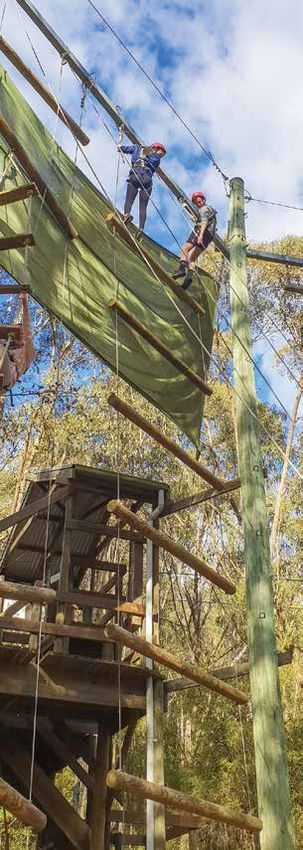
Year 8 Camp
The year 8 camp is a three day/two night outdoor
education experience that aims to develop our
students’ resilience, persistence and teamwork. It
also prepares students for the Outdoor Learning
Programme in Year 9. Students complete activities
such as hiking, bush cooking, abseiling, climbing
and flying fox.Year 8
Year 8 Programme Structure
Programme
Core Subjects
All Year 8 students undertake the following core
Structure
subjects:
• Religious Education
• English
• Mathematics
• Health and Physical Education
• Humanities
• Languages (Italian Or Japanese)
• Project Based Learning (STEM and HASS)
• Science
Elective Subjects
Year 8 students also complete two electives each
semester. This is a total of four electives for the year
- two from each of the following:
• The Arts
• Technologies
Lessons Per Fortnight
Each elective runs for 6 lessons per fortnight cycle
and for six months in duration. Students are not
permitted to select or study the same elective
twice.
LEARNING AREA LESSONS PER FORTNIGHT CYCLE
Religious Education 4
English 9
Mathematics 8
Science 6
PBL – STEM/HASS 4
Health and Physical Education 6
Humanities 5
Languages – Italian or Japanese 5
Arts – two electives 6
Technology – two electives 6
Pastoral Care Period 1All Core Subjects are year length and studied by all students
Year 8 Core Subjects
Religious Education Students begin deepening their understanding of Jesus and themselves. We
look at Jesus in two ways. Firstly, as the historical figure, examining his cultural
SUBJECT CODE
08RED history, the Roman occupation of Judea and provide students with a context for
Jesus’ birth, life, death and resurrection. Then we look at Jesus as the Christ –
the Messiah, His divinity and how He is alive today, calling us into an encounter
with Him. We look at Jesus’ parables of the Kingdom, particularly the Sower and
the Seed and the Wheat and the Tares. Then the most central Christian premise
- the resurrection, and how this can make a difference in both this life and the
next. By looking at what the cross of Christ calls us to, students are invited to see
that they are part of a much bigger story, helping “His kingdom come on Earth
as it is in Heaven”. Students will also question their own desires and motivations,
asking themselves, “What is a good life?” and “Where are the choices I’m
making now taking me?”
English English is at the core of the curriculum because it enables students to become
effective communicators in an increasingly connected world. Developing from
SUBJECT CODE
08ENG the foundations of Year 7, students will engage deeply with their studied texts,
honing their ability to write analytically, comparatively, persuasively and
creatively. In addition to written assessments they will also deliver oral presentations,
actively enhancing their communication skills. Students will engage with a
variety of fictional text types, including: a novel, a film and a selection of poetry.
They will develop the critical skills of textual interpretation alongside those of
understanding persuasion in the media. Building on their study of how language
is used in different contexts, for different purposes, they will also develop the
ability to write creatively in response to a studied text.
Mathematics The Year 8 Mathematics course focusses on the development of mathematical skills
for each individual student. Students have the ability to fill gaps in their background
SUBJECT CODE
08MAT knowledge as well as accelerate their learning up to a Year 10 level. The course has a
focus on mathematical competencies, and includes development of skills such as
problem solving, understanding and reasoning and application of mathematical
knowledge. In the classroom, students are tested at their current levels of understanding
across the Curriculum. This is done so that their education programme is tailored to
their needs. In class, the students and teacher work together in regular learning cycles
to increase math skill. There is an emphasis on student development and growth, with
effort and accuracy being a focus.
Science In Year 8 Science, students build on their scientific knowledge and inquiry skills.
Students complete one topic in each of the following areas; biological science,
SUBJECT CODE
08SCI physical science, chemical science and earth science. Students investigate forms
of energy such as light and sound. They explain how energy can be transferred and
transformed. Students also apply the particle model to explain the properties of
matter. They investigate differences between physical changes and chemical
reactions and complete a series of experiments to record evidence of chemical
change. Students will learn how to represent reactions as simple word equations.
In Science, students also plan their own practical investigations. This includes
designing, conducting and presenting their findings. For biology, students use
microscopes to investigate a variety of cells. They discuss cell structure and
function and investigate how cells work together to create organs and how
organs work together to form body systems. Students complete a heart dissection
to build on their understanding of the circulatory system. They also complete a
more detailed study of the reproductive system. Students investigate the rock
cycle including the various rock forming processes. The sustainable use of
resources such as fossil fuels is also considered in this area of study.Health and Physical
Year 8 Core Subjects
Students will cover both practical (Physical Education) and theoretical (Health)
Education components across the entire year. Students will develop motor skills through a
variety of practical activities including netball, volleyball, badminton, football codes
SUBJECT CODE
08HPE and fitness testing. Practical assessment is ongoing and takes into account teamwork,
a willingness to participate, persistence and the development of both strategy and
skills. In regards to health, a variety of topics will be covered including: respectful
relationships, fitness and the effects of alcohol and other recreational drugs.
Humanities Humanities is the study of four specific subjects. History, Civics, Economics and
Geography. In Semester One students will complete topics which will help them
SUBJECT CODE
08HUM understand Australia’s parliamentary and legal systems as well as how different
beliefs and religions, social structures, laws, and governments influenced societies
across the European and Mediterranean world. Through their studies students will
continue to develop their research and investigation skills and their ability to interpret
information and draw their own conclusions.
Civics and Citizenship - Students continue to build on their understanding of the
concepts of the Westminster system, democracy and participation. They investigate
the types of law in Australia and how they are made. They consider the responsibilities
and freedoms of citizens, and how Australians can actively participate in their
democracy. Students explore the different perspectives of Australian identity.
Economics and Business - The concept of markets is introduced to further develop
students understanding of the concepts of interdependence, making choices
and allocation. They consider how markets work and the rights, responsibilities
and opportunities that arise for businesses, consumers and governments. Work
and work futures are explored as students consider the influences on the way
people work now and consider how people will work in the future. Students
focus on national and regional issues, with opportunities for the concepts to also
be considered in relation to local community, or global, issues where appropriate.
Geography - The concepts of place, space, environment, interconnection,
sustainability and change continue to be developed as a way of thinking and
provide students with the opportunity to inquire into the significance of landscapes
to people and the spatial change in the distribution of populations. They apply
this understanding to a wide range of places and environments at the full range
of scales, from local to global, and in a range of locations.
History - Students develop their historical understanding through key concepts,
including evidence, continuity and change, cause and effect, perspectives,
empathy, significance and contestability. These concepts are investigated
within the historical context of the Middle Ages & Early Exploration. They consider
how societies changed, what key beliefs and values emerged, and the causes
and effects of contact between societies in this period.
Students will continue their study of Italian or Japanese in Year 8
Italian Year 8 Italian is a prerequisite for studying Year 9 Italian.
Italian is a rewarding language to learn as it opens up the riches of Italy’s cultural
SUBJECT CODE
08ITA past and its dynamic present. Using the communicative approach, students
focus on the development of pronunciation, grammar and practical vocabulary.
Students will learn useful phrases and develop skills to allow them to take part in
simple conversations, and read and write simple sentences covering a range of
everyday topics in Italian.Japanese
Year 8 Core Subjects
Year 8 Japanese is a prerequisite for studying Year 9 Japanese.
Students will continue to develop their Japanese speaking, listening, reading
SUBJECT CODE
08JPN and writing skills. They will learn about Japanese culture and traditions, people,
society and history, comparing their own lives to the life of a teenager in modern
Japan. Students will become proficient in reading and writing the Hiragana
script and be introduced to the Katakana and Kanji scripts. This course will
concentrate on developing the students’ communication skills, focusing on practical
vocabulary and useful phrases.
Project Based Project Based Learning (PBL) at Notre Dame College aims to ensure that Notre
Learning Dame College students are offered an excellent contemporary curriculum,
which allows them to achieve their personal best and access appropriate pathways
SUBJECT CODE
08PBL beyond school. While completing their PBL subject students will engage with
current, real-world problems and work to design a potential solution. Students
will develop skills in teamwork, critical and creative thinking, and ethical and
intercultural understanding. When completing their semester of STEM (Science,
Technology, Engineering and Mathematics) students will be presented with problems
with rollercoasters and self-propelled cars. In their semester of HASS (Humanities and
Social Sciences) their focus will be on natural hazards and war on waste.Students will complete two Technologies electives over the year, one each semester
Year 8 Elective Subjects
Digital Technology In Digital Technologies students will have the opportunity to experience working
with a variety of digital platforms while solving a number of problems. Over time
SUBJECT CODE
08DTE students will design increasingly complex solutions to information problems. This
shall be done using an array of different software applications and through the
LEARNING AREA
Technology use of a graphic programming language and a general purpose programming
language. While solving these information problems students will apply systems
thinking to develop and evaluate their own and others’ existing solutions. Most
often students will work in project development teams which will manage the
sharing of ideas and information, provide feedback within the group and monitor
their own progress.
Food This subject aims for students to continue investigating the kitchen and its equipment
and build on the skills they developed in Year 7. Students will increase their awareness
SUBJECT CODE
08FOO of safe and hygienic working procedures in the kitchen, and use more complex
utensils, equipment and appliances. Students will have a production (cooking)
LEARNING AREA
Technology and a theory class each week. They will continue to analyse how characteristics
and properties of food determine practical preparation techniques and presentation
when creating solutions for healthy eating. Students will also work both individually
and in pairs to create a variety of food items including dishes for breakfast, lunch,
dinner and meals for families. They will also make healthy snacks and focus on
sustainable cookery. A major assignment will include planning, producing and
evaluating a meal for their family. Students will also need to consider social,
ethical, and economic and sustainability factors, especially when creating
designed solutions.
Metal The learning undertaken follows the Product and Design Process. Various styles of
learning can be achieved using the practical based hands on tasks. The knowledge
SUBJECT CODE
08MET gained doing the practical tasks is complemented with collation of information for
a folio. The learning is in a safe and encouraging environment with the focus being
LEARNING AREA
Technology about using different materials to make small usable metal projects from sustainable
materials. Hand tools, metal folders and drilling machines are used to manufacture
and assemble the projects that can be used for many years to come.
Systems In this subject, students are introduced to electrical, electronic and mechanical
systems. Students explore how systems are made, tested and used in a practical
SUBJECT CODE
08SYS way. Students apply their knowledge by completing practical tasks such as;
constructing mechanical devices and simple machines, electrical and electronic
LEARNING AREA
Technology circuits and microcontrollers. This course encourages students to develop their
problem solving skills and they will begin to develop an ability to read and interpret
circuit diagrams while effectively planning and designing their projects.
Textiles In this subject, students will further develop their knowledge and understanding
of the Product Design Process. They will learn to prepare a Product Design Folio
SUBJECT CODE
08TEX and construct a number of items using a range of textile materials and processes.
Topics covered will include; the safe use of the sewing machine, accurate preparation
LEARNING AREA
Technology of materials, simple garment construction, and working safely with a range of
materials, tools and equipment. Projects will include; beginner garment construction,
simple product upcycling and introduction to fabric art and decoration.Wood
Year 8 Elective Subjects
In this subject, students will further develop their knowledge and understanding
of the Product Design Process using wood as the main material. They will learn to
SUBJECT CODE
08DWO prepare a Product Design Folio and construct a number of items using a range of
wood working processes. Topics covered will include; the production processes
LEARNING AREA
Technology and an introduction to wood, accurate preparation of materials, simple construction
of joints, and working safely with a range of materials, tools and equipment.
Projects will include; construction of a computer desk tidy.
Students will complete two Arts electives over the year, one each semester
Drama Do you love performing on stage? Have you never performed before, but would
like to give it a go? In this course, students participate in activities every lesson to
SUBJECT CODE
08DRA build their confidence as performers. They explore different ways to express
themselves by experimenting and working with different characters and scripts.
LEARNING AREA
The Arts They also develop teamwork skills by planning and presenting group performances
to the class in the styles of realism and melodrama. During this course there will
be ongoing self-reflection and evaluation so students can monitor their own
learning. Students will also view a live performance and analyse how the
elements of drama (set, costumes, acting, lights etc.) were used.
Media Media allows students to explore some new opportunities to create in the technological
age. They will become critical thinkers and learn to question what they are told by
SUBJECT CODE
08AME the Media. They will develop the skills to understand how to interpret the images,
films, music and words that they encounter every day. Students will study how the
LEARNING AREA
The Arts media shapes the viewpoints of people in society, especially in their own backyard.
Media is a great option for the student who loves investigating why we think the
way we do or why the things we read, watch and hear make us react in particular
ways. Those who might be aiming for a career in the movies, journalism, tech
design or those who just love to create will build strong foundations through
selecting this subject.
Music Students continue to investigate and manipulate the elements of music to improvise,
compose and perform music, on tuned and un-tuned instruments and through
SUBJECT CODE
08MUS the use of music technology. Through listening, interpreting and performing they
will further develop their own musicianship. During ensemble work, students will
LEARNING AREA
The Arts compose, rehearse and perform music independently and collaboratively with
their peers, on tuned and un-tuned instruments. The focus will be on music performance,
technique and conventions. Music theory, terminology, symbols, notation and
aural skills will be embedded within all music activities. Students will be given the
opportunity to complete an external online AMEB music theory exam at an
appropriate level.
Visual In Year 8 Art students will build upon skills learnt in Year 7 Visual Art as well as
developing skills in 3D art techniques. Subject matter may include landscapes,
SUBJECT CODE
08VIS fantasy, nature and indigenous themed ceramics. Students will create a folio of 2D
and 2D artworks using a variety of art media and techniques (water colour, oil and
LEARNING AREA
The Arts dry pastels, clay, printmaking and recycled materials). Students will also observe
and respond to 2D and 3D artworksYou can also read


