YEAR 7 STUDENT HANDBOOK - Mr C Burns Headteacher: Priestnall School
←
→
Page content transcription
If your browser does not render page correctly, please read the page content below

Priestnall Road
                                    Heaton Mersey
                                    Stockport
                                    SK4 3HP
                                    t: 0161 432 7727

YEAR 7 STUDENT
  HANDBOOK
     2020 - 2021

 Headteacher:      Web:
 Mr C Burns        www.priestnall.stockport.sch.uk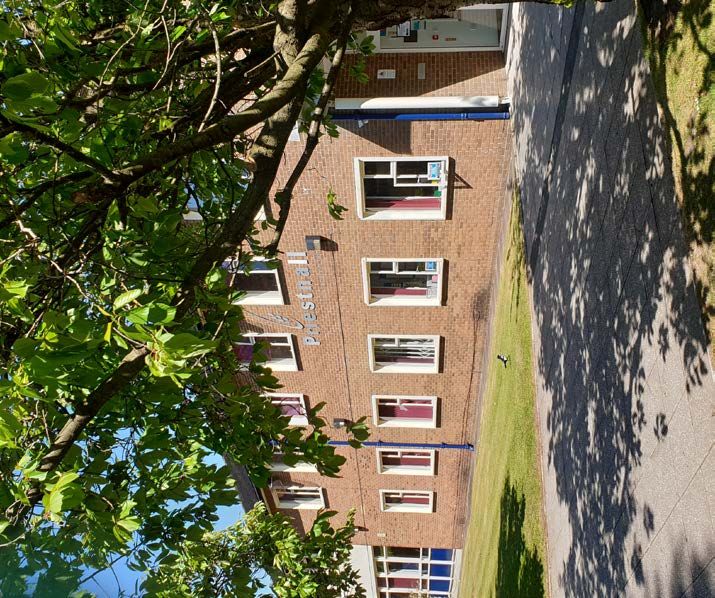
A WARM

   WELCOME                   FROM THE HEADTEACHER
   Thank you for choosing Priestnall – you have chosen a truly fantastic
   school.

   I would like to warmly welcome you to Priestnall School; it is an honour
   and privilege to be the school’s Headteacher.

   I have been Headteacher here since September 2019. Before joining
   Priestnall, I had the opportunity to visit the school on several occasions, as
   well as attend some school events such as the Exhibition and the Summer
   Concert – both excellent evenings that showed how much talent there
   is here. Having now been in the school for ten months, I can say that
   deciding to work here was the right decision. I have been really impressed
   by the well-mannered, articulate students, dedicated staff and highly
   committed governors. I am really pleased to have the opportunity to lead
   Priestnall School into the future.

   The school’s ‘college’ system is impressive, alongside the excellent pastoral
   care and guidance: it is clearly designed to ensure that all students feel
   safe, happy and secure. The structure enables students to immediately
   feel part of a small community within the wider school, and also allows
   staff to deliver personal and individual support whilst building strong
   relationships with our parents and carers.

   As a father to three children of primary and secondary school age, I
   fully recognise the vital nature of children attending a supportive, high
   quality school that allows every young person to flourish and reach their
   potential. I want the same high standard of education for your children as
   I do for my own – my expectations of everyone are high and I see it as my
   responsibility to ensure that your children excel in all areas of school life.
   We all want the best for our children, and I have always believed that
   this is best achieved when schools work in partnership with parents and
   carers. My hope is that while your child is with us, he or she will develop
   into a mature, happy, responsible young adult who is fully ‘educated for
   their future life’. Priestnall achieves some impressive GCSE examination
   results for the majority of its students; however, we are not just here to
   secure examination results, we are also here to educate the whole person
   and support and nurture them through the various stages of school life.
   Results alone do not make for a successful future, but also a person’s
   mindset, their characteristics and how they treat others.

   I look forward to working with you and getting to know your child over the
   next five years and I hope to meet you again very soon.

   Kind regards,                                                   Mr C Burns
                                                                      Headteacher

                          office@priestnall.stockport.sch.uk

www.priestnall.stockport.sch.uk                                                     2
THE SCHOOL

    CODE
    The School Code sets a standard of positive behaviour rather than listing
    negative rules and ‘taboos’. Through discussion in Learning Coordinator
    time and the work done in Beliefs and Values lessons, students are
    helped to an understanding of the code and its implications.

    Principles

    At Priestnall School we expect everyone in the school to:
    • Show respect, kindness, courtesy and tolerance;
    • Listen to each other;
    • Make the school a safe, litter free and pleasant environment in which
       to learn;
    • Allow effective learning and teaching to take place;
    • Work hard and to achieve their full potential;
    • Take responsibility for their actions and behaviours.

    We emphasise prevention and praise before sanctions.

    We actively encourage good behaviour, discourage bad behaviour and
    help our students understand the difference.

    Please see our “Student Expectations” for a detailed description of the
    expected standards at Priestnall School.

www.priestnall.stockport.sch.uk                                                 3
OUR

   MISSION                    STATEMENT

      All stakeholders will realise their potential and have the opportunity to challenge educational
      frontiers; achieving success and self-fulfilment within a global arena and knowledge based
      society.

      Our Philosophy

      That all members of Priestnall’s community, regardless of age, sex, race, religion, physical or
      academic ability:

      •   are of equal value as human beings and are unique individuals;
      •   are responsible for the consequences of their own actions;
      •   have a valuable contribution to make to the life of the school community.

      We promote fundamental British Values and define British Values to be: Democracy, The
      Rule of Law, Mutual Respect, Individual Liberty, Tolerance of those with different faiths,
      cultures and beliefs.

      Our Aims

      •   To instil a passion for lifelong learning;
      •   To provide opportunities so that all individuals are motivated to fulfil their potential;
      •   To encourage individuals to be responsible for themselves, their own learning and their
          environment;
      •   To encourage an independent, flexible approach towards learning;
      •   To equip students with transferable skills which will enable them to become independent
          learners in a global society;
      •   To encourage an ethos of school community rather than one of compliance;
      •   To encourage individuals to be tolerant and respectful of others and their views regardless
          of their age, gender, race, religion, physical or academic ability;
      •   To educate the whole person with due regard to their physical, mental and spiritual
          needs;
      •   To realise and understand the similarities and differences of other cultures;
      •   To realise that individuals learn through different styles of teaching and this is acceptable;
      •   To be ‘expansive’ and to develop essential learning attributes such as resilience,
          resourcefulness, reciprocity and reflectiveness.
      •   To promoted a ‘Growth Mindset’ and develop a positive learning attitude within all staff
          and students.
      •   To be a fully inclusive organisation.

www.priestnall.stockport.sch.uk                                                                        4
KEY STAFF
         MR C BURNS                   MR T CLAREY           MR R JONES               MR M MYERS
        HEADTEACHER               DEPUTY HEADTEACHER    DEPUTYHEADTEACHER         BUSINESS MANAGER

                   MR D CARTER           MISS J EVANS      MISS K GIBANI        MISS J HALFACRE
                    ASSISTANT             ASSISTANT         ASSISTANT             ASSISTANT
                   HEADTEACHER           HEADTEACHER       HEADTEACHER           HEADTEACHER

                    MR J KNEEN           MRS E MURRAY      MR P STIRLING         MRS J WINDSOR
                    ASSISTANT             ASSISTANT         ASSISTANT             ASSISTANT
                   HEADTEACHER           HEADTEACHER       HEADTEACHER           HEADTEACHER

DIRECTORS OF STUDIES
           MISS M GRIFFIN         MR B DELANEY    MR J KNEEN    MR A MORRISON      MR A MCCOURT
           BRIDGEWATER              IMPERIAL       RYLANDS           URBIS           VICTORIA

COLLEGE MANAGERS
  MRS BROOKE              MISS WELLS       MRS HULLEY     MRS FERN         MRS BRADBURY   MRS BOLLAND
  BRIDGEWATER              IMPERIAL         IMPERIAL      RYLANDS              URBIS        VICTORIA

www.priestnall.stockport.sch.uk                                                                         5
LEARNING
                    COORDINATORS
           MRS H DRURY             MISS S LEWIS   MR A NOKES   MR A THURSTAN      MRS G JONES
               7B1                     7I1           7R1             7U1              7V1

           MR P STUBBS            MS N CONDRON    MR G DEVER   MISS J LIGHTBURN   MR S MCGINTY
               7B2                      7I1          7R2               7U2             7V2

                                  MS J FORMAN
                                        7I2

                                  MR T TAVENDER
                                        7I2

www.priestnall.stockport.sch.uk                                                                  6
THE

  COLLEGE                          SYSTEM
                                                            As part of our drive to personalise
                                                            learning and provide high quality
                                                            welfare and guidance, we have a
                                                            ‘College’ system.

  When new students join us they are allocated to one of our five ‘Colleges’ and will remain in that
  College for their entire time at Priestnall. Our College system provides the framework for all of
  the pastoral support that the school offers, and also enables academic progress to be maximised.
  The Colleges provide a smaller community within the larger school in which students can find
  belonging and develop their leadership and social responsibility.

  Each College is named after a landmark of significance:

                   BRIDGEWATER              IMPERIAL                       RYLANDS
                      (HALL)              (WAR MUSEUM)                     (LIBRARY)

                                    URBIS                    VICTORIA
                                  (MUSEUM)                    (BATHS)

  The students collaborated in identifying the names and together we came up with ageless and
  timeless icons.

  Each College has a Director of Studies, a zone of the school, a College Manager and a College
  Assistant. We strongly believe that our college system improves the community ethos and spirit
  of the school, promotes active citizenship and increases support for learning amongst our young
  people. In securing identity for the colleges, together with the young people, we chose colours
  to represent each one. Our ties and badges reflect the College that your child belongs to.

  This structure is designed to further individualise levels of welfare and academic guidance. Each
  College contains all five year groups organised vertically. The college system ensures excellent
  communications between school and home, and enables parents/carers and teachers to liaise
  more closely and efficiently.

www.priestnall.stockport.sch.uk                                                                  7
THE SCHOOL
                                  DAY
 STUDENTS ARE EXPECTED TO ARRIVE
 AT SCHOOL BY 8.40AM VIA THE
 STUDENT ENTRANCE

                    8.50 – 9.15              Registration

                    9.15 - 10.15             Period 1

                    10.15 - 10.35            BREAK

                    10.35 - 11.35            Period 2

                    11.35 - 12.35            Period 3

                    12.35 - 1.15             LUNCHTIME

                    1.15 – 2.15              Period 4

                    2.15 – 3.15              Period 5

                              The school day operates for Years 7, 8 and 9 only.
                                  Years 10 and 11 follow a different school day.

www.priestnall.stockport.sch.uk                                                    8
THE

       CURRICULUM                                       OUTLINE
      THE SCHOOL CURRICULUM IS DIVIDED INTO FACULTIES LED BY A DIRECTOR OF
      LEARNING, LINKED TO A MEMBER OF THE SENIOR LEADERSHIP TEAM.

      Secondary Education comprises Key Stage 3 (Years 7, 8 and 9), and Key Stage 4 (Years 10 and 11).

      The curriculum statement for Priestnall School outlines the way in which the School fulfils
      its legal requirements to deliver the National Curriculum within the guidelines laid down by
      the Secretary of State for Education, and within the context of our own community and the
      knowledge we have of our own students.

      The school is non selective and admits students with a wide range of abilities, interests and
      aspirations. There is equal opportunity for all students to develop individually to maximise
      their potential.

      Learning is a lifelong process; therefore Priestnall School has the following curriculum aims:

      •    To continually improve levels of attainment and achievement;
      •    To develop in students lively and enquiring minds;
      •    To help students acquire the skills of literacy, numeracy and ICT that will enable them to
           achieve and succeed adequately in society and to continue the learning process;
      •    To help students develop as both independent and collaborative learners;
      •    To keep students abreast of developments in the fields of technology, especially information
           technology, that will enhance their ability to further extend their learning;
      •    To extend our students’ social, moral, spiritual and cultural awareness in order for them to
           act as active and responsible global citizens;
      •    To emphasise the development of character – alongside academic and other areas.
      •    To promote healthy lifestyle choices, skills and positive values by developing participation
           in sporting activities;
      •    To develop a ‘Growth Mindset’ and positive learning attitude.

      The school’s curriculum is regularly reviewed and adapted to meet the changing needs both of
      our learners and future employers.

      SUPPORTING THE CURRICULUM

      The Learning Support Faculty supports students who experience barriers to learning and
      participation who may need support in accessing the curriculum. The Faculty is led by a Co-
      Directors of Learning who lead a team of Learning Support Assistants, Therapists, Education
      Psychologist and administrative staff.

      The majority of support is provided ‘in-class’, however some students benefit from individual
      intervention strategies and groups in order to support development and promote independence
      and support emotional regulation.

www.priestnall.stockport.sch.uk                                                                           9
ACADEMIC REVIEW

 During the academic year, all students at Priestnall take part in the Academic Review process.
 This process is designed to empower students to take responsibility for their learning and
 maximise their progress. They do this by spending time reviewing their progress and the
 targets set by teachers; reflecting on what they can do in order to improve; and producing an
 action plan to further address one specific area for improvement. Students then evidence
 their efforts on working towards their goal in an on-line digital portfolio on our Virtual
 Learning Platform (FROG).

 Students will be introduced to the academic review process during an assembly in
 September.

 When the process starts, parents will get a notification via Frog and an email from school.
 As a parent you can support your child and access your child’s e-portfolio on-line or via the
 mobile phone FROG app.

www.priestnall.stockport.sch.uk                                                                   10
ACADEMIC

  ORGANISATION                                  AND ASSESSMENT

  TEACHING GROUPS

  Year 7 is split into two populations: X- and Y- halves. There is no hierarchy in this, both halves
  have an equal spread of ability.

  In order to make the Year 7 timetable work and to enable the optimum use of teaching staff
  and spaces, subjects are grouped together in ‘blocks’. English, Maths and PE haves their
  own separate blocks, but the other subjects are grouped into either a Literacy-themed block
  (History, Geography, French, Beliefs & Values) or a number/shape/pattern block (Science,
  Computing, Technology, Art, Drama, Music). The English and Maths departments take the lead
  in organising the teaching groups for each of their classes using Key Stage 2 SATs results and
  other information. English and Maths organise their classes into a top set and the remaining
  into mixed-ability groups. The groupings will be reviewed and refined at points during the year.

  PROGRESS INDICATORS

  At key points through the year (October Half Term, Christmas, February and Summer), staff
  will enter a ‘Working at’ Level for each student in their class – for every subject. These will be
  based on all aspects of a student’s attainment; classwork, homework, verbal contributions,
  performances and practical outcomes as well as tests/assessments. Also, an Attitude-to-
  Learning score (Outstanding, Good, Requires Improvement or Poor) will be adjudged. This
  information will be sent home on interim Reports to keep parents/carers and the students
  themselves informed about progress. Students will be expected to formally review and
  reflect upon their progress during registration.

  TARGET SETTING

  The ‘Working at’ Levels for the first half-term are used to benchmark students’ capabilities.
  Together with Key Stage 2 outcomes, these ‘Working at’ Levels are used to derive Target
  Levels which indicate the expected progress to be made by the end of Years 7 and 8. These
  are challenging targets and reflect the high expectations for students at Priestnall School.
  These also appear on the Interim Reports.

  REPORTING/PARENTAL CONTACT

  At the end of the first half-term, in conjunction with the ‘Working at’ Levels parents/carers will
  be invited to come into school and meet with the Learning Coordinator to discuss how their
  child has settled at Priestnall and what early progress measures are indicating. Dates for
  subject teacher/parent evenings will be published in the school calendar. (LINK)

  In conjunction with the ‘Working at’ Levels, an Interim Report is published showing attainment,
  target and Attitude to Learning information along with specific targets for each subject. Later
  in the year a subject-teacher parents evening will also be held. The exact dates of these will be
  published via the website and communicated home.

www.priestnall.stockport.sch.uk                                                                        11
YEAR 7

  ART & DESIGN                             CURRICULUM MAP
                                          In Art and Design we explore the things that we see and feel
                                          to communicate ideas and meanings.

   We work with traditional and new media, developing confidence, skills, imagination and creativity;

   We learn to appreciate and value images and artefacts across times and cultures and to understand
   the contexts in which they were made;

   In Art and Design we assess our own and other people’s work, judging quality, value and meaning;

   We learn to think and act as artists, craftspeople and designers, working creatively and intelligently
   towards individual responses;

   We develop an appreciation of art, craft and design, and its role in the creative and cultural
   industries that enrich our lives.

   Assessment Programme

   •   Recording and investigation
   •   Visual elements and media
   •   Reflection and understanding
   •   Social and emotional aspects of learning
   •   Class work
   •   Independent learning

   Student progress will be reported by formal assessments;
   these will be a mixture of teacher assessments, peer
   assessments and self-assessments throughout each
   project / theme.

            art@priestnall.stockport.sch.uk

                        @Priestnall_Art

                                  @priestnall_art_department

                                  Curriculum Leader: Mr A Nokes
www.priestnall.stockport.sch.uk                                                                          12
YEAR 7
BELIEFS & VALUES
CURRICULUM MAP
Beliefs and Values (BV) is an important subject - partly
because of its significance in framing current world issues
and partly because of the way it can shape one’s identity,
beliefs and values.
At Priestnall School, we explore the contribution that Religion, Ethics, Philosophy and PSHE
education make in the world. Students are supported in exploring their own beliefs – whatever
they may be - while reflecting on the beliefs and practices of others. Students are encouraged to
develop critical questioning of their spiritual, social and moral views. Lessons give time and space
to think, discuss and challenge.
In Year 7, students have two BV lessons each fortnight and the curriculum follows and develops
Stockport’s Agreed Syllabus. In Year 7 topics the concepts of ‘Faith’ as part of personal belief and
how they impact peoples’ lives; the concept of community and what role faith plays within our
communities; and ‘Action’, where we encourage students to complete action projects. Students
will complete a ‘Personal Action Challenge’ and a ‘School Action Challenge’, inspiring students to
become active citizens, making a difference in their communities.
In Beliefs and Values lessons students are expected to fully commit to their personal progress and
learning. Lessons develop core skills: investigation, interpretation, reflection, empathy, analysis,
application and evaluation. Attitude of fairness, respect, self-understanding, enquiry and openness
are always expected. At all times students are expected to take responsibility for their learning, to
develop positive relationships with their peers and to respect the right of each class member to
develop their own opinions in a culture of tolerance and respect. Classroom atmospheres are
positive. We like to have fun!
During Beliefs and Values lessons students will also cover Relationships and Sex Education, where
we cover the topics of personal identity, friendships, family, the evolving nature of relationships,
growing up (including the physical and emotional effects of puberty), and managing risk (including
appropriate adult relationships, online safety, child sexual exploitation and where to seek help and
advice).
In BV, we are seek to inspire students in their learning, so that they can prepare for the adult world
- confident and insightful, open and sensitive towards others. We seek to equip students to be
articulate in tackling the spiritual, moral and social questions that will surface again and again in
their lives.
beliefs@priestnall.stockport.sch.uk
Curriculum Leader: Mr M Jones
www.priestnall.stockport.sch.uk 13YEAR 7
COMPUTING CURRICULUM MAP
Students will be taught basic skills in Word Processing,
Graphics, Image Processing, Desktop Publishing and Database
construction. These basic skills will enable students to be
able to: find things out, develop ideas, make things happen,
exchange and share information.
Students will be taught basic skills in Word Processing, Graphics, Image Processing, Desktop
Publishing and Database construction. These basic skills will enable students to be able to: find
things out, develop ideas, make things happen, exchange and share information.
Modules covered during Year 7 will include:
Collaborating online
This unit has been designed to ensure that learners are given sufficient time to familiarise
themselves with the school network. It also allows the teacher to discuss appropriate use of the
school network, and to update and remind learners of important online safety issues. Whilst
completing this unit, learners will also learn how to use presentation software effectively. In
terms of online safety, this unit focuses on respecting others online, spotting strangers, and
the effects of cyberbullying.
Modelling data – The spreadsheet unit for Year 7 takes learners from having very little
knowledge of spreadsheets to being able to confidently model data with a spreadsheet. The
unit uses engaging activities to progress learners from using basic formulas to writing their
own COUNTIF statements. This unit will give learners a good set of skills that they can use in
computing lessons and in other subject areas.
Networks – Imagine a world without computer networks, and how different your life would
be. There would be no more YouTube, Google, instant messaging, online video gaming, Netflix,
and iTunes. There would be no online shopping, or quickly looking up directions to a location at
the click of a button. There would be no more sharing of files or peripherals such as a printer,
and no more central backups of information. As networks have evolved, society has become
increasingly reliant on the services that they provide. They have changed the way we learn, work,
play, and communicate. This unit begins by defining a network and addressing the benefits
of networking, before covering how data is transmitted across networks using protocols. The
types of hardware required are explained, as is wired and wireless data transmission. Learners
will develop an understanding of the terms ‘internet’ and ‘World Wide Web’, and of the key
services and protocols used. Practical exercises are included throughout to help strengthen
understanding.
Programming 1 – This unit is the first programming unit of KS3. The aim of this unit and the
following unit (‘programming 2’) is to build learners’ confidence and knowledge of the key
programming constructs. Importantly, this unit does not assume any previous programming
experience, but it does offer learners the opportunity to expand on their knowledge throughout
the unit.
The main programming concepts covered in this unit are sequencing, variables, selection, and
count-controlled iteration. All of the examples and activities for this unit use Scratch 3.
www.priestnall.stockport.sch.uk 14Programming 2 – Programming II follows on from the foundations built in ‘Programming I’. It is
vital that learners complete ‘Programming I’ before beginning this unit.
This unit begins right where ‘Programming I’ left off. Learners will build on their understanding
of the control structures’ sequence, selection, and iteration (the big three), and develop their
problem-solving skills. Learners will learn how to create their own subroutines, develop their
understanding of decomposition, learn how to create and use lists, and build upon their
problem-solving skills by working through a larger project at the end of the unit.
Gaining support for a cause - During this unit, learners develop their understanding of
information technology and digital literacy skills. They will use the skills learnt across the unit to
create a blog post about a real-world cause that they would like to gain support for. Learners
will develop software formatting skills and explore concerns surrounding the use of other
people’s work, including licensing and legal issues.
computing@priestnall.stockport.sch.uk
@PriestnallComp1
Curriculum Leader: Mrs H Drury
www.priestnall.stockport.sch.uk 15YEAR 7
DESIGN & technology@priestnall.stockport.sch.uk
TECHNOLOGY
CURRICULUM MAP
@priestnall_DT
In Design and Technology, during Key Stage 3, students use a
wide range of materials to design and make products. Design
and Technology is an inspiring, rigorous and practical subject.
Using creativity and imagination, students design and make
products that solve real and relevant problems within a
variety of contexts, considering their own and others’ needs,
wants and values.
Students acquire a broad range of subject knowledge and draw upon cross curricular disciplines
such as Mathematics, Science, Engineering, Computing and Art. Students learn how to take risks,
becoming resourceful, innovative, enterprising and capable citizens. Through the evaluation of
past and present Design and Technology, they develop a critical understanding of its impact on
daily life and the wider world.
Students develop their understanding of designing and making by investigating products and
finding out about the work of professional designers and the manufacturing industry. They use
computer-aided-design software and modern manufacturing techniques (CAD/CAM) as an integral
part of designing and making.
In Year 7, students work in six material areas. These are Resistant Materials, Product Design, Key
skills, Textiles, Graphics and Cooking & Nutrition.
Teaching aims to ensure that knowledge and understanding from the National Curriculum
Programme of Study is applied. Students are taught aspects of the design process such as:
• Research and analysis
• Developing product specifications
• Generating ideas
• Developing ideas
• Project planning
• Making quality products
• Product evaluation and analysis
• Developing technical knowledge
Assessment of students‟ designing and making capability is carried out by regular interim
assessment of aspects of the design process and the products made in all the material areas. In
Year 7 students are taught in groups which are based on their 'Numeracy' groups.
Director of Learning: Mr D Carter
www.priestnall.stockport.sch.uk 16YEAR 7
DRAMA CURRICULUM MAP
drama@priestnall.stockport.sch.uk
The key concepts in drama are skill driven and aim to build
personal skills which can be relied upon to succeed, not
only in drama lessons but beyond school life and in future
employment.
Students will:
Develop drama techniques to explore, in a role, a variety of situations and texts or respond to
stimuli;
Work collaboratively to devise and present scripted and unscripted pieces, which maintain the
attention of an audience;
Extend their spoken repertoire by experimenting with language in different roles and dramatic
contexts;
Develop drama techniques and strategies for anticipating, visualising and problem-solving in
different learning contexts;
Reflect on and evaluate their own presentations and those of others.
By the end of Year 7 students should:
Understand and demonstrate the basic social and group skills necessary for meaningful drama
to take place (listening, observation, concentration, co-operation);
Work in mixed groups of varying sizes (including individual), developing the ability to negotiate
and make decisions as part of a group;
Understand how use of space, movement and voice communicate meaning and evaluate that use;
Show a developing ability to devise, improvise and create credible characters;
Structure a presentation with a clear beginning and end;
Understand that the process of drama has its own worth and that performance is not always
part of activity;
Use and understand the following technical vocabulary:
Still picture Monologue Spoken thought
Mime Body language Facial expressions
Eye contact Role-play Empathy
Suspension of disbelief Endowing Narrator Key Image
Gibberish Soundscape Whole group image
Spontaneous improvisation Theatrical convention Prepared improvisation
Reflect upon and respond constructively to their own work and that of others in the class, with
an awareness of their own strengths and weaknesses.
Curriculum Leader: Mr G Dever
www.priestnall.stockport.sch.uk 17YEAR 7
ENGLISH
english@priestnall.stockport.sch.uk
@Priestnall_ENG
CURRICULUM MAP
The English Faculty follows a comprehensive and exciting
programme of study, which is based on both the National
Literacy Strategy and the National Curriculum.
The National Curriculum for English centres around three Attainment Targets:
EN1 - Speaking and Listening
Students are taught to communicate effectively and become confident, articulate speakers.
Listening skills are developed and refined.
EN2 - Reading
Students are encouraged to read widely, with enjoyment and understanding. Students are given
the opportunity to read a wide range of texts including pre and post 1914 literature, plays and
poetry, and works by authors from different cultures and traditions.
EN3 - Writing
Students are taught the skills necessary for both fiction and non-fiction writing. Students are
encouraged to craft and analyse their writing, establishing the effect on the reader. Students are
taught to write accurately and a variety of skills are developed including spelling, punctuation and
grammar.
Assessment is an integral part of all schemes of work, students are assessed in Speaking and
Listening, Writing and Reading. Formative and summative assessments will be completed each
half term and at the end of Year 7 a formal examination is taken.
Term Scheme of Work
Autumn 1 Ferney Valley:
EN3 Writing
Autumn 2 Dracula
EN1 Speaking and Listening EN2 Reading
Spring 1 Grammar for Writing: Spy Fiction
EN3 Writing
Spring 2 Novel
EN1 Speaking and Listening EN2 Reading
Summer 1 Grammar for Writing: Explain
EN3 Writing
Summer 2 Poetry
EN1 Speaking and Listening EN2 Reading
Director of Learning: Mrs S Birchenall
www.priestnall.stockport.sch.uk 18YEAR 7
GEOGRAPHY CURRICULUM MAP
Geography offers students the opportunity to ask questions about the world around them and
find answers to these questions. It helps students to better understand the world around us,
becoming more informed global citizens. At Priestnall we aim to equip students with knowledge
about diverse places, people and environments, alongside building a deep understanding of
the Earth’s key physical and human processes.
The areas of study for Year 7 are:
Enquiry Question Content
What type of place is Map skills, connections to other countries and the human and physical
the British Isles? geography of the British Isles.
Has Stockport seen Urban land use, urban regeneration in Stockport and sustainable urban
the light? living.
Will my street flood? Factors affecting flooding, map skills (contours), effects of flooding and
responses to flooding.
Is the Geography of Comparing the geography of Russia to the UK and considering how
Russia a curse or a the geography of Russia provides opportunities and challenges for the
benefit? people that live there.
Is the UK a safe place The causes, effects and management of a range of hazards and an
to live? assessment of whether the UK is a good place to live to avoid hazards.
Assessment:
There are five aspects to being an outstanding Geographer therefore students will be assessed on
their ability to:
• Know information as a Geographer - knowledge of locations, places, environments
• Think as a Geographer - understanding of the processes that lead to the specific characteristics
of places
• Study as a Geographer - competence in a range of skills including fieldwork, mapping and GIS
and in researching
• Apply ideas as a Geographer - apply geographical knowledge, understanding and skills to real
world contexts
• Communicate as a Geographer - develop well-evidenced arguments drawing on their
geographical knowledge and understanding.
Students will be assessed by means of a baseline test and then there will be one end of topic
assessment for each of the units. Specific pieces of work will also be assessed to provide students
with feedback on their knowledge, understanding and skills before their final assessment.
Homework: Geography homework will be set on Frog as a variety of tasks. Homework will be
assessed through either teacher assessment or students will use their homework within a lesson
and will receive feedback on it within the lesson.
geography@priestnall.stockport.sch.uk @Priestnall_Geog
Curriculum Leader: Mrs J Rackham
www.priestnall.stockport.sch.uk 19YEAR 7
HISTORY
history@priestnall.stockport.sch.uk
@Priestnall_Hist
CURRICULUM MAP
At the beginning of Year 7 students study a short unit of
work which focuses on developing the following historical
skills; making inferences and explaining how and why
interpretations of an event can differ.
Study Unit 1: The Neolithic Revolution
This unit of work explores the developments that took place during the later part of Stone Age.
Fairly unique in the sense that not many schools deal with this period at Key Stage Three, students
will gain an insight into the fundamental pre-historic change that saw humankind develop from
hunter-gatherer culture to settled farming civilisations.
Study Unit 2: The Development of Church, State and Society in Medieval Britain, 1066-1509
Students will study the Norman Conquest of 1066. This will involve considering why William of
Normandy won the Battle of Hastings and how he was then able to establish control over England.
Students will also investigate some of the attitudes and beliefs which existed in the Middle Ages.
This involves exploring the significance of religion and students will consider the causes and effects
of the Crusades, and the attitudes towards health and disease.
Students have the opportunity to develop their knowledge and understanding of society in the
Middle Ages looking at the lives of struggling peasants compared to that of the wealthy nobles.
Students will also consider how and why Parliament developed and the reasons for the Peasants’
Revolt.
Study Unit 3: The Development of Church, State and Society in Medieval Britain, 1509-1745
Students will study a number of key issues which occurred in Britain between 1500 – 1750. Students
will gain an insight into the religious changes invoked by Henry VIII, the political changes that were
brought about by the Civil War, the execution of a British Monarch and the controversial rule of
Oliver Cromwell. Students will consider the long term implications that many of these changes
have had on today’s society. Students will finish the year studying the dangers which monarchs
and their people faced in the period 1500-1750. This will involve looking at such events as the
Gunpowder Plot, the Spanish Armada, the Plague and the Great Fire of London.
Curriculum Leader: Miss J Halfacre
www.priestnall.stockport.sch.uk 20YEAR 7
MATHS
maths@priestnall.stockport.sch.uk
@PriestnallMaths
CURRICULUM MAP
Students in Year 7 follow a course of study designed to
reinforce the work done at Key Stage 2 and to extend this in
preparation for their next Key Stage.
Students will take part in individual work, small group and whole class activities. The mathematics
followed on the course can be classified under the National Curriculum targets:
MA1 Using and Applying Mathematics
MA2 Number & Algebra
MA3 Shape and Space
MA4 Data Handling
MA1 will be approached with activities during lessons and with extended tasks exploring
mathematical concepts in cross curricular events during deep learning days. These tasks will
involve functional skills elements of the curriculum.
The other Attainment Targets will be assessed regularly, approximately every term with school
assessment levels provided twice yearly after formal assessments.
With the increased emphasis on the non-calculator skills, students will have the opportunity
to improve their mental arithmetic skills to help them develop strategies for problem solving.
We have also recently reviewed and rewritten our Scheme of Work for Year 7 to incorporate
some of the ‘Mastery’ approach favoured in such countries as China and Singapore. Whilst
there are significant cultural differences we feel that there are aspects of this approach that
can be beneficial to our students and we have incorporated some of these methods into our
curriculum.
Students will be expected to be fully prepared for all lessons ensuring they have all equipment
and books. This will mean bringing the following: scientific calculator, angle measurer,
compasses, pen, pencil and ruler.
Homework is an integral part of the course and students will be expected to complete this
on a weekly basis, either by way of written assignments or using a software package called
Mathswatch.
Director of Learning: Mr R Musson
www.priestnall.stockport.sch.uk 21YEAR 7
MODERN FOREIGN
LAGUAGES
CURRICULUM MAP
French at Priestnall concentrates on providing focused
learning opportunities to enable all students to know how
a language works and how to become a language learner.
Students develop the necessary skills in order to use the
language independently for practical purpose in the modern
world.
During KS3 there are four Attainment objectives in French, used as a focus of study and assessment:
AO1 Listening
AO2 Speaking
AO3 Reading
AO4 Writing
The Year 7 course lays the foundation of language learning. Clear learning objectives are launched
and reinforced throughout the year. Teaching of basic vocabulary such as numbers and colours
goes above and beyond any learning they may have already experienced at primary school. We
also cover the topics of Family and Friends, Education, jobs and future plans.
During Year 7 students explore the sounds and grammatical patterns of French. They learn to
decipher texts both orally and written as their language skills develop. As students become more
confident they begin to express themselves through role- plays, short conversations and extended
writing. Students will familiarise themselves with the sounds of French through recorded material
including poems and songs.
We endeavour to provide as many opportunities as possible for students to learn about the
cultural aspects of French life. We aim to do this through project work wherever possible and
each half term, pupils complete an extended creative homework which they showcase in class.
Students have two formal listening and reading assessments in the year. They have three short
written assessments in the year (Picture description / Paragraph / Translation) and then one
larger end of year written exam. They have one end of year speaking assessment. Vocabulary
learning and testing are frequent and essential for language learning. All students of French must
be encouraged to revise, redraft written work and learn new concepts using a variety of strategies.
We strongly recommend all students purchase a bilingual dictionary before starting Year 7 as
competent dictionary skills are essential to good progress.
mfl@priestnall.stockport.sch.uk
@Priestnall_MFL
Director of Learning: Miss S Durkin
www.priestnall.stockport.sch.uk 22YEAR 7
MUSIC
music@priestnall.stockport.sch.uk
@Priestnall_music
CURRICULUM MAP
During Key Stage 3 students deepen and extend their own
musical interests and skills. They perform and compose
music in different styles with increasing understanding of
musical devices, processes and contextual influences.
During Key Stage 3 students deepen and extend their own musical interests and skills. They
perform and compose music in different styles with increasing understanding of musical devices,
processes and contextual influences.
They work individually and in groups of different sizes and become increasingly aware of different
roles and contributions of each member of the group. They actively explore specific genres, styles
and traditions from different times and cultures with increasing ability to discriminate, think
critically and make connections between different areas of knowledge.
Music activities involve three skill areas:
Performing - controlling sounds through singing and playing
Composing - creating and developing musical ideas
Listening and Appraising - responding and reviewing by analysis, evaluation and comparison of
pieces of music.
Teaching will ensure that listening, and applying knowledge and understanding, are developed
through the interrelated skills of performing, composing and appraising.
Half termly schemes of work in Year 7 will include exploring:
The Elements of Music
Folk Music
Graphic scores
Instruments of the Orchestra
Programme Music
The Beatles
Formative and summative assessment will take place each half term in- line with whole school and
department marking policies.
Curriculum Leader: Mr G Parker
www.priestnall.stockport.sch.uk 23YEAR 7
PHYSICAL
PE@priestnall.stockport.sch.uk
@PriestnallschPE
EDUCATION
CURRICULUM MAP
The physical education curriculum aims to introduce
students to a variety of physical activities. The objectives
are to promote fitness and create interest, which encourage
students to participate in sport throughout the rest of their
lives.
National Curriculum Physical Education is followed by Year 7 students in single sex mixed ability
groupings.
The physical education curriculum ethos is to facilitate “Inspiring and Broadening Sporting
Experiences”, by introducing students to a variety of physical activities. The objectives are to
promote fitness and create interest, which encourage students to participate in sport throughout
the rest of their lives. “Striving for a Health, Active and Skilful Future”
During our lessons we focus on the following ME in PE areas:
Thinking ME - Mental capacity, tactics, decision making and evaluation
Physical ME - Physical literacy and movements of the body.
Healthy ME - Physical and mental health, positive behaviour and attitudes.
Leading ME - Communication, teamwork, management and leadership
Creative ME - Imaginative and expressive traits
The following activities are offered to give a balanced curriculum:-
BOYS GIRLS
Baseline Baseline
Badminton Tennis
Football Athletics
Cricket Fitness
Basketball Dance
Tennis Football
Athletics Orienteering
Handball Handball
Hockey Rounders
Fitness Hockey
Rugby Netball
Dance Gymnastics
Dodgeball Cricket
Softball Softball
Rounders Basketball
The progress of students is assessed after each module with regard to the following;
• Developing skills in physical activity
• Making and applying skills
• Developing physical and mental capacity
• Evaluating and improving performance
• Making informed choices about healthy, active lifestyles.
www.priestnall.stockport.sch.uk 24During the first week of each term, students complete an aerobic endurance test and an intra-
college event. The fitness test allows students to monitor their own health and fitness levels.
The intra-competition event develops students: sportsmanship, competition and team work.
Students will also be able to attend extra-curricular clubs at lunchtime and after school. These
activities will change every half term.
Students will also be able to attend extra-curricular clubs at lunchtime and after school. These
activities will change every half term.
Director of Learning: Mrs C Jenkins
www.priestnall.stockport.sch.uk 25YEAR 7
SCIENCE
science@priestnall.stockport.sch.uk
@priestnallscie1
LEARNING
Following the national curriculum ensures all our learners
meet the challenges of life in our fast-changing world. The
scheme of work for Key Stage Three has been written “in-
house” and provides the foundations for understanding the
world through Science.
Once per half term, students will complete an assessment and a homework project based on the
core skills of a unit or several units of work. The assessments have been designed to provide
students and teachers with an opportunity to evaluate performance and set meaningful targets to
help students make progress. Students’ practical skills are also assessed through investigational
activities and written tasks throughout the year.
At the end of Year 7, students are then grouped according to the Science levels they achieved
throughout the year based on internal assessments.
The units of work covered in Key Stage Three are grouped as follows:
Biology
• Structure and function of living organisms
• Material cycles and energy
• Interactions and interdependencies
• Genetics and evolution
Chemistry
• Atoms, elements and compounds
• Chemical reactions
• Energetics
• The periodic table and materials
• Earth and atmosphere
Physics
• Energy
• Motion and forces
• Waves
• Electricity and electromagnetism
• Matter
• Space physics
Director of Learning: Mrs H Young
www.priestnall.stockport.sch.uk 26MY
FROG
Priestnall School use an online Virtual Learning Environment – FROG - to record and display
homework tasks for students in all year groups. Students and parents/carers will be provided
with a login to access their individual homework tasks. This will be the same login that will be
used to access school reports during the year.
Each homework task will have a clear description and explanation, as well as a date for
completion. In addition, all the relevant resources for each homework task (such as worksheets
or video clips) will be accessible via links on the task page.
Parents/carers and students can also download a free app (IOS and Android compatible) that
provides homework notifications, general school announcements and access to personal
homework accounts. This is called “My Frog”.
In order to support their individual learning needs, all new students will still be issued with a
student planner, in which they can record brief details of the homework set and also plan their
own time management for out-of-school activities.
Click on the icons below to watch a YouTube video of the application.
Parent Student
www.priestnall.stockport.sch.uk 27SCHOOL
HOMEWORK
Aims:
• To foster the habit of independent work;
• To help students to take responsibility for their own learning;
• To allow students time to consolidate, research and extend work undertaken in school;
• To give students an opportunity to explore new things;
• To inform parents about what has been set and to involve them in helping to develop the
habit of working independently.
To achieve these aims, the school will ensure that:
• every new student is issued with a Student Planner to help personal organisation;
• homework is set which allows scope for consolidation, extension and research as
appropriate, not just for the sake of it;
• In the first two weeks students will have seen all of their teachers at least once. During this
time teachers will make clear what their homework setting policy is for the class.
Types of Homework
Homework should reflect the range of learning experiences, many of which do not involve
writing. It may involve reading, observing, watching a relevant television programme or talking
to another student or family member.
For example in Modern Foreign Languages, where the emphasis in the early years is on
communication, it may involve consolidation of new vocabulary. This is likely to take the form
of learning new words on a regular basis.
In English, and other subjects, work may go on over several weeks as classwork and
homework involving drafting, revising and editing before producing a final version. Students
will always be expected to be reading privately.
The school’s Virtual Learning Environment will also support independent and home study.
Students can access tasks set by their teachers and also submit their responses via the VLE.
www.priestnall.stockport.sch.uk 28EXTRA
CURRICULAR AT PRIESTNALL
In additional to the curriculum taught during the school day, there are many clubs and extra
activities that students can access after school.
These include:-
• Football • Tennis • 3G Club
• Trampolining • Softball • Drama Club
• Badminton • Cricket • Tech Club
• Fitness • Hockey • Media Team
• Rugby • ICT Club • Dance Club
• Athletics • Music (various bands / • History Ambassadors
• Rounders orchestras) • Games Club
• Basketball • ECO Club • Code Academy
Full details of the clubs and activities available each term can be found on the school website.
www.priestnall.stockport.sch.uk 29PRIESTNALL
EQUIPMENT SCHOOL
All students are required to carry with them:
• Black Pen
• Blue Pen
• Green Pen
• Purple Pen
• Pencil
• Colouring Pencils
• Eraser
• Pencil Sharpener
• Highlighter
• Glue Stick
• Ruler
• Protractor
• Compass
• Scientific Calculator (as specified by
the Mathematics Department)
• Pencil case to hold everything
• A reading book that they are able to
use whenever asked
The Library sells all of the above equipment at cost price.
If students are required to use scissors they will be provided in the lesson by the teacher.
Please do not let your child bring scissors into school.
www.priestnall.stockport.sch.uk 30PRIESTNALL
ATTENDANCE INFORMATION
PRIESTNALL SCHOOL RECOGNISES THE IMPORTANCE AND VALUE OF EXCELLENT ATTENDANCE
AND PUNCTUALITY AND THE LINK BETWEEN ATTENDANCE AND EVERY CHILD’S ABILITY TO
LEARN, MAKE ACADEMIC PROGRESS AND ACHIEVE SUCCESS.
What is good attendance?
At Priestnall School, we believe that good attendance means achieving an attendance figure of 96%
and above every half term. This would mean no more than 6 days’ absence per school year.
Who monitors attendance?
Your child’s attendance is monitored by your child’s Learning Co-ordinator and College Manager.
Attendance is also monitored by Mr D Carter, Assistant Headteacher. The Attendance Officer and
Education Welfare have an overview of school attendance and punctuality and work with the
Learning Coordinators and pastoral team to promote regular school attendance. It is the legal
responsibility of the parent/carer to ensure their child attends school punctually and regularly.
How do we monitor attendance and punctuality?
A register is taken twice daily at 8.50am and 1.55pm. Class registers are taken in every lesson
using lesson monitor, an electronic register system. As a result of using lesson monitor, students’
attendance will be monitored on a lesson by lesson basis. We monitor and review every child’s
attendance.
What should I do if my child is absent from school?
If your child is absent from school you should notify the school office by 9.30am each day of the
absence. If there is a possibility that your child may be off for more than one day, please inform
the office of this at the time of ringing. The School Office is open from 8.00am – 4.00pm and can
be contacted on 0161 432 7727. When the office is closed you can leave a message on the school
answerphone. Alternatively you can email:
attendance@priestnall.stockport.sch.uk
We aim to promote and maintain excellent levels of attendance and punctuality and follow-up on
all unexplained absences from school on a daily basis. This is done using Truancy Call.
We are aware that some absences are unavoidable, however, evidence shows that progress drops
dramatically as absence increases.
What happens if my child is late to school?
If your child is going to arrive late to school, please phone the school office or send a letter with
your child to explain their late arrival. A student’s late arrival is considered unauthorised until a
satisfactory explanation is provided by the parent/carer. Registers are taken at 8.50am and 1.55pm.
If a student fails to arrive before the register closes they will be marked as absent.
Students who arrive after 8.50am and before 9.15am should enter school via the Lates Desk which
is situated in Café Mersey.
www.priestnall.stockport.sch.uk 31Your child will be given a ‘late to school’ slip, which should then be given to the period one teacher.
They will also receive a 20 minute detention from their College Manager if they are late without a
satisfactory reason. If your child arrives after 9.15am they should sign in at Reception. If your child
does not have a satisfactory reason for being late, they will receive a 30 minute detention from
their College Manager.
If a student is persistently late then she/he will be put on late report and the CM will contact
parents/carers. Students who achieve excellent punctuality will be rewarded.
How do I arrange a Leave of Absence?
Leave of absence may be granted by the Headteacher for exceptional circumstances only.
Please note that holidays are not routinely authorised and are only authorised in exceptional
circumstances.
In order to obtain Leave of Absence parents/carers must apply in writing to the Headteacher. This
should be sent to school at least four weeks before the absence.
School Attendance and the Law
By law, schools can only authorise Leave of Absence in exceptional circumstances.
Education Penalty Notices are fixed penalty fines of £60 (rising to £120 if unpaid within 21 days) per
parent per child by the Local Authority. An EPN will be issued to parents who take their children
on holiday during term time.
For further details, please contact Stockport Education Welfare Service, Dialstone Centre, Lisburne
Lane, Stockport, SK2 7LL or telephone 0161 474 2195.
Who should I contact if I have any concerns about attendance issues?
If you have any concerns about your child’s attendance please do not hesitate to contact the
Attendance Officer, Miss Lister, your child’s Learning Co-ordinator or College Manager or Director
of Studies on 0161 432 7727. Alternatively, you can contact Mr D Carter, Assistant Headteacher.
Medical or Dental appointments during school hours
Medical and dental appointments should be arranged out of school hours where possible.
If you need to take your child out of school during the school day, please follow the procedure
below:
• Send a note in to school detailing the time you will be collecting your child and if your child will
return to school after the appointment.
• Remind your son or daughter to collect a purple form from the Student Office and bring the
form completed and authorised by the Learning Co-ordinator or College Manager when they
are signing out.
• It is the responsibility of your child to ensure they leave lesson at the correct time by informing
the class teacher.
• If you want your child to make their own way to the appointment, please ensure you put this in
www.priestnall.stockport.sch.uk 32writing to us, as we cannot let your child out of school without your permission.
Appointments at the start of the school day
• If your child will be arriving late to school due to a medical or dental appointment, please leave
a message on the automated absence line (0161 432 7727) or
attendance@priestnall.stockport.sch.uk
• On arrival at school, your child must sign in at Reception. If you have not already left a message
on the answerphone or sent a message via email, your child must bring with them a letter from
you explaining where they have been.
www.priestnall.stockport.sch.uk 33PAY BY
WISEPAY
What does WisePay do?
• enables you to pay for selected trips and other items such as ties and badges, school meals;
• offers a highly secure payment site;
• gives you a history of all the payments you have made;
• allows the merging of accounts if you have more than one child at school;
• shows you all items available for payment relevant to each of your children;
• emails a receipt of your payment to the email address you register.
How does WisePay help you?
• gives you the freedom to make payments to school whenever and wherever you like;
• stops you having to write cheques or search for cash to send to school;
• gives you peace of mind that your payment has been made safely and securely;
• helps with budgeting; payments are immediate, there is no waiting for cheques to clear;
• payments for many of the larger trips can be made by instalments up to the due date;
• WisePay is quick and easy to use.
How does WisePay help our school?
• We encourage everyone to use personal debit cards to make payments as this reduces the
costs to school significantly;
• reduces the administrative time spent on banking procedures;
• keeps accurate records of payments made to every service for every student;
• payments do not bounce;
• reduces paper ‘waste’
• allows for easy and quick refunds to be made back to the payment card;
• improves communication between the school and parents concerning payments;
• offers a more efficient payment collection process, reducing the amount of money held on
school premises.
How do I get started?
We will email you an activation letter to enable you to setup your WisePay account. The activation
letter will contain a personal activation username and password to enable you to login to WisePay.
During the activation process you will be guided through changing your username and password
to something more memorable; you can also merge your accounts if you have more than one child
at Priestnall.
The easiest way of topping up payments is using the WisePay app for smartphones. This can be
downloaded using your usual app store. Login details will be issued prior to September.
Further details can be found by clicking the link below:
www.priestnall.stockport.sch.uk 34You can also read


