Your Coronavirus Test is Positive. Maybe It Shouldn't Be - Published in New York Times, August 29, 2020 - Yale School ...
←
→
Page content transcription
If your browser does not render page correctly, please read the page content below
Your Coronavirus Test is Positive.
     Maybe It Shouldn’t Be.
   Published in New York Times, August 29, 2020

       Discussion from a hospital laboratory perspective
                       by Marie L. Landry, M.D.
 Director, Clinical Virology Laboratory, Yale New Haven Hospital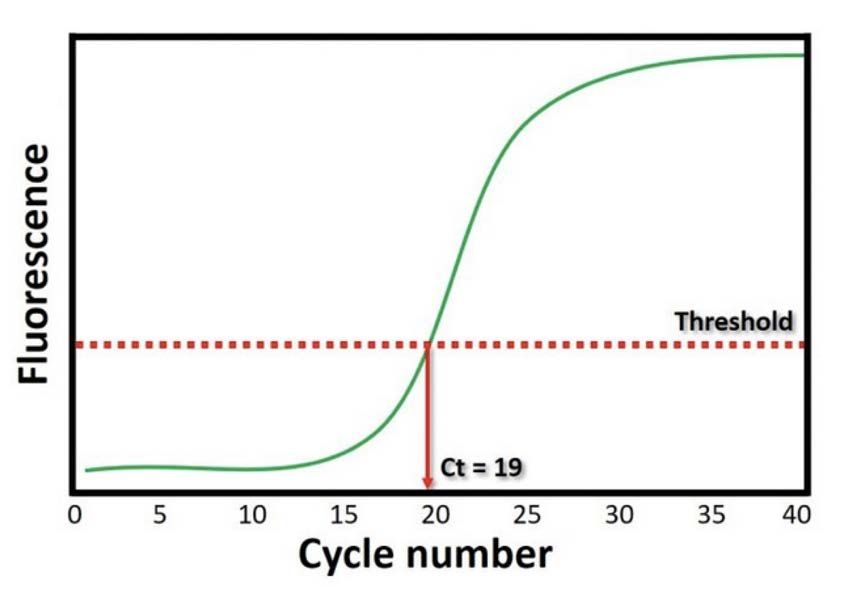
Points raised in NY Times article
• Standard tests diagnose large numbers of people carrying insignificant
  amounts of virus.
• Most are not likely to be contagious. If Ct >33, virus not grown in culture.
• A cycle threshold >35 is too sensitive.
• A more reasonable cutoff is Ct 30-35 or even Ct 35.
• In MA, 85-90% of positives in July had Ct >30.
• Cycle threshold is never included in the results sent to clinicians.
• For outbreak tracing, cheap and abundant rapid tests are needed, even if
  less sensitive
The basics of Ct values
  Correlation with amount of virus in sample
What is a cycle threshold (Ct) value? The cycle of
   amplification that the fluorescence crosses the threshold to positive.
   The Ct value correlates with viral load. A lower Ct value indicates a
   higher viral load in the sample, and vice versa.

PCR commonly uses 40 cycles
of amplification, and each cycle
doubles the target DNA.
3.3 cycles = a 10-fold change

In Real-time PCR, a fluorescence signal
emitted during amplification can be seen
“in real time”, and can provide Ct values.
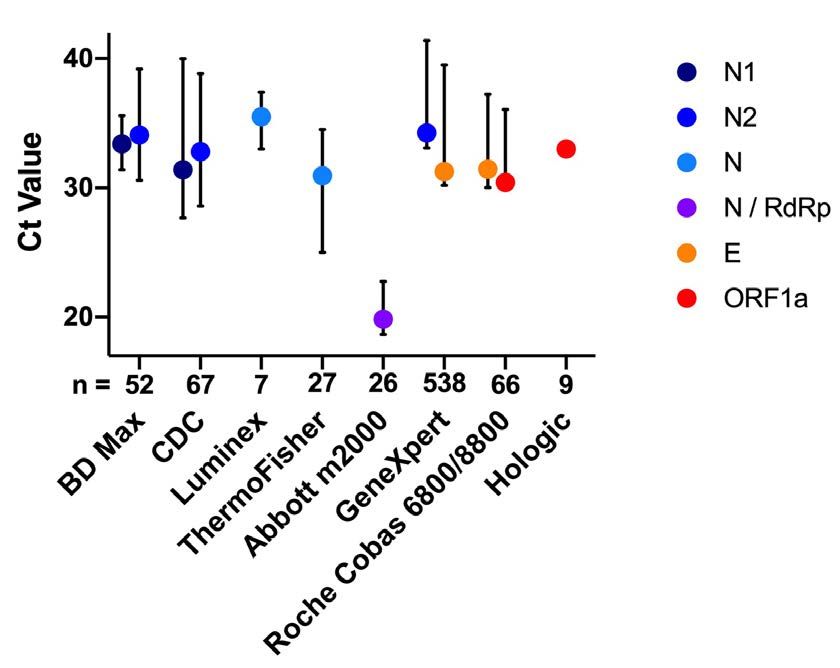
How consistent are Ct values?
  Ct values vary 3-12 cycles
  within and between viral
  gene targets, PCR tests
  and Labs.
  Rhoads D, Peaper DR, She RC, et al. College of
  American Pathologists (CAP) Microbiology
  Committee Perspective: Caution must be used in
  interpreting the Cycle Threshold (Ct) value [published
  online ahead of print, 2020 Aug 12]. Clin Infect Dis.
  2020;ciaa1199. doi:10.1093/cid/ciaa1199

Note: Similar variations can be seen with quantitative viral loads in copies/ml.
What are the Ct value cutoffs for the
  6 SARS CoV-2 tests offered at YNHH?
Test                          Method                     Cycle       Lab can        SARS CoV-2 Gene
                                                         threshold   access in      targets
                                                         cutoffs     EPIC Beaker
CDC- lab developed            Real-time RT-PCR
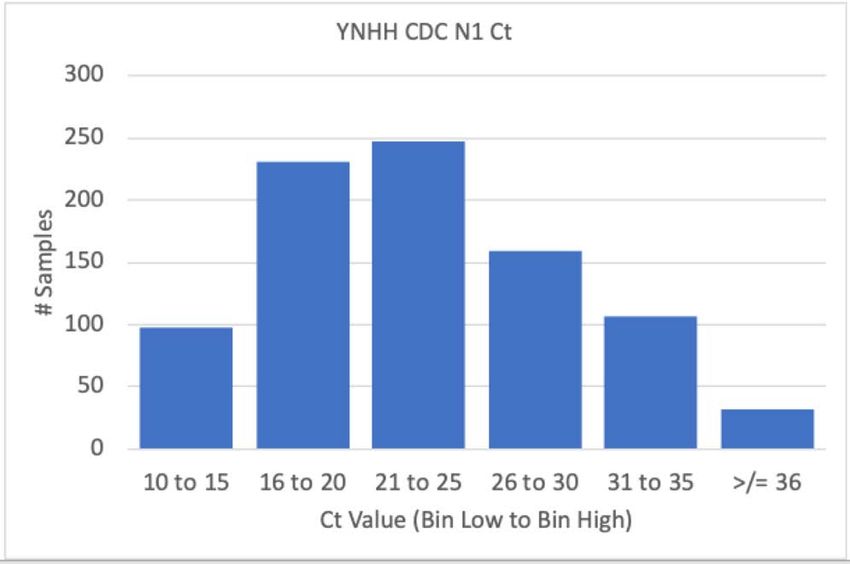
What is the distribution of Ct
values at YNHH?
Should we report not report results of Ct >30 or Ct >35?Onset of Pandemic: Ct value distribution
3/13-4/4 for admitted symptomatic patients
CDC assay used
1,016 positive (2 genes) or
inconclusive (1 gene)
~14% had Ct > 30
All were acute infections
requiring hospitalization
Obtaining the most sensitive
result was deemed essential
Graph courtesy D. PeaperCase example: Diagnosis of acute infection • 43 year old, with fever, cough, SOB for 8 days. Presented to ED at outside hospital. • CXR showed ground glass opacities • SARS CoV-2 RT-PCR negative [GeneXpert] • Sent home • Patient returned to 2 days later with worsening SOB and O2 sats • SARS CoV-2 RT-PCR positive [CDC assay] • Ct values: 35.2 N1 /37.7 N2 • Patients with pneumonia may have little virus in upper airway and using a sensitive assay is essential. • PCR of sputum or BAL preferred, but often not available.
Case example 2: Low and rising viral load
• 66 year old with hypertension, diabetes, on dialysis, anemic, admitted
  with weakness, no fever, no cough or SOB.
• Patient improved. SARS CoV-2 RT-PCR was ordered prior to discharge
  to a SNF, and was “inconclusive" with only 1 or 2 genes positive.
• Serial PCR results over 10 days shown:     PCR day  Ct value N1 Ct value N2
                                                          gene        gene
• Patient remained without symptoms
• If less sensitive test was used, diagnosis Day 0      Negative      38.4

  would have been missed and patient         Day 2        34.6        35.4
  discharged to SNF as COVID negative        Day 5         26         25.3
                                               Day 7       15.1       14.6
                                               Day 10      18..8      18.4
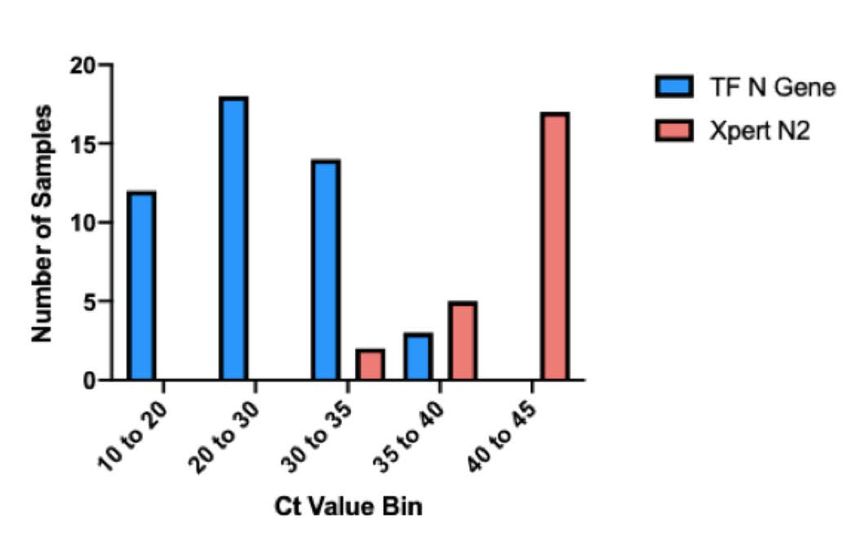
Thermofisher and Xpert RT-PCR at YNHH:
Ct values obtained from 8/11-8/31/20
Thermofisher (24 h TAT)
Used for outpatients
47 positives
17 (36.2%) Ct >30
3 (6.4%) had Ct >35
GeneXpert (2 hr TAT)
Used for admitted
patients if rapid result
needed
24 positives
24 (100%) Ct >30
17 (70.8%) had Ct >40 Graph courtesy D. PeaperHigh Ct values can diagnose acute infections
Test Category N Acute Prior Uncertainc
(gene target) Infectiona Diagnosis
Thermofisher Ct 30-34.9 14 8 (57%) 6
(N gene) Ct >35-36.9 3 1 (33%) 2
Xpert Ct 30-34.9 2 2 (100%)
(N2 gene) Ct >35-39.9 5 2b (40%) 3
Ct >40-44.9 17 0 (0%) 8 9
a, Some symptomatic or COVID-exposed patients on initial diagnosis had high Ct values, sometimes due to
delays in being able to obtain testing.
b, One patient in hypoxic respiratory failure and admitted from ED to ICU had Xpert Ct value = 37.2
c, No symptoms, no prior diagnosis, no reported exposures. Either past infection (most likely) or false positive.Proposed: Addition of Test Result Comments for positives Ct >30 to assist interpretation • Low positive: This sample was positive with a Ct 30-34.9. A low positive can be seen either very early or later in infection, with suboptimal sample collection, or with lower respiratory tract disease. • Very low positive: This sample was positive with a Ct >35-39.9. A low positive can be seen either very early or later in infection, with suboptimal sample collection, or with lower respiratory tract disease. • Borderline positive: This sample was positive with a Ct >40-44.9. A borderline positive is most likely due to recent past infection, but rarely could be a very early infection, or a false positive.
Conclusion: Response to NY Times article from the
perspective of a hospital COVID testing laboratory
 • Highly sensitive tests are essential for acutely ill hospitalized patients as virus
   titers in the upper airway may be low (Ct >30 or Ct >35). However, recovering
   patients, now non-infectious, may also have a very low positive PCR result.
 • For diagnostic testing in the community, delays in obtaining testing, as well as
   sample type and quality, can lead to higher Ct values at diagnosis. Not reporting
   positive results with Ct >30 would be a disservice to these patients.
 • Reporting Ct values alone can be misleading, especially since Ct values can vary
   significantly between various tests and labs. However, a result comment for low
   positive results may be helpful. Ct values >40 may be of questionable value.
 • It is essential to confirm actual test sensitivity, determine the goals of testing and
   understand the tradeoffs in various groups: e.g. asymptomatic screening,
   symptomatic patients, pre procedure, L&D, high risk nursing home residents.
 • Tests with rapid but somewhat less sensitive results may be acceptable in some
   outpatient settings, especially when frequent repeat testing is performed.
You can also read


