2014 Resolution Plan for Citigroup Inc. & Citibank, N.A - Public Section June 30, 2014
←
→
Page content transcription
If your browser does not render page correctly, please read the page content below
Citi §165(d) & IDI Resolution Plan

  2014 Resolution Plan for
Citigroup Inc. & Citibank, N.A.

          Public Section

           June 30, 2014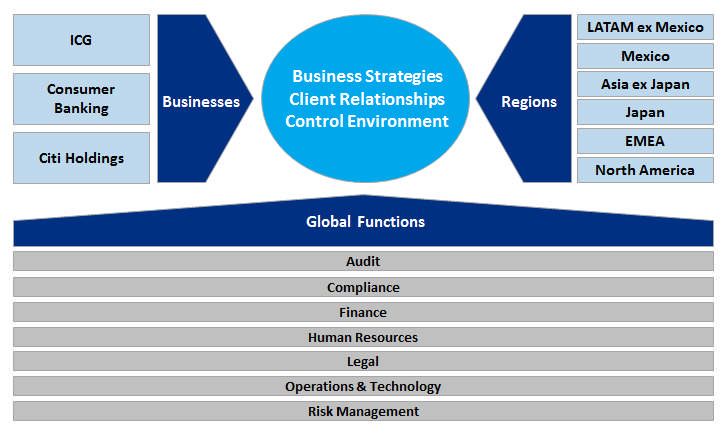
Citi §165(d) & IDI Resolution Plan

Table of Contents

I. SUMMARY OF 2014 RESOLUTION PLAN .................................................................................... 3

A. The Names of Material Entities                                                                                      6

B. Description of Core Business Lines                                                                                  7

C. Summary Financial Information Regarding Assets, Liabilities, Capital and Major Funding Sources                     10

D. Description of Derivative and Hedging Activities                                                                   15

E. Memberships in Material Payment, Clearing and Settlement Systems                                                   17

F. Description of Foreign Operations                                                                                  19

G. Material Supervisory Authorities                                                                                   23

H. Principal Officers                                                                                                 24

I. Resolution Planning Corporate Governance Structure and Processes                                                   25

J. Description of Material Management Information Systems                                                             27

K. High-Level Description of Resolution Strategy                                                                      29
Citi §165(d) & IDI Resolution Plan

[THIS PAGE INTENTIONALLY LEFT BLANK]
Citi §165(d) & IDI Resolution Plan
I. Summary of 2014 Resolution Plan
Citi continues to implement a focused, client-oriented business strategy. In a challenging
macroeconomic environment, we also continue to respond to the high and still rising regulatory
standards of the post crisis financial services landscape. As a result of significant actions undertaken
during and since the financial crisis, Citi today is a simpler, smaller, safer and stronger institution.
Simpler: Citi has returned to the basics of institutional and consumer banking and is focused on
generating consistent, quality earnings to create shareholder value.
Smaller: Citi has completed more than 60 divestitures of businesses not core to our strategy, reducing
Citi Holdings’ assets by nearly $700 billion, while also reducing the remaining portfolio’s drag on
earnings. These non-core assets now represent only 6% of Citi’s balance sheet and the company is
committed to continuing to shed the remaining assets in an economically rational manner.
Safer: Safety and soundness are our license to do business, and we continue to strengthen risk
management and invest in our controls infrastructure and processes through close collaboration
between our Risk, Finance, Compliance, and Operations and Technology functions as well as our
businesses.
Stronger: Citi is one of the best capitalized banks in the world. At the end of 1Q 2014, our Tier 1
Common capital ratio stood at an estimated 10.5% on a Basel III basis, and we maintain a strong balance
sheet with keen focus on asset quality, robust capital, liquidity and loan loss reserves.
Citi’s leadership remains confident in the firm’s ability to withstand the impact of a wide range of severe
stress scenarios while continuing to provide financial services to customers and markets. Despite the
challenging operating environment for all banking institutions throughout the past year, Citi has
demonstrated the resiliency of its franchise and ability to perform. Key indicators of “Citi’s financial
strength” include: 1
Robust liquidity levels and a strong capital base
o $424.8 billion in high quality liquid assets; Basel III Liquidity Coverage Ratio (LCR) estimated
at 120%2
o Estimated Basel III Tier 1 Common Ratio of 10.5%3
1
All information as of March 31, 2014.
2
“High quality liquid assets” generally are defined as available cash at central banks and unencumbered liquid securities; the
estimate LCR is based on Citi’s current interpretation of the definition of “high-quality liquid assets” under the Basel Committee
on Banking Supervision’s final Basel III Liquidity Coverage Ratio rules.
3
Citi’s estimated Basel III Tier 1 Common Ratio and estimated Basel III Supplementary Leverage Ratio and certain related
components are non-GAAP financial measures. Citi’s estimated Basel III Tier 1 Common Ratio is based on the “Advanced
Approaches” for determining total risk-weighted assets. Citi’s estimated Basel III ratios and related components are based on its
current interpretation, expectations and understanding of the final U.S. Basel III rules and are subject to (among other possible
reasons for revision) ongoing regulatory review, regulatory approval of Citi’s credit, market and operational Basel III risk models
(as well as its market risk models under Basel II.5), additional refinements, modifications or enhancements (whether required
or otherwise) to Citi’s models, and further implementation guidance from the Basel Committee or U.S. regulators. Any
modifications or requirements resulting from these ongoing reviews or from the continued implementation of Basel III in the
Page 3Citi §165(d) & IDI Resolution Plan
o Estimated Basel III Supplementary Leverage Ratio of 5.6%3
High credit quality and a well-reserved portfolio
o Favorable credit trends and a highly diversified portfolio
o Loan loss reserves totaling 2.9% of all loans
Disciplined ongoing balance sheet management, with Citi remaining significantly smaller today
than it was before the 2007-2008 crisis
Progress in improving quality and consistency of earnings, with Citicorp loan growth up 7% in
the 1st quarter 2014 over the prior year
With Citi’s increased financial strength and liquidity and its client-oriented business model, it is highly
unlikely that a resolution of the company would ever be required. The strength of Citi’s balance sheet
also expands the range of options available for resolving Citi, should doing so ever become necessary,
offering regulators flexibility in choosing a resolution strategy that minimizes adverse impact on
customers and U.S. financial stability. For example, Citi’s strong capital and liquidity positions mean that
regulators will have the ability, without putting taxpayer funds at risk, to require the recapitalization of
Citi’s banking entities, permitting them to serve their clients without systemic disruption. Such a
recapitalization—which would result in new management and ownership—could be undertaken even in
a failure scenario involving severe losses. Citi’s capital and liquidity levels are also sufficient to wind-
down portions of Citi’s business or, in the event of an extremely unlikely economic catastrophe, the
entire firm, while mitigating systemic disruption.
Against this background, Citi is pleased to submit its 2014 Resolution Plan (Resolution Plan) to the
Federal Deposit Insurance Corporation (FDIC) and the Board of Governors of the Federal Reserve System
(Federal Reserve). The Resolution Plan covers Citigroup Inc. (Citigroup Parent), the parent holding
company, and its subsidiaries and affiliates (collectively, Citi) as required by the final rules adopted by
the Federal Reserve and the FDIC pursuant to Section 165(d) of the Dodd-Frank Act (165(d) Rule). This
Resolution Plan also covers Citibank, N.A. (CBNA) as required by the final rules adopted by the FDIC for
certain insured depository institutions (IDI Rule).
The preparation of Citi’s Resolution Plan entailed a rigorous, enterprise-wide process involving Citi’s
senior-most management across Citi's businesses, Operations and Technology (O&T), Risk, Finance and
Legal functions, as well as the Citigroup Parent and CBNA Boards of Directors. In this Public Section, in
accordance with regulatory instruction, Citi is providing the information on the following subjects:
A. Citi’s Material Legal Entities (MLEs) (defined below)
B. Citi’s Core Business Lines (CBLs) (defined below)
C. Summary financial information regarding assets, liabilities, capital and major funding sources
D. Citi’s derivative and hedging activities
E. Memberships in material payment, clearing and settlement systems
U.S. could result in changes to Citi’s risk-weighted assets or other elements involved in the calculation of Citi’s Basel III ratios,
which could negatively impact Citi’s capital ratios and its ability to achieve its capital requirements as it projects or as required.
Page 4Citi §165(d) & IDI Resolution Plan
F. Citi’s foreign operations
G. Citi’s material supervisory authorities
H. Citi’s principal officers
I. The resolution planning corporate governance structure and process related to resolution
planning
J. Citi’s material management information systems
K. Citi’s resolution strategy, including such items as the range of potential purchasers of the
company’s businesses and legal entities
As described in more detail in Part K, Citi’s Resolution Plan demonstrates that Citi can be resolved, if
necessary, under Title I of the Dodd-Frank Act without adverse systemic impact or use of taxpayer
money, either through a recapitalization of CBNA by Citigroup Parent or through a wind-down or sale in
an orderly manner. The Resolution Plan also includes a summary of the reasons Citi could readily be
resolved under Title II of the Dodd-Frank Act without the use of taxpayer funds, based on the Title II
”Single Point of Entry” (SPOE) recapitalization approach described by U.S. regulators.
Page 5Citi §165(d) & IDI Resolution Plan
A. The Names of Material Entities
The final rules implementing Section 165(d) of the Dodd-Frank Act define CBLs as those business lines—
including associated operations, services, functions and support—that upon failure would result in a
material loss of revenue, profit or franchise value of Citi or CBNA. As described in Part B, Citi identified
its CBLs based on several factors. Using these CBLs as the foundation for its analysis, Citi identified its
MLEs according to the definition provided by the rules, which includes an entity—including a subsidiary
or foreign office—that is significant to the activities of a CBL.
At the most basic level, Citi’s legal entity structure consists of:
1. Banking activities conducted by CBNA;
2. Capital markets and banking activities conducted by Citi’s separately capitalized broker-dealers;
and
3. O&T activities conducted by select subsidiaries
The chart below lists these MLEs; two additional MLEs were identified for the 2014 Plan and included in
the Exhibit below. All of CBNA’s MLEs are also MLEs for Citi.
Citigroup Inc.
(Citigroup Parent)
Banks Broker-Dealers Service / Operational Subsidiaries
Citibank, N.A. Citigroup Global Markets Inc. HoldCo Subsidiaries
Primary Insured Depository Institution Citigroup Global Markets Limited – UK Citigroup Technology Inc.
Citigroup Global Markets Japan Inc. – Japan Citishare Corporation
Citigroup Management Corporation
Branches of CBNA Citigroup Services Japan Ltd.
CBNA London – UK
CBNA Dublin – Ireland Bank Subsidiaries
CBNA Singapore – Singapore Citicorp Credit Services, Inc. (NY)
CBNA Hong Kong – Hong Kong Citicorp Credit Services, Inc. (USA)
CBNA Bahamas – Bahamas CitiMortgage, Inc.
CBNA ROHQ – Philippines Citi Business Services Costa Rica
CBNA Frankfurt – Germany Citicorp Services India Limited
Citigroup Technology Infrastructure (Hong
Kong) Limited
Subsidiaries of CBNA
Citibank International plc – UK
Citibank Europe plc – Ireland
Citibank Japan Ltd. – Japan
Citibank Singapore Limited – Singapore
Citibank (Hong Kong) Ltd. – Hong Kong
Banamex – Mexico
Page 6Citi §165(d) & IDI Resolution Plan
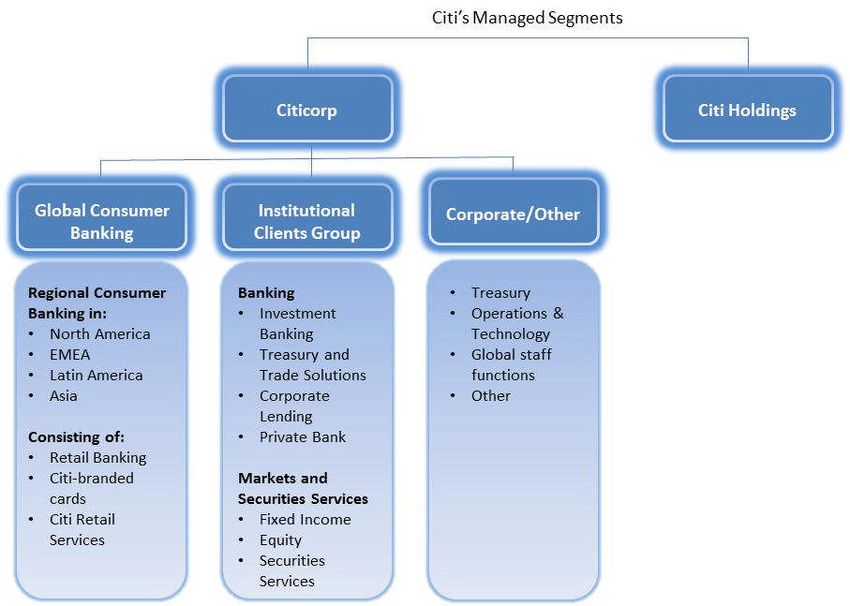
B. Description of Core Business Lines
As part of Citi’s restructuring five years ago, the company’s organization was simplified to improve and
streamline management of its businesses. Today Citi is organized into two primary segments:
Citicorp consists of Citi’s Global Consumer Banking businesses and Institutional Clients Group,
the business segments core to Citi’s strategy. Citicorp also includes Corporate/Other, which
consists of global staff functions (including Finance, Risk, Human Resources, Legal and
Compliance), other corporate expense and global O&T expenses, Citi Corporate Treasury,
corporate items, and discontinued operations.
Citi Holdings, established in 2009, consists of those businesses and assets no longer central to
Citi’s strategy. The assets in Citi Holdings are in the process of being sold off or wound down in
an economically rational way.
In late 2013, Citi further streamlined the structure of the Institutional Clients Group, by removing a
management layer in Securities & Banking and Transaction Services, which now operate in a more
integrated manner with an enhanced emphasis on client service. To reflect these changes, beginning
with Citi’s first-quarter 2014 earnings announcement, Treasury and Trade Solutions, Capital Market
Origination and Corporate & Investment Banking are now reported as part of Banking, while Markets
and Securities Services are reported together.
As noted in Part A above, CBLs are defined as those business lines—including associated operations,
services, functions and support—that upon their failure would result in a material loss of revenue, profit
Page 7Citi §165(d) & IDI Resolution Plan
or franchise value of Citi or CBNA. In developing the list of Citi’s CBLs for resolution planning purposes,
we began with the businesses in Citicorp, those core to Citi’s strategy. The analysis then incorporated
the following quantitative and qualitative criteria:
Total assets, revenue and earnings;
Market share and/or industry position;
The customer base, geographic footprint, brand and operational synergies of the business with
other Citi businesses;
Growth outlook;
The attractiveness of the business to competitors as a potential acquisition; and
Maintenance of franchise value even in a resolution scenario.
Based on the final rules under the Dodd-Frank Act and the above criteria, Citi has identified the
following businesses as CBLs for the purposes of Citi’s resolution planning only. In serving clients and
guiding Citi’s ongoing operations, the company remains managed through three main business lines:
Banking, Markets & Securities Services and Global Consumer Banking.
Each CBL is conducted through one or more MLEs identified in Part A. The CBLs for CBNA are all CBLs for
Citi as well. Global Consumer Banking – Mexico is the only CBL for Citi that isn’t a CBL for CBNA (because
Banamex is a subsidiary of Citigroup Parent that is separate from CBNA). Citi’s Resolution Plan
addresses the resolution of each of these CBLs as required by the U.S. regulators. As part of Citi’s
ongoing strategic and financial planning activities, the list of Citi’s CBLs will be subject to ongoing
evaluation and possible revision.
Banking Core Business Lines
The Global Payments business offers four key payment activities to
clients of Citi’s Institutional Clients Group: (i) same currency
Global Payments
payments; (ii) cross-currency payments; (iii) Continuous Linked
Settlement; and (iv) Automated Clearing House Payments
Liquidity Management Services provides liquidity management
Liquidity Management Services services and short-term investment products to clients of Citi’s
Institutional Clients Group
Debt Capital Markets originates, structures, and syndicates securities
Debt Capital Markets
and financing transactions in debt capital markets
Corporate Portfolio Corporate Portfolio Management is the corporate loan portfolio that
Management is part of Citi’s Corporate and Investment Banking business.
Page 8Citi §165(d) & IDI Resolution Plan
Markets and Securities Services Core Business Lines
Municipal Securities Division offers client services that include U.S.
public sector capital-raising and advisory services, project financing
Municipal Securities Division
and multifamily affordable housing financing. Clients are also offered
secondary trading in municipal securities and derivatives
Global Foreign Exchange/Local Markets includes foreign exchange
Global Foreign Exchange/Local
spot, forwards, and derivatives, as well as fixed-income rate
Markets (FX/LM)
products in emerging market countries
G10 Rates trades on behalf of clients in G10 sovereigns and agency
G10 Rates securities and derivatives, as well as secured finance products
(repos, reverse repos and securities lending)
Global Consumer Banking Core Business Lines
U.S. Branded Cards offers both proprietary and co-branded credit
cards that are originated through direct mail, apply-by-phone,
U.S. Branded Cards
mobile phone, Internet/online and Citi’s U.S. Retail Banking branch
network
U.S. Retail Services partners with major national retailers, oil
U.S. Retail Services companies and specialty retailers to provide credit card products to
their customers
U.S. Retail Banking provides traditional banking services to retail
customers and small to midsize businesses in the U.S. through a
U.S. Retail Banking
network of 962 retail bank branches as of 3/31/14 and
approximately 2,900 branch ATMs
U.S. Consumer Mortgages is a nationwide lender and servicer of
residential home mortgages and includes the mortgage assets that
U.S. Consumer Mortgages
reside in both Citicorp and Citi Holdings that are managed by
CitiMortgage
Citi’s consumer businesses in Mexico, Hong Kong, Singapore and
International Consumer Banking
Japan provide traditional banking services to retail customers and
(Mexico, Hong Kong, Singapore
small to midsize businesses, along with credit card and mortgage
and Japan)
products
Page 9Citi §165(d) & IDI Resolution Plan
C. Summary Financial Information Regarding Assets, Liabilities, Capital
and Major Funding Sources
Financial Summary – Citigroup consolidated
Net Revenue ($ millions) 1Q 2014 4Q 2013 3Q 2013 2Q 2013 1Q 2013
Global Consumer Banking 9,293 9,469 9,232 9,718 9,746
Institutional Clients Group 9,234 7,044 7,372 9,560 9,591
Corporate / Other 141 (41) 42 114 6
Citicorp 18,668 16,472 16,646 19,392 19,343
Citi Holdings 1,456 1,307 1,258 1,096 905
Total Citi 20,124 17,779 17,904 20,488 20,248
Net Income ($ millions) 1Q 2014 4Q 2013 3Q 2013 2Q 2013 1Q 2013
Global Consumer Banking 1,727 1,541 1,535 1,862 1,825
Institutional Clients Group 2,965 1,468 1,740 3,136 3,070
Corporate / Other (458) (256) 20 (229) (165)
Citicorp 4,234 2,753 3,295 4,769 4,730
Citi Holdings (283) (428) (109) (581) (799)
Continuing Operations 3,951 2,325 3,186 4,188 3,931
Discontinued Operations 37 181 92 30 (33)
Noncontrolling Interests 45 50 51 36 90
Total Citi 3,943 2,456 3,227 4,182 3,808
Citigroup Consolidated ($ billions) 1Q 2014 4Q 2013 3Q 2013 2Q 2013 1Q 2013
Total Assets 1,895 1,880 1,900 1,884 1,882
Total Liabilities 1,684 1,674 1,697 1,686 1,686
Total Equity 210 206 203 198 195
Page 10Citi §165(d) & IDI Resolution Plan
Capital Summary
Financial Ratios 1Q 2014 4Q 2013 3Q 2013 2Q 2013 1Q 2013
Estimated Basel III Tier 1 Common Ratio 10.5% 10.1% 10.5% 10.0% 9.3%
Estimated Basel III Tier 1 Capital Ratio 11.1% 10.7% 10.9% 10.4% 9.6%
Estimated Basel III Total Capital Ratio 12.5% 12.1% 13.2% 12.8% 12.3%
Estimated Basel III Supplementary Leverage Ratio 5.6% 5.4% 5.1% 4.9% N/A
Financial Summary – CBNA consolidated
Income Statement ($ millions) 2013 2012
Interest Revenue 47,728 51,013
Interest Expense 9,154 10,915
Net Interest Revenue 38,574 40,098
Non-Interest Revenue 16,883 15,980
Total Revenues 55,457 56,078
Provisions for credit losses and for benefits and claims 4,964 8,150
Operating Expenses 30,236 32,620
Income from continuing operations before income taxes 20,257 15,308
Provision for income taxes 6,193 3,386
Income from continuing operations 14,064 11,922
Income (loss) from discontinued operations, net of taxes 336 19
Net income attributable to noncontrolling interests 100 96
Net income attributable to Citibank, N.A. 14,300 11,845
Balance Sheet ($ billions) 2013 2012
Total Assets 1,347 1,313
Total Liabilities 1,198 1,165
Total Equity 148 148
Page 11Citi §165(d) & IDI Resolution Plan
Funding and Liquidity
Overview
Citi’s funding and liquidity objectives are to maintain liquidity to fund existing assets while growing our
core businesses in Citicorp to meet client needs. At the same time, we strive to maintain sufficient
excess liquidity, structured appropriately, to facilitate operating under a wide variety of market
conditions, including market disruptions for both short- and long-term periods. Citi formulates our
primary liquidity objectives according to the needs of each CBL and MLE, and in aggregate, according to
the requirements of three major categories:
the parent entity, which includes Citigroup Parent and Citi’s broker-dealer subsidiaries that are
consolidated into Citigroup (collectively referred to in this section as “parent”);
Citi’s significant Citibank entities, which consist of CBNA units domiciled in the U.S., Western
Europe, Hong Kong, Japan and Singapore (collectively referred to in this section as “significant
Citibank entities”); and
Other Citibank and Banamex entities.
At the aggregate level, Citi‘s goal is to maintain sufficient funding in amount and tenor to ensure that
customer assets are fully funded, as well as to maintain the appropriate amount of cash and high quality
liquid assets in these entities. This liquidity framework requires that entities be self-sufficient or net
providers of liquidity, including in conditions established under their designated stress tests.
Citi‘s primary sources of funding include (i) deposits via Citi‘s bank subsidiaries, which are Citi’s most
stable source of long-term funding, (ii) long-term debt (primarily senior and subordinated debt)
primarily issued at the parent and certain bank subsidiaries, and (iii) stockholders‘ equity, at both the
bank and non-bank entities. These sources may be supplemented by short-term borrowings, primarily in
the form of secured financing transactions (securities loaned or sold under agreements to repurchase,
or repos).
High Quality Liquid Assets
As referenced above, Citi works to ensure that the structural tenor of these funding sources is
sufficiently long in relation to the tenor of its asset base. The key goal of Citi’s asset/liability
management is to ensure that there is excess tenor in the liability structure so as to provide excess
liquidity after funding the assets. The excess liquidity resulting from a longer-term tenor profile can
effectively offset potential decreases in liquidity that may occur under stress. This excess funding is held
in the form of high quality liquid assets, as shown below.
Significant Citibank Other Citibank and
Parent Total
Entities Banamex Entities
1Q 4Q 1Q 1Q 4Q 1Q 1Q 4Q 1Q 1Q 4Q 1Q
In billions of dollars 2014 2013 2013 2014 2013 2013 2014 2013 2013 2014 2013 2013
Available Cash 38.8 38.4 39.3 77.1 82.6 53.6 13.3 15.6 10.4 129.2 136.6 103.3
Unencumbered
Liquid Securities 28.7 28.1 24.0 188.5 181.2 169.2 78.4 77.8 79.3 295.7 287.1 272.5
Total 67.5 66.5 63.3 265.6 263.8 222.8 91.8 93.4 89.7 424.8 423.7 375.8
Page 12Citi §165(d) & IDI Resolution Plan
Funding Sources
Deposits
Deposits are the primary funding source for Citi’s banking subsidiaries. As of March 31, 2014, deposits
stood at $966.3 billion, an increase of 3% year-over-year and largely unchanged quarter-over-quarter.
The year-over-year increase reflected, in part, elevated levels of market liquidity and strong corporate
balance sheets, in addition to underlying business growth. Excluding the impact of FX translation,
deposits grew 4% year-over-year.
Citi continues to focus on maintaining a geographically diverse retail and corporate deposit base. As of
March 31, 2014, approximately 57% of Citi’s deposits were located outside of North America, compared
to 56% on December 31, 2013 and 59% on September 30, 2013.
Long-Term Debt
Long-term debt (generally defined as debt with original maturities of one year or more) continues to
represent the most significant component of Citi’s funding for the parent entities and is a
supplementary source of funding for the bank entities.
Long-term debt is an important funding source for Citi’s parent entities owing in part to its multi-year
maturity structure. The weighted average maturities of long-term debt, issued by Citigroup Parent and
its affiliates (including CBNA), with a remaining life greater than one year (excluding trust preferred
securities), was approximately 6.8 years as of March 31, 2014—a slight decrease from the prior quarter
and prior-year period, primarily due to the slight decrease in Citi’s long-term debt issuances during the
current quarter as compared to recent periods.
Secured Financing Transactions and Short-Term Borrowings
Citi supplements its primary sources of funding with short-term borrowings when appropriate for the
company’s liquidity profile. Short-term borrowings generally include (i) secured financing (securities
loaned or sold under agreements to repurchase, or repos) and (ii) to a lesser extent, short-term
borrowings consisting of commercial paper and borrowings from the Federal Home Loan Banks and
other market participants.
Citi has significantly reduced its short-term funding from the capital markets and is today far less
dependent on this funding source than it was before the crisis, reducing sensitivity to market stresses.
Liquidity Management, Measures and Stress Testing
Citi’s aggregate liquidity resources are managed by the Citi Treasurer via both a centralized treasury
model by Corporate Treasury and by in-country treasurers. Pursuant to this structure, Citi’s liquidity
resources are managed with the goal of ensuring the proper asset/liability match and that liquidity
positions are appropriate in every country and throughout Citi. Citi’s Chief Risk Officer (CRO) is
responsible for the overall risk profile of Citi’s liquidity resources. The CRO and Chief Financial Officer
(CFO) co-chair Citi’s Asset Liability Management Committee (ALCO), which includes Citi’s Treasurer and
other senior executives. The ALCO sets the investment strategy of the liquidity portfolio and monitors its
performance. Significant changes to portfolio asset allocations need to be approved by the ALCO.
Page 13Citi §165(d) & IDI Resolution Plan
Liquidity Measures
Citi uses multiple metrics to monitor the firm’s liquidity and measures liquidity stress periods of various
lengths, with emphasis on the 30-day and 12-month periods.
In addition to internal measures that Citi has developed for a 30-day stress scenario, Citi also monitors
its liquidity by reference to the Liquidity Coverage Ratio (LCR), as calculated pursuant to the final Basel III
LCR rules issued by the Basel Committee on Banking Supervision in January, 2013. Based on Citi’s
current interpretation of the Basel Committee’s final Basel III LCR rules, Citi’s estimated LCR was
approximately 120% as of March 31, 2014, compared with approximately 117% on December 31, 2013.
The increase in the LCR during the first quarter of 2014 was primarily owing to a reduction in estimated
derivative-related outflows, and to the increase in Citi’s high quality liquid assets.
For 12-month liquidity stress periods, Citi uses several measures, including the long-term liquidity
measure. This is based on Citi’s internal 12-month, highly stressed market scenario and assumes market,
credit and economic conditions are moderately to highly stressed with potential further deterioration.
The long-term liquidity measure is broadly defined as the ratio of unencumbered liquidity resources to
net stressed cumulative outflows over a 12-month period.
Going forward Citi will continue to review the Basel Committee’s guidelines, including the
implementation of the net stable funding ratio (NSFR) issued in January, 2014, relative to the company’s
overall liquidity position.
Stress Testing
Liquidity stress testing is performed for each of Citi’s major entities, operating subsidiaries and
countries. Stress testing and scenario analyses are intended to quantify the potential impact of a
liquidity event on the balance sheet and liquidity position, and to identify viable funding alternatives
that can be utilized. These scenarios include assumptions about significant changes in key funding
sources, market triggers (such as credit ratings), and potential uses of funding and political and
economic conditions in certain countries. These conditions include standard and stressed market
conditions as well as firm-specific events.
A wide range of liquidity stress tests are important for monitoring purposes. Some span liquidity events
over a full year, some may cover an intense stress period of one month, and still other timeframes may
be used as appropriate. These potential liquidity events are useful to ascertain potential mismatches
between liquidity sources and uses over a variety of horizons (overnight, one week, two weeks, one
month, three months, one year), and liquidity limits are set accordingly. To monitor the liquidity of a
unit, those stress tests and potential mismatches may be calculated with varying frequencies, with
several important tests performed daily. Given the range of potential stresses, Citi maintains a series of
contingency funding plans on a consolidated basis as well as for individual entities. These plans specify a
wide range of readily available actions that are available in a variety of adverse market conditions, or
idiosyncratic disruptions.
For a more detailed discussion of Citi’s funding and liquidity, see Citi’s 2013 Annual Report on Form 10-K
(2013 Form 10-K) and First Quarter 2014 Quarterly Report on Form 10-Q (1Q14 Form 10-Q) filed with
the U.S. Securities and Exchange Commission (SEC).
Page 14Citi §165(d) & IDI Resolution Plan
D. Description of Derivative and Hedging Activities
Overview
In the ordinary course of business, Citi provides clients with various services and products, including
derivatives, to help manage their risks. Citi uses similar services and products to manage its own risks as
part of its commitment to the ongoing safety and soundness of the company.
Customer Needs
In order to meet the needs of its clients, Citi includes an appropriate range of derivatives in its product
offerings. Citi’s clients require a wide variety of risk management strategies, such as the need to
transfer, modify or reduce interest rate, foreign exchange and other market/credit risks, as well as
products for the clients’ own permissible trading purposes.
Citi has controls in place to evaluate whether a particular product or strategy is appropriate for a given
client. As part of this process, Citi considers the risks associated with the transaction, as well as the
client’s business purpose for the transaction. Citi also oversees the activities associated with managing
the possible risks undertaken in the course of offering derivatives to clients, such as booking offsetting
trades. This oversight includes (i) centralized price verification; (ii) credit, market, operational, and
stress and accounting limits; and (iii) frequent reporting of risks and stress results to senior managers
and periodically to the Risk Management and Finance Committee of Citigroup Parent’s and CBNA’s
Board of Directors.
Hedging
As part of its commitment to manage the safety and soundness of the company, Citi utilizes a variety of
strategies to manage certain risks that arise in the normal course of the firm’s banking activities. These
risks include:
Interest rate risk: natural mismatches can occur owing to interest rate differentials between
cash flows resulting from asset and liability businesses.
Credit risk: Citi uses products designed to hedge credit exposures to clients, to limit losses from
exposures to groups of similar client types, or to limit losses from exposures to certain countries
or regions.
Foreign exchange risk: products are used to manage exposures to currency fluctuations related
to investments made in non-U.S. subsidiaries or other non-U.S. dollar assets.
Client facilitation risk: client product offerings may include inherent balance sheet risk for Citi.
Citi’s risk reduction strategies include the use of derivatives which are subject to strict controls, including
a comprehensive set of policies and controls that specify the permitted use of Citi’s legal entities and
products, documentation, collateral management and risk limits. Independent Risk Management
provides oversight for the adherence to the credit, market, operational, stress and accounting limits that
Citi has implemented. Independent Risk Management also develops and conducts regular stress tests to
ensure compliance with the specified risk tolerances.
Page 15Citi §165(d) & IDI Resolution Plan
Please see Citi’s 2013 Form 10-K and 1Q14 Form 10-Q for a detailed discussion of Citi’s derivative and
hedging activities.
Page 16Citi §165(d) & IDI Resolution Plan
E. Memberships in Material Payment, Clearing and Settlement
Systems
Financial market utilities (FMUs) such as payment systems, exchanges, depositories and clearinghouses
are key components of the financial markets infrastructure. These FMUs serve to link together Citi’s
global network, which is the foundation of the firm’s mission to meet the financial services needs of
large multinational clients and our retail, private banking, commercial, public-sector and institutional
clients around the world. Similar to other large financial institutions, Citi participates and maintains
membership in a number of payments, clearing and settlement systems, virtually all of which are subject
to regulatory supervision and local licensing requirements.
Citi’s Payments Systems Risk Management group (PSRM) provides a consistent framework for assessing,
measuring, approving, monitoring, reporting and mitigating risks related to FMUs. Payments systems
risk is the risk to earnings or capital arising from Citi’s involvement with FMUs that facilitate the transfer
of value by providing trading, payments, clearing, settlement or depository services. Such services
include funds transfer systems; securities and derivatives clearinghouses; securities depositories;
consumer networks; and other FMUs that serve as equity, fixed income or derivatives exchanges. Listed
below are some of the material systems to which Citi belongs:
Payments FMUs
Clearing House Automated Payment System (CHAPS)
Clearing House Interbank Payments System (CHIPS)
CLS Bank International (CLS)
Electronic Payments Network (EPN)
Fed ACH Services (FedACH)
Fedwire Funds Service
Foreign Exchange Yen Clearing Systems (FXYCS)
Hong Kong Dollar Clearing House Automated Transfer System (HKD-CHATS)
Sistema de Pagos Electronico Interbancario (SPEI)
Target2
Clearing and Settlement FMUs
Chicago Mercantile Exchange (CME)
CREST
The Depository Trust Company (DTC)
Eurex Clearing AG (Eurex)
Euroclear Bank SA (Euroclear)
Fedwire Securities Services
Fixed Income Clearing Corporation (FICC)
Page 17Citi §165(d) & IDI Resolution Plan
ICE Clear Europe
LCH.Clearnet Ltd. (LCH)
National Securities Clearing Corporation (NSCC)
International Messaging Utility
Society for Worldwide Interbank Financial Telecommunication (SWIFT)
Page 18Citi §165(d) & IDI Resolution Plan
F. Description of Foreign Operations
Citi provides banking products and services that support economic activity in the United States and
around the world. The foreign operations of Citi's Banking and Markets & Securities Service business
segments help U.S. companies pursue business opportunities outside the United States, and provide a
full suite of banking services—including payments, lending and capital markets—that help to develop
and sustain their international activities. These foreign operations also serve governments and non-
profits, as well as local businesses and multi-national companies, by providing international financing
and payments services. Citi's Global Consumer Business segment serves consumers with local and
international banking services in 35 countries.
Citi's international services for U.S. corporations and other institutional and global clients include
deposit taking, payments, FX, trade finance, lending, custody, and capital markets. Citi's network
enables the international activities of these clients by linking their various international locations
through effective management of liquidity and facilitation of financial flows and other financial
transactions—including, for example, the payment of employees outside the U.S. and the hedging of
foreign currency exposures across as many as 100 countries for some U.S. corporations. Citi's network
in turn connects the various international hubs of these multinationals to their respective suppliers and
customers, enabling commercial activity by facilitating payments and disbursements, trade finance and
balance sheet hedging. Citi scales its international network, both in terms of locations and capabilities,
to match the needs of these clients.
International Governance
Citi maintains a strong global framework of governance, management and oversight of the activities
conducted in each country; supervision is effected by senior management in the product areas, the
regions and the global function managers, as depicted below:
Page 19Citi §165(d) & IDI Resolution Plan
This international franchise management structure (IFM) is designed to ensure that a core set of
processes, procedures, and guidelines govern Citi’s international franchise. IFM plays an important role
in balancing local franchise governance and management with overall institutional objectives by helping
align local franchise objectives with global platforms and strategies.
As illustrated above, in every country where Citi has facilities, there is a Citi Country Officer (CCO) that
serves as the lead representative of Citi in that country. The CCO’s responsibilities include protecting
the Citi franchise and reputation, hosting Country Risk Management, managing regulatory relationships,
ensuring appropriate controls (legal entity, compliance, legal and audit) are in place, managing liquidity
and escalating any issues to senior regional management
Page 20Citi §165(d) & IDI Resolution Plan
Financial Overview
In the first quarter of 2014, more than half of Citicorp’s revenue and income was earned from banking
operations outside of North America.4 In connection with Citi’s efforts to maintain a diversified
portfolio, Citi limits its exposure to any one geographic region, country or individual creditor and
monitors this exposure on a continuing basis. The following table shows a breakdown of Citicorp's
financial results by geographic region for the first quarter of 2014.
Income from Continuing
Revenue Average Assets
Geographic Region Operations
$ Million % $ Million % $ Billion %
North America 8,341 45% 2,309 55% 629 35%
EMEA 3,129 17% 794 19% 301 17%
Latin America 3,370 18% 652 15% 178 10%
Asia 3,687 20% 937 22% 347 20%
Other Corp 141 1% (458) -11% 318 18%
Total Citicorp 18,668 100% 4,234 100% 1,773 100%
Percentages may not total 100% due to rounding.
Europe, Middle East, and Africa (EMEA)
EMEA includes a diverse mix of developed and emerging markets. Citi’s principal operations are in the
UK, which during the first quarter of 2014, accounted for more than 43% of Citicorp’s revenues in EMEA
(about 7% of Citi's total net revenue). The following table shows a breakdown of EMEA's financial results
by business segment for the first quarter of 2014.
Income from Continuing
Revenue Average Assets
Business Segment Operations
$ Million % $ Million % $ Billion %
Institutional Clients Group 2,782 89% 779 98% 292 97%
Global Consumer Banking 347 11% 15 2% 9 3%
Percentages may not total 100% due to rounding.
Latin America
Citi has provided banking services in Latin America5 since 1904, when the firm started operations in
Panama. Citi’s most prominent operations in Latin America are in Mexico, where its subsidiary bank,
Banamex, is the country’s second largest bank, with more than 1,600 branches. During the first quarter
of 2014, Mexico accounted for 55% of Citicorp’s revenues in Latin America (about 9% of Citi's total net
revenue). The following table shows a breakdown of Latin America's financial results by business
segment for the first quarter of 2014.
4
North America includes the U.S., Canada and Puerto Rico.
5
Latin America includes Mexico.
Page 21Citi §165(d) & IDI Resolution Plan
Income from Continuing
Revenue Average Assets
Business Segment Operations
$ Million % $ Million % $ Billion %
Institutional Clients Group 1,102 33% 341 52% 98 55%
Global Consumer Banking 2,268 67% 311 48% 80 45%
Percentages may not total 100% due to rounding.
Asia (Asia Pacific and Japan)
Citi's legacy in the Asia Pacific region dates back more than a hundred years. Asia is composed of Asia
Pacific and Japan (which for management purposes is a separate region reporting to NY headquarters).
The following table includes a breakdown of Asia's financial results by business segment for the first
quarter of 2014.
Income from Continuing
Revenue Average Assets
Business Segment Operations
$ Million % $ Million % $ Billion %
Institutional Clients Group 1,792 49% 556 59% 217 63%
Global Consumer Banking 1,895 51% 381 41% 130 37%
Percentages may not total 100% due to rounding.
The Resolution Plan addresses how Citi’s non-U.S. operations would be impacted in the event of the
failure of the Citigroup Parent, including how Transaction Services/Payments could continue to process
payments for customers.
Page 22Citi §165(d) & IDI Resolution Plan
G. Material Supervisory Authorities
Overview
Citi is subject to regulation under U.S. federal and state laws, as well as applicable laws in the other
jurisdictions in which the company does business.
Holding Company Supervision
As a registered bank holding company and financial holding company, Citi is regulated and supervised by
the Federal Reserve.
Subsidiary Banks
Citi’s nationally chartered subsidiary banks, including CBNA, are regulated and supervised by the Office
of the Comptroller of the Currency (Comptroller) while Citi’s state-chartered depository institutions are
overseen by the relevant state banking departments and the FDIC. The FDIC also has enforcement
authority for banking subsidiaries whose deposits it insures. In addition, the FDIC has established the
Office of Complex Financial Institutions (OCFI), which is particularly focused on the recovery and
resolution of large banks. Overseas branches of CBNA are regulated and supervised by the Federal
Reserve and Comptroller and overseas subsidiary banks are regulated and supervised by the Federal
Reserve.
Overseas branches and subsidiary banks are also regulated and supervised by regulatory authorities in
the host countries.
Broker-Dealers
Citi conducts securities underwriting, brokerage and dealing activities in the U.S. through its ownership
of Citigroup Global Markets Inc. (CGMI), its primary broker-dealer. CGMI is registered as a broker-dealer
and as an investment adviser with the SEC, and as a futures commission merchant and commodity pool
operator with the U.S. Commodity Futures Trading Commission (CFTC). CGMI is also a member of the
New York Stock Exchange (NYSE) and other principal U.S. securities exchanges, as well as the Financial
Industry Regulatory Authority (FINRA). CGMI is also a primary dealer in U.S. Treasury securities and a
member of the principal U.S. futures exchanges.
Outside the U.S., Citi conducts similar securities activities, principally through its ownership of Citigroup
Global Markets Limited (CGML) in London, which is authorized and regulated principally by the UK
Prudential Regulation Authority and the UK Financial Conduct Authority, and Citigroup Global Markets
Japan Inc. (CGMJ) in Tokyo, which is regulated principally by the Financial Services Agency of Japan.
Page 23Citi §165(d) & IDI Resolution Plan
H. Principal Officers
Principal Officers of Citigroup Inc.
Francisco Aristeguieta, CEO, Latin America
Stephen Bird, CEO, Asia Pacific
Don Callahan, Head of Enterprise Operations & Technology, Chief Operations and Technology
Officer
Michael Corbat, Chief Executive Officer
James Cowles, CEO, Europe, Middle East and Africa
James Forese, Co-President; CEO, Institutional Clients Group
John Gerspach, Chief Financial Officer
Brian Leach, Head of Franchise Risk and Strategy
Paul McKinnon, Head of Human Resources and Talent
Barbara Desoer, CEO, CBNA
Manuel Medina-Mora, Co-President; CEO, Global Consumer Banking; Chairman, Mexico
William Mills, CEO, North America
Jeffrey Walsh, Controller and Chief Accounting Officer
Rohan Weerasinghe, General Counsel and Corporate Secretary
Principal Officers of CBNA
Ricardo Arroyo, CFO
Edith Ginsberg, Head, Human Resources
Barbara Desoer, CEO
Loretta Moseman, Treasurer
Kathryn Reimann, Chief Compliance Officer
Michael Roberts, Chief Lending Officer
Anita Romero, General Counsel
Patrick Ryan, CRO
Jagdish Rao, Chief Technology Officer
Page 24Citi §165(d) & IDI Resolution Plan
I. Resolution Planning Corporate Governance Structure and Processes
Corporate governance and management oversight are fundamental to Citi’s resolution planning
processes and are conducted through a network of Board of Director and senior management
committees, legal entities, and business line management structures, and key functions. This network
works together to support the development and implementation of Citi’s resolution planning
submission.
As noted in Part H, CBNA is operated through a distinct governance and management structure with a
dedicated CEO. In addition, CBNA is overseen by a separate Board comprised of nine Directors, seven of
whom are independent directors (i.e. not members of the management team). This governance
framework plays a significant role in reinforcing the safety and soundness of CBNA.
Citi has significant resources across its corporate center, functions, businesses and geographies
deployed against Resolution Planning. More than 500 individuals across the company contribute to the
plan.
As shown in the chart below, Citi has established executive management oversight for the resolution
planning process and created a formal senior management working group to manage and implement
the planning and development process.
The working group is comprised of senior executives and includes the participation of such functions as
Risk, Finance, Treasury, Legal, Compliance, the Regulatory Reform Steering Committee as well as CBNA;
Page 25Citi §165(d) & IDI Resolution Plan
the group is also supported by an extended team of executives throughout the organization. This
working group is overseen by the Resolution Senior Advisors whose mandate is to provide senior-level
guidance on Resolution Plan development and execution. These Senior Advisors provide regular
updates to members of Citi’s Recovery and Resolution Planning Committee (RRPC) which—given the
importance of resolution planning—includes the CEO, the CFO, the Head of Franchise Risk and Strategy,
the CRO, the General Counsel, the Head of Regulatory Reform Implementation and the business heads
of each of Citi’s core business segments. The RRPC also has the responsibility of approving the
Resolution Plan for submission to the Boards of Directors of Citigroup and CBNA for review and approval
of submission to the Federal Reserve and the FDIC.
Finally, Citi continues to maintain its Office of Recovery and Resolution Planning, which is responsible for
coordinating the development, execution and ongoing evolution of Citi's Recovery Plan as well as its
Resolution Plan.
As required by the Dodd-Frank Act, Citi’s Resolution Plan has been approved for submission by the
Boards of Directors of both Citigroup Parent and CBNA.
Page 26Citi §165(d) & IDI Resolution Plan
J. Description of Material Management Information Systems
Over the past three years, Citi has made significant investments to provide the organization with the
business capabilities and information at the level of granularity required to support decision-making and
reporting needs. This effort has consisted of the implementation of standards-based data architecture,
adoption of consistent data management practices across the enterprise and a focus on data quality in
order to provide the information to support business processes. Citi believes that these investments
have substantially improved the firm’s material management information systems as evidenced by
strengthened planning, monitoring, reporting and analytical business capabilities. In addition to
supporting management’s day-to-day needs, Citi has utilized its improved data management capabilities
to support the information needs associated with resolution planning.
Citi recognizes that the effectiveness of its material management information systems and quality of the
firm’s underlying data rest on well-defined organizational accountabilities, processes and standards.
Therefore, the firm has adopted an enterprise-wide data management policy that governs the way
systems are built and operated. A key component of this policy focuses on the need to adhere to data
standards and targeted data quality objectives. Citi supports this policy through the use of a standard
enterprise data quality measurement and management program.
Material Management Information Systems
Citi’s material management information systems have adopted an architecture built around the use of
strategic data repositories, which serve as authoritative sources of information covering areas such as
our customers, products, employees, and transactions. The following are examples of material
information systems and capabilities that are based on this architecture.
Risk Management Critical MIS Platforms
The Risk Measurement Analytics (RMA) system acts as the aggregator of wholesale credit data
into a single reporting framework. RMA went into production in September 2009 and supports
the production of Single Name Exposure Summary reporting.
Citi’s strategic risk reporting portal provides critical credit risk management capabilities such as
access to facility, counterparty, financial and credit approvals, automation of end-to-end credit
risk approvals and limit monitoring, and reporting.
Citi’s market risk monitoring and controls systems include analytical tools required for the
effective management of operational risk.
Citi’s integrated system specializes in Commercial Banking, providing portfolio, risk MIS and
early warning reporting capabilities.
Citi’s newly established strategic data repositories help the firm to meet its Basel II and III
calculation and reporting needs.
Page 27Citi §165(d) & IDI Resolution Plan
Treasury – Liquidity Management Critical MIS Platforms
Citi has a platform used across businesses worldwide to monitor balance sheet asset and liability
figures for the business entity.
Citi has an application for calculating the daily net funding requirements of various legal entities.
Users can upload, view and attest the cash flow information; the dashboard functionality
provides the ability to monitor the data uploads and a stress testing module allows the capture
and consolidation of various stress scenario information.
Citi has an application that provides detailed books and records for contractual products (such
as swaps, caps, floors, forward rate agreements and swap options); it supports a variety of
business as well as regulatory reporting requirements.
Financial Planning & Analysis Critical MIS Platforms
Citi has a single franchise database for internal management reporting and external disclosures.
The system provides a common information language for business performance measurement
and reviews, and unifies and simplifies the demands for information, whether by legal entity,
geography, or business unit.
Citi has a standard reporting engine that brings together financial information to support U.S.
statutory as well as global management reporting across all lines of businesses.
Resolution Information System
As part of its resolution planning preparation, Citi utilizes and continues to enhance its systems
capabilities to build a data and analytics tool that provides financial, operational and external
relationship data across Citi's MLEs and CBLs. This tool leverages the standards-based data architecture
and is intended to make Citi’s Resolution Plan a living plan with periodic updates as well as to provide a
streamlined method to answer questions relating to resolution. This tool incorporates the use of
strategic data repositories, e.g. employees, real-estate, corporate guarantees balances information and
gives Citi and its regulators the ability to access the information that would be needed in a crisis
situation. In addition, the functionality is an important strategic and analytic tool that supports Citi’s
ongoing processes.
Page 28Citi §165(d) & IDI Resolution Plan
K. High-Level Description of Resolution Strategy
Citi’s Resolution Plan shows how key components of Citi’s global banking network would be able to
operate without disruption during the period following the hypothetical failure of Citigroup Parent,
thereby minimizing disruption of customers’ access to their funds and property and permitting the
processing of customer and counterparty transactions to continue. In addition, as described in the
Resolution Plan, large elements of the company—indeed, virtually all of Citi—would find a variety of
potential buyers, including non-U.S. global banks, large international regional banks, certain large U.S.
banks and non-bank financial institutions.
Title I Resolution Strategy
As required by the Federal Reserve and the FDIC and in line with the applicable regulations, Citi has
prepared this Resolution Plan under the assumption that Citigroup Parent reached a point of non-
viability due to an unforeseen financial loss or liquidity crisis at Citi. The Resolution Plan presents the
regulators with multiple options for resolving Citi without using the resolution tools that are only
available to the U.S. regulators under Title II of the Dodd-Frank Act.
Citi’s Resolution Plan identifies a variety of actions that could be taken, each of which demonstrates that
Citi is resolvable in a manner that mitigates potential systemic disruption in the U.S. or global financial
markets and without the use of taxpayer funds. Each of these Title I resolution strategies is designed to:
Protect CBNA in the event of failure of Citigroup Parent and other MLEs;
Enable the resolution of CBNA by the FDIC without taxpayer support;
Minimize disruption to Citi’s clients and to the financial markets more broadly; and
Preserve the value of Citi’s CBLs to the greatest extent possible consistent with the foregoing
objectives.
The two basic Title I strategies described in the plan are these:
Recapitalization of CBNA. One strategy for resolution contemplates that before a failure of
Citigroup Parent, CBNA would be supported and, if necessary, recapitalized, by Citigroup Parent,
which Citi believes has sufficient resources to do so even under a severe stress scenario. After
recapitalizing CBNA, Citigroup Parent would commence proceedings under Chapter 11 of the
federal Bankruptcy Code. In this strategy, CBNA would continue to operate on a going concern
basis without the need for formal resolution procedures. The preferred strategy for Citi’s
broker-dealers would be to sell them before the failure of Citigroup Parent, but, if that were not
possible, the broker-dealers would be liquidated through a Securities Investor Protection
Corporation (SIPC) liquidation or other applicable insolvency regime. Citi’s core banking business
would be separated from the failed Citigroup Parent and broker-dealer businesses and
continued as a smaller but recapitalized and viable banking institution.
Wind-down or Sale. The second potential strategy would be to wind-down or sell Citi’s
operations in an orderly manner that provides Citi’s customers with continuity of service while
they migrate to other service providers. Under this strategy, Citi’s businesses and assets are
Page 29You can also read


