Towong Healthy Communities Plan 2018-2021 - Towong Shire
←
→
Page content transcription
If your browser does not render page correctly, please read the page content below
Towong Healthy Communities Plan 2018-2021

Contents

Towong Healthy Communities Plan                                         1
2018-2021                                                               1
Contents                                                                2
Executive Summary                                                       3
Mayoral Message                                                         5
Consultation in developing the Towong Shire Healthy Communities Plan    6
  Engagement with local health services                                 6
  Engagement with local community service organisations                 6
  Engagement with the Towong Shire community                            7
Council’s role in Health and Wellbeing                                  8
Understanding Towong’s Health and Wellbeing status                      9
  Where are we?                                                        10
  Who are we?                                                          10
How we assess our health status…                                       15
Our strengths                                                          15
Our challenges                                                         16
  Priority Area 1 – Healthier Eating                                   20
  Priority Area 2 – Active Living                                      22
  Priority Area 3 - Reducing Harmful Alcohol and Drug Use              25
  Priority Area 4 - Improving Mental Health                            28
  Priority Area 5 - Family Violence                                    33
Key documents to support the plan                                      37
References                                                             38
Appendices                                                             39
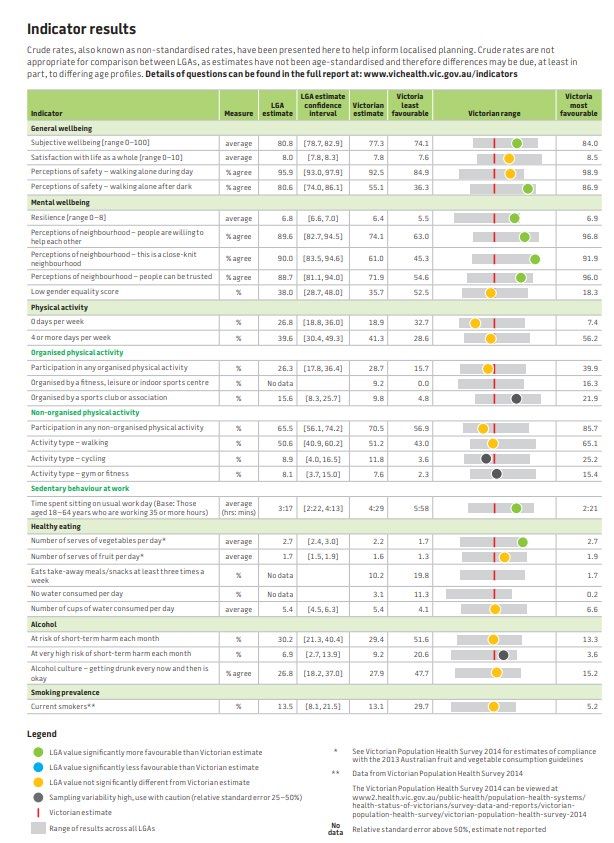
  Appendix A – VicHealth indicator results                             40
  Appendix B – Process for development of the plan                     41
  Appendix C - Other Health and Wellbeing issues                       42

This information is available in alternative formats on request.

                                                                        2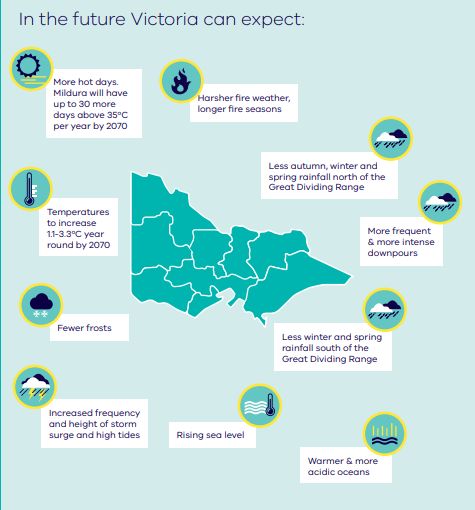
Executive Summary

On 1 September 2015 the Minister for Health released the Victorian public health and wellbeing plan 2015–
2019.

The vision of the plan is for a Victoria free of the avoidable burden of disease and injury so that all Victorians can
enjoy the highest attainable standards of health, wellbeing, and participation at every age.

The plan outlines the government’s key priorities to improve the health and wellbeing of all Victorians,
particularly the most disadvantaged. As many chronic disease and injuries are preventable, the plan focuses on
supporting healthy living from the early years and throughout life.

The Victorian health and wellbeing priorities are:

    •   healthier eating and active living
    •   tobacco-free living
    •   reducing harmful alcohol and drug use
    •   improving mental health
    •   preventing violence and injury
    •   improving sexual and reproductive health.

The plan also identifies the importance of maintaining healthy environments, and responding to the impacts of
climate change on people's health and wellbeing.

The Towong Healthy Communities Plan 2018-2021 is a key Council document, providing a framework for
positive health and wellbeing outcomes for the community. It was developed in consultation with key
stakeholders and through the examination of current data. The plan specifies how organisations or individuals
will work together to deliver initiatives to better support residents enjoy life.

The Towong Healthy Communities Plan 2018-2021 represents the strategic direction for health and wellbeing in
our communities. The following five areas have been identified as priorities for Towong Shire:

    •   Healthier Eating
    •   Active Living
    •   Reducing Harmful Alcohol and Drug Use
    •   Improving Mental Health
    •   Family Violence

Key stakeholders have agreed to focus their collaborative efforts on these priority areas for 2018 – 2021.

                                                                                                                    3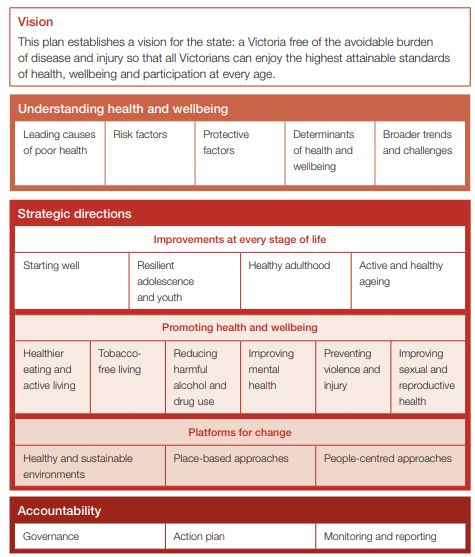
The Towong Healthy Communities Plan 2018-2021 has prioritised the following strategies to support
improvements to public health and wellbeing in the five priority areas.

 Priority Area 1 - Healthier Eating

     •   Strategy 1.1: Promote and support opportunities for healthier eating

     •   Strategy 1.2: Promote access to healthy and sustainable food and drink choices

 Priority Area 2 - Active Living

     •   Strategy 2.1: Enhance infrastructure that supports physical activity

     •   Strategy 2.2: Continue to develop partnerships to increase sport and active recreation opportunities

     •   Strategy 2.3: Promote and support opportunities for active lifestyle choices

 Priority Area 3 - Reducing Harmful Alcohol and Drug Use

     •   Strategy 3.1: Promote a safer drinking culture

 Priority Area 4 - Improving Mental Health

     •   Strategy 4.1: Provide education and information to promote good mental health through every stage
         of life

     •   Strategy 4.2: Advocate for improved support services to reach Towong Shire community members
         and increase telehealth for specialist Mental health in the local community

     •   Strategy 4.3: Identify and develop strategies to increase community resilience in emergency events

 Priority Area 5 - Family Violence

     •   Strategy 5.1: Provide community leadership to prevent violence against women and children

                                                                                                                4
Mayoral Message
It is a pleasure to introduce the Towong Shire Healthy Communities Plan 2018-2021.
Towong Shire is the ideal place to live. Located in the foothills of the Snowy Mountains with easy access to
National Parks, Lake Hume and the beautiful valleys and upper reaches of the Murray River.
Whilst we live in one of Australia’s most pristine environments we also face a diverse range of health challenges
and at times face disadvantage due to the remoteness of the locality.
We aim to support a connected, healthy and vibrant community that is resilient and provided with opportunities
for growth and prosperity. We aim to foster and encourage creativity and innovation, respecting diversity and
difference of opinions.
We are a resilient community with a proven record of accomplishment on how to prosper through collaborative
efforts.
We are committed to working closely with the Victorian Government, Towong Alliance and key stakeholders to
support improved outcomes across Victorian health and wellbeing strategic goals. After the completion of a
consultation process, a review of available data and resourcing, Towong Shire has prioritised the following
challenges:
• Healthier eating
• Active living
• Reducing harmful alcohol and drug use
• Improving mental health
• Prevention of Family Violence
We seek sustainable outcomes, a balanced lifestyle, preserved environment and a collaborative approach to
improved health and wellbeing.
Cr. David Wortmann
Mayor, Towong Shire Council
5Consultation in developing the Towong Shire Healthy
Communities Plan
In developing the Towong Shire Healthy Communities Plan 2018-2021 there has been a number of levels of
engagement with stakeholders.
Engagement with local health services
Representatives from Corryong Health, Tallangatta Health Service and Walwa Bush Nursing Centre reviewed
relevant health and census data through a facilitated process with Upper Hume Primary Care Partnership
(UHPCP), to support the community consultation process.
Health services were invited to participate in community organisation workshops (as detailed below).
In addition, draft priority areas, strategies and actions were considered prior to inclusion in the draft Plan.
Engagement with local community service organisations
UHPCP facilitated community and key agency workshops in Corryong and Tallangatta. UHPCP presented key
data to community organisations and key agencies to establish health and wellbeing priorities for the Towong
community.
Community stakeholders present included representatives from:
• North East Water • Wodonga TAFE
• Sport North East • Neighbourhood Houses
• Gateway Community Health • Corryong Health
• North East Child & Adolescent Mental • North East Health Wangaratta
Health Service • Corryong Health Food Bank
• Victoria Police • Corryong churches
Workshop discussions linked to the following key community plans to represent and acknowledge
previous community engagement and the geographical areas of Bellbridge, Corryong, Tallangatta,
and the Mitta Valley:
• Our Bellbridge
• UM2030 Vision Plan
• Tallangatta Tomorrow
• Our Valley Our Future.
The table overleaf illustrates community priorities established through the consultation process. After
presentation of key health data and a summary of the Council Plan and health services’ plans,
attendees were able to make informed choices about health priorities for the eastern (Corryong) and
western (Tallangatta) ends of the Shire. Attendees voted on their top three priorities. Their preferences
coupled with health service input provided the strategic direction for the development of the Towong
Shire Healthy Communities Plan 2018-2021.
6Health areas* Tallangatta Priorities Corryong Priorities:
Healthy Eating and Active Living 2 votes 4 votes
Alcohol 3 votes 1 vote
Family violence 5 votes 4 votes
Mental Health 10 votes 2 votes
Economic Development 1 vote 5 votes
Infrastructure & connectedness 6 votes 5 votes
Transport Walkability 0 votes 2 votes
Natural environment 0 votes 1 vote
*The above table illustrates the most popular strategic objectives from a community stakeholder
perspective.
The western end of the Shire workshops (Tallangatta) prioritised:
1. Mental Health
2. Infrastructure and community connectedness
3. Family Violence
The eastern end of the Shire workshops (Corryong) prioritised:
1. Economic Development
2. Infrastructure and community connectedness
3. Healthy Eating and Active Living
4. Family Violence
Engagement with the Towong Shire community
The Towong Shire Healthy Communities Plan 2018-2021 was considered by Council at the November
2018 Council Meeting. Following in-principle adoption of the Plan it was released on public exhibition
for community feedback. The proposed Plan was available from the Corryong and Tallangatta Council
offices and on Council’s website www.towong.vic.gov.au.
This provided opportunity for any community member to review the Plan and provide input before
the final Towong Shire Healthy Communities Plan 2018-2021 was formally adopted by Council in
February 2019.
Five submissions were received and were considered in this final Plan.
7Council’s role in Health and Wellbeing
Health and wellbeing outcomes for our community are dependent on key stakeholder partnerships
and a willingness to work together to deliver service provision. Council portfolios and programs are
developed and implemented to support the health and wellbeing of our community.
The Victorian Public Health and Wellbeing Act 2008 enlists local government as a major partner in
“the effort to protect health and prevent disease, illness, injury, disability and premature death.” The
purpose of this Act is to enact a new legislative scheme, which promotes and protects public health
and wellbeing in Victoria.
The function of a Council under this Act is to seek to protect, improve and promote public health and
wellbeing within the municipal district by—
a) creating an environment which supports the health of members of the local community and
strengthens the capacity of the community and individuals to achieve better health;
b) initiating, supporting and managing public health planning processes at the local government
level;
c) developing and implementing public health policies and programs within the municipal district;
d) developing and enforcing up-to-date public health standards and intervening if the health of
people within the municipal district is affected;
e) facilitating and supporting local agencies whose work has an impact on public health and
wellbeing to improve public health and wellbeing in the local community;
f) co-ordinating and providing immunisation services to children living or being educated within the
municipal district;
g) ensuring that the municipal district is maintained in a clean and sanitary condition.
The Towong Shire Healthy Communities Plan 2018-2021 is informed by and aligns with the 2017-2021
Council Plan, and acts as a guiding plan for a number of key Council documents:
Council Plan 2017-2021
Municipal Health and Wellbeing Plan 2018-2021
Climate Change Adaption Plan
Municipal Strategic Statement
Municipal Emergency Management Plan
Access and Inclusion Plan 2015-2018
Youth Plan 2013 -2017
Recreation Reserve Masterplan
Early Years – Service Improvement Plan and Quality Improvement Plan
8Understanding Towong’s Health and Wellbeing status
Defining the health and wellbeing of our communities requires a careful assessment of recent health
and wellbeing data, working with local health services, key agencies and community.
Towong Shire Council facilitated a strategic partnership with the Upper Hume Primary Care
Partnership (UHPCP) to assist with data analysis and to broaden agency reach and feedback for the
plan’s development. Our collaborative efforts intrinsically link and align with the State Government’s
vision and approach to improved health outcomes for our community.
Source: Victorian Health Plan 2015-2019
Our plan recognises the need for greater flexibility in responding to local priorities. Supported with an
action plan we have identified roles, responsibilities, and accountability in a measurable way. We have
also recognised future challenges and relevant data to support those challenges. We aim to focus on
inequalities in health and wellbeing, the social determinants of health that contribute to inequalities
and an explicit focus on improving health and wellbeing across the course of life.
While Victorians generally experience high levels of health and wellbeing, it is not equitable across the
State. Our plan has assessed Towong Shire’s available data, and identified the gaps and opportunities
for prioritised health outcomes.
9Where are we?
The Towong Shire is located in north-east Victoria, on the
Victorian/NSW border, about 350 kilometres north-east of
Melbourne. It is bounded by the Murray River in the north and east,
the East Gippsland and Alpine shires in the south, and the Indigo
Shire and City of Wodonga in the west. The Shire offers a diversity
of landscapes that range from pastoral and agricultural farming
areas to pristine national parks and state forest environments to
alpine peaks and waterways.
The Shire covers one of the state’s largest local government land areas of 6,600 square kilometres.
Corryong (pop. 1,348) and Tallangatta (pop. 1,082) are the Shire’s main urban centres with other
significant settlements including:
• Bellbridge and Bethanga which offer town/village living opportunities close to the larger
regional centres of Wodonga and Albury;
• Communities at Dartmouth, Eskdale and Mitta Mitta which are more remote and self-reliant;
• Talgarno, Granya, Walwa, Tintaldra and Towong which provide lifestyle choices on the banks
of the Murray River; and
• Cudgewa, Koetong, Old Tallangatta, Bullioh and Tallangatta Valley which are nestled in fertile
valleys and surrounded by scenic hills.
Who are we?
Population overview
In the 2016 Census, 5,985 residents nominated Towong Shire as their usual place of residence.
Male 51.4%
Female 48.6%
Aboriginal/Torres Strait Islander 87 (1.5%)
Median age 50
Families 1,591
Average children per family 1.9
Source: 2016 Census
Of the families in Towong Shire, 34.4% were couple families with children, 54.5% were couple families
without children and 10.1% were one parent families.
10Cultural diversity
The most common ancestries in Towong Shire were Australian 31.6%, English 31.2%, Irish 9.7%,
Scottish 8.8% and German 4.8%.
In Towong Shire 82.7% of people were born in Australia. Of those born outside Australia, the most
common countries of birth were England 2.6%, New Zealand 0.9%, Germany 0.7%, Netherlands 0.7%
and Philippines 0.4%.
Ancestry Towong % Victoria % Australia %
Australian 2,532 31.6 1,653,291 21.1 7,298,243 23.3
English 2,495 31.2 1,769,214 22.6 7,852,224 25.0
Irish 780 9.7 597,249 7.6 2,388,058 7.6
Scottish 702 8.8 492,281 6.0 2,023,470 6.4
German 387 4.8 201,850 2.6 982,226 3.1
Source: 2016 Census
Towong Shire has a higher than state or national average of Anglo-Saxon and Western European
populations living in the Shire. Opportunities for cultural diversity are harnessed through the
Neighbourhood House programs with the objective of attracting, supporting and maintaining more
ethnic diversity across the Shire.
Registered Marital status
Towong % Victoria % Australia %
Married 2,778 55.3 2,344,107 48.4 9,148,218 48.1
Separated 137 2.7 146,493 3.0 608,059 3.2
Divorced 479 9.5 382,544 7.9 1,626,890 8.5
Widowed 372 7.4 251,674 5.2 985,204 5.2
Never married 1,258 25.0 1,720,887 35.5 6,668,910 35.0
Source: 2016 Census
Towong Shire has a higher level of divorced and widowed persons than the State or National average.
Additional anecdotal evidence highlights the need to connect, promote and provide support services
to persons and their families experiencing hardship or living alone.
Housing
Of occupied private dwellings in Towong Shire, 45.9% were owned outright, 30.2% were owned with a
mortgage and 19.0% were rented.
Of occupied private dwellings in Towong Shire, 3.1% had one bedroom, 14.5% had two bedrooms and
49.2% had three bedrooms. The average number of bedrooms per occupied private dwelling was 3.2.
The average household size was 2.3 people.
11Household income
In Towong Shire 27.9% of households had a weekly household income of less than $650 and 6.9% of
households had a weekly income of more than $3,000.
Household income Towong % Victoria % Australia %
Less than $650 gross weekly income - 27.9 - 20.3 - 20.0
More than $3000 gross weekly income - 6.9 - 15.5 - 16.4
Source: 2016 Census
In Towong Shire, of all households, 67.5% were family households, 30.2% were single person
households and 2.3% were group households.
The median weekly personal income for people aged 15 years and over in Towong Shire was $535.
Median Weekly Incomes Towong $ % Victoria % Australia %
Personal 535 - 644 - 662 -
Family 1,340 - 1,715 - 1,734 -
Household 1,043 - 1,419 - 1,438 -
Towong Shire Household Statistics
All private dwellings 3,091
Average people per household 2.3
Median weekly household income $1,043
Median monthly mortgage repayments $1,083
Median weekly rent $150
Average motor vehicles per dwelling 2.1
Education
In Towong Shire 26.4% of people were attending an educational institution. Of these 25.6% were in
Primary school, 25.2% in Secondary school and 9.3% in a tertiary or technical institution.
Towong % Victoria % Australia %
Pre-school 66 4.2 94,970 5.2 347,621 4.8
Primary - Government 278 17.6 313,881 17.2 1,314,787 18.2
Primary – Catholic 92 5.8 102,778 5.6 380,604 5.3
Primary – non-Government 35 2.2 52,041 2.8 231,490 3.2
Secondary - Government 328 20.7 201,166 11.0 827,505 11.5
Secondary - Catholic 38 2.4 88,999 4.9 338,384 4.7
Secondary – other non- Government 35 2.2 73,973 4.0 280,618 3.9
Technical or further education 73 4.6 325,051 17.8 1,160,626 16.1
institution
Other 39 2.5 59,498 3.3 198,383 2.8
Not stated 523 33.1 413,199 22.6 1,707,023 23.7
12Employment
Employment type Towong % Victoria % Australia %
Worked Full-time 1,551 55.5 1,670,556 57 6,623,065 57.7
Worked Part-time 899 32.2 920,875 31.4 3,491,503 30.4
Away from work 216 7.7 144,696 4.9 569,276 5
Unemployed 129 4.6 193,465 6.6 787,452 6.9
There were 2,795 people who reported being in the labour force in the week before Census night in
Towong Shire. Of these 55.5% were employed full-time, 32.2% were employed part-time and 4.6%
were unemployed.
Unpaid employment
In Towong Shire, of people aged 15 years and over, 71.6% did unpaid domestic work in the week
before the Census. During the two weeks before the Census, 23.9% provided care for children and
14.0% assisted family members or others due to a disability, long term illness or problems related to
old age. In the year before the Census, 36.1% of people did voluntary work through an organisation or
a group.
Unpaid work Towong % Victoria % Australia %
Did unpaid domestic work 3,597 71.6 3,315,451 68.4 13,143,914 69.0
Cared for a child/children 1,202 23.9 1,329,164 27.4 5,259,400 27.6
Provided unpaid assistance to a person 704 14.0 560,866 11.6 2,145,203 11.3
with a disability
Did voluntary work through an 1,815 36.1 931,546 19.2 3,620,726 19.0
organisation or group (last 12 months)
Source: 2016 Census
The Towong Shire Socio-Economic Indexes for Areas (SEIFA) data was reported at 39 out of 79 on the
index of relative socio-economic disadvantage of local government areas in Victoria.
SEIFA is a suite of four summary measures that have been created from Census information. Each
index summarises a different aspect of the socio-economic conditions in an area, and therefore
summarises a different set of social and economic information. The indexes can be used to explore
different aspects of socio-economic conditions by geographic areas. For each index, every geographic
area in Australia is given a SEIFA number which shows how relatively 'disadvantaged' that area is
compared with other areas in Australia.
The four indexes in SEIFA are:
Index of Relative Socio-economic Disadvantage (IRSD);
Index of Relative Socio-economic Advantage and Disadvantage (IRSAD);
Index of Economic Resources (IER); and
Index of Education and Occupation (IEO)
13To determine the SEIFA rank, all the areas are ordered from lowest score to highest score. The area
with the lowest score is given a rank of 1, the area with the second-lowest score is given a rank of 2
and so on, up to the area with the highest score which is given the highest rank.
Transport
There is no public transport available.
14How we assess our health status…
Council understands that people’s behaviours are shaped by their environment and, healthier
environments ultimately lead to healthier behaviours. To find out how healthy we are in the Towong
Shire compared to the rest of Victoria, Council has looked at a range of statistical reports and data
from the Department of Health and Human Services (DHS), Australian Bureau of Statistics (ABS),
VicHealth Indicators survey and the Victorian Population Health Survey (2014). A review of existing
service plans from local health services and key stakeholder consultation process was also completed
to better understand the health and wellbeing of Towong Shire community members.
From this information, community priorities have been established.
Our strengths
The VicHealth Indicators survey 2015 highlighted that 95.9% of Towong Shire residents felt safe
walking alone during the day, similar to the Victorian estimate of 92.5%. 80.6% of residents also felt
safe to walk alone after dark, this is significantly higher than the Victorian average of 55.1%. Towong
Shire ranks 7 out of 79 Councils for people (75.9%) who feel safe on the streets alone.
Neighbourhood safety and security are important determinants of people’s health and wellbeing.
When individuals feel safe within their communities, they are more likely to connect with friends,
engage with other community members and experience greater levels of trust and social connection
(Baum et al. 2009).
Towong Shire is a connected community that feels safe. Towong ranks 10 out of 79 local government
areas for feeling safe after dark. When walking alone at night, 80.6% of people in Towong feel safe or
very safe compared to 69.4% in the Hume region and 60.8% across the State. We have an opportunity
to maintain that sense of safety and to continue supporting our residents through the delivery of
diverse health promotion and education, improved environments for health, continuous planning and
policy development and by strengthening community action and skill development for an evolving
community. Having local health services and GP services located within the Shire provides residents
with health and wellbeing support.
Towong residents also gave their wellbeing average of 80.8% compared to the Victorian average of
77.3%. The majority of surveyed residents, 90%, felt that they live in a close-knit community,
significantly higher than the Victorian average of 61%. 88.7% of residents trust their neighbours
compared to 71.9% state-wide.
Towong’s shire-wide Kindergarten participation rate is 99.8%, one of the highest rates in the State, an
increase of 5.7% from 2016.
Towong continues to achieve good results in Maternal and Child Health participation:
Home visits: 94.8%
8 week check: 84.5%
1 year check: 78.3%
3.5 year old check: 91.8%
15Our children attend Kindergarten. Research has shown that investment in the early years, in the form
of preschool and kindergarten, can have a positive effect on longer-term outcomes. The participation
rate in Towong is 9th highest in the state and performs 2nd highest for the Northeast Victorian region
and Ovens Murray area. This is a significant improvement since the development of the 2009-2013
Healthy Communities Plan when participation was ranked 14th in the State. Higher levels of
participation at Kindergarten provide early years services with opportunities to engage with families to
support preventative health measures and outcomes for children and their respective families.
We feel part of our community with 48.5% volunteering to help one another, compared to 31.8% in
Hume region and 23.2% across Victoria. Volunteering rates of participation occur in schools, health
services, through membership in organised groups and attendance at community events.
78.4% of the community attend a local community event, to feel connected and celebrate local
cultural activities, compared to 58.7% across the State.
While our sense of community is very strong, we have additional opportunities to embrace cultural,
lifestyle and socio economic diversity. Tallangatta Neighbourhood House is leading the pathway to
cultural diversity and greater acceptance.
We have a healthy environment – 96% of people living in the Towong Shire report their community as
a pleasant environment.
Our challenges
Towong Shire has a number of health and wellbeing challenges and priorities were assessed on the
available data and community and key stakeholder input received. The following ‘snapshot’ table
outlines the main challenges identified through the Victorian Population Health Survey of 2014:
Victorian Health Population data Towong Hume region Victoria
% of population % of population % of population
Fruit consumption – 1-2 serves per day 51.7 53.7 51.2
Vegetable consumption 1-2 serves per day 52.3 56.6 59.1
Do not meet fruit and vegetable guidelines 48.8 50.8 48.6
People who are pre-obese or obese 58.2 55.8 50.0
Insufficient physical activity 44.9 51.6 50.4
Increased risk of alcohol related harm 68.5 65.2 59.2
Smoking – Daily 11.8 12.6 9.8
Reported Very High Psychological stress 6.4 2.8 3.9
Reported High Blood pressure 24.1 26.0 25.9
16In summary, Towong residents experience higher levels of pre-obesity or obesity compared to the
Hume region or Victoria. Secondly, there is also an increased risk of alcohol related harm compared to
that of the Hume region and Victoria. Thirdly, the level of reported very high psychological stress is
more than double compared to the Hume region and significantly higher than Victoria.
We do not consume enough fruit and vegetables. 52.3% of Towong residents have 1-2 serves of
vegetables a day, compared to 56.6% across the Hume region and 59.1% across the State. 51.7% of
Towong residents have 1-2 servings of fruit per day, compared to 53.7% across the Hume region and
51.2% across the State.
Only 7.2% of Towong residents meet fruit and vegetable consumption in line with recommended
Australian Dietary guidelines, or 10-11% meet vegetable consumption, and 42% meet fruit
consumption guidelines. We consume a higher level of daily sugary drinks compared to the State
average (12.8% of Towong residents compared to 11.2% State average).
Further data was obtained from the Victorian Child Health and Wellbeing survey (2014) to review fruit
and vegetable consumption in children for the Ovens and Murray region:
- 2.2% children meet vegetable consumption guidelines compared to 2.1% (Victoria)
- 14.2% meet fruit and vegetable guidelines compared to 10.6% in (Victoria)
- 61.1% meet fruit consumption compared to 58.8% in (Victoria)
We are more likely to have oral health problems. Children who live in rural and regional areas in
Victoria are more likely than those living in metropolitan areas to have had toothache, a filling, dental
treatment in hospital under general anaesthetic or a tooth extracted because of a dental problem. The
towns of Tallangatta, Corryong, Dartmouth, Cudgewa, Walwa and Bellbridge do not have drinking
water that is fluoridated. Corryong Health provides a fortnightly dental service in Corryong for
schoolchildren and Health Care Concession Card holders. There are no other dental services in the
shire.
We are also sitting for too long. The number of residents that sit between 2-4 hours on average
weekday during the preceding week is 41.3%, compared to the Hume region’s 29.5% and the State
average of 27%.
44.9% of Towong residents get insufficient physical activity, compared to 51.6% across the Hume
region and 50.4% across the State.
Towong Shire has a high proportion of the adult population who are pre-obese or obese: Towong
(58.2%), Hume region (55.8%) and Victoria (50%). Improved infrastructure development and creating
opportunities for active participation are key challenges for the Shire.
68.5% of Towong residents have an increased lifetime risk of alcohol related harm, by risk category
compared to 65.2% (Hume region) and 59.2% (State average).
17The following table demonstrates levels of chronic disease compared to the Hume region and Victoria.
Source: Victorian Population Health Survey 2014
LL – Lower limit of 95% confidence interval
UL – Upper limit of 95% confidence interval
* relative standard error between 25 and 50 per cent (estimate should be treated with caution)
We have high incidence of some diseases – The Victorian Burden of Disease Study found that rural
communities in Victoria have a lower health status than metropolitan areas. People living in rural
Victoria generally have higher rates of disease burden due to cardiovascular disease, cancer,
neurological and sense disorders, chronic respiratory diseases, musculoskeletal diseases and injuries.
However, compared to the Hume region, Towong Shire is experiencing lower levels of disease with
the exception of Arthritis. 25% of residents are experiencing high levels of anxiety and depression.
The biggest cause of preventable hospital bed days is Chronic Obstructive Pulmonary Disease (COPD).
The 2016 Census data reflects disadvantage such as low income with 27.9% receiving a gross weekly
income of less than $650 per week, compared to the 20.3% of Victoria and 20.0% nation-wide. The
towns in our area with a high relative disadvantage, when compared to other parts of Victoria, include
Corryong and Walwa.
55.5% of people are in fulltime employment, compared to the State average of 57% and National rate
of 57.7%.
There is no public transport making it difficult to get around – More people in Towong experience
transport limitations than their Victorian counterparts. People with a disability will experience difficulty
accessing public transport.
9.5% of the population are divorced compared to the state average of 7.9%, highlighting the possible
need for increased promotion of family support and early interventions.
Towong Shire has a higher percentage of people who are widowed or living alone (7.4%), compared
to 5.2% in Victoria.
Whilst we appear to be living longer, a range of indicators of health status and burden of disease
indicate that residents of the Hume region have poorer health than Victorian averages. People living
18in the Hume region have lower life expectancies than people living in Melbourne metropolitan
regions. Males are expected to live 1.0 years less than the Victorian life expectancy of 80.3 years.
Females are expected to live 0.3 years less than Victorian women who have a life expectancy of 84.4
years. While longevity is generally viewed in a positive light, it also brings with it increased rates of
chronic disease and the health and wellbeing challenges associated with an ageing population.
Towong Shire has an increasingly ageing population. The median age of people has increased from
47 (2011 Census) to 50 years of age in the 2016 Census. Children aged 0-14 years made up 16.1% of
the population and people aged 65 years and over made up 25.7% of the population.
Our climate is changing – The future climate of our region is expected to be hotter and drier than it is
at present. Droughts are likely to increase in frequency by between 10% and 60% by 2070 depending
on our rate of emissions. The Victorian Government is committed to action to keep global warming
below 2 degrees Celsius.
Reducing our emissions will lessen the impact of climate change, but it will not prevent it. Towong
Shire residents need to prepare for what climate change will bring. Victoria’s Climate Change
Adaptation Plan 2017-2020 is a key component of this. The Plan is a blueprint to prepare Victorians to
meet the challenges of climate change and take action.
Climate change will affect the agricultural landscape of the region and the health of particularly
vulnerable groups within our Shire. Access to water will also continue to be a major issue.
19Priority Area 1 – Healthier Eating
Why is this area important to Towong Shire?
For every 100 people living in Towong Shire, 47 people do not consume enough fruit and vegetables.
Fruit and vegetables provide the body with vitamins and minerals, including antioxidants, such as
vitamin A, C, E and selenium. Increased consumption of fruit and vegetables helps reduce the risk of
obesity, heart disease and certain cancers.
There is clear evidence that links consumption of sugary drinks with weight gain and increased dental
issues, high blood pressure and type 2 diabetes.
Risk factors to Towong Shire residents
• 12.8% of people in Towong Shire consume sugary drinks daily, compared to 11.2% of
Victorians
• 58% of people living in Towong Shire are obese or pre-obese, compared to 50% of
Victorians
What we heard in the community workshops
“Access to fresh fruit and vegetables is cost prohibitive”
“A need to educate and focus on 0-8 years cohort”
“Healthy lunch box education at preschools and school”
“Food swap initiatives”
“Lack of shade and water bubblers”
Strategies to support improvements in this priority area
Strategy Key stakeholders Long term outcome
measure target
Promote and support Towong Shire Council, health Improvement in Healthy
opportunities for healthier services, Primary Care eating indicators (i)
eating Partnerships, Neighbourhood Increase in the consumption
of fruit and vegetables (ii)
House, local schools, Early
Years settings
Increased consumption and
availability of water
Promote access to healthy and Towong Shire Council, health
sustainable food and drink services, Primary Care
Decreased consumption of
choices Partnerships, Neighbourhood
sugar and sweetened
House, North East Water,
beverages (ii)
sporting clubs
Source i: VicHealth Indicators Survey
Source ii: Victorian Population Health Survey
The following table identifies actions to deliver on the agreed strategies in this priority area.
20Action Responsible Partners Short term
organisation output measure
Promote and support opportunities for healthier eating
Update and promote organisation Towong Shire Early years Policies reviewed
Healthier Eating Policy Council, services and promoted.
Health services
Promote healthy eating choices in early Towong Shire Early years Healthy eating
years settings and schools Council, services, promoted in
Health Supported early years
Services Playgroup services.
Delivery of the
Achievement
Program
Support implementation of the Upper UHPCP Health Services, Participation in
Hume Healthy Eating and Active Living Towong Shire relevant actions
(HEAL) Catchment plan (2017-2021) Council identified in
HEAL catchment
plan
Promote access to healthy and sustainable food and drink choices
Encourage healthy food and drink Towong Shire Local schools, Decreased sales
choices at swimming pools Council Sport North of sweetened and
East, Sporting sugary drinks
Clubs, North
East Water Increased
availability of
healthy food
Improve access to free water in public Towong Shire Health services, New water access
places Council North East points
Water established
Investigate options to support/promote Towong Shire Farming Farming
farm gate and agribusiness Council community, workshop
opportunities* Local business, completed
Wodonga TAFE
*Work with local operators to facilitate Towong Shire Farming Community
the development of farm gate trail in the Council community, Engagement and
Mitta Valley Local business, workshops
Wodonga TAFE completed in the
Mitta Valley
*As identified in the Council Plan 2017-2021
21Priority Area 2 – Active Living
Why is this area important to Towong Shire?
Low levels of physical activity are a risk for ill health. Regular activity and a healthy diet are important
factors for maintaining a healthy weight. Active living is a major factor in preventing and managing
chronic disease.
Risk factors to Towong Shire residents
• 52% of people living in Towong Shire do not get enough physical exercise
• 41.3% of people spend between 2-4 hours a day sitting
• 64.8% of children Ovens Murray region who do the recommended amount of physical
activity per day
• 32.1% young people Ovens Murray region who do the recommended amount of physical
activity
Physical activity or exercise can improve your health and reduce the risk of developing several
diseases like type 2 diabetes, cancer and cardiovascular disease. Physical activity and exercise can have
immediate and long-term health benefits. Most importantly, regular activity can improve your quality
of life.
What we heard in the community workshops
“Lack of infrastructure to support bike riding and walking”
“Walkability and paths – access to pathways needed”
“Lack of public amenity along the Murray River”
“Active Living difficult for remote communities – access and diversity”
“Lack of shade”
Strategies to support improvements in this priority area
Strategy Key stakeholders Long term outcome measure
target
Enhance infrastructure Towong Shire Council, local Proportion of adults who are
that supports physical sporting groups, peak sporting sufficiently physically active (i)
activity bodies, Neighbourhood House, Proportion of adolescents 10-17
Men’s Shed, Community, years who are sufficiently active (i)
Corryong Health Gym Proportion of children 5 – 12 years
who are sufficiently active (i)
Continue to develop Towong Shire Council, local Increased participation in
partnerships to increase sporting groups, Corryong organised physical activity (ii)
sport and active Health Gym and peak sporting
recreation opportunities bodies
Promote and support Towong Shire Council, health Improvement in Physical activity
opportunities for active services, Neighbourhood indicators (ii)
lifestyle choices House, local sporting groups,
Corryong Health Gym and
peak sporting bodies
Source i: Victorian Population Health Survey
Source ii: VicHealth Indicators Survey
22The following table identifies actions to deliver on the agreed strategies in this priority area.
Action Responsible Partners Short term output
organisation measure
Enhance infrastructure that supports physical activity
Seek Recreational Master Towong Shire Victorian Government Funding application
planning funding to support a Council, submitted
Shire-wide plan* Sporting
Clubs
Seek funding for recreation Towong Shire Victorian Government Funding application
facility upgrades/renewals* Council, submitted
Sporting
Clubs
Implement Towong Shire Tree Towong Shire NECMA, LandCare, Strategy
Management Strategy to Council Indigenous groups, implemented (trees
provide shade and support Department of Justice, planted)
tree planting* Community, UHPCP
Consider options to improve Towong Shire Victorian Government, Funding applications
accessibility and walkability Council Access and Inclusion submitted
and active exercise Officer
Continue to develop partnerships to increase sport and active recreation opportunities
Develop a School Holiday Towong Shire Sport North East, School Holiday
program to promote active Council Sporting Clubs, Health program developed
participation services, schools, and implemented
Neighbourhood House
Support the implementation UHPCP Health Services, Community
of the Upper Hume Healthy Sporting Groups, Sport awareness campaign
Eating and Catchment Plan North East, Community conducted
(2017-2021)
Implement Access and Implement Health Services, Access and Inclusion
Inclusion Plan Access and LaTrobe Community Plan implemented
Inclusion Plan Health, Villa Maria,
NDIA, Neighbourhood
Centres, Schools, Early
Years, State
Government,
Community
Promote and support opportunities for active lifestyle choices
Partner and engage with Towong Shire Health Services, Shire-wide
community to support action Council Sporting Clubs, Recreational
to improve levels of physical Community, Masterplan
activity Neighbourhood completed.
House, Schools, Men’s
Sport Northeast
Shed
programs delivered
Ensure that youth planning Towong Shire Secondary schools, Youth plan, contains
has a focus area of active Council youth active lifestyle
lifestyle choices
23priority area,
adopted
Investigate opportunities to Health Neighbourhood House NH planning include
support aged community services seniors activities
members to maintain an
active lifestyle
Participate in health Towong Shire Sport North East, NH programming
promotion campaigns to Council, Sporting Clubs, includes seniors
promote healthy eating and Health schools, activities
active living eg. Walk to Services Neighbourhood
School program, active April House, VicHealth
and H30 Challenge
*As identified in the Towong Shire Council Plan 2017-2021
24Priority Area 3 - Reducing Harmful Alcohol and Drug Use
Why is this area important to Towong Shire?
Alcohol indicators include risk of short-term harm from alcohol consumption (five drinks or more on a
single occasion), very high risk of short-term harm from alcohol consumption (11 or more drinks on a
single occasion) and respondents’ attitude towards getting drunk to the point of losing balance.
3 out of 10 (30.2%) Towong residents were identified as being at risk of short-term harm from alcohol
in a given month, similar to the Victorian estimate (29.4%). Compared to all Victorians, a similar
proportion of Towong residents was identified as being at very high risk of short-term harm each
month (6.9%, Victoria = 9.2%). Just over one-quarter (26.8%) of residents living in Towong agreed that
getting drunk every now and then is okay. This is similar to the proportion of Victorians who agreed
(27.9%).
Alcohol is estimated to be involved in up to half of partner violence in Australia and 73% of partner
physical assaults. It features prominently in police data, although not all jurisdictions keep consistent
records.
In 2010, alcohol was recorded as “present” in 41% of domestic assaults in New South Wales. This
figure increased to over 60% in the remote far west of the state.
Victorian data shows a steady rise in the rate of alcohol-related family violence incidents from about
15 to 23 incidents per 10,000 people over a ten-year period. Given incidents reported to police are
often the most severe cases, and only one-third of domestic violence is reported anyway, the figures
discussed above clearly under-represent the full extent of alcohol-related domestic violence.
Risk factors to Towong Shire residents:
• 69% Lifetime risk of alcohol related harm
• 55% Risk of alcohol related injury on a single occasion
What we heard in the community workshops
“Alcohol culture at sporting events”
“Education – Harm minimisation”
25Strategies to support improvements in this priority area
Strategy Key stakeholders Long term outcome measure
target
Promote a safer drinking Towong Shire Council, health Improvement in Alcohol
culture services, Victoria Police, indicators (i)
Freeza, local schools
Decrease proportion of adults
who consume alcohol at
lifetime risk of harm
Proportion of adults who
consume alcohol at risk of
alcohol related injury on a
single occasion at least
monthly (ii)
Source i: VicHealth Indicators Survey
Source ii: Victorian Population Health Survey
The following table identifies actions to deliver on the agreed strategies in this priority area.
Action Responsible Partners Short term
organisation output measure
Promote a safer drinking culture
Promote Safer Alcohol Culture Towong Shire Schools, Responsible
Council Sporting clubs, Service of Alcohol
Sport North programs
East, Health delivered to
Services sporting clubs
Educational
workshops
delivered in
schools
Promote and deliver Freeza events and Towong Shire Schools, Freeza and Party
Party safe programs Council Victoria Police, safe programs
NECAMHS, delivered
Secure PARTY
program funding
Identify and promote online and Towong Shire Schools, Youth Deliver an
telephone support services Council Officer, awareness
Victoria Police, campaign
Health utilising Council’s
Services, social media
Sporting
Clubs, State
Government
Deliver Headspace program Towong Shire Health School program
Council, services, delivered
Headspace Schools
26Conduct annual review of youth Towong Shire Schools, Conduct an
programs with identified partners Council Health annual review
Services,
Victoria Police,
NECAMHS,
Headspace,
Youth
Committee,
Wodonga
TAFE
27Priority Area 4 - Improving Mental Health
Why is this area important to Towong Shire?
SANE Australia identifies the benefits of keeping connected with family, friends and your community
to assist with addressing mental health wellness. Council, community and key agencies have an
opportunity to work collaboratively to support a more engaged community through a diverse range
of educational and local activities. Mental health is impacted strongly by socioeconomic status, levels
of exercise, and community connectedness. 2016 Census reports:
Risk factors to Towong Shire residents
• 27.9% of Towong residents have an income less than $650 gross weekly income compared
to 20.3% Victorians
• 52% of people living in Towong Shire do not get enough physical exercise
• 41% of people in Towong Shire volunteer
• 96% report their community as a pleasant environment
• 38% of people are over 75 years and live alone
Regular exercise, social activity and community connectivity can improve quality of life.
According to the World Health Organization, mental health is “a state of well-being in which every
individual realises his or her own potential, can cope with the normal stresses of life, can work
productively and fruitfully, and is able to make a contribution to her or his community.” So rather than
being about ‘what’s the problem?’ It is really about ‘what’s going well?'
Community consultation identified opportunities to better support mental health and young people.
Early intervention is important to address positive health and wellbeing, especially in women and
children.
However, social isolation and lack of public transport to enable people to connect to their community
is recognised as an ongoing community issue, especially for the aging population.
The 2015 Victorian Population Health Survey states that the proportion of Victorian adults with high
or very high levels of psychological distress was significantly higher in women. Psychological distress
for both men and women had the following characteristics:
• Did not complete Secondary School
• Unemployed
• Not in the labour force
• A total income of less than $40,000pa
In 2016, Victorian suicide was the leading cause of death among all people 15-44 years of age, and
the second leading cause of death among those 45-54 years of age. The median age
at death for suicide was 43.3 years. The highest proportion of suicide deaths of males occurs among
those aged 30-34 years. The suicide rate is higher in regional Victoria.
41% of our community volunteer and 96% report their community to be a pleasant environment.
With an ageing population, equitable access to key community infrastructure is necessary to facilitate
opportunities for networking and socialisation. Council will work collaboratively with community and
key stakeholders to support community connectivity opportunities.
28What we heard in the community workshops
“Lack of links to mental health and employment opportunities to support our community”
“We need to empower community groups to take a lead on culture change and action”
“We need to learn different ways of communication e.g. how to use using technology, apps and
electronics”.
“No public transport – disconnected”
“Our community aims to build capacity and duplicate the success of the Tallangatta
Neighbourhood House in Corryong”
“Corryong community will review the Corryong Neighbourhood House activities to support a
more responsive program that addresses current gaps and caters for community interests”
“We will encourage “come and try” days for older residents and beginners”
“The community has identified opportunities to create connectivity and linkages through music,
the arts and passive recreational activities”
“Better support for Carers networks and more health promotion activities”
“More educational programs that expose members of the community to learning technologies to
better connect with family and friends”
Strategies to support improvements in this priority area
Strategy Key stakeholders Long term outcome
measure target
Provide education and Towong Shire Council, health Improvement in Mental
information to promote good services, Early Years settings, wellbeing indicators (i)
mental health through every local schools, Neighbourhood
stage of life House, Employment training Proportion of adults who
providers, Family Violence report high or very high
Networks level of psychological
distress (ii)
Advocate for improved support Towong Shire Council, Health
services to reach Towong Shire Services, NECAMHS, Overall self-reported life
community members and Community Mental Health, satisfaction (ii)
increase telehealth for specialist Wodonga TAFE, Department of
Mental health in the local Education and Training,
community Neighbourhood House, North
East Border Area Mental Health
Service, Junction Support,
Headspace, NDIA, Centrelink
Identify and develop strategies Towong Shire Council,
to increase community resilience Wodonga TAFE
in emergency events
29Neighbourhood House,
NECAMHS, Victorian Farmers
Federation
Source i: VicHealth Indicators Survey
Source ii: Victorian Population Health Survey
The following table identifies actions to deliver on the agreed strategies in this priority area.
Action Responsible Partners Short term output
organisation measure
Provide education and information to promote good mental health through every stage of
life
Deliver Mental Health Health services UHPCP, Towong Action Plan
First Aid program Shire Council developed
Promote and deliver the Towong Shire Victoria Police, Delivered to
‘Love Bites’ program to Council Schools Corryong and
address respectful Tallangatta students
relationships annually
Promote and deliver Towong Shire Early years settings Program delivered to
Supported Playgroup Council align with the
Victorian School
Terms
Promote and deliver Towong Shire Neighbourhood Annual Action plan
employment pathway Council House, Wodonga developed and
options for residents TAFE implemented
Advocate for improved support services to reach Towong Shire community members and
increase telehealth for specialist Mental health in the local community
Advocate for mental Towong Shire State government Greater community
health services to provide Council awareness
greater reach across
Towong Shire
Advocate for and support Towong Shire Schools, community, Provide leadership
young people Council Health Services, opportunities for
Headspace, young people
NECAMHS, Victoria
Police
Advocate for public Towong Shire Schools, Complete a transport
transport to support Council Neighbourhood survey and
opportunities for House, Men’s Shed, undertake advocacy
connectivity Seniors groups program
Promote awareness of Health Services NECAMHS, Awareness delivered
referral pathways for
clinical support and
primary support for field
officers
Advocate for people Towong Shire NDIA, Early years Implementation of
experiencing a disability Council settings, schools, Council’s Access and
Health Services Inclusion Plan.
30Delivery of a school
holiday activities
plan for young
people.
Deliver a Dementia
Awareness campaign
Advocate for and support Towong Shire Neighbourhood Annual
cultural diversity as Council House, local Neighbourhood
valued components of the international and House plan includes
community indigenous culturally diverse
communities activities
Identify and develop strategies to increase community resilience in emergency events
Develop a plan to increase Towong Shire Municipal Community
community resilience to Council Emergency Resilience plan is
emergency events (in Management developed by the
support of the Municipal Planning Committee, MEMPC
Emergency Management CWA, Red Cross,
Plan) Church groups,
service clubs,
sporting clubs
Promote and support Towong Shire Alb/Wod Volunteer Annual Volunteer
Volunteering Council Bureau, Community, workshop delivered
Neighbourhood by Albury Wodonga
house, Health Volunteer Bureau
Services, Sporting
Clubs, Community
events
Promote and deliver Towong Shire Schools, Secure funding to
resilience training to Council Neighbourhood deliver program
young people House, State
government, Health Identified program
Services output priorities for
action
Support and deliver Towong Shire Tallangatta Neighbourhood
Neighbourhood House Council Neighbourhood House programs
programs to provide House delivered
social opportunities and
increased skills
development
Support initiatives that Towong Shire Community groups, Community tree
promote connection with Council’s Technical Landcare, Justice planting activities
natural environment e.g Services Department Department, Men’s
Shed, Service groups,
tree planting
schools
31Support Carers networks Health Services NDIA, local carers Delivery of health
and health promotion groups, promotion
activities to educate and Neighbourhood
House, State Support and
support community
government promotion of annual
members
Carers event
Support community to Towong Shire Community, Men’s Tallangatta
take action and develop Council, Shed, Artists, Seniors Neighbourhood
opportunities to create Neighbourhood groups House plan delivered
House in response to
connectivity and linkages
community needs
through music, the arts
and passive recreational
activities
32Priority Area 5 - Family Violence
Why is this area important to Towong Shire?
2016 Census data suggests that 1% of the Towong community report family violence incidents across
the Shire.
Family violence also has a major direct and indirect impact on women’s health. In fact, intimate
partner violence is the major preventable health risk factor for Victorian women aged 15 to 44 year. In
Victoria in 2013, family violence accounted for 42 per cent of crimes against the person and 44 deaths.
Family Violence is a gendered issue where inequities of power between men and women occur. The
Australian courts recognise the close connection between family breakdown and violence, and the
detrimental impact on both adult victims and children living with family violence. Protecting family
members, and particularly children, from the effects of family violence is central to all determinations
of what is in a child’s best interest. Ensuring the safety of all people engaged in the family law system,
including when attending court, is also a high priority for the courts. Issues of family violence and
child abuse have a prominent place in the Family Law Act 1975.
In 2011, the definition of family violence in the Family Law Act was expanded to incorporate notions of
coercion and control (which are not always accompanied by physical violence or threats). At the same
time, the definition of child abuse was amended to include serious psychological harm arising from
the child being subjected to or exposed to family violence. The Family Law Act contains a range of
provisions designed to protect parties and children from family violence.
The Department of Education and Training (DET) released data in 2018 addressing vulnerability of
children across the Shire. The report highlights an increase (i) in family violence incidents between
2013-2015 where young people were involved. Towong Shire has the highest recorded number of
family violence incidents across the Ovens Murray region. The Ovens Murray region includes Alpine,
Benalla, Indigo, Mansfield, Wodonga and Towong.
The DET data for 2014, 2015 and 2017, highlights a marginal decrease in 4-month MCH key Ages and
Stages visits however an increase in 3.5-year-old checks. Council operates Maternal and Child Health
services in Bellbridge, Corryong, Mitta Valley, Tallangatta and Walwa. Council actively pursues the
extension and provision of child care and support services for families and actively promote the Early
Start Kindergarten program to attract children known to child protection and/or those identifying as
aboriginal or Torres Straight Islanders. Towong’s participation rates in funded four-year-old
kindergarten has increased between 2013-2017.
Current DET data suggests the proportion of children enrolled in kindergarten whose placement
attracts a Kindergarten fee subsidy is consistently higher in Benalla, Towong and Wangaratta. During
2015, the proportion of children whose parents report one or more speech or language concerns on
entry to school was the highest in the Ovens Murray region.
There is a state-wide increase in the number of family violence incidents where children and young
people are recorded as present however they are not recorded as being affected despite being
present at the scene of the crime. Stronger reporting and support for families, especially women and
children are necessary. The Towong Shire community has an opportunity to engage families and
agencies to support early intervention, education and better outcomes for women, children and their
families.
Sources i: Ending Family Violence: Victoria’s Plan for Change and Crime Statistics Agency, DET
33You can also read


