2018 Business & Sustainability Report - The Coca-Cola ...
←
→
Page content transcription
If your browser does not render page correctly, please read the page content below
2018 Business & Sustainability Report
CEO/Board Our Priority Portfolio World Without Water Sustainable People & Partnerships Climate Regional Data
Letters Company Issues Transformation Waste Agriculture Communities Change Highlights Appendix
Letter from James Quincey 3
SUSTAINABLE AGRICULTURE 30
Letter from
Our Board of Directors 5 Shared Opportunity: Agriculture
Sustainable Growth for
Across the globe and around the clock, OUR COMPANY India’s Smallholder Farmers
and Our Portfolio 32
At A Glance 6
we never stop working to give people The Coca-Cola System 7
the drinks they want and to improve Total Beverage Portfolio 8
CARING FOR PEOPLE
the world we all share. Business Transformation
Timeline 9
AND COMMUNITIES 33
Human Rights 34
Selected Financial Data 10
Women’s Economic
We turn our passion for consumers Progress Against Our
Sustainability Goals 11
Empowerment 35
into the brands people love, and create Our System in Context 12
Workplace 36
Diversity & Inclusion 37
shared opportunity through growth. Giving Back 38
PRIORITY ISSUES
Our Approach to Managing
Our Priorities 13 PARTNERSHIPS 39
That’s the essence of Priority Issues: Stakeholder Engagement 40
Risks & Opportunities 15 Sustainable
our transformation.
Development Goals 41
PORTFOLIO TRANSFORMATION 17
Providing Choice to Consumers 18 A GLOBAL PERSPECTIVE
ON CLIMATE CHANGE 43
Reducing Calories—
Expanding Portfolio 19
REGIONAL HIGHLIGHTS 46
Shared Opportunity:
Sugar Reduction
ABOUT THIS REPORT 51
Refreshingly Less Sugar 20
DATA APPENDIX 52
WORLD WITHOUT WASTE 21
ASSURANCE STATEMENT 67
Shared Opportunity: Waste
PRAISE: Transforming Waste
GLOBAL REPORTING
into Value in Indonesia 25
INITIATIVE INDEX 71
WATER LEADERSHIP 26
Shared Opportunity: Water
Replenishing Cape Town
in a Time of Drought 29
The Coca‑Cola Company 2018 Business & Sustainability Report 2
CEO/Board Our Priority Portfolio World Without Water Sustainable People & Partnerships Climate Regional Data
Letters Company Issues Transformation Waste Agriculture Communities Change Highlights Appendix
Letter from Letter from Our
James Quincey Board of Directors
On May 8, 1886, a store Lifting, shifting and scaling
brands around the world:
in Atlanta served the first
Coca-Cola. • We used the strength of our
distribution system to help launch
Today, that now-famous drink forms brands like Fuze Tea, smartwater
the foundation for a total beverage and AdeS across multiple markets
company that offers more than 500 with increased speed and agility.
brands and 4,300 products worldwide. • Worldwide, we expanded 165
products into additional markets
While many brands have come and in 2018.
gone during the past 133 years,
our success is based in part on our
history of investing in the success Making strategic investments
and sustainability of the communities for the future:
we call home, from our hometown of
Atlanta to more than 200 countries • We strengthened and expanded
and territories where you can find our our portfolio through mergers
products today. and acquisitions, including
Costa Limited, which closed in
In 2018, we continued to transform our early 2019 and gives us a global
portfolio and, in turn, our company. coffee platform.
We delivered strong, geographically • We invested in a strategic
balanced revenue growth and value partnership with the premium
share gains in line with our strategy. sports hydration brand
There are many highlights, including: BODYARMOR, one of the fastest-
growing beverage trademarks in
the U.S.
More innovation, including options
with less sugar:
Investing in the Coca-Cola system
• Globally, sparkling soft drink advantage:
volume was up 2% in 2018, fueled
by double-digit volume growth of • We are aligned with our bottling
Coca-Cola Zero Sugar, along with partners to capture growth
strong performance from new, low- opportunities. Since 2010, we’ve
and no-calorie versions of sparkling invested—with our system—more
beverages such as Sprite and Fanta. than $125 billion to strengthen
Letter from • Our innovations included Coca‑Cola our platform for growth, including
Plus Coffee, now available in technology, such as connected
James Quincey
multiple markets around the world, coolers; and in new plants and
and a restage for Diet Coke in route-to-market innovation.
North America that included new • For example, our bottling partner
packaging, marketing and flavors. Arca Continental, the first Latin
• We launched about 600 new American bottler to operate in the
Chief Executive Officer products. Of those, more than 250 U.S., announced a $250 million
were low- or no-sugar, and more investment in a new facility in Texas
than 400 were juices, teas, waters to help us get more drinks to the
and other non-sparkling beverages. market faster.
The Coca‑Cola Company 2018 Business & Sustainability Report 3
CEO/Board         Our                 Priority          Portfolio        World Without   Water        Sustainable    People &         Partnerships      Climate       Regional       Data
          Letters           Company             Issues            Transformation   Waste                        Agriculture    Communities                        Change        Highlights     Appendix

         Letter from       Letter from Our
         James Quincey     Board of Directors

                                                           Building leadership for success                 •	establishing or joining 10 global                and metrics. This is an idea born from
                                                           and a growth culture:                              recycling/packaging partnerships;                stakeholder engagement and our belief
                                                                                                           •	announcing four packaging                        that, working together, we can create a
                                                           •	We announced several key                        technology advancements including                positive impact and respond effectively
I n 2018, we continued                                       leadership appointments, including              the opening of our PlantBottle TM IP             to the collective challenge of the
 to transform our portfolio                                   Brian Smith as president and chief              for use across the industry; and                 UN Sustainable Development Goals.
                                                                                                           •	launching bottles made from
 and, in turn, our company.                                   operating officer, John Murphy as
                                                                                                              100% recycled materials in                       We are pleased with our progress
                                                              chief financial officer, and new group
 We delivered strong,                                         and business unit presidents.                   multiple markets.                                against some of our goals, while
 geographically balanced                                   •	Our new Global Ventures group,                                                                   recognizing that more needs to be
                                                              led by Jennifer Mann, was created            We replenished 155% of the water                    done in other areas. We will continue to
 revenue growth and value                                     to ensure we connect and globally            we use in our finished beverages                    take action and grow our business the
 share gains in line with                                     scale key acquisitions, investments          to communities and nature in 2018,                  right way—not the easy way.
 our strategy.”                                               and brands such as Costa, innocent,          continuing to exceed our 2020 goal. We
                                                                                                           also economically empowered more                    Sincerely,
                                                              Dogadan and Monster.
                                                           •	These changes will help us continue          than 865,000 women in 2018, adding
                                                              to build a culture that fuels our            an additional 17 countries.
                                                              transformation and supports
                                                              growth worldwide.                            We don’t just recognize our
                                                                                                           responsibility to be a part of the
                                                                                                           solution to challenges we all
                                                           Creating Shared Opportunity                     face—we embrace it.
                                                           through Growth
                                                                                                           For us, that means using our size,
                                                                                                           scale and success to create shared                  James Quincey
                                                           While we’re proud of our business
                                                                                                           opportunity through growth—creating                 Chief Executive Officer
                                                           results in 2018, companies like ours
                                                                                                           real opportunity for our communities,               April 24, 2019
                                                           have a responsibility as leaders. As
                                                           we grow, we will continue to support            our customers, our employees and
                                                           local economies and help create                 our shareowners.
                                                           economic opportunity.

                                                           Our commitment to doing business the            Leveraging Data to Help Us Grow
                                                           right way continued in 2018, as we set          Our Business the Right Way
                                                           out to show the world that the drinks
                                                           they love can make life more enjoyable,         Finally, I am a firm believer in the
                                                           without harming our planet and the              importance of data. In a digital and
                                                           natural resources we all depend on.             data-driven world, good information
                                                                                                           helps us make better decisions.
                                                           In early 2018, we announced our World           When we share our data, we can help
                                                           Without Waste initiative with a clear,          drive collective accountability for us
                                                           simple goal: to help collect and recycle        and others.
                                                           a bottle or can for each one we sell by
                                                           2030. The company’s progress during             In this year’s report—our first combined
                                                           the first year included:                        business and sustainability report—
                                                                                                           we created a detailed Data Appendix
                                                                                                           to share more details on our progress

The Coca‑Cola Company    2018 Business & Sustainability Report                                                                                                                                       4
CEO/Board Our Priority Portfolio World Without Water Sustainable People & Partnerships Climate Regional Data
Letters Company Issues Transformation Waste Agriculture Communities Change Highlights Appendix
Letter from Letter from Our
James Quincey Board of Directors
Letter from Our Board of Directors
Our company’s heritage of innovation, growth and In 2010, we launched our 5by20 program with
value creation includes 133 years of creating beverage the goal of helping to empower 5 million women
brands loved and shared by people around the world. entrepreneurs by the end of the year 2020.
The program is considered one of the most ambitious
Today, The Coca‑Cola Company is continuing to women’s economic empowerment initiatives ever
build on this heritage by opening new horizons for undertaken by a commercial enterprise. By the end
growth as a total beverage company. Our portfolio of 2018, we had empowered more than 3.2 million
is evolving and expanding to meet the changing women across 92 countries. From the Philippines to
tastes of people around the globe. Our board of South Africa to Poland and beyond, we have provided
directors strongly believes in the bright future of training, mentorship and other support.
our brands, our business and the positive impact
we have, and should have, on local communities.
Looking beyond 2020
New Horizons for Growth Sustainability will of course remain a central focus for
our company and our board well beyond 2020. Our
Since becoming CEO in May 2017, James Quincey longstanding belief is that our business can only be as Herbert A. Allen 4, 5, 6
has led the company in exciting new directions and strong and successful as the communities we serve.
assembled a strong leadership team with extensive President, Chief Executive Officer and
Director, Allen & Company Incorporated
system experience, robust industry and consumer There is an inextricable connection between building
knowledge, and an enhanced focus on innovation a thriving business and strengthening communities. Ronald W. Allen 1
Muhtar Kent 4
and growth. He has also continued our legacy of That is one reason we decided to publish a combined Former Chairman of the Board, Chairman of the Board,
sustainability with the introduction of the global business and sustainability report this year. After all, President and Chief Executive Officer, The Coca‑Cola Company
World Without Waste initiative. business and sustainability are not separate stories Aaron’s Inc.
for The Coca‑Cola Company—but different facets of Robert A. Kotick 5, 6
James has demonstrated that he is the right leader the same story. Marc Bolland 1
Chief Executive Officer and Director,
to serve as our next board chairman. Our world and Head of European Portfolio Operations, Activision Blizzard, Inc.
our industry are changing rapidly and, as chairman As we look to our future leadership, we remain a The Blackstone Group L.P.
and CEO, James will help The Coca‑Cola Company brand business. As a board and a business, we Maria Elena Lagomasino 2, 3, 6
Ana Botín 2, 5
Chief Executive Officer and
continue to innovate for long-term growth and continue to believe that, just as a brand is a promise,
Executive Chair, Managing Partner, WE Family Offices
value creation. a great brand is a promise kept. And we think these Banco Santander, S.A.
words speak to the heart of The Coca‑Cola Company Sam Nunn 2, 7
and what we’re all about. Richard M. Daley 2, 7
Co-Chairman and Former Chief Executive
Accountability for Sustainability Executive Chairman, Officer, Nuclear Threat Initiative
Our entire board of directors thanks you for your Tur Partners LLC; Of Counsel,
The board’s Public Issues and Diversity Review interest in The Coca‑Cola Company and for joining Katten Muchin Rosenman LLP James Quincey
Committee keeps us abreast of the ways broad us in our ongoing journey of innovation, growth Chief Executive Officer,
societal and environmental trends may impact the and value creation. Together, let’s raise an ice-cold Christopher C. Davis 3, 5
The Coca‑Cola Company
interests of shareowners and other stakeholders. Coke to the bright future ahead! Chairman, Davis Selected Advisers—
Throughout the year, the committee receives detailed NY, Inc. Caroline J. Tsay 1
briefings and updates about progress against our Barry Diller 2, 4, 5, 6 Chief Executive Officer,
sustainability goals. This is critical to fulfilling its Very best regards, Compute Software Inc.
Chairman of the Board and
responsibility to provide oversight of the company’s Senior Executive, IAC/InterActiveCorp David B. Weinberg 1, 6
sustainability commitments, actions and results. and Expedia Group, Inc. Chairman and Chief Executive Officer,
Judd Enterprises, Inc.
As we look back on the past decade, we’re proud Helene D. Gayle 3, 7
of the Coca-Cola system’s sustainability progress. Chief Executive Officer, 1
We particularly want to note our progress on water The Chicago Community Trust Audit Committee
Muhtar Kent 2
replenishment and women’s empowerment. Committee on Directors
Chairman of the Board of Directors Alexis M. Herman 3, 7 and Corporate Governance
3
In 2015, we reached our 2020 target of returning to Chair and Chief Executive Officer, Compensation Committee
4
communities and nature an equivalent amount of the New Ventures LLC Executive Committee
5
water used in our finished beverages, and we have Finance Committee
6
exceeded our goal every year since. In fact, we have Management Development Committee
7
replenished more than 1 trillion liters of water to Alexis Herman Public Issues and Diversity
Director and Chair of the Public Issues Review Committee
communities and nature over the past decade.
and Diversity Review Committee
The Coca-Cola Company 2018 Business & Sustainability Report 5
CEO/Board Our Priority Portfolio World Without Water Sustainable People & Partnerships Climate Regional Data
Letters Company Issues Transformation Waste Agriculture Communities Change Highlights Appendix
At A The Coca-Cola Total Beverage Business Transformation Selected Financial Progress Against Our Our System
Glance System Portfolio Timeline Data Sustainability Goals in Context
At A Glance $31.9B $202.1B 500+ 4,300+
Net Operating Market Brands Products
Revenues Capitalization
As a total beverage company, we have been creating shared opportunity (2018, as Reported) (As of 12/31/2018)
through growth since 1886.
2018 GLOBAL UNIT CASE VOLUME BY REGION
20% 27% 30% 23%
North Latin Europe, Middle Asia
America America East & Africa Pacific
133 YEARS OF REFRESHING GLOBAL HEADQUARTERS PRODUCTS SOLD IN 200+
CONSUMERS ATLANTA, GEORGIA COUNTRIES & TERRITORIES
THE COCA-COLA SYSTEM 2018 GLOBAL UNIT CASE VOLUME BY CATEGORY CLUSTER*
~225 ~900
Bottling Partners Bottling
Worldwide Plants
JUICE, DAIRY AND PLANT-BASED 8%
>700K ~28M
SPARKLING SOFT DRINKS 70%
TEA AND COFFEE 4%
Employed by the Company Retail Customer WATER AND SPORTS DRINKS 18%
and Bottling Partners Outlets
* Excluding energy drinks cluster
Regional: Global Unit Case Volume b
OUR SUSTAINABLE BUSINESS PRIORITIES VOLUME GROWTH
Total Company Unit Cases (in Billions)
29.3 29.6
29.2 29.2
28.2 28.6
27.7
26.7
25.5
24.4
SUGAR WORLD WITHOUT WATER COMMUNITY
REDUCTION WASTE STEWARDSHIP
We create value for
We are expanding We believe a World We replenish water everyone connected
reduced-, low- and no- Without Waste is back to nature and to our business, and
sugar options across possible. communities. we economically
our portfolio. empower women. 2009 2010 2011 2012 2013 2014 2015 2016 2017 2018
The Coca‑Cola Company 2018 Business & Sustainability Report 6
CEO/Board          Our                 Priority           Portfolio          World Without        Water            Sustainable     People &       Partnerships   Climate   Regional     Data
            Letters            Company             Issues             Transformation     Waste                                 Agriculture     Communities                   Change    Highlights   Appendix

           At A        The Coca-Cola     Total Beverage       Business Transformation    Selected Financial      Progress Against Our   Our System
           Glance      System            Portfolio            Timeline                   Data                    Sustainability Goals   in Context

How We
Operate
                                                                                       THE                                                                     THE COCA-COLA
The Coca‑Cola Company
                                                                                    COCA-COLA
                                                                                                                                                                 COMPANY

markets, manufactures                                                                                                                    CONCENTRATES        INNOVATION, CREATION

and sells:                                                                           SYSTEM*                                                                     & MARKETING

• beverage concentrates and syrups
•	finished beverages (including
                                                                                                                                                                  FINISHED
   sparkling soft drinks; water and                                                                                                                              PRODUCTS
   sports drinks; juice, dairy and plant-
   based drinks; and tea and coffee).                                                                           BOTTLERS

In our concentrate operations,
The Coca‑Cola Company typically
generates net operating revenues by
selling concentrates and syrups to
authorized bottling partners.                                              Approximately
                                                                           225 bottling
                                                                           partners
Our bottling partners combine the
                                                                           worldwide
concentrates with still and/or sparkling
water, and/or sweeteners, depending
on the product, to prepare, package,
sell and distribute finished beverages.

                                                                           More than
Our finished product operations
                                                                           1.9 billion                                                       DISTRIBUTION
consist primarily of company-owned
                                                                           servings
or -controlled bottling, sales and
                                                                           a day
distribution operations.

                                                                                                                                        CUSTOMERS & CONSUMERS
*	The Coca‑Cola Company and its bottling partners
    are collectively known as the Coca-Cola system.
    The Coca‑Cola Company does not own, manage or
    control most local bottling companies.

The Coca‑Cola Company       2018 Business & Sustainability Report                                                                                                                                          7
CEO/Board            Our            Priority            Portfolio              World Without        Water            Sustainable      People &          Partnerships     Climate         Regional            Data
             Letters              Company        Issues              Transformation         Waste                                 Agriculture      Communities                        Change          Highlights          Appendix

            At A     The Coca-Cola      Total Beverage      Business Transformation         Selected Financial      Progress Against Our   Our System
            Glance   System             Portfolio           Timeline                        Data                    Sustainability Goals   in Context

Total Beverage Portfolio                                                                         #1 VALUE SHARE ACROSS ALL CATEGORY CLUSTERS
                                                                                                                                                                                                           500+
                                                                                                                                                                                                                       BRANDS
                                                                                                 (EXCEPT ENERGY)

SPARKLING SOFT DRINKS                         JUICE, DAIRY & PLANT-BASED                         WATER AND SPORTS                               TEA AND COFFEE                            ENERGY2

>50%                                          ~10%                                               ~15%                                           ~15%                                      ~15%
2018 Retail Value Share                       2018 Retail Value Share                            2018 Retail Value Share                        2018 Retail Value Share                   2018 Retail Value Share

Coca-Cola                Fresca               Del Valle juices         fairlife                   Dasani waters           smartwater            G eorgia coffee      Ayataka green        Burn                    Full Throttle
                                              and nectars              ultra-filtered milk1                                                                           tea

Diet Coke                Coca-Cola            Odwalla                  Minute Maid                Aquarius                vitaminwater          Gold Peak teas        Honest Tea           NOS
                         Zero Sugar                                                                                                             and coffees

Fanta                    Sprite               Simply                   Chivita                    ILOHAS                  ZICO coconut
                                              Juices                                                                      water

                          Schweppes                                                               Powerade
                                                                                                  sports drinks

Coca-Cola Plus Coffee                        innocent Smoothies and Juices                       Ciel Water                                                                               Monster Energy

Globally, sparkling soft drink               In 2018, we further lifted, shifted                 In 2018, we introduced the                                                               In 2018, we announced a new
volume was up 2% in 2018, fueled             and scaled on-trend brands like                     new bottle made from 100%                      Fuze Tea                                  operating group, Global Ventures,
by double-digit volume growth                innocent across markets.                            recycled material for the purified,                                                      to ensure we connect and globally
of Coca-Cola Zero Sugar, strong                                                                  noncarbonated water brand                      We launched Fuze Tea across               scale key brands and partnerships
growth in the low- and no-calorie
                                             1	The  fairlife® brand is owned by fairlife
                                                                                                 Ciel in Mexico.                                major European markets in 2018.           like Monster.
                                                LLC, our joint venture with Select Milk
offerings of Sprite and Fanta and               Producers Inc. Products from fairlife are                                                                                                 2	Energybrands are owned by Monster
supported by innovations such                   distributed by our company and certain
                                                                                                                                                                                            Beverage Corporation, in which
as Coca-Cola Plus Coffee.                       of our bottling partners.
                                                                                                                                                                                            The Coca‑Cola Company has a
                                                                                                                                                                                            minority investment.

The Coca‑Cola Company       2018 Business & Sustainability Report                                                                                                                                                                  8
CEO/Board Our Priority Portfolio World Without Water Sustainable People & Partnerships Climate Regional Data
Letters Company Issues Transformation Waste Agriculture Communities Change Highlights Appendix
At A The Coca-Cola Total Beverage Business Transformation Selected Financial Progress Against Our Our System
Glance System Portfolio Timeline Data Sustainability Goals in Context
Business Total Beverage Company: Our Accelerated Transformation
Transformation
Timeline
1886
Announced our support Coca-Cola invested in Introduced Developed new Gold Launched more
First Coca-Cola sold
of the recommendation Nigerian beverage Coca-Cola Zero Sugar— Peak bottled coffee than 500 new
in Atlanta, Georgia.
by several leading leader Chi Limited, a reformulated and beverages, expanded
1992 health authorities, maker of popular value- rebranded version Honest Tea into products globally
1899 Powerade 2016 including the World added dairy and juice of Coke Zero— Western Europe, in 2016. That’s
introduced as a
Health Organization, beverages, and fairlife in Belgium, France, and in partnership more than one
Large-scale that people should milk captured over one- Ireland, the with Dunkin’ Donuts
Coca-Cola bottling hydration offering. a day!
limit their intake of third of the retail value Netherlands and the announced a line of
begins. added sugar to no more growth in value-added United Kingdom. branded iced coffee
2005 than 10% of their total dairy in its second year. beverages.
energy/calorie intake.
1955 Coca-Cola Zero
Fanta Orange introduced.
introduced in
Italy, the first new
product distributed 2007
by the company Acquisition of
since 1886. Energy Brands Inc.
(glacéau), maker of
vitaminwater and
1960 smartwater.
The purchase
of Minute Maid
2009
2017
marks the first
venture outside Coca‑Cola Freestyle,
of carbonated an innovative Announced Topo Lifted and shifted
Scaled glacéau Along with our bottling Reduced sugar in
beverages. fountain dispenser Chico®, a premium
smartwater®, ZICO® partners, acquired more than 300 of new formula for
that allows coconut water and AdeS®, the leading soy- sparkling mineral water, our drinks globally,
consumers to select Appletiser® into based beverage brand and Barrilitos Aguas while introducing
Coca-Cola Zero
1961 from more than 100 Sugar into 20
new markets. in Latin America, now Frescas™, a flavored, more than 500 new
Sprite lemon- beverages, unveiled. being rolled out across noncarbonated water products across a total markets in 2017.
lime beverage key markets in Europe. beverage, as part of the beverage portfolio.
introduced. company’s portfolio in
2012
the United States.
Select Milk
1963 Producers entered
Tab introduced, into a partnership
the first diet drink with the company to
produced by the form fairlife, LLC.
company.
2013
1975 Coca-Cola Life,
Georgia Coffee naturally sweetened
2018
introduced with cane sugar and
in Japan. stevia, introduced in
Argentina and Chile.
Scaled successful Invested in the Grew tea and coffee by Diet Coke mounted a Announced
1982 brands like Fuze premium sports 1% for the year, largely successful comeback plans in 2018 to
Diet Coke Tea, smartwater and hydration brand driven by innovation in North America, with
introduced as the AdeS across more BODYARMOR in the and new product new marketing and acquire the global
first extension markets, helping to United States. launches including new flavors. operations of
of the Coca-Cola aggressively expand Georgia Craftsman in Costa coffee, which
trademark. our portfolio. Japan and Authentic
helps us get into
Tea House in China.
hot beverages.
The Coca‑Cola Company 2018 Business & Sustainability Report 9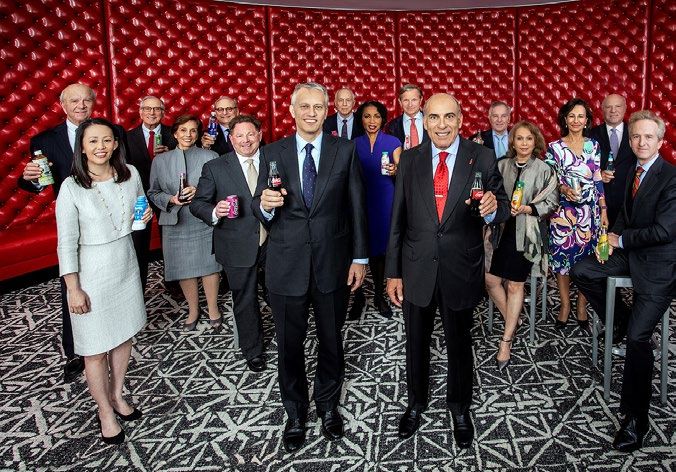
CEO/Board Our Priority Portfolio World Without Water Sustainable People & Partnerships Climate Regional Data
Letters Company Issues Transformation Waste Agriculture Communities Change Highlights Appendix
At A The Coca-Cola Total Beverage Business Transformation Selected Financial Progress Against Our Our System
Glance System Portfolio Timeline Data Sustainability Goals in Context
Table Title
Selected Year ended December 31,
(In millions except per share data)
2016 2017 2018
Financial Summary of Operations1
Data
Net operating revenues $ 41,863 $ 35,410 $ 31,856
Net income from continuing operations 6,550 1,182 6,727
Net income attributable to shareowners of The Coca‑Cola Company 6,527 1,248 6,434
Per Share Data
Basic net income from continuing operations $ 1.51 $ 0.28 $ 1.58
Basic net income 1.51 0.29 1.51
Diluted net income from continuing operations 1.49 0.27 1.57
Diluted net income 1.49 0.29 1.50
Cash dividends 1.40 1.48 1.56
Balance Sheet Data
Total assets $ 87,270 $ 87,896 $ 83,216
Long-term debt 29,684 31,182 25,364
Organic Revenue Growth Operating Income Growth Diluted Net Income Per Share Adjusted Free Cash
(Non-GAAP)2 (Non-GAAP)3 from Continuing Operations Flow Conversion Ratio
Growth (Non-GAAP)4 (Non-GAAP)5
5% 11% 13%
75%
8% 70%
3%
1%
′17 ′18 ′17 ′18 ′17 ′18 ′17 ′18
Organic Revenue Growth Income Continuing Operations Diluted Net Income Cash Flow Conversion
1 4 Reflects
The financial statement line items in Summary of Operations were unfavorably impacted by the refranchising of comparable currency neutral diluted net income per share from continuing operations, which is a non-
bottling territories in North America as well as the divestitures of certain company-owned bottling operations. In GAAP financial measure. Reported diluted net income per share from continuing operations grew 474 percent and
addition, net income attributable to shareowners of The Coca‑Cola Company for the year ended December 31, 2017 declined 82 percent for the years ended December 31, 2018 and 2017, respectively.
was unfavorably impacted by a net provisional tax charge of $3,610 million recorded by the company as a result of
5 Adjusted
the U.S. Tax Cuts and Jobs Act signed into law in December 2017. free cash flow conversion ratio = free cash flow adjusted for pension contributions divided by net
income from continuing operations adjusted for noncash items impacting comparability. Adjusted free cash flow
2 Organic revenue is a non-GAAP financial measure. Reported net operating revenues declined 10 percent and conversion ratio is a non-GAAP financial measure.
15 percent for the years ended December 31, 2018 and 2017, respectively.
Note: See pp. 54–57 for a reconciliation of non-GAAP financial measures to our results as reported under GAAP.
3 Reflects comparable currency neutral operating income (adjusted for structural items and accounting changes),
which is a non-GAAP financial measure. Reported operating income grew 14 percent and declined 12 percent for
the years ended December 31, 2018 and 2017, respectively. For more information about our performance, see the Data Appendix.
The Coca‑Cola Company 2018 Business & Sustainability Report 10CEO/Board Our Priority Portfolio World Without Water Sustainable People & Partnerships Climate Regional Data
Letters Company Issues Transformation Waste Agriculture Communities Change Highlights Appendix
At A The Coca-Cola Total Beverage Business Transformation Selected Financial Progress Against Our Our System
Glance System Portfolio Timeline Data Sustainability Goals in Context
2020 Sustainability Goals Our publicly reported 2020 sustainability goals drive us to continually improve. We aim to achieve our goals through a
concerted effort by The Coca‑Cola Company and approximately 225 bottling partners in more than 200 countries and
territories. We have set ambitious goals to drive system-wide change beyond small operational improvements.
Packaging Water Giving Back Women
Percentage of bottles and cans we refilled Percentage of water used in our Percentage improvement in water Percentage of the company’s annual Cumulative number of women
or helped recover equivalent to what we finished beverages returned to efficiency since 2010 operating income invested back into entrepreneurs economically empowered
introduced into the marketplace 1, 2 nature and communities 3 local communities across our global value chain
2030
GOAL 2020 2020
100% GOAL GOAL
150% 155% 1.6%
WORLD WITHOUT WASTE 25% 1.5% 5M
133%
115% 1.2% 1.2%
3.2M
59% 59% 59% 58% 56% 2020 2020
GOAL 58% GOAL 15% 16%
2020 2.4M
75% 100% 13%
56% 12% GOAL
1% 1.7M
1.2M
′15 ′16 ′17 ′18 ′15 ′16 ′17 ′18 ′15 ′16 ′17 ′18 ′15 ′16 ′17 ′18 ′15 ′16 ′17 ′18
Taking Packaging
additional rev1
packaging types into Water Return Water Imprvmt Efficiency Giving Back Women
consideration, our rate was 56% for 2018.1
Human Rights Agriculture Climate
Percentage of bottling partners Percentage of direct suppliers Percentage of ingredients sustainably sourced Estimated percentage reduction of
that achieved compliance with our that achieved compliance with our the carbon footprint of the “drink in
2017 2018
Supplier Guiding Principles Supplier Guiding Principles your hand” since 2010 4
2020 2020
90% 89% 87% 89% 2020 92% 90% 88% 89% 2020 GOAL GOAL
GOAL GOAL 100% 25%
76–100%
98% 95% 21%
19%
51–75%
14%
12%
26–50%
0–25%
′15 ′16 ′17 ′18 ′15 ′16 ′17 ′18 APPLES BEET CANE COFFEE CORN GRAPES LEMONS MANGOS ORANGES TEA SOY ′15 ′16 ′17 ′18
SUGAR SUGAR
Bottling Partner Compliance Direct Suppliers Compliance Climate
Agriculture
1 Our 3 As
method to track our 58% packaging collection rate against our 2020 goal focused on our predominant estimated working with our many external partners and using generally accepted, independently peer-
package types (glass bottles, steel and aluminum cans, and PET plastic bottles), which make up approximately reviewed scientific and technical methods. Finished beverages based on global sales volume.
85% of our portfolio. Because of new data that we have available to us, our 56% collection rate against our
4 The
World Without Waste goal takes into account a more inclusive collection rate, representing all of our consumer calculation of progress toward our “drink in your hand” goal has been internally vetted using accepted
packaging—including beverage cartons, juice boxes and pouches, etc. (see p. 24). and relevant scientific and technical methodologies, which are aligned with GHG Protocol Scopes 1, 2 and 3.
Due to the nature of our franchise bottling system, our manufacturing emissions are normally split between
2 Ourpercentage calculations of progress toward collection of 100% of the equivalent of the consumer Scopes 1 and 2 for company-owned facilities and Scope 3 for bottling partner facilities. However, in our “drink
packaging we sell has been internally vetted using relevant scientific and technical methodologies, but those in your hand” calculations, we consider the full Coca‑Cola system (including franchise bottling partners) in the
methodologies are evolving as the industry learns more about calculating collection in different markets. We are calculation of our manufacturing, distribution and refrigeration emissions.
working to improve our data collection and measuring systems. As systems and methodologies improve, we will
revisit our prior estimates to ensure their accuracy and make any necessary corrections to our public reporting.
For more information about our performance, see the Data Appendix.
The Coca‑Cola Company 2018 Business & Sustainability Report 11CEO/Board Our Priority Portfolio World Without Water Sustainable People & Partnerships Climate Regional Data
Letters Company Issues Transformation Waste Agriculture Communities Change Highlights Appendix
At A The Coca-Cola Total Beverage Business Transformation Selected Financial Progress Against Our Our System
Glance System Portfolio Timeline Data Sustainability Goals in Context
Our System in Context
SHARED OPPORTUNITY
Our business operates within
a wider context. We consider
this context carefully, and we
continuously apply what we learn
to manage our impacts, aiming
INPUTS OUTCOMES
What We Depend On What We Create
to create shared opportunity
as we transform into a total
beverage company.
Our short- and long-term success
depends on a range of inputs, CONSUMER &
such as ingredients, water CUSTOMER DEMAND
and packaging from our many
INCREASING TRANSPARENCY
suppliers, and the talents and CONSUMER, CUSTOMER &
AND TRUST
passion of our global workforce STAKEHOLDER INSIGHTS
and system employees. And, of THE PRODUCT CHOICES:
COCA-COLA
course, our business generates RAW MATERIALS:
SHARED OPPORTUNITY
SHARED OPPORTUNITY
Total Beverage Portfolio
revenue from consumers who Water, Ingredients, Energy,
SYSTEM
provide us with their trust Raw Materials
and the financial resources to COMMUNITY IMPACT:
operate, innovate and grow. TALENT:
Local Community Support, Watershed
Protection, Access to Safe Water and Sanitation,
As a result, we create a range Employees, Farmers, Partners
PASSION FOR Recycling, Disaster and Humanitarian Relief,
of outcomes including diverse Around the World
CONSUMERS Education, Arts & Culture
beverage products; economic
benefits such as jobs, taxes paid INNOVATION
FINANCIAL RESOURCES:
and community investment; ECONOMIC DEVELOPMENT:
Top-Line Revenue MARKETING
ecosystem impacts and Jobs, Women’s Empowerment, Taxes Paid,
Community Investment, Value and Revenue
initiatives; and customer and GOVERNANCE for Customers, Growth Opportunities
shareowner value. RECYCLED MATERIALS,
REUSE MANUFACTURING
DISTRIBUTION PACKAGES, WASTE,
See the Coca-Cola system CARBON EMISSIONS
REINVESTMENT
diagram.
FINANCIAL RESOURCES,
PROFIT, DIVIDENDS
SHARED OPPORTUNITY
The Coca‑Cola Company 2018 Business & Sustainability Report 12CEO/Board Our Priority Portfolio World Without Water Sustainable People & Partnerships Climate Regional Data
Letters Company Issues Transformation Waste Agriculture Communities Change Highlights Appendix
Our Approach to Priority Issues:
Managing Our Priorities Risks & Opportunities
Our Approach to Managing Our Priorities
THE COCA‑COLA COMPANY THE COCA-COLA SYSTEM
Our board’s role is overseeing the
company’s long-term business Corporate Sustainability Sustainability
strategy, which includes providing
review of and guidance for our Governance Governance Approach
ongoing transformation to a total
beverage company. I am pleased
with how this board works with At The Coca‑Cola Company, we set high The Public Issues and Diversity Review We aim to achieve our operating and
management toward the common standards for our people at all levels Committee helps the board fulfill sustainability goals through a concerted
goal of long-term value creation and strive to meet these standards responsibilities relating to diversity, effort by The Coca‑Cola Company and
for our shareowners and consistently. Our sound business sustainability, corporate social approximately 225 bottling partners
other stakeholders.” principles and practices foster a strong responsibility and public issues of in more than 200 countries and
innovative, and collaborative culture, significance, especially with regard territories. We have set ambitious goals
SAM NUNN which is committed to ethical behavior, to ways in which these issues may to drive system-wide change beyond
Lead Independent Director accountability and transparency. affect the shareowners, the company, small operational improvements.
communities in which we operate,
Information about the company’s and the general public. This entails We have robust programs in place to
corporate governance, including the evaluating and reviewing information identify issues for our business and
company’s Code of Business Conduct, pertaining to social, political and stakeholders, and cross-functional
Corporate Governance Guidelines, environmental trends, with oversight teams working across our system to
Certificate of Incorporation and Bylaws over diversity and sustainability goals, gather data and perspectives to inform
are on our website. Information as well as human and workplace rights. our actions. Beyond our internal
about how to report concerns about Enterprise Risk Management team,
the company and our public policy The committee reviews, at least this also includes the work of our
engagement and political contributions annually, all shareowner proposals, dedicated Stakeholder Engagement
policy can be accessed here. public policy advocacy efforts, function that partners with business
political contributions and charitable units, bottling partners, NGOs,
The company’s board of directors has contributions to ensure alignment with governments, and people in
established a number of committees company policy and our overall values. communities all around the world.
to assist in discharging its duties.
These include an Audit Committee, The committee reports to the board
a Compensation Committee, regularly regarding actions and
a Committee on Directors and recommendations, and annually
Corporate Governance, an Executive conducts a self evaluation, which it
Committee, a Finance Committee, a presents to the full board.
Management Development Committee,
and a Public Issues and Diversity
Review Committee. The charter for
each committee can be viewed on
our website.
The Coca‑Cola Company 2018 Business & Sustainability Report 13CEO/Board Our Priority Portfolio World Without Water Sustainable People & Partnerships Climate Regional Data
Letters Company Issues Transformation Waste Agriculture Communities Change Highlights Appendix
Our Approach to Priority Issues:
Managing Our Priorities Risks & Opportunities
Priority Issues Matrix
Focusing on the highest-priority
environmental, social and governance Obesity concerns and category perceptions
issues for our business and our
stakeholders is a foundational step Water stewardship
in how we conduct business and
develop our corporate strategy. It is
also foundational to how we build,
evolve and report on our business and
our sustainability efforts. For example,
since we conducted our priority issues Packaging
INCREASING CONCERN TO STAKEHOLDERS
analysis in 2015 (see chart to the right),
the company has launched strategic
global initiatives including Our Way Community engagement
Forward and World Without Waste, Women’s economic empowerment
Climate change risks
and conducted a climate scenario
Responsible sourcing
analysis. Human rights
Greenhouse gas emissions
During 2019, we will be undergoing Energy use and efficiency
a thorough review of our priority Responsible supply
issues in collaboration with a cross- chain management
functional internal team and key
external stakeholders. This will ensure Occupational health and safety
that we take into consideration the
Employee wellness, Product safety and ingredients
changing social, environmental and development
economic context as we evolve our and engagement
business, along with wider stakeholder
Diversity and
expectations. equal opportunity
Manufacturing waste
Learn more about our approach to
stakeholder engagement here.
* This matrix represents the results of
our 2015 priority issues analysis.
INCREASING CURRENT OR POTENTIAL IMPACT TO THE COCA-COLA SYSTEM
The Coca‑Cola Company 2018 Business & Sustainability Report 14CEO/Board Our Priority Portfolio World Without Water Sustainable People & Partnerships Climate Regional Data
Letters Company Issues Transformation Waste Agriculture Communities Change Highlights Appendix
Our Approach to Priority Issues:
Managing Our Priorities Risks & Opportunities
Priority Issues: Risks & Opportunities
As a company operating Product Innovation Plastic Waste
with a growth mindset
and a presence in almost Consumers are adopting healthier diets Concern about plastic waste has
and lifestyles, which include eating and risen sharply as waste collection and
every country and drinking less sugar, creating demand recycling infrastructure have not kept
territory in the world, we for a wider range of low- or no-sugar pace with plastic manufacturing,
products, and new ingredients, such causing an increase in plastic waste
consider our risks and as plant-based protein. This trend in the environment. Issues such
opportunities in a global presents a growth opportunity for as changes in local regulations to
us, and we listen to consumers as we discourage the use of plastic and the
context. evolve our long-term business strategy. cost of material inefficiencies of linear
production models all constitute risks
Many of the issues we face are Along with the business opportunity, across our global operations. There are
interconnected and evolving quickly, there are also real risks. For example, hotspots in regions where recycling
and we need to understand them to there is a growing concern among infrastructure is weakest and/or where
fulfill our long-term vision to grow in a consumers, public health professionals, ecosystem damage from pollution
way that creates value for all people— and government agencies about is most acute, including oceans and
consumers, customers, suppliers and the increased prevalence of obesity, coastal areas.
communities—while working toward which is correlated to several non-
solutions that benefit us all. communicable diseases. The food and Innovations in packaging materials,
beverage industry has a responsibility such as plant-based raw materials
Throughout this report we reference to help adequately address these that substitute for petrochemical
our transformation to a total beverage Approximately 14% of plastic
challenges through innovation and new feedstocks, as well as circular
company. There are many issues of packaging—including beverage
product offerings. models that turn post-consumer
relevance to our company, both in packaging as well as that of other
plastics into new, economically viable
relation to this transformation, and consumer products—is collected
value streams, present multiple
more broadly as a global growth for recycling globally.1 Our collection
opportunities. These new plastic
business, which we explore in more We support the current rate for non-returnable PET plastic
production models offer improved
detail in our key sustainability topics recommendation by several leading bottles is approximately 52%, in part
ecosystem impacts and carbon
and subsequent pages. The following health authorities, including the because PET plastic has a high value
footprint reductions, accelerate the
risk and opportunity areas help World Health Organization, that relative to other types of plastics. 2
shift away from single-use plastic,
provide a snapshot of the global people should limit their daily intake and in some regions also create
context in which our transformation of added sugar to no more than new employment.
is taking place. 10% of their total energy/calorie
consumption.
1
New Plastics Economy—Ellen MacArthur Foundation those methodologies are evolving as the industry
2017 report, p. 16. learns more about calculating collection in different
markets. We are working to improve our data
2
Our percentage calculations of progress toward collection and measuring systems. As systems and
collection of 100% of the equivalent of the consumer methodologies improve, we will revisit our prior
packaging we sell has been internally vetted using estimates to ensure their accuracy and make any
relevant scientific and technical methodologies, but necessary corrections to our public reporting.
The Coca‑Cola Company 2018 Business & Sustainability Report 15CEO/Board Our Priority Portfolio World Without Water Sustainable People & Partnerships Climate Regional Data
Letters Company Issues Transformation Waste Agriculture Communities Change Highlights Appendix
Our Approach to Priority Issues:
Managing Our Priorities Risks & Opportunities
Water Resources Climate Change
There are many threats to water There is growing concern that Innovations in ingredients and
quality and availability, including an increase in global average packaging materials are becoming
unsustainable agriculture practices, temperatures and the resulting more scalable, while access to
poor sanitation infrastructure, runoff changes to the climate will cause renewable energy is increasingly
and industrial pollution, and overuse of significant disruptions in weather mainstream. Companies that take
water resources. Additionally, climate patterns around the globe, creating advantage of the significant potential
change is exacerbating water scarcity more frequent and severe natural of these and other solutions have the
through increased droughts and floods, disasters, including fires, storms and opportunity to improve the resilience
which in turn impact farmers and other floods. In addition to direct impacts of their own supply chains, operations
water users who will need to adapt to on our operations and communities, and distribution networks, while
water stress in many different regions. this may affect food security and contributing to greater stability of the
Our products depend on the availability also decrease the agricultural planet we all share.
of high-quality water, as do the people productivity—and/or increase the
living in the communities where we cost—of key agricultural commodities.
do business. Policies that incentivize emissions
reductions, and initiatives that reduce Limiting global warming to
By bringing our expertise and other deforestation or other negative below 1.5°C will be required to
resources to bear, we can ensure that impacts through land-use changes for remain below relevant global
our operations contribute positively food production, are also increasing. risk thresholds—and this will entail
to healthy freshwater and marine These changes are important rapid and far-reaching transitions
ecosystems around the world. We can considerations for companies as in land use, energy, industry,
use these same resources to provide they assess CO 2 emissions in their buildings, transport and cities. 2
access to safe drinking water and value chains as well as key supplier
sanitation while helping to restore relationships. These and other
natural water cycles, benefiting factors combine to create a growing
multiple aspects of our value chain and financial business risk, of which For more information on our climate
the people and communities we serve. investors and other stakeholders risks and opportunities, see p. 45.
are increasingly aware.
According to the World Economic
Forum, water crises have been
among the top five global risks in
each of the last seven years.1
1 CEO 2 IPCC
Water Mandate report, The Business Case 2018 report summary.
for Water Stewardship (2018).
The Coca‑Cola Company 2018 Business & Sustainability Report 16CEO/Board Our Priority Portfolio World Without Water Sustainable People & Partnerships Climate Regional Data
Letters Company Issues Transformation Waste Agriculture Communities Change Highlights Appendix
Overview Providing Choice Reducing Calories—
to Consumers Expanding Portfolio
Taking Action and Expanding Choice
425,000
tons of sugar removed on
an annualized basis through
People’s tastes and Using Data to Reduce innovation such as new recipes
and smaller package sizes
preferences are Sugar and Calories in 2017/2018
changing, so we’re
changing, too. Around the world, consuming less
sugar is an increasingly important issue
Driven by our passion for consumers, for many people.
we have been shifting our mindset and Total
culture, as well as the way we measure To meet these changing consumer Reformulations
our success, resulting in bold action to needs, we have updated our approach Globally
transform our portfolio. to more effectively measure our sugar
and calorie reduction efforts. Since our
18 20
~80
2016
CEO-led Our Way Forward initiative of our
Gradually reducing sugar was launched in 2017, we have been
aggressively reformulating recipes top brands are
across our entire portfolio1
to reduce sugar, using our marketing low- or no-sugar
muscle to promote low- and no-calorie or have a low- or
~310
2017
Making smaller, more beverage options and investing along no-sugar option
with our system to make smaller
convenient packages so
packages more available. We have also
controlling sugar intake is easier been accelerating the expansion of
~400
beverage options across our portfolio. 2018
Offering more new drinks Just as we harness data and analytics
that provide benefits like to inform and improve our growth
nutrition and hydration efforts at scale, we also track our sugar
and calorie reduction efforts from
market to market.
Giving people the information
they need to make informed We keep track of metrics resulting
from the sugar reduction levers
choices
we are using, such as total calories
from sugar—both added and natural
sugars—across all of our brands, 2
sugar reductions from a combination
1 To of new recipes, 3 promotion of low- and
maintain consumer acceptance and avoid
moving so far that consumers substitute higher no-calorie beverages, and reduced
sugar alternatives, it is widely accepted that package sizes.
reformulation is a gradual process.
The cumulative effect of these actions
2 Thisdoes not include calories from non-sugar
ingredients such as protein or fat.
is lowering the average calories per
3 Due to regulations affecting 100% natural juices, package in our portfolio.
natural sugars must be left intact to be classified
as 100% juice.
The Coca‑Cola Company 2018 Business & Sustainability Report 17CEO/Board Our Priority Portfolio World Without Water Sustainable People & Partnerships Climate Regional Data
Letters Company Issues Transformation Waste Agriculture Communities Change Highlights Appendix
Overview Providing Choice Reducing Calories—
to Consumers Expanding Portfolio
Putting Consumers First
We’re exploring and bringing to market Responding to
new sugar alternatives that help us
keep the great tastes people love but Local Conditions to
with less sugar and fewer calories. For Reduce Sugar
example, Coca-Cola Zero Sugar realized
double-digit volume growth in 2018
globally as we continued to invest as We are taking action on sugar
a system in marketing and promotions reduction even where it means
of this zero-calorie sparkling changes to our most popular,
product innovation. time-tested products—putting our
strength in innovation to work for our
We’re also heavily promoting our consumers’ evolving needs.
low- and no-sugar drinks, making
them more visible and easier to find. Coca-Cola Chile’s portfolio is now
And we’re bringing drinks like organic composed of 95% low- and no-
tea, coconut water, juices, purified calorie beverages representing a
water and beyond to more people in significant reduction in sugar and
more places. calories. The Coca-Cola system
Smaller, More removed the equivalent of 33,000
tons of sugar from the market through
Convenient Packages recipe changes across our Chilean
beverage portfolio.
Smaller, more convenient packaging Coca-Cola Singapore launched new
helps people control sugar intake more Sprite and Fanta Orange recipes in
easily for themselves and their families. 2018, which contain more than 40%
less sugar without compromising on
• Today, about 44% of our sparkling taste. In Japan, we continued to offer
soft drink brands come in convenient no-sugar product varieties including
packages of 250 mL (8.5 oz.) or less. Ayataka FOSHU tea and Japan
• Smaller packages of sparkling soft Craftsman Black (no-sugar) coffee.
drinks in North America again posted
double-digit growth led by 7.5-ounce The commitment we made along with
mini cans of sparkling soft drinks like the European soft drinks industry
Coca-Cola and Sprite. to reduce the average added sugar
content of still and carbonated soft
drinks by 10% has led to 16 national
sugar reduction pledges in the EU to
More than 30% growth for date, and counting.
mini cans in North America
in 2018.*
For information about our innovative
sugar reduction in Mexico, see p. 20.
* Nielsen AMC.
18CEO/Board Our Priority Portfolio World Without Water Sustainable People & Partnerships Climate Regional Data
Letters Company Issues Transformation Waste Agriculture Communities Change Highlights Appendix
Overview Providing Choice Reducing Calories—
to Consumers Expanding Portfolio
Offering More Responsible Marketing
New Drinks
We do not target our advertising to
children under age 12, anywhere in the
We’re looking for ways, whenever we
world. Examples of this longstanding
can, to make many of our beverages
policy in action include:
better and more nutritious by providing
We’re making reduced-sugar vitamins, minerals and electrolytes,
• We do not place advertising in media
products more available through while also introducing more dairy,
where the audience is comprised
reformulation. We’ve reformulated plant-based beverages and different
of over 35% children under 12 years
hundreds of products around sweetness level options to meet an
old, including television shows,
the world. We’re also making our increasing range of consumer choices.
print media, websites, social media,
zero-sugar products taste better. With this in mind, we launched more
movies, SMS/email marketing,
and promoting them more. As we than 600 products in 2018 including:
animation, third-party characters,
take these actions, consumers are celebrities/games/contests, branded
responding positively in the sense • Sprite Fiber+, a no-sugar drink
toys/merchandise, talent selection,
that they are accepting sugar- with dietary fiber and the flavor
point of sale, and merchandise items.
reduced products at a good rate. and refreshment consumers expect
• We do not design our marketing
We also see growth in our zero- from Sprite, was launched in China. Giving People communications in a way that
sugar portfolio as well as in smaller • Coca-Cola Batch Blends Coffee
pack sizes.” and Chocolate, a no-sugar beverage Information appeals primarily to children under 12.
• We work with industry platforms
combining refreshing Coca-Cola
such as the International Food &
ROBERT LONG taste with chocolate and real
We continue to put clear, easy-to-find Beverage Alliance (IFBA), World
Chief Innovation Officer coffee from Brazil, was launched
nutrition information right up front to Federation of Advertisers (WFA), the
in Vietnam.
support informed choices, without the EU Pledge initiative, Children’s Food
• smartwater alkaline, which is ionized
guesswork. and Beverage Advertising Initiative
to ensure the pH level is 9+, was
Delivering Strategic launched in select U.S. markets.
(CFBAI) and others to put meaningful
actions in place to reduce the
Growth exposure of children to advertising of
We lead the food and all products high in fat, salt or sugar.
beverage industry in • We evolve our commitments to
Prioritizing consumers’ preferences respond to changing societal
means identifying strategic
voluntary front-of-package
concerns, including advertising
acquisitions and investments in calorie labeling. For example, on digital platforms, and work
emerging brands. In 2018, we in Europe, we are introducing with local industry to join these
announced the definitive agreement trials of color-coded nutrition framework commitments and scale
to acquire Costa Limited. Costa is collective actions.
the leading coffee company in the
labelling to help people
• We openly participate in audits by
United Kingdom and has a footprint know exactly what is in the external organizations that monitor
in more than 30 countries in the drinks they enjoy. Our labels our advertising to demonstrate
fast-growing coffee category. We build on a scheme that is compliance with our standards and
also acquired a minority ownership all relevant authorities.
stake in BODYARMOR, a sports
already familiar to more than
drink that contains potassium and 500 million people across
other electrolytes, vitamins and the European Union, adding See more information on our approach to
coconut water, with no artificial colors responsible marketing here.
red, amber and green colors
or flavors.
to the numbers for key
nutrients (fats, saturated fat,
salt, sugar).
The Coca‑Cola Company 2018 Business & Sustainability Report 19You can also read


