2018 Instruction Manual TOM Ltd - Regional, Branch and International Tournaments
←
→
Page content transcription
If your browser does not render page correctly, please read the page content below
Instruction Manual
TOM Ltd        2018
Regional, Branch and International Tournaments
           © Copyright 2018 Tournament of Minds Ltd.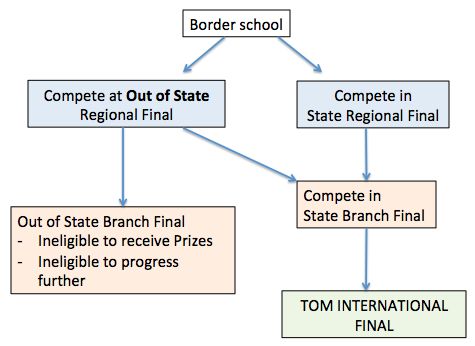
Published in Australia by:

Tournament of Minds Limited
Website & TOM Portal: www.tom.edu.au
Email: aus-director@tom.edu.au

© 2018 Tournament of Minds Ltd.

Important Copyright Notices
The Tournament of Minds program is copyright protected and any materials
must not be copied or distributed outside registered schools for any purpose.

The Tournament of Minds logo with the words ‘Challenging the World’ is the
registered trademark of Tournament of Minds Ltd. (A36145L).

Please note:
This manual needs to be read carefully and in
conjunction with Challenges. There have been changes
for 2018.
The Glossary section provides additional, essential
information – please read it thoroughly.

                              © Copyright 2018 Tournament of Minds Ltd.
Contents
1. Overview .................................................................................................................................... 2
1.1 What is Tournament of Minds?........................................................................................ 2
1.2 TOM Objectives ............................................................................................................... 2
1.3 The Long Term Challenge ............................................................................................... 3
1.4 The Spontaneous Challenge ........................................................................................... 3
1.5 Spirit of TOM ................................................................................................................... 3
2. General Rules ............................................................................................................................ 4
2.1 School Registration ......................................................................................................... 4
2.2 Copyright Information for Registered Schools ................................................................. 5
2.3 Team Nomination ............................................................................................................ 5
2.4 Divisions .......................................................................................................................... 5
2.5 Team Membership........................................................................................................... 6
2.6 Access to Challenges ...................................................................................................... 6
2.7 Scoring ............................................................................................................................ 6
3. The Spontaneous Challenge...................................................................................................... 7
4. The Long Term Challenges........................................................................................................ 8
4.1 Overview.......................................................................................................................... 8
4.2 The Presentation ............................................................................................................. 8
4.3 Multi Media Presentations ............................................................................................... 9
4.4 Challenges Requiring Specific Materials ......................................................................... 9
4.5 Scoring ............................................................................................................................ 9
4.6 Recordings and Media Release ...................................................................................... 9
4.7 Risk Management Policy ................................................................................................. 9
5. Judging..................................................................................................................................... 11
5.1 Judges ........................................................................................................................... 11
5.2 Rule Violations............................................................................................................... 11
5.3 Disciplinary Action ......................................................................................................... 11
5.4 Awards........................................................................................................................... 11
6. Tournament Days..................................................................................................................... 12
6.1 Regional Tournament Day............................................................................................. 12
6.2 Branch Finals & TOM International Final....................................................................... 12
7. Team Forms ............................................................................................................................. 14
7.1 Regional Finals .............................................................................................................. 14
7.2 Presentation Skills Form ................................................................................................ 14
7.3 Outside Assistance Form .............................................................................................. 14
7.4 Branch and TOM International Finals ............................................................................ 14
Presentation Skills Form .............................................................................................................. 15
Presentation Skills Form Sample .................................................................................................... 16
Outside Assistance Form ................................................................................................................ 17
Presentation Summary Form........................................................................................................... 18
(For 3 hour Challenges only) ........................................................................................................... 18
8. Glossary ................................................................................................................................... 19
9. Timeline 2018........................................................................................................................... 24
© Copyright 2018 Tournament of Minds Ltd. | Page 11. Overview
1.1 What is Tournament of Minds?
Tournament of Minds (TOM) is an international program designed to give participants the
opportunity to participate in creative activities involving stimulating open-ended Challenges
which demand experimentation and reward divergent thinking. TOM promotes learning and
developing as an individual within a team structure.
Tournament was launched in Victoria in 1987 and by 1992 all Australian states and
territories had joined the program. It is now an international program, with competitions
conducted in New Zealand, Africa and southeast Asia. In 2018, the TOM program has been
updated to reflect a worldwide educational focus on STEM by reinvigorating our technical
disciplines in a way that complements our humanities-based disciplines.
1.2 TOM Objectives
How TOM links to the Australian
TOM’s objectives are to: Curriculum - General Capabilities:
! provide real open-ended challenges • Literacy
• Numeracy
• Information and Communication Technology
(ICT) capability
• Critical and creative thinking
• Personal and social capability
• Ethical behaviour
• Intercultural understanding
! develop creative problem-solving • Critical and creative thinking
approaches and techniques • Literacy
• Numeracy
• Information and Communication Technology
(ICT) capability
! foster co-operative learning and • Personal and social capability
teamwork
! promote knowledge and appreciation of • Personal and social capability
self and others • Ethical behaviour
• Intercultural understanding
! encourage experimentation and risk • Critical and creative thinking
taking
! expand and reward creative and • Critical and creative thinking
divergent thinking
! stimulate a spirit of enquiry and a love of • Critical and creative thinking
learning • Personal and social capability
! develop enterprise and demonstrate • Critical and creative thinking
initiative
! celebrate excellence • Personal and social capability
On Tournament Day, teams of between five and seven students are required to present
their solutions to two challenges - the Long Term Challenge and the Spontaneous
Challenge. These challenges are designed to foster the development of attitudes and skills
that are valued by employers and to promote lifelong learning.
© Copyright 2018 Tournament of Minds Ltd. | Page 21.3 The Long Term Challenge
The Long Term Challenge is an open-ended challenge, in that it does not have any one
specific solution. Teams must work collaboratively and creatively to satisfy multiple criteria
and present their solutions in a dramatic format.
The Long Term Challenge disciplines are:
1.3.1 STEM
The combination of Science, Technology, Engineering and Mathematics (STEM)
principles provides an integrated approach for students to deepen their conceptual
understanding, and use their creative and critical thinking skills to solve the
challenges within an authentic context. There may be additional materials required
to create a physical model to help demonstrate the Challenge solution. These
materials will be provided separately for the Branch and International Finals.
1.3.2 The Arts
The Arts Challenge asks students to research aspects of visual and performing arts
and will require students to apply performing arts skills in their solutions. This may
involve existing or original works of art, theatre, dance, music and song. The use of
musical instruments is allowable in The Arts Challenge performance.
1.3.3 Language Literature
The Language Literature Challenge asks students to investigate and apply common
literary devices and language techniques. This may involve existing or original texts,
where texts may be written, spoken or multimodal, and in print or digital forms.
1.3.4 Social Sciences
The Social Sciences Challenge asks students to explore social issues and aspects
of human society. This may include posing moral and ethical questions in a variety
of contexts.
Teams select ONE Long Term Challenge from the disciplines above. They then work
collaboratively, without outside assistance, to prepare their solution. This solution is
performed to a panel of judges and an audience, at Regional Tournament Day.
1.4 The Spontaneous Challenge
On Tournament Day teams are also presented with a Spontaneous Challenge.
Spontaneous Challenges are previously unseen ‘on the spot’ Challenges. They allow only a
short time for teams to discuss and plan their response. The purpose of the Spontaneous
Challenge is to closely analyse the team’s ability to develop ideas and work collaboratively
towards a solution.
1.5 Spirit of TOM
The Spirit of TOM is the fundamental attitude that underpins the entire program. It
encompasses all of the activities involved in successful personal and team participation. It
is evident when teams:
• demonstrate tolerance, co-operation and fair play;
• abide by the rules of the program and are self-disciplined in their problem solving;
• respect the views and opinions of all team members; and
• respond positively to overcome obstacles encountered during the challenge timeline.
© Copyright 2018 Tournament of Minds Ltd. | Page 32. General Rules
2.1 School Registration
Registration is completed through the TOM Portal at www.tom.edu.au.
Schools MUST register in the State Branch where their school is situated.
EXCEPTION BORDER SCHOOLS: A border school may request to compete in a
regional final outside of their State Branch through a request via their Branch
Director. The following conditions will apply if a border school competes out of State:
• In the event the border school team wins at the regional level, they would
compete in their school’s State Branch Final to be eligible to win and
progress to the TOM International Final. For example a school which is
situated in NSW but wishes to compete in Victoria cannot go through to the
Victorian Branch Final to be eligible to continue to the TOM International
Final. The team will be able to progress if competing in the NSW Branch
Final.
• Teams which win a regional final and choose not to go to their school State
Branch final may choose to compete in the closer Branch Final as non
conforming and therefore not eligible to win and progress to the TOM
International Final. A non-conforming team will not be awarded a prize at
Branch Final and not progress to the TOM International Final.
• If the winning team chooses to go to their own Branch final, the second
placed team may be invited (at the discretion of the director) to compete in
their own home branch final.
Registration for 2018 costs $220AUD for the school plus $50 per team. There is no limit to the
amount of teams a school may enter.
Schools may register an unlimited number of teams in any of the disciplines.
© Copyright 2018 Tournament of Minds Ltd. | Page 42.2 Copyright Information for Registered Schools
All Tournament of Minds materials and Challenges are copyright protected. School
registration allows unlimited copies to be made of all such materials for use within the
school for the period of registration.
Please note: Distribution of Tournament of Minds materials beyond a registered
school violates copyright.
2.3 Team Nomination
Team Nominations are separate to registration. This is for Facilitators to submit:
• The team’s selected challenge;
• The name of each student in the team;
• The year level of each student in the team.
Nominations are completed through the TOM Portal after teams have received the
challenges and made their selection. Facilitators should carefully note the deadlines
for team nomination as given by their Regional Director.
2.4 Divisions
Both divisions receive the same Challenges.
Tournament of Minds has two divisions. These are dependent on Branch systems and may
differ slightly depending on what constitutes primary/secondary in a particular school. The
division entered is determined by the grade level of the oldest team member.
Please see the table below for your state, territory or country.
Division I Division II
ACT K 1 2 3 4 5 6 7 8 9 10
NSW K 1 2 3 4 5 6 7 8 9 10
NT T 1 2 3 4 5 6 7 8 9 10
QLD P 1 2 3 4 5 6 7 8 9 10
SA R 1 2 3 4 5 6 7 8 9 10
TAS P 1 2 3 4 5 6 7 8 9 10
VIC P 1 2 3 4 5 6 7 8 9 10
WA P 1 2 3 4 5 6 7 8 9 10
NZ 1 2 3 4 5 6 7 8 9 10
Please note: Teams from other countries need to contact the Director of their country or the
Australian Director to clarify which division is applicable.
© Copyright 2018 Tournament of Minds Ltd. | Page 52.5 Team Membership
Tournament of Minds encourages and fosters team co-operation. All Tournament activities
are performed as a team.
2.5.1 Each team consists of between five and seven students.
2.5.2 Division I teams must consist of a mixture of students from at least two year levels,
with a maximum of four students from any year. Refer to table in 2.4.
2.5.3 Division II teams must consist of a mixture of students from at least two year levels,
with a minimum of two students from the lowest year level in the division with a
maximum of four students from any year level.
2.5.4 Division I students may compete in Division II however Division II students cannot
compete in Division I.
2.5.5 Teams that do not conform to the above rules may still participate in the Tournament
but will be ineligible to receive awards or progress further in the Tournament
program.
2.5.6 Only the original team members may work on the Challenge during the six weeks
prior to Tournament Day and if the team progresses beyond the Regional level.
2.5.7 There must be no substitution of team members after the Team Nomination Form
has been submitted. If a team member is unable to compete, the Facilitator must
notify the Tournament Director as soon as possible and continue with only the
remaining members. The minimum number of team members for a conforming team
is five.
2.5.8 All team members registered on Tournament Day are to be involved in both the
Long Term Challenge presentation and in solving the Spontaneous Challenge.
2.5.9 Should a team member require specific adjustments to be made, it is the
responsibility of the Facilitator to notify the Tournament Director. Wherever possible,
these adjustments will be made.
2.6 Access to Challenges
Six weeks before the Regional Tournament facilitators will be able to download the
Challenges and all associated forms from the ‘Resources’ section of the TOM Portal at
www.tom.edu.au. All documents published on the TOM Portal are the official and up-to-date
requirements from which teams must work.
2.7 Scoring
2.7.1 The total score is obtained by adding the team’s Long Term Challenge score (max.
270) and the team’s Spontaneous Challenge score (max. 150).
2.7.2 In the event of a tie the overall winner will be determined by the highest
Spontaneous Challenge score.
2.7.3 Scores may be affected by serious rule violations.
2.7.4 Feedback will be provided to teams for both Long Term and Spontaneous
Challenges.
2.7.5 No score will be divulged.
2.7.6 The judges’ decision is final and no correspondence will be entered into.
© Copyright 2018 Tournament of Minds Ltd. | Page 63. The Spontaneous Challenge
3.1 All team members must be involved in solving the Spontaneous Challenge.
3.2 The only item teams may use in the Spontaneous Challenge is a timer. No other items are
allowed – this includes mobile phones and smart watches. All the materials a team may
need will be supplied, including paper, pens or pencils, and a timing device. Teams may not
take any notes or papers away from the Spontaneous Challenge room.
3.3 No-one except the judges and the team members are allowed in the Spontaneous
Challenge room. No spectators, facilitators, parents or media are allowed to view this
activity. This allows the judges to focus on the finer details of the team’s work.
3.4 The Spontaneous Challenge will not be revealed until presented to the team by the judges.
Each team will be given the same Challenge. Any team member found revealing the nature
of the Spontaneous Challenge prior to the end of the Tournament will be subject to
disciplinary action and may cause their team to be disqualified.
3.5 All Spontaneous Challenges will allow team discussion time before the response time so it
is important for teams to have developed the ability to work collaboratively. The judges will
not answer questions related to the Challenge.
3.6 A laminated copy of the Challenge will be provided to teams when the discussion time
starts. Students with hearing impairments will be given a copy to read as the Challenge is
read by judges.
3.7 The Challenge will be read twice before the timer is started. Team members are required to
listen carefully and note what they are required to do and how to respond. There may be a
limit to the number of responses allowed. Teams are advised to present their best
responses. Team members may begin to take notes once the judge starts to read the
challenge for the first time.
3.8 The buzzer will ring to mark the end of Discussion Time. It will then be re-started to time
the response period. Once the response time has begun it cannot be stopped. During the
response time no further discussion is allowed.
3.9 Teams will be judged on the group’s thinking processes, the creativity of responses and
their ability to work as a team. No points are awarded for presentation.
3.10 Only responses given during the Response Time will be included in judging – anything said
during Discussion Time but not during Response Time will not be marked no matter how
good it is.
3.11 The Spontaneous Challenge is scored out of 150, with marks each allocated to:
• Group thinking processes (35 marks):
• Ability to work as a team (35 marks)
• Creativity of responses (80 marks)
© Copyright 2018 Tournament of Minds Ltd. | Page 74. The Long Term Challenges
4.1 Overview
4.1.1 Six weeks before Tournament Day, Facilitators will be able to access the Long Term
Challenge in each of the Tournament disciplines via the TOM Portal at
www.tom.edu.au. Please note that occasionally this will be five weeks due to school
holidays.
4.1.2 Facilitators give team members copies of the Long Term Challenges to discuss,
from which each team is to choose one Long Term Challenge only.
4.1.3 The Facilitator must nominate on the TOM Portal the team’s chosen challenge and
each team member’s name.
4.1.4 The team has the rest of the preparation period to interpret the Challenge,
experiment with different solutions and put a final solution into dramatic form (a
play), make costumes and props, and rehearse the presentation.
4.1.5 On Tournament Day each team presents their solution to a panel of judges and an
audience.
4.2 The Presentation
4.2.1 A performance area of approximately 3m x 3m will be marked, known as ‘the
square’. Team members who are performing must be visibly inside this area. If the
performance area is to be a different size or shape, the team will be notified.
4.2.2 The judges will indicate to the team when the presentation time is to begin. Entry
into the square prior to this will result in the presentation time commencing.
4.2.3 The total time for setting up, performing the Challenge solution and clearing away is
ten minutes. After nine minutes the judges will indicate that the team has only “one
minute remaining”. Any part of the presentation after the ten-minute mark will not
be considered.
4.2.4 All seven team members must be involved in the Challenge presentation and must
play a meaningful part.. A minimum of four team members must be visibly within the
square at all times, including during scene changes.
4.2.5 The Tournament Director will provide:
• two chairs
• one table
• an electrical outlet that will accept a standard three-prong plug.
• The table and chairs will be outside the performance area before the performance time
starts and must be outside it again before the timer will be stopped.
4.2.6 All furniture, props and backdrops are to be arranged and removed within the ten-
minute time frame. However, teams may be dressed in costumes before the ten
minutes begins and remain in them; audio visual equipment may be set up prior to
this time with the judges’ permission.
4.2.7 If teams need to display a backdrop, they must provide their own display boards or
screens. Likewise, teams must provide their own power boards and extension cords
if required. All electronic equipment, power boards and extension cords need
to be currently tested and tagged.
4.2.8 Team members must wear predominantly black clothing.
4.2.9 Teams must make any costumes and props from the list of ‘Allowable Materials’
included in the Challenge. Other items may be used, such as musical instruments
© Copyright 2018 Tournament of Minds Ltd. | Page 8and technology – see 7.3 for further details.
4.2.10 No naked flames (e.g. matches, candles), sparklers, party poppers, firecrackers,
smoke bombs, laser lights, sharp implements (e.g. darts or knives) or similar
paraphernalia may be used.
4.2.11 During the presentation, a team member may ask for audience involvement, e.g.
applause, boos or laughter. However, if it appears that the audience is involved
more directly, such as specific dialogue, or non-verbal coaching, between a team
member and a member of the audience, it will be deemed outside assistance.
4.3 Multi Media Presentations
4.3.1 Prepared visual presentations must contain team members as featured performers.
Other people may appear but may not be featured. On Tournament Day the team
members must be those who appear in the photographs, slides and videos.
4.3.2 No more than 30% of a team’s presentation may be pre-recorded, unless otherwise
stated in the Challenge.
4.3.3 Screened images must be projected to appear within or directly behind the
presentation square.
4.3.4 Any projection equipment necessary for the successful use of media may be placed
outside the square.
4.3.5 The use of multi media must be such that it enhances the presentation and not
replace the presentation, i.e., the team must interact with the multi media during
their performance.
4.4 Challenges Requiring Specific Materials
4.4.1 STEM challenges will often require teams to create a device as part of their solution.
If any additional materials are required or allowed to be used, these will be listed
separately to the list of allowable materials for costumes and props. The use of
recycled materials, however, is strongly encouraged in all solutions.
4.4.2 There is $75 cost limit for each discipline.
4.5 Scoring
4.5.1 Each Long Term Challenge outlines the criteria on which that Challenge will be
scored. In addition, teams earn bonus points through their presentation skills and
bonus points.
4.5.2 The Long Term Challenge is scored out of 270 points:
• Challenge criteria total - maximum 170 points
• Presentation skills total - maximum 50 points
• Bonus points - maximum 50 points
4.6 Recordings and Media Release
Tournament of Minds Limited will not accept responsibility for any person(s) taking
recordings before, during or after any TOM Inc. organised events, or for any other form of
media release. This includes, but is not limited to: use of photographs, videos, newsletters,
internet, audio or any other form of visual or print publication, regardless of whether the
intended purpose is for private or public use.
4.7 Risk Management Policy
Tournament of Minds Limited does not accept the responsibility to undertake a ‘Risk
© Copyright 2018 Tournament of Minds Ltd. | Page 9Management Plan’ for any person attending Regional, Branch and/or Australasian Pacific
Finals. This rule also extends to workshops and training. Those who do attend any of the
above mentioned events must undertake and implement their own Risk Assessment Plan.
(Please refer to your individual governing body for your Risk Assessment Plan and Policy
Guidelines).
© Copyright 2018 Tournament of Minds Ltd. | Page 105. Judging
5.1 Judges
5.1.1 Each judging panel has a minimum of two judges.
5.1.2 Judges will judge all teams fairly according to the set criteria and will consciously
avoid bias at all times.
5.1.3 Judges are not to be approached by any member of the audience at any time.
5.1.4 Judges' decisions are confidential and final. No correspondence will be entered
into.
5.2 Rule Violations
Most rule violations are very minor in nature and are addressed through Bonus Points.
Judges will refer any serious violation of the rules of Tournament to the Tournament
Director. Violations may include but are not limited to:
5.2.1 Copyright violation. This includes the release of the Challenges or copyright TOM
Ltd materials on public spaces or to non-registered schools.
5.2.2 Substituting participants for the nominated seven team members.
5.2.3 Serious or multiple displays of unsporting conduct.
5.2.4 Disclosing the Spontaneous Challenge before the end of the Tournament.
5.2.5 Unauthorised and unwarranted outside assistance.
5.2.6 Uploading video/digital footage of presentations to the Internet, including YouTube
or any other social media, before all Regional Finals have been completed.
5.2.7 Profanity – subject to judges' interpretation.
5.2.8 Comments that the judges regard as offensive. Awareness of and sensitivity to
gender, race, religion, politics and culture is especially important.
5.3 Disciplinary Action
The following penalties may be incurred for rule violations or violation of the Spirit of TOM:
5.3.1 Penalty points (up to –50).
5.3.2 Disqualification - the team will be disqualified from the current Tournament. This is
only used in extreme cases.
The appropriate penalty will be determined by the Tournament Director, after consultation
with judges and/or officials. The Tournament Director’s decision is final and no
correspondence will be entered into.
5.4 Awards
Both the Long Term and Spontaneous Challenges are performed as a team. There are no
individual awards in Tournament.
5.4.1 All team members and the facilitator will receive a Certificate of Participation.
5.4.2 Awards are at the discretion of the Tournament Director (for instance, a first place
may not always be awarded).
5.4.3 Tournament Honours are awarded to teams distinguishing themselves. Generally
this will be teams that score within the top 15% in their Discipline and Division.
5.4.4 Spirit of Tournament Awards are made at the discretion of the Branch Director or the
© Copyright 2018 Tournament of Minds Ltd. | Page 11Australian Director upon the recommendation of the judges or other officials.
5.4.5 Successful teams will be invited to participate at the next stage of the Tournament
program.
6. Tournament Days
6.1 Regional Tournament Day
6.1.1 Timetables for Regional Tournament will be distributed to teams shortly after
registrations have closed.
6.1.2 Teams need to arrive in plenty of time on Tournament Day as all team members
must be present to register at the official registration desk. The official will check the
names of team members against your initial online team nomination.
6.1.3 The following materials must be given to Long Term Challenge judges by a team
member immediately prior to their team’s Long Term Challenge presentation:
• Presentation Skills Form
• Outside Assistance Form
• Script - one copy
• Any other required materials (e.g. requirements for STEM challenge)
6.1.4 Once performance room doors have been closed, no audience members are
permitted entry. This is to ensure all teams are provided with the full performance
time and not distracted by interruptions. Team members are encouraged to watch
and support other teams’ presentations once they have completed their own.
6.2 Branch Finals & TOM International Final
6.2.1 Winning teams from Regional Finals may be invited to participate in Branch Finals
(Branch/National), where these are held.
6.2.2 Successful teams may be invited to represent their state/territory/country at the TOM
International Final. The TOM International Final is hosted by a different Australian
branch each year.
6.2.3 Team membership must not change throughout the Tournament program – there
can be no substitutions. Violation will incur a penalty.
6.2.4 Teams will enter the same discipline at all stages during the Tournament program.
6.2.5 At the Branch Final and TOM International Final, teams solve a Three Hour
Challenge on the morning of Tournament Day and present their solution in the
afternoon. All materials that can be used to solve the Challenge and make costumes
and props are provided.
6.2.6 A ‘Room Supervisor’ (usually a Facilitator from another team) will be in the team’s
room to ensure safety, but team members may not ask them for assistance.
6.2.7 All live presentation content must be prepared and rehearsed in the lockdown
period, which is 3 hours and 10 minutes (to allow for the Spontaneous Challenge to
be given). No preparation or rehearsal will take place after this time, including any
lunch break. This may incur a penalty if it occurs. No pre-prepared content is
allowed.
6.2.8 During lockdown, judges will visit the preparation room to issue a Spontaneous
Challenge. The team must cease their Long Term Challenge preparations at this
time and return to their preparations after the judges have left. The Room Supervisor
will leave the room during this time. This should take no longer than ten minutes.
6.2.9 During lockdown, all mobile phones and devices must be handed to the room
supervisor on arrival at the preparation room. However, the team may request one
© Copyright 2018 Tournament of Minds Ltd. | Page 12(1) device to be used, as a timing device only, when required.
6.2.10 Pre-written and rehearsed scripts, songs and scenarios are not permitted for any of
their Three Hour Challenges. This rule is designed to maintain the integrity and
purpose of creative problem solving within the three-hour period on the day of the
Branch and TOM International Final. Failure to comply with this rule will be seen as
a violation of the Spirit of TOM and will incur a penalty.
6.2.11 The time allowed for the presentation is ten minutes. Presentations will be
scheduled 20 minutes apart.
6.2.12 Teams are required to remain in the theatres for the duration of all presentations and
Team Facilitators are expected to enforce this.
© Copyright 2018 Tournament of Minds Ltd. | Page 137. Team Forms
7.1 Regional Finals
At Regional Finals, the following forms must be given to Long Term Challenge judges by a
team member immediately prior to their team’s Long Term Challenge presentation:
• One copy of the script;
• Presentation Skills Form;
• Outside Assistance Form;
• Any other materials required by the challenge.
These forms must have been completed by Team Members.
These are listed in Section C, Presentation, of each Long Term Challenge.
7.2 Presentation Skills Form
This form identifies two (2) skills which the team has used to enhance the overall
presentation of their solution. Teams must select two Presentation Skills. These may both
be from the list on the form, or they may identify one (1) from the form and one (1) other
Presentation Skill and explain in 50 words or less how each technique enhances their ability
to communicate the challenge solution.
7.3 Outside Assistance Form
This form must be read and signed by all team members and their Facilitator. Once the
Challenges have been accessed, neither the Facilitator nor anyone else should help the
team in solving the Challenge. They may, however, assist teams in developing the skills
required to solve the Challenge. Additionally, adults may provide limited assistance if safety
would otherwise be a concern, particularly for younger students (for example, using power
tools or heating devices). Any outside assistance must be acknowledged on the form for the
judges to take into consideration. Teams will not be penalised if outside assistance is
clearly justified and did not influence the team’s final solution.
7.4 Branch and TOM International Finals
At the Branch Finals and the TOM International Finals, teams are required to complete:
• An amended Presentation Skills form (which does not include multimedia);
• A Presentation Summary form, in lieu of a script. This form is used to provide
a brief summary of the team’s presentation of their Challenge solution.
Both of these forms will be provided to teams in their challenge pack during lockdown.
© Copyright 2018 Tournament of Minds Ltd. | Page 14Presentation Skills Form
School Name: ___________________________________ Branch: _____________________
Team Division: " Primary " Secondary Team Number: _____________________
Challenge: " Language Literature " Social Sciences " STEM " The Arts
Instructions: Select TWO Presentation Skills, at least one of which must be from the list below. Each
will carry 0-20 points (total maximum 40 points). In addition, points will be awarded to your team’s
overall dramatic performance from 0-10 points. Total possible points is 50.
• Puppets • Song • Dance or Creative Movement • Genre – e.g. soap opera, western, opera, thriller,
• Masks • Verse • Speech Style or Language or science fiction, film noir etc.
• Sound Effects or • Magic Tricks Accent • Humour – i.e. slapstick, farce, absurd, melodrama,
Soundscapes • Circus Skills • Costumes physical
• Mime or Nonverbal • Props or Sets • Multimedia (no more than 30% of• Other…………………………………………………….
Communication the total presentation time)
Presentation Skill 1 Category Points Awarded:
(Team to complete) (Judges to complete)
Possible points 0-20
1: …………………………………………………………………………
In 50 words or less
• Explain why you have used this dramatic technique
• How does the technique enhance the communication of your solution to the audience?
....................................................................................................................................................................................
....................................................................................................................................................................................
....................................................................................................................................................................................
....................................................................................................................................................................................
Presentation Skill 2 Category Points
(Team to complete) Awarded:
(Judges to complete)
Possible points 0-20
2: …………………………………………………………………………
In 50 words or less
• Explain why you have used this dramatic technique
• How does the technique enhance the communication of your solution to the audience?
....................................................................................................................................................................................
....................................................................................................................................................................................
....................................................................................................................................................................................
....................................................................................................................................................................................
Overall Dramatic
Performance:
(Judges to complete) Possible points
TOTAL PRESENTATION SKILLS POINTS
0-10
AWARDED:
(Judges to complete) Possible points 0-50
© Copyright 2018 Tournament of Minds Ltd. | Page 15Presentation Skills Form Sample
School Name: St Sam pletow n College Branch: ………………………………
Team Division: " Primary # Secondary (tick one only) Discipline: Language Literature ...........
Challenge: " Language Literature " Social Sciences " STEM " The Arts
Instructions: Select TWO Presentation Skills, at least one of which must be from the list below. Each
will carry 0-20 points (total maximum 40 points). In addition, points will be awarded to your team’s
overall dramatic performance from 0-10 points. Total possible points is 50.
• Puppets • Song • Dance or Creative Movement • Genre – e.g. soap opera, western, opera, thriller,
• Masks • Verse • Speech Style or Language or science fiction, film noir etc.
• Sound Effects or • Magic Tricks Accent • Humour – i.e. slapstick, farce, absurd, melodrama,
Soundscapes • Circus Skills • Costumes physical
• Mime or Nonverbal • Props or Sets • Multimedia (no more than 30% of• Other…………………………………………………….
Communication the total presentation time)
Category Points Awarded:
Presentation Skill 1 (Judges to complete)
Possible points 0-20
(Team to complete)
1: N on Verbal Com m unication
In 50 words or less
• Explain why you have used this dramatic technique
• How does the technique enhance the communication of your solution to the audience?
W e chose this perform ance skill as it shows the feelings of lack of power for
som e characters in the scene. Also, m ore characters can express them selves
and stay involved in the scene. This also allows our team to show variety in
em otions adding interest and m eaning to the perform ance.
Presentation Skill 2
(Team to complete) Category Points Awarded:
(Judges to complete)
Possible points 0-20
2: Soundscapes
In 50 words or less
• Explain why you have used this dramatic technique
• How does the technique enhance the communication of your solution to the audience?
W e feel the characters of Lady Macbeth, the face in Eduard Munch’s The
Scream and Disney’s’ Eeyore experience deep-seated feelings of isolation and
fear. W e have chosen to represent this with a series of soundscapes that com e
into effect when these characters are prom inent in the scene. This rem inds
the audience of the elem ents that these characters have in com m on with
each other; and with the natural sounds we have selected .
Overall Dramatic Performance:
(Judges to complete) Possible points 0-10
TOTAL PRESENTATION SKILLS POINTS AWARDED:
(Judges to complete) Possible points 0-50
© Copyright 2018 Tournament of Minds Ltd. | Page 16Outside Assistance Form
School Name: .............................................................................................. Branch: .............................................
Team Division: " Primary " Secondary Discipline: .............................................
Challenge: " Language Literature " Social Sciences " STEM " The Arts
Instructions: This Form must be read and signed by all Tournament of Minds team members and the facilitator.
Each team member’s parent/guardian must have read this Form before it is signed by the team member.
This Form is to be handed to the judges immediately prior to your Long Term Challenge presentation.
Only your original team members may work on your Challenge solution. No one should help your team get the
idea for your solution or help with the actual development and construction of the solution. For example, if you are
working on a performance Challenge, you could have a drama teacher show you some general acting
techniques. However, the drama teacher may not help write or be the director of the play. One or more of the
team members must do this. If you are working on the construction of a solution, costume or prop, you may ask
someone to teach you how to use a particular tool. However, they cannot demonstrate by making the part for you.
You must make it yourself. If you cannot make the solution you want to use, then you have to get the skills you
need or you must use another solution which you can make. If there was any part of your solution thought of or
made by someone other than your team members, state its nature in the space below. A violation of the Spirit of
Tournament penalty may be given. The severity of the penalty depends on the amount and type of assistance you
received.
Team members must apply make-up, put on and fasten costumes, and make all repairs to Challenge solutions
(even on the day of Tournament and even if someone else breaks it taking it to the Tournament). If an official
sees anyone except the team members doing any of these duties, the team will receive no bonus points and
maybe in violation of the Spirit of Tournament.
If outside assistance was received, please give details: (State “NONE” if none received)
.........................................................................................................................................................................
.........................................................................................................................................................................
.........................................................................................................................................................................
By signing this, I certify that I know the Outside Assistance rules, and that unless noted below, one or
more of the team members listed had the ideas and made the solution my team is entering in the
Tournament.
Facilitator’s Signature Team Members’ Signature
X. ............................................... 1. ............................................... 5. ..............................................
2. ............................................... 6. ..............................................
Date: .........................................
3. ............................................... 7. ..............................................
4. .................................................
© Copyright 2018 Tournament of Minds Ltd. | Page 17Presentation Summary Form
(For 3 hour Challenges only)
School Name: .................................................................... Branch: …………………………………
Division: Primary / Secondary Discipline: …………………………………
Challenge: " Language Literature " Social Sciences " STEM " The Arts
Please write a brief summary of your presentation of the Challenge solution.
For use in Branch
and TOM
International Final
only!
© Copyright 2018 Tournament of Minds Ltd. | Page 188. Glossary
Allowable Materials
A list of Allowable Materials is included in each Challenge. Please read this list carefully and
ensure the team uses only materials from the list. Sometimes extra materials will be allowed for a
particular Challenge and this will be outlined in the Challenge.
The Arts
One of the TOM disciplines. The Arts Challenge asks students to research aspects of visual and
performing arts and will require students to apply performing arts skills in their solutions. This may
involve existing or original works of art, theatre, dance, music and song. The use of musical
instruments is allowable in The Arts Challenge performance.
Audience
The group of parents, friends, siblings and other interested people who assemble to watch the
team’s Long Term Challenge presentation.
TOM International Final
The culmination of all the hard work! This is the final event on the annual TOM calendar where the
finalists from each branch (discipline and division) involved, meet for the final Tournament.
Branch
A sub-division of TOM across the Australasian Pacific region. It is either a state, a territory or a
country.
Branch Final
Previously known as State or Territory Final. Winners of Regional Finals are invited to compete.
Teams complete a new Three Hour Challenge and a Spontaneous Challenge.
Bonus Points
There are 50 bonus points available to be allocated in recognition of a team endeavouring to fulfil
all of the requirements of the Challenge. Bonus points are awarded for:
• All props and costumes made by team members either from the list of allowable materials
(Regional level) or from the materials supplied (Branch and Australasian Pacific Finals);
• All required paperwork completed and supplied to judges;
• All team members playing a meaningful part/role in the Challenge solution and presentation;
• Minimum of four team members playing a meaningful role in the presentation area at all
times;
• Presentation area cleared to the satisfaction of the judges.
© Copyright 2018 Tournament of Minds Ltd. | Page 19Costumes and Props
All costumes and props must be designed and made by the team members from materials listed in
the given Challenge.
Design Plans
Diagrams to illustrate clearly the construction/invention or device. Plans must be clear and
annotated.
Device
The invention or construction created to solve a STEM Challenge. The creation of the device will
usually rely on principles of mathematics and/or engineering. Specifications and limitations for this
are outlined in the Challenge.
Discipline
The four areas in which the Long Term Challenges are based – STEM; The Arts; Language
Literature and Social Sciences.
Divisions
The two levels in which students may compete – generally Division I (Primary) and Division II
(Secondary).
Facilitator
A teacher, parent or older student who supports the team. They work with the team to develop
skills leading up to Tournament and provide ongoing assistance and encouragement throughout
the program. A Facilitator must not assist in solving challenges for Tournament Day.
Facilitator Training
In-service course or workshop designed to assist TOM facilitators in delivering the Tournament
program in their school.
Group Thinking Processes
The many processes by which teams brainstorm challenges and seek to problem solve together,
particularly important in solving the Spontaneous Challenge. Examples of some group thinking
tools and techniques are: De Bono’s Six Thinking Hats; DO IT!; and SCAMPER.
Humanities
The study of human culture, as reflected in the Social Sciences and Language Literature
challenges.
Language Literature (LL)
One of the TOM disciplines. The Language Literature Challenge asks students to investigate and
apply common literary devices and language techniques. This may involve existing or original
texts, where texts may be written, spoken or multimodal, and in print or digital forms.
© Copyright 2018 Tournament of Minds Ltd. | Page 20Lockdown
The time in the Branch and TOM International Final when teams are to work in a defined area
without outside assistance, for a period of three hours. One adult, usually the Facilitator of another
team, will be allocated to supervise each room.
Long Term Challenge Package (or Six Week Challenge Package)
This set of materials which includes the four Long Term Challenges is made available by
facilitators to teams. This package must not be distributed to teams before the set date.
Manual
This Instruction Manual is available to all registered and paid schools as a download from the TOM
Portal. It is extremely important that all team members have access to this manual and read it
carefully. Facilitators are free to make as many copies as they wish in the year in which the school
is registered.
Outside Assistance
The Challenge can only be worked on by the team members. If Outside Assistance is required
e.g. for safety reasons such as using a power tool, then this must be listed on the Outside
Assistance Form.
Penalty
A deduction from a team’s score. These are only issued by the Tournament Director for serious
violations of the Spirit of Tournament.
Presentation Skills Form
Up to 20 points will be awarded for each Presentation Skill. To gain the maximum points, skills
must be displayed to a significant level and contribute positively to the presentation.
The Presentation Skills Form relates specifically to the Long Term Challenge solution.
The judges will also allocate up to 10 points for the overall dramatic performance of each team.
Overall dramatic performance is defined as the extent to which the performance had excitement,
flair, creativity or impact that was related to the Challenge solution. Basic stagecraft skills should
be evident in the performance.
Regional Tournament
The first round of the TOM program in most states/territories. Every registered team is entitled to
present its Challenge solution at venues across Australia and the Asia Pacific region.
Registration
The process of confirming participation in TOM. Schools may register an unlimited number of
teams in any of the disciplines. Registration is processed on the TOM Portal. Registration costs
$220AUD for the school plus $50 per team, each year.
© Copyright 2018 Tournament of Minds Ltd. | Page 21Response
In the Spontaneous Challenge the team will be asked to present a number of responses (usually
between one and three) to the given challenge. Time is allowed for the team to discuss their
responses and choose their best) to present to the judges.
Room Supervisor
A Room Supervisor, usually a Facilitator from another team, will be in a team’s preparation room to
ensure safety, but teams cannot ask them for assistance of any kind. This only applies to the
Branch and Australasian Pacific Finals.
Script
Each Regional challenge requires that teams submit one copy of their script to the Long Term
Challenge judges prior to their presentation.
Social Sciences (SS)
One of the TOM disciplines. The Social Sciences Challenge asks students to explore social issues
and aspects of human society. This may include posing moral and ethical questions in a variety of
contexts.
Spirit of TOM
Demonstration of tolerance, co-operation and fair play; abiding by the rules of the program; self-
disciplined in problem solving; respecting the views and opinions of all team members; and
responding positively to overcome obstacles encountered during the challenge timeline.
Spontaneous Challenge
A short, previously unseen, challenge requiring excellent teamwork and brainstorming skills. No
points are given for presentation but points are allocated for group thinking processes, creativity of
responses and the ability to work as a team.
STEM
The combination of Science, Technology, Engineering and Mathematics (STEM) principles provides an
integrated approach for students to deepen their conceptual understanding, and use their creative and
critical thinking skills to solve the challenges within an authentic context. There may be additional
materials required to create a physical model to help demonstrate the Challenge solution. These
materials will be provided separately for the Branch and International Finals.
(The) Square
A performance area of approximately 3m x 3m. The Long Term Challenge must be presented
entirely within the Square. It should not be entered before the performance time commences.
© Copyright 2018 Tournament of Minds Ltd. | Page 22Substitution
Changing a member of a team. There must be no substitution of team members after the team
nomination has been submitted.
Team
Teams have five to seven members from across year levels. All Tournament activities are
performed as a team. Only the team members registered on the TOM Portal can work on the
Challenge and present its solution. No substitutions are allowed. To be viable a team must have at
least five members on Tournament Day.
Team Nomination
Submitting final team details. Facilitators submit on the TOM Portal the team’s selected challenge,
the name of each student in the team and the year level of each student.
Three Hour Challenge (see also Lockdown)
Used at Branch and Australasian Pacific Finals, teams are allowed three hours to prepare a
solution to a Challenge they are given on the day. They present their solution on the same day.
Training Challenges
These are long term practice Challenges for registered schools to use. They are available to
registered schools.
Tools
Devices used to assist with the creation of costumes, props or devices. Check the Allowable
Materials and Outside Assistance Form for more details.
Violation of the Spirit of TOM
A phrase referring to negative actions or attitudes towards other teams, or the TOM program.
Penalties may apply for serious violations.
© Copyright 2018 Tournament of Minds Ltd. | Page 239. Timeline 2018
As we are an International organisation, for Branch specific timelines refer to your Branch’s website
visit our website: tom.edu.au
More Information
To contact your Branch Director please go to: https://tom.edu.au/Contact
For more information, please visit our website: www.tom.edu.au
© Copyright 2018 Tournament of Minds Ltd. | Page 24You can also read


