2018 recap - World Medical Innovation Forum
←
→
Page content transcription
If your browser does not render page correctly, please read the page content below

| 2018 recap
“. . . S t a r W a r s t e c h n o l o g y i n a
F l i n t s t o n e s h e a l t h c a r e s y s t e m .”
2018 recap | world medical innovation forum

content

4		    Overview
5		    Recap: By the Numbers
6		    Day One: Monday, April 23
10		   Day Two: Tuesday, April 24
14		   Day Three: Wednesday, April 25
18		   Innovation Discovery Grant Winners
20		   Discovery Cafés
23		   Sponsors
24		   Innovator’s Dinner
26		   2018 Panel Videos
29		   2019 World Medical Innovation Forum
overview

The 2018 Forum focused on the
advancements and opportunities
of Artificial Intelligence.
The event brought together industry-leading CEOs, digital            “The meeting
experts, investors and deal makers to share perspectives on how      was spectacular,
cognitive computation, machine learning, and big data are having      truly. It’s the best
a transformative impact on patient care. International experts        conference I’ve
were joined by attendees from the senior ranks of the information     ever attended.
technology, life science, pharmaceutical, government and health
                                                                      Our team will
                                                                      have follow-up
care investment communities, as well as top Harvard faculty and
                                                                      aplenty before
staff.
                                                                      next year’s
In addition to examining the cutting-edge issues in the field, the    conference.”
Forum featured presentations from emerging leaders called First      Kevin Little
Look, the Discovery Café featuring senior academic and industry      CSO, Advisor,
                                                                     Alliances, Toronto,
experts, and the “Disruptive Dozen”—12 AI emerging technologies
                                                                     Ontario, Canada
with the potential to revolutionize the breadth of health care.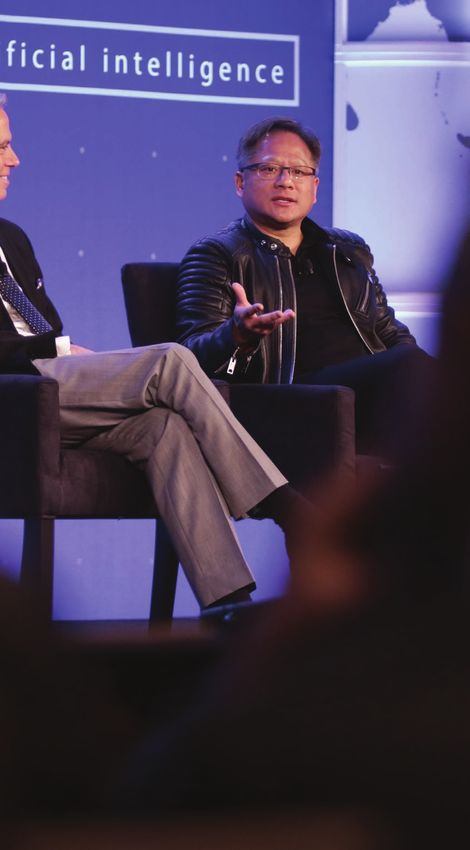
2018 recap | world medical innovation forum

93%                         89%
of 2018 attendees           of 2018 attendees rated the
recommend the 2019 event.   moderators and panelists
                            either excellent or very good.

       1,700 registrants             173 international
       representing                  registrants from
       646 organizations.            30 countries.

    169       speakers
                                     1,440
                                     minutes of discussion

by the numbers
monday, april 23
A Sell Out Crowd
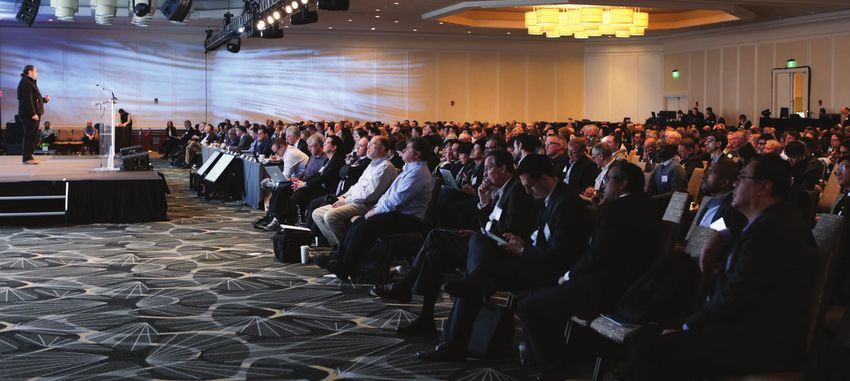
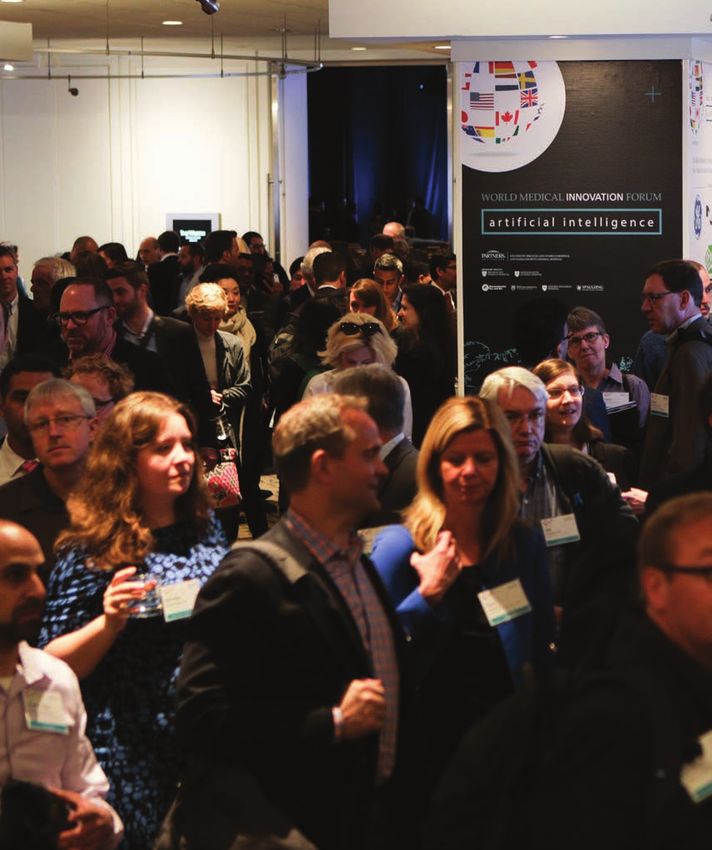
               The fourth annual World Medical Innovation Forum kicked off
               Monday morning with a record attendance representing the top
               health care, biotech and venture capital firms from across the
               globe.
               Much of the discussion on Day One focused on the promise,
               complexities and limitations of AI in health care. Speakers were
               optimistic about the potential for AI to drive big improvements in
               predicting disease, treating patients and managing outcomes, but
               also cautioned that the technology is still in its early stages and
               there will likely be some growing pains along the way.
               In her opening remarks, Anne Klibanski, MD, Chief Academic
               Officer of the Partners HealthCare, noted that Partners has been
               investing in the large-scale aggregation, collection and curation of
               clinical data that can be used to power AI technologies, and is well
               positioned to serve as an AI hub with collaborators worldwide.
               Massachusetts Governor Charlie Baker was impressed by the
               speakers and participants at the Forum. “This is what I call rock
               star city,” Baker said in his opening remarks. “I’ve never seen such a
               terrific collection of intellectual capital.”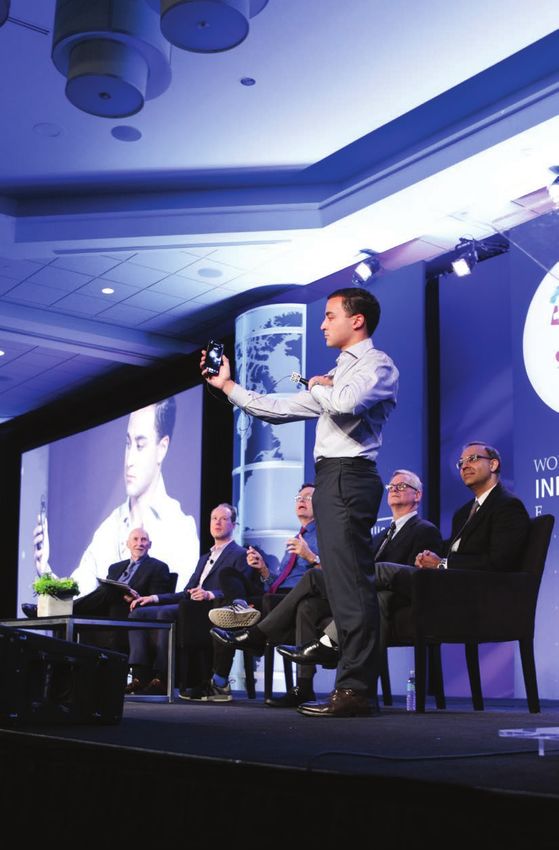
2018 recap | world medical innovation forum

First Look: Next Wave of AI Breakthroughs
Monday’s First Look Session provided attendees with a look at 19
new innovations in AI-powered medical applications from Partners
early career Harvard faculty.
Applications were in psychiatry, surgery, genetic profiling, in vitro
fertilization, predicting C. difficile infection rates and blood group
typing, just to name a few. Audience members were energized by
the presentations with 100% positive comments.
Ziad Obermeyer, MD, an emergency medicine clinician at Brigham
Health, presented a concept for using machine learning algorithm
to improve the decision making process for costly medical tests.
“We’re seeing errors on both sides,” Dr. Obermeyer explained.
“Predictably low risk patients are getting tested and predictability
 high risk patients are not getting tested.”
“One thing clear to me is that anything would be better than what
 we are doing today.”
“It won’t come as a surprise to anyone that doctors make mistakes,
 but we can use these algorithms to find out where and with whom
 those doctors make mistakes. Building on this understanding, you
 can come to a whole range of possibilities.”
Dan Hashimoto, MD, a surgical resident at Massachusetts General
Hospital (MGH), presented on a system called “Surgical Fingerprints”
that is designed to reduce the risk of adverse intra-operative
events by collecting data from previous surgeries and using that
information to guide real-time decision making in the operating
room.
“It’s like Waze for surgery, but instead of avoiding traffic, it will allow
 you to avoid surgical complications,” Hashimoto explained.
Discovery Café Workshops
At lunch, the crowd broke out into smaller groups for a series of Discovery Café Sessions
taking a closer look at the potential for AI in pathology, anesthesiology, neurosciences,
data security and the workforce.
In the neurosciences session, Maurizio Fava, MD, director of the Division of Clinical
Research at MGH and the vice chair of the MGH Department of Psychiatry, noted that
20 percent of clinical trial participants never actually take the drug that is being tested.
Fava said he was hopeful that AI technology could help to identify and screen out those
participants to improve the accuracy of results.

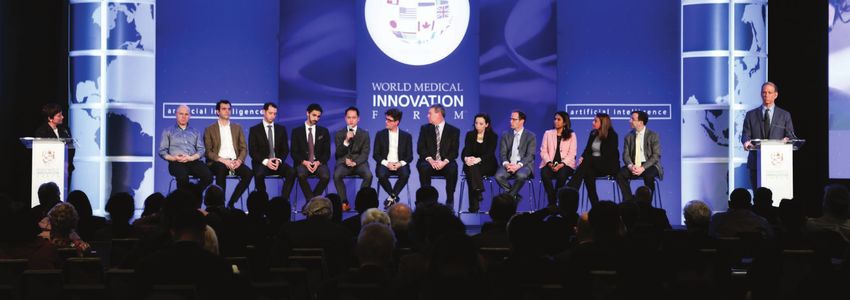
Panel Sessions
Monday afternoon’s panel sessions began with a big picture view of AI in clinical care
before digging deeper into specific areas of interest, such as the role of AI in drug
development, the interaction of AI with electronic health records and the role of AI in
improving clinical trials.
Tom Lynch, MD, Executive Vice President and Chief Scientific Officer of Bristol Myers Squibb,
was optimistic that AI could help to streamline the movement of new molecules from
discovery to development. The current process “takes way too long and costs way too
much,” he said. +
2018 recap | world medical innovation forum

“A I i s d u m b w i t h o u t c u l t i v a t e d
data, supervised learning and
t e a c h i n g t o u n d e r s t a n d .”

                  Notable Tweets

                  Charlie Baker | @MassGovernor
                  Massachusetts is a leader in innovation, technology, and
                  healthcare, and I’m excited to welcome so many leaders who are
                  experts in these fields to the Commonwealth for the World Medical
                  Innovation Forum here in Boston. #WMIF18

                  Nikhil Bhojwani | @bnikhil
                 “AI will not replace radiologists. Radiologists who embrace
                  Ai will replace radiologists who don’t.” Bill Thorwarth, CEO
                  American College of Radiology #WMIF18 @PHSInnovation
                  #ArtificialIntelligence #radiology

                  Deepthi Bathina | @deepthibathina
                  Expecting the impossible from clinicians ..to interpret 100s
                  or 1000s of lab test results for patient diagnosis #AI and
                  #MachineLearning can help #WMIF18 @NuanceHealth

                  Nick Mathisen | @njmathisen
                  I’ve only been at #wmif18 for 2 hours and brain is already melting
                  from 19 amazing presentations on AI breakthroughs. Thanks
                  @PHSInnovation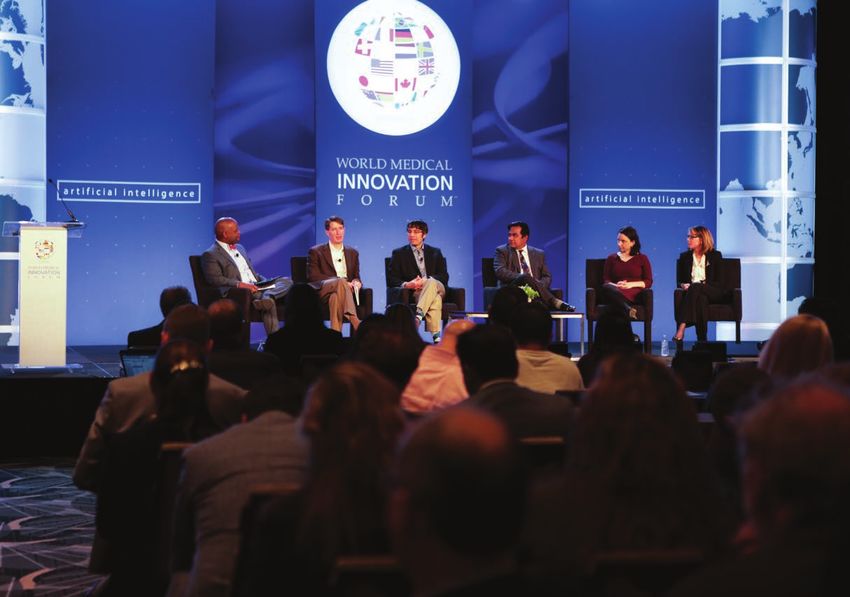
tuesday, april 24
The Role of AI in Health Care
Accessibility and Drug Discovery
A closer look at how to turn the promise of
implementing AI in health care into a reality.

Day 2 of the Forum was packed with in-depth discussions on the opportunities and
challenges of integrating AI into the health care system, with an up-close look at the role
it could play in delivering affordable health care, supporting clinical decision making,
processing large amounts of data and speeding up drug development.
The discussion also highlighted some key challenges in AI integration, such as convincing
clinicians, patients and payors of the value of AI technology, standardizing data across
platforms, and protecting patient privacy in a digitized world.
2018 recap | world medical innovation forum

The Importance of Data
Data collection was a key topic in many
sessions throughout the day. “The theme
you will hear over and over is very high
quality, well-curated data,” said Mark
Murcko, PhD, Chief Science Officer of
Relay Therapeutics, during a session
on drug development. “One of the big
challenges we have is to better represent
the interactions that molecules are having.
Just to tease out that little bit of insight that
helps the drug discovery team move a little
faster.”
A panel discussion on Data Engineering in
Health Care emphasized the importance
of engaging patients in discovery process
regarding the benefits of sharing their
health information with clinicians and              Fireside Chats
researchers outweigh the risks of a                 Day 2 also featured a series of one-on-
potential data breach.                              one fireside chats. Atul Gawande, MD, a
James Mault, MD, Senior Vice President and          surgeon at Brigham Health and bestselling
Chief Medical Officer for Qualcomm Life,            author of Being Mortal and The Checklist
noted that 15 years ago many people were            Manifesto (among others), told Brigham
hesitant about using their credit cards to          Health President Betsy Nabel, MD, that
make purchases online, but today nearly             the key to successfully integrating AI
everyone has their information stored on            technology into clinical care is to identify
website such as Amazon because of the               clear benefits for both the patient and the
convenience it provides.                            clinician-and to ensure that the health care
“The risk is still there, but we’re willing to      providers are ready and willing to use it.
 accept that risk because we’re getting             “If you give people a great process solution,
 these tremendous benefits,” he said. “In            the perfect innovation tool, and plug it into
 health care we’re seeing a lot of risk, but         a ready environment, you make a major
 we’re not yet seeing a lot of benefit.”             impact.”
Afternoon Panel Sessions
In a panel session on AI and Genetic Sequencing, moderator Heidi
Rehm, PhD, said that while researchers are now able to collect
much more genetic data from patients, their ability to process and
take action on that data is still lagging behind.
“The team in my laboratory still reads articles in the literature to
 try to figure out what these variants mean,” Rehm said. “We will
 never be able to disseminate these technologies for broad medical
 use if we can’t advance what we are doing today in terms of
 understanding the genetic and genomic variation.”
Despite the concerns raised and the work that still needs to be
done, the tone of the day’s sessions were overwhelming positive,
with nearly all participants saying they believed that AI technology
could make significant improvements in the delivery of health care.
In a CEO roundtable discussion hosted by MGH President Peter
Slavin, MD, Terri Bresenham, Chief Innovation Officer for GE
Healthcare, shared her optimistic outlook.
“We’re very bullish,” Bresenham said. “I think there’s no doubt that
 this will be by far the most transformational technology change
 that is going to occur, in concert with some other very important
 changes in genomics and genetics and biotherapies as well as
 diagnostics and imaging technology.” +
2018 recap | world medical innovation forum

“Software writing software:
b e t t e r a n d f a s t e r, we w i l l
b e c o m e t h e t e a c h e r s o f A I .”

                 Notable Tweets

                 Samuel Myllykangas | @SamuMyllykangas
                 CEO panel: #AI will transform healthcare by expanding access to
                 care, improving quality, reducing cost, streamlining information
                 flow and integration, accelerating drug discovery, supporting
                 decision making and supplementing research. #WMIF18

                 Behrooz Hashemian | @behxyz
                 Amazing roundtable with CIO and CEO’s from @Philips,
                 @SiemensHealth, @Vertex, and @GEHealthcare, talking about
                 the AI opportunities in healthcare and how it is transforming the
                 industry. #WMIF18 @MassGeneralNews

                 Cassie Lee | @cassan_druh
                 Understanding that you in the #innovation world have two
                 customers: you have the patient whose lives you have to make
                 better, and you have the clinicians who you need to make easy
                 tools for that scale – @Atul_Gawande at #WMIF18
                 @BrighamWomens

                 Dan Hashimoto | @Laparoscopes
                 I want @Nvidia to be an intelligent autonomous machine. I want
                 @NvidiaAI to be an #AI. #AI needs to do 3 things: perception of the
                 environment, reason about what it’s perceiving, develop a plan to
                 take action. – CEO Jensen Huang #WMIF18
wednesday, april 25
1,700 Registrants, 169 Executive Presenters and Key
Leaders Shape the Future of Artificial Intelligence
The third day of the World Medical
Innovation Forum featured a series of
panel discussions and fireside chats
that focused on ways that AI can be
used to improve the performance and
data-gathering capabilities of medical
devices, reduce health care costs, improve
operational efficiencies across the health
care system and mine new insights from
clinical and research data.
“If you think about the magnitude of the
information we have available to us in this
space, you think about where technology
is today and the compute horsepower
that is available to all of us, it just makes
sense to continue to evaluate technologies
like artificial intelligence to be able to
streamline not just operational and
administrative efficiency, but be able to
make more informed and timely decisions,”
said Eric Murphy, CEO of OptumInsight
and Enterprise Growth Officer at
Optum, during a discussion on how AI
technologies could factor into health care
reimbursement systems.2018 recap | world medical innovation forum Another engaging discussion focused on the concerns that AI technologies may eventually replace human pathologists and radiologists in diagnosing patients. The message from the speakers on this panel was that AI tools should be viewed as a friend, not a foe. Constance Lehman, MD, PhD, Chief of Breast Imaging at Massachusetts General Hospital (MGH), said AI technologies have helped make imaging services at MGH more precise, targeted and personalized while reducing repetitive tasks that lead to burnout. “Without a doubt this is on the friend side and a really powerful technology,” said Andrew Beck, MD, PhD, CEO, of PathAI. “The types of problems we are interested in solving are really hard and big and we’re very far from being able to effectively solve them, even with the AI of today. We’re very lucky that we have the access to these new technologies that will assist the profession.” Fireside Chats Wednesday’s Fireside Chat sessions provided valuable insights from health care leaders in the government, technology and pharmaceutical sectors. “I’ve been in this industry for nearly four decades now. I honestly believe that I have never seen a technology that’s as transformative as this one,” said John Kelly, PhD, Senior Vice President for Cognitive Solutions and Research at IBM. “The opportunity is enormous to transform this industry for better outcomes, lower costs for the benefit of all,” Kelly said. “But it’s now into the hard work portion of this. It is not easy to build a very intelligent, at scale, precise artificial intelligence system to be injected in the workflow of a clinical physician or a drug researcher. That is a big job. And by the way, you better have heck of a lot of good data to train that system.”
The Disruptive Dozen: 12 AI Technologies That Will Reinvent Care
The forum concluded on Wednesday afternoon with the presentation of the Disruptive
Dozen, 12 technologies that faculty members in the Partners HealthCare System (PHS)
believe have the potential to significantly advance health care in the next decade.
 1. AI at the Bedside                          8. Minimizing the Threats of
 2. A Picture is Worth a Thousand Words            Antimicrobial Resistance and
 3. Can Personal Devices Improve Your              Infections Associated with Antibiotic
    Health?                                        Use
 4. Risky Business: Using EHRs to Predict      9. Getting Back to Face Time: AI Tools that
    Disease Risk                                   Help Reduce Physicians’ Computer Use
 5. Reading the Tea Leaves of Cancer           10. Disseminating Medical Expertise to
    Immunotherapy                                  Areas that Need it Most
 6. Bringing “Smart” Machines to Medicine      11. Next-Gen Radiology
 7. Harnessing the Power of Digital            12. Melding Mind and Machine
    Pathology
First Look Winners
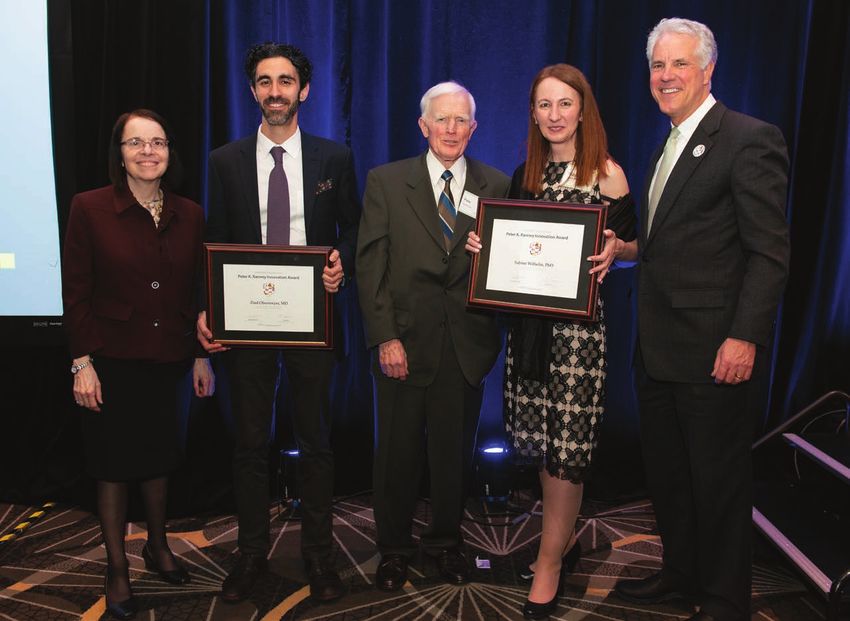
Congratulations to First Look presenters MGH’s Sabine Wilhelm, PhD and Brigham Health’s
Ziad Obermeyer, MD for winning the Peter K. Ranney Innovation Award!
The award was presented at the Innovator’s Dinner on Wednesday, April 25 to honor the
BWH and MGH First Look presenters who embodied the innovative, entrepreneurial and
visionary spirit the World Medical Innovation Forum was established to recognize. +
2018 recap | world medical innovation forum
“In 5 years, there will
not be a decision made
in health care without AI
b e i n g s o m e h o w a p a r t o f i t .”
Notable Tweets
Timothy Howe | @HamiltonHowe
Vasant Narasimhan CEO of @Novartis, “We need to win the race of
turtles…” commenting on how slow the industry is moving with
regard to #AI and data collection. #WMIF18
BCBSNC | @BCBSNC
“We need to remove any remaining friction between insurers and
#healthcare providers when it comes to sharing #data. We need a
free flow of information.” – @PatrickConwayMD #WMIF18
Laura Lovett | @lauralovett7
Will robots be creating our meds in the future? Experts say
probably not. But there is use for AI in pharma. I got to hang out at
the World Medical Innovation Forum yesterday and hear all about it
#WMIF18
Slalom Boston | @SlalomBoston
It’s the final day of #WMIF18 and we’ve had a blast learning about
#AI in #healthcare. Thanks to @PartnersNews for the outstanding
event!innovation discovery
grant winners
Please join us in congratulating the twelve
2018 Innovation Discovery Grant Award
recipients. Also, many thanks to the more
than 100 faculty members who applied
for these $50,000 AI focused grants. We
are also grateful to the large number
of industry reviewers who guided the
selection as well as our own IDG grant
management team.2018 recap | world medical innovation forum A Web-Based Neural Network Calculator Machine Learning Optimized for Ovarian Cancer Screening using Intraoperative Multiplexed Quantitative Serum miRNA Optical Image Guidance for Brain Tumor Kevin Elias, MD Surgery BWH | Obstetrics and Gynecology Alexandra Golby, MD Artificial Intelligence Based Seizure BWH | Neurosurgery Detection and Classification Poly-Exposure Risk Scores for Psychiatric Brandon Westover, MD, PhD Disorders MGH | Neurology Martin Teicher, MD, PhD Augmented Digital Microscopy for McLean | Psychiatry Diagnosis of Endometrial Neoplasia The Identification of Intracranial George Mutter, MD Hemorrhage using Machine-Learning BWH | Pathology Analysis of Sparse Transcranial Breast Cancer Scanning Initiative (BCSI): Ultrasound Signals Predicting Unnecessary Surgeries in Phillip Jason White, PhD High-Risk Breast Lesions BWH | Radiology Jochen Lennerz, MD, PhD Ultrasound-based Sensors for MGH | Pathology Physiological Monitoring, and How They Deep-Learning Facilitated Lesion can make MRI and PET/CT Scanners Work Detection in Medical Images Better Jinsong Ouyang, PhD Bruno Madore, PhD MGH | Radiology BWH | Radiology DeepROP - A Point-of-Care System for Using Deep Learning to Predict Next-Day Diagnosis of Plus Disease in Retinopathy Patient Discharges to Optimize Hospital of Prematurity Capacity Management Jayashree Kalpathy-Cramer, PhD Peter Dunn, MD MGH | Radiology MGH | Anesthesia Development of a Machine Learning Algorithm-Guided Approach to Treatment Selection for Depressed Patients Christian Webb, PhD McLean | Psychiatry
discovery                                      The Future of AI in Neurosciences
                                               The neurosciences in its broadest definition
cafés                                          touches the most patients in medicine.
                                               This session addressed how AI will impact
                                               neurology, psychiatry and psychology.
The Future of AI in Pathology and
                                               Intelligence in Sight: How
Laboratory Medicine
                                               Machine Learning Will Impact
Diagnostic medicine is accepted as one of      Ophthalmology
the first domains in medicine that should
benefit from AI and machine learning.          There has been an explosion in the
This session addressed how AI will impact      research and development of artificial
pathology and laboratory medicine in the       intelligence for assessment of retinal and
near and long term.                            optic nerve diseases using ophthalmic
                                               imaging. Deep learning algorithms have
Technology and AI in                           been shown to screen for common
Anesthesiology                                 conditions such as diabetic retinopathy
                                               with high precision. The advantages and
Anesthesiology is a major element              challenges of integrating machine learning
of the in-patient environment and AI           in ophthalmic care was discussed by a
implementation in it has the potential of      panel that includes industry leaders and
far reaching effects. This session addressed   clinicians who are the forefront of artificial
how AI will impact anesthesiology in the       intelligence discovery and development in
near and long term.                            the ophthalmic space.
2018 recap | world medical innovation forum Data Security The security of data is a fundamental requirement throughout health care. The growing ubiquity of data driven machines throughout medicine introduces new risks and potentially increased scale of breaches. A panel of top provider and industry data security experts discussed security implications in detail. Innovation Fellows: A New Tool The Innovation Fellows program is a hands-on model of collaborative innovation that enables industry to gain access to early career Harvard faculty through personnel exchanges between Partners hospitals and participating biopharmaceutical, device, venture capital, digital health, payor and consulting firms. It provides experiential, career- development opportunities for future leaders in health care. Panelists highlighted program characteristics, how participants can maximize value and broader implications for industry- academic collaboration including how it might be used to address AI requirements. Workforce: Humans, Machines and the Future Delivery of Care The growth of AI and machine learning in health care is inexorably tied to workforce issues – it will both drive the evolution of the workforce and its rate of adoption will be subject to workforce characteristics. This session will address the human dimension in the growth of AI in healthcare including workforce composition and strategic issues associated with the inevitable changing roles of humans and machines. Issues of how to identify, characterize and respond to future requirements were discussed in detail.
2018 recap | world medical innovation forum

sponsors
The 2018 World       stakeholder
Medical Innovation
Forum was made
possible through
the generosity
of the following
                     strategic
sponsors.

                     collaborator
i n n o v a t o r ’s d i n n e r The 2nd Annual Innovator’s Dinner was held Wednesday evening, April 25th as the concluding event of the World Medical Innovation Forum. This invitation-only dinner honored the 660 MGH, BWH, McLean and Spaulding principal investigators who submitted an invention disclosure during the calendar year 2017. Each investigator was recognized with a framed certificate and inclusion in the Innovator’s Dinner program guide. A popular event, over 350 investigators and attendees registered to hear insights and perspectives from Sue Siegel, GE’s Chief Innovation Officer and CEO of Business Innovations, and Anne Klibanski, MD, Chief Academic Officer, Partners HealthCare. Following the keynote and fireside chat the Peter K. Ranney Innovation Award was given to Sabine Wilhelm, PhD, Chief of Psychology; Director, OCD and Related Disorders Program, MGH; Professor, HMS, and Ziad Obermeyer, MD, Assistant Professor, Emergency Medicine, BWH; Assistant Professor, HMS. These two First Look presenters embodied the innovative, entrepreneurial and visionary spirit the World Medical Innovation Forum was established to recognize. The award comes with a framed certificate and a $10,000 cash reward.
panel videos
Watch the 2018 panels and
subscribe to our channel

[DC] The Future      [DC] Technology       [DC] The Future of    [DC] Intelligence in
of AI in Pathology   and AI in             AI in Neurosciences   Sight: How Machine
and Laboratory       Anesthesiology                              Learning Will Impact
Medicine                                                         Ophthalmology

                                                                 *[DC]
                                                                  Discovery Café

[DC] Data Security   [DC] Innovation       [DC] Workforce:
                     Fellows: A New Tool   Humans, Machines
                                           and the Future
                                           Delivery of Care
2018 recap | world medical innovation forum
Reflecting on the Can AI Based Drug Smart EHRs: AI for AI and the Cost of
Impact of AI at the Development Feed All Trials: The Impact of
Bed and the Bench: A Hungry Pipeline? Real World and Real
Chairs Roundtable Time Evidence
Will AI Bend the Drug Therapy 1:1 Fireside Chat: Data Engineering
Cost and Access Redefined Through Atul Gawande, MD in Healthcare:
Curve Machine Learning Liberating Value
1:1 Fireside Chat: 1:1 Fireside Chat: AI and Gene Tangible Returns
Jensen Huang, CEO, Paul Ricci, Former Sequencing on the AI Value
NVIDIA Chairman and Proposition
CEO, Nuance
CommunicationsCEO Roundtable: Regulating AI AI in Hospital Reconceiving
The AI Opportunity in Health Care, Environments: The Medical Devices in
as Foundational Requirements and Learning Provider an AI Dominated
Change Challenges Environment
Fireside Chat: Fireside Chat: 1:1 Fireside Chat: Machine Learning
Seema Verma, Paying for Vasant Narasimhan, in Image Analysis:
Administrator, AI: Thinking MD, CEO, Novartis A Diagnostician’s
Centers for Strategically About Best Friend... or
Medicare and Reimbursement and Replacement?
Medicaid Services Acceptance
1:1 Fireside Chat: Illuminating the Disruptive Dozen:
John Kelly, PhD, SVP, Path to Clinician 12 AI Technologies
Cognitive Solutions Empowerment That Will Reinvent
and Research, IBM CareJoin Us in 2019. Register Today. www.worldmedicalinnovation.org APRIL 8–10, 2019 | BOSTON
215 First Street, Suite 500, Cambridge, MA 02142
857-307-2400 | innovation.partners.org
You can also read


