2018 to 2022 Capital Strategy Planning and Property Development Services - York Region District School Board
←
→
Page content transcription
If your browser does not render page correctly, please read the page content below
2018 to 2022 Capital Strategy Planning and Property Development Services
Table of Contents

    Introduction                                               5    Appendices
    Summary of Capital Recommendations                         7    Appendix 1:   Facility Partnership Process      67
    Glossary of Terms                                          9    Appendix 2:   School Utilization Summary        68
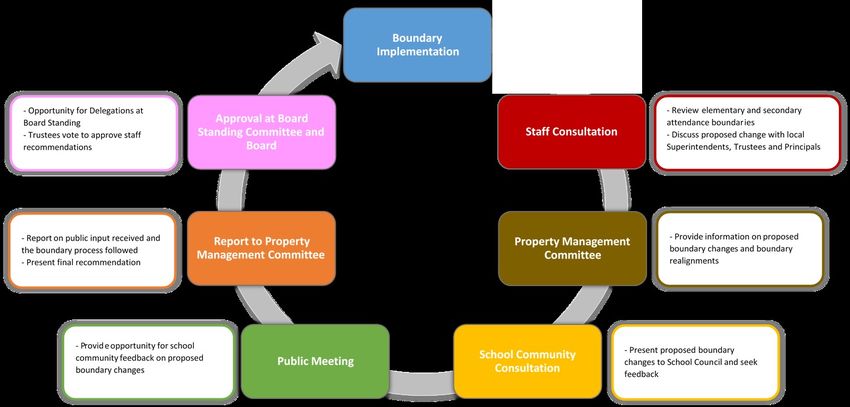
                                                                    Appendix 3:   Boundary Review Process           75
    1.0 Regional Trends                                             Appendix 4:   Development Application Process   76
         Elementary Summary                                    11
         Secondary Summary                                     12
         Small Schools / Pupil Accommodation Review            13
         School Utilization                                    15
         Underutilized Schools for Facility Partnerships       16
         French Immersion                                      17
         Development Summary                                   19
         Facility Condition Index (FCI) Review                 21

    2.0 Elementary Planning Areas / School Level Projections
          Key Map                                              23
          Aurora                                               25
          East Gwillimbury                                     27
          Georgina                                             28
          King                                                 30
          Markham                                              31
          Newmarket                                            37
          Richmond Hill                                        40
          Vaughan                                              44
          Whitchurch-Stouffville                               50

    3.0 Secondary Planning Areas / School Level Projections
         Key Map                                               51
         Aurora                                                53
         Georgina                                              54
         King                                                  55
         Markham                                               56
         Newmarket / East Gwillimbury                          60
         Richmond Hill                                         61
         Vaughan                                               62
         Whitchurch-Stouffville                                65

Capital Strategy 2018-2022
Introduction

The Capital Strategy document identifies the need for potential new schools, additions to schools    For more than two decades, the York Region District School Board has experienced significant
and replacement schools. The document also highlights utilization across the region and identifies   enrolment growth in both the elementary and secondary panel. During peak years of growth the
areas that may require a potential pupil accommodation review. This information will serve as the    Board averaged an annual rate of 3.5% to 5.5% growth in the elementary and secondary panel.
basis for the Board’s multi-year capital funding request to the Ministry of Education.               In the past five years the average rate of enrolment growth has softened to 0.96% in the
                                                                                                     elementary panel and increased to 0.30% at the secondary panel reflecting a change in
The goals of the Board’s Capital Strategy are provided below. The implementation of each goal is     demographics throughout the Region.
subject to Ministry approvals and funding.
                                                                                                     In York Region, it is projected that the elementary panel will see periods of decline as smaller
1. To provide community schools for all students wherever possible.                                  numbers of kindergarten students enter school while larger grade eight pools graduate into the
 ● Designate school sites in new community areas                                                     secondary panel. The larger grade eight pools entering the secondary panel will create growth in
 ● Review residential development applications as part of the municipal planning process to          the secondary panel for a period of time. Part of the decline in elementary is due to a smaller
   determine school accommodation requirements                                                       birth rate between 2013 and 2016 that is projected to impact kindergarten enrolment from 2017
                                                                                                     to 2020. Growth in York Region will still continue in certain areas of York Region while decline in
2. To provide permanent accommodation to match sustainable community growth in a timely              other areas offsets this growth.
   fashion.
 ● Annually review enrolment projections for all schools                                             The York Region District School Board utilizes portables to provide additional accommodation for
 ● Submit business cases to the Ministry of Education for new pupil places where student             students where schools experiencing a high rate of growth in enrolment will surpass the built
   threshold has been reached and surrounding pupil places are utilized                              capacity of the school. Once peak enrolment within a school community has been reached,
 ● Construct new schools/additions with a capacity to align with long term sustainable enrolment     portables can be relocated as needed. For areas of new development, portables are also utilized
                                                                                                     at designated holding schools to accommodate students until a viable threshold is reached for
3. To minimize the reliance on portable accommodation.                                               new school construction.
 ● Use portables for temporary accommodation
 ● Locate portables at holding schools until a viable threshold is reached for a new school or at    Various changes to programming in the elementary panel, such as Primary Class Size, the
   existing schools experiencing peak enrolment                                                      implementation of Full Day Kindergarten, changes to the Ministry of Education capital funding
                                                                                                     model and recent changes to the class size regulation that set lower class averages between
4. To replace older school facilities where conditions warrant.                                      2017 and 2020, are all factors which contribute to the use of portables in addressing
 ● Review facility condition and renewal needs for all schools                                       accommodation pressures.
 ● Focus on schools with facility and site constraints as well as accommodation pressures from
   new development                                                                                   There are currently 177 elementary schools and 33 secondary schools operating with the York
                                                                                                     Region District School Board. As of October 2017, the elementary panel was operating at 90%
5. To utilize excess capacity within the system wherever practical.                                  utilization and the secondary panel at 105% utilization.
 ● Consider existing vacant pupil spaces when locating programs such as French Immersion and
   Gifted or other board uses (e.g. administrative requirements)                                     Effective utilization of schools has been identified as an area of focus by the Ministry of
 ● Encourage partnerships with municipalities and other agencies in locations with excess capacity   Education, through their School Board Efficiencies and Modernization initiative that began in
   according to Board Policy 422, Facility Partnerships                                              2013. Accordingly, this document includes a summary of small schools and underutilized schools
                                                                                                     for planning and potential partnership purposes.
6. To combine schools and/or undertake pupil accommodation reviews where circumstances
   warrant according to Board Policy 463, Student Accommodation Review.
 ● Prepare a Capital Strategy to identify small and/or underutilized schools, and areas of decline

Capital Strategy 2018-2022                                                                                                                                                                           5
Summary of Capital Recommendations
For Submission to the           Elementary
Ministry of Education            ** Proposed
(Timeline TBD) *                                                 Project Name                         Municipality            Project Type        Proposed Capacity
                                   Opening
                                     2021            Sharon PS (Replacement) / New School            East Gwillimbury      Growth / Replacement          638
                                     2021                        Aurora 2C ES                            Aurora                  Growth                  638
                                     2021                   Kleinburg / Nashville ES                    Vaughan                  Growth                  638

                               Secondary
                                ** Proposed
                                                                Project Name                         Municipality            Project Type         Proposed Capacity
                                  Opening
                                    2023                         Block 11 SS                            Vaughan                  Growth                 TBD
                                    2023         Oak Ridges SS (Dr. Bette Stephenson addition)       Richmond Hill               Growth                 TBD

                               * As of June, 2018, the Ministry of Education has not identified the next opportunity to submit capital funding requests.
                               ** Subject to Ministry of Education funding approval. School opening dates are based on a minimum of 2-3 years for elementary and
                               4-5 years for secondary, from date of approval.

                               Elementary
Emerging Projects
                                    Year                        Project Name                          Municipality            Project Type        Proposed Capacity
Emerging Projects listed in
alphabetical order by “Year”         2022                     Markham Centre ES                         Markham                  Growth                  638
                                     2022                       North Leslie ES                       Richmond Hill              Growth                  638
                                     2022                   Oak Ridges East #1 ES                     Richmond Hill              Growth                  638
                                     2022                       Queensville ES                      East Gwillimbury             Growth                  638
                                  Post 2022                 Block 40 ES (South site)                    Vaughan                  Growth                  638
                                  Post 2022                       Cornell ES                            Markham                  Growth                  638
                                  Post 2022                   Holland Landing ES                    East Gwillimbury             Growth                  638
                                  Post 2022                      King City ES                           King City                Growth                  638
                                  Post 2022      New School / Adrienne Clarkson PS (Addition)    Markham / Richmond Hill         Growth                 TBD
                                  Post 2022                   Newmarket SE ES                          Newmarket                 Growth                 TBD
                                  Post 2022                    Stouffville NW ES                  Whitchurch-Stouffville         Growth                  638

                               Secondary
                                    Year                        Project Name                          Municipality            Project Type        Proposed Capacity
                                  Post 2023                Stouffville DSS (Addition)             Whitchurch-Stouffville         Growth                 TBD

Capital Strategy 2018-2022                                                                                                                                            7
Glossary of Terms

Attendance Area (also referred to as a School Boundary)                                                            Holding School
Each school has a defined attendance area, appropriately sized to accommodate sustainable student                  A holding school is a school at which students are attending until long-term accommodation is available
enrolment. Attendance areas are subject to change based on enrolment trends, construction of new schools,          and is not part of the student’s attendance area. Examples of holding school situations include, but are
program changes and alignment of elementary and secondary boundaries. The following are considerations             not limited to, enrolment pressure, construction of a new school or renovation of an existing community
which may affect where students attend school: programs for exceptional students, optional programs,               school. Policy #108.0, Student Accommodation – Attendance Areas and Student Transfers.
student transfers, and students directed to attend a school other than the community school because of
overflow, enrolment pressure, primary class size, a holding school situation, school capacity and/or               Planning Area
exceptional circumstances. The physical school boundary is defined by geographical features including, but         The York Region District School Board services a large geographic area and the Board operates
not limited to, roads, railway tracks, rivers and land parcels.                                                    hundreds of schools. To effectively review the accommodation needs of schools, planning areas were
                                                                                                                   defined for both the elementary and secondary panel. A planning area uses municipal boundaries and
Capacity (OTG)                                                                                                     other geographic features such as major roads and waterways to divide one area from another.
The On-The-Ground (OTG) capacity of a school is determined by the Ministry of Education by loading all             Planning areas in this document have been grouped or divided for the purposes of map/page display.
instructional spaces within the facility to current Ministry standards for class size requirements and room
areas.                                                                                                             Portables
                                                                                                                   A portable classroom provides flexibility for a school to accommodate more students than the built
Facility Condition Index (FCI)                                                                                     school allows. When enrolments increase above the built capacity of a school, portables can ensure
The Facility Condition Index indicates a building’s state of repair. The Ministry of Education determines FCI      students are accommodated at their local school. In a new school community, portables will be required
by calculating the ratio between the five-year renewal needs and the replacement value for a given facility.       to accommodate students over a period of time when enrolment peaks. Once a school community ages
Components of the FCI include the building structure (e.g. foundations, roof, exterior walls, door, and            and enrolment declines, portables can be easily removed and relocated to other schools in the Board,
windows), interiors (e.g. stairs, floor finishes, ceilings, interior doors), services (e.g. plumbing, HVAC, fire   where required. The York Region District School Board utilizes a mix of single classroom portables, as
protection, electrical), site and other (e.g. site utilities, paved areas such as parking lots and walkways).      well as groupings of 2 or more classrooms.

French Immersion (Single Track, Dual Track, Primary Dual Track)                                                    Secondary Plans
Within the York Region District School Board, French Immersion (FI) is an optional program that consists of        Secondary Plans are long range municipal planning documents which direct major infrastructure such
full-day French instruction starting in Grade 1, at a designated school. A single track French Immersion           as; arterial roads, servicing, schools and community parks.
school is a school that only offers French Immersion programming. A dual track school French Immersion
school accommodates students in both the Regular and French Immersion program. A primary dual track                Small School
(PDT) is similar to a dual track school, however a PDT school only serves French Immersion students in             An elementary school with a total enrolment of 200 students or less.
primary grades who then continue to a nearby French Immersion school for the balance of their elementary
grades.                                                                                                            Urban boundary
                                                                                                                   The limit of where settlement and development can occur within the region as defined in the York
Greenfield                                                                                                         Region Official Plan.
An area that is undeveloped and/or not built-up.
                                                                                                                   Utilization
Holding Area                                                                                                       A measurement that compares the total enrolment of a school to the On-The-Ground Capacity (OTG)
A geographically assigned portion of an elementary or secondary boundary to be temporarily accommodated            capacity of the school.
at a nearby school. Holding areas are not considered part of the permanent long-term attendance area. A
holding area may be created to accommodate students for an interim period. Policy #108.0, Student                  Whitebelt
Accommodation – Attendance Areas and Student Transfers.                                                            Undeveloped lands outside of the urban boundary unencumbered by regulatory or environmental
                                                                                                                   constraints for development.

Capital Strategy 2018-2022                                                                                                                                                                                             9
Regional Trends

Elementary Summary

The number of elementary students enrolled in the York Region District School Board
had been steadily growing for many years and in recent years, growth has begun to slow.
Over the next five years enrolment will become static. Minimal growth is projected for
2018 and 2019 and then a slight decline for 2020 and 2021. This small decline will be
offset by growth in 2022.

The decline projected in 2020 and 2021 is partly due to larger grade eight pools of
students graduating from the elementary panel being replaced with projected smaller
cohorts of younger students. Contributing to this decline in elementary enrolment was a
decline in the intake of kindergarten pupils in 2017 due to a low birthrate in 2013. The
intake of kindergarten pupils is projected to increase but at a much slower rate over the
next few years due to a continued low birth rate until 2016.

The five year elementary enrolment projections are based on current and historic
enrolment trends, program location and anticipated pace of new development.

                                                                                                                              Historical Enrolment                               Projected Enrolment
                                                                                                                  2013       2014       2015         2016     2017     2018     2019     2020     2021     2022

                                                                                            Total Enrolment       82,227    83,299     83,750        84,341   84,508   84,566   84,605   84,494   84,226   84,561

                                                                                            Total Utilization      94%       91%        91%           91%      90%      89%      89%      89%      89%      89%
                                                                                                                Note: Enrolment as of October 31st

Capital Strategy 2018-2022                                                                                                                                                                                          11
Regional Trends
Secondary Summary
Prior to 2011, secondary enrolment in the York Region District School Board experienced
a consistent rate of growth ranging from 1.0% to 3.0%. Between 2011 to 2013 enrolment
began to decline with rates ranging from -0.05% to -2.0%. In 2014, the Board began to
experience growth again in secondary enrolment that is projected to continue over the
next few years as larger pools of grade eight students enter the secondary panel. Beyond
this five year secondary projection, the trend of minimal growth and slight decline in the
elementary panel will impact future growth in secondary enrolment.
The five year secondary enrolment projections are based on current and historic
enrolment trends, program location and anticipated pace of new development.
Historical Enrolment (FTE) Projected Enrolment (FTE)
2013 2014 2015 2016 2017 2018 2019 2020 2021 2022
Total Enrolment 38,560 38,565 38,934 39,291 39,936 40,045 40,230 40,608 41,354 41,728
Total Utilization 110% 106% 106% 108% 105% 106% 106% 107% 109% 110%
Note: Enrolment as of October 31st
FTE is the full-time equivalent enrolment
Capital Strategy 2018-2022 12Regional Trends Small Schools / Pupil Accommodation Review The Board has identified elementary schools with enrolment less than 200 students as small, and enrolment less than 100 as very small. The very small school category of less than 100 students is based on the Ministry of Education's 2013 consultation on underutilized and small schools that was part of a larger strategy to modernize school board funding (School Board Efficiencies and Modernization Consultations, October 2013). As of 2017, the Board has 3 small schools and 3 very small schools. Details regarding these schools are provided in the table on page 14. In the 2016 Capital Strategy, staff focused a review on very small schools because of the impact of small enrolment on: ● programming and supports ● extracurricular opportunities ● instructional challenges for small grade cohorts (i.e. combining three grades in one classroom) ● limited numbers of staff for teacher collaboration, student supervision or undertaking initiatives In the 2017 Capital Strategy, small schools were reviewed in conjunction with information on the facility, site, grade information and distance to nearby schools. Recommendations were brought forward to annually review or propose that pupil accommodation reviews be considered where appropriate. A number of variables would impact the consideration for a pupil accommodation review (PAR), as small schools could have more than one emerging concern. Staff proposed potential PARs for J.L.R. Bell PS and Stornoway Crescent PS be considered. However, due to a Ministry of Education moratorium on pupil accommodation reviews while they revised their Pupil Accommodation Guideline, initial staff reports were not brought forward for consideration by the Board. In April 2018, the Ministry of Education updated and released a revised Pupil Accommodation Review Guideline (PARG). The final revised PARG will take effect in fall 2018 upon the Ministry of Education release of templates and guidelines to assist in pupil accommodation reviews. Boards will then be tasked with updating their PAR policies to reflect the changes to the PARG prior to presenting initial staff reports to Trustees. This will result in Board Policy #463 Student Accommodation Review being updated during the first quarter of 2019. As part of the 2018 to 2022 Capital Strategy, staff are proposing that pupil accommodation reviews for Markham Thornhill (Stornoway Crescent Public School) and Newmarket Central (J.L.R. Bell Public School) be considered by the Board. The proposed pupil accommodation reviews will be part of a separate report (Initial Staff Report) to the Board as described in Board Policy #463, Student Accommodation Review. All communities impacted by a PAR will be notified in advance of the first Board meeting where an initial staff report would be presented. For Deer Park PS, Kettleby PS and Schomberg PS, staff are proposing to continue to operate these schools as long as it is viable from a financial and/or program perspective. This will be reviewed on an annual basis. Queensville PS will be replaced with a larger school capacity that will accommodate additional students from new residential development growth. The timing for the replacement school is dependent on the pace of new development, a threshold of students and Ministry of Education funding approval. Capital Strategy 2018-2022 13
Regional Trends

Small Schools / Pupil Accommodation Review (continued)

The following table outlines small schools with an enrolment of 200 or less, as of October 2017.
                                                                                                                                        Facility
                                                                                                               2018
School                            Grade Structure         Category       2013      2014   2015   2016   2017            Utilization * Condition
                                                                                                             Projection
                                                                                                                                      Index (FCI)
Deer Park PS                    Kindergarten - Gr. 8     Small               192   174    190    178     154    162         88%          59%
J.L.R. Bell PS **               Kindergarten - Gr. 5     Very Small           88    95     88     77      72     82         39%          46%
Kettleby PS                     Kindergarten - Gr. 8     Small               176   177    167    162     160    149         92%          25%
Queensville PS                  Kindergarten - Gr. 6     Very Small          101    77     74     83      75     76        214%           N/A
Schomberg PS                    Kindergarten - Gr. 6     Small               137   135    136    127     126    119         57%          21%
Stornoway Crescent PS **        Kindergarten - Gr. 6     Very Small           91    93     94     84      84     92         66%          71%
* Utilization excludes portables
** Staff is proposing a pupil accommodation review (PAR) for these schools

In addition to providing the grade structure, enrolment, and utilization for these small schools, the Facility
Condition Index (FCI) is also included. FCI data is from the Ministry of Education release on October 10,
2017.
The Facility Condition Index indicates a buildings state of repair. The Ministry determines FCI by calculating
the ratio between the five-year renewal needs and the replacement value for a given facility. Components of
the FCI include the building structure (e.g. foundations, roof, exterior walls, door, and windows), interiors
(e.g. stairs, floor finishes, ceilings, interior doors), services (e.g. plumbing, HVAC, fire protection, electrical),
site and other (e.g. site utilities, paved areas such as parking lots and walkways). Information is gathered
through inspections carried out by the Ministry of Education in 5 year cycles. Based on the inspections, the
Ministry can determine the projected 5-year renewal costs. These costs are then compared against the cost
of rebuilding the school. The results of the comparison give the school an FCI, which is measured as a
percentage. A school with a low FCI rating needs less repair and renewal work than a school with a higher
FCI rating. The FCI of a school is a snapshot in time based on the date of the inspection.

Capital Strategy 2018-2022                                                                                                                          14
Regional Trends
School Utilization
School Boards use ‘utilization’ as a method to determine the status of space in schools. School utilization is a
calculation of the enrolment as a percentage of the OTG (On-the-Ground) capacity of a school (excluding
portables). Enrolment at a school can shift due to changes in demographics, programming and new residential
development. When enrolment projections indicate excess space or a lack of space over time, it can reach a
point where the Board must examine and implement options to efficiently use space or provide space to
accommodate growth.
As of October 2017, the elementary panel overall was operating at 90% and the secondary panel at 105%
utilization. Current and projected utilization rates for all Board schools are provided in Appendix 2 of this report.
The Ministry of Education defines underutilized schools as those schools with a utilization rate of 60% or lower.
In their Facility Partnerships guideline, the Ministry of Education uses 60% utilization to identify schools where
there may be partnership opportunities.
Using this 60% benchmark, there are currently 13 underutilized elementary and secondary schools operating in
the 2017 school year. The Board has employed specific strategies to address underutilized space, where
possible which include:
● Directing students from new residential development;
● Adding programs such as French Immersion or Gifted where sufficient space is available as well as a
threshold to begin a new program has been reached;
● Developing a partnership policy to support future partnerships with other agencies and government with a
view to providing services in schools that support the needs of students and the broader community. The
Board’s partnership policy allows for suitable agencies to lease existing space or co-build when a new
school is proposed. Appendix 1 provides detail on the partnership process.
Where a school or schools remain underutilized over time, School Boards also initiate pupil accommodation
reviews to “make the most effective use of [their] school buildings and funding” “within the context of supporting
the school board’s student achievement and well-being strategy” (Ministry of Education Pupil Accommodation
Review Guideline, April 2018). Based on the Board’s projection for continued slow growth with some decline,
future pupil accommodation reviews may need to be considered.
Capital Strategy 2018-2022 15Regional Trends
Underutilized Schools for Facility Partnerships
Table 1
According to the Ministry's Community Planning and Partnership Guideline and the Board’s Policy #422, Part A: Schools that Meet the Ministry’s Facility Partnership Criteria
Facility Partnerships, the schools listed in Table 1 and Table 2 (Part A and Part B) meet the following
criteria consecutively between 2018 to 2022: Municipality Panel School Name
● a utilization rate of 60% or lower or; Georgina Elementary Lakeside PS
● more than 200 pupil places available (excluding portables) Georgina Elementary Morning Glory PS
The schools identified in Part A are potential facility partnership opportunities; however, they are subject to Georgina Secondary Sutton District HS
a review to determine partner requirements and confirm suitability at these identified schools. King Elementary Schomberg PS
Markham Elementary Cedarwood PS
Even though the schools in Part B meet the partnership criteria, they are not available for potential facility
partnership opportunities as they are required for planned student programming or proposed partnership Markham Secondary Thornlea SS
requirements. Newmarket Elementary J.L.R. Bell PS
Vaughan Elementary Brownridge PS
All submissions from eligible partners will be reviewed for suitability of the following, but not limited to
building configuration, separate access being available or created where appropriate, Vaughan Elementary Charlton PS
suitable parking and access exists, space not required for other Board programming, and other conditions Vaughan Elementary Yorkhill ES
as determined by the Board.
Underutilized schools are subject to change and are identified on an annual basis based on the Board's
Table 2
Capital Strategy.
Part B: Schools that Meet the Ministry's Facility Partnership
Criteria and Not Eligible for Partnerships due to Proposed
Program / Partnership Requirements
Municipality Panel School Name
East Gwillimbury Elementary Mount Albert PS
Richmond Hill Secondary Langstaff SS
Markham Elementary Wilclay PS
Capital Strategy 2018-2022 16Regional Trends
Elementary French Immersion
Over the past decade, interest in the French Immersion program at the elementary panel has almost
doubled. In 2007, 6,303 students were enrolled in French Immersion and in 2017 the program grew to
12,428 students. This represents an increase of 97% over the past 10 years. In the same time period,
grade 1 registration increased from 1,263 to over 1,900 students, however intake did stabilize between
2013 to 2017 and has ranged from 1,880 to 1,990 students. As the growth in French Immersion intake
has been slowing, the overall elementary French Immersion enrolment which has historically grown at
8% to 10% every year, has also slowed to 2% to 4% in 2016 and 2017.
In 2012, the York Region District School Board undertook a review of French as a Second Language.
This was a comprehensive review of both Immersion and Core French delivery. The review included a
long-term French Immersion accommodation plan for students. This plan outlined various grade
configurations for the Board’s French Immersion programming:
● Single Track - French Immersion grades 1-8
● Dual Track - English grades kindergarten to grade 8 and French Immersion grades 1-8
● Primary Dual Track (PDT) - English grades kindergarten to grade 8 and French Immersion grades
1, or 1-2, or 1-3
These program configurations allow the Board flexibility to address accommodation needs locally,
utilize existing pupil places within the community and also continue to offer the French Immersion
program to all who wish to enrol.
The first primary dual track sites opened in September 2013 and there are 10 primary dual track
locations across the region as of September 2017 with 3 more primary dual track locations opening in
September 2018.
Capital Strategy 2018-2022 17Regional Trends Secondary French Immersion The significant number of students choosing French Immersion in the elementary panel has also increased demand in the secondary panel. In 2007, 1,437 students were enrolled in French Immersion and in 2017 the program grew to 2,673 students. This represents an increase of 86% over the past 10 years. In the same time period, grade 9 registration increased from 386 to 793 students. Growth in secondary French Immersion is anticipated to continue as larger pools of elementary French Immersion students enter the secondary panel. Due to continued growth in secondary French Immersion, new programs have been required at additional sites over the last 10 years: ● Bill Hogarth SS began 2017 ● Woodbridge College began 2015 ● Thornlea SS began 2011 ● Vaughan SS began 2009 ● Newmarket HS began 2007 In September 2019, a new French Immersion program will begin at King City SS. Capital Strategy 2018-2022 18
Regional Trends

Development Summary

From the Region of York’s 2016 Growth and Development Review, population in the Region increased by                                                Annual Population Growth in York
20,500 people in 2016 to 1,186,900 people. This accounts for a 16.4% share of the Greater Toronto and
Hamilton Area’s (GTHA) population growth and 1.2% of the total population of the GTHA. The Region is on
track to meet the 2031 population target of 1,590,000 people and has steadily averaged approximately
1.9% population growth on an annual basis since 2011.

A majority of the population growth has continued to occur in the municipalities of Markham, Vaughan and
Richmond Hill where most new schools have been built in the last 5 years.

New Residential Communities                                                                                                         Source: York Region Growth and Development Review 2016

In accordance with provincial policies, the Region is required to have at least 40% of new residential units be located in existing built up areas (intensification) and built at a higher density. The updated Provincial Growth
Plan enacted as of July 1, 2017 requires 60% of new residential units to be in existing built-up areas by 2041. The Region has achieved average intensification of 48% over the last 10 years and is well positioned to
achieve the 60% target. The majority of high density residential units have been planned near major roads and transit areas where significant infrastructure has been built over the last few years and additional works are
planned to accommodate the higher densities.

The higher intensification targets in the new Growth Plan will reduce the need for urban expansion (commonly referred to as Whitebelt Lands) for residential uses as there will be more growth being accommodated within
the built-up area than would be the case under the previous Growth Plan 40% intensification target.

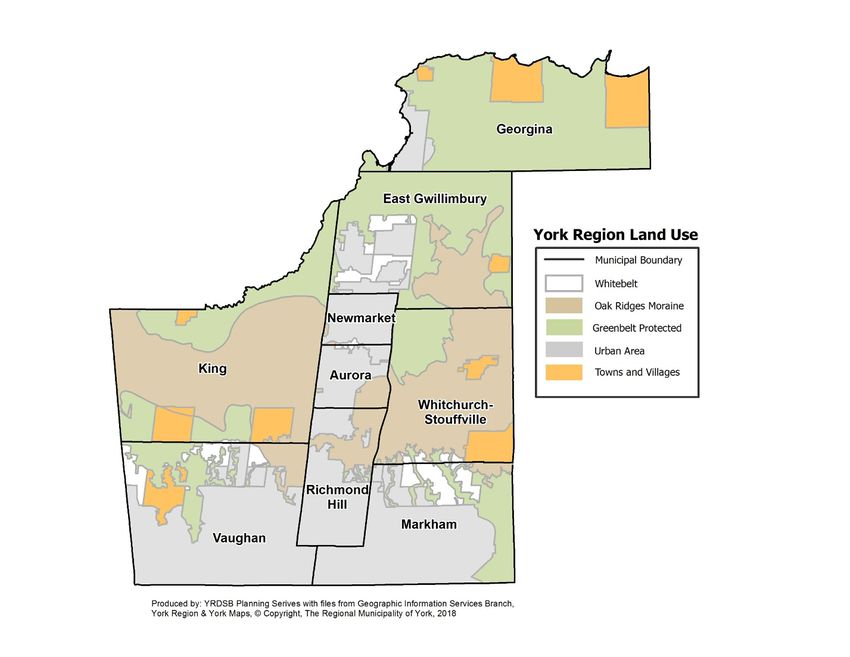
Whitebelt lands are undeveloped vacant lands located outside the Region’s current defined urban boundary and unencumbered by restrictions on development, such as the Oak Ridges Moraine Act or Places to Grow
Act. These lands will be required to serve the population growth that cannot be accommodated in intensification areas or vacant lands already within the urban boundary. The Region reviews the need to expand the
urban boundary through the Municipal Comprehensive Review (MCR) process, and if required, the location and amount of lands to be added to the Region’s urban boundary will be reflected either through an
amendment or update to the York Region Official Plan. The Region is in the process of updating the MCR following the release of the updated Provincial Growth Plan to determine the land budget (including any
expansion of the urban boundary) required to accommodate population growth to 2041 which is anticipated to be released in late 2019.

The majority of potential future urban expansion lands are located in North Markham, North Vaughan and East Gwillimbury. The remaining undeveloped areas are covered by the Oak Ridges Moraine and the Greenbelt,
both areas restrict the type of land uses and residential growth under The Greenbelt Plan, the Oak Ridges Moraine Conservation Plan, and related legislation enforcing the conservation plans.

Capital Strategy 2018-2022                                                                                                                                                                                                    19
Regional Trends

Development Summary (continued)

High Density Communities

It is anticipated that as the Region moves towards higher intensification development, higher density
residential buildings will become an increasingly larger proportion of the housing stock.

Much of the higher density buildings will occur in planned high density communities along major centres
and corridors where active transportation, pedestrian oriented communities well served by public
transportation, will be available. Through the Provincial Growth Plan and adopted in the Region’s Official
Plan, there are four Urban Growth Centres in York Region which are Newmarket Centre, Richmond
Hill/Langstaff Gateway, Markham Centre and Vaughan Metropolitan Centre.

With the opening of the new subway extension into Vaughan Metropolitan Centre and completion of the
VIVA Bus Rapid Transitway in Markham Centre, it is anticipated that these two areas will experience a big
proportion of the high density growth.

                             Source: Regional Municipality of York - Planning and Economic Development Branch Corporate Services Department

Capital Strategy 2018-2022                                                                                                                    20
Regional Trends Facility Condition Index (FCI) Review In 2016, the Ministry of Education initially released a province wide summary of Facility Condition Index (FCI) ratings for each school in Ontario. This information was updated on October 10, 2017 and the chart to the right reflects this update. The Facility Condition Index indicates a buildings state of repair. The Ministry determines FCI by calculating the ratio between the five-year renewal needs and the replacement value for a given facility. Components of the FCI include the building structure (e.g. foundations, roof, exterior walls, door, and windows), interiors (e.g. stairs, floor finishes, ceilings, interior doors), services (e.g. plumbing, HVAC, fire protection, electrical), site and other (e.g. site utilities, paved areas such as parking lots and walkways). Information is gathered through inspections carried out by the Ministry of Education in 5 year cycles. Based on the inspections, the Ministry can determine the projected 5-year renewal costs. These costs are then compared against the cost of rebuilding the school. The results of the comparison give the school an FCI, which is measured as a percentage. A school with a low FCI rating needs less repair and renewal work than a school with a higher FCI rating. The FCI of a school is a snapshot in time based on the date of the inspection. For comparative purposes the following categories have been utilized: Good (60%). The York Region District School Board has an average FCI rating of 14% compared to the rest of the province at 30%. YRDSB has 77.5% of schools with an FCI rating of
Elementary Planning Areas

                                                                         (Pg 28-29)

                                                         (Pg 27)

                                                            (Pg 37-38)

                                (Pg 30)     (Pg 25-26)
                                                             (Pg 50)

                                          (Pg 40-43)

                             (Pg 44-49)                    (Pg 31-36)

Capital Strategy 2018-2022                                                            23
Aurora East Elementary
School Enrolment
Portables
Capacity 2018 2019 2020 2021 2022 2017 Comments
Aurora Grove PS 490 413 507 598 689 782 875 0 French Immersion Gr. 1-2
Hartman PS 551 611 619 605 583 581 575 6
Northern Lights PS 612 525 510 498 476 458 443 0
Rick Hansen PS 612 724 720 721 711 707 677 5
2,265
Total Enrolment 2,273 2,356 2,422 2,459 2,528 2,570
Total Utilization 100% 104% 107% 109% 112% 113%
Area Summary
● There are 4 schools in the planning area with a total capacity of 2,265 pupil places and a 2017 enrolment
of 2,273 students. Enrolment is projected to increase over the next 5 years to 2,570 students with
utilization increasing from 100% to 113%.
● Over 2,200 low and medium density units have been built over the past 4 years in the area north of
Wellington Street and west of Leslie Street and this new community is anticipated to be complete over the
next few years.
● The redevelopment of the Magna Lands south of Wellington Street proposes approximately 2,500
residential units but due to the existing land uses, various planning approvals required and significant size
of the area, development is not anticipated to begin within the next 5 years and build out will occur over a
number of years.
● Aurora Grove PS is a primary dual track French Immersion school serving grades 1-2 FI. Grades 3-8 FI
attend Lester B. Pearson PS.
● The planning area contains 1 future elementary school site identified as a Aurora 2C ES. Students living
in this area are being held at Rick Hansen PS, Hartman PS and Aurora Grove PS. An additional holding
school may be required before the new Aurora 2C Elementary school opens.
Recommendations
● A new school - Aurora 2C ES is proposed for 2021. The timing of this new school is subject to funding
approval by the Ministry of Education.
Capital Strategy 2018-2022 25Aurora West Elementary
School Enrolment
Portables
Capacity 2018 2019 2020 2021 2022 2017 Comments
Aurora Heights PS 435 361 363 375 362 361 353 0
Devins Drive PS 508 355 342 325 318 320 310 0 French Immersion Gr. 1-2
Highview PS 528 365 364 385 394 412 445 0
Lester B. Pearson PS 771 711 700 707 695 672 656 0 French Immersion Gr. 3-8
Regency Acres PS 451 322 308 296 278 277 277 0
Wellington PS 522 379 371 374 366 372 376 0 Gifted Gr. 4-8
3,215
Total Enrolment 2,493 2,448 2,462 2,413 2,414 2,417
Total Utilization 78% 76% 77% 75% 75% 75%
Area Summary
● There are 6 elementary schools located in the planning area with a total 2017 capacity of 3,215 pupil
places and a 2017 enrolment of 2,493 students. Enrolment is projected to decline over the next 5 years to
2,417 students with utilization decreasing from 78% to 75%. Only one school in the planning area is
projected to grow over the next five years while the remainder will have either stable or declining
enrolment.
● There are approximately 130 low density residential units proposed for the Regency Acres PS area as
part of the Highland Gate Golf Course redevelopment and approximately 500 units of low density
residential development proposed in the northwest corner of Bloomington and Yonge Street in the
Highview PS attendance boundary.
● Highview PS is currently holding an area of new residential development from the Lake Wilcox PS
attendance boundary (Yonge Street & Bloomington Road).
● Devins Drive PS is a primary dual track French Immersion school serving grades 1-2 FI. Grades 3-8 FI
attend Lester B. Pearson PS.
Recommendations
● There are no projects planned for this area.
Capital Strategy 2018-2022 26East Gwillimbury Elementary
School Enrolment
Portables
Capacity 2018 2019 2020 2021 2022 2017 Comments
Holland Landing PS 428 305 356 523 652 794 838 0
Mount Albert PS 583 375 378 375 367 373 364 0 Gr. 4-8
Park Avenue PS 487 337 360 434 488 518 554 0
Queensville PS 35 75 76 77 71 75 79 6 Gr. KG-6 (7-8 at Sharon PS)
Robert Munsch PS 488 363 354 345 356 337 338 0 Gr. KG-3
Sharon PS 348 258 266 268 283 277 273 0
2,369
Total Enrolment 1,713 1,790 2,022 2,217 2,374 2,446
Total Utilization 72% 76% 85% 94% 100% 103%
Area Summary
● There are 6 elementary schools in the planning area with a total capacity of 2,369 pupil places and a 2017
enrolment of 1,713 students. Enrolment is projected to increase over the next 5 years to 2,446 students
with utilization increasing from 72% to 103%.
● Queensville PS is identified as a small school with a 2017 enrolment of 75 students.
● Over 15,000 new residential units are proposed for the communities of Queensville, Sharon and Holland
Landing to be built over the next 15+ years with occupancies that began in 2016.
● Existing sanitary servicing is available for approximately 7,000 units between all 3 communities and
construction of additional units will require the expansion of sanitary sewer infrastructure, which is not
expected to be completed prior to 2024.
● Sharon has approximately 2,000 units proposed and servicing for approximately 1,700 units with
occupancies that began in 2017. Queensville has over 8,000 units proposed and servicing for 1,500 units
with occupancies that began in 2017. Holland Landing has approximately 2,800 units proposed and
available servicing with occupancies anticipated to begin in 2018.
● Approximately 10,000 units have been proposed within the Green Lane Secondary Plan, which is located
south of Sharon.
● Students from new development in Sharon, Holland Landing and Queensville are holding at Holland
Landing PS, Park Avenue PS, Meadowbrook PS, Denne PS and Glen Cedar PS. New development
holding may need to be modified as occupancies continue to occur.
● Due to proposed new development in the planning area, multiple elementary school sites have been
designated to serve future growth.
Recommendations
● A new school / replacement for Sharon PS is proposed for 2021. The timing of this new school is subject
to funding approval by the Ministry of Education.
Capital Strategy 2018-2022 27Georgina Elementary
School Enrolment
Portables
Capacity 2018 2019 2020 2021 2022 2017 Comments
Black River PS 365 248 239 231 221 220 217 0
Deer Park PS 176 154 162 157 153 151 150 7
Morning Glory PS 595 330 333 321 320 317 315 0
Sutton PS 491 378 407 432 437 455 480 0
1,627
Total Enrolment 1,110 1,141 1,141 1,131 1,143 1,162
Total Utilization 69% 70% 70% 70% 70% 71%
Area Summary
● There are 4 schools in the planning area with a total of 1,627 pupil places and a 2017 enrolment of 1,110
students. Enrolment is projected to remain stable over the next 5 years with a 2022 utilization of 71%.
● Deer Park PS was identified as a small school with a 2017 enrolment of 154 students in kindergarten to
grade 8.
● 2,500 new residential units are proposed with the majority in the community of Sutton with approximately
480 units built since 2012.
● To date, the pace of development has been slow in comparison to other communities in the Region and
additional infrastructure improvements will be required to achieve full build out.
● Due to proposed new development in the community of Sutton, 2 elementary school sites have been
designated to serve future growth in this planning area.
Recommendations
● There are no projects currently planned for this area.
Capital Strategy 2018-2022 28Keswick Elementary
School Enrolment
Portables
Capacity 2018 2019 2020 2021 2022 2017 Comments
Fairwood PS 463 366 354 348 341 331 317 0
Jersey PS 398 299 296 288 286 277 278 0
Keswick PS 368 412 448 465 482 500 526 4 French Immersion Gr. 1-8
Lake Simcoe PS 514 515 503 536 524 525 522 6
Lakeside PS 609 361 350 338 346 342 355 0
R.L. Graham PS 636 411 417 440 446 457 475 0
W.J. Watson PS 509 381 386 379 365 365 365 0
3,497
Total Enrolment 2,745 2,754 2,794 2,790 2,797 2,838
Total Utilization 79% 79% 80% 80% 80% 81%
Area Summary
● There are 7 schools in the planning area with a total of 3,497 pupil places and a 2017 enrolment of 2,745
students. Enrolment is projected to increase over the next 5 years to 2,838 with utilization increasing from
79% to 81%.
● Approximately 5,000 new units are proposed for Keswick with development anticipated to begin in the
next couple of years as a result of the completion of the Highway 404 extension and availability of water
and wastewater services.
● A significant portion of the development will occur between The Queensway South and Woodbine
Avenue, north of Ravenshoe Road within the Lake Simcoe PS attendance boundary which is referred to
as the South Keswick Secondary Plan. A portion of this area is currently holding at R.L. Graham PS.
● Due to proposed new development in the South Keswick Secondary Plan, 3 elementary school sites have
been designated to serve future growth in this planning area.
Recommendations
● There are no projects currently planned for this area.
Capital Strategy 2018-2022 29King Elementary
School Enrolment
Portables
Capacity 2018 2019 2020 2021 2022 2017 Comments
Kettleby PS 173 160 149 141 136 136 127 4
King City PS 451 314 308 298 286 287 306 0
Nobleton PS 585 378 372 389 387 377 380 0
Schomberg PS 222 126 119 111 109 108 103 0 Gr. KG-6 (7-8 at Nobleton PS)
1,431
Total Enrolment 978 948 939 918 908 916
Total Utilization 68% 66% 66% 64% 63% 64%
Area Summary
● There are 4 schools in the planning area with a total capacity of 1,431 pupil places and a 2017 enrolment
of 978 students. Enrolment is projected to decline over the next 5 years to 916 with utilization falling from
68% to 64%.
● Schomberg PS is a kindergarten to grade 6 school with a current enrolment of 126 students which is
projected to decline over the next 5 years. Grades 7-8 from the Schomberg PS attendance area attend
Nobleton PS. Schomberg PS was identified as a small school.
● Kettleby PS has a 2017 enrolment of 160 students in a kindergarten to grade 8 program, and has been
identified as a small school. Enrolment is projected to decline over the next 5 years.
● In King City, there are approximately 1,900 new residential units remaining to be developed in the King
City PS attendance area including the new King East community proposed west of Dufferin Street, north
of the railway.
● Enrolment is projected to increase beyond 2022 with future residential developments.
● The planning area contains one potential elementary school site.
Recommendations
● There are no projects currently planned for this area for submission to the Ministry of Education.
Capital Strategy 2018-2022 30Markham Centre East Elementary
School Enrolment
Portables
Capacity 2018 2019 2020 2021 2022 2017 Comments
Central Park PS 467 566 549 545 544 530 535 6
Edward T. Crowle PS 292 274 270 257 251 241 238 2
Franklin Street PS 534 484 501 515 515 522 524 0 French Immersion Gr. 3-8
James Robinson PS 359 344 380 420 470 518 602 6
Ramer Wood PS 281 287 272 254 237 236 235 4
Reesor Park PS 441 420 408 377 345 332 319 2 French Immersion Gr. 1-2
Roy H. Crosby PS 223 273 264 258 253 257 258 5 Gr. KG-6, Gifted Gr. 4-6
Unionville Meadows PS 684 658 652 642 640 637 631 0
Unionville PS 333 334 324 311 296 293 278 6
William Armstrong PS 292 269 262 254 243 232 224 0
3,906
Total Enrolment 3,909 3,882 3,833 3,794 3,798 3,844
Total Utilization 100% 99% 98% 97% 97% 98%
Area Summary
● There are 10 schools in the planning area with a total capacity of 3,906 pupil places and a 2017 enrolment
of 3,909 students. Enrolment is projected to remain stable with utilization ranging between 97% and 100%
within the next 5 years.
● A limited amount of new development is expected in this planning area.
● James Robinson PS is holding students from a portion of the Markham Centre West planning area
(Highway 7 & Warden Avenue) until a new school for the Markham Centre West planning area is
constructed.
● Unionville PS accommodates students from a portion of the community northwest of 16th Avenue and
Warden Avenue.
● Roy H. Crosby PS is a kindergarten to grade 6 school. Grade 7-8 students attend James Robinson PS
and Gifted grade 7-8 students attend William Berczy PS.
● Reesor Park PS is a primary dual track French Immersion school that serves grades 1-2 FI. Grades 3-8 FI
attend Franklin Street PS.
Recommendations
● There are no projects planned for this area.
Capital Strategy 2018-2022 31Markham Centre West Elementary
School Enrolment
Portables
Capacity 2018 2019 2020 2021 2022 2017 Comments
Buttonville PS 572 452 412 409 422 397 384 0
Coledale PS 457 471 445 433 423 416 399 8
Parkview PS 448 519 488 477 456 439 446 6
William Berczy PS 567 562 560 550 526 501 483 4 Gifted Gr. 4-8
2,044
Total Enrolment 2,004 1,905 1,869 1,827 1,753 1,712
Total Utilization 98% 93% 91% 89% 86% 84%
Area Summary
● There are 4 schools in the planning area with a total capacity of 2,044 pupil places and a 2017 enrolment
of 2,004 students. Enrolment is projected to decline over the next 5 years to 1,712 with utilization
decreasing from 98% to 84%. Enrolment growth is expected beyond the 5 year projection.
● Additional new high density developments are proposed in the Markham Centre community along
Highway 7, east and west of Warden Avenue.
● 24,000 high density residential units are envisioned for this planning area (predominantly within the
Markham Centre Secondary Plan area) at build out with a consistent phased approach to development.
● Students from the Markham Centre area are currently holding at Parkview PS and James Robinson PS.
● In addition, a potential high density mixed-use community has been proposed as part of the
redevelopment of the Buttonville airport lands. Due to existing operating airport, and other planning
studies and approvals required, development is not anticipated to occur within 10 years.
● Due to proposed new development in Markham Centre, 3 elementary school sites have been designated
to serve future growth in this planning area.
Recommendations
● There are no projects currently planned for this area for submission to the Ministry of Education.
Capital Strategy 2018-2022 32Markham North East Elementary
School Enrolment
Portables
Capacity 2018 2019 2020 2021 2022 2017 Comments
Black Walnut PS 612 746 748 767 772 745 738 6
Cornell Village PS 578 638 662 676 739 789 825 6
Donald Cousens PS 551 696 656 643 643 617 604 6 Gifted Gr. 4-8
Fred Varley PS 650 614 616 607 616 625 639 3 French Immersion Gr. 1-2
Greensborough PS 599 556 592 574 592 581 579 2
John McCrae PS 551 619 613 629 646 643 636 4
Little Rouge PS 624 554 614 635 647 667 705 0
Mount Joy PS 560 607 597 573 556 532 512 6
Sam Chapman PS 599 561 616 637 674 670 668 6 French Immersion Gr. 3-8
Wismer PS 612 606 612 612 614 609 604 0
5,936
Total Enrolment 6,197 6,326 6,353 6,499 6,478 6,510
Total Utilization 104% 107% 107% 109% 109% 110%
Area Summary
● There are 10 schools within the planning area with a total capacity of 5,936 pupil places and a 2017
enrolment of 6,197 students. Enrolment is projected to increase over the next 5 years to 6,510 students
with utilization increasing from 104% to 110%.
● There are approximately 9,500 units remaining to be developed within this planning area with the majority
of the development located in the Cornell community, which will include a mix of medium density units and
high density along Highway 7.
● A number of new schools have been opened to serve new growth in this planning area, most recently
Fred Varley in 2015 and Black Walnut PS in 2012.
● Fred Varley PS is a primary dual track French Immersion school serving grades 1-2 FI. Grades 3-8 FI
attend Sam Chapman PS.
● Due to proposed new development in the Cornell community, 2 elementary school sites in addition to
Unnamed Cornell #4 ES have been designated to serve future growth in this planning area.
Recommendations
● A new school, Unnamed Cornell #4 ES, received funding approval from the Ministry of Education in
January 2018 and has a proposed opening for September 2019.
Capital Strategy 2018-2022 33Markham North West Elementary
School Enrolment
Portables
Capacity 2018 2019 2020 2021 2022 2017 Comments
Ashton Meadows PS 430 311 325 340 350 341 330 0 Gifted Gr. 4-8
Beckett Farm PS 650 708 715 729 743 762 785 4
Castlemore PS 699 737 716 693 667 630 612 3
Lincoln Alexander PS 540 565 545 524 499 477 465 2
Sir John A. Macdonald PS 612 684 424 433 439 447 462 5
Sir Wilfrid Laurier PS 734 763 762 659 680 660 665 2 French Immersion Gr. 2-8
Stonebridge PS 623 572 715 671 636 592 560 6
Victoria Square PS 638 0 336 528 595 639 683 0 Opens in September 2018
4,926
Total Enrolment 4,340 4,538 4,577 4,609 4,548 4,562
Total Utilization 101% 92% 93% 94% 92% 93%
Area Summary
● There are 7 schools in the planning area with a 2017 total capacity of 4,288 pupil places and enrolment of
4,340 students. Enrolment is projected to increase over the next 5 years from 4,340 to 4,562 students.
Utilization will decline from a current 101% utilization to 92% in 2018 with the opening of a new school,
Victoria Square PS. Enrolment in the planning area will remain stable with utilization between the 8
schools ranging from 92% to 94% over the next 5 years.
● Victoria Square PS will open in September 2018 as a primary dual track French Immersion school with a
capacity of 638 pupil spaces and the school will serve kindergarten to grade 8 English track and offer
grade 1 FI. In September 2019, the school will serve grades 1-2 FI. Sir Wilfrid Laurier PS will offer French
Immersion in grades 2-8 in September 2018 and grades 3-8 in September 2019.
● Prior to 2018 Sir John A. Macdonald PS offered grade 1 French Immersion and was holding students from
the Victoria Square PS attendance area.
● Recent new school openings in this area include Beckett Farm PS in 2014 and Sir John A. Macdonald PS
in 2012.
● Over 12,000 units are proposed within this planning area of mostly low and medium density units. This
planning area includes the York Downs golf course redevelopment and the three new communities of
Berczy Glen, Angus Glen North and Robinson Glen located north of Major Mackenzie between Woodbine
Avenue and Kennedy Road.
● Future residential growth will increase accommodation pressures and new schools will be required beyond
2022.
Recommendations
● There are no projects currently planned for this area.
Capital Strategy 2018-2022 34Markham South Elementary
School Enrolment
Portables
Capacity 2018 2019 2020 2021 2022 2017 Comments
Aldergrove PS 673 623 643 648 659 662 693 2
Armadale PS 808 704 706 695 701 684 682 4
Boxwood PS 494 346 327 311 302 296 288 0
Cedarwood PS 900 697 683 671 662 655 637 0
Coppard Glen PS 621 593 558 540 538 521 518 2 French Immersion Gr. 1
David Suzuki PS 788 774 787 777 771 765 766 0
Ellen Fairclough PS 549 438 438 457 523 591 647 0
Highgate PS 493 482 494 497 510 508 512 3
Legacy PS 583 542 543 533 529 527 518 0
Markham Gateway PS 572 444 426 413 413 403 402 0
Milliken Mills PS 602 370 432 447 452 463 470 0 French Immersion Gr. 2-8
Parkland PS 751 565 553 556 557 545 545 0 Gifted Gr. 4-8
Randall PS 841 836 839 839 827 827 838 0
Wilclay PS 793 602 593 581 576 561 536 0
9,468
Total Enrolment 8,016 8,022 7,965 8,020 8,008 8,052
Total Utilization 85% 85% 84% 85% 85% 85%
Area Summary
● There are 14 schools in the planning area with a total capacity of 9,468 pupil places and a 2017 enrolment
of 8,016 students. Enrolment is expected to remain stable over the next 5 years with utilization ranging
between 84% to 85%.
● There are over 11,000 units proposed in this planning area including low and medium density
development proposed in the Cedarwood, Ellen Fairclough and Box Grove communities (eastern part of
planning area).
● New high density development is proposed in the vicinity of Steeles Ave East & Kennedy Rd; however
timing of new development in this location remains uncertain.
● Coppard Glen PS is a primary dual track French Immersion school currently serving grades 1-2 FI.
Grades 3-8 FI attend Milliken Mills PS. Starting September 2018, Coppard Glen PS will serve grade 1 FI
and grades 2-8 FI will attend Milliken Mills PS.
● The Board has one elementary school site designation in this planning area and will be reviewing the need
for additional future school sites.
Recommendations ● There are no projects currently planned for this area.
Capital Strategy 2018-2022 35Markham Thornhill Elementary
School Enrolment
Portables
Capacity 2018 2019 2020 2021 2022 2017 Comments
Baythorn PS 452 522 520 509 500 498 492 0 Arts Gr. 5-8
Bayview Fairways PS 254 236 237 232 228 232 225 0
Bayview Glen PS 245 254 234 227 224 207 208 1 Gr. KG-6 (7-8 at German Mills)
E.J. Sand PS 338 331 356 373 363 379 399 0
German Mills PS 315 329 340 323 294 300 292 1
Henderson Ave PS 303 384 381 375 366 365 362 4 Gifted Gr. 4-8
Johnsview Village PS 234 216 209 216 214 215 209 0
Stornoway Crescent PS 127 84 92 90 84 83 82 0 Gr. KG-6 (7-8 at Willowbrook)
Willowbrook PS 310 233 248 245 245 229 230 4
Woodland PS 380 319 303 269 256 239 229 0 French Immersion Gr. 4-8
2,958
Total Enrolment 2,908 2,920 2,859 2,774 2,747 2,728
Total Utilization 98% 99% 97% 94% 93% 92%
Area Summary
● There are 10 elementary schools in the planning area with a total capacity of 2,958 pupil places and a 2017
enrolment of 2,908 students. Enrolment is expected to decline over the next 5 years to 2,728 students with
utilization declining from 98% to 92%.
● Schools in this area were built in an era of small, neighbourhood schools with 8 out of 10 schools less than
350 pupil places in size.
● The E.J. Sand PS facility will be re-built and is proposed to open September 2020. Students will be held at
the former Holy Family Catholic Elementary School for 2 years while construction takes place.
● The grade structure of Stornoway Crescent PS is kindergarten to grade 6. In 2010 and 2016, grade 6
students attended Willowbrook PS due to the size of grade pools within Stornoway Crescent PS. In 2017,
enrolment at Stornoway Crescent PS was 84 students for kindergarten to grade 6 and has been identified as
a small school.
● Future enrolment growth is expected from the proposed high density development in the Langstaff Gateway
Secondary Plan area which is a designated Provincial Urban Growth Centre with over 15,000 units at build
out. Occupancy for the first phase of development within Langstaff Gateway is anticipated to occur no earlier
than 2022 and subsequent phases will require infrastructure improvements and extension of the subway
north to Highway 7. Additional high density development is anticipated along the major corridors along Yonge
Street & Steeles Avenue, and Highway 407 & Bayview Avenue.
● Due to proposed new development in the Langstaff Gateway Growth Centre, 2 elementary school sites have
been designated to serve future growth in this planning area.
Recommendations ● As identified in the Small Schools / Pupil Accommodation Review section of this
document, staff are proposing a pupil accommodation review for Markham
Thornhill (Stornoway Crescent PS) be considered by the Board.
Capital Strategy 2018-2022 36Newmarket Central Elementary
School Enrolment
Portables
Capacity 2018 2019 2020 2021 2022 2017 Comments
Armitage Village PS 540 421 406 393 380 364 347 0
Denne PS 339 278 326 370 386 392 400 4
J.L.R. Bell PS 183 72 82 79 75 72 69 0 Gr. KG-5 (6-8 at Stuart Scott PS)
Maple Leaf PS 422 287 290 281 290 272 269 0
Rogers PS 525 419 421 409 409 415 406 0 Gifted Gr. 4-8
Stuart Scott PS 303 225 210 207 202 203 198 0
2,312
Total Enrolment 1,702 1,735 1,739 1,742 1,718 1,689
Total Utilization 74% 75% 75% 75% 74% 73%
Area Summary
● There are 6 schools in the planning area with a total capacity of 2,312 pupil places and a 2017 enrolment
of 1,702 students. Enrolment will remain stable over the next 5 years. Utilization during this period will
range between during this period will range between 73% and 75%.
● The grade structure of J.L.R. Bell PS is kindergarten to grade 5. In 2017, grade 5 students attended Stuart
Scott PS due to the size of grade cohorts within J.L.R. Bell PS. In 2017, enrolment at J.L.R. Bell PS was
72 students for kindergarten to grade 4 and has been identified as a small school.
● High density redevelopment is planned along the regional corridors of Yonge Street and Davis Drive.
Recommendations
● As identified in the Small Schools / Pupil Accommodation Review section of this document, staff are
proposing a pupil accommodation review for Newmarket Central (J.L.R. Bell PS) be considered by the
Board.
Capital Strategy 2018-2022 37You can also read


