2019 ASSESSMENT METHODOLOGY - MULTI-RESIDENTIAL MANUFACTURED HOME PARK - Multi-Residential Manufactured ...
←
→
Page content transcription
If your browser does not render page correctly, please read the page content below
2019
ASSESSMENT
METHODOLOGY
MULTI-RESIDENTIAL
MANUFACTURED HOME PARK

A summary of the methods used by the City of Edmonton in
determining the value of multi-residential manufactured home
park land properties in Edmonton for assessment purposes.

edmonton.ca/assessment

Revised: February 21, 2019 (see revision history)
2019 Manufactured Home Park
Assessment Methodology Page | 1
Table of Contents
Table of Contents 1
Scope 2
Introduction 2
Mass Appraisal 4
Valuation Models 6
Approaches to Value 7
Property Groups 7
Sub-Group 7
Income Approach Definitions 8
Zoning 10
Variables 11
Definitions 12
Revision History 13
References 13
Appendix 14
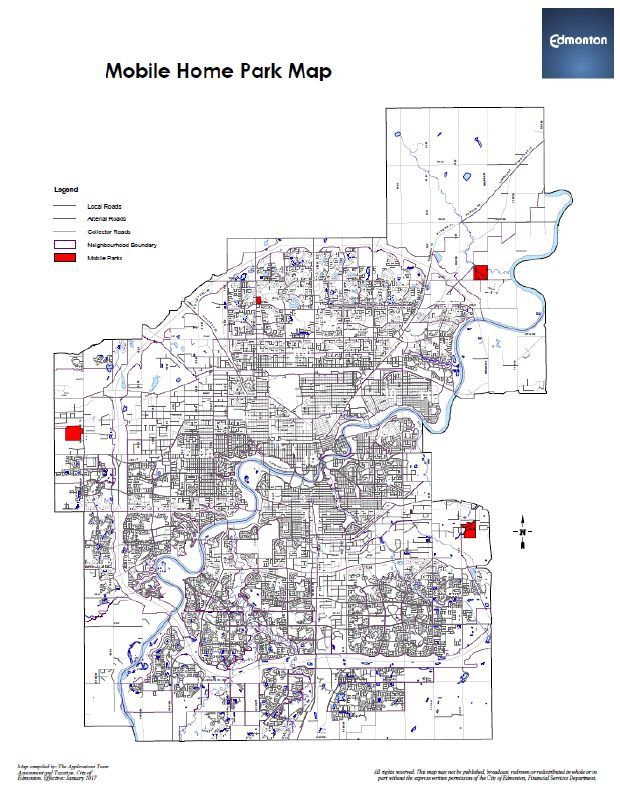
Map 14
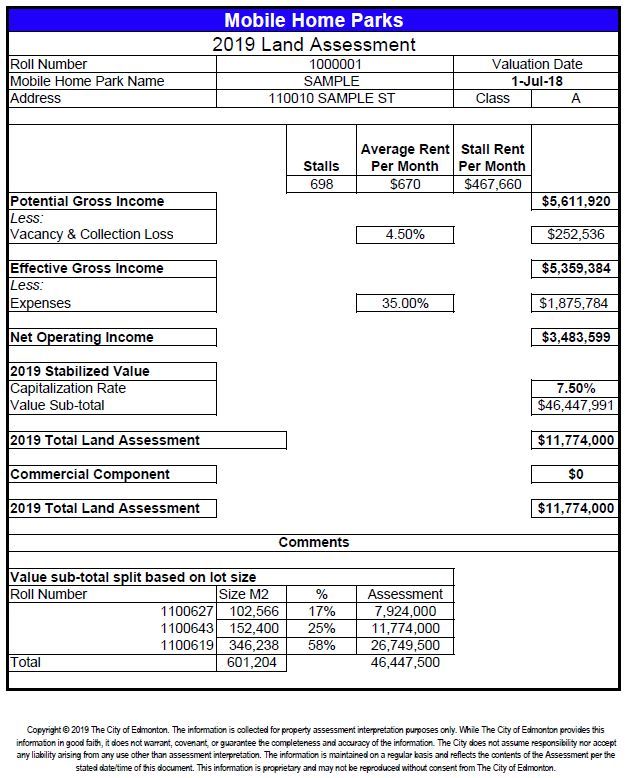
Assessment Detail Report 15
Measure Conversion Chart 16
2019 Manufactured Home Park
Assessment Methodology Page | 2
Scope
This guide is an aid in explaining how manufactured home parks are valued for assessment purposes. It
sets out the valuation method and procedure to derive market values. The information presented in this
guide is aimed at deriving values for a group of properties with similar property characteristics. In some
circumstances, not every property’s valuation parameters will be covered.
The guide is intended as a tool; it is not intended to replace the assessor’s judgment in the valuation
process.
This icon signifies when legislation is quoted.
Introduction
Property assessments in the City of Edmonton are prepared in accordance with the requirements of the
Matters Relating to Assessment and Taxation Regulation, 2018, Alta Reg 203/2017, (hereinafter
“MRAT” ). This regulation establishes the valuation standard to be used, defines the procedures to be
applied, and proposes objectives for the quality to be achieved in the preparation of assessments. The
legislation requires the municipality to prepare assessments that represent market value by application
of the mass appraisal process. All assessments are expected to meet quality standards prescribed by the
province in the regulation.
Property assessments represent:
● an estimate of the value
● of the fee simple estate in the property
● as it existed on December 31, 2018
● would have realized if it had been sold on July 1, 2018
● on the open market and under typical market conditions
● from a willing seller to a willing buyer
The assessment is a prediction of the value that would result when those specific, defined conditions are
met.2019 Manufactured Home Park Assessment Methodology Page | 3 Both market value and property, along with additional terms are defined in the Municipal Government Act, RSA 2000, c M-26 (hereinafter the “MGA” ) and MRAT :
2019 Manufactured Home Park
Assessment Methodology Page | 4
Mass Appraisal
Mass appraisal is the legislated methodology used by the City of Edmonton for valuing individual
properties, and involves the following process:
● properties are stratified into groups of comparable property
● common property characteristics are identified for the properties in each group
● a uniform valuation model is created for each property group
The following two quotations indicate how the International Association of Assessing Officers
distinguishes between mass appraisal and single-property appraisal:2019 Manufactured Home Park
Assessment Methodology Page | 5
For both mass appraisal and single-property appraisal, the process consists of the following stages:
Mass Appraisal Single Appraisal
Mass appraisal is used to The client specifies the nature of
determine the assessment base the value to be estimated,
Definition and Purpose for property taxation in including rights to be valued,
accordance with legislative effective date of valuation, and
requirements any limiting conditions
Mass appraisal requires a The extent of data collection is
continuing program to maintain a specific to each assignment and
Data Collection current database of property depends on the nature of the
characteristics and market client’s requirements
information.
Mass appraisal is predicated on Market analysis includes the
Market Analysis
highest and best use analysis of highest and best use
Valuation procedures are Subject property is the focus of
predicated on groups of the valuation. The analysis of
Valuation Model
comparable properties comparable properties is generally
six or less
The testing of acceptable analysis The reliability of the value
and objective criteria estimate is more subjective.
Validation Acceptability can be judged by the
depth of research and analysis of
comparable sales2019 Manufactured Home Park
Assessment Methodology Page | 6
Valuation Models
A valuation model creates an equation of variables, factors and coefficients that explains the
relationship between estimated market value and property characteristics.
● variables are created from property characteristics
● analysis of how variables affect market value
Valuation Model
● factors and coefficients are determined
● the resulting valuation models are applied to property characteristics
Depending on the property type multiple regression analysis or other mass appraisal techniques are
used to determine variables, factors and coefficients.
An assessed value is then calculated by applying the appropriate valuation model to individual
properties within a group.2019 Manufactured Home Park
Assessment Methodology Page | 7
Approaches to Value
The most common approaches to determine market value are the direct sales, income, and cost.
Typical market value (or some other characteristic) is determined by
Direct Sales referencing comparable sales and other market data. It is often used when
Approach sufficient sales or market data is available. It may also be referred to as the
Sales Comparison Approach.
This approach considers the typical actions of renters, buyers and sellers
Income when purchasing income-producing properties. This approach estimates the
Approach typical market value of a property by determining the present value of the
projected income stream. Often used to value rental or leased property.
Typical market value is calculated by adding the depreciated replacement
Cost cost of the improvements to the estimated value of land. It is often used for
Approach properties under construction or when there is limited market data
available.
Property Groups
The use of a property determines the property groupings and the valuation model applied.
Multi Residential
Multi-Residential group consists of investment properties of four or more dwelling units, each having
one or more rooms accommodating sitting, sleeping, sanitary facilities and most often has a kitchen.
Excluded from this group are those still under construction and dormitories.
Sub-Group
Some property groups have sub-groups based on property characteristics. This guide is for the valuation
of Manufactured Home Parks, and does not include valuation of the Manufactured Homes located
within the Manufactured Home Park.
For information on the valuation and assessment of Manufactured Homes, please refer to the Residential
Improved Properties brief for further information.2019 Manufactured Home Park
Assessment Methodology Page | 8
Manufactured Home Park means a parcel of land under one title which has been divided into Mobile
Home Lots. (Zoning Bylaw, s.6.1(60)).
For this property group, the assessment is determined using the income approach. It is the most
appropriate method of valuation for Multi Residential Manufactured Home Park properties in the City of
Edmonton.
Income Approach Definitions
To provide a clear understanding of the terms used in the income approach, the following definitions are
supplied.
Typical Market Rent is the rent currently prevailing in the market for properties comparable to the
subject property (otherwise known as current economic rent). Current economic or market rents are
used to form the basis of the valuation as opposed to actual rents, because in many cases actual rents
reflect historical revenues derived from leases negotiated before the valuation date. In determining
potential gross income, the assessor is not bound by the contractual rent between the landlord and
tenant, but must determine rental income on the basis of what is typically paid in the market at the time
of valuation.
Potential Gross Income (PGI) is the total current market rent for all space types that would be collected
if the property were fully occupied at the date of valuation. In estimating PGI, the assessor distinguishes
between market rent and contract rent. Market rent is the rate prevailing in the market for comparable
properties and is used in calculating market value by the income approach. Contract rent is the actual
amount agreed to by landlord and tenant.
Potential gross income for Manufactured Home Parks is derived by multiplying all Manufactured Home
Stalls on the property by the current market rent for those stalls.
X =
Vacancy Allowance is a deduction from the potential gross income for typical vacancy and collection
losses, assuming current market conditions and typical management. Vacancy losses are best described
as an allowance for vacant space. Collection losses are considered unpaid rents that the landlord is
unlikely to recover. These allowances are usually expressed as a percentage of potential gross income.
Effective Gross Income (EGI) is the anticipated income from all operations of real property adjusted for
vacancy and collection loss.
- =2019 Manufactured Home Park
Assessment Methodology Page | 9
Operating Expenses (OE) are the periodic expenditures necessary to maintain the real property and
continue the production of the effective gross income; these are accounted for by the expenses
deducted in the pro forma.
Net Operating Income (NOI) is the actual or anticipated (before income tax) net income from the
operation of the property after deducting all expenses from the effective gross income but before
debt servicing costs. The term is often abbreviated to net income and sometimes stated as net
income before recapture.
- =
Overall Capitalization Rate (Cap Rate) is the rate reflecting the relationship between the anticipated net
operating income from a single year and the total price or value of the property. The cap rate converts
net operating income into an indication of property value. The cap rate, in its basic formula, is found by
dividing net operating income by the sale price.
÷ =
Alternative Capitalization Techniques
When sufficient sales data is not available to derive a capitalization rate directly from the market, as is
the case for Manufactured Home Park Land; the ‘Debt Coverage Ratio Approach’ can be used. This
approach derives a capitalization rate by analyzing various factors, including mortgage rates, typical
mortgage terms, the typical loan-to-value ratio, and expected returns on investment.
Debt Coverage Ratio (DCR) Approach
The City has used the DCR technique for valuing Manufactured Home Park Land. This approach,
assuming typical mortgage terms, derives a capitalization rate by analyzing various factors, including
mortgage rates [RM], the typical loan-to-value ratio [M], and expected returns on investment [DCR].2019 Manufactured Home Park
Assessment Methodology Page | 10
As per IAAO:
● RM - the percentage of the original loan [principal and interest] that is required to be paid annually;
● M - relationship between loan amount and value of the property;
● DCR - relationship between NOI and total annual debt service;
● Ro - overall capitalization rate.
The method of determining an overall capitalization rate to apply is summarized in “The Appraisal of
Real Estate, 2nd Canadian Edition” textbook on page 22.8:
“To estimate an overall rate, the debt coverage ratio can be multiplied by the mortgage
capitalization rate and the loan-to-value ratio….The formula is:
Ro = DCR * RM * M
With this method, lenders can use market data to check on the reasonableness of capitalization
rates derived from comparables and internal valuation guidelines.”
With this method, market data can be used as a check on the reasonableness of capitalization rates
applied.
Zoning
The rules and regulations for land development within Edmonton are contained in the Zoning Bylaw, No.
12800.
Residential land use zones vary in part due to density.
A multi residential zone summary is in the appendix.
Not all property conforms to the zoning use set out in the Zoning Bylaw. In these cases, an effective
zoning is applied to reflect the current use of the property. The effective zoning may differ from the
actual zoning when the current use differs from the Zoning Bylaw (e.g., a legal nonconforming use).2019 Manufactured Home Park
Assessment Methodology Page | 11
Variables
Below is the list of variables that affect the assessment value for 2019.
Mobile/Manufactured
Potential Gross Income Capitalization Rate Class
Home Stalls
Commercial Component
Mobile/Manufactured Home Stalls: This is the total number of stalls that are available for rent in the
Manufactured Home Park.
Potential Gross Income: This is the total assessed market rent for the manufactured home park. It is
calculated by multiplying the monthly rental rate per stall (as shown below) by the number of
manufactured home stalls. This result is multiplied by 12 to estimate the yearly market rent.
Class: This determines the market rent applied to number of stalls in the manufactured home park as
well as the cap rate applied to the estimate of net operating income. There are three basic classes for
manufactured home land in Edmonton; A, B, and C. In addition to providing a basic stall and services for
each manufactured home, different classes will offer different benefits to the residents.
● A Class manufactured home parks offer some on site (or immediately adjacent) features to the
tenants such as community centers, restaurants, car washes, realty offices, skating rinks,
convenience stores, pet grooming salons, etc.
● B Class manufactured home parks do not have on-site amenities, but still offer a place to situate
a mobile or manufactured home in a neighborhood very similar to the average single family
house and are still reasonably close to nearby schools and shopping.
● C Class manufactured home parks are similar to B class, except they are located in less desirable
areas such as industrial parks and are further from schools and shopping.2019 Manufactured Home Park
Assessment Methodology Page | 12
The rates applied to these classes are summarized as follows:
Class Rent/Stall Cap Rate
Class A $ 670 7.50%
Class B $ 620 7.50%
Class C $ 620 8.00%
*vacancy is stabilized at 4.5% and expenses at 35% for all manufactured home park land in Edmonton.
Commercial Component: The commercial component, such as a retail convenience store, is valued on
the Income Approach to Value. This component is valued separately and added to the manufactured
home land value, using the same vacancy and capitalization rate for the property as a whole.
Definitions
Manufactured Home Stalls: The total number of the stalls available for Manufactured Homes in a
Manufactured Home Park.
Manufactured Home: For purposes of this methodology guide, the term Manufactured Home includes
“manufactured homes” and “mobile homes”, as defined in ss. 284(1)(m) and (n.1) of the Municipal
Government Act.
Amenities: some manufactured home parks offer on site features to the tenants such as community
centers, restaurants, car washes, realty offices, skating rinks, convenience stores, pet grooming salons,
etc.
Foreclosure: Foreclosure is a legal process by which a lien on a property is enforced. Foreclosure results
in the mortgagee becoming titleholder to, or forcing the sale of, the mortgaged property when the
mortgagor defaults on the mortgage and does not redeem it.
Judicial Sale: (1) A sale made at the direction of a court, by an officer duly appointed and commissioned
to sell, as distinguished from a sale by an owner in virtue of his right of property. (2) A court action that
enforces a judgment lien by selling property to pay a debt.2019 Manufactured Home Park
Assessment Methodology Page | 13
Standardize: To adjust, for appraisal purposes, reported data such as income and expenses, to remove
the effects of non-real-estate factors, such as abnormally good or bad management. Another common
term for this adjustment process is normalization.
Revision History
February 21, 2019 - removed Provincial Quality Standards section
References
City of Edmonton. (2014). Zoning Bylaw No. 12800. Retrieved from City of Edmonton:
http://webdocs.edmonton.ca/InfraPlan/zoningbylaw/bylaw_12800.htm
Eckert, J., Gloudemans, R., & Almy, R. (1990). Property Appraisal and Assessment Administration.
Chicago, Illinois: International Association of Assessing Officers.
Farlex. (2015). Retrieved from The Free Dictionary: www.thefreedictionary.com
International Association of Assessing Officers [IAAO]. (1997). Glossary for Property Appraisal and
Assessment. Chicago IL.
Province of Alberta. (2012). Matters Relating to Assessment and Taxation Regulation. Retrieved from
Service Alberta, Queen's Printer: http://www.qp.alberta.ca
Province of Alberta. (2015). Municipal Government Act. Edmonton, AB: Queen's Printer.2019 Manufactured Home Park Assessment Methodology Page | 14 Appendix Map
2019 Manufactured Home Park Assessment Methodology Page | 15 Assessment Detail Report
2019 Manufactured Home Park
Assessment Methodology Page | 16
Zone Summary
Residential
RA7 Low Rise Apartment Zone (s.210) provides for low rise apartment buildings
RA8 Medium Rise Apartment Zone (s.220) provides for medium rise apartment buildings
RA9 High Rise Apartment Zone (s.230) provides for high rise apartment buildings
Rural Residential Zone (s.240) is to provide for single detached residential
RR development of a permanent nature in a rural setting, generally without the provision
of the full range of urban utility services
Residential Mixed Use Zone (s.910.10) is to provide for primarily medium to high
RMU density residential mixed-use developments, with limited commercial, institutional,
office and service Uses distributed on-site
Mobile Home Zone (s.250) is to provide for Mobile Homes developed within a Mobile
RMH
Home Park or Mobile Home Subdivision.
For additional zone details, refer to the Zoning Bylaw.
Measure Conversion Chart
Imperial to Metric – Length Imperial to Metric – Area
1 inch (in) = 2.54 centimetres (cm) 1 square foot (sqft) = 0.09290 square metre (m2)
1 foot (ft) = 0.3048 metres (m) 1 acre (ac) = 4,046.86 s quare metre (m2)
Imperial Conversions 1 acre (ac) = 0.40469 h
ectares (ha)
1 acre (ac) = 43,560 square feet (sqft) Metric Conversions
1 square mile = 640 acres (ac) 1 square kilometer (sq km) = 100 hectares (ha)
1 section = 640 acres (ac) 1 hectare (ha) = 10,000 square metres (m2)You can also read


