2020-2021 District 15 Planning Presentation - Office of District Planning December 17, 2019 - Wsimg.com
←
→
Page content transcription
If your browser does not render page correctly, please read the page content below

2020-2021 District 15
Planning Presentation

Office of District Planning
December 17, 2019
Agenda
•   Division of School Planning & Development
•   District Planning Process
•   District 15 Landscape
•   District Needs Discussion
•   Questions & Feedback
•   Appendix

                                                2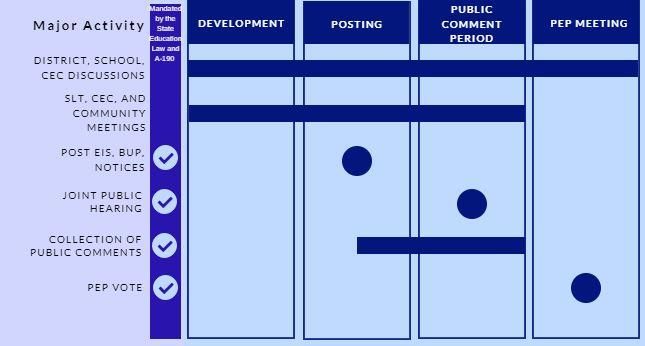
Division of School Planning & Development

                                            3
Division of School Planning & Development
Shared goal: Execute the Chancellor’s vision of Equity and Excellence for All
Karin Goldmark
New York City School Deputy Chancellor,
Roberto Perez
Construction School Planning and Senior Advisor to
Authority Development Deputy Chancellor
Carrie Bateman Brian Fuller
Chief Operating Officer Chief of Staff
Shahzad Kazi
Deputy Chief Operating Gabrielle Fraenkel
Officer Director of Special
Projects
Lisette Saravia
Executive Assistant
Bernadette Melissa Harris
Rebecca Rawlins Jennifer Cheryl Williams
Fitzgerald Chief Executive,
Tom Taratko, Senior Executive Maldonado Interim Chief
Senior Executive Office of School
Chief Executive, Director, Office Executive Director, Administrator,
Director, Design and
Office of Space of District Education Impartial Hearing
Office of Non-public Charter
Management Planning Construction Fund Office
Schools PartnershipsDistrict Planning Priorities
ODP shares the Chancellor’s commitment to Equity and Excellence for All by focusing its
efforts on the following priorities:
Increase access to quality schools and
programs, particularly in underserved areas
Increase diversity and integration across our
schools
Equity and
Excellence
Improve learning conditions for students and for All
increase access to appropriate facilities
Partner with and empower communities
through the district planning process
5District Planning Process
The Office of District Planning (ODP) partners with CECs, school communities,
Superintendents, other DOE offices, and additional stakeholders on strategic district
plans that drive equity and excellence.
Levers to make important district or school changes include:
• Rezoning in partnership with CEC • Grade Level Changes
• Unzoning in partnership with CEC • School Relocation
• New Schools • New Programs
• School Mergers • Enrollment Planning
6Community Empowerment
• Community empowerment is a key part of the district planning process, and as a
system we have been working to transform the way district planning is done
• Instead of developing a proposal and then engaging the community about the
proposal we developed, we now engage in dialogue with communities in order to
develop the proposal
• Community partnership allows us to have authentic conversations about needs and
potential solutions collectively
• ODP is committed to:
• Ensuring all voices are heard, early in the process
• Providing transparent and accessible information so that community members
can be full participants in the planning process
• Empowering communities through discussions about district needs and potential
ways to address them throughout the process
7Guiding Questions to Consider
• What planning priorities are important to you?
• What stands out to you in the data being presented?
• Do all students have access to a full array of quality schools and programs to meet
their needs, and does access vary by neighborhood or student group?
• What opportunities exist to increase diversity and integration in the district?
• Is there overcrowding in the district and a need to improve physical learning
environments for students?
• How can available space be used to address district needs?
8District 15 Landscape
9District 15 Schools
This map reflects schools in the district during the 2019-2020 school year
10District 15 Demographics: PK-8
1. All demographic data is based on students enrolled in district and charter schools located in the district and is from the Audited Register as of October 31, 2018
11District 15 Demographics: PK-8
Figure 1: PK-8 Student Groups1
1. Economically Disadvantaged data is based on the number of students with families who would be income-eligible for free or reduced price lunch, or are eligible
for Human Resource Administration (HRA) benefits.
12District 15 Performance
Based on 2018-2019 state test proficiency for grades 3-8 and 2017-2018 graduation rates
13District 15 Enrollment Trends
Figure 2: District 15 3-Year Enrollment Trend1
Level 2016-2017 2017-2018 2018-2019
Pre-K 1,646 1,574 1,598
K-5 19,535 19,363 19,018
6-8 6,723 7,046 7,428
9-12 7,140 7,057 7,188
Total 33,044 35,040 35,232
Figure 3: District 15 Total 3-Year Enrollment Trend (ES, MS, HS)
25,000
20,000
15,000
10,000
5,000
0
2016-2017 2017-2018 2018-2019
K-5 6-8 9-12
1. Based on Audited Registers for district schools and October Headcounts for charter schools
14Kindergarten Capacity and Projected Enrollment
Kindergarten enrollment is projected to increase slightly over the next few years. New capacity is
expected to open for the 2020-2021 school year as well as in subsequent years.1
1. Based on historical growth and projected new students from new construction; chart includes district and charter enrollment and capacity within the district.
Enrollment for 2015-16 through 2018-19 is from Audited Register. Enrollment for 2019-20 and beyond is projected based on the average of the last three years of
kindergarten.
15Sixth Grade Capacity and Projected Enrollment
Although middle school enrollment increased over the past several years, District 15 is projected to
have sufficient capacity to accommodate all students.1
1. Based on historical growth, K-6 cohort retention, and projected new students from new construction; chart includes district and charter enrollment and capacity
within the district. Enrollment for 2015-16 through 2018-19 is from Audited Register. Enrollment for 2019-20 and beyond is projected based on the cohort size of
the younger grades and the historical grade-to-grade attrition.
16Over-Utilized Schools
The DOE uses many strategies to alleviate overcrowding and address increases in enrollment. This
includes opening new school buildings, rezoning schools, siting new schools or programs in under-
utilized buildings, supporting principals in programming space more efficiently, and creating
capacity through repurposing or converting rooms.
Source: 2018-2019 Blue Book
17Under-Utilized Buildings
The DOE publishes a list of under-utilized buildings. This list recognizes that a building may have
excess space that could be used more efficiently, but does not mean the DOE will propose a
change in building utilization. Before proposing any changes, the DOE closely assesses available
space and discusses potential changes with the community.
Figure 4: District 15 Under-Utilized Buildings with 150-299 Seats1
Excess Seats Building Code Schools in Building Building Utilization Rate2
Digital Arts and Cinema Technology HS, The
K293 Boerum Hill School for International Studies, 86%
150 – 299 Success Academy – Cobble Hill, P.S. 368
seats
K804 Cobble Hill School of American Studies, P.S. 373 70%
K917 Brooklyn College Academy, P.S. K077 65%
1. From a preliminary space analysis based on the 2018-2019 Blue Book.
2. Please note this represents the utilization rate for the building overall. Utilization rates for individual schools within co-located campus vary and may be
higher or lower than the overall building utilization rate. For more details on individual school capacity, please see the School Construction Authority’s
Enrollment, Capacity, and Utilization Report at : http://www.nycsca.org/Community/Capital-Plan-Reports-Data#Enrollment-Capacity-Utilization-69
18Under-Utilized Buildings – Continued
Figure 5: District 15 Under-Utilized Buildings with 300+ Seats
Excess Seats Building Code Schools in Building Building Utilization Rate
Red Hook Neighborhood School, Summit Academy
K027 42%
Charter School
300+ Seats John Jay School for Law, Cyberarts Studio Academy,
K460 86%
Park Slope Collegiate, Millennium Brooklyn HS
The Math & Science Exploratory School, Brooklyn
K655 High School of the Arts 81%
19District Needs Discussion
20District Need: Middle School Enrollment
• Manage growing enrollment at middle school level
• Over the past five years, middle school enrollment in the district has increased by 24%, but
has begun to stabilize as of 2019-2020.
• District Planning will continue to monitor enrollment patterns at the middle school level
across the district and work with the Superintendent to identify opportunities to add
additional sections at schools serving middle school grades.
21District Need: Planning for New Capacities
• A 436-seat addition at P.S. 32 is scheduled to open in 2020-2021.
• Several new buildings are projected to open in 2021-2022 and beyond.
• These new buildings will further help address overcrowding in District 15, particularly in
Sunset Park.
• The DOE will collaborate with the CEC and broader D15 community to develop plans
for new capacity that are aligned with community needs and priorities.
Projected
Building ID Description Location Seats
Opening
K032 2020-2021 P.S. 32 addition 317 Hoyt St. (Gowanus) 436
K671 2021-2022 New ES capacity 5th Ave and 36th Street (Sunset Park) 404
K730 2021-2022 P.S. 896 grades 3-5 8th Ave and 46th Street (Sunset Park) 328
K557 2022-2023 New ES capacity 4th Ave and 43rd Street (Sunset Park) 332
K330 2023-2024 P.S. 1 Annex 4th Ave and 43rd Street (Sunset Park) 328
New capacity @ 80 362 Schermerhorn Street (Downtown
K654 TBD
Flatbush Brooklyn) 350
22District Need: Diversity, Integration, and Equity
• This year, District 15
implemented a diversity plan
for middle school admissions
• ODP has been working closely
with the District 15
community to explore
opportunities to increase
diversity, integration and
equity in elementary schools
through rezoning and
admissions changes,
specifically in the Red
Hook/Carroll
Gardens/Gowanus area
23Rezoning Update
• The DOE has been collaborating with the District 15 community since Spring 2019 on
a potential rezoning for P.S. 15, P.S. 29, P.S. 32, P.S. 38, P.S. 58, P.S. 261 and P.S. 676.
• This rezoning would utilize the new capacity at P.S. 32 to address enrollment, space and
demographic disparities across the impacted schools.
• The DOE has committed to engaging in a Participatory Action Research (PAR)
process to empower potentially impacted communities and develop equitable
rezoning plans in this area as well as in Sunset Park.
• The PAR process will build on the knowledge, lived experiences, and expertise of
community members potentially impacted by a rezoning.
• In support of this, the DOE has issued two Scope of Service Needs to solicit proposals
for PAR and Diversity, Equity, and Integration (DEI) services for these rezonings.
24Rezoning Update –PAR and DEI
• The PAR process will enable diverse community stakeholders, particularly those in
historically underrepresented communities, to meaningfully participate in a process that
will shape the proposal and its intended outcomes, including the goal of school
integration.
• DEI supports alongside the PAR process will ensure PAR researchers and community
members are equipped to embark on conversations around equity and integration. The
DEI efforts may be in support of the research of the PAR team, the development of the
PAR researchers’ recommendation, community engagement and education, and/or the
implementation of the ultimate rezoning proposals in schools and communities.
• These processes will result in a formal set of recommendations that advance equity and
integration to inform the DOE’s ultimate proposal to the CEC. Recommendations could
pertain to the following topics:
• Potential changes to admissions priorities to increase diversity and integration across
potentially impacted schools
• Direction and magnitude of potential zone line changes
• Ideas for interventions beyond admissions and zoning that can promote equity and excellence
in all impacted schools
• Proposed supports to be provided between a rezoning approval and implementation
25Rezoning Update –PAR and DEI
• The PAR process will seek to deeply understand communities’ needs, priorities, and
desires around equity and access in order to inform the assumptions that will
ultimately underlie the DOE’s rezoning proposal:
• What does equity mean and what does it look like for different school communities?
• What do families value most when it comes to deciding where to send their children to
elementary school? (Diversity, performance/quality, distance/geography, school culture
and environment, etc.)
• Do families want greater access to options beyond their zoned school? Why or why not?
• Do families in historically underserved neighborhoods want to be rezoned to higher-
demand schools in different neighborhoods? What concerns persist in the context of
implementing such a rezoning proposal?
• What supports do impacted schools need to ensure they are prepared to welcome and
support a more diverse student enrollment? What do parents need to feel confident their
child’s needs will be met?
• Aside from rezoning and admissions changes, what other levers could the DOE use to
increase equity and excellence across all potentially impacted schools?
• The PAR process can lead to a rezoning proposal that is aligned with one of the two
previously shared by the DOE, or an entirely different proposal.
26Rezoning Update –Timeline
• Responses to the Scope of Service Needs are due on Friday, December 20th.
• The DOE aims to select vendors by early January.
• The DOE anticipates issuing proposals based on the recommendations developed
through the PAR process for a vote by CEC 15 in late Spring 2020 for Red
Hook/Gowanus/Carroll Gardens and in Fall 2020 for Sunset Park.
27ODP Contact Information
Max Familian
Director of mfamilian2@schools.nyc.gov
Planning
Will Candell,
Senior Associate
wcandell@schools.nyc.gov
Director of
Planning
Office of District https://www.schools.nyc.gov/about-us/school-
Planning Website planning/district-planning
28Guiding Questions to Consider
• What planning priorities are important to you?
• What stands out to you in the data being presented?
• Do all students have access to a full array of quality schools and programs to meet
their needs, and does access vary by neighborhood or student group?
• What opportunities exist to increase diversity and integration in the district?
• Is there overcrowding in the district and a need to improve physical learning
environments for students?
• How can available space be used to address district needs?
29Appendix
30Additional District Data
31District 15 School Count
Figure 9: School Count1
School Type District Count Charter Count
Pre-K Center 4 0
Early Childhood Center 0 0
Elementary School 28 1
K-8 0 2
Middle School 9 1
6-12 3 2
K-12 0 0
High School 8 0
Transfer High School 3 0
Total 55 7
1. As of the 2018-2019 school year
32District 15 Demographics: 9-12
33District 15 Demographics: 9-12
Figure 10: 9-12 Student Groups
34Charter Siting Requests
• In 2014, the New York State Charter Law was amended to require the DOE to
offer space to eligible new and expanding charter schools.
• If the DOE does not offer space, charters can pursue a process to receive rental
assistance from the DOE for private facilities.
• This means the DOE must provide space or money for eligible charter schools’
facilities. Therefore, any decision not to site a charter school has a significant cost
to the city.
• Multiple new or existing charter schools have requested space in Brooklyn,
including four in District 15.
• Any potential charter co-locations would be preceded by extensive community
engagement before deciding whether to proceed with a formal proposal process.
35Charter Siting Requests – Continued
Figure 6: 2020-2021 Brooklyn Charter Requests and Siting Needs1
Preferred School Name Request Type Grades
District(s)
13 Brooklyn Prospect 1 ES Expansion (down) (temp) K-5
14, 15, 17 Success Academy Charter School – Bushwick MS Expansion (up) 5-8
14, 15, 17 Success Academy Charter School – Flatbush MS Expansion (up) 5-8
15 Brooklyn Prospect 2 ES Expansion (down) (temp) K-5
15 Success Academy Charter School - Myrtle Middle School Re-siting 5-8
18 Lamad Academy Charter School New School 6-8
21, flexible Brooklyn Hebrew Public Charter School Re-siting (temp) K or 4
23 Uncommon Leadership Preparatory Ocean Hill Charter School Re-siting 5-8
Flexible Success Academy Charter School--Bed Stuy 1 HS Expansion (up) 9-12
Flexible Success Academy Charter School--Bed Stuy 2 HS Expansion (up) 9-12
Flexible Success Academy Charter School--Cobble Hill HS Expansion (up) 9-12
Flexible Success Academy Charter School—Williamsburg HS Expansion (up) 9-12
Flexible Uncommon Collegiate Elementary School (1) ES Expansion (down) K-4
Flexible Uncommon Collegiate Elementary School (2) ES Expansion (down) K-4
1. Charter Schools that have indicated interest or requested space to date for the 2020-2021 School Year (as of November 2019) - subject to change
36Significant School Changes and
Chancellor’s Regulation A-190
37Public Review Process for Significant School Changes
• Chancellor’s Regulation A-190 governs the public review process for any proposal resulting
in a significant change in school utilization. Significant changes include:
• Grade reconfigurations
• Co-locations of new or existing schools
• Re-sitings
• Mergers
• Closures
• For every significant change proposal, the DOE is required to:
• Publish an Educational Impact Statement (EIS) and, where applicable, a Building
Utilization Plan (BUP)
• Convene a Joint Public Hearing with the CEC and affected school communities
• Publish an Analysis of Public Comment
• Arrange for the Panel for Educational Policy (PEP) to vote on the proposal*
• Proposals must be issued at least six months before the start of the upcoming
school year in order to be implemented, if approved by the PEP
* On July 31, 2019, the PEP approved amendments to Chancellor’s Regulation A-190 that incorporate recent changes to the state Education Law.
38Proposal Engagement
The DOE is committed to robust and meaningful engagement. Beyond the A-190 process,
additional opportunities for providing feedback on a proposal include:
• Conversations with community stakeholders
• Principals, School Leadership Teams, families, and school community members
• Community and Citywide Education Councils
• Elected officials
• PEP members
• CEC presentations
• Annual share of district data workbooks and needs
• Conversations on scenarios and specific proposals
• Walkthrough and debrief for co-location proposals as needed
• Led by DOE leadership at impacted buildings alongside school, district, and PEP
stakeholders
• Community meeting offered for each proposal
• Opportunity for school communities to gather and discuss the proposal in advance of
the formal Joint Public Hearing, and in some cases after the Joint Public Hearing as
needed
39Chancellor’s Regulation A-190 Timeline
*Proposals must be issued at least six months before the start of the upcoming school year in order to be implemented, if approved by the PEP.
40Rezoning and Chancellor’s Regulation A-185
41What is Rezoning?
• Rezoning is a collaborative process of changing existing school zone lines and creating
new zones, and is governed by Chancellor’s Regulation A-185
• ODP and the Superintendent develop rezoning plans in partnership with the CEC and
school communities
• The CEC decides on the zones; the local CEC votes on rezoning proposals for their
Community School District
What Can Rezonings Accomplish?
• Rezonings are an important lever for improving educational access and learning
conditions
• Improve educational access
• Create a zone for a new school option
• Increase access to high quality schools
• Increase diversity in or across zones
• Improve learning conditions
• Alleviate overcrowding
• Equalize or balance utilization across buildings
42Chancellor’s Regulation A-185 Timeline
2019 2020
Major Activity
SEP OCT NOV DEC JAN FEB MAR APR MAY JUN JUL AUG SEP OCT NOV
1. Identify Needs: The need to rezone can
be raised by the DOE, CEC, schools, and/or
the community
2. Stakeholder Engagement: This includes
partnering with the CEC, school principals,
SLTs, communities, elected officials, and
other stakeholders. Feedback from these
discussions inform potential zone lines
3. Zoning Scenario Development: The DOE
analyzes enrollment trends, demographics,
residential data, and school capacity to
inform needs of the district and potential
zoning scenarios
4. Presentation of Proposed Zone Lines to
CEC: ODP and the Superintendent present
zone line changes to the CEC at a public
meeting
5. CEC Votes: Within 45 days of proposal
submission, the CEC votes on zonings
scenario*
*Rezoning votes take place on this suggested timeline for fall 2021-2022 implementation so that changes to school admissions/enrollment can be included in
admissions process for the following school year.
43You can also read


