Application Guidebook 2020/21 - Lady Margaret Hall
←
→
Page content transcription
If your browser does not render page correctly, please read the page content below
Application Guidebook
       2020/21

                        0
Contents

Section One: About the Foundation Year ...................................................................................... 3
   Who can apply to the Foundation Year? ............................................................................................ 3
   Defining parental occupation and education ..................................................................................... 4
   What can you study on the Foundation Year? ................................................................................... 5
   Money Matters ................................................................................................................................... 5

Section Two: Making your Application.......................................................................................... 6
   How to apply for the Foundation Year................................................................................................ 6
   Completing the Application Form ....................................................................................................... 6
           Part 1: About You ....................................................................................................................... 6
           Part 2: About Your School .......................................................................................................... 6
           Part 3: What do you want to study in the Foundation Year ...................................................... 7
           Part 4: Additional Information about you.................................................................................. 8
           Part 5: Children in the Care of the Local Authority.................................................................... 8
           Part 6: Family Dependents ......................................................................................................... 8
           Part 7: About your parent(s)/Guardian(s) job(s) ..................................................................... 10
           Part 8: Family Financial Circumstances .................................................................................... 11
           Part 9: Further Information ..................................................................................................... 12
           Part 10: A short essay about you ............................................................................................. 13
           Part 11: Referees...................................................................................................................... 14

Section Three: Supporting Documents ........................................................................................ 15
  What documents do I need to send? ................................................................................................. 15
  Where can I get the documents I need? ............................................................................................ 16

  When shall I send my supporting documents? ................................................................................. 17

Section Four: What Happens Next? ............................................................................................ 18
  What happens after I submit my application? ................................................................................. 18

  How do I progress from the Foundation Year? ................................................................................ 18

                                                                                                                                                    1
Funding ............................................................................................................................................. 19
Section Five: Frequently Asked Questions ................................................................................... 20
What about my UCAS application? ................................................................................................... 20
Further study at Oxford .................................................................................................................... 20
Pre-admissions test scores................................................................................................................ 20
Reimbursement of interview costs ................................................................................................... 20
How to appeal eligibility .................................................................................................................. 20
Foundation Year Eligibility Indicators.......................................................................................... 21
Section Six: How to check your eligibility for the Foundation Year ............................................... 23
Low Income ....................................................................................................................................... 23
Socio-Economic Group ...................................................................................................................... 23
Section One: About the Foundation Year
2The Foundation Year is an academic and personal preparation course for school-leavers who
may have been prevented from reaching their full educational potential by life
circumstances. The course gives students the essential academic skills and confidence they
need to go on and thrive at university.
Foundation Year students live and are taught at Lady Margaret Hall, a college at the
University of Oxford. Students are integrated with undergraduate students. They will study
one core course and one subject specific course over three terms: each course is aimed at
increasing their academic confidence. Students will make an application for an
undergraduate degree at the University of Oxford during their time on the Foundation Year,
but progression to Oxford University is not automatic. For more detailed information on the
course please refer to http://www.lmh.ox.ac.uk/prospective-students/foundation-year
Foundation Year Eligibility Criteria
To be considered eligible for the Foundation Year you must meet all of the following
criteria:
1) Have attended a state school for your entire school career*
2) Come from a household with a combined income at or below £42,875
3) Belong to socio-economic groups 4-8 (calculated based on parental occupation - see
below for further information) OR belong to socio-economic group 3 and have
parent(s)/ guardian(s) with no qualification at undergraduate degree level or higher
(or equivalent)
4) Have home student fee status (we cannot accept international students)
OR meet all of the following criteria
1) Have attended a state school for your entire school career
2) Have home student fee status
3) Have been in the care of the local authority for at least 6 months OR are
irreconcilably estranged from your parent(s).
We also use a range of other indicators (based on school performance and geographical
location) to inform the shortlisting process. However, these are not used to determine
eligibility on the course. For a full list of indicators used please refer to Page 21.
If you are unsure whether or not you meet these criteria then please get in touch with us.
Email foundation@lmh.ox.ac.uk with any questions and we will get back to you.
*We cannot accept applicants who have studied at a private school, regardless of other socio-economic circumstance. If
you have not always been in school due to circumstances beyond your control, you may still be eligible for the course:
please email foundation@lmh.ox.ac.uk to check.
Defining parental occupation
3Jobs are categorised into 8 groups: some examples are given below to give you an idea of
the types of jobs that are in each category, but you can also use a free online tool to find out
what category your parent(s)/guardian(s) are in: information on how to do this is provided
on page 23 of this guidebook. However, you are strongly advised to contact us if you are
unsure if you meet this indicator or not.
NS-SEC category Examples
4: Small employers and own account Shopkeeper, Taxi driver, driving instructor
workers
5. Lower supervisory and technical Mechanic, Chef, plumber
occupations
6. Semi-routine occupations Shop assistant, receptionist, care worker
7. Routine occupations Waitress, cleaner, bus driver, labourer
8. Never worked and long-term Unemployed for 6 months or more OR
unemployed have never worked (e.g. stay-at-home
parent)
Defining parental education
Where parent/guardian socio-economic group is 3, we will consider an applicant eligible if
they also meet the income and school criteria, and parent(s)/guardian(s) do not have a
qualification at undergraduate level or higher. If you unsure what level your
parent(s)/guardian(s) is, please email foundation@lmh.ox.ac.uk
I’m eligible for the Foundation Year, what can I study?
4We currently offer a range of subjects on the Foundation Year. The table below details
which subjects we offer, and the entry grades required. We also accept BTEC, Scottish
Higher and International Baccalaureate qualifications: please contact
foundation@lmh.ox.ac.uk to find out if you meet the requirements for your course.
Note: there are no requirements for GCSE grades.
Subjects & Requirements
Biology ABB including A2 Biology and another Science or Maths
Biochemistry AAB including A2 Chemistry at Grade A and another Science or Maths, with
Biology and Maths to at least AS Level
Engineering AAB including A2 Maths & Physics
English BBB including A2 English literature or English language and literature
English & French BBB including A2 English literature or English language and literature, and
A2 French
English & Spanish BBB including A2 English literature or English language and literature, and
A2 Spanish
French BBB including A2 French
Law ABB
Mathematics AAB including A2 Maths
Mathematics & Statistics AAB including A2 Maths
Physics ABB including A2 Physics and A2 Maths
Politics, Philosophy and BBB including GCSE Maths to at least grade B/6
Economics (PPE)
Psychology ABB including one science or maths
Spanish BBB including A2 Spanish
Money Matters
The Foundation Year is a fully funded course. Successful candidates will have their tuition
and accommodation costs (during term time) covered throughout the Foundation Year, and
will receive a stipend each term to cover living costs. Successful candidates will not need to
apply for Student Finance for the Foundation Year.
Section Two: Making Your Application
5How Do I Apply?
Applicants to the Foundation Year must do the following:
1. Fill in the application form linked on the LMH website by no later than 12.30pm on
12th February 2020
2. Ask two referees to fill in the Referee Form (also hosted on the LMH website) by no
later than 12.30pm on the 12th February 2020. Your referee must be somebody who
can comment on your academic ability, for example: a Head Teacher, Year Head or
Form Teacher. Referees must not be family members or friends.
3. If you are shortlisted for the Foundation Year, we will ask you to provide evidence of
household income and/or Free School Meals evidence. Please ensure this evidence is
ready when we ask for it. Details of how to obtain the evidence needed can be found
on Page 15.
To complete your application you will need to ask your parent/guardian for assistance. Use
this guidebook to help you answer any questions you might have about the application form
and supporting evidence. If you have any questions that cannot be answered by the
guidebook, please email foundation@lmh.ox.ac.uk
The application form is long and you will need to get assistance from your
parent(s)/guardian(s). Please ensure that you leave enough time to complete the
application form fully as incomplete forms will not be considered. You can save the form as
you go along and return to it at a later date.
The guide below is a step-by-step guide to help you to complete the main application form
for the LMH Foundation Year, so make sure you have it to hand when filling in your form.
We will be communicating with you by email and phone, so please make sure that you use
an active email address and phone number throughout the application process.
If you need any extra assistance, email foundation@lmh.ox.ac.uk
PART 1: ABOUT YOU
6Address:
This is the address where you live. If you are co-resident between two homes (for example,
if your parents are divorced), please state the address at which you spend the majority of
your time. You may be asked to provide proof of your address. You will only have to do this
if we contact you to request it. If you are asked to provide evidence of this address we will
provide you with a list of acceptable documents as evidence.
Universities applied to:
If you have already applied – or are planning to apply – to university through UCAS for entry
in 2020 then please tell us where you have applied to, and what courses you have applied to
study.
PART 2: ABOUT YOUR SCHOOL
School(s)/Colleges Attended
List all schools and colleges that you have attended from the age of 5. If there is not enough
space on the form, please continue on a separate sheet of A4 and email it to us at the same
time as your application form.
GCSE Grades
List all GCSE subjects you took and the grades you received, regardless of whether you
passed them or not.
Year 12 Exam results
List all subjects that you studied in Year 12, and the grades that you received. Please specify
if the exams were AS Levels, or a school equivalent. If you have not been examined, state
the subject but leave the grade blank.
A Level Grades
List all the A Level subjects you are taking, and the grades you are predicted by your
teachers to achieve. If you do not know this information, talk to the relevant subject
teacher. If you are in a Gap Year and have already taken your A Levels, put the grades you
have achieved
PART 3: WHAT DO YOU WANT TO STUDY IN THE FOUNDATION YEAR?
Please select ONE subject that you would like to study on the Foundation Year. This should
be the subject that you would like to study at undergraduate level. Details of the types of
modules that you can expect to study on each course are available on the website. Some
subjects require you to have taken specific AS and/or A Levels (or equivalent). To check this,
refer to Page 5.
7PART 4: ADDITIONAL INFORMATION ABOUT YOU
We ask this information to verify your eligibility for the course, and to ensure that we can
provide you with the support necessary if you should be successful in your application.
Are you currently in receipt of Free School Meals?
Tick ‘Yes’ if you are currently in receipt of Free School Meals. If you are unsure, your School
Administrator or Head of Sixth Form will be able to provide you with the information.
In the past six years, have you ever been in receipt of Free School Meals?
Tick ‘Yes’ if you have been in receipt of Free School Meals in the past six years. If you are
unsure, your School Administrator or Head of Sixth Form will be able to provide you with
the information.
For how many of the past six years have you been in receipt of Free School Meals?
Do you have a disability? (Optional)
Tick ‘Yes’ if you have a disability. This question is being asked so that we can support
positive action for disabled people, and you will not be discriminated against in any way.
PART 5: CHILDREN IN THE CARE OF THE LOCAL AUTHORITY
Are you currently the subject of a Local Authority Care Order?
Tick ‘Yes’ if you have ever been the subject of a care order for a period of at least six months
(for example: living with relatives under the care of a local authority; living in foster care or
living in a children’s home).
If you are not currently the subject of local authority care order, have you ever been in the
past for a duration of six months or more?
Do you identify as estranged from both of your parents (or one parent, if the other parent
is deceased)? If you are unsure what we mean by estranged, please refer to the definition
here. If you are still unsure, please email us.
If you are currently living in foster care or in a children’s home, you do not need to
complete Sections 6, 7 and 8.
PART 6: FAMILY DEPENDENTS
This section asks about how many people are classed as ‘dependents’ in your household.
Tell us about any people in your family who live in the same house as you and are one or
more of the following:
8 Under the age of 18 on 1st September 2020 – this should include you, so please put
your name in the box.
Over the age of 18 and in full-time education (i.e. a university or college course)
Over the age of 18 and medically certified as permanently unfit to work
You are also a dependent, so please put your own name in the box too.
Example 1: Sarah is applying for the Foundation Year. Sarah is 17, and has two sisters – Daisy and
Amy, aged 15 and 13. She also has one brother called Mark, who is 19 and is a full-time university
student. She has another brother called David, who is 23 and works in a hotel.
Sarah would fill out the form as follows:
Full Name Date of Relationship Attending Full Time Name of School/
Birth to you School/College Course?
College Attending
Sarah 12/02/1999 Me YES YES The Generic School
Daisy 15/02/2001 Sister YES YES The Generic School
Amy 21/03/2003 Sister YES YES The Generic School
Mark 30/08/1997 Brother NO YES Generic University
Sarah has not put David in the form, because he is older than 18 and is not in full time education.
Example 2: Jasmin is applying for the Foundation Year Course. She is 17, and has two brothers. Syed
is 19 and unemployed, and Halim is 24 and is disabled and unable to work.
Full Name Date of Relationship Attending Full Time Name of School/
Birth to you School/College Course?
College Attending
Jasmin 12/02/1999 Me YES YES The Generic School
Halim 15/02/1992 Brother No No Disabled and unable
to work
Jasmin has not put Syed on the form because he is over 18 and is not in full-time education.
PART 7: ABOUT YOUR PARENT(S’)/GUARDIAN(S’) JOB(S)
9We need to know about your parent(s’)/guardian(s’) job status because the socio-economic
group that you belong to, based on your parents occupation/employment status, is a key
eligibility criteria for the course. It is therefore vital that you provide accurate and detailed
information.
Please select the situation that best describes each parent(s)’/guardian(s)’ employment
status:
This part deals with your parents’/guardians’ occupations and employment history. Please
get their help to complete this part of the application form.
Employment status is what your Mother/Father/Guardian(s) are doing right now. Only tick
No Contact what so ever if you have never had any contact with your parent/guardian. Only
tick Never worked if you parent/guardian has never had a job. If your parent/guardian works
full time, works part-time or is on an employment scheme please tick ‘working for payment
or profit’. This includes self-employment.
Parent/Guardian’s Current or Most Recent Job title
We use this to determine your eligibility for the Foundation Year, and so it is crucial that you
provide correct, detailed information. Please give the most accurate title of their job e.g.
‘bus driver’, ‘customer services assistant’.
Only put ‘unemployed’ if they have been unemployed for more than 12 months.
If they voluntarily do not work in order to look after the home/family, put ‘looking
after family’.
If your parent/guardian has more than one job, please state all their jobs, separating
them with a comma.
If you have put unemployed, retired or looking after the home/family, please tell us what
your parent/guardian(s) did beforehand, and state the date that they ceased this job role. If
they have never worked, state ‘none’.
Tick the type of employments your parent(s)/guardian(s) have or had in their
current/most recent job:
- If your parent/guardian is employed by another person or company, tick ‘employee’.
- If they work for themselves, and do not employ anybody else, tick ‘Self-Employed
with no employees’
- If they work for themselves and employ other people, tick ‘Self-Employed with paid
employees’
- If your parent/guardian has more than one job, tick each relevant answer.
10Parent/Guardian’s Education
Please tell us the highest level of education that each of your parent(s)/guardian(s) has, and
the date that they obtained this.
PART 8: FAMILY FINANCIAL CIRCUMSTANCES
Who contributed to your family income in 2018/19?
We need to know who contributed to your family income. Please tick ‘YES’ for each
parent/guardian/other that contributed to your family income. Income is not just defined as
money earned through jobs: We also need to know about benefits, income from rental
property, savings, investments etc. So, for each parent/guardian/other that received an
income (whether through a job, savings or benefits etc.) select ‘YES’.
Please write the full name of all those who contributed to the family income in 2018/19.
This may include income from anybody who is not in full time education, and who
contributes to your household finances – such as a grandparent, an aunt/uncle or an older
sibling.
Please state your total household income, including any income from benefits
This is a sum of all the money earned by people in your household who are not in full time
education – this could be your parent/guardian or somebody else such as a relative.
Write the total amount of each income earned, and then add up this total at the end, to
form a total household income.
This needs to be as accurate as possible, and you will be asked for evidence if you are
shortlisted.
Example: Stephen’s mum works part-time and earned £12,000 in the 2018/19 tax year. His
dad received £4,000 in benefits. His grandmother also lives in the same house, and earned
£9,000. They also have a lodger, who pays £4,500 per year. Stephen would fill in the form
like this: (see following page)
11Income type in 2018/19 Income amount in 2018/19
Employment (including self-employed) £ 21,000
Benefits payments £ 4,000
Redundancy payment £ 0
Private pension £ 0
Child Maintenance £ 0
Interest from investments/Savings £ 0
Other £ 4,500
Total Household Income £ 29,500
If anybody in the household received benefits (excluding Child benefits) in the 2018/19 tax
year, please tick which one(s) they received:
This question helps us to determine your eligibility for the Foundation Year course. Please
tick all appropriate benefits that your household received in the 2018/19 tax year.
If you are shortlisted for interview, we will require evidence of each source of household
income. Details of where to obtain this and how to send it to us can be found in on Pages
15-16. We do not need it until we call you for interview. You are strongly advised to start
collecting your supporting evidence before you hear back from us, as any applicants who
cannot provide evidence of their household income by this date will not be able to
proceed for an interview.
PART 9: FURTHER INFORMATION
To help promote the Foundation Year to future students, it’s helpful to understand where
applicants find out about us. Please tell us where you heard about the course – if you have
heard about us through more than one place, tick the one that made the most difference to
you. If you heard about the course through something that is not listed, then please tell us
in the box provided.
12PART 10: A SHORT ESSAY ABOUT YOU
This is the section where we find out more about you, and about why you want to study on
the Foundation Year. This is your chance to tell us, in your own words, why you are applying
and what you hope to achieve from the course.
Why have you chosen the particular subject?
o Why do you want to study that subject on the Foundation Year and at
undergraduate level – what motivates you or interests you about it?
What do you hope to achieve by participating in the Foundation Year?
o What do you hope to learn on the Foundation Year?
o How do you think the Foundation Year will help you to prepare for an
undergraduate degree?
What do you think makes you a suitable candidate for the Foundation Year?
o What skills and attributes do you have that will make you an excellent
student at Lady Margaret Hall?
What do you feel you will find most difficult at university?
What significant influences have there been in your life?
If are a mature student, why have you decided to return to study now?
You may also include information about anything that you think has negatively
affected your education.
o There is no obligation to answer this – many applicants will not be able
to point to particular challenges, and so don’t worry if you can’t!
o If you feel your schooling hasn’t been conducive to achieving high
grades, this could be relevant
o If there are any home circumstances that have affected your ability to
study, this could also be relevant – but please remember that you do not
have to share information if you don’t want to!
Essays should be a minimum of 600 and a maximum of 1000 words. You should try to write
your answers in an essay style, rather than as bullet points or headings.
You should write your essay in a separate programme, and save it as ‘YOUR NAME
Foundation Essay’. It should be emailed to foundation@lmh.ox.ac.uk in the same email as
you send your application form.
This essay should not be the same as your UCAS Personal Statement. If you have applied to
university for 2020 entry, please also send this statement along with your application.
13PART 11: REFEREES
Please provide the name, email addresses and school of your referees. We ask for this
information so that if we have not received your references before the application deadline
we can contact the referees directly.
14Section Three: Supporting Documents
You do not need to provide supporting evidence unless you are shortlisted for interview.
However, some of these documents may take up to 4 weeks to obtain. You are therefore
strongly advised to gather all the evidence you need whilst you make your application.
Applicants who are unable to prove their household income by the 16th March will not be
able to proceed with their application.
What documents do I need to send?
Local Authority Care Order
Evidence for: Document Required
Have you ever been the subject of a Local Letter from your Local Authority detailing:
Authority Care order for more than 6 The date(s) you were taken into care
months? The income provided to you/your foster
family in the 2018/19 financial year
Evidence of Household Income
Type of Income Document Required
My parent/guardian is a paid employee P60 for 2018/19 tax year
My parent/guardian is self-employed SA302: Self-Assessment evidence of earnings for
2018/19 tax year
My parent/guardian receives income from SA302: Self-Assessment evidence of earnings for
rental properties 2018/19 tax year
My parent/guardian receives income from Letter(s) from the relevant DWP agency
Social Welfare payments (benefits) detailing the benefit received and the amount in
2018/19. If you received more than one benefit,
then you need a letter for each benefit.
My parent/guardian was made redundant in Notification of Redundancy
2018/19
My parent/guardian received a lump sum Notification of Redundancy letter detailing the
payment from their former employer in sum paid in 2018/19
2018/19
My parent/guardian is retired Pension payslip or pension statement for
2018/19
My parent/guardian receives maintenance Official letter from the child support agency,
from a former partner signed statement from the non-resident parent
My parent/guardian receives income from Bank statements evidencing the latest three
savings and investments month’s income
If you currently receive Free School Meals then a letter from your school confirming this –
with dates of when you began to receive Free School Meals – will suffice as evidence of
household income
15Where can I get the documents I need?
Once you have determined what evidence you need, use the tables below to find out where
you can get these. Please be aware that some of these documents – particularly evidence of
receipt of benefits – can take time to obtain, so you are advised to start gathering your
supporting documents when you send in your application, rather than waiting to hear from
us if you have been shortlisted.
Where to get your supporting documents
P60 Your employer. If you have lost your P60,
ask your employer for a replacement copy.
SA302 Print online from your HMRC self-
assessment account: Click Here
Notification of Redundancy/Redundancy Your last employer
sum
Pension payslip/statement Your pension provider
Child Maintenance Letter Official letter from the child support
agency OR a signed statement from the
non-resident parent. The amount given in
2018/19 must be detailed
Bank Statement Your bank/building society
Where to get supporting evidence of Social Welfare payments (benefits)
We need a letter detailing all of your benefits entitlements. If you receive multiple
benefits, you will need to call each of the relevant numbers listed below to get a letter for
each one. The letter(s) must state the total amount of each benefit you received during
the 2018/19 tax year, and the dates you received these benefits between.
Employment Support Allowance 0345 608 8545
Job Seekers Allowance 0345 608 8545
Incapacity Benefit 0345 608 8545
Income Support 0345 608 8545
Universal Credit 0345 600 4272 OR Online
Disability Living Allowance 0345 712 3456
Personal Independence Payment 0345 850 3322
Carer’s Allowance 0345 608 4321
Working Tax Credit 0345 300 3900
Pensions (including State Retirement, War 0345 606 0265
Disablement and War Widow’s)
Widow’s Pension/Bereavement Allowance 0191 218 7608
Widowed Parents Allowance 0345 608 8601
Housing Benefit Your local authority
Industrial Injuries Disablement Benefit 0345 758 5433
Statutory Sick Pay Your employer
Maternity Allowance 0800 055 6688
16 Request your financial documents before you find out if you are shortlisted as it can
take up to 4 weeks to issue them
If your parent/guardian(s) received income from more than one source make sure
you provide all the relevant documents
Please do not send in your evidence before we request it: we will be in touch to let
you know when you have to send it in.
Any further questions can be directed to: Esther Fisher, foundation@lmh.ox.ac.uk
17Section Four: What Happens Next
What Happens after my application?
If your application is successful, we will notify you of your interview date by early March
2020. Interviews will be held at Lady Margaret Hall, Oxford, with the majority taking place
between the 16th – 20th March. Interview expenses will be paid for, and if you need to stay
overnight, accommodation and meals will be provided in college.
The interviews will be carried out by the Foundation Year Director or Coordinator, together
with at least one Tutor for the subject you have said you would like to study. The aim of the
interview is to assess your intellectual engagement, your academic potential and your
commitment to the Foundation Year.
If you are successful at interview, we will offer you a conditional place, dependent on your A
Level (or equivalent) results. If you chose to accept your place on the Foundation Year, you
still do not need to reject any offer you have from UCAS yet. Once you have your A Level
results on the in August 2020, you will know if you have met your conditional offer to the
Foundation Year. If you have not achieved the grades required, then you can still accept one
of your UCAS offers, providing you meet their requirements.
How do I progress from the Foundation Year?
It is important to note that an offer of a place on the Foundation Year does not give you
automatic entry to a degree at the University of Oxford. For the Foundation Year you will be
a student of Lady Margaret Hall, but not a student of the University of Oxford itself. You will
be expected to make a further application to the University of Oxford, by completing a UCAS
form for the October 2020 deadline. This should include four other choices of University to
be sure that you have a reserve offer in case your application to Oxford is unsuccessful.
The procedure for Oxford University Admissions is that all subjects require Admission
Interviews, and some subjects require Admissions Tests and submission of written work. If
you are successful at this stage, you will be given a conditional offer of a place, and the
condition will be that you should receive a Distinction on the Foundation Year. Further
information on progression and Foundation Year assessments can be found on our website.
18Funding:
The funding for the Foundation Year is entirely separate from the financing of your degree
course. This special funding is limited to your Foundation Year. You will need to apply for
funding for your degree course in exactly the same way as other undergraduate students
(e.g. from Student Finance England or Student Finance Wales). You may find that you are
eligible for a bursary from the University, but this cannot be guaranteed and will require a
separate financial assessment of your household income.
19Section Five: Further Questions
Will applying for the Foundation Year course jeopardise offers I currently hold from other
universities?
No, any offer that you have received through UCAS will not be jeopardised by an application
to the Foundation Year. You should not make any changes to your current UCAS
application, and you should continue with any applications for Student Finance for the
2020/21 academic year. If you are accepted onto the Foundation Year and go on to achieve
the required A Level results, you can then notify any universities/Student Finance of your
change in circumstances.
Do I have to apply to Oxford for my undergraduate degree?
We encourage all our students to apply for an undergraduate degree at Oxford, but the aim
of the course is to prepare candidates to achieve at any top university, so there is no
obligation for a student to continue to Oxford University as an undergraduate. Furthermore,
it should be remembered that progression from the Foundation Year to an Oxford
undergraduate degree is not guaranteed. Students will also make an application to other
universities for entry in 2021.
I’ve already taken a pre-admissions test for Oxford/Cambridge and my test score was
quite low in 2019, will this affect my chances?
We do not take MAT/ELAT/PAT/LNAT results into account when shortlisting candidates for
the Foundation Year. Furthermore, you will be given the opportunity to retake any
admissions tests if you apply to Oxford as an undergraduate whilst participating in the
Foundation Year.
Will my travel to interview be reimbursed?
Yes, all travel will be reimbursed by LMH.
What if I don’t agree with the outcome of my application?
If you believe that we have wrongly ruled you ineligible for the Foundation Year based on
the financial and socio-cultural indicators, you may appeal at any point before the 24th
February 2020 by emailing foundation@lmh.ox.ac.uk. We will only accept appeals that
clearly state:
Which of the indicators you think you meet, with evidence showing how you meet
that indicator.
We will reassess your application, and will contact you if we need more information. You
will receive a decision on your appeal by early March 2020. We will not accept any appeals
20that are unrelated to the financial and socio-cultural indicators. Our decision on academic
suitability for the Foundation Year course is final.
Foundation Year Eligibility Indicators
The LMH Foundation Year is for students who have faced educational disadvantage that has
been caused by their socio-economic circumstances. The selection criteria that we use have
been informed by academic research into the socio-economic circumstances that cause a
student from a lower socio-economic quintile to under-achieve at school in relation to those
from higher socio-economic quintiles1. The indicators that we use to help us inform our
decisions are detailed below. If you would like more information on our eligibility criteria
then please contact foundation@lmh.ox.ac.uk
KEY ELIGIBILITY CRITERIA
Indicator Description Rationale
Income Identifies applicants with a Income is associated with educational
household income below £42,850 disadvantage2. £42,850 is the level that
the University of Oxford has set as a cut
off for any bursary.
In-care Identifies students who have been 6% of care leavers enter higher
in the care of the local authority for education, compared to 60% of young
at least 6 months. people from the most advantaged
areas, and 20% of young people from
the most disadvantaged areas3.
Socio-economic Identifies students who live in a When used in conjunction with low-
group household where adults are classed income, is a proxy for socio-economic
within NS-SEC 4-8, indicating status, which has been identified as
routine or manual employment, or having the greatest influence on a
unemployment students’ educational attainment as its
effects act indirectly through a number
of different factors4.
INFORMATIVE CONTEXTUAL INFORMATION AND DATA
Information Description Rationale
Parental level of Whether or not any of the Parental education is seen as a causal
education applicant’s parent(s) /guardian(s) factor in education attainment levels6.
have undertaken a HE course
1
Research suggests that there are a number of key factors that through which the effects of socio-economic background act indirectly to
affect educational attainment. These include: Parental education; parental and child aspirations; family/child interactions; material
resources; neighbourhood deprivation; school type and performance (Chowdry et al 2009; Chowdry et al 2010; Feinstein 1998; DfES 2006;
Blanden et al, 2005)
2
Chowdry et al 2009; Sutton Trust 2010 (http://www.suttontrust.com/research/education-mobility-in-england/)
3
https://www.offa.org.uk/universities-and-colleges/guidance/topic-briefings/topic-briefing-care-leavers/
4
Mongon and Chapman 2008; Strand 2008; Raffo et al 2007; Dearing et al 2001; Blanden and Gregg 2004; Chowdry et al 2009:26; Katz et
al 2007a; Leventhal and Brroks-Gunn 2003; CPAG 2009:8
21GCSE Identifies students that have School performance average allows
performance attended a school that performed comparison across the country.
data below the national average at GCSE
A Level Identifies students that have School performance average allows
Performance attended a school that performed comparison across the country.
data below the national average at A
Level
% FSM Indicates the percentage of Indicates levels of disadvantage in the
students in the school who are school. Often correlates with
entitled to free school meals. school/college level performance
measures.
School Progression rates to higher Indication of support or aspiration
progression education from the school/college. levels in schools.
levels
School Type Identifies if the student went to a Progression rates to Russell Group and
selective or non-selective school Oxbridge are high at selective schools,
even for disadvantaged students (29%
of disadvantaged students in selective
schools go to Russell Group, compared
to 9% at non-selective)5
POLAR Divides country into quintiles that Identifies areas with low progression to
show the higher education Higher Education.
participation rates of people who
were aged 18 between 2005 and
2009 and entered an HE course
between 2005-06 and 2010-11.
IMD Combines a number of indicators, Living in an area of deprivation – with
covering a range of economic, associated resource deficit (including
social and housing issues, into a school performance) is correlated to
deprivation score for each small low educational attainment6, and
area in England allowing for each provides more granularity than POLAR.
area to be ranked relative to one
another according to the level of
deprivation.
ACORN Classification of residential Living in an area of deprivation – with
neighbourhoods dataset that associated resource deficit (including
divides neighbourhoods into five school performance) is correlated to
socio-economic categories low educational attainment7
5
SFR 01/2018: key stage 5 destination measures 2014/15 (revised)
6 Chowdry et al 2009
7
Chowdry et al 2009
22How to check your eligibility for the Foundation Year 2020/20
Low Income:
Ask your parents what your household income is. If it is below £42,875 then you meet this
indicator
Socio-Economic Group:
The instructions below detail how to check what NS-SEC category the job(s) of your
parent(s)/guardian(s) is classified as. However, if you are in any doubt then we strongly
advise that you contact us (foundation@lmh.ox.ac.uk).
Step 1: Go to this website:
http://www.neighbourhood.statistics.gov.uk/HTMLDocs/dev3/ONS_SOC_occupation_codin
g_tool.html
Step 2: Enter one parent/guardians job title in the box ‘Job Title’. Be as accurate as you can.
Step 3: A list of job titles that most accurately match the one you searched will come up.
Select the one that most closely matches your parent/guardians job
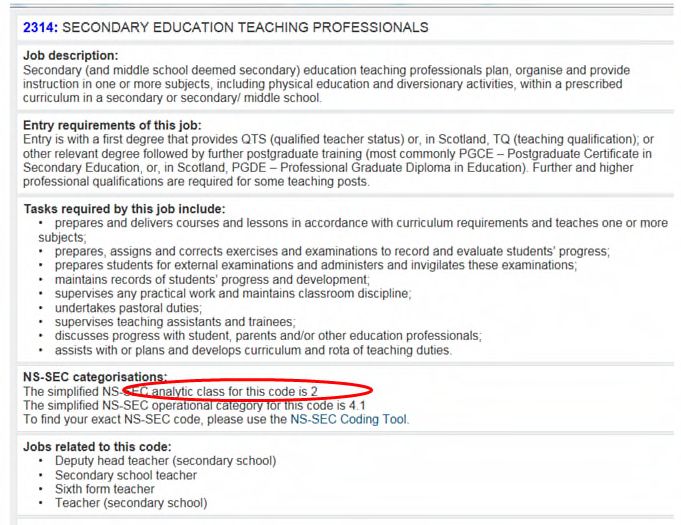
Step 4: A new window will open up on your computer (See the image below). You need to
look for the NS-NEC Analytic Class code number. For example, in the image below the
analytic class code number is 2.
Step 5: If you have two parents/guardians, repeat this step for the other one. If BOTH of
them are in analytic classes 4,5,6, 7 or 8 then you meet this indicator. If one or both have
NS-SEC 3 (and neither are NS-SEC 1 or 2) then you will meet this indicator if they also do not
have an undergraduate degree or higher.
23You can also read


