2020 Local government elections Media handbook - Victorian ...
←
→
Page content transcription
If your browser does not render page correctly, please read the page content below
2020 Local government elections Media handbook
Contents
The Victorian Electoral Commission .........................................................................................................2
Acknowledgement of Country .................................................................................................................2

1.    Latest news ...................................................................................................................... 3

2.    Key changes ..................................................................................................................... 5

3.    Key dates ......................................................................................................................... 8

4.    Postal elections ................................................................................................................ 9

5.    Roles and responsibilities ................................................................................................. 10

6.    Enrolment ......................................................................................................................... 11

7.    Nominations and candidates ........................................................................................... 13

8.    Voting and the election process ....................................................................................... 16

9.    Advertising and campaign material ................................................................................. 18

10.      Customer feedback and complaints ............................................................................. 20

11.      Council communication schedule .................................................................................. 21

12.      Education and inclusion ............................................................................................... 22

Appendix 1: Detailed election timeline .................................................................................... 23

Appendix 2: Melbourne City Council elections........................................................................ 24

Appendix 3: Profile summary of councils holding elections in October .................................... 28

                                                                                                                                           2
The Victorian Electoral Commission
Our vision
All Victorians actively participating in their
democracy.

Our purpose
To deliver high quality, accessible electoral
services with innovation, integrity, and
independence.

Our values
•   Independence: acting with impartiality and
    integrity

•   Accountability: transparent reporting and
    effective stewardship of resources

•   Innovation: shaping our future through
    creativity and leadership

•   Respect: consideration of self, others, and the
    environment

•   Collaboration: working as a team with
    partners and communities.

                                                      2
Victoria’s 2020 local council elections will be our State’s largest single election program. Over 4.5
million enrolled voters and upwards of 2,000 candidates will participate in nearly 300 individual
elections across 76 of Victoria’s 79 councils. Casey City Council, Gippsland Shire Council and
Whittlesea City Council will not be having elections this October and remain under administration.
As the responsible agency, the Victorian Electoral Commission (VEC) will manage every element of the
local council elections which, under a strict statutory regime, requires forward planning and strong
project management.
The elections will consume considerable financial, logistical, human and administrative resources.
This handbook provides answers to the VEC’s more frequently asked questions, including key changes
to elections following the implementation of the Local Government Act 2020 in April.
The handbook also covers the adjustments to our service delivery model to ensure we deliver a safe
election during the coronavirus (COVID-19) global pandemic.
I hope you find this information kit useful and look forward to working with you as we deliver this large
program of elections on behalf of all Victorians.
Warwick Gately AM
Electoral Commissioner
1Acknowledgement of Country
The VEC pays respect to Victoria's traditional
owners and their elders past and present who
have been custodians of this country for many
thousands of years. Their living culture and
their role in the life of Victoria is acknowledged
by the VEC.
21. Latest news
Keep up to date with the latest council elections The proposed counting and results timelines for
information via: individual councils will be made available
before the close of voting.
• vec.vic.gov.au/Media
• twitter.com/electionsvic
Media enquiries
• facebook.com/electionsvic
General enquiries
Media centre For general media enquiries, contact the VEC’s
Communication Team:
The VEC Media Centre provides a hub of useful
resources, links and media releases for communication@vec.vic.gov.au
journalists for the 2020 local council elections.
Contact details for individual Communication
Team staff are available on the Media Centre.
Election information Individual elections
From the opening of election offices on
Individual elections Wednesday 16 September, media enquiries
All 76 local councils undergoing elections relating to a specific election should be
during October will have a dedicated page on directed to the relevant Election Manager on
the VEC website, with information about the election office number available via the
enrolment, voting, nominations and results as VEC website in late August.
they become available. Visit:
Melbourne City Council elections
vec.vic.gov.au/voting/2020-local-council-
election For all Melbourne City Council election
enquiries before 7 September, please contact
For summary profile information on each Ruth Murphy, Senior Media and
council, see Appendix 3. For electoral maps of Communication Advisor:
each council, visit vec.vic.gov.au. Please note
that the electoral structure for a number of • ruth.murphy@vec.vic.gov.au
councils has changed following the
implementation of the Local Government Act • (03) 8620 1189
2020 (LG Act 2020).
From 7 September, contact: Bill Lang, Election
Manager on (03) 8619 1444
Results
Official results declarations are expected to be Contacting candidates
finalised by Friday 13 November. Due to the
coronavirus (COVID-19) global pandemic, The names and contact information (where
additional measures have been put in place to provided) of candidates will be progressively
protect the health and wellbeing of our staff available on the VEC website, in nomination
and the public. The final date for declaring all order, during the nomination period, Thursday
results has been extended to Friday 13 17 September to 12 noon Tuesday 22
November to accommodate social distancing September.
measures and safe work practices in election
offices and count centres.
3The final list of candidates, in ballot paper
order, will be available online on the afternoon
of Tuesday 22 September (Monday 28
September for Melbourne City Council
elections).
Candidates can submit a photograph and a
statement of up to 300 words to be included in
the ballot pack. Leadership Team and
Councillor groups for Melbourne City Council
elections are permitted a statement of up to
350 words in length; ungrouped candidates
have up to 300 words. Other information
specific to Melbourne City Council elections,
including indications of preferences and group
voting tickets, will also be made available.
Note: Regulations changing the permitted word
limit for councillor group statements for
Melbourne City Council have not yet been
finalised.
This information will also be available on the
VEC website from Thursday 1 October, after
ballot packs have been printed.
All candidates have the option of completing a
questionnaire for publication on the VEC
website, which will allow voters to make a
comparison of each candidate’s experience.
The questions are prescribed by legislation.
Answers to the candidate questionnaire will be
published on the VEC website from Monday 28
September (Tuesday 29 September for
Melbourne City Council elections).
The VEC does not gather or provide
demographic information on candidates.
42. Key changes
Recent legislative changes have resulted in The candidate information session and the
several changes since the 2016 local council interactive seminars will be available online at
elections. vec.vic.gov.au
The LG Act 2020 came into effect in April 2020 Melbourne City Council will conduct two live
and new Local Government (Electoral) streamed sessions for Melbourne City Council
Regulations 2020 (LG Regs 2020) were made elections. Visit the Melbourne City Council
shortly thereafter. website for further information
melbourne.vic.gov.au.
Mandatory candidate
Compulsory voting
training The VEC’s planned advertising, community
As part of their nomination, all candidates must information and media campaigns for the
declare they have completed the mandatory elections will reinforce the message that voting
local government candidate training and is compulsory for all Victorians on the State roll.
provide details relevant to their training.
All candidates must complete the mandatory
training, even if they have previously been or Council electoral
are currently sitting councillors.
structures
Due to the Coronavirus (COVID-19) pandemic,
The Victorian Electoral Commission’s 2019-20
the mandatory candidate training is being
electoral representation and subdivision review
offered online. Candidates can access the
program commenced in January 2019. The
training through their local council website or
program involved the review of 38 local councils
Local Government Victoria
- 31 representation reviews and seven
localgovernment.vic.gov.au/council-
subdivision reviews.
governance/candidate-training
The following council electoral structures will
change to single-councillor wards for the
Candidate October 2020 local council elections:
information session • Bayside City Council
Prospective candidates are strongly encouraged • Manningham City Council
to watch the online information session offered
by the VEC from Thursday 3 September. • Cardinia Shire Council
The online information session will be • Darebin City Council
complemented by three State-wide interactive
seminars on the following dates: • Greater Dandenong City Council
• 7 pm Wednesday 9 September • Kingston City Council
• 1 pm Sunday 13 September • Maroondah City Council
• 5 pm Tuesday 15 September • Whitehorse City Council
• Boroondara City Council
5• Murrindindi Shire Council • Whittlesea City Council (no election until
October 2024)
The following councils will change to an
unsubdivided structure for the October 2020 • Surf Coast Shire Council
local council elections:
• Wyndham City Council
• Mansfield Shire Council – 5 councillors in an
unsubdivided structure • Stonnington City Council
• Swan Hill Rural City Council – 7 councillors • Yarra Ranges Shire Council
in an unsubdivided structure
• Hume City Council
The following councils will not change from their
current structures for the October 2020 local • Monash City Council
council elections, although there may be
changes to the ward boundaries, number of • Moorabool Shire Council
councillors or single-councillor wards:
The LG Act 2020 received Royal Assent on 26
• Banyule City Council March 2020 and the electoral provisions came
into operation on 6 April 2020.
• Nillumbik Shire Counci
The immediate impact was the cancellation of
• Casey City Council (no election until the representation reviews of Whittlesea City
October 2024) Council and Mitchell Shire Council. The
proclamation of the new LG Act 2020 did not
• Hepburn Shire Council have a direct impact on the subdivision reviews,
which were completed according to the
• Northern Grampians Shire Council schedule of reviews.
• Buloke Shire Council The LG Act 2020 stipulates a uniform system of
single-councillor wards for all Victorian local
• East Gippsland Shire Council councils. The Minister for Local Government
may decide, however, that in some cases a local
• Benalla Rural City Council council can be unsubdivided or consist of
multi-councillor wards with an equal number of
• Campaspe Shire Council councillors per ward.
• Moira Shire Council Details of council electoral structures for the
2020 elections are listed in Appendix 3.
• Borough of Queenscliffe
Ararat Rural City Council
•
Council-enrolled
Colac Otway Shire Council
•
voters
• Golden Plains Shire Council
It is not compulsory for council-enrolled voters
to vote, except in Melbourne City Council.
• Glenelg Shire Council
People can apply to enrol with their council if
• Moyne Shire Council
they:
• Southern Grampians Shire Council
• are not an Australian citizen, but live and
pay rates in a council
• Mitchell Shire Council
6• pay rates on a property they occupy and
have no other entitlement to vote in the
council
• are a director or company secretary of a
corporation that pays rates and have no
other entitlement to vote in the council
• are a ratepayer, who was not on the council
roll at the last election and are not on the
State roll for that council area.
Non-resident owners who were enrolled with
council at the last elections (or at the last
by-election) will be automatically enrolled
Results timeline
Official results declarations are expected to be
finalised by Friday 13 November, noting
additional social distancing requirements in
election offices and count centres and possible
recount requests.
Counting and results timelines for individual
council elections will be made available before
the close of voting.
73. Key dates
Time and Date Activity
From Saturday 8 August Close of roll notice
Voter information campaign commences with advertisements and
releases containing enrolment information.
4 pm Friday 28 August Close of roll
Voters must be on the roll by this date to be eligible to vote or
stand as a candidate, 57 days before election day.
Wednesday 16 September Election offices open
9 am Thursday 17 Nomination period
September to 12 noon Anyone wishing to stand as a candidate must lodge their
Tuesday 22 September nomination with the Election Manager during this period.
Ballot draws to determine the order of candidate names on ballot
papers are held following the close of nominations.
Tuesday 6 October to Ballot packs distributed
Thursday 8 October Ballot packs are mailed to all enrolled voters in a random order
over three days.
6 pm Friday 23 October Close of voting
Completed ballot material must be in the mail or hand-delivered
to the relevant Election Office by 6 pm.
12 noon Friday 30 October Deadline for inclusion of postal votes
The Election Manager will include ballot material if satisfied it was
signed by voters before 6 pm Friday 23 October (close of voting).
Monday 2 November to Results declarations (anticipated)
Friday 13 November Results for all elections will be officially declared and published in
relevant newspapers and to the VEC website during this period.
Variations to this timeline apply for Melbourne
City Council elections (see Appendix 2).
84. Postal elections
The 2020 local council elections will be held
entirely by postal voting for all councils in
Victoria as a result of the direction of the
Minister for Local Government under the LG Act
2020.
The average voter turnout rate in the 2016
council elections conducted by post was
73.75%, with an average informality rate of
6.02%.
To vote in a postal election, enrolled voters:
• receive a ballot pack in the mail with voting
instructions, candidate information, a ballot
paper (or two ballot papers for Melbourne
City Council), ballot paper envelope (with
flap) and a reply-paid envelope for
returning the completed ballot paper
• complete the ballot paper by following the
instructions on the ballot paper
• insert the completed ballot paper into the
ballot paper envelope, complete their details
on the flap, sign and date it, then insert it
into the reply-paid envelope
• mail or hand-deliver the completed ballot
material by 6 pm Friday 23 October.
In previous elections councils were able to
choose their method of voting between
attendance voting or postal voting.
At the 2016 local council elections, six councils
held their elections by attendance voting –
Banyule, Greater Dandenong, Knox, Moreland,
Port Phillip and Yarra City Councils.
Casey City Council, Gippsland Shire Council
and Whittlesea City Council will not have
elections this October and remain under
administration.
95. Roles and responsibilities
The Inspectorate works closely with the VEC as
Victorian Electoral Commission well as other integrity and law enforcement
The VEC is the statutory provider for Victorian agencies, including the Independent Broad-
council elections. The VEC has conducted all based Anti-corruption Commission (IBAC).
local council elections in Victoria since 2004 and
has a long history of working in partnership with
Councils
the local government sector.
Individual councils provide council-enrolled voter
The VEC: data to the VEC for inclusion on the voters’ roll.
• prepares and certifies the voters’ roll for the Councils are responsible for enforcing local laws
election (but not for Melbourne City Council in relation to candidate signage and other
elections), compiled through council- publicly displayed election matter.
enrolled (CEO list) voters and State-enrolled
voters Following the declaration of an election, the
Chief Executive Officer of a council will arrange
• appoints, trains and oversees the Election the swearing in of the incoming council and
Managers schedule the first council meeting. Elected
councillors formally leave office at 6 am on
• provides infrastructure and support for the election day.
Election Managers and their offices
• provides compulsory voting enforcement
services.
Media enquiries about the arrangements for
and administration of the elections should be
directed to the VEC.
Election Manager
An Election Manager is appointed by the VEC to
conduct each election
The Election Manager is responsible for the
management of nominations, public enquiries,
vote counting and results declarations for their
election.
Media and public enquiries for a specific
election should be directed to the relevant
Election Office from Wednesday 16 September.
Local Government Inspectorate
The Local Government Inspectorate is
responsible for investigating any alleged
breaches of the LG Act 2020. Complaints
received by the Election Manager or the VEC
that allege a breach of the Act will be referred to
the Inspectorate.
106. Enrolment
There are several entitlement categories and • have never enrolled
thus more people entitled to vote in Victorian
council elections, compared to the relatively • have lived at their present residential
straightforward residential and citizenship address for at least a month and have not
requirements for State and Federal elections. updated their enrolment details.
Most enrolled voters will be Australian citizens, Australian citizens can enrol, check or update
aged 18 or over, residing in a council area going their State enrolment details at vec.vic.gov.au.
to an election. People enrolled in this way are
referred to as ‘State-enrolled voters’ or being on
the State electoral roll. These voters accounted
for 84.97% of total enrolments in the 2016 Who can apply to
council elections.
council to enrol?
The bulk of remaining enrolments will be
People can apply directly to council if they will
non-resident property owners who are
be 18 years of age or over on 24 October 2020
automatically enrolled by council if they were
and:
enrolled at the last election (including the last
by-election for their council or ward).
• own property in a council area but don’t live
in the council area, and were not enrolled at
The minority of remaining enrolments will be
the last council election or by-election
voters who apply directly to council to enrol
under a council-administered entitlement
• are non-Australian citizens who live and pay
category. People enrolled in either of these ways
rates in the council area
are referred to as ‘council-enrolled voters’.
• pay rates on a property they occupy in the
Enrolment in all categories closes at 4 pm on
council area (typically business tenants)
Friday 28 August 2020.
• are a director or company secretary of a
corporation that pays rates to the council.
Who is automatically To apply to enrol in one of these categories,
enrolled? people need to contact their council directly.
People are automatically enrolled if they will be
18 years of age or over on 24 October and:
One vote per council
• live in a council area and are on the State
A person is entitled to only one vote per council,
electoral roll for their current address
regardless of how many entitlements they may
have. Entitlements are hierarchical, with a
• own property in a council area but don’t live
person’s State enrolment taking precedence.
there and were enrolled at the last election
(including the last by-election for their
People can enrol and vote in more than one
council or ward).
council election if they have the necessary
entitlements, for example, voting as a resident in
one council, and as a non-resident property
Who must enrol? owner for a holiday home or investment
property in another council.
Australian citizens aged 18 or over on 24
October 2020, living in Victoria, must enrol if
they:
11Provision to
candidates
On request, the VEC will provide each candidate
with a copy of the voters’ roll for the election in
which the candidate has nominated. The roll is
provided for election campaign purposes only.
This information contains an elector’s name and
address, but not their contact details. It also
excludes silent electors.
Candidates who receive a copy of the voters’
roll must securely destroy or return it to the VEC
within 30 days of the election day.
There are significant penalties for any
candidate who misuses voters’ roll information.
127. Nominations and candidates
Nominations Mandatory candidate
To nominate, a person must be: training
• an Australian citizen and enrolled on the All potential candidates must complete
voters’ roll for the council they are mandatory local government candidate training
nominating for before lodging their nomination with the Election
Manager.
• eligible to become a councillor should they
be elected, and Candidates can access the mandatory training
online through their local council websites or on
• have completed the mandatory local the Local Government Victoria website
government candidate training before localgovernment.vic.gov.au/council-
lodging their nomination with the Election governance/candidate-training
Manager.
All candidates must complete the training, even
Certain conditions disqualify a person from
if they are or have previously been a councillor.
nominating, for example if they are:
• a member of any Australian Parliament
• a councillor for another local council in
Candidate
Australia information session
• a member of council staff for the council Prospective candidates are strongly encouraged
they are nominating for to watch the online information session offered
by the VEC from Thursday 3 September.
• convicted of certain criminal offences
The online information session will also be
• an undischarged bankrupt. complemented by three state-wide interactive
seminars on the following dates:
This list is not exhaustive; further details are
outlined in the LG Act 2020. Depending on the • 7 pm Wednesday 9 September
type of disqualification, candidates may resolve
the disqualification if they take leave from the • 1 pm Sunday 13 September
conflicting position (and must resign if elected)
or seek relief from the disqualification through • 5 pm Tuesday 15 September
the Victorian Civil and Administrative Tribunal
(VCAT). Melbourne City Council will conduct two live
streamed sessions for Melbourne City Council
Candidates in subdivided councils can stand for elections. Visit the Melbourne City Council
election for any ward, even if their enrolled website for further information
address is in a different ward within the council. melbourne.vic.gov.au.
Nominating
Candidates must make an appointment during
business hours with the Election Manager to
13lodge their nomination and pay their $250 Candidate questionnaire
nomination fee.
All candidates have the option of completing a
The nomination period begins on Thursday 17 questionnaire for publication on the VEC
September and nominations close at 12 noon website, which will allow voters to make a
Tuesday 22 September. Late nominations comparison of each candidate’s experience. The
cannot be accepted. questions are prescribed by legislation.
A list of nominations (including candidate Answers to the candidate questionnaire will be
contact information, where supplied) for each published on the VEC website from Monday 28
election will be updated regularly during the September (Tuesday 29 September for
nomination period on the VEC website. Melbourne City Council elections).
Ballot paper order
The order of names on the ballot paper is
determined by a computerised single random
draw. The Election Manager will conduct the
draw at the election office following the close of
nominations.
The final list of candidates in ballot paper order
will be available on the VEC website on the
afternoon of Tuesday 22 September (Monday
28 September for Melbourne City Council
elections – after the ballot draw).
Candidate
information
Candidates can submit a photograph and a
statement of up to 300 words to be included in
the ballot pack.
Leadership Team and Councillor groups for the
Melbourne City Council elections can submit a
statement of up to 350 words.
This information will also be available on the
VEC website on Monday 28 September
(Tuesday 29 September for Melbourne City
Council elections).
Note: Regulations changing the permitted word
limit for councillor group statements for
Melbourne City Council have not yet been
finalised.
14Endorsements
Candidate statements and questionnaire
answers where a candidate claims endorsement
or support from a person, organisation or party,
must be lodged alongside written evidence of
consent to the claim by the person, organisation
or party.
The LG Act 2020 does not recognise the formal
participation of political parties in council
elections, and no party affiliations are included
on ballot material. Candidates are, however,
free to seek endorsement from any party, group
or organisation. Evidence is required if this
endorsement is included in formal election
material.
Uncontested elections
If, at the close of nominations, the number of
candidates is equal to or less than the number
of vacancies for any election, this results in an
uncontested election.
The Election Manager will declare these
candidates elected on or after election day and
provide public notice of their election.
Voters in an uncontested ward will be mailed an
uncontested election leaflet informing them of
the outcome. If the election for an unsubdivided
council is uncontested or all wards within a
subdivided council are uncontested, the
outcome will be advised via advertisement.
If there are no candidates for an election or
where an uncontested election leaves further
vacancies to be filled on the council, a
by-election will be required to fill the vacancies.
158. Voting and the election
process
Redirection and replacement
Compulsory voting Voters who will not be at their enrolled or mailing
address during the voting period can arrange
Voting is compulsory in Victorian council for their ballot material to be sent to another
elections for all State-enrolled voters, regardless address by making a redirection request in
of age. This includes all voters enrolled for the writing by Thursday 17 September.
elections because they were on the State
electoral roll as at the close of roll (4 pm Friday Election Managers can also issue voters with a
28 August). replacement ballot pack if they claim to have
lost, spoilt or not received their ballot pack. The
It’s compulsory for all voters enrolled in the VEC’s election management system ensures
Melbourne City Council elections to vote, only one declaration envelope proceeds to the
including non-Australian citizens and count.
corporation voting representatives.
If a person is required to vote at an election and Voting deadline
doesn’t vote, they may be fined unless they
Completed ballot material must be in the mail
have a sufficient excuse for failing to vote.
by 6 pm Friday 23 October. Alternatively, ballot
material can be hand-delivered to the election
office by the same deadline.
Filling in the ballot
paper Failure to vote
In all council elections except the election of
Compulsory voting enforcement, including the
councillors for Melbourne City Council (see
prosecution of non-voters, is a mandatory
Appendix 2), voters receive the same kind of
requirement under the LG Act 2020.
ballot paper, with candidates listed in the order
determined by the ballot draw for the election.
The VEC will commence a compulsory voting
Full preferential voting is used, where voters
enforcement program in early 2021, with the
complete their ballot paper by numbering all the
mail-out of an ‘Apparent Failure to Vote Notice’
boxes in order of their preference.
to all voters who were required to vote and
appear to have failed to vote. Any voters who
are automatically excused from failing to vote
Voting in postal will not be sent a notice. This notice is not a fine,
but an opportunity to provide an explanation for
elections having failed to vote or provide details if they
did indeed vote.
Ballot packs are mailed (priority paid) to
enrolled voters between Tuesday 6 and A person who receives an ‘Apparent Failure to
Thursday 8 October. Voters in the same Vote Notice’ and does not respond with a
household may receive their ballot packs on sufficient excuse for failing to vote, or those who
different days. do not respond at all, will be issued an
Infringement Notice. For the October council
elections, the fine for not voting is $83.00 (half a
penalty unit).
16• this process continues until all vacancies are
Counting the votes filled
• In some instances, one or more candidates
Preferential counting may be elected without receiving a quota.
Preferential vote counting is used in single
councillor ward elections and for the Melbourne More information, explaining preferential and
City Council Leadership Team election: proportional counting, is available on the VEC
website at vec.vic.gov.au/voting/how-voting-
• to be elected, a candidate (or Team) must works/counting-votes
gain an absolute majority of the first
preference votes (more than 50%) to be
elected
Obtaining the result
• if no candidate (or Team) receives an In most circumstances, preferential vote counts
absolute majority of first preference votes, a will be conducted manually (the count for the
preference distribution is required. The Melbourne City Council Leadership Team will be
candidate or team with the fewest first conducted by computer) and proportional vote
preference votes is excluded and their votes counts will be conducted using computer data
are distributed to the other candidates entry.
according to the voter’s preferences. This
process continues until one candidate (or Candidates can appoint scrutineers to observe
Team) has an absolute majority and is the counting process.
elected
• the process continues until one candidate Counting and results timeline
(or Team) gains an absolute majority.
Results can only be calculated once all votes
admissible to the count have been received.
Proportional counting
Due to the coronavirus (COVID-19) global
Proportional representation vote counting is pandemic the official results declaration period
used to elect councillors where there is more has been extended to allow for adequate social
than one vacancy to be filled distancing in election offices and during the
counting activities. Official declarations are
• to be elected, candidates have to obtain a anticipated to take place between Monday 2
‘quota’, determined by dividing the number November and Friday 13 November, varying
of formal votes by one more than the according to the electoral structure of each
number of vacancies to be filled, and then council, the Melbourne Cup Day public holiday
rounding up to the nearest whole number or for parts of Victoria, and requirements for any
adding ‘1’ to the result (for example, if there recounts.
are 10,000 formal votes for three vacancies,
the quota is 10,000 divided by four plus ‘1’, Detailed counting and results timelines for
equalling a quota of 2,501) individual councils will be made available before
the close of voting on the VEC website.
• each candidate who achieves the quota is
elected, and then any surplus votes (votes
above the quota) are transferred to the
remaining candidates at a reduced value
• if there are still vacancies to be filled once
the surpluses for each elected candidate
have been transferred, the candidate with
the fewest votes is excluded and their votes
are transferred to the remaining candidates
at the value received
179. Advertising and campaign
material
Anyone may publish electoral material during a September to Saturday 24 October), all
council election campaign. All published published articles or letters in a newspaper that
electoral material—such as advertisements, contain electoral matter must include the
flyers, billboards and social media posts—must author’s name and address at the end. This
be authorised and comply with the LG Act does not apply to leading articles that only
2020, to ensure voters are informed about the contain a report of a meeting. Letters to the
source of political advertising and not misled editor only require the author’s name and a
about how to cast their vote. suburb or locality where the author’s address is
located.
Authorisation
Advertising and campaign material must be
Misleading or
authorised, ensuring the producers of election
material are accountable and contactable.
deceptive matter
During an election period, it is illegal to print,
The authorisation statement must be at the end publish, distribute, permit or authorise to be
of the electoral material, as follows: printed, published or distributed:
• ‘Authorised by [authoriser’s name], • anything that is likely to mislead or deceive
[authoriser’s address]’. a voter in relation to the casting of their vote
This requirement applies to the person who has • an electoral advertisement containing a
printed, published or distributed the material, or representation of a ballot paper that is likely
the person who has caused, permitted or to induce a voter to vote otherwise than in
authorised the material to be printed, published accordance with the directions on the ballot
or distributed. The address included must be a paper.
physical address or a PO box address (email
addresses are not acceptable). The definition of ‘misleading’ advertising in the
LG Act 2020 has been interpreted narrowly by
Authorisation requirements always apply—not the courts. The Act does not regulate the
just in the election period. The authorisation content or truthfulness of political messages
requirements include material published online contained in electoral matter, as these
and through social media. If it is not possible to messages can be freely debated and opposing
include an authorisation statement in a social views can be put forward during ordinary
media comment (e.g. Twitter), the post must political discourse. Instead, the Act is principally
include or directly link to an authorisation concerned with ensuring that electoral material
statement. does not mislead or deceive electors about the
way in which the voter understands their vote
must be cast and the effect of their vote.
Newspapers
Paid election advertisements in newspapers For example, material that suggests that
must be properly authorised and additionally be someone should number the candidates on a
printed with the word ‘advertisement’ as a ballot paper in a particular order to vote for
headline (in at least 10 point font). candidate X, when in fact voting in that order
would see candidate X getting voters’ last
During the election period, from close of preferences, would be likely to be considered
nominations to election day (Tuesday 22 misleading or deceptive by the courts.
18In contrast, to suggest that a candidate has Candidates and other producers of such
‘been in the area all their life’ when they have material should seek their own legal advice in
lived somewhere else and just worked in the this area.
area, is not likely to be considered misleading or
deceptive within the interpretation of the LG Act
2020. Posters and billboards
Posters and billboards must be properly
authorised.
Electoral matter Candidates and other producers of such
Electoral matter means matter which is intended material should check with the council about
or likely to affect voting in an election. any local laws that may apply to the display of
advertising material and/or with the
Department of Transport for provisions
Heading to electoral advertisements governing the display of material alongside
major roadways or at public transport facilities.
Newspaper proprietors must print the word
‘advertisement’ as a headline (in at least 10
point font) to each article or paragraph printed Letters and direct mail
in the newspaper containing electoral matter
which is paid for, or for which compensation is Leaflets, flyers and other forms of unaddressed
to be made. direct mail delivered to households must be
properly authorised.
Identification of author(s) Producers and distributors should be aware of
the rules relating to such material. It would be
During an election period, all articles or letters
advisable to contact Australia Post.
containing electoral matter, which are printed,
published or distributed in a newspaper, circular
Letters addressed to individual voters by name
or pamphlet must include the name and address
do not have to include an authorisation
(not an email address) of the author at the end.
statement but must include the author’s name
However, letters to a newspaper simply have to
and address at the end of the letter.
include the author’s name and the suburb or
locality in which the author’s address is located.
A candidate or other campaigner who intends to
distribute campaign material in public should
The identification requirement does not apply to
check with the council for any local laws about
a newspaper leading article or an article that is
the distribution of advertising material, as well
solely a report of a meeting.
as any other relevant authorities or property
owners (e.g. shopping malls).
Social and online
media
The use of online platforms (including social
media) by candidates and others for
campaigning purposes must conform with
electoral law and terms and conditions of the
platforms concerned.
Social media, websites, blogs and email
containing electoral matter or content must be
authorised. Advertisements, including sponsored
links, published online must also carry or
directly link to an authorisation statement.
1910. Customer feedback and
complaints
The VEC has a robust process for handling • Unauthorised material —all election
customer feedback and complaints. If a campaign material must have appropriate
complaint relates to: authorisation, as described in Section 9
above
• a possible breach of the LG Act 2020—it will
be referred to the Local Government • Misleading or deceptive material —strictly
Inspectorate relates to material that misleads or deceives
a voter in relation to how they cast their
• the administration of the election, including vote (that is, if it causes a voter to
the actions and behaviours of Election misunderstand the effect of their vote).
Managers and election staff—the VEC will
manage it
• a possible breach of local laws—it will be Confidentiality of
referred to the CEO of the relevant local
council customer feedback
The VEC and Election Managers may comment
• alleges a criminal offence—it will be referred
on the customer feedback and complaints
to Victoria Police.
process, but will not comment on any specific
complaints, or confirm whether a complaint or
A complaint that alleges wrongdoing by a public
feedback has been received—to do so would
officeholder (including a councillor) may be
infringe on the confidentiality of the customer.
protected by Victoria’s public interest disclosure
laws. The VEC is not empowered to receive
Parties to the complaint are free to discuss the
public interest disclosures under the relevant
complaint with the media.
laws, so these statutory protections will only
apply for complaints made directly to the
Reporting on the number and category of
relevant authorities, including the Independent
complaints will be provided in the VEC’s
Broad-based Anti-corruption Commission
post-election reporting.
(IBAC).
If a complaint alleges corrupt conduct by a
public officeholder, the VEC is required to
provide a mandatory notification to IBAC in
addition to referring the matter to the relevant
authority.
Candidate conduct
and advertising
complaints
Complaints about candidate conduct and
advertising material will most likely relate to the
LG Act 2020, with some of the most common
complaints including:
2011. Council communication
schedule
The VEC will deliver a voter information elections. Traditionally, participation in council
campaign on a local and State-wide basis, with elections is markedly lower than State elections
advertising services, media relations, and (72% vs 91% respectively), even though voting in
election information on the VEC website. both election types is generally compulsory. This
is particularly the case for young voters
Although the elections are ‘local government’ between the ages of 18 and 29.
elections, from a communication perspective the
VEC refers to ‘local council’ elections - a term State-wide media releases will be available on
more familiar to voters. the VEC Media Centre. Some state-wide media
releases will also be translated into 20 different
The campaign comprises two main phases: languages and distributed to ethnic language
enrolment and voting. media outlets across the state. Individual council
releases will be distributed to local publications
The aim of the campaign is to increase public according to the council communication
awareness of, and participation in, local council schedule below.
Timing Communication
From Saturday 8 August Close of roll advertisements and media release
how to enrol and eligibility
council contact number for council enrolments
From Monday 24 August Notice of election advertisements and “call for
candidates” media release
how to nominate as a candidate
candidate information session details
requesting redirection or large print/braille ballots
Monday 5 October “Ballots mailed” media release
From Wednesday 12 October Voting reminder advertisements
Monday 17 October “Voting deadline” media release
From Friday 13 November Results advertisements (media advisories will be
issued as results are declared from Monday 2
November)
2112. Education and inclusion
The VEC’s Education and Inclusion Team is Electoral information, including translated
conducting a range of activities to increase enrolment forms is available in 20 languages
engagement and participation in the on the VEC website along with contact details
democratic process. Engagement and outreach for interpreter assistance.
will be delivered online and through other
contactless methods to protect the health and Read more online at vec.vic.gov.au/about-
safety of our staff and the community during us/what-we-stand-for
the coronavirus (COVID-19) global pandemic.
School and community-based outreach and
education programs include:
• Be Heard Democracy Ambassador Program
online education sessions and social media
video content aimed at raising electoral
awareness within communities traditionally
under-represented in voting, including
diverse cultural and language
communities, Aboriginal and Torres Strait
Islander communities, people with a
disability, and people experiencing
homelessness.
• Passport to Democracy
(passport.vec.vic.gov.au), delivered online
to schools and tertiary institutions aimed at
increasing the political literacy of students
• Talking Democracy, an online civic
education kit for people studying English as
an additional language
• Myth Busting outdoor advertising
campaign to dispel enrolment and voting
myths, for Victorians experiencing unstable
housing.
• Voting is for Everyone, electoral education
audio visual resources and facilitator guide
aimed at people with disabilities.
• Indigenous Video Project, collaboration
with Reconciliation Victoria to produce a
video series on electoral engagement for
Aboriginal Victorians.
• Youth Co-design Project, online workshops
with young people to identify barriers and
solutions to engaging in the electoral
process.
The Education and Inclusion Team also
distributes the Be Heard newsletter to
community sector audiences with useful
electoral information.
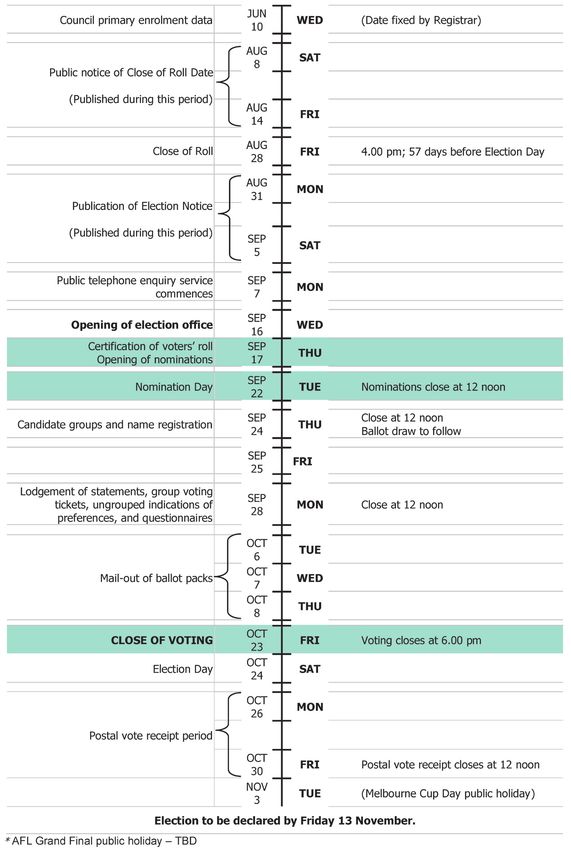
22Appendix 1: Detailed election
timeline
23Appendix 2: Melbourne City
Council elections
Melbourne City Council elections are distinct to
other Victorian council elections. Key differences Two voting methods are used
include: Separate voting methods apply for each
election:
Two simultaneous elections are held Leadership Team
Two simultaneous elections are held for
Melbourne City Council—one to elect the Full preferential voting is used to elect the
Leadership Team (Lord Mayor and Deputy Lord Leadership Team, where voters number all the
Mayor) and the other to elect nine councillors. boxes in order of their preference. Each
Leadership Team can have a team name.
Voters will receive two ballot papers in their
Nine councillors
ballot pack, one for each election.
The councillor ballot paper is similar to Victorian
Non-ratepayer occupiers can enrol Legislative Council ballot papers, allowing
voters to vote for a group above the line or for
Once they have lived at an address for a month, individual candidates below the line. Voters only
occupiers of rateable properties in the City of need to mark one box above the line for a valid
Melbourne can apply directly to the Council to vote at Melbourne City Council elections.
enrol, even if they are not ratepayers.
Applications must be made to Melbourne City Candidates can form into groups and lodge
Council before the close of roll at 4 pm on group voting tickets, which determine the order
Friday 28 August 2020. of voting preferences for where a voter votes for
that group above the line.
Corporations are entitled to two Unlike State elections, voting below the line
votes and must be enrolled requires voters to number every box below the
A corporation that solely or jointly owns or line.
occupies rateable property in the City of
Melbourne may appoint two representatives to Voting is compulsory for all enrolled
vote on its behalf. Representatives must be a
director or company secretary of a corporation
voters
or hold an equivalent position. Voting in the Melbourne City Council elections is
compulsory for everyone on the voters’ roll,
If a corporation that solely owns or occupies regardless of age—including non-Australian
rateable property in the City of Melbourne does citizens and corporation voting representatives.
not validly appoint two voting representatives
by the close of roll at 4 pm on Friday 28 August This is different to all other council elections,
2020, the Council is required by law to enrol the where council-enrolled voters are not obliged to
first two of the following (to be taken in vote. The voters’ roll for Melbourne City Council
alphabetical order): elections is made up of:
• the company secretary of the corporation • residents of the City of Melbourne
• the directors of the corporation. • owners of rateable property in the City of
Melbourne
24• occupiers of rateable property in the City of
Melbourne
• representatives of corporations that own or
occupy rateable property in the City of
Melbourne.
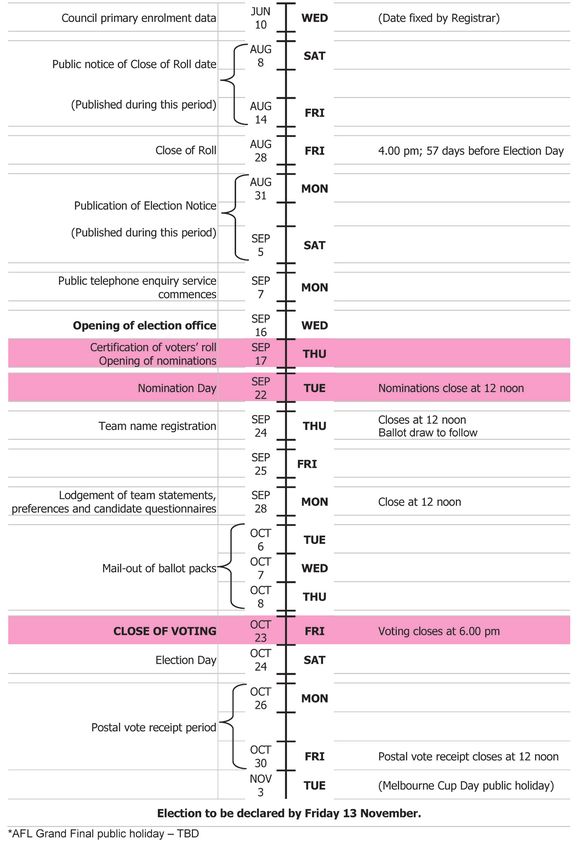
25Melbourne City Council elections timelines
LEADERSHIP TEAM ELECTION TIMELINE
26Councillor election timeline
27Appendix 3: Profile summary of
councils holding elections in
October
Victoria’s municipalities and electoral structures
The estimate of voters for each council is based on anticipated voters as at January 2018.
The VEC completed an electoral representation review of this local council. The VEC’s
recommended structure was accepted and the recommended number of councillors and
electoral structure (shown) will take effect at the 2020 local government elections.
The electoral structure of this local council was determined by the Minister for Local Government in
accordance with the provisions of the LG Act 2020.
The VEC completed an electoral representation review of this local council; the number of councillors
and electoral structure (shown) will remain unchanged for the 2020 local government elections.
Local Council Area (km2) Estimate Number of Electoral structure
of voters Councillors
Alpine 4,787 11,929 7 Unsubdivided
Ararat 4,230 9,311 7 Unsubdivided
Ballarat 740 84,783 9 3 x three-councillor wards
Banyule 63 99,158 9 9 x single-councillor wards
Bass Coast 864 46,280 9 3 x three-councillor wards
Baw Baw 4,031 42,184 9 3 x three-councillor wards
Bayside 36 78,937 7 7 x single-councillor wards
Benalla 2,375 12,131 7 Unsubdivided
Boroondara 60 133,357 11 11 x single-councillor wards
Brimbank 123 135,931 11 3 x three-councillor wards
1 x two-councillor ward
Buloke 8,004 5,807 7 1 x three-councillor ward
2 x two-councillor wards
Campaspe 4,519 31,345 9 2 x three-councillor wards
3 x single-councillor wards
Cardinia 1,281 82,303 9 9 x single-councillor wards
Casey 1 407 223,917 11 5 x two-councillor wards
1 x single-councillor ward
Central Goldfields 1,534 11,446 7 1 x four-councillor ward
3 x single-councillor wards
1
Casey City Council’s general election has been postponed to October 2024
28Local Council Area (km2) Estimate Number of Electoral structure
of voters Councillors
Colac Otway 3,433 20,750 7 Unsubdivided
Corangamite 4,407 13,584 7 1 x three-councillor ward
4 x single-councillor wards
Darebin 54 117,261 9 9 x single-councillor wards
East Gippsland 20,931 43,123 9 Unsubdivided
Frankston 131 109,662 9 3 x three-councillor wards
Gannawarra 3,732 9,044 7 1 x three-councillor ward
1 x two-councillor ward
2 x single-councillor wards
Glen Eira 38 106,440 9 3 x three-councillor wards
Glenelg 6,212 17,570 7 Unsubdivided
Golden Plains 2,704 18,567 7 Unsubdivided
Greater Bendigo 3,048 91,665 9 3 x three-councillor wards
Greater Dandenong 130 101,846 11 11 x single-councillor wards
Greater Geelong 1,247 200,616 11 3 x three-councillor wards
1 x two-councillor ward
Greater Shepparton 2,422 46,359 9 Unsubdivided
Hepburn 1,470 15,693 7 2 x two-councillor wards
3 x single-councillor wards
Hindmarsh 7,527 4,913 6 3 x two-councillor wards
Hobsons Bay 65 69,683 7 1 x three-councillor ward
2 x two-councillor wards
Horsham 4,249 16,454 7 Unsubdivided
Hume 503 144,959 11 2 x four-councillor wards
1 x three-councillor ward
Indigo 2,044 13,725 7 Unsubdivided
Kingston 91 122,333 11 11 x single-councillor wards
Knox 114 118,678 9 9 x single-councillor wards
Latrobe 1,426 58,849 9 1 x four-councillor ward
2 x two-councillor wards
1 x single-councillor ward
Loddon 6,694 7,651 5 5 x single-councillor wards
Macedon Ranges 1,747 38,413 9 3 x three-councillor wards
Manningham 114 89,624 9 9 x single-councillor wards
Mansfield 3,843 10,971 5 Unsubdivided
Maribyrnong 31 65,202 7 1 x three-councillor ward
2 x two-councillor wards
Maroondah 61 87,817 9 9 x single-councillor wards
29Local Council Area (km2) Estimate Number of Electoral structure
of voters Councillors
Melbourne 36 119,595 11 Lord Mayor and Deputy Lord
Mayor directly elected as a
leadership team by the voters
at-large
Unsubdivided
Melton 527 99,690 9 1 x four-councillor ward
1 x three-councillor ward
1 x two-councillor ward
Mildura 22,330 41,305 9 Unsubdivided
Mitchell 2,864 35,965 9 3 x three-councillor wards
Moira 4,045 25,086 9 Unsubdivided
Monash 81 123,695 11 3 x three-councillor wards
1 x two-councillor ward
Moonee Valley 44 94,682 9 3 x three-councillor wards
Moorabool 2,110 27,856 7 1 x four-councillor ward
3 x single-councillor wards
Moreland 51 132,790 11 2 x four-councillor wards
1 x three-councillor ward
Mornington 723 161,497 11 2 x three-councillor wards
Peninsula 1 x two-councillor ward
3 x single-councillor wards
Mount Alexander 1,529 16,826 7 1 x three-councillor ward
4 x single-councillor wards
Moyne 5,478 14,424 7 Unsubdivided
Murrindindi 3,889 14,685 7 7 x single-councillor wards
Nillumbik 435 48,969 7 7 x single-councillor wards
Northern Grampians 5,918 11,055 7 1 x three-councillor ward
1 x two-councillor ward
2 x single-councillor wards
Port Phillip 20 93,106 9 3 x three-councillor wards
Pyrenees 3,433 7,497 5 5 x single-councillor wards
Borough of 11 4,400 5 Unsubdivided
Queenscliffe
South Gippsland 2 3,305 29,505 9 3 x three-councillor wards
Southern 6,652 13,436 7 Unsubdivided
Grampians
Stonnington 25 93,754 9 3 x three-councillor wards
Strathbogie 3,302 10,182 7 2 x two-councillor wards
3 x single-councillor wards
2
South Gippsland Shire Council’s general election has been postponed to October 2021.
30Local Council Area (km2) Estimate Number of Electoral structure
of voters Councillors
Surf Coast 1,560 34,547 9 1 x four-councillor ward
2 x two-councillor wards
1 x single-councillor ward
Swan Hill 6,117 14,915 7 Unsubdivided
Towong 6,673 5,525 5 Unsubdivided
Wangaratta 3,639 23,168 7 1 x four-councillor ward
3 x single-councillor wards
Warrnambool 120 27,497 7 Unsubdivided
Wellington 10,989 43,171 9 3 x three-councillor wards
West Wimmera 9,107 3,824 5 Unsubdivided
Whitehorse 64 117,705 11 11 x single-councillor wards
Whittlesea 3 489 154,183 11 2 x four-councillor wards
1 x three-councillor ward
Wodonga 433 32,230 7 Unsubdivided
Wyndham 541 151,786 11 2 x four-councillor wards
1 x three-councillor ward
Yarra 20 81,669 9 3 x three-councillor wards
Yarra Ranges 2,447 118,812 9 9 single-councillor wards
Yarriambiack 7,158 6,024 7 1 x three-councillor ward
2 x two-councillor wards
3
Whittlesea City Council’s general election has been postponed to October 2024
311 Document Title Victorian Electoral Commission
You can also read


