A Handbook on Nutrition Labelling (Singapore) - Revised version 2015 - 3 Second Hospital Avenue, Singapore 168937 www.hpb.gov.sg - Health ...
←
→
Page content transcription
If your browser does not render page correctly, please read the page content below
A Handbook on
          Nutrition Labelling
                 (Singapore)
                   [Revised version 2015]

3 Second Hospital Avenue, Singapore 168937 www.hpb.gov.sg
Table of Contents
Introduction ............................................................................................................................................ 2

Contacts .................................................................................................................................................. 3

Nutrition Information Panel.................................................................................................................... 4

Nutrient Analysis and Nutrient Verification Criteria ………………………………………………………………………….7

Nutrient Claim Verification ……………………………………………………………………………………………………………….8

Guidelines for Nutrient Claims.............................................................................................................. 13

Aids to Calculation ................................................................................................................................ 30

Health Claims ........................................................................................................................................ 31

Healthier Choice Symbol ....................................................................................................................... 32

Application Procedures ......................................................................................................................... 33

Licence Agreement ............................................................................................................................... 36

Symbol Labelling & colour Guide .......................................................................................................... 37

Symbol Size Guide.………………………………………………………………………………………………………………………… 40

Guidelines on Symbol Usage ................................................................................................................. 42

Questions & Answers ............................................................................................................................ 45

                                                                                                                                                Page | 1
Introduction
Nutrition labelling provides point-of-sale information to help consumers make informed food choices. This
handbook provides nutrition labelling information to assist manufacturers, distributors, retailers and other
users in the labelling of food products.
In view of the growing interest in nutrition labelling, the Ministry of Health initiated the Nutrition Labelling
Programme in 1998. The Programme is implemented in three phases:
• Phase I : Development of nutrition information panel;
• Phase II : Development of the ‘Healthier Choice’ Symbol; Provision for nutrient claims;
• Phase III : Provision for health claims.
Observations from developed countries show that consumers welcome nutrition labelling as an important
source of point-of-sale information to help them moderate or increase their intake of certain nutrients or food.
The provision of nutrition labelling serves as a useful marketing strategy for food companies to improve their
market share in the food industry.
This handbook details:
• the format or way in which nutrition information can be presented;
• the definition of nutrient claims;
• the guidelines for nutrient claims;
• the use of Healthier Choice Symbol.
Guidelines in this handbook do not apply to infant formula or any other food products for persons one year of
age and below.
Page | 2Contacts
Questions concerning the nutrition labelling of food products may be directed to:
Level 4, Healthy Food Products Department
Health Promotion Board
3 Second Hospital Avenue
Singapore 168937
Facsimile: (65) 6438 3609
Email: HPB_HCSadmin@hpb.gov.sg
NB: Queries related to food labelling, other than nutrition labelling, should refer to the Food Regulations.
Page | 3Nutrition Information Panel
A recommended nutrition information panel (NIP) should meet the following basic requirements:
i) The nutrition information panel can include the core list of nutrients namely energy, protein, total fat,
saturated fat, trans fat, cholesterol, carbohydrate, dietary fibre and sodium.
ii) The energy and nutrient values can be stated in per 100 g / 100 ml and per serving of the food.
iii) The nutrition information panel can include the number of servings per package and the serving size.
iv) For powdered beverages and liquid concentrates, an additional column of per 100ml (as reconstituted) can
be included.
v) The variance between the declared value and analysed value has to be within 20%.
(For reference to calculation example, please see section on Nutrient Claim Verification, page 10.)
A typical nutrition information panel is shown in Figure 1a and a nutrition information panel with additional
column of per 100ml (as reconstituted) is shown in Figure 1b.
Figure 1a
A typical nutrition information panel
NUTRITION INFORMATION > Panel Heading
Servings per package: (insert number of servings)
Serving size: x g (or ml) (insert household measurement) > Serving Size
Per serving Per 100 g (100 ml)
Energy x kcal (x kJ) x kcal (x kJ)
Protein xg xg
Total Fat xg xg
- Saturated Fat xg xg
> Nutrient Listing
- Trans Fat xg xg
Cholesterol x mg x mg
Carbohydrate xg xg
- Total Sugar xg xg
Dietary Fibre xg xg
Sodium x mg x mg
The panel may be placed on any site on the food package that can be easily seen by the consumer. It is
recommended that it be placed with the ingredients list and the name and address of the manufacturer,
packer, importer or distributor.
Page | 4Nutrition Information Panel
1. General Format
• The text of the nutrition information panel shall be in English.
• The text shall be clear, legible and permanent.
• If a nutrition claim is made, the name and quantity of any other nutrient in the food that is relevant to the
claim should be declared in the nutrition information panel in addition to the ‘core list’ of nutrients.
• Values for Energy, Cholesterol and Sodium are to be rounded off to the nearest whole number. Remaining
nutrient values are to be rounded off to the nearest one decimal place.
2. Panel Heading
‘NUTRITION INFORMATION’, ‘NUTRITION FACTS’, as well as words of similar meanings may be used as the
panel heading.
3. Serving Size
Number of servings per package and serving size shall be declared, with the serving size stated both in metric
and common household measurements (e.g. pieces, cups, teaspoons).
4. Nutrient Listing
The ‘core list’ of nutrients includes:
i) Energy
ii) Protein
iii) Total fat
iv) Saturated fat
v) Trans fat
vi) Cholesterol
vii) Carbohydrate (excluding dietary fibre)
viii) Dietary fibre
ix) Sodium
Additional nutrients can be added after the ‘core list’, with the following exceptions:
i) Starch and Total Sugar may be declared as a subgroup of carbohydrate.
ii) Breakdown of the types of sugar eg. Lactose, Fructose, Maltose may be declared as a subgroup of
Total Sugar
iii) Polyunsaturated fat and monounsaturated fat may be inserted after saturated fat.
iv) Omega fatty acids may be inserted after polyunsaturated fat and before trans-fat.
Page | 5Nutrition Information Panel
All nutrients shall be declared in the appropriate metric units. The unit for energy will be in kilocalories and/or
kilojoules. The conversion factor will have to be stated if only one unit is listed (e.g. one kcal is equivalent to
4.2 kJ as shown in the example below).
Figure 1b
A nutrition information panel with additional column of per 100ml (as reconstituted)
NUTRITION INFORMATION
Servings per package: 10
Serving Size: 30 g (1 sachet)
Per serving Per 100 g Per 100 ml**
Energy 198 kcal* 660 kcal* 96 kcal*
Protein 1.5 g 5.0 g 0.7 g
Total Fat 10.9 g 36.3 g 1.92 g
- Saturated Fat 4.0 g 13.3 g 1.9 g
Monounsaturated fat 2.9 g 9.6 g 1.4 g
Polyunsaturated fat 4.0 g 13.3 g 1.9 g
Omega 3 0.5 g 1.7 g 0.2 g
Omega 6 0.7 g 2.3 g 0.3 g
- Trans Fat 0.1 g 0.3 g 0.0 g
Cholesterol 0 mg 0 mg 0 mg
Carbohydrate 23.5 g 78.3 g 11.3 g
- Total Sugar 18.0 g 60.0 g 8.7 g
-Fructose 2.0 g 6.7 g 1.0 g
Dietary Fibre 1.5 g 5.0 g 0.7 g
Sodium 270 mg 900 mg 130 mg
Other nutrients claimed (e.g. Calcium, Vitamin A, Vitamin C)
*1kcal = 4.2kJ
** As reconstituted according to label directions
5. Small Packaging
A nutrition information panel display will not be required on a packaging that has a total surface area of less
than 100 square centimetres, provided that the food label does not bear nutrient claims or other nutrition
information. However, it is necessary to include in the label a statement of the quantity of each nutrient in
respect to any nutrition claim that is made. A statement of the energy yield of the food is also required in the
case of a claim that the food is free of sugar or where there is a claim with respect to the energy value of the
food.
Page | 6Nutrient Analysis and
Nutrient Verification Criteria
1. Methods of Nutrient Analysis
To ensure that the nutrient information declared is accurate and consistent, the following method is
recommended:
Direct chemical analysis using official methods of AOAC (Association of Official Analytical Chemists) and/or
alternative methods shown to be equivalent to AOAC official methods;
A list of Singapore Accreditation Council-Singapore Laboratory Accreditation Scheme (SAC-SINGLAS) accredited
laboratories can be found at the following link:
http://www.sac-accreditation.gov.sg
Glycemic Index (GI) testing should be performed using an in-vivo GI testing according to the SAC-SINGLAS
Technical Notes FFT01-General criteria for testing of Health Related Properties of Food supported ISO
26642:2010(E) at an accredited laboratory.
For reference, the Glycemic Index (GI) classification is Low : ≤ 55 ; Medium : 56 – 69 ; High :≥ 70
2. Nutrient Verification Criteria
The Health Promotion Board and the Agri-Food and Veterinary Authority of Singapore will follow up on cases
of misrepresentation of the nutrition information on any food product.
Reports obtained through the forms of analysis outlined in Section 1, as well as product recipes, ingredient
listing and a sample of the food product are to be submitted on request to Healthy Food Products Department
for verification. Each product report shall include the following information:
i) Name of food product
ii) Analysis of declared nutrients
iii) Method of analysis
iv) Name and address of laboratory or company, which conducted the analysis and
v) Contact name and telephone number of the person from the food company and
representative.
Declared nutrition information must be based on the composition of the food product in the form in which
they are packaged (e.g. solid or liquid).
The variance between the declared value and analysed value has to be within 20%.
(For reference to calculation example, please see section on Nutrient Claim Verification, page 10)
Page | 7Nutrient Claim Verification
A. DEFINITIONS
1. Nutrient Claim
A nutrient claim suggests/implies that a food has a nutritive property. This property may be general or
specific and it can be stated positively or negatively. This property may refer to:
i) Energy
ii) Salt, sodium or potassium
iii) Amino acids, carbohydrates, cholesterol, fats, fatty acids, dietary fibre, protein, starch or sugars
or
iv) Any other nutrients.
2. Quantity Basis for Nutrient Claims
The quantity may be stated as ‘per serving’, ‘per 100 g’, ‘per 100 ml’ or ‘per 100 kcal’.
3. Reference Foods
A ‘reference food’ is defined as one of the following:
i) The regular product which has been produced for a significant period by the manufacturer making the
nutrient claim or
ii) A weighted average of an industry norm for that particular type of food or
iii) A food whose composition is determined by reference to published food composition tables.
4. ‘Meal-type’ Products
A ‘meal-type’ product is a food that:
• Is represented or promoted as a quick and easy alternative to a prepared meal or light meal. Typically, it is
already part-cooked to the point where it needs only to be heated before serving or ready for consumption. It
is commonly known as, a breakfast, lunch, dinner, meal, main dish, quick-bite, ready-to-go meals or
pizza/pasta.
5. Foods that are Naturally Low or High in a Nutrient
Many foods are naturally low or high in particular nutrients. Fruit, for example, is high in fibre. When making
claims, such foods should be labelled as ‘a naturally high/low (nutrient) food’.
Claims of this type shall apply to a class of foods rather than to a particular food. The claim shall be made only
to a class of foods and not a specific brand of food.
Page | 8B. NUTRITION INFORMATION PANEL
A nutrition information panel contains nutrient information, which helps consumers assess the nutritive value
of a given food. A nutrition information panel must accompany any nutrient claim. Please refer to the section
on nutrition information panel for further information.
C. NUTRIENT CLAIMS VERIFICA TION
1. Methods of Nutrient Analysis
To ensure that the nutrient information declared is accurate and consistent, the following methods are
recommended:
Direct chemical analysis using official methods of AOAC and/or alternative methods shown to be equivalent to
AOAC official methods, or
Glycemic Index (GI) testing should be performed using an in-vivo GI testing according to the SAC-SINGLAS
Technical Notes FFT01-General criteria for testing of Health Related Properties of Food supported ISO
26642:2010(E) at an accredited laboratory.
For reference, the Glycemic Index (GI) classification is Low : ≤ 55 ; Medium : 56 – 69 ; High :≥ 70
2. Sampling
At least three sample units should be drawn from different batches at random. These can be analysed as a
composite or separately. If the samples are analysed separately, the test results will be averaged to give a
mean result. Sampling should be done on the final product at the point closest to the consumer. The size of a
sample unit will vary, depending upon the nutrient analysed, the methodology used and the food itself. On
average, a 200 g sample may be enough.
The production lot should be representatively sampled and analysed by trained staff using recognised methods
of measurement. The analyst may determine how best to collect and analyse products to ensure accuracy of
the declared values. If the analysis is done outside Singapore, the sampling requirements should still meet the
above requirements.
3. Nutrient Verification Criteria
Reports obtained through the forms of analysis outlined in Section 1, as well as product recipes, ingredient
listing and a sample of the food product are to be submitted on request to Healthy Food Products Department
for checking. Each product report shall include the following information:
i) Name of food product
ii) Analysis of declared nutrients
iii) Method of analysis
iv) Product recipe (ingredient listing in descending order)
v) Name and address of laboratory or company, which conducted the analysis and
vi) Contact name and telephone number of person from the food company and representative.
The stated nutrition information must be based on the composition of the food product in the form in which
they are packaged (e.g. solid or liquid).
Page | 9Nutrient Claim Verification
3.1. Verification Criteria for Nutrients with a Labelled Claim
If the labelled claim says that the nutrient content meets the minimum requirement, then the actual nutrient
content must be at that level or higher, and not more than 20% difference from the stated nutrient content.
If the label says that the nutrient content is not more than the maximum allowed, then the actual nutrient
content must be at that level or lower, and not more than 20% difference from the stated nutrient content.
3.1.1. Definitions
For guidelines with a minimum requirement
(e.g. A specific nutrient must be present in amount X or higher. One example is High in dietary fibre):
• The stated nutrient content and the tested value must meet the minimum value.
The stated nutrient content must not be more than 20% difference from the analysed value.
Figure 3 Examples of ‘High’ Claims
Criteria
Declared value* Analysed value
Guideline Does the analysed Is the declared value Acceptable
Claim (What is stated (Actual
/100 g value meet within 20% difference
on the packaging content)
the guideline? from analysed value?
/100 g)
i) High in dietary
fibre ≥6g 6g 6g ✓ ✓ ✓
ii) High in dietary
fibre ≥6g 6g 5.6 g ✓
iii) High in dietary
fibre ≥6g 7g 6g ✓ ✓ ✓
vi) High in dietary
fibre ≥6g 8g 6g ✓
i) Analysed value meets the guideline and declared value is 100% of the analysed value
ii) Analysed value does not meets the guideline
iii) Analysed value meets the guideline and not more than 20% difference from the declared value.
iv) Analysed value meets the guideline but declared value is more than 20% of the analysed value
Calculation Example of 20% variance
Analysed value = 6g / 100g, Declared value = 7g / 100g
Difference of analysed value and declared value =x
= 1g / 100g
% difference = x /analysed value x 100
= 1/6 x 100
= 16.7%
Page | 10Nutrient Claim Verification
3.1.1. Definitions
For guidelines with a maximum value allowed
(e.g. A specific nutrient must not be present in an amount higher than X. One example is Low in fat):
• The stated nutrient content and the tested values must not exceed the maximum value.
The stated nutrient content must not be more than 20% from the analysed value.
Figure 4 Examples of ‘Low’ Claims
Criteria
Declared value
Claim Guideline
(What is stated Analysed value Does the analysed Is the declared value
/100 g Acceptable
on the packaging (Actual value meet within 20% difference
/100 g) content) the guideline? from analysed value?
i) Low fat ≤3g 3g 3g ✓ ✓ ✓
ii) Low fat ≤3g 3g 3.6 g ✓
iii) Low fat ≤3g 2.5 g 3g ✓ ✓ ✓
v) Low fat ≤3g 2g 3g ✓
i) Analysed value meets the guideline and declared value is 100% of the analysed value
ii) Analysed value does not meets the guideline
iii) Analysed value meets the guideline and not more than 20% difference from the declared value.
iv) Analysed value meets the guideline but declared value is more than 20% of the analysed value
Calculation Example of 20% variance
Analysed value = 3g / 100g, Declared value = 2g / 100g
Difference of analysed value and declared value =x
= 1g / 100g
% difference = x /analysed value x 100
= 1/3 x 100
= 33.3%
Page | 11Nutrient Claim Verification
4 Misrepresentation
All labels should comply with the Food Regulations.
5 Advertisements
The Food Regulations prohibit the use of misleading statements in claims made by food manufacturers or
marketers.
Page | 12Guidelines for Nutrient
Claims
The following tables recommend the guidelines for making nutrient claims for each of the following nutrients:
• Energy
• Protein
• Carbohydrate
• Sugar
• Dietary fibre
• Total fat
• Fatty acids
• Cholesterol
• Sodium / Salt and
• Vitamins / Minerals
• Low Glycemic Index
Key
To refer to ‘Note’
High in Energy+ ≥ 300 kilocalorie per 100 g, or^
High Energy + ≥ 80 kilocalorie per 100 ml.^
Nutrient Claims
Guidelines
Page | 13Guidelines for Nutrient
Claims
#
1. Energy
Nutrient Claim Guideline
Energy Free - ≤ 1 kilocalorie per 100 g / 100 ml, or
Calorie Free - ≤ 5 kilocalorie per serving
Source of Energy - ≥ 100 kilocalorie per serving ^
High in Energy + - ≥ 300 kilocalorie per 100 g, or ^
- ≥ 80 kilocalorie per 100 ml ^
High Energy +
Low Energy - ≤ 8 kilocalorie per 100 ml for beverages (ready for
Low Calorie consumption) and ≤ 20 kilocalorie per 100 ml for other
Lite in Energy liquid food, or
Light in Energy - < 40 kilocalorie per serving, or
Light in Calorie - ≤ 40 kilocalorie per 100 g
Light Dinner Meal Type Product
Lite Dinner
Light Meal - ≤ 120 kilocalorie per 100 g, or
- ≤ 300 kilocalorie per serving
Lite Meal
Less Energy - ≥ 25% less energy than the reference food*
Less Calorie
Lower in Calorie
Reduced Energy
Calorie-Reduced
More / Increased / Fortified - ≥ 25% more energy than the reference food*
/ Enriched / Added Energy
Page | 14Guidelines for Nutrient
Claims
Note:
When using the ‘per serving’ claim, the food would have to meet the requirements for ‘per 100 g’ (solid) or
‘per 100 ml’ (liquid).
^ The recommended quantity of food to be consumed per day must provide ≥ 300 kilocalories.
+
This claim can only be used with ‘formulated supplementary sports food’ and ‘meal replacement’.
* A statement must be included to compare the energy content of the subject food to the reference food.
#
If a food is naturally high or low in energy without any special processing to increase or lower the energy /
calorie content, the food is to be labelled with the word ‘naturally’ (e.g. Cider vinegar, a naturally calorie-free
food).
Definitions:
‘Formulated supplementary sports food’ - A food or mixture of foods formulated to help sports people achieve
specific nutritional goals, such as, regaining strength.
‘Meal replacement’ - A product intended as a complete meal, containing all of the basic nutrients and calories,
i.e. essential amino acids, vitamins, minerals, carbohydrate, fats, protein and dietary fibre, which are
considered important for daily nutritional needs.
Page | 15Guidelines for Nutrient
Claims
2. Protein
Nutrient Claim Guideline
Source of Protein - ≥ 10 g of protein per day and ≥ 3 g of protein per
Contains Protein 100 kcal,
- ≥ 5 g of protein per 100 g, or
- ≥ 2.5 g of protein per 100 ml, or
- ≥ 5 g of protein per serving
Good Source of Protein - ≥ 10 g of protein per day and ≥ 5 g of protein per
High in Protein 100 kcal,
Rich in Protein - ≥ 10 g of protein per 100 g, or
- ≥ 5 g of protein per 100 ml, or
Excellent Source of Protein
- ≥ 10 g of protein per serving
Low Protein - < 5% kilocalories from protein
Reduced Protein - ≥ 25% less protein than the reference food*
More / Increased / Fortified - ≥ 25% more protein than the reference food*
/ Enriched / Added Protein
Page | 16Guidelines for Nutrient
Claims
Note:
When using the ‘per serving’ claim for solid food, the food would also have to meet the requirements for:
• ‘per 100 kcal’
• ‘per day’
• and ‘per 100 g (solid)’
When using the ‘per serving’ claim for liquid food, the food would also have to meet the requirements for:
• ‘per 100 kcal’
• ‘per day’
• and ‘per 100 ml (liquid)’
When using the ‘per 100 g’ or ‘per 100 ml’ claims, the food would also have to meet the requirements for:
• ‘per 100 kcal’
• and ‘per day’
* A statement must be included to compare the protein content of the subject food to the reference food.
Page | 17Guidelines for Nutrient
Claims
3. Carbohydrate
Nutrient Claim Guideline
Source of Carbohydrate - > 10 g carbohydrate per 100 g
Contains Carbohydrate
Low in Carbohydrate - ≤ 10 g carbohydrate per 100 g, or
Low Carbohydrate - ≤ 2 g carbohydrate per serving
Reduced Carbohydrate - ≥ 25% less carbohydrate than the reference food*
Carbohydrate-Reduced
More / Increased / Fortified - ≥ 25% more carbohydrate than the reference
/ Enriched / Added food*
Carbohydrate
Note:
When using the ‘per serving’ claim, the food would also have to meet the requirements for ‘per 100 g’ (solid).
* A statement must be included to compare the carbohydrate content of the subject food to the reference
food.
Definition:
Carbohydrates - are polyhydroxy aldehydes, ketones, alcohols, acids, their simple derivatives and their
polymers having linkages of the acetal type. They may include sugars such as monosaccharides (e.g. glucose),
disaccharides (e.g. sucrose), sugar alcohols (e.g. isomalt, lactitol, maltitol, maltitol syrup, mannitol, sorbitol and
xylitol), polydextrose and starch.
Page | 18Guidelines for Nutrient
Claims
#
4. Sugar
Nutrient Claim Guideline
No Added Sugar - no sugars or ingredients with added sugar, honey, malt and
Without Added Sugar malt extract, with the exception of sugar alcohols, are
added during processing
Unsweetened - no sugars or ingredients with added sugar, honey, malt,
malt extract, sweetening substances or sugars alcohols,
are added during processing
Sugar Free - ≤ 0.5 g sugars per 100 g or 100 ml +
Free of Sugar
Lactose Free Meal Type Product
- ≤ 0.5 g sugars per serving +
Low Sugar - ≤ 5 g sugars per 100 g+, or
Low in Sugar - ≤ 2.5 g sugars per 100 ml +, or
Lite in Sugar
- ≤ 2 g sugars per serving+
Light in Sugar
Less Sugar - ≥ 25% less sugar than the reference food*
Lower Sugar
Lower in Sugar than ...
Reduced Sugar
Page | 19Guidelines for Nutrient
Claims
Note:
When using the ‘per serving’ claim, the food would also have to meet the requirements for ‘per 100 g’ (solid)
or ‘per 100 ml’ (liquid).
+
Sugar alcohols may be considered in these guidelines.
* A statement must be included to compare the sugar(s) levels of the subject food to the reference food.
#
If a food is naturally low in sugar without any special processing to lower the sugar content, the food is to be
labelled with the word ‘naturally’ (e.g. Cider vinegar, a naturally sugar-free food).
Definition:
Sugars - Simple carbohydrates, that are molecules of either single sugar units (monosaccharides) or pairs of
those sugar units (disaccharides) bonded together, including
- hexose monosaccharides and disaccharides, e.g. dextrose, fructose, sucrose and lactose
- starch hydrolysate
- glucose syrups, maltodextrin and similar products
- products derived at a sugar refinery
- icing sugar, invert sugar, fruit sugar syrup.
Sweetening substances - Non-nutritive or artificial sweeteners such as saccharin, aspartame, acesulfame-K and
sucralose and steviol glycosides.
Page | 20Guidelines for Nutrient
Claims
5. Dietary Fibre
Nutrient Claim Guideline
Source of Dietary Fibre - ≥ 1.5 g per 100 kcal, or
Contains Dietary Fibre - ≥ 3 g per 100 g, or
- ≥ 3 g per 100 ml
High in Dietary Fibre - ≥ 4 g per serving, or
High Source of Dietary Fibre - ≥ 3 g per 100 kcal, or
Good Source of Dietary Fibre - ≥ 6 g per 100 g, or
Fibre-Rich - ≥ 6 g per 100 ml
More / Increased / Fortified - ≥ 25% more dietary fibre than the reference
/ Enriched / Added Dietary Fibre food*
Note:
When using the ‘per serving’ or ‘per 100 kcal’ claim, the food would also have to meet the requirements for
‘per 100 g’ (solid) or ‘per 100 ml’ (liquid).
* A statement must be included to compare the dietary fibre content of the subject food to the reference
food.
Definition (by the Codex Alimentarius Commission):
Dietary fibre means carbohydrate polymers with ten or more monomeric units , which are not hydrolysed by the
endogenous enzymes in the small intestine of humans and belong to the following categories:
Edible carbohydrate polymers naturally occurring in the food as consumed,
carbohydrate polymers, which have been obtained from food raw material by physical, enzymatic or chemical
means and which have been shown to have a physiological effect of benefit to health as demonstrated by
generally accepted scientific evidence to competent authorities,
synthetic carbohydrate polymers which have been shown to have a physiological
Page | 21Guidelines for Nutrient
Claims
#
6. Total Fat
Nutrient Claim Guideline
Fat Free - ≤ 0.15 g fat per 100 g or 100 ml of food
Contains No Fat
Free of Fat Meal Type Product
- ≤ 0.5 g of fat per serving
Low Fat - ≤ 3 g fat per 100 g, or
Low in Fat - ≤ 1.5 g fat per 100 ml
Light in Fat
Lite in Fat
Reduced Fat - ≥ 25% less fat than the reference food*
Lower Fat
Reduced in Fat
Lower in Fat
Less Fat than...
A certain % less
Lean Meat - < 10 g total fat, < 4 g saturated fat, and
< 95 mg cholesterol per 100 g of food
Extra Lean Meat - < 5 g total fat, < 2 g saturated fat, and
< 95 mg cholesterol per 100 g of food
Note:
Claims stating or implying that a product is of a certain percent fat free (e.g. 20% fat free) are considered
misleading unless the product qualifies as a ‘fat free’ or ‘low fat’ product. .
* A statement must be included to compare the total fat content of the subject food to the reference food.
#
If a food is naturally low in fat without any special processing to lower its fat content, then the food is to be
labelled with the word ‘naturally’ (e.g. Broccoli, a naturally fat-free food).
Page | 22Guidelines for Nutrient
Claims
#
7. Fatty Acids
Nutrient Claim Guideline
Saturated Fat Free - ≤ 0.5 g of saturated fatty acids per 100 g, and ≤1% of the
Free of Saturated Fat total fat is trans fatty acids
Low Saturated Fat - ≤ 1.5 g saturated fats per 100 g, and ≤10% of kilocalories from
Low in Saturated Fat saturated fats, or
- ≤ 0.75 g of saturated fats per 100 ml, and ≤ 10% of kilocalories
from saturated fats
Trans fatty acids should be counted as saturated fatty
acids for this claim
A certain % less - ≥ 25% less saturated fat than the reference food*
Reduced in Saturated Fat
Lower in Saturated Fat Trans fatty acids should be counted as saturated fatty
Reduced Saturated Fat acids for this claim
Contains Polyunsaturated Fats - > 40% total fat shall be polyunsaturated fatty acids, < 20%
Source of Polyunsaturates total fat shall be saturated fatty acids and > 25%
(or Polyunsaturated Fatty kilocalories shall be derived from fat
Acids or Polyunsaturates)
Presence of Polyunsaturates
High in Polyunsaturated Fats - > 40% total fat shall be polyunsaturated fatty acids, < 20%
(or Polyunsaturated Fatty Acids total fat shall be saturated fatty acids and > 50%
or Polyunsaturates) kilocalories shall be derived from fat
Increased Polyunsaturated - ≥ 25% more polyunsaturated fatty acids than the
Fats reference food*
More Polyunsaturated Fats
Page | 23Guidelines for Nutrient
Claims
Nutrient Claim Guideline
Contains Monounsaturated Fats - > 40% total fat shall be monounsaturated fatty acids,
Source of Monounsaturates < 20% total fat shall be saturated fatty acids and > 25%
(or Monounsaturated Fatty Acids or kilocalories shall be derived from fat
Monounsaturates)
Presence of Monounsaturates
High in Monounsaturated Fats (or - > 40% total fat shall be monounsaturated fatty acids,
Monounsaturated Fatty Acids or < 20% total fat shall be saturated fatty acids and > 50%
Monounsaturates) kilocalories shall be derived from fat
Increased Monounsaturated Fats - ≥ 25% more monounsaturated fatty acids compared with
More Monounsaturated Fats reference food*
Trans Fat Free - < 0.5 g of trans fatty acids per 100 g
Free of Trans Fat
Note:
Claims stating or implying that a product is of a certain percent saturated fat free (e.g. 20% saturated fat free)
are considered misleading.
* A statement must be included to compare the fatty acids content of the subject food to the reference food.
#
If a food is naturally high or low in fatty acids without any special processing to increase or lower the fatty
acids content, then the food is to be labelled with the word ‘naturally’ (e.g. Broccoli, a naturally saturated fat-
free food).
Definitions:
Monounsaturated fatty acids - Fatty acids that contain one double bond between carbon atoms, e.g.
palmitoleic acid and oleic acid.
Polyunsaturated fatty acids - Fatty acids that contain two or more double bonds between carbon atoms, e.g.
linoleic acid and linolenic acid.
Page | 24Guidelines for Nutrient
Claims
#
8. Cholesterol
Nutrient Claim Guideline
Cholesterol Free Food that are derived solely from plant source
No Cholesterol - 0 mg of cholesterol per 100 g food
Free of Cholesterol
Other food products
- < 5 mg of cholesterol per 100 g food, and meets the
conditions for a ‘low saturated fatty acids’ food
Low Cholesterol Light in - ≤ 20 mg of cholesterol per 100 g, and
Cholesterol Low in ≤ 1.5 g of saturated fats per 100 g food, and ≤ 10% of
Cholesterol Lite in kilocalories from saturated fats +, or
Cholesterol - ≤ 10 mg of cholesterol per 100 ml and
≤ 0.75 g of saturated fats per 100 ml, and
≤ 10% of kilocalories from saturated fats+
A certain % less - ≥ 25% less cholesterol than the reference food*
Reduced in Cholesterol
Lower in Cholesterol
Reduced Cholesterol
Note:
Claims stating or implying that a product is of certain percent cholesterol-free (e.g. 20% cholesterol free) are
considered misleading.
+ trans fatty acids must be counted (or calculated) as saturated fatty acids for this claim.
* A statement must be included to compare the cholesterol content of the subject food and the reference
food.
#
If a food is naturally low in cholesterol without any special processing to lower the cholesterol content, then
the food is to be labelled with the word ‘naturally’ (e.g. Canola oil, a naturally cholesterol-free food).
Page | 25Guidelines for Nutrient
Claims
#
9. Sodium / Salt
Nutrient Claim Guideline
No Added Salt - No sodium chloride, sodium compounds, or any ingredient
No Salt Added containing added sodium chloride or other sodium
Unsalted compounds, should be added to the food
Salt Free - ≤ 5 mg sodium per 100 g
Sodium Free
Low in Salt - ≤ 120 mg sodium per 100 g
Low Sodium
Light in Salt
Low Salt
Light in Sodium
Lite in Salt
Low in Sodium
Lite in Sodium
Lightly Salted
Very Low in Salt - ≤ 40 mg sodium per 100 g
Very Low in Sodium
A certain % less - ≥ 25% less sodium compared to reference food*
Reduced Salt
Lower in Salt
Lower in Sodium
Note:
Claims stating or implying that a product is of a certain percent sodium/salt free (e.g. 20% sodium / salt free)
are considered misleading.
* A statement must be included to compare the sodium/salt content of the subject food to the reference
food.
#
If a food is naturally low in sodium without any special processing to lower the sodium content, then the
food is to be labelled with the word ‘naturally’ (e.g. Lettuce, a naturally sodium-free food).
Definition:
Salt is sodium chloride.
Page | 26Guidelines for Nutrient
Claims
10. Vitamins / Minerals
Source / Presence / Contain
10.1. No claims based on the presence of a vitamin or a mineral or implying the presence of a vitamin or a
mineral in a food shall be made on the label unless the reference quantity for that food as laid down in
the Food Regulations contains at least one-sixth of the daily allowance as laid down in Figure 5 for the
relevant vitamin or mineral.
Excellent Source / Enriched / Fortified / Ennobled / Vitaminised / High / Rich /Good/Added with
10.2. No label shall claim that any article of food is enriched, fortified, ennobled, vitaminised or in any way
imply that the article is an excellent source, high or rich in one or more vitamins or minerals unless the
reference quantity for that food as laid down in the Food Regulations contains not less than 50% of the
daily allowance as laid down in Figure 5 for the relevant vitamin and mineral.
10.3. When vitamin A or vitamin D or a mineral is added to a food, the addition must not increase the vitamin
A content to more than 750 mcg of retinol activity per reference quantity for that food as specified in the
Food Regulations, nor increase the content of vitamin D to more than 10 mcg of cholecalciferol or of any
mineral to more than three times the daily allowance (as specified in Figure 5 for that mineral) per
reference quantity for that food as specified in the Food Regulations.
(The information provided in the vitamins/minerals section was adapted from the Sale of Food Act, Cap. 283,
Regulation 11).
11. Low Glycemic Index
Foods claiming to have Low Glycemic Index
Must have a GI value* of less than 55.
Must meet all the HCS nutrient guidelines as specified in the respective categories.
*The cut-off values for the classification of low, medium and high GI are standardised internationally (ISO
26642:2010).
Page | 27Guidelines for Nutrient
Claims
Figure 5
Daily allowances of vitamins and minerals
Substances To be Calculated as Daily Allowance
Vitamin A, vitamin A alcohol and esters, Micrograms of retinol activity 750 mcg
carotenes
Vitamin B1, aneurine, thiamine, Milligrams of thiamine 1 mg
thiamine hydrochloride, thiamine
mononitrate
Vitamin B2, riboflavin Milligrams of riboflavin 1.5 mg
Vitamin B6, pyridoxine, pyridoxal, Milligrams of 2.0 mg
pyridoxamine pyridoxamine
Vitamin B12, cobalamin, Micrograms of 2.0 mcg
cyanocobalamin cyanocobalamin
Folic acid, folate Micrograms of folic acid 200 mcg
Niacine, niacinamide, nicotine acid, Milligrams of niacin 16 mg
nicotinamide
Vitamin C, ascorbic acid Milligrams of ascorbic acid 30 mg
Vitamin D, vitamin D2, vitamin D3 Micrograms of 2.5 mcg
cholecalciferol
Vitamin E, α-tocopherol compounds Milligrams of 10 mg
α-tocopherol
Calcium Milligrams of calcium 800 mg
Iodine Micrograms of iodine 100 mcg
Iron Milligrams of iron 10 mg
Phosphorus Micrograms of 800 mg
phosphorus
Page | 28Guidelines for Nutrient
Claims
Figure 6
Vitamins / mineral claims
Vitamins / Minerals Claims Criteria to Claim
Source/Contain/added with/with/presence of a vitamin / Reference quantity* should contain
mineral at least 1/6 of the daily allowance
Excellent source/Enriched/Fortified/Ennobled/ Reference quantity* should contain
Vitaminised/High/Rich/ of a vitamin / mineral at least 50% of the daily allowance
* As specified in Figure 7 (as specified in the Food Regulations)
Figure 7
Reference Quantity
Food Reference Quantity
Bread 240 g
Breakfast cereals 60 g
Extracts of meat or vegetables or yeast (modified or not) 10 g
Fruit and vegetable juices 200 ml
Fruit juice concentrates (diluted according to directions on the label) 200 ml
Fruit juice cordials (diluted according to directions on the label) 200 ml
Flavoured cordials or syrups (diluted according to directions on the label) 200 ml
Malted milk powder 30 g
Condensed milk 180 g
Milk powder (full cream or skimmed) and food containing not less than 51% of
60 g
milk powder
Other concentrated liquid food including powdered beverage not specified
200 ml
above (diluted according to directions on the label)
Liquid food not specified above 200 ml
Solid food not specified above 120 g
Page | 29Aids to Calculation
International Units (IU)
To convert IU to:
• RE (Retinol equivalents of vitamin A): from animal sources, divide by 3.33; and from vegetables and fruit,
divide by 10.
• mcg vitamin D: divide by 40 or multiply by 0.025.
• mg α-tocopherol: divide by 1.5.
Sodium
1 g of salt (sodium chloride) contains 400 mg of sodium.
Food Energy
To convert food into kilocalories:
Fat 1 g = 9 kilocalories
Carbohydrate 1 g = 4 kilocalories
Protein 1 g = 4 kilocalories
Page | 30Health Claims
Types of health claims as defined under the “Guidelines for Use of Nutrition and Health Claims” established
by the Codex Alimentarius Commission
Under the “Codex Guidelines for Use of Nutrition and Health Claims”, health claim means any representation
that states, suggests, or implies that a relationship exists between a food or a constituent of that food and
health. Health claims include the following:
(a) Nutrient function claims refer to nutrition claims that describe the physiological role of the nutrient in
growth, development and normal functions of the body.
Example:
“Nutrient A (naming a physiological role of nutrient A in the body in the maintenance of health and promotion
of normal growth and development). Food X is a source of/ high in nutrient A.”
(b) Other function claims refer to claims concerning specific beneficial effects of the consumption of foods or
their constituents, in the context of the total diet on normal functions or biological activities of the body, and
relating to a positive contribution to health or to the improvement of a function or to modifying or preserving
health.
Example:
“Substance A (naming the effect of substance A on improving or modifying a physiological function or
biological activity associated with health). Food Y contains x grams of substance A.”
(c) Reduction of disease risk claims refer to claims relating the consumption of a food or food constituent, in
the context of the total diet, to the reduced risk of developing a disease or health-related condition.
Examples:
“A healthful diet low in nutrient or substance A may reduce the risk of disease D. Food X is low in nutrient or
substance A.”
“A healthful diet rich in nutrient or substance A may reduce the risk of disease D. Food X is high in nutrient or
substance A.”
2
Food or food constituent refers to energy, nutrients, related substances, ingredients, and any other feature of
a food, a whole food, or a category of foods on which the health claim is based. The category of food is
included in the definition because the category itself may be assigned a common property of some of the
individual foods making it up.
Please refer to AVA’s A Guide to Food Labelling and Advertisements for the list of acceptable nutrient
function claims, criteria for use of nutrient specific diet-related reduction of disease risk health claims and
further information.
2
include special purpose foods; foods fortified with nutrients such as protein, carbohydrate, dietary fibre, fatty acids, amino
acids, vitamins and minerals: and foods added with approved herbal ingredients.
Page | 31Healthier Choice Symbol
The Healthier Choice Symbol (HCS) is a symbol that Singaporeans can relate to for healthier packaged foods. It
is a part of the Nutrition Labelling Programme and is intended to provide point-of-sale information to help
people make informed food choices.
Dietary intake has been shown to be associated with the development of several chronic degenerative
diseases, namely coronary heart disease, hypertension, stroke, diabetes mellitus and certain cancers. These
are the current health concerns in Singapore and can be prevented by changing dietary practices.
In line with the policy of the National Healthy Lifestyle Programme, the Ministry of Health (MOH)
implemented the Nutrition Labelling Programme in 1998 to encourage the food industry to display the
nutrition information panel and to educate consumers in reading food labels. The Health Promotion Board
(HPB), a statutory board of the MOH, currently administers this Nutrition Labelling Programme.
Food products may carry the HCS if they meet nutritional standards set by HPB. Evaluation will be based on the
nutritional values; particularly fat, saturated fat, sodium and dietary fibre, as well as the contribution of that
product towards a balanced diet.
Page | 32Application Procedures
Application will be via the HCS online system. The general steps are as follows:
Step 1 - Registration
i) Please select a representative from your company as Organisation Administrator (OA) and register your
company in Partners Connect (https://connect.hpb.gov.sg/pc). The role of an OA is to approve, reject or
amend the role (staff, witness or bearer) of fellow colleagues and is the first person to register in Partners
Connect.
ii) The OA will receive their password within 5 working days of application. Please change the password
during first log in.
iii) Please select a witness and bearer to register in Partners Connect. They will receive their password within
5 working days. A notification email will be sent to the OA to approve or reject their colleagues. The OA
can do so by clicking “worklist”, where they can see the list of colleagues registered in Partners Connect.
iv) There is no limit to the number of staff registering in Partners Connect. However there can only be 1
witness and 1 bearer. The rest will be staff. The OA can be witness, bearer or staff.
Step 2 – Submit your application
i) Click on “e-services>>HCS online”. You may submit your product’s information for stages 1 to 3 at a go
during your application.
ii) There are 4 stages to the completion of your HCS application
a. Product Category – Stage 1
Submission of product description and product details
Classification of product category and sub category
b. Nutrient Values/Lab Report – Stage 2
Submission of nutrient analysis report
Once stage 2 is approved, you may download the HCS logo from the screen.
c. Product Label Artwork – Stage 3
Submission of artwork
d. Licence Agreement – Stage 4
Generation of Licence Agreement if product is approved at stage 3
Page | 33Application Procedures
iii) The status of each stage is represented by colour buttons.
Green – Approved
Yellow/Amber – Pending for approval/amendment required
Red - Rejected
iv) Once the artwork has been approved, the licence agreement (LA) will be generated at stage 4. HPB officer
who is the bearer and the witness will endorse the LA. An email notification will be sent to the company
bearer to endorse the LA. After the company bearer endorse, an email notification will be sent to the
company witness to endorse the LA. Once the company witness endorse, the application process will be
completed.
You may download the user manual guide at this link (http://www.hpb.gov.sg/HOPPortal/health-article/2780).
1. Approving Process and Renewal
Each food group has a set of nutritional guidelines and each product will be evaluated according to these
guidelines. If the nutritional guidelines are met, the company will be required to send in the product
packaging artwork for approval. Once the artwork is approved, the company will then enter into a licence
agreement with HPB.
Approved products are randomly selected for analysis annually to ensure that they continue to meet the
nutritional guidelines. Analysis will be carried out by independent laboratories using official methods of AOAC
and / or alternative methods shown to be equivalent to that of AOAC. Analytical results are to be compared
against the guidelines for acceptability and food companies will be notified of their results. Any food
companies whose products fail to meet the nutritional guidelines will be investigated. Finally, the approved
products, which no longer meet the nutritional guidelines, will be disqualified from the Programme.
2. Procedures for Renewal of Licence Agreement
i) The LA is valid for 2 years. Thus a month before the LA is expire, an email notification will be send to the
company to indicate their interest in renewing the LA via the HCS online application system. A second
email (reminder email) will be sent out 14 days before the LA expires.
ii) Company will be required to indicate if there is a change in formulation and the products that they are
keen to renew in the Licence Renewal tab. For products that have a change in formulation, the company
would need to apply them as a new application.
iii) After which, the endorsement of the LA will be as per Application procedures, Step 2 (iv).
iv) For companies which fail to indicate their interest to renew, after the LA expired, the products will be
automatically remove from the database by the system.
Page | 343. Procedures following Expiry / Termination of Licence Agreement
Upon the expiry or termination of the licence agreement, food companies will be given a period of six calendar
month to remove the HCS from the products.
If companies fail to remove the HCS from the products within six calendar month, the Board will take legal
actions against them.
4. Failure to Comply with Licence Agreement and Misuse of the HCS
• Food companies are expected to adhere strictly to all rules and guidelines.
• If a company fails to comply, a warning in written form will be issued to inform the company to take the
necessary action.
• If the recommended actions are not carried out within 7 working days, the Board reserves the rights to
terminate the licence agreement.
• Upon termination of the licence agreement, the company will no longer hold the right to use the HCS.
5. Procedures for Approval of Advertising Material
1) All artworks using or with reference to the HCS must be submitted to the Health Promotion Board,
prior to printing, distribution, publishing or broadcasting.
2) The following materials are to be submitted for approval:
TV Commercial : Storyboard including graphic illustration and,
supertitles
Radio : Scripts
Printed Material : Final artwork printout (original, in full colour) (e.g.
press/magazine advertisement, leaflets)
Product Packaging : Final artwork printout (original, in full colour)
3) All advertisements are required to comply with the requirements of the Food Regulations. A “Guide on
Food Labelling and Advertisement” to guide industry members in ensuring that their food labels and
advertisements comply with the requirements of the Food Regulations can be found in the AVA website
(www.ava.gov.sg).
4) The advertisements submitted to the Health Promotion Board will be reviewed in a timely fashion. Please
submit the advertisements at the ‘Advertising Material’ tab (stage 5) of the HCS online application system.
The Board will endeavour to give notice of any amendments in 5 working days upon receipt of the submitted
materials.
5) All materials submitted are not returnable and are kept for the Board’s records.
6) A final approved, printed packaging (for distribution) must be submitted for the Board’s records.
Page | 35Licence Agreement
Companies entering into the licence agreement with HPB will agree to:
i) the non-exclusive use of the HCS by any one company for any one product
ii) no sub-licensing
iii) be responsible for monitoring the legal use of the HCS on licensed products
iv) display the nutrition information panel, in the format recommended by HPB
v) seek HPB’s approval with regard to the use of HCS in all advertising and promotional materials.
The licence will be valid for the duration of two years (24 months) upon the execution of the licence
agreement. At the end of the contract year, your company’s products will be re-evaluated based on the latest
criteria*. If these criteria are met, the licence may be renewed for another two years.
All food companies applying for the Healthier Choice Symbol are expected to adhere strictly to the rules and
guidelines. If a company fails to comply, a warning in written form will be issued to inform the company to
take the necessary action.
* The nutritional guidelines may be amended to reflect the latest scientific updates.
Page | 36Symbol Labelling & colour
Guide
Symbol Labelling and Presentation
i) The Symbol must not be distorted, photographically or otherwise.
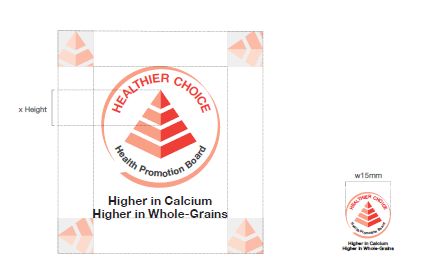
ii) The size of the Symbol may vary but the ring of the Symbol should not be smaller than 15 mm in diameter
(refer to Colour Guide).
iii) The Symbol must not touch the brand name on the product to suggest that the product is generic to HPB.
iv) The Symbol must not cover any essential information on the label.
v) There must be appropriate amount of clear space around the Symbol. The clear space is determined by the
height of the first 2 steps from the tip of the pyramid in the Symbol. This also applies to the Nutrition
Information Panel.
Page | 37Symbol Labelling & Colour
Guide
v) The designated colours of the Symbol are
viii) The following statement must always accompany the Symbol:
a) Statement to qualify the comparison taglines (lower in sugar, lower in sodium, lower in saturated fat,
higher in whole-grains, higher in calcium and etc at the bottom of the Symbol
An example of the statement is "25% lower in sugar as compared to regular [range or name of food
category]" or any other statement bearing similar meaning.
ix) Under certain circumstances where printing onto the packaging is not feasible, the company will be
allowed to paste sticker labels onto the packaging.
x) Companies are responsible for printing their own stickers for the HCS and the nutrition information panel.
xi) The HCS is the copyright of HPB.
Page | 38Symbol Labelling & Colour
Guide
Use of Non-designated Colours
The use of non-designated colours is strictly prohibited for most packaging. However, in cases of budget
constraint, some products may use a one-colour or two-colour Symbol.
In such cases, the company may print the Symbol in one colour on this particular product provided that the
product fulfils the guidelines stated below. All artworks will be assessed individually on a case-by-case basis
in addition to the guidelines below.
The company may print the symbol in black (with the inside circle of the HCS in reversed white) on the
product label if:
i) The product packaging is printed in two colours or less (excluding white) of which one of the colour is black
(100% K) and
ii) The Pantone Red 032 and any of the approved variations* is not one of the colours printed on the
packaging.
* The Symbol can have these variations of the Pantone Red: Pantone colours 186, 192, 199, 206, 485 and
1788. Custom colours may be accepted but the colour samples must be submitted for approval.
Page | 39Symbol Size Guide
Guide to the Size of the Symbol on Product Packaging
• The preferred location of the Symbol is on the front panel of the product packaging.
• There should not be more than two Symbols per product.
Text on the Descriptor should be legible on the packaging.
The display surface are of the packaging is defined as the area of the face of the product where the symbol is
placed.
Example:
Display Surface Area = H x W
H = Height W = Width C = Circumference
The size of the Healthier Choice Symbol should preferably no smaller than 15 mm width when applied on
the packaging.
The minimum size of 15 mm width of the HCS logo should be maintained if the calculations yield smaller
than the recommended value.
Page | 40Example:
Page | 41Guidelines on Symbol Usage
Advertising Codes
This section illustrates the guidelines for all packaging, advertising and promotional materials of food products
licensed to carry the Symbol. These guidelines are set with the intention of:
governing the appropriate use of the Healthier Choice Symbol
Designing, reviewing of product packaging, advertising and promotional materials involve perceptions and
decisions, which are subjective. The guidelines stated in this barticle, however, are not intended to limit a
creative approach. However, companies participating in the Healthier Choice Label Programme have to
comply with certain guidelines.
General Guidelines
1) The guidelines stated here are applicable to all products licensed by the Health Promotion Board that use
and make reference to the Healthier Choice Label Programme.
2) These guidelines are applicable to all product packaging, advertising, and promotional materials or efforts
of any nature and through any media that play a role in influencing consumer perception.
3) The Healthier Choice Symbol and the appropriate certification statement must at all times conform to the
guidelines as stated in this section and any other recommendations made by the Health Promotion Board.
Responsibility
1) It is the responsibility of participating companies to ensure that their packaging labels and advertising
materials do not go against the Food Regulations.
2) While these guidelines are applicable to the company and its advertising and/or other related agencies, the
primary responsibility for enforcing and conforming to these standards lies solely with the individual
participating company.
3) Any violation of these guidelines may result in termination of the participating company’s licence to use the
Symbol.
4) These guidelines are subject to change according to the Board’s scientific positions, government
regulations and other circumstances.
All packaging, advertising and promotional material artworks must conform to the guidelines in effect at the
time they are submitted for approval. Should there be any changes made to these guidelines, notification of
changes and their effective dates will be sent out to all relevant participating companies.
Page | 42You can also read


