A new pro-competition regime for digital markets - Advice of the Digital Markets Taskforce - GOV.UK
←
→
Page content transcription
If your browser does not render page correctly, please read the page content below
A new pro-competition
     regime for digital
             markets
  Advice of the Digital Markets Taskforce

                                 December 2020
                                      CMA135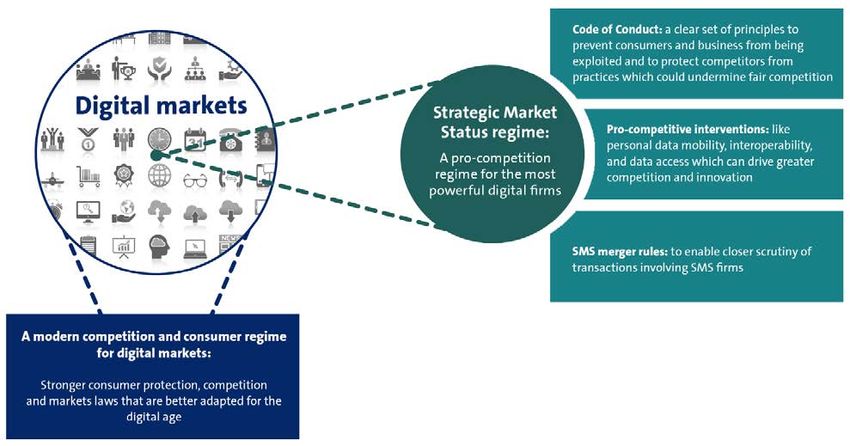
© Crown copyright 2020

You may reuse this information (not including logos) free of charge in any format or
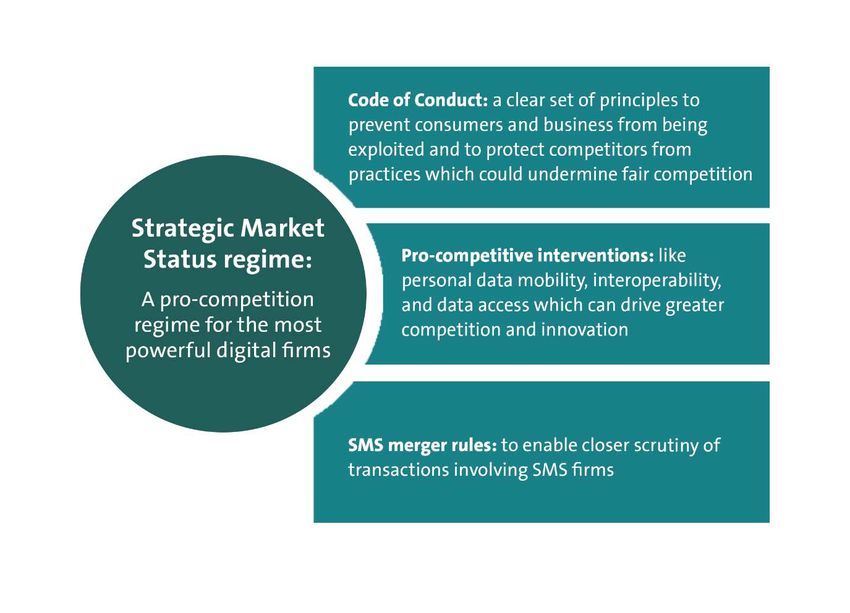
medium, under the terms of the Open Government Licence.

To view this licence, visit www.nationalarchives.gov.uk/doc/open-government-
licence/ or write to the Information Policy Team, The National Archives, Kew, London
TW9 4DU, or email: psi@nationalarchives.gsi.gov.uk.
Contents

                                                                                                                       Page

Overview .................................................................................................................... 2
1. Introduction ........................................................................................................... 9
2. The case for change ........................................................................................... 16
3. The role of the DMU............................................................................................ 22
4. A pro-competition framework for the most powerful digital firms ......................... 26
5. A modern competition and consumer regime for digital markets ........................ 66
6. A coherent regulatory landscape ........................................................................ 75
7. Next steps ........................................................................................................... 81

                                                              1
Overview
1.       In March 2020, the CMA was asked to lead a Digital Markets Taskforce,
         working closely with the Office of Communications (Ofcom) and the
         Information Commissioner’s Office (ICO), to provide advice to the government
         on the design and implementation of a pro-competition regime for digital
         markets. The government was clear when commissioning this work that it
         should complement and build on the outputs of the Furman Review, 1 as well
         as drawing evidence from the CMA’s market study into online platforms and
         digital advertising. 2 This report sets out our advice.

2.       Digital markets play a fundamental role in modern life, delivering substantial
         benefits for consumers, businesses and the economy more widely. The online
         services available to so many of us at the touch of a button have transformed
         the way we go about our daily lives. For businesses they have opened up new
         markets and audiences. And in the process, these developments have
         boosted innovation, lowered prices, and created jobs throughout our
         economy.

3.       However, the dynamics of digital markets have changed hugely, and what
         were once the ‘scrappy, underdog startups’ 3 are now amongst the most
         powerful global firms. The lack of effective competition in the activities of
         these firms is often the result of specific market features like network effects,
         economies of scale or unequal access to data. Mergers and acquisitions are
         also an important part of the business model of these firms, with strategic
         acquisitions being used to build-up a strong position and to reinforce it, for
         example by building ‘ecosystems’ of complementary products and services
         around their core service, insulating it from competition.

4.       The accumulation and strengthening of market power by a small number of
         digital firms has the potential to cause significant harm to consumers and
         businesses that rely on them, to innovative competitors and to the economy
         and society more widely:

         •   A poor deal for consumers and businesses who rely on them. These
             firms can exploit their powerful positions. For consumers this can mean
             they get a worse deal than they would in a more competitive market, for
             example having less protection or control of their data. For businesses this
             can mean they are, for example, charged higher listing fees or higher

1 Furman Review (2019), Unlocking Digital Competition.
2 CMA’s market study into online platforms and digital advertising, July 2020, final report
3 US Antitrust House Subcommittee Investigation of Competition in Digital Markets, 2020.

                                                         2
prices for advertising online. These higher prices for businesses can then
feed through into higher prices for consumers for a wide range of products
and services across the economy.
• Innovative competitors face an unfair disadvantage. A powerful digital
firm can extend its strong position in one market into other markets,
ultimately giving itself an unfair advantage over its rivals. This means
innovative competitors, even if they have a good idea, are likely to find it
much harder to compete and grow their businesses. This can result in
long-term harmful effects on innovation and the dynamism of UK markets.
• A less vibrant digital economy. If powerful digital firms act to unfairly
disadvantage their innovative competitors, these innovative firms will find it
harder to enter and expand in new markets, meaning the ‘unicorns’ of
tomorrow that will support jobs and the future digital economy will not
emerge.
5. It is imperative that digital markets continue to thrive and deliver the benefits
we all value so highly. Without effective competition, we will not unlock the full
potential for these digital services to contribute to economic growth and the
UK’s recovery from COVID-19. That is why we can no longer ignore the
significant harms caused by powerful digital firms which are now increasingly
evident. As has now been recognised in many prominent reports, 4 existing
competition laws are not, by themselves, sufficient to address these
challenges. Given the substantial and entrenched market power of these
firms, an ex ante regime is needed to prevent them from exploiting their
powerful positions as well as to drive vibrant competition and innovation.
Our proposals
The DMU
6. We recommend that the government establish a Digital Markets Unit (DMU) to
further the interests of consumers and citizens in digital markets, by promoting
competition and innovation. The DMU should be a centre of expertise for
digital markets, with the capability to understand the business models of
digital firms, including the role of data and the incentives driving how these
firms operate.
4 Jacques Cremer, Yves-Alexandre de Montjoye and Heike Schweitzer (2019), Competition for the digital era,
final report for the European Commission; Stigler Center (2019), ; US House Judiciary Subcommittee on
Antitrust, Commercial and Administrative Law (2020), Investigation of Competition in Digital Markets.
37. To that end, government should put in place a regulatory framework for the
most powerful digital firms, alongside strengthening existing competition and
consumer laws. In considering the design of this regulatory framework we
have sought to strike the right balance between the following key principles:
• Evidence driven and effective – regulation must be effective, and that
means ensuring it is evidence based, but also that it can react swiftly
enough to prevent and address harms. The activities undertaken by the
most powerful digital firms are diverse and a ‘one size fits all’ approach
could have damaging results.
• Proportionate and targeted – regulation must be proportionate and
targeted at addressing a particular problem, minimising the risk of any
possible unintended consequences.
• Open, transparent and accountable – across all its work the DMU
should operate in an open and transparent manner. In reaching decisions
it should consult a wide range of parties. It should clearly articulate why it
has reached decisions and be held accountable for them.
• Proactive and forward-looking – the DMU should be focused on
preventing harm from occurring, rather than enforcing ex post. It should
seek to understand how digital markets might evolve, the risks this poses
to competition and innovation, and act proactively to assess and manage
those risks.
• Coherent – the DMU should seek to promote coherence with other
regulatory regimes both domestically and internationally, in particular by
working through the Digital Regulation Cooperation Forum which is
already working to deliver a step change in coordination and cooperation
between regulators in digital markets. 5
8. These factors are not always aligned and there are trade-offs between them.
Our recommendations strike what we consider to be the most appropriate
balance between these different factors.
The proposed new regime
9. The DMU should have strong powers to drive vibrant competition and
innovation across digital markets. In particular, we are recommending the
DMU should oversee a regulatory framework for the most powerful digital
5 The Digital Regulation Cooperation Forum comprises the CMA, Ofcom and the ICO and has been established
to support regulatory coordination in digital markets, and cooperation on areas of mutual importance.
4firms – ‘the Strategic Market Status (SMS) regime’, with SMS merger rules
overseen by the CMA.
10. We are also proposing existing competition and consumer protection laws are
strengthened so they are better adapted for the digital age.
Figure 1: Overview of the proposed new pro-competition regulatory regime
The SMS regime
11. The majority of our recommendations relate to the design of a regulatory
regime to address the market power of the most powerful digital firms.
12. The entry point to the SMS regime is an assessment of whether a firm has
‘strategic market status’. This should be an evidence-based economic
assessment as to whether a firm has substantial, entrenched market power in
at least one digital activity, providing the firm with a strategic position
(meaning the effects of its market power are likely to be particularly
widespread and/or significant). It is focused on assessing the very factors
which may give rise to harm, and which motivate the need for regulatory
intervention.
13. Those firms that are designated with SMS should be subject to the following
three pillars of the regime:
• An enforceable code of conduct that sets out clearly how an SMS firm is
expected to behave in relation to the activity motivating its SMS
designation. The aim of the code is to manage the effects of market power,
5for example by preventing practices which exploit consumers and
businesses or exclude innovative competitors.
• Pro-competitive interventions like personal data mobility, interoperability
and data access which can be used to address the factors which are the
source of an SMS firm’s market power in a particular activity. These
interventions seek to drive longer-term dynamic changes in these
activities, opening up opportunities for greater competition and innovation.
• SMS merger rules to ensure closer scrutiny of transactions involving SMS
firms, given the particular risks and potential consumer harm arising from
these transactions.
14. The SMS regime should be an ex ante regime, focused on proactively
preventing harm. Fostering a compliance culture within SMS firms will be
crucial to its overall success. However, a key part of fostering compliance is
credible deterrence and the DMU will need to be able to take tough action
where harm does occur, requiring firms to change their behaviour, and with
the ability to impose substantial penalties. The ability to take tough action sits
alongside enabling resolution through a participative approach, whereby the DMU
seeks to engage constructively with all affected parties to achieve fast and
effective results.
A modern competition and consumer regime for digital markets
15. Alongside the SMS regime, it is essential the right tools are available across
digital markets more widely to drive competition and innovation and address
harm.
16. The core focus of the taskforce advice has been on the design of a pro-
competition regulatory regime for digital firms with SMS. We have therefore
not considered the challenges across digital markets more widely at the same
level of detail. Our key proposal is therefore to establish the DMU such that it
is able to take on a proactive role as a centre of expertise in relation to
competition across digital markets, making it well-placed to advise on whether
further reforms are needed.
17. Many of the CMA’s reform proposals 6 will be key in ensuring existing laws are
best able to address the challenges of the digital age. In particular, reforms to
6In February 2019, the CMA published a letter to the Secretary of State for Business Energy and Industrial
Strategy, setting out proposals for a series of reforms to the CMA’s competition, consumer protection, markets
and mergers tools.
6the markets regime 7 to ensure it can be most effectively utilised to promote
competition and innovation in digital markets, for example by pursuing
measures like data mobility and interoperability.
18. In addition to these, we highlight recommendations in a few key areas where,
based on existing evidence and experience we believe action is necessary.
These are as follows:
• action to address unlawful or illegal content, such as fake online
reviews and scam advertisements, hosted on platforms which could result
in economic detriment to consumers and businesses;
• action to enable effective consumer choice in digital markets, including
by addressing instances where choice architecture leads to consumer
harm; and
• stronger enforcement of the Platform to Business Regulation. 8
A coherent regulatory landscape
19. Whilst a new pro-competition framework is needed to promote competition
and protect consumers and businesses in digital markets, this framework
cannot operate in isolation. It will need to be joined-up and coherent with the
wider regulatory landscape, in particular with sectoral regulation, data
protection regulation 9 and with the government’s new regime for harmful
online content. 10
20. As part of the taskforce work, we have given initial consideration as to what
mechanisms might be needed to support enhanced regulatory coherence
across these regimes. Our proposals cover information sharing between
regulators, and enabling the DMU’s powers in relation to the SMS regime to
be shared with Ofcom and the Financial Conduct Authority (FCA).
21. The CMA, Ofcom and the ICO have already established the Digital Regulation
Cooperation Forum (DRCF) to deliver a step change in coordination and
7 Under the Enterprise Act 2002.
8 The EU platform-to-business relations (P2B regulation), which entered into force in July 2019, contains a set of
rules intended to create a fair, transparent and predictable business environment for smaller businesses and
traders on online platforms.
9 Data Protection Law – the General Data Protection Regulation and Data Protection Act 2018 provide the
general framework for the protection of personal data that applies in the UK.
10 DCMS, Online Harms White Paper – the government has consulted on a new regulatory framework intended to
improve citizens’ online safety by setting clear expectations of companies, with robust action to counter illegal
and unacceptable online content and activity.
7cooperation between regulators in digital markets. 11 The DRCF is now
working with government to consider the steps that should be taken to ensure
adequate coordination, capability and clarity across the digital regulation
landscape. 12 Proposals in this area will therefore be developed and explored
further by the DRCF.
22. The most powerful digital firms operate across multiple jurisdictions globally.
Regulators in many jurisdictions are investigating and addressing very similar
challenges. We therefore also propose measures to better enable regulators
active in different jurisdictions to work together, both to understand the issues
and to consider solutions. Our proposals cover information-sharing and
establishing a network of agencies to work together to tackle the conduct of
the most powerful digital firms, modelled on the ‘colleges’ which currently exist
for supervising the largest global banks.
Next steps
23. We believe the case for an ex ante regime in digital markets has been made.
We therefore welcome the government’s response to the CMA’s online
platforms and digital advertising market study, 13 and its commitment to
establishing a DMU from April 2021 within the CMA. We also welcome
government’s commitment to consult on proposals for a new pro-competition
regime in early 2021 and to legislate to put the DMU on a statutory footing
when parliamentary time allows. We urge government to move quickly in
taking this legislation forward. As government rightly acknowledges, similar
action is being pursued across the globe and there is a clear opportunity for
the UK to lead the way in championing a modern pro-competition, pro-
innovation regime.
24. We stand ready to assist government in establishing the DMU and in
undertaking work to operationalise key elements of the regime. Our advice
provides government with the information it needs to form the basis of this
legislation and it is now for government and Parliament to decide on. Subject
to decisions on key elements of the regime being taken by government, we
will undertake the preliminary work needed to best enable the DMU to be fully
operational as soon as any legislation comes into effect.
11 Digital Regulation Cooperation Forum.
12 Government response to the CMA’s market study into online platforms and digital advertising, November 2020.
13 Ibid.
81. Introduction
1.1 In this chapter, we provide an overview of the Digital Markets Taskforce,
including background on the commission from government, how we have
gone about developing our advice, including the evidence underpinning it, and
the wider domestic and international context for our work.
Background
1.2 In March 2020, the government commissioned the CMA to lead a Digital
Markets Taskforce (‘the taskforce’), working closely with Ofcom and the ICO,
to provide advice on the design and implementation of pro-competition
measures for digital markets. This report sets out our advice.
1.3 The taskforce was asked to base its advice around the proposals put forward
by the Digital Competition Expert Panel, led by Professor Jason Furman (‘the
Furman Review’), which published its findings in March 2019. 14 The Furman
Review recommended the establishment of a digital markets unit (DMU),
tasked with securing competition, innovation, and beneficial outcomes for
consumers and businesses. The Furman Review recommended the DMU
have three core functions:
• establishing and overseeing an enforceable code of conduct for firms that
are designated as having strategic market status;
• pursuing personal data mobility and systems with open standards; and
• using data openness to promote competition.
1.4 The Furman Review also recommended strengthening the merger control
regime, including requiring that digital firms with SMS make the CMA aware of
their intended acquisitions to enable the CMA to determine in a timely manner
which cases warrant more detailed scrutiny.
1.5 Subsequently, the CMA undertook a 12-month market study 15 into online
platforms and digital advertising, publishing its report in July 2020. The
narrower focus on ad-funded platforms, coupled with a longer time frame and
strong evidence gathering powers, enabled the market study to reach much
more detailed and company-specific findings, supported by a robust evidence
14 Furman Review (2019), Unlocking Digital Competition.
15 CMA’s market study into online platforms and digital advertising, final report.
9base. This also enabled the market study to further develop the high-level
proposals of the Furman Review for a new pro-competition regime.
1.6 The market study conducted a detailed assessment of the market position of
Google and Facebook in relation to digital advertising, and in doing so further
supported the case for a new pro-competition regime that is ex ante in nature.
Moreover, it was able to provide ‘proof of concept’ for the high-level proposals
of the Furman Review. The market study made practical and applicable
proposals for the design and implementation of a code of conduct for these
firms, to manage harmful effects of their market power. It also identified more
granular, firm and market-specific pro-competitive interventions that would
open up competition by targeting the sources of Google’s and Facebook’s
entrenched market position.
1.7 In March 2020, the government formally accepted the six strategic
recommendations of the Furman Review. 16 Simultaneously, it also
commissioned the taskforce. In November 2020, the government responded
to the CMA’s online platforms and digital advertising market study. 17 In
particular, the government committed to establishing and resourcing a new
DMU from April 2021, to consulting on proposals for the new pro-competition
regime in early 2021, and to legislating to put the DMU on a statutory footing
when parliamentary time allows.
The wider context
Other UK initiatives
1.8 Work to develop a pro-competition regime for digital markets sits as one part
of a number of wider initiatives in relation to digital markets. Other key
initiatives and work include:
• The online harms regime 18 – the government has consulted on a new
regulatory framework for online safety to make clear companies’
responsibilities to keep UK users safer online with robust action to counter
illegal and unacceptable content and activity.
• The Cairncross Review 19 – this review looked into the sustainability of
high-quality journalism in the UK and as part of that investigated the role
16 HM Treasury, Budget 2020.
17 Government response to the CMA's market study into online platforms and digital advertising, November 2020.
18 DCMS, Online Harms White Paper.
19 The Cairncross Review (2019), A sustainable future for journalism.
10and impact of digital search engines and social media platforms. It
recommended a number of proposals including new codes of conduct to
rebalance the relationship between platforms and publishers.
• The House of Lords Communications and Digital Committee report
on the Future of Journalism 20 – this report considers the future of
journalism including the imbalances of power between news publishers
and platforms.
• Digital Strategy 21 – the government has announced its intention to
publish a new Digital Strategy, which will give consideration as to the
regulatory regime for digital.
• National Data Strategy 22 – the government is consulting on its National
Data Strategy in relation to its framework for considering how it best
supports the use of data in the UK.
• Smart Data initiatives 23 – in June 2019 the government consulted on
proposals to enable data driven innovation in consumer markets, use data
and technology to help vulnerable consumers, and to ensure consumers
and their data are protected. Since then government has launched the
Smart Data Working Group to coordinate and accelerate existing smart
data initiatives across regulators and government.
International initiatives
1.9 Furthermore, work to consider the challenges that digital markets pose and
how best to address these challenges is underway across the globe. It is
promising that there has recently been increasing consensus between a
number of jurisdictions on these challenges, and on the need to develop a
new pro-competition approach. In particular:
• In the US, there have been recommendations made by both the Stigler
Center 24 and the House Judiciary Antitrust Subcommittee 25 relating to
digital platforms, both emphasising that tougher action is needed to
20 House of Lords, Communications and Digital Committee (2020), Breaking News? The Future of UK
Journalism.
21 Digital Secretary Oliver Dowden's closing speech at the UK Tech Cluster Group's Road to Recovery summit,
June 2020.
22 UK National Data Strategy.
23 HMG, Smart data: Putting consumers in control of their data and enabling innovation.
24 Stigler Center (2019), Committee on Digital Platforms Final Report.
25 US House Judiciary Subcommittee on Antitrust, Commercial and Administrative Law (2020), Investigation of
Competition in Digital Markets.
11address competition concerns. The recommendations made by the
Antitrust Subcommittee include a number of interventions to restore
competition ranging from structural separations to data remedies such as
interoperability and data portability.
• In Europe, the European Commission has consulted on proposals for the
introduction of a new Digital Markets Act, which includes ex ante rules
covering large online platforms acting as gatekeepers, as well as plans to
potentially increase the responsibility of platforms through the Digital
Services Act proposals. 26
• In Germany, the German Federal Government has endorsed a draft
legislation introducing the concept of ‘undertakings with paramount
significance for competition across markets’ and establishing that the
Bundeskartellamt have powers to prohibit them engaging in a range of
conduct. 27
• In Australia the government has established a special unit within the
Australian Competition and Consumer Commission (ACCC) to proactively
enforce, monitor and investigate competition and consumer protection in
digital platform markets, and asked the ACCC to create a mandatory code
of conduct to govern the commercial relationship between digital platforms
and media companies. 28
• In Japan, the government has established a ‘Headquarters for Digital
Market Competition’ in September 2019 with an aim to facilitate
discussions on the transparency of the dealings with digital platform
businesses and the protection of privacy. In June 2020, it released an
interim report proposing that ex ante regulation be applied to digital
platforms. 29
1.10 Throughout our work we have engaged frequently with our counterparts in
these and many other jurisdictions, holding bilateral meetings and workshops
to better understand their approach. We have had regard to their approach in
26 The European Commission, The Digital Services Act package.
27 Press release: Bundeskartellamt welcomes Economic Affairs Ministry’s plans to modernise competition law.
The German Federal Ministry for Economic Affairs and Energy officially presented its draft bill for the 10th
amendment to the ‘German Act against Restraints on Competition’ on 24 January 2020.
28 ACCC (2019). Digital Platforms Inquiry, p30. Australian Government (2019), Regulating in a Digital Age.
29 List of publications from the Headquarters of Digital Markets Competition including establishment notice and
Report on Medium-Term Vision on Competition in the Digital Market; JFTC (2019), Guidelines Concerning Abuse
of a Superior Bargaining Position in Transactions between Digital Platform Operators and Consumers that
Provide Personal Information.
12developing our own proposals for a regulatory framework to promote
competition in digital markets in the UK.
The role of the Digital Markets Taskforce
1.11 The taskforce is led by the CMA and has worked closely with officials from
Ofcom, the ICO and the FCA. The taskforce’s purpose is to provide
government with expert advice on the functions, processes, and powers
needed to deliver greater competition and innovation in digital markets in a
proportionate and efficient way.
1.12 The government was clear when commissioning this work that it should
complement and build on the outputs of the Furman Review, as well as
drawing evidence from the CMA’s market study. The government asked the
taskforce to answer a broad range of practical questions around how the
regime should be implemented and administered in practice. These include
advice on an appropriate methodology for designating firms with SMS, the
form and scope of a code of conduct, how such a code might interact with
other relevant regulations, and the associated powers and processes required
to operate and enforce the full range of proposed regulatory functions. 30
Our approach
Evidence gathering
1.13 In developing our advice, we have sought information on:
• the types of concerns our proposals need to be capable of addressing;
and
• how a regulatory regime could best be designed to address these
concerns.
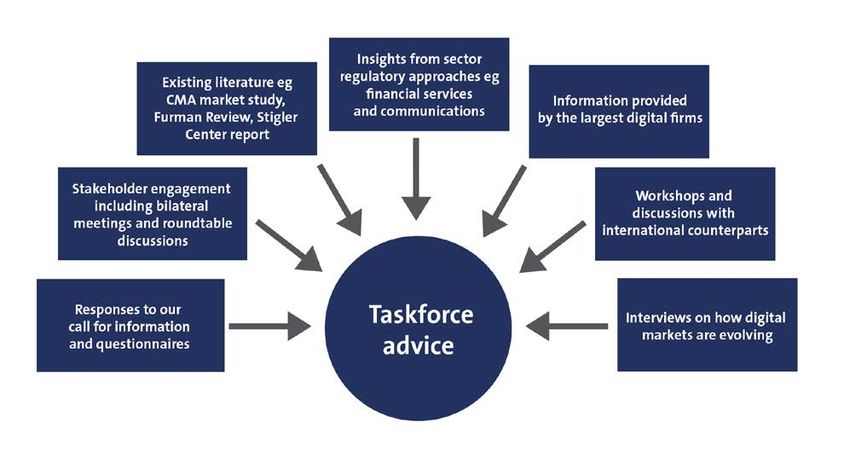
1.14 We have gathered this information from a wide range of sources. These are
set out in more detail in Appendix A and summarised in Figure 1.1. Our
sources include:
• Responses to our call for information, launched in July 2020, alongside
extensive stakeholder engagement through a mix of bilateral and
roundtable discussions involving a wide range of digital firms, investors,
30 See our terms of reference for full details of the government’s request for advice.
13consumer and businesses representatives and academics. Responses to
our call for information have been published alongside this advice.
• Existing reports on the challenges posed by the most powerful digital
firms, including the CMA’s market study on online platforms and digital
advertising as well as numerous expert reports on this subject. 31
• Engaging with existing regulators to learn from existing regulatory
approaches, in particular in relation to the communications, financial
services and groceries sectors.
• Information provided to us by the largest digital platforms.
• Workshops and discussions with international counterparts.
• Interviewing experts, as well as undertaking our own research, to better
understand how digital markets might evolve.
Figure 1.1: summary of the key sources informing our advice
31 Jacques Cremer, Yves-Alexandre de Montjoye and Heike Schweitzer (2019), Competition for the digital era,
final report for the European Commission; Stigler Center (2019) Committee on Digital Platforms Final Report; US
Antitrust House Subcommittee Investigation of Competition in Digital Markets, 2020.
14Our advice
1.15 The remainder of this report sets out the main elements of our key proposals.
To meet the government’s request for proposals that can be readily
implemented, we have gone into some detail on specific aspects of the
framework. This can be found in the supporting appendices which provide far
more detail on the evidence and rationale behind our proposals and
alternative approaches considered.
1.16 Our advice is organised as follows:
• Chapter 2 provides an overview of the benefits and challenges of digital
markets and why we believe it is crucial the government acts to ensure
they remain competitive.
• Chapter 3 provides an overview of the role to be played by the DMU.
• Chapter 4 sets out recommendations in relation to the SMS regime. This is
supported by further detail in Appendices B, C, D, E and F.
• Chapter 5 sets our recommendations for reform of competition and
consumer laws. This is supported by further detail in Appendix G.
• Chapter 6 sets out how the DMU will work with other regulators, at home
and abroad.
• Chapter 7 sets out what we expect our proposed regulatory framework will
deliver and next steps.
152. The case for change
2.1 In this chapter, we briefly outline the huge importance of digital markets, both
to consumers, businesses and the economy. We then set out why it is crucial
government takes action to ensure digital markets are competitive and
continue to deliver the innovative products and services which are now so
fundamental to our daily lives.
The benefits of digital markets
2.2 Digital markets have revolutionised our lives with rapid and profound changes
for consumers and businesses, the economy and society:
• For consumers, digital has provided easy access to a world of information,
as well as the ability to connect and interact with friends and family all over
the world, to consume music or video content when and wherever, and to
buy products online and have them delivered the same day.
• For businesses, digital has opened up new markets and audiences,
provided new revenue streams and revolutionised business models. The
ongoing global COVID-19 pandemic has only served to emphasise the
important role digital markets can play.
• For the UK economy, the digital sector contributed nearly £150 billion to
the UK economy in 2018. 32 The sector’s economic contribution has grown
rapidly, increasing by 30% since 2010, outpacing most other sectors.
• For society, digital markets can have an important role in supporting wider
values such as democracy and free speech.
Powerful digital firms and the risks to competition
2.3 The dynamics of digital markets have changed, and those firms which once
competed so vigorously to gain a foothold in their markets are in many cases
now amongst the largest and most powerful global firms, and have been for a
number of years.
2.4 There is an increasing body of evidence that the lack of effective competition
in activities dominated by powerful digital firms is often the result of specific
market features, that lead to entrenched market power, inhibiting the ability of
rivals to enter and expand and undermining effective competition. This was borne
32 DCMS, Sectors Economic Estimates 2018: Gross Value Added, 2020.
16out in the CMA’s market study of online platforms and digital advertising. These
mark features include:
• Network effects and economies of scale – network effects occur when
the value of a service to its users increases as the total number of users
increases. While sometimes a natural feature of the market, network
effects can also be the result of technological design decisions.
Economies of scale arise where average costs decrease with increasing
scale. These features mean that once a firm reaches a certain size, it can
be extremely difficult for smaller new entrants to challenge it effectively.
• Consumer decision making and the power of defaults – rapid
increases in the availability of information and services online, coupled
with a reduced tolerance for delays, has encouraged ‘default behaviour’ on
the part of consumers – a propensity to avoid wasting time by immediately
accepting whatever default option is presented. 33
• Unequal access to user data – data about users is highly valuable for
developing and providing digital services, such as targeting advertising
and personalised timelines with relevant suggested content. The scale of
data available to powerful digital firms acts as a competitive advantage,
while creating a barrier to entry and expansion to smaller potential rivals.
• Lack of transparency – a common attribute amongst the large online
platforms is that they rely on sophisticated algorithms to make a large
volume of decisions in real-time. One of the consequences of this reliance
on ‘black box’ decision-making is that consumers and businesses that
interact with them find it difficult to understand or challenge how decisions
are made and may find it harder to exercise choice effectively.
• The importance of ecosystems – the companies behind the most
powerful digital firms have built large ‘ecosystems’ of complementary
products and services around their core service. While this type of
integration can deliver efficiency savings and improve the consumer
experience overall, it can also insulate these core services from
competition, making it harder for rivals to compete.
• Vertical integration, and resultant conflicts of interest – the large
digital firms are increasingly present at multiple stages of the supply
chains in which they operate. This can give rise to conflicts of interest, and
33CMA market study into online platforms and digital advertising, Appendix L: summary of research on
consumers’ attitudes and behaviour
17the potential to use their power in their main activity to undermine
competition in other stages of the chain.
2.5 Together, these market features mean a small number of digital firms have
been able to develop particularly strong and entrenched market positions,
which they may seek to leverage into other markets. 34
2.6 Mergers and acquisitions are an important part of the business model of these
firms, with strategic acquisitions being used to reinforce an existing strong
position or expand that position into adjacent markets. Large digital firms can
also use acquisitions to build and strengthen their ‘ecosystems’ of
complementary products and services around their core service, insulating the
core service from competition. Acquisition targets are often at an early stage
of their development, making it difficult for competition authorities to assess
whether the target firm is likely to develop into a competitor.
2.7 The accumulation and strengthening of market power by a small number of
digital firms has the potential to cause significant harm to consumers and
businesses that rely on them, to innovative competitors and to the economy
and society more widely.
2.8 Harms to consumers and business users of large digital firms include:
• A poor deal for consumers – although consumers do not pay money for
many online services, there is still an exchange that takes place. In
exchange for searching the internet, watching videos, or communicating
with friends, consumers provide their attention and data about themselves.
In a more competitive market, consumers might not need to provide so
much data in exchange for the services they value, may be provided with
greater protection and control of their data or alternatively they may be
rewarded, financially or otherwise, for continuing to use the services.
• A poor deal for business users - digital firms with market power may be
able to exploit the business users reliant upon them, such as marketplace
sellers, app developers and advertisers (the vast majority of which are
likely to be SMEs), through charging high prices. This can include through
charging higher fees, higher commissions or higher prices for advertising
than would be expected in a more competitive market. A lack of
competition can lead to them being offered worse terms by powerful digital
firms than would otherwise be the case – for example restrictions in
34See for example the CMA’s market study into online platforms and digital advertising, final report, paragraph
58, and, in the case of Google, from paragraph 5.261.
18relation to the design and pricing of their goods and services or on the
other digital firms they can form relationships with.
• Higher prices of goods and services across the economy – higher
prices charged by powerful digital firms to business users like marketplace
sellers, app developers and advertisers can be expected to feed through
into higher prices paid by consumers for goods and services across the
economy.
• Reduced innovation and choice – as barriers to entry and expansion
weaken the incentives of new entrants and challenger businesses to come
forward with disruptive innovation – these dynamics also limit the
incentives of the large digital firms to innovate themselves. This leads to
less innovation and choice for consumers and businesses – meaning they
are less likely to benefit from the next ‘big idea’ to revolutionise their lives
in the way advances in technology have done to date.
2.9 Harms to innovators include:
• A competitive disadvantage – a powerful platform can use its powerful
position to further entrench its market power, for example by raising
barriers to entry (such as access to data) or by extending its strong
position in one market into other adjacent markets, ultimately giving itself
an unfair advantage over its rivals. This can include for example by
promoting or directing consumers to its own services, over those of
competitors. This means innovative competitors, even if they have a good
idea, are likely to find it much harder to compete and grow their
businesses. Importantly, this could act as a handbrake on innovation right
across digital markets.
2.10 Lastly, harms to the economy and society include:
• A less vibrant digital economy – if powerful digital firms act to unfairly
disadvantage their innovative competitors, these innovative firms will find it
harder to enter and expand in new markets, meaning the ‘unicorns’ of
tomorrow that will support jobs and the future digital economy will not
emerge.
• Harm to society – the actions of these firms can also have wider
consequences on society, with impacts on issues of mental health, media
plurality, accuracy of news, and democracy.
192.11 As recognised in the Furman Review, in the CMA’s market study, and in other
prominent reports, 35 existing competition laws are not, by themselves,
sufficient to address these challenges. The most powerful digital firms have
such entrenched market power that existing laws, which allow enforcement
against individual practices and concerns, are not sufficient to protect
competition. Further, digital markets are fast-moving, and the issues arising
within them are wide-ranging, complex and rapidly evolving. Tackling such
issues requires an ongoing focus, and the ability to monitor and amend
interventions as required. An ex ante regulatory approach is therefore needed
to proactively shape the behaviour of digital firms with substantial and
entrenched market power, and to prevent harm arising. Our proposals for this
regime are outlined in Chapter 4.
Wider competition and consumer concerns in digital markets
2.12 There are widely held concerns in relation to a broad range of digital markets.
These concerns are not solely confined to a small number of the most
powerful digital firms, and as such not all will be addressed through our
proposals for an SMS regime. Our work has focused on four particular
concerns, which are set out in more detail in Appendix G:
• Barriers to effective and informed consumer decision-making – there
are a range of factors which can lead to barriers to consumers making
effective and informed decisions. These can include the information
consumers are provided with (which may be too much, too little,
misleading, hidden, or presented at an ineffective time). However, the way
in which choices are presented and the defaults that are selected can also
be used both to support, but also to impair consumers’ decisions, for
example to nudge or push consumers into choices which may not be in
their interests.
• Activity or content which could lead to economic detriment for
consumers and businesses – activity or material hosted on platforms
which can result in economic detriment to consumers and businesses
includes fake and misleading online reviews, scam advertisements (such
as for high-risk financial schemes) and the sale of counterfeit goods. Such
35For example: Stigler Center (2019), Committee on Digital Platforms Final Report; Jacques Cremer, Yves-
Alexandre de Montjoye and Heike Schweitzer (2019), Competition for the digital era, final report for the European
Commission.
20practices can damage consumer confidence online, undermine effective
competition and damage businesses.
• Barriers to switching and multi-homing 36 – barriers to switching and
multi-homing include factors such as loss of customers data (such as chat
history, photos or tracked activities) or loss of reputation (such as customer
reviews) which may mean a consumer or business is less likely to switch
providers. Similarly, technical barriers like a lack of interoperability
between providers may make it harder for consumers to switch and multi-
home. 37
• Coordination failures – in some circumstances it would be beneficial for
customers if market participants coordinated their actions. For example,
coordination on standards for the world wide web has made it possible for
webpages to be developed so they are compatible with a wide choice of
browsers. However, beneficial coordination may sometimes fail to arise
where individual firms do not account for the benefits such coordination
would provide customers, either in the short or long term, and/or do not
have incentives to reach the same outcome (in fact, in many cases
companies have strong incentives to build ‘moats’ around their services to
protect future revenues).
2.13 Our experience has demonstrated the need for reform of existing competition
and consumer laws to address these challenges. Much of the existing
legislative framework pre-dates modern digital markets and our experience
has demonstrated particular challenges in applying this to these issues.
Strengthening the existing toolkit is vital to safeguarding the vibrance and
dynamism of digital markets more widely. Our proposals in this regard are set
out in Chapter 5.
36Multi-homing refers to customers using similar services provided by different providers simultaneously.
37For example, if users of an instant messaging app are ‘locked in’ to that app, because their contacts also use it
and they cannot message their contacts through an alternative messaging app.
213. The role of the DMU
3.1 In this chapter, we provide a brief overview of the DMU, including its
overarching aims and objectives.
Recommendation 1: The government should set up a DMU which should seek
to further the interests of consumers and citizens in digital markets, by
promoting competition and innovation.
3.2 In its responses to both the Furman Review, and the CMA’s market study into
online platforms and digital advertising, the government has already accepted
the recommendation that a DMU be established. 38
3.3 The principal duties of the DMU will be the lynchpin of the regulatory
framework, framing how and to what aim the DMU uses its powers. We
recommend the DMU’s primary duty should be ‘to further the interests of
consumers and citizens in digital markets by promoting competition and
innovation.’
3.4 We believe it is essential that the consumer interest underpins the regime.
Furthermore, we also believe it is important that digital markets support the
interests of UK citizens, respecting wider rights such as privacy, data
protection, and free speech. Framing the DMU’s duties in this way should
ensure the DMU is focused on outcomes which support the overarching
interests of consumers and citizens while using competition to deliver these.
Across its work we would expect the DMU to make digital markets work well in
the interests of consumers, businesses and the economy.
3.5 The DMU should seek to deliver these outcomes through regulation that
promotes effective competition. Promoting more effective competition in digital
markets will have a number of important benefits, including:
• greater innovation and more choice, for example new features or
adaptations to existing popular services, or the emergence of
transformative new products and services;
• lower prices for a wide range of goods and services across the economy,
both directly to consumers, but also where businesses pass the costs of
lower commissions, or advertising prices through to consumers;
38 Government response to the CMA’s market study into online platforms and digital advertising, November 2020.
22• improvements on multiple aspects of quality, as firms face greater
pressure to meet consumer expectations on issues such as control over
data and privacy;
• predictable, consistent, and fair operating conditions for smaller
firms who rely on powerful digital firms;
• greater certainty for innovative businesses who compete with powerful
digital firms, increasing confidence to invest and expand; and
• a boost to productivity and growth, leading to job creation in new firms
and emerging markets, and the retention and attraction of highly skilled
workers in the UK.
3.6 We recommend the DMU should also have an explicit focus on promoting
beneficial innovation. A full assessment of competition should focus not only
on the situation that currently presents itself (a ‘static assessment’) but must
also build a view of possible harms to future consumers through reduced
innovation (sometimes referred to as ‘dynamic competition’). This is especially
important in digital markets, where often the greatest harm to arise from a lack
of effective competition is foregone innovation. Dynamic harms are, by their
nature, difficult to quantify and can be underweighted in competition
assessment. An explicit duty should focus the DMU on considering the
relative impact an intervention has on innovation that promotes consumer
interests. It should lead the DMU to explicitly favour remedies which support
dynamic competition.
Recommendation 1a: The DMU should be a centre of expertise and knowledge
in relation to competition in digital markets.
3.7 To be able to operate the regulatory framework we are proposing most
effectively, the DMU will need to build up a great deal of expertise and
knowledge. This should include the capability to understand:
• the business models of digital businesses, including the role of data and
the incentives driving how they operate; and
• the role of algorithms and artificial intelligence.
3.8 This is essential if the DMU is to be successful in intervening effectively to
drive greater competition and innovation in these markets. Not only would
such expertise enable better and swifter identification of potential problems as
or even before they emerge, it should also support better remedy design,
ensuring interventions address a particular harm, without unnecessarily
restricting how these digital firms operate.
233.9 In acting as a centre of expertise in relation to competition in digital markets,
the DMU will need to work closely with other regulators with responsibilities for
digital markets, most notably Ofcom, the ICO and the FCA. In particular, it will
need to work closely with other regulators where the practices of digital firms
have effects on wider policy objectives such as data protection, media
plurality, and public service broadcasting.
3.10 The DMU should also maximise opportunities to work effectively and
efficiently with these regulators, recognising that many of the same skills and
processes will be necessary to support wider regulation of digital markets. We
expect the DMU would work with the DRCF to consider how expertise and
analytical capabilities are best developed and shared across regulators.
Further information on how the DMU would work with other regulators and the
DCRF is set out in Chapter 6.
Recommendation 1b: The DMU should be proactive, seeking to foster
compliance with regulatory requirements and taking swift action to prevent
harm from occurring.
3.11 The DMU should be a proactive regulator, focused on preventing harm and
shaping markets to deliver greater competition and innovation.
3.12 In relation to the SMS regime, we expect the DMU would focus on supporting
SMS firms to comply with the code. The primary motivation for establishing a
new ex ante regime is the ability to proactively shape the behaviour of SMS
firms in advance before harm occurs. We expect it would do this in a range of
ways, including through establishing open and productive relationships with
SMS firms, and being clear about what is expected. This is explored further
under recommendation 5 below and in Appendix C.
3.13 The DMU would also undertake monitoring in relation to SMS firms, enabling
it to take swift proactive action where it identifies risks of potential problems
occurring, as well as where those risks have crystallised and problems now
exist. The DMU would monitor the conduct of SMS firms to ensure it is
compliant with the code. Where it finds problems, it should have a range of
tools available to address them. This includes using a participative approach
reliant on engagement with all affected parties, as well as tough powers where
a participative approach is inappropriate or insufficient. This is further explored
under recommendation 7 below as well as in Appendix C.
3.14 We expect the DMU would also undertake monitoring in relation to digital
markets more widely, including in relation to firms and activities not covered
by the SMS regime. This monitoring role would provide for swifter intervention
to promote greater competition and innovation, both by spotting problems
earlier and by providing greater expertise enabling them to be addressed
24more quickly. It would also enable the DMU to spot opportunities where
intervention could better support competition and innovation, for example
where regulatory requirements act as a barrier to innovation, or where
remedies like personal data mobility and interoperability could be most
beneficial.
3.15 In order to support this, we would expect the DMU to engage regularly with a
diverse range of participants in digital markets, undertake research and gather
information to ensure it kept abreast of how digital markets are evolving and
any risks to and opportunities for competition and innovation. The DMU’s role
in relation to digital markets more widely is explored under recommendation
12 below and in Appendix G.
254. A pro-competition framework for the most powerful
digital firms
4.1 This chapter provides an overview of our proposed regulatory framework for
the most powerful digital firms. The chapter covers:
• an overview of the proposed regime;
• how SMS should be assessed and firms designated;
• the code of conduct;
• pro-competitive interventions;
• monitoring and enforcement;
• the DMU’s processes and decisions; and
• SMS merger rules.
4.2 Further detail on the evidence and rationale supporting our recommendations,
as well as alternative approaches considered, can be found in the
accompanying appendices B, C, D, E, and F.
Overview of the regime
Recommendation 2: The government should establish a pro-competition
framework, to be overseen by the DMU, to pursue measures in relation to SMS
firms which further the interests of consumers and citizens, by promoting
competition and innovation.
4.3 The purpose of the SMS regime is to address harm arising from the market
power and strategic position of the most powerful digital firms that have
extensive reach and influence over many aspects of our lives, as well as
driving vibrant competition and dynamic innovation in the markets in which
these firms operate.
26Figure 4.1: overview of the SMS regime
4.4 The entry point to the regime is a test as to whether a firm has ‘strategic
market status’. This should be an evidence-based assessment as to whether
a firm has substantial, entrenched market power in a particular digital activity,
providing the firm with a strategic position (meaning the effects of its market
power are likely to be particularly widespread and/or significant). It is focused
on assessing the very factors which may give rise to harm, and which
motivate the need for regulatory intervention.
4.5 When the SMS test is met by a firm, it should be subject to the following three
pillars of the regime:
• An enforceable code of conduct which sets out clearly how the firm is
expected to behave in relation to the activity motivating its SMS
designation. The code seeks to set clear ‘rules of the game’ up-front,
preventing the firm taking advantage of its powerful position, such as
through exploiting consumers and businesses or excluding innovative
competitors.
• Pro-competitive interventions that seek to address the sources of
market power and drive longer-term dynamic changes in these activities,
opening up opportunities for greater competition and innovation. For
example, interventions relating to personal data mobility, interoperability,
27and data access, which can be used to address the factors which lead to
the firm holding such a powerful position.
• SMS merger rules to ensure closer scrutiny of transactions involving
SMS firms, given the particular risks and potential consumer harm arising
from these transactions.
4.6 This chapter provides a brief overview of the SMS regime including our key
recommendations in relation to SMS designation and in relation to the design
of these three pillars of the regime.
Designating SMS firms
Recommendation 3: The government should provide the DMU with the power to
designate a firm with SMS.
4.7 The entry point to the regime is a test as to whether a firm has ‘strategic
market status’ in relation to a particular activity.
4.8 The DMU should decide whether a firm meets the SMS test in a particular
activity. We believe it is important this decision is made by an independent
regulator and that it is an expert regulatory judgement, both as to whether the
criteria for designation are met and whether it is appropriate to designate a
firm.
Recommendation 3a: SMS should require a finding that the firm has
substantial, entrenched market power in at least one digital activity, providing
the firm with a strategic position.
4.9 The SMS test should, at least, involve an assessment of whether a firm has
substantial, entrenched market power in an activity. In our view it should also
involve an assessment of whether the firm’s market power in that activity
provides the firm with a strategic position. We now provide an overview of
these elements.
The SMS test should involve an assessment of whether the firm has substantial,
entrenched market power in the activity
4.10 Substantial market power arises when users of a firm’s product or service lack
good alternatives to that product or service and there is a limited threat of
entry or expansion by other suppliers. This allows the firm to increase prices
and/or reduce quality and innovation since a significant number of users are
unwilling or unable to switch away to competing products or services. As a
result, substantial market power can lead to immediate harm to consumers by
28You can also read


