A RESILIENT SINGAPORE - 100 Resilient Cities
←
→
Page content transcription
If your browser does not render page correctly, please read the page content below
A RESILIENT SINGAPORE
01

A RESILIENT
SINGAPORE
02                                                                                                                                                                                                                             03

                                                                                                                                                        CONTENTS
Writers
Lim Wei Da, Senior Assistant Director, Centre for Liveable Cities         All rights reserved. No part of this publication may be reproduced,
Tan Guan Hong, Manager, Centre for Liveable Cities                        distributed, or transmitted in any form or by any means, including
                                                                          photocopying, recording, or other electronic or mechanical methods,
                                                                          without prior written permission of the publisher.

Editorial Committee                                                       Every effort has been made to trace all sources and copyright holders of
                                                                          news articles, figures, and information in this book before publication. If
Sophianne Araib, Director, Centre for Liveable Cities                     any have been inadvertently overlooked, CLC will ensure that full credit is   FOREWORD                                                          05
Michael Koh, Fellow, Centre for Liveable Cities                           given at the earliest opportunity.
Lauren Sorkin, Managing Director (APAC), 100 Resilient Cities
Amit Prothi, Associate Director, 100 Resilient Cities                                                                                                   MESSAGE FROM CENTRE FOR LIVEABLE CITIES                           06
Gemma Kyle, Programme Manager, 100 Resilient Cities
                                                                                                                                                        MESSAGE FROM 100 RESILIENT CITIES                                 07

Editor                                                                                                                                                  EXECUTIVE SUMMARY                                                 09

Justin Zhuang, Adjunct, Centre for Liveable Cities                                                                                                      SINGAPORE: A JOURNEY OF RESILIENCE                                10
                                                                          The images listed in this publication may not be reproduced for any           Our Urban Transformation                                          10
                                                                          purposed except with the permission of their respective copyright             Chronic Stresses, Acute Shocks                                    13
Designer                                                                  holders.                                                                      Developing Our Liveable and Resilient City                        18
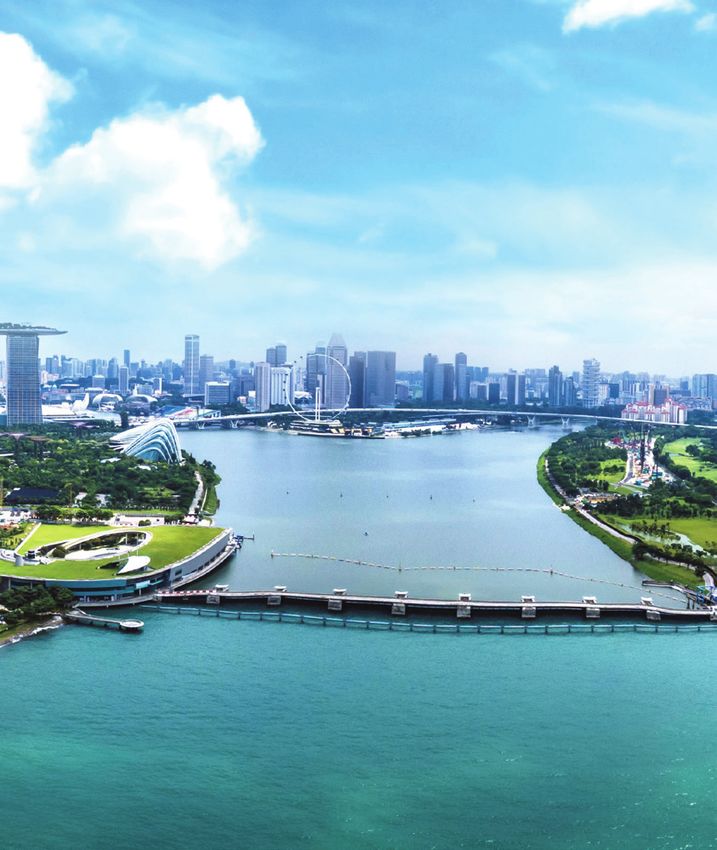
Green House Design + Communications                                       Cover Image: Aerial shot of the Marina Bay Area, including the Marina
                                                                          Barrage, Marina Reservoir and Bay East Garden, Singapore, Credit: PUB,        RESILIENCE MATTERS                                                22
©2018 Centre for Liveable Cities, Singapore. All rights reserved.         Singapore’s National Water Agency.
                                                                                                                                                        What Makes a City Resilient                                       22
                                                                                                                                                        Writing Our Resilience Story                                      24

                                                                                                                                                        OUR RESILIENCE CHALLENGES                                         26
                                                                                                                                                        Two Key Challenges                                                26
Set up in 2008 by the Ministry of National Development and the Ministry
of the Environment and Water Resources, the Centre for Liveable                                                                                         Surviving and Thriving in a World Where the Climate is Changing   27
Cities’ mission is to distil, create and share knowledge on liveable                                                                                    Adapting to Changing Demographics                                 28
and sustainable cities. The Centre for Liveable Cities’ work spans four
main areas–Research, Capability Development, Knowledge Platforms
and Advisory. Through these activities, the Centre hopes to provide                                                                                     LEARNING FROM THE PAST, LOOKING TO THE FUTURE                     30
urban leaders and practitioners with the knowledge and support                                                                                          More Than Just the Environment                                    32
needed to make our cities better. For more information, please visit
www.clc.gov.sg.                                                                                                                                         Unity Amidst Diversity                                            46

                                                                                                                                                        AN ONGOING JOURNEY: OUR RESILIENCE EFFORTS                        60

For Feedback and Enquiries
                                                                                                                                                        GOALS AND OPPORTUNITIES                                           66
CLC Publications                                                                                                                                        From Awareness to Action                                          67
45 Maxwell Road #07-01
The URA Centre
                                                                                                                                                        Co-Creating Solutions                                             70
Singapore 069118
T +65 6645 9576                                                                                                                                         LEARNING FROM THE 100RC NETWORK                                   76
E MND_CLC_Enquiries@mnd.gov.sg

                                                                                                                                                        ENDNOTES AND BIBLIOGRAPHY                                         78
ISBN 978-981-11-7810-8 (print)
ISBN 978-981-11-7811-5 (electronic)                                                                                                                     ACKNOWLEDGEMENTS                                                  80
04                                                                                                                                    05

     FOREWORD
     LAWRENCE WONG,
     MINISTER FOR NATIONAL DEVELOPMENT AND
     SECOND MINISTER FOR FINANCE, SINGAPORE
     Singapore has come a long way in transforming into a liveable
     and resilient city. In the 1960s, living conditions were far
     from ideal. We were subjected to multiple urban challenges
     including poor public health conditions, lack of quality housing,
     low connectivity across the island and employment insecurity.

     The situation is very different today. The quality of life in
     Singapore has significantly improved—everyone has access
     to a clean and green environment, and to live in an inclusive
     society with opportunities for all.

     As a small city-state with limited natural resources, we were
     keenly aware of the need to adapt and evolve to our constantly
     changing circumstances. Hence, we focus on long-term urban
     planning, and develop contingency plans for different scenarios.
     We do all this in a holistic, integrated manner, working across
     different sectors and more importantly, involving different         Similarly, our approach to managing water is more than just a
     stakeholders to create a sustainable and liveable Singapore.        supply issue. We saw an opportunity to innovate and grow our
                                                                         water industries, and create beautiful blue-green recreational
     Beyond robust physical infrastructure, resilience is also about     spaces through efforts such as the Active, Beautiful,
     working closely with our communities and stakeholders. For          Clean (ABC) Waters Programme and the Park Connector
     example, in providing affordable and quality public housing         Network (PCN).
     in Singapore, we not only build the flats, but also develop
     programmes to bring residents closer together and foster            We have achieved much, but there is still more that needs to be
     strong community bonds. Through this process, neighbours            done. Building an increasingly resilient Singapore is an ongoing
     can forge deeper support networks which can be counted on           journey, where the results hinge on the combined efforts of the
     during times of need.                                               government, our communities and stakeholders.
06                                                                                                                                                                                                                                                                         07

MESSAGE FROM CENTRE                                                                                                                     MESSAGE FROM 100
FOR LIVEABLE CITIES (CLC)                                                                                                               RESILIENT CITIES (100RC)
KHOO TENG CHYE, EXECUTIVE DIRECTOR, CLC                                                                                                 MICHAEL BERKOWITZ, PRESIDENT, 100RC
It would have been hard to imagine that Singapore, a basket                                                                             Singapore’s story is one that demonstrates the importance of
case of urbanisation back in the 1960s–with urban slums,                                                                                resilience thinking for cities. Singapore’s transformation over
poor infrastructure and lack of sanitation–would make the leap                                                                          the past five decades has been remarkable–from a fledgling
to a thriving city-state in the space of 50 years, let alone be                                                                         nation state plagued by pollution, corruption, social unrest,
considered a highly liveable city.                                                                                                      and other urban challenges to a clean, safe, liveable and
                                                                                                                                        sustainable city today. That transformation towards resilience
Indeed, our transformation into a highly sustainable and liveable                                                                       was achieved through a rigorous commitment to integrated
city-state while being one of the most densely populated cities                                                                         planning and to constantly reimagining the city as it could be
with limited natural resources is a story of resilience. We built                                                                       and as it should be in the near and far term. What is just as
strong communities and overcame racial riots in the early                                                                               important is the commitment that Singapore has put in place
years; fostered strong social cohesion through the way we plan                                                                          to ensure that plans come to fruition and stakeholders are
and build our housing estates; established a clean and green                                                                            engaged in the process.
Singapore; overcame our water scarcity by establishing 4
National Taps; and built multi-functional infrastructure such as                                                                        Since it gained independence, Singapore has taken
the Marina Barrage. All these and the rest of the case studies                                                                          an integrated, and strategic approach to creating and
outlined in this publication are examples of how resilience is                                                                          implementing its plans. By developing plans with both 50-year
embodied in the Singapore journey.                                                                                                      and 10-year time horizons and designing multiple benefits into
                                                                                                                                        every intervention, Singapore has become a living lab for the
Singapore’s development model of high density and high                                                                                  value of resilience thinking. Projects like Marina Barrage and      Resilience is an ongoing process of reflection, engagement
liveability has been a subject of interest for many. Even so,         This publication has utilised the Singapore Liveability           Bishan-Ang Mo Kio Park could have focused on singular goals–        and innovation. Nowhere is this stated more clearly than
we are also continuously learning from other cities and               Framework, which distils the key principles of Singapore’s        to increase fresh water reserves and improve storm drainage–        in the final call to action of this document–a shift towards
how Singapore can do better to further build our resilience,          urban transformation, and 100 Resilient Cities’ City Resilience   but delivered multiple benefits including improving biodiversity,   a values-based society, a call for the whole city to come
sustainability and liveability. This is why the Centre for Liveable   Framework, to capture how Singapore has gone about building       reducing flooding, creating recreational space, reducing urban      together in good times and bad. Singapore holds a special
Cities was inspired to join the 100 Resilient Cities Network          resilience. The publication has focused on two pertinent          heat island effect and improving community cohesion.                place as the only nation state in the 100RC network. But in
to learn from other cities in the network, as well as share           resilience challenges of climate change and changing                                                                                  many ways here again, Singapore is tackling challenges that
Singapore’s experience.                                               demographics and the ongoing efforts and future actions to        In this Resilience Narrative, Singapore has documented how it       many cities will eventually have to face–how to survive and
                                                                      address them.                                                     has been successful in implementing its resilience plans and        thrive as a city in an increasingly connected global context.
As cities continue to grow and urbanise in the face of global                                                                           overcoming its challenges. But it has also asked some difficult     I look forward to continuing our work with Singapore through
uncertainties and complex challenges, resilience is key. In           The Centre for Liveable Cities looks forward to continue          questions and recognised continued challenges that will shape       the Centre for Liveable Cities on these challenges. Singapore
Singapore’s experience, resilience is not just about being able       working with 100 Resilient Cities to learn from its network       Singapore’s future. The two challenges of climate change and        has the potential to be a valuable contributor not only to our
to recover after times of crisis. Resilience is continuously built    of cities and share Singapore’s experience with others. The       changing demographics that Singapore has identified resonate        network but to all cities around the world on building resilience,
through integrated and long-term planning and good urban              collective knowledge and experience will most definitely go       with many cities around the world. This publication outlines        planning for uncertainty and optimising resources. I hope this
governance. This has allowed us to build a Singapore that can         towards helping Singapore and other cities better understand      what Singapore can and needs to do to further its resilience        document can be instructive and a starting point for deeper
survive, adapt and thrive regardless of the stresses and shocks       resilience challenges and find innovative urban solutions to      when dealing with such challenges.                                  global collaboration on important issues impacting cities today.
we face.                                                              tackle them.
08 09
EXECUTIVE
01
SUMMARY
ABOUT CENTRE FOR LIVEABLE CITIES (CLC) ABOUT THE 100 RESILIENT CITIES
Singapore’s journey is as much a story of built our economy, without compromising our sustainability
(100RC) NETWORK sustainable urban development as it is of and liveability. We worked with different stakeholders to build
Set up in 2008 by the Ministry of National Development and
inclusive public spaces, conserve our nature reserves and
the Ministry of the Environment and Water Resources, the 100RC possesses a unique vantage point for resilience. Just barely 50 years ago, a newly protect our greenery, while reserving spaces for the arts and
Centre for Liveable Cities’ mission is to distil, create, and share understanding the changing landscape of cities in the 21st independent Singapore had to grapple with many more.
knowledge on liveable and sustainable cities. century. The holistic lens urban resilience offers decision serious urban challenges—overcrowded
makers is uniquely suited to meet the needs of the modern
The Centre for Liveable Cities’ work spans four main areas city and regions of which they are critical members. Cities
slums, poor sanitation and public With increasing globalisation and urbanisation, Singapore,
as with many other cities around the world today, continues
–Research, Capability Development, Knowledge Platforms, in the 100RC network are provided with the resources health conditions as well as inadequate to face increasingly complex urban challenges. Resilience
and Advisory. Through these activities, the Centre hopes to necessary to develop a roadmap to resilience along four infrastructure to meet a growing population. thinking is not a luxury but a necessity for cities. It is about
provide urban leaders and practitioners with the knowledge
and support needed to make our cities better.
main pathways: Then, we were less than two million people. putting in place holistic and integrated measures to enable
Today, our population is more than 5.6 cities to adapt, survive, and thrive regardless of the stresses or
• Financial and logistical guidance for establishing shocks they face.
an innovative new position in city government—a million without significant increases in our
Chief Resilience Officer—who will lead the city’s land area. Even as our population tripled, The Centre for Liveable Cities (CLC) and 100 Resilient Cities
resilience efforts we have become more liveable as a city. (100RC)—Pioneered by Rockefeller Foundation, have put
together this publication to share Singapore’s resilience story
• Expert support for the development of a robust of building a highly liveable and sustainable city, and how we
Resilience Strategy are continuing to build resilience in an increasingly complex
ABOUT 100 RESILIENT CITIES (100RC) environment. Through research and a series of engagements
• Access to solutions, service providers and partners with various stakeholders from the public, private, and people
Resilience has been embedded in our efforts to develop
100 Resilient Cities–Pioneered by the Rockefeller Foundation from the private, public and NGO sectors who sectors, we have identified key case studies and insights on
Singapore into a liveable and sustainable city. In taking a long-
is dedicated to helping cities around the world become more can help them to develop and implement their Singapore’s efforts to build resilience, focusing in particular
term and integrated approach to planning and developing our
resilient to the physical, social and economic challenges of the Resilience Strategies on two key cross-cutting challenges: Climate Change and
city, we have been building up our resilience and capacity to
21st century. manage and adapt to stresses and putting in place different Changing Demographics.
• Membership in a global network of cities who can
measures to handle potential shocks. Given our context as a
100 Resilient Cities supports the adoption and incorporation learn from and help each other Building resilience is an ongoing process. What matters is
globally connected, high-density city-state with limited land
of a view of resilience that includes not just shocks such as and resources, our perennial stresses can easily spiral into to learn from what we have done and achieved and to learn
floods, fires, riots, but also stresses such as growing diversity larger problems or become amplified in times of crises if not from others. More importantly, it is about how the whole city
and aging population that could threaten and weaken the fabric well-managed. can come together, both in the day-to-day and during times of
of the city on a day-to-day or cyclical basis. crises. We need to move from awareness to action. Everyone
In our early years, we provided basic necessities and has a part to play in this continued commitment to building a
infrastructure, such as public housing and clean water, and resilient Singapore.
01 - Waterfront view of Tanjong Rhu, Credit: Jeremy Photography 2013
10 11
SINGAPORE: 01 02 03 04
A JOURNEY OF
term Meet
long- s
ters
Fos planning basic n
Need to do better
gr ated eed
s
nte
d &i
oa liv Sup
br ders
a ol em elih p
gy He
Doing well but
s pl o
eh
ate alt
or s & t
ak o
r
str
we
h
ts
od en
,
&
po
ym
st
&
can be improved
of
Em
WE
RESILIENCE
e
we
ip
g
ran
rsh
llb
anag ip &
de
ein
ent
Good
Lea
Ens
ersh
em
hea
g
ures
lth s
lead
THRIVE
ervice
effective m
public
Promotes
s
communic
e &
ties
Provide
Singapore
mmuni
ohesiv
I n fr a
ation
Creating a liveable and
s rel
tes c
d co
iabl
age
1950s & 60s
&m
mo
y
str
sustainable city-state
ie t
e
Pro
WE
eng
uc
obi
oc
tu
lity
s
despite our perennial
y,
&
re
&
jus bilit
en y
En critic
om
OUR URBAN TRANSFORMATION
nd sta
v ir
e
su
on
of
tic
on
stresses of limited
re
co
Ec
al
s
me so
ci
n
se tinu nt s
re ity a
al
ADAPT
rv it su
ice y
land, lack of natural
r
s Pro En ecu
v s
nat ides & e ic
ura nhances om
econ
resources, and a
l and
manma Fosters
de erity
In 1947, the British Housing Committee Report proclaimed that We have come a long way, but we cannot afford to be asse
ts prosp
Singapore “had one of the world’s worst slums—a disgrace to a complacent or remain stagnant. Our journey forward diverse society
civilised community”.1 builds upon our past as we continuously strive to further Putting in place robust
our resilience.
infrastructure and
The British colony then had a population of less than one million
systems that not only
people, more than half of which lived in dirty, overcrowded long-
term Meet
slums. Singapore was plagued by various urban challenges, protect us against Fos
ters
ed pla
nning basic n
s
eed
grat s
crises but also benefit nt e
&i
and there was a dire lack of basic infrastructure with poor
d
oa liv Sup
br ders
A city that fails to plan, plans
em elih p
us in times of peace
a l
s ho gy He pl o
drainage and sanitation, polluted rivers, and a lack of clean, e
ate alt
or s & t
ak o
r
str
we
h
ts
od en
,
&
po
ym
st
&
piped water. As a result, malnutrition and disease were rife, as
to fail. With the emergence
of
Em
e
we
ip
g
ran
rsh
was the prevalence of water and food borne diseases such as
WE
llb
anag ip &
de
ein
ent
and continued existence of
Lea
Ens
ersh
tuberculosis and cholera. Life expectancy was short, and infant
em
hea
g
ures
lth s
lead
mortality was high.
challenges that are increasingly
ervice
effective m
public
Promotes
SURVIVE
s
Today, Singapore ranks 25th on the Mercer Liveability Index. global and complex, continuing
communic
e &
ties
We have the third highest Gross Domestic Product (GDP)
the resilience journey in
Provide
Singapore
mmuni
ohesiv
per capita and one of the lowest unemployment rates in the
I n fr a
ation
s rel
tes c
d co
world. As our population tripled over the past 50 years, we have
Singapore is critical. Overcoming incidents
iabl
age
2010s
&m
mo
y
str
ie t
e
Pro
eng
uc
obi
become a highly dense but liveable and sustainable city-state and crises that
oc
tu
lity
s
y,
&
re
&
ilit
that offers our residents a high quality of life.2 threaten the en y
En critic
b
om
sta
v ir
e
su
on
of
tic
on
re
co
Ec
al
jus
s
me so
stability of our
ci
n
se tinu nt
nd
s
re ity a
al
rv it su
ice y r
This transformation of Singapore since our independence from city-state
s Pro
v
nat ides & e ic
En ecu
s
ura nhances om
econ
1965 is very much a story of resilience. l and
manma
asse de
Fosters
erity
ts prosp
05 06 07
01 - An officer from Flood Relief Survey Team taking particulars of dwellers at Potong Pasir, Credit: Ministry of Information and the Arts Collection, Courtesy of National Archives of Singapore
02 - Street hawker stalls at the old Glutton’s Square at Orchard Road, Credit: Ministry of Information and the Arts Collection, Courtesy of National Archives of Singapore
03 - Street hawker operating from a “five-foot way” by the street, Credit: Ministry of Information and the Arts Collection, Courtesy of National Archives of Singapore
04 - Flooding in the 1960s, Credit: Ministry of Information and the Arts Collection, Courtesy of National Archives of Singapore
05 - A bird-eye view of the Bishan-Ang Mo Kio Park, Credit: Jimmy Tan (Flickr)
06 - Singapore’s skyline at night, Credit: Joan Campderros-i-Canas
07 - Commuters exiting the Mass Rapid Transit (MRT), Credit: Centre for Liveable Cities (CLC)
12 13
SNAPSHOT ECONOMIC CHRONIC STRESSES
OF SINGAPORE3 ACUTE SHOCKS
Land Area: Our Perennial Stresses Learning from Shocks
719.9 sq km Unemployment rate: 2.1% As a small city-state, Singapore’s plans are often dealt with Oftentimes, stresses that are not managed well can spiral into
GDP
BY SECTORS Tourists: 17.4 mil at the national level. We have to fit in the needs of a nation, larger incidents such as riots, financial crises or infrastructural
including catering for military training grounds, defence accidents. When facing incidents beyond our control, what we
Population: 5,612,300 External debt: $0 airbases, sea ports, airports, water catchment areas, industrial have done to prepare ourselves will also impact on how well
GDP/K: S$79,697
zones and more while ensuring the well-being of a highly dense we can cope.
population. These are not typically expected of a city and they
Population density: 7796per sq km constantly add additional pressure on us. While Singapore has fortunately avoided major natural
disasters, we have had our fair share of shocks over the
Life Expectancy: 83.1 Years As a small island constrained by limited natural resources, we years. Every incident is an opportunity to learn and adapt,
SERVICES PRODUCING INDUSTRIES 12.0%
Other services industries: have to constantly find innovative ways to balance competing ensuring that systems are in place for us to prevent or
Wholesale and retail trade: 17.6% Ownership and dwellings: 3.9% land requirements to meet our different economic, social, and mitigate and recover better when faced with recurring or
Indians 9.1% Transportation and storage: 7.2%
environmental needs. new shocks.
Accommodation and food services: 2.1% GOODS PRODUCING INDUSTRIES
Chinese 74.3% Information and communication: 4.2% Manufacturing: 19.2%
Finance and insurance: 13.3% Construction: 4.3%
Malays 13.4% Others 3.2% Business and services: 14.8% Utilities: 1.3%
SOCIAL ENVIRONMENTAL STRESSES
Days with good and
moderate air quality:
IN SINGAPORE
99%
Area of skyrise greenery: 100ha
Green cover: 47% LIMITED CHANGING GLOBAL
Literacy rate of residents aged over 15: 97%
Green view index (urban tree canopy density): 29.3%
RESOURCES DEMOGRAPHICS CHALLENGES
Doctors / 10,000 population: 24 Limited land area; Increasing diversity; Climate change;
Flood prone area: 30.5ha Limited resources: Decreasing total Global economic
Crimes / 10,000 population: 584
Access to clean water: 100%
food, energy, fertility rate; uncertainties;
and water Rapidly ageing Terrorism threats
Home ownership rate: 90.7% population
Volunteerism: 35% Domestic recycling rate: 21%
Donations to charitable organisations: S$2.18 billion Non-domestic recycling rate: 76%
Volunteering hours: 121 million hours Fuel mix: 95.2% natural gas and
2.9% other energy products
14 15
ACUTE SHOCKS 2003 CONTAINING A PANDEMIC
—Severe Acute Respiratory Syndrome (SARS) Outbreak in Singapore
By the time the World Health Organisation (WHO) termed the previously • Integrated and coordinated national-level responses that were
1965
SUDDEN INDEPENDENCE unknown virus as SARS on 15 March 2003, some 82 people in Singapore
had already been infected. The city’s economy also suffered as fears
led by the high-level Executive Group formed to lead government-
wide responses to contain the virus and address the socio-
—Separation from Malaysia of the virus impacted tourism and streets were emptied as people economic impacts.
stayed indoors.
In 1965, Singapore suddenly found itself an independent nation with One of the most pressing issues we faced was ensuring the security • Rapid and effective mobilisation of different groups from various
the separation from Malaysia. Without a hinterland, we had to deal of our border. A new Ministry of Foreign Affairs was formed, as well Within two and a half months, the outbreak was successfully contained sectors, including the military, healthcare and grassroots, to
with issues of sovereignty, defence and economic survival. This was as a People’s Defence Force. This was followed by the expansion of and Singapore was declared free of SARS on 30 May 2003. However, in work tirelessly and closely together to contain the virus. This
compounded in 1967 when the British administration announced the the Singapore Armed Forces through mandatory conscription of male that short period, the city had a total of 238 reported cases, including included contact tracing; monitoring and screening; campaigning
withdrawal of its military bases here, which accounted for a significant citizens through National Service in 1967. The same year, a Bases 33 deaths. to keep hygiene standard high in public spaces; and boosting
proportion of Singapore’s economy then. Economic Conversion Department was also set up to convert British public confidence.
bases for commercial uses to avoid large-scale unemployment. We were able to quickly contain the pandemic because of strong
measures that addressed the issues on multiple fronts, including: • Ground-level initiatives among the public and community, e.g.
neighbours sending food and groceries to those under quarantine.
Cable
Car Tragedy MRT
Laju Asian Breakdown
Incident 1983
Financial H1N1 2015
1974 Crisis Outbreak
1998 Orchard Road Batam
01
02 2009 Flash Floods Bomb Plot
2013 2016
Jemaah Nicoll
Singapore Islamiyah Highway Economic Little
Airlines Flight Terrorist Collapse Recession India Riot
Attempt
MacDonald Spyro Hotel New 117 Hijack 2004 2008 2013
House Bombing Disaster World 1991 2001
Racial Collapse
Riots 1965 Major 1978
1986 03
2013 CATCHING A BREATHER
Floods
1964
60s/70s —Dealing with the Haze Episode
In 2013, Singapore was hit by one of our worst haze incidents since • Rapid integrated crisis management responses: The Ministry of
1997. The haze, which enveloped the city in mid-July, was caused by Health subsidised treatment of haze-related ailment for needy
forest fires from neighbouring Indonesia. Haze levels reached Pollution patients at private clinics, while the Singapore Armed Forces,
Standards Index (PSI) of 400 on 21 July, a critical level deemed to together with grassroots volunteers, were mobilised by the
be “potentially life threatening to the ill and elderly” by the National People’s Association to distribute N95 masks to 200,000 vulnerable
Environment Agency (NEA). households.
Some of the measures that were rapidly adapted in Singapore to deal • Community level responses: The wider community also stepped up
with the haze included: and reached out to vulnerable groups. Members of the public bought
masks to distribute to needy families, and some even offered to house
• Integrated national level coordination: A Crisis Management Group neighbours in their air-conditioned rooms.
(Haze) meeting was convened by the Permanent Secretary of the
Ministry of the Environment and Water Resources (MEWR) to lead
01 - Registration exercise of first batch of National Service recruits, Credit: Ministry of Information and the Arts Collection, Courtesy of National Archives of Singapore
02 - Poster to raise awareness during SARS, Credit: Ministry of Community Development and Sports Collection, Courtesy of National Archives of Singapore
and coordinate government responses.
03 - Haze in Singapore, Credit: TH Tan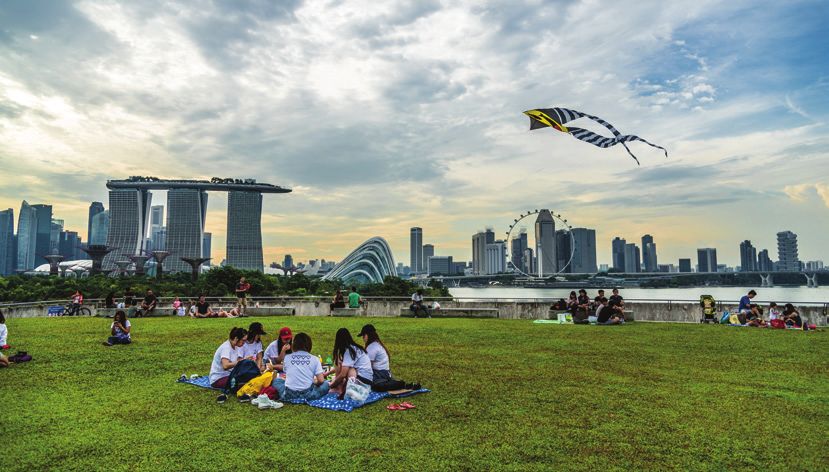
16                                                                                                                                                                                                                             17

SUSTAINING
                   Singapore’s strategic location in Asia has made us a gateway for multinational
                   companies to enter the region’s emerging markets. This is supported by our pro-

AN OPEN
                   business, world-class financial infrastructure, and a well-developed transportation
                   hub that is home to one of the world’s busiest sea and air ports. Singapore
                   also has a skilled workforce, a result of efforts to develop people, our best and

ECONOMY
                   only resource.

                   Without a hinterland, Singapore has strived to keep an open and well-connected        Maintaining an            Forging strong              Developing a world         Developing         Creating a safe and
                   economy over the past five decades. While strong trading ties with other              open economy             trading ties with         class transportation hub   strong financial      stable environment
                   countries have helped us prosper, this strength also makes us vulnerable to                                     other countries                                      infrastructure       to attract investors
                   global economic, political, and social stressors and uncertainties. It is critical
                   that we remain highly flexible and nimble in the global economy, providing a safe,
                   conducive, and liveable space to attract continued investments and talent.

OVERCOMING
                   With limited land and resources, Singapore has placed great emphasis on
                   sustainable development since our formative years, rejecting the “develop first,

LIMITATIONS
                   clean up later” approach. Rather than treating environmental protection as
                   being at odds with economic development, we see both as an integral part of
                   city planning and development. In our early days, having a clean and green city

TO CREATE A
                   demonstrated to foreign investors that we were well-run and safe—key factors
                   that distinguished us from other cities and countries in the region.

SUSTAINABLE
                   Although surrounded by water, we are one of the world’s most water-stressed             Avoiding a “Develop              Cleaning up         Improving sanitation         Greening             Enhancing
                                                                                                              first, clean up             Singapore River         and public health          the city            water security
                   countries. In our earlier years, water rationing had to be imposed during periods
                                                                                                             later" approach

ENVIRONMENT
                   of drought. Monsoon periods led to flooding due to intense rainfall. Despite
                   these perennial stresses, since 1979, Singapore had provided 100% access to
                   clean, portable water to all its people and has reduced our flood prone areas to a
                   mere 32 ha in 2015. Beyond the provision of clean water, we have also bolstered
                   our water capacity with "4 National Taps": water from local water catchments,
                   imported water from Malaysia, NEWater (high-grade reclaimed water); and
                   desalinated water.

MAINTAINING
                   As a small city-state with no natural resources, bringing together Singapore’s
                   multi-ethnic, multi-religious society has been fundamental to our development.

A MULTI-CULTURAL
                   Founding Prime Minister Lee Kuan Yew once shared that the biggest challenge for
                   Singapore was “how to build a nation out of a disparate collection of immigrants
                   from China, British India and the Dutch East Indies”4. Today, diversity continues

AND DIVERSE CITY
                   to be a hallmark of Singapore, with an ever growing foreign population attracted
                   to live, work, and study here.
                                                                                                         Maintaining racial and         Providing quality      Developing inclusive      Working with     Four official languages:
                   Our evolving demographic is going to challenge and stress the capacity of the          religious harmony              and affordable           shared spaces          communities        English, Mandarin,
                   city-state. In addition, an ageing population will impact the workforce and the                                       public housing                                                      Malay and Tamil
                   economic dynamism of the city-state. It is critical that Singapore continues to
                   engage our population and adapt to changes to ensure a healthy and happy
                   populace. This means not just engaging and mitigating potential fault lines
                   within the society, but also fostering a more cohesive community to play a key
                   role in social support and rapport in times of troubles.
18 19
DEVELOPING OUR Singapore Liveability
Framework
LIVEABLE AND RESILIENT CITY Credit: Centre for Liveable Cities (CLC)
Resilience is the capacity of individuals, communities, The capacity of individuals,
institutions, businesses and systems within a city to survive,
adapt, and grow no matter what kinds of chronic stresses and communities, institutions,
acute shocks they experience.
businesses and systems within
For Singapore, resilience is embedded in our pursuit of a liveable a city to survive, adapt, and
and sustainable city, ensuring that we can continue and better
our path of development regardless of the shocks and stresses
grow no matter what kinds of
we face. We have done so by constantly balancing competing chronic stresses and acute
demands of developing a competitive economy, building a
sustainable environment, and ensuring a high quality of life for
shocks they experience.
our population.
- Definition of Urban
This is expressed in the Singapore Liveability Framework, which Resilience by 100RC
captures the liveable city outcomes of a competitive economy,
a high quality of life and a sustainable environment; and the
approach to achieving these outcomes through integrated
master planning and dynamic urban governance.
Integrated Master Planning
Singapore’s integrated master planning system has enabled ent
pm
the government to create and manage urban systems that
v elo
balances the different priorities of the city. Integrated master f De
tho
Pa
planning goes beyond the drafting of physical plans. We
look at optimising planning decisions such that policies and
plans can meet both short-term and long-term needs, and
respond to the changes of a dynamic political, economic, and
social environment.
Dynamic Urban Governance
The challenge for most cities is in translating plans and Shock or Stress
strategies effectively and efficiently into reality. Singapore does
this by having the necessary systems and processes in place
based on accountability, transparency, and incorruptibility.
Oftentimes, the political leadership in Singapore sets a clear
direction and rallies people from the public, private, and people
sectors. With the proper systems and sound institutions in to 50 years of development, and these are translated
place, different government agencies cooperate and work with into the Master Plan—a detailed and granular statutory
stakeholders from multiple sectors to implement and execute plan that is used to guide development over the next 10
policies and programmes that foster growth and improve lives. to 15 years.
Singapore’s Concept and Master Plans embody the key As a city-state that has to factor in considerations at both
principles of the Singapore Liveability Framework. Strategic the city and national levels, a comprehensive governance
and long-term in nature, the Concept Plan establishes approach involving different stakeholders is in place to
the vision for land-use and transport for the next 40 coordinate policy, planning, and implementations.
www.clc.gov.sg/research-publications/framework20 21
Concept Plan Urban Governance
Singapore’s first Concept Plan, completed in 1971, guided might not lead to results beneficial to us in the long-term. This Acutely aware of our limited land and resources, we understand security, platforms for a whole-of-government approach such as
development of new towns, transport infrastructure and other means embarking on projects that do not seem pressing at the the need for coordination and integration across the different the Inter-Ministerial Committee on Climate Change are in place
aspects of urban development while safeguarding long-term moment but would be important in the future. Such a long-term agencies involved in developing Singapore. today to ensure that we look at issues and approach them in a
land-use needs. The Concept Plan is reviewed every 10 years to view also enables planners to identify possible problems in the holistic manner.
address changes in social and economic needs, with mid-term future and take steps earlier to pre-empt them. Emphasis has been on integrating and creating synergies
reviews being carried out when necessary. Embedded within across different urban systems and domain areas, and ensuring On top of coordinating and delivering effective and efficient
the Concept Plan process is a consultative process where The involvement of multiple agencies through inter-agency its integrity. Ultimately, incorruptibility and professionalism are solutions and outcomes to meet the basic needs of the
feedback from the public are sought through detailed focus efforts also ensures that all key land-use requirements of the key elements that we hold steadfast to and these have been population and beyond, what has been critical is also the
groups as well as platforms such as surveys, public forums, city are met and individual systems such as transport, water key contributors to our rapid success and development. level of trust built with the people through both working for
and exhibitions. This is coordinated by the Ministry of National or public housing are not decided in isolation. This integrated and with them. Most of Singapore’s plans and initiatives
Development (MND) and the Urban Redevelopment Authority approach involving more than 20 government ministries and Effective implementation is key to governance. For example, actively engage the community and stakeholders. We have
(URA), the national authority for land-use planning. agencies in drafting Concept Plans is an important element in in the early days, given the urgency of combatting air pollution, held nation-wide engagements such as Our Singapore
building resilience. the Anti-Pollution Unit was formed under the Prime Minister's Conversation (OSC) and strategic reviews such as the
Such long-term integrated planning builds resilience as Office in 1970 to combat the urgent issue of air pollution. When Committee for Future Economy which reviewed Singapore's
planners consider how decisions deemed convenient now looking at cross-cutting issues such as climate change and economic strategies for the future.
(Clockwise from left) Concept Plan 1971, 1991, 2001 and 2011, Credit: Urban Redevelopment Authority (URA)22 23
RESILIENCE
Seven Qualities of Resilience
Credit: 100 Resilient Cities
MATTERS Reflective
Using past experience
to inform future
Resourceful
Recognising
alternative ways
Inclusive
Prioritise broad consultation
to create a sense of shared
Integrated
Bring together a range
of distinct systems
decisions to use resources ownership in decision making and institutions
Today, the Earth is getting hotter, the sea is rising, and case of power outages or failures. But we need more than that.
the climate is changing. The scale of globalisation and We need to understand and consider the interdependencies
urbanisation is impacting our economy and society. The pace between the urban systems of our city.
of demographic change is impacting many aspects of city life.
In short, Singapore and cities around the world are facing an We need to recognise that people and communities are also at
ever-increasingly complex environment. the heart of resilience. This means fostering a whole-of-society
approach: enabling and supporting our stakeholders to deal with
Many tend to think of resilience as building robust critical the evolving challenges of today and tomorrow.
infrastructure or factoring redundancy into systems, such as Robust Redundant Flexible
having strategically located back-up power generators in the Well-conceived, Spare capacity Willingness and ability
WHAT MAKES A CITY RESILIENT?
constructed and purposively created to to adopt alternative
managed systems accommodate disruption strategies in response to
City Resilience changing circumstances
Framework 100 Resilient Cities (100RC) articulates the dimensions
and drivers needed to build resilience via its City Resilience
MORE THAN
Credit: 100 Resilient Cities
Framework (CRF). This framework outlines four dimensions of
The Marina Barrage in Singapore is one example of achieving multiple resilience
Health and Wellbeing; Economy and Society; Infrastructure and
long-
term Meet dividends.5 It helps to alleviate flooding in the low-lying areas in the city and also serves
s
Environment; and Leadership and Strategy as well as twelve
JUST A BARRAGE
ters
Fos planning basic n
ated eed as the first fresh-water reservoir in the heart of the city. Besides this water management
&i
nte
gr s
drivers that contribute to resilience and the multiple entry points
oa
d
liv Su function, the barrage has been designed as a recreational community space for all to
a
br ders
l em elih pp for actions.
s
eh
o gy He pl o enjoy. The reservoir's constant water level also makes it ideal for various water sports
ate alt
or s &
ak o
r
str
we
h
ts
od en
& such as dragon-boating, kayaking, and sailing.
po
ym
st
& The CRF provides a lens to understand the complexity of cities
of
Em
e
t
we
ip
g
and the drivers that contribute to its resilience. Cities can
ran
rsh
llb
anag ip &
de
ein
ent
assess the extent of their resilience using the CRF and identify
Lea
Ens
ersh
em
hea
g
critical areas for improvements, interdependencies between
ures
lth s
lead
systems, and potential actions to further the city's resilience.
ervice
effective m
public
Promotes
WATER
s
Building a city’s resilience means creating systems that are
SUPPLY
communic
e &
LIFESTYLE
ties
designed to withstand, respond to, and adapt more readily to
Provide
mmuni
ohesiv
shocks and stresses. 100RC has built on decades of research
Boost Singapore’s Water Supply
ATTRACTION
I n fr a
ation
on resilient systems to identify seven qualities that various city
s rel
tes c
d co
as Singapore’s 15th reservoir
iabl
age
systems need.
&m
mo
y
str
and its first reservoir in the city
ie t
e
Pro
eng
uc
obi
Hotspot for recreational
oc
tu
lity
s
y,
& activities in Singapore
re
Resilience is not just about emergency preparedness or the
&
jus bilit
en y
En critic
om
nd sta
v ir
e
su
on
of
tic
on ability to recover after disasters or crises. A key element of
re
co
Ec
al
s
me so
ci
n
se tinu nt s
re ity a
resilience, particularly for Singapore, is also about making the
FLOOD CONTROL
al
rv it su
ice y Pro En ecu
r
s v
nat ides & e
ura nhances om
ic
s
city better in good times to benefit all, and in the process, build
l and econ
Fosters
manma
asse de
prospe rity capacity to deal with crises when they do happen. Acts as a tidal barrier to
ts
keep seawater out and
alleviates flooding in
low-lying city areas
www.100resilientcities.org/resources/24 25
WRITING OUR RESILIENCE STORY Taking Stock of Existing Work Engaging the Wider Community
Utilising 100RC's tools, such as the Action Inventory tool and the In a second workshop, CLC again brought together stakeholders
In developing this publication, the Centre for Liveable Cities Perception Assessment tool, CLC also reviewed and captured from the public, people, and private sectors to identify gaps,
(CLC) conducted a number of stakeholder interviews and stock- the wide range of initiatives and programmes that are and have opportunities, and actions, and agreed to focus on two key
taking and analysis exercises to capture Singapore’s past and been in place to build resilience in Singapore. challenges of climate change and changing demographics.
current efforts in building resilience, and identify areas for further
discussion and future action. These were done and facilitated by
100RC's City Resilience Framework (CRF).
02
Setting the Agenda and Learning from 100RC's Network
CLC kick-started the process with an Agenda-Setting Workshop
to identify key resilience challenges and gaps in Singapore.
The discussions with stakeholders from key government
agencies and the people and private sectors concluded that
while Singapore has done well in building resilience in many
areas, more could be done to empower a broader range of
stakeholders and foster stronger communities.
Leveraging on 100RC’s Network, the Chief Resilience Officers
(CROs) of Melbourne and Bangkok shared their experiences
and efforts in developing their city's resilience strategies. Amy
Chester, Managing Director from Rebuild by Design (RBD)6,
also shared with the workshop about the RBD project and the 04 05
value of applying a collaborative research and design process.
03
Agenda Setting Action Inventory Workshop on Resilience
Workshop Exercise Gaps and Opportunities
Mar 2016 Jan 2017 Jan 2018
Utilised 100RC tools Conducted Launch of
and methodology to stakeholder A Resilient
Joined the diagnose resilience engagements Singapore
100RC Network status, gaps and and interviews publication
Dec 2014 opportunities Jun 2017 Jul 2018
2014 2016 2018
01
01 - Table Exercise at the Agenda Setting Workshop, Credit: Centre for Liveable Cities
02 & 03 - Analysis using 100RC's tools on actions in Singapore that contributes to resilience; and stakeholder perceptions on the gaps and opportunities in Singapore
04 - Workshopping ideas on gaps and opportunities, Credit: Centre for Liveable Cities
05 - Sharing by Ms Sophianne Araib, Director/ CLC & Singapore’s resilience officer to 100RC, Credit: Centre for Liveable Cities26 27
OUR RESILIENCE Surviving and Thriving in a World Where the Climate proliferation of vector-borne diseases such as Dengue and
CHALLENGES
is Changing Zika; cause crop failure in the countries from which we import
food; and harm our biodiversity. For example, high sea surface
By dint of our geographical location, Singapore is fortunate to temperatures were responsible for coral bleaching from 1998
have avoided the direct impacts of natural disasters, such as to 2010. In 2015, hot weather caused a plankton bloom in the
hurricanes and earthquakes. Nevertheless, we remain extremely Johor Straits resulting in mass fish deaths.
vulnerable to climate change.
Third, the contrast between the wet months (November to
There are three main areas of concern: First, as a small, low-lying January) and dry months (Febuary and June to September) are
island-state, Singapore faces an existential threat from rising likely to become more pronounced. An increase in intense rainfall
TWO KEY CHALLENGES
As Singapore grew into a densely-populated city-state, the type sea levels. Experts estimate that sea levels around Singapore can lead to flash floods. Conversely, a lack of rainfall poses
of stresses and shocks we are exposed to have also evolved. could rise by up to 1m by the end of the century. If left threats to our water supplies. In 2014, Singapore experienced
We cannot assume Singapore to be sheltered from what is unaddressed, low-lying coastal regions in Singapore could a record dry spell of 27 days. The drier weather in 2015 and
happening around the world, nor can we simply replicate A Resilient Singapore has identified two key resilience experience flooding during severe coastal storms, or even 2016 caused water levels at Linggiu Reservoir in Johor (which
solutions from the past for current and future challenges. Our challenges: Climate Change and Changing Demographics. become permanently submerged over time. Singapore imports water from) to drop to a historic low (about
approach to today's issues has to be integrated and holistic, Both have significant impacts across different sectors, some of 20% in October 2016). To remain resilient, Singapore’s water
based on a deeper understanding of the interdependencies which—such as the occurrence of flash floods and the brewing Second, daily mean temperatures are projected to rise by security and flood prevention plans need to be able to cope with
between different sectors and domains. undercurrents of social tensions—are already apparent today. 1.4 to 4.6°C towards the end of this century. This can aid the the impact of changing weather patterns.
PUBLIC HEALTH
WATER RESOURCES
• Warmer periods can increase the risk of
AND DRAINAGE vector-borne diseases
• A persistent lack of rainfall or prolonged • Warmer weather may also lead to more
dry spell could place our water resources occurrences of heat stress and heat-induced
under pressure illnesses, particularly among the very young,
elderly and infirm.
• Intense rainfall could overwhelm our drainage
system and lead to flash floods
COASTAL PROTECTION
• Areas along Singapore’s coast are at risk of coastal
inundation given that about 30% of our island is less
than 5m above mean sea level .
FOOD SECURITY
BIODIVERSITY Changes to the climate, such as rising
sea surface temperatures, rising sea
•
& GREENERY
As we import more than 90% of our food, we are
levels and more intense rainfall, can
vulnerable to fluctuations in global food supply and
adversely affect our flora and fauna. prices, which may be affected by climate change.28 29
Adapting to Changing Demographics
As a nation of immigrants, Singapore has a strong commitment above, a demographic shift that will impact both our economy
to multiculturalism borne from hard lessons in the lead up to our and society. With the projected decline of the population of
independence. A series of racial riots in 1964 remind us of the working-age citizens (aged 20-64), we need to maintain a
need to build a socially cohesive city and we have supported balanced inflow of immigrants and foreign workers, and keep
the integration of diverse groups of people through a variety of raising productivity in order to maintain our economic dynamism
approaches, such as developing common shared spaces. and growth.
We know the future holds even more changes. As an open and These changing demographics—a sizeable non-resident
global hub, Singapore will continue to attract people from all population and a growing elderly population with increasing
over the world, making the city-state even more cosmopolitan social and eldercare needs—will test Singapore’s social
and diverse. We also have a rapidly ageing population. By 2030, resilience. We will need to continue our work in building
Singapore will have around 900,000 citizens aged 65 years and communities and trust in this multicultural, multiracial, and
multi-religious city-state.
1.65 Million Non-residents
1.5 Million Non-residents
Transnational
marriages makes
up almost one
third of all citizen The ratio of
marriages 1 in 4 Citizens
(900,000) 20-64 years old
will be aged 65 years residents to 65
old and above in 2030 years and over
residents has
Low total fertility been steadily
rates (TFR); at 7.4 5.1
decreasing
2013 2017 20% 2 in 10 marriages between citizens
in 2017 were inter-ethnic
only 1.16 per
female in 2017. 2010 2017
SIZABLE PROPORTION TRANSNATIONAL RAPIDLY AGEING LOW FERTILITY DECREASING OLD-AGE
OF NON-RESIDENTS MARRIAGES POPULATION RATES SUPPORT RATIO30 31
LEARNING
FROM THE PAST, Local Delights!
LOOKING TO THE FUTURE
13. Singapore Public Housing
14. Hawker
To better prepare ourselves for the future, we need to reflect
on past efforts and programmes that have contributed 02. Marina Barrage Centres
significantly to our resilience. Through a collection of case
studies, we distil and share our efforts in building resilience
which future actions can continue to build upon.
01 Spaces and platforms for fostering community interactions
and building social cohesion amidst diversity. 16. ABC Waters
02 Flexible and inclusive infrastructure with multiple functions, 15. Build-A-Playground Programme
including managing water supply, flood control, and
recreational space.
01. Community Centres and
03 Promoting greater awareness and action in Singapore to fight Inter-Racial Confidence 12. Repair
climate change.
Circles (IRCCs) Kopitiam
04 Providing opportunities for lifelong learning and strengthening 03. Year of
economic resilience.
Climate Action
05 Building capacity amongst the community to respond and 07. Community Networks
stay united in times of crises. for Seniors (CNS)
06 Building a caring and inclusive society through acts of kindness
and volunteerism.
07 Building a strong community-based support system for our seniors.
11. Four National Taps
08 Unlocking the potential of streets as temporary public spaces to
enhance vibrancy and engage with the community.
09 Spaces for community gardening and urban farming.
10 Creating “an inspired and extraordinary community space”
along the rail corridor with the people, for the people.
11 A robust, diversified, and sustainable water supply.
12 Ground-up initiative to bring people together to learn how to repair 06. SGCares & SG Fund
broken items and create sense of ownership of the environment.
04. SkillsFuture 05. Total Defence
13 More than just a flat—creating affordable and high quality homes
for all. and SG Secure
14 Providing access to affordable and clean food where different
groups can also mingle.
15 Fostering ownership and social cohesion through participatory 10. Rail Corridor
planning and design.
16 Inclusive blue-green spaces to improve quality of life, and better
connect people to the environment.
08. Streets for People /
Car-free Sundays 09. Community in Bloom Programme32 33
MORE THAN
JUST THE
ENVIRONMENT
From early on, we understood the
importance of having a clean and green
city to be more than just aesthetics. We
saw it as being key to convincing foreign
investors that Singapore was well-planned
and sustainable. It was also important
for the physical and mental well-being of
the population.
These are some examples of how
Singapore has built its resilience by
taking care of fundamentals. Today’s
development should not come at the
expense of our current and future
generations’ living environment.
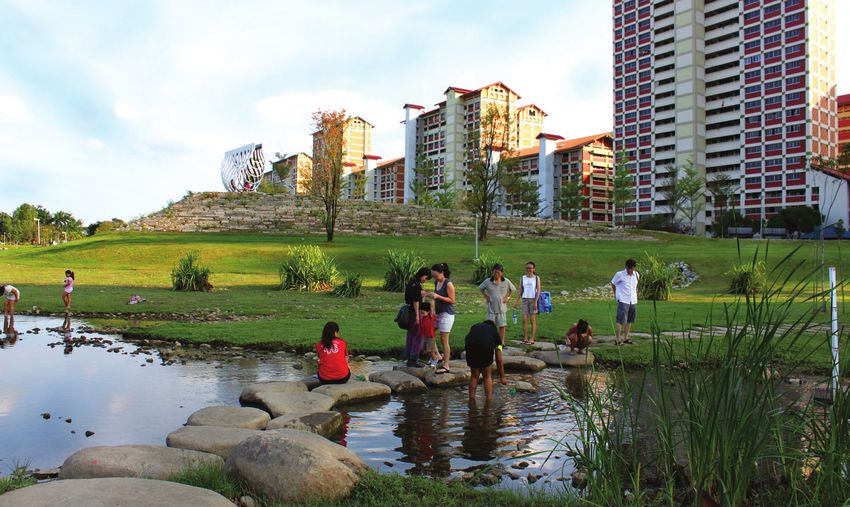
People at the stepping stones at Bishan-Ang Mo Kio Park, Credit: AtelierDreiseitl34 CASE STUDY CASE STUDY 35
RESILIENCE VALUE:
• Systematic, integrated, and long-term approach
• Access to a clean, green, and healthy living environment to
improve public health, economic competitiveness, and
social well-being
RESILIENCE QUALITIES:
Integrated Reflective Redundant
03 CITY RESILIENCE FRAMEWORK (CRF):
term Meet
long- s
ters
Greening the City
Fos planning basic n
egrated eed
s
nt
d &i
oa liv Sup
br ders
a ol em elih p
s
eh gy He pl o
ate alt
or s & t
k o
r
str
a
we
h
ts
Since our independence, the government recognised the value
od en
&
po
ym
st
&
of
Em
of providing people with access to greenery, as well as creating
e
we
ip
g
ran
rsh
llb
anag ip &
a pleasant and liveable environment for all. The pervasive green
de
ein
ent
Lea
Ens
ersh
em
hea
g
CLEANING &
spaces in Singapore today was not by chance as greenery was
ures
lth s
lead
01 put in place with infrastructure development. In 1963, then-Prime
ervice
effective m
public
Promotes
Minister Lee Kuan Yew launched the first tree planting campaign
s
and set a target of planting 10,000 trees every year, with half of
GREENING
communic
e &
ties
them along new roads, housing estates, school grounds, and
Provide
mmuni
ohesiv
car parks.
I n fr a
ation
s rel
tes c
d co
Cleaning Up the City
iabl
age
&m
mo
ty
s tr
SINGAPORE
cie
e
Pro
eng
uc
obi
Since then, Singapore has taken an integrated approach
so
tu
lity
y,
&
re
towards greening the city. In the 1970s, the Garden City Action
&
jus bilit
y
Creating a clean and healthy living environment were key en
En critic
om
nd sta
v ir
e
su
on
of
tic
on
re
Committee was formed to oversee greening efforts across co
Ec
al
priorities for Singapore in the 1960s. Living conditions and public
s
me so
ci
n
se tinu nt s
re ity a
al
rv it su
hygiene then were deplorable, and vector diseases were common various governmental agencies. The Parks and Trees Act was ice y
s Pro
v
En ecu
s
r
nat ides & e ic
occurrences. Any shocks—be it manmade or natural—often had enacted in 1975, mandating road codes that guarantee planting ura
l and
nhances
manma Fosters
econ
om
de e rity
a severe impact on the people. verges for trees along all roads, and requiring developers to set asse
ts prosp
aside green buffers. More recently, the Master Plan of 2003 was
This was why the government placed significant emphasis on released with the Parks and Water Bodies Plan and Identity Plan,
cleaning and greening Singapore. The first nationwide public which look to create an island-wide network of green and blue STAKEHOLDERS:
education programme—“Keep Singapore Clean”—was launched spaces. Between 23 July and 22 October 2002, public feedback
in 1968 to change public’s perception and behaviour with regard was sought and incorporated in these plans.
to cleanliness. Fines were imposed on individuals who littered, Government Grassroots Community
and competitions were held to rate schools, markets, community Despite intense urbanisation, green cover in Singapore has
increased from 36% in 1986 to 47% in 2007. Moving beyond
centres and government offices on their cleanliness. To lead by STATUS: ONGOING
example, Member of Parliaments (MPs) and community leaders making greenery prevalent, Singapore also focused on bringing
the community closer to it. To expand the network of greenery and As at 2015, we have
worked with residents to clean up common areas.
• 4,100 ha of park spaces
enhance the use of these spaces, the Park Connector Network
• 61 km of Nature Ways
Singapore became one of the first countries in the world to have was created to connect discrete pockets of parks, open spaces
• 300 km of park connectors
a ministry dedicated to the environment when it established and waterways with tree-lined walking and biking paths for
the Ministry of Environment (ENV) in 1972. The ministry the community.
took a systematic and integrated approach to managing the
environment by setting up an Environmental Public Health
02
Division to look after public hygiene, while the Engineering
Services Division provided and managed infrastructure such as 01 - Kite-flying on the garden roof at Marina Barrage, Credit: Ricard O'Rorke
sewerage, drainage and solid waste management systems to 02 - Residents participating in the street cleaning campaign (1967), Credit: Ministry of
Information and the Arts Collection, Courtesy of National Archives of Singapore
safeguard and sustain the environment. 03 - Grassroots leader planting a sapling at the plot between Blocks 25 and 26 in Toa Payoh
East on Tree Planting Day (1983), Credit: Ministry of Information and the Arts Collection,
Courtesy of National Archives of SingaporeYou can also read


