ABBOTS LEIGH, HAM GREEN, PILL, EASTON-IN-GORDANO NEIGHBOURHOOD PLAN
←
→
Page content transcription
If your browser does not render page correctly, please read the page content below
ABBOTS LEIGH, HAM GREEN,
      PILL, EASTON-IN-GORDANO

        NEIGHBOURHOOD PLAN
          Background Paper 2

        Transport and Movement

                    July 2019

  Background Papers were prepared over 2018 and
2019 to assist the Neighbourhood Plan Team develop
its thinking and proposals. Some of this background
 work has been overtaken by the development of the
                Final October 2020 Plan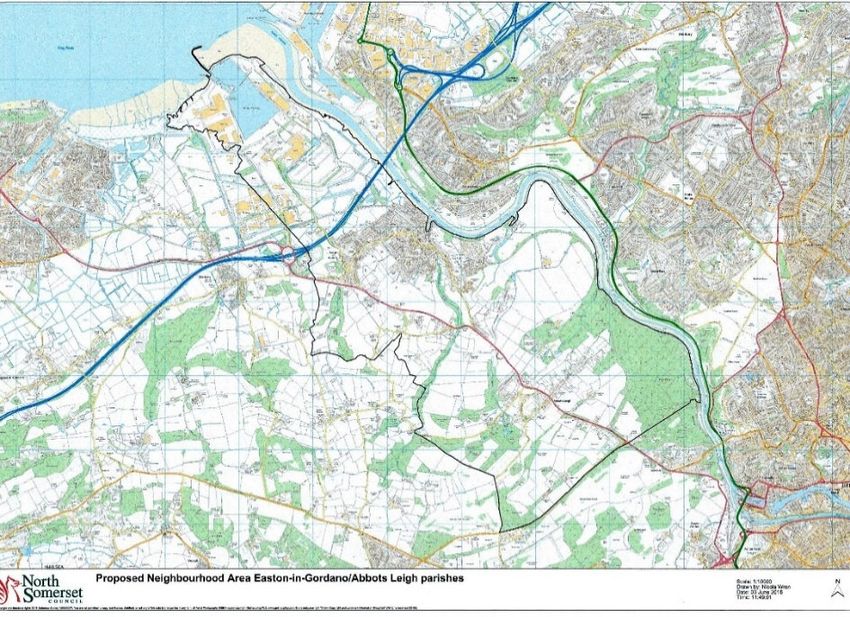
TRANSPORT AND MOVEMENT
SUMMARY AND CONCLUSIONS
A 369 and Pill Loop are the major routes through the Neighbourhood Plan Area, (NPA)
with a number of side roads feeding in both in Abbots Leigh and in Pill/Easton-in-Gordano.
Royal Portbury Dock lies in part within the Neighbourhood Plan Area generating traffic
both to and from the M5 Junction 19 but also along Marsh Lane by employees working at
the dock.
Information on car ownership, travel to work, journey destination, and distance travelled all
contribute to an understanding of travel flows into, out of and within the NPA.
Day time traffic flows (07.00-19.00) may rise as a consequence of increased population
and housing (including at Portishead).
Day time flows are around 21,000 with the A 369 heavily loaded and congested at peak
hours. Off-peak flows are typically a third lower.
Traffic flow is constrained by the narrowness of the road at Lodway in Easton in Gordano
and at the George Inn in Abbots Leigh.
Night time traffic adds 19% to daytime flows, producing a 24-hour traffic total approaching
21,000 vehicles on the A 369.
Car travel dominates on the A369 but HGVs and vans make up 18% of all traffic.
12% of active residents work from home. Travel to work is dominated by use of car or
van. A fifth of residents in work do so within the Neighbourhood Area with work journeys of
less than 2 kilometres.
There are important cycle routes (Avon Trail and the A369 cycle path) but travel to work
and to school by bicycle is relatively light
There is a network of Rights of Way and footpaths throughout the Neighbourhood Plan
Area together with two major walking routes.
There is a frequent bus service through the area, the regularity and reliability of which is
affected by congestion in Portishead and at Junction 19.
Recorded accidents involving casualties are rare. Speed limits have been reduced at the
margin on the A 369 but residents continue to regard speed and safety as key problems
Parking is a major concern – in particular along Church Road and at the junction of the
A 369 in Abbots Leigh, and around the Pill Precinct as well as residential streets in Pill.
Air Quality measurement at the Pill Road junction on the A369 shows this to be the third
highest level of air pollution in North Somerset.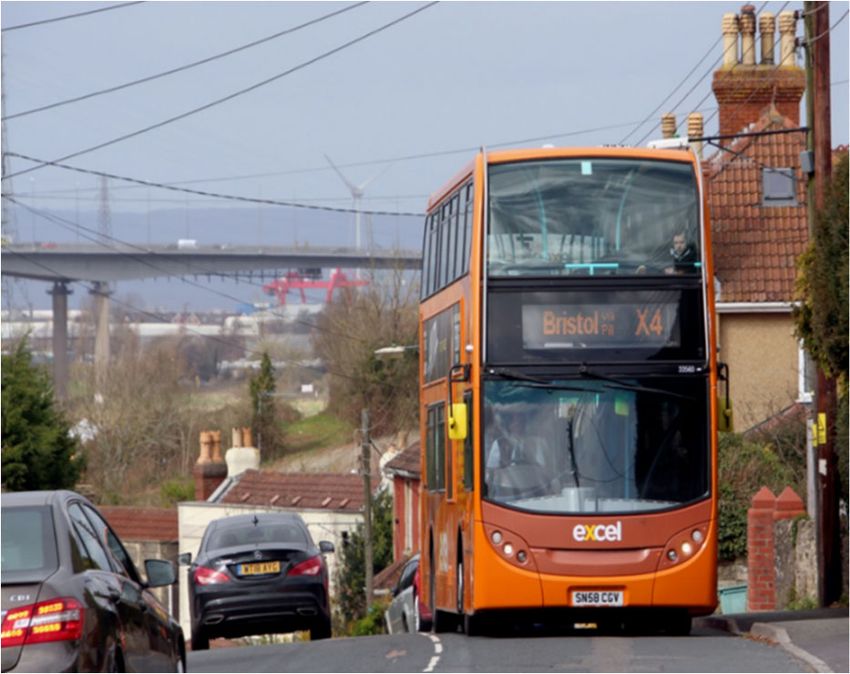
SECTION 1            INTRODUCTION
Movement within the Neighbourhood Plan Area is dominated by the A 369 bisecting the area
from the edge of Bristol to the M5. There are major community concerns about the traffic
associated with this busy and overloaded trunk road - volume, speed, pollution and safety. Also
important is the Pill Loop, running from the Haberfield junction on the A 369 and rejoining at St.
George’s Hill close to the M5. Within Pill itself there are concerns about the volume of traffic
through the village, as well as anxieties about parking and safety. Feeding into both the A 369
and the Pill Loop run a number of side roads and lanes, many narrow and twisting. Motorised
traffic is the largest worry for residents, but cycling and walking are also crucial community
concerns.
In preparing this statement the Neighbourhood team has been greatly assisted by an
independent study undertaken by Peter Evans Partnership, Bristol and much of material,
included in this report draws on their work. We have also drawn on advice from Locality on
what transport issues are appropriate for inclusion in a Neighbourhood Plan. Finally, there has
been an important input from the local community both through consultation meetings and input
to the traffic survey described below.

                               Map 1 The Neighbourhood Area
SECTION 2 MOTORISED TRAFFIC
Introduction
The A369 is heavily loaded. Traffic statistics were produced for the Neighbourhood Plan by
North Somerset Council (NSC) in April 2018. Further local resident-led daytime surveys (07.00-
19.00) distinguishing between different vehicle types were undertaken by Abbots Leigh
residents on the A 369 at the George Inn and by Pill and Easton-in-Gordano/Pill residents at St.
Katherine’s School and St George’s Hill on the Pill Loop.
2.1 Traffic Volumes: The A369
Table 1 North Somerset Council and Abbots Leigh Traffic Numbers
A369 All Motorised Users (AMUs) both directions
12Hr AM PM %HGV % Flow East %Flow West
Flow Peak Peak bound bound
North Somerset 17056 1778 1868 2.8% 54% 46%
Council (NSC)
Abbots Leigh 16987 1793 1886 2.6% 52% 48%
NB Peak hours in this table are AM 08.00-09.00 and 17.00-18.00.
There are inevitably some small variations between the NSC and local survey data. The census
points were slightly differently located, with NSC measuring A 369 traffic just west of Beggar
Bush Lane and the local survey the George Inn. There are entry and exit points in between
these two census points. Weather conditions were variable between the March/April 2017
figures (NSC) and the October 2018 local survey figures. There may have been errors in
counting.
Nevertheless, the two sets of figures – both conducted on weekday school term days –are
remarkably close. The overall daytime flows and the peak hour morning and evening flows are
similar as is the balance of flows in terms of east and west direction, and the percentage of
HGVs.
On the A 369 at Beggar Bush Lane night-time flows (19.00-07.00) were around 19% of daytime
flows with the implication that 24-hour flows on the A 369 (at Abbots Leigh) were around 20,250
in March/April 2018. This lies close to a second estimate made by NSC of a 24 flow of 20,910.
For more detail on hourly flows and on the volumes of different types of vehicle and on peak
hour flows, we set out below an analysis based on the 2018 ALPC Census.
Table 2 Traffic on the A 369 at the George, Abbots Leigh (October 2018)
The George The George Inn
Inn to Bristol % from Bristol %
All Daytime Vehicles 9017 8111
Peak Hour vehicles am 2000 22.2% 1522 18.8%
Peak Hour vehicles pm 1840 20.4% 1783 22.0%
All Daytime Cars 7217 6512The George The George Inn
Inn to Bristol % from Bristol %
Peak Hour Cars am 1604 22.2% 1255 19.3%
Peak Hour Cars pm 1477 20.5% 1493 22.9%
NB Peak hours in the following ALPC tables are 07.00-09.00 and 16.00-18.00.
A number of findings emerge from the more detailed figures.
The total daytime traffic flow into and out of Bristol amounted to around 17,000 motorised
vehicles (excluding bicycles).
The overall daytime flow into Bristol (9,017 vehicles exceeded that outwards from Bristol
(8011) by 11%
There was a significant flow during the daytime with an average hourly flow into Bristol of
751 vehicles and outwards of 676 vehicles.
Peak hour traffic into Bristol accounted for 22.2% of all daytime traffic but only 18.6% of
daytime traffic outwards from Bristol
The morning peak hour flow of 2000 vehicles into Bristol (07.00-09.00) exceeded the
evening hour flow outwards (16.00-18.00) by 12%
Cars dominated traffic volumes by over 80% both throughout the day and at peak hours.
Heavy Goods vehicles flowed throughout the day – around 220 in each direction but
making up only 2.5% of all traffic.
By contrast vans - 1440 a day towards Bristol and 1210 outwards comprised 15.5% of all
traffic.
12 hour daytime traffic is estimated to have made up 81 % of all 24 hour traffic.
2.2 Traffic Volumes: The Pill Loop and the A 369
We have no NSC traffic data for the Pill Loop but data for the two ends at St Katherine’s School
and St. George’s Hill were collected by Abbots Leigh, Pill and Easton-in-Gordano residents.
The Pill Loop figures are slightly distorted by the fact that there is entry into and out of Royal
Portbury Dock via Marsh Lane from Priory Road in Easton-in-Gordano and also out of the
village onto the A 369 by the narrow Rectory Road
Table 3 Traffic on the Pill Loop (October 2018)
St. Katherine’s % St. Katherine’s %
School to Bristol School to Pill
All Daytime Vehicles 2105 2190
Peak Hour Vehicles am 440 20.9% 496 22.6%
Peak Hour Vehicles pm 455 21.6% 430 19.6%
All Daytime Cars 1777 1840
Peak Hour Cars am 362 20.4% 451 24.5%
Peak Hour Cars pm 412 23.2% 361 19.6%St. George’s Hill % St. George’s Hill %
towards Pill towards the M5
All Daytime Vehicles 2539 2356
Peak Hour vehicles am 399 15.7% 476 20.2%
Peak Hour vehicles pm 507 20.0% 475 20.2%
All Daytime Cars 2036 2023
Peak Hour Cars am 301 14.8% 428 21.2%
Peak Hour Cars pm 418 20.5% 399 19.7%
Over two thousand vehicles per day (2105) pass St Katherine’s School towards Bristol. Around
30% turn towards Martcombe and the M5 (so contributing to the numbers shown above in Table
2) ,Roughly the same number (2190) leave the A 369 to go into Pill past St. Katherine’s As on
the A 369 as a whole cars are slightly more dominant throughout the day (84%) and even more
so at peak hours - 77% towards Bristol, 88% towards Pill, a balance in part explained by the
school run in the morning to St Katherine’s.
At St George’s Hill 2,356 vehicles a day leave Easton-in-Gordano to join the M5 whereas a
slightly larger number (2,539) leave the A 369 to enter Pill. The imbalance is in part due to the
one-way access to the A 369 via Rectory Way which allows the vehicles from Pill to join the
A369 and avoid the controlled St George’s Hill junction. As elsewhere cars dominate (even
more so than at St Katherine’s) with 85.6% towards the M5 and 89% into Pill during the whole
day. At peak hours into Pill the proportions are 80% (all day) and 82% (at peak) and 88.7% at
peak towards the M5, but only 80% and 82% at peak. By contrast with the main A 369, whilst
peak hours dominate, the volume of traffic is spread more evenly throughout all other hours
across the day.
2.3 Traffic Growth
Not only are the current levels of traffic causing some congestion at peak hours, but further
growth is inevitable. The JSP Transport Topic Paper (2018) suggested that daytime traffic flows
(07.00-19.00) would be expected to rise significantly as a consequence of increased population
and housing (including at Portishead1 Whilst no increased traffic flows have as yet been noted
as a consequence of the removal of tolls on the Severn Bridges and/or the opening of the South
Bristol Link, these, together with Royal Portbury Dock - a strategic economic growth area which
may grow further – may influence traffic movement in and around the Neighbourhood Plan Area
over the next seven years.2
Other future influences may be those of South Bristol Link together with that of traffic from South
Wales towards Bristol stimulated by the removal of tolls on the Severn Bridges. Part at least of
these impacts may be onto the A369. Government predictions were that the longer-term effects
(2018-2027 of traffic across both Severn Crossing would be to increase traffic by 48%.3 Finally
Royal Portbury Dock is a strategic economic growth area, which may grow further and is
already putting pressure onto Junction 19 of the M5.
1 North Somerset Site Allocations Plan 2018 Table 1 p 43.
2 See Chapter 9 below.
3
Forecasts indicate that traffic across the Severn Crossings will increase by 28% between 2018 and 2027.Travel patterns – current and future – are influenced by a range of factors. For example, the
growing number of vans reflects the increase in home deliveries which in turn has an impact on
parking. Other factors affecting traffic growth include the levels of car ownership, the method of
travel chosen (to work, to access services or for recreation), the distance travelled to work, the
destination and the distance of the work journey. These are discussed in turn below.
2.5 Car Ownership
In Pill and Easton-in-Gordano 14% of households have no access to a car or van, whereas in
Abbots Leigh only a few households (2.6%) are without a car. There is higher level of single car
ownership in Pill/Easton (43.7%) than in Abbots Leigh (33.3%) and in Pill/Easton there are over
40% of households with access to two cars - a higher level of two car ownership than in Abbots
Leigh. Conversely ownership of two, three, or more cars is more widespread in Abbots Leigh.
Table 4 2011 Car ownership
Car ownership Abbots Leigh
Houses Flats All Dwellings
No Car 2.7.% 0% 2.6%
One Car 32.2% 75% 33.3%
Two Cars 65.1% 25% 42.4%
Three Cars 15.2%
Four + Cars 6.5%
Car ownership Pill and Easton-in-Gordano
Houses Flats All Dwellings
No Car 11.8& 29.8% 14.0%
One Car 42.5% 52.3% 43.7%
Two Cars 45.7% 17.9% 33.0%
Three Cars 7.3%
Four + Cars 2.0%
2.6 Method of Travel
Abbots Leigh has significant numbers working at or from Home (14%) in comparison with
Pill/Easton where homeworking runs only at 6% (combined figure 7%). Throughout the Area,
however, over seventy per cent of journeys to work are by car or van either as driver or
passenger. Travel to work is dominated by use of car or van. Eight per cent of Pill/Easton
journeys are on foot and, perhaps surprisingly, five per cent of Abbots Leigh journeys are also
on foot, explained perhaps by the fact that Abbots Leigh Nursing Home and St. Katherine’s
School are both in Abbots Leigh.
Table 5 Method of Travel to Work
Pill and Easton-in-
Method of Travel Abbots Leigh Gordano
Work mainly at/from home 14% 6%
Tube, tram etc. 1% 0%
Train 2% 0%
Bus, minibus, coach 2% 4%Pill and Easton-in-
Method of Travel Abbots Leigh Gordano
Taxi 0% 0%
Motorcycle, scooter, moped 0% 1%
Car/Van (driver) 67% 70%
Car/Van (passenger) 5% 6%
Bicycle 3% 4%
On foot 5% 8%
Other 1% 1%
TOTAL 100 100
2.7 Location of and Distance travelled to work
Data from DataShine shows the location for employment – a determinant obviously of the
distance of the work journey. Information about workplace location is drawn from the 2011
Census small area data (MSOA 004) an area which in broad terms covers Abbots Leigh and
Pill.
Table 6 Destination of travel to work journeys
Almost a fifth of residents work from home (see also table 5 above). A further fifth work within
the Neighbourhood Area and probably have work journeys of less than 2 kilometres. Abbots
Leigh residents have longer journeys of up to 10 kilometres, many to central Bristol, and some
travel over 60 kilometres again probably to London. Some Pill residents also make longjourneys but the data shows that half of the journeys to work from Pill/Easton residents in
employment are to Portishead, nearby villages and Avonmouth.
Table 7 Location of Workplace
Location Neighbourhood Area
Home 7%
Pill and Abbots Leigh (including Royal Portbury Dock 18%
Central Bristol 15%
Portishead 7%
Nearby (Portbury, Failand, Tickenham, Long Ashton) 6%
Avonmouth 4%
Other 43%
Table 8 Distance travelled to work
Distance Abbots Leigh Pill and Easton-in-Gordano
Less than 2km 2.0% 13.8%
2 to 5km 26.8% 12.0%
5 to 10km 23.8% 34.1%
10 to 30km 11.7% 15.6%
30 to 60km 1.2% 1.5%
60 km and over 5.5% 3.2%
Work from Home 22.4% 10.7%
Other 6.7% 9.2%
2.8 Safety and Parking
Safety Data provided by North Somerset council confirm that over recent years the
Neighbourhood Area is not a high accident area. On the A 369 between Beggar Bush and
Martcombe there were sixteen accidents in the last seven years involving twenty-four casualties
– two serious and twenty-two slight. Motor cars accounted for all but three of the accidents
barring three involving bicycles. Since those records there has been one pedestrian fatality
near Beggar Bush. In the latest three years there have been four slight accidents (involving a
cyclist, a pedestrian, a horse rider and two cars. On neither the A369 nor the Pill Loop have
accidents involved pedestrians.
Despite these relatively small numbers there are fears in the community about speeds on the
A369 and the risk of accidents. These fears are most severe at junctions, where the majority of
accidents occur (ten out of the above sixteen), notably junctions on the A369 between the
George Inn and Pill Road. There are also concerns about the risk to cyclists as they join the
main road from side roads and/or cycle paths.
In Pill there have been concerns about a number of danger points on narrow streets/lanes
and/or where visibility is poor. In the 2006-16 Parish Plan for Easton-in-Gordano, Pill and Ham
Green there was support for a one-way priority system at Lodway and for a safety rail on the
raised footpath, also at Lodway.There was also support for a speed limit of 20 mph throughout the village and in 2018 the Pill Parish Council initiated a further consultation on the possibility of a 20 mph speed limit across the entire built up area from St. George’s Hill to St. Katherine’s School or on all residential roads off the main through road. A majority of a small number of respondents preferred the first option, and also favoured improved parking arrangements around the Green, and on other local roads. In Abbots Leigh current parking concerns have arisen in Church Road as a consequence of the combination of the re-opening of the George Inn, the opening of a Fitness Gym, and the more frequent presence of delivery vans. There is a need for a footway alongside the A 369 Linking Martcombe to Pill Road into Ham Green. Parking on the footways on Pill makes it more dangerous for people who want to walk around the village and may deter them from walking as an alternative to using their cars 2.9 Capacity, Overload and Congestion The guidance on road design provided to us by Peter Evans Consultants included the Design Manual for Roads and Bridges, relevant to roads managed by Highways England as well as those maintained local highways authorities. The criteria for assessment of capacity include the width of carriageway, the road purpose (single or wide), the vehicle combinations that can be accommodated (how many cars/lorries can pass), the speed limit applicable, and the road arrangements (e.g. pedestrian crossings, traffic lights). In practice design capacity is often exceeded by operational flows. This is evident at a number of points on the A 369 where daily flows of up to 22,000 have been counted. At the same time there can be pinch points at which actual traffic flow falls well below design capacity. The A369 Through Abbots Leigh at the George Inn the A 369 has frontage access, side roads, bus stops, and an at-grade pedestrian crossing. The speed limit is 30mph, the road width varies from 4.8m to 9.6m. It has a nominal road capacity of less than 900 vehicles by direction per hour (or 1500 on a two-way split) in the peak hour. Current operational flows exceed this frequently by 33%. Up the Pill Road much of the road is within its capacity but on the stretch towards Martcombe the road is already beyond design capacity, At and beyond St. George’s Hill traffic flow is limited by the provision of the three signal-controlled junctions. The Pill Loop The narrow part of the Pill Loop is at Lodway. Technically the road width allows a car and lorry to pass, but with walls on one side and a pedestrian walkway (without railings) on the other in practice only two cars can pass and on-site observation provides evidence that the road is often in practice one way4. At Priory Road traffic flows are similar to Lodway and on these stretches the road is operating at capacity at peak times during the day. In summary, the A369 at the George Inn is at or above its capacity in the peak hours. On other sections of the A369 operational traffic flows are above capacity level. The three traffic signals close to the M5 Junction 19 are the defining constraint (as opposed to road width). On the Pill Loop at Lodway (and to a lesser extent at Priory Road) road width is the capacity constraint with the road already operating at capacity at peak times. Typically, but depending on household vehicle ownership, new residential housing might add 0.45 to 0.55 peak hour trips (2 way) to traffic flow. New development of up to 1000 dwellings 4 PEP consultants observed traffic flows as part of their work for us.
accessing the A 369 and generating travel in both directions might therefore generate 500 extra
peak hour trips of which perhaps 300 might be towards Bristol, thus adding a third to peak hour
traffic.
2.7    Pollution
The main pollutant measured by NSC locally is nitrogen dioxide (NO2) originating primarily from
road traffic emissions. Monitoring for 2017 (the latest year for which results are available)
shows that all of the twenty-six air quality sites in North Somerset show levels below the
objective of 40pg/m3. There are two sites in the Neighbourhood Area – in Pill at the end of
Avon Road (the Railway Line) and at the junction of the A369 and the Pill Road (the A369). At
the Railway Line the mean 2017 level was 6.1, - unsurprising perhaps given this location. At the
A369 site the mean annual level was 28.0 – the third highest annual level in North Somerset.
From November to April inclusive, however, the level of air quality was above 30.0 and reached
45.1, again the third highest level for any month across the whole district.

                      SECTION 3             CYCLING AND WALKING
3.1 Cycle Networks
A traffic free cycle route runs alongside the A 369 from Bridge Road in Leigh Woods all the way
to the road into Pill at Ham Green. The section to the George in Abbots Leigh has been
designated as National Cycle Route 334 and following Manor Road, past Abbots Pool and
then Sandy Lane this continues through to Lower Failand and Portbury. This cycle path attracts
both commuter rides to Bristol but also recreational cycling, accessing for example Leigh
Woods, Abbots Pool, Snake’s Well. The A 369 cycle route, currently only cleared once or twice
a year needs proper maintenance to attract users. There are several side entrances and 'give
way’ markings which confuse even hardened cyclists. As a result, as many people choose to
cycle on the main road as on the cycle path because it is quicker.
The cycling and walking National Cycle Route 41 (the Avon Trail) runs along the towpath
beside the River Avon through the Avon Gorge to Chapel Pill, through Watchhouse Hill and Pill
and then connects to the cycle route on the Avonmouth Bridge across the river. The towpath
section of this route lies within the boundary of Bristol City Council and is thus outside the
Neighbourhood Area having been historically the towpath up the river through the Avon Gorge
leading to the Port of Bristol. The route is poorly maintained so that in wet conditions it has
become difficult for cyclists. The route offers offers a level access into Bristol and was popular
as both a commuting and recreational route, but its condition is a disincentive to use and
sections of it have now become poor. National Cycle Route 26 branches off Route 41 before
the Avonmouth Bridge and goes through Royal Portbury Dock to Sheepway and Portishead.
3.2    Cycling Numbers
The 2011 Census shows that only 7.4% of Neighbourhood Area residents in employment
travelled to work by bicycle (199 cyclists). Since then the numbers choosing the bicycle as a
means of travel – to work and elsewhere – may have risen. Cycling has become more popular,
cycling has become safer, the cycle path beside the A 369 has made travel to and from Bristol
more acceptable. These trends are borne out by the numbers observed in the local traffic
counts.
Table 9 Cycling Numbers in the Neighbourhood Area (October 2018)
The George Inn The George Inn
to Bristol % from Bristol %
All Daytime Bicycles 79 141
Peak Hour Bicycles am 40 50.6% 29 20.6%
Peak Hour Bicycles pm 29 36.7% 23 16.3%
St. Katherine’s St. Katherine’s
School to Bristol School to Pill
All Daytime Bicycles 50 46
Peak Hour Bicycles am 16 32.0% 15 32.0%
Peak Hour Bicycles pm 15 30.0% 12 26.1%
St. George’s Hill St. George’s Hill
towards Pill towards the M5
All Daytime Bicycles 37 20
Peak Hour Bicycles am 25 67.6% 0 0%
Peak Hour Bicycles pm 7 18.9% 9 45.0%
3.3 Where there are significant differences between am and pm peak flows, as at the George
Inn, this may be because some cyclists prefer to avoid the evening peak hour rush. It is not
unusual for PM peak period cycle flows to be lower than for the AM peak period. AM peak
periods include trips from home to School or colleges whereas the return home trips fall outside
of the PM peak period. Additionally, there are trips in the PM peak that are not employment
related so return trips are not restricted to the PM peak period. This is especially notable in the
winter months where darkness prevails in the PM peak period and conditions for cyclist are less
favourable.
There are four fixed cycle counters in the Neighbourhood Plan area. These show that in
addition to the numbers shown in table 9 there are significant cycle flows elsewhere.
Table 10 Cycling Flows at Cycling Points
Location Point Average weekday flow
A 369 Clifton College Sports Ground 73
A 369 near turn off to Pill 59
Avon Trail at Pill alongside disused railway 279
Sheepway Bridlepath 203
Comparing the numbers at the George Inn with the cycle path counter data suggests that the
figures indicate that up to two thirds of the cyclists on the A 369 use the carriageway rather than
the cycle path, confirming the point made earlier that many cyclists avoid the cycle path.
It is noticeable that the predominantly westbound flow pattern coincides with the alignment of
the cycle path alongside the westbound carriageway. The data suggest that the imbalance is
greatest outside of the peak periods and thus suggests that there is significant traffic along this
route that is leisure related. This can often explain imbalances in flows due to the often circularroutes followed by many leisure cyclists. NC Route 41 provides a connecting route to NC Route 26 where average daily flows of 279 are recorded alongside the railway under the M5 Bridge. Cycle flows at this latter location are a combination of trips generated To/From both M5 Bridge route and the Pill Path connecting to Avon Way. Flows recorded further along this route at Sheepway are considerably lower there are some cyclists use the path from Pill to Sheepway – possibly making travel to work journeys to Royal Portbury Dock. Finally travel by bicycle to school runs at 4% of pupils at St. Katherine’s School, suggesting that improved safety and/or a 20mph speed limit for residential areas of Pill and Easton in Gordano might significantly improve conditions for cycling to school and indeed for all cyclists. 3.4 Walking: Rights of Way and Footpaths There is an extensive network of walking routes (some shared with cyclists) into, out of and across the Neighbourhood Area. These routes serve a number of purposes. Walking to Work. Section 2.8 above sets out the location of and distance travelled to work emphasising that travel to work on foot and doing so over a distance of less than 2 kilometres accounts for around fifteen per cent of work journeys although the 2011 Census shows that only 7.3% of those in employment walk to work. Walking to work is most likely for those employed locally – in shops in the precinct or elsewhere, at the schools, at the Heywood Health Centre, in pubs. A few will also walk to work in the two business centres at Eden Park and the Old Brewery or at Penny Brohn but information collected from such organisations suggests the numbers are low – Eden Park has over 320 parking places, Penny Brohn 80 and both are regularly full. Walking to Access Services. Within Pill there several walks and lanes which cut down from Westward Drive, Cross Lanes and Crockerne Drive to give access to the retail outlets of the Precinct as well as to the Post Office, the Resource Centre and Victoria Park. By Pill Creek there are paths which lead up to Watchhouse Hill, others which take walkers down past the Dip to the Severn Estuary and the rhynes of Royal Portbury Dock, whilst other lanes provide access upwards to what will soon be the new rail station. Recreational Walking. North Somerset Council, (the Highway Authority) manages the legally recorded Public Rights of Way within the Parishes. The position, and legal status of these paths is recorded on the ‘working copy Definitive Map’ held by North Somerset Council and is available via the Council’s website. Public access to unrecorded routes would be with the consent of the landowner. Duties and enforcement powers with regards to Public Rights of Way lie with North Somerset Council. Parish Councils, however, have ‘powers’ in relation to definitive routes and are able to arrange or contribute funds towards improvements, such as replacing stiles with gates or clearing vegetation locally important routes. Public Rights of Way are, in the main, across private land, and responsibility for any structure across a Right of way/public path such as a gate or stile, lies with the landowner. It is also the responsibility of alongside landowners to maintain their boundary and ensure vegetation does not impede access to any path. The Highway Authority have ‘control’ of the surface of a Public Right of Way and endeavour to maintain it in a condition suitable for safe public access. There are two major trails relevant to the Neighbourhood Plan Area – the River Avon Trail and the Gordano Round. The River Avon Trail (see also Cycling above) runs alongside the river from below the Clifton Suspension Bridge to Pill. Technically much of the trail lies within the boundaries of Bristol City Council (the BCC boundary is the south bank of the Avon) but from Chapel Pill it strikes inland. The Trail is managed by the Avon Frome Partnership.
The Gordano Round, devised by the Gordano Footpath Group, is a circular walk much of it
within the Neighbourhood Plan Area, passing Haberfield Park Farm, Happerton, Markham, and
Summerhouse Wood and Failand Farm, returning thereafter via Glen Farm.
The long-distance Monarch’s Way (allegedly approximating the escape route taken by King
Charles II in 1651 after being defeated in the Battle of Worcester) passes through Abbots Leigh
where allegedly the king spent a number of nights unrecognised at Leigh Court.
There are numerous rights of way and footpaths on the Leigh Court Estate as well as some
footpaths which lead down through the Bottoms across Priory Fields towards Pill
The main Rights of Way footpath routes are:
The Gordano Round (circular walk) from Haberfield > Happerton > Summerhouse Wood
>. Failand Farm > Glen Farm
Monarch’s Way Beggar Bush > Coronation Avenue > Home Farm Road > Church Road
Monarch’s Way Beggar Bush Abbots Leigh Kennels > Happerton Lane
Happerton Lane to Sandy Lane (two paths)
Abbots Leigh Kennels > Blackmoor > Ham Green > Watchhouse Road
Water Lane > Crockerne Drive > Markham Farm and Martcombe
Cross Lanes > past allotments > Priory Fields > Rectory Road (x3)
St George’s Hill > Summerhouse Wood/The Bottoms
Brookside > Martcombe Road
Severn Road > The Breaches >Stoneyfields Road/The Poplars
Old Sea Bank – Marine Parade.
The Longshore Wal. Severn Road > under the M5 >alongside the Dock fence.
The Drove Rhyne (Royal Portbury Dock)
Leigh Woods and Leigh Court Estate – a number of cross-cutting paths
Sandy Lane > Abbots Pool > Manor Road > Cotham Park > Beggar Bush
Weir Lane > Sandy Lane (Tanpits).
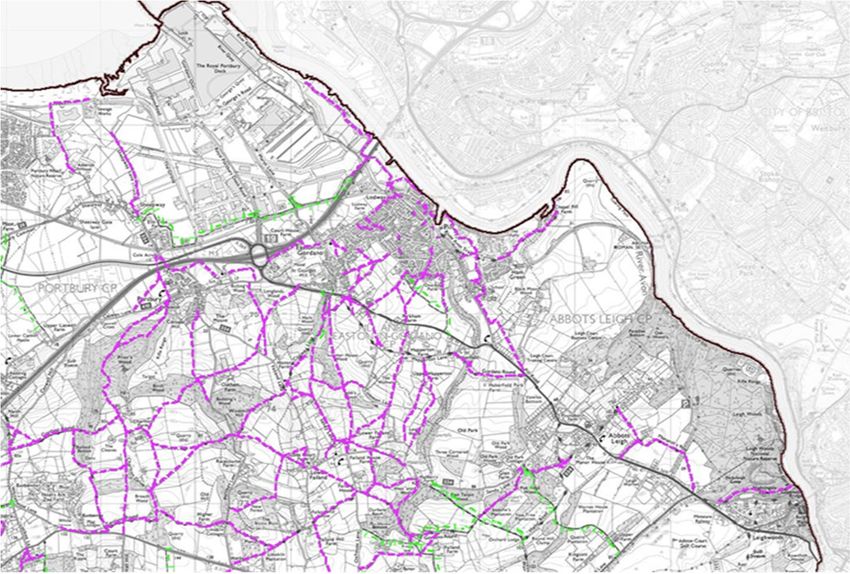
For more detail see Map 2 below.
Map 2 Rights of Way in the Neighbourhood AreaElsewhere within the Neighbourhood Area there are several shorter footpaths/bridlepaths
running both through and across the two parishes, as well as a number of lanes and
passages within the Pill Settlement area which serve to link streets together and/or provide
short cuts to the Pill Precinct.
Some of these would benefit from improvement either as public footpaths or permissive paths
(e.g. links between Church Road in Abbots Leigh to the Leigh Court area and on to Ham
Green, also between Church Road and into Leigh Woods. In Pill and Easton-in-Gordano
there is concern about threats to the Rights of Way crossing from the A 369 to Cross Lanes
and Rectory road, whilst the Longshore Walk would benefit from regular maintenance.
SECTION 4 PUBLIC TRANSPORT
Buses
The Neighbourhood Area is currently served by two bus services. The X4 serves Abbots
Leigh, Pill, and Easton whilst the X3 keeps to the A369 bypassing Pill and Easton. The
services are regarded by the community as being acceptable subject to regularity and
reliability and the recent change to a double decker service is evidence of the commitment of
the bus company to a good service.
The X4 passes St. Katherine’s School but the school also benefits from a dedicated schools
bus service (7 buses a day).
Train
A Bristol Temple Meads to Portishead rail service is scheduled to open in (2023). Services
will call at Pill, where a restored station will be created (off Station Road) with parking. The
new service will attract some traffic off the roads and will provide faster journeys to Bristol
and to Portishead. The longer-term proposal for a station at Ashton Gate would also be of
benefit to users wishing to access events at Ashton Gate Stadium. it is unlikely that there will
be significant usage from Abbots Leigh residents although the possibility of travelling to Pill to
make a bus/rail connection will be a realistic one.You can also read


