ACQF Peer Learning Webinar 9
30 June 2021
←
→
Page content transcription
If your browser does not render page correctly, please read the page content below
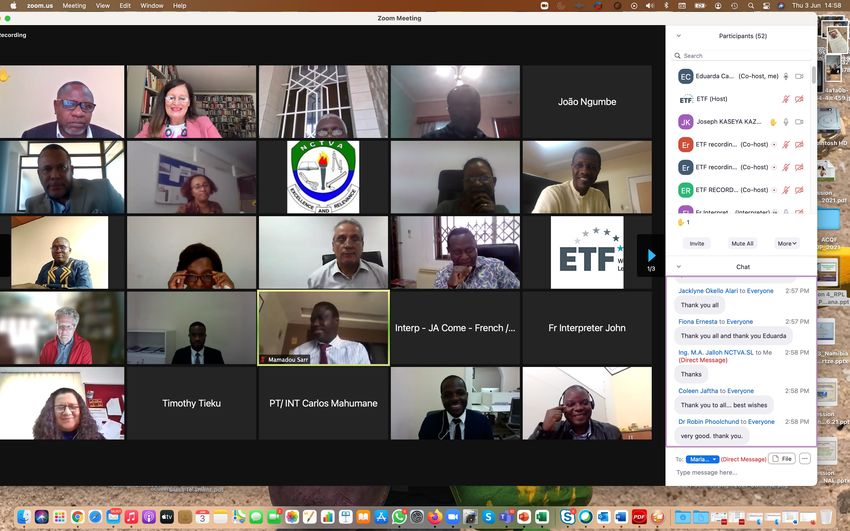
ACQF Peer Learning Webinar 9 30 June 2021

ACQF Peer Learning Webinar
                30 June

        • We start at 10.00 GMT
11.00 RDC, 12.00 South Africa, 13.00 East
         Africa, 14.00 Mauritius

   • Nous commençons à 10.00 GMT
    • Vamos começar às 10.00 GMT
ACQF Peer Learning Webinar 9
                  30 June
• Welcome             • Bienvenu(e)s        • Benvindo(a)s
• We start soon       • Début sous peu      • Começamos em
• Please use                                  breve
                      • Veuillez utiliser
  TRANSLATION –                             • Por favor, use a
                        TRADUCTION –
  select your                                 TRADUÇÃO –
                        votre langue          selecione o seu
• You can keep          préférée
  your camera on,                             idioma preferido
  but sound off, if   • Vous pouvez         • Pode manter a
  not speaking          garder l’image –      sua imagem;
• If you did not        mais son étteint      mas o som
  give consent to       si vous ne parlez     apagado
  record – please       pas                   enquanto não
  camera off                                  fala
Agenda of the Peer
              Learning Webinar
Main topics
              African experiences
    of this   shared today
 session 1
              ACQF Capacity
              development programme
PLW 9 – 30 June 2021
Time, heure, hora   Theme, theme, tema                                        Speaker, orateur,
                                                                              orador
10.00-10.10         Opening and welcome. Ouverture. Abertura                  AUC
10.10-10.30         Overview of learning and issues discussed at previous PLW ACQF project
Session 1

10.30-11.10         African Quality Assurance experiences                      Secretary General of
Session 2           •   CAMES – African and Malagasy Council for Higher        CAMES
                        Education. Goals, programmes, instruments, status of
                        LMD.

11.10-11.40         African Quality Assurance experiences – Expériences        ANAQ-Sup
Session 3           Africaines en Assurance Qualité – Experiências Africanas
                    de Garantia de Qualidade
                    •   ANAQ-Sup - Senegal: quality assurance in higher
                        education – policy, system, implementation

11.40-12.10         African experiences                                   Africa Early Childhood
                    • Early childhood education and development – towards Network (AfECN)
                         a continental framework – role of qualifications

12.10-12.30         Discussion, interactive assessment, main conclusions       ACQF Project
AFRICAN EXPERIENCES
    QUALITY ASSURANCE HIGHER EDUCATION
EARLY CHILDHOOD EDUCATION AND DEVELOPMENT

CAMES: Secretary General, Prof.
Bertrand Mbatchi
ANAQ-Sup: Executive Secretary,
Prof. Lamine Gueye (Senegal)
AfECN: Mr Moses Abiero,
Programme manager
2. Context:
ACQF
is in
development
ACQF development project (09/2019-2022)
                                                                          Component of “Skills for Youth Employability”
                                                                           / Skills Initiative for Africa (SIFA) – Technical
                                                                                              cooperation

 Conditions for Success
 in the Implementation of the African
 Continental Free Trade Agreement

                                                                           Main objective: lay the foundations for the
 Work commissioned by the African Union Development Agency (AUDA-NEPAD)

                                                                             ACQF as a sustainable policy instrument
                                                                           contributing to relevant continental policies

 Frederick S. Pardee Center for             African Union Development
 International Futures contributors:        Agency contributors:
 Dr. Jonathan D. Moyer                      Dr. Ibrahim Mayaki
 Dr. Abigail Kabandula                      Martin Bwalya
 David K. Bohl
 Taylor Hanna

                                                                          Main Output: ACQF Policy and Technical
               CONTINENTAL
            EDUCATION STRATEGY
                                                                          Document and Action Plan
                FOR AFRICA
                                 2016 – 2025                              • ACQF Guidelines. Analysis and evidence
                                                                          • Capacity development programme
                                 CESA 16-25                               • Participative approach
Functions:
                                  • Overarching framework against which national and
Principles:                          regional frameworks and level descriptors - can be
• Inclusive: all levels Qualifº      calibrated.
• Innovation-ready                • Referencing / alignment qualifications framework –
• Open: users, stakeholders’         NQF-RQF
    needs                         • Reference for comparison with other international
                                     frameworks
                                  • Hub, catalyst for development of national
                                     qualifications frameworks and their instruments 9
Components Capacity Development Programme (CDP)
 Combination of modalities for different needs (2021)

                           5 Peer
                          learning
                          webinars

                                        Training
            Education
                                      workshops
           institutions
                                      (on-offline)

                          CDP
           E-Learning
                                      Conference
            platform

                          Work with
                          countries
Peer Learning Webinars 2021
Complementarity: NQF - Quality Assurance - Recognition
30 June
Quality 22 July 23 September 28 October
3 June Assurance
Higher
education NQF –systemic
view
NQF Regional - Learning
Seychelles CAMES School
NQF-TVET outcomes
curriculum
NQF Senegal - ACQF Level survey
Registers
Anaq-Sup descriptors
Namibia qualifications TVET-NQF
Recognition QA reforms
RPL Kenya Early Guidelines
qualifications ACQF-AfCFTA
childhood
education &
developm1. Learning outcomes
2. Level descriptors
3. Referencing NQF-ACQF: criteria, process, tools
10 4. Validation of learning: RPL, CATS, recognition
Guidelines
5. Quality assurance
and
6. Registration, databases of qualifications
training
7. Monitoring & evaluation in the context ACQF
modules
8. Communication / users’ outreach
9. Innovation and technology in NQFs / ACQF
10. Qualifications, NQFs, NQS - systemic viewThematic briefs 8 briefs • Concepts and definitions • Competences’ frameworks • Level descriptors • Quality Assurance in TVET • Regional qualifications frameworks (RQF) • Governance of NQFs • Registration and databases of qualifications • Recognition of prior learning Case studies
For information, self-learning
https://www.etf.europa.eu/en/news-and-events/events/acqf-peer-learning-
                              webinar-9
From previous webinar (03 June) Seychelles: NQF – part of national strategy to incorporate standards and quality into the national education and training system. Since 2008. SQA. Qualifications map: architecture 10 levels, qualif. types, notional hours, pathways. Over 100 qualifications registered. Aligned with SAQCQF Namibia NQF: E-T is about People, Planet, Change. NQF Purpose: reform, communicate, redress, QA, articulate, progression, mobility. 10 levels. Qualif types: Certificates (L1-8), diplomas (L5-8), Degrees (L7-10) – defined NQF credits. NQA (NQ Act 1996) – Council & Committees, Secretariat , CEO; wide range of functions: from standards setting to evaluation and validation RPL Kenya, KNQA: tool for LLL, empower individuals to self-determination, education, better employment; paradox of shortage of relevant qualified workforce while there is island of skilled / experienced workers without proof qualification. RPL: identify, assess, certify KSC regardless where and how learning occurred / standards – part or full qualification. RPL policy framework taking shape fast - integrate RPL in E-T system and NQF. Roadmap implementation. Package of tools and guides. NAC appointed. Piloting started 19/05/2021: motor vehicle mechanics, welding, textile. Highest level political support.
Questions, discussion
Questions on Quality Assurance
           Higher Education
•   Les défis et surtout l'opportunité des grandes transformations
    globales en cours (transitions numérique, verte, technologique,
    sociale) pour le renouveau de l'enseignement supérieur: quelle est la
    vision du CAMES et de l’ANAQ-Sup à ce sujet?
•   Face à l'urgence et échelle massive des besoins en formation continue
    / tout au long de la vie (tous niveaux, compétences, métiers): quel
    type de réponses sont envisageables dans le contexte de l’espace
    CAMES / Sénégal (par ex.: flexibilité, digitalisation et innovation des
    formations et des nouvelles certifications, telles que les "micro-
    certificats")?
•   Quelle est la place des micro-certificats dans l'eco-système de l'AQ de
    l'ES, c'est-à dire, avez vous une politique d'ouverture envers ces
    nouveaux types de certifications?
Questions on Quality Assurance
Higher Education
• The challenges and especially the opportunity of the major global
transformations underway (digital, green, technological, social
transitions) for the renewal of higher education: what is the vision of
CAMES and ANAQ-Sup on this subject?
• Faced with the urgency and massive scale of the needs in
continuing training / throughout life (all levels, skills, professions):
what kind of responses are possible in the context of the CAMES
space / Senegal (e.g. flexibility, digitalisation and innovation of
training and new certifications, such as "micro-certificates")?
• What is the place of micro-credentials in the eco-system of the
Quality assurance of Higher education, that is to say, do you have a
policy of openness towards these “new” types of certificates?Questions and answers On ECED – to AfECN: Moses Abiero Early childhood development stage / period and Lifelong learning of individuals: please could you share your views on the links between EC development stage and LLL. How can ECE better prepare children for learning to learn, for a culture of learning? In many regions and countries globally a top skill on demand by employers is "adaptability" (meaning: flexibility, openness, agility). Analysts believe that this skill must be developed, nurtured from EC development stage. What are your views on this matter? How can ECE better prepare for skills for the future?
3. For reference: ACQF at a glance – 2020-
2022
ACQF is in development…

            RQFs in Africa:
            • SADCQF
            • EAQFHE
            • ECOWAS
            • CAMES
            • IGAD (in development
ACQF: Enablers and opportunities
• Africa: Youth repository of • Free Trade: AfCFTA – largest
the world in the world
• Advances in human • AU Free movement
development: projected protocol
educational attainment, life • Continental Education
expectancy Strategy for Africa-25
• PAQAF
• Green recovery:
large investments – Climate-
Smart Agriculture, Clean • NQFs: approved, started
Energy, Green Banking implementation & advanced
implementation – 21
• NQFs: in development, early
• Digital transformation: thinking - 17
economy, learningBuilding the ACQF (2021-2022)
Output 1: Output 2: ACQF
Scenarios and policy and technical
options for the document and
ACQF action plan
Feasibility and Objectives,
features in functioning and
1st step was: different scenarios governance of ACQF
Ø Mapping
Study
Technical
Output 3: ACQF foundations:
Capacity ACQF Guidelines;
development ACQF website; other
programme & analyses (AfCFTA,
networking School curriculum
survey)11 themes
Holistic & consistent view – all Outputs ACQF project
Translated into ACQF Guidelines and
Training ModulesSchool curriculum survey – launched (4 May)
Objectives of this initiative
Objective of this initiative: Conduct a survey to map the state of
play and developments of school curricula, so as to identify the
different curriculum policies and practices, to compare their
application, trends, similarities and divergences, and the
interactions of curricula with National Qualifications Frameworks.
The conclusions and findings of the mapping study will underpin and
inform the design of a possible future African Continental
Curriculum Framework (ACCF), to be developed under the auspices
of CESA Curriculum Cluster.Outputs of the School Curriculum Survey
AUC – African Curriculum Association - CESA Curriculum Cluster
May-October 2021
All countries – online survey (respondents list)
Analytical report
Survey based on the Webinars to present
and disseminate the
instrument, survey data and a findings and discuss
database synthesis- the way forward
infographicACQF Mapping
study
• 13 country
reports
• 3 REC reports
v Comprehensive report • Comprehensive
• 5 chapters, over 200 report
pages • Synthesis report
3 languages • Analysis LD
• Analysis Qualif
v Synthesis report • Inventory NQFs
• 30 pages, 3 languages • Survey report
v Snapshot infographic
• 6 pages, 3 languagesACQF Mapping Study
Aim: stocktaking of state-of-play, main features, current
dynamics, perspectives of qualifications frameworks on the
continent. Commonalities, differences, challenges,
opportunities. Interfaces with the future continental QF.
Scope: national level, RECs.
Common analytical framework: 11 themes; common structure
Sources Review process and exchanges:
a) Online survey a) Before, during and after the
b) Country and REC technical country visits;
visits; virtual meetings b) Review of drafts: 1 by external
c) Documents: inventory, reviewer, 1 by ACQF project, 1
analysis with country representatives /
d) Updates and exchanges: via experts
peer learning c) TranslationsACQF Mapping study
4. Legal act 5.Advanced
3.In devel & approved, implem,
1. No NQF 2.Early thinking consultation implem started reviewed Total
NQFs 3 8 13 14 3 41
Incl sector QFs 3 8 9 18 3 41
ACQF MAPPING - QF IN AFRICA, BY STAGES - 41 COUNTRIES, UPDATED
5.Advanced implem,
reviewed 1. No NQF
7% (3 countries) 7% (3 countries)
2.Early thinking
20% (8 countries)
4. Legal act
approved, implem
started
44% (18 countries)
3.In devel &
consultation
22% (9 countries)3. ACQF Opens
New Horizons
2. ACQF Creates
Mutual Trust
1. ACQF
Connects
Scenarios for the ACQF – looking aheadACQF - Capacity development programme 2021
ACQF Peer learning 2020 – combination of QF experiences

                   July 2020                                                September 2020

                                                                                             Lesotho, Bahrain &
Kenya, Slovenia,                 Mozambique,                   Mauritius, France,
                                                                                             Arab Qualifications
     EQF                       ASEAN QRF, Ireland                 Portugal
                                                                                                Framework
    2/July                          16/July                        10/Sept
                                                                                                  24/Sept

                                               October 2020

                                                                                     South Africa, Sierra
                                            Zambia, Cabo Verde,
    Angola, Ghana, Egypt,                                                                  Leone
                                                 SADCQF
         Zimbabwe                                                                   EU: Digital Credentials
                                                    EAQFHE
           (8/Oct)                                                                       Final debate
                                                    (22/Oct)
                                                                                           (29/Oct)
22 Cases presented at ACQF Peer Learning
Webinars 2020 (17 NQFs + 5 RQFs)
May webinars: 4 NQFsThank you Obrigada Merci
ecb@etf.europa.euYou can also read


