Adsorption properties of iodine on fused silica surfaces when evaporated from tellurium in various atmospheres - DORA 4RI
←
→
Page content transcription
If your browser does not render page correctly, please read the page content below
Journal of Radioanalytical and Nuclear Chemistry (2020) 326:711–718
https://doi.org/10.1007/s10967-020-07326-y
Adsorption properties of iodine on fused silica surfaces
when evaporated from tellurium in various atmospheres
Erik Karlsson1,2 · Jörg Neuhausen1 · Robert Eichler1,2 · Alexander Vögele1 · Andreas Türler2
Received: 9 June 2020 / Published online: 28 August 2020
© The Author(s) 2020
Abstract
The evaporation of iodine containing species from tellurium has been investigated together with their adsorption behavior
on a fused silica surface. In inert gas, the formation of two species was observed with adsorption enthalpies of around − 90
to − 100 and − 110 to − 120 kJ/mol, respectively. For reducing environments, a single species identified as monatomic
iodine was observed with an adsorption enthalpy around − 95 kJ/mol. In oxidizing conditions, species with low adsorption
enthalpies ranging from − 65 to − 80 kJ/mol were observed. Presumably, these are iodine oxides as well as oxo-acids of
iodine (HIOx). The results of the thermochromatography experiments performed here prove the usefulness of the employed
production method for carrier-free iodine isotopes and enhance the understanding of the evaporation and deposition behavior
of iodine under various chemical conditions.
Keywords Iodine · Tellurium · Thermochromatography · Fused silica · Adsorption
Introduction most prominent radiological hazards are iodine isotopes pro-
duced through fission. The behavior of these radionuclides
With upwards of 450 currently operating nuclear power have been extensively studied in classic light-water reactor
reactors worldwide, the waste problem is becoming an systems. However, the adsorption behavior in a lead-bismuth
increasing worry. One of the possible ways to deal with this based system is so far unexplored. Studies have been per-
problem efficiently is introducing a nuclear reactor concept formed on the evaporation of iodine from a dilute solution in
that is capable of treating the spent nuclear fuel through LBE in an inert (Ar/5%H2) atmosphere. One of the studies
transmutation to reduce the required storage time. Such reac- found significant volatilization occurring around 800 K in
tors require different components compared to light-water an inert atmosphere (Ar/5%H2) [2], however another found
reactors, such as a coolant that is adapted for fast neutrons release temperatures around 700 K [3]. The maximum cool-
to facilitate transmutation. To achieve the goal of efficient ant temperature of the MYRRHA is 723 K [4], so fractional
transmutation of nuclear fuel on a large scale, research is evaporation of iodine is expected which merits studying it
proceeding in several projects, one of them being the MYR- in more detail. Apart from the evaporation of iodine from
RHA-reactor [1]. The MYRRHA-reactor is a lead-bismuth the LBE also the adsorption of the evaporated iodine spe-
eutectic (LBE) cooled fast neutron spectrum reactor con- cies on surfaces is relevant for safety studies. To learn more
structed as a research and training facility as a well as a proof about the adsorption behavior of the LBE/iodine system in
of concept. Novel reactor systems require licensing proce- different gas atmospheres ( H2, He, O 2), the mixing of LBE
dures to be performed, which include a thorough look at the with natural tellurium followed by neutron irradiation to
chemistry of potential radiological hazards. One of these produce iodine is considered as a sample production route.
The reason for this approach is the requirement of very small
* Jörg Neuhausen mole fractions of iodine present in the final sample, prevent-
joerg.neuhausen@psi.ch ing simply mixing weighable amounts of iodine with LBE.
To be able to properly assess the adsorption interaction of
1
Laboratory of Radiochemistry, Paul Scherrer Institut (PSI), iodine it cannot be present in amounts that allow for more
Forschungsstrasse 111, 5232 Villigen, Switzerland
than a monolayer adsorbed to the surface [5].
2
Department of Chemistry and Biochemistry, University
of Bern, Freiestrasse 3, 3012 Bern, Switzerland
13
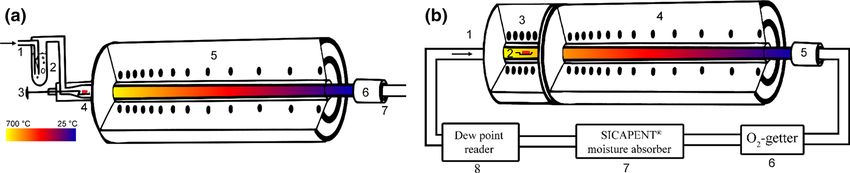
Vol.:(0123456789)712 Journal of Radioanalytical and Nuclear Chemistry (2020) 326:711–718 The main concern with this approach is the introduction Experimental of significant amounts of tellurium (2% by weight) into the system which may influence the behavior of the iodine. To Sample preparation establish a baseline before attempting to interpret the behav- ior of iodine in an LBE system, experiments using irradiated The sample preparation consisted of the irradiation of natural tellurium were conducted. In some experiments, a natural tellurium (Sigma Aldrich, Batch: MKBW7373V, pre-separation was performed where the iodine was evapo- 99.999%, granules, 5–25 mg) by thermalized neutrons from rated onto a piece of silver foil prior to the experiment to the spallation neutron source SINQ for 3 h at a thermal neu- examine the influence of the removal of a large fraction of tron flux of 1013 n s− 1ּ cm− 2. This irradiation produced initial the tellurium from the final sample. Previous similar studies activity levels of approximately 3 kBq of 131I per mg Te, have been performed successfully on α-irradiated natural tin measured by a HPGe (High-purity germanium) γ-detector with tellurium being the desired end product as an analogue on the 364.5 keV γ-line [11]. The sample was placed in a for polonium [6]. stainless steel (SS316L) boat of approximately 15 mm in The binary tellurium-iodine system is not particularly length and 3 mm in width. To capture aerosols potentially well-studied chemically, especially at very low mole frac- released from the sample, a piece of quartz wool was placed tions of iodine. There are phase diagrams available, how- immediately downstream of the sample. ever these are not applicable at the mole fractions we are interested in (xI ~ 1 0− 10) [7]. Compounds that contain more than one iodine atom per molecule such as TeI4 and TeI2 are Thermochromatography unlikely to form at these low concentrations. On the other hand, polyatomic compounds with respect to tellurium can The equipment used for this series of experiments consisted form due to the abundance of tellurium in the system. The of two furnaces, one to be used with water saturated car- compounds identified as possible to form at these mole frac- rier gas and the other to be used for experiments with low tions are sparsely studied as single gaseous molecules and levels of moisture. Inside the furnaces there is an Inconel® are instead often studied in the solid phase [8]. tube in which the TC column is inserted. At one end of this The fused silica surface was chosen for the adsorption Inconel® tube, the system for feeding gas through the fur- experiments in the present study due to the large body of nace is connected. This system consists of a tube ending in knowledge available, its simple stable chemical constitu- a hollow metallic pin. At the end of the tube a mass flow tion, as well as existing correlations relating the sublimation controller is attached to control the flow velocity of the car- enthalpy (ΔHsubl) of a macroscopic species to the micro- rier gas. The chromatography columns used for these experi- scopic adsorption enthalpy (ΔHads) of single molecules or ments consist of fused silica with a length of approximately atoms of the species on quartz [9]. Other experiments on the 1200 mm and an inner diameter of 5 mm (Schmizo AG, adsorption of iodine on fused silica generated via a fission Oftringen, Switzerland). The hollow metallic pin used as a source show a clear increased volatility in the presence of gas inlet has an outside diameter of roughly 4 mm. To close oxygen suggesting formation of volatile oxygen containing the gap between pin and column, Teflon tape was applied to compounds of iodine [10]. the outside of the pin until it fits tightly into the fused silica The method used in this work to determine the affinity column. between a specific surface/gaseous chemical species pair For the experiments performed in dry conditions a gas is known as thermochromatography (TC). This method is loop was used to clean the gas prior to the experiment. This based on the successive adsorption/de-adsorption equilibria gas loop features a Sicapent® moisture absorber and a hot established between gaseous chemical species transported (900 °C) tantalum O2-getter as well as a dew point meter in a carrier gas stream and a surface exposed to a negative (Michell Easidew) to monitor the moisture content of the temperature gradient. The species is evaporated and carried gas. Prior to the experiment, the gas in the system is pumped inside an empty, usually cylindrical column made of the around the gas loop through the cold furnace until the condi- investigated stationary surface material. During the trans- tions are satisfactory (< 100 vol ppm H2O). Before an exper- port, the gaseous species interacts with the surface numerous iment is started, the thermal gradient furnace is turned on times, adsorbing to it and desorbing after a certain time. to allow it to stabilize its temperature profile reproducibly After a sufficient number of reversible interactions at equi- throughout the length of the stationary column. For water librium, thermochemical assessments can be made on the saturated conditions the difference is the lack of the gas loop strength of the interaction based on the formation of charac- and the addition of a water bubbler to saturate the gas with teristic deposition patterns on the surface known as internal H2O at room temperature. The saturation concentration of thermochromatograms. H2O in the different gases at room temperature corresponds 13
Journal of Radioanalytical and Nuclear Chemistry (2020) 326:711–718 713
to about 2 vol%, however when measuring the concentra- similar to the experiments described above, with the differ-
tion using a dew point meter available after experiments ence being a strip of silver foil added at a spot in the gradi-
were finished, the actual value in the gas was found to be ent furnace where a temperature of 150 °C was measured.
closer to 1 vol% indicating incomplete saturation. Other dif- This temperature was chosen to enable the majority of the
ferences between the two setups include differing ways of iodine to be carried to the foil and adsorbed onto it strongly
starting the experiment. In the setup with water saturated while minimizing the amount of tellurium present on it. In
carrier gases, a pin is used to push the sample into the hot TC experiments metallic tellurium adsorbs to fused silica
zone of the furnace to commence the evaporation. For dry at around 400 °C, and it deposits at even higher tempera-
conditions a starting furnace operating at 700 °C is used, tures when using macroscopic amounts [6, 9, 12, 13]. Small
which is separate from the gradient furnace. The experiment pieces of the silver foil were then cut to produce samples to
time was two hours in water saturated conditions and three be used in further experiments.
hours in dry conditions.
Carrier gases used for these experiments were H2, He and
O2 with flowrates of 25 ml min− 1 for O
2, 28 ml m in− 1 for H
2 Monte Carlo simulations
−1
and 45 ml m in for He for dry carrier gases. In water satu-
rated conditions the flowrate was 25 ml m in− 1 for all gases. The Monte Carlo method utilized to describe this adsorption
The flowrates were verified using a mini-BUCK Calibrator chromatography process is based on the model drawn up
M-5 from A.P. Buck Inc. At the exit of the Inconel® tube by Zvara [5]. The method takes into account experimental
for both setups, a charcoal filter was fitted to capture any parameters such as for example carrier gas flowrate, ther-
species of iodine with a low enough affinity to allow escape mal gradient, experimental time, and column dimensions.
from the column. Each of the gradient furnaces was operated Additional parameters considered are the lattice vibrational
at a maximum temperature of 700 °C, tapering off to room spectrum of the surface in question as well as the adsorption
temperature at the end of the column. Sketches of the two enthalpy. The adsorption enthalpy is fed to the simulation as
setups used are displayed in Fig. 1. a variable parameter. From the initial guess, the adsorption
After completing the experiment, the furnace was turned enthalpy is adjusted until the deposition pattern produced by
off along with the gas flow and allowed to cool down before the Monte Carlo simulation agrees with the experimentally
the column was removed. The column is then measured in measured one. The goodness of fit was judged by visual
1 cm steps on an HPGe-detector through a lead collimator comparison of the simulation result with the experimen-
with a small hole in it, enabling measurement of the column tal data. The ranges for the uncertainties of the adsorption
step-wise centimeter by centimeter. This produces a deposi- enthalpy were determined by assuming a shift of ± 1 cm of
tion pattern which describes the amount of activity present the deposition peak and a flow rate change of ± 5 ml min− 1.
at each centimeter of the column. This pattern is then fed as To help simulate wider deposition patterns a parameter
experimental data into the Monte Carlo routine described change was introduced into the Monte Carlo simulation to
below. address a continuous evaporation of iodine from the tellu-
Additional experiments were conducted using iodine pre- rium throughout the duration of the experiment. This is use-
separated from the Te-source to examine how a reduction ful if significant (> 5%) activity remains in the sample after
of the tellurium content in the system influenced the specia- the experiment, suggesting an incomplete and continuous
tion. To produce samples for these experiments, the irradi- evaporation rather than a more discrete pulsed release.
ated Te-samples were processed in the temperature gradient
Fig. 1 Sketch of the two experimental setups used, arrows showing Furnace setup with loop for dry conditions, b featuring (1) Gas inlet,
the gas flow direction. Furnace setup for water saturated conditions (2) Sample, (3) Starting furnace, (4) Gradient furnace, (5) Charcoal
a featuring (1) Gas inlet, (2) Water bubbler, (3) Sample pusher pin, filter, (6) Oxygen getter. (7) SICAPENT® moisture absorber. (8) Dew
(4) Sample, (5) Gradient furnace, (6) Charcoal filter, (7) Gas outlet. point reader
13714 Journal of Radioanalytical and Nuclear Chemistry (2020) 326:711–718
Results and discussion speciation of iodine. In all helium experiments except Exp.
VI, there is a recurring deposition pattern of two peaks being
In Table 1 we compile important experimental parameters formed in close proximity to each other (Fig. 2).
and results of the experiments. Figures 2 , 3 and 4 show the The determined adsorption enthalpies of the two peaks
measured deposition patterns and temperatures, thermal gra- are approximately − 110 to − 120 kJ mol− 1 and − 90 to
dients as well as outputs from Monte Carlo simulations with − 100 kJ mol− 1 respectively. In dry conditions with an
the corresponding extracted adsorption enthalpy. inert carrier gas, the dominant species should not contain
elements other than iodine and tellurium. Because of the
Helium carrier gas extremely low amounts of iodine present, the species con-
sidered in the following are T e2I, TeI and monatomic I.
In experiments with helium carrier gas two different types The available data suggests a higher volatility for TeI com-
of samples were used. For experiments I & IV, a tellurium pared to Te2I [7]. Based on a correlation determined for the
granule was used as the sample whereas for the remaining adsorption of elements in carrier-free amounts on fused
four experiments, pre-separated iodine from a silver foil was silica surfaces [9] a plausible assignment for the deposi-
used instead. The purpose of studying samples with differ- tions with an adsorption enthalpy of about − 90 to − 100 kJ
ent tellurium content was to detect whether variations of the mol− 1 is monatomic iodine. The correlation from [9], modi-
amount of tellurium in the system has an influence on the fied to include a value determined in that work, relates the
Table 1 Experimental Exp Gas H2O in carrier Dew point (°C) − ΔHads Tdep (°C) Chemical speciation
parameters and results of the gas (vol-ppm)b (kJ mol− 1)
performed experiments
I He 12 − 59 119 ± 10 203 TeI/Te2I
98 ± 10 104 Monatomic I
II (p) He 4 − 67 143 ± 10 317a Transport of TeI/Te2I?
98 ± 10 104 Monatomic I
III (p) He 0.1 − 90 118 ± 10 203 TeI/Te2I
99 ± 10 104 Monatomic I
IV He ~ 10,000 97 ± 5 95 Monatomic I
89 ± 4 79 iodine oxides/hydroxides
V (p) He ~ 10,000 104 ± 6 146 TeI/Te2I
89 ± 5 95 Monatomic I
66 ± 2 24 Iodine oxides/hydroxides
VI (p) He ~ 10,000 107 ± 6 178 TeI/Te2I
VII H2 55 − 47 95 ± 10 103 Monatomic I
VIII H2 56 − 47 95 ± 10 103 Monatomic I
IX H2 ~ 10,000 94 ± 4 112 Monatomic I
X H2 ~ 10,000 96 ± 4 112 Monatomic I
XI O2 0.2 − 86 76 ± 3 55 Monatomic I
67 ± 2 24 Iodine oxides/hydroxides
65 ± 2 24 Iodine oxides/hydroxides
XII O2 1.1 − 76 74 ± 3 47 Iodine oxides/hydroxides
65 ± 2 24 Iodine oxides/hydroxides
XIII O2 ~ 10,000 82 ± 4 74 Monatomic I
67 ± 2 30 Iodine oxides/hydroxides
XIV O2 ~ 10,000 66 ± 2 28 Iodine oxides/hydroxides
(p) indicates an experiment using pre-separated iodine as the sample. For each experiment the gas used, the
dew point and the calculated water content is given, and for each observed chromatographic peak the depo-
sition temperature (Tdep) and the deduced adsorption enthalpy (− ΔHads) determined by MC-simulation are
listed together with the presumed chemical speciation of the deposit
a
Minor deposition
b
H2O content calculated using the measured dew point and the calculator at http://www.michell.com/uk/
calculator/
13Journal of Radioanalytical and Nuclear Chemistry (2020) 326:711–718 715
Fig. 2 Deposition patterns of experiments I–VI using helium as shown are deposition temperatures as well as extracted adsorption
carrier gas (gas flow direction left to right; black dashed line: tem- enthalpies for each peak. The experiments using pre-separated iodine
perature gradient; solid black step line: measured deposition pattern; evaporated from silver as starting material are labelled (p)
hatched histograms: output from the Monte Carlo simulation). Also
Fig. 3 Deposition patterns of experiments VII–X using hydrogen as hatched histograms: output from the Monte Carlo simulation). Also
carrier gas (gas flow direction left to right; black dashed line: tem- shown are deposition temperatures as well as extracted adsorption
perature gradient; solid black step line: measured deposition pattern; enthalpies for each peak
adsorption enthalpy on fused silica to the standard enthalpy with the lower deposition temperatures in the experiments
of the monatomic gaseous element as performed in dry helium. The adsorption enthalpy value also
agrees fairly well with a previous experimentally determined
−ΔHads = (−3.7 ± 8.6) + (0.85 ± 0.06) − ΔHsubl kJ mol−1
( )
one for monatomic iodine on fused silica of − 92 kJ m ol− 1
(1) [14]. Based on this assignment, we conclude that the deposi-
For monatomic iodine the standard enthalpy is equal to tions in the second peak at slightly higher temperatures most
107 kJ mol− 1 [12]. Using the correlation this evaluates to an likely result from adsorption of TeI and/or Te2I, possibly in
expected adsorption enthalpy of − 87 ± 16 kJ/mol, overlap- variable relative amounts. One can observe a small reduction
ping with the experimentally determined value for the peaks of the relative amount of Te-iodides compared to the amount
13716 Journal of Radioanalytical and Nuclear Chemistry (2020) 326:711–718
Fig. 4 Deposition patterns of experiments XI–XIV using oxygen as enthalpies for each peak. All peaks except for the right-most peak
carrier gas (gas flow direction left to right; black dashed line: tem- in the deposition pattern of Exp XI were fitted assuming continuous
perature gradient; solid black step line: measured deposition pattern; evaporation of iodine from the tellurium throughout the duration of
hatched histograms: output from the Monte Carlo simulation). Also the experiment
shown are deposition temperatures as well as extracted adsorption
of elemental iodine in the two experiments performed using The formation of a broad single peak in Exp VI could be
pre-separated iodine. However, still substantial amounts of explained through close grouping of two peaks giving the
iodine are deposited in the second peak, indicating that suf- illusion of a single deposition. It is located between where
ficient amounts of tellurium to form these species are carried we find the depositions in dry carrier gas conditions using
over in the separation process. Considering the large excess a tellurium granule sample. Overall, the deposition patterns
of tellurium (~ 1010) in the original sample this is not sur- found in moist atmosphere agree with the tentative identi-
prising. For Exp II using pre-separated iodine a minor high fication of the main deposits as Te-iodides and monatomic
temperature deposition at 317 °C occurred. From the peak iodine derived from the experiments in dry conditions. The
shape of the right-most deposition, one can infer that the similarities observed between experiments using samples
317 °C deposition appears to be part of a transport reaction with different iodine/tellurium ratios again indicate that the
possibly involving the species which makes up the ~ 200 °C silver foil pre-separation method is not sufficient to reduce
deposition in Exp I & III, which is also supported by the tellurium to low enough levels to prevent Te-iodide forma-
observed peak broadening in comparison to the expected tion when using carrier free iodine.
peak shape from the simulations. A similar behavior is also
observed albeit at slightly different temperatures in Exp IV Hydrogen carrier gas
& V. This indicates the chemical reactivity of the involved
initially volatilized species and also suggests the superposi- In hydrogen as carrier gas only one peak is formed repro-
tion of chemical reactions with the multi-step adsorption ducibly at all conditions irrespective of moisture content
processes, the full assessment of which is difficult not hav- (Fig. 3). Based on the argumentation outlined in the section
ing at hand kinetic and thermodynamic data relevant for the above, the observed adsorption enthalpies indicate this spe-
chemical reactions. Therefore, the occurring species were cies most likely is monatomic iodine. This requires that in
treated equally as if they formed all directly upon volatiliza- hydrogen the tellurium iodides are decomposed according
tion from the source. to the following two consecutive reactions:
In moist conditions also reaction products of the above
mentioned species with H 2O could occur. However, the
Te2 I + H2 ⇄ TeI + H2 Te (2)
results obtained in moist helium carrier gas are rather similar
to those obtained in dry helium. In the experiment using a TeI + H2 ⇄ I + H2 Te (3)
tellurium granule as a sample the behavior aligned with that
The hydrogen telluride formed in these reactions either
observed in the analog experiment at low moisture content.
is decomposed quickly at the conditions present inside the
In one experiment under moist conditions (Exp. V) there
column, or is carried away due to its volatility [8]. Thus, the
was an additional low temperature peak formed analogous to
equilibria (2) and (3) would be driven towards the formation
the ones seen in oxygen (see section on oxygen carrier gas)
of iodine.
indicating an ingress of trace oxygen during the experiment.
13Journal of Radioanalytical and Nuclear Chemistry (2020) 326:711–718 717
From chemical reasoning there is a possibility of a third This was sufficient to successfully simulate the shapes of
reaction occurring, producing HI from the monatomic some of the broad peaks, but as mentioned before there are
iodine. Formation of HI would invariably result in a clear other chemical reaction phenomena at play, which the used
large deposition in the charcoal filter owing to the volatil- modelling and simulation algorithm does not fully describe.
ity of the species as it is a gas at room temperature [8]. No In Exp XI, the right-most peak in the deposition pattern
such increase is observed, only a small variation within the could not be simulated using the described method despite
uncertainty of the γ-measurement of the filter, indicating it being an oxygen carrier gas experiment. This peak shape
that this reaction does not take place under the conditions could only be reproduced assuming instantaneous release,
prevailing in the present experiments. suggesting that the evaporation of iodine from tellurium in
At moisture saturated conditions in hydrogen no signifi- oxygen has a faster evaporating fraction combined with one
cant change is observed other than a slight broadening of that has higher retention. Simulating a peak with a maximum
the peaks. This is however also present in the Monte Carlo at low temperature using a delayed release results in a peak
simulation and therefore likely just an effect of the properties much wider than the one present in the measured deposition
of the gradient in that furnace. pattern. We stress that one must remember that this method
is not perfect as is evident from some experiments where a
Oxygen carrier gas good fit of simulation to result was not possible (Exp XII for
example). This suggests that there are additional processes
In oxidizing conditions, the chemistry of the system changes going on such as transport reactions in the region of lasting
dramatically, with multiple species occurring that have lower adsorption, which influence the result [15]. To obtain more
affinities to the silica surface compared to those observed in precise results on the behavior of these very volatile species,
helium and hydrogen. In some of the experiments, this led extending the temperature gradient to temperatures below
to a partial transport of iodine to the charcoal filter located at room temperature is required. This would potentially capture
the exit of the thermochromatography column. The specia- species that were found in the charcoal filter. Additionally, it
tion seems unstable with the number of pronounced peaks would steepen the gradient around room temperature lead-
fluctuating, as well as the shape of the peaks themselves ing to sharper deposition peaks and thus facilitating their
(Fig. 4). Successfully reproducing the peaks using Monte evaluation.
Carlo simulation was not possible for all of them, suggesting
processes are occurring that have not yet been implemented
in the code. Such processes include for example in-flight Conclusions
speciation changes in regions where the adsorption time
is non-negligible, resulting in an unpredictable adsorption The adsorption behavior of iodine on a fused silica surface
behavior. when evaporated from a tellurium matrix has been suc-
Possible speciations in these conditions include differ- cessfully studied. In water saturated and dry conditions in
ent iodine oxides as well as HIO and additional oxo-acids helium, hydrogen, and oxygen it was possible to extract
of iodine (HIOx). These are likely produced through the adsorption properties for the evaporated iodine. In inert
oxidation of the TeI/Te2I while in parallel tellurium oxide conditions there was a recurring formation of two peaks.
is formed. The multiple products formed in such reactions While the peak with the higher absolute adsorption enthalpy
may be very sensitive to local conditions. Variations in these appears to fluctuate slightly between − 100 kJ m ol− 1 and
−1
conditions could result from small fluctuations in temper- almost − 120 kJ m ol (with one presumed transport peak
ature driven by the very flat temperature gradient as well present around − 140 kJ mol− 1), the lower has an adsorp-
as changes in H 2O content of the gas. Testing of the influ- tion enthalpy of about − 90 to − 100 kJ m ol− 1. A pre-sep-
ence of different water levels in the bubbler described in aration of iodine from the irradiated tellurium appears to
the "Experimental" section confirmed that this introduces a have no consistent effect on the speciation. The peak with
maximum variability of ± 2000 ppm in H2O concentration an adsorption enthalpy of approximately − 90 kJ mol− 1 can
in the bulk flow. be assigned to monatomic iodine based on an empirical cor-
The evaporation of iodine was quantified for one experi- relation for element adsorption to fused silica as well as a
ment with each carrier gas, with complete evaporation previously experimentally determined value for monatomic
observed in reducing and inert conditions, whereas oxidiz- iodine adsorption on fused silica. The peaks with the higher
ing conditions induced retention in the tellurium matrix. To absolute values of adsorption enthalpies are assumed to
account for this retention and its effect on the observed depo- result from deposition of tellurium iodides (TeI or Te2I).
sition patterns, the continuous evaporation of iodine from Based on the deposition patterns observed under the dif-
the tellurium throughout the duration of the experiment was ferent conditions it would appear that any tellurium iodides
modeled in the Monte Carlo simulation as explained above. only survive in helium carrier gas, both in dry and in moist
13718 Journal of Radioanalytical and Nuclear Chemistry (2020) 326:711–718
conditions. For reducing conditions, consistently a single need to obtain permission directly from the copyright holder. To view a
species adsorbing with ΔHads = − 95 ± 5-10 kJ mol− 1 is copy of this licence, visit http://creativecommons.org/licenses/by/4.0/.
observed, regardless of the water content of the carrier gas.
This indicates that the tellurium iodides observed in helium
carrier gas are decomposed in hydrogen. The absence of References
iodine in the charcoal filter suggests that the reaction does
1. Aït Abderrahim H, Baeten P, De Bruyn D, Heyse J, Schuurmans P,
not progress to HI which would likely be very volatile and Wagemans J (2010) MYRRHA, a Multipurpose hYbrid Research
not stick to the column at all. In dry and moist oxygen a vari- Reactor for High-end Applications. Nucl Phys News. https://doi.
ety of species with even higher volatility than monatomic org/10.1080/10506890903178913
iodine are observed. These species most likely are iodine 2. Neuhausen J, Eichler B (2009) Investigations on the thermal
release of iodine from liquid eutectic lead-bismuth alloy. Radi-
oxides and oxoacids of iodine whose relative abundance is ochim Acta. https://doi.org/10.1524/ract.2006.94.5.239
strongly influenced by small fluctuations in the temperature 3. Rijpstra K, Neuhausen J, Espegren F, Retegan T (2015) Interaction
gradient and moisture content. Overall, the results presented between iodineand liquid lead bismuth. Deliverable D4.4 of the
here give valuable information on the iodine containing EU FP7 SEARCH project
4. Aït Abderrahim H, Sobolev V, Malambu E (2005) Fuel design for
species that can form when neutron irradiated tellurium is the experimental ADS MYRRHA. Technical Meeting on use of
heated in different chemical conditions. These results should LEU in ADS, 10–12 Oct 2005. IAEA, Vienna, Austria
prove useful when interpreting results from similar experi- 5. Zvara I (2008) The inorganicchemistry of heavy elements, 1st edn.
ments performed using tellurium doped LBE samples pre- Springer, Dordrecht
6. Maugeri EA, Neuhausen J, Eichler R, Piguet D, Schumann D
pared in order to study iodine released from the liquid metal (2014) Thermochromatography study of volatile tellurium
coolant of an ADS and its deposition. species in various gas atmospheres. J Nucl Mater. https://doi.
org/10.1016/j.jnucmat.2014.04.036
Author contributions EK: Conceptualization, Methodology, Software, 7. Kniep R, Rabenau A (1983) Physical and inorganic chemistry.
Validation, Formal analysis, Investigation, Writing—Original Draft, Topics in current chemistry, vol 111. Springer, Berlin
Visualization. JN: Conceptualization, Validation, Data Curation, Writ- 8. Wiberg N, Holleman AF (2007) Lehrbuch der Anorganischen
ing—Review & Editing, Visualization, Supervision, Project admin- Chemie, 102nd edn. De Gruyter, Berlin
istration, Funding acquisition. RE: Validation, Methodology, Soft- 9. Steinegger P, Asai M, Dressler R, Eichler R, Kaneya Y, Mitsukai
ware, Writing—Review & Editing, Visualization. AV: Methodology, A, Nagame Y, Piguet D, Sato TK, Schädel M, Takeda S, Toy-
Resources. AT: Validation, Writing—Review & Editing, Supervision. oshima A, Tsukada K, Türler A, Vascon A (2016) Vacuum chro-
matography of Tl on SiO2 at the single-atom level. J Phys Chem
Funding This work was funded by the Project MYRTE under EUR- C. https://doi.org/10.1021/acs.jpcc.5b12033
ATOM HORIZON2020 Grant Agreement No. 662186. Open Access 10. Bächmann K, Matschoss V (1975) Separation of nuclear reaction
funding provided by Lib4RI – Library for the Research Institutes within products in the gas phase—I: separation of Tc in a flow of oxygen.
the ETH Domain: Eawag, Empa, PSI & WSL. J Inorg Nucl Chem. https: //doi.org/10.1016/0022-1902(75)80116
-3
11. Nucleonica GmbH (2019) Nuclide datasheets. Nucleonica Nuclear
Compliance with ethical standards Science Portal (www.nucleonica.com), Version 3.0.151.0001,
Karlsruhe, Germany
Conflict of interest The authors declare that they have no conflict of 12. Barin I (1995) Thermochemical data of pure substances, 3rd edn.
interest. Wiley-VCH, Weinheim
13. Eichler B, Domanov VP (1975) Verflüchtigung von Radionukliden
Open Access This article is licensed under a Creative Commons Attri- im Luftstrom und ihre Abscheidung im Temperaturgradientrohr.
bution 4.0 International License, which permits use, sharing, adapta- J Radioanal Chem. https://doi.org/10.1007/BF02516873
tion, distribution and reproduction in any medium or format, as long 14. Eichler B, Zude F, Fan W, Trautmann N, Hermann G (1992)
as you give appropriate credit to the original author(s) and the source, Volatilization and deposition of ruthenium oxides in a tempera-
provide a link to the Creative Commons licence, and indicate if changes ture gradient tube. Radiochim Acta. https://doi.org/10.1524/
were made. The images or other third party material in this article are ract.1992.56.3.133
included in the article’s Creative Commons licence, unless indicated 15. Schäfer H (1962) Chemische Transportreaktionen: der Transport
otherwise in a credit line to the material. If material is not included in anorganischer Stoffe über die Gasphase und seine Anwendungen.
the article’s Creative Commons licence and your intended use is not Wiley-VCH Verlag GmbH & Co., Weinheim
permitted by statutory regulation or exceeds the permitted use, you will
13You can also read


