Agreement between the ACT Minister for Police and Emergency Services, Australian Federal Police Commissioner, and the Chief Police Officer for the ...
←
→
Page content transcription
If your browser does not render page correctly, please read the page content below
Agreement between

the ACT Minister for Police and Emergency Services,

   Australian Federal Police Commissioner, and

        the Chief Police Officer for the ACT

      for the provision of policing services to

          the Australian Capital Territory

                    2017-2021
The relationship between the AFP and the ACT Government for the provision of
     policing services to the ACT is long standing and contributes to Canberra being one
                            of the safest places to live in Australia.

            The AFP, through ACT Policing, will provide a
       professional, innovative and effective policing service
        to the people of the ACT, contributing to a safe and
                       just community for all.

To achieve this vision, the ACT Government and ACT Policing
are committed to:
 • Whole of government collaboration
 • Community engagement
 • Working in partnership
 • Transparency and information sharing
 • Innovation

ACT Policing reflects the values of the AFP when delivering policing
services to the ACT:
 •     Integrity
 •     Commitment
 •     Excellence
 •     Accountability
 •     Fairness
 •     Trust
 •     Respect
1. Definitions
1.1 Unless stated otherwise, definitions in this Agreement are the same as in the Arrangement
commenced in June 2017, between the Minister for Justice of the Commonwealth and the
ACT Police Minister for the provision of policing services to the ACT.
2. Purpose and Objectives
2.1 In accordance with clause 2.1 of the Arrangement, this Agreement details the policing
services to be purchased by the ACT Government from the AFP, including ACT Government
Ministerial support, reporting, performance expectations and financial arrangements.
2.2 This Agreement will be read in conjunction with the Arrangement and Ministerial Directions
issued under section 7 of the Arrangement.
2.3 The ACT Government and the AFP seek from this Agreement:
appropriate policing levels and services for the ACT community;
sustained high quality of service provision; and
provision of stable and effective policing services for the ACT community as well as
the building and retention of corporate knowledge within ACT Policing.
3. Scope
3.1 This Agreement includes all policing services to be purchased by the ACT Government from
the AFP through the direct police budget appropriation and other funding outlined in
Schedule 1. This Agreement does not cover activities funded by revenue outside the funding
outlined in Schedule 1.
3.2 This Agreement includes:
policing outcomes and all associated outputs to be provided;
ACT Government Ministerial and policy support outcomes;
performance measures, together with targets where appropriate;
financial arrangements; and
reporting requirements.
4. Governance and Principles
4.1 Overall responsibility for policing in the ACT rests with the Minister for Police. The Minister
for Police has delegated the day-to-day management of the Arrangement and Agreement to
the Director-General of the Justice and Community Safety Directorate (JACS), consistent with
the Public Sector Management Act 1994.
4.2 This Agreement is a partnering arrangement in which AFP and JACS, on behalf of the
ACT Government, work together jointly to provide a community policing capability to the ACT.4.3 This Agreement will be supported by governance arrangements agreed between the Director-
General JACS and the Chief Police Officer. These governance arrangements will:
set the strategy for the achievement of the objectives of the Arrangement and
Agreement;
make decisions on the strategic direction and management of the Arrangement and
Agreement;
measure and manage performance; and
ensure accountability.
4.4 The Director-General JACS and the Chief Police Officer will provide oversight and coordinate
relevant committees or working groups to develop and implement appropriate processes and
procedures to guide the parties’ interactions related to:
security and emergency management;
accommodation and facilities;
policy and legislative matters related to ACT law or justice reforms which directly
impact the delivery of policing services in the ACT;
reporting and performance measures;
enabling and other financial arrangements;
how equitable sharing arrangements apply when ACT Government, ACT Policing or
the AFP acting on behalf of ACT Policing make contribution to action leading to
money or assets being forfeited to a State or Territory or the Commonwealth; and
other issues where required, to support the Director-General JACS and the Chief
Police Officer and manage specific issues that require additional detailed work.
5. ACT Policing Operating Environment
5.1 ACT Policing operations may change in response to the evolving operating environment
including:
security and threat levels;
geographical and population changes in the ACT;
community expectations;
fiscal environment; and
changes in the ACT Government legal and policy frameworks.
5.2 ACT Policing and the ACT Government will ensure appropriate risk management frameworks
are in place and existing ACT Government budget processes will be used to address current or
emerging risks in the operating environment that require funding.
5.3 ACT Government will continue to consider the risks and drivers in clause 5.1 when making
decisions that impact on ACT Policing.
6. Responsibilities to the Police Minister and other ACT Government
Ministers
6.1 In accordance with clause 5.2 of the Arrangement, the Chief Police Officer, subject to the
authority of the Commissioner, will be responsible to the Police Minister for the delivery of
the outcomes as set out in this Agreement.
6.2 In accordance with the legislative framework for the provision of police services by the AFP in
the ACT, the responsibility for operational matters rests with the Chief Police Officer, subject
to the authority of the Commissioner, and responsibility for ACT Government policing policy
and other policing matters rests with the Police Minister supported by the Directorate.6.3 In accordance with section 6 of the Arrangement, ACT Policing will work in collaboration with
JACS to support the Police Minister, and other ACT Government Ministers as relevant, to
participate in the parliamentary process and develop and implement ACT Government policy
and legislation related to policing.
6.4 If ACT Policing is requested to provide information to an agency of the ACT Government,
subject to the authority of the Commissioner, the Chief Police Officer must provide the
requested information to the extent that is permissible under Commonwealth and/or ACT
law.
6.5 Nothing in clause 6.4 requires the Chief Police Officer to provide information that would
compromise operational activity by the AFP, including ACT Policing.
6.6 The Chief Police Officer may impose conditions on the use of requested information if the
Chief Police Officer considers it necessary for operational reasons.
6.7 Any information requested under clause 6.4 and provided by ACT Policing to the nominated
agency must be provided in a timely manner and only be used for the purposes of the
request.
6.8 Subject to operational requirements, the Chief Police Officer will proactively ensure timely
advice is provided to the Police Minister on any ACT Policing issues that have a significant
media or other impact on ACT Government. The Police Minister and the Director-General
JACS will be responsible for informing the other relevant ACT Government parties.
7. Supporting ACT Government Strategies
7.1 ACT Policing will promote and support a whole of government approach in achieving the
objectives of ACT Government strategies, particularly those addressing crime in the ACT
community while remaining responsive to changing commitments and adaptive to the needs
of the community.
7.2 ACT Policing will support all agreed ACT Government strategies and initiatives, including
capturing and providing relevant and available information and data.
8. Supporting events in the ACT
8.1 The funding in this Agreement includes costs to deliver policing services in support of the ACT
Government events listed in Schedule 2.
8.2 The Director-General JACS, in consultation with the Director-General Chief Minister, Treasury
and Economic Development Directorate and the Chief Police Officer may, by joint agreement,
negotiate the provision of policing services that will not be subject to cost recovery for other
community events that support ACT Government priorities.
8.3 ACT Policing may seek cost recovery for the provision of policing services to other events that
do not fall within the scope of normal policing services in accordance with relevant AFP user
pays policies.
8.4 The funding for this Agreement includes costs for ACT Policing to provide a base level of
monitoring the Public Safety Closed Circuit Television (CCTV) System, as agreed in writing by
the Director-General JACS and the Chief Police Officer.8.5 ACT Policing may seek cost recovery for monitoring the Public Safety CCTV System for events
outside of agreement in 8.4, in accordance with relevant AFP user pays policies.
9. Supporting ACT Government in national forums
9.1 In accordance with section 8 of the Arrangement, ACT Policing will represent the interests of
the ACT in national forums.
9.2 Where a conflict exists between the AFP and ACT Policing, ACT Policing should resolve any
such conflict in the interests of the ACT.
10. Agreement making
10.1 ACT Policing may enter into agreements separate from this Agreement so long as they are not
inconsistent with the Arrangement, this Agreement or the Ministerial Direction.
10.2 ACT Policing will provide JACS with an overview of all formal agreements it has in place with
all areas of ACT Government each financial year.
10.3 ACT Policing may enter into agreements with the Speaker of the Legislative Assembly on
issues related to policing functions within the parliamentary precincts of the Legislative
Assembly.
11. Financial Arrangements
11.1 The AFP will follow the general principles of Commonwealth Cost Recovery Guidelines where
appropriate in the provision of policing services to the ACT Government.1
11.2 The amount of funding provided to the AFP for ACT Policing services as outlined in Schedule 1
of this Agreement, is determined by the ACT Executive through the ACT budget process and
included in the payments on behalf of the Territory (Territorial appropriation) for JACS to
administer.
11.3 Schedule 1 details the amount of funding provided for ACT Policing through the budget
process, including forward estimates, and a pro-rata monthly payment schedule.
11.4 Changes to the annual budget appropriation for ACT Policing will be determined through the
ACT Government Budget process.
11.5 ACT Policing will collaborate with JACS Strategic Finance, and other policy areas of JACS where
relevant, in participating in the annual budget process.
12. Facilities and Structures
12.1 In accordance with clause 2.4 of the Arrangement, the ACT Government will be responsible
for the provision of appropriate facilities and associated infrastructure for the provision of
policing services by the AFP. ACT Policing will manage maintenance, leasing and running costs
associated with facilities. This will be governed by the joint JACS and ACT Policing Strategic
Accommodation Committee and subject to any guidelines developed by that group.
1
RMG No. 304 - Australian Government Cost Recovery Guidelines, July 2014 – Third Edition12.2 The funding provided for ACT Policing includes an amount agreed by the Strategic
Accommodation Committee, as outlined in Schedule 1, to be applied by ACT Policing for
leasing, maintenance and running costs associated with facilities.
12.3 If forecast facilities costs exceed the budgeted amount as outlined in Schedule 1, ACT Policing
will notify the Police Minister and JACS of the requirement to apply for additional funding, to
meet the additional forecast facilities costs
12.4 Capital Upgrades Program (CUP) funding will also be provided to JACS (territorial) for minor
capital works on ACT Policing facilities.
13. Terms and conditions of employment
13.1 In accordance with clause 3.5 in the Arrangement, the Commissioner is responsible for
establishing the terms and conditions of employment of AFP appointees involved in the
provision of policing services to the ACT.
13.2 If the Commissioner proposes to vary the terms and conditions of employment of AFP
personnel in a way which might affect the manner and cost of providing policing services to
the ACT, the Chief Police Officer must consult with the Police Minister and advise of the likely
implications of the proposed alterations.
13.3 The AFP will notify the Police Minister of the commencement of any industrial negotiation
process that may have implications for AFP personnel providing policing services to the ACT.
13.4 The AFP will take into consideration input received from the ACT Government on any
industrial negotiation process related to AFP personnel providing policing services to the ACT.
13.5 Throughout any industrial negotiation process, the Chief Police Officer will provide regular
updates to the Police Minister.
14. Enabling Services Cost Methodology
14.1 In accordance with clause 2.2 of the Arrangement, the appropriation funding provided to the
AFP, under this Agreement includes enabling costs for services integral to the delivery of
policing services to the ACT according to the agreed enabling cost model.
14.2 The underlying principle for determining enabling costs is the allocation of effort and cost that
would not have been incurred by the AFP but for ACT Policing.
14.3 To determine the enabling services cost base, only services which are ‘integral’ are within
scope. Integral services are those where there is a dependency or reliance on an activity to
deliver community policing to the ACT. The agreed costing model:
identifies AFP business areas that provide an enabling service to
ACT Policing;
excludes cost for business areas that have no relationship with
ACT Policing; and
has been developed to reflect underlying operational structures.
14.4 In accordance with clause 2.3 of the Arrangement, the enabling cost model will be reviewed
by a joint JACS and AFP working group every four years in conjunction with the negotiation of
the Agreement.14.5 Any variation to enabling services as a result of review; or change in demand that may arise as
a result of a policy change by the ACT Government; or referred to the Police Minister by the
Chief Police Officer must be endorsed by the ACT Government and considered as part of the
ACT budget process.
15. Performance Measures
15.1 Over the course of this Agreement, the performance measures in Schedule 3 will be
considered to ensure they reflect ACT Policing’s capability and contribution to
ACT Government performance indicators and community expectations.
15.2 If changes in the performance measure framework have a financial impact (cost or savings),
this impact will be considered through the ACT budget process.
15.3 Schedule 3 will be reviewed annually in conjunction with any funding adjustments that may
occur through the ACT budget process.
15.4 Short-term variations to targets and priorities set by this Agreement may be determined by
the Police Minister, in accordance with section 7 of the Arrangement, including at the request
of the Chief Police Officer, following consultation and with reasonable notice.
15.5 Such variations will be appended to this Agreement and should be within budget limits unless
otherwise agreed.
15.6 If a performance measure is not consistently met over the period of the Agreement, the
Police Minister may direct that, as soon as possible, a review panel consider performance
against the performance measure and make recommendations for remedial action.
15.7 A review panel under clause 15.6 must consist of at least one member appointed by the Chief
Police Officer, one member appointed by the Director-General, JACS and an independent
person agreed by the Chief Police Officer and the Director-General, JACS.
16. Reporting
16.1 The Chief Police Officer shall provide a report to the Police Minister, in collaboration with
JACS, within two calendar months at the end of June and December, unless otherwise agreed
by the parties, on this Agreement and on the Ministerial Direction.
16.2 The report will contain:
narrative, including relevant available data where appropriate, on the activities
conducted by ACT Policing during the reporting period to achieve the performance
measures and in support of the Ministerial Direction;
information on the deployment, operational status and movement of AFP employees
engaged in providing policing services under the Agreement.
16.3 Each June report will also contain:
the intended allocation of the direct funding from JACS for crime prevention
initiatives for the following financial year; and
a breakdown of the legal services requested by ACT Policing during the immediate
preceding financial year.16.4 Pursuant to the AFP Professional Standards Framework outlined at Schedule 4 in this
Agreement, each six monthly report will contain information in relation to complaints
management, including with regard to the following matters:
complaints submitted by category;
complaint trends/systemic issues;
complaints submitted by source;
status of complaints;
finalised conduct issues by category; and
conduct issue trends.
16.5 The Professional Standards report outlined in Schedule 4 will be publicly released by the
Police Minister and include complaints against AFP appointees providing policing services
under this Agreement, including the investigation of such complaints and any related action
whether undertaken by the AFP, Australian Commission for Law Enforcement Integrity
(ACLEI), the Commonwealth Ombudsman or otherwise.
17. Annual Report
17.1 The Chief Police Officer shall provide a report to the Police Minister, on the provision of
police services pursuant to this Agreement. The Chief Police Officer will adhere to the
timelines and processes identified in the ACT Government Annual Reports (Government
Agencies) Notice for the relevant year. The annual report will describe the outcomes achieved
during the period reported on and shall include details of the resources utilised, the levels of
crime reported and such other matters as may be specified by the Police Minister.
17.2 In accordance with section 10 of the Arrangement, the Chief Police Officer will provide an
audited financial statement to the Police Minister following the completion of each financial
year.
18. Dispute Resolution
18.1 Issues and disputes related to the Arrangement and Agreement will be escalated in
accordance with issues management processes agreed by the Director-General JACS and the
Chief Police Officer.
18.2 Any disputes that cannot be resolved through the agreed issues management process will be
referred to the Director-General JACS and the Chief Police Officer for resolution.
18.3 Any dispute or matter of concern to either party arising from the Arrangement and this
Agreement that cannot be resolved by Director-General JACS and the Chief Police Officer shall
be referred to the Police Minister and the Commissioner for resolution.
19. Duration and development of Agreements
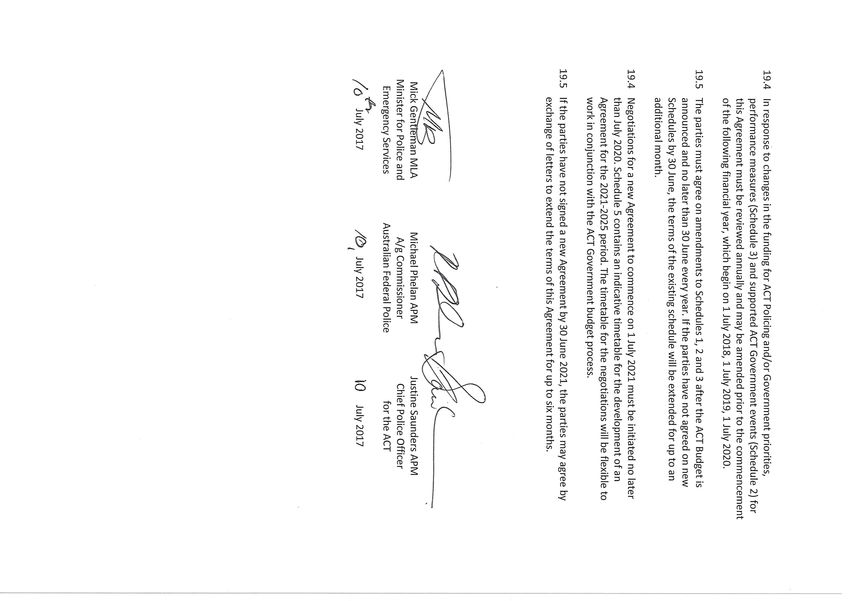
19.1 This Agreement shall apply for the period 1 July 2017 to 30 June 2021, with the exception of
the Schedules outlined in 19.3 and 19.4.
19.2 No variation of this Agreement is binding unless it is agreed in writing between the parties.
19.3 Schedule 1 will be amended each financial year to reflect any changes from the ACT Budget
process.Schedule 1 – Annual funding
In accordance with section 11 of the Agreement, funding provided to the AFP for policing services as
outlined in this Agreement, is determined by the ACT Executive through the ACT budget process and
included in the payments on behalf of the Territory for JACS to administer.
In addition to the Territorial appropriation, the Payment Schedule provides details of other funding
sources relevant to ACT Policing operations.
Total ACT Policing Budget appropriation (includes capability maintenance funding)
2017-18 2018-19 2019-20 2020-21
Budget Estimated Estimate Estimate
$’000 $’000 $’000 $’000
Total ACT Policing Budget 161,331 163,938 164,931 164,359
appropriation
The 2017-18 funding breakdown:
2017-18
2017-18 ACT Policing Budget appropriation (as per BP) 161,331,000
Crime Prevention Initiatives1 232,000
Recurrent Initiative - Enhanced security for ACT Policing1 189,000
2017-18 Policing Purchase Agreement Amount 161,752,000
Capital Upgrade Program Budget2 264,000
Capital Initiative - Enhanced security for ACT Policing3 1,006,000
1. These items are processed through invoicing and does not form part of the budget for the contract price
2. Capital Upgrade Program funding is held by JACS on ACTP's behalf and does not form part of the budget for the
contract price
3. Capital initiative funding is held by JACS on ACTP's behalf and does not form part of the budget for the contract priceThis Agreement reflects new initiatives, offsets and transfers from 2017-18 Budget process: 2017-18 Budget Initiatives 2017-18 Additional Resourcing for Taskforce Nemesis 1,593,000 Enhanced Security for ACT Policing - recurrent 189,000 Enhanced Security for ACT Policing – capital 1,006,000 Equipping more ACT Police with TASERs 845,000 Planning for the future of policing in the ACT 889,000 Reducing alcohol fuelled violence 1,207,000 Eastman retrial 800,000 Supporting careers in ACT Policing NFP Upgrading ACT Policing’s water and rescue response NFP capability Transfer of function to Access Canberra (203,000) Initiative offsets (753,000) Total 2017-18 Budget Initiatives 8,806,000 The total price of this Agreement includes funding applied by ACT Policing for leasing, maintenance and running costs associated with facilities. The budgeted amount to be applied to facilities leasing, maintenance and running costs by ACT Policing in 2017-18 is $4.251m. The budget for this expenditure is based on expenditure incurred in 2016-17. Facilities Leasing, Maintenance and Running Costs Budgeted 2017-18 Facilities Costs $ Leasing 1,103,000 Maintenance 1,754,000 Running Costs 1,394,000 Total Recurrent $4,251,000
ACT Justice & Community Safety Directorate
 2017-18 Appropriation Payment Schedule for ACT Policing

 Pay No                            Date                  Amount ($)

 1                                 27 Jul 17             13,444,250

 2                                 29 Aug 17             13,444,250

 3                                 28 Sep 17             13,444,250

 4                                 26 Oct 17             13,444,250

 5                                 30 Nov 17             13,444,250

 6                                 21 Dec 17             13,444,250

 7                                 30 Jan 18             13,444,250

 8                                 27 Feb 18             13,444,250

 9                                 29 Mar 18             13,444,250

 10                                26 Apr 18             13,444,250

 11                                31 May 18             13,444,250

 12                                28 Jun 18             13,444,250

 Total Appropriation                                     161,331,000

The AFP agrees to the above schedule of payments for ACT Policing to be processed by the JACS
with the last payment run each month of 2017-18 (Tuesday or Thursday).
Schedule 2 – Supported ACT Government Events
In accordance with clauses 8 and 11 of this Agreement the price of this Agreement includes
costs to deliver policing services in support of the following ACT Government events:

31 December                                      New Year’s Eve

Early January                                    Summernats City Cruise

25-26 January                                    Queens Baton Relay

26 January                                       Australia Day Celebrates

Mid-February                                     National Multicultural Festival

Early-March                                      Enlighten

Mid-March                                        Skyfire

Mid-September – Mid-October                      Floriade including Floriade NightFest
Schedule 3 – Performance Reporting
The framework for measuring the performance of policing services in the ACT is a contemporary
model which incorporates an outcome-focused framework.

Overarching budgetary outcome:

In partnership with the community, create a safer and more secure Australian Capital Territory
(ACT) through the provision of quality police services.

This will be achieved through three main areas of activity: Reduce Crime; Public Safety; and
Community and Partner Engagement.

The performance measure framework aims to enhance accountability for the delivery of services
and provides clear linkages between ACT Policing’s outcomes, outputs, strategies and individual
measures.

The performance measures are an important element of determining the appropriate allocation of
all resources in ACT Policing. Actual performance is rigorously measured and reported upon and,
over time, informs decisions about adjustments to performance targets.

The indicators of effectiveness within this framework recognise that the performance outcomes for
these indicators are not fully within ACT Policing control. There are a number of public and private
institutions and individuals who contribute to the overall results and standings of these indicators.
OUTCOME: REDUCE CRIME
                                                        Output: Crime Prevention and Reduction

                          Prevent or reduce crime and violence
                          Continued support and delivery against the Property Crime Prevention Strategy
     Strategies
                          Promote innovative and enduring community crime prevention strategies and programs
                          Preventing and reducing opportunities for crime to occur and/or reoccur

Performance Measure                                                                                                           Target
Number of offences against the person reported or becoming known per 100,000 population a                                    800 or less b

Number of offences against the property reported or becoming known per 100,000 population a                                  8300 or less b

                                                   Output: Criminal Investigations and Prosecutions

                          Enhance response to and investigation of offences
                          Forge strong partnerships with key stakeholders to facilitate whole-of-government and cross-jurisdictional information sharing and
     Strategies            collaboration
                          Apply effective technology and forensic science capabilities
                          Effectively use intelligence from a wide range of sources

Performance Measure                                                                                                            Target
Percentage of offences against the person cleared                                                                           72% or more b

Percentage of offences against property cleared                                                                             15% or more b

                          Effective and efficient support to the judicial process
                          Promote a robust partnership between ACT Director of Public Prosecutions, ACT Law Courts, JACS and the community to enhance
     Strategies            criminal justice outcomes
                          Deliver a high standard of briefs of evidence in a timely manner
                          Facilitate a more efficient criminal justice system with emphasis on timely preventative justice measure and judicial process

Performance Measure                                                                                                            Target
Percentage of briefs delivered to the Director of Public Prosecutions within the designated
                                                                                                                             75% or more
timeframes f

Percentage of cases finalised by offence proved in court g,h,j                                                               82% or more

Percentage of cases otherwise resolved g,I,j                                                                                  5% or less

Indicators of Effectiveness                                                                                                    Target
Percentage of persons who are concerned about becoming a victim of physical assault in a public
                                                                                                                       National Average or less
place- excluding sexual assault in the next 12 months a,b,d
Percentage of persons who are concerned about becoming a victim of sexual assault in the next 12
                                                                                                                       National Average or less
months a,c,d
Percentage of persons who are concerned about becoming a victim of housebreaking in the next 12
                                                                                                                       National Average or less
months a,c,d
Percentage of persons who are concerned about becoming a victim of motor vehicle theft in the
                                                                                                                       National Average or less
next 12 months a,c,d
Percentage of persons who feel safe when walking in their neighbourhood by themselves during the
                                                                                                                      National Average or more
night a,c,d

Percentage of persons who feel safe at home alone during the night a,c,d                                              National Average or more

Percentage of persons who perceive the following quality of life issues to be a problem in their
neighbourhood: a,c,d
Speeding cars, dangerous or noisy driving                                                                              National Average or less
Graffiti/vandalism                                                                                                     National Average or less
Louts/gangs                                                                                                            National Average or less
Drunken/disorderly behaviour                                                                                           National Average or less
OUTCOME: PUBLIC SAFETY
Output: Police Response
Responsiveness to calls and incidents taking into consideration public and police safety
Response meets the expectations of community needs
Strategies
Ensure resources meet demands
Enhance police responsiveness through mobility solutions
Performance Measure Target
Response time for Priority One within 10 minutes 80% or more
Response time for Priority Two within 20 Minutes 80% or more
Response time for Priority Three where police attention or response is required:
as determined in consultation with the complainant
90% or more
but, in any event, no later than 48 hours from the initial contact by the complainant
Percentage of 000 calls answered on first or second presentation:
a) On first presentation 92% or more
b) On second presentation 98% or more
Output: Public Order and Emergency Management
Effective planning and management of major community events and public demonstrations
Work with the community and other agencies to contribute to improved events management
Strategies
Review and improve existing arrangements around scheduled annual major public events
Conduct post operational assessments with relevant stakeholders to ensure best practice
Performance Measure Target
Percentage of the community satisfied with police in dealing with public order problems a,c,d National Average or more
Respond to emergencies and disasters
Work with partners to develop and maintain preparedness
Strategies
Review and improve multi-agency emergency management and plans and responses
Conduct post operational assessment processes with relevant stakeholders to ensure best practice
Performance Measure Target
Review and testing of arrangements for responding to and recovering from emergencies and disasters Annual
Output: Road Safety & Traffic Management
Collaborate with partner agencies to improve and promote road safety through education, innovation and
targeted enforcement
Strategies Continue to deliver against the ACT Road Safety Strategy and Action Plan
Maintain targeted campaigns to align with the ACT Road Safety Calendar
Aspire to reduce the annual number of road crash fatalities and serious injuries by at least 30 per cent by 2020
Performance Measure Target
a
Number of road crashes resulting in death per 100,000 population 4.2 or less c
Number of road crashes resulting in injury per 100,000 population a 180 or less c
ors of Effectiveness Target
Percentage of persons who self-report to driving 10km per hour or more over the speed limit a,c,d National Average or less
Percentage of persons who self-report to driving while not wearing a seatbelt a,c,d National Average or less
Percentage of persons who self-report to driving while suspecting they are over the prescribed alcohol limit a,c,d,e National Average or less
Percentage of persons who self-report to driving when using a mobile phone a,c,d National Average or lessOUTCOME: COMMUNITY AND PARTNER ENGAGEMENT
Output: Community Support and Whole-of-Government Collaboration
Increase community confidence in police
Develop and deliver innovative communication strategies to share information and foster community participation
Strategies
Maintain the use of social media to provide real time information to support and serve the needs of the community
Collaborate with partner agencies, business and community groups to support community events
Performance Measures Target
Percentage of the community satisfied in general with services provided by police c.d National Average or more
Percentage of the community who have confidence in police c,d National Average or more
Increase support for early intervention and diversion
Collaborate with partner agencies and community groups to prevent and reduce recidivism, prevent repeat victimisation and
protect 'at risk'/vulnerable groups
Strategies
Continued support and delivery against the ACT Aboriginal Justice Partnership 2015-18 to prevent and reduce the number of
Aboriginal and Torres Strait islander people coming into contact with the criminal justice system
Support strategies and initiatives that deter, detect and prevent violence against women and children
Performance Measures Target
Percentage of eligible young people referred to restorative justice
100%o
Number of persons referred to community support agencies 5500 or more
Number of referrals to drug diversion programs (drug demand and reduction effort) 80 or more
Enhance and strengthen resilience of communities
Work with community and partners to reduce tolerance for crime
Strategies
Support community derived safety and security initiatives
Build relationships with vulnerable community groups
Performance Measures Target
ACT Policing Victim Liaison Officers providing contact with victims of indictable crime reported to police m 80% or more
Indicators of effectiveness Target
Percentage of persons satisfied with most recent contact with police services c,d National Average or more
Percentage of persons who agree that police perform their job professionally c,d National Average or more
Percentage of persons who agree that police treat people fairly and equally c,d National Average or moreSchedule 3 - Notes These measures encompass the jurisdiction of a great many public and private institutions and individuals who contribute to the overall results and standings. Success in these targets is not the sole domain or responsibility of ACT Policing. These targets are based on a five year average, operational environment, crime trends and ACT Government priorities. These indicators are sourced from the National Survey of Community Satisfaction with Policing (NSCSP), a self reporting survey conducted by the Social Research Centre. Using the results of the relevant NSCSP questions, the percentage of the community ‘satisfied’ in measure 16 equals those who scored ‘satisfied’ or ‘very satisfied’; the percentage of the community who have ‘confidence’ in measure 17 equals those who scored ‘agree’ or ‘strongly agree’; the percentage of persons ‘concerned’ in Indicators A-D equals those who scored 'somewhat concerned' or 'very concerned'; the percentage of persons 'who feel safe' in Indicators E-F equals those who scored 'safe’ or ‘very safe'. Indicator G equals those who scored 'somewhat of a problem' or 'major problem' for each separate problem; the percentage of persons 'self-report to driving' in Indicators H-K equals those who scored 'sometimes', 'most of the time' or 'always'; the percentage of persons 'satisfied' in Indicator L equals those who scored 'satisfied' or 'very satisfied'; the percentage of persons who agree' in Indicators M-N equals those who scored 'agree' or 'strongly agree'. In the ACT, the prescribed limit is 0.000 of alcohol per 100mL of blood for those classed as a 'special driver' in the Road Transport (Alcohol and Drugs) Act 1977. 'Special drivers' include those with a learner, provisional, probation, restricted, suspended and disqualified licence. The prescribed limit for all other drivers is 0.050 of alcohol per 100mL of blood. Briefs delivered to the Director of Public Prosecutions within the designated timeframe include those where a formal extension was applied for and granted. These measures are based on the concept of a 'case' where a person may be brought before the court on multiple charges. The charges are, for the purposes of this measure grouped under the apprehension identification number which is automatically generated by the PROMIS Case Management System. This measure records successful prosecutions as being those where any of the charges under one apprehension identification number has been proven before the court. This measure records cases which resulted in a court appearance where a magistrate or judge has made a determination which is not related to a finding of guilty or not guilty. This currently refers to mental health orders used by a court. The term "otherwise resolved' includes cases referred to the Mental Health Tribunal, remands by the court before a matter is determined. It should be noted that a proportion of the young people referred are as a diversion whilst others are referred in conjunction with criminal prosecution. This target does not include matters where police discretion has determined that no further action or a caution is the most appropriate action.
This indicator measures all cases where ACT Policing Victim Liaison Officers have made initial contact
with victims for specific indictable offences reported to police within the reporting period.

Eligible according to s19 of the Crimes (Restorative Justice) Act 2004:

19 Eligible offenders
(1) An offender who commits an offence is eligible for restorative justice if—
              (a) this Act applies to the offence and the offender under part 4; and
              (b) the offender—
                   (i) accepts responsibility for the commission of the offence; and
         (ii) was at least 10 years old when the offence was committed, or was allegedly committed;
                   and
                   (iii) is capable of agreeing to take part in restorative justice; and
                   (iv) agrees to take part in restorative justice.

    ACT Policing is required to report on the following against this target:
          Total number of young offenders
          Total number of ineligible young offenders
          Total number of Aboriginal and Torres Strait Islander young offenders
          Total number of ineligible Aboriginal and Torres Strait Islander young offenders
          Reasons why the offenders were deemed ineligible
Schedule 3 – Definitions
Term Definition
Comparability of Survey of The National Survey of Community Satisfaction with Policing (NSCSP)
Community Satisfaction was conducted by Roy Morgan Research from 1 July 2006 to 30 June
with policing results 2010. Since 1 July 2010 the NSCSP is conducted by the Social Research
Centre. While the content of the survey remains relatively similar over
time, there is some potential for variations in results based solely on
the difference in the survey methodologies and survey providers.
Complaint issues Issues associated with a complaint made in accordance with Part V of
the Australian Federal Police Act 1979.
Contact with Victim ACT Policing Victim Liaison Officers (VLOs) contact victims either via
phone, letter or face to face. The VLOs may contact victims of the
following indictable offences:
Family Violence;
Homicide;
Stalking;
Assault;
Sexual Assault (including Acts of Indecency and Indecent
Exposure);
Kidnapping;
Robbery; and
Residential Burglary
For offences investigated by ACT Policing's Criminal Investigations
portfolio, contact with victims is made where necessary after
consultation with the relevant case officer.
Custody The restriction or removal of a person's right to freedom of
movement.
May also be constructive as a result of a person believing that they
may not exercise their free will as a result of dealings with a police
officer and is deemed to exist in circumstances where a person:
is in the company, care, custody or control of a member or special
member, and is restricted from leaving that company for the time
being;
is placed in a holding room;
is lodged in police cells or an area or facility controlled by police;
is placed under arrest.
DPP Director of Public Prosecutions.Term Definition
Hearing brief of evidence A collation of all relevant evidentiary material relating to a
prosecution to be forwarded to the DPP. It is accepted that for the
judicial Process Measures (Numbers 24, 25, 26, 27) the efficiency of
other agencies such as the DPP as well as the capacity of victims and
witnesses to present their evidence may also affect judicial process
outcomes.
Injury An injury sustained by any person as a result of a collision, which
necessitates treatment by a medical practitioner.
Offence A breach of the criminal law.
Offence cleared Offence cleared - Offences that are cleared by any method including,
but not restricted to, Arrest, Caution, Summons, Charge withdrawn,
Unfounded, Court Attendance Notice, Charge before the court,
Diversionary conference, Simple Cannabis Offence Notice, Complaint
withdrawn by victim, Offender identified - child under 10 years old,
Assault - inadequate evidence to support allegation or Civil
reconciliation between offender and victim.
Offences against property Offences against property include robbery, blackmail, extortion,
burglary, fraud, motor vehicle thefts, other theft offences, property
damage and environmental offences.
Offences against the Offences against the person include homicide assaults, sexually based
Person
offences, kidnap and related offences, other person offences.
Percentage of 000 calls It is the policy of Telstra to re-present 000 calls to another line after 9
answered on first
rings in order to maximise the response rate. This is a national
and second
presentation standard endorsed by Emergency Services Organisations across
Australia. The measurement of response to 000 calls is based on
average operating capacity and the target for this measure does not
include abnormal instances created by one major event where
operating capacity is overloaded due to multiple reporting of
the same incident.
Police response All police attendance to calls for assistance from members of the
community that fit within the prioritised response model.
Prioritised response model The model used by the Computer Aided Dispatch system to prioritise
incidents for dispatch of patrols.Term Definition
Priority One Incident Life threatening or time critical situations.
Priority Two Incident Situations where the information provided indicates that time is
important, but not critical.
Priority Three Incident There are two possible responses to situations where there is no
immediate danger to safety or property. This will be either police
attention or police response. Each incident will be managed on a case
by case basis in full consultation with the complainant. During that
consultation, a determination will be made as to whether the
complainant agrees that the matter can be handled over the
telephone (police attention) or if attendance is required by
Police. If the latter, then attendance must be not later than 48 hours
from the initial contact by the complainant.Schedule 4 – Complaints Reporting
AFP Professional Standards is the primary mechanism for maintaining integrity and applies to all AFP
appointees in Australia, its Territories and overseas.
Fundamental to compliance with the professional standards of the AFP is a requirement to adhere to
the core values of the organisation.
Reporting of ACT Policing complaint matters will occur in accordance with clause 16.5 of this
Agreement and will cover such matters as:
Complaints submitted by category;
Complaint trends, systemic issues;
Complaints submitted by source;
Status of complaints;
Finalised conduct issues by category; and
Conduct issue trends.Schedule 5 – Timetable for Developing 2021-25 Agreement
Action Indicative Date
The Chief Police Officer and Director-General JACS establish an
1. Agreement sub-committee to lead the development of the 2021-25 July 2020
Agreement.
2. Commencement of negotiation. September 2020
Endorsement of proposed Agreement by Chief Police Officer and
3. End of May 2021
Director-General JACS.
Obtain agreement from Commissioner and ACT-Government Police
4. June 2021
Minister to the proposed Agreement.
5. Signing of Agreement. End of June 2021Schedule 6 – Resource Reporting
In accordance with clause 16 of this Agreement, the Chief Police Officer will report to the Minister
for Police on the deployment, operational status and movement of ACT Policing employees.
Reporting will include:
Definitions;
Designation of staff as per operational and non-operational staff;
Aggregated number of staff transfers into ACT Policing;
Aggregated staff transfers out of ACT Policing; and
Superintendent rank (or equivalent).
The Chief Police Officer will give timely advice to the Police Minister on any senior AFP personnel
movements or changes. Changes to the Deputy Chief Police Officer and Director Corporate Services
will be reported at the time of occurrence.Schedule 7 – Financial Reporting In accordance with clause 16 of this Agreement, the Chief Police Officer will report to the Minister for Police on ACT Policing’s financial performance in the below format. The report will be accompanied by commentary where consolidated node variations exceed 5 per cent of pro-rata phased budgets.
You can also read


