Airside Driving and Vehicle Permit Rules - Civil Aviation Rules Part 100.3; 139.119 - Auckland Airport ...
←
→
Page content transcription
If your browser does not render page correctly, please read the page content below
Airside Driving and Vehicle
Permit Rules
Civil Aviation Rules Part 100.3; 139.119
INFORMATION:

                For Airside Driving Rules, test information & bookings, please go to Auckland
                Airport's website:

                https://corporate.aucklandairport.co.nz/aeronautical-operations/airside-driving

                For charts and maps go to Auckland Airport's website:
                https://corporate.aucklandairport.co.nz/aeronautical-operations/downloads

                To contact Airfield Operations Team, phone 256-8990/1 or extn 98990/1

                                                             COPYRIGHT

   Copyright in this document is the property of Auckland International Airport Ltd ("Auckland Airport").

Auckland Airport Airside Driving and Vehicle Permit Rules                                 Preliminary Pages
Recommended review frequency: 2-yearly
Owner: Head of Airport Operations                                                                       Page   2
This page last amended: 10-09-21
                        09-04-21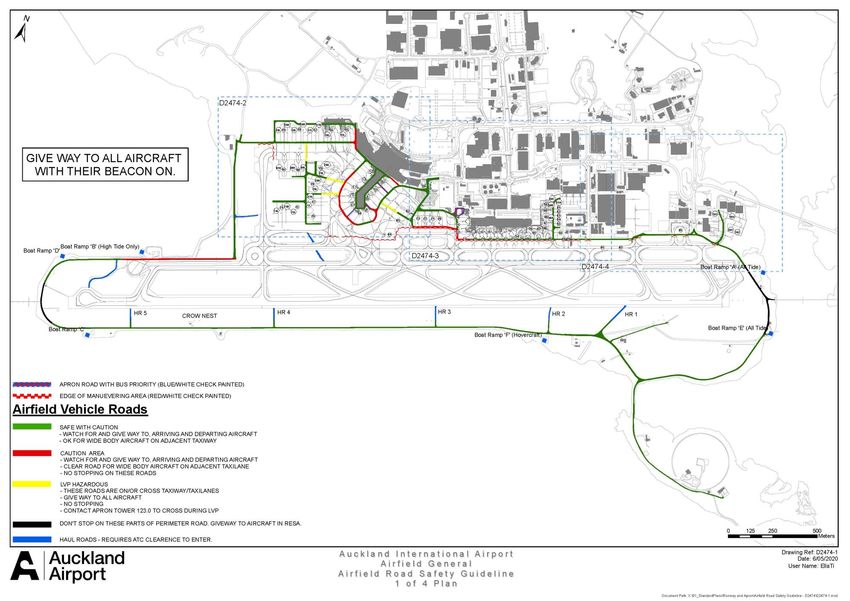
TABLE OF CONTENTS

    Paragraph                                                                                                                                                          Page

PRELIMINARY PAGES

    RECORD OF REVIEWS & APPROVAL OF CONTENTS                                                                                                                                 7
    UNCONTROLLED COPYHOLDERS                                                                                                                                                 7
    REVIEW PROCESS                                                                                                                                                           7
    ABBREVIATIONS & DEFINITIONS                                                                                                                                              9

SECTION 1 - GENERAL GUIDELINES ........................................................................................................................ 14

   1.1    STATEMENT OF PURPOSE ................................................................................................................................. 14
   1.2    ENTERING & EXITING AIRSIDE VIA CHECKPOINT CHARLIE...................................................................... 14
   1.3    UNSTAFFED AIRSIDE ACCESS POINTS .......................................................................................................... 15
   1.4    AIRPORT WORKERS’ RULES ............................................................................................................................. 16
   1.5    CATEGORIES OF AIRSIDE PERMITS ................................................................................................................ 16
     1.5.1 Stage 1 Airside Driving Permits .................................................................................................................... 16
     1.5.2 Stage 2 Airside Driving Permits .................................................................................................................... 16
     1.5.3 Stage 3 Airside Driving Permits .................................................................................................................... 16
     1.5.4 Category 1 Airside Vehicle Permits ............................................................................................................. 16
     1.5.5 Category 2 Airside Vehicle Permits ............................................................................................................. 17
   1.6    OBTAINING AN AIRSIDE DRIVING PERMIT ..................................................................................................... 17
   1.7    TRAINING AND TESTING ..................................................................................................................................... 18
     1.7.1 Driver Competency ........................................................................................................................................... 18
     1.7.2 Driver Testing for Stage 1 Airside Driving Permit .................................................................................... 18
     1.7.3 Driver Practical Training & Log Requirement ........................................................................................... 19
     1.7.4 Completion of Requirements & Refresher Test ........................................................................................ 19
     1.7.5 Probationary Period for New Holders .......................................................................................................... 20
   1.8    RENEWAL OF AIRSIDE DRIVING PERMITS ..................................................................................................... 20
   1.9    USE OF ANY AIRSIDE DRIVING PERMIT .......................................................................................................... 20
   1.10 LOSS OR THEFT OF ANY AIRSIDE DRIVING PERMIT ................................................................................... 21
   1.11 OTHER CHANGES OF STATUS .......................................................................................................................... 21
   1.12 SUSPENSION OR REVOCATION OF ANY AIRSIDE DRIVING PERMIT ...................................................... 21
   1.13 ENFORCEMENT OF RULES AND PENALTIES ................................................................................................ 22
   1.14 BIOSECURITY ISSUES ......................................................................................................................................... 22
   1.15 UNSATISFACTORY BEHAVIOUR ....................................................................................................................... 22
   1.16 AMENDMENTS TO THESE RULES..................................................................................................................... 23
   1.17 POWER TO SEARCH............................................................................................................................................. 23
   1.18 JOB TITLES & OTHER DESIGNATION CHANGES .......................................................................................... 23
   1.19 APPLICATION FOR EXEMPTION TO RULES ................................................................................................... 24

SECTION 2 - AIRSIDE DRIVING PERMIT RULES FOR STAGE 1 DRIVERS ........................................................ 25

   2.1    GAINING ENTRY TO AUTHORISED OPERATING AREAS ............................................................................ 25
   2.2    AUTHORISED OPERATING AREAS ................................................................................................................... 25
   2.3    MANOEUVRING AREA .......................................................................................................................................... 25
   2.4    DOCUMENTATION ................................................................................................................................................ 26
   2.5    GENERAL SAFETY RULES .................................................................................................................................. 26
     2.5.1 Requirement ....................................................................................................................................................... 26

Auckland Airport Airside Driving and Vehicle Permit Rules                                                                                           Preliminary Pages
Recommended review frequency: 2-yearly
Owner: Head of Airport Operations                                                                                                                                     Page   3
This page last amended: 10-09-21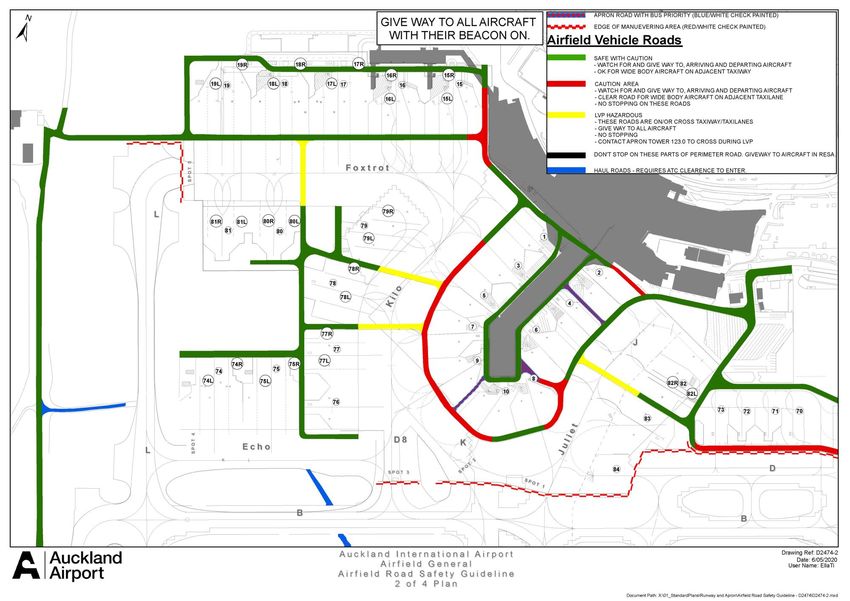
2.5.2 Rights of Way..................................................................................................................................................... 26
     2.5.3 No Smoking/Vaping .......................................................................................................................................... 26
     2.5.4 Drugs and Alcohol Prohibition ...................................................................................................................... 26
     2.5.5 Drug and Alcohol Testing after Accidents, Incidents and Near Misses ............................................. 26
     2.5.6 Drug and Alcohol Testing for Cause ........................................................................................................... 27
     2.5.7 Drug and Alcohol Rehabilitation ................................................................................................................... 28
     2.5.8 Cell phones (Mobiles) ...................................................................................................................................... 28
     2.5.9 Beacons............................................................................................................................................................... 29
     2.5.10  Secure Loads ................................................................................................................................................. 29
     2.5.11  FOD (Foreign Object Debris) ..................................................................................................................... 29
     2.5.12  Spills ................................................................................................................................................................ 30
     2.5.13  “No Seat No Ride” ........................................................................................................................................ 31
     2.5.14  Seatbelts ......................................................................................................................................................... 31
     2.5.15  Airbridges ....................................................................................................................................................... 31
     2.5.16  Keep to the Roads ........................................................................................................................................ 31
     2.5.17  Headlights ...................................................................................................................................................... 31
     2.5.18  Becoming Lost or Immobilised ................................................................................................................. 32
     2.5.19  Runway End Safety Area (RESA) ............................................................................................................. 32
     2.5.20  Passengers/Airside Workers Walking..................................................................................................... 33
     2.5.21  Incident Reporting ........................................................................................................................................ 33
     2.5.22  Emergency Access/Egress Points ........................................................................................................... 33
     2.5.23  Awareness of Service & Common Use Areas ....................................................................................... 33
   2.6    SAFETY AROUND AIRCRAFT ............................................................................................................................. 33
     2.6.1 Requirement ....................................................................................................................................................... 33
     2.6.2 Aircraft Right of Way........................................................................................................................................ 33
     2.6.3 Aircraft or Aircraft Wings Close to Roads .................................................................................................. 33
     2.6.4 Anti-collision Lights & Aircraft on Pushback ............................................................................................ 34
     2.6.5 Aircraft About to Move .................................................................................................................................... 34
     2.6.6 Driving in Front.................................................................................................................................................. 34
     2.6.7 Jet Blast............................................................................................................................................................... 35
     2.6.8 Prop Aircraft ....................................................................................................................................................... 35
     2.6.9 Prop Wash .......................................................................................................................................................... 35
     2.6.10  Parking Near Aircraft ................................................................................................................................... 35
     2.6.11  Aircraft Circle of Safety............................................................................................................................... 36
     2.6.12  Wing Tip Clearance Lines .......................................................................................................................... 36
     2.6.13  Aircraft Refuelling ........................................................................................................................................ 36
   2.7    SPEED LIMITS ........................................................................................................................................................ 37
   2.8    PARKING.................................................................................................................................................................. 37
   2.9    ESCORTING ............................................................................................................................................................ 38
   2.10 VEHICLES ................................................................................................................................................................ 39
   2.11 TOWING OF TRAILERS OR TROLLEYS ............................................................................................................ 39
   2.12 GOLF CARTS .......................................................................................................................................................... 40
   2.13 BICYCLES (CYCLISTS) ......................................................................................................................................... 40
   2.14 VEHICLE HEIGHT RESTRICTIONS .................................................................................................................... 40
   2.15 INNER PIER ROAD RESTRICTIONS .................................................................................................................. 40
   2.16 AREAS TO USE EXTREME CAUTION ................................................................................................................ 41
   2.17 INTERNATIONAL AND DOMESTIC BREEZEWAY RESTRICTIONS ............................................................ 41
   2.18 DESIGNATED BUS ROUTES ............................................................................................................................... 41
   2.19 TAXIWAY ALPHA .................................................................................................................................................... 41

Auckland Airport Airside Driving and Vehicle Permit Rules                                                                                                Preliminary Pages
Recommended review frequency: 2-yearly
Owner: Head of Airport Operations                                                                                                                                           Page   4
This page last amended: 10-09-21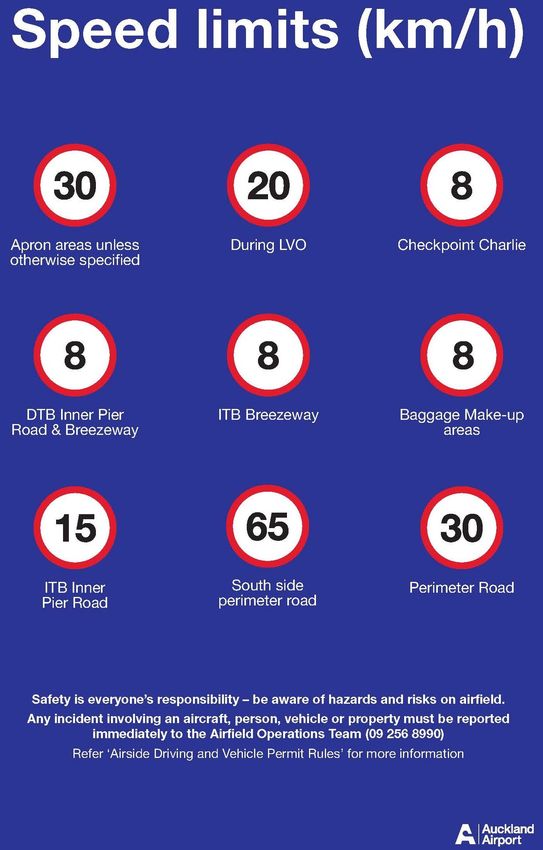
2.20 GEOGRAPHICAL KNOWLEDGE ......................................................................................................................... 42
   2.21 LOW VISIBILITY OPERATIONS (LVO) ............................................................................................................... 42
     2.21.1 Introduction.................................................................................................................................................... 42
     2.21.2 The LVO Process .......................................................................................................................................... 42
     2.21.3 Airside Driving Rule Restrictions During LVO ...................................................................................... 44
     2.21.4 Other LVO Restrictions ............................................................................................................................... 44
     2.21.5 Exceptions ..................................................................................................................................................... 45
   2.22 AIRSIDE PAINT MARKINGS ................................................................................................................................. 46
   2.23 AIRSIDE LIGHTS .................................................................................................................................................... 46
   2.24 APRON WARNING SIGNS .................................................................................................................................... 47
   2.25 OTHER WARNING SIGNS .................................................................................................................................... 47

SECTION 3 - AIRSIDE DRIVING PERMIT RULES FOR STAGE 2 PERMITS ......................................................... 49

   3.1    OBTAINING A STAGE 2 AIRSIDE DRIVING PERMIT....................................................................................... 49
   3.2    CONDITIONS OF A STAGE 2 DRIVING PERMIT .............................................................................................. 49
   3.3    AIR TRAFFIC CONTROL CLEARANCES ........................................................................................................... 50
   3.4    RADIO COMMUNICATIONS FOR STAGE 2 DRIVERS .................................................................................... 50
   3.5    COMMON RADIO PHRASES FOR STAGE 2 DRIVERS .................................................................................. 51
   3.6    RADIO FAILURE ..................................................................................................................................................... 52
   3.7    DRIVING ON THE MANOEUVRING AREA ......................................................................................................... 52
   3.8    DRIVING ON THE ACTIVE RUNWAY ................................................................................................................. 53
   3.9    ESCORTING ............................................................................................................................................................ 53
   3.10 RUNWAY INCURSION – A MAJOR SAFETY HAZARD .................................................................................... 53
   3.11 MULTI-LATERATION ............................................................................................................................................. 54
     3.11.1    Overview ......................................................................................................................................................... 54
     3.11.2    Transponder Approval & Installation ...................................................................................................... 54
     3.11.3    Transponders Required for ATC Clearance .......................................................................................... 54
     3.11.4    Transponder Operation ............................................................................................................................... 54
   3.12 GEOGRAPHICAL KNOWLEDGE ......................................................................................................................... 55
   3.13 AIRSIDE PAINT MARKINGS ................................................................................................................................. 55
   3.14 AIRSIDE LIGHTS .................................................................................................................................................... 55
   3.15 HOLD BARS (HOLD POSITION MARKING) ....................................................................................................... 55
   3.16 INTERMEDIATE HOLD BARS .............................................................................................................................. 56
   3.17 STOP BARS ............................................................................................................................................................. 57
   3.18 MAG SIGNS ............................................................................................................................................................. 59
   3.19 RESTRICTED RED AREAS .................................................................................................................................. 59
   3.20 RUNWAY STRIP SAFETY ZONES ...................................................................................................................... 59
   3.21 QUESTIONS APPLICANTS SHOULD BE ABLE TO ANSWER ....................................................................... 60

SECTION 4 - AIRSIDE DRIVING PERMIT RULES FOR STAGE 3 PERMITS ......................................................... 61

SECTION 5 - AIRSIDE VEHICLE PERMIT RULES .................................................................................................... 62

   5.1        REQUIREMENT ...................................................................................................................................................... 62
   5.2        CATEGORIES OF PERMIT ................................................................................................................................... 62
   5.3        CLASSES OF VEHICLE ......................................................................................................................................... 62
   5.4        APPLICATION FOR AIRSIDE VEHICLE PERMIT ............................................................................................. 62
   5.5        INSURANCE ............................................................................................................................................................ 63
   5.6        GENERAL REQUIREMENTS FOR VEHICLES .................................................................................................. 63
   5.7        VEHICLES OR EQUIPMENT TAKEN LANDSIDE.............................................................................................. 64
   5.8        TRAILERS, TROLLEYS AND TRACTORS ......................................................................................................... 64

Auckland Airport Airside Driving and Vehicle Permit Rules                                                                                                Preliminary Pages
Recommended review frequency: 2-yearly
Owner: Head of Airport Operations                                                                                                                                           Page   5
This page last amended: 10-09-21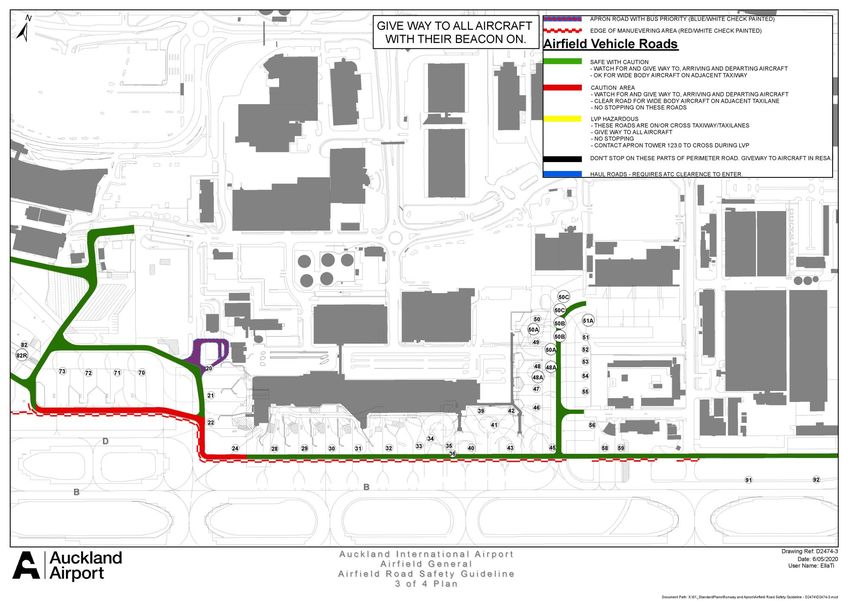
5.9        GOLF CARTS .......................................................................................................................................................... 64
   5.10       BICYCLES ................................................................................................................................................................ 65
   5.11       APPROVAL OF NEW TYPES OF VEHICLE ....................................................................................................... 65
   5.12       ACCIDENTS AND SAFETY ................................................................................................................................... 65
   5.13       VEHICLES CEASING TO OPERATE ................................................................................................................... 66
   5.14       ESCORT VEHICLES .............................................................................................................................................. 66
   5.15       POWER TO SEARCH VEHICLES ........................................................................................................................ 66

SECTION 6 - ENFORCEMENT OF RULES AND PENALTIES ................................................................................. 67

   6.1        RESPONSIBILITY ................................................................................................................................................... 67
   6.2        ACKNOWLEDGEMENT OF SERIOUSNESS ..................................................................................................... 67
   6.3        DEMERIT POINTS SYSTEM ................................................................................................................................. 67
   6.4        PENALTIES WHEN 100 POINTS IS REACHED ................................................................................................ 67
   6.5        ENFORCEMENT OF VEHICLE RULES .............................................................................................................. 68
   6.6        POWERS OF REVOCATION ................................................................................................................................ 69
   6.7        APPEAL PROCEDURES ....................................................................................................................................... 69
   6.8        PROVISION OF NOTICE ....................................................................................................................................... 70

SECTION 7 - APPENDICES .......................................................................................................................................... 71

  Airfield Road Safety Guideline – Airfield - D2474-1                                                                                                                                 72
  Airfield Road Safety Guideline - International Apron - D2474-2                                                                                                                      73
  Airfield Road Safety Guideline - Domestic Apron - D2474-3                                                                                                                           74
  Airfield Road Safety Guideline - DHL Apron - D2474-4                                                                                                                                75
  Airfield Stand Numbers & Taxiway Designations                                                                                                                                       76
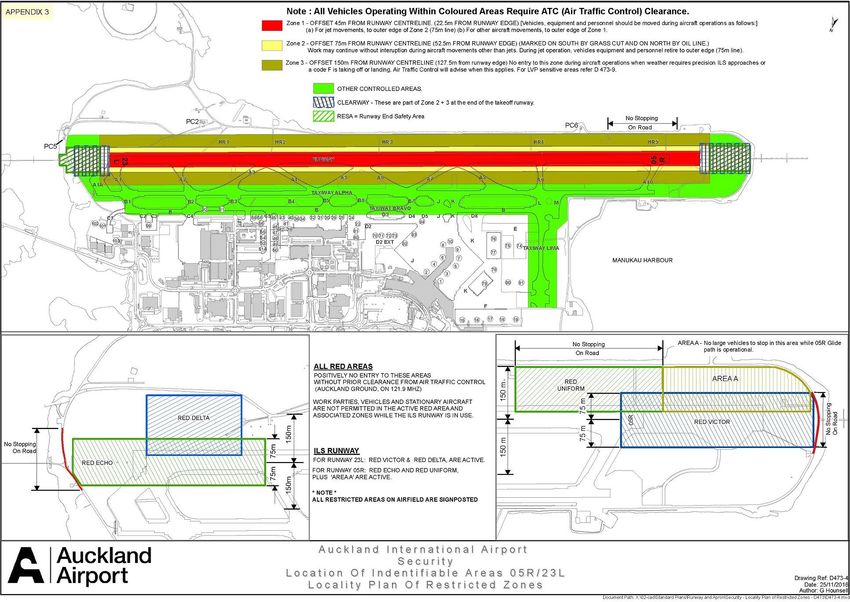
  RWY 05R/23L Restricted Zones                                                                                                                                                        77
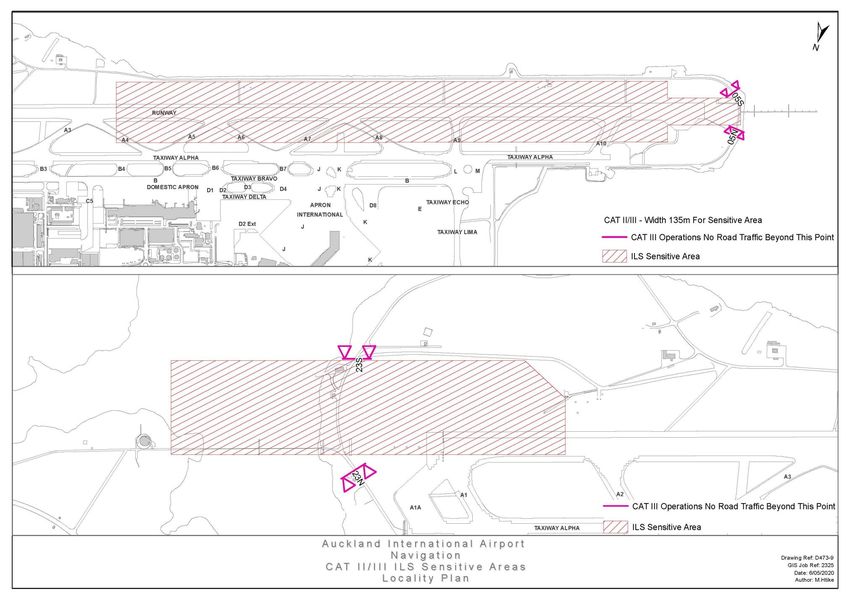
  CAT III Sensitive Areas - D473-9                                                                                                                                                    78
  LVO Sign Locations - D2939-1                                                                                                                                                        79
  Airside Driving & Vehicle Demerit Points Schedule                                                                                                                                   80
  Copies of “12 Rules” Posters                                                                                                                                                        84

Auckland Airport Airside Driving and Vehicle Permit Rules                                                                                                   Preliminary Pages
Recommended review frequency: 2-yearly
Owner: Head of Airport Operations                                                                                                                                              Page   6
This page last amended: 10-09-21
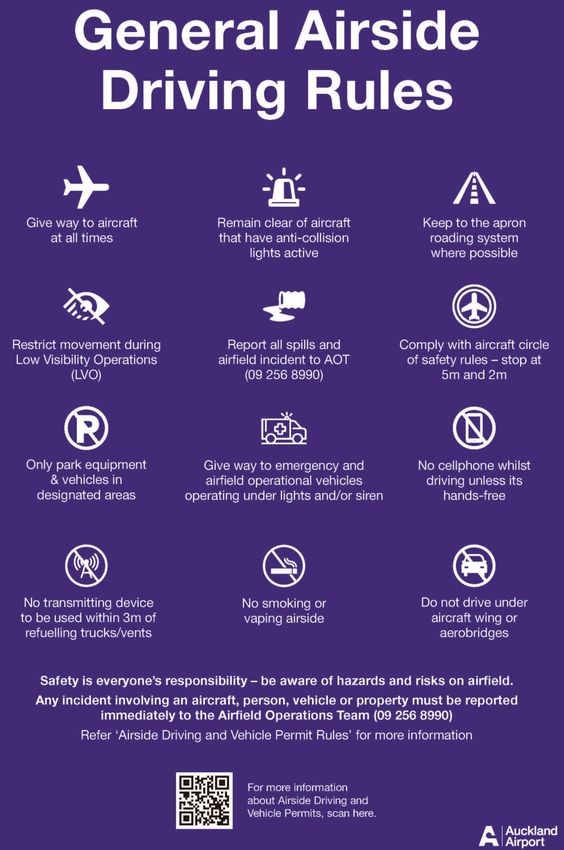
RECORD OF REVIEWS & APPROVAL OF CONTENTS
 Control and distribution details for this Manual are as follows:

 •      The Word master is doc # OPSMASTERS-1040927276-33070 in the MS Team "Ops Forms, Manuals, Docs
        CONTROL". A pdf is made for publication and saved into the SharePoint "Aerowiki" document library using
        the same pdf file name as the existing version in that library to ensure any hyperlinks still function, including
        hyperlinks to the pdf from The Radar. The pdf may also need uploading to the corporate website.
 •      The Word master uses SharePoint "version history" to retain full details of changes over time.
 •      The final pdf is attached to an email and distributed to external users, and the sent email saved into a specific
        Sonar SharePoint folder (Operations Policy and Integrity / Document Management Initiatives / Aero doc
        approvals and reviews) to give it a doc number, which is recorded in the table overleaf to retain an auditable
        record of who the document has been sent to.

                                          UNCONTROLLED COPYHOLDERS
 AIAL corporate website pdf copy (and ServiceNow vendor FAQ, using same url as AIAL website).

 Head of Airport Operations.

                                                         REVIEW PROCESS
 A document review process is in place requiring content reviews at regular intervals (see bottom left-hand footers
 for recommended frequencies). Unique document numbers (prior to the April 2019 update, FileSite, now SharePoint,
 via folder Operations Policy and Integrity / Document Management Initiatives / Aero doc approvals and reviews)
 containing evidence of review, and evidence of document owner approval of content and amendments, are listed
 below. Paragraphs affected by amendments at each review are marked by lines in the right margin (except for
 consequential changes to Table of Contents, etc).

     Content        Reviewer:          Number of document in      Amendment         Doc            Number of document in which         Date of
     Review                            which reviewer confirms      Date:          Owner:         doc owner approves the content      approval:
      Date:                                  the review:                                              of the amended Manual:

  May 2011      Babcock Fitzroy,                997668             09-06-11     Trevor Herriott             564845_1                   23-06-11
                 Sarah Kane,                                       (re-issue)
                 Roy Thomas

Nov 11 & Oct Steve Hardwick,                997682_1 to _8         24-01-13     Mark Croudace               564845_2                   19-03-13
   2012 to     Sarah Kane,
March 18 2013  Matt Palliser

  June-Aug         Gretchen             1689175 & 6, 1705998,      02-09-15      Anil Varma                  1779543                   27-11-15
    2015         Fenton, Steve            1719558, 1763009,
                 Hardwick, Nick           1770591, 1777753
                 Muller BARNZ

  May-Nov          Gretchen          2429366, 2475770, 2476490     17-05-18     Robin Cooper                 2597836                   23-05-18
 2017, Feb-      Fenton, Izaaz        & 91, 2510179, 181 & 194,
 May 2018         Dean, Steve            2499075, 2509316,
                 Hardwick, Nick        2548259, 2583374 & 5,
                 Muller (plans),       2583377 & 8, 2583388,
                  Ali Hassan          2583400 & 417, 2596414,
                                              2597554

 Auckland Airport Airside Driving and Vehicle Permit Rules                                                        Preliminary Pages
 Recommended review frequency: 2-yearly
 Owner: Head of Airport Operations                                                                                              Page   7
 This page last amended: 01-08-20
                         10-09-21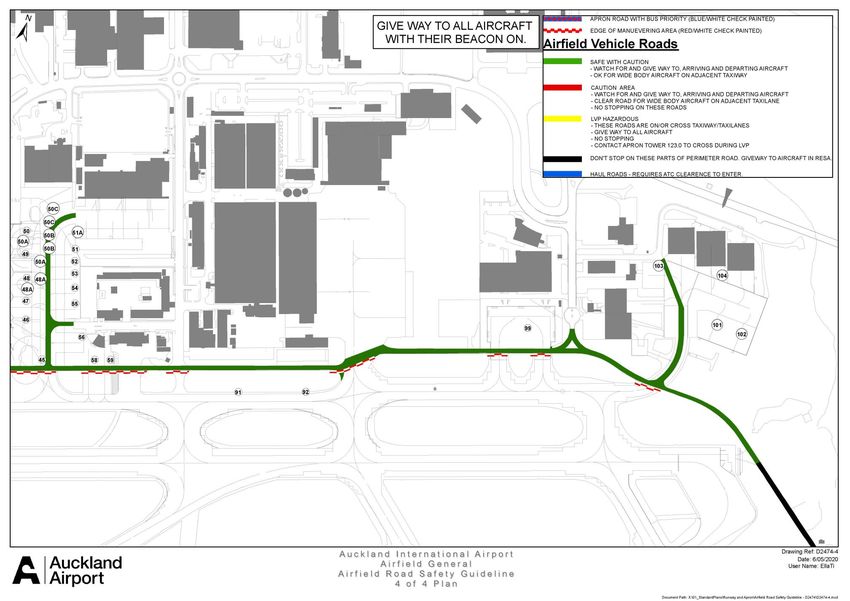
CONTROL, DISTRIBUTION, RECORD OF REVIEWS & APPROVAL OF CONTENTS
                                                                                (cont)

  Content            Reviewers:          Document Numbers in     Amendment         Doc     Document Numbers in which     Date of     Document Numbers of
  Review                                  evidence of review:      Date:          Owner:   doc owner approves content   approval:      emails issuing to
   Date:                                                                                       of amended Manual:                      external holders

 19-06-18        Airways review,              2619037             19-06-18       Robin             2619290              20-06-18     2608068, 2626478
                 Gretchen Fenton                                 (para 3.8.2)    Cooper                                               to 484, 2626486

 Nov-Dec         Steve Hardwick,         2619037, 2721014,        18-12-18       Robin             2721491              20-12-18          unknown
  2018            Kristina Cooper,             5&6               (CPC entry)     Cooper
                 Gretchen Fenton,
                Natalie Morris, Legal
                        Team

   29-04-          Louise Martin         AIAL-1336572876-         13-05-19       Robin     AIAL-1336572876-65414        11-06-19          unknown
  19, May          (Legal), Steve         65410 (power to                        Cooper
    2019             Hardwick              search), AIAL-
                                         1336572876-65407

27-02-2020       Steve Hardwick,         1336572876-100555        27-02-20       Robin     AIAL-1336572876-100556       27-02-20          unknown
                 Kristina Cooper,        (“Suspected drug or                     Cooper
                  Robin Cooper            alcohol use etc…”
                                         sentence reinstated
                                            after mistaken
                                         removal in 13-05-19
                                             amendment)

 March to        Gretchen Fenton,         AIAL-1336572876-        01-08-20       Robin     AIAL-1336572876-100904       30-07-20             tbc
  July             Ali Hassan,            100619, 20 & 22, -                     Cooper
  2020           Kristina Cooper,       100635 & 37, -100641,
                 Steve Hardwick,        -100667, -100715 & 16,
                                        -100729 to 31, -100801
                                           to 7, -100876 to 8,
                                        -100882 to 87, -100889
                                               to -100901

 09-04-21        Kristina Cooper,         AIAL-1336572876-        09-04-21       Robin     AIAL-1336572876-102019       09-04-21             tbc
                 Steve Hardwick                102019                            Cooper

April to July    Hana Lee, Laurie        AIAL-1336572876-         10-09-21       Robin     AIAL-1336572876-102318       08-09-21             tbc
  2021,           Culpan, Adam            102225, 273, 306,                      Cooper             & 317
 07-09-21         Eltham, Simon          311, 312, 313, 314,
                Macpherson (LVO) ,              315
                  Steve Hardwick

    Auckland Airport Airside Driving and Vehicle Permit Rules                                                                 Preliminary Pages
    Recommended review frequency: 2-yearly
    Owner: Head of Airport Operations                                                                                                       Page   8
    This page last amended: 10-09-21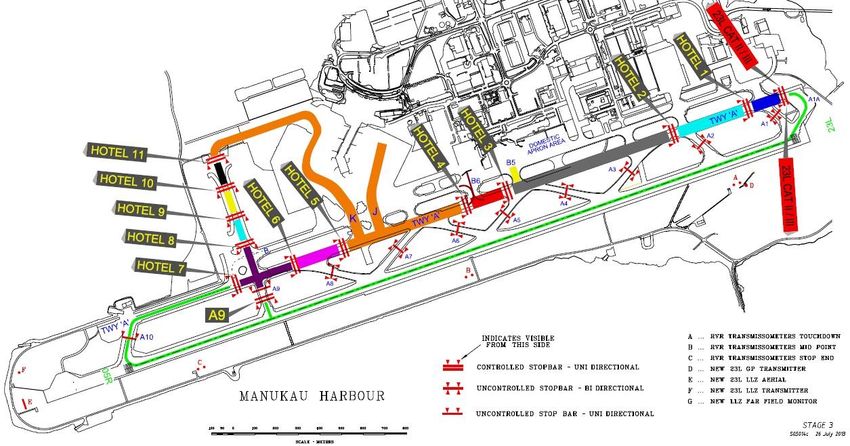
ABBREVIATIONS AND DEFINITIONS
ADP                       Airside Driving Permit.

Aerodrome

                          ●      That part of the Airport that is a defined area of land or water intended or designed to be
                                 used either wholly or partly for the landing, departure, and surface movement of aircraft,
                                 and
                          ●      Includes any buildings, installations, and equipment on or adjacent to any such area used
                                 in connection with the aerodrome or its administration.

AIAL                      Auckland International Airport Limited, and includes its successors and assigns. Also referred
                          to as “Auckland Airport”.

Air Traffic Control (ATC)

                          The Ground Movement Controller who has charge of all aircraft and vehicles operating on the
                          manoeuvring area on VHF 121.9 MHz or the Tower Controller operating on VHF 118.7 MHz.

Airfield Access Controller

                          A person whose role is to verify the legitimacy and authority to go airside of any person or
                          vehicle presenting to any airside access point.

Airfield Operations Team/Apron Tower (AOT)

                          The team responsible for safe operating on the airfield. They are the team to contact regarding
                          airside matters. Their contact phone number is (09) 256-8990 or extension 98990, radio
                          frequency 123.0 MHz or email aot@aucklandairport.co.nz.

Airport

                          Auckland Airport, at Mangere, Auckland, including any other land, buildings, installations and
                          facilities that may from time to time be acquired by, or come under the control of AIAL.

Airport Identity Card

                          An airport identity card issued by the Aviation Security Service, or its agent, on behalf of the
                          Director of Civil Aviation under Civil Aviation Rule Part 19 after screening of the relevant
                          person, and which carries a photograph of the relevant person.

Airport Official

                          The Chief Executive of Auckland Airport and any person appointed or authorised by Auckland
                          Airport to assist in the management or control of persons or property at the Airport, including
                          (but not limited to) the General Manager Operations, the Head of Airport Operations, the Head
                          of Risk and Assurance, Safety and Security Manager, Apron Operations staff, Head of Health
                          and Safety and any other Auckland Airport employees.

Auckland Airport Airside Driving and Vehicle Permit Rules                                                 Preliminary Pages
Recommended review frequency: 2-yearly
Owner: Head of Airport Operations                                                                                        Page   9
This page last amended: 10-09-21
                        10-09-21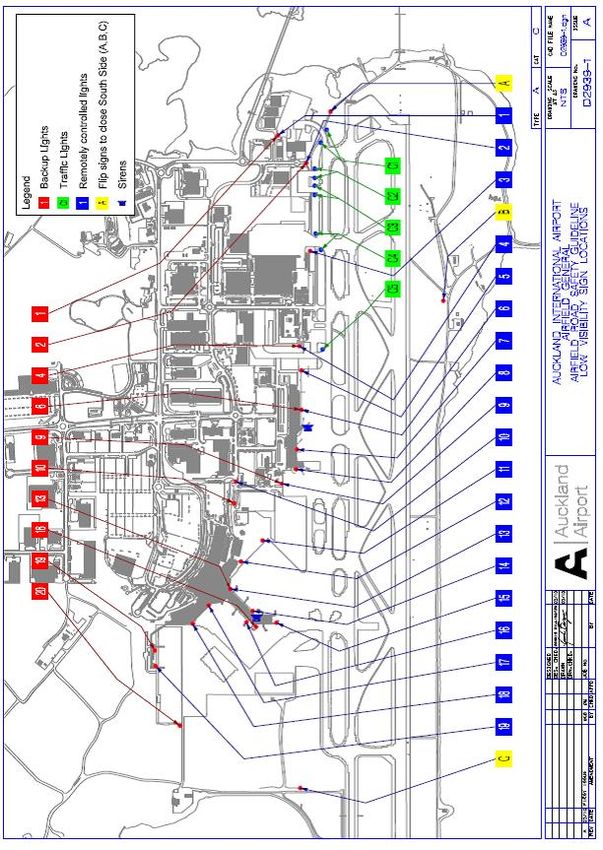
Airside Area
                          That part of the Airport used for the surface movement of aircraft, including (but not limited to)
                          those areas used for take-off, landing and taxiing of aircraft, and the apron area used for the
                          purpose of loading and unloading of passengers and cargo and refuelling, parking and
                          carrying out of maintenance of aircraft being declared a “security area” by the Director Of Civil
                          Aviation pursuant to section 84 (1) of the Civil Aviation Act 1990.

Airside Driving Permit (ADP)

                          The permit granted by Auckland Airport to a person to allow that person to drive a vehicle
                          within the Airside Area issued in accordance with the Airside Driving Permit Rules.

Airside Vehicle Permit (AVP)

                          A permit issued by Auckland Airport, in its sole discretion, to authorise a particular vehicle to
                          operate within the airside area.

Apron                     That area set aside for the loading, unloading or maintenance of aircraft.
ATC                       Air Traffic Control.

AVP                       Airside Vehicle Permit.

Auckland Airport

                          Either:

                          a. Auckland Airport, at Mangere Auckland, including any other land, buildings, installations and
                               facilities that may from time to time be acquired by, or come under the control of AIAL, or

                          b. A reference to AIAL as a corporate entity.

Auckland Airport Authorised Agent

                          A person authorised in writing to conduct vehicle escorts.

Authorised Airside Purpose

                          Access to Airside areas is only authorised and permitted if, and to the extent that, such access is
                          required to conduct an operational activity authorised directly or indirectly by Auckland Airport.

CAT III                   A precision navigational aid system that provides guidance to aircraft and allowing them to land
                          in low visibility conditions such as fog.

CPC                       Checkpoint Charlie.

Checkpoint Charlie
                          Checkpoint Charlie is Auckland Airport’s primary vehicle airside/landside access way located at
                          Cyril Kay Road Auckland International Airport. Because its purpose is to facilitate the controlled,
                          safe and secure access of authorised persons and vehicles from landside to airside (and vice
                          versa), Auckland Airport deems that the area designated as Checkpoint Charlie commences in
                          the entrance lane from the start of the band of orange cross-hatched paint on the surface of Cyril
                          Kay Road prior to the barrier arm, and continues until the sliding gate which allows access

Auckland Airport Airside Driving and Vehicle Permit Rules                                                 Preliminary Pages
Recommended review frequency: 2-yearly
Owner: Head of Airport Operations                                                                                    Page   10
This page last amended: 10-09-21
through the airside boundary into the airside area; and in the exit lane from the sliding gate
allowing vehicles to exit from the airside area to the barrier arms next to the gatehouse.
Blue and white road system
The road system which is primarily used for the movement of buses. These roads are marked
by alternating blue and white lines. All vehicles may use these roads but buses have priority.
Designated Parking Areas
Areas on the aprons set aside for parking ground handling equipment or vehicles, and which
are delineated by specific markings on the apron or roadside.
Emergency Equipment
Any vehicle from the Auckland Airport Airport Emergency Service, the Fire Service,
Ambulance, Police, Auckland Airport and Aviation Security Service or any other emergency
vehicle approved by Auckland Airport displaying a flashing beacon.
FOD Foreign Object Debris.
Foreign Object Debris (FOD)
Any object on the airfield that could cause damage to an aircraft.
Golf Cart An electrically-operated vehicle.
GSE Ground Service Equipment.
Incident
Any accident or event that occurs in an Airside Area. Incidents may include, but are not limited
to fire and explosions, injuries to persons, damage to vehicles, equipment, plant or property,
spills or other exposures to hazardous substances or circumstances (including occurrences
which could have, but did not actually cause such injury, damage, spill or exposure).
Low Visibility Operations
An operational status of the airfield that is declared when visibility deteriorates below specific
minima (usually due to fog).
Low Visibility Procedures
Standard procedures required for safe operations on the airfield during LVO.
LVO Low Visibility Operations.
LVP Low Visibility Procedures.
MAG Manoeuvring Area Guidance.
MAG Signs
Manoeuvring Area Guidance signs used to assist pilots and other airfield users in establishing
direction and location on the airfield.
Auckland Airport Airside Driving and Vehicle Permit Rules Preliminary Pages
Recommended review frequency: 2-yearly
Owner: Head of Airport Operations Page 11
This page last amended: 10-09-21Manoeuvring Area
That area of the aerodrome designated for the landing, take off and for the surface movement
of aircraft, being:
● at the domestic terminals at the Airport, the area south of the Red & White Road
System, and
● at the international terminal at the Airport, the Apron holding points, including in each
case, all taxiways, runways and the associated grass areas, but does not include the
Perimeter Road.
A Red Check line delineates the boundary between the manoeuvring area and the Apron.
MLAT
Means Multi-lateration, which is a secondary radar system that provides information on a
display to air traffic controllers of the position of all transponder equipped aircraft and vehicles
on the airfield.
Movement Area
Any part of the Airport that is intended for the movement of aircraft on the ground, and
includes the manoeuvring area, maintenance areas and aprons.
MPI Ministry for Primary Industries
Notice of Removal
A notice issued by Auckland Airport for the removal of unsafe vehicles or equipment.
NZTA NZ Transport Agency
Perimeter Road
That road that transits the edge of the airfield starting at Perimeter Access Gate 1 via the
southern boundary and terminates near Stand 80, as illustrated on the plan series D2474-1 to
4 in the Appendices Section of these Rules.
Red & White Road System
The road system which is reserved for the movement of vehicles not equipped with radios
around the apron areas and on which the roads are designated by alternating red and white
lines, as illustrated on the plan series D2474-1 to 4 in the Appendices Section of these Rules.
Auckland Airport Airside Driving and Vehicle Permit Rules Preliminary Pages
Recommended review frequency: 2-yearly
Owner: Head of Airport Operations Page 12
This page last amended: 10-09-21Runway End Safety Area (RESA)
The safety area at each end of the runway at Auckland Airport if aircraft overshoot or
undershoot the runway. Signs either side of the RESA require vehicles to give way to aircraft
likely to pass over the road.
Runway Incursion
Any occurrence involving an aircraft, vehicle, person, or object on the ground that creates a
collision hazard or results in loss of separation with an aircraft taking off, intending to take-off,
landing, or intending to land.
Towable Airfield Barriers (TABS)
Physical barriers used to block off an active movement area or road
Unit Load Device (ULD)
Unit Load Device
Vehicles
Motor vehicles and specialist equipment and vehicles used for ground transport for which
Auckland Airport has given approval to be used within the Airside Area.
Wing Tip Clearance Lines
A red painted line indicating the safe operating area outside of the aircraft’s wing tip.
Auckland Airport Airside Driving and Vehicle Permit Rules Preliminary Pages
Recommended review frequency: 2-yearly
Owner: Head of Airport Operations Page 13
This page last amended: 10-09-21SECTION 1 - GENERAL GUIDELINES
1.1 STATEMENT OF PURPOSE
1.1.1 The purpose of these Airside Driving and Vehicle Permit Rules is to provide a safe and secure
environment in which to undertake aerodrome operations. The overriding requirements are that all
airside vehicles must have certain equipment and characteristics, and that the drivers must:
● Always enter the Airside Area, drive and carry out work duties in a safe and appropriate manner.
● Ensure that driving and parking of vehicles and equipment do not impede aircraft operations or
movement on aprons.
● Be aware of the aviation environment and its inherent dangers.
1.1.2 These Rules are designed to meet the requirements of Civil Aviation Rule Part 139.119,
139.203(d)(12)(i), and other relevant legislation.
1.1.3 The airport is the private property of Auckland International Airport Ltd (“Auckland Airport”). Access
to all or any part of the Airside Area may be granted by Auckland Airport to approved drivers and
vehicles, however that access is conditional on observing these Rules. Failure to observe these Rules
may lead to revocation of an Airside Vehicle Permit, the relevant driver’s Airside Driving Permit and/or
Airside access.
1.2 ENTERING & EXITING AIRSIDE VIA CHECKPOINT CHARLIE
1.2.1 It is a condition of entry to airside by means of Checkpoint Charlie (“CPC”), as defined in these Rules,
that all drivers and occupants of vehicles consent to all reasonable checks Auckland Airport (or any
CPC service provider that Auckland Airport contracts from time-to-time) deems necessary, including but
not limited to:
● Checking the validity of permanent or temporary airport identification cards of all people
accessing airside;
● Checking of temporary airport identification card holders’ and escorted drivers’ passports and/or
NZ drivers licences;
● Checks or visual inspections of the exteriors and interiors of vehicles or any parts thereof;
● Utilising static and mobile card readers;
● Checking the validity of Airside Vehicle Permits and checking the validity of and authenticating
Airside Driving Permits.
Auckland Airport Airside Driving and Vehicle Permit Rules Section 1 - General Guidelines
Recommended review frequency: 2-yearly
Owner: Head of Airport Operations Page 14
This page last amended: 10-09-21
01-08-201.2.2 Drivers entering and exiting airside via CPC must do so in a safe and appropriate manner, and must
also use a level of caution appropriate to the presence of Airfield Access Controllers on foot in the area,
and must put their vehicles into neutral with their hand or foot brakes engaged while at the gate house
and being screened by Airfield Access Controllers.
1.2.3 Auckland Airport reserves the right to refuse any person or vehicle entry to, or access through,
Checkpoint Charlie for any reason, including but not limited to:
● Drivers not carrying their own Airside Driving Permit or airport identification card;
● Attempting to use another person’s Airside Driving Permit or another person’s airport
identification card;
● Airside Driving or Vehicle Permit or airport identification card not current;
● Vehicle has no Vehicle Permit and is not under legitimate escort;
● Driver does not have access granted to the CPC Gate.
1.2.4 If any occupant of a vehicle other than the driver has no or an invalid airport identification card, or does
not have access granted to the CPC Gate, they will be asked to leave the vehicle and will not be allowed
airside.
1.2.5 Auckland Airport refusing any person or vehicle entry to, or access through, Checkpoint Charlie does
not preclude Auckland Airport from issuing an Infringement Notice if Auckland Airport deems it is
warranted.
1.2.6 If any pedestrian or animal is seen entering or attempting to enter the airfield through the CPC entrance
or exit this must be reported immediately to Airport Monitoring on 09 256 8817. Any animal loose
landside in the vicinity of any gate must also be reported to Airport Monitoring.
1.3 UNSTAFFED AIRSIDE ACCESS POINTS
1.3.1 Any driver presenting a vehicle or piece of equipment to enter or exit an Airside Area through any vehicle
access point must do so in a safe and appropriate manner, and the driver must report any damage
witnessed or caused (and any faults) to Operations Monitoring on 0800 677 242 ext 4.
1.3.2 After each vehicle has passed through the gate, it must stop and wait for the gate to close. If any animal
or pedestrian is seen entering into the airlock or onto the airfield this must be reported immediately to
Ops Monitoring on 0800 677 242 ext 4. If the driver is in the airlock, the driver should remain in this
area without proceeding onto the airfield until Operations arrive. Any animal loose airside or in the
vicinity of any airfield gate, including CPC must also be reported to Airport Monitoring on 09 256 8817.
1.3.3 The gates on public roads giving access to airside areas are all “Quick Gates” and must not be used
until a green light is displayed, either after using an access card from landside or stopping on a pressure
pad if airside. Unless being escorted, only one vehicle is allowed through on each green light.
1.3.4 Some gates are not “Quick Gates” but are opened and closed by lock and key. These include all access
doors. The driver is responsible for ensuring that these gates and doors are closed and locked after
use.
Auckland Airport Airside Driving and Vehicle Permit Rules Section 1 - General Guidelines
Recommended review frequency: 2-yearly
Owner: Head of Airport Operations Page 15
This page last amended: 10-09-21
01-08-20
01-08-201.3.5 Any gate observed open must immediately be reported to Auckland Airport Operations Monitoring on
0800 677 242 ext 4, SkyGate Security 09 255 9095, or Aviation Security 09 255 6000. The person
noticing that the gate is open must close it if possible and remain with it until Auckland Airport, SkyGate
or Avsec arrive.
1.3.6 It is a condition of entry to or exit from airside by means of any vehicle access point other than
Checkpoint Charlie, that all drivers and occupants of vehicles consent to all the types of search in para
1.2 of these Rules, if Auckland Airport decides to conduct such searches at any such airside access
points from time to time.
1.4 AIRPORT WORKERS’ RULES
The Airside Driving and Vehicle Permit Rules must be read in conjunction with the Airport Workers’
Rules. The Airport Workers’ Rules covers the rules for personnel who work in, on and/or near airside
and is deemed to form part of the Airside Driving Rules. These can be obtained from Auckland Airport’s
website, https://corporate.aucklandairport.co.nz/aeronautical-operations/downloads.
1.5 CATEGORIES OF AIRSIDE PERMITS
1.5.1 Stage 1 Airside Driving Permits
The Stage 1 Airside Driving Permit (ADP) is required by drivers who operate solely on the red and white,
and blue and white road system, the Perimeter Road and aprons, and do not operate within the
manoeuvring area. Stage 1 drivers are not permitted to drive on runways or taxiways (the manoeuvring
area), except where the red and white road forms part of a taxiway and should never cross the red and
white checked line which is the boundary to the manoeuvring area. Refer Section 2 of these Rules for
further information.
1.5.2 Stage 2 Airside Driving Permits
Stage 2 ADP holders are permitted to drive on the manoeuvring area subject to clearance from Air
Traffic Control (ATC). To operate on the manoeuvring area, drivers must have an approved Category 2
vehicle equipped with a functioning UHF radio, MLAT transponder, beacon and a current Stage 2 ADP.
To get a Stage 2 driving permit, applicants must pass a theoretical assessment, a practical assessment
and a geographical knowledge assessment. Refer Section 3 of these Rules for further information.
1.5.3 Stage 3 Airside Driving Permits
The Stage 3 ADP is for drivers whose work requires them to drive within the manoeuvring area during
LVO conditions. To maximise safety, Stage 3 permits will only be granted to a minimum number of
selected personnel who hold a Stage 2 driving permit, by the Auckland Airport Operations Safety &
Compliance Team. Refer Section 4 of these Rules for further information.
1.5.4 Category 1 Airside Vehicle Permits
A Category 1 Airside Vehicle Permit (AVP) allows the vehicle to operate on the Apron Road System
and Perimeter Roads (refer to Category 1 (Blue) Vehicle Operating Areas drawing in the Appendices).
Refer Section 5 of these Rules for further information.
Auckland Airport Airside Driving and Vehicle Permit Rules Section 1 - General Guidelines
Recommended review frequency: 2-yearly
Owner: Head of Airport Operations Page 16
01-08-20
10-09-21
This page last amended: 10-09-211.5.5 Category 2 Airside Vehicle Permits
A Category 2 AVP allows the vehicle to operate on the Manoeuvring Area, Apron Road System and
Perimeter Roads (refer to Category 2 (Red) Vehicle Operating Areas drawing in the Appendices). Refer
Section 5 of these Rules for further information.
1.6 OBTAINING AN AIRSIDE DRIVING PERMIT
1.6.1 Applications for an ADP must be made through the applicant’s employer. The application form can be
downloaded from the Auckland Airport website, https://corporate.aucklandairport.co.nz/aeronautical-
operations/airside-driving.
1.6.2 Auckland Airport may, at its sole discretion, determine whether to issue an ADP to any person and may
impose a charge for, and impose reasonable conditions on the issue of any ADP.
1.6.3 ADP applicants must have a current New Zealand Drivers Licence issued under the Transport (Vehicle
and Driver Registration and Licensing) Act 1986, the Transport (Drivers Licensing) Regulations 1987 or
other equivalent legislation. That Licence must be produced for inspection when applying for an ADP
and be a minimum of a NZ Full licence or international equivalent. A NZ learners’ or Restricted Licence
will not be approved as a suitable pre-requisite for a Stage 1 ADP.
1.6.4 Drivers must be trained in the type of vehicle or equipment they will be using airside. Drivers must have
the appropriate class of licence or equivalent training. For example, a driver of a bus must have the
applicable endorsement from NZTA and a driver of a truck must have the applicable endorsement from
NZTA if over the limitations to drive on standard licence.
1.6.5 Permit holders’ employers must ensure permit holders’ training records and currency details are kept
up-to-date and made available upon request by Auckland Airport. Note that the Civil Aviation Authority
and Auckland Airport audit driving records, and employers must make these available when requested.
1.6.6 A driver who does not permanently live in New Zealand but has a valid driver’s licence from another
country can be issued with an ADP for a maximum period of up to one year on a one-time basis only
(ie, upon expiry, that driver must obtain an NZ Drivers Licence in order to obtain an ADP).
Auckland Airport Airside Driving and Vehicle Permit Rules Section 1 - General Guidelines
Recommended review frequency: 2-yearly
Owner: Head of Airport Operations Page 17
This page last amended: 10-09-21
10-09-211.7 TRAINING AND TESTING
1.7.1 Driver Competency
1.7.1.1 Each employer will be responsible for training their driver(s) in the safe and correct operation of any
vehicle or equipment the driver is to operate airside.
1.7.1.2 Each driver will be required to demonstrate sufficient geographic knowledge and awareness of
operational hazards on the airfield and apron.
1.7.2 Driver Testing for Stage 1 Airside Driving Permit
1.7.2.1 The employer must ensure that the applicant has read and UNDERSTOOD the Airside Driving Rules &
Airport Workers’ Rules before presenting applicants for the ADP test.
1.7.2.2 The ADP test is conducted at the Auckland Airport ADP/AVP Permit Office under Stand 5/6 Airside
International Terminal. ADP tests are conducted using a computer-based testing system and consist
of 30 multi-choice questions. Applicants are given 60 minutes to complete the test and must answer a
minimum of 27 questions correctly in order to pass successfully.
1.7.2.3 Applicants completing computer-based tests are to be given no assistance from colleagues or request
this from the Auckland Airport Airside Licencing Administrator. Cell phones, radios and/or any other
reference material (including translators) are prohibited during test sessions.
1.7.2.4 The ADP Office is open between 0700 and 1500 on business days, except on statutory holidays. There
is no requirement to book an appointment time to sit the ADP test. However, no testing commences
after 1400..
1.7.2.5 If an applicant does not pass the test on their first two attempts, a stand-down period of 1 calendar
weeks must be adhered to before re-sitting each test. If the applicant does not pass the test at their
third attempt:
● The applicant’s employer may contact the Safety, Risk & Compliance Lead – Airfield for approval
for a fourth attempt, and;
● Upon a 4th attempt being approved, a 1-month stand down will be imposed and the employer
must provide evidence of remedial training prior to re-sitting. If the 4th attempt is not successful,
a further attempt will not be permitted.
1.7.2.6 Auckland Airport is under no obligation to approve a fourth attempt, and no consideration for a fifth
attempt will be given within any timeframe.
1.7.2.7 Once the theory component has been successfully completed, the candidate will be given the Airside
Driving Applicant Training Log to complete.
Auckland Airport Airside Driving and Vehicle Permit Rules Section 1 - General Guidelines
Recommended review frequency: 2-yearly
Owner: Head of Airport Operations Page 18
This page last amended: 10-09-211.7.3 Driver Practical Training & Log Requirement
1.7.3.1 Each applicant MUST complete a minimum of 10 hours practical driver training in a vehicle which they
will be working in when airside (ie, truck, motor vehicle, tractor, loader, etc) under the supervision of a
current ADP holder, who has held an ADP for a minimum 6 months and is actively coaching and sitting
beside the trainee driver.
1.7.3.2 If a driver under training breaches any airside driving rules or gets involved in any incident or accident
whilst under supervision, the trainer driver will be held accountable with loss of demerits/suspension to
their ADP.
1.7.3.3 The 10-hour practical driver training must be logged over a minimum five day period (prior to submission
for an ADP) and must have a minimum of five separate entries. Both portions of the Driving Log (driving
hours logged, competency activities) must be completed, endorsed by a company supervisor and
sighted by Auckland Airport before an ADP can be issued.
1.7.3.4 The 10-hour practical driver training log is required for initial issue of an ADP, or where an ADP has
been expired for greater than 6 months.
1.7.3.5 The 5-hour practical driver training log is required for drivers after an extended suspension of 1 month
period or greater.
1.7.3.6 It is the responsibility of the employer to facilitate and record the practical training as detailed above.
1.7.3.7 A driver under training must carry the Driving Log (signed by an Airside Licencing Administrator) at all
times during the practical driver training.
1.7.4 Completion of Requirements & Refresher Test
1.7.4.1 Applicants are to sit and pass the theory test, then complete the Driving Log (see above). Applicants
will be issued their Stage 1 ADP upon receipt of the completed Driving Log, correct endorsements by
their employer and sighting of the applicant’s NZ Driver’s licence.
1.7.4.2 On successfully completing the requirements for an ADP for the first time, the permit holder will be
issued with an ADP, valid for a period of three years. The permit holder is required to sit a refresher test
every three years to remain valid. This expiry date will be brought into line with the permit holder’s CAA
Airport Identity Card expiry date, and completion of the refresher test will be a prerequisite for an ADP
renewal. If no refresher test is taken within 6 months after the expiry date of an ADP, the applicant will
have to re-apply for an ADP as a new applicant.
1.7.4.3 Accountability for training drivers and for maintaining driving standards within the company is required
to be delegated to a supervisor or manager chosen by the company in question, and managed by that
person. If an airside driver incurs an airside driving infringement or has an incident at any stage of the
process (ie, regardless of whether they hold a Permit or are still in training), the name of the supervisor
or manager may be requested by Auckland Airport. Any serious infringement or lack of supervision of
an airside driver will have a direct impact on the acting supervisor/manager, which may result in demerit
loss to their own ADP.
Auckland Airport Airside Driving and Vehicle Permit Rules Section 1 - General Guidelines
Recommended review frequency: 2-yearly
Owner: Head of Airport Operations Page 19
This page last amended: 10-09-21You can also read


