An Interactive E-book Application in Musical Production of University Theatre Department
←
→
Page content transcription
If your browser does not render page correctly, please read the page content below
An Interactive E-book Application in Musical
          Production of University Theatre Department

                        Liu, Chin-Li                                                        Chang, Yen-Ting
                   Department of Drama,                                       Department of Graphic Communication Arts
             National Taiwan University of Arts                                  National Taiwan University of Arts
                  New Taipei City, Taiwan                                             New Taipei City, Taiwan
                    T0121@ntua.edu.tw                                                  Clara.c28@gmail.com

Abstract —The content of the e-book consists of three units:        achieve complete and systematic course planning. On the part
                                                                    of learning, well designed browsing environment and interface
performance and directing section, technique section, and           can not only arouse more interest of learning but also boost
administration section. Each unit consists of sub-units. The        autonomous learning with spatiotemporally unlimited mobile
                                                                    devices.
performance and directing section is divided into directing,
                                                                         Therefore, this study systematically plans and produced
acting, and rehearsal. The technique section is divided into        teaching material in the form of interactive e-book through
stage, stage lighting, costume, stage prop, multimedia design,      multimedia including images, videos and audios, motion
                                                                    picture, and interactive manipulation, using skills and abilities
and music. The administration section is composed of                such as script, directing, acting, stage, lighting, stage property,
planning and play-writing. The design of the interface is           music, costume design, etc., required of the course of musical
                                                                    production.
characterized with the effect of interactive reading and fun.
                                                                                      II. LITERATURE REVIEW
Keywords —interactive e-books, teaching of performing arts,         A. Interactive e-books
procedure of musical production
                                                                         The terminology “e-book” comes from “electronic book”
                      I. INTRODUCTION                               in English. It was first referred to in Van Dam, denoting the
      In the teaching of performing arts, musicals are an           multimedia that delivers and saves texts and images in
integration of disciplines such as music, drama, and dance.         electronic channels.
Therefore, the curriculum design and planning for musical                Barker (1992) suggests that e-books are a new form of
courses are relatively complicated and demanding. Students          books, which should be distinguished from conventional books.
may have to take courses and study material across fields. On       Like conventional books, e-books are composed of many pages;
the other hand, since instructors have diverse teaching styles      however, unlike them, in an e-book, each page conveys
and courses are scheduled in different time sessions, an effect     designed and dynamic electronic information. E-books can be
of systematic learning can hardly occur.                            viewed as a multiplex of multi-paged, responsive, lively
     In recent years, with the development of the Internet and      multimedia, which contains information such as texts, images
computerized multimedia, traditional teaching software such         or audios.
as books, films, audios, etc., can be integrated, designed, and           The “carrier” of e-books refers to the media for
used in a more versatile fashion. In addition, the government       information presentation and saving such as CD-ROM, WWW,
introduced digital technologicalized instruction, promoted          etc. The multimedia elements used include texts, images,
information-integrated instruction, and thus popularized            motion pictures, audios, sound effects, music, etc. E-books are
electronicalized and digitalized content in teaching.               controlled (in the interactive mode) through the uses of the
Furthermore, since digitalized electronics have been                mouse and the keyboard. The user drags and selects by the
commonly used, portable devices such as smartphones,                mouse; they key in and type in on the keyboard. With respect
tablets, etc. have become the new media where students touch        to the source of stories, adaption and creation are possible
upon information. How the digitalized content can be                choices.
introduced into instruction has turned to be one of the newest            Regarding the development of e-books, they have created
teaching skills.                                                    a series of trends of digitalized reading, since Amazon
      The use of e-books as an instructional tool in the            introduced e-book reader “Kindle” on November, 2007. The
teaching of musical production is a thought out of the box,         hot sales of Amazon’s Kindle in 2009 and iPad in 2010
integrating systematic multimedia planning of images, videos,       demonstrate that people have undergone changes not only in
motion pictures, interactive operation, etc., to help instructors   visual-audio entertainment but also in reading habits.

978-1-4799-8706-1/15/$31.00 ©2015 IEEE                                            20-24 September 2015, Florence, Italy
              Proceedings of 2015 International Conference on Interactive Collaborative Learning (ICL)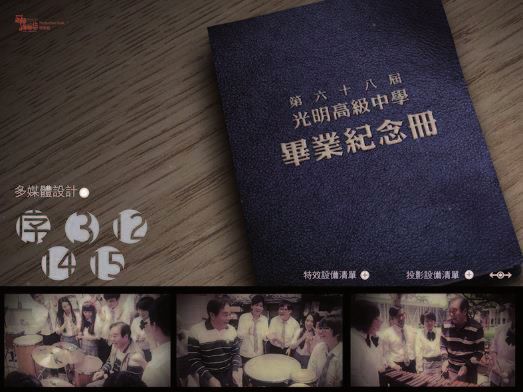
The need of mobile learning by using time fragments has           and users, emphasizing that users gain control of different
been increased on the market. Hence, it has become a new trend          degrees.
to use carriers which serve the purpose of reading at any                         Rafaeli &Sudweeks (1997) reported that the idea of
moment. According to the first three quarters’ investigation,               interactivity has been used all new communication media,
such fragmented reading activities have been extended to form           which can be divided into declarative communication, reactive
a habit of digitalizedreading. Since 2013, the appearance of                communication, and fully interactive communication. No
Google e-book platform, along with the spread of smartphones            matter what the medium is, there is hardly full interaction. Full
and tablets, has boosted the growth of e-books in the future.             interactive communication has equal participation and larger
From this phenomenon, it can be foreseen that e-books are                communicative power than reactive communication and even
inevitable trends and fashions for the time to come.                    declar active communication. In terms of the extent of
      Godwin-Jones (2003) noted that in recent years, the               interaction, full interactive communication engages the
updates of tablet PCs have found e-books a new chance of                interactivity of the highest degree, subsequently followed by
revival. The platform which was used exclusively for reading            reactive communication and declarative communication.
might be converted into a new business mode due to tablet PCs.                  There are distinctive levels with respect to interactivity in
    Tablets can be viewed as a combination of laptops and PDAs.         terms of the target, the extent of interaction, and form of
They have higher resolution and larger displays than traditional        interaction. This is in line with the seven-element account for
readers. They afford multi-chrome displays and faster                   interaction put forth by Borsook & Higginbotham(1991). Good
processing times than electronic readers. Also, they provide a          interactive design aims to simulate human-to-human interaction;
writing tablet and stylus-based input/navigation. Furthermore,          it, however, is not an easy task due to the limited development
they offer the possibility of corroborative cooperation and             of computer software. Nevertheless, such understanding helps
classroom, because most of them are able to link to wireless            designers take into account the different levels of interactivity
communication networks. They can offer us unparalleled                  in story design, serving as reference for planning, designing,
capacity for competition in terms of digitalized content and            and production.
written text, which consequently arouses enormous attention and
interest in the application of e-books. At the same time, tablets       C. Essence of Interactive Design
will definitely serve as the major platform of e-book reading.                Interactive design mainly concerns the creation and
Therefore, our project aims to develop interactive e-books for          expression of experience and information. It does not make any
teaching, and explore the possibility of their application.
                                                                        sense and offer any assistance if we simply put many media
B. Human-Machine Interaction                                            together without providing any channel of manipulation. The
       Gilbert and Moore (1998) suggested that the essence of           design of user interface is an ergonomic strategy, a procedure
mutual interaction lies in the mutual interaction that occurs           of presenting media and conveying messages. No matter
between two people or among three people in order to achieve            whether the message is informational, emotional, or
a task, a teaching competition or social relations in the context       instructional, there are many reference rubrics to help us
of learning. Graham (1999) stressed that interactivity is               achieve the purpose of communication through multimedia.
manifested from the integration of all forms of media, and              The essence of multimedia interactive design is to allow users,
allows users to interact to a certain degree.                           not designers, to control the whole procedure of browsing as
       Heeter (1989) pointed out that human-machine                     well as the speed, and, above all, decide exactly what they want
interaction must be integrated with communication, and it is a          to see and what they want to skip.
peculiar form of communication. Laurel (1996) proposed that                   The interactive design begins with the decision on what
interactivity is like an experience of acting in a theater in which     and how you would give the right of control to users. It is the
many roles participate in the human-machine interactive                 basis of interactive design to think what users would act at any
context. In a word, human-machine interaction refers to the             given point of time. In any situation, the advantages and
communication between users and machines, an information                disadvantages of interactive design involve length of
exchange between two parties.                                           developing time, cost, and technological resources. The more
       Borsook & Hgginbotham (1992) declared seven elements             rights of control in interaction, the more complicated the
composing interaction: immediacy of response, non-sequential            process of development. Methods of product creationcan differ
access of information, adaptability, feedback, options, bi-             dramatically; nevertheless, no matter how interactive the design
directional communication, grain-size. As far as Sims (1999) is         is, the basic goal of interactive design is: preciseness, clarity,
concerned, interactivity can be divided into different levels:          and user-friendliness.
object, linear, hierarchical, support, update, construct, reflective,   D. Design of E-Books
simulation, hyperlinked, non-immersive contextual, immersive
                                                                              Currently, e-book applications can be compared akin to
virtual, etc.
                                                                        print books with respect to logical and physical features.
       Taken all together, interaction is a mode of mutual
                                                                        Logical features include the hierarchical structure and chapters;
interaction. There should be feedback and opportunities to
                                                                        physical features include the image of books, portability, and
satisfy different needs of individuals. Schwiern & Misanchuk
                                                                        graphical design. The design of display function is a critical
(1993) divided interactivity into reactive, proactive, and mutual
                                                                        issue for e-books or e-book readers. The page display of the e-
modes in terms of the interaction between computer software
                                                                        book can be compared to the page layout of a print book.

978-1-4799-8706-1/15/$31.00 ©2015 IEEE                                            20-24 September 2015, Florence, Italy
              Proceedings of 2015 International Conference on Interactive Collaborative Learning (ICL)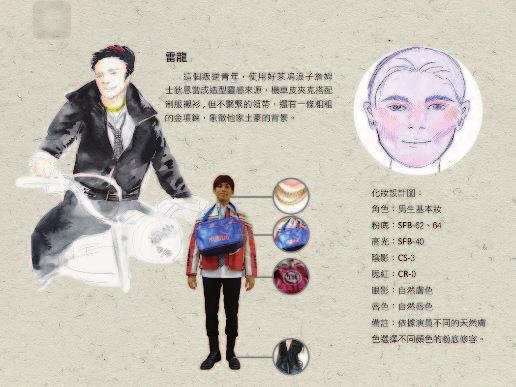
Studies have pointed out that the dimensional values and the                multimedia, text-voice conversion, connection to
weight values of e-books should be on a par with those of print             research data and results, as well as personalization
books(Scheidlinger 2004). Due to the strengths of tablets,                  including forms and communication linked to bulletin
researchers have discussed the applicability of e-textbooks at              boards and chat rooms.
college. The presentation of e-books includes many media such         ɀ     Multiple-article display: The information in the relevant
as audios, videos, motion pictures, etc. This experience of                 context can be arranged in one or more than one positions
reading resembles being embedded in the context, giving rise to             in the e-book, and can also be linked to other e-books and
a very significant effect of teaching and learning.                         electronic resources. In addition, it can also be placed on
      At the moment, e-books have come in various formats as                the e-bookshelf.
developed by different manufacturers. E-books, which are              ɀ     Ability to modify and expand e-books: Through
designed in incompatible formats, are the main obstacle to their            annotation and bookmarks, printing, cutting, copying,
wide acceptance. These formats are less flexible with respect to            pasting, and electronic updating, readers can update their
mutual assistance and support in display formats, structure of              e-books.
documents, and content search. They are not able to satisfy the       ɀ     Library: The library function of e-books raises the
needs of publishers regarding digital rights management. On the             number of readers. Libraries offer services of borrowing,
current market, the most commonly supported e-book format                   circulating, searching, and deleting of e-books.
includes Microsoft Reader, Adobe eBook, Palm Doc, etc. These          ɀ     Laws and contracts: Digital content and print books must
formats support digital rights management and access                        be governed by regulations concerned, and be protected
restriction of different degrees, and afford more complicated               and regulated by copyright laws.
display formats. Other formats like Gemstar or hiebook have
this peculiar drawback as well.                                       E. This paper examines the case study of musical theatre"
      However, although Palm Doc is supported in many                    Thank You, Teachers!" of National Taiwan University
devices, it is constrained with respect to the potential of display      (NTUA) that illustrates the process of staging musical
format since it restricted to the format of plain text (Godwin-          production in Taiwan universities.
Jones 2003). Therefore, since 1999, the proposal has been put                Musicals are not just written, they are collaborative
forth as to the establishment of common format for e-books. For          creations that must be put together piece by piece. How does
instance, Open eBook Forum, which has been established by                a stage musical go from first inspiration to opening night?
leading businesses and publishers, has set up the Open eBook             And who does what to get it there?
publication specification, a.k.a OEBPS.                                  This study has the following outcomes:
OEBPS adopts XML, extensible markup language, as the norm                ɀ This paper included a practical study of musical theatre
of documents, of which the conversation program is labeled                   production of "Thank You, Teachers!", drawing on the
Plucker, a hypertext reader program. It enables users to browse              work of key composer, lyricist, librettist, director,
OEBPS e-books on handheld devices. Currently, the                            producers, stage manager, scene designer, lighting
development of digital right management rubrics for OEBPS is                 designer and costume designer.
another challenge. Still, some technical problems remain to be           ɀ In the interactive e-book demonstrates the process of
solved.                                                                        making musical theatre, and enable readers to relate
      Due to the different styles of using and reading e-books                 this knowledge to the current situation in Taiwan
and print books, users must learn as well as adapt themselves to               university musical theatre.
the interface. How to offer a good user interface in the                 ɀ Demonstrate understanding of the features of the
interaction between human and e-books is pretty much the key                   musical as a form, and have developed a critical
to a successful e-book product. As in Gibbons et al. (2003),                   vocabulary for reading and discussing musical theatre
researchers have proposed many rubrics for the design of e-                    practice.
book interface including:                                                ɀ Have explored the skills and techniques required for
ɀ Human-machine interface: The functionality and                               the creation of the form, and understand the process of
       interactivity of e-books can be captured as the following               staging musical theatre.
       elements: customization, visibility and accessibility,
       screen-readability, barrier-free readability for the                   Staging musical theatre requires the collaboration of a
       physically challenged, good human-machine engineering,             great number of talented people. First, the production
       ability to switch to specific pages, paging function,              involves writers-the book writer, composer and lyricist-who
       durability, etc.                                                   create the book, music and lyrics, which they sell to a
ɀ Reading and text comprehension ability: The functions                   producer. The latter, who is the top organizer in a university
       should be included into reference models in order to help          to produce the musical, raises the money for the presentation
       readers gain knowledge from e-books, such as in-text               and hires every needed. Among those artists to be engaged
       search, hypertext browsing, navigability, locality,                for the musical theatre production in this study are:
       heading, and similarity to printed versions.                       ɀ Stage director, who controls the artistic elements of the
ɀ Efficiency of e-books: E-books improve the efficiency of                    presentation
       learning due to enriched elements of learning, such as             ɀ Musical director, who is in charge of all musical matters

978-1-4799-8706-1/15/$31.00 ©2015 IEEE                                            20-24 September 2015, Florence, Italy
              Proceedings of 2015 International Conference on Interactive Collaborative Learning (ICL)
ɀ   Choreographer, who creates and directs the dancing            C. Design of content and operation interface in e-books
   ɀ   Stage manager                                                       The content of this interactive e-book consists of the
   ɀ   Actors, singers and dancers                                   units including summary of the script, performance and
   ɀ   Designers of scenery, lighting, sound, costumes,              directing section, technical section, administrative section,
       makeup and hairstyles                                         each of which is divided into sub-units. The performance and
   ɀ Conductor, orchestrator, arrangers ,rehearsal pianists          directing section comprises director, and actor, rehearsal; the
     and orchestra                                                   technical section is composed of stage, lighting, costume,
   ɀ General manager, company manager, press agent and               stage property, multimedia design, and music; the
       others who aid the producer                                   administrative section covers planning and playwriting. The
   ɀ Various assistants to those listed above                        design of operation interface features the effect and fun of
                                                                     interactive reading.
    III.    COURSE DESIGN OF INTERACTIVE E-BOOKS
A. Software and hardware employed in design of interactive                               outline of the script
    e-books
    In this interactive e-book used for the teaching purpose, with
respect to hardware, ipad is employed as the carrier for
presentation; regarding software, the editing software “Indesign”
and “DPS”, which is responsible for digital publication
production, releasing system and publishing, released by Abode.
They incorporate multimedia components such as graphics, text,
video, audio, motion picture, etc., as to create comprehensive
interactive e-books. Readers can not only read, but also interact
with e-books, which boosts the sense of participation. The use
of the portable carrier ipad can free learning from the
spatiotemporal restriction, further facilitating the development
of autonomous learning..                                                                  Design of content:
                                                                      Caption by summarizing the scripts of the 15 scenes of the
B. Setting and publishing of e-books                                  play, in accompany with the videos and songs of the on-
                                                                      stage performance.
                                                                      Design of operation interface:
                    material establishment
  establishing material by graphics and audiovisual software          ͌Slides/Controlling slides by button
                                                                      ͌Audios and videos/Embedding video and music files
                                                                      ͌Panning and zooming/Panning and zooming images
        sorts of material:         Formats of material files:         ͌Hot spots/Switching on/off hot spots on site
  text, images, videos, music        JPG/PNG/MP4/MP3
                                                                          Performance and Directing Section (Scripts, actors,
                                                                                          and rehearsal)

                            Layout
       layout design using editing software “InDesign”ġ

             combination of layout and material
   combining material and layout to design and product
  interactive and multimedia e-books using the function
    panels ȾFolio Builderȿ and ȾFolio Overlayȿ in
                       Adobe DPS

                                                                      Director/
                      Preview on desktop                              Design of content:
      view the e-book product by Adobe Content Viewer                 Describing the duty and the reflection of the director.
                                                                      Design of operation interface:
                                                                      ͌Hot spots/Switching on/off hot spots on site
                                                                      ͌Panning and zooming/Panning and zooming images
                     Uploading to Cloud
    sharing and publishing e-books through Folio Producer

978-1-4799-8706-1/15/$31.00 ©2015 IEEE                                            20-24 September 2015, Florence, Italy
              Proceedings of 2015 International Conference on Interactive Collaborative Learning (ICL)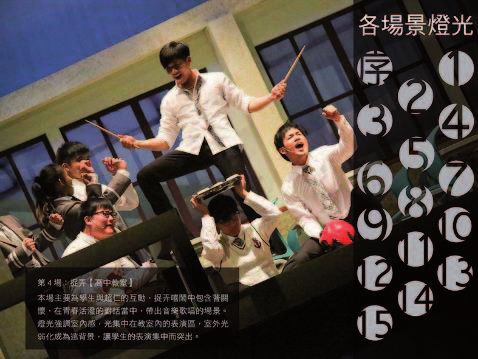
                                                     Technical Section

 Actor/                                                         Stage management/
 Design of content:                                             Design of content:
 Setting and introduction of all characters in the play as      Duties of stage management including the planning and
 well as reflection and opinions of the actors and actresses.   monitor of overall progress such as stage, lighting,
 Design of operation interface:                                 performance schedule, etc.
 ͌Slides/Scrollable slides                                      Design of operation interface:ġ
 ͌Controlling slides by button                                  ɀ Slides/Scrollable slidesġ
 ͌Panning and zooming/Panning and zooming                       ɀ Vertical and horizontal scrolling of video framesġ
                                                                ɀ Hot spots/Switching on/off hot spots on siteġ
                                                               ɀ Panning and zooming/Panning and zooming images

 ImagesġRehearsal/
 Design of content:
 Training processes such as script reading, rehearsal,
 percussion, and dancing.                                       Design of content:
 Design of operation interface:                                 Thorough presentation of stage arrangement and design by
 ͌Controlling slides by button                                  text, pictures, color pictures, real scene photos, also sharing
 ͌Panning and zooming/Panning and zooming images                the statements and reflections of designers.
                                                                Design of operation interface:ġ
                                                                ɀ Scrollable slides, button-controlled slides, button-
                                                                       corresponding slidesġ
                                                                ɀ Vertical scrolling of video framesġ
                                                                ɀ Panning and zooming/Panning and zooming

978-1-4799-8706-1/15/$31.00 ©2015 IEEE                                            20-24 September 2015, Florence, Italy
              Proceedings of 2015 International Conference on Interactive Collaborative Learning (ICL)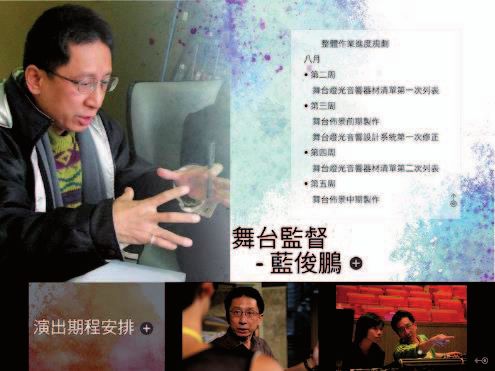
Multimedia design/
                                                                Design of content:
                                                                Description of multimedia design required in the play,
                                                                such as projection, white scrim, black scrim, special effect
                                                                facility, etc.
                                                                Design of operation interface:
                                                                Integrating the multi-page graphics application button
                                                                switch design in a window.
                                                                ɀ Scrollable slides, button-controlled slides and
                                                                       button-corresponding slides
                                                                ɀ Panning and zooming/Panning and zooming
                                                                ɀ Switching on/off hot spots on site

 Design of lighting/
 Design of content:
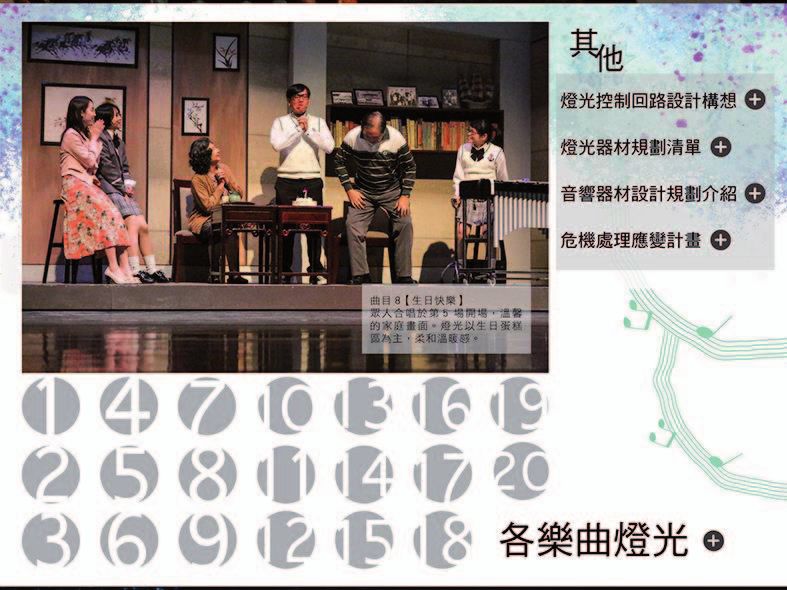
 Caption of lighting design by real-life pictures and text in
 terms of the lightings of the 15 scenes and 18 musical
 pieces in line of the plot, in addition to the overall
 planning and arrangement of the design of lighting.
 Design of operation interface:
 Integrating the multi-page graphics application button
 switch design in a window.
 ɀ Button-controlled slides and button-corresponding
       slides

 ɀ Panning and zooming/Panning and zooming
 ɀ Switching on/off hot spots on site


                                                                Costume Design/
                                                               Design of content:
                                                               Statement of costume design regarding roles, characters,
                                                               age changes in terms of time backgrounds, in addition to
                                                               the details of accessories, hair styling, and makeup in line
                                                               with the scenes.
                                                               Design of operation interface:
                                                               Detailed description of text, hand-painted blueprints,
                                                                partial view frames of stage photos on the layout, where

                                                                no sophisticated interactive design is used.


978-1-4799-8706-1/15/$31.00 ©2015 IEEE                                            20-24 September 2015, Florence, Italy
              Proceedings of 2015 International Conference on Interactive Collaborative Learning (ICL)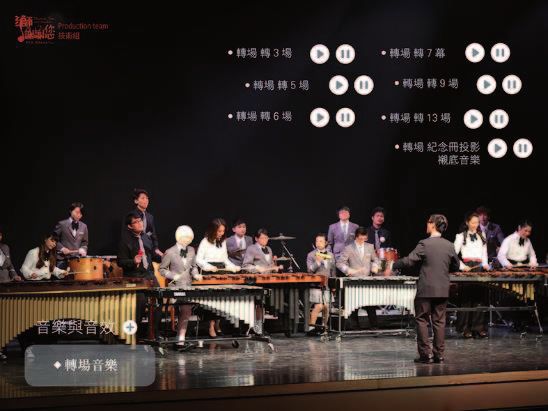
IV.    CONCLUSION
                                                                     The musical “Thank you, teacher!” is an independent
                                                             newly created script. It is set in a high school, and plotted
                                                             around students, and connected by teachers’ love and action. It
                                                             is a lively and entertaining stage musical composed of
                                                             touching plot, dancing, singing, and percussion. What is more,
                                                             the whole play is collaborated by NTUA teachers, students,
                                                             and alumni. As far as performing arts are concerned, it is a
                                                             pretty comprehensive practical teaching material.
                                                             In order to substantiate the material, we collaborated with the
                                                             teachers and students at the Department of Graphic
                                                             Communication Arts, National Taiwan University of Arts.
                                                             With the expertise in digital publishing, we co-authored this
                                                             interactive e-book. The results demonstrated that in the
                                                             instruction of musical production, along with a systematic use
                                                             of images, videos and audios, animation, interactive
 Music and sound effects/                                    manipulation, frees from the conventional means of
 Design of content:                                          instruction and thus helps instructors complete a
 Embedding songs of each scene, music of opening and         comprehensive and systematic course planning. In terms of
 transition, and sound effects, along with captioned         learning, well-designed environment and interface for
 illustrations of musical notes and audio system.            browsing not only increases the motivation of learning but
 Design of operation interface:                              also leads to the development of autonomous learning.
 ͌          Panning and zooming/Panning and zooming
 ͌          Switching on/off hot spots on site                                             REFERENCES

      Administrative Section (planning and playwriting)    [1]  Barker, P. (1992). Electronic books and libraries of the future. The
                                                                  Electronic Library,10(3), 139-149.

                                                             [2] Borsook, T. K. & Higginbotham-Wheat, N. (1991). Interactivity: What is
                                                                  it and whatġ can it do for computer-based instruction? Educational
                                                                  Technology, 31(10),11-17.
                                                             [3] Bob Godwin-Jones, 2003. “Emerging Technologies: E-Books and the
                                                                  Tablet PC,”Language Learning & Technology, Volume 7, Number 1, pp.
                                                                  4-8.
                                                             [4] Heeter, C. (1989). Implications of new interactive technologies for
                                                                  conceptua lizingġcommunication. In J. L. Salvaggio, and J. Bryant (eds.),
                                                                  Media use in theġ information age: Emerging patterns of adoption and
                                                                  consumer use (pp. 217-235). Hillsdale, NJ: Lawrence Erlbaum..
                                                             [5] H.P. Schoch, H.Y., Teoh, and M., Kropman, 2006. “Adopting an
                                                                  electronic text book forġ a postgraduate accounting course: An
                                                                  experimental study,” Australian Journal ofġEducational Technology, Vol.
                                                                  22, No. 2, pp. 166-188.
                                                             [6] Gilbert, L., & Moore, D.R. (1998). Building interactivity into web courses:
                                                                  Tools forġ social and instructional interaction. Educational Technology,
                                                                 38(3Rafaeli, S. & Sudweeks, F. (1997). Network Interactivity. CMC
                                                                  Magazine, 2(4).
 Design of content:
 Description of the administration needed to accomplish a    [7] Rafaeli, S. & Sudweeks, F. (1997). Network Interactivity. CMC Magazine,
                                                                  2(4).
 musical, such as human resources and allocation such as          Retrieved May 30, 2002, from
 planning section, playwriting section, creation and             http://jcmc.huji.ac.il/vol2/issue4/rafaeli.sudweeks.html.), p.29-35.
 production team, actors, theater technicians, planning,
                                                             [8] S. Gibbons, T.A. Peters, and R. Bryan, “E-Book Functionality: What
 ticketing, promotion, etc.                                      Libraries and Theirġ Patrons Want and Expect from Electronic Books,”
                                                                  Chicago and Landon: LITA-ALA.
                                                             [9] S. Gibbons, T.A. Peters, R. Bryan. 2003. E-book Functionality: what
                                                                  libraries and theirġpatrons want and expect from electronic books, LITA
                                                                  Guide, 10, Chicago, LITA.
                                                             [10] Schwier, R. A., & Misanchuk, E. R. (1993). Interactive multimedia
                                                                  instruction.
                                                                  Englewood Cliffs, NJ: Educational Technology Publication.
                                                             [11] Sims, R. (1997). Interactivity: a forgotten art? Computers in Human
                                                                  Behavior, 13(2),157-IJĹı

978-1-4799-8706-1/15/$31.00 ©2015 IEEE                                            20-24 September 2015, Florence, Italy
              Proceedings of 2015 International Conference on Interactive Collaborative Learning (ICL)

You can also read


