Angela Phillips DNP, APRN, FNP-BC, CNN - National Nurse-Led Care ...
←
→
Page content transcription
If your browser does not render page correctly, please read the page content below

Angela Phillips DNP, APRN, FNP-BC, CNN

Identify the importance of accurate ROS
completion during a patient encounter.
Acknowledge and understand the impact ROS
has on value based health care.
Recognize the role of ROS and how it
interfaces with social determinants for
effective health care delivery.
Body systems inquiry
Assessment is the foundation of healthcare
Widely accepted and recognized throughout
healthcare
14 areas recognized by Centers for Medicare
and Medicaid Services (CMS)
Constitutional Eyes Ears, Nose, Mouth, Throat Cardiovascular Respiratory Gastrointestinal Genitourinary Musculoskeletal Integumentary/Breast Neurological Psychiatric Endocrine Hematologic/Lymphatic Allergic/Immunologic


Identify potential or underlying illness
Way to prioritize objective examination
Guides objective physical examination
Structured patient assessment improve
clinician performance
Serves as a safety net
Evaluation and Management
◦ Billing, coding and reimbursement
3 key components when selecting the
appropriate level of E/M service
◦ History
◦ Examination
◦ Medical decision making
Elements required for history
◦ Chief complaint
◦ History of present illness
◦ Review of systems
◦ Pertinent past, family, and/or social history
Four levels of service recognized for
evaluation and management:
◦ Problem focused
◦ Expanded problem focused
◦ Detailed
◦ Comprehensive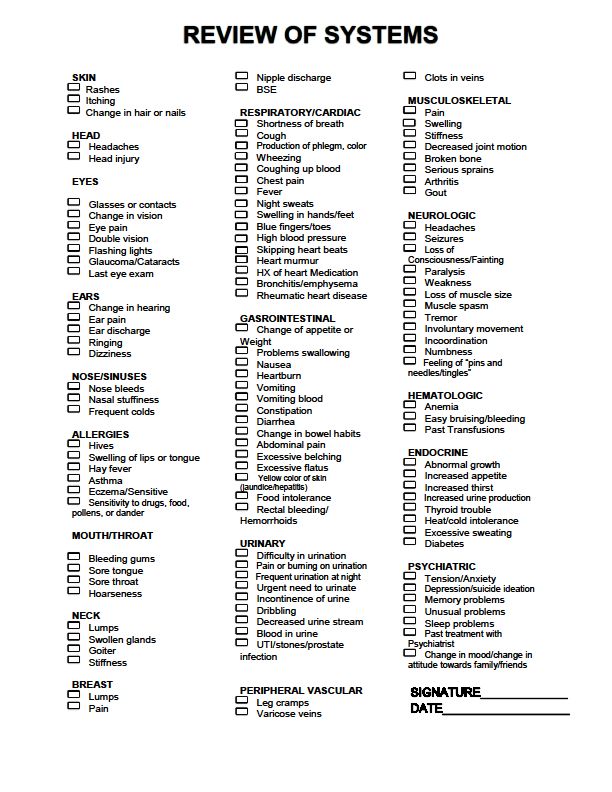
Problem focused
◦ 99201 or 99212
◦ Example: “My finger hurts.”
◦ ROS not required
Expanded problem focused
◦ 99202 or 99213
◦ Example: “I have a sore throat.”
◦ Problem pertinent ROS required Detailed
◦ 99203 or 99214
◦ Example: “ I have increased nasal congestion and
an earache.”
◦ Extended ROS is required Comprehensive
◦ 99204, 99205 or 99215
◦ Example: “I need a primary care provider.”
◦ Complete ROS required Questions asked in head to toe manner
Document both pertinent positives and
negatives
Not recommended for staff or patients to
complete ROS
Follow up visits do require a ROS
Acceptable to review previous ROS and note
current date of review Nurses / physicians
EHR mandated in 2009
◦ HITECH Act
Foundation for health care reform
Meaningful use of EHRs
◦ E-prescribing
◦ Electronic exchange of health information
◦ Submission of clinical quality
Paper charting will eventually cease Does EHR charting adequately cover what we
want it to?
Take care with charting - Check boxes are
easy ROS within primary care
ROS within urgent care
ROS within NP education
◦ OSCE experiences
ROS within research
◦ Medical surveillance program from US DOE Transition from volume to value
Patient satisfaction and population health
focus are both expected
Providers are paid based on health outcomes
Chronic disease management
All requires adequate ROS Less money spent Provider efficiency Patient and provider satisfaction Positive patient outcomes Society becomes healthier Financial stability of practice
Conditions in the environments in which
people are born and live
Health starts where our patients are
Interaction between healthy choices and good
health
Healthy People 2020 Goal Payers are focusing on addressing social
determinants of health as a way to improve
outcomes
ROS can help identify social determinants
It is important to see the WHOLE picture! Transition from fee for service to pay for
performance
◦ Quality of service
◦ Value to patient NPs are eligible to participate in merit based
incentive payment system (MIPS)
Assess current operations and systems
Develop a plan
Develop partnerships with third party entities
Address social determinants of health as a
way to improve outcomes ROS is important for:
◦ Foundation for patient assessment
◦ Drives the plan of care
◦ Value based healthcare and quality of care
◦ Identification of social determinants
◦ E&M codingAngela Phillips, DNP, APRN, FNP-BC, CNN Associate Professor Director of Family Nurse Practitioner Program West Texas A&M University 806-651-2662 aphillips@wtamu.edu
American Academy of Family Physicians: Understanding when to use the new patient E/M Codes.
https://www.aafp.org/fpm/2003/0900/p33.html
American Academy of Family Physicians: Coding.
https://www.aafp.org/fpm/topicModules/viewTopicModule.htm?topicModuleId=49
Balestra M. Electronic health records: patient care and ethical and legal implications for nurse
practitioners. J Nurse Pract. 2017;13(2):105-111.
Healthy People 2020. https://www.cdc.gov/dhdsp/hp2020.htm
HITECH Act Enforcement Interim Final Rule | HHS.gov. https://www.hhs.gov/hipaa/for-
professionals/special-topics/hitech-act.../index.html
Managed Health Care Connect, Health care news. February 14, 2018.
https://www.managedhealthcareconnect.com/content/majority-payers-concerned-about-social-
determinants-health
National Electronic Health Records Survey. 2015 state and national electronic health record adoption
summary tables. 2015. https://www.cdc.gov/nchs/data/ahcd/nehrs/2015_nehrs_web_table.pdf/
Phillips, A., Frank, A., Loftin, C, & Shepherd, S. (2017). A detailed review of systems: an educational
feature. The Journal for Nurse Practitioners, 13(10), 681-686.
https://doi.org/10.1016/j.nurpra.2017.08.012
Porter, M.E. (2010). What is value in health care? New England Journal of Medicine, 363: 2477-2481.
doi: 10.1056/NEJMp1011024.
Stanik-Hutt, J., Newhouse, R.P., White, K.M., Johantgen, M., Bass, E.B., et al. (2013). The quality and
effectiveness of care provided by nurse practitioners. The Journal for Nurse Practitioners, 9(8), 492-
500. http://dx.doi.org/10.1016/j.nurpra.2013.07.004
US Department of Human Services. Centers for Medicare & Medicaid Services. Evaluation and
management services. 2016. https://www.coursehero.com/file/16626992/eval-mgmt-serv-guide-
ICN006764/You can also read


