Anthropometric Properties versus Physical Performance in Rugby Union Forwards and Backs - A Systematic Review
←
→
Page content transcription
If your browser does not render page correctly, please read the page content below
Annals of Applied Sport Science, vol. 6, no. 2, pp. 01-13, Summer 2018

                                                                                                                                                                                 Original Article

                                                                                w w w.a a s sjo u rn a l .co m                                                                  www.AESAsport.com
                                                                                ISSN (Online): 2322 – 4479                                                                      Received: 20/02/2018
                                                                                ISSN (Print): 2476–4981                                                                         Accepted: 06/05/2018
Downloaded from aassjournal.com at 19:31 +0330 on Wednesday October 31st 2018

                                                                                Anthropometric Properties versus Physical Performance in
                                                                                Rugby Union Forwards and Backs - A Systematic Review
                                                                                                1Rahel   Stoop*, 1,2,3Erich Hohenauer, 4Alfred ML Rucker, 1,2,3Ron Clijsen
                                                                                1
                                                                                 Department of Business Economics, Health and Social Care, Rehabilitation Research Laboratory, University of Applied
                                                                                Sciences and Arts of Southern Switzerland, Landquart, Switzerland. 2THIM University of Applied Sciences, Landquart,
                                                                                Switzerland. 3Department of Movement and Sport Sciences, Vrije Universiteit Brussel, Brussels, Belgium.
                                                                                4
                                                                                 Department of Physiotherapy, Döpfer-Schulen, Regensburg, Germany.

                                                                                ABSTRACT
                                                                                Background. Rugby union is a team sport with a high amount of physical contact during match play. The physical
                                                                                performance and anthropometric characteristics required, differ based on the playing position. Objectives. The
                                                                                objective of this systematic review was to relate anthropometric properties with physical performance parameters in
                                                                                Rugby union backs and forwards across different playing levels of Tier 1 nations. Methods. Two electronic searches
                                                                                were performed in MEDLINE on the PubMed and on BISp (German Federal Sports Science Institute) databases from
                                                                                August 2016 to July 2017. All experimental study types in English and German were assessed for eligibility. Inclusion
                                                                                criteria were 15-a-side senior male backs and forwards, with anthropometric and/or physical performance data.
                                                                                Results. In n = 7 studies out of 12 selected, the elite forwards were significantly taller than the elite backs (p < 0.05).
                                                                                This accounted not for lower playing levels. Across all levels the forwards were significantly heavier than the backs.
                                                                                Significantly lower body fat percentages for the backs demonstrated n = 5 out of 6 studies. Consequently, backs were
                                                                                more ectomorphic than forwards. Backs reached significantly lower sprint velocities over short distances and higher
                                                                                ones over longer distances (10 to 40 m). Conclusion. Anthropometric parameters adapt to physical performance
                                                                                requested. In strength and endurance test situations heavier players may be underestimated postulating careful
                                                                                interpretation of those results to avoid misleading conclusion.

                                                                                    KEY WORDS: Anthropometric Properties, Body Composition, Physical Performance, Rugby Union, Somatotype.

                                                                                     INTRODUCTION
                                                                                   Rugby union is a contact team sport played                     during a match, indicating the need for a meso-
                                                                                outdoors on a grass field, one match lasts 80                     endomorphic body composition to sustain these
                                                                                minutes, interrupted by a 10-minute half time                     impacts (5). Consequently, physical demands and
                                                                                break. One team consists of 15 players a-side,                    hence anthropometric characteristics differ
                                                                                divided into two units, 8 forwards and 7 backs (1).               between playing positions (6). Further, changes
                                                                                Since 1995 when Rugby union became                                made in the year 2000 have led to a faster (7) and
                                                                                professional, the amount of physical contact                      more attractive match play which has, in turn,
                                                                                during match play has increased (2). The forwards                 influenced the requirements of each playing
                                                                                cope with 62% (3) to 68% (4) of all collisions                    position over time (8). Thus, a tendency towards

                                                                                *. Corresponding Author:
                                                                                Rahel Stoop
                                                                                E-mail: rahel.stoop@supsi.ch
2 Rugby Union Forwards and Backs
heavier and taller players with enhanced physical MEDLINE and by screening the reference lists of
performance characteristics has occurred (9-11). the retrieved articles.
Large body size strongly correlates with team Study Selection and Data Extraction.
(12,13) and individual player success (12), high Inclusion and exclusion criteria were set a priori.
body mass and anaerobic cycle test performance Clinical trials in English and German were
with scrum force (14). Since new regulations on included and used as sources of primary literature
foreign player transfers were instated, promoting to describe and evaluate the anthropometric and
Downloaded from aassjournal.com at 19:31 +0330 on Wednesday October 31st 2018
young talent has become more important (12). A match relevant physical performance outcomes
lower percentage of body fat and faster sprint between senior (≥ 18 years old) male back and
times over a distance of 15 m were the most forward 15-a-side Rugby union players of elite,
meaningful predictors in 15-year old rugby sub-elite and amateur level of Tier 1 nations (New
players for career success, indicating a correlation Zealand, South Africa, England, Australia,
between anthropometric profile and physical France, Ireland, Wales, Argentina, Scotland,
performance parameters (15). Therefore, an Italy). Two researchers (EH, RS) independently
appropriate monitoring of body composition is screened the titles and abstracts of the retrieved
crucial to ensure the optimal development of a studies for their eligibility. Cases of disagreement
rugby specific somatotype (5). were solved in a consensus meeting with a third
Nicholas (1997) described in his review the researcher (RC). Data were extracted by the same
differences in body height and mass, total body procedure. The results were subdivided into 1)
fat and lean body mass between first and second anthropometric parameters and somatotypes, 2)
class players (1). Further, the author highlighted locomotive parameters and sprint performance
the importance to analyze the anthropometric and during matches, 3) lower and upper body strength
physiological performance in relation to and power performance. The sequence of the
positional physical demands (1). Other literature description followed the professionalism in
comparing playing levels concluded that fat free decreasing order. Playing positions were divided
mass is the only significant predictor of level into two units, forwards and backs. Somewhere
classification (16). possible, the units were further sub-divided as
Therefore, the aim of this review was to follows: the props, hookers, second row, flankers
describe and evaluate the anthropometric and and the number 8 were considered to be forwards,
match relevant physical performance outcomes the scrum-half, fly-wing, right and left wings,
between senior back and forward players of elite inside and outside center and full-backs to be
(professionals, national team and first division backs. A significance level of p < 0.05 was
players), sub-elite (semi-professionals, second accepted for the reported study results.
division, college players) and amateur level (non-
professionals, non-licensed) of Tier 1 nations RESULTS
according to World Rugby. In total, n = 29 studies met the inclusion
criteria (see Figure 1). The studies showed a wide
MATERIALS AND METHODS heterogeneity for the outcome parameters,
Search Strategy. This study was performed precluding a general analysis:
according to the PRISMA statement (17). From 1) body fat composition was reported as total
August 2016 until July 2017, the German Federal body fat (%) (16, 18-23), lean body mass (kg)
Sports Science Institutes’ database (BISp) and the and total body fat mass (kg) (18)
Medical Literature Analysis and Retrieval System 2) running performance comprises locomotive
Online (MEDLINE) were searched for articles. parameters during matches (3, 24-26), agility
The non-MeSH proofed key word “Rugby union” assessments including the T-Test (s) (27),
was combined with the Boolean formula “AND” Illinois Agility-Test (s) (27) and the Agility
with “anthropometry” (MeSH), “physical Run-Test (s) (28), endurance assessments as
activity” (MeSH), “physical performance” (non- the Intermittent Progressive Running Test
MeSH), “body composition” (non-MeSH), (IPRT) (m/s) to assess the maximal aerobic
“somatotype” (non-MeSH). Additional literature velocity (21), the 20 m-Multistage Fitness Test
was found by the function “similar articles” on (20 m-MFT) (level) (27,28), the 30-15
Stoop, R., et al. (2018). Ann Appl Sport Sci, 6(2): 01-13.Rugby Union Forwards and Backs 3
Intermittent Fitness Test (30-15 IFT) (m/s) squat jump (SJ) PPO (W/kg) (22), standing arm
(29) and the Yo-Yo Intermittent Recovery Test reach up CMJ (cm) (14), vertical jump (VJ)
level 1 (YYIRT) (m) (29) height (cm) (2,28), upper body strength by the
3) lower body strength was tested via the one 1RM bench press performance (kg) (22,30) or
repetition maximum (1RM) (kg) of box squats maximal number of push-ups (No of
(22,30) lower body force production by repetitions) (2,28) performed, upper body
means of peak power (PPO) counter-movement force production by using the 50-kg bench
Downloaded from aassjournal.com at 19:31 +0330 on Wednesday October 31st 2018
jump performance (CMJ) (W/kg) (31), 70-kg- throw PPO (W/kg) (2,28).
Figure 1. Flow chart of the study selection process.
Anthropometric Parameters and (see Table 1) (16, 19-23, 27, 28, 32-35). Data
Somatotype. The n = 12 studies focusing on showed significantly taller elite forwards than
height of forwards and backs involved all levels backs in n = 7 studies (16, 19, 22, 23, 28, 33,
Stoop, R., et al. (2018). Ann Appl Sport Sci, 6(2): 01-13.4 Rugby Union Forwards and Backs
34). In sub-elite and amateur players, the height sub-elites forwards (14, 28, 36). The same
difference between forwards and backs was composition was mentioned for elite and sub-
non-significant (27). Two of the selected elite backs, whereas here the mesomorphic and
studies (16, 21) and n = 1 additional study (2) endomorphic portion was lower compared to
compared the heights within the units. In the the forwards, with the ectomorphy being
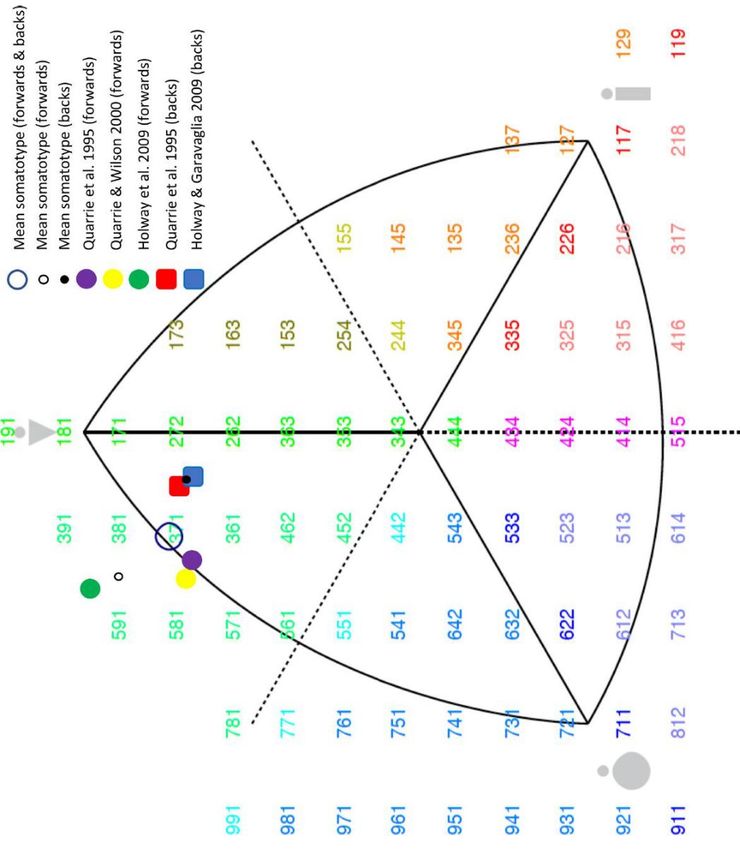
elite forwards, the locks were the tallest players higher (28, 36). A secular trend for the
and the hookers the shortest (16). Within the forwards was seen in the study of Holway and
Downloaded from aassjournal.com at 19:31 +0330 on Wednesday October 31st 2018
elite and second division backs, the outside Garavaglia (2009) compared to the earlier
backs were taller than the half scrums (16). studies (see Figure 2) (36).
Within the sub-elite forwards the locks were Physical Performance. For the total
significantly taller than the props, hookers and distance covered during a match, data from elite
loose forwards (p = 0.001) (2). Within the level players was available. Out of the n = 7
backs, the midfield and outside backs were included studies, n = 5 reported significantly
significantly taller than the inside backs (p = higher total match distance for backs than
0.001) (2). Lacome et al. (2014) mentioned forwards (p < 0.05) (37-41). From n = 2 studies
non-significant results for the within unit no details were available (3, 25). The values of
comparison (21). the backs varied between 5693 to 6544 m, for
A total of n = 13 studies displayed body the forwards between 4757 to 6038 m (3, 24,
mass data for both units, out of them n = 9 25, 37, 38, 40, 41).
showed significantly heavier forwards (16, Locomotive parameters were evaluated in n =
19-23, 28, 33, 34). The results revealed that 5 studies, investigating elite players, speed
the lower the level, the lighter both units ranges are described somewhere else (3, 25, 26,
were. Of the elite forwards, the props were 39, 40).
significantly the heaviest sub-group (p < The backs covered significantly fewer
0.05). All back sub-groups were significantly distance standing (293 ± 63 m, [n = 15]), and
lighter than each forward sub-group (p < more distance walking (2351 ± 287 m [n =
0.05) (16, 21). In sub-elite forwards, the 15]) than the forwards (354 ± 50 m [n = 14],
props were the heaviest sub-group, the 1928 ± 234 m [n = 14]), respectively (p <
hookers the lightest (p = 0.006) (2). Of the 0.05) (24). These results are in line with
backs, the midfield players were heavier than Deutsch et al. (2007) and Jones et al. (2015)
the inside backs (p = 0.001) (2). (26,42). For low-speed running (25) or
Body fat percentage was reported in n = 6 jogging (24,40), forwards and backs covered
studies, the results covered all levels, with lower equal distances, (p 0.05). Conversely, n = 1
fat percentages for backs (16,18,19,21,23,30). study reported a significant difference for
Out of these studies, n = 5 mentioned a forwards’ jogging time compared to the backs
significant difference (p < 0.05) (16, 18, 19, 23, (p < 0.0125) (26). Significantly longer sprint
30), n = 1 mentioned non-significant results (21). times for backs than for the forwards were
Within the backs’ group, on elite level, the reported (26,40).
outside backs and the half scrums were leaner A total of n = 6 studies measured sprint
than the inside backs (16). Within the elite and time for distances between 2 m and 60 m,
sub-elite forwards’ group, the front row / props comparing forwards and backs at the elite and
had the highest fat percentage, the third row the sub-elite level (27, 28, 30, 32, 35, 43). A total
lowest (see Table 1) (16). On amateur level, Bell of n = 4 studies described sprint velocity (30,
(1979) showed a significantly lower total body 32, 35, 43) and n = 1 reported sprint
fat percentage for the backs and consequently a momentum results (28). Overall, the backs
significantly higher lean body mass for the backs were faster than the forwards (see Table 2),
(87.83 ± 3.9 kg, [n = 28]) versus forwards (80.51 the elites faster than the lower categories.
± 3.76 kg, [n = 28]), (p < 0.001) (18). Significantly higher sprint velocities
The n = 3 studies reporting on somatotypes achieved by the backs were reported for
presented a higher degree of meso- distances of 10 m to 40 m, respectively (see
endomorphy than ectomorphy for elite and Table 2) (30).
Stoop, R., et al. (2018). Ann Appl Sport Sci, 6(2): 01-13.Rugby Union Forwards and Backs 5
Downloaded from aassjournal.com at 19:31 +0330 on Wednesday October 31st 2018
Stoop, R., et al. (2018). Ann Appl Sport Sci, 6(2): 01-13.6 Rugby Union Forwards and Backs
Downloaded from aassjournal.com at 19:31 +0330 on Wednesday October 31st 2018
Stoop, R., et al. (2018). Ann Appl Sport Sci, 6(2): 01-13.Rugby Union Forwards and Backs 7
Downloaded from aassjournal.com at 19:31 +0330 on Wednesday October 31st 2018
Stoop, R., et al. (2018). Ann Appl Sport Sci, 6(2): 01-13.8 Rugby Union Forwards and Backs
Downloaded from aassjournal.com at 19:31 +0330 on Wednesday October 31st 2018
Figure 2. Somatotypes of back and forward players, their means and overall mean.
Stoop, R., et al. (2018). Ann Appl Sport Sci, 6(2): 01-13.Rugby Union Forwards and Backs 9
Four different agility tests were utilized in the showed that the loose-forwards jumped
n = 2 retrieved studies, all on sub-elite level significantly higher than the props (p <
players (27,28). Jarvis et al. (2009) reported that 0.001)(14). The mean VJ height of sub-elite backs
the backs were significantly faster than forwards was reported as 63.2 cm (n = 44) and for the
in the T-Test and the Illinois Agility Test (p < forwards as 59.7 cm (n = 50), (p = n/a) (28),
0.05). Further, no significant within group within the backs (p = 0.290) and forwards (p =
differences were found by Quarrie et al. (1996), 0.094) no significant difference existed (2).
Downloaded from aassjournal.com at 19:31 +0330 on Wednesday October 31st 2018
(backs; p = 0.623, forwards; p = 0.247) (2). Bench press performance for upper body
Five studies reported aerobic endurance test strength showed significantly higher values for
results, n = 1 in elites (21), n = 3 in sub-elites the elite forwards than the backs (p < 0.001) (30).
(27,28,32). No significant difference was found Crewther, Gill, et al. (2009) mentioned higher
for maximal aerobic velocity when assessed by values at p ≤ 0.05 for forwards, which still
the IPRT (4.27 ± 1.1 m/s [n = 13] versus 4.3 ± 0.8 remained after ratio scaling but disappeared after
m/s [n = 17], respectively, p > 0.05) (21). In the allometric scaling (22). In Crewther, Lowe, et al.
sub-elites, the backs completed more 20 m-bouts (2009), even after allometric scaling the
(No 127.4, n = 43) during the 20 m-MFT than the difference stayed significant (p < 0.05) (30).
forwards (No 108.6, n = 50), (p = n/a) (28). Quarrie et al. (1995) measured the maximal
Within the forwards’ group, the hookers number of push-ups completed during a given set
performed significantly better than the props (p = up with a cadence of 50 beats per minutes. The
0.005), within the backs’ group the inside backs backs performed significantly more push-ups (n =
performed significantly better than the outside 32.3 repetitions) than the forwards (n = 25.6
backs (p = 0.001) (2). Likewise, the backs reached repetitions), (p = 0.001) (28). No positional
significantly better 20 m-MFT levels (10.2 ± 1.2 differences within the units could be found
[n = 9] compared to the forwards (8.1 ± 1.6 [n = (forwards; p = 0.246, backs; p = 0.784) (2).
10], p < 0.05, (27). The same trend was found for For upper body power production 50-kg bench
the YYIRT level 1 but not for the 30-15 IFT throw PPO in elite players was measured (22,30).
between the units (29). In one study the mean and PPO results differed
For lower body strength significantly higher significantly between the forwards and backs (p <
one repetition maximums (1RM) compared to the 0.05) and became non-significant after allometric
backs’ in squats (22,30) were reported for elites scaling (30). In the other study the PPO values
(p < 0.05) (30). After body mass correction using were different before and after ratio scaling at a
allometric scaling (1RM.kg0.67), the difference significance level of p ≤ 0.05, but not after
became non-significant (22,30). allometric scaling (22).
Crewther et al. (2012) reported no significant
difference in CMJ PPO performance between DISCUSSION
inside and outside backs, and loose and tight- Anthropometry and Somatotype.
forwards (p = 0.272) (31). After mass correction, Regardless of playing level, the forwards were
the inside and outside backs jumped both taller and heavier than the backs. The sub-elites
significantly higher than the tight-forwards (p < were generally shorter than the elite players (28).
0.05) (31). After allometric scaling, only the This finding is in line with the fact that usually tall
outside backs reached significantly higher values players become elite Rugby athletes. Since teams
than the tight-forwards (p = 0.014) (31). In an with the tallest forwards win a greater number of
earlier study, they found significantly higher 70- matches, this anthropometric advantage has great
kg SJ PPO values in forwards (p < 0.05). After importance (12). As height cannot be influenced
ratio scaling, the backs still reached significantly by training, it is uniquely a matter of directional
higher values and after allometric scaling, no selection (10). Over a time period of 20 years
significant difference remained (forwards: 246.4 (1988 to 2008), the average height of an elite back
± 26.2 W.kg0.67, [n = 14]) versus backs: 247.6 ± increased by 5.4 cm, and of the elite forward by
26.2 W.kg0.67, [n = 11]), (p < 0.05) (30). Quarrie 2.9 cm (10). From the time period 1905 to 1974
and Wilson (2000) performed a standing and arm to the years 1975 to 1999, the average body mass
reach up CMJ in elite forwards. Their results of forwards increased by 11 kg, whereas the backs
Stoop, R., et al. (2018). Ann Appl Sport Sci, 6(2): 01-13.10 Rugby Union Forwards and Backs
only gained 4.7 kg (12). Interestingly, from 1988 ectomorphism within the backs. Nevertheless, the
to 2008, the backs became even heavier by about time differences for all sprint distances were
12 kg (10). Consequently, for the time period sometimes surprisingly small, revealing, that both
between the years 1905 to 1999 Olds (2001) units require and are trained for the sprinting
described a significant reduction in demands during match play (2, 27, 30, 32, 35).
endomorphism and mesomorphism in high-level In terms of sprint velocities, the results of elite
Rugby union backs and forwards and of players uniformly showed that the taller and
Downloaded from aassjournal.com at 19:31 +0330 on Wednesday October 31st 2018
ectomorphism in forwards only (12). Those heavier forwards reached higher sprint velocities
changes in anthropometric parameters and in the 10 m and 20 m distance, whereas the backs
somatotypes may be associated with and have performed better in 30 m and 60 m distances.
developed due to changing match demands that These findings reflect power components
followed rule changes (7,8). Playing situations necessary for short distances and endurance
requiring an increase in force augmented, linked with ectomorphic somatotype required for
therefore body mass became essential to sustain maintaining speed over longer distances.
the forces. Evidence that teams with the heaviest Analyzing sprint momentum over 10 and 30 m,
forwards and backs won more matches than their large body size (height and mass) is advantageous
lighter opponents support this evolution (9, 12). for gaining better results. For training purposes,
Physical Performance. Analyzing the following the findings of Barr et al. (2014), the
locomotive parameters during match play, data on optimal training adaptation time sequence in
total distance covered and locomotive variables developing sprint momentum and speed through
were only available for elites with only small enhanced muscular hypertrophy and power is
sample sizes, maybe since the used GPS-tracking likely in the late teens to early twenties rather than
systems are costly (3,24,25). The backs covered later (46). Considering these results, amateur
less standing distance, more distance in walking, players could improve their sprint performance by
moving at high-intensities and sprinting than the enhancing their ectomorphic component and by
forwards. Both positions covered equal distances gaining body mass through muscle mass increase.
jogging (3, 24) and with medium-intensity The shorter and lighter backs performed better
running (21). Moreover, one study reported in the agility tests than the taller and heavier
greater jogging distances for forwards than backs forwards. Not surprisingly, the backs covered a
(26). However, according to Reardon et al. (2015) greater distance than the forwards in the aerobic
the use of absolute speed thresholds, as used in tests. The result highlights the negative effect of
the retrieved studies, rather than individual high body mass on aerobic running test
playing position speed zones may lead to an performance, therefore the calculated VO2max, is
overestimation of high-speed running in backs underestimated in heavier players. The YYIRT
and an underestimation in forwards (41). was mentioned to be of sufficient sensitivity to
Supporting this assumption, both units experience discover training-induced changes in repeated
an equal reduction in the relative distance covered high-intensity exercise similar to that occurring in
at high-intensities in the second match half, Rugby union (47), in contrast to absolute values.
indicating fatigue (44, 45). On the assumption In terms of strength parameters, elite and sub-
that sub-elites and amateurs have fewer, less elite forwards reached higher 1RMs in lower and
intense training sessions we conclude them to upper limb strength tests than backs after ratio
have a lower physical capacity and therefore a scaling. However, after allometric scaling (48),
smaller amount of total distance covered during the significance did not remain for lower limb
match with less minutes at high-intensity speeds. strength and the results for upper limb strength
Sprint results revealed that backs were faster were contradictory. Amateur backs were the
than forwards across all studies and all sprint shortest and lightest players within the backs,
distances, with heavier, taller and slower forwards with the lowest strength values. Consequently,
(except Jarvis et al. [2009]) than backs. Within the
elite backs performed best, but it was the oldest,
backs, the heaviest and shortest were the fastest
not the heaviest back, who performed best on the
(30). These results suggest that over a short sprint
1RM bench press. Push-up testing for upper body
distance, leg power has more importance than
Stoop, R., et al. (2018). Ann Appl Sport Sci, 6(2): 01-13.Rugby Union Forwards and Backs 11
power showed that sub-elite backs who were elite and elite level remains vague since
shorter and lighter reached a greater number categorization varies within each country.
reflecting the influence of supported or Therefore, the grouping of the included studies
unsupported body mass in testing situations. used in this review may be questioned. Upcoming
After ratio scaling, the elite backs reached studies would profit from performing powerful
higher force production in the CMJ than the statistics in terms of a meta-analysis, from rating
the studies’ methodological quality to ensure
Downloaded from aassjournal.com at 19:31 +0330 on Wednesday October 31st 2018
forwards, however, after allometric scaling, the
difference was no longer significant, highlighting high-level research and to clearly classify the
the bias of body mass. The literature discussed players using international standards. This review
ratio scaling for functional test performance, shows the differences in anthropometric and
allometric scaling for force-generated activities physical performance parameters between Rugby
(49), tests with additional external load or those at union forward and back players of different levels
slow movement speeds (22). For upper body force of Tier 1 nations and highlights the need to follow
production, elite backs who were shorter and Rugby union players in terms of body
lighter produced a lower PPO during 50-kg bench composition to ensure a Rugby specific
throw as the older, taller and heavier forwards somatotype according to playing position.
(22,30). Hence, with respect to force parameters,
a higher body mass consisting of a high
percentage of muscle mass, increases 1RM and APPLICABLE REMARKS
jump performance.
Regarding anthropometric properties,
CONCLUSION Rugby Union forwards are
Across all playing levels of Tier 1 nations, the significantly taller than backs at the
forwards were taller and heavier than the back elite level. The lower the classification
players. Heavy body mass positively affects level, the smaller the height difference
sprint momentum, short sprints, and sustaining between forwards and backs.
force in demanding situations. Consequently, as Across all levels, the forwards are
body mass simultaneously favors speed and significantly heavier than the backs
strength performance and body height positively reflecting the demands of each playing
affects power, results should be carefully position.
interpreted by means of ratio or allometric scaling
when comparing forwards and backs. Concerning As the level increases, so does the
the locomotive parameters, the number of speed of the backs in sprints.
repeated high-intensity runs during match may Regardless of playing level, the backs
not account more for the backs since literature performed significantly better in sprints
criticizes an overestimation for the backs, and attained higher jump values than
respectively an underestimation for the forwards. the forwards.
For the compared parameters, the general view is
“the higher the level, the higher the values”, In contrast, forwards achieved higher
emphasizing the importance of training volume 1RM results in lower and upper body
and match intensity as important components in strength assessments.
developing physical characteristics.
The findings of this review should be
considered critically as the power of the results is
limited due to the heterogeneity of the reported ACKNOWLEDGMENT
outcome parameters and its descriptive study The authors like to thank the “Thim van der
design. Although only studies on Tier 1 nations Laan” foundation, Landquart, Switzerland, for the
were discussed, the subdivision into amateur, sub- financial support.
Stoop, R., et al. (2018). Ann Appl Sport Sci, 6(2): 01-13.12 Rugby Union Forwards and Backs
REFERENCES
1. Nicholas CW. Anthropometric and Physiological Characteristics of Rugby Union Football Players. Sport Med.
1997;23(6):375–96.
2. Quarrie KL, Handcock P, Toomey MJ, Waller AE. The New Zealand rugby injury and performance pro ject . IV .
Anthropometric and physical performance comparisons between positional categories of senior A rugby players.
Br J Sports Med. 1996;30:53–6.
Downloaded from aassjournal.com at 19:31 +0330 on Wednesday October 31st 2018
3. Cunniffe B, Proctor W, Baker JS, Davies B. An Evaluation of the Physiological Demands of Elite Rugby Union
using Global Positioning System Tracking Software. J Strength Cond Res. 2009;23(4):1195–203.
4. van Rooyen M, Rock K, Prim SK, Lambert MI. The quantification of contacts with impact during professional rugby
matches. Int J Perform Anal Sport [Internet]. 2008;8(1):113–26. Available from: papers://cdf6ea96-27e8-40e2-
a222-
a38262792b20/Paper/p312%5Cnhttp://www.ingentaconnect.com/content/uwic/ujpa/2008/00000008/00000001/ar
t00012?crawler=true
5. Hohenauer E, Rucker AM, Clarys P, Küng U, Stoop R, Clijsen R. Anthropometric and performance characteristics
of the German rugy union 7s team.
6. Vaz L, Morais T, Rocha H, James N. Fitness profiles of elite portuguese rugby union players. J Hum Kinet.
2014;41(June):235–44.
7. Owen SM, Venter RE, du Toit S, Kraak WJ. Acceleratory match-play demands of a Super Rugby team over a
competitive season. J Sports Sci. 2015;414(July):1–9.
8. Quarrie KL, Hopkins WG. Changes in player characteristics and match activities in Bledisloe Cup rugby union from
1972 to 2004. J Sport Sci. 2007;25(8):895–903.
9. Sedeaud A, Marc A, Schipman J, Taffl M, Hager J, Toussaint J. How they won Rugby World Cup through height ,
mass and collective experience. Br J Sports Med. 2012;46:580–4.
10. Sedeaud A, Vidalin H, Tafflet M, Marc A, Toussaint J-F. Rugby morphologies: “bigger and taller”, reflects an
early directional selection. J Sport Med Phys Fit. 2013;53(November 2016):185–91.
11. Lombard WP, Durandt JJ, Masimla H, Green M, Lambert MI. Changes in Body Size and Physical Characteristics
of South African Under-20 Rugby Union Players Over a 13-Year Period. J Strength Cond Res. 2015;29(4):980–8.
12. Olds T. The evolution of physique in male rugby union players in the twentieth century. J Sports Sci.
2001;19(4):253–62.
13. Smart D, Hopkins WG, Quarrie KL, Gill N. The relationship between physical fitness and game behaviours in
rugby union players. Eur J Sport Sci. Taylor & Francis; 2011;14(December):1–10.
14. Quarrie KL, Wilson BD. Force production in the rugby union scrum. J Sports Sci. 2000;18(January 2015):237–46.
15. Fontana FY, Colosio AL, Da Lozzo G, Pogliaghi S. Player’s success prediction in rugby union: From youth
performance to senior level placing. J Sci Med Sport. Sports Medicine Australia; 2016;
16. Fontana FY, Colosio A, Roia GF De, Lozzo G Da, Pogliaghi S. Anthropometrics of Italian Senior Male Rugby
Union Players : From Elite to Second Division. Interational J Sport Physiol Perform. 2015;10:674–80.
17. Liberati A, Altman DG, Tetzlaff J, Mulrow C, Gøtzsche PC, Ioannidis JPA, et al. The PRISMA statement for
reporting systematic reviews and meta-analyses of studies that evaluate health care interventions: explanation and
elaboration. J Clin Epidemiol. 2009;62(10):e1-34.
18. Bell W. Body composition of rugby union football players. Br J Sports Med. 1979;13(1):19–23.
19. Zemski AJ, Slater GJ, Broad EM. Body composition characteristics of elite Australian rugby union athletes
according to playing position and ethnicity. J Sports Sci. 2015;33(9):970–8.
20. Bell W, Evans WD, Cobner DM, Eston RG. Regional placement of bone mineral mass, fat mass, and lean soft
tissue mass in young adult rugby union players. Ergonomics. 2005;48(11–14):1462–72.
21. Lacome M, Piscione J, Hager J-P, Bourdin M. A new approach to quantifying physical demand in rugby union. J
Sports Sci. 2014;32(3):290–300.
22. Crewther BT, Gill N, Weatherby RP, Lowe T. A comparison of ratio and allometric scaling methods for
normalizing power and strength in elite rugby union players. J Sports Sci. 2009;27(14):1575–80.
23. Scott AC, Roe N, Coats AJS, Piepoli MF. A erobic exercise physiology in a professional rugby union team. Int J
Cardiol. 2003;87(2):173–7.
24. Roberts SP, Trewartha G, Higgitt RJ, El-Abd J, Stokes KA. The physical demands of elite English rugby union. J
Sports Sci. 2008;26(8):825–33.
25. McLaren SJ, Weston M, Smith A, Cramb R, Portas MD. Variability of physical performance and player match
loads in professional rugby union. J Sci Med Sport. 2016;19(6):493–7.
26. Deutsch MU, Kearney GA, Rehrer NJ. Time–motion analysis of professional rugby union players during match-
Stoop, R., et al. (2018). Ann Appl Sport Sci, 6(2): 01-13.Rugby Union Forwards and Backs 13
play. J Sports Sci. 2007;25(4):461–72.
27. Jarvis S, Sullivan LEEO, Davies B. Interrelationships between measured running intensities and agility
performance in subelite rugby union players. Res Sport Med. 2009;17(July):217–30.
28. Quarrie KL, Handcock P, Wallert AE, Chalmers DJ, Toomeyl MJ, Wilsont BD. The new zealand rugby injury and
performance project. III. Anthropometric and physical performance charcteristics of players. Br J Sports Med.
1995;29(4):263–70.
29. Darrall-Jones JD, Jones B, Till K. Anthropometric, Sprint, and High-Intensity Running Profiles of English
Downloaded from aassjournal.com at 19:31 +0330 on Wednesday October 31st 2018
Academy Rugby Union Players by Position. J Strength Cond Res. 2015;30(5):1348–58.
30. Crewther BT, Lowe T, Weatherby RP, Gill N, Keogh J. Neuromuscular performance of elite rugby union players
and relationship with salivary hormones. J Strength Cond Res. 2009;23(7):2046–53.
31. Crewther BT, Kilduff LP, Cook CJ, Cunningham DJ, Bunce PJ, Bracken RM, et al. Scaling strength and power
for body mass differences in rugby union players. J Sport Med Phys Fit. 2012;52:27–32.
32. Darrall-Jones JD, Jones B, Till K. Anthropometric and physical profiles of english academy rugby union players.
J Strength Cond Res. 2015;29(8):2086–96.
33. Brown SR, Brughelli M, Griffiths PC, Cronin JB. Lower-Extremity Isokinetic Strength Profiling in Professional
Rugby League: Discovery Service. Int J Sports Physiol Perform. 2014;(9):358–61.
34. Bradley WJ, Cavanagh BP, Douglas W, Donovan TF, Morton JP, Close GL. Quantification of training load, energy
intake, and physiological adaptations during a rugby preseason: a case study from a elite eurpoean rugby union
squat. J Strength Cond Res. 2015;29(2):534–44.
35. Cross MR, Brughelli M, Brown SR, Samozino P, Gill ND, Cronin JB, et al. Mechanical Properties of Sprinting in
Elite Rugby Union and Rugby League. Interational J Sport Physiol Perform. 2015;10:695–702.
36. Holway FE, Garavaglia R. Kinanthropometry of Group I rugby players in Buenos Aires , Argentina. J Sports Sci.
2009;27(September):1211–20.
37. Swaby R, Jones PA, Comfort P. Relationship between Maximum Aerobic Speed Performance and Distance
Covered in Rugby Union Games. J Strength Cond Res. 2016;1–16.
38. Cahill N, Lamb K, Worsfold P, Headey R, Murray S. The movement characteristics of English Premiership rugby
union players. J Sports Sci. 2013;31(3):1–9.
39. Roberts SP, Stokes KA, Weston L, Trewartha G. The Bath University Rugby Shuttle Test (BURST): A pilot study.
Int J Sports Physiol Perform. 2010;5(1):64–74.
40. Jones MR, West DJ, Harrington BJ, Cook CJ, Bracken RM, Shearer DA, et al. Match play performance
characteristics that predict post-match creatine kinase responses in professional rugby union players. BMC Sport
Sci Med Rehabil. 2014;6(38):1–7.
41. Reardon C, Tobin DP, Delahunt E. Application of individualized speed thresholds to interpret position specific
running demands in elite professional rugby union: A GPS Study. PLoS One. 2015;10(7):1–12.
42. Jones B, Emmonds S, Hind K, Nicholson G, Rutherford Z, Till K. Physical qualities of international female rugby
league players by playing position. J Strength Cond Res. 2015;30(5):1333–40.
43. Duthie GM, Pyne DB, Marsh DJ, Hooper SL. Sprint patterns in rugby union players during competition. J Strength
Cond Res. 2006;20(1):208–14.
44. Tee J, Lambert M, Coopoo Y. Impact of fatigue on positional movements during professional Rugby Union match
play. Int J Sports Physiol Perform. 2016;
45. Lacome M, Piscione J, Hager JP, Carling C. Analysis of running and technical performance in substitute players
in international male rugby union competition. Int J Sports Physiol Perform. 2016;11(6):783–92.
46. Barr MJ, Sheppard JM, Gabbett TJ, Newton RU. Long-Term Training-Induced Changes in Sprinting Speed and
Sprint Momentum in Elite Rugby Union Players. J Strength Cond Res. 2014;28(10):2724–31.
47. Austin D, Gabbett TJ, Jenkins DG. Reliability and Sensitivity of a Repeated High-Intensity Exercise Performance
Test for Rugby League and Rugby Union. J Strength Cond Res. 2013;27(4):1128–35.
48. Jaric S, Mirkov D, Markovic G. Normalizing physical performance tests for body size: a proposal for
standardization. J Strength Cond Res. 2005;19(2):467–74.
49. Crewther BT, McGuigan MR, Gill ND. The Ratio and Allometric Scaling of Speed, Power, and Strength in Elite
Male Rugby Union Players. J Strength Cond Res. 2011;25(7):1968–75.
Stoop, R., et al. (2018). Ann Appl Sport Sci, 6(2): 01-13.You can also read


