Aspect-Based Sentiment Analysis for Polarity Estimation of Customer Reviews on Twitter
←
→
Page content transcription
If your browser does not render page correctly, please read the page content below
Computers, Materials & Continua                                                              Tech Science Press
DOI:10.32604/cmc.2021.014226
Review

               Aspect-Based Sentiment Analysis for Polarity Estimation of
                             Customer Reviews on Twitter
         Ameen Banjar1 , Zohair Ahmed2 , Ali Daud1 , Rabeeh Ayaz Abbasi3 and Hussain Dawood4, *

           1
            Department of Information Systems and Technology, College of Computer Science and Engineering,
                                    University of Jeddah, Jeddah, 21589, Saudi Arabia
                                      2
                                        Air University, Islamabad, 44000, Pakistan
                             3
                               Department of Computer Science, Islamabad, 44000, Pakistan
          4
            Department of Computer and Network Engineering, College of Computer Science and Engineering,
                                    University of Jeddah, Jeddah, 21589 Saudi Arabia
                          *
                            Corresponding Author: Hussain Dawood. Email: hdaoud@uj.edu.sa
                                Received: 07 September 2020; Accepted: 13 December 2020

                 Abstract: Most consumers read online reviews written by different users before
                 making purchase decisions, where each opinion expresses some sentiment.
                 Therefore, sentiment analysis is currently a hot topic of research. In particular,
                 aspect-based sentiment analysis concerns the exploration of emotions, opin-
                 ions and facts that are expressed by people, usually in the form of polarity.
                 It is crucial to consider polarity calculations and not simply categorize reviews
                 as positive, negative, or neutral. Currently, the available lexicon-based method
                 accuracy is affected by limited coverage. Several of the available polarity
                 estimation techniques are too general and may not reflect the aspect/topic in
                 question if reviews contain a wide range of information about different topics.
                 This paper presents a model for the polarity estimation of customer reviews
                 using aspect-based sentiment analysis (ABSA-PER). ABSA-PER has three
                 major phases: data preprocessing, aspect co-occurrence calculation (CAC) and
                 polarity estimation. A multi-domain sentiment dataset, Twitter dataset, and
                 trust pilot forum dataset (developed by us by defined judgement rules) are used
                 to verify ABSA-PER. Experimental outcomes show that ABSA-PER achieves
                 better accuracy, i.e., 85.7% accuracy for aspect extraction and 86.5% accuracy
                 in terms of polarity estimation, than that of the baseline methods.

                 Keywords: Natural language processing; sentiment analysis; aspect
                 co-occurrence calculation; sentiment polarity; customer reviews; twitter

1 Introduction
    The web is a vast source of information and knowledge discovery regarding different entities
that can be evaluated by analysis (positive, negative, and neutral sentiments of users). Sentiment
analysis is an emerging field and has been a significant task performed on social network datasets
using Natural Language processing (NLP) since the mid-2000s [1]. E commerce has provided
companies and users with many opportunities to explore online content to make selling and

                      This work is licensed under a Creative Commons Attribution 4.0 International License,
                      which permits unrestricted use, distribution, and reproduction in any medium, provided
                      the original work is properly cited.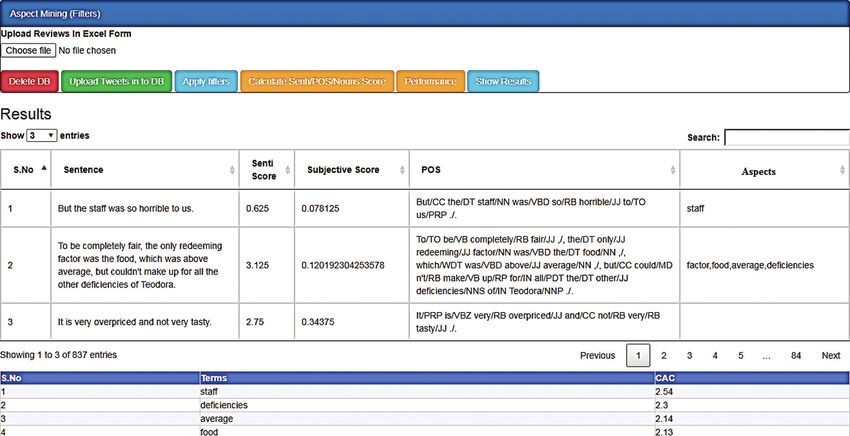
2204                                                                            CMC, 2021, vol.67, no.2

buying decisions, specifically enabling companies to manage their production decisions based
on the selling patterns of products and services [2]. There are many methods to analyse sen-
timents using natural language processing (NLP) techniques, such as employee opinion mining,
machine learning, deep learning, and computational linguistics. Several types of datasets have
been explored, such as online product reviews, tweets about politics, education and economic
affairs, opinions in blogs or discussion forums, and other methods. Several practical applications
of sentiment analysis include product selling and buying decisions, the prediction of company
sales, and online market development strategies [3]. A polarity scale is employed to analyse
the sentiments or user opinions for different domains. Different levels of granularity have been
investigated, such as context-aware sliding windows and document-level, sentence-level or aspect-
based sentiment analysis [4]. Sentiment analysis focuses on finding the polarity in textual content
to uncover the hidden semantics of people’s opinions.
     Extracting sentiments from a text with opinion mining by using NLP is one of the fields of
artificial intelligence. Some researchers have stated that subjectivity analysis is the leading driver of
opinion mining [5,6]. However, initially, subjectivity analysis was a sub-task of sentiment analysis
and opinion mining [7]. Consider the following: ‘According to my friend, it is a greenish shirt,
but for me, the colour of the shirt is yellow.’ The previous sentence shows that one is convinced
that the colour of the shirt is yellow, but to another person, the colour of the shirt is green.
The sentence in the previous example is both a subjective and an objective sentence. The sentence
‘The shirt is green, a colour that is more eye-catching’ is a subjective sentence with sentiment and
emotions. Additionally, ‘My favourite yellowish shirt is sold out’ is an objective sentence with a
sentiment [3].
    According to the above discussion, the search for sentiments involves four items. These are
the sentiment and target objective expressed in a sentence, where h represents the holder and
t represents time. These four items are expressed in the form of a quadruple as (s; g; h; t) [8].
Here, the first two items, i.e., the sentiment and target objective, are the most important in
sentiment analysis. Two additional terms, i.e., entity and aspect, are also significant in sentiment
analysis. An entity can be anything with an independent existence. For example, in mobile reviews,
mobile devices can be taken as an entity, while other things such as price and colour are the
aspects of mobile devices. Aspect-level sentiment analysis is a vast field; it not only judges the
sentiment and emotions that are related to a particular entity but also explores the aspects related
to entities [9,10]. There is also a predetermined list of aspects available to use in some techniques.
Usually, aspects present in this predetermined list are general-purpose aspects. Discovering aspects
from a text is known as the extraction of aspects.
    On the other hand, ‘I could not attend the call because of a signal problem’ is an example of
an implicit sentence. Here, someone expects to attend a call; however, this expectation is a negative
sentiment. There are many emotions expressed by human beings, such as happiness, anger, and
sadness. Languages other than English can apply aspect-based sentiment analysis, such as Arabic
and Bangla [11,12].
    Document-level sentiment analysis classifies textual documents based on general sentiments of
the whole document, e.g., product reviews, comments on tweets, and opinions in blogs or online
forums. There is one type of emotion that classifies a document (positive, negative, or neutral).
However, sentiment analysis classifies a sentence/phrase, where many sentences in a document
can be classified into different types of sentiments, keeping in mind that not all sentences are
subjective [2]. When a user provides an opinion about one aspect of an entity, it does not mean
that he/she likes or dislikes all other aspects of that entity as well. Consider the following: “The
CMC, 2021, vol.67, no.2                                                                            2205

Canon camera is amazing; it is better than the Samsung camera.” The preceding sentence is
an example expressing both positive and negative opinions about two different entities in one
sentence. This type of sentiment is confusing and should not be generalized to both products.
     Aspect-level sentiment analysis is essential for obtaining fine-grained opinions [3]. It is also
called aspect-based opinion mining (ABOM). It is employed to investigate and extract entities and
opinions about them. It involves a three-step process: first, extract aspects of a specific entity, then
extract opinion words and determine the polarities of the entities, and finally identify the links
among the opinions and aspects. If we apply ABOM to the same example, the process output
will be “Canon camera,” with the corresponding opinion “amazing,” and then a link between
the opinion “amazing” and “Canon camera” instead of “Samsung camera,” based on the correct
mapping of relationship. The correct opinion regarding a specific entity is identified and then
mapped to the correct entity. Additionally, presenting multiple entities and multiple opinions in
one sentence is quite challenging.
    The proposed technique is accomplished in three sub-phases: data preprocessing, aspect term
extraction, and the polarity estimation of reviews. Data come from the preprocessing step, and
then aspect mining or aspect extraction is performed. In this step, all significant aspects are
extracted and called features, which reflect user interest. To find the sentiments in any review or
opinion, NLP part-of-speech (POS) tagging is performed. POS tagging defines consistent tags and
describes how to use a term in a review and the heaviness of the weight estimate polarity of the
aspect or feature.
    Overall, the contributions made in this paper are as follows:
    1. Calculation of the polarity intensity of a review aspect instead of classifying it as either
       positive, negative, or neutral.
    2. Ranking of the identified aspects, which can be achieved using feature ranking methods.
    3. A new dataset development, named the trust pilot (forum dataset), which uses defined
       judgment rules.

2 Related Work
    The related work is divided into two subcategories, i.e., aspect detection and sentiment
analysis, based on the focus of this work.

2.1 Aspect Detection
    The detection of aspects from text data is an essential task in aspect-based sentiment analysis.
Aspect detection techniques are categorized as frequency-based methods, syntax-based meth-
ods, unsupervised machine learning methods, supervised machine learning methods and hybrid
methods [8,10], as shown in Fig. 1.

2.1.1 Frequency-Based Methods
     Generally, frequently used words are taken as aspects. These small sets of words are preferably
used instead of the rest of the dictionary.
    The most well-known approach is the use of frequency-based methods to detect aspects [5].
First, they find all combination of nouns. Nouns sometimes do not have successive values. They
must be present in the same text. Then, they are used to judge the screen size of aspects. The
primary purpose of using rules is to overcome or remove combinations where nouns occur near
each other. One additional purpose is to remove single-word aspects that appear as a part of the
2206 CMC, 2021, vol.67, no.2
multi-word aspect. The primary reason behind this preprocessing is to find infrequent aspects that
are mostly unrelated to any specific aspect.
Figure 1: Aspect identification methods
Aspect-based sentiment analysis overcomes this issue in which noun phrases that appear with
high frequency are mistakenly considered as aspects [10]. It takes a corpus of 100 million words of
spoken and written conversational English. Then, it produces results by comparing the frequency
of a prospective aspect with baseline statistics gathered from the corpus. The baseline frequency
is very similar to a bigram, which frequently occurs in reviews as an aspect. These non-features
are those that slow down the processing of techniques.
2.1.2 Syntax-Based Methods
Syntax-based methods work by finding the aspects of syntactical relations. The difference
between frequency-based methods and syntax-based methods is that frequency-based methods
work by finding the frequencies of aspects, while syntax-based methods find aspects of syntactical
relations. The problem of aspect extraction and sentiment lexicon expansion (in its improved
methodology) was solved by the proposed algorithm of double propagation [10]. It takes features
similar to aspect detection and parallels sentiment words. A speciality of this method is its ability
to find more sentiment words using known aspects. These algorithms continuously work for all the
different sentiment words or targets. A constructed set of rules based on grammatical relations is
used to find the sentiment words. This method needs only a small corpus to accomplish its task.
2.1.3 Supervised Machine Learning Methods
Supervised machine learning is a type of machine learning for testing only labelled data and
validating the model. The training of any algorithm is necessary for supervised machine learning.
A large dataset is usually needed to train these algorithms. Machine learning [13] methods work
based on features; thus, features are the main driver of supervised methods. These features are
better than part-of-speech features or a bag of words; usually, these features are more generalized.
Aspect detection is considered a labelling problem [11,14], which addresses a linear-chain
conditional random field (CRF). Use of the CRF in NLP and to process a whole sentence is
common. In the preprocessing of an algorithm, the context of each word is automatically taken
and then used to derive multiple features. These features include the actual word, POS tag and
relation with other words and sentiment expressions. If the word is a noun, then it is closest to
a sentiment expression.CMC, 2021, vol.67, no.2 2207
2.1.4 Unsupervised Machine Learning Methods
Unsupervised machine learning or cluster analysis is a type of machine learning carried out
to find undetected patterns in a dataset without using any labelled data. There is no training
required for unsupervised machine learning methods, and groups/clusters of entities are usually
formed using distance measures.
Latent Dirichlet allocation (LDA) is one of the most common approaches for aspect detec-
tion [8] among the unsupervised machine learning methods. LDA is very similar to probabilistic
latent semantic analysis, in which a latent layer is used to model word and document semantic
relationships. Both LDA and LSA can be used for the same purpose, but the difference between
them is that LDA uses the Dirichlet prior for the topic distribution, while LSA uses a uniform
topic distribution. LDA provides the direct link between topic names and aspects or entities using
a bag-of-words approach when modelling the topics and documents.
In MG-LDA, there is a dynamic set of local topics and a fixed set of global topics [10].
A document is modelled in such a way that MG-LDA covers a specific number of adjacent
sentences to find the local topics. Several local topics vary from document to document. These
windows overlap, and by using this overlap, they generate a particular word. This word can be
the most sampled from many windows. This phenomenon solves the problem of unigram words
or aspects.
2.1.5 Hybrid Methods
Whenever two methods or techniques are combined, hybrid methods are formed. Hybrid
methods can be categorized into two main types: serial hybridization and parallel hybridization.
In serial hybridization, the output of one phase becomes the input for the next phase. In other
words, the output of one technique becomes the input of the next technique.
Here, aspect pointwise mutual information is used, and it is provided to the naïve Bayes
classifier as its input to yield an output in the form of explicit aspects [15]. More examples
of serial hybridization are those in which clusters of noun phrases are produced using a Dice
similarity measure. Then, those aspects become the input of support vector machines (SVMs) or
any other supervised machine learning method to make a final decision regarding whether they
are aspects.
Parallel hybridization deals with two or more methods used to find a complementary set of
aspects [11]. Parallel hybridization in the MAXENT classifier finds frequent aspects. Here, sample
data and a rule-based method are used. Both use frequency information and syntactic patterns to
find less frequent aspects. On the basis of this idea, aspect detection explores the available data,
which serve as a back-up for cases in rule-based methods, where sufficient data are not available.
2.2 Sentiment Analysis
Sentiment analysis calculates the sentiment score for each review or sentence. It is also known
as precise and accurate sentiment analysis. There are many approaches to calculate the sentiment
scores for each aspect. Some methods are dictionary-based, corpus-based or phrase-level [16–20].
The details of each approach are given in Fig. 2.
2.2.1 Dictionary-Based Methods
Dictionary-based methods are efficient over a specific domain of study. Usually, sentiment
words are adjectives. The standard dictionary methods are SENTICNET, SENTIFUL, SENTI-
WORDNET, and WORDNET [21].2208 CMC, 2021, vol.67, no.2
Figure 2: Sentiment analysis methods
A dictionary is generated for each adjective that occurs in a sentence and will be presented in
a sentiment class [2]. After five sentiment words, a negation word appears, and then its polarity
is changed. In this case, a sentiment class is judged using voting. However, for the same positive
and negative words, a different approach can be used. In that case, each adjective sentiment is
associated with the closest aspect based on the word distance. Sentiment or opinion words that
are attached to the same aspects are more valuable.
2.2.2 Lexicon (Corpus)-Based Methods
The lexicon-based method uses an adjective set provided by some online sources, such as
Epinions.com. A technique involving the use of a star rating is proposed; here, all adjectives are
mapped to a particular star rating [22]. If a situation where a sentiment word does not exist in this
set occurs, then the word is taken from the WORDNET synonym graph. A breadth-first search is
used to find the two closest adjectives (opinion words) present in the rated list of Epinions.com.
After that, a distance weighted nearest neighbour algorithm is used. The purpose of this algorithm
is to assign a weighted average to the rating of two neighbours as the estimated rating of the
current sentiment word (adjective).
2.2.3 Phrase-Level/Sentence-Level
Several approaches discussed in the literature calculate one sentiment score for each sentence,
either positive, negative, or neutral. These approaches usually fail when a sentence has multiple
sentiment aspects. Consequently, a technique is proposed to overcome this issue [23]. Here, sen-
tences are considered in the form of segments. Each segment is attached to one of the aspects
found in the sentence. After that, a sentiment dictionary or lexicon is used to calculate the score
of each segment, and an aspect score pair is produced that contains the overall scores or polarity
of an aspect within a particular review/comment.
3 Problem Framework
After studying the existing literature regarding aspect extraction and polarity estimation, we
can conclude that there exists a need to design a refined technique for polarity estimation in
sentiment analysis.CMC, 2021, vol.67, no.2 2209
3.1 Problem Formulation
Consider a set of aspects extracted from different customer reviews, for example, opinions
presented on reviewing forums or in tweets.
her
·
Aspects of first review: A11 , A12 , A13 , . . . , A1m .
Aspects of second review: A21 , A22 , A23 , . . . , A2m .
·
·
·
Aspects of nth, review: An1 , An2 , An3 , . . . , Anm .
The total number of aspects of all the reviews:
n X
X m
R(A) = Aij (1)
i=1 j=1
where Ari is a particular aspect corresponding to review r. To calculate the polarity of each
aspect, a model is built for polarity estimation of the normalized relevance of each aspect and
the polarity of each aspect, named PEROCCR :
m
X
PEROCCR (Ar ) =
PEROCCR Arj (2)
j=1
where the norm is the aspect relevance score after normalization. The sum of all scores for the
polarity of reviews can be calculated as:
Xn m
X
PEROCCR (A) =
PEROCCR Aij (3)
i=1 j=1
3.2 Problem Statement
Most of the existing techniques are lexicon-based, and their accuracy is affected by limited
coverage. Various techniques in practice for polarity estimation about a particular product are too
general (either positive, negative, or neutral) and may not indicate the topic clearly, mainly when
the category contains much diverse information. Although tweet length is minimal, Twitter can
convey a story about different occurrences or events in a precise way. Moreover, tweets sometimes
contain a mixture of languages and may not follow the grammatical rules or conventions of
English or other languages.
4 Proposed Approach
The proposed approach is composed of three major phases, i.e., data preprocessing, aspect
term extraction and the polarity estimation of reviews. The following subsections briefly discuss
each phase. Fig. 3 shows a conceptual model of our proposed approach for polarity estimation
in customer reviews using aspect-based sentiment analysis.2210 CMC, 2021, vol.67, no.2
Figure 3: Proposed framework
4.1 Data Preprocessing
Twitter data are obtained using the Twitter API based on the following search criteria: origin
name, hashtags, time and “Where on Earth ID” (WOEID) [24]. For text cleansing, stemming is
performed, and stop words are eliminated. Reviews are split into sentences and phrases. Tab. 1
shows the data preprocessing of tweets.
In the data preprocessing segment, the paper takes reviews and tweets of any product and
generates an output after preprocessing. The output contains a clean form of these tweeted
reviews. The following standard rules are applied in data preprocessing:
1. Any full post or review that contains a hyperlink is eliminated because it might be for an
announcement, ad, commercial or junk message.
2. All retweets are removed because of redundancy. Posts starting with RT are ignored.
3. Hashtags are used to associate tweets with topics. Mentions refer to usernames on Twitter.
4. Non-English words are removed, for example, invalid characters and digits.CMC, 2021, vol.67, no.2 2211
Table 1: Data preprocessing of tweets
S. No Original tweet Kept Processed tweet
1 Leading cinematic presents No –
offline inspecting for iPhone
and iPad http://t.co/crtbKLyfTX
2 @Jackson together since I have Yes Together since I have a
a colleague who transfers files colleague who transfers
using her iPhone files using her iPhone
4.2 Subjectivity Segment
In this research, any statements with sentiments that have some positive or negative opinions
are subjective statements, while statements with no sentiments are objective statements. Objective
statements are universal truths or facts. For example, “I love the world” is considered in subjec-
tivity, but “The sun rises in the east” must be considered as an objective statement. Therefore, in
the subjectivity segment, to achieve this, we need to obtain subjective reviews. After applying pre-
processing to any review, we find the subjectivity of those reviews using SENTIWORDNET [2,3].
SENTIWORDNET is a text-based word list that is categorized by the part-of-speech key letters
and contains positive, negative, and objective scores of each term. Few words are displayed
using SENTIWORDNET. Only positive and negative scores are used to verify that any review is
subjective or objective. Tab. 2 provides the positive, negative, and objective scores of some terms,
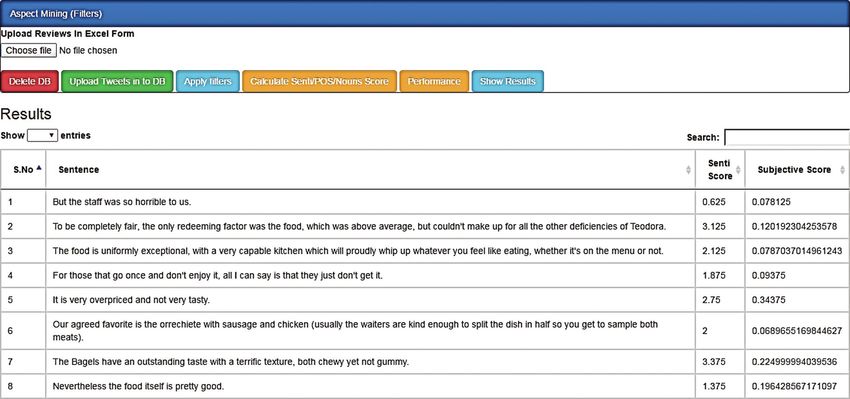
and Fig. 4 provides the term subjectivity and Senti score using SENTIWORDNET.
Table 2: Terms along with their scores on SENTIWORDNET
Word Positive Negative Objective
Glad 0.984 0.00 0.236
Low 0.246 0.86 0.236
Bad 0.00 0.536 0.486
Best 0.86 0.00 0.36
Horrible 0.00 0.486 0.736
4.3 Calculating the Subjectivity of Posts
Let posi be the positive score of word wi from SENTIWORDNET and negi be the negative
score. Eq. (4) is used to obtain the subjective score from a review or post. The subjectivity score
for review r is as follows:
Pn
(posi + negi )
R(r) = i=1 (4)
n
where n is the total number of words/terms in review R. Basically, this equation sums up the
positive and negative weights of each term of review R and the accumulation of all words that
occurred in the review or post. To calculate the normalized subjectivity score, it is required to2212 CMC, 2021, vol.67, no.2
divide by n. If posi = negi , then the overall score will be 0, even though the sentence is subjective.
For example, consider the following two posts:
R1: For those who go once and do not enjoy it, all I can say is that they just do not get it.
R2: The staff was so horrible to us.
Figure 4: Subjectivity and Senti scores obtained using SENTIWORDNET
In the above example, R2 has more sentiment than R1 regarding any food service, but
after adding up all the weights, R1 scores higher than R2 because the number of words is
maximum in R1. Therefore, the outcome that R1 reflects stronger sentiment than R2 is false.
Dividing by the total number of words is helpful for normalization, and this normalized weight is
helpful for further processing. We build a tool to calculate the subjectivity and Senti score using
SENTIWORDNET. Algorithm 1 provides the details of the calculation of the subjectivity score
of reviews.
4.4 Aspect Term Extraction
Aspect identification from text is known as aspect extraction. It can also be considered an
information extraction task, but in the case of sentiment analysis, some definite characteristics of
the current problem can help in extraction as well. One of the most critical pieces of information
is opinions or emotions. It is essential to judge the sentiment and opinion expressions and
their targets related to a sentence. In many situations, opinions or sentiment expressions can be
considered in two ways. For example, in the sentence “I love my country,” love is a sentiment
word and country is an aspect. Some of the critical approaches include extraction based on
frequent nouns and noun phrases, extraction by manipulating opinion and objective associations,
or extraction by using supervised machine learning techniques. This research proposes a method
named aspect co-occurrence calculation (CAC) to determine the refined aspects of posts with the
help of the POS.CMC, 2021, vol.67, no.2 2213
Algorithm 1: Calculating the subjectivity score of reviews
Input: Preprocessed reviews, R from the preprocessing module
Output: Subjective posts, SP.
Start
IF (WR > 3) THEN
WHILE (WR.startswith! = “RT”)) DO
WHILE (WR.contains(! = URL)) DO
FOR Reviews R in pre-processed reviews DO
Get the pos_score and neg_score of each word, w from SENTIWORDNET
Get the subjective score for R
IF (subjective score ≥0.05) THEN
Add review, R, to collection of subjective posts, SP
ELSE
Discard
ELSE
Discard
End
4.4.1 Part-of-Speech (POS) Tagging
POS tagging is performed to identify how a term is used in a review. The Stanford POS tagger
is one of the best POS taggers for assigning POS tag metadata in reviews or tweets [23], examples
of which are provided in Fig. 5.
Figure 5: Descriptive part of speech [25]2214 CMC, 2021, vol.67, no.2
A POS tagger finds labels or words in a sentence along with the grammatical relationships
present in a sentence. For example, each word in a sentence can be tagged as a verb (VB),
noun (NN), noun phrase (NNP), proper noun (NNP), adjective (JJ), or article (DT).
4.4.2 Computing the Aspect Co-Occurrence (CAC)
The aspect co-occurrence is used to compute the semantic similarity between words/terms used
in a review sentence and those that are selected by the user to represent an aspect [25]. When
the value of CAC(x, y) is relatively small, words can be considered to have a more significant
semantic similarity.
As an example, in this review, we detected two candidate aspects; here, we compute the
semantic similarity between them. “Mobile” received 130 hits; “Battery” received 260 hits; and the
accumulative for “Mobile” and “Battery” together received 80 hits in the reviews. According to
the formula CAC(x, y) = 0, x is the same as y. Therefore, f (x) = 130, f (y) = 260, (f (x), f (y)) = 80,
and N = 190 when the calculation value is 1.63. CAC is defined in Eq. (5).
n
X f (t1) + f (t2) − f (t1 , t2 )
CAC (t1 , t2 ) = (5)
N
i=1
Here, N is the total number of words/terms in reviews, and x and y represent words used to
compute the similarity. In addition, f (x) and f (y) are the numbers of occurrences containing x
and y, respectively.
Figure 6: Aspect extraction using the CAC
This association measure can be utilized to identify the most accurate aspects of a particular
category. Finding an association between two different terms using the CAC does not require any
background knowledge or analysis of the problem domain. Instead, it automatically analyses allCMC, 2021, vol.67, no.2 2215
features through occurrence or frequency in the dataset. In this phase, an aspect matrix is created
that provides each aspect along with the corresponding class/category.
In the aspect matrix, all aspects of the relevant class are represented as a vector consisting
of the co-occurrence (number of occurrences of a feature with its class) along with its rele-
vance score. Aspects with a minimum score greater than a standard threshold are discarded.
Our method’s second-phase results are shown in Fig. 6. Details of the aspect term extraction are
provided step by step in Algorithm 2.
Algorithm 2: Aspects of term extraction (CAC)
Input: Subjective reviews, R, from the subjective module
Output: Aspect terms
Start
FOR Review, R in SR DO
T = R.Split (’ ’)
FOR T in stop_words DO
Regex.Replace(T, stop_words)
LOAD_POS_tagger
= new MaxentTagger(@“/wsj-0-18-bidirectional-nodistsim.tagger”)
R = MaxentTagger.tokenizeText(T)
FOR SR in R DO
POS = edu.stanford.nlp.ling.Sentence.list(taggedSentence)
pattern = @“/w∗ /NN/b|/w∗ /NNS/b|/w∗ /NNPS/b”;
MatchCollection matches = Regex.Matches(POS, pattern)
FOR matches in pattern DO
PAT = matches
Calculate_CAC (A, B, AB)
N = Total no. of aspects
CAC_AB = No. of occurrences of both terms
CAC_A = No. of occurrences of term A
CAC_B = No. of occurrences of term B
CAC (A, B) = ((CAC_A + CAC_B) − CAC_AB)/N
FAT = Maximum of CAC(A, B)
End
End
4.5 Polarity Estimation
Polarity calculation and estimation are part of sentiment judgment. The most common types
of polarities are positive, negative, and neutral.
4.5.1 Sentiment Detection
Detecting important sentiments and aspects simultaneously from a dataset is an essential task
in sentiment analysis. These features are used to find opinion and sentiment words appearing as
adjectives/adverbs. Usually, adjectives are taken as opinion words; if adjectives or opinions come
close to a feature in the text, then this adjective will be taken as a full opinion word. Fig. 7 shows
the extracted phrases.2216 CMC, 2021, vol.67, no.2
• The strap is terrible and can only be attached to the camera with much effort.
• After acquiring approximately 700 images, I found the ability of this camera to capture
images to be unbelievable.
• It comes with a rechargeable battery that does not seem to last all that long.
Figure 7: Extracted phrase patterns
The judgement term “terrible” is related to the closest aspect “strap” in review number
one. Similarly, the judgement term “unbelievable” is related to the closest aspect “images” in
the next review example. Opinion words/phrases are mainly adjectives/adverbs that are used to
qualify product features with noun(s) phrases. The closest adjectives can be extracted as opinion
words/phrases based on the availability of features in the sentences. For review number three,
the feature “battery” was not found to be related to the closest adjective with the opinion
word “long.”
Adverbs and adjectives are good indicators of subjectivity and opinions. Therefore, phrases
containing noun(s), verbs, adverbs, and adjectives that signify opinions should be extracted. Verbs
such as like, dislike, love, appreciate, recommend, and prefer and adverbs such as really, overall,
absolutely, never, always, not, and well are considered opinion words in this work.
Consequently, we fetch 2/3 consecutive terms after the POS tagging of several patterns.
We collect all opinionated phrases of mostly 2/3 words such as (ADJ, NN), (ADJ, NN, NN), (AD-
VERB, ADJ), (ADVERB, ADJ, NN), and (VRB, NN) onward after processing the POS-tagged
reviews. Tab. 3 offers some examples of opinion phrases. The patterns obtained are later used to
match and find opinion words/phrases from tweets and reviews after POS tagging is performed.
Although the patterns are quite comprehensive, some of the expected opinion words/phrases were
not detected from the dataset. Most adverbs/adjectives extracted by applying these patterns signify
opinions regarding the nearest noun words/phrases.
Tab. 3 provides a few examples of applying sentiment detection to the extracted aspect,
for example, (low battery), (good celebrations), (remarkable camera), (extremely happy), (very
relaxed), (really annoying), (totally incredible), (accomplished well), which were successfully
detected by our method.
4.6 Polarity Weight Calculation
Generally, context words are taken as aspects. A sentiment dictionary of words or lexi-
cons is developed for each type of domain separately for identifying opinions from the text inCMC, 2021, vol.67, no.2 2217
SENTIWORDNET. The units of resources are verbs and adjectives, such as hNoi + hadjective +
verbi. All the sentiment units are mapped or linked by calculating similarity scores. PC OCCR
(pointwise occurrence) is used to calculate the similarity among different units.
Table 3: Examples of sentiment detection
POS Tags Sentiments
(Adjective, noun) (Low battery), (good memories), (awesome camera),
and so forth
(Adjective, noun, noun) (High-quality pictures)
(Adverb, adjective) (Extremely pleased), (very easy), (really annoying),
(absolutely amazing), and so forth
(Adverb, adjective, noun) (Very compact camera), (very good pictures), and
so forth
(Adverb, verb) (Personally recommend) (not so bad), and so forth
(Verb, noun) (Recommend camera), (appreciate picture), and so
forth
(Verb, adverb) (Perform well)
To calculate positive and negative PC OCCR , we used Eq. (6) for positive polarity and Eq. (7)
for negative polarity.
Pn
(wi , +ve) · N
P+ve (wi , +ve) = log2 Pn i Pn (6)
i (wi ) · i (+ve)
Pn
(wi , −ve) · N
P−ve (wi , −ve) = log2 Pn i Pn (7)
i (wi ) · i (−ve)
Eq. (8) is employed on a given text from the complete dataset to calculate the PCOCCR scores,
from which the highest similarity score is selected as a final sentiment score. Tab. 4 provides exam-
ple results for different terms, and step-by-step details of the computation of polarity estimation
scores are provided in Algorithm 3.
Table 4: Example results
Multi-domain amazon dataset Subjectivity Polarity estimation Results
Aspect Polar % Positive (+ve) Negative (−ve) Neutral Sentiment
Awesome movie 70.2 0.702 0.177 0.121 Positive
Great screen 68.6 0.686 0.221 0.093 Positive
Reasonable price 59.2 0.592 0.299 0.109 Positive
Low battery 50.3 0.132 0.503 0.365 Negative
Helpful service 68.9 0.273 0.038 0.689 Neutral2218 CMC, 2021, vol.67, no.2
Algorithm 3: Computing the polarity estimation scores
Input: Final aspect terms, T, from the CAC model
Output: Pointwise occurrence, PC (OCCR), score with sentiment
Start
FOR Aspect, T, in set of aspects DO.
FOR add patterns in pattern[i] DO
Pattern[i] = “JJ,” “NN/NNS,” “null”
Pattern[i] = “JJ,” “NN/NNS,” “NN/NNS”
Pattern[i] = “RB/RBR/RBS,” “JJ,” “null”
Pattern[i] = “RB/RBR/RBS,” “JJ/RB/RBR/RBS,” “NN/NNS
Pattern[i] = “RB/RBR/RBS,” “VBN/VBD,” “null”
Pattern[i] = “RB/RBR/RBS,” “RB/RBR/RBS,” “JJ”
Pattern[i] = “VBN/VBD,” “NN/NNS,” “null”
Pattern[i] = “VBN/VBD,” “RB/RBR/RBS,” “null”
MatchPattern(w, Pattern[i])
IF (Pattern_Found.Count > 0) THEN
Compute_Positive_Score(w, pos_i)
FOR w in Positive pos_i DO
w, pos_i = log2((Count(pos_i))/(w∗ Count(pos_i)))∗ N
Compute_Negative_Score(w, neg_i)
FOR w in Negative neg_i DO
w, neg_i = log2((Count(neg_i))/(w∗ Count(neg_i)))∗ N
Compute_PC(OCCR)_Score(pos_i, pos_n)
FOR w in pos_i && neg_i DO
T_Score = pos_i − neg_i
Sum_T_Score+ = T_Score
T_Score = Sum_T_Score;
IF (MAX(T_Score).Contains(pos_i)) THEN
Final_ Sentiment = Positive
ELSE
IF (MAX(T_Score).Contains(neg_i)) THEN
Final_ Sentiment = Negative
ELSE
Final_ Sentiment = Neutral
ELSE MatchPattern(w, Pattern[i])
End
End
For the polarity calculation, the following notations are used:
n
X
(wi , +ve): Number of aspect terms wi in positive reviews.
i
n
X
(wi , −ve): Number of aspect terms wi in negative reviews.
iCMC, 2021, vol.67, no.2 2219
N: Total number of tokens in the dataset.
Xn
(wi ): Number of aspect terms wi in all reviews.
i
n
X
(+ve): Total number of terms in positive reviews.
i
n
X
(+ve): Total number of terms in negative reviews.
i
Tscore (wi ) = P+ve (wi , +ve) − P−ve (wi , −ve) (8)
5 Experiments
In this section, we discuss the experimental setup and evaluation of our proposed method.
5.1 Datasets
For the evaluation, we used three different types of datasets: tweets, customer reviews and
online forums. The distribution of datasets is shown in Tab. 5.
Table 5: Distribution of datasets
Domain Customer review Twitter Trust pilot forum
Dataset Books DVDs Tweets
Reviews/tweets 1250 1500 2000 300
No. of reviews/tweets after preprocessing 1052 1236 1675 250
No. of aspects identified 776 1021 1296 137
Positive 246 359 507 32
Negative 167 203 313 42
Neutral 363 459 476 63
5.1.1 Tweets
We utilize the SemEval-2017 task 4 sentiment analysis in Twitter; here, 50,000 tweets [26] of
goods are used. We took English tweets from Twitter using the WOEID [6,27].
5.1.2 Customer Reviews
The multi-domain sentiment dataset [26] contains product reviews taken from META-
SHARE. We gathered a domain-related dataset (Books, DVDs). It includes the core aspects
identified, aspect polarities and overall sentence polarities. Each domain has several thousand
reviews, but the exact number varies by domain [24].
5.1.3 Trust Pilot Forum
Trust pilot [28] is a source of online reviews for businesses and online transaction areas.
This research collects some reviews randomly from this forum and computes results to evaluate
our proposed method. For judgements, we share data with product experts who have used these
products before. They rate the aspects of these products using a rating scale of 1, 2, or 3.
However, a majority vote determines the final decision. If all judges have a different opinion2220 CMC, 2021, vol.67, no.2
(i.e., judge1 6= judge2 6= judge3 = 0), then the review is not considered. Tab. 6 shows the results of
the judgement procedure. The rating scale is as follows:
Scale value 1: Not a related aspect of the product.
Scale value 2: Minor related aspect of the product.
Scale value 3: Related aspect of the product.
Table 6: Sample judgement results of the aspects of trust pilot forum reviews
Aspect Judge 1 Judge 2 Judge 3 Final score Final decision
score score score (majority basis)
Display 1 3 1 1 Not relevant
Screen 3 3 2 3 Relevant
Case 2 1 3 0 No result
Charger 2 2 3 2 Minor relevance
5.2 Baselines
We use different baseline methods for the experimental comparisons. The baseline methods
are provided in Sections 5.6–5.8.
5.3 Performance Measures
This research uses precision, recall, f-measure, and accuracy to calculate the relevance and
irrelevance of the mined aspects or features and opinions from reviews. Eqs. (9)–(12) show each
of the performance measures.
True Positive
Precision = (9)
True Positive + False Positive
True Positive
Recall = (10)
True Positive + False Negative
(Precision · Recall)
F-Measure = 2 · (11)
(Precision + Recall)
True Positive + True Negative
Accuracy = (12)
(True Positive + False Negative + False Positive + True Negative)
5.4 Results and Discussion
This research compares our method with SWIMS [29], Diego Terrana [27] and manually
annotated data. For the manually labelled dataset, we label the review ratings regarding how
appropriate the aspects are to the products using the abovementioned rating scale.
5.5 Qualitative Example
In this section, we explain with an example where our method works fine compared to the
baselines and why.
Review Example: “The transportation facility was good, but the vehicle was too old when we
reached the hotel; the accommodation was better than their transportation.”CMC, 2021, vol.67, no.2 2221
In the above example, a wide range of information may not reflect the aspect strongly.
The person is talking about one service being too bad compared to other services and another
service being much better than the previous one.
The baseline methods use dataset-based general sentiments; when a complex sentence struc-
turing is present, they produce majority-based results or could consider them neutral [27,29].
In our model, first, we calculate the subjectivity score to check whether the sentence has
sentiment or not. Second, the aspect co-occurrence is calculated, and the aspects are ranked to
obtain the top (with the maximum scores) aspects. Finally, polarity estimation is used to calculate
the polarity of each aspect and then summed to find the intensity of polarity. Considering the
above review Senti score of 2.125, the subjective score is 0.965. Next, in the aspect extraction
phase, the most relevant aspects are “vehicle,” “hotel”, “transportation,” and “accommodation.”
During the polarity estimation phase, we find the sentiments of these aspects (transportation:
good, vehicle: old, hotel: better, and accommodation: better), after which we calculate the intensity
(good: 0.85, old: 0.69, better: 0.75). Therefore, the final result of the above review is the intensities
of the sentiments (Positive: 0.57, Negative: 0.29, and Neutral: 0.14)
5.6 Comparison (Customer Reviews)
In our proposed method, named aspect-based sentiment analysis—polarity estimation of
reviews (ABSA-PER), we use the new aspect term extraction method CAC and rank them. Tab. 7
shows a comparison of the aspect term extraction after sentiment term detection is applied to
calculate the polarity estimation. Tab. 8 presents an analysis of the polarity estimation, which is
discussed in detail in Section 3. Fig. 8 visualizes a comparison of ABSA-PER aspect extraction
with existing state-of-the-art approaches [29].
Table 7: Comparison of aspect term extraction with existing approaches
Multi-domain SWIMS—10-fold SWIMS [30] ABSA-PER
dataset baseline approach baseline approach proposed approach
P R F P R F P R F
Amazon DVD 76.20 78.80 77.39 80.00 84.00 81.95 81.35 84.62 82.95
Books 76.83 81.80 79.23 80.39 82.00 81.19 82.93 83.79 83.35
Table 8: Comparison of sentiment polarity with the state-of-the-art approach
Dataset Label Steinberger et al. [31] ABSA-PER proposed approach
P R F P R F
Amazon # Positive reviews 72.12 75.3 73.671 81.24 82.69 81.95
# Negative reviews 74.07 66.04 69.83 83.35 78.48 80.84
# Neutral reviews 71.35 76.35 73.65 85.78 84.59 85.182222 CMC, 2021, vol.67, no.2
Comparison of ABSA-PER with existing state-of-the-art approaches
ABSA - PER
F Measure
Recall
Precision
F Measure
Models
SWIMS
Recall
Precision
F Measure
10 Fold
Recall
Precision
70 72 74 76 78 80 82 84 86
Performance Measures
Books DVD
Figure 8: Visual comparison of our approach with existing state-of-the-art approaches
5.7 Comparison (Twitter)
Our proposed technique is compared with the baseline method of Terrana et al. [27]. In this
comparison, initially, a Twitter dataset is built, and preprocessing is applied to subjective segments
to finalize the cleansing of tweets. Then, we apply aspect term extraction using the CAC. The
categorization is made using the polarity estimation model. Experimental outcomes reveal that
our methodology reduces human involvement and the sub-processes. Tab. 9 shows the polarity
estimation on the Twitter dataset and a comparison with the baseline. Fig. 9 shows our model on
polarity estimation of the Twitter dataset and its comparison with the baseline.
Table 9: Polarity estimation on a Twitter dataset
Twitter (class label) Terrana et al. [27] ABSA-PER
baseline approach proposed approach
Accuracy Accuracy
No. of aspects identified 0.741 0.895
No. of positive reviews 0.761 0.879
No. of negative reviews 0.863 0.947
No. of neutral reviews 0.977 0.872
Average accuracy % 83.55 89.82
Polarity estimation on Twitter dataset
0.5
0.5 1 1.5 2 2.5 3 3.5 4
Diego Terrana et al Accuracy ABSA - PEL Accuracy
Figure 9: Visualization of polarity estimation on the Twitter datasetCMC, 2021, vol.67, no.2 2223
5.8 Comparison (Gold Standard)
We do not use any baseline method here; rather, we use human annotators. We collect random
reviews from forums and select the top N correct reviews, with which several experts perform
annotations. They convert these reviews into readable sentences, obtain useful aspects or features
for the product of interest, and classify them into sentiment classes (positive, negative and neutral).
After that, we use the same forum dataset for our proposed ABSA-PER and find that the
results are in good agreement. We also compute accuracy with respect to the human annotator
results. Tab. 10 shows the difference between the results of our proposed method and the human
annotation results.
Table 10: Experimental results for human annotations
Dataset No. of No. of No. of aspects Accuracy %
reviews sentences extracted %
Our approach 300 216 113 87
5.9 Overall Performance of Our Proposed Technique
An overall comparison of our technique on different datasets [27,29] is provided in Fig. 10.
The results show a clear improvement compared to the baseline methods, and good accuracy is
achieved on the forum dataset as well in comparison to the human-annotated data.
1.2
PERFORMANCE EVALUATION
1
0.8
0.6
0.4
0.2
0
SWIMS - Books SWIMS - DVD Diego Terrana et al - Human Annotator
Twitter
MODEL NAME - DATASET
Baseline Methods ABSA - PER
Figure 10: Overall performance of the proposed technique (ABSA-PER)
6 Conclusions and Future Work
In today’s research, determining sentiment polarity can be considered one of the significant
tasks in opinion mining. Polarity estimation has standard methods to recognize aspects or features,
which are regularly in use and have gained much recognition, e.g., Screen, Memory and Battery.
It can be concluded from the results and discussion that theme-specific polarity estimation in
which a diverse type of information is present is essential. It is also evident that the exploitation
of aspect-based sentiment analysis provides better insights into review and tweet data. In social
media, tweets can be examined for the identification of a specific occasion, which may be an
emerging event. There are distinct possibilities to improve this work. For example, multi-word2224 CMC, 2021, vol.67, no.2
clustering enables the exploration of reviews in a better way, e.g., “hard” is one word, and “disk”
is another, but their combination (“hard disk”) has completely different semantics. A Vector
representation of these multi-words may help improve the performance of different approaches.
Furthermore, objectivity feature exploration for tweets and reviews can improve the correctness
of aspects and improve accuracy.
Acknowledgement: The authors acknowledge with thanks the University technical and finan-
cial support.
Funding Statement: This work was funded by the University of Jeddah, Saudi Arabia, under Grant
No. (UJ-12-18-DR).
Conflicts of Interest: The authors declare that they have no conflicts of interest to report regarding
the present study.
References
[1] N. Shelke, S. Deshpande and V. Thakare, “Domain independent approach for aspect-oriented sentiment
analysis for product reviews,” in Advances in Intelligent Systems and Computing, Singapore: Springer,
pp. 651–659, 2017.
[2] F. H. Khan, U. Qamar and S. Bashir, “A semi-supervised approach to sentiment analysis using revised
sentiment strength based on SentiWordNet,” Knowledge and Information Systems, vol. 51, no. 3, pp. 851–
872, 2017.
[3] K. Sarawgi and V. Pathak, “Opinion mining: Aspect level sentiment analysis using SentiWordNet and
amazon web services,” International Journal of Computer Applications, vol. 158, no. 6, pp. 31–36, 2017.
[4] M. A. Masood, R. A. Abbasi and N. W. Keong, “Context-aware sliding window for sentiment
classification,” IEEE Access, vol. 8, pp. 4870–4884, 2020.
[5] B. Kama, M. Ozturk, P. Karagoz, I. H. Toroslu and O. Ozay, “A web search enhanced feature
extraction method for aspect-based sentiment analysis for Turkish informal texts,” Big Data Analytics
and Knowledge Discovery, LNCS, vol. 9829, pp. 225–238, 2016.
[6] H. Saif, Y. He, M. Fernandez and H. Alani, “Contextual semantics for sentiment analysis of Twitter,”
Information Processing Management Journal, vol. 52, no. 1, pp. 5–19, 2016.
[7] V. Gayakwad and A. Tiwari, “Improved technique of sentiment classification for objective word,”
International Journal of Emerging Research in Management Technology, vol. 5, no. 6, pp. 105–112, 2016.
[8] K. Schouten and F. Frasincar, “Survey on aspect-level sentiment analysis,” IEEE Transactions on
Knowledge and Data Engineering, vol. 28, no. 3, pp. 813–830, 2016.
[9] M. D. Molina-González, E. Martinez Camara, M. T. Martín-Valdivia and L. A. Urena Lopez,
“A Spanish semantic orientation approach to domain adaptation for polarity classification,” Information
Processing Management, vol. 15, no. 4, pp. 520–531, 2015.
[10] K. Ravi and V. Ravi, “A survey on opinion mining and sentiment analysis: Tasks, approaches and
applications,” Knowledge Based System, vol. 89, pp. 14–46, 2015.
[11] M. Al-Smadi, M. Al-Ayyoub, Y. Jararweh and O. Qawasmeh, “Enhancing aspect-based sentiment
analysis of Arabic hotels’ reviews using morphological, syntactic and semantic features,” Information
Processing & Management, vol. 56, no. 2, pp. 308–319, 2019.
[12] M. Rahman and E. Kumar Dey, “Datasets for aspect-based sentiment analysis in Bangla and its
baseline evaluation,” Data, vol. 3, no. 2, pp. 15, 2018.
[13] H. H. Do, P. W. C. Prasad, A. Maag and A. Alsadoon, “Deep learning for aspect-based sentiment
analysis: A comparative review,” Expert Systems with Applications, vol. 118, pp. 272–299, 2019.
[14] H. Cho, S. Kim, J. Lee and J. S. Lee, “Data-driven integration of multiple sentiment dictionar-
ies for lexicon-based sentiment classification of product reviews,” Knowledge Based System, vol. 71,
pp. 61–71, 2014.CMC, 2021, vol.67, no.2 2225
[15] P. Takala, P. Malo, A. Sinha and O. Ahlgren, “Gold-standard for topic-specific sentiment analysis of
economic texts,” in Proc. of the Ninth Int. Conf. on Language Resources and Evaluation, Reykjavik, Iceland,
pp. 2152–2157, 2014.
[16] A. Montejo-Raez, M. C. Díaz-Galiano, F. Martinez-Santiago and L. A. Ureña-López, “Crowd explicit
sentiment analysis,” Knowledge Based System, vol. 69, pp. 134–139, 2014.
[17] F. Bravo-Marquez, M. Mendoza and B. Poblete, “Meta-level sentiment models for big social data
analysis,” Knowledge Based System, vol. 69, pp. 86–99, 2014.
[18] S. Zhou, Q. Chen, X. Wang and X. Li, “Hybrid deep belief networks for semi-super-vised sentiment
classification,” in 25th Int. Conf. on Computational Linguistics Technical Papers, Dublin, Ireland, pp. 1341–
1349, 2014.
[19] S. Poria, E. Cambria, G. Winterstein and G. B. Huang, “Sentic patterns: Dependency-based rules for
concept-level sentiment analysis,” Knowledge Based System, vol. 69, pp. 45–63, 2014.
[20] A. Weichselbraun, S. Gindl and A. Scharl, “Enriching semantic knowledge bases for opinion mining
in big data applications,” Knowledge-Based Systems, vol. 69, pp. 78–85, 2014.
[21] C. M. Faisal, A. Daud, F. Imran and S. Rho, “A novel framework for social web forums’ thread
ranking based on semantics and post quality features,” The Journal of Supercomputing, vol. 72, no. 11,
pp. 4276–4295, 2016.
[22] J. Smailović, M. Grčar, N. Lavrač and M. Žnidaršič, “Stream-based active learning for sentiment
analysis in the financial domain,” Information Sciences, vol. 285, pp. 181–203, 2014.
[23] H. U. Khan, A. Daud, U. Ishfaq, T. Amjad, N. Aljohani et al., “Modelling to identify influential
bloggers in the blogosphere: A survey,” Computers in Human Behavior, vol. 68, pp. 64–82, 2017.
[24] M. A. Jarwar, R. A. Abbasi, M. Mushtaq, O. Maqbool, N. R. Aljohani et al., “CommuniMents: A
framework for detecting community based sentiments for events,” International Journal on Semantic Web
and Information Systems, vol. 13, no. 2, pp. 87–108, 2017.
[25] P. M. B. Vitányi and R. L. Cilibrasi, “Normalized web distance and word similarity,” arXiv, pp. 317–
338, 2010.
[26] “Tweet object—Twitter developers. (n.d.),” 2017. [Online]. Available: https://dev.twitter.com/overview/
api/tweets.
[27] D. Terrana, A. Augello and G. Pilato, “Automatic unsupervised polarity detection on a Twitter data
stream,” in IEEE Int. Conf. on Semantic Computing, Newport Beach, CA, USA, pp. 128–134, 2014.
[28] “Trustpilot API documentation (n.d.),” 2017. [Online]. Available: https://developers.trustpilot.com/.
[29] F. H. Khan, U. Qamar and S. Bashir, “SWIMS: Semi-supervised subjective feature weighting and
intelligent model selection for sentiment analysis,” Knowledge-Based Systems, vol. 100, pp. 97–111, 2016.
[30] “Amazon developer services (n.d.),” 2017. [Online]. Available: https://developer.amazon.com/.
[31] J. Steinberger, T. Brychcín and M. Konkol, “Aspect-level sentiment analysis in Czech,” in Proc. of the 5th
Workshop on Computational Approaches to Subjectivity, Sentiment and Social Media Analysis, Baltimore,
Maryland, pp. 22–30, 2014.You can also read


