Assessing policy approaches to halt deforestation in EU agricultural supply chains
←
→
Page content transcription
If your browser does not render page correctly, please read the page content below
POLICY PAPER

Assessing policy approaches
to halt deforestation in EU
agricultural supply chains
Authors: Katharina Brandt, Carolina Groß, Cornelia Heydenreich, Julia Otten, Finn Schufft,
Friederike Teller, Martin Voß, Lutz Weischer (Germanwatch e.V.)
Brief Summary

Forests are an essential carbon sink; without protecting the world’s forests, it will be
impossible to keep global warming to 1.5°C above preindustrial levels. Forests also
provide habitat to over 80 per cent of the world’s terrestrial biodiversity. The liveli-
hood of millions of people and especially Indigenous communities is dependent on
forests. However, global deforestation continues at an alarming rate, accelerating
species extinction and climate change and threatening human rights. Global trade in
agricultural commodities is a major driver of deforestation. As the world’s second
largest importer of forest-risk commodities (FRCs), the EU’s responsibility is to avoid
deforestation in its supply chains. The EU is currently discussing various approaches
to do so.

In the context of this publication, we have analysed, compared and evaluated five
different approaches. These include the EU Regulation on deforestation-free prod-
ucts, the EU Sustainable Corporate Governance initiative, reform of EU trade agree-
ments, Sustainable finance and voluntary corporate commitments. To identify
Strengths, Weaknesses, Opportunities and Threats (SWOT) of each approach, we
have conducted expert interviews as well as an extensive literature review.

Our analysis finds that to varying extents, all options can contribute to reducing EU-
driven deforestation. Voluntary corporate commitments as they exist today are not suf-
ficient to address the problem. The EU should pursue a combination of several more
binding approaches to address both the specific problem of imports linked to defor-
estation as well as the broader systemic drivers of corporate responsibility, finance
and trade. While the EU Regulation on deforestation-free products appears to have
the potential to be the most effective in preventing deforestation linked to the impor-
tation of specific high-risk products, the current legislative proposal contains several
loopholes that would significantly reduce its effectiveness. A strong EU legislation on
environmental and human rights due diligence is needed to complement the prod-
uct-specific approach of the Regulation on deforestation-free products. Through
comprehensive sustainable finance frameworks, the EU should also contribute to a
shift of international financial flows away from activities that drive deforestation and
towards more sustainable land-use. EU trade agreements could contribute to reduc-
ing deforestation if they are reformed to include enforcement mechanisms that en-
sure compliance with environmental and labour commitments. Furthermore, EU ac-
tion should be embedded in a cooperative international strategy that engages pro-
ducer countries as well as other large consumer markets.
Halting deforestation in EU agricultural supply chains                                 Transnational Network for Deforestation-Free Supply Chains

                Imprint
                Authors:
                Katharina Brandt, Carolina Groß, Cornelia Heyden-
                reich, Julia Otten, Finn Schufft, Friederike Teller, Martin
                Voss, Lutz Weischer (Germanwatch e.V.)

                Publisher:                                                    Supported by:
                Germanwatch e.V.

                Bonn Office:
                Kaiserstr. 201, 53113 Bonn, Germany
                Phone: +49 (0)228 / 60 492-0, Fax -19

                Berlin Office:
                Stresemannstr. 72, 10963 Berlin, Germany
                Phone: +49 (0)30 / 28 88 356-0, Fax -1

                Internet: www.germanwatch.org
                Email: info@germanwatch.org

                Layout:
                Designbüro honey–studio

                Photos:
                william william / Unsplash
                CHUTTERSNAP / Unsplash

                February 2022

                This publication can be downloaded at:
                www.germanwatch.org/en/84931

                We would like to thank the following people for
                sharing their perspectives and insights through inter-
                views (in alphabetical order by last name):
                Dörthe Arend, Belisario de Azevedo, Leandro Baum-
                garten (TNC), Giulia Bondi (Global Witness), Kaike
                Brand (Eine Welt Landesnetzwerk M-V e.V.), Alejandro
                Brown (Fundación ProYungas), David Cleary (TNC),
                Laura Kehoe (University of Oxford), Prof. Dr. Tobias
                Kümmerle (HU Berlin), Agustín Noriega (Fundación
                Gran Chaco), Dr. María Piquer-Rodriguez (TNC), Maja-
                Cathrin Riecher (WWF), Alfredo Romero-Muñoz (HU
                Berlin), Christine Scholl (WWF)

                                                                      3
Halting deforestation in EU agricultural supply chains Transnational Network for Deforestation-Free Supply Chains
Acronyms
AA Association Agreement
AFI Accountability Framework Initiative
CBD Convention in Biological Diversity
CGF Consumer Goods Forum
CITES Convention on International Trade in Endangered Species of Wild Fauna and Flora
CMS Convention on Migratory Species
COP26 26th United Nations climate change conference
CSRD Corporate Sustainable Reporting Directive
DG AGRI Directorate-General for Agriculture and Rural Development (EU Commission)
DG ENV Directorate-General for Environment (EU Commission)
DG GROW Directorate General for Internal Market, Industry, Entrepreneurship and SMEs
DG JUST Directorate-General for Justice and Consumers (EU Commission)
DG TRADE Directorate General for Trade (EU Commission)
EGD European Green Deal
ENVI Committee on the Environment, Public Health and Food (EU Parliament)
EP European Parliament
EU European Union
EUTR EU Timber Regulation
FDI Foreign Direct Investment
FEFAC European Feed Manufacturers’ Federation
FPIC Free, Prior and Informed Consent
FRCs Forest-risk commodities
FTAs Free trade agreements
IDH Sustainable Trade Initiative
ILO International Labour Organization
INL Legislative initiative procedure
INTA Committee on International Trade (EU Parliament)
NDCs Nationally Determined Contributions
NFRD Non-Financial Reporting Directive
NGO Non-governmental organisation
NYDF New York Declaration on Forests
4Halting deforestation in EU agricultural supply chains Transnational Network for Deforestation-Free Supply Chains
OECD Organisation for Economic Co-operation and Development
SAN Sustainable Agriculture Network
SDGs Sustainable Development Goals
SEG SF Sustainable Finance Technical Expert Group
SFDR Sustainable Finance Disclosure Regulation
SMEs Small and medium-sized enterprises
TFA Tropical Forest Alliance
TFEU Treaty on the Functioning of the European Union
TSD Trade and Sustainable Development
UNEP United Nations Environmental Programme
UNFCCC United Nations Framework Convention on Climate Change
WTO World Trade Organization
ZDCs Zero-deforestation commitments
5Halting deforestation in EU agricultural supply chains Transnational Network for Deforestation-Free Supply Chains
Content
1 Background............................................................................................................................................... 7
2 Methodology........................................................................................................................................... 11
3 EU Regulation on deforestation-free products...............................................................................13
3.1 What is the EU Regulation on deforestation-free products? ....................................................... 14
3.2 SWOT analysis ............................................................................................................................................ 15
3.2.1 Recommendations .................................................................................................................................... 18
3.2.2 Stakeholders with influence on the approach .................................................................................. 19
3.2.3 Current status and timeline ....................................................................................................................20
4 EU Sustainable Corporate Governance initiative ............................................................................21
4.1 What is the EU Sustainable Corporate Governance initiative? ....................................................22
4.2 SWOT analysis ............................................................................................................................................23
4.2.1 Recommendations ....................................................................................................................................26
4.2.2 Stakeholders with influence on the approach ..................................................................................26
4.2.3 Current status and timeline ....................................................................................................................27
5 Reform of EU trade agreements........................................................................................................ 28
5.1 What is a reform of EU trade agreements? .......................................................................................29
5.2 SWOT analysis ............................................................................................................................................30
5.2.1 Recommendations ....................................................................................................................................33
5.2.2 Stakeholders with influence on the approach ..................................................................................35
5.2.3 Current status and timeline ....................................................................................................................36
6 Sustainable finance ............................................................................................................................... 37
6.1 What is sustainable finance? ..................................................................................................................38
6.2 SWOT analysis ............................................................................................................................................40
6.2.1 Recommendations ....................................................................................................................................42
6.2.2 Stakeholders with influence on sustainable finance .......................................................................43
6.2.3 Current status and timeline ................................................................................................................... 44
7 Voluntary corporate commitments................................................................................................... 46
7.1 What are voluntary corporate commitments?..................................................................................47
7.2 SWOT analysis ............................................................................................................................................49
7.2.1 Recommendations ....................................................................................................................................53
7.2.2 Stakeholders with influence on the approach ..................................................................................54
7.2.3 Current status and timeline ....................................................................................................................55
8 Conclusions............................................................................................................................................. 56
Glossary ................................................................................................................................................... 60
Bibliography ........................................................................................................................................... 62
61 Background
1Halting deforestation in EU agricultural supply chains Transnational Network for Deforestation-Free Supply Chains
Deforestation – an urgent global problem
Deforestation and forest degradation continue at an alarming rate. This has serious consequences
for biodiversity, the climate, and human rights. Forests host over 80 per cent of the world’s terrestrial
biodiversity. (FAO 2020b) They provide vital ecosystem services such as purification of water, en-
hancing water storage capacity of the soil or improving air quality. Forests function as an essential
carbon sink and provide oxygen. Additionally, around one third of the world’s population closely de-
pend on forests and forest products. Forest loss endangers the livelihood of many Indigenous peo-
ples as they depend to a particularly high degree on forests. Since 1990, an estimated area of 420
million hectares of forest have been cleared worldwide for conversion to other land uses. (FAO
2020a) In Latin America and the Caribbean, between 1990 and 2020, 138 million hectares of forest
cover were lost (Quiroga 2021), further fueling the climate crisis. On the other hand, forest protection
and restoration are very important to mitigate it. The destruction of forests for industrial agriculture
often comes along with human rights violations, such as expropriation and displacement of Indige-
nous peoples and local communities from their customary lands, dispossession of their resources,
loss of access to food, clean water and traditional medicines, threats and violence. (Acevei and Shim-
ray 2021)
The EU’s responsibility for impacts of deforestation in supply chains
Global agricultural trade is a major driver of deforestation. International trade in agricultural commod-
ities, mainly beef and vegetable oil, such as soy and palm oil, causes the emission of more than one
billion tons of CO2 per year due to tropical forest loss. (Pendrill et al. 2019) The EU is the world’s second
largest export market for forest-risk commodities after China (TRASE 2020) and thereby responsible
for 10 per cent of global deforestation caused mainly by the consumption of products such as soy,
palm oil, livestock products (like beef, leather and poultry), rubber, timber, cacao, maize or coffee –
the so-called forest-risk commodities (FRCs). (European Commission 2019b)
The EU’s responsibility is to address the impacts on forests, ecosystems, climate and human rights
associated with its trade. However, apart from laws to regulate illegal trade in timber and fish or trade
of conflict minerals, there is currently no regulation governing the importation of agricultural com-
modities into the EU that drive degradation and deforestation of ecosystems with high ecological and
social value. In July 2019, the European Commission (EU COM) adopted the Communication on step-
ping up EU action to protect and restore the world's forests (European Commission 2019a). It recom-
mends establishing a multi-stakeholder platform to provide a forum for exchange and to promote
certification schemes that encourage ‘deforestation-free’ commodities to combat imported deforesta-
tion. Moreover, the EU COM has also committed to minimising the risk of deforestation and forest
degradation associated with commodity imports into the EU by law. (European Commission 2019b)
In this publication, we evaluate different political instruments to address deforestation and ecosystem
degradation. We analyse five demand-side regulatory policy options at the EU level for their strengths,
weaknesses, opportunities, and threats (see Methodology in chapter 2). Based on the individual eval-
uation, we then formulate policy recommendations for an effective strategy to halt deforestation.
Our analysis focuses on deforestation in the economic and political block Mercosur (Argentina, Brazil,
Paraguay and Uruguay), a region where deforestation is particularly prevalent and exports to the EU
play a significant role.
8Halting deforestation in EU agricultural supply chains Transnational Network for Deforestation-Free Supply Chains
Deforestation in Mercosur due to agricultural production
Brazil has had the second highest tree cover loss globally in the past 20 years. 1 (Global Forest Watch
2022) This development was supported by state policies that from the 1970s onwards made Brazil one
of the largest agricultural producers and exporters worldwide. (Spring 2018) Deforestation is particu-
larly serious in Brazil, but similar dynamics exist in the other countries of Mercosur as well. Soybean
production and cattle ranching are the main drivers of deforestation in Mercosur. It is estimated that
cattle ranching cause 80 per cent of deforestation in the Amazon region. (Global Witness n.d.) There,
ranching is used as a simple way to claim cleared land. The land later is often transformed into mon-
ocultural soybean production. Many land use changes are associated with land grabbing and illegal
deforestation. In the past years, those practices have not been closely monitored or punished by the
Brazilian government, but - on the contrary - encouraged. (Philips 2020) Institutions that monitor de-
forestation and illegal clearings have been hindered in their work and not been equipped with ade-
quate resources. As of 2018, 173 million hectares of pasturelands were degraded in Brazil. (Feltran-
Barbieri and Féres 2021) Instead of restoring these landscapes, it is more attractive for industrial agri-
cultural production to deforest more land. This has been politically underpinned through the construc-
tion of roads, tax incentives, subsidised rural credits, and agrarian reform projects. Meanwhile the
productivity of livestock production remains low. (Barreto 2021)
Box 1: Definition of forests, deforestation, net- and zero deforestation
More than 800 definitions of FORESTS are recognised by the United Nations Environ-
mental Programme (UNEP). The Food and Agriculture Organization (FAO) defines forests
as “land with tree crown cover (or equivalent stocking level) of more than 10 per cent and
area of more than 0.5 hectares (ha). The trees should be able to reach a minimum height
of 5 meters (m) at maturity in situ.” (FAO 1998) Additionally, each country can define for-
ests differently within these criteria. (European Forest Institute 2013)
DEFORESTATION is the loss of natural forest, depletion of tree crown cover to less than 10
per cent (FAO 1998), because of: i) conversion to agriculture or other non-forest land use;
ii) conversion to a tree plantation; or iii) severe and sustained degradation. Therefore, dif-
ferent indicators are used: one regarding the loss of tree cover and the other in terms of
change in land use.
Changes within the forest that lower the production capacity and negatively affect the
stand or site are categorised as FOREST DEGRADATION.
ZERO DEFORESTATION means that no forest areas are cleared or converted at all.
ZERO NET DEFORESTATION, on the other hand, allows the clearance or conversion of
forests when this is compensated by an equal area that is replanted elsewhere. What an
equal area of forests means in terms of carbon, biodiversity, cultural or ecosystem value,
is debated. (Lake and Baer 2015)
1
Only Russia had a higher relative tree cover loss.
9Halting deforestation in EU agricultural supply chains Transnational Network for Deforestation-Free Supply Chains
ILLEGAL DEFORESTATION occurs when deforestation takes place against the laws and reg-
ulations of the country of harvest. Therefore, to halt illegal deforestation does not imply
halting deforestation in general.
While deforestation of the Amazonian rainforest has received a high level of public attention and
action against deforestation has been taken by public and private actors, other South-American bio-
diverse ecosystems as the Brazilian Cerrado or Argentinian Gran Chaco are under increasing pressure.
Over the last 20 years, vast areas of native vegetation of the Cerrado, the most biodiverse savanna
ecosystem worldwide, and the Gran Chaco, the largest dry forest in South America, have been replaced
by soybean cultivation and livestock pastures. (Global Forest Watch 2021) Many ecosystems are close
to critical ecological tipping points, after which the ecosystems are irreversibly lost.
In addition, there are serious social consequences of deforestation and the destruction of ecosys-
tems, which often remain unnoticed by the international public. Cases of labour abuses and precari-
ous working conditions on cattle farms, illegal loggers working in slavery-like conditions, and forced
labour can be associated with deforestation for agricultural production in Brazil. (Teixera 2021)Addi-
tionally, land conflicts, especially between local communities and big corporates often become vio-
lent and reinforce the oppression of marginalised people. (Food First Informations- und Aktions-
Netzwerk 2018)
10Methodology
2Halting deforestation in EU agricultural supply chains Transnational Network for Deforestation-Free Supply Chains
To evaluate the effectiveness of each approach to halt deforestation in EU supply chains, we con-
ducted a SWOT analysis. A SWOT analysis is a common instrument for strategic planning, which al-
lows comparison, selection, and combination of different actions. A SWOT analysis focuses on a spe-
cific goal and evaluates the Strengths, Weaknesses, Opportunities and Threats of a particular action
regarding this goal, in our case to halt deforestation linked to EU agricultural supply chains in Mer-
cosur. Prior to the SWOT analysis we identified relevant stakeholders, whose position we considered
for the SWOT analysis. Sources for the SWOT analysis have been an extensive literature review as
well as qualitative interviews with relevant stakeholders and experts. However, the concepts and pro-
posals do not necessarily reflect their views but are educated evaluations of those by the Ger-
manwatch project team.
123 EU Regulation on
deforestation-free products
3Halting deforestation in EU agricultural supply chains Transnational Network for Deforestation-Free Supply Chains
3.1 What is the EU Regulation on deforestation-free
products?
In July 2019, the European Commission (EU COM) adopted the Communication on stepping up EU
action to protect and restore the world's forests. (European Commission 2019a) Therein, the EU COM
among others, made a commitment to minimise the risk of deforestation and forest degradation as-
sociated with commodity imports into the EU. This was the first step towards a regulation to curb
EU-driven deforestation. (European Commission 2019b)
The EU COM reinforced this commitment in the European Green Deal (EGD) (December 2019), the
Farm to Fork strategy (May 2020) and the 2030 Biodiversity Strategy (May 2020). Subsequently, the
European Parliament (EP) drafted a legislative initiative report (Burkhardt 2020) in October 2020
seeking proposals from the EU COM on an EU legal framework to reduce deforestation caused by
EU imports. (European Parliament 2020)
The EU COM’s proposal for a Regulation on deforestation-free products was published on 17 No-
vember 2021. (European Parliament 2021a)
The main objective of this regulation is to close the EU market to commodities and products that
caused deforestation, leading to biodiversity loss, greenhouse gas emissions or displacement of local
communities including Indigenous peoples who rely on forest ecosystems. The regulation is thus in-
tended to promote deforestation-free supply chains.
Before placing forest-risk commodities (FRCs) like soy, beef, palm oil, timber, coffee and cocoa
and their processed products on the EU market or exporting them from the EU, operators and
large traders would be required by the proposed regulation to carry out comprehensive, effective
and continuous due diligence to prove that their products are not linked to deforestation or forest
degradation.
Depending on the size of the company and the country of origin of the commodity, the scope of the
due diligence obligation differs. Small and medium-sized enterprises (SMEs) are required to provide
information on their suppliers and the sources of raw materials and products, including information
demonstrating that no deforestation or forest degradation has taken place and that legal require-
ments are met. Large enterprises additionally must carry out a risk assessment in step two of the due
diligence process. If the risk assessment determines that there is a non-negligible risk, companies
must take mitigation measures in the third step of the process. The EU COM also proposes a bench-
marking system to assess countries of origin and their level of risk of deforestation and forest degra-
dation driven by the FRC. If a company is placing commodities on the EU market from a country or
parts of countries identified as low risk, they only have to carry out a simplified due diligence and do
not have to carry out a risk assessment and risk mitigation.
Compliance with due diligence requirements is to be controlled by competent authorities and the
number and types of controls will vary according to the size of the business. Where there is a high
risk of non-compliance, authorities are required to take immediate action, such as suspending the
placing on the market of the commodities and products. In case of infringements, the regulation
14Halting deforestation in EU agricultural supply chains Transnational Network for Deforestation-Free Supply Chains
contains a list of sanctions. These include fines as well as seizure of the commodities, products and
revenues or the prohibition of economic activities for the concerned company.
A review two years after the law comes into force will revise the law and might extend its scope to
include more commodities and/or ecosystems.
3.2 SWOT analysis
To what extent can an EU regulation on deforestation-free products contribute to reducing de-
forestation in global supply chains?
The following SWOT analysis explores the Strengths, Weaknesses, Opportunities and Threats on
halting and reversing EU-driven global deforestation of the EU COM’s proposal from 17 November
2021. (European Commission 2021a)
Strengths
• Comprehensive, effective and continuous due diligence, including a risk assessment for
commodities with non-negligible risk would become mandatory for all operators. Import-
ing would be allowed only if companies can prove that they meet the specified due dili-
gence criteria. Clear traceability information would have to be provided. Selected forest-risk
commodities (FRCs) produced on recently deforested land would no longer have access to
the EU market.
• All operators who place FRCs and their processed products on the EU market or export
them are subject to the regulation.
• Market operators would have to provide subsequent traders with information about their
supply chains of FRCs and their due diligence investigations. Market participants that are
not small or medium enterprises (SMEs) would have to publish an annual report on their
due diligence system.
• An EU-wide database for the registration of market participants and traders and their
due diligence declarations would lead to greater transparency and traceability in supply
chains.
• The regulation provides for fines and clear enforcement measures. EU member states
would be obliged to define and implement sanctions for infringements of the regulation.
• The EU Commission (EU COM) would engage with producer countries affected by the reg-
ulation to develop partnerships and cooperation with the full participation of all stakehold-
ers, including civil society, Indigenous peoples, local communities, and the private sector
including SMEs and small farmers.
Specific strengths regarding soy and beef
supply chains from Mercosur
• A strict market regulation for FRCs is especially important for ecosystems that have already
lost large areas of their original surface and which are already at the edge of irreversible
tipping points at which they can no longer cope with environmental change, such as the
Brazilian biomes Amazon, Caatinga and Cerrado. (Lovejoy and Nobre, 2018)
• Transparency in supply chains driven by an EU regulation could benefit producer countries
to make use of a system to track the origin their products. For example, in Brazil it is cur-
rently is not possible to track beef from indirect suppliers.
15Halting deforestation in EU agricultural supply chains Transnational Network for Deforestation-Free Supply Chains
Weaknesses
• The current proposal does not consider other natural ecosystems with high ecological or
social importance, such as the grasslands, wetlands, shrublands or savannah of the Cer-
rado. Just like forests, other ecosystems also provide livelihoods for local communities and
Indigenous people, harbour endemic species and play an important role in absorbing car-
bon dioxide.
• The control of EU imports would apply to beef, palm oil, soy, timber, cocoa, coffee and
their processed products. Other high-risk commodities such as rubber, maize and pro-
cessed beef are not regulated by the current proposal. Rubber is responsible for a signifi-
cant amount of deforestation in Southeast Asia. (Global Witness 2019)
• The finance sector would not be targeted by the regulation, although European banks are
contributing significantly to deforestation through their financing. According to Global Wit-
ness (Global Witness 2021), financial institutions based in EU countries and the United King-
dom generated higher revenues from investments in the largest deforestation operations
than either the United States or China.
• Placing products on the market would not be subject to compliance with international hu-
man rights standards. According to the proposal, only national law in the producing coun-
tries would be binding. In many forest countries, the human rights of Indigenous communi-
ties are not effectively protected. If companies are incentivised to appropriate areas under
cultivation by local communities in order to avoid new deforestation, and if there is no
strong human rights protection that respects and secures collective land and territorial
rights, then such actions could cause harm to people and their livelihoods.
• Companies sourcing from low-risk countries would not need to carry out a risk assessment.
This could have a leakage effect if trade flows shift to low-risk countries that have weaker
regulatory frameworks and which sell products from high-risk countries under false decla-
rations to the EU market.
• Defining ‘deforestation-free' as goods produced on land that has not been subject to de-
forestation or forest degradation only after 31 December 2020 allows soy production for
the EU to expand to former pasture areas, because cattle grazing is typically the first activ-
ity on land once forests are cleared. Cattle farming for non-EU markets could then be dis-
placed to forest areas leading to new deforestation activity.
• The proposal does not yet include a sufficient framework to guarantee effective prosecu-
tion, including accessible ways to provide proof for violations. In the proposal, the amount
of the fines is limited to a maximum of 4% of the annual turnover of the economic opera-
tors and could be a relatively low deterrent.
Specific weaknesses regarding soy and beef
supply chains from Mercosur
• The displacement effect described above (i.e. pasture areas that existed before December
2020 being used for soy production for the EU market, while grazing livestock whose pro-
duction is not destined for the EU market moves into forest areas) could be very significant
in Latin America.
• The proposal does not foresee any measures to take care of the preservation of ecosys-
tems of high environmental value. Large natural areas such as those of the Gran Chaco and
Cerrado need measures to preserve ecosystems from degradation. The proposal does not
include incentive mechanisms for farmers to produce sustainably in forest countries. Sus-
tainable production is usually more cost-intensive, and in order to be able to take small
producers along with them, financial incentives must be offered to switch production to
sustainable and deforestation-free.
16Halting deforestation in EU agricultural supply chains Transnational Network for Deforestation-Free Supply Chains
Opportunities
• In the Glasgow Leaders‘ Declaration on Forest and Land Use (UN Climate Change Confer-
ence UK 2021a), 141 countries made commitments to halt deforestation by 2030. Mercosur
countries – with their significant share of forests, other important ecosystems and demand
markets for FRCs such as China and EU member states – signed the commitment. This is a
great opportunity to prioritise deforestation in global supply chains and to counter leakage
effects of the proposal, such as commodities produced on deforested areas being sold to
other markets.
• The proposal would enable the creation of a playing field for industry and businesses by
providing uniform regulations for all operators putting FRCs and their products on the EU
market or exporting them from the EU.
Specific opportunities regarding soy and beef
supply chains from Mercosur
• Cerrado’s soy sector could grow without additional conversion of natural vegetation.
(Fishbein et al. 2019) In Argentina, Brazil and Paraguay, a huge amount of land classified as
pasture is unproductive to secure the ownership of the land. The recovery of 12 million
hectares of degraded pastures could generate additional production of 17.7 million bovines
while reducing the need for new agricultural land. (Feltran-Barbieri and Féres 2021) It might
be a business model for investment in the regeneration of degraded land and the purchase
of products from the land.
• Beef directed to the EU market is already tracked for sanitary reasons. Therefore, in Brazil a
registration and monitoring process for direct supply chains is already established. A de-
mand from the EU to also monitor indirect supply chains to avoid deforestation would
build up the system to use it.
• In autumn 2022, elections will be held in Brazil, which could lead to a change in govern-
ment. A new government could step up its efforts to support the implementation of zero-
deforestation monitoring and control commitments.
• Argentina has ambitious preservation and sustainable use laws, such as the Ley de Bosques
(national ‘forest law’) that preserves 80% of current forest cover in the country. The obliga-
tion through the regulation for companies importing into the EU to comply with the na-
tional legislation of producing countries could strengthen the governance structures of
those countries.
• In the coalition agreement, the new German government commits to legally binding regu-
lations that prevent the import of products and raw materials associated with deforestation.
It also supports the EU COM's proposal for EU Regulation on deforestation-free products.
(SPD, Bündnis90/Die Grünen, FDP 2021)
• The EU is a Party to the United Nations Convention on Biological Diversity (CBD) and has
made several international commitments to halt biodiversity loss worldwide (among others
the SDGs 14 and 15, the Convention on International Trade in Endangered Species of Wild
Fauna and Flora (CITES), the Convention on Migratory Species (CMS). (European Commis-
sion n.d.) Ending deforestation in EU supply chains could contribute significantly to the pro-
tection of biodiversity, as deforestation is a major cause of biodiversity loss. (European
Commission 2020)
17Halting deforestation in EU agricultural supply chains Transnational Network for Deforestation-Free Supply Chains
Threats
• Restricting the requirements to certain commodities may lead to a shift in demand towards
less efficient commodities that consume more land, which could lead to further deforesta-
tion. (Khalid 2020)
• FRCs could be imported via countries with weaker regulations. From there, they could be im-
ported into the EU, thus circumventing EU regulation. Trade diversion would then not lead to
a change in the production patterns of FRCs, but merely to a shift in export destinations.
• The implementation of the EU Timber Regulation (EUTR) showed that a lack of conscious-
ness for the regulation at customs and inadequate resources cause difficulties in controlling
imports. There is a risk of the legislative EU COM proposal being watered down by the Eu-
ropean Council (EC) and thus losing effectiveness. For example, the certification mechanism
could be more integrated and thus partially replace due diligence. There is also a risk that
commodities such as soy cake will be removed from the regulation annexes, which would
leave unaddressed an important driver of ecosystem destruction.
Specific threats regarding soy and beef
supply chains from Mercosur
• Difficulties might occur in implementing deforestation-free supply chains, as forest and hu-
man rights protection governance in Brazil in particular, but also in Argentina, is still weak.
(Ocaña 2020) Currently even illegal deforestation and land grabbing is rarely punished or
avoided. (Variety of authors 2021) Ecosystems such as the Gran Chaco are already 25%
converted for agricultural use. (The Nature Conservancy n.d.) Similar developments can be
observed in other ecosystems, such as the Pantanal, whose native vegetation could be ex-
tinguished by 2050 at current rates of development. (WWF n.d.)
3.2.1 Recommendations
The EU COM’s proposal for an EU Regulation on deforestation-free commodities opens up opportu-
nities to limit deforestation in Mercosur by limiting the placing of deforestation-linked commodities
on the EU market. Serious weaknesses and loopholes could, however, significantly reduce the effec-
tiveness of the regulation. Therefore, several improvements and specifications are necessary.
It is important that the regulation also covers, from the start, the protection of ecosystems with high
environmental value beyond narrowly defined ‘forests’, and that it applies to all commodities that are
highly associated with deforestation, degradation of natural forests and conversion and degradation
of other natural ecosystems, including rubber, poultry and maize. (WWF 2021b)
Additionally, the legislation should contain clear provisions to protect the rights of Indigenous peo-
ples and local communities and be based on international standards of human rights such as the
United Nations Guiding Principles on Business and Human Rights and OECD Guidelines for Multina-
tional Enterprises. It should respect customary property rights and guarantee free, prior and in-
formed consent (FPIC). (WWF 2021b) Comprehensive due diligence including risk assessment and if
necessary risk mitigation should be independent of the countries from which companies source their
commodities and apply to companies of all sizes. If all companies were made legally responsible for
complying with the due diligence and risk assessment obligations, regardless of whether a product
comes from a country of origin generally classified as low or high risk, this would ensure a level play-
ing field. (WWF 2021b) This would not create an unnecessary burden, as the risk assessment for
commodities where the risk is indeed low should be easy and straightforward.
18Halting deforestation in EU agricultural supply chains Transnational Network for Deforestation-Free Supply Chains
Country benchmarking, after countries undergo a three-stage risk assessment, should include addi-
tional aspects in order to be effective. These should include, for example, land ownership rights, cor-
ruption and the implementation of existing agreements between the EU and the producer country.
Furthermore, there should be no ‘simplified due diligence’ for market participants and no ‘low risk
category’ in the benchmarking, as this might weaken the effectiveness of the legislation. Due dili-
gence should apply to risk raw materials from all countries of origin.
Implementation of the EU Timber Regulation (EUTR) has shown that compliance can only be expected
if penalties are proportionate and dissuasive. The EU regulation on deforestation-free products must
include effective prosecution and must specify the fines to provide deterrence. Effective implementa-
tion also requires public transparency in product information and enforcement controls in all EU mem-
ber states. Certification should not be used to exempt companies from their legal due diligence obliga-
tions. However, it could be used as part of a company's risk assessment and mitigation.
Third parties should be given a legal claim in the case of impairment due to deforestation or forest
degradation. Civil liability and access to justice is important in order to create the possibility of com-
pensation in case of damage.
The reporting requirements are not sufficient as they exclude small and medium-sized enterprises
and there is the possibility of reporting under other legislation. Due diligence reporting is an im-
portant tool for monitoring compliance with the regulation. Therefore, all companies should report
in accordance with the new legislation.
The Regulation on deforestation-free products should further lay down rules imposing due diligence
obligations on financial institutions that operate in the EU. These rules should ensure that the financial
and banking sector in the EU is not directly causing or contributing to deforestation, forest degradation,
conversion or degradation of natural ecosystems and human rights abuses. (Greepeace European Un-
ion 2020)
Implementation of the EU Taxonomy Regulation and the future Corporate Sustainability Reporting
Directive (see chapter 6 on Sustainable finance) could complement and support this legislative initia-
tive on deforestation.
With its regulation, the EU must also signal its willingness to contribute to the design and implementa-
tion of incentive mechanisms for partner countries that are going to be necessary to help fund the
transition to deforestation-free supply chains. Incentive mechanisms include political dialogue and
technical cooperation to enhance sustainable forest governance in producer countries.
3.2.2 Stakeholders with influence on the approach
European Commission (EU COM): The EU COM’s Directorate-General for Environment (DG ENV) was
the lead DG for the impact assessment and the proposal on ‘Minimising the risk of deforestation and
forest degradation associated with commodities placed on the EU market’. During the impact assess-
ment process representatives of several other Directorate Generals (among others DG TRADE, JUST,
GROW, AGRI, etc.) met five times within an inter-service group to provide input for the evaluation.
(European Commission 2021c)
19Halting deforestation in EU agricultural supply chains Transnational Network for Deforestation-Free Supply Chains
European Parliament (EP): The EP is organising hearings and meetings with stakeholders and dis-
cussing the proposal within the Committee on Environment, Public Health and Food Safety (ENVI). In
2020, Delara Burkhardt (S&D, Germany) was appointed ENVI committee rapporteur on this legisla-
tion. Since November 2021, she has accompanied the legislative proposal as shadow rapporteur.
Now, Christophe Hansen (EPP, Luxemburg) is new ENVI committee rapporteur on the legislation.
Council of the European Union: The Agriculture and Fisheries (AgriFish) Council and the Environment
(Envi) Council are responsible for discussing the legislative proposal within the Council of the EU,
which is comprised of representatives of all 27 member states. As with all legislative proposals, Coun-
cil and EP will have to find a consensus and ultimately adopt the regulation. The French government
has stated that ending imported deforestation will be a priority issue during the French Council pres-
idency in the first half of 2022. (Ministère de l´Europe et des Affaires Étrangères 2021) France will set
up an ad hoc working group with members of the AgriFish and Envi Council.
Non-governmental organisations: More than 180 NGOs, (Together4Forests 2022) mostly from Eu-
rope but also from producer countries, including Client Earth, Greenpeace, DUH, Conservation Inter-
national Europe, Environmental Investigation Agency, Fern, WWF and Global Witness support the
campaign #together4forests. More than 1 million people took part in the campaign in November
2020, calling for a strong new EU law to protect the world's forests and other ecosystems through a
public consultation. The public consultation was the second most popular in the EU's history. This
shows the strong public support behind the initiative.
3.2.3 Current status and timeline
The legislative proposal published by the EU COM on 17 November 2021 currently must go through
the ordinary legislative procedure and must be formally adopted by both the EP and the Council of
the European Union. Both bodies may propose amendments. The agreement on the text can take up
to two years. (Liboreiro 2022)
If adopted, the regulation will provide for a transitional period during which traders and operators
would have 12 months to put in place appropriate due diligence systems and to submit due dili-
gence declarations before placing the commodities concerned on, or exporting them from, the EU
market. This transition period would be extended to 24 months for micro-enterprises. (European
Commission 2021a)
204 EU Sustainable Corporate
Governance initiative
4Halting deforestation in EU agricultural supply chains Transnational Network for Deforestation-Free Supply Chains
4.1 What is the EU Sustainable Corporate
Governance initiative?
Burning factories, dam breaks at mining sides, deforested land and child labour on plantations: cata-
strophic conditions in the value chains of companies are widespread, especially at the beginning of
global value chains. The COVID-19 pandemic has further exposed and highlighted the fragilities and
inequities in these global chains. The European Commission (EU COM) is working on a Sustainable
Corporate Governance initiative that intends to address these problems by introducing mandatory
human rights and environmental due diligence standards for companies. (Business & Human Rights
Ressource Center 2020)
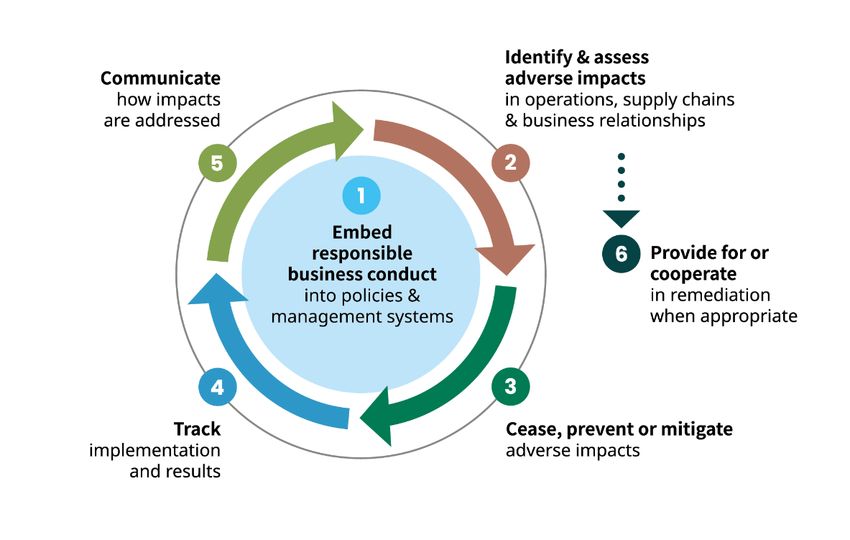
Due diligence is a continuous, risk-based process through which companies must effectively identify,
prevent and mitigate actual and potential adverse impacts in their operations and along their value
chains and business relationships. They must also track the effectiveness of their response and ac-
count for how they address the identified adverse impacts (see Figure 1). (United Nations 2011)
Figure 1: Six steps of the due diligence process
Source: Germanwatch, based on OECD (2018), OECD Due Diligence Guidance for Responsible Business Conduct.
In February 2020, the results of a study arranged by the EU COM affirmed that voluntary measures
have so far proved to be vastly insufficient and that there is an urgent need for regulatory action at
EU level. (British Institute of International and Comparative Law 2020) Meanwhile EU member states
France, the Netherlands (on child labour), and most recently Germany have adopted legislation on
mandatory due diligence; other member states are also considering the adoption of such legislation,
including Austria, Belgium, Finland and Luxembourg.
In April 2020, the EU Commissioner for Justice, Didier Reynders, committed to a legislative initiative
in this regard. About a year later, in March 2021, the European Parliament (EP) followed up with a
legislative initiative procedure (INL) setting out its expectations for legislation to be developed by the
22Halting deforestation in EU agricultural supply chains Transnational Network for Deforestation-Free Supply Chains
EU COM. (European Parliament 2021a) After several delays, the respective EU COM proposal is now
expected to be presented on 23 February 2022.
The EU already regulates product-specific due diligence requirements through the Conflict Minerals
Regulation, the Timber Regulation and the Anti-Torture Regulation, amongst others. The recently
proposed Regulation on deforestation-free products will also set product-specific requirements. The
upcoming Sustainable Corporate Governance legislation is set to define due diligence obligations
across sectors building on the UN Guiding Principles on Business and Human Rights and the OECD
Guidelines for Multinational Enterprises.
4.2 SWOT analysis
To what extent can the EU Sustainable Corporate Governance initiative contribute to reducing
deforestation in global supply chains?
The Sustainable Corporate Governance initiative is aimed at addressing, inter alia, business's adverse
impacts on human rights and the environment in global supply chains. It is not designed to specifically
deal with product-related deforestation. However, deforestation is one of the major risks that compa-
nies, such as agricultural businesses, are facing in their supply chains and therefore would have to ad-
dress and mitigate as required under the initiative. In fact, the EP, in its legislative report, states that en-
vironmental impacts "should include, but should not be limited to, production of waste, diffuse pollu-
tion and greenhouse emissions that lead to a global warming of more than 1.5°C above pre-industrial
levels, deforestation, and any other impact on the climate, air, soil and water quality, the sustainable use
of natural resources, biodiversity and ecosystems". (European Parliament 2021a, 20)
The contribution of the future EU Sustainable Corporate Governance legislation to reducing defor-
estation highly depends on the applied definition of environmental due diligence. As the EU COM's
proposal has not yet been published, the SWOT analysis in this chapter is primarily based on the rec-
ommendations of the EP's legislative report. The upcoming EU COM proposal will have to be negoti-
ated between the EP, the EU COM and the Council, i.e. the member states. Political compromises will
have to be found. These will inevitably affect the strengths and weaknesses described below.
Strengths
• According to the EP's suggestions, the upcoming legislation should be broad in scope and
possibly cover all large EU undertakings, including the financial sector. The EP is also pro-
posing that it covers "publicly listed small and medium-sized undertakings and high-risk
small and medium-sized undertakings" (European Parliament 2021a, no 9) and non-EU
companies that are active on the internal market. This would allow for a comprehensive
horizontal approach in the legislation.
• With regard to the scope of the due diligence obligation, the legislation should cover the
entire value chain. (European Parliament 2021a, no 7) The horizontal scope of the obliga-
tion should be an important strength of the upcoming instrument and contribute to its ef-
fectiveness as it counteracts a shift of problems and loopholes that would be connected to
placing obligations on a number of defined products only.
• Concerning the definition of environmental impacts, the EP is suggesting that the legislation
should cover the "production of waste, diffuse pollution and greenhouse emissions that lead
to a global warming of more than 1.5°C above pre-industrial levels, deforestation, and any
23Halting deforestation in EU agricultural supply chains Transnational Network for Deforestation-Free Supply Chains
other impact on the climate, air, soil and water quality, the sustainable use of natural re-
sources, biodiversity and ecosystems". (European Parliament 2021a, no 23 Annex to the reso-
lution) This definition would require companies to address adverse impacts in their value
chains relating to deforestation and the loss of biodiversity. The legislative report generally
stresses that the enjoyment of human rights depends on the preservation of biodiversity as
the foundation of ecosystem services. (European Parliament 2021a, no 5) A definition that in-
cludes deforestation and adverse impacts on biodiversity makes it possible for companies to
collectively address these problems against ongoing pressures on prices.
• Due diligence implies that relevant stakeholders, including Indigenous communities, are in-
volved and the legislative report explicitly mentions that such involvement is "conducted in ac-
cordance with international human rights standards, such as the United Nations Declaration
on the Rights of Indigenous Peoples, including free, prior and informed consent and Indige-
nous peoples’ right to self-determination". (European Parliament 2021a, no 19 and 39)
• With regard to enforcement, the upcoming legislation should, according to the European
Parliament (EP) and as previously announced by the EU COM, include a civil liability regime
and an administrative enforcement mechanism via national authorities. A combination of
both instruments would allow for a strong enforcement of the obligations.
• The Sustainable Corporate Governance initiative could bring about positive changes on the
ground. Production workers benefit from improved working conditions when companies
are obliged to comply with social and environmental standards. Workers in a factory are
better off in terms of their health if the factory complies with mandatory emissions stand-
ards and, for example, is required to install an exhaust filter.
Specific strengths regarding soy and beef
supply chains from Mercosur
• Concerning the scope of the upcoming legislation, the due diligence obligations apply to
major German and EU feed producers if companies with more than 500 employees are
covered.
Weaknesses
• The effectiveness of the upcoming sustainable corporate governance legislation in address-
ing environmental damages depends to a large extent on the definition thereof. If refer-
ences to deforestation and biodiversity are missing in the definition of environmental due
diligence in the final proposal, there is a risk that many companies will not act upon it and
will fail to address these risks in their supply chain.
• With regard to potential weakness in the enforcement of the legislation, Parliament "under-
lines that such authorities should be provided with sufficient resources and powers to real-
ize their mission; considers that the EU COM should set up a European due diligence net-
work to be responsible for, together with the national competent authorities, the coordina-
tion and convergence of regulatory, investigative, enforcement and supervisory practices,
and the sharing of information and to monitor the performance of national competent au-
thorities". (European Parliament 2021a, no 23) A law without sanctions is a mere paper tiger
and remains ineffective.
• Companies can prioritise risks and the actual and potential adverse impacts they address in
their supply chains according to the severity and likelihood of adverse impact. However,
prioritisation is only relevant where it is not possible to address all potential and actual ad-
verse impacts immediately and should be based on a comprehensive risk assessment un-
dertaken at the outset.
24Halting deforestation in EU agricultural supply chains Transnational Network for Deforestation-Free Supply Chains
• A company’s due diligence obligation should not be simply passed on to producers in the
supply chain, without the mother company fulfilling its own due diligence obligation
properly.
Specific weaknesses regarding soy and beef
supply chains from Mercosur
• None.
Opportunities
• The COVID-19 pandemic has exposed the fragilities and inequities in global value chains,
and as a result some companies are becoming more aware of the importance of reliable
and sustainable relationships with their suppliers.
• Further pressure for companies to act and improve corporate accountability in global value
chains arises through stricter criteria that financial institutions are applying (compare chap-
ter 6 in this paper).
• There are developments in several countries addressing human rights and environmental
due diligence in legislation, such as in the 2017 French Law on the Duty of Vigilance, the
German Supply Chain Act adopted in June 2021 and the Norwegian Due Diligence Law
from 2021. In the Netherlands, Finland, Luxembourg, Belgium and Austria there are parlia-
mentary processes ongoing or awaiting action from the EU COM. These legislative devel-
opments increase the pressure on the EU COM to act. Moreover, there is the so-called
treaty process at the United Nations negotiating an international approach to due dili-
gence.
Specific opportunities regarding soy and beef
supply chains from Mercosur
• In November 2021 the EU COM put forward a proposal on deforestation-free product sup-
ply chains and there has been much debate and voluntary pledges around this issue lately.
A future sustainable corporate governance proposal could complement these EU legislative
efforts and set the benchmark for human rights and environmental due diligence across
different sectors.
Threats
• Despite the poor results voluntary approaches have shown (see chapter 7), major business
associations are continuing to strongly lobby against mandatory obligations and sound en-
forcement, including liability. They have political allies in the EU COM and among member
states and could therefore try to water down an effective proposal on sustainable corpo-
rate governance.
• The price pressure in international competition on certain products continues to pose a
challenge for business when changing their pricing policies in global value chains.
Specific threats regarding soy and beef
supply chains from Mercosur
• None.
25You can also read


