Assessing Present and Future Climate Conditions for Beach Tourism in Jardines del Rey (Cuba) - MDPI
←
→
Page content transcription
If your browser does not render page correctly, please read the page content below
atmosphere
Article
Assessing Present and Future Climate Conditions for
Beach Tourism in Jardines del Rey (Cuba)
María Belén Gómez-Martín 1, * , Felipe Matos-Pupo 2 , Reynier Bada-Díaz 3 and
Daynier Escalante-Pérez 4
 1   Department of Geography, University of Barcelona, Montalegre 6, 08001 Barcelona, Spain
 2   Centro Meteorológico Provincial de Ciego de Ávila, Instituto de Meteorología de Cuba,
     Avda. de los Deportes; Ciego de Ávila 65100, Cuba; felipe.matos@cav.insmet.cu
 3   Departamento de Oceanografía, Facultad de Ciencias Naturales y Oceanográficas,
     Universidad de Concepción, Concepción 4030000, Chile; rbada@udec.cl
 4   Facultad de Ingeniería, Universidad Nacional Autónoma de México, Ciudad de México 04510, Mexico;
     daynier.escalante@comunidad.unam.mx
 *   Correspondence: bgomez@ub.edu

 Received: 14 November 2020; Accepted: 27 November 2020; Published: 30 November 2020

 Abstract: This study assesses, adapting the weather types method, the suitability of the climate
 in Jardines del Rey (Cuba) for the practice of sun and beach tourism over the period 1991–2014,
 and the potential future impacts of climate change on this form of tourism on the basis of outputs
 from the PRECIS-Caribbean Regional Climate Model for the period 2021–2050. The methodology
 applied makes a classification of daily situations according to the most frequent combinations of
 climatological variables in tropical areas while focusing on a very specific segment of the tourism
 market (sun and beach tourism) and taking into account the behaviour of beach users and bioclimatic
 criteria. The results indicate that the distribution of weather types at the destination during the period
 1991–2014 was highly consistent with the monthly distribution of tourists in Cuba, highlighting the
 existence of a low season from May to October and a high season between November and April.
 The future scenarios project an improvement in climate conditions for the practice of sun and beach
 tourism. This improvement is not based on a spectacular increase in favourable weather types
 compared to unfavourable ones, but rather on a better distribution of both.

 Keywords: weather types method; sun and beach tourism; tourism behaviour; climate change; Cuba

1. Introduction
      Coastal tourism is widely considered the most important segment in the tourism industry
worldwide and “sun and beach” tourism is its most important variant [1–3]. This is especially true in
many island states, in which “sun and beach” tourism has become the main business activity, generating
substantial income and profits and boosting general economic development [4,5]. One example is
the Caribbean, in which the increasing importance of this sector is manifested in figures provided by
the UNWTO: 25.7 million international tourists visited the Caribbean subregion in 2018, generating
an income of USD 32 billion. These highly significant figures translate into market shares within the
Americas region of 11.9% and 9.6%, respectively [6]. These islands’ main resources in terms of tourist
attractions are their climate and beaches, which means that climate change could pose a serious threat
to all of them (although the exact situation varies greatly from state to state). The IPCC Fifth Assessment
Report concluded that [7] (p. 1628) “for the SRES A2 and B2 scenarios, the PRECIS regional climate
model projects an increase in temperature across the Caribbean of 1 ◦ C to 4 ◦ C compared to a 1960–1990
baseline, with increasing rainfall during the latter part of the wet season from November to January in

Atmosphere 2020, 11, 1295; doi:10.3390/atmos11121295                       www.mdpi.com/journal/atmosphere
Atmosphere 2020, 11, 1295 2 of 18
the northern Caribbean (i.e., north of 22◦ N) and drier conditions in the southern Caribbean linked to
changes in the Caribbean Low Level Jet with a strong tendency to drying in the traditional wet season
from June to October” [8–10]. These projections suggest that the Caribbean island states as a whole,
whose economies are highly vulnerable to changes in the climate, could be subject to serious impacts
that could put their medium- and long-term development in jeopardy [11–18].
In this context, evaluating the climate potential for sun and beach tourism is a key task and a first
step on the way to estimating the direct impacts of climate change on the tourism sector in general and
on certain specific regions in particular [19–21]. In the academic field of tourism climatology, the sun and
beach segment of the tourism sector has been the subject of a large number of potentiality assessments
due to its high dependence on weather conditions [22–24] and its leading role within the wide range of
available tourism products worldwide. Many of the research papers that have assessed the potential of
climates for sun and beach tourism have tried to measure or quantify it using climate tourism indexes
such as the Tourism Climate Index [25–29], the Climate Index for Tourism [30], the Climate Tourism
Information Scheme [31–34], the Beach Climate Index [35], the Beach Utility Index [36] and the Holiday
Climate Index [37], among others. However, relatively few assessments have been made of the tourism
potential of a particular climate using the weather types method, in spite of the fact that it is based on
the true state of weather and more accurately reflects the nature of the atmospheric medium by rejecting
both the exclusive use of one single climate element and the use of potentially misleading average
values (instead using the daily figure, which is real and tangible for people) [23,38–47]. It is important to
point out that the results obtained from the application of the different assessment proposals have also
depended on the procedures used to calculate the suitability thresholds for the different atmospheric
variables. At times, these procedures have been based on expert opinion [27,39,48]. On other occasions,
procedures have been based on bioclimatic criteria [49–52], declared preferences (stated preferences
approaches using surveys or interviews) [23,43,53–59] and/or revealed preferences (tourist behavioural
observation) [46,51,60,61]. The sun and beach tourist destinations that have most frequently been the
subject of this kind of research are in the Mediterranean, Pacific and Caribbean Lesser Antilles regions.
Research has focused, above all, on assessing the potential of these areas for this kind of tourism and
on calculating their suitability thresholds for the different atmospheric variables (Table 1).Atmosphere 2020, 11, 1295 3 of 18
Table 1. Daily climatic (ideal/unacceptable) threshold conditions for beach tourism.
Precipitation Sun (h)/Could Conditions
Region Tempretuare Wind (m s−1 ) Source
(mm or h) (%)
Ideal Unacceptable Ideal Unacceptable Ideal Unacceptable Ideal Unacceptable
Spain 22–28 33 0h >3 h >11 h ≤5 h 12 Gómez-Martín (2006) [43]
Canada 27 - - - 25% - ≤2.5 - Scott, et al. (2008) [62]
New Zealand 25 - - - - - ≤2.5 - Scott, et al. (2008) [62]
Sweden 29 - - - 0% - ≤2.5 - Scott, et al. (2008) [62]
Belgium 28 - - - >8 h/0% - ≤2.5 - Moreno (2010) [63]
Europe 27–32 37 0h ≥2 h 25% ≥75% ≤2.5 ≥11.4 Rutty & Scott (2010) [64]
36
Germany 27–3225–32 0h ≥2.5 h 25% ≥75% ≤2.5 ≥11.4 Wirth (2010) [65]
34
Spain 28–31 - 0h - >75% - 1 h Gómez-Martín &
Spain 29.5–31 80% 1 mm Martínez-Ibarra (2012) [60]
Caribbean 27–30 34Atmosphere 2020, 11, 1295 4 of 18
The objective of this research was to assess, adapting the weather types method, the suitability of
the climate in Jardines del Rey (Cuba) for the practice of sun and beach tourism and how this might be
affected by climate change. The Greater Antilles, the Caribbean region in which this area is located,
has been a subject of little research in the tourism climatology field to date [66], a situation that needs
to be remedied. The Cuban tourist region of Jardines del Rey a group of Keys which, together, form
the eastern part of the Sabana-Camagüey Archipelago, situated to the north of the island of Cuba just
off the coast of the central provinces. The climate conditions in Jardines del Rey may be considered
representative of the tourist regions in the north of the island of Cuba, which specialize in sun and
beach tourism (Table 2).
Table 2. Monthly mean values in Jardines del Rey (meteorological station of Cayo Coco, Cuba).
Variables January February March April May June July August September October November December
Precipitations (mm) 41.0 35.9 32.6 50.6 132.1 133.4 82.9 101.8 145.0 165.8 90.6 45.7
Maximum Temperature (◦ C) 25.9 26.6 27.3 28.5 29.6 30.8 31.5 31.8 31.4 29.9 27.7 26.5
Environmental Temperature (◦ C) 23.4 23.6 24.3 25.4 26.5 27.7 28.6 28.5 27.9 27.2 25.6 24.2
Wind Speed (km/h) 13.3 12.6 13.1 12.3 9.4 7.8 8.1 8.1 8.6 10.1 13.8 13.8
Duration of Sunlight (h) 7.5 8.6 9.3 10.1 9.1 8.1 9.3 9.1 8.3 7.8 6.7 7.3
Cloud Cover (okts) 3.9 3.3 3.4 3.5 4.2 4.7 4.1 4.4 4.7 4.5 4.3 4.3
Together with Varadero and Polo Turístico Norte de Holguín, Jardines del Rey has become
one of the most popular tourist destinations on the island with various large resorts, such as Cayo
Coco and Cayo Guillermo, that are well known internationally for sun and beach tourism. With its
4.7 million foreign tourists, Cuba is the second most important tourist destination in the Caribbean
region after the Dominican Republic [6,67]. Tourism has become one of the most important drivers of
the island’s economy and the second largest source of income after the sale of professional services
abroad, contributing 10% of the gross domestic product (GDP) and creating more than half a million
jobs. This situation explains the interest in studying the direct impacts of climate change on tourism
on the island, as the resulting information could provide a starting point from which to develop new
strategies that would enable this key economic sector to adapt to future climate scenarios.
2. Materials and Methods
2.1. Weather Types Method Approach
The studies carried out in the field of tourism climatology using the weather types method have
focused, above all, on two meanings of this term. The first meaning is based on the concept of synoptic
weather type defined by Pédelaborde [68], which refers to a well-defined meteorological situation with
its weather, air masses and centres of action. The second meaning is based on the physionomic concept
defined by Hufty [69], which understands weather type as the everyday combination of climatological
variables. As occurs with the various climate tourism indexes [62,70,71], the weather types method
also has a number of limitations, which have been resolved to a greater or lesser degree through the
different contributions made by researchers in this field.
The first studies in the field of tourism climatology that used weather types, in the sense defined
by Hufty [69], were those of Masterton, Crowe and Baker [47], Gates [42] and Crowe and McKay and
Baker [41]. Their proposals established favourable and unfavourable weather types for up to six types
of tourism/tourism activities. This segmentation, together with the inclusion of comfort as a factor
for consideration (measured using the Humidex), was an important step forward that highlighted
the complex nature of research in the field of tourism climatology. In spite of these advances and of
the easy interpretation of the graph-based calendars, the proposals made by these authors had three
weaknesses. The first was related to the fact that the thresholds established for some of the atmospheric
variables were not exact (in particular, those for the state of the sky), while the second was related
to the lack of any empirical comparison or checking. The third, and most important, weakness wasAtmosphere 2020, 11, 1295 5 of 18
related to the binary method of classifying weather types as either suitable or unsuitable, which did
not allow for different levels of suitability in the favourable weather types.
Besancenot, Mounier and de Lavenne [40], once again using the approach presented by Hufty [69],
proposed a classification of favourable and unfavourable weather types (in different degrees) for the
practice of tourism in general, which considered the main atmospheric demands of the tourist in terms
of enjoyment, comfort and safety. This approach to the classification of the weather types allowed them
to individualize the most relevant, everyday combinations of the main types of climate experienced by
tourists in different atmospheric contexts (temperate, tropical, polar and subpolar latitudes), which was
a fundamental issue given that the environmental conditions of the tourist destination have a strong
influence on tourists’ expectations and behaviour. In spite of these strengths, this proposal also had a
number of limitations. The first limitation was the fact that the proposal assessed weather types for the
practice of tourism in general, and as a result neglected the fact that each tourism activity requires
specific atmospheric conditions for its practice. The second limitation was the fact that it established
the suitability thresholds on the basis of expert opinion. Numerous research studies have followed
these original guidelines of Besancenot, Mounier and de Lavenne [40], including, among others, those
conducted by the authors of [38,66,72]. The work of all these authors has served as an inspiration for the
different research studies that have tried to overcome some of the limitations referred to above. In the
case of Mediterranean climates, these include the studies by Gómez-Martín [23,43,73], which introduced
the preferences of tourists, as expressed in surveys, in the ranking of the weather types and in the
establishment of thresholds for the atmospheric variables, as well as those by Martínez-Ibarra [45,46],
which took into account the behaviour of sun and beach tourists.
Barbière [39], referring to both meanings of weather types mentioned above, based his proposals
for tourism climatology on the impossibility of separating the weather experienced by tourists from
the mechanisms that produce it, presenting a very useful feature, namely a classification of different
levels of suitability. The lack of segmentation in Barbière’s classification, the lack of any empirical
checking of the levels of suitability established, the fact that the multidimensional variable “comfort”
was only considered in passing and the complexity and difficulty involved in interpreting the results
led to this proposal being largely unsuccessful.
All these studies, conducted over the course of several decades, created a base on which to develop
new proposals that tried to correct the main weaknesses detected while making the most of their
innumerable strengths, so allowing great strides to be made in the field of tourism climatology.
2.2. Methodology
The weather types method applied here makes a classification of daily situations according to
the most frequent combinations of climatological variables. This classification is then subjected to an
analysis of frequencies within the context of the particular tourist destination, in this case, Jardines
del Rey in Cuba. To this end, in this study, we used a modified version of the original classification
of weather types for tropical climates proposed by Besancenot [48], the main differences being that
we focused on a very specific segment of tourist demand and that we decided not to refer to expert
opinion when establishing the suitability thresholds for the atmospheric variables under consideration.
In this way, the new classification enabled us to assess climate potential (present and future) for the
practice of sun and beach tourism at the selected destination, taking into account tourist behaviour as
observed in previous research and bioclimatic criteria. Hence, this adaptation overcomes the inherent
limitations in the original method, first with regard to the universal nature or lack of segmentation in
the weather types proposal (the typology presented here is specific for the sun and beach segment of
the tourism market), and second, in the sense that the original list was based on the authors’ criteria,
whereas the list we used was linked to empirical observations (the hierarchization of the variables
and the establishment of favourable and unfavourable thresholds in the typology presented here are
referenced to the behaviour of sun and beach tourists and to bioclimatic criteria).Atmosphere 2020, 11, 1295 6 of 18
In this way, the weather types established take into account the needs of tourists in terms of
comfort, enjoyment and safety. Each of these three tourism climate needs is associated with one of the
three facets of climate conceptualized by Perry [74] and De Freitas [22] when analysing its effect on
tourism: The aesthetic facet, the thermal facet and the physical facet (Table 3). The set of parameters
used to assess these needs were as follows: Daily amount of sunshine (hours), cloud cover at 13:00
(oktas of cloud cover), duration of daily precipitations (hours) or the amount of daily precipitation
(mm), maximum daily temperature (◦ C), wind speed at 13:00 (m/s). Values for various indexes were
also calculated, including the Wind Chill Index proposed by Siple and Passel to measure the cooling
power of the wind (W/m2 ), Thom’s thermal discomfort index (◦ C) and the humidity comfort index
(hPa), calculated at the hottest time of day (in practice at 13:00 every day).
Table 3. Needs of tourists and facets of the climate.
Needs of Tourists Effect on Tourists Climate Facets Atmospheric Variables Involved
Sunshine, Cloud Cover, Visibility, Fog,
Enjoyment Psychological Aesthetic
Length of the Day, etc.
Air Temperature, Humidity, Wind Speed,
Comfort Physiological Thermal
Solar Radiation, etc.
Wind Speed, Amount and Duration of
Safety Mechanical Physical
Precipitation, UV Index, etc.
Source: Based on [22,23,48,74,75].
In this study, we used the results of previous research, in which the behaviour of sun and beach
tourists in the Iberian Peninsula was observed using nonintrusive techniques, as a reference [60].
The authors of [60] analysed the density of use of beaches (via webcam) and how this varied in
line with changes in the different atmospheric parameters. The results suggested that the variables
that most affect the use of beaches are sunshine, precipitation, maximum temperature and thermal
comfort. It is therefore essential to consider these parameters in the new classification. Sun and beach
tourists have also shown themselves to be more tolerant to high temperatures and heat discomfort than
other segments of tourist demand. This suggests that the thresholds for these parameters should be
broadened, while respecting the bioclimatic recommendations at all times. This finding was also noted
in various different research studies on this segment of the tourism market on the basis of preferences
declared in surveys [23,35,43,57,62–65,70]. Regarding thresholds, the analysis of the density of use of
Spanish beaches in relation to a range of different atmospheric parameters revealed that “the optimal
thresholds for going to the beach were: a maximum temperature between 28.83 and 31 ◦ C; a maximum
Physiological Equivalent Temperature (PET) of between 34.5 and 38.8 ◦ C; a percentage of solar radiation
at 13:00 of at least 50%; a wind speed at 13:00 ofAtmosphere 2020, 11, 1295 7 of 18
Table 4. Classification of tropical weather types for sun and beach tourism.
Type 1. Very Good Comfortable Weather
I > 7 or Nb < 3
Enjoyment, Comfort 175 ≤ K < 700
D = 0 or P = 0
and Safety 15 ≤ THI ≤ 26.4
29.5 ≤ Tx ≤ 31
U ≤ 26.5
2≤V≤8
Type 2. Comfortable Weather but Partially Overcast
3 < I ≤ 7 or 3 ≤ Nb < 6
175 ≤ K < 1049
D = 0 or P = 0
15 ≤ THI ≤ 26.4
23.5 ≤ Tx ≤ 31
U ≤ 26.5
2≤V≤8
Type 3. Comfortable Weather but with a Brief Rain Shower
I > 3 or Nb < 6
Relative Displeasure 175 ≤ K < 1049
0 < D < 1.5 or 0 < P < 2
15 ≤ THI ≤ 26.4
23.5 ≤ Tx ≤ 31
U ≤ 26.5
2≤V≤8
Type 4. Good Weather with Strong Winds
I > 3 or Nb < 6
175 ≤ K < 1049
D = 0 or P = 0
15 ≤ THI ≤ 26.4
23.5 ≤ Tx ≤ 31
U ≤ 26.5
8 < V < 10
Type 5. Good Cool Weather
I > 3 or Nb < 6
K ≥ 700
D = 0 or P = 0
15 ≤ THI ≤ 26.4
20.8 ≤ Tx ≤ 23.5
U ≤ 26.5
2≤V≤8
Relative Discomfort
Type 6. Good Hot and Sultry Weather
I > 3 or Nb < 6
0 < K < 349
D = 0 or P = 0
26.5 ≤ THI ≤ 29.9
31 ≤ Tx ≤ 33
26.5 < U < 31.3
2≤V≤8
Absolute Discomfort Type 7. Bad Weather, Unfavourable for Sun and Beach Tourism
and/or Displeasure All other kinds of weather (includes the effects of severe hydrometeorological events)
Description legend of tropical weather types: I: duration of sunlight (h); Nb: cloud cover at 13:00 (okts of cloud
cover); D: duration of daily precipitations (h); P: height of daily precipitations (mm); Tx: maximum temperature
(◦ C); V: wind speed at 13:00 (m/s); K: cooling power of the wind (W/m2 ); THI: Thom’s thermal discomfort index
(◦ C); U: humidity comfort index (hPa).
In this way, bearing in mind the results of past observations of the behaviour of sun and beach
tourists [60], as well as the variant introduced by the bioclimatic criteria, according to which the
optimum maximum temperatures are those within the 16–33 ◦ C range (16 ◦ C is the point at which the
body mechanisms that defend us against the cold are triggered and someone who is wearing light
clothes and is not moving begins feeling cold; 33 ◦ C is the point at which the body, with exposed bare
skin, is at risk of not being able to let heat flow out to the exterior), maximum temperature values were
set in the proposed classification. A threshold of 29.5–31 ◦ C was established for Type 1, which meets
the conditions considered as optimum and guarantees the maximum density of use of the beaches
(density of use 3, according to the aforementioned study). For Types 2, 3 and 4, the threshold was set
between 23.5 ◦ C and 31 ◦ C, allowing for densities of use of the beaches of over 0.5. For Type 5 (good
cool weather), the threshold values were reduced to 20.8–23.5 ◦ C. For Type 6 (good hot sultry weather),
the threshold values were in the 31–33 ◦ C range.
Bearing in mind the information obtained by observing the behaviour of sun and beach tourists [60],
as well as the length of the day and the maximum possible hours of sunshine in the study area (which
ranges from 10 h 46 min on 21 December to 13 h 31 min on 21 June), it was decided that the minimum
amount of sunshine compatible with maximum enjoyment is 7 h (Type 1). This minimum limit can beAtmosphere 2020, 11, 1295 8 of 18
reduced to 3 h of sunshine/day for the weather types with good weather and the occasional drawback
(Types 3, 4, 5 and 6). The threshold was set at 3 < I ≤ 7 h for Type 2 (good weather with partial cloud
cover). The threshold for Type 7 (bad weather unsuitable for sun and beach tourism) was set at less
than 3 h/day.
The effect of rain on the enjoyment and safety of tourist activities is well known, especially in
the case of outdoor activities such as sunbathing on the beach. Rain in excess of certain thresholds
may act as a limiting factor, capable of eclipsing all other favourable elements and creating, by itself,
an impression of poor weather. According to the observed behaviour of sun and beach tourists,
the maximum rainfall thresholds are 1 mm or 60 min per day. Given the climate characteristics of
the destination in this study, which has a humid, tropical climate with a rainy season in the summer,
the aforementioned thresholds were extended to 2 mm or 90 min per day. Weather Types 1, 2, 4, 5
and 6 do not allow for any rainfall at all over the period 0.00–24.00 h. Type 3 (comfortable weather
with a brief period of rain) allows for precipitations lasting less than 1.5 h a day or in amounts of up to
2 mm per day. Finally, rainy days can be classified as Type 7, when precipitation levels exceed the
thresholds for Type 3. Days in which there are extreme hydrometeorological events were also classified
as weather Type 7.
Regarding wind speed, it was observed that the most favourable weather types for sun and beach
tourism (Types 1, 2, 3, 5 and 6) had light wind speeds of less than 8 m/s. For Type 4 (good weather
with strong winds), wind speeds between 8 and 10 m/s were considered acceptable. Finally, on Type
7 days, considered unsuitable for sun and beach tourism, wind speeds may be even higher than on
windy days (Type 4).
Regarding comfort indices, although there are more complete, integrative proposals as reported
in reviews by De Freitas & Grigorieva [76] and Potchter et al. [77], we decided to continue using
the Wind Chill Index proposed by Siple and Passel (W/m2 ), Thom’s thermal discomfort index (◦ C)
and the Humidity Comfort Index (hPa), proposed in Besancenot’s classification [48], although the
original optimum favourable thresholds were altered to take into account the fact that sun and beach
tourists are more tolerant to thermal discomfort (Tables 5 and 6). In this way, Type 1 accepts comfort
conditions of 175 W/m2 ≤ K < 700 W/m2 , 15 ◦ C ≤ THI ≤ 26.4 ◦ C and U ≤ 26.5 ◦ C. Types 2, 3 and 4
have thresholds of 175 W/m2 ≤ K < 1049 W/m2 , 15 ◦ C ≤ THI ≤ 26.4 ◦ C and U ≤ 26.5 ◦ C. Type 5 has
K values of K ≥ 1049 W/m2 , 15 ◦ C ≤ THI ≤ 26.4 ◦ C and U ≤ 26.5 ◦ C. For Type 6 (good hot and sultry
weather), the following conditions applied: 0 W/m2 < K < 349 W/m2 , 26.5 ◦ C ≤ THI ≤ 29.9 ◦ C and
26.5 ◦ C < U < 31.3 ◦ C.
Table 5. Siple and Passel Index: Cooling power of the wind (K) and comfort conditions.
K Comfort Conditions Value
0–174 Hot Discomfort −2
175–349 Hot Subcomfort −1
350–699 Neutral Comfort 0
700–1049 Cold-Subcomfort +1
+1050 Cold Discomfort +2
Table 6. Thom’s thermal discomfort index and comfort conditions.
THI Comfort Conditions
≥ 30 Torrid
26.5 to 29.9 Very Hot
20.0 to 26.4 Hot
15.0 to 19.9 Comfortable
13.0 to 14.9 Cool
−1.7 to 12.9 Cold
−9.9 to −1.8 Very Cold
≤−9.9 Extremely ColdAtmosphere 2020, 11, 1295 9 of 18
The proposed weather types classification was applied for the whole year. It was calculated on a
daily basis and presented in graphs on a monthly scale.
2.3. Data
In line with the above, this study presents the distribution of the climate conditions for tourism at
the Jardines del Rey Cuban tourist region for the base period and for a future period based on outputs
from the PRECIS-Caribbean Regional Climate Model for SRES A2 and B2 [9,78–81]. In the IPCC
Fifth Assessment Report (IPCC, 2014), four new scenarios were defined, referred to as Representative
Concentration Pathways (RCP). These cover a broader range than the emissions scenarios (SRES) used
in previous assessments by the IPCC, in that they consider climate policies and evaluate a wider range
of emissions. The projections provided by the AR4 and AR5 are not directly comparable because they
are based on different collections of scenarios, but both are consistent with each other. The projections
allow some comparison only between the scenarios that are close in terms of volume and rate of
emission (in climate forcing terms, RCP 8.5 is consistent to SRES scenario A2/A1FI and RCP 6.0 is
consistent to B2).
Regarding the data used, the base period 1991–2014 was defined on the basis of observations from
meteorological station 78,339 in Cayo Coco. This station belongs to the Coastal Ecosystems Research
Centre (Centro de Investigaciones de Ecosistemas Costeros or CIEC), which provides information to
the national stations network of the Cuba Meteorology Institute (INSMET). We also considered the
primary variables involved in the classification of weather types, based on the daily data outputs from
the PRECIS-Caribbean Regional Climate Model, which, in turn, used boundary data generated by the
Echam-4 General Circulation Model in future climate scenarios A2 and B2 (Big Caribbean domain,
50 × 50 km, 1961–2100). The model output point (22◦ N–78◦ W) corresponds with the location of the
meteorological station. A total of 19,723 days was analysed, 8766 of which were from the base period
and 10,957 were from the future period 2021–2050. A total of 138,061 pieces of data were used to
calculate the parameters that are really covered by the weather type, as well as to enable the correction
of the output from the model and the calculation of the bioclimatic indices for the future period.
The output data from the PRECIS-Caribbean Regional Climate Model were processed using the
Microsoft Excel program in order to verify the accuracy of the model, which can be idealized as a
simple comparison of the prediction made by the model and the real weather using the years from the
base period (1991–2014).
Accuracy = Prediction by the Model − Real Weather (1)
Some of the daily outputs for scenarios A2 and B2 were different from the real values measured by
the station (the wind force and relative humidity were lower in the model output and the temperature
values were higher than the real temperature). The variables were therefore adjusted to bring them as
close as possible to the real value by means of a bimonthly coefficient.
In order to determine whether there were any statistically significant differences between the
variables from the model, the corrected variables and those from the station, we decided to carry out
the Multiple Sample Comparison procedure, which was designed to compare two or more independent
samples of data using the Statgraphics program. The result corroborated the null hypothesis that
there are statistically significant differences between the station data and those modelled by PRECIS.
Therefore, we decided to determine a coefficient (bimonthly) to adjust the values of the model to bring
the values closer to the climatic reality. The graphs and the analyses of the data were prepared using
Excel and MatLab.
The coefficient was made by taking the data from the base period of the model and the station.
Once the coefficient was determined and the model outputs were adjusted, the new values obtained
were submitted to rule out the existence of statistically significant differences. The adjusted values
complied with the condition, as they did not present statistically significant differences from those ofAtmosphere 2020, 11, 1295 10 of 18
the station. Therefore, the coefficients were taken to adjust the model values for the 2021–2050 period,
so that the prediction that was made as close to the future climate scenario in the area.
3. Results
We now show the results for the base period 1991–2014 of the application of the tropical weather
types classification for sun and beach tourism. We then present the results for the period 2021–2050,
generated by the PRECIS-Caribbean Regional Climate Model for SRES A2 and B2.
3.1. Classification of the Weather Types in Jardines del Rey (1991–2014)
The results for the base period (Figure 1) show that weather types 1, 2, 3 and 4 predominated in
the period November to April. These weather types were also recorded in May and October, although
in smaller numbers. Of these four weather types, Type 1 (ideal weather) was the most frequently
recorded weather type in the period November to April, with an average of 31% of the days. February
was the only month in which there were more days with Type I weather than with Type 7 weather:
37.8% compared to 32.4%, respectively. Of weather Types 2, 3 and 4 (good weather with a relative
degree of unpleasantness), the type that appeared most frequently during the period November to
Atmosphere 2020,was
April 11, xType 4, good weather with strong winds. 12 of 19
% Jardines del Rey (1991-2014)
100
90
80
70
60
50
40
30
20
10
0
T1 T2 T3 T4 T5 T6 T7
FigureFigure 1. Annual
1. Annual distribution
distribution ofofweather
weather types
typesinin
Jardines del Rey
Jardines del (1991–2014).
Rey (1991–2014).
Type 7 weather, unsuitable for sun and beach tourism, was recorded in every single month of the
Type 7 weather, unsuitable for sun and beach tourism, was recorded in every single month of
year. Within the period analysed (1991–2014), 60% of days registered this weather type. The months
the year.with
Within the numbers
the highest period analysed
of days with(1991–2014),
Type 7 weather60% of days
were June, registered
July, August, this weather
September and Octobertype. The
months with the74.2%
(between highestand numbers
85.5%), the of daysclassified
months with Type 7 weather
as “low were
season” for June,
tourism July, August, September
in Cuba.
The least frequent weather type was Type 5 (relative discomfort due
and October (between 74.2% and 85.5%), the months classified as “low season” for tourism to cool weather), at aroundin Cuba.
The0.5%,
leastwith just 48 days in the 24-year analysis period. These cool temperatures were recorded in January,
frequent weather type was Type 5 (relative discomfort due to cool weather), at around
February and December. These are winter months, a period when Cuba is affected by frontal systems.
0.5%, with just 48 days in the 24-year analysis period. These cool temperatures were recorded in
By contrast, Type 6 (relative discomfort due to heat) weather occurred all year round. From June to
January, February and December. These are winter months, a period when Cuba is affected by frontal
systems. By contrast, Type 6 (relative discomfort due to heat) weather occurred all year round. From
June to September, about 6 days a month (20%) were classified as Type 6, and significant percentage
levels can also be observed in October and December. These nonideal Type 6 bioclimatic conditionsAtmosphere 2020, 11, 1295 11 of 18
September, about 6 days a month (20%) were classified as Type 6, and significant percentage levels
can also be observed in October and December. These nonideal Type 6 bioclimatic conditions at the
Jardines del Rey region in the period June–October, in which there is a relative degree of discomfort
due to heat, can combine with other days that are totally unfavourable for sun and beach tourism
(Type 7), due to a high degree of heat-related discomfort, strong winds or heavy rain. These factors
explain why this period is classified as “low season.”
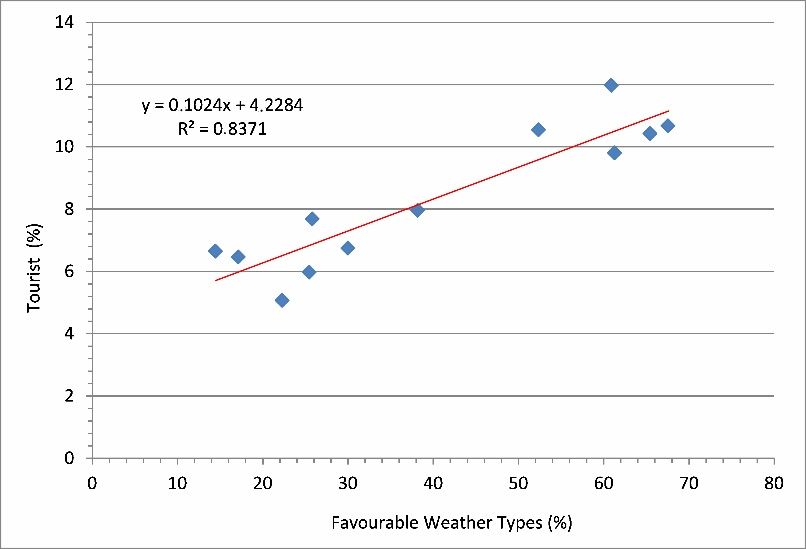
The distribution of favourable weather types at the Jardines del Rey region over the period
1991–2014 shows a high correlation with the monthly distribution of tourists during the same
period (R = 0.92 and R2 = 0.84, a significant correlation given that the p value is less than 0.01)
(Figure 2). This finding validates the classification proposed here. When establishing the weather
types, the classification takes into consideration the climatic characteristics of the region, the behaviour
of tourists based on an analysis of their visits to (Spanish) beaches and bioclimatic criteria.
Atmosphere 2020, 11, x 13 of 19
Xi Yi
Favourable
Tourist
Weather Types
(%)
(%)
January 52.4 10.5
February 67.6 10.7
March 60.9 12.0
April 61.3 9.8
May 30.0 6.7
June 17.2 6.5
July 25.8 7.7
August 14.5 6.7
September 22.3 5.1
October 25.5 6.0
November 38.2 8.0
December 65.4 10.4
Covariance XY = 37.99
Standard Deviation X = 19.26
Standard Deviation Y = 2.16
Pearson Correlation Coefficient XY =
0.9149
Figure2.2.Monthly
Figure Monthlydistribution
distributionofoffavourable
favourableweather
weathertypes
types(1991–2014)
(1991–2014) and
and monthly
monthly distribution
distribution of
of
tourists in Cuba (1991–2014). Source: The data series from which the monthly distribution of
tourists in Cuba (1991–2014). Source: The data series from which the monthly distribution of tourists
tourists
ininCuba
Cubaforforthe
theperiod
period1991–2014
1991–2014was wascalculated
calculated are
are from
from the
the Cuban
Cuban Statistics
Statistics Office
Office (Oficina
(Oficina de
de
Estadísticas de Cuba).
Estadísticas de Cuba).
3.2.
3.2.Classification
ClassificationofofWeather
WeatherTypes
TypesininJardines
Jardinesdel
delRey
Rey(2021–2050)
(2021–2050)
Theclassification
The classificationofofweather
weathertypes
typesforforfuture
futurescenarios
scenarios A2
A2 and
and B2
B2 showed
showed notable differences
differences
comparedtotothe
compared thebase
baseperiod
period(Figure
(Figure3).
3).Although
Although thethe overall
overall percentage
percentage values for the days
days with
with
favourable(Types
favourable (Types1,1,2,2,3,3,4,4,55and
and6)6)and
andunfavourable
unfavourable (Type
(Type 7)
7) weather
weather types
types are very similar
similar to
to
those recorded for the period 1991–2014, there are important
those recorded for the period 1991–2014, there are important variations variations in their monthly distribution.
monthly distribution.
Favourableweather
Favourable weathertypes
typesfor forsunsunand
andbeach
beachtourism
tourism will
will occur
occur more
more frequently
frequently in the future
future over
over
the period November to April, with average values of around 70% for both scenarios A2 and B2.
These values contrast with the figure of around 57% for the period 1991–2014. January and February
stand out in these new future scenarios, because over 90% of the days have favourable weather types
for sun and beach tourism. According to these scenarios, the number of days in which the weather
will be suitable for sun and beach tourism will increase significantly during the high season, which,Atmosphere 2020, 11, 1295 12 of 18
the period November to April, with average values of around 70% for both scenarios A2 and B2.
These values contrast with the figure of around 57% for the period 1991–2014. January and February
stand out in these new future scenarios, because over 90% of the days have favourable weather types
for sun and beach tourism. According to these scenarios, the number of days in which the weather will
be suitable for sun and beach tourism will increase significantly during the high season, which, for the
Jardines del Rey region, runs from November to April.
Atmosphere 2020, 11, x 14 of 19
A %
B
Jardines del Rey (2021-2050). SRES A2 % Jardines del Rey (2021-2050). SRES B2
100
100
90 90
80 80
70 70
60 60
50 50
40 40
30 30
20 20
10 10
0
0
T1 T2 T3 T4 T5 T6 T7
T1 T2 T3 T4 T5 T6 T7
Figure
Figure 3.
3. Annual
Annualdistribution
distributionof
ofweather
weathertypes
typesin
inJardines
Jardinesdel
delRey
Rey(2021–2050,
(2021–2050,scenarios
scenariosA2
A2and
andB2).
B2).
(A)
(A) scenario
scenario A2
A2 (B)
(B) scenario
scenario B2.
B2.
Thethe
For weather
periodtypes that will
2021–2050 most increase
(scenarios in November–April
A2 and B2), are Type 2 and
Type 7, which is unfavourable forType 4. During
sun and beach
the low season
tourism, remained between May andweather
the dominant October,type
Typebetween
6 will occur
Juneabout half as frequently
and September, scoringaseven
during the
higher
than
base in the period 1991–2014, such that around 95% or 96% of the days during the period 2021–2050
period.
will have
For theweather
period Type 7 compared
2021–2050 (scenariosto A2
theand
80% figure
B2), Typerecorded
7, which is during the basefor
unfavourable period.
sun and Further
beach
development
tourism, remainedof sunthe
and beach tourism
dominant weather at type
the region
between during
June the
andsummer
September,months (June
scoring to September)
even higher than
will beperiod
in the difficult due to the
1991–2014, suchfact
thatthat temperature
around 95% or 96% andofhumidity levels the
the days during willperiod
remain high during
2021–2050 this
will have
part of the
weather year.
Type The months
7 compared of May
to the 80% and October,
figure recordedwhich, during
during the period.
the base base period, recorded
Further 70% and
development of
74.5%,
sun and respectively,
beach tourism of days
at thewith unfavourable
region during the weather, now show
summer months values
(June in the 80–90%
to September) will range, and
be difficult
can
duetherefore
to the factbethat
added to the months
temperature and considered
humidity levelsunsuitable for sunhigh
will remain and beach
duringtourism at the
this part region.
of the year.
The
The trend
months toward
of May Type
and 7October,
weatherwhich,
conditions
during was
themore
base pronounced in scenario
period, recorded 70% and B2.74.5%, respectively,
of days with unfavourable weather, now show values in the 80–90% range, and can therefore be added
4.
toDiscussion
the months and Conclusions
considered unsuitable for sun and beach tourism at the region. The trend toward Type 7
weather conditions
Climate changewas willmore
havepronounced
serious direct in repercussions
scenario B2. for island destinations whose economies
are centred on sectors that are highly dependent on the climate. This highlights the need for accurate
4. Discussion and Conclusions
assessments of the future potential of tourism in light of these changes, so as to be able either to adapt
Climate
tourist change
activities will
at these have to
regions serious direct repercussions
new calendars or to developfor island
new destinations
tourism productswhose
that caneconomies
make the
are centred
most of newon sectors thatprovided
opportunities are highlybydependent
the climateon
forthe climate.forms
particular This highlights
of tourism the needAssessments
[23,82]. for accurate
assessments
of of the
the potential future
of the potential
climate of tourism
for tourism in light
purposes areoftherefore
these changes, so tools
practical as to that
be able
can either
provideto
adapt tourist
useful activities
information at these
on which regions to
important new calendars
decisions for the or to develop new
management tourism
of tourism products that
destinations cancan
be
make [82].
based the most of new opportunities provided by the climate for particular forms of tourism [23,82].
Assessments of the potential
In this context, of the
the weather climate
types for tourism
method purposes
(representative of are
the therefore
so-called practical
synthetictools that can
approach in
provide useful
tourism information
climatology on which
research) is an important
interestingdecisions for to
alternative thethe
management of tourism
various climate destinations
tourism indexes
can betypical
(more based [82].
of the separative approach) which have mainly been used in most of the assessments
carried out to date of the potential of the climate for particular kinds of tourism. In this study, we
used an adapted version of the weather types method proposed by Besancenot in 1991 to present a
classification of tropical weather types for sun and beach tourism. This adapted version enabled us
to take advantage of the main strengths of Besancenot’s original version, while, at the same time,
overcoming some of its inherent limitations. These limitations have also been and continue to be a
feature of some of the indexes frequently used in the field of tourism climatology [70,71]. In this sense,Atmosphere 2020, 11, 1295 13 of 18
In this context, the weather types method (representative of the so-called synthetic approach
in tourism climatology research) is an interesting alternative to the various climate tourism indexes
(more typical of the separative approach) which have mainly been used in most of the assessments
carried out to date of the potential of the climate for particular kinds of tourism. In this study,
we used an adapted version of the weather types method proposed by Besancenot in 1991 to present
a classification of tropical weather types for sun and beach tourism. This adapted version enabled
us to take advantage of the main strengths of Besancenot’s original version, while, at the same time,
overcoming some of its inherent limitations. These limitations have also been and continue to be a
feature of some of the indexes frequently used in the field of tourism climatology [70,71]. In this sense,
the classification presented here has enabled us to:
(a) Work with the daily combination of different climate variables that, together, make up the
weather, not as an abstract concept but as the daily atmospheric situation experienced by tourists.
This means that tourists can identify the proposed weather types as real situations, which are
currently being recorded or will be recorded at the destination. Hence, tourists can discover
their frequency in numbers of days a month (a value that is easy for all to understand). This is a
significant difference compared to the climate tourism indexes traditionally used in the field of
tourism climatology, which offer global suitability values for a particular tourism activity that are
easy to understand but are rarely associated with real atmospheric situations.
(b) Contextualize the proposal within a regional climate framework. In a particular climate context
(in our case, tropical climates), the daily weather conditions are generally reduced to a limited
number of weather types, which are specific to and characteristic of the place. In this way,
the established weather types take into account the main defining features of the climate of
the region.
(c) Take into account tourists’ needs in terms of enjoyment, comfort and safety in the classification
of the weather types. This was done either through the selection of the weather variables to be
included in the weather types, or via the differentiation and hierarchization between favourable
(which meet these needs in full or in part) and unfavourable weather types (which do not meet
some or any of these needs).
(d) Take into account the segmentation of the tourism market, in this case manifested in the choice
of the type of tourism to be studied: Sun and beach. The method adapted well to more
detailed segmentation, an aspect of fundamental importance given the current situation of the
hypersegmentation of the tourism market. This will be an important future line of research in the
field of tourism climatology.
(e) Take empirical comparisons into account when establishing the order of the different weather
types in the classification and when establishing the thresholds for the atmospheric variables
considered for the different weather types. In this case, the practical comparison took into account
the behaviour of sun and beach tourists observed in previous research [60]. The fact that this
previous research was conducted in a different climate context (medium latitudes/Mediterranean
climate) introduced a small degree of bias into the current study in that both the origin of the
users of the beaches and the destination could have affected the behaviour and the weather
expectations of the tourists. This limitation should be resolved in future research by observing
and measuring the behaviour of tourists on Cuban beaches.
(f) Consider the bioclimatic aspects as rational criteria that can impose limits on certain thresholds
on the basis of the unsuitable behaviour of tourists in weather situations in which their comfort or
safety are compromised. These bioclimatic aspects were taken into account via the maximum
temperature and comfort index values included in the weather types. In future research, these
comfort indexes could be complemented by other more complete indexes, such as Physiological
Equivalent Temperature (PET).Atmosphere 2020, 11, 1295 14 of 18
The classification of weather types applied in this study enabled us to find out more about the
climate potential for tourism purposes of Jardines del Rey (Cuba) for the base period (1991–2014)
and for a future period (2021–2050) based on outputs from the PRECIS-Caribbean Regional Climate
Model for scenarios SRES A2 and B2. The results obtained from the application of this method provide
extremely useful data for a touristic region that has been studied very little in the scientific literature
on this subject to date. The results showed, for example, that the distribution of weather types at
the destination during the period 1991–2014 was highly consistent with the monthly distribution of
tourists in Cuba (R = 0.92 and R2 = 0.84, a significant correlation at level 0.01). Two clearly distinct
periods can be identified. The first, which ran from May to October, was not ideal for sun and beach
tourism, due to the discomfort produced by the high temperatures and the high relative humidity
and due to the fact that it coincided with the rainy period and the hurricane season in the Caribbean.
These conditions, which were covered by weather Types 6 and 7 (those which occurred most frequently
in the summer months) help explain, from a climate point of view, why less tourists visited the region
during the summer. The second period, which ran from November to April, was generally favourable
for sun and beach tourism at this region and largely coincided with the period classified as “high
season.” Of the days in this period, 57% were suitable for sun and beach tourism and the most frequent
weather type was Type 1 (ideal for sun and beach activities).
The future scenarios (2021–2050 period) indicated an improvement in the climate conditions for
sun and beach tourism in Jardines del Rey, which was slightly more pronounced in scenario A2 than
in B2. This improvement was not based on a spectacular increase in the favourable weather types
compared to the unfavourable ones, but rather in a better distribution of both. In this way, the projection
showed the same differentiation between the high and low seasons, but with a polarization of the
weather conditions in each: There will be an increase in the number of days that are favourable for
sun and beach tourism during the high season (average values will be over 70% of the days) and,
in particular, in the number of days with the most suitable weather types (Types 1 and 2). At the other
end of the scale, there will also be an increase in the number of days that are not suitable for sun and
beach tourism during the low season. This seems to be the result, above all, of changes in the main
comfort indices assessed, with a predicted decrease in the cooling power of the wind and an increase
in Thom’s thermal discomfort index during this period.
The future improvement in climate conditions for the practice of sun and beach tourism in Jardines
del Rey (Cuba) must be taken into account in the management of tourism at the region, in terms of the
flows of visitors, the model for development of tourism products at the destination and the way the
region is marketed.
Author Contributions: Conceptualization, M.B.G.-M. and F.M.-P.; methodology, M.B.G.-M.; software, R.B.-D. and
D.E.-P.; investigation, M.B.G.-M., F.M.-P., R.B.-D. and D.E.-P.; data curation, F.M.-P., R.B.-D. and D.E.-P.; writing,
M.B.G.-M. and F.M.-P.; supervision, M.B.G.-M. and F.M.-P. All authors have read and agreed to the published
version of the manuscript.
Funding: This research was conducted within the framework of the R+D+i project with reference number
CSO2014-51866-R (funded as part of the Spanish National R&D&I Plan of the Spanish Ministerio de Economía y
Competitividad) and with the support of the Centro de Física de la Atmosfera (Instituto de Meteorología, Cuba)
and the Research Group 2017 SGR 25 recognized by the Generalitat de Catalunya (Consolidated Research Group
of Territory, Tourism and Climate Change).
Conflicts of Interest: The authors declare no conflict of interest.
References
1. Hall, C.M. Trends in ocean and coastal tourism: The end of the last frontier? Ocean. Coast. Manag. 2001,
44, 601–618. [CrossRef]
2. Honey, M.; Krantz, D. Global Trends in Coastal Tourism; Center on Ecotourism and Sustainable Development:
Washington, DC, USA, 2007.
3. UNWTO. Tourism and the Sustainable Development Goals; UNWTO: Madrid, Spain, 2015.Atmosphere 2020, 11, 1295 15 of 18
4. McElroy, J.L. Tourism development in small islands across the world. Geogr. Ann. Ser. B Hum. Geogr. 2003,
85, 231–242. [CrossRef]
5. UNWTO. Challenges and Opportunities for Tourism Development in Small Island Developing States; UNWTO:
Madrid, Spain, 2012.
6. UNWTO. International Tourism Highlights, 2019 Edition; UNWTO: Madrid, Spain, 2019.
7. IPCC. Climate Change 2014–Impacts, Adaptation and Vulnerability: Regional Aspects; Cambridge University
Press: Cambridge, UK, 2014.
8. Campbell, J.D.; Taylor, M.A.; Stephenson, T.S.; Watson, R.A.; Whyte, F.S. Future climate of the Caribbean
from a regional climate model. Int. J. Climatol. 2011, 31, 1866–1878. [CrossRef]
9. Taylor, M.A.; Whyte, F.S.; Stephenson, T.S.; Campbell, J.D. Why dry? Investigating the future evolution of the
Caribbean Low Level Jet to explain projected Caribbean drying. Int. J. Climatol. 2013, 33, 784–792. [CrossRef]
10. Whyte, F.S.; Taylor, M.A.; Stephenson, T.S.; Campbell, J.D. Features of the Caribbean Low Level Jet.
Int. J. Climatol. 2008, 28, 119–128. [CrossRef]
11. Cashman, A.; Cumberbatch, J.; Moore, W. The effects of climate change on tourism in small states: Evidence
from the Barbados case. Tour. Rev. 2012, 67, 17–29. [CrossRef]
12. Clayton, A. Climate change and tourism: The implications for the Caribbean. Worldw. Hosp. Tour. Themes
2009, 1, 212–230. [CrossRef]
13. Emmanuel, K. Shifting tourism flows in a changing climate: Policy implications for the Caribbean.
Worldw. Hosp. Tour. Themes 2014, 6, 118–126. [CrossRef]
14. Mackay, E.A.; Spencer, A. The future of Caribbean tourism: Competition and climate change implications.
Worldw. Hosp. Tour. Themes 2017, 9, 44–59. [CrossRef]
15. Moore, W.R. The impact of climate change on Caribbean tourism demand. Curr. Issues Tour. 2010, 13, 495–505.
[CrossRef]
16. Robinson, S.A. Adapting to climate change at the national level in Caribbean small island developing states.
Isl. Stud. J. 2018, 13, 79–100. [CrossRef]
17. Scott, D.; Simpson, M.C.; Sim, R. The vulnerability of Caribbean coastal tourism to scenarios of climate
change related sea level rise. J. Sustain. Tour. 2012, 20, 883–898. [CrossRef]
18. Stancioff, C.E.; Stojanov, R.; Kelman, I.; Němec, D.; Landa, J.; Tichy, R.; Prochazka, D.; Brown, G.; Hofman, C.L.
Local Perceptions of Climate Change Impacts in St. Kitts (Caribbean Sea) and Malé, Maldives (Indian Ocean).
Atmosphere 2018, 9, 459. [CrossRef]
19. Gómez-Martín, M.B. Weather, climate and tourism a geographical perspective. Ann. Tour. Res. 2005, 32,
571–591. [CrossRef]
20. Gómez-Martín, M.B. Retos del turismo español ante el cambio climático. Investig. Geográficas 2017, 67, 31–47.
[CrossRef]
21. Scott, D.; McBoyle, G.; Schwartzentruber, M. Climate change and the distribution of climatic resources for
tourism in North America. Clim. Res. 2004, 27, 105–117. [CrossRef]
22. De Freitas, C.R. Tourism climatology: Evaluating environmental information for decision making and
business planning in the recreation and tourism sector. Int. J. Biometeorol. 2003, 48, 45–54. [CrossRef]
23. Gómez-Martín, M.B. An evaluation of the tourist potential of the climate in Catalonia (Spain): A regional
study. Geogr. Ann. Ser. APhys. Geogr. 2004, 86, 249–264. [CrossRef]
24. Martínez-Ibarra, E.; Gómez-Martín, M.B. Progress in tourism climatology. In Tourism and Developments—Issues
and Challenges; Mihalič, T., Gartner, W.C., Eds.; Nova Science: New York, NY, USA, 2013; pp. 121–138.
25. Amelung, B.; Viner, D. Mediterranean tourism: Exploring the future with the tourism climatic index.
J. Sustain. Tour. 2006, 14, 349–366. [CrossRef]
26. Fitchett, J.M.; Robinson, D.; Hoogendoorn, G. Climate suitability for tourism in South Africa. J. Sustain. Tour.
2017, 25, 851–867. [CrossRef]
27. Mieczkowski, Z. The tourism climatic index: A method of evaluating world climates for tourism. Can. Geogr./Le
Géographe Can. 1985, 29, 220–233. [CrossRef]
28. Perch-Nielsen, S.L.; Amelung, B.; Knutti, R. Future climate resources for tourism in Europe based on the
daily Tourism Climatic Index. Clim. Chang. 2010, 103, 363–381. [CrossRef]
29. Yu, D.D.; Rutty, M.; Scott, D.; Li, S. A comparison of the holiday climate index: Beach and the tourism climate
index across coastal destinations in China. Int. J. Biometeorol. 2020, 1–8. [CrossRef]Atmosphere 2020, 11, 1295 16 of 18
30. De Freitas, C.R.; Scott, D.; McBoyle, G. A second generation climate index for tourism (CIT): Specification
and verification. Int. J. Biometeorol. 2008, 52, 399–407. [CrossRef] [PubMed]
31. Lin, T.P.; Matzarakis, A. Tourism climate and thermal comfort in Sun Moon Lake, Taiwan. Int. J. Biometeorol.
2008, 52, 281–290. [CrossRef] [PubMed]
32. Matzarakis, A. Transfer of climate data for tourism applications—The climate-tourism/transfer-information-
scheme. Sustain. Environ. Res. 2014, 24, 273–280.
33. Matzarakis, A.; Nastos, P. Analysis of tourism potential for Crete Island, Greece. Glob. Nest J. 2011, 13, 142–150.
34. Nastos, P.T.; Matzarakis, A. Present and Future Climate—Tourism Conditions in Milos Island, Greece.
Atmosphere 2019, 10, 145. [CrossRef]
35. Morgan, R.; Gatell, E.; Junyent, R.; Micallef, A.; Özhan, E.; Williams, A.T. An improved user-based beach
climate index. J. Coast. Conserv. 2000, 6, 41–50. [CrossRef]
36. Georgopoulou, E.; Mirasgedis, S.; Sarafidis, Y.; Hontou, V.; Gakis, N.; Lalas, D.P. Climatic preferences for
beach tourism: An empirical study on Greek islands. Theor. Appl. Climatol. 2019, 137, 667–691. [CrossRef]
37. Demiroglu, O.C.; Saygili-Araci, F.S.; Pacal, A.; Hall, C.M.; Kurnaz, M.L. Future Holiday Climate Index (HCI)
Performance of Urban and Beach Destinations in the Mediterranean. Atmosphere 2020, 11, 911. [CrossRef]
38. Andrade, H.; Alcoforado, M.J.; Oliveira, S. Methodologies to assess the effects of climate on tourism:
Weather type and individual perception. In Development in Tourism Climatology; Commission on Climate and
Recreation, International Society of Biometeorology: Freiburg, Germany, 2007; pp. 74–79.
39. Barbière, E.B. O factor climatico nos sistemas territoriais de recreaçao (Le facteur climatique et les bases
régionales du tourisme). Rev. Bras. Geogr. Rio Jan. 1981, 43, 145–265.
40. Besancenot, J.P.; Mounier, J.; de Lavenne, F. Les conditions climatiques du tourisme, littoral. Norois 1978,
99, 357–382. [CrossRef]
41. Crowe, R.B.; Mckay, G.A.; Baker, W.M. Le Climat de l’Ontario et Son Influence Sur Le Tourisme et Les Loisirs
de Plein Air. Volume I, Objectif et Définitions Des Saisons. Volume II Eté. Volume III. Hiver; Publications en
Météorologie Appliquée. REC-1-73; Environnement Canada, Service de l’Environnement Atmosphérique:
Toronto, ON, Canada, 1977.
42. Gates, A.D. Le Climat Des Maritimes en Fonction du Turisme et Des Loisirs de Plein Air; Environment
Canada/Atmospheric Environment: Toronto, ON, Canada, 1975.
43. Gómez-Martín, M.B. Climate potential and tourist demand in Catalonia (Spain) during the summer season.
Clim. Res. 2006, 32, 75–87. [CrossRef]
44. Machete, R.; Lopes, A.; Gómez-Martín, M.B.; Fraga, H. Tourism and climate in Lisbon. An assessment based
on weather types. Finisterra 2014, 49, 153–176. [CrossRef]
45. Martínez-Ibarra, E. Tipos de tiempo para el turismo de sol y playa en el litoral alicantino. Estud. Geográficos
2008, 69, 135–155.
46. Martínez-Ibarra, E. The use of webcam images to determine tourist–climate aptitude: Favourable weather
types for sun and beach tourism on the Alicante coast (Spain). Int. J. Biometeorol. 2011, 55, 373–385. [CrossRef]
47. Masterton, J.M.; Crowe, R.B.; Baker, W.M. Tourism and Outdoor Recreation Climate of the Prairie Provinces;
Environment Canada/Atmospheric Environment: Toronto, ON, Canada, 1975.
48. Besancenot, J.P. Clima y Turismo; Masson: Barcelona, Spain, 1991.
49. Blazejczyk, K.; Matzarakis, A. Assessment of bioclimatic differentiation of Poland based on the human heat
balance. Geogr. Pol. 2007, 80, 63–82.
50. De Freitas, C.R. Assessment of human bioclimate based on thermal response. Int. J. Biometeorol. 1985,
29, 97–119. [CrossRef]
51. De Freitas, C.R. Recreation climate assessment. Int. J. Climatol. 1990, 10, 89–103. [CrossRef]
52. Höppe, P.R.; Seidl, H.A.J. Problems in the assessment of the bioclimate for vacationists at the seaside.
Int. J. Biometeorol. 1991, 35, 107–110. [CrossRef]
53. Denstadli, J.M.; Jacobsen, J.K.S.; Lohmann, M. Tourist perceptions of summer weather in Scandinavia.
Ann. Tour. Res. 2011, 38, 920–940. [CrossRef]
54. Lohmann, M.; Kaim, E. Weather and holiday destination preferences image, attitude and experience. Tour. Rev.
1999, 54, 54–64. [CrossRef]
55. Rutty, M.; Scott, D. Differential climate preferences of international beach tourists. Clim. Res. 2013, 57,
259–269. [CrossRef]You can also read


