"NHS Organisation" Sickness Absence Policy
←
→
Page content transcription
If your browser does not render page correctly, please read the page content below
“NHS Organisation”

              Sickness Absence Policy

Approved by:          Welsh Partnership Forum Business Committee

Issue Date:           September 2015

Review Date:          October 2016

                                       1
Revised Sickness Absence Policy
September 2015
CONTENTS
1. Policy Statement
2. Scope of the Policy
3. Definitions of Sickness Absence
4. Confidentiality
5. Responsibilities
6. Record Keeping
7. Notification and Certification of Sickness Absence
8. Entitlement to Sick Pay
9. Returning to Work
10. Seeking Medical Advice
11. Rights of Accompaniment
12. Procedure for Management of Frequent Sickness Absence
13. Procedure for the Management of Long Term Sickness Absence
14. Authority to Dismiss
15. Appeals Process
16. Premature Retirement on Ill Health Grounds
17. Help and Advice
18. Review of Policy
Appendix A: The Equality Act 2010
Appendix B: Accidents or incidents at work (including Industrial injury
or Violence to Staff).
Appendix C: Medical Suspension Flow Chart
2
Revised Sickness Absence Policy
September 20151. Policy Statement
1.1 The NHS in Wales recognises the pivotal contribution that its employees make to
ensuring that a high quality, timely, cost effective and safe service is delivered to
the people of Wales. It further recognises that employees wish to make a
consistent contribution to the work of their local organisations, but that, from time
to time, will themselves become ill and be unable to work.
1.2 Because their contribution is so vital, and because the benefit of work is
recognised, it is essential that the organisation has in place a comprehensive and
effective policy that lays out the responsibilities of the organisation to provide a
healthy working environment, to support the employee when ill and to facilitate
their timely return to work. In return, the employee must take responsibility for the
maintenance of their health with a view to minimizing the time they spend away
from work through sickness.
1.3 This policy has been agreed by the Welsh Partnership Forum and equality impact
assessed. It is expected that organisations will work in partnership to ensure its
effective implementation.
1.4 This policy aims to promote the following objectives:
1.4.1 The provision of high quality services to patients, and a high quality of
working life for its employees recognising the need to create an
environment that enables everyone to contribute fully through regular
attendance at work.
1.4.2 To ensure that all parties work together to facilitate a return to work as soon
as possible following a period of sickness.
1.4.3 To ensure that in all cases of employee ill-health, there will be a
progressive and thorough review of the employee’s circumstances, taking
into account the need to maintain a service to the public, support to
individuals and to comply with all employment and equality legislation.
1.4.4 The right of all employees subject to this sickness and absence procedure
to be treated fairly and equally and with dignity and respect.
1.4.5 A proactive, consistent and fair approach to managing sickness absence.
To be effective it should be read in conjunction with the other relevant
organisational policies and procedures.
1.4.6 Good health through the development of proactive health initiatives that
support staff to be well and stay well and improve their health and
wellbeing.
1.4.7 Agreed and accepted procedures to facilitate the appropriate management
of long and short term illnesses.
1.4.8 The utilisation of the “NHS Organisation”’s services, including Occupational
Health services, to support a timely return to good health, and ultimately
back to work.
3
Revised Sickness Absence Policy
September 20151.4.9 The full and proper consideration of any reasonable adjustments that will
enable an employee to attend regularly and/or return to work.
1.4.10 Whilst the policy aims to ensure that every effort is made to support,
wherever possible, the return to good health and the resumption of work,
there will be occasions, however, where this proves impossible, and when
the termination of employment remains the only practicable course of
action.
2. Scope of the Policy
The Policy will apply to all employees of “NHS Organisation” for matters relating to their
incapacity to attend work through mental or physical ill health. This policy is not
intended for use when employees are unable to attend work through illness of
dependants/family members. Such instances should be handled in line with the
Special Leave Policy, and any existing organisational Flexible Working policies.
3. Definitions of Sickness Absence
This policy seeks to address the appropriate process relating to the management of
sickness and sickness related absence. The policy identifies a number of patterns of
sickness absence detailed below. The policy relates to all of these areas.
3.1 Short Term Sickness Absence
Short term absence is regarded as any period lasting less than 28 calendar days.
3.2 Long Term Sickness Absence
Long term absence is regarded as any continuous period of 28 calendar days or
longer.
3.3 Planned Sickness Absence
This includes health problems that require an operation or treatment programme
which may have a recognised period of expected recovery or duration.
3.4 ‘A Sickness Day’
An employee is considered as having taken a sickness day when, because of
their illness, they have been unable to undertake their daily hours of work/shift.
Where an employee has carried out more than half their daily hours of work/shift
but is unable to complete the day/shift because of illness, this day will not count as
a sickness day as far as sick pay is concerned. It should, however, be recorded
and may be taken into account when considering any accumulated pattern of
sickness.
3.5 Rolling Year
A “rolling year” means that when an episode of sickness occurs the manager
should review the twelve month period preceding that specific absence.
4
Revised Sickness Absence Policy
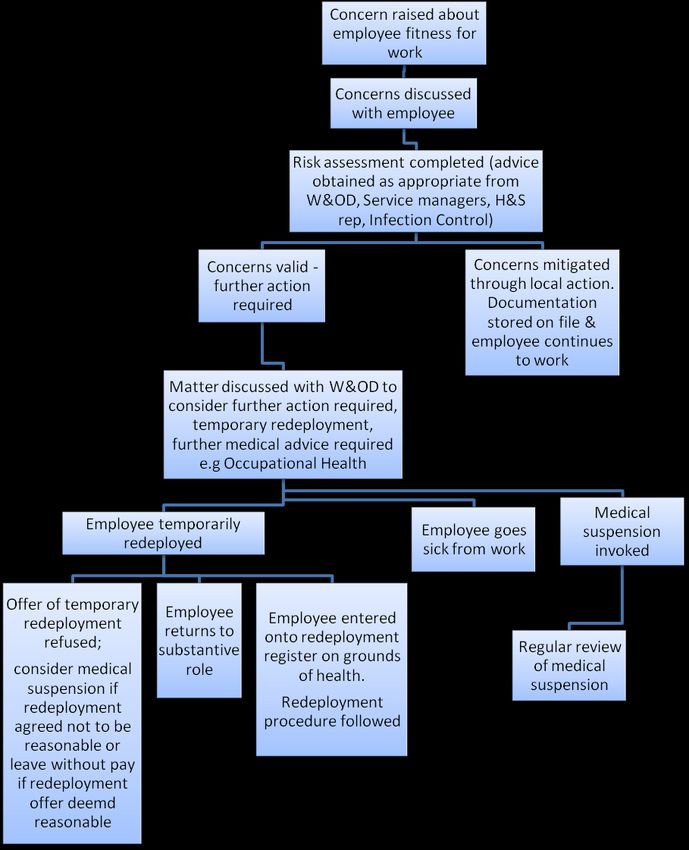
September 20153.6 Medical Suspension
When an employee is deemed unfit to work by their manager due to reasons of ill-
health, the manager has the right to enforce a short period of absence for no
longer than 7 days in which time the member of staff must seek advice from their
GP regarding their fitness to work.
Managers should ensure that a risk assessment is completed before medical
suspension is agreed, considering alternative options to the medical suspension.
The manager should seek advice from the Workforce and OD Department.
Appropriate medical advice will be sought from Occupational Health.
This absence will be counted as suspension from duty with pay for medical
reasons. Where the NHS Organisation can demonstrate that the employee has
refused a reasonable offer of alternative employment as an alternative to medical
suspension, the employee will not receive pay for the period of medical
suspension.
Where the employees GP advice conflicts with that of Occupational Health the
organisation will rely on its Occupational Health department’s advice following
discussions between the GP and Occupational Health.
Appendix C outlines how this process should flow.
4. Confidentiality
Confidentiality will be retained at all times by all parties except where overridden by
legal responsibilities.
5. Responsibilities
5.1 The successful management of sickness absence relies on all parties
understanding and performing their role and meeting their responsibilities. It also
relies on all parties closely observing the rules of confidentiality as it relates to
employee sickness.
The following identifies the key responsibilities that are essential for supporting the
process:
5.2 The Employee
5.2.1 To maximise their attendance in line with their contract of employment and
the organisation’s policies.
5.2.2 Follow the organisation’s policy and any local procedures in respect of
notifying and certifying their sickness absence, including the timely
submission of self certificates and fit notes.
5.2.3 Attend occupational health appointments and sickness absence meetings
when requested to do so by their manager. It is essential that employees
understand that they must attend these meetings if asked to do so.
Wherever possible appointments will take account of the employee’s
normal working patterns. Failure to attend two occupational health
appointments without good reason will mean that decisions are made on
5
Revised Sickness Absence Policy
September 2015the basis of the information available, which may be detrimental to the
interests of the employee.
5.2.4 To be responsible for their own health and welfare and to acknowledge that
this policy is not for use when employees are unable to attend work through
illness of dependants/family members.
5.2.5 Ensure that any medical advice and treatment is received and actioned as
quickly as possible in order to facilitate a return to work.
5.2.6 To facilitate their recovery and desist from participating in any activity that
may delay or undermine their recuperation. If an employee is employed in
any other capacity in the organisation or elsewhere, they must obtain the
written permission of their manager before continuing with that
employment. Any such employment must be therapeutically beneficial to
the employee. The manager may consider whether equivalent benefit may
be gained from returning to work in an appropriately modified NHS post for
a temporary period.
5.2.7 Where an employee undertakes other work without the prior written consent
of the manager they may be considered in breach of contract and will be
subject to disciplinary action which may result in the involvement of the
counter fraud department and/or dismissal. Such action will only be taken
following advice from the Workforce Department.
5.2.8 Maintain contact with their line manager regularly during their period of
absence.
5.2.9 Raise concerns with their line manager, trade union representative, or a
member of the Workforce Team if they believe that their job or work
environment may be having a detrimental effect or contributing to their
illness in any way.
5.2.10 If appropriate, advice should be sought from Occupational Health and the
Workforce and OD Department.
5.2.11 To work with the manager and Occupational Health Department and where
relevant, trade union representative, to facilitate a return to work as soon as
possible following a period of sickness.
5.2.12 If an employee is in receipt of any benefit payments from any external
agencies, at the same time as the payment for annual leave is made, it is
the employee’s responsibility to notify the relevant benefit agency of the
additional payment(s).
5.3 Managers:
It is the responsibility of all managers to:
5.3.1 Ensure that the impact of absence on patient care and services is
minimised.
6
Revised Sickness Absence Policy
September 20155.3.2 Ensure that the sickness absence policy and procedure is applied fairly and
consistently and in a way that promotes dignity and respect and to ensure
their employees acknowledge and understand that this policy is not for use
if they are unable to attend work through the illness of dependants/family
members.
5.3.3 Ensure that good communication is maintained at all times in the
management of individual and departmental sickness cases and levels.
This will include briefing employees periodically on the current short and
long term sickness figures for their specific work areas.
5.3.4 Work with the employee, Occupational Health Department or relevant
support agency and the trade union representative, to facilitate a return to
work as soon as possible following a period of sickness.
5.3.5 Fully consider and implement any reasonable adjustments to support
employees in regularly attending for work and/or facilitating a return to work
after a period of sickness.
5.3.6 Ensure that all employees understand their roles and responsibilities in line
with this policy. Such knowledge will be imparted through initial induction
and ongoing training.
5.3.7 Ensure any local notification arrangements are agreed and communicated
to all employees in their department as part of their induction and via
regular departmental communication.
5.3.8 Keep accurate records and monitor attendance for all their employees,
undertaking analysis that would highlight any underlying trends, causes and
reasons that may be influencing sickness levels.
5.3.9 Undertake periodic audits to monitor the implementation and effectiveness
of the policy and procedure.
5.3.10 Ensure that self certificates and fit notes are received and retained covering
appropriate periods of absences.
5.3.11 Ensure that all instances of non-attendance are recorded appropriately.
5.3.12 Ensure appropriate contact occurs with all employees on sick leave on a
regular basis.
5.3.13 Ensure that the employee is given the right to be accompanied by a trade
union representative/work colleague, at any formal meetings held under the
policy and not to unreasonably withhold permission to be thus
accompanied at informal discussions when requested by the employee.
5.3.14 Maintain their levels of competence in the management of sickness
absence and in the application of the Policy.
5.3.15 Ensure that employees are made aware of the range of support and
assistance that is available to them at times of ill health.
7
Revised Sickness Absence Policy
September 20155.4 Role of Trade Union Representative:
It is the role of trade union representatives to:
5.4.1 Support the individual member and his/her organisation in minimising
absence from work caused by sickness.
5.4.2 Provide their members with advice on all aspects of the policy.
5.4.3 Ensure an appropriate trade union representative is available at all levels of
the procedure should their member wish to be accompanied and to ensure
that meetings can occur in a timely manner.
5.4.4 Work closely with managers and other groups to make the policy effective
at organisational level, including being aware of all relevant legislation.
5.4.5 Maintain their competence in the application of the policy and in supporting
their member through absence due to sickness.
5.4.6 Work with their individual member, the manager and occupational health
department to facilitate a return to work as soon as possible following a
period of sickness.
5.5 Role of Occupational Health Department
It is the role of the Occupational Health Department to:
5.5.1 Provide confidential support and guidance to employees regarding their
health and fitness for work.
5.5.2 Signpost employees to the full range of services available for support and
assistance.
5.5.3 Provide written advice to managers regarding the impact of the employee’s
illness on their fitness to work.
5.5.4 Provide advice to managers on any reasonable adjustments to the
workplace or an employee’s job that may support them in attending
regularly for work and/or returning to work after a period of sickness.
5.5.5 Provide advice on rehabilitation and how employment may be matched to
employee capability following illness. This may include assessment of the
workplace.
5.5.6 Access advice and support for the employee from other professionals, as
the need arises and with the agreement of the employee.
5.5.7 Work with the employee and manager and where relevant, the trade union
representative, to facilitate a return to work as soon as possible following a
period of sickness.
8
Revised Sickness Absence Policy
September 20155.6 Role of the Workforce & OD Department
It is the role of the Workforce & OD Department to:
5.6.1 Provide training, specialist advice and support on managing sickness
absence, e.g. cases involving injury allowance, reasonable adjustments for
disabled employees or the “Access to Work Programme”.
5.6.2 Work with managers and trade union representatives to achieve consistent
application of the policy and fair and acceptable outcomes, including
monitoring trends, causes and reasons.
5.6.3 Undertake periodic audits to monitor the implementation and effectiveness
of the policy and procedure and to provide information to the Welsh
Partnership Forum to inform the policy’s formal review.
5.6.4 Support the management of sickness through the provision of data.
5.6.5 Attend the formal stages of the sickness absence procedure, as
appropriate.
5.6.6 Advise employees of help and support available to them.
5.7 Role of the Payroll Function
It is the role of the payroll function to:
5.7.1 To provide advice on sick-pay, pensions, industrial injuries and injury
allowance.
5.7.2 To administer the processes involved with the above entitlements.
6. Record Keeping
Accurate record keeping is essential to support the effective management of absence.
Regular reports on levels of sickness absence will be provided to the organisation’s
board and Local Partnership Forum.
6.1 Sickness Absence records:
Successful sickness management is reliant on having and maintaining consistent
and accurate records. The major benefits of accurate records are to identify
patterns of sickness and to trigger appropriate management intervention, for
example, highlighting a recurring health problem that could be addressed quickly
through accessing support services.
The following records must be included:
A record of absence including notification details
Records of any occasions when the employee was not recorded as sick for
payment purposes but could not complete their shift due to illness
9
Revised Sickness Absence Policy
September 2015 Record of communication during sickness absence
Records of other unplanned absences
Back to work Interviews
Informal and formal meeting notes
Self certificates and fit notes for appropriate absences
Occupational Health referrals
Occupational Health reports
Any reasonable adjustments considered and/or implemented for disabled
employees
All other relevant correspondence e.g. incident reports if accident at work
7. Notification and Certification of Sickness Absence
7.1 Wherever there is reference to the number of days throughout this policy this
means calendar days whether or not the employee would be expected to work on
that day.
7.2 First Day of Sickness
7.2.1 It is the responsibility of the employee to report their sickness absence by
telephone (or by text phone for employees with a hearing impairment) to
their manager or designated deputy as soon as they become aware that
they will not be able to attend work. Early notification is particularly
important when alternative cover needs to be arranged. This will normally
be no later than the normal time of commencement of duty.
7.2.2 The employee should state the reason for the absence (confirming whether
or not the absence is due to a work related incident/injury) and the likely
date of return to work. If the employee reports diarrhoea and vomiting or
other relevant and notifiable infectious diseases, as the reason for their
absence, see Section 7.6 below.
7.2.3 The individual should notify their manager themselves as above when they
are unable to attend work due to sickness. Where in exceptional
circumstances, this is not practicable a third party may notify on their
behalf. However it is the employee’s responsibility to ensure that this is
done appropriately in accordance with the Departmental requirements for
notification. Where the manager is unable to take the call personally
he/she will ring the employee back as soon as is practicable.
7.2.4 For any period of sickness absence between 1–7 calendar days an
employee must complete a self-certification form unless already certified by
a Fit note or hospital certificate. This should be completed on return to
work. Failure to complete the self-certification form could result in loss of
sick pay, as could failure to comply with the procedure for notification.
10
Revised Sickness Absence Policy
September 20157.3 Maintaining Contact
The employee and his/her manager must communicate regularly to discuss
his/her progress during the sickness absence, in order to ensure that any
necessary additional support and/or expert advice can be sought that may aid
rehabilitation and an early return to full health. The frequency of contact will be
mutually agreed at the beginning of the absence period and depend on the likely
duration of the absence.
7.4 Eighth Day of Sickness
If the period of absence continues beyond 7 calendar days, the employee must
produce a fit note (medical certificate) for every day of absence thereafter. A fit
note should normally be received by the manager no more than 3 calendar days
after it becomes due. Sickness absence not covered by a self certificate or a fit
note will be treated as unauthorised absence for which no payment will be made.
7.5 Hospital Certificates
When an employee is hospitalised, the hospital will provide certificates confirming
that the employee is expected to be an inpatient for a certain period of time. Such
certificates should be submitted to the manager in the normal way.
Employees are not required to provide additional self certificates or fit notes from
their general practitioner when they are covered by a hospital certificate.
7.6 Medical exclusion following infectious/notifiable disease
Where the absence is the result of diarrhoea and vomiting or other relevant
notifiable infectious disease and whilst the employee is suffering from the effects
of the disease, the absence will be recorded as a period of sickness in the usual
way.
The manager must obtain information regarding the nature of the illness and
obtain advice, if necessary, from the Infection Control or Occupational Health
Department as to whether a period of further exclusion is required after the
symptoms have subsided and sick leave has ended.
Where the advice requires the employee, for purposes of infection control to
remain off work, this subsequent period will be regarded as a medical exclusion
with pay, and not be recorded as sick leave.
8. Entitlement to Sick Pay
8.1 Under the provisions of this policy there may be an entitlement to occupational
sick pay. This is set out in the schedule of main terms & conditions of services
issued to all employees on commencement of their employment. This does not
automatically allow employees to remain in the employment of the organisation
until the occupational sick pay is exhausted.
8.2 Sick pay is not normally payable for an absence caused by an accident due to
active participation in sport as a profession or where contributory negligence is
11
Revised Sickness Absence Policy
September 2015proved, in accordance with the Agenda for Change terms and conditions
handbook.
8.3 Sickness during Annual Leave
When an employee falls sick during annual leave they will be required to report
that illness in line with normal notification procedures and produce a fit note
covering the period from the first day of sickness.
In order to allow annual leave to be reinstated a satisfactory fit note must be
received within 3 working days of the beginning of the illness (unless abroad). In
such cases the employee will be deemed to have been on sickness absence
rather than annual leave from the date of the certificate.
Only in exceptional cases will a foreign medical certificate of more than one month
be accepted for payment purposes. A U.K. fit note should be obtained on return
to the country.
8.4 Holidays during a period of Sickness Absence
8.4.1 All employees are expected to take their annual leave entitlement during the
leave year and should not normally carry over annual leave. Where staff are
returning from long term sickness absence they should be expected to take
any outstanding leave within the current leave year. This should be
managed carefully taking account of the needs of the service and the
practicalities of them being able to use up all of their entitlement in that leave
year.
8.4.2 Employees on long term sick leave must, therefore, be given the opportunity
to take annual leave during their sick leave period.
8.4.3The employee must have the agreement of their manager prior to the
commencement of such annual leave which should be a reasonable
proportion of their annual entitlement. It is the manager’s responsibility to
authorise in writing, the payment of the annual leave.
8.4.4 Where the employee has not taken their annual leave entitlement during the
period of sickness absence, and where an employee’s sickness absence
spans two or more leave years, they will accrue annual leave for the period
of their sick leave and can be asked to take all of their accrued, but untaken
annual leave, by the end of the leave year in which they return.
The leave entitlement for the previous year/years will be the statutory
element of their leave.
8.4.5 Where an employee returns to work in a new leave year after a period of
long term sickness absence they are entitled to carry over any outstanding
leave from the minimum statutory element of their leave (currently 20 days).
This entitlement will be pro rata for part time staff.
N.B. This paragraph (8.4.5) is in relation to the statutory minimum of annual
leave that can be carried over into a new leave year due to long term
sickness absence and is not in relation to ‘normal’ A4C annual leave
provision.
12
Revised Sickness Absence Policy
September 20158.4.6 Any annual leave accrued at the time of the return to work may also be
taken, by agreement with the manager to allow the employee a more gradual
return to work.
8.5 Accidents Involving a Third Party
In cases where employees are absent from work as a result of an injury sustained
wholly or partly as a result of the actions of a third party against whom the
employee has made a claim, any payments made to the employee by the
organisation will be recoverable. The employee must notify the fact that they are
making a claim to their manager at the commencement of the absence, or as
soon as practicable. The manager should notify the payroll department of this
fact. Where an employee is unable to notify his/her manager personally because
of, for example, serious injury, notification maybe undertaken by another party.
8.6 Overtime / Bank Working
Where the manager feels that continuing to work overtime or bank working, in
addition to their contractual hours, may be contributing to an employee’s sickness
absence, managers can restrict employees from undertaking additional work/shifts
following sickness.
When an employee has a period of long term sickness, advice from the
occupational health department should be sought regarding restricting employees
from undertaking additional work/shifts for a temporary period following sickness.
This is to support the employee to regain their full health capacity.
8.7 Pregnancy Related Illness
8.7.1 Where an illness is attributable to pregnancy, sickness absence will not be
counted towards the trigger of the management of sickness absence.
However, any such sickness will be managed in accordance with the
sickness policy to facilitate a return to work as soon as possible with any
necessary support or adjustment to duties during the pregnancy.
8.7.2 As required, under the management of Health and Safety at Work
Regulations 1999, written risk assessments should be undertaken regularly
throughout the pregnancy. Guidance can be obtained through the
organisation’s maternity policy, and through the HSE publications on New
and Expectant Mothers at Work, which can be accessed online at
http://www.hse.gov.uk/pubns/indg373hp.pdf. A referral to the occupational
health service for medical advice and support may be required.
8.7.3 If an employee is on sick leave due to pregnancy related illness on or after
the fourth week before the expected week of confinement, their ordinary
maternity leave will commence the day after their first completed day of
sickness absence.
8.7.4 Where a pregnant employee suffers from non pregnancy related sickness
absence, these absences will count towards the management of sickness
absence as usual.
13
Revised Sickness Absence Policy
September 20158.8 Disability Related Illness
8.8.1 Where an absence is clearly attributable to a disability as defined in the
Equality Act( 2010) the Health Board has a responsibility to comply with the
requirements of the Act (Appendix A refers.)
9. Returning to Work
9.1 Employees must inform their manager on the first day that they regard themselves
as being fit for duty whether or not they are due to work that day. This is
important and will ensure that both their sickness records and their remaining
entitlement to sick pay provision are accurate. To ensure overall sickness rates
are accurate managers must also ensure that employees are recorded as fit for
work on the first day the employee reports as being fit for work, even if the
employee is not due to work that day i.e. weekends or non rostered day.
9.2 On every occasion of sickness absence, the employee should be seen promptly
on their return by their manager or designated deputy, in private, to discuss,
sensitively and confidentially, the reason for the absence.
9.3 The return to work discussion provides an opportunity for the manager to establish
that the employee is fully recovered and if there are any aspects of the sickness
absence, which may require support or guidance from the manager.
9.4 The return to work discussion also provides the manager with the opportunity to
brief the employee on work related matters that may have occurred during their
absence.
9.5 The employee may express concerns that suggest difficulties at work. If the
matter is health related, the employee should be encouraged to seek medical
attention, particularly if the problem recurs from time to time. Where difficulties
are arising as a consequence of home circumstances, the employee should be
signposted to the appropriate services for support.
9.6 It may be appropriate, depending on the nature of the issue, to refer the employee
to the Occupational Health Department, or with the employee’s consent to another
appropriate service or to consider and implement any reasonable adjustments that
will enable an employee to attend regularly for work and/or return to work.
9.7 Managers should make employees aware that support or advice may be available
through trade union representatives if required.
9.8 A return to work form must be completed at the conclusion of the discussion, and
signed by both the manager and employee. The form will be retained on the
employee’s personal file in line with organisational policy. All absences must be
self certified from the first day of absence. If a self-certificate has not been
completed the manager must ensure that it is completed as part of the return to
work process.
14
Revised Sickness Absence Policy
September 201510. Seeking Medical Advice
10.1 Attending G.P, dental and hospital appointments
The “NHS Organisation” recognises that employees will need to make occasional
visits to a dentist, GP or other health professional or may be required to attend a
hospital or clinic for investigation and/or treatment. Wherever it is possible to do so,
employees (both full and part time) must endeavour to arrange such appointments at
a time that they are not scheduled to work or, if this is not possible, as near to the
beginning or end of the working period as possible so as to minimise the absence
from work and disruption to the service. Staff should not be refused permission to
attend a pre-arranged appointment as long as reasonable notice has been given
The manager must keep a record of any such appointments and must ask to see
documentary confirmation of the appointment where this is available
Where staff need to attend routine appointments (with GPs, Dentists, screening
programmes, blood tests or hospital checkups) during work time they will be required
to make up the time taken at the earliest opportunity. Employees must discuss and
agree with their manager how this will be achieved. The following are options that
can be agreed
Arriving earlier or leaving later on the day of the appointment
A temporary increase in hours over a short period
Unpaid leave
Annual leave
Time in lieu
Any other arrangement agreed with the manager.
Where a medical appointment involves treatment which results in an employee
being unfit for work afterwards, the period of absence will be recorded as sick
leave.
10.2 Where the appointments form part of an ongoing treatment programme for a
serious health condition, or are related to a disability or long term health condition,
or are for a work related disease or injury, the manager must discuss such
appointments with the employee to plan any necessary support to be offered. In
some circumstances staff will be given a reasonable amount of paid time off to
attend such appointments as part of their programme of care and support.
10.3 The Occupational Health Service
In addition to the normal medical care provided by their dentist, GP or other health
professionals an employee may be required to attend an assessment by the
Occupational Health Department when asked to do so .Time taken to attend such
appointments will not be required to be worked back. Other sources of medical
advice will be arranged as necessary by the Occupational Health Department.
A manager can refer an employee to the Occupational Health service at any stage
of this policy. Where sickness absence can be attributed to the employee’s work,
the employee may be referred to Occupational Health for advice and support.
15
Revised Sickness Absence Policy
September 2015The employee will be notified of the referral which should be made on the
standard referral form. Information provided to the Occupational Health Service
may include:
The attendance record of the employee
The content and outcome of the Informal Discussion and previous sickness
interviews
What opportunity has been given to improve
The needs of the service and work difficulties created by the absence
What alternative action has been considered
10.4 Referral may need to be repeated on more than one occasion during an
employee’s sickness absences.
The Occupational Health consultation is confidential and subject to the conditions
of the Data Protection and Medical Records Acts. Medical details will not be
shared with the manager without the prior consent of the employee, except where
legal requirements override this. Following the consultation, a written report will
be prepared, the contents of which will be discussed with the employee prior to
the report being sent to the manager. A copy of the report will be given to the
employee for their records.
The report may include advice on:
The fitness or otherwise of the individual to return to work
Whether there are any underlying causes for persistent absence and, if so, if
there is any action that can be taken to improve this
When the individual is likely to return to work
The nature and scope of any reasonable adjustments that would enable a
disabled employee to attend regularly and/or return to work
Details of a plan for a return to work, including, in some cases, advice on;
Any necessary rehabilitation or other reasonable adjustments required to
facilitate a return to work.
Whether there is scope for redeployment.
The possibility of partial or restricted duties being carried out where
acceptable and practicable.
10.5 Self-Referral
10.5.1 Employees have a right to self refer to the Occupational Health Department
at any time. Under these circumstances, a report will not normally be sent
16
Revised Sickness Absence Policy
September 2015to the manager unless the employee specifically requests this or unless
legal or professional/ regulatory requirements override this.
10.5.2 Employees have the right to self refer to the ‘Access to Work Programme’
through the disability employment adviser at their local Job Centre Plus
office.
10.6 Obtaining further Independent Specialist Advice
10.6.1 The occupational health physician /occupational health practitioner and the
employee’s general practitioner may discuss matters relating to the
employee’s fitness to work, particularly in cases of long term sickness. In
the unusual event of there being irreconcilable differences of opinion, the
Occupational Health Practitioner would with the employees consent seek
further, independent advice from an accredited Occupational Health
Specialist.
10.6.2 The manager will take all available medical advice into account when
deciding the appropriate course of action.
11. Rights of Accompaniment
11.1 Informal Discussions
The purpose of the informal discussion is to enable the manager and employee to
explore informally and sensitively the reasons behind the individual’s pattern of
absence and to agree any measures necessary to assist the individual in
improving their attendance at work. As such, it is not considered necessary for
the individual to be accompanied.
If, however, the individual requests to be accompanied by an official of a
recognised trade union or staff organisation or by a workplace colleague, the
manager should not unreasonably refuse this request.
11.2 Formal Interviews
Employees requested to attend a formal interview relating to their sickness under
this policy will have the right to be accompanied by an official of a recognised
trade union or staff organisation or a work colleague, if they so wish.
In certain circumstances employees will be able to request in advance a
manager/supervisor of the same gender to carry out interviews under the
procedure and this will be respected wherever it is practicable.
12. Procedure for Management of Frequent Sickness Absence
12.1 The key purpose of the procedure is to support the employee in maintaining an
appropriate level of attendance at work. In order to achieve this outcome, an
individualised approach to improvement will be taken, in consultation with the
employee, and, where appropriate, their trade union representative.
12.2 At any stage of the procedure the individual or their manager may request the
involvement of the Occupational Health Department and due consideration will
17
Revised Sickness Absence Policy
September 2015given to any medical advice received that can assist the employee in improving
their attendance at work.
12.3 Managers are required to actively manage where an employee has demonstrated
a pattern or frequency of absence, which gives rise to concern both for the
employees well being and the effect on provision of service. A sickness period
may either be short term or long term but all should be taken into account when
considering the most effective course of action.
12.4 In all cases, the manager must instigate an informal discussion where there are:
Three episodes of sickness absence of any length in any rolling six month
period
or
Four episodes of any length in any rolling twelve month period
or
Two or more absences totalling 10 calendar days in a rolling 12 month
period
or
Recognisable patterns of absence, including any in previous years, which
cause concern but may not meet other triggers
A period of absence is a ‘sickness day’ or a sequence of days off due to sickness.
In all cases, the manager should keep a record of the discussion.
12.5 Attendance at informal discussions and subsequent formal meetings
Employees must attend informal discussions and formal sickness interviews as
requested by their manager.
A minimum of 7 calendar days notice in writing will be given for attendance at
formal sickness interviews and will include their right to be accompanied by an
official of a recognised trade union or staff organisation, or a workplace colleague.
If this date is unacceptable to the employee, notification of an alternative date will
be given within the next 7 calendar days to allow the employee to arrange to be
accompanied.
Where there is an unavoidable reason why the employee cannot attend a
sickness review meeting, then their manager will arrange one alternative
appointment taking into account the reason for the inability to attend.
It is important that the employee understands the importance of attending these
meetings. If they fail to attend the rearranged meeting without good reason the
manager may hold the meeting in their absence and make a decision about the
situation based on the evidence they have at hand which may result in further
action being instigated under the policy.
12.6 Format of informal discussion and formal interviews
12.6.1 The informal discussion and formal interviews are an opportunity for the
manager and employee to explore the circumstances of the employee’s
sickness absence. The discussions will be handled with sensitivity and in
18
Revised Sickness Absence Policy
September 2015confidence and are an important opportunity for the employee to raise any
matters which they feel may be causing or exacerbating their sickness
either work related or not.
12.6.2 The nature of the discussion should be supportive of the employee and is
not disciplinary in nature although it is important that the manager explains
to the employee that the level of sickness is causing concern both in terms
of the wellbeing of the employee and the effect his/her absence is having
on the department.
12.6.3 It may be appropriate to consider any reasonable adjustments that will
enable disabled employees to attend work regularly for work. Further
information on the duty to consider reasonable adjustments as required by
the Equality Act 2010 is set out in Appendix A.
12.6.4 In some circumstances it would be appropriate to refer the employee to the
Occupational Health Service. In these circumstances the manager must
submit a management referral making it clear the reason for the referral
and what advice is required.
12.6.5 When considering what action, if any, to take the manager must take into
account the whole of the employee’s absence record.
12.6.6 An outline of the content of informal discussions or formal interviews will be
confirmed in writing by the manager to the employee. A copy will be placed
on the employee’s personal file.
12.6.7 When one or more of the absences are related to:-
An industrial injury, incident or accident at work, which has been reported
to the manager at the time it occurred and where an incident report has
been completed
or
or a serious condition acquired at work and which has been notified to the
manager and the Occupational Health Department
or
A D&V or similar infection which is considered by Infection Control or the
Occupational Health Department to be associated with a hospital
outbreak. (Refer to para 7.6 for information on medical exclusion following
infectious/notifiable disease)
These periods of absence should normally be discounted when considering
further action under the procedure for the management of frequent sickness
absence (see appendix B).
12.7 Informal Discussion
12.7.1 Where one or more of the triggers set out in 12.4 are breached the
manager must instigate an informal discussion as set out in 12.6.
12.7.2 It will be necessary to inform the employee that they will be placed on the
informal discussion stage of the policy for 12 months effective from the last
day of the last episode and that if they have further sickness which
19
Revised Sickness Absence Policy
September 2015breaches a trigger as set out in section 12.4 within that 12 month period,
they will be asked to attend a First Formal sickness review.
12.8 First Formal Sickness Interview
12.8.1Where one or more of the triggers set out in section 12.4 are breached
whilst on the 12 month informal discussion stage a first formal sickness
interview will be convened by the manager as set out in 12.6.
12.8.2 The manager should seek advice from a member of the Workforce
Department at this stage and a department representative may be in
attendance at the meeting. (If a workforce manager is not available then
another appropriate manager may attend).
The meeting should conclude with the employee being notified as follows:-
12.8.3 That there has been a failure to meet the required level of improvement
despite a previous discussion (i.e. the trigger has been breached).
12.8.4 That the need for the employee’s work to be done is paramount and the
difficulty caused by such a level of sickness must be addressed.
12.8.5 That they will be escalated and placed on the first formal stage of the policy
for a period of 12 months effective from the last day of the last episode of
sickness.
12.8.6 That, where appropriate, reasonable adjustments or other support in line
with Occupational Health advice will be introduced and reviewed over an
agreed period of time.
12.8.7 That where one or more of the triggers set out in section 12.4 are breached
whilst on the 12 month first formal stage a second formal sickness interview
will be convened by the manager.
12.8.8That where the trigger is breached again, it will lead to progression
through the procedure, and could ultimately result in dismissal.
12.9 Second Formal Sickness Interview
12.9.1 Where one or more of the triggers set out in section 12.4 are breached
whilst on the 12 month first formal stage of the policy a second formal
sickness interview will be convened by the manager.
12.9.2The second formal interview will follow the same format and take into
account the same points as the first formal interview and the informal
discussion.
12.9.3 The meeting should conclude with the employee being notified that they
will be escalated and placed on the second formal stage of the policy for a
period of 12 months effective from the last day of the last episode of
sickness.
20
Revised Sickness Absence Policy
September 201512.9.4 That further breaches of the triggers will lead to progression through the
procedure and could ultimately lead to termination of employment.
N.B Periods for which 12 month reviews are active may be paused if an
employee is absent from work for an extended length of time in excess of
28 days, to cover the length of the absence where sickness absence
cannot be monitored.
12.10 Third/Final Formal Sickness Interview
12.10.1 Where one or more of the triggers set out in section 12.4 are breached
whilst on the 12 month second formal stage, a third and final formal
sickness interview will be convened by the manager.
12.10.2 The service of an employee may be terminated when frequent or continued
absence affects the efficiency of the service.
12.10.3 The arrangements and format of the interview will be the same as those for
the previous interview. It is essential that a member of the Workforce
department is in attendance and that the manager conducting the meeting
has the appropriate level of authority to implement all possible outcomes,
including notice of termination of employment.
12.10.4 In reaching a decision about the appropriate outcome of the meeting the
following matters will be taken into consideration:
The attendance record of the employee
The content and outcome of the informal discussion and previous
formal sickness interviews
What opportunity has been given to improve
All medical advice available
Whether there is a diagnosis of an underlying medical condition
Any reasonable adjustments that have been considered and/or
introduced
The likelihood of improvement in the foreseeable future
The needs of the service and work difficulties created by the absence
12.10.5 The manager will give a written summary of the position to date outlining
the reasons why termination is being considered. The employee or their
representative will be given an opportunity to state their case.
12.10.6 Termination of employment will be considered if all other options open to
improve attendance have been explored. These might include:
Making reasonable adjustments to the existing post
21
Revised Sickness Absence Policy
September 2015 Reduction in working hours – temporarily or permanently
Redesign or modification of duties (where it is possible to do so)
Redeployment (where possible) – see separate procedure
Ill-health retirement (where this is available and granted)
12.10.7 A decision to terminate employment must not be made without advice from
the Occupational Health Department or with other specialist advice, unless
the lack of such advice is caused by failure to attend Occupational Health
appointments or other specialist medical appointments. The employee
should, in these circumstances, be advised that failure to attend may result
in limited information being available to the manager which may influence
the decision made, to the detriment of the employee.
12.10.8 If, after consideration of all the above a decision to terminate employment
is made, then this will be confirmed in writing and shall be on the grounds
of capability under this policy. This shall be the responsibility of the
manager with authority to dismiss the employee concerned after seeking
advice from a member of the Workforce department.
12.10.9 Notice of termination shall be given or payment made in lieu of notice,
whichever is most appropriate and in accordance with terms & conditions of
service.
12.10.10 Employees must be advised of their right to appeal in accordance with
section 15 of this policy.
13. Procedure for the Management of Long Term Sickness Absence
13.1.1 There is a significant distinction between long term and frequent absence,
which consequently involves different approaches albeit under the same
broad principles. However, an employee’s sickness record may include
both short and long term absences, and all should be accumulated for the
purposes of this policy and the activation of “trigger points.”
13.1.2 Throughout this process consideration needs to be given to any reasonable
adjustments that may facilitate the employee returning to work. Further
information about the duty to consider reasonable adjustments as required
by the Equality Act is set out in Appendix A.
13.1.3 Long-term sickness absence is generally related to a specific cause, and
may or may not follow a predictable pattern. The priority is to ensure that
the health problem is effectively managed, giving the employee the best
opportunity of returning to work in their current role. If that is impracticable,
then alternative strategies should be identified and put in place, within a
reasonable timeframe.
13.1.4 Where an employee’s period of sickness is 28 calendar days or more it
should be treated as long term sickness in accordance with this policy and
dealt with as follows.
22
Revised Sickness Absence Policy
September 201513.1.5 Where the employee’s long term absence is pregnancy related the
manager should meet with the employee informally to establish what help
or support may be required e.g. temporary adjustments to shifts/duties.
13.2 Communication and Contact
13.2.1 It is expected that managers will proactively and positively manage long
term sickness so as to be able to offer appropriate help and support. It is
recognised that, for some staff, returning to work after a prolonged period of
absence can be difficult.
13.2.2 It is vital therefore, that early and regular contact is maintained throughout
an employee’s absence. It is expected that this contact will be two-way and
that the employee will keep in touch to ensure that the manager is regularly
updated on his/her condition/progress.
13.2.3 Arrangements for such contact should be agreed when the sickness is first
reported and kept under review. It is important that a written record is kept
of the date and content of the conversation where relevant to the sickness
absence.
13.2.4 There may be circumstances where it may be detrimental and difficult for
the manager to attempt to contact the employee. In such cases advice
should be sought from the Workforce and/or Occupational Health
Departments.
13.2.5 Return from Long Term Sick Leave Accrual and Taking of Annual
Leave
The employee may have accrued annual leave during their period of
sickness. Arrangements for taking this accrued annual leave on return
from sick leave are covered in section 8.4.5.
13.2.6 Rehabilitation
To facilitate a return following a period of sickness absence, it may be
appropriate for a member of staff to resume work on a gradual basis or with
some adjustment made to their duties or working arrangements to support
their return. This will be discussed with the line manager, depending on the
nature of their illness, in the following circumstances:
Where the employee is as yet, unfit to carry out their normal duties but
capable of undertaking modified or restricted duties in the same area of
work on a temporary basis, whilst recuperating fully.
Where the employee is fit to continue with their normal duties but at
reduced or different hours, or at a different place of work for a limited
period.
There may be occasions where a combination of the above may be
appropriate
23
Revised Sickness Absence Policy
September 2015The exact details of the rehabilitation arrangements, including review
periods, will be agreed between the employee and their manager before
the employee returns to work. Consideration will be given to any medical
advice available and if there is any dispute regarding the details of the
adjustments agreed, additional medical advice may be needed.
During the period of rehabilitation, if a reduction in hours/duties has been
agreed, it is expected that normally as a minimum, the employee is able to
fulfil *50% of their contractual hours / duties when they initially return to
work and that they will be fully rehabilitated to their normal contractual
hours/duties within a period of two to four weeks. During this period the
employee will receive full pay and will be treated for pay purposes as if they
were working their full contractual hours.
* It is recognised that occasionally following Occupational Health advice
local arrangements outside of the normal 50% minimum will be agreed as
being more appropriate in facilitating the return to work of an employee.
At the end of the agreed rehabilitation period the manager will meet with
the employee to confirm their return to their normal working arrangements,
or in exceptional circumstances where the Occupational Health
Department, General Practitioner or Consultant support a longer period
agree to extend the rehabilitation arrangements. However, these
arrangements must not exceed 6 weeks in total. If the employee,
Occupational Health Department, General Practitioner or Consultant
requests that they continue working reduced hours/duties beyond 6 weeks,
as a temporary measure to assist their return, then it is expected that
annual leave is taken to support their absence as per Section 8.4.6 of the
policy. Alternatively, in agreement with the manager, a temporary reduction
in hours and associated pay reduction may be considered.
In some circumstances it may be necessary to refer the employee back to
Occupational Health for further advice.
13.2.7 Alternative Duties
There may be occasions when Occupational Health, General Practitioner
or Consultant suggests that it may be appropriate for a member of staff to
undertake work outside of their area of work for a specific period of time as
an aid to their rehabilitation and return to normal substantive post. The
member of staff must possess the necessary skills to undertake such
alternative work.
Consideration should be given by the manager to this proposal and the
availability of any suitable work. The exact details of the programme,
including review periods will be agreed between the employee and their
manager based on medical advice given before the employee returns to
work. Any agreement reached should be in writing.
24
Revised Sickness Absence Policy
September 201513.3 Planned Long Term Sickness Absence
13.3.1 Sickness absence can be planned where it is known that a member of staff
will be undertaking a programme of clinical treatment that will be debilitating
for a recognised period of time, for example, to undertake an operation or
chemotherapy.
13.3.2 The manager and employee will meet prior to the absence and discuss the
following:
The likely period of time the employee will be absent;
Agreed dates and times for maintaining regular contact, to update each
other on work and progress of recovery;
Agreed date and time for a formal meeting to start to plan a return to
work;
Any other issue of concern for either party;
A mutually agreed plan must be drawn up and a copy kept by both
parties;
Support in the drawing up this plan can be obtained from the
Occupational Health Department.
13.4 Medical Opinion
13.4.1 Employees on long term sick leave may be referred to the Occupational
Health department by their manager.
13.4.2 Referral should normally be made when unplanned absence exceeds 28
calendar days and may need to be repeated on more than one occasion
during a period of sickness absence. In some circumstances although the
absence is expected to be long term, it may be helpful to refer the
employee before the 28 day period to ensure that prompt support and
treatment is made available and for appropriate plans to be developed for
those who will be returning to work after planned treatment.
13.4.3 Any report from Occupational Health will be discussed with the employee
before being sent to the manager. The content of the report will be subject
to the requirements of the Medical Records and Data Protection Acts and a
copy will be given to the employee.
13.5 Formal Discussion
13.5.1 During the course of long-term sickness it will be necessary to arrange one
or more formal meetings under the sickness absence procedure. The first
of these meetings should be held no later than one week following the 28th
day of absence and sooner if it would be advantageous to meet earlier in
order to facilitate the early provision of appropriate support.
25
Revised Sickness Absence Policy
September 2015You can also read


