Australian banking and the recovery - 5 strategic priorities for banks - Boston Consulting Group
←
→
Page content transcription
If your browser does not render page correctly, please read the page content below

Australian banking and the
recovery – 5 strategic
priorities for banks
Boston Consulting Group partners with leaders in business and society to tackle their most
important challenges and capture their greatest opportunities. BCG was the pioneer in business
strategy when it was founded in 1963. Today, we help clients with total transformation—inspiring
complex change, enabling organizations to grow, building competitive advantage, and driving
bottom-line impact.

To succeed, organizations must blend digital and human capabilities. Our diverse, global teams
bring deep industry and functional expertise and a range of perspectives to spark change. BCG
delivers solutions through leading-edge management consulting along with technology and
design, corporate and digital ventures—and business purpose. We work in a uniquely
collaborative model across the firm and throughout all levels of the client organization,
generating results that allow our clients to thrive.
Australian banking and the
recovery – 5 strategic
priorities for banks

Brad Noakes, Laure Jouan

NOVEMBER 2020
AT A GLANCE

                          Retail and corporate banking in Australia has experienced solid growth of 2.7% p.a.
                          over the past five years, primarily driven by lending. However, the growth has been
                          stunted by COVID-19, and the pandemic will continue to impact the banking industry.
                          Two different scenarios (Scenario 1: quick rebound; and Scenario 2: slower recovery)
                          have been modelled for the industry over the next four years. While Australia’s
                          economic outlook was expected to lean towards Scenario 2, high government spending
                          under the 2020-21 Federal Budget, through measures such as extended JobKeeper
                          payments and cash boosts for SMEs, is expected to shift recovery towards Scenario 1.
                          Despite this, there continues to be significant uncertainty surrounding the pandemic,
                          and Australia may face downside risks, such as subsequent outbreaks or disruption to
                          global trade, which may see a slower recovery.

                          Banking revenue is expected to take 4 years to recover to 2019 levels under Scenario 1,
                          and 5 years to recover under Scenario 2, with an average net growth of +0.4% to +2%
                          p.a. from 2019 to 2024. In an international context, Australia is expected to recover
                          relatively quickly compared to peers: faster than the UK (-1.1% under Scenario 2) and
                          the US (-1.5%), but slower than Canada (0.7%), due to some differences in pandemic
                          intensity, product mix and historic trends.

                          COVID-19 has had significant implications for the industry in Australia. Among
                          customers there has been a shift towards digital banking, with more than 17% of
                          customers increasing their use of mobile banking apps during the outbreak. From the
                          banks’ perspective, industry revenue is expected to decline by $8-10 billion, from
                          $87 billion in 2019 to $77-79 billion in 2021. Looking across the big 4 and top 4 mid-
                          sized banks, the banking industry has already seen a cumulative ~$7.5 billion in
                          additional credit impairment expenses, roughly 45% of the peak seen during the Global
                          Financial Crisis (GFC).

                          In response to these deteriorating market conditions, banks will have to transform fast
                          enough to protect profits, with three levers available to manage the crisis: (1) Reduce
                          cost to maintain flat cost-to-income (CTI); (2) Reduce dividends; and (3) Use their
                          capital buffers. For banks to maintain the same CTI ratio through the crisis, the
                          industry will need to reduce costs by a further 5 to 10% over the next three years,
                          equivalent to a reduction of $0.4-1.1 billion for a big 4 bank, and a $20-130 million
                          reduction for a top mid-sized bank.

                          While the COVID-19 crisis poses significant challenges to the banking industry, it also
                          presents opportunities to grow during the downturn and to emerge stronger and more
                          resilient by strengthening customer relationships, gaining market share not available
                          during good times and initiating merger and acquisition (M&A) activities.

2 | Banking and the recovery
To succeed in the COVID-19 crisis, banks should address five priorities:
i. Reinforce the leadership, purpose and culture of the organisation to support the
economy: During the downturn banks have a vital role to play, working alongside
government as part of the coordinated response to stabilise, reboot and grow the
Australian economy. This unprecedented global crisis will test and provide an
opportunity to reinforce every bank’s leadership, purpose and culture.
ii. Double-down on risk and compliance: As the downturn deepens, banks are
experiencing increasing levels of market, credit, liquidity, business and operational
risks. Banks will have to invest in technology to improve operational risk
management, radically strengthen credit risk capabilities and help customers
to be viable beyond government relief.
iii. Accelerate digitisation of acquisition and servicing: With the rise of digitisation,
customer expectations have rapidly changed for greater convenience and digital,
frictionless processes. While Australian banks have heavily invested in their digital
capabilities over the past few years, they lag European digital leaders. In order to
succeed, banks will need to accelerate their digital transformation agendas by
either digitising their processes front-to-back or investing in a neobank/digital
attacker and progressively simplify to migrate the core.
iv. Consider inorganic growth: Past experience (e.g. GFC, Recession in 1990) shows
that during or soon after a crisis-driven economic downturn, M&A activity typically
increases. In the current context, smaller players may struggle to compete and
expand their balance sheets. Consolidation would help these players to better
compete, expand their capabilities and scale to improve the customer experience
and increase productivity.
v. Take share in priority segments: Banks that understand customer needs, attract
and retain customers with stronger service, pricing or products, while managing the
risk of expanding lending will come out ahead in the COVID-19 crisis. Banks can
employ three tactics: target existing and prospective customers to maintain and
gain share in priority segments during the acute crisis period; deepen customer
understanding; and build and develop customer orchestration engine capability to
provide tailored offerings.
Boston Consulting Group | 31. BANKING INDUSTRY
DYNAMICS
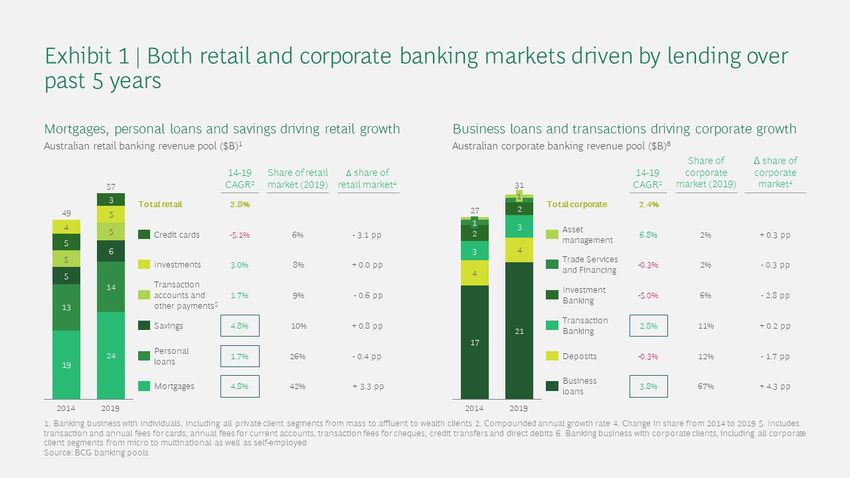
Retail and corporate banking from 2014 to 2019 to $57 billion and
experienced solid growth over the $31 billion respectively. This market growth
past five years, primarily driven by has been predominantly driven by
lending mortgages and business loans, which
comprised 50% of total revenue in 2019.
Although banks experienced solid growth
over the past few years, they also became An increase in the number of mortgages and
increasingly complex, offering a wide the average value of mortgages has spurred
range of products across banking, asset total mortgage growth. This is mostly due to
management, wealth management and population growth and rising house prices,
insurance. Since the Banking Royal which directly raised mortgage values and
Commission surfaced problems related to indirectly increased volumes by stimulating
product offerings, banks have leaned into the new borrowers into the market. Meanwhile,
findings, simplified their offerings and dynamic business activity and therefore
refocused on core banking activity. However, increasing business loan balances have
the Royal Commission’s findings have contributed to business loan growth, despite
significantly impacted customers’ trust. a small decline in net interest margin (NIM),
stemming from increased competition by
The industry has nonetheless proven online unsecured lenders and Asian banks
resilient, with total revenue growing 2.7% in the institutional space. To a lesser extent,
p.a. over the past five years. This growth has personal loans and savings have also
been consistent across retail and corporate contributed to growth in retail banking and
banking, with revenues up 2.8% and 2.4% p.a. transactions in corporate banking.
4 | Banking and the recoveryTwo different COVID-19 scenarios This relief was further supplemented by
(1. Quick rebound; 2. Slower repayment deferrals in the banking industry.
recovery) have been modelled for
the Australian banking industry in The Government's 2020-21 budget includes an
the next four years estimated $670 billion in total spending, of
which $138 billion will fund the COVID-19
Without question, the pandemic will Response Package for the full year. This
profoundly impact the Australian economy increase in spending is expected to be
and particularly the banks. COVID-19 supplemented by a further drop in interest
scenario modelling suggests that this crisis rates in coming months. Of this $138 billion,
might take longer to recover from than the three main measures are: (1) Continued
previous shocks such as SARS in 2003 JobKeeper payments until 28 March 2021
(V-shaped). ($80.7 billion); (2) Free, tax-free cash flow
boost payments to SMEs and non-profits
In this context, two scenarios for GDP are ($17 billion); and (3) Other income support for
plausible: individuals, including an extension of the
• Quick rebound (Scenario 1): GDP bounces Coronavirus Supplement ($11.6 billion).
back to pre-crisis levels in 2021, boosted
by business and consumer activity In addition to the COVID-19 Response
following high levels of government Package, other Budget measures are expected
spending, with banking revenue recover- to benefit the banking industry, including:
ing by 2023 (1) Personal income tax cuts ($17.8 billion);
(2) Enabling businesses to write off full cost of
• Slow recovery (Scenario 2): GDP returns to eligible depreciable assets ($3.2 billion);
pre-crisis levels in 2022 as downside risks, (3) Establishing the JobTrainer Fund ($1
such as further COVID-19 outbreaks, billion); (4) Implementing the JobMaker
undercut the impact of government Hiring Credit program ($850 million); and
spending, pushing the recovery of (5) Extending the First Home Loan Deposit
banking revenue to 2024 Scheme (up to 15% of deposits guaranteed by
the government for first home buyers). The
Due to ongoing uncertainty surrounding the Government has also made changes to
COVID-19 health crisis, and prior to responsible lending laws to ease access to
additional government investment in the credit and to insolvency laws, providing a
2020-21 Federal Budget, Australia’s economic safety net for businesses in a bid to ensure
recovery was expected to lean towards that otherwise profitable and viable
Scenario 2. However, government measures businesses survive temporary distress during
in the Budget are likely to shift Australia’s the crisis.
outlook towards Scenario 1, given the focus
on boosting activity and investment,
increasing household income and creating
jobs.
In 2019-2020, the Government spent
$578 billion in total, $57 billion of which
went towards its COVID-19 Response
Package from March to June. This included
welfare payments such as JobKeeper, the
Coronavirus Supplement, cash flow boosts
payments for SMEs, the SME guarantee
scheme, and early access to superannuation.
Boston Consulting Group | 5Nevertheless, the economy still faces Under both scenarios we expect a sharp
downside risk in the coming months, which shock to banking revenue, declining at -3% to
may impact Australia’s recovery profile and -6% p.a. from 2019 to 2021, then recovering at
shift the outlook further towards Scenario +5% to +6% p.a. from 2021 to 2024. Overall,
2. These include the risk of further this translates to growth of +0.4% to +2% p.a.
outbreaks and lockdowns, any delay in from 2019 to 2024 (Exhibit 2).
projected vaccine development and/or
distribution, potential impacts on global Corporate banking is expected to recover
trade, as well as potential structural shifts more quickly, growing at +1% to +3% p.a.
in the Australian economy post-COVID-19 from 2019 and 2024 vs. +0.2% to +2% in retail
(e.g. in the education sector if international banking. Corporate banking’s relatively quick
student enrolments do not recover). recovery is due to: (a) increased demand by
Recovery would be especially impacted if businesses for loans in the short term to
the crisis is dragged out over the medium to maximise liquidity; and (b) less leverage
long term. Defaults and losses typically among businesses compared to households,
spike during crises, as people and resulting in greater scope to increase business
businesses struggle to repay their debt. For debt. Retail banking’s slower recovery is due
the time being, several policies are fending to: (a) flat to slightly positive growth in the
off the threat of defaults. Though some of mortgage market, compared to an average
these policies will extend, they may growth rate of +4.8% p.a. from 2014 to 2019,
eventually be withdrawn if the crisis drags where reduced origination is diluted by the
out over the long term, impairing consumer large existing back book; and (b) a sharper
and business ability to meet repayments. drop in personal loans and reduced savings
as consumer preferences shift towards short-
As a result, Australia’s economic recovery is term liquidity and their risk mitigation
likely to fall between Scenarios 1 and 2, increases.
depending largely on external factors over
which there remains significant uncertainty.
6 | Banking and the recoveryAustralia is expected to recover corporate banking revenue, which
relatively quickly compared to peers historically grew much faster than Australia’s
(e.g. 9.6% p.a. from 2014 to 2019 in Canada
We anticipate Australia’s recovery to be vs. 2.4% p.a. in Australia).
relatively quicker than recovery in the UK and
US, but slower than Canada. Under Scenario Conversely, the UK and the US are expected
2, we estimate 2019 to 2024 growth of +0.4% to recover more slowly than Australia.
p.a. for Australia compared to 0.7%, -1.1% and Although the banking market in the UK was
-1.5% for Canada, the UK and the US growing as quickly as Australia before
respectively, due to some differences in COVID-19 at 2.5% p.a. from 2014 to 2019, it is
pandemic intensity, product mix and historic experiencing declining margins from
trends (Exhibit 3). increased competition and political issues
related to Brexit. And while the US had
Canada’s relatively swift recovery compared robust growth pre-COVID-19 at 4.4% p.a. in
to Australia stems from: (a) lower average the five years to 2019, it is likely to recover
household debt which will enable mortgage more slowly given the current outlook for the
growth throughout the crisis; (b) more pandemic and the unemployment rate.
resilient credit card and personal loan
markets; and (c) a quicker recovery in
Boston Consulting Group | 72. IMPLICATIONS OF
COVID-19 FOR BANKS
COVID-19 has triggered significant Moreover, customers and businesses may
changes in customer banking struggle to meet repayments if government
behaviour and sentiment in support is progressively withdrawn. If the
Australia, with a shift towards overall loss rate were to increase from the
digital banking FY19 baseline of 14bps at industry level, to
the peak seen during the GFC of 75bps in
Due to restrictions on branch operations and FY09, this would constitute additional losses
the shift towards cashless transactions, more of $17 billion for the industry, equivalent to
than 17% of customers have increased their $2.5-4 billion of extra loss for each major
use of mobile banking apps during the bank and $90-$390 million for a top mid-
COVID-19 outbreak. The crisis has increased sized banks. These losses will be reflected in
Australian online banking enrolment by 3 additional credit impairment expenses,
points to 81% and may cause a long-term shift impacting banks’ net profits. Looking across
away from physical banking, with over 18% of the big 4 and top mid-sized banks, the
customers planning to use branches less or to banking industry has already seen a
stop visiting branches post COVID-19. cumulative ~$7.5 billion in additional credit
However, customer interest in products has impairment expenses, roughly 45% of the
been sustained, with 55% of customers not peak seen during the GFC.
planning to delay financial product purchases
in the short term. We expect the largest losses to be in credit
cards and personal loans, as well as business
Following a drop in the retail and loans. Mortgage losses remain lower as riskier
corporate banking revenue, and an home loans are insured by Lender’s Mortgage
increase in losses, margins are likely Insurance (LMI) and consumers are likely to
to be under pressure, and banks will prioritise mortgage repayments over credit
have to transform fast to protect card and personal loan payments. During the
profits GFC, for example, mortgage loan loss rates
only rose to 8bps in FY09, while credit cards
The banking market is expected to and personal loans loss rates peaked at
experience a revenue drop of $8-$10 billion 400bps, and business loans at 100bps.
between 2019 and 2021, from a baseline of
$87 billion in 2019. This forecast market Banks will have three levers to manage the
growth of -3% to -6% p.a. would translate into crisis: (1) reduce cost to maintain flat cost-to-
a $1-1.4 billion revenue drop for each major income (CTI); (2) reduce dividends; and (3)
bank under Scenario 1, and a $2.0-2.7 billion use their capital buffers.
drop under Scenario 2, while the top eight
larger mid-sized banks could see a
$25-120 million revenue drop under Scenario
1, and a $50-240 million drop under
Scenario 2.
8 | Banking and the rec
recover
overyy(1) Despite substantial investment in digital against the 2019 baseline. On average, this
and cost transformations over the past few equates to a reduction of $0.4-1.1 billion for
years, incumbent Australian banks have not a big 4 bank, and a $20-130 million reduction
been able to change their overall cost for a top mid-sized bank. At the same time,
positions significantly: the CTI ratio of the banks are likely to have to manage scrutiny
major banks has been increasing at +1.9% and pressure from the Federal and State
p.a. for the past three years, and at +6.1% p.a. Governments when it comes to reducing
for all non-majors. An acceleration of these costs in times of economic downturn and
transformations will be required to succeed societal upheaval (Exhibit 4).
in the coming years.
For banks to maintain the same CTI ratio
through the crisis, the industry will need to
reduce costs by a further 5% (Scenario 1) to
10% (Scenario 2) over the next three years.
This is equivalent to -$2.2 to -$4.5 billion
Boston Consulting Group | 9(2) & (3) Assuming only limited cost There is precedent that in times of crisis
reduction is achieved, the crisis would successful companies strengthen customer
significantly impact 2021 profit. For example, relationships, gain market share not
under Scenario 2, factoring a revenue drop of available during good times, and initiate
$2.0-2.7 billion and extra loan losses of M&A activities. The BCG publication
$2.5-4 billion, the profit of the big 4 banks “Advantage in adversity: Winning the next
could fall to $1.6-$3.5 billion (from downturn” found that 14% of companies
$6.5-$10.2 billion in 2019). APRA recently across all industries, including financial
announced that it would cap dividend services grew both their top and bottom lines
payouts to 50% of earnings which compares in the past four economic downturns. Firms
to 78%-91% payout ratio for the big 4 banks in that succeed in a downturn do reduce costs
2019. Under Scenario 2, this would equate to to maintain viability, but they also innovate
an ~80% decline in dividends in absolute to shape the post-crisis future and reinvest to
value in 2021 compared to 2019, which capture growth.
translates into a $23 billion decline in
dividends across the big 4. All of this would For example, NAB grew its market share of
have a direct impact on total shareholder SMEs by 1.8%, Corporate by 2.7% and
return (TSR). Institutional by 3.1% in the 24 months
following the GFC. Meanwhile in 2008, the
Depending on their results, banks will have to Commonwealth Bank Group acquired
further reduce their payout ratio or utilise Bankwest and Westpac Group acquired St
into their Common Equity Tier 1 (CET1) George Bank.
capital buffers to cope with negative profit.
This could lead to further consolidation
among some mid-sized banks to strengthen
their competitive positioning.
Even in tough times you can succeed
While the COVID-19 crisis poses significant
challenges to the banking industry, it also
presents opportunities to grow during the
downturn and to emerge stronger and more
resilient.
10 | Banking and the recovery3. FIVE STRATEGIC
MOVES TO PREVAIL
DURING THE COVID-19
CRISIS
To succeed in the COVID-19 crisis, banks Evidence is mounting that companies that
should address five strategic priorities: focus on this wider impact, which we call
Total Societal Impact (TSI), can increase
• Reinforce the leadership, purpose and profits through appealing to investors and
culture of the organisation to support adhering to new environmental, social, and
the economy governance (ESG) standards.
• Double-down on risk and compliance As we move through COVID-19, banks
have two key opportunities to centre their
• Accelerate digitisation of acquisition organisational purpose and support the
and servicing economy:
• Consider inorganic growth 1.1 Support and accelerate Australia’s
transition to a safer, more vibrant and digital
• Take share in priority segments economy: Banks can use innovations such as
cashless payments, open data, digital identity,
1. Reinforce the leadership, purpose digital signatures and AI to monitor
and culture of the organisation to compliance and improve efficiency in the
support the economy wider economy by removing unnecessary
financial frictions. For example, open data
During the COVID-19 downturn banks have a will make it easier for people, companies
vital role to play, working alongside and governments to seamlessly transact
government as part of the coordinated and accelerate decision-making. Moreover,
response to stabilise, reboot and grow the AI-enabled credit and compliance will allow
Australian economy. This unprecedented real-time monitoring to forecast company-
global crisis will test every bank’s leadership, level activity, improving risk management
purpose and culture. Leadership can and giving banks more opportunity to
revitalise their banks’ reputation and position provide credit provisions to small businesses,
them as a force for good by taking bold, creating new employment models through
visible actions – maintaining a culture of the gig economy. Adopting such innovations
compliance, remaining profitable and will help the industry meet its higher purpose
contributing positively to Australian society. of creating growth and enabling a more
In other words, they need to ‘do right, do productive economy.
well, and do good’.
Banks should take their lead from companies
that are striving to contribute positively to the
wider community and environment, while
maximising their Total Shareholder Return
(TSR) at the same time.
Boston Consulting Group | 111.2 Reinforce internal organisational purpose: Further, as more Australians face financial
The crisis gives banks the chance to reflect hardship, banks could face severe brand and
on and reinvigorate their organisation by financial penalties for misconduct or
focusing on purpose and culture-building negligence. Historically, banks have invested
activities. These actions can increase in solving discrete operational risk issues by
employee engagement, talent retention and adding more controls to handle increased
levels of productivity. Research has shown regulatory requirements – but without
that employees who derive meaning and always rethinking the end-to-end processes.
purpose from their work and are inspired by
company leadership are 2.25 times more Banks should use the increased regulatory
productive than merely satisfied employees. requirements as an opportunity to work
closely with regulators to reduce existing
2. Double down on risk, compliance systemic risk and prevent new crisis-related
and collections risks by moving towards real-time
monitoring. In this new landscape, banks
As the downturn deepens, banks are have four levers to help transform their risk
experiencing increasing levels of market, and compliance agendas:
credit, liquidity, business and operational
risks. Furthermore, distinctive elements 2.1 Invest in technology to improve
within operational risk, such as cybersecurity, operational risk management: Banks should
are particularly targeted during times of crisis redesign end-to-end process, taking a
(threats to banks include malware, phishing, customer-centric approach, including by de-
distributed denial-of-service attacks, and duping controls and increasing the
ransomware). automation and efficiency of controls where
possible. Building a next-generation
Although government policies are currently operational risk platform where information
forestalling defaults, some retail customers is readily accessible, such as in policies and
and businesses will eventually struggle to procedures, will also increase efficiency and
make repayments. Further waves of the virus help reduce risk events and near misses.
will only exacerbate these issues and drive a
need for more credit underwriting of existing 2.2 Radically improve credit risk capabilities:
and new facilities and stronger collections Banks can use AI and machine learning
processes to prevent and manage defaults. technology to transform credit risk
assessment and collections processes.
The banks will need to scale up their This technology can deliver real-time insights
collections capability to minimise non- and projections into customer data, helping
performing loans (NPL). However, existing pre-empt and mitigate risk while improving
credit models that attempt to predict the the customer experience. Banks can use real-
future from past behaviour have limited use time tracking of client transactions as the
in these unprecedented conditions. Since basis of cash-flow projections, improving or
there is no time to develop complex models replacing financial statement-based methods,
and highly engineered processes, banks will which do not provide very effective forecasts
need to design new solutions that are robust, in the current environment. A sophisticated,
quick to implement and simple to use. rule-based decision-making approach can
also help banks to make better use of
At the same time, increased regulatory frontline teams and credit risk resources, by
requirements are impacting compliance and enabling quick decline/approval decisions,
risk functions. With new technology such as and better management of queues for
AI, banks’ risk, treasury and compliance manual review.
functions can leverage internal and external
data to more quickly remediate past issues 2.3 Help customers to be viable beyond
and free up capacity to respond rapidly to the government relief: Banks should act on early
current crisis. Regulators will continue to warning signals to support at-risk customers,
closely monitor the way banks do this. helping SMEs restructure their businesses
12 | Banking and the recoveryand implement good credit management. COVID-19 has triggered a significant increase
They will need to significantly scale their in consumer digital adoption, accelerating
capabilities to meet the volume of businesses the need for banks to deliver highly
likely to need support. personalised experiences. During the
pandemic, ~12% of Australian respondents
2.4 Reimagine enterprise risk capabilities: moved to online and mobile banking for the
To meet the uncertainty around the financial first time. China has seen a 30-40% shift to
impact of COVID-19, banks need access to digital banking channels since the outbreak,
dynamic projections of financials, capital, while European banks have seen a ~100%
liquidity and other key metrics using increase. The SARS epidemic in 2003 saw
advanced scenario analysis. This could similar results within Asian economies. The
provide stress-test results in hours instead of business banking segment has also
weeks. Leaders must think beyond historic experienced comparable changes. Australian
events to understand how unprecedented Banks will therefore need to accelerate the
stress scenarios, tailored to their unique digitisation of customer acquisition and
business profile, can impact their business. servicing.
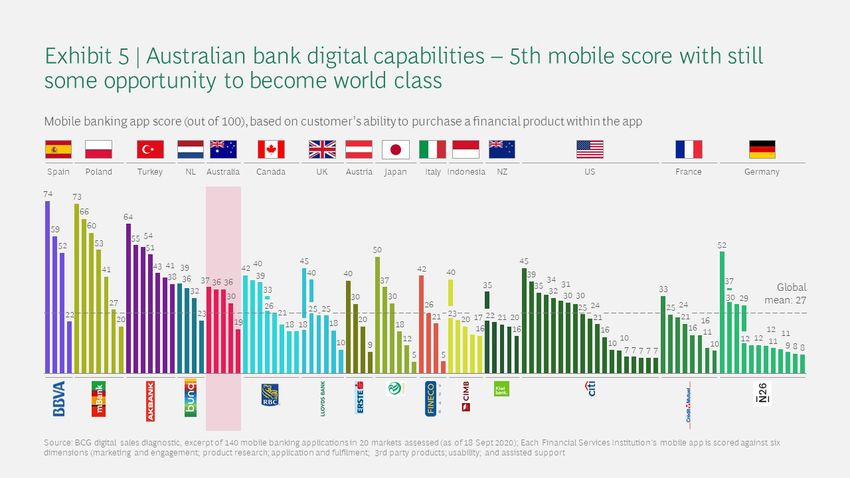
3.Accelerate the digitisation of While Australian banks have heavily
acquisition and servicing invested in their digital capabilities over the
past few years, they still have room for
With the rise of digitisation, customer improvement. For example, Australian banks
expectations have rapidly changed for greater currently have a mobile score between 19-37
convenience and digital, frictionless compared to the best-practice scores of 70 as
processes. Customers expect instant per BCG’s digital diagnostic done for 140
approvals, access to cash in minutes or days, banks across 20 countries (Exhibit 5).
limited paperwork, real-time visibility on the Further, neobanks are grabbing revenues
status of their requests, a seamless omni- between three and four times faster than
channel experience, access to self-service for traditional banks. These digital banks also
most of their needs and more targeted advice enjoy high NPS and lower cost bases with
and insights. productivity three to four times higher than
their traditional counterparts.
Boston Consulting Group | 13The best-practice standards set by leading • Completely digitise end-to-end processes
European digital banks demonstrate the sort with straight-through-processing, same-day
of cost reduction opportunities available to decisioning and self-servicing capabilities
Australian banks, particularly in branch and to digitally answer more than 80%
contact centre performance and in middle customer requests quickly online. This can
office and operations. Leading European eliminate process waste, significantly
digital players maintain customer service reduce cycle time for customers and
levels of 0.5 yearly inbound calls and 0.7 reduce overall costs by 30% or more.
branch transactions per year, per customer,
and achieve FTE productivity levels of 14,000 • Modernise the tech stack – the cloud and
yearly branch transactions per branch FTE, services architecture – and capitalise on
and 25,000 yearly calls per contact centre network effects from disruptive technolo-
FTE. Further, top decile performers maintain gy, such as New Payments Platform (NPP).
streamlined operations, with 0.4 middle
office FTE and 1.4 operations FTE per 10,000 • Commercialise Data & Analytics (D&A)
customers – significantly below the levels of business cases on the front-end using
comparable Australian banks. Martech with the aim to initiate more than
50% of complex sales like home loans
In order to succeed post-COVID-19, banks through enhanced D&A capabilities such
will need to increase the speed of their as prompts, click-to-call or
digital transformation agendas, and make cross-channel appointments.
swift decisions on make-or-buy opportunities.
Beyond enabling better customer service • Adapt the physical network to changing
and protecting current market share, customer preferences by treating the
digitisation will lower operational risk and branch as a destination for advice rather
deliver services at a lower cost, bolstering than simple transactions. Our research
their balance sheets in the wake of the crisis. indicates one in five Australian customers
plan to either use branches less or stop
Banks have two options to accelerate their visiting them altogether once the
digitisation. COVID-19 crisis is over. Banks should
provide digital channels to pre-book
3.1 First option - Digitise the core front-to- branch appointments and use branches to
back. Omni-channel and data and analytics maintain some physical presence, depen-
will play central roles in enabling the ding on the needs of communities. They
transformation: should also upskill current employees to
• Develop personalisation capabilities to newer modes of interaction such as
provide the right offer and service at the telebanking.
right time via the right channel to accele-
rate new customer growth. For example 3.2 Second option - Invest in a neobank or a
Millennium, the most personalised bank in digital attacker and progressively simplify
Poland, became number one in NPS and (e.g. products, processes) to migrate the core
grew revenues from 10%-50% in priority to the challenger
segments in the space of just 12 months.
• Assess opportunities to build or invest by
• Expand digital front-end capabilities to screening potential ‘digital attackers’
include video appointments, enhanced neobanks and fintechs and identify
online banking and mobile app functio- attractive strategic assets such as digital
nalities – increasingly popular with brand (e.g. targeting new customer
affluent and small business customers and segments, millennials and digitally savvy
resulting in higher customer satisfaction. customers), modern real time core
Use video channels to deepen the banking platforms, API architecture with
customer relationship and digital channels single customer view and efficient
to originate more than 70% of simple sales. customer engagement through digital
channels.
14 | Banking and the recovery• Map out a migration pathway from the Consolidation would help merging banks to
core to the challenger, starting with the better compete together, expand their
simplest products and segments to test capabilities and scale to improve the
and learn. Simplification of products, customer experience and increase
policies and processes will be required to productivity.
successfully transition over time. While
some players are considering migrating to During the COVID-19 crisis, a payments
a challenger, this approach is still being Industry Committee has been formed by the
tested by banks around the world. New Payments Platform Australia (NPPA)
and industry shareholders (big 4 banks,
4. Consider inorganic growth smaller banks, large retailers) to explore
consolidation of NPPA, BPAY and EPAL
(the owner/operator of eftpos).
In the next few years the Australian banking
Consolidation is proposed as a solution to
industry is likely to experience a further wave
perceived industry challenges including a lack
of consolidation. Past experience shows that
of coordination, misaligned investment, and
during or soon after a crisis-driven economic
halting innovation created by different
downturn M&A activity typically increases.
shareholder structures for different entities.
Strategic acquisitions out of reach or unlikely
The proposed consolidation model may
to be approved by regulators become more
include merging ownership, governance and
feasible during and after crises. For example,
even operating business units that have
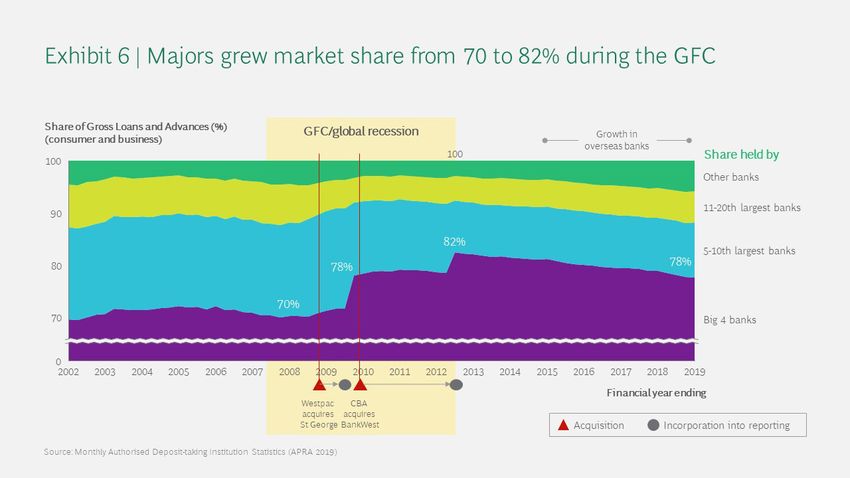
during the GFC, market share of mid-tier and
synergies (e.g. account to account payments
smaller banks contracted to the benefit of
services).
larger, more financially secure banks, which
grew market share from 70% in 2008 to 82%
Throughout the crisis, three critical steps will
in 2012 (Exhibit 6).
help enhance inorganic growth.
In the current context, smaller players may
struggle to compete. It may be tough for
digital attackers like neobanks, fintechs and
digital platforms to expand their balance
sheet in the short run.
Boston Consulting Group | 154.1 Identify potential partners: to succeed they must better understand
Banks should monitor the market to identify customer needs and risks by determining the
potential, relevant targets. They should behavioural and emotional responses
prepare deals by considering the capabilities of customer segments.
they wish to acquire, the benefits of the
merger, and the operational and strategic Banks that can understand customer needs
implications of an integration. and attract and retain customers with
stronger service, pricing or products, while
4.2 Be decisive at the portfolio level: managing the risk of expanding lending, will
Acquiring companies should understand come out ahead in the COVID-19 crisis. Those
which products might be targets to exit, sell players embracing change to gain market
(back book), or white-label through a joint- share could also benefit from open banking,
venture partnership. They should also which empowers customers to switch
consider which assets, processs or channels products more easily. Preliminary research on
are non-competitive. Companies should Australian banking customers’ responses to
investigate opportunities for a utility model COVID-19 indicates that 25 to 44-year-olds
with additional benefits, such as multiple are the most likely segment to switch banks
banks sharing assets like branches and as a result of the pandemic. This could be a
ATMs, or exchanging information about key segment for banks to protect and target.
customers to reduce fraud or improve credit
scoring (e.g. KYC utility company). Three tactics can help banks to take share in
priority segments:
4.3 Determine a clear payment consolidation
strategy to get the most from the Industry 5.1 Target existing and prospective
Committee process: When evaluating customers, to maintain and gain share in
consolidation, banks must be specific about priority segments during the acute crisis
the benefits that they are seeking to realise, period: Banks should use real-time tracking
whether it is faster speed to market of new of customer transactions to predict likely
innovation, less duplicate investment, changes in cash flow. They can then apply
reduced management complexity, and/or these insights to design a rules-based
clearer industry alignment on technology playbook with actionable customer classifica-
development. They also need to evaluate tion signals, that can determine the right
whether consolidated ownership will be customer treatment as the crisis unfolds.
meaningfully more effective at leading the These insights can enable banks to pursue
industry. existing high-quality customers by providing
reassurance, strengthening relationships and
5. Take share in priority segments offering price-led retention if needed. For
new customers, banks should focus on
The COVID-19 environment poses both the winning the relationship by offering superior
challenge of taking a defensive approach to rate and service levels.
mitigate loan losses, and an opportunity to
go on the offence by prudently offering 5.2 Deepen customer segmentation: At the
credit to expand lending books and build same time, banks should add behavioural
loyalty. and emotional attributes to customer
segmentation, to improve traditional
Banks will have the chance to gain market approach by product and wallet. By
share in priority products such as home loans combining existing internal data with
and business loans. Together with deposit quantitative surveys that test consumer
products, they have historically driven decision-making, they can determine real
around 60% of a bank’s revenues, but are consumer demand, and identify white or
highly competitive when times are good. high-value spaces for growth. Demand-centric
While banks have historically interacted with segmentation will enable banks to provide
customers through a product focused lens, more targeted products and services, to
better meet customer needs.
16 | Banking and the recovery5.3 Build and develop customer orchestration engine capability to provide tailored offerings,
based on customer segmentation: This capability will help banks move from siloed, product-
led campaigns to customer-led interactions prioritised by the engine; and from high volumes
of uncoordinated messages and non-personalised inbound interactions, to customer
engagements governed by identified next best actions. During this time of heightened
customer stress, banks could also think about developing more altruistic prompts and
nudges that foster customer financial wellbeing – such as timely prompts for home loan /
card repayments or spending alerts.
CONCLUSION
Digital disruption and regulatory reform were already rapidly transforming Australia’s
banking landscape before COVID-19 restrictions drove people indoors. Since then, inevitable
trends have accelerated, with consumer expectations of digital and convenient banking
solutions at a high. Other shifts, such as the sudden drop in revenue and looming spike in
defaults, have been more abrupt. Both types of shifts require rapid, decisive responses from
the banking sector.
The COVID-19 crisis has provided banks with the opportunity to play a significant role for
the community and the economy, build a relationship with government in earnest, digitise
their processes, improve their management of credit risk, collection and remediation, and be
prepared to take new market share. The banks that put the five strategic moves into action
will prevail during the crisis and emerge stronger and well-positioned to succeed beyond the
pandemic.
Boston Consulting Group | 17About the Authors
Brad Noakes is a Managing Director and Partner in BCG’s Sydney office. He leads
the Financial Institutions and Insurance Practice in Australia and New Zealand.
Laure Jouan is a Principal in BCG’s Melbourne office. She is a core member of the
Financial Institutions and Insurance Practice in Australia and New Zealand.
Acknowledgments
The authors would like to acknowledge the many contributions to the research,
writing and production of this report, including Claudia Wilson, Matthew Hardy,
Emily Chen, Nanak Narulla, Marissa Lynch, Madeline Hudson and Eliza Spring.
For Further Contact
If you would like to discuss this report, please contact one of the authors
noakes.brad@bcg.com or jouan.laure@bcg.com.
18 | Banking and the recovery© Boston Consulting Group 2020. All rights reserved. For information or permission to reprint, please contact BCG at permissions@bcg.com. To find the latest BCG content and register to receive e-alerts on this topic or others, please visit bcg.com. Follow Boston Consulting Group on Facebook and Twitter. 11/20
bcg.com
You can also read


