Basel III regulatory consistency assessment (Level 2) Japan - Basel Committee on Banking Supervision
←
→
Page content transcription
If your browser does not render page correctly, please read the page content below
Basel Committee
on Banking Supervision

Basel III regulatory
consistency assessment
(Level 2)
Japan
October 2012
This publication is available on the BIS website (www.bis.org).

© Bank for International Settlements 2012. All rights reserved. Brief excerpts may be reproduced or
  translated provided the source is cited.

ISBN 92-9131-151-0 (print)
ISBN 92-9197-151-0 (online)
Contents

Foreword...................................................................................................................................1
Assessment Team ....................................................................................................................4
Executive summary ..................................................................................................................5
Overview table of compliance grading ....................................................................................10
Response from the Japanese authorities ...............................................................................11
Assessment ............................................................................................................................12
        1.       Introduction ..........................................................................................................12
        2.       Detailed findings...................................................................................................15
                 2.1       Scope of application....................................................................................15
                 2.2       Transitional arrangements ..........................................................................16
                 2.3       Definition of capital......................................................................................17
                 2.4       Pillar 1: minimum capital requirements .......................................................19
                           2.4.1 Credit risk: standardised approach ....................................................19
                           2.4.2 Credit risk: internal ratings-based approach ......................................19
                           2.4.3 Securitisation framework ...................................................................20
                           2.4.4 Counterparty credit risk rules .............................................................21
                           2.4.5 Market risk: scope and standardised method ....................................22
                           2.4.6 Market risk: internal models approach ...............................................23
                           2.4.7 Operational risk: Basic Indicator Approach and Standardised
                                 Approach ...........................................................................................23
                           2.4.8 Operational risk: advanced measurement approach .........................23
                           2.4.9 Capital buffers (conservation and countercyclical) ............................24
                 2.5       Pillar 2: Supervisory Review Process .........................................................24
                  2.6      Pillar 3: Market Discipline............................................................................25
Annexes ..................................................................................................................................26
        A.        Glossary ...............................................................................................................26
        B.        Reference documents ..........................................................................................27
        C.        List of Japanese institutions met during the on-site visit ......................................30
        D.        Data on the Japanese banking Sector .................................................................31
        E.        Outcome of Materiality Analysis ...........................................................................34
        F.        List of issues for follow-up assessment ................................................................36
        G.        Statement of the Japanese authorities on areas of super-equivalence ..............37

Basel III regulatory consistency assessment (Level 2) - Japan
Foreword
This report presents the conclusions of the Basel Committee’s Basel III1 Regulatory
Consistency Assessment (“Level 2”) for Japan. It is based on information available at the
time it was completed on 22 August 2012. The assessment was conducted over a period of
six months from March to August 2012, including an on-site visit in July 2012. The
preliminary findings of this assessment were published in a June report to the G20 leaders.2
The team, led by Ms Sylvie Matherat, Deputy Director General Operations, Banque de
France, consisted of six experts, and was coordinated by the Secretariat.
For purposes of this Level 2 assessment of Japan, the Japan Financial Services Agency
(JFSA) and the Bank of Japan (BoJ) served as the assessment team’s main counterparts.
The bank data analysis that forms part of the assessment was coordinated by the JFSA.
Representatives from the JFSA, BoJ and from the industry (for specific meetings)
participated in the review.
The assessment in this report is based on recently published regulation (as of March 2012)
and other rules that implement Basel III in Japan. Hence, the assessment is largely
considered final. Nonetheless, there are a limited number of elements which will remain
subject to follow-up analysis:
The assessment excluded certain sections of the Basel rules that are under review
or are being finalised by the Basel Committee. In particular, the leverage ratio, the
liquidity ratios and the framework for global systemically important banks (GSIBs)
have not been assessed. Japan’s implementation of these rules will be assessed
once they are finalised by the Basel Committee.
While Japan has already put in place the vast majority of its domestic Basel III rules,
specific issues (primarily the rules for capital buffers) are still under final discussion
and implementation is envisioned at a later stage but prior to the deadline(s) agreed
by the Basel Committee.
The report has been written in accordance with “exception-based reporting”, ie it focuses on
deviations that could lead to a less robust capitalisation of the banking sector than would
otherwise have been achieved if the Basel Framework had been implemented in full. As
such, areas of compliance are not explicitly addressed, nor are domestic measures that
strengthen the minimum requirements. However, with respect to the latter, assessed
jurisdictions were given the option to provide this information in an annex to this report (see
Annex G).3 The information on measures to strengthen the minimum requirements has not
been assessed nor is endorsed by the assessment team.
The report outlines where these qualifications apply, and will be subject to updates at a later
stage.
1
Basel III builds upon and enhances the regulatory framework set out under Basel II and Basel 2.5 (ie the July
2009 enhancements to Basel II), which now form integral parts of the Basel III framework. The assessments
thus cover the full set of components, including those introduced by Basel II and Basel 2.5. This full set of
requirements is collectively referred to in this document as “Basel III” or the “Basel framework”.
2
The “Report to G20 Leaders on Basel III implementation” is available at www.bis.org/publ/bcbs220.htm.
3
The Japanese authorities have not listed any areas as super-equivalent compared to the Basel Framework.
Basel III regulatory consistency assessment (Level 2) - Japan 1This Level 2 assessment report is part of a comprehensive review programme adopted by
the Basel Committee, which comprises the following three levels:
Level 1: ensuring the timely adoption of Basel III
The objective of the “Level 1” assessment is to ensure that Basel III is transformed
into law or regulation according to the agreed international timelines. It focuses on
the domestic rule-making processes and does not include the review of the content
of the domestic rules. The Level 1 assessment is the foundation for the
assessments at the other levels.
Level 2: ensuring regulatory consistency with Basel III
The “Level 2” assessment process assesses the compliance of domestic regulations
implementing Basel III with the international minimum requirements defined by the
Basel Committee. By identifying domestic regulations and provisions that are not
consistent with the rules agreed by the Committee and by assessing their impact on
financial stability and on the international level playing field, this process will
promote full and consistent implementation of Basel III. It will also facilitate an
effective dialogue among members and provide peer pressure if needed. The
conclusions following each jurisdiction’s assessment will be published by the
Committee. This assessment programme supports the Financial Stability Board’s
monitoring of the implementation of the agreed G20/FSB financial reforms and is
fully consistent with the “Coordination Framework for Monitoring the Implementation
of Agreed G20/FSB Financial Reforms” put in place by the FSB.4
Level 3: ensuring consistency of risk-weighted assets
The objective of the “Level 3” assessments is to ensure that the outcomes of the
new rules are consistent in practice across banks and jurisdictions. It extends the
analysis of Levels 1 and 2, which focus on national rules and regulations, to
supervisory implementation at the bank level. This work is currently focusing on the
review and validation of how banks calculate their risk weighed assets (RWAs).
The Level 2 assessment methodology includes the following key elements:
The Level 2 assessment is factual in nature and focuses on reviewing the
completeness (all required Basel III provisions have been adopted) and consistency
(differences in substance) of domestic regulations (ie binding documents that
effectively implement Basel III independent of their label).
When a gap or difference is identified, a key driver for assessing compliance is its
materiality and impact.
To the extent possible, the materiality and impact is quantified using all available
data, including those submitted by the jurisdiction being assessed. The assessment,
in particular, seeks to measure the significance of any identified difference(s) for
internationally active banks. The assessment considers the current impact and
consequences, but also the potential impact in the future. The assessment team
might also perform its own estimations and analyses, using all available sources of
4
See the “Coordination Framework for Monitoring the Implementation of Agreed G20/FSB Financial Reforms”
put in place by the FSB at www.financialstabilityboard.org/publications/r_111017.pdf.
2 Basel III regulatory consistency assessment (Level 2) - Japaninformation and including in particular the Basel Committee’s Quantitative Impact
Study (QIS) and Capital Monitoring Group (CMG) data.
Specificities and drivers of local implementation are not taken into account when
assessing compliance: local specificities are not seen as mitigants for going beyond
the scope of national discretion specified within Basel III.
Domestic measures that strengthen the minimum requirements are not considered
to compensate for inconsistencies or gaps identified elsewhere, unless they fully
and directly address the identified inconsistencies or gaps.
The Level 2 assessment is limited to regulatory issues and does not consider
supervisory or bank practices. The extent to which Basel III is effectively enforced by
supervisors or whether firms are actually complying with the Basel III framework is
assessed as part of the Level 3 process.
All level 2 assessments are graded using a four-grade scale5 - compliant, largely compliant,
materially non-compliant and non-compliant:
Compliant: all minimum provisions of the international framework have been
satisfied and if no material differences have been identified;
Largely compliant: only minor provisions of the international framework have not
been satisfied and only differences that have a limited impact on financial stability or
the international level playing field have been identified;
Materially non-compliant: key provisions of Basel III have not been satisfied or
differences that could materially impact financial stability or the international level
playing field have been identified; and
Non-compliant: Basel III has not been adopted or idifferences that could severely
impact financial stability or the international level playing field have been identified.
The assessment team would like to thank the Japan FSA and the Bank of Japan for their
cooperation and contribution to this exercise, and in particular the Japan FSA for hosting the
on-site visit.
The assessment team leader also thanks the assessment team members, the agencies
contributing these staff, and staff from the Basel Committee Secretariat for their valuable
contributions.
5
This four-grade scale is consistent with the approach used for assessing countries’ compliance with the Basel
Committee’s Core Principles for Effective Banking Supervision. The actual definition of the four grades has
however been adjusted to take into account the different nature of the two exercises. In addition, components
of Basel III that are not relevant to an individual jurisdiction may be assessed as non-applicable.
Basel III regulatory consistency assessment (Level 2) - Japan 3Assessment Team Team Leader: Ms Sylvie Matherat Banque de France Team members: Mr Mark Ginsberg US Office of the Comptroller of the Currency Mr Changyi Shao China Banking Regulation Commission Mr Jinshink Son Bank of Korea Mr Edgar Weirauch Deutsche Bundesbank Mr Daniel Westin Sveriges Riksbank Supporting members: Ms Aliénor Margerit Banque de France Mr Christian Schmieder Basel Committee Secretariat Ms Jingchun Zhang Basel Committee Secretariat 4 Basel III regulatory consistency assessment (Level 2) - Japan
Executive summary

The Japanese Basel III rules were published in March 2012,6 supplemented by recently
published updates (see Tables 1 and 2 in Annex B). From a Level 1 perspective, Japan’s
rules for implementing the Basel framework have therefore been considered to have been
put in place.7

The current status of the implementation of Basel II, Basel 2.5 and Basel III in Japan is
displayed below.8

         Rules                      Grade                          Next steps – Implementation plans

        Basel II                       4
      Basel 2.5                        4
       Basel III                       3               Final rules published on 30 March 2012 – Implementation of
                                                       final rules (end of March 2013 – In Japan, the fiscal year for
                                                       banks starts in April and ends in March).
                                                       Rules covering capital conservation buffer and the counter-
                                                       cyclical buffer not yet issued. Draft regulations expected in
                                                       2014/15.

1 = draft regulation not published; 2 = draft regulation published; 3 = final rule published; 4 = final rule in force.
Green = implementation completed; Yellow = implementation in process; Red = no implementation.

The Japanese Basel rules are mandatory for the 16 internationally active banks, which
account for about 56% of the Japanese banking sector assets (see Table 4 in Annex B for a
list of these banks), and voluntary for two large broker-dealers. The other domestic banks are
subject to domestic rules, which are, overall, similar to the Basel III standard (but use a
different minimum capital adequacy ratio).9

The team’s Level 2 assessment consisted of a comprehensive comparison of Japan’s Basel
rules with the global Basel standard. With the exception of a limited number of non-material
gaps, the assessment team found that the Japanese rules meet the Basel standards.
Additional secondary rules recently issued by the JFSA helped to close some of the gaps,
and have generally been recognised by the review team in its assessment.

The gaps identified relate to the scope of application, capital, credit risk and market risk and
were considered by the assessment team as not material. The materiality assessment was
based on bank-specific data for each of the 16 internationally active banks affected by a
specific gap (see Figures 2 and 3 in Annex E) and was undertaken for all quantifiable gaps.

6
    See www.fsa.go.jp/en/news/2012/20120330-1.html
7
    The Japanese Basel II and Basel 2.5 regulations had been transposed into domestic rules in March 2007, and
    December 2011, respectively (Tables 1 and 2 in Annex B).
8
    See also Appendix 1 of the Report to G20 Leaders on Basel III implementation available at
    www.bis.org/publ/bcbs220.pdf (p.24, 26 and 28) for the status as of May 2012.
9
    The rules applicable for the domestic banks deviate (mainly) in terms of the minimum capital ratio adequacy
    ratio (4 percent instead of 8 percent) and the recognition of capital.

Basel III regulatory consistency assessment (Level 2) - Japan                                                            5
The team also assessed whether potential gaps were influenced by inaccurate translation. It
concluded that this was not the case.
The assessment team observed that a number of the standards were implemented through
“secondary” legislation (eg guidelines and inspection manuals as well as published questions
and answers) rather than primary regulation, reflecting the more informal legal tradition in
Japan. While some of the secondary legislation is not necessarily binding in formal terms, the
assessment team, based on detailed discussions with the authorities on specific issues, still
considers them to be generally binding and thus eligible to meet Basel standards. This is
supported by evidence, in some instances, of supervisory action based on these rules that
were established through secondary legislation. Nevertheless, in order to meet Basel
standards in full and to be consistent with other legislations (especially those with a formal
legal background), the authorities might consider adding primary legislation (eg by moving
part of the secondary legislation to the March 2012 Basel III notice), in order to further
strengthen banks’ commitment to the regulation.
Overall, the review team considers the current scope of the Japanese Basel III rules as
“compliant” with Basel standards.
Assessment findings
Overall grading
Using a standardised assessment format, the assessment team has provided compliance
ratings for 13 components of the Basel framework (out of a total of 20) and an overall rating
of compliance. One component, relating to the manner in which the capital buffers will
operate in practice, remains subject to a follow-up assessment once further guidance is
established (using the remaining time for implementation until 2015), and another six
components will be assessed once the Basel III standards are finalised. Detailed information
on the findings and compliance ratings for each of the 13 assessed components is set out in
greater detail later in this report.
The assessment team’s overall finding is that the Japanese Basel framework is compliant
with the global standard agreed by the Basel Committee. This is based on three
facts/observations: (1) the number of gaps identified by the assessment team was relatively
low; (2) all gaps were found to be non-material, both in isolation (ie as single issues) and in
aggregate terms (for single banks and/or the group of internationally active banks as a
whole); and (3) the review team has noted that a notable portion of Japan’s rules are based
on secondary legislation, reflecting the legal tradition in Japan, and has generally recognised
these rules as binding. As such, none of the above issues was assessed as likely to have a
material impact on financial stability or on the international playing field.
Overarching Issues
The review team has made the following observations, some of which will be re-assessed at
a later stage:
In terms of scope (ie the possibility to use different options/approaches under
Japanese rules), a few options (eg the maturity ladder approach for commodity
risks, the internal model method – IMM – for counterparty credit risk) are not
specified by the Japanese rules and are therefore not available to Japanese banks,
6 Basel III regulatory consistency assessment (Level 2) - Japanbut these do not constitute instances resulting in inappropriate capital treatment and
are expected to be made available if needed;
There are some deviations from Basel’s definition of capital, Pillar 1 market risk
(exception for small trading books, commodity risk) and Pillar 1 securitisation, which
also applies, to a lesser degree, to Pillar 1 credit risk, but these are not considered
material;
The Pillar 2 rules are generally stipulated as secondary legislation, and there are
some gaps in terms of the granularity of the rules (ie some specific issues are not
stipulated in the Japanese rules). However, the JFSA and the BoJ have established
a comprehensive Pillar 2 framework, and are, in general legal terms, in a position to
take action, if needed, and have done so in the past;
The capital buffers remain to be implemented at a later stage and will be subject to
follow-up analysis, together with the standards yet to be established by the Basel
Committee.
Main specific Issues
The key issues identified by the assessment team are discussed below, and the
corresponding rating is shown in the compliance table. The authorities’ response to the
assessment follows the compliance table.
Definition of Capital and Capital Buffers
While most of the rules concerning the definition of capital had been established with the
March 2012 Basel III notice (see Tables 1 and 2 in Annex B), some additional secondary
legislation in the form of more detailed guidelines and Q&A’s were published in June10 and
August.11 This filled the majority of gaps that had previously been identified.12
The two remaining issues are with respect to the loss absorption for Additional Tier 1 and
Tier 2 instruments and the divergent cutt-off date for state aid instruments. With respect to
the cut-off date for the grandfathering of state aid instruments, the Japanese rules allow for a
window of opportunity until early 2013 (unlike the September 2010 cut-off date in the Basel
rules), but this opportunity has not been used by banks for now and the assessment team
understands (based on discussions during the on-site visit) that there is no intention to do so
going forward.
As for the PON rules, based on discussions with the JFSA, its staff informed the assessment
team that it intends to implement the contractual approach rather than the statutory approach
(as originally envisaged). Supervisory rules are foreseen to be implemented in the near
future, whereby no gaps would be identified.13 Some additional questions as to how the
10
See the following link (in Japanese only) for the Q&A’s published on 6 June 2012.
11
See www.fsa.go.jp/news/24/ginkou/20120807-3/05.pdf (Japanese only), for the revised supervisory
guidelines, published on 7 August 2012 and www.fsa.go.jp/news/24/ginkou/20120807-3/08.pdf (Japanese
only) for additional Q&A’s, also published on 7 August 2012.
12
Specifically, recent regulation has filled the previously identified gaps with respect to the recognition of stock
acquisition rights as regulatory capital, the deduction of deferred tax assets and most of the missing
recognition criteria for additional Tier 1 instruments.
13
Provided that the rules were to be implemented as envisaged.
Basel III regulatory consistency assessment (Level 2) - Japan 7contractual approach will work with the current legislation will have to be discussed and potentially addressed, and will be part of follow-up analysis.14 For the capital buffers (capital conservation, countercyclical), the domestic rules are not yet in place, but the Basel III rules leave more time for implementation, which is intended to be used by the authorities. The Japanese authorities plan to issue the rules by 2015, ie one year ahead of the international schedule for implementation (2016). Pillar 1 - Minimum Capital Requirement For securitisation, a gap has been identified in terms of the treatment of exposure (being part of a nationwide investment scheme)15 as securitisation rather than re-securitisation. This gap has been found to be non-material for the time being, though, as none of the internationally- active banks exhibits such exposure. One other gap relates to the general treatment of securitisation exposure but similarly is not considered material. In terms of counterparty credit risk and cross-product netting, Japan has not implemented the IMM but implementation could become relevant in the future and the authorities have indicated being ready to issue the relevant rules. In the assessment team’s view, this issue is not considered a case of inappropriate capital treatment. Concerning market risk, the team has identified areas of non-compliance with respect to (i) the exemption of the regulatory treatment of smaller trading books (
authorities are willing to act. Likewise, Japan’s Banking Act16 generally enables the
authorities to impose additional capital charges.

At the same time, the authorities have established a comprehensive Pillar 2 assessment
framework, including a three-tier supervisory approach to cover the four Pillar 2 principles as
established by the Basel rules.

The assessment team has also evaluated the materiality of some key Pillar 2 risks (eg
interest rate risk in the banking book, concentration risk), and found that banks’ capital levels
reflect (ie are related to) the level of Pillar 2 risks (IRBB, concentration risk), where applicable
(see Figure 3 in Annex 2).

Follow up work
The team recommends a follow-up assessment on the capital buffers once further Basel
Committee guidance on this topic has been implemented in Japan. Implementation is
envisaged by 2014/15 (see Annex F). Likewise, any other areas in which the domestic rules
will be updated, be it to finalise the existing rules (as is foreseen for the definition of capital)
or to address findings outlined in this report, will be subject to follow up analysis.

Other follow-up work will include the areas of the Basel standards that have not yet been
implemented (liquidity, leverage and G-SIB, as shown below).

16
     See www.fsa.go.jp/en/refer/legislation/index.html

Basel III regulatory consistency assessment (Level 2) - Japan                                     9
Overview table of compliance grading
Key components of the Basel framework (and number of elements) Grade
Overall Grade: C
Capital requirements
Scope of application C
Transitional arrangements C
Definition of capital (LC)
Pillar 1: Minimum capital requirements
Credit Risk: Standardised Approach C
Credit risk: Internal Ratings-Based approach C
Credit risk: securitisation framework LC
Counterparty credit risk rules C
Market risk: standardised measurement method LC
Market risk: internal models approach C
Operational risk: Basic Indicator Approach and Standardised Approach C
Operational risk: advanced measurement approaches C
Capital buffers (conservation and countercyclical) “Not yet assessed”
G-SIB additional loss absorbency requirements (1)
Pillar 2: Supervisory Review Process
Legal and regulatory framework for the Supervisory Review Process and C
for taking supervisory actions
Pillar 3: Market Discipline
Disclosure requirements C
Liquidity standards
Scope of application (1)
Transitional arrangements (1)
Liquidity Coverage Ratio (1)
Net Stable Funding Ratio (1)
Leverage ratio
Leverage ratio (1)
Compliance assessment scale (See foreword for more information): C (compliant), LC (largely compliant), MNC
(materially non-compliant) and NC (non-compliant). (1) To be assessed after the Committee concludes its review
on any revisions or final adjustments of these elements of Basel III. Ratings that are based on draft or proposed
rules are indicated within parentheses. Ratings based on final rules are indicated without parentheses.
10 Basel III regulatory consistency assessment (Level 2) - JapanResponse from the Japanese authorities The Japanese authorities appreciate the detailed and holistic assessment conducted by the assessment team. We have made our utmost efforts for timely implementation of Basel III, which resulted in the publication of our final rules in March 2012, the earliest publication among BCBS members only next to that of Saudi Arabia. Highly committed to the Level 2 assessment process, we have submitted full English translations of our domestic rules/guidance and the results of self-assessment both in March 2012, and provided quantitative data in accordance with the team’s request. After the cut-off date of the June interim report by the BCBS, we have published draft supervisory guideline and final Q&A’s in June. We had the opportunity to discuss about these additional publications as well as notices with the team on the occasion of the on-site visit in July. The supervisory guideline was subsequently finalised in August. The Level 2 assessment is only a starting point for the proper implementation of Basel III. The major challenge remains in securing the internationally-active banks implement the rules properly at the bank level. The FSA intends to conduct effective supervision and inspections. The Bank of Japan will provide any necessary cooperation and contribution to this end. Basel III regulatory consistency assessment (Level 2) - Japan 11
Assessment
Below, the report details the structure of the banking sector along with some basic
information on financial soundness, after which details of the assessment are given by
category.
1. Introduction
Overview of the Japanese Banking Sector17
The Japanese banks dominate the financial system, holding about 55 percent of the
system’s assets. Relative to GDP (320 percent, Table 3), the Japanese financial sector is
larger than most of its G-7 peers, except for the U.K. and France.
There are 123 banks in Japan (and 445 cooperatives), but the sector is highly concentrated:
The banking sector is dominated by three megabanks (and their related entities),
which account for 41 percent of the banking sector assets (Table 4).
13 other banks are internationally active,18 most of which fall into the category of
regional banks and account for 15 percent of the sectoral asset.
The other banks, including foreign-owned banks account for a total of about 44
percent of the banking sector assets.
In total, there are 16 banks that are classified as internationally active, as shown in Table 4 in
the Annexes. The three megabanks are among the G-SIFIs.19
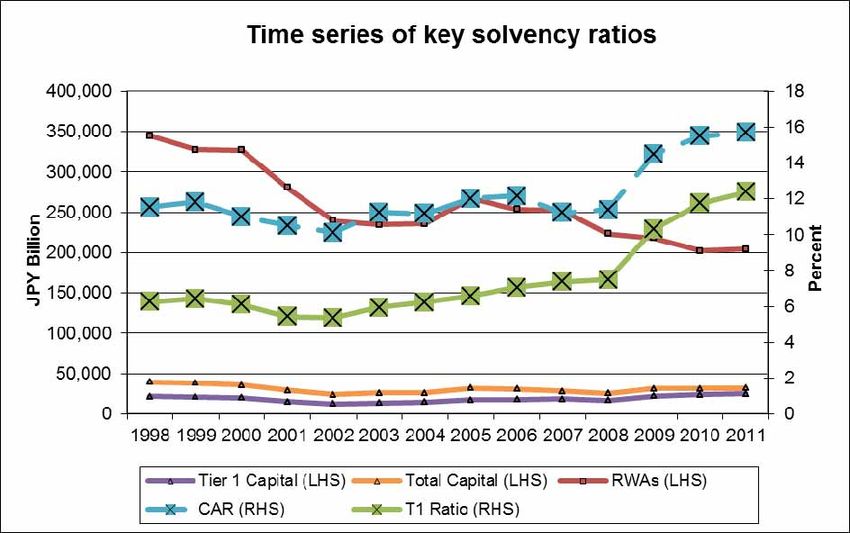
The capital adequacy ratios of Japanese banks and the subset of internationally active banks
alike have increased in recent years (Figure 1). For the internationally active banks, the total
risk-based capital ratio by end of 2011 was at 16.3 percent and the tier 1 risk-based ratio at
12.9 percent (Table 3, figures based on current Basel rules).
Risk-weighted Assets have slightly declined in recent years, and are predominantly held for
credit risk (above 91 percent), with market risk accounting for 3 percent and operational risk
for about 6 percent. With the introduction of Basel 2.5 and III, the portion for market risk will
increase moderately given the limited degree of banks’ activities in this area.
Capital increased slightly in recent years and its quality has increased markedly20 (79% of
total capital is tier 1), but the phase-in of Basel III will make part of capital ineligible, alike for
other countries.
17
See Bank of Japan, 2012, Financial System Report, April
(www.boj.or.jp/en/research/brp/fsr/data/fsr120419a1.pdf) and the Japan Financial Sector Stability Assessment
Update, IMF 2012 (www.imf.org/external/pubs/cat/longres.aspx?sk=26137.0), for further information.
18
Internationally active banks include bank holding companies and credit cooperatives which have one or more
foreign branches or subsidiaries.
19
For a list of G-SIFIs see www.financialstabilityboard.org/publications/r_111104bb.pdf, p.4.
20
From 2006 till 2011, the portion of tier 1 capital on total capital increased from about 58 percent to 79 percent.
12 Basel III regulatory consistency assessment (Level 2) - JapanThe sizeable increase of capital ratios since 2008 was predominantly driven by sizeable
capital raisings of the larger banks.21
Total assets in the banking system have increased slowly, in line with contained GDP growth
rates. Loans account for about 55 percent of total assets, which is broadly in line with most
peer countries. Bank profitability has been moderate and stable (return on equity was at 5-10
percent during recent years), alike the level of non-performing loans. Bank’s profitability is
rather low compared to peers, and could challenge the build-up of capital buffers in the
future. The basic liquidity ratios are sound, with banks benefiting from solid customer deposit
funding, but do not necessarily reflect the liquidity situation of banks more generally.22
Broader context of the Level 2 assessment23
The regulatory consistency assessment (Level 2) assessment for Japan is part of the
Financial Stability Board’s (FSB) mandate of monitoring the implementation of the agreed
G20/FSB financial reforms.24 The assessment for Japan, along with the European Union and
the United States, was part of the first “wave” of Level 2 assessments undertaken by the
Basel Committee.
The Level 2 assessment seeks to assess regulatory consistency with Basel II/III. Specifically,
the Level 2 process is meant to:
(i) identify the domestic regulations and provisions that are, in terms of content (ie,
scope and substance), not consistent with the standards agreed by the Committee
and
(ii) to assess the gaps potential impact on financial stability and on the international
level playing field.
It should also be noted that the Basel Committee’s implementation assessment programme
and the Financial Sector Assessment Program (FSAP), which is conducted by the
International Monetary Fund and the World Bank,25 have different scopes and focuses and
will complement each other. In particular, the Basel III Level 2 assessment programme
provides a narrower but deeper focus on the regulatory consistency with Basel III, while the
assessment of the Core Principles considers the full range of the regulatory framework and
supervisory practices.
21
For the total capital adequacy ratio, 26 percent (ie three quarters) of the total increase of 38 percent (from 11.4
in 2008 to 15.7 percent in 2011) resulted from higher capital, and the remainder from a decrease in RWAs.
For the tier 1 ratios, the increase by 65 percent (from 7.5 percent in 2008 to 12.4 percent 2011) was
predominantly (51 percent) driven by an increase in capital.
22
The crisis has shown that liquidity risks need to be assessed in a holistic manner.
23
See www.bis.org/publ/bcbs216.pdf for further information.
24
As such, it is consistent with the “Coordination Framework for Monitoring the Implementation of Agreed
G20/FSB Financial Reforms” put in place by the FSB.
25
The FSAP assesses country’s compliance with the Basel Committee’s Core Principles for Effective Banking
Supervision (BCPs). See www.imf.org/external/pubs/cat/longres.aspx?sk=26163.0 for the recently published
BCP assessment (in August 2012) as part of the Japan FSAP update.
Basel III regulatory consistency assessment (Level 2) - Japan 13Basel rules used for the assessment
The Level 2 assessment undertaken at this stage was benchmarked against most Basel II
and 2.5 standards, while Japan will finalise some of Basel III standards, such as those
applying to the G-SIBs, liquidity, provisions on leverage, and, to some degree to the rules on
capital buffers at a later date after the Committee concludes its review on any revisions or
final adjustments, consistent with the agreed phase-in arrangements.26
The report explicitly indicates which Basel Accord standards will be included in follow up
analysis (see the executive summary and the overview on compliance grading), and lists all
documents used for the assessment in Annex B.
Japanese Basel rules used for the assessment
The assessment is based on the latest rules published in Japan: By end March 2012, the
Japanese authorities published final rules implementing Basel III with respect to the definition
of capital and risk-weighted assets (RWA), while the Basel II and Basel 2.5 standards had
already been transposed into domestic rules previously (Tables 1, 2 in Annex B).
The Japan level 2 assessment was based on a variety of elements related to the Japanese
Basel rules: (i) the universe of Basel rules considered relevant, namely notices, supervisory
guidelines, inspection manuals and Q&As issued by the FSA to spell out the detailed
interpretation;27 (ii) meetings with the authorities and selected industry representatives
(during the on-site visit in July); and (iii) a self-assessment by the Japanese authorities.
The degree of formality of the rules (and the implications on whether they are binding) was
discussed both with the authorities and the private sector. The team also compared them
with general principles and took into account the country’s legal tradition. The conclusions
are discussed in the respective sections, but overall the review team considers the majority
of primary and secondary rules in Japan as binding. More information on the rules used for
the assessment and their hierarchy (in terms of formality) is given in Annex B.
The team has also assessed the appropriateness of the English translation of the Japanese
rules through comparison with the original text in Japanese based on a number of examples.
For the specific sections the review team has looked at, it was found that the translation is
robust and only minor issues were identified and subsequently clarified.
Finally, the Basel schedule for Japan is slightly different from other countries due to the
difference in terms of the fiscal year, which ends on 31 March rather than 31 December. The
review does not consider this difference to be a deviation from the Basel rules.
Data for materiality assessment
For all issues that were quantifiable,28 the Japanese authorities have provided data for all
internationally active banks subject to the specific gaps. A list of the internationally active
26
See www.bis.org/publ/bcbs216.pdf, p.8/9.
27
The notices constitute a formal part of the Banking Law. The FSA's supervision and inspection is conducted
based on the supervisory guidelines and inspection manuals. The Q&As represent the FSA’s official
interpretation of notices. Corrective action is taken and administrative sanctions are imposed in line with these
guidance documents.
28
Except for issues that are apparently very minor.
14 Basel III regulatory consistency assessment (Level 2) - Japanbanks that are subject to the Basel standards is shown in Table 4. The internationally active
banks constitute close to 60 percent of the banking sector assets. The largest, internationally
active broker-dealers also comply with the Japanese Basel rules on a voluntary basis. It
should also be noticed that the other banks in Japan are subject to local rules that are more
or less congruent with the rules for the internationally active banks, except for the minimum
capital level and the treatment of unrealised gains for capital purposes (see section 2.1 on
scope).
Preliminary report
On 11 June, the assessment team revealed the preliminary findings of its work as part of the
Basel Committee’s “Report to G20 Leaders on Basel III Implementation”.29 The initial
assessment in June highlighted the same areas of potential gaps (definition of capital, Pillar
1 and 2) as identified by now and outlined that these areas would be subject to follow-up
analysis (including during the on-site visit). The report concluded that the rules were in
“broad consistency with the majority of the sections of the Basel rules”.
On-site visit
From 4 to 6 July 2012, the assessment team held an on-site visit at the premises of the JFSA
in Tokyo. The team met with various representatives of the FSA and the BoJ. In addition, the
assessment team met with representatives of the industry (see Annex C for further
information).
2. Detailed findings
In the next sections, the detailed assessment findings are presented together with an
assessment of their materiality. The sections correspond with the sections in the overview
table of compliance grading above.
As remarked in the foreword, only deviations that could lead to a less robust capitalisation of
the banking sector are reported. Areas of compliance are not explicitly addressed (and
discussed), nor are areas where the Japanese approach would be super-equivalent vis-à-vis
the Basel standards. Areas where the domestic rules strengthen the minimum requirements
have also not been taken into account in the section gradings.
The following findings are not in order of importance, but in the order of assessment through
the relevant Basel rules texts.
2.1 Scope of application
Section Grading Compliant
Summary In terms of scope, the team has observed one finding, namely in terms
of the definition of internationally active banks. Discussions with the
29
See www.bis.org/publ/bcbs220.htm, pages 10 to 13.
Basel III regulatory consistency assessment (Level 2) - Japan 15authorities on materiality (which included data) indicate that the issue is
not material.
Overview of findings by Basel paragraph:
Basel paragraph no Paragraph 20–24, revised framework
Reference in the Articles 1, 2 and 3 of FSA Notice “Internationally active bank: a bank
domestic regulation which calculates the capital adequacy ratio (...) in article 2”
Art 2 : “(...) a bank that has overseas business locations”
Findings The 2006 Basel Agreement (Basel 2) foresees that Basel rules apply to
internationally active banks, without however defining the concept. In
the JFSA’s Administrative notice, an internationally active bank is
restrictively defined as a bank that has one or more overseas business
locations.
Although such a definition does not explicitly contradict Basel rules –
which do not provide any specific definition, it may seem in
contradiction with the spirit of the Basel agreement. A purely domestic
bank with no establishment abroad may still compete with foreign banks
in foreign markets – it is not necessary to own a branch or a subsidiary
in a foreign country to be internationally active and provide financing on
a global scale, such as by means of cross-border lending.
In the case of Japan, the impact of this rather restrictive definition is not
material, at least for now, as banks with noteworthy oversees
operations are the internationally active banks, who own at least one
subsidiary or branch abroad. More generally, the sample of banks with
oversees activities has been stable (while their activities have been
growing in recent years) and cross-border lending usually constitutes
intra-group lending. Cross-border lending activities of domestic banks
are monitored on a quartely basis by the authorities. These appear to
be very limited.
The rules for local banks and internationally active differ in terms of the
minimum capital ratio (which is significantly lower for local banks at 4
percent) and in terms of the recognition of unrealised gains. Hence,
there would, in principle, be some potential for a gap for now (although
it appears highly unlikely that a bank would establish business overseas
based on cross–border lending only).
Materiality The review team has discussed and assessed the finding (which is not
a formal gap) and found that it is not material.
2.2 Transitional arrangements
Section Grading Compliant
Summary No deviations vis-à-vis the Basel framework have been found.
However, due to differences in the fiscal year the implementation in
Japan deviates from the one in other countries by 3 months (due to the
year end being on 31 March rather than 31 December).30
30
The transitional arrangements do, in principle, also comprise the grandfathering of capital instruments (Para.
94f), see section 1.2.3, but have been assigned to the rules on capital (consistent with the other Level 2
analysis).
16 Basel III regulatory consistency assessment (Level 2) - Japan2.3 Definition of capital
Section Grading (Largely Compliant)
Summary The review team identified two deviations from the Basel standards,
while a few other issues identified earlier in the assessment process (the
treatment of additional tier capital; detailed rules for netting for some
elements of capital; some additional issues related to the definition of
capital) have been implemented based on secondary legislation in June
2012.
While the team recognises the fact that the recently issued secondary
legislation appears to be binding, they are less formal than primary
regulation.
The team has discussed the materiality of the identified gaps with the
authorities. One issue (grandfathering of state–aid instruments) is not
relevant for any bank for now, but leaves a potential window of
opportunity for the coming months till end March 2013. The gap in terms
of the loss absorption of additional tier 1 capital and tier 2 capital (related
issues pertinent to paras 55 and 58) is not considered material.
The implementation of the rules related to the PON will be assessed at a
later stage.
Overview of findings by Basel paragraph:
Basel paragraph no Paragraph 55
Reference in the Art. 6 para 4
domestic regulation
Q&A’s (as of June 2012)
Findings The Japanese legislation (Art. 6 para 4 (v)) allows redeeming
instruments “in cases where, considering the purpose of the issuance,
unavoidable reasons are found for the redemption before the date on
which five years have passed from the issuance”. The only exemptions
from five year minimum non-call period are a tax or a regulatory call as
set out in FAQ No. 15 for AT 1-instruments. The FSA clarified in the
Q&As that in addition to a regulatory or a tax call, a call in case of
delisting of issuer will be considered as “unavoidable reasons”.
As regards the triggering of the loss absorption mechanism of Additional
Tier 1 instruments, the Japanese Supervisory Guidelines give banks the
possibility to avoid the write down or the conversion of the instrument, if
the bank submits a plan to the FSA, which contains measures that are
considered reasonable for ensuring that the CET 1-ratio will exceed the
trigger level of the instrument going forward. Where, based on such a
plan, a bank obtains approval from the FSA, it may stop the write down
or conversion from becoming effective.
While the possibility to avoid the write down or the conversion of a
capital instruments once the trigger is hit by submitting a plan which sets
out remedial actions to the relevant supervisor is not foreseen in Basel
III, the assessment team was not made aware that the authorities intend
change the approach currently chosen with respect to this issue.
Materiality The review team has not explicitly quantified the gap but has discussed
the issue in detail with the authorities and considers it as insignificant
and thus not material.
Basel paragraph no Paragraph 58
Reference in the Art. 7 para 4 (v)
domestic regulation
Q&A’s (as of June 2012)
Basel III regulatory consistency assessment (Level 2) - Japan 17Findings The recognition criteria for Tier 2 instruments as transposed in Art. 7
para 4 (v) of the Japanese legislation allow a call option “in cases where,
considering the purpose of the issuance, unavoidable reasons are found
for the redemption before the date on which five years have passed from
the issuance”. The FSA clarified in the Q&As that in addition to a
regulatory or a tax call, a call in case of delisting of issuer will be
considered as “unavoidable reasons”.
Materiality The gap is insignificant and thus not material.
Basel paragraph no Paragraphs 94f
Reference in the Art. 1, Art. 2 para 1 and Art. 4 of the Supplementary Provisions for Basel
domestic regulation III
Findings Para 96 of the Basel III text stipulates that only those capital instruments
will qualify for grandfathering, which were issued before 12 September
2010. However, as regards state aid instruments, the treatment of which
during the transitional period is set out in para 94 (f), Art. 4 of the
Supplementary Provisions for Basel III allows for inclusion of all
instruments issued “prior to the Application Date” into the
grandfathering, with the Application Date defined in Art. 2 para 1 in
conjunction with Article 1 as being 31 March 2013 (ie, end 2012, in
principle).
This postpones the cut-off date for state aid instruments to be included
in the grandfathering by 2.5 years and might give room for banks to
meet the new capital requirements by frontloading state aid capital
instruments, which, according to the Japanese legislation, would only
have to meet the pre-Basel III recognition criteria for Tier 1 in order to be
eligible as CET 1 until 31 March 2018.
Based on follow-up discussions with the Japanese authorities no bank
has used the window of opportunity for now to issue such instruments,
and this is not foreseen to be the case in the remaining period until 31
March 2013.
Materiality The gap provides banks with a potential window of opportunity, but as it
is not expected that this opportunity will be used in the remaining time
the gap is not material.
Loss absorbency at the point of non-viability (PON)
Reference in the Rule not yet implemented
domestic regulation
Findings According to the discussions with the JFSA during the on-site visit and
follow up discussions more recently, the JFSA intends to implement the
contractual approach rather than the statutory approach as originally
envisaged. Provided that the rules are implemented as currently
foreseen, no gaps are identified. A final judgement on this matter will be
subject to follow-up analysis.
18 Basel III regulatory consistency assessment (Level 2) - Japan2.4 Pillar 1: minimum capital requirements
2.4.1 Credit risk: standardised approach
Section Grading Compliant
Summary In terms of the standardised approach for credit risk, the assessment
team has identified two minor issues. Both issues are not material.
Overview of findings by Basel paragraph:
Basel paragraph no Paragraph 65, revised framework31 (Claims on securities firms)
Reference in the
Article 64
domestic regulation
Findings The risk weight to be applied to the exposures to a Type 1 Financial
Instruments Business Operator (securities firm) that is supervised on a
solo basis is foreseen to be treated as exposures to Deposit Taking
Financial Institutions under Article 63, and not a corporate exposure.
However, the impact of the deviation is minor.
Materiality The team has not explicitly quantified the impact, but the discussions
and clarifications during the on-site visit indicate that the gap is not
material.
Basel paragraph no Paragraphs 189–201 as amended by the revised framework32
(Guarantees and credit derivatives)
Reference in the Articles 118,119,120,121,122,124,125,126,127.128, 129,130(1) and
domestic regulation 251(2)
Findings The Japanese Basel rules miss the provision in Accord paragraph
191(d), which says credit derivatives allowing for cash settlement are
recognised for capital purposes insofar as a robust valuation process is
in place in order to estimate loss reliably.
Materiality The team has not explicitly quantified the impact, but the discussions
and clarifications during the on-site visit indicate that the gap is not
material.
2.4.2 Credit risk: internal ratings-based approach
Section Grading Compliant
Summary The implementation of the IRB is closely aligned to the Basel
framework. The only gap identified during the assessment is that the
Japanese rules do not explicitly require human judgement and oversight
for the use of models. The issue is not quantifiable, but not considered
material.
31
New paragraph 689(iv) introduced by Basel II.5.
32
Paragraph 195 amended by Basel III (paragraph120).
Basel III regulatory consistency assessment (Level 2) - Japan 19Overview of findings by Basel paragraph:
Basel paragraph no Paragraphs 394–421 as amended by the revised framework33
(Rating system design)
Reference in the Articles 149,179,180,181,182,183,184,185,186,187, 188,189,190 and
domestic regulation 191
Findings The Basel Accord says sufficient human judgment and oversight is
necessary for use of models, while the Japanese rules do not mention
“human judgment” per se, but rather point to the quantitative validation
processduring the IRB model approval.
Based on the discussion with the authorities, some degree of human
judgment is part of the process and the authorities validate it’s
appropriateness through the IRB model approval process, but not
explicitly outlined in the rules.
Materiality While the issue is not quatifiable, the team considers the issue non-
material.
2.4.3 Securitisation framework
Section Grading Largely Compliant
Summary In terms of securitisation the team identified two differences. Based on
evidence received by the authorities, there is no impact fo the sample of
internationally active banks for the issue on re-securitisation, and a very
minor impact for other banks. However, the issue has some potential to
be more material, which is also the case of another general issue that is
not quantifiable.
Overview of findings by Basel paragraph:
Basel paragraph no Paragraph 538–552 as amended by the revised framework34 (Scope
and definitions)
Reference in the Articles 1(ii),(ii–ii), (xvi), (lxv), (lxvi), (lxvii), (lxviii), (lxix), (lxx), (lxxi), (lxxii),
domestic regulation (lxxv), (lxxvi) and (lxxvii)
Findings The review team found that certain type of exposure is excluded from
the definition of re-securitisation exposures provided under Japanese
rules (see definitions, Article 1, (ii)–2(b), a portion of which is copied
below for reference), which appears to be a deviation from the Accord
paragraph 541(i).
Specifically, the exception applies to exposure that falls under article 1,
(ii)–2 (b)–“Securitization Transaction conducted by the government of
Japan, Japanese local governments or the Japanese Government-
Affiliated Organizations prescribed in Article 61, paragraph (1)
(collectively referred to as the “State” in 1. to 3. below) with the main
purpose of facilitating the smooth functioning of financial services for
small and medium sized enterprises, and which satisfies all of the
33
New paragraph 415(i) added by Basel III (paragraph 112).
34
New paragraph 541 (i) as amended by Basel II.5
20 Basel III regulatory consistency assessment (Level 2) - Japanfollowing requirements:
1. the State retains the first loss position for the relevant
Securitization Transaction, as an Originator;
2. the State is to keep the accounts of the relevant Securitization
Transaction separately from other accounts based on laws
and regulations;
3. the State periodically publishes the default information of the
Underlying Asset of the relevant Securitization Transaction.”
Based on data provided by Japanese Authorities the impact is zero for
the internationally active banks. All banks that are affected are smaller
ones, and also for those banks the potential impact is very limited at
present (equivalent to 0.0002% of the total RWAs in the system).
Materiality The data analysis show that the finding is not material.
Basel paragraph no Paragraphs 566–576 as amended by the revised framework3536
(Standardised approach scope; risk weights; and exceptions to
general treatment)
Reference in the Articles 249 and 250
domestic regulation
Findings While Japanese Authorities’ rules do not require that the risk associated
with unrated commitment or credit enhancement in a second loss or
higher position be investment grade (or better), given the level of
overcollateralisation provided by originators, nearly all such
commitments and enhancements likely would meet the investment
grade requirement. The few instances where the associated risk may be
below investment grade are not considered material.
Materiality While the issue is not readily quatifiable, the team considers the issue
non-material.
2.4.4 Counterparty credit risk rules
Section Grading Compliant
Summary In terms of counterparty credit risk, the review team has found an issue
(non-implementation of the IMM), which is not a “real” gap as the current
treatment of risks using the standardised approach is appropriate. If the
IMM were to be adopted at a later stage, it would be subject to a follow-
up review.
Overview of findings by Basel paragraph:
Basel paragraph no 10–19, Annex 4
20–68, Annex 4 (as applicable to the IMM)
Reference in the Not implemented
domestic regulation
Findings In terms of the treatment of counterparty credit risk and cross-product
35
Paragraph 567amended by Basel III (paragraph 90).
36
Updated table on page 5 of Enhancements to the Basel II framework (July 2009).
Basel III regulatory consistency assessment (Level 2) - Japan 21You can also read


