BASA Regional Meeting - Dr. Scott J. Hunt, Executive Director of Field Relations Dr. John Richard, Deputy State Superintendent January 2021 ...
←
→
Page content transcription
If your browser does not render page correctly, please read the page content below
BASA Regional Meeting

Dr. Scott J. Hunt, Executive Director of Field Relations
Dr. John Richard, Deputy State Superintendent            January 2021
2
3

Three Core Principles   • Co-designing initiatives with educators
                          who serve the state’s most in-need
     Equity               students

                        • Applying an equity lens across the
                          Department’s work

                                                                4
Three Core Principles   • Partnerships with major associations and
                          other stakeholders to support students and
Partnerships              families

                        • Use data to tackle chronic absenteeism

                                                               5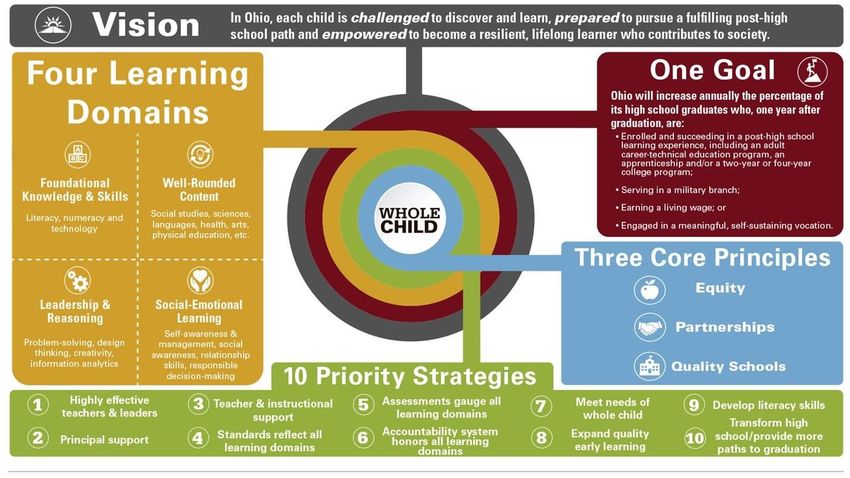
Three Core Principles   • Enhance Ohio Improvement Process
Quality Schools
                         • Launch a new Improvement Council

                                                              6
Flexible   Nimble

       Pivot

                    7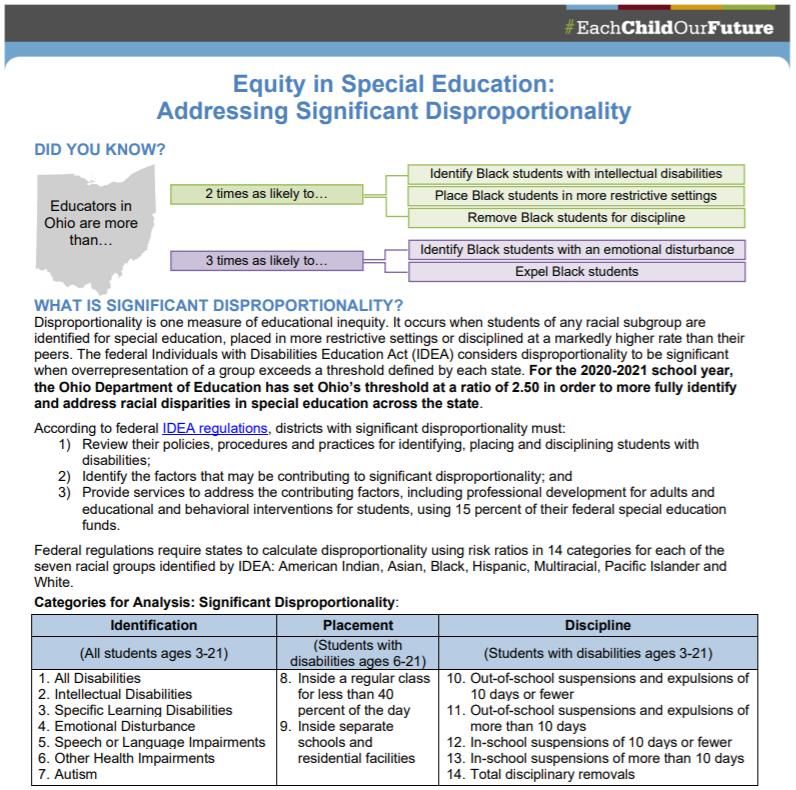
Reset and Restart Updates

   Reset and Restart Webpage

                               8
Educator Information & OPES

Assessments/Graduation

Special Education

RemotEDx

P-EBT

                         9
Educator Information & OPES

Assessments/Graduation

Special Education

RemotEDx

P-EBT

                         10
Educator Evaluations
May Elect Not to Conduct Evaluations
– Boards of education may elect not to conduct evaluations for the
2020-2021 school year for a teacher, school counselor, administrator
or superintendent if deemed impossible or impracticable.
May Not Use Student Growth Measures or Student Metrics
– No value-added, high-quality student data or student metric may be
used when conducting evaluations for a teacher, principal or school
counselor in 2020-2021 or 2021-2022.
11Virtual Meetups
Virtual meetups by the Office of Learning and Instructional Strategies continue to
support educators with professional learning during this time to:
– Provide a platform to network, share and gain new skills or strategies to help
students succeed while learning remotely.
– Help facilitate discussions on equitable learning opportunities and practices for
each child while partnering with educators and professional organizations to
promote quality schools and student success.
Upcoming topics include:
• Meet Teacher and Student Needs in Physical Education
• Courses that Address the Technology, Computer Science or Career Field
Technical Content Standards
• Reading Interventions in the Virtual Environment: A Community of Practice
http://education.ohio.gov/Topics/Learning-in-Ohio/OLS-Graphic-Sections/Resources
12Extension of Time for Licensure Renewal
• All licenses, permits and certificates previously set to expire on July 1,
2020, have been extended to July 1, 2021.
• All renewal requirements must be completed by July 1, 2021.
• Local Educator Preparation Programs are potential partners for the
recruitment of their educator candidate graduates.
– The Ohio Department of Higher Education Program Finder
13Professional Conduct
The Office of Professional Conduct has continued its publication, #ABConduct,
and developed three new tip sheets over the past six months. These tip sheets are
designed to provide educators guidance when facing ethical situations. Those tip
sheets include:
– Remote instruction – provides guidance to educators who are now teaching
remotely;
– Professional Boundaries and Personal Business – helps educators
navigate their education job with other employment they may have; and
– Mandatory Reporting – released in December and covers educators’
responsibility when handling allegations of neglect or abuse.
14Ohio’s Principal Evaluation System (OPES) An introduction to OPES 2.0
The Why: OPES 2.0
• Ohio Standards for Principals were revised and adopted in 2018

• The current OPES 1.0 is aligned to the 2005 Ohio Standards for
  Principals

• By law, OPES must mirror OTES as closely as possible

• By aligning to OTES 2.0, adopting OPES 2.0 will be easier for
  administrators

                                                                   16
Ohio Principal Evaluation System 2.0
Tentative Timeline:
• Currently collecting feedback from stakeholders
• Anticipate to ESB and SBOE for approval by the end of this school year
• Considering optional implementation for 2021-2022
• Possible full implementation in 2022-2023
17OPES 2.0
Items that have been revised and aligned with OTES 2.0:
– OPES 2.0 Evaluation Framework
– OPES 2.0 Levels of Performance
– OPES 2.0 Principal Performance Evaluation Rubric (with
updated 2018 Ohio Standards for Principals)
– Criteria for Using High-Quality Student Data for Principal
Evaluation
18Resources
• OPES 2.0 Narrated Presentation Link:
https://drive.google.com/file/d/1VUbIVwtRET99RNQc2Ff8hOjZTX2cPIiE/view?ts=5fdb8515
• OPES 2.0 Feedback Form Link:
https://forms.gle/kMT9cnprn1fgcuEf8
• Please also refer to the OPES 2.0 Draft Framework/Model Word Document
• Please feel free to reach out if you have additional questions:
– Mark Jones; OAESA Associate Executive Director mjones@oaesa.org
– Becky Hornberger; OPES 2.0 Workgroup Facilitator
Rebecca.hornberger@cuchicago.edu
– Jill Grubb, Associate Dir. Office Educator Effectiveness jill.grubb@education.ohio.gov
19Educator Information & OPES
Assessments/Graduation
Special Education
RemotEDx
P-EBT
20Third Grade Reading Guarantee
Fourth Grade Promotion: No retention if the child’s principal and
reading teacher agree that other evaluations demonstrate academic
preparedness for fourth grade.
Reading Improvement and Monitoring Plans (RIMPs): Required to be
developed and implemented in the 2020-2021 school year.
District Reading Achievement Plans: Not required to be submitted to
the Department in 2020-2021.
Dyslexia Legislation: HB 436 requires annual dyslexia screenings
beginning 2022-2023 school year.
21Accountability/Report Card
• Performance on state tests still are factors in both federal and state
accountability systems.
• Potential for temporary waivers from state or federal accountability
consequences
• The US Department of Education released one-year flexibility options
through an ESSA Addendum process.
– Due February 1
– Includes options for states to extend long-term goals, delay federal
school improvement identification by one year, and adjust weighting
or methodologies for certain indicators as needed to address missing
data from the 2019-2020 school year.
• Recent Ohio legislation instructs ODE to only publish report cards to
the extent required by federal law.
22State Testing
• The Department emphasizes that districts first and foremost should be
attentive to the safety of students and staff.
• Continue administration of the fall end-of-course exams.
• The test window has been extended an additional week in January
and now runs from Nov. 30 to Jan. 15.
– The 15 consecutive days of testing is flexible based on learning
mode and can count days when students are in buildings.
– Districts could wait until the spring 2021 test administration window
to complete the required assessments.
23COVID-19 Flexibility for Missed
Assessments
• Flexibility for 2020 Spring/Summer missed assessment windows
(HB 164 - Section 12) allowed districts and schools to:
– Substitute an eligible student’s final course grade in an eligible course
for the corresponding high school end-of-course examination.
– Students who completed qualifying courses in the 2019-2020 school
year also may elect to take the associated end-of-course
examinations in a future administration.
• HB 404 provided flexibility for missed diagnostic assessments and
health screenings in Fall 2020.
24Course Grade Substitution Eligibility
• Students were eligible for this flexibility if they were either:
– Taking a qualifying course AND scheduled to take an end-of-
course examination for the first time in the 2019-2020 school
year but did not take the test because the administration of
the examination was canceled.
OR
– Scheduled to retake an end-of-course examination in the
2019-2020 school year and did not retake the test because
the administration of the examination was canceled.
25Grading Scale
FINAL COURSE GRADE SKILL LEVEL / POINT VALUE
A Advanced and Competent/5
B Accelerated and Competent/4
C Proficient and Competent/3
D Basic and Not Competent/2
F Limited and Not Competent/1
262020-2021 Graduation Flexibility
• To date, there has been no flexibility given to graduation
options for the Class of 2021.
• If there is flexibility provided, we will share information
widely and as quickly as possible.
27Other Recent Legislation
• New methodology for traditional EdChoice Scholarship
program for the 2021-2022 school year. Application
window opens March 2, 2021.
• Extends to the 2021-2022 flexibility in conducting teacher
and principal evaluations and prohibition on using
student academic growth data in employee performance
evaluations.
28Office of Federal Programs COVID Relief Updates
CARES Act website
1. CARES Act signed March 27, 2020
– $31 billion for education
– Two main K-12 education programs
• Governor’s Emergency Education Relief (GEER)
• Elementary and Secondary School Emergency Relief (ESSER)
2. 2021 Consolidated Appropriations Act (HR 113)
– $82 billion in additional education COVID relief
• Largest in history discretionary K-12 fund
• Very streamlined and flexible (more details to come on states
implementation)
29Office of Federal Programs ED STEPS Updates
ED STEPS website
• Expecting to begin the procurement and selection of vendor in early
2021 (new technology systems for e-planning)
– The system components will be designed, developed and rolled out
in phases over next several years
• Piloting the planning and approval process through existing systems
– One Needs Assessment prototype
– 39 pilot districts (wide variety of LEAs) began three-year planning
cycle this past year
– All districts assigned to 1 of 3 three-year planning cohorts
30Educator Information & OPES
Assessments/Graduation
Special Education
RemotEDx
P-EBT
31Disproportionality & Support for Districts
Special Education Profiles: new section
and data
Each Child, Our Future & Ohio’s Whole
Child Framework
Trauma-Informed Practices & Positive
Behavioral Interventions & Supports
Culturally Responsive Practices Training
& Resources
32Disproportionality
Resources
Equity in Special Education:
Disproportionality
Overview of requirements,
supports, and exemplars
Video walkthrough, FAQ, technical
doc, and fiscal guidance
OEC.monitoring@education.ohio.gov
33Special Education Profiles
The 2020 and 2021 Special Education Profiles are being released in two
phases:
• The first release on Dec. 2020 contains all indicators that may have
required actions. This includes student outcome, compliance,
disproportionality and survey indicators.
• The second release, targeted for April 2021, will add
informational student outcome indicators that do not have required
actions.
34Alternate Assessments
The Office of Assessment and Office for Exceptional Children have
recently released a new Alternate assessment tool and Frequently ask
Questions:
• Tool serves as a guide and support individualized education program
(IEP) teams in determining whether a student is most appropriately
assessed with an alternate assessment
• The tool DOES NOT override IEP team decisions
• The IEP team has final decision on any supports, teaching strategies
and assessment needs for each student
35Educator Information & OPES
Assessments/Graduation
Special Education
RemotEDx
P-EBT
36Components of RemotEDx
Coordinating Council (State Level Coordination)
Function: Coordinates and integrates RemotEDx partners to ensure maximum collective impact in remote
education.
Members: Representatives from ODE, ESCs, Management Council and ITCs, innovative student learning and
remote education exemplars (Ohio STEM Learning Network, TIES, Johns Hopkins University, etc.), philanthropy
and business. Subgroups representing students, parents and other key perspectives.
Exchange (State Level Tool for Schools and Districts)
Function: A user-friendly venue that showcases high-quality remote education models, curricula, instructional materials, professional learning and other important items.
Expected users: Ohio’s schools, districts, ESCs and innovative student learning and remote education exemplars and partners.
Powered by: INFOhio
Support Squad (Direct Supports for Schools and Districts)
Function: Provides in-need schools and districts with direct support and job- Connectivity Champions (Direct Supports for Schools and Districts)
embedded professional learning for remote education. This includes supports to Function: Offers on-the-ground assistance to help schools and districts overcome
ensure students are engaging in remote education. internet connectivity and technology challenges. Links districts to state-level tools like
Powered by: ESCs and innovative student learning and remote education BroadbandOhio Connectivity Grant and DAS’s RFI for lowest cost technology.
exemplars. Leverages assets already in place: Remote Learning Alliance,, Powered by: Management Council and ITCs
Reframing Education Initiative, Ohio STEM education platform, etc.
Connecting, collaborating and sharing through Building capacity and accelerating innovation
RemotEDx Learning Network & Academy Collaborative Fund for Educating
Remotely & Transforming Schools
37RemotEDx
Seeks to enhance, expand and scale quality remote, hybrid and blended
education models.
RemotEDx Aims:
• Short-term: Coordinate remote education partners to support schools
and districts.
• Mid-term: Transform remote caring, teaching and learning opportunities
to ensure whole child wellness and success in a remote setting.
• Long-term: Reimagine how to plan and deliver instruction using a
platform that transfers learning from in-person to a remote, hybrid
or blended model instantaneously and in a way that preserves the
sequence of learning.
38RemotEDx
Convenes Public and Private Partners to ensure coordinated direction, aligned
resources and greater impact:
• School and district leaders • High-quality instructional material
creators
• Information Technology Centers (ITCs)
and INFOhio • Personalized, inquiry-based learning
experts
• Educational Service Centers
• Professional learning designers
• Internet and broadband connectivity
providers • Learning network experts
• Remote education innovators
39RemotEDx
RemotEDx Exchange powered by INFOhio is live!
• Through the Exchange, parents and educators have easy access
to all the supports, services and resources available
through RemotEDx including assistance from the Connectivity
Champions and services offered by Ohio’s Educational Service
Centers.
• Explore the contents and resources available on the Exchange
at https://remotedx.infohio.org
40Educator Information & OPES
Assessments/Graduation
Special Education
RemotEDx
P-EBT
41P-EBT: Pandemic Electronic Benefits Transfer
• The benefit is for students who qualified for free or reduced meals in either
school year 2019-2020 or 2020-2021 or attends a community eligibility
provision school and the school is either in a hybrid or remote learning
model.
• Schools should make National School Lunch Program applications available
and certify students.
• Additional guidance issued Dec. 20.
• The P-EBT covers days students learn from home and/ or do not have
access to participate in school meals at the school building.
42P-EBT: Pandemic Electronic Benefits Transfer
• The benefit is $5.86 times the number of remote learning days for any given
student.
– $5.86 is the value of a daily school breakfast and school lunch.
• Students can qualify students for P-EBT even if their school offers pick up
meal service.
• Schools will send their P-EBT data to an Information Technology Center
(ITC) beginning early January.
• P-EBT will be distributed every 2-3 months throughout the 2020-2021 school
year.
43Let’s stay connected!
scott.hunt@education.ohio.gov
john.richard@education.ohio.gov
614-905-2208 (Scott)
614-995-1985 (John)
Twitter: @DrSJHunt #InTheField
44Questions?
45Share your learning
community with us!
#MyOhioClassroom
Celebrate educators!
#OhioLovesTeachers
46@OHEducation
47You can also read


