HE WHENUA 2018 - NORTHTEC
←
→
Page content transcription
If your browser does not render page correctly, please read the page content below
He Whenua
  2018

            Page | 1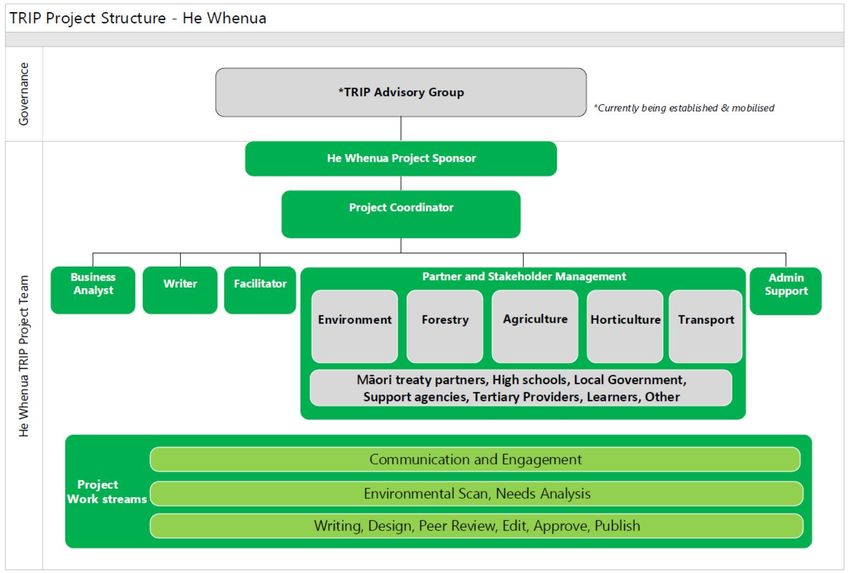
Contents

1     EXECUTIVE SUMMARY................................................................................................................ 3
    1.1      Regional Tertiary Investment .............................................................................................. 3
    1.2      Phased Approach................................................................................................................ 3
    1.3      Tertiary Education Commission........................................................................................... 4
    1.4      Our Region ......................................................................................................................... 5
2     SCOPE ........................................................................................................................................ 6
    2.1      He Whenua ........................................................................................................................ 7
    2.2      Out of Scope ...................................................................................................................... 7
3     COLLABORATION........................................................................................................................ 8
    3.1      Partners and Stakeholders .................................................................................................. 8
    3.2      Process - Bringing the plan together ................................................................................. 10
    3.3      Needs Analysis ................................................................................................................. 10
    3.4      Plan Writing ..................................................................................................................... 12
    3.5      Governance and Control ................................................................................................... 12
4     PLANNING................................................................................................................................ 13
    4.1      Project Team .................................................................................................................... 13
    4.2      Timeline ........................................................................................................................... 13

                                                                                                                                         Page | 2
1        EXECUTIVE SUMMARY

1.1       Regional Tertiary Investment

      This document describes how the region of Tai Tokerau will respond to the desire for closer links and
      collaboration between tertiary organisations, treaty partners, industry, and other partners and
      stakeholders when developing tertiary education investment plans for the region.

      Tai Tokerau will lead a new approach to develop and test a new iterative investment approach for our
      region. He Whenua is the first stage in a phased approach in 2018 for delivery from 2019. He Whenua
      will focus on the primary industries; forestry, agriculture, horticulture, the natural environment
      (including water) and also transport.

      The purpose of the Tai Tokerau Regional Investment Plan (TRIP) for tertiary education is to deliver the
      best educational outcomes whilst meeting the needs of Tai Tokerau region and its people. Stakeholders
      representing Māori Treaty Partners, Industry, Providers, Local Government, High Schools, Learners and
      Support Agencies are being engaged to collaborate around regional needs to develop a plan that
      delivers the best outcomes for the regions communities, industries, high schools, learners and their
      whanau.

1.2       Phased Approach

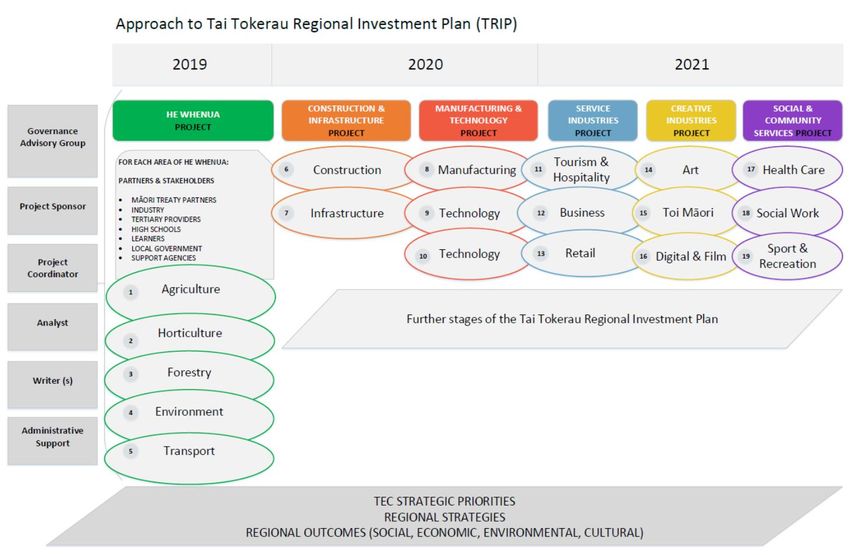
      The TRIP will be managed in a phased approach, illustrated below. This particular project responds to
      He Whenua in 2019 as the first stage.

                                                                                                    Page | 3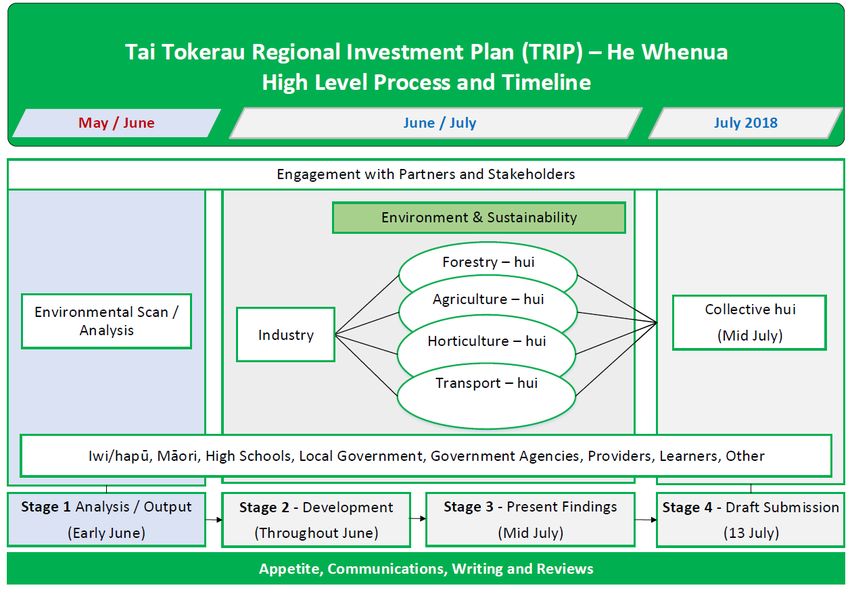
1.3        Tertiary Education Commission

      The Tertiary Education Commission (TEC) is committed to investing in a tertiary education system that
      works for all New Zealanders; as such, there is a commitment to key focus areas and achievement of
      parity for Māori and Pasifika learners. Until the end of 2019, the priorities of the current Tertiary
      Education Strategy (TES) are;

           1.   Delivering Skills for Industry
           2.   Getting at-risk young people into a career
           3.   Boosting achievement of Māori and Pasifika
           4.   Improving adult literacy and numeracy
           5.   Strengthening research-based institutions
           6.   Growing international linkages

      Some key areas of focus for the TEC are:
       Schools to Tertiary

       -    Improving the transition of Tai Tokerau school leavers into tertiary education either through a
            provider or through employment at an ITO.
                 o By 2021, 61% of all Tai Tokerau Northland school leavers are in tertiary education the
                     year after they leave school (from 56% in 2015 to 2016).
                 o By 2021, 55% of Māori school leavers in Tai Tokerau Northland are in tertiary
                     education the year after they leave school (from 49% in 2015 to 2016).
       -    Increase in the proportion of Tai Tokerau students enrolling in tertiary education programmes
            at level 4 and above.
                 o By 2021, 5-percentage point’s increase in the proportion of Tai Tokerau Northland
                     students enrolled in tertiary education programmes at level 4 and above.
       -    By the end of 2022, improve the participation and achievement rates for Tai Tokerau learners
            to the national average for all learners.
                 o This will contribute to the goals of the TEC’s parity project.

       Primary Sector

       Growing key areas of provision and encouraging more learners to pursue opportunities in the
       primary sector. Growing provision in these areas will require TEOs to work together and with
       schools. This includes ITO and ITP relationships for Levels 3-5 provision.
       - Level 4 apprenticeships and related pathways.
                   o Opportunities for Level 4 apprenticeships are growing in some primary industries.
                        TEC want to invest in apprenticeships and pathways to them, and to support
                        learners’ progress to higher levels.
       - Levels 5-6 provision related to management capability in the primary sector.
               o Management capability is critical to growing productivity.
       - Primary sector-specific degree provision.
               o Degree-level provision gives graduates the skills they need to integrate a wide range of
                    technologies into primary industry systems. Interdisciplinary delivery models are
                    particularly effective at building these skill sets.
       - Primary sector-specific Levels 8-10 provision
               o This aims to enhance innovation capability, and enable long-term sustainable growth.

                                                                                                     Page | 4
Achievement of Parity

       i) Māori Achievement:
       TEC has set an organisational target that, by 2022:
           - TEC will fund provision in which Māori learners participate and achieve on a par with other
                learners.
           - Māori participation in tertiary education will be at levels and in fields of study that over
                time, should deliver parity of post-study outcomes for these learners.

       ii) Pasifika Achievement:
       Pasifika performance improved in recent years, but there is a significant and enduring gap between
       performance for Pasifika and for non-Māori/non-Pasifika at most levels. The gap is especially
       pronounced at level 7 and post study.

       TEC still have work to do to close the gap between Pasifika and non-Māori/non-Pasifika learners. TEC
       will work with the region to ensure the TRIP has:
            - key stakeholders being involved in the development of the Investment Plan.
            - leadership, governance and management commitment to achieving parity outcomes.
            - clear involvement of key Pasifika leaders in development of the Investment Plan.
            - a clear commitment and actions to attain parity of both participation and achievement
                 (especially at level 4 and above) by the end of 2022, such as:
                         o evidence-based initiatives that will make a much bigger contribution to
                              reducing participation, retention and achievement disparities
                         o delivery models better suited to the realities of Pasifika learners’ lives (e.g.,
                              secondary-tertiary pathways, workplace-facing provision, recognition of prior
                              learning and short courses).

1.4       Our Region

      Tai Tokerau has many tertiary education providers serving communities from Auckland to Whangarei
      and the mid to the far north. Within the scope of He Whenua covering the primary industries and
      environment, there is one Institute of Technology and Polytechnic (ITP), two Wānanga, five Private
      Training Organisations (PTEs) and four Industry Training Organisations (ITOs) that operate in and serve
      our region; delivering quality education to communities through certificate, diploma, graduate diploma
      and degree level programmes.

      Northland has two regional economic growth strategies, both of which will underpin the He Whenua
      TRIP;
          - He Tangata he Whenua he Oranga (Māori Economic Growth Strategy for Tai Tokerau).
          - Northland Economic Regional Development Plan.

                                                                                                    Page | 5
2 SCOPE
This TRIP is the first of its kind in New Zealand and is being launched in Tai Tokerau.
The plan will prioritise the tertiary education needs of the region and its learners and the necessary
qualifications and training to be offered by providers and funded by the TEC. The plan will better
connect the needs and aspirations of Tai Tokerau with how the TEC invests in education. This will in
turn be reflected in providers coming together collaboratively to deliver those education services.
The He Whenua project will develop a framework for regional investment planning that represents and
demonstrates:
- Communities, Treaty partners, local industry, employers, and local government working
together to address the needs of Tai Tokerau Northland.
- Planning and coordination with other TEOs that deliver tertiary education in Tai Tokerau
Northland.
- Work with schools to better align education programmes between secondary and tertiary
and improve transition to higher-level tertiary programmes that deliver good graduate
outcomes. This includes using the Career Development Benchmarks as a supporting tool.
- Early engagement with secondary school students in tertiary education and career
discussions. Sharing of information and data in an integrated, efficient and user-friendly way.
- Review of programmes delivered by TEOs, industry, and employers in the region. Examining
how tertiary education programmes for 2019-2021 will meet the needs identified in regional
economic, social and industry plans and opportunities.
- Consideration to opportunities for joint delivery of tertiary education programmes, joint
support of tertiary students in Tai Tokerau and joint career development services.
- Consideration to ways of support and delivery of tertiary education programmes in the work
environment for school leavers that go straight into employment and for those for whom
industry training is not an option.
Page | 62.1 He Whenua
The first focus area of the TRIP chosen is He Whenua, and will include:
- Environment
- Forestry
- Agriculture
- Horticulture
- Transport
2.2 Out of Scope
- This project does not address the implementation and monitoring requirements post TRIP
He Whenua final submission 20 August 2018.
- This particular project is not responsible for further stages of the Tai Tokerau Regional
Investment Plan.
Page | 73 COLLABORATION
High-level engagement and discussions around the TRIP has been taking place throughout May and
June with He Whenua partners and stakeholders across the region and external to the region.
The TRIP concept has been shared with senior business leaders and key partners and stakeholders from
Industry, Māori, and some support agencies across Tai Tokerau. Positive support continues, and wider
communication is in progress to include high schools, providers, local government and regional support
agencies.
Tailored communications are being created to support this process. Initial contact is taking place
through letters, phone calls, and followed up by individual and group hui across the large stakeholder
groups.
Information, commitments and discussions are being documented and captured in a central repository
that will be used a reference tool when undertaking the plan narrative.
The purpose of partner and stakeholder engagement will be to:
- Discuss and agree tertiary education needs based on what is best for the region and its
growth.
- Re-validate findings of the Tai Tokerau environmental scan.
- Seek support, input and statements of endorsement from stakeholders as to the proposals
developed in the plan.
3.1 Partners and Stakeholders
Partner and Stakeholder groups have been identified for the purpose of engagement around the TRIP
for He Whenua.
Many partners and stakeholders in the region are not directly impacted by the He Whenua TRIP, but
are being communicated with to update on the overall activity ahead of further stages. A table of He
Whenua partners and stakeholders are detailed on the following page, although this table is not
exhaustive and will continue to develop.
Page | 8Māori (Treaty Partners) Industry and Employers Tertiary Providers/ITO’s High Schools Local Government Government Agencies Learners
Far North Forestry Forestry Far North Far North District Council Ministry of Education Student Voice / Reps
Ngāti Kuri Trust Board Incorporated Hancock Forest Management Competenz Kura Kaupapa Māori o Te Rangi Aniwaniwa (KAITAIA) Whangarei District Council Tertiary Education Commission (TEC) Māori & Pasifika
Te Aupōuri Māori Trust Board Rayonier Regent Training Centre Rangiawhia Kura Kaupapa Māori (KAITAIA) Kaipara District Council Ministry of Social Development Youth
Waipapa Pine NorthTec Te Kura o Oturu (KAITAIA) Northland Regional Council Ministry for Vulnerable Children / Oranga NEETS
Te Rūnanga a Iwi o Ngati Kahu
Kiwi Lumber Agriculture Kaitaia College Tamariki School leavers
Te Rūnanga o Te Rarawa Tai Tokerau Māori Forests Inc Taratahi Ministry of Women's Affairs International
Taipa Area School
Moko Foundation Northland Forest Managers – Kerikeri NorthTec Okaihau College Ministry for Primary Industries
He Korowai Trust NZ Forestry Ltd Horticulture Abundant Life School Te Puni Kokiri
Te Hiku Social Accord Northern Forest Products Open Polytechnic Mid North MP for Whangarei
Mid North Rosewarne NorthTec Te Kura Kaupapa Māori o Taumarere MP - Northland
Ngati Hine Forestry Trust Croft Pole Distributors Environment (MOEREWA) MP for Te Tai Tokerau
Ihaka Open Polytechnic Te Kura Kaupapa Māori o Kaikohe Department of Conservation
Ngati Hine Rūnanga
Forest Protection Services Unitec Institute of Technology Bay of Islands College Northland Regional Corrections
Ngati Hine Health Trust BBS Timbers NorthTec New Zealand Police
Northland College
Te Rūnanga A Iwi O Ngāpuhi PF Olsen Transport Northland District Health Board
Kaikohe Christian School
Kotahitanga PTE Westpoint Management MITO Kerikeri High School Northland Inc.
Te Kapotai Symbiosis Tree Services Competenz Springbank Northland Chamber of Commerce
He Iwi Kotahi Tahoa Trust Agriculture NorthTec East Creative Northland
Ngati Rangi Development Trust SilverFern Farms Other Te Kura Kaupapa Māori o Whangaroa Work Ready
Fonterra Primary ITO Whangaroa College Te Ha Northland Health
Tuhoronuku
Primary ITO Industry Training Federation West Youth Services
East Taratahi People Potential Te Kura Taumata o Pangaru Area School (KOHUKOHU)
Te Rūnanga o Whaingaroa Huruiki Farms The Skills Organisation Te Kura Kuapapa o Hata Maria o Pawarenga
Te Rūnanga o Ngati Rehia Plant & Food (prev HortResearch) Te Matarau Education Trust (HOKIANGA)
West Federated Farmers Te Kura Kaupapa Māori o Te Tonga o Hokianga
Hokianga o Nga Hapu Whanau Agriculture Forum Opononi Area School
Ben Smith - Farmer / Driver Broadwood Area School
Te Uri o Hau Settlement Trust
Balance Agri Nutrients Kaipara
Pouto Topu A Trust AGFIRST Dargaville High School
Pouto 2F Trust Beef & Lamb NZ Ruawai College
Te Uri o Hau Incorporated PGG Wrightsons Otamatea High School
Tamihana Trusts Farmlands Otamatea Christian School
Whangarei Kia Ora Honey Limited Whangarei
Ngātiwai Trust Board Dairy training NZ Te Kura Kaupapa Māori o Te Rawhiti Roa (TIKIPUNGA)
Tari Honey Te Kāpehu Whetū (WHANGAREI)
Ngātiwai Education
Horticulture Pompallier College
Ngati Hau Trust Board Onyx Horticulture Whangarei Girls High School
Ngati Hau Health Gold Kiwifruit Orchard Whangarei Boys High School
Patuharakeke Hapu Huanui Orchards Tikipunga High School
Te Parawhau Hapu Environment Excellere College
Māori Trustee Department of Conservation Kamo High School
Te Matarau Education Trust NIWA Christian Renewal School
Northland Regional Council He Mataariki
Te Rununga o Ngati Hine
Transport Huanui College
Ngati Hau Health and Social Services Fonterra Mangakahia Area School
Ngātiwai Trust Board Road Transport Association NZ Whangarei South
Te Uri o Hau Settlement Trust Toll NZ Bream Bay College
Te Hiku Representative Semenoff Group Tauraroa Area School
Te Kahu o Taonui Northern Rural Haulage Rodney College
Clements Contractors Mahurangi College
Ngātiwai Trust Board
Smith & Davies NZ Ltd Orewa College
Te Rūnanga A Iwi O Ngāpuhi NZ Couriers Mangawhai Beach School
Te Rūnanga o Whaingaroa Fulton Hogan
Te Rūnanga o Ngāti Whātua Road Transport Association NZ
Other
Refining NZ
Northport
Northpower
Top Energy Group
Sport Northland
Creative Northland
Page | 93.2 Process - Bringing the plan together
There are three main work streams of this project to bring together a single submission for the
regions tertiary investment plan, He Whenua;
1) Needs Analysis – Delivered through an environmental scan and landscape analysis to inform
stakeholder engagement and plan development.
2) Collaboration (Stakeholder and partner engagement) – Managed through a variety of
methods; individual and collective hui, phone calls and letters.
3) Plan Writing – Aligned to the two regional growth strategies, underpinned by a kaupapa
tikanga framework and peer reviewed.
3.3 Needs Analysis
Information from key documents and plans will help to inform the Tai Tokerau Regional Investment
Plan (TRIP) for tertiary education.
A desktop activity is in progress analysing relevant information as part of an environmental scan of
needs for tertiary education in the identified Whenua areas in the region. A holistic research approach
is being undertaken; this will then be reviewed and validated with stakeholders. This information will
then inform stakeholder collaboration and hui to agree the best solutions to deliver the desired
outcomes for the region. The following provides examples of the sorts of sources of information being
referenced.
Page | 10Agriculture - Northland Workforce Stocktake And Planning - Final Report August
2017
Far North District Council - FNDC Annual Plan 2017-18
- FNDC Annual Report Final Web
- LTP1025 Consultation Doc
Environment - Northland Workforce Stocktake And Planning - Final Report August
2017
Forestry - NorthTec Forestry training needs review
- NorthTec Forestry training needs review – Final Presentation
- MPI reports
- Northland Workforce Stocktake And Planning - Final Report August
2017
High Schools - E2E STPP Agreement – NorthTec 14 Sept 2016
- NorthTec School Leaver Intention survey full table 2016 report
Horticulture - Northland Workforce Stocktake And Planning - Final Report August
2017
International - International Education Strategy 2018 – 2030
- International Student Wellbeing Strategy June 2017
Iwi Leaders - Tai Tokerau Maori Growth Strategy (He Tangata, he Whenua, he
Oranga)
Iwi Hapu Education Strategies - 2017 annual report Te Runanga a Iwi o Ngapuhi
- Te Runanga o Ngapuhi Charitable revised trust deed 01 11 2014
- Ako – Ngati Whatua
- Summary survey findings 2012 – Ngati Whatua
- Nga korero whakahoki mahara Ngatiwai
- Ngapuhi strategic plan 2014 – 2019
- Ngati Rehia 5 year Education Strategy 2018 – 2023
- Ngati whatua - Kaihu valley puna report – Ngati whatua
Te Matarau Strategy
Te Matarau Research Report
Te Matarau - MPTT Regional Distribution A3 2017
Northland Inc - 201706 Northland Inc statement of intent
- Annual report 2016/17
- Financials 1415 audited
- Tai Tokerau Northland Economic Action Plan one year summary
February 2017
Northland Regional Council - Consolidated Regional Water and Soil Plan as at 2014
- Proposed regional plan September 2017 final
- Regional Air Quality plan for Northland including PC 1 and 2
- Regional Coastal Plan – Part 1 – definitions
- Regional Coastal Plan – schedules
Patuharakeke - Patuharakeke – HEMP – December 2014
Ministry of Primary Industries - Tai Tokerau Regional Growth Study 2015
TEC - Maori Tertiary Education Framework
- Tertiary Education Strategy
- Wellbeing report
Page | 11- Future of Work 1 (full report)
- Future of Work 2 (summary report)
- Productivity Commission report
TEC Toolkit - Productivity Commissions Report
- Future of Work Report
Whangarei District Council - 2018-2028 Long Term Plan Concurrent Consultations
- 2018-2028 Long Term Plan Consultation
- 2018-2028 Long Term Plan Supporting Documents
- WDC District Plan
3.4 Plan Writing
The Tai Tokerau Regional Investment Plan for tertiary education will be developed for the region and
based on a kaupapa Māori tikanga framework. The plan will include partner and stakeholder
endorsements illustrating the regional collaborative input to the plan. The governance Advisory Group
will play a role in the review panel prior to submission.
The document will be branded independently, and the final version will be published as a public
document.
3.5 Governance and Control
A Tai Tokerau governance Advisory Group has been formed to monitor and steer the He Whenua plan
development. The group will represent the region of Tai Tokerau and ensure that the project responds
to the deliverables outlined in the plan. It is expected the Advisory Group will meet regular for the
period of the He Whenua project.
The Project Co-ordinator will report progress to key project stakeholders; Project Sponsor and TRIP
governance Advisory Group.
Page | 124 PLANNING
4.1 Project Team
This diagram illustrates the project structure mobilised for the Tai Tokerau He Whenua TRIP.
4.2 Timeline
A high-level timeline illustrated against key milestones for the He Whenua Plan.
Milestone May June July August
Project team established 31 May 2018
Strategic communication / 30 June 2018
engagement with key
stakeholders
Governance group 30 June 2018
established
Environmental scan and 06 July 2018
analysis completed
Outline He Whenua TRIP 13 July 2018
submitted to the TECPresentation of findings with Throughout July key stakeholders Collective hui – Outline of By 31 July 2018 the Plan Stakeholder engagement 31 July 2018 complete MoP complete / final edits 10 August 2018 Writing complete 10 August 2018 Peer review and feedback 12 August 2018 Governance group review, 17 August 2018 feedback, approve Document edit 17 August 2018 Final He Whenua TRIP 20 August 2018 submitted
You can also read


