Behaviour for Learning Policy - The Ridgeway School & Sixth Form ...
←
→
Page content transcription
If your browser does not render page correctly, please read the page content below
Behaviour for Learning
Policy
School Name:   The Ridgeway School & Sixth Form College
Version No:    9                             Ratified date:         November 2020
Author:        G Moody & H Dixon             Interim review date:   n/a
Owner:         J Povoas                      Next review date       September 2021
Approved by:   Principal

Behaviour for Learning Policy and Guidance

Contents

Behaviour for Learning Policy                                             3

Behaviour for Learning Code                                               3

The Consequence System                                                    5

Out of Classroom Behaviour                                                9

Disciplinary Stages / Fixed Term Exclusion Stages                         11

Governors review of Exclusion levels Criteria                             12

Sixth Form Disciplinary Procedure                                         14

Pastoral Support and Early Intervention                                   17

Appendices                                                                19

   a. Uniform Policy

   b. Exclusion Letter - sample

   c. Responsibilities & Support for Students

   d. Guidance on the use of Rewards

   e. Relationship to other policies, Monitoring, Review and Evaluation

   f. Reports: Examples and Expectations

   g. Discipline in Schools - What the Law Allows

                                                2
                                           Version 8
Behaviour for Learning Policy
Purpose
To ensure that all Governors, staff, students and parents are aware of the high
expectations of the school in terms of Behaviour for Learning.
To promote positive behaviour and self-discipline to create a safe, calm and
productive environment for students to learn in disruption free classrooms.
To facilitate the school’s mission statement ‘Inspiring learners for their future’,
To promote Section 61 of the Schools Standards and Framework Act 1998 which
requires a Governing Body to ensure that its school pursues policies to promote
positive behaviour.
Aims & Objectives
This policy will set the boundaries for the detailed operating procedures for a system that
rewards and reinforces the right behaviours;
delivers consistent consequences for the wrong behaviour;
outlines a system where the roles and responsibilities are clear and staff take
responsibility for students’ learning;
seek to ensure that all students are treated equally and fairly in the implementation of
rewards and sanctions;
enables staff to teach effectively by removing disturbances to learning and promoting
respect and positive attitudes to learning;
supports and promotes the Anti-Bullying Policy, the Disability Discrimination Policy,
Race Equality Policy and Mobile Phone Policy.
Behaviour for Learning Code
Rights
The school believes that the following rights apply to all within The Ridgeway:
all students have the right to learn in a ‘disruption free’ environment;
all teachers have the right to teach in a ‘disruption free’ environment;
everyone has the right:
o to feel safe;
o to be listened to and be treated with respect;
o to be treated fairly;
o to be free from discrimination.
3
Version 8
We, as a community, agree to the following rights and responsibilities:
to learn and let others learn;
to show respect for others and their property;
to arrive on time, equipped ready to work and dressed correctly;
to follow instructions straight away.
Ridgeway Expectations
1. Arrive on time and ready to learn.
2. Sit in your seating plan position and remain in seat unless the teacher has given
permission to move around.
3. Listen quietly and respectfully when any adult is talking, or if other student are
talking about their learning.
4. Be Respectful in the way you speak to staff and to other students.
5. Do as you are asked first time. If you are given a consequence, accept it without
arguing.
6. If you have a question or comment, wait for the teacher to ask you to speak.
7. Work hard to complete all work that has been set and allow others to learn without
disruption.
8. Take pride in your work and present work neatly.
Rewards and Sanctions
A House Point reward scheme is in place that recognises and promotes:
positive attitudes to learning;
outstanding achievement and learning behaviour;
students’ teamwork and independent learning.
Sanctions are in place in order to:
ensure consequences for poor behaviour and allow students to learn from
mistakes;
establish a staged and proportionate response to poor behaviour;
identify clear roles and responsibilities for operation;
re-establish appropriate expectations of behaviour and to restore teacher-student
relationships.
In order to create an environment conducive to learning and disruption free classrooms and
corridors, The Ridgeway School and Sixth Form College uses five levels of sanctions for
behaviour:
4
Version 8
1. Consequences
2. Detention (break, lunch and after school)
3. Saturday, Inset and Parent/Mentor Day Detentions
4. Isolation (5 lessons, 1, 2 or 3 days)
5. Exclusion
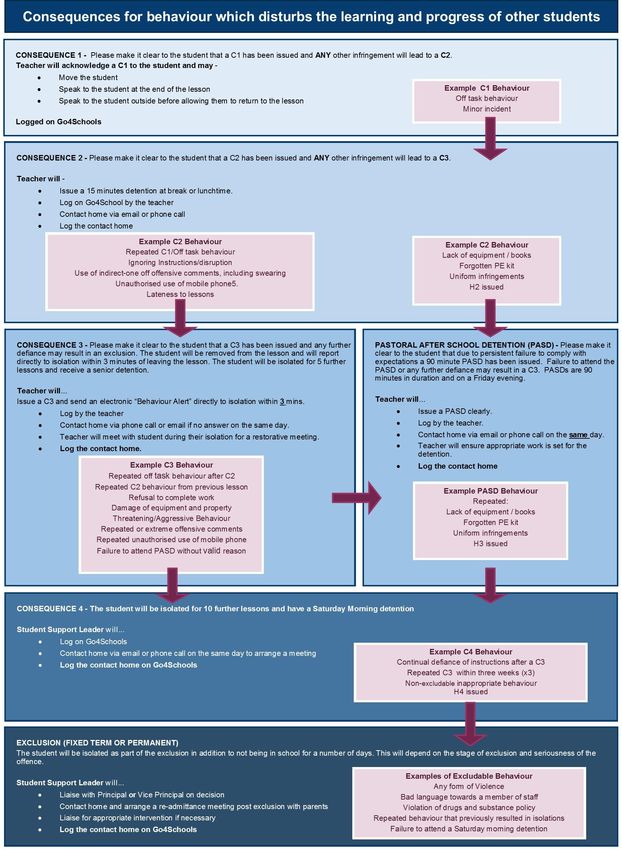
The Consequence System (Cs)
It is essential that every teacher responds in exactly the same way using the Consequence
system:
C1 Initial warning. Logged on Go4Schools
C2 Second warning. A 15 minute detention (break or lunchtime) with
15min the class teacher and an email, letter or telephone call home
detention informing the parent and logged on Go4Schools.
Restorative meeting with student during the detention.
PASD Used for repeated use of “Expectation Reminders”
90 min Friday Students will be issued a straight Pastoral After School Detention
Detention consisting of a 90min Friday evening detention.
C3 Removed from lesson or school to Isolation. Students will remain
5 lessons in in Isolation for 5 lessons following the incident and remain until
Isolation 3.25.
& Fri Friday Senior detention for 1.5hrs. Logged on Go4Schools.
Detention Teacher or Faculty Leader will inform parents via phone, email or
letter. Staff to meet with student before next lesson for restorative
meeting.
C4 Removed from lesson or school to Isolation. Students will remain
10 lessons in in Isolation for 10 lessons following the incident/disruption.
isolation & Saturday morning detention. Logged on Go4Schools. Teacher or
Sat detention Faculty Leader will inform parents via phone, email or letter. Staff
to meet with student before next lesson for restorative meeting.
Fixed Term Depending on the stage and seriousness of the incident, students
Exclusion would either be educated in Isolation for two full days or Excluded
from school for 1,2,3,4,or 5 days. Once a student has been
excluded they will automatically be placed on an exclusion stage
as part of the exclusion staged process (see page 11).
For persistent offenders the school will impose detentions outside of normal school hours
and inform parents (note, this does not require parental consent). These can be evenings,
Saturday mornings (2 hours) and certain non-teaching days (days which have been set
aside wholly or mainly for members of staff to work but not to teach students, sometimes
referred to as ‘training days’, ‘INSET days’ or ‘non-contact days’).
Failure to attend these detentions will result in escalated consequences.
If any criminal activity in school is suspected the police will be contacted.
5
Version 8
equences for Non Completion of Homework

                                      6
                                   Version 8
Consequences for Wider Learning
The Ridgeway School value the work we set and its completion is essential in extending
and consolidating the lessons taught in the school day.
We do however, recognise sometimes there are barriers to students not being able to
complete work. Therefore, we ask all students notify the member of staff issuing the
work at the earliest available time (latest being the morning of the deadline before 8.45
am) if completion was not possible. Alternative setting/deadlines are then left to staff
discretion after discussion with the student.
WL1 Logged on Go4Schools – used to track positive interactions with staff
and monitor any barriers to wider learning.
WL2 Logged on Go4Schools – Break time reflection the following day
(missing work must be handed in at the beginning of the reflection).
WL3 Logged on Go4Schools - Student issued with a Faculty After School
Detention
WL4 Logged on Go4Schools - Student issued with a Saturday Morning
Detention
Please see behaviour policy for more detail.
NB. Before a WL3 students will be placed on mentor report to help support the time
management/overcome barriers before moving to a WL4. If a student receives multiple
WL2’s or WL3’s they will also be placed on Wider Learning Mentor Report. Amongst each
log above, there will be contact made home via email and phone calls if necessary.
7
Version 88 Version 8
Out of Classroom Behaviour
All staff have a responsibility to maintain a calm environment around the school at
all times regardless of duty allocations.
At The Ridgeway School & Sixth Form College we believe that everyone has a right to learn
in a safe and secure environment and in a community where people feel free to be
themselves. Behaviour which challenges this community will result in consequences.
DFE guidance states –
‘A teacher may discipline a student misbehaviour when the child is -
taking part in any school, organised or school related activity or
travelling to or from school or
wearing school uniform or
in some other way identifiable as a student at the school
or misbehaviour at any time, whether or not conditions above apply that –
could have repercussions for the orderly running of the school or
poses a threat to another student or member of the public or
could adversely affect the reputation of the school
9
Version 810 Version 8
Exclusions
Disciplinary Stages / Fixed Term Exclusions/ Stages
Stage 1 - Internal Exclusion re-admission meeting + 2 or 3 days in the Isolation Room and a
Saturday morning 2-hour detention.
Parents asked into school to meet with the Student Support Manager, and the Mentor if
possible. The student will attend.
Behaviour Targets to be set up and monitored by the Mentor.
Student Action Plan/Report system set up.
Readmission Report Card.
Stage 2 - Fixed Term Exclusion 1-3 days.
Readmission meeting + 1 day in the Isolation Room
Parents asked into school to meet with the Student Support Manager, Assistant Principal,
and the Mentor. The student will attend.
Pastoral Support Plan set up and monitored by Student Support Leaders supported by
Assistant Principal Learning and Behaviour Support and the Mentor.
Pastoral report required.
Stage 3 - Fixed Term Exclusion 3-5 days.
Readmission meeting + 1 or 2 days in the Isolation Room (if appropriate)
Parents asked into school to meet with the Assistant Principal or Principal where
appropriate. The student will attend.
PSP reviewed and outside agencies identified as necessary.
Parents notified of the options of a Managed Move through Swindon Fair Access Protocol
(FAP) to another Swindon secondary school (if appropriate).
If a managed move is agreed, parents are invited into the school for the FAP paperwork
to be fully completed and signed. This allows students to have an 8-week trial at another
school with support from Swindon Borough Council and The Ridgeway in attempt to
provide a smooth transition into another mainstream secondary school.
Stage 4 - Permanent Exclusion repeated offence following Stage 3
If Permanent Exclusion, parents invited into the school for the permanent exclusion
meeting with the Student Support Leaders, representatives from SLT, and 3 Governors.
Permanent Exclusion paperwork fully documenting issues and actions taken.
Exceptions to the Staged Procedure
There will be, however, exceptional circumstances where in the Principal’s judgement, it is
appropriate to permanently exclude a child for a first or ‘one off’ offence.
a) Serious actual or threatened violence against another student or a member of staff;
b) Sexual abuse or assault;
c) Sharing, supplying or in possession of an illegal drug (ref. drugs policy)
11
Version 8d) Carrying an offensive weapon (for advice on what constitutes an offensive weapon, see
School Security – Dealing with Troublemakers – Chapter 6 (see related documents).
Schools now have a power to screen and search students without consent for prohibited
items.
These instances are not exhaustive, but indicate the severity of such offences and the fact that
such behaviour can affect the discipline and well-being of the school community.
In cases where a Principal has permanently excluded a student for:
one of the above offences; or
persistent and defiant misbehaviour including bullying or possession and/ or use of an
illegal drug on school premises (see further guidance in related documents).
And where the basic facts of the case have been clearly established on the balance of
probabilities, the Secretary of State would not normally expect the governing body or an
independent appeal panel to reinstate the student.
Personalisation and Equality
As an inclusive school, The Ridgeway School and Sixth Form College understands that the use
of sanctions must be reasonable and proportionate to the circumstances of the case and that
account must be taken of a range of individual pupil needs in determining the appropriate use of
sanctions, including, but not limiting to, the pupils age, any special educational needs or disability
and any religious requirements affecting the pupil. The Ridgeway School should also consider
safeguarding arrangements in all decisions related to behaviour. Reasonable adjustment should
be considered where appropriate within the capacity of a mainstream setting.
Exclusion Staged Governor Review Meeting
The Assistant Principal, Student Support Manager, PMCO and Governors will meet once a term
to review students on an exclusion stage. Students will have a period of 3 terms to improve their
behaviour and the logs recorded in this period will be considered whilst determining any
recommendations made to the Principal for de-escalation in the staged process.
If students fail to meet the required criteria as outlined below, showing an improvement in their
behaviour, then students will remain at the given staged level for a further 3 terms to enable them
to show this improvement. Parents and students will be informed of the outcome of the meeting
by letter. It may be that if a student is on a high stage e.g. Stage 3 the parents and the pupil may
be invited to a governor panel so that the student clearly understands the next steps that the
school may have to take if behaviour is not improved, the Governor will outline the next steps the
school may have to take, but also offer support for parents.
Date of Behaviour Date of Behaviour Incidents Date of Review
Exclusion Incidents Review Period to be reviewed Meeting if Students
Period to be Meeting if students do not Did Not Move
reviewed come down a level or Down Through the
have more than 1 Staged Approach
stage to be reviewed.
Term 1 – (Sept Term 2 - Term 4 Term 5 Term 5 – Term 1 Term 2
– Oct)*
Term 2 – (Oct – Term 3 - Term 5 Term 6 Term 6 – Term 2 Term 3
12
Version 8Dec)*
Term 3 – (Jan – Term 4 - Term 6 Term 1 Term 1 – Term 3 Term 4
Feb)*
Term 4 – (Feb – Term 5 - Term 1 Term 2 Term 2 – Term 4 Term 5
April)*
Term 5 – (April Term 6 - Term 2 Term 3 Term 3 – Term 5 Term 6
– May)*
Term 6 – ( May Term 1 - Term 3 Term 4 Term 4 – Term 6 Term 1
– July)*
* Dates may differ dependent upon the timing of the academic year. Please see school calendar
for further information.
Criteria to move down one stage:
No exclusions
No isolation
No C4’s
No C3’s
5 or less C2’s
15 or less C1’s
Consideration to move down one stage will be given to students if they have the
following:
1-3 C3’s
No more than 10 C2’s
No more than 20 C1’s.
(Assistant Principal and Student Support Leaders are asked to make a recommendation in these
cases)
Students cannot move down a stage if they have the following:
Any exclusions since the last meeting.
Any C4’s
More than 3 C3’s
More than 10 C2’s
More than 20 C1’s.
R6 Rewards
The praise and reward system of Ipoints encourages positive behaviours for learning and
transferable life skills allowing students to achieve Ipoints are awarded for:
o intuition
o inspiring others
o initiative
o individuality
o independence
o inclusivity
o getting involved
o attending intervention
13
Version 8R6 Disciplinary Procedure
Rationale
The R6 Disciplinary Procedure is designed to support student progress and treat them as young
adults by adopting practices reflective of those in the workplace. It works in conjunction with the
school’s exclusion policy and other policies where appropriate.
We seek to give a fresh start to all R6 students on entering the 6 th Form. When making any
decisions concerning behaviour, previous C1-C4 consequences are not considered. However,
significant infringements of the BfL system (exclusions) are taken into account. Any student on
exclusion stages will be reviewed in either April or October in accordance with the main school
procedure.
Monitoring report
Reasons Action
o Attendance and punctuality: if attendance o Monitoring report issued
drops below 90% following intervention by o Parents contacted
mentor and R6 Leaders o Students meeting with Head of Year
o Accumulation of 3 repeated behaviour logs in and/or mentor
a fortnight raising concerns in the following o Teachers informed
categories:
o Attitude to learning
o Rudeness
o Homework and deadlines
Stage 1
Reasons Action Possible Sanction
o Failure to address the o Meeting with Student and o Withdrawal of free
issue/s that led to them HOY and/or Mentor to periods and
being placed on a explain why on Stage 1 implementation of fixed
o Support put in place and independent study
monitoring report
shared with staff and periods
o Failure to respond to parents and set date to o Expectation to register
repeated verbal review progress will be fixed in the R6 Study Centre
requests. at the meeting. and study in a
o Sudden change in o A letter to be sent to supervised area.
attendance, progress or parents/guardians by HOY
effort resulting in a to inform them of this action
and inviting them to contact
failure to meet required
the Students Mentor/HOY.
expectations.
14
Version 8Stage 2
Reasons Action Possible Sanction
Failure to address the issue/s o Student and parent meet o Withdrawal of free
that led to them being placed on with R6 Leaders periods and
a Stage 1 contract. o Implementation of Pastoral implementation of fixed
A student may be placed Support Plan (PSP) to
independent study
directly on stage 2 for failure to address problem. Date to
meet R6 expectations resulting review progress will be periods
in the student harming the fixed at meeting. o Expectation to register
education or welfare of o Reasons for being placed in the R6 Study Centre
themselves or others. on Stage 2 explained and and study in a
Example behaviours include but letter sent. supervised area.
are not limited to: o Stage 2 contract and o Stage 2 Fixed term
Discrediting themselves readmittance report agreed
exclusion of 1-2 days’
or R6 and signed by all parties.
Being disrespectful to duration. Readmissions
members of the school meeting as per BFL
community policy.
Vandalism
Continual defiance
Stage 3
Reason Action Possible Sanction
o A student who fails to address o Student and parent meet o Stage 3 Fixed term
the issue/s that led to them with R6 Leaders/Vice exclusion of 3-5 days’
being placed on a Stage 2 Principal/Principal duration.
contract o Implementation and/or Readmissions
o A student may be placed review of Pastoral Support meeting as per BFL
directly on a stage 3 contract Plan (PSP) to address policy.
for a serious misdemeanour. problem. Date to review
Example behaviours include but progress will be fixed at
are not limited to: meeting.
Any form of violence or o Reasons for being placed
threatening behaviour on Stage 3 explained and
towards staff or students letter sent.
Bad language towards a o Stage 3 contract and
member of staff readmittance report
Violation of drugs and agreed and signed by all
substance policy parties.
Repeated behaviour that o Support and guidance will
previously resulted in be provided for a move to
exclusions another educational
institution or employment.
15
Version 8Stage 4 - Permanent Exclusion repeated offence following Stage 3
Parents notified of the Permanent Exclusion and offer of support to find alternative post-
16 provision.
Parents invited into the school for the permanent exclusion meeting with the R6 Leaders,
representatives from SLT and 3 Governors.
Permanent Exclusion paperwork fully documenting issues and actions taken.
Exceptions to the staged Procedure
There will be, however, exceptional circumstances where in the Principal’s judgement, it is
appropriate to permanently exclude a student for a first or ‘one off’ offence.
e) Serious actual or threatened violence against another student or a member of staff;
f) Sexual abuse or assault;
g) Sharing, supplying or in possession of an illegal drug (ref. drugs policy)
h) Carrying an offensive weapon (for advice on what constitutes an offensive weapon, see
School Security – Dealing with Troublemakers – Chapter 6 (see related documents).
Schools now have a power to screen and search students without consent for prohibited
items.
These instances are not exhaustive, but indicate the severity of such offences and the fact that
such behaviour can affect the discipline and well-being of the school community.
In cases where a Principal has permanently excluded a student for:
a) one of the above offences; or
b) persistent and defiant misbehaviour including bullying or possession and/ or use of an
illegal drug on school premises (see further guidance in related documents). And where
the basic facts of the case have been clearly established on the balance of probabilities,
the Secretary of State would not normally expect the governing body or an independent
appeal panel to reinstate the student.
Exclusion Staging Governor Review Meeting
The Assistant Principal, Student Support Manager, and Governors will meet termly to review all
students on an exclusion stage.
All behaviour logs since the recorded incident occurred, or since the previous exclusion staging
review meeting, will be considered whilst determining any recommendations made to the
Principal for de-escalation in the staging process. If students have had insufficient time to show
improvement in behaviour, or if students fail to meet the required criteria as outlined below, then
students will remain at the given exclusion stage until the next panel review. Parents and
students will be informed of the outcome of the meeting by letter.
Students can move down a level for the following:
o No behaviour logs
Consideration will be given to students moving down a level if they have:
o 1-6 behaviour logs
o Been placed on a monitoring report
16
Version 8Students cannot move down a level if they have the following:
o 7 or more behaviour logs
o Have been on a Stage 1, 2 or 3 contract
o Have been excluded since the last meeting or exclusion
Pastoral Support and Early Intervention
Mentors
All students are in mentor groups and see their mentors three times a week. Mentors
communicate with home at least on a once termly basis and in particular, communicate with
home over referrals and house points. The mentor programme promotes good behaviour and
has strong SEAL (Social, Emotional Aspects of Learning) elements which encourages students
to be aware of their emotional needs and to share concerns with their mentor. All Y7 Mentor
groups have peer mentors who work with the group under the supervision of the mentor.
Subject Teachers
Teachers are encouraged to use positive behaviour strategies in their teaching and use praise to
reprimand in a ratio of 4:1. The Consequence system is well established within the school and
the vast majority of students respond to a C1 and C2 without further levels needed to be used.
Students who exhibit challenging behaviour within a subject will face a number of strategies
including, withdrawal from lessons, subject report, afterschool detentions and if necessary, the
change to another teaching group.
The Student Support
The Student Support Leaders and their assistants work with students who are referred to them
by either Teachers, Mentors or Team Leaders. Support strategies for intervention such as the
writing of IEPs (Individual Education Plan) and PSPs (Pastoral Support Plan) are used and they
discuss the need for intervention by outside agencies such as Stratton PRU and Marlborough
House with their teams with the Assistant Principal, SENCO and Principal.
Attendance
Attendance panels with Student Support Leaders, Education Welfare Officer and School
governors in attendance lead to early intervention on attendance issues in order to bring about
improvements (see Attendance Policy).
17
Version 8Isolation Unit
The Isolation Unit will be used as a consequence (or can be used while investigating an incident)
for a high level incident or If a student is not responding to a teacher using the strategies
available to them. A teacher issues a C3, referring the student immediately to student support
and their assistants who along with the Assistant Principal will be the gatekeepers for this room.
The number of lessons or days spent in the room are documented in the Behaviour Procedures.
18
Version 8Appendices
A. Uniform Policy
B. Exclusion Letter - sample
C. Responsibilities & Support for Students
D. Guidance on the use of Rewards
E. Relationship to other policies, Monitoring, Review and Evaluation
F. Reports: Examples and Expectations
G. What the law allows
19
Version 8Appendix A
The Ridgeway School Uniform Policy
All items should be clearly marked with name and Mentor group
Parents will notice that the list is clear and concise. We believe that uniform is important to
ensure that students take pride in our school and are ready to learn. We do not want staff time
and effort to be lost on uniform problems. It is our aim that teachers should be allowed to teach
and students to learn. The co-operation of parents is appreciated and we draw your attention to
the following points:
Uniform should be smart and appropriate for the school environment
It should give a clear sense of identity
No extreme of fashion is allowed
Offensive lettering or suggestive logos/comments on clothing, school bags, books and
other items required at school is prohibited
Failure to conform to these rules will result in the student being sent home or placed in
internal isolation
Autumn and Winter Term
All skirts/trousers/shirts should be purchased from Famous Branches or the ‘school range’ of
major department stores as long as the correct style is purchased (See permitted styles below
and the image guidelines that follow)
A blazer with The Ridgeway School badge on the pocket must be worn by all students in
Year 7-11. Students may choose to wear a Ridgeway School sweatshirt or cardigan with
the school logo under their blazer.
White long sleeved school shirt/blouse (tucked in, sleeves unrolled and buttoned to the
neck)
The Ridgeway School House tie
Black regular length school trousers, ‘skinny’ or tight fitting in style are not permitted.
Trousers should meet the shoe, and should not be rolled up at the hem
Skirts must cover at least two thirds of the upper leg in length and be an appropriate
school type material and style. They should not be fitted pencil skirts
Large belts, buckles, zips, laces, pin stripes etc. are not acceptable on either skirts or
trousers
Plain black school shoes that are appropriate for a formal school uniform. We do not
permit black trainers/footwear that are trainer in style yet labelled as shoes, boots
(including ankle boots), daps, sandals, shoes without backs, and heels higher than 3cm.
Natural or black colour tights, or plain black socks
Cream apron for Technology
20
Version 8Summer Term (Term 6)
Students may choose to wear a short sleeved white shirt and tie instead of a long sleeved
shirt and tie. Ties may be removed, but shirts must remain tucked in and have the top button
undone. Long sleeved shirts can be rolled to the elbow; short sleeved shirts must remain
unrolled. Jumpers and cardigans may not be worn without a blazer. Students may wear tailored
shorts as long as they are no shorter than knee height and black in colour. Plain black socks
must still be worn.
PE Kits- boys & girls
Please note that whilst Covid-secure regulations are in place in the Ridgeway School, KS3
students come to school wearing their PE kit on days where they have a PE lesson. Students are
permitted to wear either the Ridgeway Fleece jumper or blazer to keep warm. KS4 students wear
their PE top but school trousers/skirts, blazer and shoes, changing into the rest of the PE kit at
the appropriate time.
Items marked in the PE section with an * are optional and available from the PE Office.
Sky blue polo shirt with school logo (available from Famous Branches)
Plain black shorts. Short, tight-fitting shorts and ‘hot pant’ style shorts are not appropriate to
be worn around the school site and so we ask that students wear plain black tracksuit
bottoms on top of their shorts and remove these for PE, or wear a looser pair of shorts
instead
Sky blue rugby shirt/hockey shirt with black collar and reversible contrast band in black
(available from Famous Branches)
Two pairs of sky blue with navy ‘turnover top’ long socks (available from Famous branches)
* Black plain tracksuit bottoms, these should not be any other colour and should not be
emboldened with a logo. Leggings of any kind are not permitted
Acceptable tracksuit bottoms; Unacceptable tracksuit bottoms;
Plain black, Unsuitable These are
no logo and due to the leggings and
not leggings. stripes down too tight
the side. fitting and
therefore not
suitable.
Specialist PE kit required:
Black ‘Speedo’ style swimming trunks/costume, swimming hat and towel
Football boots and shin pads
Gum shield/mouth guard are advisable
Trainers (please see important note below)
* Ridgeway athletics vest
*Ridgeway black drill top/tracksuit top
*Ridgeway Exam PE Polo shirt (GCSE students only)
*Ridgeway shower proof jacket (black)
21
Version 8Please note: the risk of injury and long term damage to joints and bones is
increased if students perform in ‘leisure trainers’ where the sole is narrower than
the foot, and has little cushioning effect or much support and are too often worn with
either the laces untied or loosely tied. We strongly recommend a cross trainer type of trainer.
Further Points
Outdoor coats –Should be “School Type” (not leather or denim coats/jackets) and must
not have inappropriate logos, slogans. These should NOT be worn inside the school
building (unless temperature drops below freezing). Hooded tops or tracksuits tops are
also not permissible as an outdoor coat
Trainers and boots are NOT school uniform and should NOT be worn during the
school day. Trainers can be worn when students are taking part in a sporting activity
ONLY
Jewellery – the wearing of jewellery is not considered appropriate for school and is
therefore not allowed. Students can only wear one small pair of discreet stud earrings in
lower lobe. (These will need to be removed for PE lessons.) No other piercings allowed.
Students who infringe this rule will be isolated until the piercing is removed
Excessive make up, including extreme eye liner and false lashes are not permitted
Coloured nail varnish and false nails are not permitted
Extreme haircuts and styles are not acceptable. This includes shaving of the full head
below a grade 2 and dying the hair an unnatural colour
In all matters of uniform and dress, the decision of the Principal is final.
The school will remove any student from lessons who do not conform to these guidelines.
Purchasing
If you are purchasing through the school supplier we are suggesting 3 options for purchasing the
uniform.
Online from store.famousbranches.com
In store at:
The Famous Schoolwear Specialists
Unit 1B
Plaza 21
Sandford Street
Swindon
SN1 1HE
Telephone – 01793 520843
A plain black blazer can be bought from other retailers, and then a sew-on Ridgeway badge
bought from our Main Reception for £5. Please ensure it meets our uniform criteria.
22
Version 8The Ridgeway School Uniform Criteria
Item Acceptable Not Acceptable Additional Information
School range blazer Colour trims Blazers are not compulsory during term 6.
School badge ¾ length, rolled up sleeves We encourage them to be removed for
Black in colour Short waisted jackets practical lessons to avoid damage.
Blazers Full length body Fashion blazers School blazers are “easy care” polyester
Full length sleeves Tight fitting Black blazers may be purchased from
Button up front No other logo/badge, other than other retailers in conjunction with a school
Collar school. badge available from Reception for £5
The Ridgeway School tie worn
Clip on ties will now be optional.
correctly Untied
Students may be allowed to remove ties in
Ties Proper knot by the top button of the Large loose knots
summer terms at the discretion of the
shirt Shorter than waist length Principal
Waist length and showing 5 stripes
Sweatshirt/ Can be worn underneath blazer if desired.
Black with school logo
Cardigan Cannot be worn without a blazer.
School range Untucked
Students may choose to wear a short
Plain white Coloured
sleeved shirt in the summer providing the
Long sleeved Embroidery
Shirt sleeves are elbow length. Long sleeves
Tucked in Capped sleeves
may be rolled to the elbow when summer
Must button to the neck Patterned uniform is authorised.
Designed to take a tie Midriff on show
School range Coloured
Plain white Embroidery
Blouse Fitted/ tailored Capped sleeves
Must button to the neck Patterned
Designed to take a tie Midriff on show
23
Version 8Examples of Acceptable Examples of unacceptable Additional
Item Acceptable uniform Not Acceptable uniform Information
Cropped/rolled –
School range the ankle must not
Plain black be on show
Flat or Skinny or flared leg Students may wear
pleated front Jeans or denim tailored black
Trousers Bootleg or Leggings
shorts in the
straight style summer providing
Zips that show
Regular they are knee
Large belts length.
length to
Buckles/ laces
meet the
Tight fitting
shoe Fitted Cropped
Pin stripes
Trousers Trousers
School Large belts,
range buckles, laces, pin
Plain black stripes
Skirts must cover
Modest Denim
Skirts 2/3 of the upper
length Tube or skinny
leg
Pleated, fitting styles
straight and Slits Tube or Skirts with
A-line styles Coloured Fitted Skirts a slit
24
Version 8 Boots
Trainers (including
Suitable plain black and/or those
black school
that pose as
shoes that are
Shoes shoes)
appropriate for a
Daps
formal school
Flip flops/backless
uniform
Open toes
Heels over 3cm
25
Version 8Uniform Consequences
1. The member of staff on duty before school and teacher who is first point of contact with the
student should issue a C2 for Uniform and log on Go4Schools straight away so the student can
attend a break time detention
2. Defaulters identified later in the day should be issued with a C2, log on Go4Schools and through
the behaviour log internal system and attend the C2detention at break, lunch or the following day.
3. Failure to attend the C2 detention will result in a Pastoral After School Detention.
4. The mentor should follow this up with the student and contact home about the uniform issue.
5. If on the following day there is still no compliance, arrangements will be made to withdraw the
student to a working area outside an office or within Student Support. Parents will be telephoned
and asked to bring in the correct uniform for the student to change into on the day. The student
will be isolated at break and placed in detention at lunchtime.
6. If there is further non-compliance, i.e. more than one uniform infringement in a term except where
a reasonable arrangement has been made with parents, the infringement will be considered an
act of defiance and further sanctions of a C3 or further will be implemented.
7. Extremes of hairstyle, etc. are also not permitted and should be referred in the first instance to the
Student Support Leaders.
.
26
Version 8Appendix B Exclusion Letter - SAMPLE
Dear [Parent's Name]
I am writing to inform you of my decision to exclude [Child's Name] for a fixed period of [specify period].
This means that he/she will not be allowed in school for this period. The exclusion begins/began on [date]
and ends on [date].
I realise that this exclusion may well be upsetting for you and your family, but the decision to exclude
[Child's Name] has not been taken lightly. [Child's Name] has been excluded for this fixed period for
[specify].
?? now moves to Stage ? of the Exclusion Stages (as shown below)
Stage 1: 2 day Internal Exclusion in Isolation Room
Stage 2: 1 to 3 day Fixed Term Exclusion with Pastoral Support Plan commencing
Stage 3: 3 to 5 day Fixed Term Exclusion – Final Warning
Stage 4: Permanent Exclusion
You have a duty to ensure that your child is not present in a public place in school hours during this
exclusion on [specify dates] unless there is reasonable justification for this. I must advise you that you
may receive a penalty notice from the local authority if your child is present in a public place during school
hours on the specified dates. If so, it will be for you to show reasonable justification.
We will set work for [Child's Name] to be completed on the days specified in the previous paragraph as
school days during the period of his/her exclusion when you must ensure that he/she is not present in a
public place without reasonable justification. [detail the arrangements for this]. Please ensure that work
set by the school is completed and returned to us promptly for marking.
You have the right to make representations about this decision to the governing body. If you wish to
make representations, please contact The Clerk to the Governors at The Ridgeway School, Inverary
Road, Wroughton, Swindon, SN4 9DJ: telephone 01793 846100; e mail admin@ridgeway.swindon.sch.uk
as soon as possible.
Whilst the governing body has no power to direct reinstatement, they must consider any representations
you make and may place a copy of their findings on your child’s school record. Whilst the governing
body/management committee has no power to direct reinstatement, they must consider any
representations you make and may place a copy of their findings on your child's school record.
You should also be aware that if you think the exclusion relates to a disability your child has, and you
think disability discrimination has occurred, you have the right to appeal, and/or make a claim, to the
Special Educational Needs and Disability Tribunal (SENDIST). The address to which appeals should be
sent is SENDIST, Mowden Hall, Staindrop Road, Darlington DL3 9DN.
27
Version 8You [and your child or student's name] are requested to attend a reintegration interview with me
[alternatively, specify the name of another staff member] at [place] on [date] at [time]. If that is not
convenient, please contact the school [within the next ten days] to arrange a suitable alternative date
and time. The purpose of the reintegration interview is to discuss how best your child's return to school
can be managed [not for parents of secondary aged students]. Failure to attend a reintegration
interview will be a factor taken into account by a magistrates' court if, on future application, they consider
whether to impose a parenting order on you.
You also have the right to see a copy of [Child's Name]'s school record. Due to confidentiality
restrictions, you will need to notify us in writing if you wish to be supplied with a copy of [Child's Name]'s
school record. I will be happy to supply you with a copy if you request it. There may be a charge for
photocopying.
You may wish to contact [Name] at [LA name] LA on/at [contact details — address, phone number,
email], who can provide advice. You may also find it useful to contact the Advisory Centre for Education
(ACE) — an independent national advice centre for parents of children in state schools. They offer
information and support on state education in England and Wales, including on exclusion from school.
They can be contacted on 020 7704 9822 or here [insert reference to local sources of independent
advice if known.]
[Child's Name]'s exclusion expires on [date] and we expect [Child's Name] to be back in school on
[date] at
[time].
Yours sincerely
J S Povoas
Principal
28
Version 8Appendix C
Responsibilities and Support for Students
The Mentor will:
Monitor behaviour of all members of the mentor group.
Monitor the attendance of all members of the mentor group and check unexplained absences with
parents.
Support the students verbally and by use of the mentor report.
Encourage and praise students for good behaviour.
Give guidance on how to behave.
Liaise with parents as necessary.
Work with teachers, Student support Leaders, and SLT to enforce the school code of behaviour
fairly, consistently and effectively.
Monitor House Points and respond as necessary.
Be involved in regular pastoral reviews.
Check the Student Planner on a weekly basis to communicate with home and Student support
Leaders to monitor the recording and completion of homework.
The Teacher will:
Liaise with parents regarding student attainment & behaviour.
Follow behavioural procedures to achieve consistency across the school
Implement appropriate awards & sanctions.
Work with mentors, Student support Leaders, Heads of Faculty/ Department and SLT to enforce
code of behaviour fairly, consistently and effectively.
Take responsibility for the behaviour of students in their lessons.
Heads of Faculty/Dept. will:
Ensure that the school rules are enforced consistently and fairly within their area.
Follow the procedures in order to achieve good order and effective learning within their area.
Implement rewards and sanctions as appropriate.
Support staff as necessary when there are implementing the school rules.
Take responsibility for the behaviour of students in their area.
Student Support Leaders/ Mentor Co-ordinators will:
Monitor the overview of the Year group's behaviour.
Work with all staff to modify student behaviour as necessary.
Keep records of behaviour for certain individuals.
Monitor trends and patterns of behaviour.
Liaise effectively with the outside agencies to support students and parents.
Meet parents.
To set and maintain high standards of behaviour within the school.
Ensure that positive behaviour is taught.
Distribute rewards and apply sanctions as necessary.
Hold regular pastoral reviews.
Meet parents with the student.
Refer to the Associate Principal/Principal if a very serious incident occurs or if a student is failing
to modify behaviour when all the strategies have been implemented.
29
Version 8Student Support Team will:
Manage and lead the isolation Room.
Oversee the provision for students whose behaviour reflects significant learning or personal
problems.
Liaise and attend meetings with outside agencies to provide learning and behaviour/ attendance
improvements for students.
Work closely with Mentor Co-ordinators with rewards to pastoral reviews
Line manage the School Counsellor/Targeted Mental Health Worker.
Provide reports on Student Support packages and support for students on a managed move.
Be the first point of contact for the police.
Liaise and meet parents for students on support.
Monitor and collate all statements.
Deliver all behaviour intervention groups for all year groups
Assistant Principal will:
Support the Student support Leaders when needed with students, parents and outside agencies.
Monitor the overview of whole school behaviour.
Hold regular pastoral meetings to ensure effective communication takes place throughout pastoral
team.
Refer to the Principal if a very serious incident occurs or if a student is failing to modify behaviour
when all the strategies have been implemented.
Ensure that the systems for rewards and sanctions are consistently and fairly implemented.
Oversee the SENCO, Autistic Spectrum Condition and Hearing Impaired Units and provision of
Special Needs Education
Support for students whose behaviour reflects significant learning or personal problems
Peer Observations.
Learning Support.
Anger Management.
Student Support Group.
Behaviour support team.
Learning Mentor.
Student coach.
Life coach.
Buddy.
Support and training available to help staff manage challenging student behaviour
In house training from the Student Support Leaders.
Peer Observations.
Peer Mentoring.
External training as appropriate.
Support available to parents who wish to learn more about improving behaviour
Parent support evening organised by the school.
Parental support from meetings with the Mentor, Mentor Co-ordinators, Student support Leaders,
Mentor, Teacher or Head of Faculty/Learning.
30
Version 8Appendix D
Guidance on the use of rewards
Praise and rewards should have emphasis to encourage students to participate, perform and progress.
Staff members are encouraged to use and of the following methods of providing students with satisfaction
and pride in their achievements (please note that this is not exhaustive list and it may be appropriate for
other rewards to be given not listed below):
Smile.
Thumbs up!
Verbal Praise (Remember a 4:1 ratio of praise to reprimand in a classroom).
Stickers or Stamps for good work.
Positive comments written in books.
Appropriate comments on report books.
The House point system and the accumulative certificate and vouchers which will be presented in
assemblies.
Displays of Students work around the school.
Praise in assemblies.
Team Leader, Mentors, Mentor Co-ordinators, SLT or Governors invited to classrooms to deliver
praise.
Positive postcards sent to parents.
Badges for roles of responsibility.
Student of the Term. Subject staff to nominate students for effort.
Annual presentation evening to celebrate effort and achievement.
Positive phone calls home/letters home.
Positive conversations with or e mails to a student’s Mentor/Tutor.
Ask Tutor/Mentor, Team Leader, SLT along to class to praise a group of students or view work
where appropriate;
In addition a more formal rewards system will operate:
House points will be awarded and will be recorded on Go4Schools.
House points can be awarded for upholding the Ridgeway School values:
1. Respect
2. Honesty
3. Endeavour
4. Creativity
5. Community
31
Version 8The following criteria will be used for rewarding students who obtain conduct points:
Praise Bronze Silver Gold Platinum
Postcard Certificate Certificate Certificate Certificate
KS3 15 30 50 100 150
KS4 10 20 40 80 100
Praise postcards will be organised by the Mentor/Tutor.
Bronze, Silver, Gold and Platinum Certificates will be awarded in Assembly.
Praise postcards can be sent home by a classroom teacher for a particularly pleasing piece of
class work/progress/homework. This practice is encouraged.
Teams are asked to select a Student of the Term for each subject in each year group and their
names read out in year group assemblies.
Annual presentation evening to celebrate effort and achievement.
Competition between Houses will be encouraged in House Assemblies once a term and in year
group assemblies regularly.
House reward trips to celebrate those with the highest conduct logs (House points minus
behaviour points) 3 times a year. Students with high numbers of behaviour logs will not be eligible
for these trips.
32
Version 8Appendix E
Relationship to other policies
The Attendance Policy.
The Equal Opportunities Policy.
The Anti-bullying Policy.
The SEN policy.
The Teaching and Learning Policy.
Monitoring, Review and Evaluation
The bodies consulted and to be consulted in the development and future revision of this document.
Students
Parents
Staff
Governors
DCSF
The purpose of reviewing the effectiveness of the implementation and development of this policy are:
To ensure that all parents are aware of this Behaviour for Learning Policy.
To ensure that all school staff are aware of the workings of the policy.
To ensure that all students are aware of the behaviour requirements.
To monitor the standards of behaviour in the school and to aim for increased improvements.
Areas for future consideration:
To consider any relevant new legislation.
To look at best practice and consider new strategies.
33
Version 8Appendix F
Reports: Examples and Expectations
Mentor Report
A student who receives 3 C2s in a fortnight should be recommended to the Mentor Co-ordinator as a
student in need of a Mentor Report.
This should last for a period of at least two weeks.
The student should have three daily targets, and two weekly targets.
When the mentor has chosen the targets with the student, the mentor will contact home outlining
these.
This will be logged on Go4Schools by the Mentor.
As the name of the report suggests, the mentor should be monitoring and reviewing this report in
mentoring sessions and contacting the student’s home to discuss progress and achievement each week
of the report period.
Student Support Leaders/ Pastoral Report
A student who does not respond to the Mentor Report, or who receives 2 or more C3s in a fortnight
should be recommended as a student in need of a Student Support Leaders Report.
This should last for a period of at least two weeks.
The student should have three daily targets, and two weekly targets.
The Student Support Leaders will discuss the targets with the student and contact home outlining
these.
This will be logged on Go4Schools by the Student Support Leaders monitored daily, sometimes
twice daily.
The mentor should continue to review and discuss the student’s progress as part of the learning
conversation between mentor and student during mentoring sessions.
Post-Exclusion Report / Pastoral Support Plan (PSP)
These reports will be set up by the Pastoral Team during a re-admittance meeting, following a period of
exclusion. Targets will be agreed by the parent/carer, the student and the Student Support Team. The
type of report is dependent on which exclusion stage the student is at.
This should last for a period of at least two weeks but may be up to 8 weeks.
The student should have three daily targets, and two weekly targets.
This will be logged on Go4Schools by the Student Support Leaders.
34
Version 8Appendix G – WHAT THE LAW ALLOWS
Behaviour and discipline in schools: Advice for headteachers and school staff
DFE January 2016
Discipline in schools – teachers’ powers
Key Points
• Teachers have statutory authority to discipline pupils whose behaviour is unacceptable, who
break the school rules or who fail to follow a reasonable instruction (Section 90 and 91 of the
Education and Inspections Act 2006).
• The power also applies to all paid staff (unless the headteacher says otherwise) with
responsibility for pupils, such as teaching assistants.
• Teachers can discipline pupils at any time the pupil is in school or elsewhere under the charge of
a teacher, including on school visits.
• Teachers can also discipline pupils in certain circumstances when a pupil’s misbehaviour occurs
outside of school.
• Teachers have a power to impose detention outside school hours.
• Teachers can confiscate pupils’ property.
Punishing poor behaviour
What the law allows:
13. Teachers can discipline pupils whose conduct falls below the standard which could reasonably be
expected of them. This means that if a pupil misbehaves, breaks a school rule or fails to follow a
reasonable instruction the teacher can impose a punishment on that pupil.
14. To be lawful, the punishment (including detentions) must satisfy the following three conditions:
1) The decision to punish a pupil must be made by a paid member of school staff or a member of staff
authorised by the headteacher;
2) The decision to punish the pupil and the punishment itself must be made on the school premises or
while the pupil is under the charge of the member of staff; and
3) It must not breach any other legislation (for example in respect of disability, special educational needs,
race and other equalities and human rights) and it must be reasonable in all the circumstances.
15. A punishment must be proportionate. In determining whether a punishment is reasonable, section 91
of the Education and Inspections Act 2006 says the penalty must be reasonable in all the circumstances
and that account must be taken of the pupil’s age, any special educational needs or disability they may
have, and any religious requirements affecting them.
35
Version 816. The headteacher may limit the power to apply particular punishments to certain staff and/or extend
the power to discipline to adult volunteers, for example to parents who have volunteered to help on a
school trip.
17. Corporal punishment is illegal in all circumstances.
18. Schools should consider whether the behaviour under review gives cause to suspect that a child is
suffering, or is likely to suffer, significant harm. Where this may be the case, school staff should follow the
schools’ safeguarding policy. They should also consider whether continuing disruptive behaviour might be
the result of unmet educational or other needs. At this point, the school should consider whether a multi-
agency assessment is necessary.
19. A clear school behaviour policy, consistently and fairly applied, underpins effective education. School
staff, pupils and parents should all be clear of the high standards of behaviour expected of all pupils at all
times. The behaviour policy should be supported and backed-up by senior staff and the head teacher.
20. Good schools encourage good behaviour through a mixture of high expectations, clear policy and an
ethos which fosters discipline and mutual respect between pupils, and between staff and pupils.
21. Schools should have in place a range of options and rewards to reinforce and praise good behaviour,
and clear sanctions for those who do not comply with the school’s behaviour policy. These will be
proportionate and fair responses that may vary according to the age of the pupils, and any other special
circumstances that affect the pupil.
22. When poor behaviour is identified, sanctions should be implemented consistently and fairly in line with
the behaviour policy. Good schools will have a range of disciplinary measures clearly communicated to
school staff, pupils and parents. These can include:
• A verbal reprimand.
• Extra work or repeating unsatisfactory work until it meets the required standard.
• The setting of written tasks as punishments, such as writing lines or an essay.
• Loss of privileges – for instance the loss of a prized responsibility or not being able to participate
in a non-uniform day (sometimes referred to as ‘mufti’ days).
• Missing break time.
• Detention including during lunch-time, after school and at weekends.
• School based community service or imposition of a task – such as picking up litter or weeding
school grounds; tidying a classroom; helping clear up the dining hall after meal times; or removing
graffiti.
• Regular reporting including early morning reporting; scheduled uniform and other behaviour
checks; or being placed “on report” for behaviour monitoring.
• In more extreme cases schools may use temporary or permanent exclusion.
36
Version 8Pupils’ conduct outside the school gates, teachers’ powers
What the law allows:
23. Teachers have the power to discipline pupils for misbehaving outside of the school premises “to such
an extent as is reasonable”7 – see paragraph 21.
7 Section 90 of the Education and Inspections Act 2006
24. Maintained schools and Academies’ behaviour policies should set out what the school will do in
response to non-criminal bad behaviour and bullying which occurs off the school premises and which is
witnessed by a staff member or reported to the school, including the punishments that will be imposed on
pupils.
25. Subject to the behaviour policy, teachers may discipline pupils for:
• misbehaviour when the pupil is:
taking part in any school-organised or school-related activity or
travelling to or from school or
wearing school uniform or
in some other way identifiable as a pupil at the school.
or misbehaviour at any time, whether or not the conditions above apply, that:
could have repercussions for the orderly running of the school or
poses a threat to another pupil or member of the public or
could adversely affect the reputation of the school.
26. In all cases of misbehaviour the teacher can only discipline the pupil on school premises or elsewhere
when the pupil is under the lawful control of the staff member.
Detention
What the law allows:
27. Teachers have a power to issue detention to pupils (aged under 18).
28. Schools must make clear to pupils and parents that they use detention (including detention outside of
school hours) as a sanction.
29. The times outside normal school hours when detention can be given (the ‘permitted day of detention’)
include:
a) any school day where the pupil does not have permission to be absent;
b) weekends - except the weekend preceding or following the half term break; and
c) non-teaching days – usually referred to as ‘training days’, ‘INSET days’ or ‘non-contact days’.
30. The headteacher can decide which members of staff can put pupils in detention. For example, they
can limit the power to heads of year or heads of department only or they can decide that all members of
staff, including support staff, can impose detentions.
37
Version 8You can also read


