BUSINESS LEADERS AND CLIMATE CHANGE IN BARCELONA
←
→
Page content transcription
If your browser does not render page correctly, please read the page content below
REPORT    Fundació ENT
MARCH     C/ Josep Llanza, 1-7, 2n 3a
2021      08800 Vilanova i la Geltrú
          +34 93 893 51 04
          info@ent.cat | www.ent.cat

         BUSINESS
         LEADERS AND
         CLIMATE CHANGE
         IN BARCELONA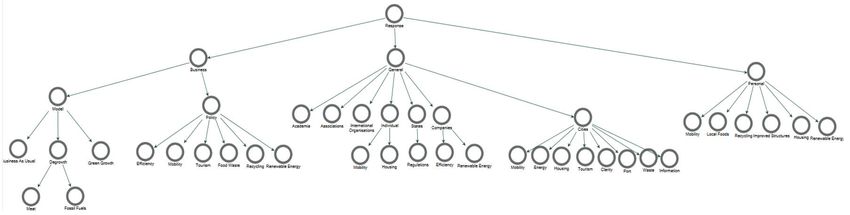
2

Business Leaders and Climate Change in Barcelona
Master’s Thesis in Political Ecology, Degrowth and Environmental Justice

Author

Igor Živković

Supervisor

Dr. Miquel Ortega Cerdà
Fundació ENT & Institut de Ciència i Tecnologia Ambiental - ICTA
Universitat Autònoma de Barcelona

                                                     @ENTmediambient

                                                     ENTmediambient
  Fundació ENT
  C/ Josep Llanza, 1-7, 2n 3a                        ENT Environment & Management
  08800 Vilanova i la Geltrú
  +34 93 893 51 04                                   ENT environment & management
  info@ent.cat | www.ent.cat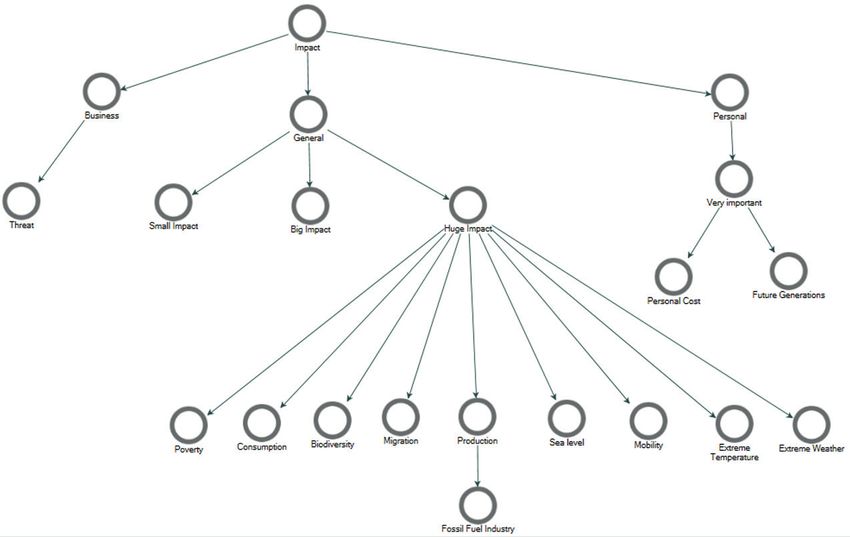
3

ABSTRACT
This research explores the ways in which some of
the main business leaders in the Metropolitan Area
of Barcelona perceive climate change. It analyses
themes such as who should lead the changes, how
it affects their business strategies and its personal
lifestyle, and how they position themselves
regarding competing economic-environmental
relations paradigms. In-depth interviews were
performed, and results were compared with
information provided by local policy makers
and advisors. The analysis shows that business
leaders are very concerned about climate change.
Nevertheless, this is often not transferred into
strategic business changes. Therefore, there is
a tension between their self-claimed alignment
with the “green growth” paradigm and the policy
makers/advisors that perceive “business as usual”
practices. At the business level, business leaders
want public administrations to lead on climate
change and do not perceive degrowth as a realistic
strategic option for their activity.
4

INDEX

Economy-Environment Paradigms			        5

Climate Change and the Role of
Business Leadership					6

Economy of Barcelona 				               7

Climate Change Policy in Barcelona 		   10

Methodology						12

Results						14

Discussion						23

Limitations and Further Research			     26

Conclusion						27

Bibliography						29

Annex 1 Interview Questionnarie			      33

Annex 2 Respondent profiles			          34

Annex 3 Respondent profiles			          35
5

ECONOMY-ENVIRONMENT
PARADIGMS

IDeal
  n December 2019, the European Union announced
  a new policy programme, the European Green
      (EGD). It aims to put climate policy at the
                                                              The defining characteristics of green growth are
                                                              the expansion of markets and accurate pricing of
                                                              natural resources, a central role for technological
centre of all EU policies (Dupont, Oberthür and               innovation based on competitive markets and
von Homeyer, 2020). Additionally, in reaction to              resource efficiency, and a decoupling of economic
the economic crisis triggered by the Covid crisis,            growth from resource use (Bina, 2013; Kallis and
the EU introduced NextGenEU in May of 2020, a                 Hickel, 2019; Ossewaarde & Ossewaarde-Lowtoo,
750-billion-euro recovery plan. Despite some calls            2020).
to the contrary, the EU made climate ambitions a
central part of the economic recovery (Dupont,                In this view, environmental practices can create
Oberthür and von Homeyer, 2020).                              advantages to businesses, which in turn will be
                                                              beneficial to the environment. Consequently, in the
Therefore, one cannot view these EU policies as               green growth paradigm, companies are expected
merely environmental policies. Underlying them                to invest in resource efficiency and sustainable
is a specific paradigm that tries to reconcile                practices, products and services. The economy in
tensions between the need for a prosperous                    general and businesses in particular are expected
environment and a growing economy (Ossewaarde                 to grow (Bina, 2013; Ossewaarde & Ossewaarde-
& Ossewaarde-Lowtoo, 2020). It is in this light that          Lowtoo, 2020).
we can understand the comments of the president
of the EU Commission, Ursula von der Leyen, on                The third paradigm is ‘all change’, which focuses
the EGD (European Commission, 2019):                          on well-being and happiness as a metric, rather
                                                              than economic growth (Bina, 2013). An important
 The European Green Deal is not only about emissions. It      proponent of this paradigm is the degrowth
 is about boosting innovation. It is about quality food. It   movement. According to degrowth, economic
 is about modern mobility. It will create new businesses      growth and sustainability are fundamentally
 and markets all across Europe. The European Green            irreconcilable (Kallis and Hickel, 2019). Proponents
 Deal is our new growth strategy (emphasis added).
                                                              of degrowth advocate a radically different
In the last decade, there have been three main                economic model, without economic competition
policy paradigms in response to the economic and              and without profit as a primary business motive
environmental crises: ‘almost business as usual               (Nesterova et al., 2020).
(BAU)’, ‘green growth’, and ‘all change’ (Bina,
2013).                                                        These different policy paradigms are crucial to
                                                              understand the approach of public administrations
Almost BAU refers to stimulus packages whose                  and businesses. Therefore, they are necessary
primary aim is to minimise the impacts of a global            to understand how business leaders view and
economic crises and to boost economic growth.                 respond to environmental crises in general, and
Greening is seen as an investment strategy and the            climate change in particular.
paradigm remains strongly attached to economic
growth as the main goal (Bina, 2013). Governments,            In the next section, we review the role of business
in this view, should be willing to significantly              leaders on environmental issues in general, and
intervene in the economy and direct investments to            climate change in particular. Following this, we
the eco-industry. Businesses are also encouraged              describe Barcelona’s economy to understand the
to make green investments, but there is no                    key economic sectors the context in which the
comprehensive sustainability strategy. (Bina, 2013).          business leaders take their decisions. Afterwards,
                                                              we review the climate policy framework in
The second, and dominant paradigm, is green                   Barcelona to understand the political context. This
growth (Bina, 2013). The concept of green growth              is followed by the methodology, the empirical
is not well defined (Kallis and Hickel, 2019) and is          analysis and the results. We end the research with
sometimes used interchangeably with the green                 a discussion of the results and a final conclusion.
economy (Bina, 2013). The European Green Deal
largely conforms to this paradigm (Ossewaarde &
Ossewaarde-Lowtoo, 2020).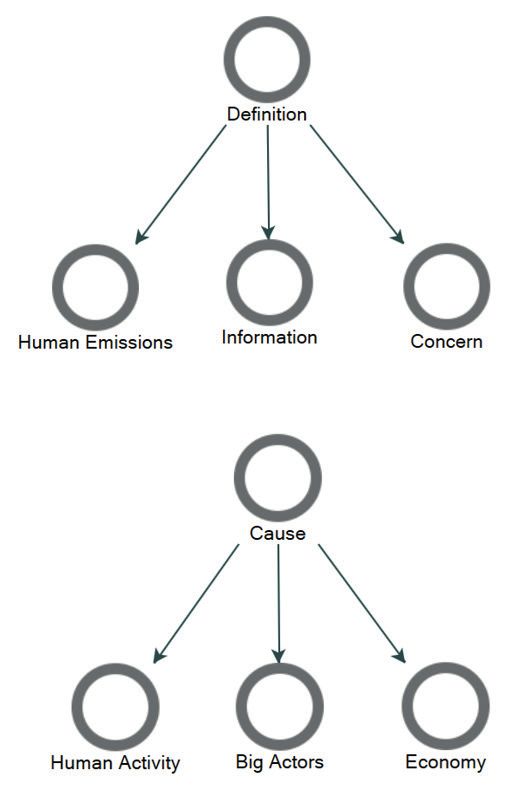
6

CLIMATE CHANGE AND
THE ROLE OF BUSINESS
LEADERSHIP
C   limate change is one of the most important
    aspects of the environmental crises humanity
is facing today. According to the Paris Agreement,
                                                          is increasingly seen as a business opportunity,
                                                          although the number of CEO’s that think this is still
                                                          quite low (25% globally) (PWC, 2019).
countries are legally obligated to limit global warming
to ‘well below 2 degrees’ (‘The Paris Agreement’,         Furthermore, the United Nations Global Compact
n.d.). Since corporations are the cornerstones            developed a report on business leaders’ view of
of current economic activity and consumption,             sustainability. The report interviewed more than a
they have an important role to play in decreasing         thousand top executives. In contrast to the PWC
greenhouse gas emissions. The largest companies           report, it found that a large majority thought
are some of the biggest economic actors and their         sustainability has a link to their business value.
revenue and greenhouse gas emissions are larger           40% of respondents say sustainability is increasing
than some national economies (Wright and Nyberg,          revenue growth. However, the respondents also
2017).                                                    admitted businesses and industries are not doing
                                                          enough. Less than 50% incorporated sustainability
Nevertheless, large companies have not only               in their operations. They also found that market
historically been a large source of emissions, some       constraints and a lack of incentives were barriers
of them have also actively lobbied against climate        to sustainability, and more than half of the CEO’s
regulations (Brulle, 2018; Wright and Nyberg, 2017).      reported a tension between short-term gains and
Clearly then, strong business action is needed now        long-term strategic objectives (Gupta et al., 2019).
more than ever. The green growth paradigm requires
that businesses incorporate sustainability in their       However, even these two reports don’t try to uncover
core business.                                            how business leaders understand climate change
                                                          on a fundamental level. This is because research
While businesses are complex and corporate                on individuals’ conception on climate change tends
leaders alone do not decide the complete economic         to be explanatory or prescriptive (see for example:
behaviour of the firm, we follow Godos-Díez,              Pidgeon, 2012; Weber and Stern, 2011). It looks at
Fernández-Gago & Martínez-Campillo’s (2010)               factors explaining individual’s attitudes to climate
assertion that ‘there cannot be socially responsible      change and how to change individual’s behaviours
corporations without socially responsible managers’       and ideas on the subject. Given the urgent nature
(p. 531). If important decision makers are not            of climate change, such approaches are clearly
convinced of the need for different business              important.
practices, change is unlikely to happen. There will
need to be a change in priorities, beyond the large       Yet, in-depth researching of people’s understanding
importance given to short-term interests.                 of climate change is also valuable. It can provide
                                                          clearer and more accurate information (Whitmarsh,
The little research that exists on this topic suggests    2008). This understanding, says Whitmarsh (2008),
that decision makers can make a difference in some        should not be only seen as knowing ‘hard scientific
cases. Sharma (2000) confirms found that business         facts’ but also as “understanding” in the fullest sense
leaders’ interpretation of environmental issues does      which includes how individuals apply scientific facts
have an impact on the environmental policies of their     and principles to particular situations and express
companies. The more they see them as a central            them in their understanding of the world’ (p. 415).
concern to their company, the more they will see
environmental policy as an opportunity, rather than       This report aims to learn how business leaders in
a threat. They will also try to frame such concerns as    Barcelona understand climate change beyond a
a defendable business interests, and they will signal     narrow scientific understanding. We study how
that the environment is a priority to internal and        business leaders perceive the climate change
external stakeholders (Wright and Nyberg, 2017).          problem at the global, business, and personal level
                                                          and analyse what they perceive as causes, impacts
But to know how business leaders will respond to          and responses.
climate change, it has to be known how business
leaders understand climate change. Nonetheless,
research on this topic has also been rare. One PWC
study surveyed more than a thousand CEO’s around
the world and posed a limited set of questions
about climate change. The study found that 24%
of the CEO’s are extremely concerned about
climate change. It also found that climate change
7

ECONOMY OF BARCELONA

B  arcelona Metropolitan Area (AMB) is one of the
   wealthiest areas in the whole of Spain. AMB has
around 3,2 million inhabitants (IERMB, 2017), in
addition to being attractive to foreign high-skilled
workers. It is a hotspot for industry, tourism and
services and the digital innovation sector. In this
section, we’ll look more closely into the economy
of Barcelona Metropolitan Area and some of its
important actors.

Catalonia and Spain
Barcelona is the capital and economic centre of
Catalonia, which is an autonomous community
in Spain. Catalonia is the richest autonomous
community in Spain after Madrid, making up roughly
20% of its GDP. It also has a lower unemployment
rate than the average in Spain (14,4% vs 10,7%)
and produces 25% of Spain’s exports (‘Spain
autonomous communities comparison: Spain vs                          Figure 1: Source IERMB (2017)
Catalonia’, 2020). In 2016, the GDP of the Barcelona
Metropolitan Area was more than 50% of the whole
GDP of Catalonia.

Governance                                              Geography and Transport Infrastructure
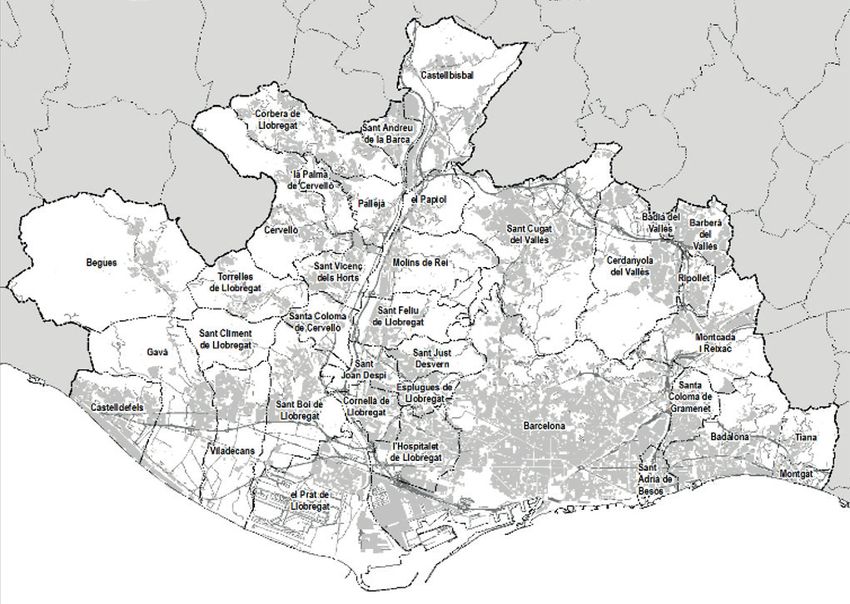
The Barcelona Metropolitan area is made up of 36        Barcelona’s central position in the Mediterranean
municipalities, of which Barcelona municipality is      and access to the sea plays an important role in its
the most well-known. In 2011, the AMB was formed,       economic strategy. Its position enables it to thrive
which is the public administration of the Barcelona     and facilitates access to markets, in particular
Metropolitan Area. All municipalities are represented   the Southern European markets (such as France,
in the AMB administration, though Barcelona             Portugal and Italy), and the interior markets of Spain,
municipality is most represented because of its high    including Catalonia (Barcelona Activa, 2018). The
number of inhabitants (‘AMB’, 2020). Currently the      transportation of goods happens along two axes:
president of the AMB is Ada Colau, who is also the      the Mediterranean axis and the Ebre axis. Most of the
mayor of Barcelona.                                     goods are transported by road (93,2%), of which the
The AMB body has shared -but limited- competencies      A7 is among the most important (‘Contact’, 2020),
with local governments related to territorial and       while the train only transports 6,8%. (‘Transport’,
urban planning, mobility, housing, environment,         2020).
economic development and social cohesion (‘AMB’,
2020).                                                  Furthermore, the port and airport are among the
                                                        largest and busiest in Europe and were growing up
                                                        until the Covid-19 crisis. The airport is the 7th largest
                                                        in Europe in terms of passenger volume (50 million
                                                        passengers in 2019), while the port ranked 9th in
                                                        Europe, in terms of container throughput (AMB,
                                                        2019 Barcelona Activa, 2018; Notteboom, 2019). It is
                                                        estimated that the port generates 9,2 billion euros
                                                        for the Catalan economy and contributes to 5,2% of
                                                        Catalan employment (ACN, 2018). The port also had
                                                        more or less 4,5 million passengers in 2019, of which
                                                        a large part came from tourist cruises (AMB, 2019).
8
Dispersed Economic Activity and GDP
Knowledge
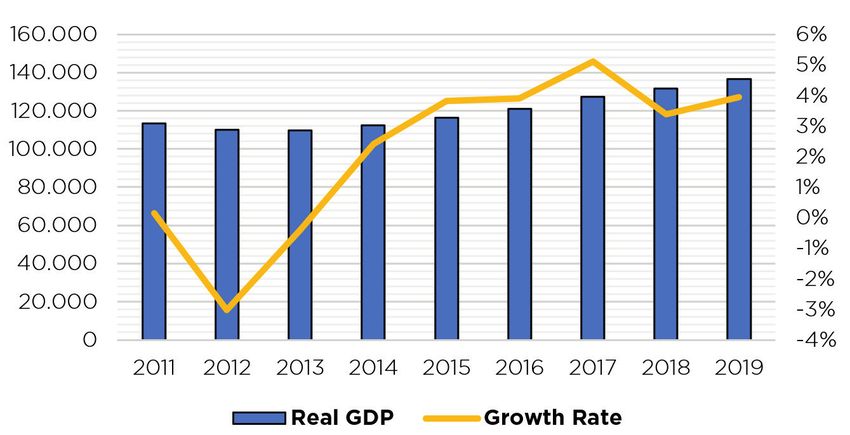
As shown in Figure 2, the economy had been growing
The metropolitan area has various economic centres, at a steady rate since the debt crisis in 2012, until
specialised in different sectors of the economy. the Covid-19 crisis. The growth rate in 2019 was 4%.
Technology/knowledge-intensive industries and The GDP per capita in 2019 was 41.546 euros (AMB,
services are highly concentrated in the municipality 2020). The impact of Covid is yet unknown, but
of Barcelona and other traditional sub-centres the current projection (for Barcelona municipality)
located in the wider Barcelona regions (Muñiz & is a 10,5-12,5% shrinkage of GDP in 2020 (Oficina
Garcia-López, 2010), while industry has increasingly Municipal de Dades, 2020).
moved away to the periphery (Muñiz & Garcia-
López, 2010), partly due to the high price of land
(Chica & Marmolejo, 2016).
Barcelona is very well positioned to have a strong
start-up ecosystem, especially in the areas of
technological innovation and the digital economy
(Barcelona Activa, 2018). It is ranked the 4th most
innovative city in Europe according to the 2019
Innovation Cities Index and is ranked as the 3rd most
preferred city to launch a start-up according to the
Start-up Heatmap Europe Report 2019 (Barcelona
Activa, 2020).
Contributing factors to this ecosystem are
Barcelona’s highly educated population (almost
50% of the working population has a university
degree) and Barcelona’s excellent business schools Figure 2: Real GDP in In Millions of Euros and Annual
and universities (it is the only city in Europe with two Growth Rates. Gross GDP at AMB Market Prices, Base
Year 2010. Data Retrieved from ‘AMB’ (2020)
teaching institutions among the top ten business
schools), in addition to other factors such as a
high quality of life and the innovative and vibrant
atmosphere (Barcelona Activa 2018, Barcelona
Activa 2020).
Key Sectors
In 2019, the Gross Added Value (GVA) in the AMB
stemmed largely from the Services (76,9%), followed
by Public Administration, Education, Health and
Social Services (15,1%), Professional, Scientific and
Administrative Activities (12%), Real Estate (11,1%),
Industry (10,3%) and Construction (4%) (‘Valor
Afegit Brut (VAB) de l’AMB per grans sectors’, 2020)
Employment follows this dynamic, with 90,7% off the
people employed in Services, followed by Industry
(5,6%) and Construction (3,6%). The number
of service workers has increased progressively
(‘Contractació laboral per grans sectors’, 2020).
While the impact of the Covid crisis is uncertain,
projections expect a large decrease in GVA for
each sector. Construction is projected to decline
by around 17%-19,4%, Industry by around 13,2% to
15,5%, and Services by 9,5%-11,5% (Oficina Municipal
de Dades, 2020).9
Tourism and International Congresses Labour
Barcelona city attracts most of the tourist activity in Barcelona’s labour and employment situation is
the Metropolitan Area. Tourism has been estimated volatile. In 2017, In 2017, 1,628,055 contracts were
to be around 18% of the entire revenue of Barcelona signed in the AMB, the vast majority of which
city’s commercial sector. As much as at least (1,400,860; 86% of the total) are temporary
26,000 people depend on sales made to tourists and a small part (227,195; 14% of the total) are
(Haupt, 2017), while many more are employed in indefinite. In the 4th quarter of 2019, again 86%
interdependent sectors. The large touristic sector has of labour contracts was temporary, of which 42%
also brought challenges with it, such as an increase have a duration of one month maximum. The
in housing prices, which led the municipality to high proportion of temporary work is a structural
promote sustainable tourism (Tourism department feature of the labour market. This makes the labour
manager’s office for enterprise and tourism, 2017). market vulnerable to economic downturns, with
temporary contracts the first to decrease (AMB,
An important area of economic activity closely 2019; IERMB, 2017). The unemployment level in the
related to tourism is the hosting of international 4th quarter of 2019 in the Metropolitan Area of
congresses. Barcelona hosted 195 international Barcelona was 10% (AMB, 2019), in 2020 and under
congresses in 2017, which was the most of any impact of Covid, it was 10,5% (‘Mercado de trabajo’,
city in the world. Many of these happen in the Fira n.d.).
de Barcelona, a very large trade and exhibition
centre. It hosts among others the Smart City Expo The average salary is 29,039 euros a year. There
World Congress and the Mobile World Congress is a 23% wage gap between men and women,
(Barcelona Activa, 2018), which are hugely important as men earn more than women: 32,718 versus
events, and also reflect Barcelona’s positioning as a 25,726 euros. Between 2010 and 2018, real wages
technological innovator. have decreased with 3%, despite a nominal wage
increase (AMB, 2019). There are no recent data on
The recent Covid-19 crisis has had a very severe poverty and inequality.
impact on tourism and large events such as the
congresses and expositions hosted in the Fira
de Barcelona have been cancelled. The number
of tourists decreased with 77,7 % in 2020, in
comparison to 2019. (‘Turistes i pernoctacions als
hotels de Barcelona’, n.d.).
Industry
Industry is still important to the Metropolitan Area
of Barcelona (Barcelona Activa, 2018). The main
industries are the chemical industry, food production
and car manufacturing. However, the industry
sector is in decline, with traditional industries such
as textiles closing the factories (‘Barcelona: Industry
Studies’, 2020). Only recently, Nissan closed down
its plant in Barcelona, leading to the loss of at least
3000 jobs. Nissan’s factory is one of the key car
factories in Barcelona, and the decision to close
left Spanish politicians very worried (Posaner &
Gallardo, 2020).10
CLIMATE CHANGE
POLICY IN BARCELONA
W hile a lot of decisions on climate change
policies necessarily happens on international
and national levels, local governments can have an
The Plan Clima focuses largely on energy (non-
transport related) and transport. Regarding energy,
they aim to have at least 30% of energy consumption
important role to play as well. Local governments’ originating from renewables, and a 30% increase in
proximity to citizens, flexibility and competences energy efficiency (in comparison with a business
in climate policy areas means that they can have a as usual projection). Some of the technological
significant impact (Galarraga, Gonzalez-Eguino and improvements they count on are electric vehicles,
Markandya, 2011). As such, local governments have more energy efficient machines and electronic
to draft, implement and coordinate climate policies distribution systems. AMB also intends to have
in their region. These policies will be important to internal procedures to follow-up on results and
understand the role of businesses. actions, and interchange them between actors, and
to make sectoral goals (AMB, 2018).
The two main climate policy frameworks in Barcelona
are the ‘Climate Plan 2018-2030’, created by the These two reports make it clear that the approach
Barcelona municipality, and the ‘Plan Clima AMB’, to climate policies in Barcelona fits into the green
created by the Metropolitan Government. growth discourse. Especially in the Plan Clima of
the AMB, the focus is on technology, the creation of
The ‘Climate Plan 2018-2030’ has a range of areas new markets and resource efficiency. Even though
in which it proposes a series of actions to decrease Barcelona municipality discusses the need for a
the impacts of climate change and transform the different economic model, the climate plan remains
city to a sustainable future. The Climate plan aims rooted in the green growth paradigm.
to reduce greenhouse gas emissions by 40%, and
to increase the green space in the city by 1,6 km².
Barcelona also aims to decouple energy use from
economic growth.
The climate plan has 5 different spheres of action:
‘people first’, ‘starting at home’, ‘transforming
communal spaces’, ‘climate economy’ and ‘building
together’. People first focuses on providing key
services to the citizens, and especially to the city’s
most vulnerable groups. Starting at home aims to
increase the energy efficiency of private buildings,
for example through subsidising renovations
that increase insolation. Transforming communal
spaces is the sphere of action that is concerned
with improving the city’s public spaces parks,
infrastructure and efficiency. The climate economy is
seen as an economy that uses resources efficiently,
where citizens consume responsibly and recycle
their waste to create a sustainable, fair and circular
economy. Finally, the building together category
aids communities with their collaborative projects
that are in line with the climate goals.
The second document is the ‘Plan Clima AMB’, a
report on climate and energy policy and objectives
by 2030, written by the AMB. To reduce greenhouse
gas emissions by 40% by 2030, which is a European
target, the AMB will aim to decrease its emissions
by 13,2% (the remaining 27,8% will be reduced by
the municipalities).11
12

METHODOLOGY

Iand
  n this section we describe the type of interview
  conducted in the research, its design and contents
     the results analysis.
                                                           First, access to possible respondents was reduced.
                                                           Physical proximity is important to gain access
                                                           to respondents, especially in high-status circles.
                                                           Second, online interviews are not as attractive to
Interview Type                                             people as in-person interviews. At least one possible
                                                           respondent declined to be interviewed once it was
This study follows a constructivist perspective. That      clear the interview would be conducted online.
means that the study recognizes that knowledge of          Finally, the Covid-19 crisis has severely impacted
natural phenomena is socially constructed (Patton,         some businesses and sectors. Many business leaders
2002). This approach enables the charting of the           were occupied with adapting to these impacts. As
various ways in which participants understand              such, interviews on climate change were likely not a
climate change (Shepardson, et al. 2010).                  priority.

For this purpose, we use semi-structured interviews.       Another barrier may have been the language.
Semi-structured interviews cover a general set of          Possible respondents may have been deterred from
questions but leave some flexibility in the order of       participating in interviews in English. However, when
the questions, and the amount and variety of follow-       requested, the option to conduct the interview with
up questions. It thus permits flexibility while allowing   a translator was provided. One of the eight final
the researcher to cover the questions he/she was           interviews has been conducted with a translator
interested in (‘Social Research Glossary’, 2020).          (English-Spanish).
Usually, the interviewer has an interview guide with
questions of interest written down on them to keep         Ultimately, we achieved to conduct 5 semi-
the interview relevant (Jamshed, 2014)                     structured interviews with local business leaders
                                                           and 3 with policy makers/advisors. Alex Goñi
The semi-structured interview has the advantage of         (President Pimec Comerç, that represents SME’s),
staying close to the topic of interest, which decreases    Constantí Serrallonga (General Manager of the Fira
the noise and filtering the interviewer has to do and      De Barcelona), Francisco Doblas-Reyes (Director
can decrease selection bias. However, it still allows      of the Earth Sciences Department at the Barcelona
for sufficient flexibility by allowing participants to     Supercomputing Centre), Jordi Torrent (Strategic
express themselves beyond the narrow conception            Director of Barcelona Port) and Mateu Hernández
of the researcher. The questionnaire of this research      (CEO of Barcelona Global, an organisation promoting
can be found in Annex 1.                                   Barcelona internationally) are the business leaders
                                                           we interviewed. Albert Arias (Tourism Expert),
Interview Corpus                                           Anna Català (Environmental Scientist), Oriol Estela
                                                           (General Coordinator of PEMB) are the policy
We interviewed two different groups of respondents:        makers/advisors1. The respondents were identified
business leaders on the one hand, and policy               and contacted with the help of local experts. The
makers and advisors on the other. The goal of the          interview period took around three months, from
interviews with the business leaders was to uncover        the end of August until the end of November. The
their understanding and meaning of climate change.         interviews had a duration of around 40 minutes on
The goal of the interviews with the policy makers/         average.
advisors was to receive more information about the
behaviour of companies and triangulate some of the         Respondents were asked at the outset of the
findings from the interviews with business leaders.        interview whether they consented to the interview
                                                           being recorded, and the results being public. The
The approach was to interview business leaders             recording only served for transcription purposes
active in each of Barcelona’s main economic sectors,       and to analyse the results. The option to provide
such as the port and the airport, the congress             confidential answers was provided. Therefore, this
sector, the tourist sector, traditional industry, and      research will not provide the full recordings nor
knowledge-intensive industries, as well as leaders         transcripts. However, quotes will be used to illustrate
of interest groups. Unfortunately, during the              the findings of the interview.
preparation of the empirical part of the research,
the Covid-19 crisis broke out. This severely impacted
the interview process.
                                                           1
                                                               Additional information on the respondent profiles can be found
                                                               in Annex 2.
13
Questionnaire Design Interview Analysis
The goal of interviewing the business leaders is to The data analysis involves a content analysis of
uncover their understanding and meaning of climate respondents’ replies in the interviews. The nature
change. The literature tries to unveil understandings of the analysis is inductive, rather than deductive.
of climate change in different ways. Shepardson This means that the interviewer decides, based on
et al. (2010) created an ‘assesment instrument’ the research question or theoretical framework,
encompassing five items: interpreting scientific which information provided by the interviewees is
evidence, examining the conceived relation between considered. Following this consideration, themes
carbon dioxide and global warming, asking about are deducted from the content of the replies, rather
the impacts of climate change, understanding the than a pre-conceived set of themes or categories
greenhouse effect and understanding the impact of (Mayring, 2000; Shepardson, et al. 2010).
human activity.
We used NVivo software to perform the data
Whitmarsh (2008), in her research, started with an analysis. Interviews were transcribed based on
open-ended question on how people understand the video recording soon after the interview was
climate change as a whole. She followed this up conducted. A first round of coding identified various
with asking about the causes and impacts of climate themes, that were placed into several categories. A
change, and a range of questions on people’s second assessment refined the categories and the
attitudes and concerns regarding climate change. coding to ensure accuracy and consistency and
increase validity.
Finally, Reynolds et al. (2010) focused on four main
categories: basic facts and definitions surrounding The coding scheme differs for the two groups of
climate processes, causes of climate change, people we interviewed, namely the policy makers/
impacts of climate change and the effectiveness of advisors and the business leaders. The coding
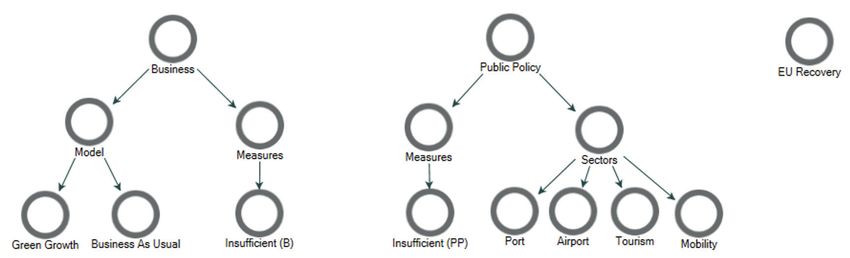
different responses. scheme in annex 3.1 illustrates which topics were
discussed with the policy makers/advisors. Coding
For the purposes of this research, we will synthesise schemes do not pertain to the relative importance of
the approaches of Whitmarsh (2008) and Reynolds each topic, it only shows which topics were covered.
et al. (2010). We start with an open-ended question Every circle represents a topic that was covered
on how people understand climate change as a during the interview. When arrows follow from a
whole. Afterwards, we focus on people’s view on circle, the following circle signifies more concretely
causes, impacts and responses to climate change. what was covered.
Additionally, we relate these categories to different
scales, since climate change operates at multiple
scales, from the personal to the global (Capstick,
2013). As people’s identities are also connected
to multiple scales and social roles (Devine-Wright,
2013), it is only by making these scales explicit that
we will get a full picture of a person’s understanding
of climate change. Our interview will ask participants
about the global level, the local level, and the
personal level.
The business leaders all received the same set of
questions, with small differences to make them
applicable to the specific respondent in question.
The questionnaire can be found in Annex 1.
The goal of the interviews with the policy makers/
advisors was to receive more information about the
expected and actual behaviour of companies. To do
so, we asked about whether businesses are following
the green growth paradigm and what kind of
policies they have enacted. We also enquired about
the climate policies of the public administrations to
gain a better overall picture of their priorities.14
RESULTS
Ibusiness
n this section we review the results of the interviews.
We first discuss the interviews with the with the
leaders, and then with the policy makers/
advisors.
Business Leaders
INTERVIEW TOPICS
We start by looking at individual respondents and
which themes they most often covered, by plotting
the percentage coverage for each code. This is
the number of characters in a particular code in
proportion to the total number of characters of that
individual’s text or interview. For example, if code
‘Economy’ has 8% coverage, it means that 8% of all
the characters from the interview, were coded as
‘Economy’. Thus, 8% of the interview was about the
economy as a cause of climate change. We selected
the five most covered topics per respondent,
because of the wide variety of topics.
Figure 3: Percentage Coverage of Business Leaders Interviews15
We see in figure 5 that Jordi Torrent talked a lot INTERVIEW RESPONSES
about the causes of climate change, this being
big actors and the economy. He also discussed In this section, we review the interview responses
renewable energy in the context of how the Port of of the business leaders. Since all the respondents
Barcelona is electrifying its operations. received the same questions, we sort the responses
by interview topics, rather than by every respondent
Alex Goñi, on the other hand, talked mostly about individually. This means we largely structure the
mobility, in the context of Barcelona policy; the responses based on the coding scheme. We start
need for clarity from public administrations and by mentioning the several definitions that were
how climate change is a threat to small and medium mentioned, followed by the perceived causes,
enterprises, as well as fish vendors. impacts and possible responses.
Additionally, we see that Doblas-Reyes covered Definition:
degrowth as a paradigm for businesses and a rising
sea level as an impact of climate change the most. Climate change was described in three different
This was followed by the identifying big actors as ways by respondents. Three out of five respondents
a cause of climate change and establishing that (Hernández, Doblas-Reyes and Serrallonga) defined
climate change comes at a personal cost to him. it as a consequence of human activity:
Hernández talked frequently of how climate change ‘Well, climate change is, let’s say, a reality that,
is a threat to Barcelona Global, how individuals unfortunately is happening due to human behaviour.
need better structures (for example better public After many years, especially after the industrial
transport) to live sustainably and how mobility is revolution, that’s been changing the atmosphere and is
beginning to affect the planet in a special way that may
important for Barcelona. He also identified migration really affect how life is in the planet.’ – Hernández
and biodiversity loss as some of the consequences
of climate change. Jordi Torrent defined climate change as a very
strong concern, especially for the next generations,
Finally, we discern that Serrallonga discussed while Alex Goñi defined climate change in terms of
mobility and tourism in Barcelona. He also talked the information that people receive about it in their
about the Fira de Barcelona and how it receives its local context.
energy from renewable sources. Serrallonga also
identified international organisations and academia ‘Personally, I’m pretty much concerned about climate
as actors who can help with the fight against climate change and I think it is one of the most compelling
change. issues today for our society and for the future
generations, I believe it’s not going to affect probably
me a lot, my generation, but my daughters, I have three
kids, so I’m pretty much concerned for them basically.’
– Torrent
‘What is especially important is the perception of
the public, the information they are receiving here in
Catalunya. It’s not about what is happening, it’s about
the information that is being heard, and it is perceived
as something external and happening to others. It is not
seen as an immediate circumstance here in Catalunya.
This doesn’t mean we are not conscious or aware of
climate change, people have awareness and conscience.
But the worried feelings come mostly from the
information that they hear somewhere else.’ – Goñi
Cause:
Several causes were identified by respondents.
The economy was most often identified as the
cause, followed by the more general identification
of ‘human activity’ and ‘big actors’, which are often
large countries.16
Basically, I mean the main causes of climate change, The truth is that small and medium-sized entrepreneurs
I would say, come from something - this is a personal (and also the micro and autonomous) are undoubtedly
perspective I’m speaking of- so I come from something those who do the most to contribute to curb climate
positive at the end there, which is that middle class change from your sector. Notice that the trade in
all over the world has grown. Particularly in Asia, but proximity is based on commercial relationships, most
not only in Asia. so, greenhouse gas emissions have of them, sustainable; to the extent that the impact they
increased globally. Although I believe the US is still the have on their environment is absolutely interrelated.
main emitter of greenhouse gas emissions, but I guess They are most interested that the environment in which
if it was only for the US and Europe, the situation would they operate is suitable and does not degrade.’ – Goñi
not be as bad as it is now. Taking into account that you
have today, over, I don’t know, over 1 billion people in ‘Our mission is to make Barcelona one of the best
Asia that belong to the middle class that consume more cities of the world for talent and talented people. So,
or less like we do. […] And so, consumption, industry these talented people are highly sensitive to climate
transportation, et cetera, have grown a lot. So, this has change. So, we must as a city have a strategy on this
become an even worse problem. […] Problem is that green economy. […] Because [if] Barcelona is not a
the dynamics of global economy makes it very difficult sustainable city, the city won’t be attractive for talent.
to make a substantial impact on reducing, for instance, So, Barcelona must be a sustainable city in order also to
greenhouse gases emissions. – Torrent be attractive for talent.’
As we see, Jordi Torrent explicitly sees climate Other respondents did not see climate change as a
change of a consequence of a positive trend, unlike direct threat to their businesses. However, everyone
other respondents. shared concerns on the impacts of climate change.
Hernández, Reyes and Torrent expect climate
‘I suppose other people who work on this will know change to have a huge impact in the long term and
more, but for us it is the failure to control emissions, Serrallonga expects a big impact. Only Goñi stated
especially in large countries, such as the USA, China, he expected a small impact, although that was
India... This can give a feeling of powerlessness, because
people are working to live in a sustainable way, and then dependent on our societies being able to respond
to see how the big countries are not doing enough and in time:
do whatever they like, it can be disheartening. The truth
is that it is difficult to see.’ – Goñi Personally I am convinced that it will have a small
‘Well, its causes are mainly the carbon economy impact, but not big or huge, because that would mean
and the human economy, the way it’s organized, the a social catastrophe, so I hope that people will be smart
carbonization of the economy.’ – Hernández enough to implement measures to make it have just a
small or medium impact.’ – Goñi
‘Human activity is one of the main causes of climate
change. For decades we unknowingly caused it through ‘The number of sectors that will be affected, is huge.
emissions related to the use of fossil fuels and other I would say that it’s covering and it’s affecting almost
substances.’ – Serrallonga every single activity of human societies.’ – Doblas-Reyes
Impact: Respondents identified a range of impacts, from
poverty and migration, to differerent production and
Both Goñi and Hernández have indicated that consumption patterns, to environmental changes
climate change is a direct threat to their businesses. such as droughts, rising sea levels, decreased
For Goñi, SME’s are directly dependent on a safe biodiversity et cetera.
environment. As he is also the president of the
Catalunya Fish Vendor Association, he also talked Finally, all respondents indicated that climate change
extensively about how climate change would impact is very important to them on a personal level. When
the fishing industry. Hernández, whose goal as CEO asked if they could put a number on how concerned
of Barcelona Global is to attract international talent they are with climate change out of 10, Torrent,
to Barcelona, said this talent will only come to a city Serrallonga and Hernández said eight, eight and ten
that is aware of climate change and dealing with respectively (the other respondents could not put a
mitigation and adaptation: specific number on it). Everyone indicated they were
worried about the impacts on future generations,
‘As representatives of businessmen, we are aware that while some explicitly mentioned the impacts it will
to obtain an optimal development of our economic have on Barcelona and the personal cost of climate
activities, we must have the best possible environment. change:
That is why sustainability is presented as a fundamental
element to preserve, care and incorporate into all our
business strategies. Can you imagine important that
climate change is for a sector such as fishermen?[…]17
‘Climate change will have and impact in future ‘There’s three different levels of responsibility. One I
generations if we fail to prevent it. And that is precisely would say is the Generalitat Catalunya. Second is the
why we need to act now and we need to act together.’ – AMB, third the city, the municipality, the city council,
Serrallonga and also the state, the Spanish state, has also a degree
of responsibility here.’ – Torrent
‘When it comes to personal, I have two daughters of 18
and 16, so imagine, and they are extremely implicated.’ Businesses were also mentioned, as were individuals:
– Torrent
‘As you approach a local level such as making Barcelona
‘For me, on a personal level, for my kids and nephews more sustainable, I strongly believe that policy makers
and friends, very important. This is something you don’t as well as big and small companies need to commit
physically experience, but evidently it exists and it’s to sustainability but, at this level, everyone’s actions
going to impacts us directly and indirectly.’ – Goñi matter’ – Serrallonga
‘Of course, it’s really worrying and especially in, I think ‘The main responsible should be the people themselves.
worldwide, but especially in places like Barcelona, in The true results appear when people have trust in
the Mediterranean climate near the sea where global solutions, and they integrate in their way of thinking and
warming will surely have a big impact on the way we
doing.’ – Goñi
are living nowadays.’ – Hernández
‘For instance, I live at sea level. So, the sea and beaches Respondents identified several policy areas that
are 50 meters from my home, and any sea level rise is the city should be focused on. Mobility has most
going to end up having an impact on my life. And, we often been identified, followed by energy, housing,
could see this quite clearly during the storm that took tourism, the port, and waste. Additionally, Goñi and
place in January.’ – Doblas-Reyes Torrent noted that the public administrations should
provide clearer rules and frameworks in cooperation
Response: with citizens and businesses. They also noted,
alongside Doblas-Reyes, that the citizenry should
Respondents identified a range of actors that should be informed properly about climate change:
be responsible for acting against climate change on
a global level. They noted that it is the responsibility ‘[We need] simplification and more rapidness of
of everyone to be involved. However, governments, administrative procedures [and] clear understanding
businesses and individuals were most frequently and communication to the public opinion about the
mentioned. Some other, less common replies were impact on the environment of different activities and try
to stop misinformation (for instance when it comes to
international organisations, academia, cities and port activity and cruise ships).’ – Torrent
civil associations:
‘Surely we still have many fields in which to have a
‘Well, this is a shared effort that should be done greater contribution to climate change, but I insist
from governments on their role as regulators up to on need for such actions and model changes to be
companies and individuals. So, everyone is involved in agreed upon and to be predictable, so that your
this issue. Some have bigger responsibilities like major implementation has a clear transition and known to all.
states and supra-governmental institutions. But then Prohibit, impose and limit from one day to the next,
also governments and companies, everyone has to have and as a general rule, without a previous pedagogy
its role. Big or small, everyone has to have its role.’ – or a special sensitivity applied towards small business
Hernández models, it will mean that the measure will not succeed,
and what’s more, even generate the contrary reaction.’
In the context of Barcelona, respondents expressed – Goñi
a strong belief in the need for local governments to
play a role in climate change policy. This especially And […] associations, at the local level, all those sectors
included the Barcelona city council, but also the in society that we know are vulnerable to climate
AMB and the Catalan Government: change and air quality. So, for instance, parents’
associations and to really work with them to develop
material that can explain what climate change is so that
‘Oh, there are many actors that could play a role. It’s they can use it afterwards with their children. […] Yeah,
obvious that local councils would be one of them. citizens, either directly through them, through the local
And now I’m not just thinking of the local council of councils, but also through the associations that they use
Barcelona, but also of the metropolitan area. […] And for the daily life in the city. – Doblas-Reyes
the Generalitat for sure.’ – Doblas-Reyes18
On the topic of business response to climate change, ‘Well, when we talk with big companies in Barcelona
four out of five respondents indicated that they were in Global, they all [are] aligned with the sustainability
very strongly in favour of the green growth paradigm. strategy. And the same when we talk with individual
Other paradigms were not considered. members in Barcelona Global, we also feel the same;
[Green growth] because I don’t think it would be honest that they are all engaged in this sustainable strategy.’
or even moral to ask people from China, from India, – Hernández
from Indonesia, from Africa to de-grow. – Torrent
Finally, all of the respondents adapt greener
‘Green Growth. I don’t know if it is realistic, but it should practices in their lives, to some extent:
be green growth’ – Hernández
‘On the personal level I try not to take the airplane, I
Only Doblas-Reyes indicated that the response go by train, boat or car. It’s a personal decision already
should have elements of both green growth and before climate change was a topic. Flying looks faster,
degrowth: but the whole procedure takes up a lot of time. This is
why I believe that in Spain, train has been the forgotten
Yeah, I think it’s difficult to choose between de-growth mode of transport. It has been forgotten by the
and green growth, in the sense that, as in many other authorities, but it is a great way to deliver commodities
things in life, the medium term, is probably the solution and people. I really hope we can switch to trains. […] In
or the least bad solution, in the sense that there is no the matter of eating meat, I eat a considerate amount
reason why the economy can’t keep growing if we have of fish, and we have a struggle against those who are
a circular economy and we have a larger respect for against eating meat. I know that in Argentina and
our environment. So of course, Green growth is not a the USA you find industrial ranches where the meat
continuous growth and is not homogeneous. It’s not production is terrible. But here in Spain, the meat
that everyone is going to grow, but somehow looking production is more local, it is in the hands of small
at history in the past, humanity with ups and downs, businesses. And for that reason, I won’t stop eating
kept growing in terms of population and the size of its meat like rabbit, chicken or pork, because I consider
economy. Some sectors were losers and some others the production is local and not that damaging to the
were winners. If people have the opportunity to make climate. But in other areas I support improvements that
business and they’ll have a better life in a green growth are better for the environment.’ – Goñi
economy, and somehow, we have an environment that is
that is taken in full consideration, basically we wouldn’t ‘So, at home, everything is recycled, I go normally by
be that far from the de-growth possibility. Of course, bicycle to the office. I don’t think stopping travel is an
that would only make sense if inequalities are reduced important issue. There are other things that can be
social inequality and particularly economic inequalities. done, when it comes to the other sectors, and I’m not
going to name some industries, because they are our
Respondents provided several areas in which their customers. But there’s other sectors more important
businesses tried to be more sustainable. Energy is one than aviation. I think aviation is something good in
terms of cultural exchange, knowing countries, et
of the main domains of incorporating sustainability. cetera. So, I’m not going to stop traveling if I can travel.
The Port is committing to electrification of the I’m going to Zaragoza by car today because I cannot go
wharves, generating renewable energy with solar by train. But I already do lots of things at home to be
panels and switching transport of goods from more sustainable, let’s say.’ – Torrent
trucks to trains. The Fira de Barcelona installed solar
panels, and all its consumption of energy stems from ‘In terms of mobility, I only use public transport. We
renewable energy. The Barcelona Supercomputing have a car, but we use it only for emergencies and,
Centre also retrieves its energy from renewable and it’s an old car that we don’t foresee replacing in
sources, or the energy it uses is offset by producing a very long time. The other thing is in terms of foods.
renewable energy elsewhere. We eat meat at home, but we use products from the
neighbourhoods, vegetables and fruits. In terms of
recycling, we follow all recommendations that, we can
Furthermore, Pimec Comerç and the Barcelona apply here in the council. And, that’s, I think about it.
Supercomputing Centre also recycle their waste, We spent three years ago quite an essential amount of
while the Fira de Barcelona created a manual of money insulating the house because it’s an old house,
good environmental practices for exhibitors and it’s a 100-year-old house. And, yeah, in the end, it
attendees, that includes promoting public transport sounds like, well, I’m going to do something for climate
and sustainable tourism. change. It’s much better to live in the house because
it’s warmer. So, from that point of view, it was a clever
Mateu Hernández, CEO of Barcelona Global that move.’ – Doblas-Reyes
represents many of the largest institutions and ‘I’d be willing to bring changes to my lifestyle, which
companies in Barcelona, was asked about the stance in fact I have, such as committing to green energy or
of these companies in regard to sustainability: changing my mobility patterns.’ – Serrallonga19
‘The issue is that it’s difficult to build heroes. So, being
a hero is complicated. So, infrastructures should be
updated in order to align those infrastructures into
green behaviour. I can commute to Madrid and now
it’s by high speed train. I’m using high-speed train, it’s
much more sustainable than using the airplane. But if
I have to commute with Valencia, which is even closer
than Madrid, the train is not ready to be a commute. So,
we need green investment on those infrastructures that
has to be greener. And without those infrastructures,
we will rely on heroes and heroes is difficult to rely on.’
– Hernàndez
Policy makers/advisors
INTERVIEW TOPICS
To get a clearer picture of the themes explored by
the policy makers/advisors individually, we again
plot the percentage coverage of each code.
Figure 4: Percentage Coverage of Expert Interviews. Insufficient (PP) and Insufficient (B)
stand for insufficiency of public policy and business measures respectively
Figure 4 shows the percentage coverage of each covered the insufficiency of both businesses and
code of per respondents. The figure shows that public administrations, followed by the EU Recovery
Oriol Estela mainly talked about the EU Recovery Fund and mobility. She also mentioned the port,
Fund, the business as usual paradigm and the airport and tourism as important local areas of
insufficiency of public policies. Albert Arias mostly improvement.
discussed the insufficiency of public policies, and the
Barcelona El Prat Airport. Finally, Càtala primarily20
INTERVIEW RESPONSES […] I’m afraid that we will come back to business as
usual. You can see this for instance [with] the press
The findings discussed above give a general picture releases of the port: one of the goals for the port
of the topics discussed in the interviews. In this authorities [is] to recover the previous activity to the
pandemics. That includes growth on cruises, tourist
section we specify the findings by reporting the key cruises.
replies of the respondents.
Additionally, when asked specifically about the way
Oriol Estela: businesses themselves signalled their economic
activity, Oriol answered that business as usual has
Oriol Estela noted that public policies have been been the main reply from businesses.
insufficient so far. He remarked that the previous
strategic plan of the PEMB has only been nominal ‘I think that, that all we have seen at the moment from
and has not been implemented whatsoever. the business sector, from the economic sector, is going
While researching existing climate policies in the back to the previous situation and then we’ll see what
Barcelona region, Estela has also found that many we do. But recovery will be the same elements that we
municipalities in the AMB did not even have climate had. And afterwards we will see. And, of course there
plans. must be some exceptions, but not the major ones.’
During the interview, we asked this respondent Finally, throughout the interview he stressed
whether he agreed that the Climate Plan 2018-2030 the importance of the EU Recovery Fund. A lot
and ‘Plan Clima AMB’ use the paradigm of green of companies are waiting for the EU Recovery
growth, and that businesses are expected to follow Fund, which aims to help European economies by
the green growth paradigm. Oriol Estela agreed, but offering money to be invested in green and digital
with some important considerations in mind. technologies, to be more concrete. For Oriol, there
is an opportunity if Barcelona effectively manages
First, he commented on the disconnect between and invests the money from the EU Recovery fund.
the public climate policies and economic policies of In order to achieve the goals of the EU, there should
Barcelona municipality: be strong conditions on sustainability attached to
receiving the funds:
‘All these plans, the climate plans which have been
made, the leadership came from the environmental ‘So, I’m not very confident that a measurable change
departments, let’s say, not the economic ones. And if will come, unless the funds that are supposed to come
you compare the economic plans with environment to Spain and to Barcelona, the European funds, are
plans or the climate plans you will see that there’s strictly oriented to a change in the economic paradigm.
a difference at least in the hidden letters of the And I’m not sure that this will happen, but I think that
document, in the intention. They probably say similar this will be the opportunity.’
things, but the economic plans and intention are
different and it’s more business as usual, even more Albert Arias:
than the other ones.
We interviewed Albert Arias to learn more about
Estela thus states that while the Climate Plan 2018- public policies on tourism, more specifically, the
2030 may have a green growth paradigm, the way the ecological sustainability is viewed by public
economic plans are not congruent with this climate administrations and the touristic sector. According
plan and has a business as usual perspective. to Arias, the sole focus on deconcentrating tourism
from specific areas is insufficient. Tourism, he thinks,
Second, he notes that while green growth perhaps needs to be managed more sustainably and more
had been the paradigm before the pandemic, democratically. Furthermore, he criticised the focus
currently the focus on economic recovery resembled on growth within the sector and the neglect of
the business as usual paradigm more: environmental and social externalities, especially
the airport:
‘We shall see […] especially with the big institutions
or big businesses or the main stakeholders, the port ‘And aviation is at the heart of it. […] They are
authority, that is very, very important, and defines a managed, set to grow, grow and grow. They are
lot the way that businesses will go, and the airport, all expecting revenues and shareholders want them.
these big institutions, how will they behave? Because They make projections on growing, they do not care
maybe there were signs of green growth on their plans about externalities, and not just the environmental
and the public plans or the government’s plans before externalities such as the carbon footprint, but also,
the pandemics. they do not care about the social externalities relatedYou can also read


