Cargo Crime Insights BSI SCREEN Intelligence - Q1 2020
←
→
Page content transcription
If your browser does not render page correctly, please read the page content below
Cargo Crime
Insights
BSI SCREEN Intelligence
Q1 2020
Cargo Crime Insights: Q1 2020
Introduction
The beginning of 2020 presented many new and unique
challenges to organizations. The coronavirus disease 2019
(COVID-19) outbreak that erupted just as the year began quickly
brought supply chain disruption and resilience to the front of
organization’s minds. BSI data and trend analysis highlights the
impacts that COVID-19 had over the first quarter of the year. This

                                                                                    Cargo Crime Insights
report discusses the data trends BSI Global Intelligence analyzed
this year, as well as provides insights on many of the various
supply chain-related topics tracked in BSI’s SCREEN intelligence
platform over the first quarter of the new year.

                                                        bsigroup.com /supplychain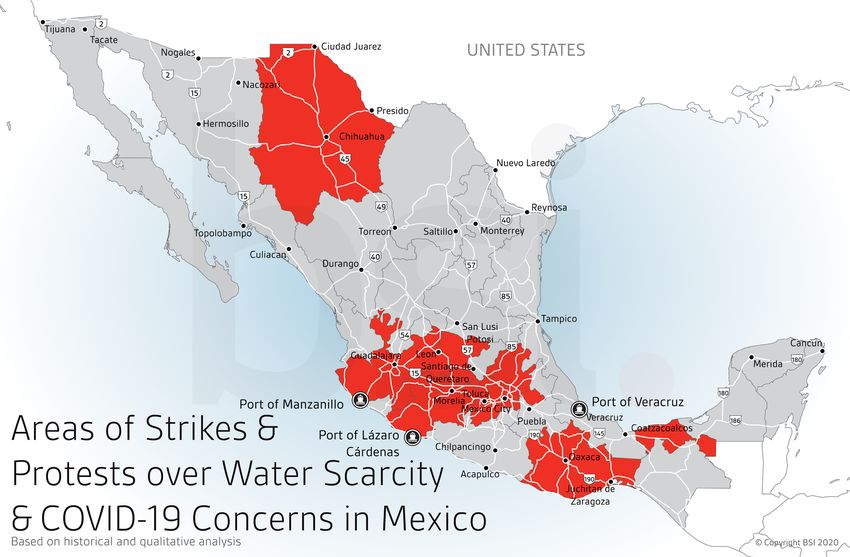
Q1 Data Trends for Asia                                        board the vehicle, and then throw goods to trailing
                                                               accomplices.
In cargo theft incident data collected by BSI in Asia in
Q1 2020, cargo thieves in the area primarily stole food        Overall, these trends are reflective of the dominant type
and beverage products, following the same trend from           of theft seen in the region, stealing cargo directly from
the first quarter of 2019. Throughout this report, you         facilities, a trend demonstrative of poor access controls.
will see this is not the only region that saw food and         Poor access control protocols often contribute to cargo
beverage products as a top commodity stolen. The rise          theft in Asia, but particularly in India where terminated
in value of these products due to the COVID-19 outbreak        employees often retain facility keys that are used to
may explain this rise in theft.                                conduct thefts at a later date.

Cargo thefts in Asia occurred largely in both theft from       Supply chain corruption is another major element
trucks and facilities, with a large amount of thefts from      contributing to thefts in Asia, with corrupt employees
warehouses. A large portion of these incidents occurred        removing goods during transport or accessing
in India, which has a high threat rating for cargo theft.      shipments stored in warehouses or logistics facilities.
Cargo thieves in India employ a wide-range of tactics.         These thieves pilfer small numbers of items but
The methods utilized by thieves in India range from            occasionally manage to steal larger quantities of goods.
very opportunistic means, such as pilferage and thefts         These trends play out in the median value of thefts in
by drivers or passersby, to more organized tactics,            the region, which tends to remain much lower than
including in-transit truck thefts. In these types of thefts,   other regions where thieves often steal entire truckloads
thieves drive a vehicle behind a moving cargo truck,           of high-value goods.

                                                                                                                                 Cargo Crime Insights

                                                                                                 bsigroup.com /supplychain   1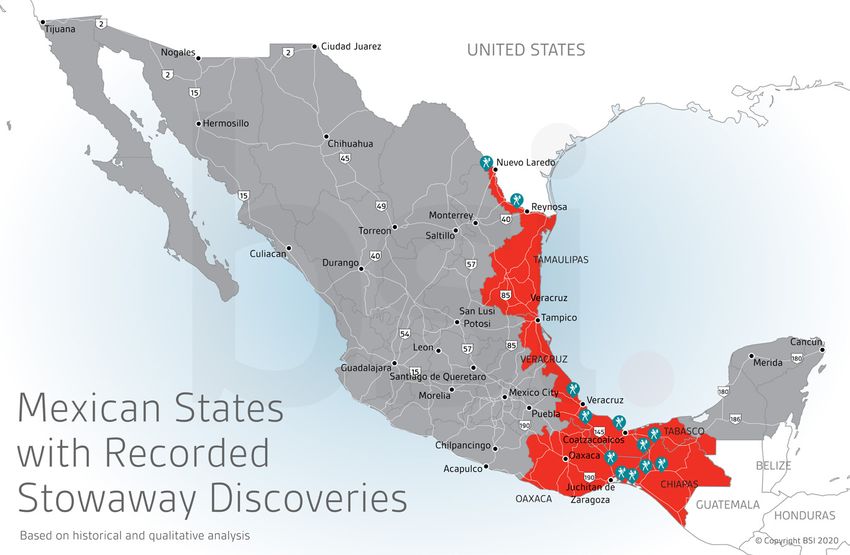
Q1 Data Trends for North
America
North America continues to be split by the dichotomy
of the more reserved thefts involving unattended
cargo trucks that BSI records in the United States and
Canada and the aggressive, and often violent, hijackings
characteristic of Mexico and the majority of Central
America.

Thieves in Mexico and Central America utilize cargo
truck hijackings as a primary tactic. In most incidents
that BSI records in this region, thieves often brandish,
and occasionally use, firearms to force cargo truck
drivers to the side of the road. Thieves commonly take
drivers hostage during cargo truck hijackings, holding
these personnel generally for a short period of time to
delay police response. Not all cargo truck hijackings in
Mexico occur when vehicles are in-transit, with thieves
approaching cargo trucks that are parked at gas stations
or other similarly insecure locations.

                                                                                           Cargo Crime Insights
In Q1 2020, BSI recorded an increase in thefts involving
consumer products, including personal hygiene items
in North America, with the majority of these thefts
involved cargo truck hijackings in Mexico. A possible
explanation for the rise in consumer product thefts
across North America is the increased value on these
products due to COVID-19 shortages and limitations on
resources. Food and beverage theft remained similar
across the first quarters of 2019 and 2020.

                                                           bsigroup.com /supplychain   2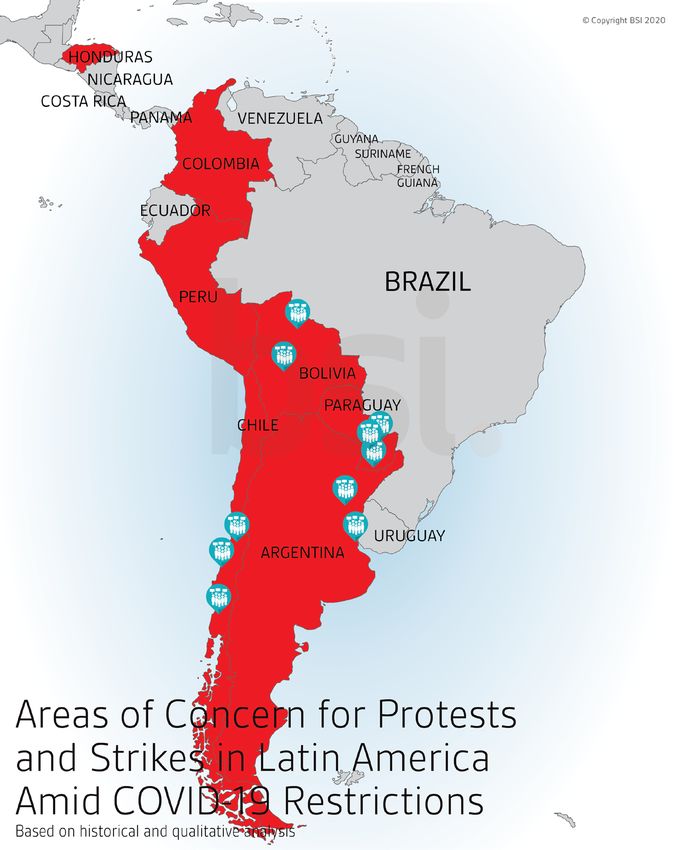
Q1 Data Trends for
Europe
Historically, Europe is arguably the leading region
where the lack of secure parking for cargo trucks
influences cargo theft trends. All major countries
of concern for cargo theft in the region, including
the United Kingdom and Germany, lack a sufficient
amount of secure parking locations, creating
ample, and easy, opportunity for thieves to strike
vulnerable vehicles. Regulations that limit the
length that cargo truck drivers can operate before
taking a mandatory break also exacerbates the lack
of secure parking and often forces drivers to stop
in vulnerable locations. Additionally, the prevalence
of soft-sided trailers further increases the ease to
which thieves can gain access to cargo truck-borne
shipments of good.

However, in Q1 2020, BSI noted a jump in the
number of facility thefts over theft from vehicle

                                                                                        Cargo Crime Insights
or slash and grab thefts from trucks. It is highly
possible that travel restrictions due to the
COVID-19 outbreak that caused many companies
to have limited operations, combined with
the added vulnerability of goods backed up in
warehouse facilities, explains this spike in facility
thefts in Europe.

Additionally, Q1 data in Europe showed a shift
in the type of goods stolen, favoring food and
beverage items. It is possible that this spike was
due in part to the rise in the value of food during
COVID-19 lockdowns across the region.

Reports indicate that food prices have increased
across Europe during the COVID-19 lockdowns, as
COVID-19 restrictions and measures disrupted food
production supply chains. The increase in value of
food may explain the increase in theft during Q1
2020.

                                                        bsigroup.com /supplychain   3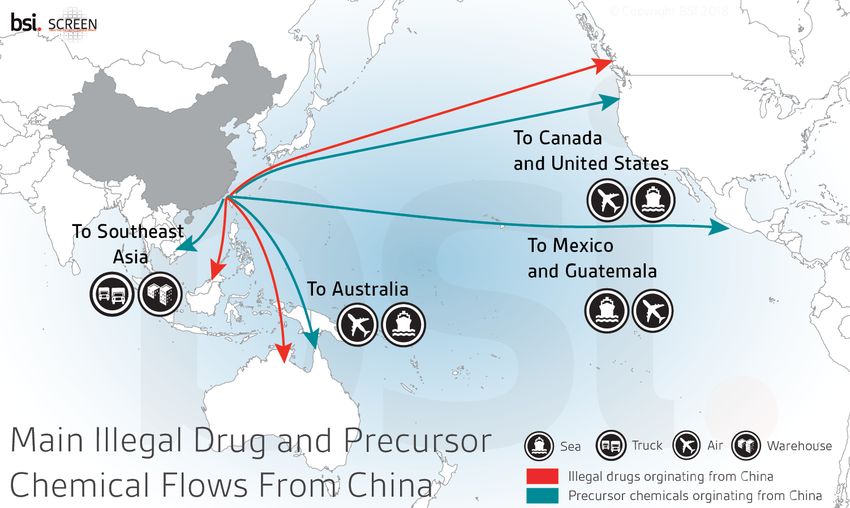
Q1 Data Trends for South                                    locations must be factored into route planning in order
                                                            to comply with regulations on driving time, a cargo
America                                                     truck driver may not be able to take the shortest route
                                                            to the destination and thereby incur a higher risk of
South America continues to suffer from the highest          cargo theft due to the additional time spent on the road.
rate of cargo truck hijackings in the world, driven         In addition, most approved breakpoints, especially gas
primarily by the extreme rate of theft seen in Brazil.      stations, lack sufficient security such as cameras and
Unlike in Europe where we saw a spike in facility thefts,   fencing, allowing thieves to hijack cargo trucks with
BSI has not noted the same level of restrictions and        relative ease. The use of dual drivers for ground freight
enforcement of restrictions in the North America and        shipments would allow cargo trucks to avoid stopping
South America leaders for cargo theft: Mexico and           and help mitigate the risk of cargo theft from longer
Brazil. This could explain why BSI did not record a         routes.
similar spike in facility thefts in these regions.
                                                            In contrast to North American data for Q1 2020, South
Brazil is often accused of lacking the necessary amount     America saw a decrease in the amount of consumer
of approved parking locations, which can explain why        product thefts from 2019 to 2020, while the frequency
hijacking and theft from vehicle remained the top means     of food and beverage thefts grew.
of cargo theft in South America. Because breakpoint

                                                                                                                             Cargo Crime Insights

                                                                                             bsigroup.com /supplychain   4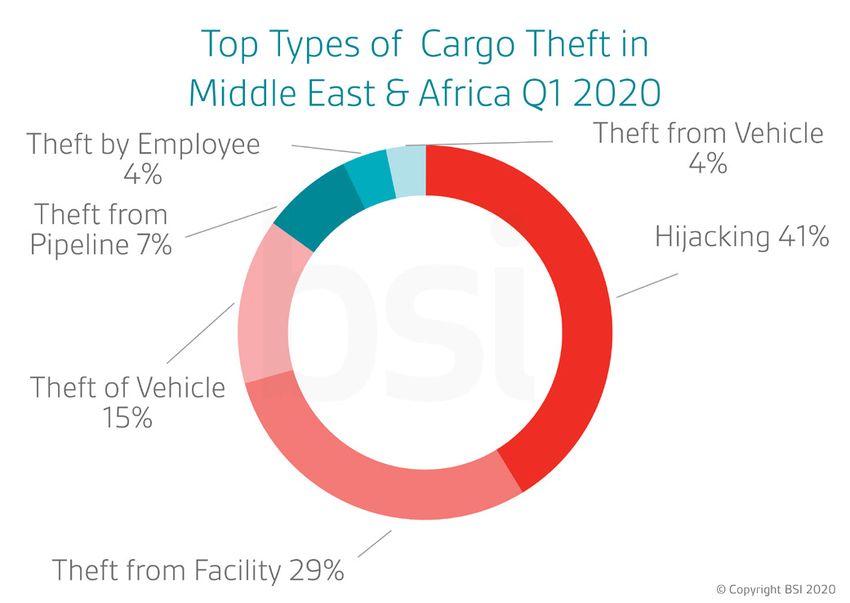
Q1 Data Trends for Africa                                  and more hostile forms of cargo theft are also prevalent
                                                           across the severely rated countries for cargo theft in the
and Middle East                                            Middle East, including Iraq, Afghanistan, and Pakistan.

Q1 2020 saw a shift in the type of cargo theft occurring   Throughout Q1 2020, many African countries instituted
in the Middle East and Africa compared to Q1 2019.         border restrictions and varying levels of internal
There was an shift from theft from vehicles and from       lockdowns, with some impacting the flow of cargo
facilities to a surge in hijacking across the regions.     through the region. Authorities in Africa faced additional
Additionally, Q1 2020 saw a change in top product          issues from COVID-19 in that border closures and delays
stolen across the region, with electronics overtaking      exacerbated other regional issues, namely the mass
food and beverage products as the top commodity.           locust outbreak in East Africa. Due to border closures
                                                           and delays, farmers could not receive all of pesticides to
Cargo truck hijackings remain the dominant form of         combat the outbreak.
cargo theft in South Africa, where BSI continues to most
frequently record theft incidents across Africa. Violent

                                                                                                                             Cargo Crime Insights

                                                                                             bsigroup.com /supplychain   5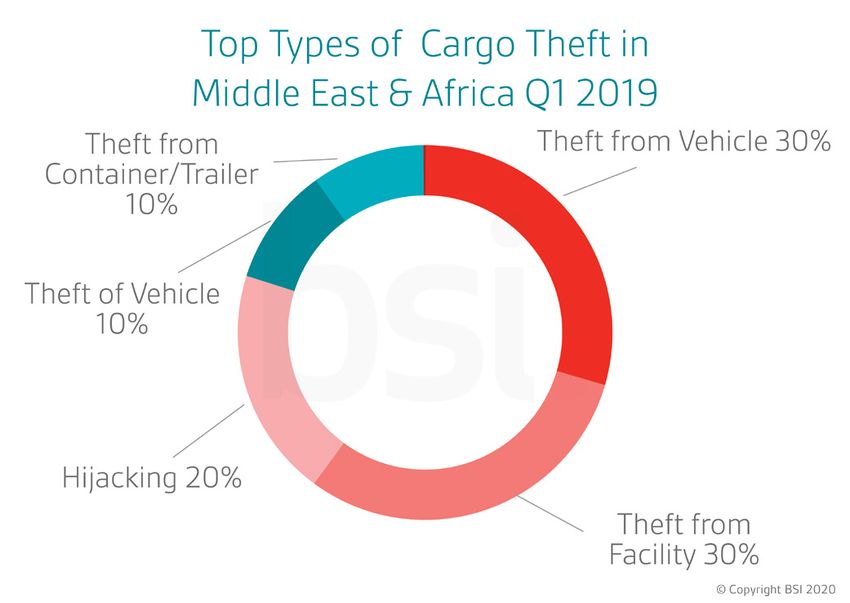
Illegal Drug Seizure Trends                                 due to COVID-19 suggests that it may be easier to
                                                            detect “narco flights,” further constricting the ability
in Q1 2020                                                  of Mexican cartels to source product. Additionally, due
                                                            to COVID-19, the U.S.-Mexico border closed to all but
BSI continues to record seizures of illegal drugs from      essential traffic, namely freight. This closure, as well as
cargo loads throughout the COVID-19 outbreak. Top           the flight restrictions, removed key avenues utilized by
origin countries remain relatively consistent from the      cartels to traffic illegal drugs into the United States that,
last quarter of 2019 into the first of 2020, however        combined with supply constraints, are likely to have
there was a significant jump in seizures of drugs           significant ramifications for supply chains in the short
originating in Colombia during Q1 2020. This rise in        to medium-term. Cartels may also increasingly seek
frequency of seizures in Colombia is possible due to        to exploit corrupt individuals or infiltrate those supply
smugglers accelerating shipments ahead of pending           chains deemed essential to make up for this
lockdowns due to the COVID-19 outbreak sweeping             now restricted transportation route.
across the globe during this time. Prior to the outbreak,
cocaine production in Colombia reached an all-time          The United States’ recent announcement of enhanced
high.                                                       illegal drug interdiction efforts in the Caribbean Sea
                                                            is likely to converge with the supply constraints of
These trends are likely to change as we start to            precursor chemicals and further impact Mexican cartel
see the full impact of COVID-19 on drug smuggling           supplies.
operations. The global drop in the number of flights

                                                                                                                                Cargo Crime Insights

                                                                                               bsigroup.com /supplychain    6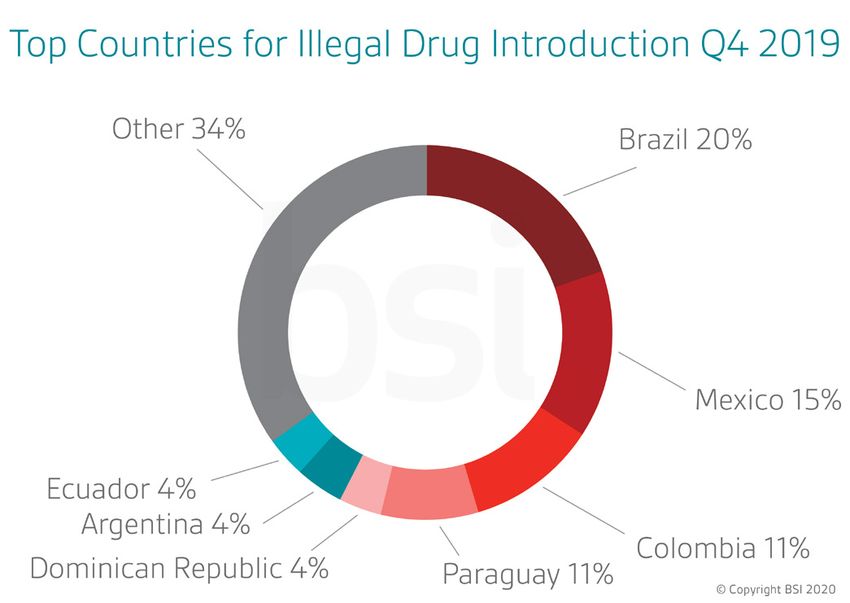
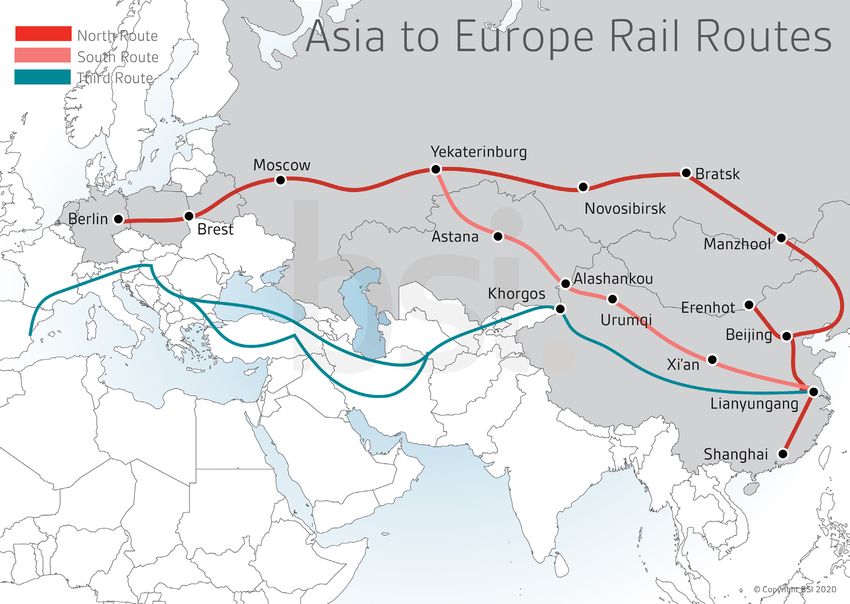
Search for Alternative                                     corruption among border guards in Russia and countries
                                                           throughout Central Asia, and the remote terrain of the
Shipping Routes Highlights                                 area which may make it difficult to detect or respond to
                                                           a theft during the duration of the cargo transportation.
the Importance of Assessing                                As companies search for alternative routes and explore
Risk                                                       the China–Europe Rail routes, they should consider
                                                           the possible threats to cargo. Security measures that
Ports in China experienced significant impacts due to
                                                           can be implemented to guard against these threats
COVID-19 as truckers could not carry goods to the ports
                                                           include placing containers at the front of rail cars when
and sailings reduced and canceled. As an alternative,
                                                           possible, using locking mechanisms on containers and
rail routes from China to Europe became attractive for
                                                           rail cars whenever possible and consider using door
moving goods out of China.
                                                           opening or light-sensing alarms, and ensuring that
However, there are several security risks associated       logistics company employees are trained to recognize
with those rail routes including frequent stops in         signs of container tampering and have an incident
Russia, which has a severe risk of cargo theft. These      escalation and reporting plan in place.
risks include gauge changes between different rail lines
which can delay containers 2-3 days in some instances,

                                                                                                                             Cargo Crime Insights

                                                                                             bsigroup.com /supplychain   7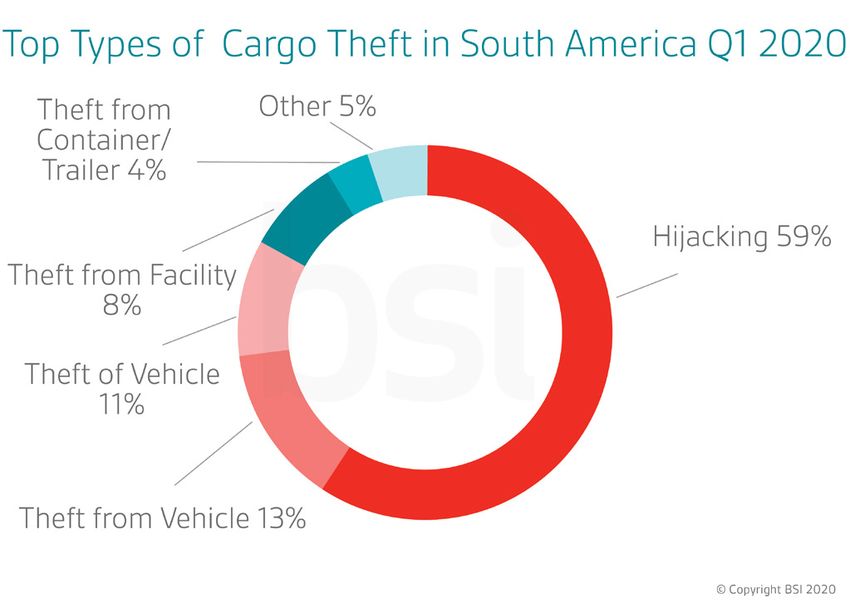
COVID-19 Affecting Criminal                                 these so-called “narco flights,” further constricting the
                                                            ability of Mexican cartels to source product.
Supply Chains Too                                           Perhaps most notably, the closure of the U.S.-Mexico
Like many companies, Mexican drug cartels similarly         border to all but essential traffic, namely freight, has
felt the impacts of the initial outbreak and spread         removed a key avenue utilized by cartels to traffic illegal
of COVID-19 in China on their criminal supply chain         drugs into the United States that, combined with supply
throughout the first quarter of 2020. The measures that     constraints, is likely to have significant ramifications for
the Chinese government implemented to halt the spread       supply chains in the short to medium-term. Cartels may
of COVID-19 disrupted the ability of cartels to secure      also increasingly seek to exploit corrupt individuals or
the precursor chemicals needed to produce illegal drugs     infiltrate those supply chains deemed essential to make
as well as the counterfeit goods that cartels sell both     up for this now restricted transportation route.
domestically and internationally.
                                                            Cartels in Mexico may increasingly target cargo trucks
The United States’ recent announcement of enhanced          for illegal drug smuggling operations, as these types of
illegal drug interdiction efforts in the Caribbean Sea      vehicles are still able to cross the U.S.-Mexico border.
is likely to converge with the supply constraints of
                                                            BSI already notes a significant number of seizures of
precursor chemicals and further impact Mexican cartel
                                                            illegal drugs from cargo trucks at the border, with the
supplies.
                                                            vehicles representing the overwhelming majority of
In addition, the global drop in the number of flights due   supply chain transportation modes used in illegal drug
to COVID-19 suggests that it may be easier to detect        smuggling attempts in Mexico

                                                                                                                               Cargo Crime Insights

                                                                                               bsigroup.com /supplychain   8
Migrants may be more inclined to try and stowaway in
cargo trucks for the similar reason that these are the only
vehicles allowed through the border. This trend may come to
fruition rapidly should economic conditions in Mexico worsen,
spurring migration north in an attempt to find economic
opportunities otherwise absent.
U.S. Customs and Border Protection officials in the El Centro
Sector indicated that they have seen a spike in migrant
smuggling attempts via cargo trucks over Q1 2020.
One possibility could be a turn to cargo theft, which BSI has
noted in incidents previously collected in Mexico. The theft and
fencing of goods made high-value by the COVID-19 outbreak,
such as personal protective equipment or other medical supplies
and food, could be one alternative source of income.
In the short to medium-term, it is also feasible that cartels in
Mexico would turn inward and carry out criminal operations
where possible domestically. This trend would likely involve
other legitimate business ventures, which cartels target for both
investment and extortion. Violence between and from cartels is
Cargo Crime Insights
also a possibility as Mexico and the rest of the world grapples
with COVID-19.
So far, the Mexican government has
largely taken a passive approach to
combat COVID-19, which suggests
that a wider spread of the virus
is possible. Should this occur, the
government would likely have to
pivot and divert resources from anti-
cartel operations in a move that may
allow cartels to more freely fight for
territory in localized areas.
The federal government may also
incite further violence between cartels
and authorities should it impose
transportation restrictions, similar to
those BSI recorded in other countries
around the world, as these limitations
would also surely affect cartel operations.
In the absence of government financial support, it is also possible that cartels will step in to provide relief, which
BSI noted as already happening in certain parts of the country. There are recorded cases in which cartels are
providing citizens with essential goods that are otherwise hard to obtain. Although on paper these “gifts” may seem
free, in reality, it is a transaction in which the cartel is buying loyalty and the likely favor at a future date. This could
lead to potential entanglements between workers at a given company and cartels, presenting risks of corruption.
bsigroup.com /supplychain 9Protests and Strikes Mexico saw a myriad of protests throughout the
first quarter of the year. BSI recorded incidents of
Continue in Q1 2020 Due Normalista protesters hijacking delivery vehicles
transporting food and beverage goods to draw attention
to COVID-19 and Other to their demonstrations in Mexico, as well as supply
protesters with stolen goods. BSI notes that organized
Concerns criminal groups often act with impunity in the region,
and that inadequate security or a lack of response from
As the globe contends with the COVID-19 pandemic, police exacerbate the risk posed by these groups to
there are sporadic political protests occurring in businesses. Throughout Q1 2020, BSI recorded protests
numerous countries across the globe. While many with various levels of disruption to supply chains
of these protests have been related to the COVID-19- throughout as this same group, including furloughed
related topics, such as how governments have handled workers demand government support and students and
lockdowns, border closures, and tackling the spread, educators resume their own demonstrations.
BSI recorded protests by the “Normalista” indigenous
group in Mexico; over water scarcity in Mexico; and a In Michoacán, Normalistas resumed protests, stealing
continuation of last year’s protests against the Hong several buses to block highway and blocking important
Kong government at the beginning of the quarter, rail connections in the state. BSI also recorded ongoing
amongst others. protests in Tabasco, Oaxaca, the State of Mexico,
Guanajuato, and Michoacán. Industries such as taxi
Cargo Crime Insights
bsigroup.com /supplychain 10drivers and transporters protested in
Oaxaca, blocking a major road there.
Strikes, protests, and walkouts occurred
globally throughout the COVID-19
outbreak. Several Latin America countries
experienced protests by supply chain
workers as well as regular citizens over
the COVID-19 response; demanding aid
and better sanitary protections. These
protests have occurred in Argentina,
Colombia, Chile, and other countries
across the region. BSI recorded protests
over sanitation measures and PPE in
Panama, Honduras, El Salvador, Colombia,
Paraguay, Argentina, Chile, and Bolivia.
Roadway blockages and the creation of
artificial sanitary boundaries in some areas
were a key disruptive element of these
strikes.
BSI also recorded protest activity by supply
Cargo Crime Insights
chain workers throughout Southeast Asia;
however, these demonstrations generally
had a limited effect on supply chain
operations. BSI recorded these protests in
Hong Kong, Cambodia, India, Bangladesh,
and Australia.
As Africa contended with the COVID-19
pandemic, sporadic political protests
occurred in some countries including
Niger, South Africa, and Kenya. Protests in these nations resulted in some delays at border crossings and traffic
delays in major cities.
bsigroup.com /supplychain 11Our Services: BSI Screen Country-Level Threat Ratings
Each proprietary risk indicator is conveniently displayed for over
Intelligence 200 countries through SCREEN’s global risk mapping views. For
every indicator, a country is assigned a rating of Low, Guarded,
Supply Chain Risk Exposure Evaluation Network (SCREEN), is Elevated, High, or Severe. This rating system allows users to
BSI’s web-based, comprehensive global supply chain intelligence quickly identify and categorize the threats to their supply chain
system. SCREEN is the most complete, publicly available Supply and address them quickly.
Chain Security, Corporate Social Responsibility, Food Safety/
Fraud, and Business Continuity intelligence and analysis resource Daily Updates and Notifications
used to measure country level risk factors through BSI’s 25 SCREEN provides users the ability to stay current and up to date
proprietary country-level supply chain risk ratings. SCREEN’s with breaking news and changing conditions around the world
unique, proprietary global supply chain risk data and analysis that impact the integrity of their supply chain. Users are able to
helps organizations identify and understand where their supply look on SCREEN’s homepage for a compilation of daily analysis,
chain risks exist. insights, and incidents. Additionally, users can subscribe to the
notifications for specific locations and subject areas that concern
SCREEN generates trade interruption updates, BSI-authored them the most. SCREEN’s daily updates provide data and analysis
special reports on major disruption incidents and trends as well on the most pressing global incidents and crucial topics in supply
as insights and analyses on supply chain topics, countermeasure chain.
programs, and risk mitigation best practices to help protect
supply chains worldwide. SCREEN’s intelligence provides Custom Report Builder
organizations with full transparency of country risks and SCREEN’s custom country report builder provides users with
helps them to make intelligent risk-based decisions that drive more control over the areas that are represented in the report.
resilience. Users can easily pull and compare reports for multiple countries,
threat assessments, and commodities tagged throughout the
Custom Intelligence Services SCREEN system instantly. Our intelligence team reviews each
BSI’s Intelligence Team offers custom intelligence services country on a consistent basis and updates them based on threat
specific to your organization’s supply chain. This innovative rating changes, new discoveries, and other pertinent factors.
feature allows our team to dive deep into geographies,
commodities, and subject areas that are of the most importance
to your organization. Our team can then work with you to
address your supply chain concerns and needs by creating
custom reports, developing specific threat ratings, and providing
analyses. For more information on having our team craft custom
intelligence solutions for your organization, please reach out to
one of our supply chain analysts at supplychain@bsigroup.com.
Additional Supply Chain Services and Solutions
Supplier Compliance Manager (SCM) Training Services
BSI’s automated self-assessment and audit analysis solution Our customizable training services help develop a deeper
that quantifies and tracks supplier risk and compliance through understanding of supply chain security, corporate social
various assessment methods to ensure your supply chain, brand, responsibility, and business continuity risks and how to quickly
and reputation are protected. respond and proactively manage them.
Advisory Services Auditing Services
BSI’s experienced risk management professionals leverage Our services provide organizations with complete visibility into
their knowledge and SCREEN intelligence to help organizations their suppliers’ practices and procedures worldwide. Our audits
effectively identify, manage, and mitigate risk and develop robust provide your organization cost-effective assurance that your
management programs. suppliers are not exposing your brand.
BSI Group America
4150 Drinkwater Blvd. Ste 160, Scottsdale, AZ 85251
For more information: supplychain@bsigroup.comYou can also read


