CHEMISTRY CONNECTIONS - PASSPORT TO SCIENCE EXPLORATION - Chemical Educational Foundation
←
→
Page content transcription
If your browser does not render page correctly, please read the page content below
®

PASSPORT TO SCIENCE EXPLORATION
    CHEMISTRY CONNECTIONS

                        CREATED BY THE
                     CHEMICAL EDUCATIONAL
                         FOUNDATION®
Copyright 2018 by the Chemical Educational Foundation®

TABLE OF CONTENTS
          CHEMISTRY CONNECTIONS
I. CHEMICAL FORMULAS
    Lewis Symbols . . . . . . . . . . . . . . . . .                             .   .   .   .   .   .   .   .   .   .   .   .   .   .   .   .   .   .   .   .   .   .   .   .   .   .   .   .   4
    Writing Chemical Formulas . . . . . . . . . .                               .   .   .   .   .   .   .   .   .   .   .   .   .   .   .   .   .   .   .   .   .   .   .   .   .   .   .   .   7
    Chemical Formulas of Common Compounds                                       .   .   .   .   .   .   .   .   .   .   .   .   .   .   .   .   .   .   .   .   .   .   .   .   .   .   .   .   9
    Naming Chemical Compounds . . . . . . . .                                   .   .   .   .   .   .   .   .   .   .   .   .   .   .   .   .   .   .   .   .   .   .   .   .   .   .   .   .   9

II. FORCES OF ATTRACTION
    Intramolecular Forces . . .     .   .   .   .   .   .   .   .   .   .   .   .   .   .   .   .   .   .   .   .   .   .   .   .   .   .   .   .   .   .   .   .   .   .   .   .   .   .   15
    Periodic Trends . . . . . .     .   .   .   .   .   .   .   .   .   .   .   .   .   .   .   .   .   .   .   .   .   .   .   .   .   .   .   .   .   .   .   .   .   .   .   .   .   .   16
    Types of Chemical Bonds         .   .   .   .   .   .   .   .   .   .   .   .   .   .   .   .   .   .   .   .   .   .   .   .   .   .   .   .   .   .   .   .   .   .   .   .   .   .   21
    Bonding Review . . . . .        .   .   .   .   .   .   .   .   .   .   .   .   .   .   .   .   .   .   .   .   .   .   .   .   .   .   .   .   .   .   .   .   .   .   .   .   .   .   26
    Lewis Structures . . . . .      .   .   .   .   .   .   .   .   .   .   .   .   .   .   .   .   .   .   .   .   .   .   .   .   .   .   .   .   .   .   .   .   .   .   .   .   .   .   27
    Gravity . . . . . . . . . . .   .   .   .   .   .   .   .   .   .   .   .   .   .   .   .   .   .   .   .   .   .   .   .   .   .   .   .   .   .   .   .   .   .   .   .   .   .   .   31
    Magnetism . . . . . . . . .     .   .   .   .   .   .   .   .   .   .   .   .   .   .   .   .   .   .   .   .   .   .   .   .   .   .   .   .   .   .   .   .   .   .   .   .   .   .   32

III. CHEMICAL REACTIONS
    Visualizing Chemical Reactions . . . . .                        .   .   .   .   .   .   .   .   .   .   .   .   .   .   .   .   .   .   .   .   .   .   .   .   .   .   .   .   .   .   34
    Rates of Chemical Reactions . . . . . .                         .   .   .   .   .   .   .   .   .   .   .   .   .   .   .   .   .   .   .   .   .   .   .   .   .   .   .   .   .   .   36
    Energy of Chemical Reactions . . . . . .                        .   .   .   .   .   .   .   .   .   .   .   .   .   .   .   .   .   .   .   .   .   .   .   .   .   .   .   .   .   .   38
    General Types of Chemical Reactions .                           .   .   .   .   .   .   .   .   .   .   .   .   .   .   .   .   .   .   .   .   .   .   .   .   .   .   .   .   .   .   40
    Oxidation-Reduction (Redox) Reactions                           .   .   .   .   .   .   .   .   .   .   .   .   .   .   .   .   .   .   .   .   .   .   .   .   .   .   .   .   .   .   41
    Chain Reactions . . . . . . . . . . . . .                       .   .   .   .   .   .   .   .   .   .   .   .   .   .   .   .   .   .   .   .   .   .   .   .   .   .   .   .   .   .   42
    Reversible Reactions and Equilibrium . .                        .   .   .   .   .   .   .   .   .   .   .   .   .   .   .   .   .   .   .   .   .   .   .   .   .   .   .   .   .   .   43

IV. BALANCING CHEMICAL EQUATIONS
    Conservation of Mass . . . . . . . . . . . . . . . . . . . . . . . . . . . . . . . . . . . . . . . . 4 4
    Balancing Chemical Equations . . . . . . . . . . . . . . . . . . . . . . . . . . . . . . . . . . . 4 6

V. ACIDS, BASES, AND pH
    Acids . . . . . . . . . . . . . .       .   .   .   .   .   .   .   .   .   .   .   .   .   .   .   .   .   .   .   .   .   .   .   .   .   .   .   .   .   .   .   .   .   .   .   .   47
    Bases . . . . . . . . . . . . .         .   .   .   .   .   .   .   .   .   .   .   .   .   .   .   .   .   .   .   .   .   .   .   .   .   .   .   .   .   .   .   .   .   .   .   .   47
    The pH Scale . . . . . . . . .          .   .   .   .   .   .   .   .   .   .   .   .   .   .   .   .   .   .   .   .   .   .   .   .   .   .   .   .   .   .   .   .   .   .   .   .   48
    Strength of Acids and Bases             .   .   .   .   .   .   .   .   .   .   .   .   .   .   .   .   .   .   .   .   .   .   .   .   .   .   .   .   .   .   .   .   .   .   .   .   49
    Indicators . . . . . . . . . . .        .   .   .   .   .   .   .   .   .   .   .   .   .   .   .   .   .   .   .   .   .   .   .   .   .   .   .   .   .   .   .   .   .   .   .   .   50

VI. RADIOACTIVITY AND NUCLEAR REACTIONS
    Radioactivity . . . . . . . . . . . . . . . . . . . . . . . . . . . . . . . . . . . . . . . . . . . . . . 5 1
    Nuclear Energy . . . . . . . . . . . . . . . . . . . . . . . . . . . . . . . . . . . . . . . . . . . . 5 5
    Human-made Elements . . . . . . . . . . . . . . . . . . . . . . . . . . . . . . . . . . . . . . . . 5 7

      You Be The Chemist Challenge® Passport to Science Exploration                                                                                                                                 1
SECTION I:
                          CHEMICAL FORMULAS

       OBJECTIVES
       • Identify the Lewis symbols for different elements.
       • Identify and write chemical formulas using chemical symbols.
       • Recognize common chemical compounds and their formulas.
       • Use the guidelines of chemical nomenclature to name chemical compounds.

    LEWIS SYMBOLS
    Scientists have many different ways to represent an atom of an element. One way is to write the element’s
    ground-state electron configuration (see the subsection on Electron Configuration from The Core of
    Chemistry). Another way is to use Lewis symbols. Lewis symbols (also known as electron dot structures)
    contain the element’s chemical symbol and dots that represent the high-energy outermost electrons, called
    valence electrons. Remember, each element has a unique chemical symbol of one or two letters, as shown on
    the periodic table.

    VALENCE ELECTRONS
    Valence electrons are the electrons in the highest energy level, located in the electron shell the farthest from
    the nucleus of an atom (see Periodic Trends). Atoms often react using their valence electrons, so looking at a
    Lewis symbol and knowing how many valence electrons an element has can help determine how it will react
    with other elements. The electrons not in the highest energy level are known as core electrons, and are not
    usually involved in chemical reactions.

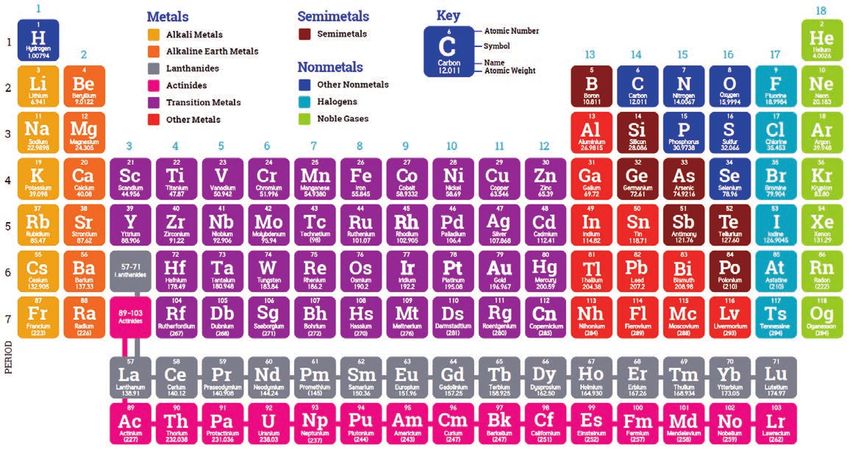
    Most main group elements (elements in groups 1-2 and groups 13-18) can have up to eight valence electrons.
    Transition metals (groups 3-12) do not follow this rule.

    Groups 1-2 and 13-18 (the main group elements) all follow the
    same pattern of valence electrons. Moving from left to right
    across the periodic table, one electron is added with each
    group. The number of valence electrons increases by
                                                                         Quick Fact
    one with each group from left to right, not including the
                                                                        The ground-state electron
    transition metals (groups 3-12, colored purple), as
                                                                   configuration of an atom shows the
    shown on the following page.                                   lowest energy state of the atom. In
                                                                   the presence of light, electrons can
                                                                    sometimes absorb energy to jump
                                                                    to a higher energy level, changing
                                                                     the electron configuration. This
                                                                        is called an excited state.

                                                                                                                2

2                 CHEMISTRY CONNECTIONS, SECTION I: Chemical Formulas
Valence
electrons
            1        2                                                                              3      4      5      6      7    8
 Group      1        2      3      4      5      6       7      8      9     10      11     12     13     14     15     16      17   18

            • Groups 1-2: the number of valence electrons equals the element’s group number on the periodic table. For
              example, calcium is in group 2 and has two valence electrons.

            • Groups 13-18: the number of valence electrons is ten fewer than the element’s group number. For example,
              oxygen is in group 16 and has six valence electrons.

            • Groups 3–12: the process is not so simple for the transition metals. Transition metal atoms can use electrons
              from their inner shells as valence electrons, so the number of valence electrons varies.

            • Group 18: the noble gases in the last group on the periodic table each have eight valence electrons. Since
              eight is the maximum number of electrons that can fit into each of these atom’s outermost energy level, each
              of the noble gases has a full octet. Atoms are most stable when they have eight valence electrons, making
              the noble gases generally unreactive.

                The noble gas helium is an exception with only two valence electrons. Its outermost energy level is only a 1s
                orbital, which is full with two electrons, making helium stable.

                EXAMPLE:
                One beryllium (Be) atom has four electrons and an electron configuration of 1s22s2. Two electrons
                are in energy level one (shell 1). The other two electrons are in energy level two (shell 2). The
                electrons in the second level (2s2) are the outermost electrons for beryllium, so they are beryllium’s
                two valence electrons. The two electrons in the second level (2s) are the ones involved when a
                beryllium atom bonds with other atoms.

                         You Be The Chemist Challenge® Passport to Science Exploration                                               3
DRAWING LEWIS SYMBOLS
    The Lewis symbol of one atom of an element depends on the element’s chemical symbol and the number of
    valence electrons that element has.

    To draw the Lewis symbol of one atom of an element, use the following steps:

     1. Write the chemical symbol of the element. The symbol represents the nucleus and all of the electrons not
        in the valence shell (the core electrons).

     2. Determine the number of valence electrons based on the element’s periodic table group.

     3. For each of the first four valence electrons, draw a single dot on each side of the chemical symbol.

     4. After there is one electron dot on each side, each additional electron can be paired with another electron
        dot until all valence electrons are shown in the structure.

         EXAMPLE:
         To draw the Lewis symbol of one atom of nitrogen, begin with the chemical symbol “N.” Nitrogen
         is in group 15. To determine the number of valence electrons, we subtract ten from fifteen and
         find that nitrogen has 5 valence electrons.

                Add the first four valence electrons with one dot on each
                                                 side of the chemical symbol:

            Finally, add one more electron to reach a total of five valence
            electrons. This is the Lewis symbol for one atom of nitrogen:

    Atoms of other elements can be drawn using these same steps, as shown below.

                                       Atom of Element            Lewis Structure

                                             Lithium

                                             Boron

                                            Carbon

                                            Fluorine

                                            Chlorine

    Lewis symbols help illustrate why elements of the same group tend to react similarly. Look at the Lewis
    symbols for fluorine and chlorine above. The Lewis symbols for elements in the same group have the
    same number of valence electrons. All of the halogens (group 17) need just one more electron to have a full
    octet and be stable, so they will all participate in reactions where they gain one electron (see the subsection
    on Types of Chemical Bonds).

4                   CHEMISTRY CONCEPTS, SECTION I: Chemical Formulas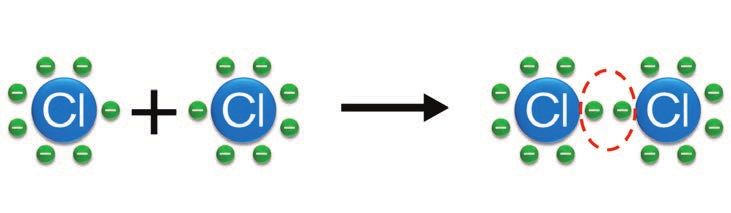
THE OCTET RULE
The number of valence electrons indicates how many bonds an element is likely to make. The number of elec-
trons that an atom tends to gain, lose, or share (and therefore the number of bonds that atom will make) can
be predicted by the octet rule, which states that:

   ● Atoms of main group elements are more stable when they have eight valence electrons, so they gain,
     lose, or share electrons by forming chemical bonds with other atoms. Atoms form bonds in such a way
     that they achieve an octet of valence electrons (eight valence electrons).
   ● A metal element tends to lose electrons until it has the same electron
     configuration as the noble gas in the period above itself. Sodium tends
                                                                                            Think
     to lose an electron to achieve the same electron configuration as neon.
                                                                                          About It...
   ● A nonmetal element tends to gain or share electrons until it has the                   Argon’s electron
     same electron configuration as the noble gas in the same period as                      configuration is
     itself. Sulfur tends to gain two electrons to achieve the same                    1s22s22p63s23p6. What ion
                                                                                        of chlorine has the most
     configuration as argon.                                                                 stable electron
   ● Hydrogen, helium, lithium, and beryllium are exceptions to the octet rule            configuration? What
                                                                                             about calcium?
     because they achieve the same electron configuration as the noble gas
     helium, which has only two electrons.

WRITING CHEMICAL FORMULAS
When atoms form chemical bonds to gain or lose electrons according to the octet rule, those atoms form a
compound. Remember, a compound is a pure substance made up of two or more atoms that are chemically
combined in a whole-number ratio. The chemical formula of a compound shows which elements it contains,
as well as how many atoms of each element. Chemical formulas use subscripts to indicate how many atoms
of each element there are in a given compound. Subscripts are the numbers located at the lower right of a
chemical symbol.

EXAMPLE:

     Water is a compound that contains the elements hydrogen and oxygen. Two hydrogen atoms and
     one oxygen atom are needed to form one water molecule, so the chemical formula is H2O.

        Chemical symbol for hydrogen                                     Chemical symbol for oxygen

                                                      H2O
      The 2 indicates that two hydrogen              When no subscript is written after the chemical symbol,
       atoms are required to make one                just one atom is needed. One atom of oxygen is required
                water molecule                                   to make one molecule of water.

The subscripts after hydrogen and oxygen in the previous example show how many atoms of each element are
needed to make a molecule of water: 2 hydrogen atoms and 1 oxygen atom.

          You Be The Chemist Challenge® Passport to Science Exploration                                            5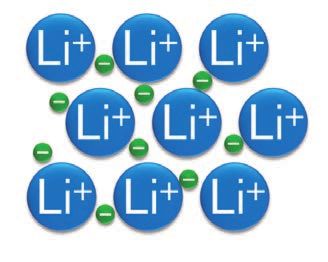
Oxidation numbers are also important when writing                      Quick Fact
       chemical formulas. Oxidation numbers are used to
                                                                       Many elements have more than one
       show how many electrons an atom has gained,                   possible oxidation number. For example,
       lost, or shared, usually after a chemical reaction.          iron may have an oxidation number of +2
                                                                   or +3 in different compounds. Fe2O3, which
       Oxidation numbers are similar to charge. An atom             contains iron in the +3 state, is the main
       gets a positive oxidation number when it loses                source of iron used to make steel. FeO,
       electrons, and a negative oxidation number when             which contains iron in the +2 state, makes
                                                                       up roughly 9% of Earth’s mantle. A
       it gains electrons (just like charge).                        possible explanation for disturbances in
                                                                      Earth’s rotation is that the FeO in
       When writing chemical formulas, the element with                  the mantle conducts
       the positive oxidation number is written first. Since                   electricity.
       metals tend to give up electrons, they usually have
       positive oxidation numbers and are written first. Nonmetals
       usually have negative oxidation numbers because they tend to gain
                                                                                                  Quick Fact
       electrons.                                                                              In a chemical formula, the less
                                                                                            electronegative element is written
       The overall charge of a compound (or ion) is equal to the sum of the                 first. After reading the subsection
                                                                                            on Electronegativity, this will be an
       oxidation numbers of all of the elements in that compound. In a neutral                   easier way to determine the
       compound, the sum of the oxidation numbers is zero. For example, in MgBr2                    order of elements in a
                                                                                                    chemical formula than
       magnesium has an oxidation number of +2 and bromine has an oxidation
                                                                                                      oxidation number.
       number of -1. There are two bromine ions and one magnesium ion in one
       formula unit of MgBr2, so to find the overall charge:

                      (1 Mg x +2) + (2 Br x -1) = (+2 from Mg) + (-2 from Br2) = 0

       The overall charge is zero, so MgBr2 is neutral.

       Magnesium has a +2 oxidation state because it needs to lose two electrons to achieve an octet, the same
       electron configuration as the noble gas neon. Bromine has a —1 oxidation state because it gains one electron
       to achieve an octet, the same configuration as krypton. You can predict what oxidation number an element is
       likely to have by figuring out how many electrons it can gain or lose in order to achieve an octet.

                                   EXAMPLE:

                                         Consider writing the formula for sodium chloride, NaCl. Sodium is in

     Quick Fact                             group 1 of the periodic table, therefore it needs to give away one
                                       electron to complete its octet and to have the same electron
  Chlorine changes to chloride in
  the compound sodium chloride.         configuration as a noble gas (in this case, neon). When sodium
 For some elements, the name is
                                         reacts with chlorine, sodium gives away one electron, resulting in
  changed to end in -ide when the
element gains electrons to become        an oxidation number of +1 for sodium.
   an ion. The change reflects a
   decrease in oxidation number.        Chlorine takes the electron from sodium to complete its octet and
  Because chloride has a negative      obtains an oxidation number of -1. After chlorine gains one electron,
   oxidation number, it is written
       second in the chemical        it has the same electron configuration as the noble gas argon.
             compound.             Sodium is written first because its oxidation number is positive. Sodium
                                     and chlorine combine in a 1:1 ratio because each atom of sodium wants to
                              give away one electron and each atom of chlorine wants to gain one electron.

6                    CHEMISTRY CONNECTIONS, SECTION I: Chemical Formulas
CHEMICAL FORMULAS OF COMMON COMPOUNDS
The following table lists some common compounds and their chemical formulas.

        Common Name                          Chemical Name                        Chemical Formula

          Alcohol (grain alcohol)              Ethanol (ethyl alcohol)                C2H5OH

          Bleach (chlorine bleach)             Sodium hypochlorite                    NaOCl (aq)*

          Chloroform                           Trichloromethane                       CHCl3

          Laughing gas                         Nitrous oxide (dinitrogen monoxide)    N2O

          Lye                                  Sodium hydroxide                       NaOH

          Quicklime                            Calcium oxide                          CaO

          Silica (sand)                        Silicon dioxide                        SiO2

          Rock salt (halite)**                 Sodium chloride                        NaCl

          Table sugar (cane sugar)             Sucrose                                C12H22O11

          Vinegar                              Acetic acid                            CH3COOH (aq)*

          Water                                Water                                  H2O

          Wood alcohol                         Methanol (methyl alcohol)              CH3OH

 * An aqueous solution is a solution in which the solvent is water. Vinegar is actually a mixture of acetic acid in
   water. To indicate an aqueous solution, scientists generally list (aq) after the chemical formula. For example, in
   the chemical equation H2CO3 (aq) → H2O (l) + CO2 (g), carbonic acid, H2CO3, is dissolved in water.

** Halite, commonly known as rock salt, is the mineral form of NaCl. Common table salt is also primarily made of
   NaCl (generally about 97%–99% NaCl), but it may also contain other chemical substances, such as
   magnesium carbonate. Many brands of table salt also contain additives, such as iodine salts, for health reasons.

NAMING CHEMICAL COMPOUNDS
Chemical nomenclature is the system used for naming chemical substances.
There are millions of identified chemical compounds, so naming them all
would be difficult without a set of systematic rules. Some compounds
have been recognized for a long time and have common names (like
water) but most compounds do not have common names. Instead,                         Quick Fact
they have standard names based on the naming rules established                  There are exceptions for naming
                                                                                  compounds. According to the
by the International Union of Pure and Applied Chemistry (IUPAC).              guidelines for naming compounds,
The rules for naming compounds depend on the type of                          the chemical name of water should
compound. Similar compounds, like acids or ionic compounds,                  be dihydrogen monoxide. Instead, the
                                                                                IUPAC name for water is actually
have similar names.                                                             oxidane. However, water is most
                                                                                  commonly called “water,” even
                                                                                          by scientists.

          You Be The Chemist Challenge® Passport to Science Exploration                                                 7
NAMING IONS AND IONIC COMPOUNDS
    An ion is an atom or molecule that has lost or gained one or more of its valence electrons. Atoms that have
    lost electrons and acquired a positive charge are called cations. Atoms that have gained electrons and
    acquired a negative charge are called anions. Ions formed from a single atom are called monatomic ions.

       ● Monatomic cations formed from atoms keep the same name as the element.

                                                Symbol                    IUPAC Name

                                                   K+                      Potassium ion

                                                   Na+                     Sodium ion

                                                   Al3+                    Aluminum ion

                                                   H+                      Hydrogen ion

       ● If a metal can form different cations, the positive charge is shown by placing Roman numerals in
          parentheses after the metal name. Many of the transition metals can take on different charges and still
          be stable. Take a look at the ions of iron in the table below. Both cations are stable and are likely to form.

                                                  Symbol                  IUPAC Name

                                                     Fe2+                   Iron(II) ion

                                                     Fe3+                   Iron(III) ion

    Scientists sometimes include Roman numerals even for metals that do not form more than one cation. For
    example, although Al3+ is the most common aluminum ion, it is also theoretically possible for aluminum to have
    a charge of 1+ or 2+. Scientists can write “aluminum(III) ion” to specify which ion is present.

    To distinguish anions from cations, anions have different endings to their names.

       ● Monatomic anions are named by replacing the ending of the element name with “–ide.”

                                                  Symbol                   IUPAC Name

                                                     H-                     Hydride ion*

                                                     Cl-                    Chloride ion

                                                     N3-                    Nitride ion

    *As noted in The Core of Chemistry, H- is a hydrogen anion. These anions are officially called hydride ions, as listed above.

8                  CHEMISTRY CONNECTIONS, SECTION I: Chemical Formulas
Ions containing more than one atom are polyatomic ions. When writing the name of an ionic compound, the
name of the cation is written first, followed by the name of the anion. The overall charge of a polyatomic ion is
the sum of the individual oxidation numbers for each atom in that ion.
● Polyatomic cations formed from nonmetal atoms have names that end in “–ium.”
Symbol IUPAC Name
NH4+ Ammonium ion
Quick Fact
H3O+ Hydronium ion In NH4+, each H has a +1
● Polyatomic anions may be written in different ways depending on
oxidation state and the N has a
–3 oxidation state. To find the
the number of atoms and the elements that combine. For example, overall charge:
some are named in the same way as monatomic ions with “–ide” at (1 N x 3–) + (4 H x 1+) = 1+
The overall charge is 1+.
the end of the name (as a suffix).
Symbol/Formula IUPAC Name
OH- Hydroxide ion
CN- Cyanide ion
● Polyatomic anions that contain oxygen have names that end in “–ate” or “–ite.” These anions are known
as oxyanions. When an element can form two different oxyanions with the same charge, the suffix “–ate”
is used for the oxyanion with one more oxygen than the oxyanion with the suffix “–ite.” As shown below,
sulfate and sulfite have the same charge, but sulfate has one more oxygen atom than sulfite.
Symbol/Formula IUPAC Name
SO42- Sulfate ion
SO32- Sulfite ion
● An ion that contains hydrogen and an oxyanion is named by adding the word hydrogen or dihydrogen at
the beginning of the name (as a prefix).
Symbol/Formula IUPAC Name
HCO3- Hydrogen carbonate ion
H2PO4- Dihydrogen phosphate ion
Ionic compounds are formed from oppositely charged ions bonded together by electrical forces (remember,
opposite charges attract). When writing the name of an ionic compound, the name of the cation is written first,
followed by the name of the anion.
You Be The Chemist Challenge® Passport to Science Exploration 9NAMING ACIDS
Chemical compounds that release hydrogen cations (H+) when they are dissolved in
water are acids (see the Acids, Bases, and pH section). Many acids are composed
of two parts: negatively charged ions (monatomic or polyatomic) combined with enough
positively charged hydrogen ions (H+) to make the compound electrically neutral.
Some acid compounds have only two elements: hydrogen and one other element. These compounds
are called binary acids and do not contain oxygen.
● To name binary acids use the following steps:
1. Start with the prefix “hydro–.”
2. Add the name of the monatomic anion (the element that is not hydrogen).
3. Change the “–ide” ending to “–ic.”
4. Add the word “acid” to the end of the name.
EXAMPLE:
For the acid HF, begin with the prefix “hydro.” Then, add on the name of the monatomic anion of
fluorine, which is fluoride. The result of the first two steps is “hydrofluoride.” Next, change the
“–ide” ending to “–ic.” This gives the name “hydrofluoric.” Finally, add the
word “acid.” The name of the compound HF is hydrofluoric acid.
Symbol/Formula IUPAC Name
Quick Fact
HCl Hydrochloric acid
Hydrofluoric acid actually
refers to HF that is dissolved in
H2S Hydrosulfuric acid water, or HF(aq). When HF is in
the gas phase, it is called
hydrogen fluoride.
Other acidic compounds contain oxygen. These acids are called oxyacids.
There are two main methods for naming acids that contain oxygen, depending
on the name of the polyatomic anion involved.
● To name oxyacids that contain an anion ending in “–ate” use the
Think
following steps:
About It...
Look back at the definition
of an acid. Why do HF(aq)
1. Start with the name of the anion.
and HF(g) have different
names? Is HF(g) still an
2. Change the “–ate” ending to “–ic.”
acid?
3. Add the word “acid.”
EXAMPLE:
For the acid HClO3, begin with the name of the anion. ClO3– is a chlorate ion. Next, change the
“–ate” ending to “–ic.” This gives the name “chloric.” Finally, add the word “acid.” The name of
the compound HClO3 is chloric acid.
10 CHEMISTRY CONNECTIONS, SECTION I: Chemical FormulasSymbol/Formula IUPAC Name
HNO3 Nitric acid Think
About It...
H2SO4 Sulfuric acid HNO3 is a neutral
compound. The oxidation
Notice that sulfuric acid is an exception to step 2 above because its name state of hydrogen is +1 and
is not “sulfic acid.” Another exception is phosphate, PO43–. The acid H3PO4 the oxidation state of oxygen
is –2. What is nitrogen’s
is called phosphoric acid, rather than “phosphic acid.”
oxidation state? Is this
● To name oxyacids that contain an anion ending in “–ite” use the
surprising? Why or
why not?
following steps:
1. Start with the name of the anion.
2. Change the “–ite” ending to “–ous.”
3. Add the word “acid.”
EXAMPLE:
For the acid compound HClO2, begin with the name of the anion. ClO2– is a chlorite ion. Next,
change the “–ite” ending to “–ous.” This gives the name “chlorous.” Finally, add the word
“acid.” The name of the compound HClO2 is chlorous acid.
Symbol/Formula IUPAC Name
HNO2 Nitrous acid
H2SO3 Sulfurous acid
NAMING MOLECULAR COMPOUNDS
Molecular compounds are formed by combining two or more nonmetal atoms. They are typically held together
by covalent bonds (see the section on Types of Chemical Bonds).
● To name binary molecular compounds from the molecular formulas use the following steps:
1. Write the name of the element that is the most electropositive (least electronegative). This is usually the
element that is farther to the left in the periodic table. If both elements are in the same group, then the
element with the higher atomic number is usually written first.
2. Write the name of the second element.
3. Change the ending of the second element to “–ide.”
4. Use Greek prefixes on the next page to represent the number of atoms of each element in the com-
pound.
You Be The Chemist Challenge® Passport to Science Exploration 11Prefixes Quick Fact
1: mono- 6: hexa- The prefix “mono—” means
one. In carbon monoxide, it
2: di- 7: hepta- indicates that there is only one
3: tri- 8: octa- oxygen atom. The prefix
4: tetra- 9: nona- “mono—” is used in many
other English words, such as
5: penta- 10: deca- monotonous, which
means in one tone
or boring.
EXAMPLE:
For the molecular compound CO, oxygen has a negative oxidation
number because it is found farther to the right on the periodic table,
and therefore attracts electrons more strongly than carbon does. Since carbon is found farther
to the left on the periodic table, it has a positive oxidation number and is less electronegative.
Therefore, carbon is written first. Oxygen is written second, and its ending is changed to “–ide.”
At this point, the name is “carbon oxide.” Finally, add the Greek prefix “mono–” to oxygen. The
name of the compound is carbon monoxide.
Likewise, the name of the molecular compound CO2 is carbon dioxide.
Quick Fact Symbol/Formula IUPAC Name
The prefix mono– is not used when Cl2O Dichlorine monoxide
there is only one atom of the first
element in a molecular compound. NF3 Nitrogen trifluoride
That is why CO is called carbon
monoxide rather than monocarbon
monoxide. It is also sometimes left off Remember, these rules apply only to molecular compounds, which
of the second element. For
are made of nonmetal atoms bonded together. The rules for naming
example, HF is hydrogen
fluoride, not monohydrogen combinations of metal and nonmetal atoms (see the subsection on
monofluoride. Ionic Compounds) are not the same.
Quick Fact
Be careful not to confuse
molecules with ions. Some
NOTES molecules have almost the same
formula as certain ions. For example,
the molecular formula for sulfur trioxide
is SO3. The formula for a sulfite ion is
SO32-. One unit of a molecular
(covalent) compound such as SO3 is
called a “molecule.” One unit of a
polyatomic ion such as SO32-
is called a “formula
unit.”
12 CHEMISTRY CONNECTIONS, SECTION I: Chemical FormulasSECTION II:
FORCES OF ATTRACTION
OBJECTIVES
• Explain the relationship of Coulomb’s law and electronegativity to chemical bonding.
• Describe the periodic trends for electronegativity, ionization energy, and atomic radii.
• Identify the three primary types of bonds.
• Use Lewis structures to illustrate bonding.
• Explain the forces of gravity and magnetism.
Although forces are most often discussed in relationship to gravity and pressure, a force is any kind of push or pull
on an object. Pressure is a type of force that requires objects to touch, so it is known as a contact force. Friction,
air resistance, and tension are also examples of contact forces. There are other forces that can act on objects at a
distance; these are known as non-contact forces. The most familiar examples of non-contact forces are gravity and
magnetism.
Although the forces mentioned above are easily identified and experienced, there are other types of forces that
play an important role inside chemical substances. These forces include intermolecular and intramolecular forces.
An intermolecular force is a force acting between two or more molecules. An intramolecular force is a force
acting within an atom, ion, or molecule.
INTRAMOLECULAR FORCES
Intramolecular forces of attraction hold together atoms and molecules. These forces are described by Coulomb's
law which states that:
1. The charges in an atom or molecule attract if they are different (one positive and one negative). The
attraction is greater when the charges are higher.
2. The charges in an atom push each other apart if they are the same (both positive or both negative).
For example, two electrons repel each other because they both have negative charges. An electron and a proton
attract each other because one is negative and one is positive.
The electron (-) is attracted to the
proton (+) at the center of an atom.*
The two electrons repel each other, and their like
charges push them away from each other.*
Both of the two electrons are attracted to the proton
but still repel one another. They tend to be close to
the proton but not close to each other.*
*In the atom images above, the electron cloud has been removed for easier visualization. The images are not to scale.
You Be The Chemist Challenge® Passport to Science Exploration 13These forces also occur in ions and ionic compounds. Just like protons and
electrons, cations and anions are attracted to one another. For example, an Quick Fact
_
ammonium cation (NH4+) will be attracted to a chloride anion (Cl ). A Quantum mechanics explains
_
bromide anion (Br ) will be attracted to a potassium cation (K+). why the electrons in an atom
stay a certain distance away from
Coulomb’s law and other principles of chemistry, such as quantum the nucleus. Otherwise, protons
mechanics, combine to explain the structure of atoms. and electrons would simply
crash into one another
because of Coulomb’s law
and the attraction of
PERIODIC TRENDS their charges.
As mentioned previously, valence electrons are the electrons in the outermost
energy level of an atom (including all sublevels of the outermost energy level). They are
represented as the dots that surround the chemical symbol in a Lewis symbol. For group 1-2
elements, the number of valence electrons equals their group number. For group 13-18 elements, the number of
valence electrons is ten fewer than their group number (see the subsection on Lewis Symbols).
• An atom of a main group element can typically hold a maximum of eight valence
electrons. The exceptions are hydrogen and helium.
• Atoms that have fewer than eight valence electrons tend to form bonds
Quick Fact
with other atoms. Atoms will give, take, or share electrons to achieve a full
The first energy level of an
outermost energy level (with eight electrons), which makes them stable. atom can hold a maximum of
two electrons. Hydrogen and
• Although some energy levels can hold more than eight electrons, helium are the only elements with
main group elements usually have a maximum of eight valence electrons that only occupy this
electrons that participate in chemical bonding. For example, energy energy level. The electrons of
level three (which has sublevels 3s, 3p, and 3d) can hold a maximum of all other elements occupy
additional energy levels.
18 electrons (3s=2 electrons, 3p=6 electrons, 3d=10 electrons). However,
the element chlorine (1s22s22p63s23p5) will only use 7 valence electrons in a
chemical bond (see the section on Electron Configuration from The Core of
Chemistry). The third sublevel with energy level three, 3d, is actually higher in energy
than the 4s sublevel and therefore will not be filled until after the 4s sublevel is filled.
• Generally, metals lose valence electrons to become more stable and nonmetals gain electrons.
The energy level of an element’s valence electrons relates to the period on the periodic table in which that element
is found. For example, potassium is in the fourth period, so its valence electrons are on the fourth energy level. The
energy level of potassium’s valence electrons can also be seen in its electron configuration: 1s22s22p63s23p64s1.
ELECTRONEGATIVITY
Electronegativity is a chemical property that describes how strongly the nucleus of an atom attracts the electrons
in a chemical bond. Electronegativity indicates how strong of a pull an atom has on electrons and how strongly it
will compete for electrons during reactions. When two atoms are bonded together, the electrons are more at-
tracted to and more tightly bound to the more electronegative atom. The difference in electronegativity between
two atoms determines what type of bond they form.
14 CHEMISTRY CONNECTIONS, SECTION II: Forces of Attraction• Within a period, electronegativity tends to increase from left to right. Within the same period of the
periodic table, moving one column to the right means adding one more proton and electron to the same
outer electron shell (elements within the same period have the same number of electron shells). Think of
proton-electron attractions as small magnets. The more proton-electron pairs are present in an atom, the
more the outer shell is drawn towards the center of the atom. As the outer shell is drawn in and the
valence electrons get closer to the attractive, positively charged nucleus, the atom holds onto its own
electrons and other electrons more tightly.
• Within a group, electronegativity tends to decrease from top to bottom. Moving
down one group on the periodic table means adding one more electron shell,
increasing the size of the atoms. As the atoms get bigger, there is more
space and there are more electrons between the nucleus and the outer
Think
shell. The nucleus’ ability to attract an electron decreases as the electron About It...
How does electronegativity
moves farther away from the nucleus and as more electron shells are
explain why metals lose
added between that electron and the nucleus—this is called “shielding”. electrons and nonmetals gain
Therefore, the nucleus of a larger atom can’t attract other (or its own) electrons in chemical reactions?
electrons as well as a smaller atom. Go back to the example on page
8. How does electronegativity
Fluorine and chlorine have the same number of valence electrons, but explain the reaction
fluorine is smaller, therefore fluorine is more capable of attracting between sodium and
chlorine?
electrons and adding them to its shell to complete its octet. Fluorine is
more electronegative than chlorine (See the subsection on Atomic Radii.).
*Electronegativity is measured on the Pauling scale, with 0.7 being the least and 4.0 being the most electronegative.
**The electronegativity is unknown for the elements on the table shown in gray. This includes all the noble gases besides
krypton and xenon, as well as elements 103 through 118.
***The arrows indicate the general trend of electronegativity: it increases moving to the right within a period and moving
up within a group.
The most strongly electronegative elements are found in the upper right of the periodic table (excluding the
noble gases). Fluorine is the most electronegative element. Francium is the least electronegative, meaning its
nucleus attracts electrons more weakly than any other element. Francium is the most “electropositive” element.
You Be The Chemist Challenge® Passport to Science Exploration 15EXAMPLE:
The electronegativity (from least to greatest) for the second row of the periodic table is: Li, Be,
B, C, N, O, F. Notice that neon (Ne) is not listed. Neon’s outermost energy level, level 2, al-
ready has eight valence electrons (an octet). Since the outer shell is full, neon does not need to
gain or lose electrons - it is already stable!
IONIZATION ENERGY
Ionization energy is the amount of energy needed to remove one of the outermost electrons from a neutral
atom in the gas phase. Each negatively charged electron is attracted to the positively charged nucleus, so in
order to remove an electron a certain amount of energy (the ionization energy) is needed to overcome that
attraction. Think of ionization energy as an indicator of how strongly an atom holds onto its valence electrons.
A higher ionization energy means the atom has a stronger hold on its valence electrons, so it takes more
energy to get the electrons away from the atom and its nucleus. A lower ionization energy means that the atom
can more easily lose its valence electrons, and the electrons are not as tightly bound to the nucleus.
• Within a period, ionization energy tends to increase from left to right across the periodic table.
Much like electronegativity, this trend occurs because of the increasing number of protons and electrons.
More protons and electrons means more proton-electron pairs attracted to one another (again, think of
proton-electron attractions as small magnets). As proton-electron pairs are added, the electron shell is
pulled closer to the nucleus. Electrons closer to the nucleus are more strongly attracted to the nucleus,
so it requires more energy to overcome that attraction and remove an electron.
• Within a group, ionization energy tends to decrease from top to bottom down the periodic table.
Also similar to electronegativity, this trend occurs because atoms get larger moving down a group. The
valence electrons are in electron shells farther and farther from the nucleus. Less energy is needed to
remove an electron that is farther from the nucleus, so ionization energy decreases as atoms get larger
moving down a group.
*In the table above, ionization energy is measured in kilojoules per mol (kJ/mol).
**The ionization energy is unknown for the elements on the table shown in white.
***The arrows indicate the general trend of ionization energy. It increases moving
to the right within a period and moving up within a group.
16 CHEMISTRY CONNECTIONS, SECTION II: Forces of AttractionIonization energy and electronegativity trends explain why metals and nonmetals react differently to achieve
stability. Metallic elements like sodium lose, rather than gain, electrons to reach an octet because they have
lower ionization energies (and lower electronegativity). Moving to the right across the periodic table, atoms get
closer to having a full octet, become more electronegative, and have higher ionization energy. As a result, non-
metals are more likely to gain, rather than lose, electrons and become like the noble gas in their same period,
rather than losing electrons to become like the noble gas in the period above.
Since atoms want to be stable, elements like the halogens (fluorine, chlorine, etc.) that are only one electron
away from a full octet will want to gain an electron, and it will take more energy to take one away. Notice that
noble gases have higher ionization energies because they already have an octet and are therefore stable.
ATOMIC RADII
The atomic radius of an element’s atom is a measure of atomic size. For a single atom, it can be considered
as the typical distance from the nucleus to the boundary of the electron cloud. Think of an atom as a ball. The
radius of the ball can be found by measuring from the center of the ball to the edge. It can also be found by
dividing the diameter by two.
An atom does not have a clearly defined edge because of the electron cloud. The atomic radius is determined
by how close one atom is to a neighboring atom. It is half the distance between the nuclei of two atoms of one
element that are bonded together. This distance is so small that it is typically measured in picometers (1 pm =
10-12 m).
EXAMPLE:
The atomic radius for bonded metallic atoms in an elemental sample, like sodium, is half the
distance between the nuclei of the two neighboring atoms.
Distance between the nuclei of two neighboring sodium atoms:
372 pm
Atomic radius of sodium:
186 pm
You Be The Chemist Challenge® Passport to Science Exploration 17EXAMPLE:
In a bonded nonmetal, like oxygen or another diatomic molecule, the radius is half the distance
between the nuclei of the atoms in the molecule.
Distance between the nuclei of oxygen atoms joined in a diatomic oxygen molecule:
146 pm
Quick Fact
The cation of an element generally
Atomic radius of oxygen: has a smaller radius than the neutral
73 pm
atom. This is because electrons are
attracted to the positive protons in the
• Atomic radius tends to decrease from left to right across nucleus, but are repulsed by other
negatively charged electrons. The
the periodic table. Similar to electronegativity and ionization electrons want to be near the nucleus
energy, this trend results from the increasing positive charge in but far away from each other.
the nucleus. The more positively charged nucleus attracts the Removing an electron decreases the
electrons more strongly and pulls them closer to the nucleus. electron-electron repulsion, so the
nucleus can pull the
• Atomic radius tends to increase from top to bottom down the remaining electrons in
more tightly.
periodic table. This trend is caused by the increasing energy levels
(and thus larger orbitals). The electrons are farther from the pull of the
positive nucleus, and are therefore not held as tightly or as closely.
*In the table above, the atomic radii are measured in picometers (pm).
**The atomic radius is unknown for the elements on the table shown in gray.
***The arrows indicate the general trend for atomic radii. It increases as you move
to the left within a period and as you move from the top to the bottom within a group.
18 CHEMISTRY CONNECTIONS, SECTION II: Forces of AttractionKnowing the atomic radii of elements can help to explain their ionization energies. If the radius of an element is
small, the electrons are closer to the nucleus. This means that the protons in the nucleus are more strongly at-
tracting and pulling in the electrons in the outer shells. The amount of energy needed to pull an electron off
(the ionization energy) gets smaller as the distance between the valence electrons and nucleus gets larger,
and as more electrons are added between the valence electrons and nucleus. When there are more electrons
shells, the attraction between the nucleus and the outermost electrons is weaker, so pulling off an electron will
be easier and require less energy.
TYPES OF CHEMICAL BONDS
CHEMICAL BONDS
A chemical bond is an intramolecular force of attraction that holds together atoms in a molecule or
compound. Bonds are formed as a result of the attraction between the positive nucleus of one atom and the
negative electrons of another atom. Chemical bonds can also be formed by the attraction between positive
and negative ions. Ionic bonds, for example, are the result of attraction between oppositely charged ions.
Atoms work to achieve a stable octet arrangement of valence electrons. Atoms and molecules give, take, or
share their valence electrons during chemical reactions in order to reach this stable state. When atoms or ions
of different elements interact, chemical bonds can be formed, broken, or rearranged to create new
compounds. Therefore, a chemical change takes place.
EXAMPLE:
Hydrogen is commonly found on the earth as diatomic hydrogen gas. Two hydrogen atoms
combine to make up a molecule of hydrogen gas (H2). Likewise, a molecule of oxygen gas (O2)
contains two bonded oxygen atoms. When a molecule of oxygen gas combines with
two molecules of hydrogen gas, the hydrogen-hydrogen bonds in H2 and the oxygen-oxygen bonds
in O2 break. Each oxygen atom then forms two new bonds, each to a different hydrogen atom,
producing H2O molecules (see the Chemical Reactions section).
2H2 + O2 g 2H2O
There are three types of chemical bonding: ionic, covalent, and metallic. Bonding involves only the valence
electrons of an atom (see the subsection on Valence Electrons).
IONIC BONDING
Ionic bonds occur when one atom gives up electrons and another atom takes them. The atom that gains
electrons becomes a negative ion (anion). The atom that loses electrons becomes a positive ion (cation). The
resulting ions have opposite charges and become attracted to one another. This force of attraction holds the ions
together. Compounds held together by ionic bonds are called ionic compounds.
Ionic bonds typically occur between metal atoms and nonmetal atoms because of their very different
electronegativities. The less electronegative atom (the metal) readily gives up electrons, and the more
electronegative atom (the nonmetal) readily accepts these electrons. The resulting metal cation and nonmetal
anion are attracted to each other because of their opposite charges. The cations and anions in an ionic bond can
also be polyatomic.
You Be The Chemist Challenge® Passport to Science Exploration 19As a result, individual atoms or ions are not held together closely by shared electrons, as is the case with covalent
bonds. There are no distinct, individual molecules, but rather a collection of ions held together by the attraction of
their charges. Ionic compounds exist as three-dimensional networks of ions all connected by ionic bonds.
EXAMPLE:
When sodium (Na) and chlorine (Cl) combine to make sodium chloride (NaCl), the chlorine
atoms want to take the valence electrons from the sodium atoms. Chlorine, a nonmetal, is on
the more electronegative side of the periodic table. Sodium, a metal, is on the electropositive
side and donates electrons to the chlorine atoms.
Step 1: Na g Na+ + electron (production of an Na+ cation plus release of electron)
Step 2: electron + Cl g Cl– (released Na electron reacts with Cl to produce a Cl– anion)
Overall: Na + electron + Cl g Na+ + Cl– + electron
Notice that the electron produced in Step 1 is used in Step 2, so it is cancelled out in the overall
reaction. (See the section on Ions from The Core of Chemistry.)
EXAMPLE:
What would happen if magnesium (Mg) atoms were bonding with Cl atoms instead?
Step 1: Mg g Mg2+ + 2 electrons (production of an Mg2+ cation plus release of electrons)
Step 2: 2 electrons + 2 Cl g 2 Cl– (released Mg electrons react with Cl to produce Cl– anions)
Overall: Mg + 2 electrons + 2 Cl g Mg2+ + 2 Cl– + 2 electrons
Magnesium is in group 2 and has two valence electrons. When magnesium reacts with chlorine,
each Mg atom donates two electrons. Chlorine is in group 17 and has seven valence electrons,
so each Cl atom will only gain one electron. Therefore, two Cl atoms are
needed to accept the electrons from each Mg atom, making the
formula MgCl2.
Quick Facts
The periodic table can be used
to predict ionic compounds.
Remember: all atoms want electron
configurations like the noble gases.
Here’s the periodic table
In the MgCl2 example, Mg wants to be trick:
like Ne. Mg can only do this by losing
two electrons. Chlorine wants to be • Count two boxes backward from
like Ar, which only requires one Mg to get to Ne. Give the 2 to the Cl.
electron. Two chlorine atoms • Count one step forward for Cl to get
are required to bond with
to Ar. Give that 1 to the Mg.
one magnesium atom.
• The result is Mg1Cl2. Because
we don’t show the number one
in formulas, we write
MgCl2.
20 CHEMISTRY CONNECTIONS, SECTION II: Forces of AttractionCOVALENT BONDING
Covalent bonds occur when valence electrons are shared between two nonmetal
atoms, which have similar electronegativities and are close to one another on the
periodic table. Compounds formed entirely from atoms that share electrons
through covalent bonds are called covalent compounds.
Quick
• Covalent bonds create stable compounds if the sharing of
Fact
electrons brings about a noble gas electron configuration for each
Hydrogen is an exception to the
atom (with eight valence electrons). octet rule. A hydrogen atom is
stable when it makes one bond
• In a covalent bond, one atom does not actually lose an electron in
(has two valence electrons),
order for the other atom to gain an electron. Instead, the atoms because it achieves the same
share the electrons. Both atoms in a covalent bond gain electrons. electron configuration as
Two atoms would not be able to share electrons if their the noble gas
helium.
electronegativities were very different, because one atom would attract
the electrons much more strongly than the other.
• Each covalent bond contains one electron pair (two electrons).
• Nonmetal atoms generally have high electronegativity, meaning that they want to gain electrons, and also
high ionization energy, meaning that they do not want to give up their own electrons. Nonmetal atoms
tend to form covalent bonds because it allows them to share electrons, so they can gain electrons
without giving up any of their own.
EXAMPLE:
Look at the molecule of Cl2 below. Chlorine is found on the third period of the periodic table and
is part of the halogen group. Because this molecule is made up of two atoms that are the
same, both atoms in the bond have the same electronegativity and the same ability to attract
electrons. The two chlorine atoms share the electrons equally between them. Remember that
only the outermost electrons participate in the bond. Chlorine’s electron configuration is
1s22s22p63s23p5, so its outermost electrons are those in the third energy level: the 3s23p5
subshells. Chlorine has a total of seven valence electrons, and it is these electrons that
participate in the bond. The reaction can be shown as:
The two electrons inside the dotted oval (above right) are shared. Each chlorine atom now has
access to eight electrons. Both atoms now have the same electron configuration as the noble gas
in the same period, argon, and are therefore stable.
You Be The Chemist Challenge® Passport to Science Exploration 21A single covalent bond contains two shared electrons. This means there is
one covalent bond in a Cl2 molecule (2 electrons shared, divided by 2
electrons in each bond = 1 bond).
Quick Fact
Structures that show atomic
• Two electrons that form a bond are shown as a line between
centers (symbols) and either lines or
the bonded atoms. Cl2 is shown as: dots for the valence electrons, such as
the one pictured to the left, are called
Lewis structures (see the section on
Lewis Structures).
This name was given in honor
of Gilbert N. Lewis for
his contributions to
bonding theory.
• The bond that forms between the chlorine molecules to make Cl2 is
called a single covalent bond. Chemical compounds can also contain
double covalent bonds and triple covalent bonds.
– Single covalent bond (single bond): a covalent bond sharing only one
pair of electrons (two electrons total) between two atoms.
– Double covalent bond (double bond): a covalent bond Think
sharing two pairs of electrons (four electrons total) between two About It...
atoms. What type of covalent bond is
found in diatomic oxygen?
– Triple covalent bond (triple bond): a covalent bond sharing What about diatomic nitrogen?
three pairs of electrons (six electrons total) between two Use the periodic table to
atoms. determine how many bonds
oxygen and nitrogen tend
Atoms do not have to be identical to form a covalent bond. A covalent to make.
bond can form between two nonmetals or between a nonmetal and a
semimetal.
Think
About It...
Why must atoms have
similar electronegativities to
form covalent bonds? What
happens when atoms have
very different
electronegativities?
22 CHEMISTRY CONNECTIONS, SECTION II: Forces of AttractionMETALLIC BONDING
Metallic bonding occurs when metal atoms bond by contributing their electrons to a “sea” of shared electrons.
This “sea” of electrons is shared among all of the bonded atoms in the entire structure.
• Metallic bonds are collective by nature, so a single metallic bond does not exist.
• In a metal, the valence electrons are shared among all the atoms. Each metal atom gives up its valence
electrons, forming a “sea” of electrons.
– The creation of an electron “sea” only occurs if there are no elements with high electronegativity (i.e.
nonmetals) present to accept the electrons. Since there are no nonmetals to accept the electrons, there is
no more stable place for the electrons to be than in the electrons sea, shared between all metal atoms.
– Remember, metals often have low electronegativity and low ionization energy. This allows
metal atoms to give up electrons easily. Metallic bonds occur when the Coulombic
attraction keeping the electrons bound to the atom’s nucleus is weaker than
the electron’s energy; the electrons have enough energy to break free.
• Metallic bonds can also form among elements that have higher ionization Quick Fact
energies. These elements' atoms do not give up electrons to other Silver and gold are precious
substances easily. metals because they are less
reactive than most other
– Gold, cadmium, iridium, and platinum are metals with relatively high metals and have a high
ionization energies. Atoms of gold will not give up electrons to other luster. “Precious” refers to
substances, but will come together to form strong metallic bonds. their high economic
value.
• Some metallic elements are actually quite easy to keep in pure form because
they are relatively unreactive. These elements include gold, platinum, and silver.
Since electrons in a metallic compound are not held tightly to individual nuclei, the electrons are
able to move more freely. Many properties of metals result from the high mobility of electrons in
a metallic bond, as well as the ability of those electrons to move across the entire object.
• Luster: the ability to reflect light. Luster is why metals look shiny.
Think
– The large number of freely moving electrons in a metal absorb and re-
emit light.
About It...
In the movie A Christmas Story,
• Electrical conductivity: a measure of the rate at which electricity Flick is dared to touch his tongue
can travel through a material. to a metal flagpole in freezing
temperatures. He takes the dare,
– Metals have good electrical conductivity because their electrons and his tongue gets stuck to the
can move easily throughout the metal. metal. Why would this NOT
have happened if the
• Thermal conductivity: a measure of the rate at which thermal energy can flagpole had been
made of wood?
travel through a material.
– Metals also have good thermal conductivity. As part of a metal is heated, the
electrons become excited. The excited electrons then travel to the other side of the
metal, carrying the thermal energy with them. Electrons are much better at carrying this energy than
nuclei, so metals conduct thermal energy better than substances whose electrons cannot move freely.
This is why cold metal feels colder to the touch than equally cold plastic or wood. The thermal energy in
a person’s hand is transferred to metal more quickly than it is transferred to wood, even if the difference
in thermal energy (difference in temperature) between someone’s hand and the wood is the same.
You Be The Chemist Challenge® Passport to Science Exploration 23• Malleability: the ability of a metal to be flattened, shaped, or formed
without breaking when pressure is applied. This includes the ability
Quick Fact
of a metal to be hammered into a thin sheet.
Gold, silver, and copper (all group
– The mobility of electrons allows metal atoms to slide past one 11 elements) are highly malleable
and ductile. They are also good
another when stress is applied. They do so without conductors of electricity. Because of
experiencing strong repulsive forces that would cause other these properties, gold, silver, or
materials to shatter. copper could be used to make
electrical wires. However, gold and
• Ductility: the ability of a metal to be stretched into a thin silver are expensive metals, so
wire or thread without breaking. copper is commonly used
in wiring.
– Like malleability, the mobility of electrons in a
metallic bond allows the atoms to slide past one
another as the metal is pulled and reshaped.
BONDING REVIEW
• Ionic bonding is the result of one atom donating an electron to another atom so that both atoms complete
their octets.
• Covalent bonding is the result of atoms that both need electrons, so they share electrons.
• Metallic bonding is the result of collectively shared electrons.
Ionic Bonding
Covalent Bonding
Metallic Bonding
*In the atom images above, the electron cloud has been removed for easier visualization.
24 CHEMISTRY CONNECTIONS, SECTION II: Forces of AttractionLEWIS STRUCTURES
Lewis structures are one way to represent chemical compounds. In the Lewis structure of a compound, chemical
symbols are used to represent each atom in the compound. Bonds (lines) are drawn between symbols to show
how electrons are shared. Dots represent valence electrons that are not shared, or “lone pairs” belonging to only
one atom.
When atoms react, they create bonds to achieve a full octet of eight valence electrons (again, hydrogen and
helium are exceptions—they are stable when they have two valence electrons). The bonding rules below
determine the number of bonds that one atom of an element will make in a compound.
• Gaining electrons: when an atom is gaining electrons, the number of bonds it
will make equals the number of electrons that the atom needs to complete its
octet. In a covalent bond, both atoms gain electrons. In an ionic bond, the
more electronegative atom gains electrons. Think
Number of bonds = 8 — Number of valence electrons About It...
How many bonds is krypton
For example, fluorine is in group 17 and has seven valence likely to make? How does
electrons. According to the equation above, fluorine makes one krypton’s electron
bond because 8 - 7 valence electrons = 1 bond. Moving along configuration explain this
number?
period 2, oxygen makes two bonds, nitrogen makes three bonds, and
carbon makes four bonds. Nonmetals tend to gain electrons.
• Losing electrons: when an atom is losing electrons, the number of bonds
it will make equals the number of valence electrons that atom has. In ionic
compounds, the less electronegative element loses all of its high-energy valence electrons to achieve the
same electron configuration as the noble gas in the period above it.
Number of bonds = Number of valence electrons
In period 2 of the periodic table, lithium makes one bond and beryllium makes two
bonds. Metals tend to lose electrons.
• Hydrogen atoms always make one bond, whether they are in an ionic or a
Think
covalent compound. Hydrogen atoms are never given a full octet
because a hydrogen atom can hold only two electrons.
About It...
Why can’t a hydrogen
• Except in rare and unstable cases, carbon cannot have any lone pairs atom hold more than two
and will always make four bonds. electrons? What is the
ground-state electron
configuration of a
COVALENT COMPOUNDS hydrogen atom?
Covalent compounds are made up of one or more nonmetal atoms connected
by covalent bonds. In the Lewis structure of a covalent compound, lines between
atoms are used to represent the sharing of electrons (covalent bonds).
You Be The Chemist Challenge® Passport to Science Exploration 25You can also read


