Class of 2021 - Curriculum Guide - Manheim Central School ...
←
→
Page content transcription
If your browser does not render page correctly, please read the page content below

Class of 2021

Curriculum Guide
Principal’s Message
Dear Student:

You are about to make some of the most important decisions of your high school career as you select courses
for the 2017-2018 academic year. While next year may seem far off, decisions and choices made in the near
future will play a major role in determining the direction and quality of your educational experiences.

As you make your selections, remember that the Curriculum Guide is only a starting point in choosing your
2017-2018 schedule. Before completing your online course selection, discuss your immediate and long range
plans with your parent(s)/guardian(s). Make certain the courses chosen reflect not only your current interests,
but also your goals for after graduation as well. Make your aspirations compatible with your ability, but set
goals which are ambitious as well as attainable. Plan a program which will demand your best and aid you in
getting the most from your education. To learn more about the courses offered talk with your school
counselor, teachers, and appropriate department representatives so that you can make sound decisions based
on the best advice available.

As an aid in the course selection process, an orientation meeting for you and your parent(s)/guardian(s) will be
held in the high school cafeteria on February 7, 2017 @ 6:30 PM (snow date, February 9, 2017). At the
meeting, school counselors will outline Manheim Central High School’s graduation requirements, present
information about available academic opportunities, and provide an overview of the online course selection
process. Administrators and school counselors, will be present to answer any questions about the curriculum
and/or the course selection process. I sincerely urge you and your parent(s)/guardian(s) to set aside this
evening so that we can work together to assist you in planning an academic program which is relevant and of
the highest quality.

Mr. Hughes
Manheim Central High School Principal

Table of Contents
          Content Area                          Page Number
      Graduation Requirements                        3
          Keystone Exams                             4
           Course Levels                             4
            Honor Roll                               5
            Class Rank                               5
 College in the High School Program                  6
          Dual Enrollment                            6
      Credit Recovery Options                        7
         Schedule Changes                            7
      NCAA Eligibility Center                        8
            Agriculture                             17
                Art                                 22
         Business Education                         26
        Computer Education                          28
       English Language Arts                        31
   Family and Consumer Sciences                     36
         Learning Support                           38
            Mathematics                             43
               Music                                47
              Science                               52
           Social Studies                           55
Technology Education and Engineering                58
        Wellness and Fitness                        62
         World Languages                            64
Graduation Requirements
                  Regular Education Graduation Requirements
                                  Course                                         Required Credit Earnings
                             English Language Arts                                           4 Credits
                                 Mathematics                                                 4 Credits
                                 Social Studies                                              3 Credits
                                    Science                                                  3 Credits
                              Physical Education                                            1.5 Credits
                   Ecology, Environment, and Engineering                                     0.5 Credit
                        Microsoft Office 2010 or 2013                          0.5 Credit or Test Out of the Course
                                     Health                                                  0.5 Credit
     Humanities (One of the following courses: Ceramics 1, Drawing and
    Painting 1, Sculpture 1, Music Technology, Arts Connections, Musical                    0.5 Credit
                  Theater, German I, Spanish I, or French I)
                              F.C.S. Connections                                            0.5 Credit
                               Elective Courses                                             10 Credits

                         Modified Graduation Requirements
Any student who has been determined by an IEP team, based upon recommendation in a multidisciplinary
evaluation, to need specialized instruction to address special education needs must satisfy the following
requirements or successfully complete the requirements in his/her IEP to be eligible for the awarding of a
Manheim Central High School diploma.

                                  Course                                         Required Credit Earnings
                             English Language Arts                                           3 Credits
                                 Mathematics                                                 3 Credits
                                 Social Studies                                              2 Credits
                                    Science                                                  2 Credits
                              Physical Education                                            1.5 Credits
                   Ecology, Environment, and Engineering                                     0.5 Credit
                        Microsoft Office 2010 or 2013                          0.5 Credit or Test Out of the Course
                                     Health                                                  0.5 Credit
     Humanities (One of the following courses: Ceramics 1, Drawing and
    Painting 1, Sculpture 1, Music Technology, Arts Connections, Musical                    0.5 Credit
                  Theater, German I, Spanish I, or French I)
                              F.C.S. Connections                                            0.5 Credit
                               Elective Courses                                             14 Credits

                                                      3
Keystone Exams
In addition to the graduation requirements defined by Manheim Central School District Policy 217, students
must now demonstrate a level of proficiency on end-of-course exams, titled Keystone Exams. These
assessments will be a mandatory requirement for graduation from Manheim Central High School.

Some of our students are already proficient or advanced, from previous Keystone testing, and may not be
taking the exams. Listed below are the students who will be taking the exams during the 2017-2018 school
year.
    • Algebra I
            o Any student who has completed the course but is not currently proficient on the Keystone
               Exam (to include all juniors, sophomores, and freshmen)
    • Biology
            o Any junior who is not currently proficient on the Keystone Exam
            o All sophomores who have already completed the course
            o Any freshmen who have completed the course in high school
    • Literature
            o Any junior who is not currently proficient on the Keystone Exam
            o All sophomores who have completed the course in high school

Alternative Assessment
Students who are not proficient on the Algebra I, Literature, and/or the Biology Keystone Exam(s) by the end
of the student’s the junior will be required to take an alternative assessment in the subject area(s) where
proficiency was not achieved. For more detailed information about how the Keystone Exams are being
integrated into the Pennsylvania graduation requirements, please visit the Pennsylvania Department of
Education’s Standards Aligned System (SAS) website at:
http://www.pdesas.org/module/assessment/keystone.aspx

                                            Course Levels
Four levels of instruction will be offered in Physical Science, Biology, Social Studies and English Language Arts.
In order to insure the most appropriate placement, students should seek input from their
parent(s)/guardian(s) and teachers. Additionally, students should refer to the prerequisites outlined in the
curriculum guide. The levels of instruction for all courses are described as follows:
    • Advanced Placement (AP): This level refers to college-level courses taught according to syllabi
        prescribed by The College Board Advanced Placement Program and are designed to prepare students
        for the College Board AP Tests. AP courses receive School Board approved weighting when the
        cumulative Grade Point Average (GPA) is calculated.
    • Honors: This level refers to those courses taught at a high school level and serve as preparation for
        post-secondary opportunities. Honors level courses are the gateway to AP course work. Honors level
        courses receive School Board approved weighting when the cumulative Grade Point Average (GPA) is
        calculated.
    • Level 1 or Level 2: These levels refer to those courses taught at a high school level and serve as
        preparation for post-secondary opportunities. Level 1 courses will explore specific content with more
        depth and at an accelerated pace.

                                                         4
Honor Roll
    •   Distinguished Honors: 4.0 GPA on a 4.0 scale
    •   First Honors: GPA between a 3.9 and 3.5 GPA on a 4.0 scale
    •   Second Honors: GPA between 3.0 and 3.49 on a 4.0 scale

At the end of the marking period, students who earn a D, F or U in any subject will not be eligible for any honor
roll for that grading period.

Students receiving incomplete grades for a marking period will be considered for Honor Roll distinction only
when a grade is submitted to the Guidance Office.

                                              Class Rank
Method of Calculating and Reporting
    •   Class rank will be calculated and reported following the end of each semester for students in each
        grade.
    •   Foreign exchange students will not be included in class ranking
    •   Home Education Students entering Manheim Central High School after grade 9 will not receive a GPA
        based upon their home education program (see Board Policy 137)
    •   Grades earned in courses graded on a Satisfactory/Unsatisfactory, or other non-traditional grading
        system will not be included in the calculation of Class Rank

Weighted Class Rank Guidelines
    •   Advanced Placement courses will be given a weight factor 1.3
    •   Honors classes will be given a weight factor of 1.2
    •   College in the High School will be given a weight factor of 1.2
    •   3rd and 4th level World Languages will be given a weight factor of 1.2
    •   All other courses will be given a weight factor of 1

Formula for Calculating Weighted Grade Point Average
Each student's weighted grade point average will be computed by using the procedure and formula described
below. For the purpose of calculating weighted class rank letter grades earned will be converted to the
following numerical equivalents:

                                                        5
Percentage Grade Numerical Equivalent
100-94 A 4.0
93-90 A- 3.67
87-89 B+ 3.33
83-86 B 3.00
80-82 B- 2.67
77-79 C+ 2.33
73-76 C 2.00
70-72 C- 1.67
67-69 D+ 1.33
63-66 D 1.00
60-62 D- 0.67
59 and below F 0.00
A student’s weighted grade point average will be calculated by following the bulleted directions below.
• First calculate the quality points for each course a student has taken by using the following formula:
o Grade (Numerical equivalent) x course credit x weighting factor
o Example: A grade of “B” earned in a weighted AP course which is worth 1 credit
3 x 1 x 1.3= 3.9 weighted quality points
• Once the quality points are determined for each course, add all of the quality points together
• Then divide the total quality points by the number of total credits attempted
• The answer is the student’s weighted grade point average
College in the High School Program
The College in the High School program enables qualified high school students to enroll in college level courses
at their high school or technical school during the regular school day. College in the High School students earn
concurrent high school and college credit. Course offerings are selected from the college’s or university’s
required courses, core curriculum or technical courses. Courses are taught by a high school teacher who
qualifies as an adjunct faculty member and are offered to high school students at a reduced tuition rate.
Students are responsible for the cost of the course.
Dual Enrollment
Dual Enrollment is the opportunity for students to take college courses (at local colleges) and high school
courses at the same time. The college credits can be earned at a reduced cost and can count towards both high
school graduation and a college transcript. Students are responsible for the cost of the course.
6
We currently have an agreement with the following schools:
• Clarion University
• Elizabethtown College
• Harrisburg Area Community College
• Lebanon Valley College
• Millersville University
• Pennsylvania College of Health Sciences
• Pennsylvania College of Technology
• Thaddeus Stevens College of Technology
All of the institutions have specific application procedures students must follow in order to enroll in their Dual
Enrollment Program. All courses taken under this program must be core academic courses as defined by the
No Child Left Behind Act of 2001. This means that courses can be in any of the following subjects: English,
reading or language arts, mathematics, science, foreign languages, civics and government, economics, arts,
history and geography, psychology and sociology.
Please note that students are responsible for their own transportation, and must sign in and out of the
Manheim Central High School office when leaving to or arriving from a college campus course. There are
academic, attendance, and behavioral requirements the student must meet in order to participate. Interested
students should meet with their counselor for further information.
Credit Recovery Options
A student who fails a course at Manheim Central High School has the option to either attend an approved
summer school or to make up the course via an approved online credit recovery provider. Interested students
should meet with their counselor for further information.
Schedule Changes
Students will be permitted to change their course requests or schedules for the 2017-2018 school year during
specific time frames which are outlined below. Please note that all schedule changes will be honored based
upon course availability and meeting specific course prerequisites.
• Requests Made During the 2016-2017 Academic Year
o Students will make an appointment with their school counselor to request a change to the
course requests or schedule
• Requests Made During the 2017 Summer Break Through the Third Day of the 2017-
2018 Academic Year
o Students will submit their requests to change their schedules in writing on a schedule conflict
form
Schedule conflict forms can be obtained from the high school guidance office
o These requests will be addressed by the school counselors no later than the first week of
school
o To accurately process all scheduling changes during this timeframe, requests will not be
accepted through phone calls or email
7• Requests Made During the First Three Days of Marking Periods 2, 3, or 4
o Students will make an appointment with their school counselor to request a change to their
schedule during a specific marking period
o This timeframe will be referred to as the drop/add period
o Requests made after the drop/add period will not be honored
• Requests Made During any Other Time of the 2017-2018 Academic Year
o If it is determined that a student is academically misplaced or an unforeseen circumstance
arises, the student or parent/guardian should contact the student’s school counselor
o The school counselor will consult a building administrator about the concern
o The building administrator will make a determination as to whether a schedule change is
warranted
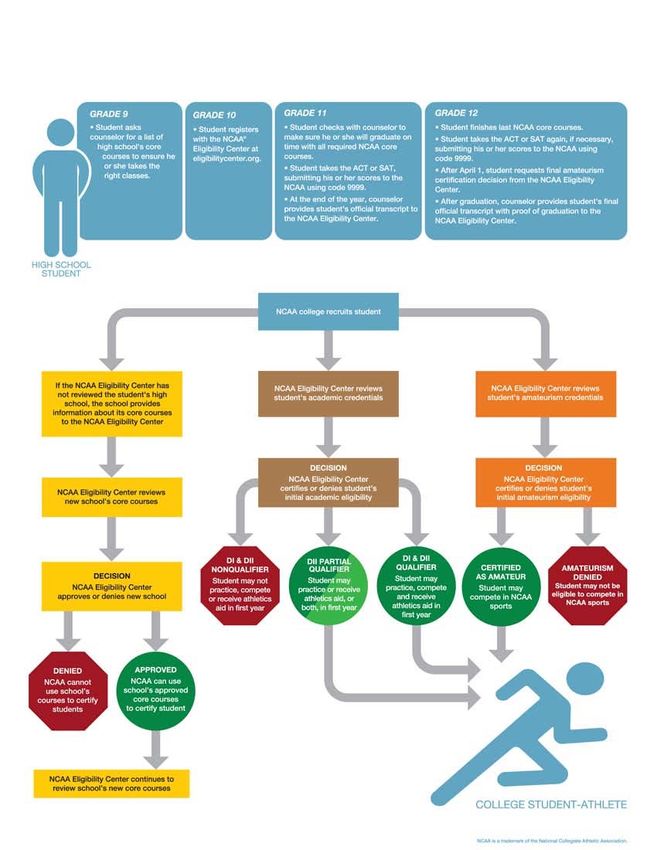
NCAA Eligibility Center
Student-athletes who are considering participating in collegiate athletics should explore the NCAA (National
Collegiate Athletic Association) requirements for eligibility. A high school diploma alone is not sufficient to
permit a student to participate in college athletics. The NCAA has a set of minimum standards that students
must meet to be eligible. Below is a quick reference sheet taken directly from the NCAA Eligibility Center that
outlines the requirements to play at a Division I or Division II College or university. For more detailed
information and to register with the NCAA Eligibility Center please visit the following website:
http://web1.ncaa.org/ECWR2/NCAA_EMS/NCAA.jsp.
8Steps to Register with the NCAA Clearinghouse
• Step 1: It is recommended that the student athlete registers in his/her junior year, beginning in the
month of May. To register, the student athlete needs to apply online at www.eligibilitycenter.org
• Step 2: After the student registration is complete, you must request your high school transcripts be
sent to the NCAA Clearinghouse. One will be sent as a final junior transcript and one will be sent as a
final senior transcript. (If the student has attended more than one high school, each high school must
receive a copy of the completed Student Release form. A transcript must be sent from each high
school attended.)
• Step 3: All prospective student-athletes intending to enroll in an NCAA Division I or II institution for
the first time must complete the NCAA Amateurism Certification questionnaire.
• Step 4: Test scores must be reported directly from either ACT or SAT. They will no longer be accepted
from the high school transcript. When registering to take the SAT’s or ACT’s you should include the
NCAA as one of your free choices to where to send your scores. The code for the NCAA is 9999. If you
did not do this, go online for SAT scores to www.collegeboard.org or for ACT
scores to www.act.org and send your score directly to the NCAA Clearinghouse.
• Step 5: Upon completion of the junior year, the final junior year transcript will be sent to the
Clearinghouse. The student will receive an initial clearing statement from the Clearinghouse in the fall
of the student’s senior year.
• Step 6: Before the end of the senior year, you must request the Final Amateurism
Certification for each sport that you will participate in. Log back into your account
at www.eligibilitycenter.com. Click on MY PLANNER. Then select the red “Request Final
Amateurism” button and follow the instructions.
• Step 7: After graduation, the student’s final senior transcript with the exact date of graduation must
be sent to the Clearinghouse from the high school. The student will then receive a final clearing
statement from the Clearinghouse.
In completing the registration forms, the high school CEEB code is required.
• Manheim Central High School CEEB CODE is 392-385.
Clearinghouse Customer Services:
• NCAA Eligibility Center
Certification Processing
P.O. Box 7136
Indianapolis, IN 46207
910
11
12
13
14
15
16
Agriculture
                         Career and Technical Education Program
Agriculture courses are offered to meet the needs of students in the following agriculture
career preparation tracts:
   • Agriculture School to Work Technical Preparation: Students who will pursue a career in an
       agricultural trade after graduating from high school.
   •   Agriculture College to Career Preparation: Students who will pursue collegiate agriculture
       education after graduating from high school.

The following agriculture career preparation Four-Year Sequence of Agriculture Program
courses are offered in two agriculture industry areas of study:
   • Agriculture Mechanics
   • Agriculture Science

                       Agricultural Mechanics Career Pathway
   Agriculture              Credit                                 School Year         Academic and
                                              Description
 Mechanic Courses           Value                                  Availability       Technical Level
                                                                                         Introductory
                                         Introduction to Power,
 Agriculture Mechanics                                                                Prerequisite for all
                                1             Structural and           Yearly
            1                                                                          other Agriculture
                                           Technical Systems
                                                                                      Mechanic courses
                                           MIG, TIG, Arc and
  Agricultural Welding         0.5                                   2017/2018         Advanced Level
                                            Plasma Welding
                                           Ag Machinery and
 Ag Machinery & Diesel                       Diesel Engine:
                               0.5                                   2017/2018         Advanced Level
      Mechanics                           Function, Repair and
                                           Maintenance Skills
                                          2 & 4 Cycle Engines:
                                                                     2018/2019
   Small Gas Engines           0.5        Function, Repair and                         Advanced Level
                                                                     2019/2020
                                           Maintenance Skills
     Advanced Ag
     Construction:                        Plumbing, Wiring and
                               0.5                                   2018/2019         Advanced Level
 Plumbing, Concrete &                     Concrete Trade Skills
       Electricity
      Agriculture                         Framing and Building
                               0.5                                   2019/2020         Advanced Level
     Construction                                Trades
    Senior SAE, Fall                      Vocational Ag-Ed Skill   Yearly, Blocks 3    Senior Year Only
                                2
       Semester                              Development              and/or 4         Advanced Level
   Senior SAE, Spring                     Vocational Ag-Ed Skill   Yearly, Blocks 3    Senior Year Only
                                2
       Semester                              Development              and/or 4         Advanced Level

                                                      17
Agricultural Science Career Pathway
Agriculture Science Credit School Year Academic and
Description
Courses Value Availability Technical Level
Agriculture Science 1: Introductory
Introduction to
Introduction to Prerequisite for
1 Agriculture, Food, and Yearly
Agriculture, Food, and all other Agriculture
Natural Resources
Natural Resources Science courses
Agriculture Processing:
Food Chemistry, Meat &
Food Sciences and Dairy 0.5 2017/2018 Advanced Level
Dairy Processing
& Meat Processing
Applied Animal Science Dairy, Poultry,
1: Dairy & Poultry 0.5 Management, and 2017/2018 Advanced Level
Management Veterinary Care
Applied Plant Science 1:
Greenhouse
Greenhouse
0.5 Management & Flower 2017/2018 Advanced Level
Management and Floral
Design
Design
Applied Animal Science Horse & Small Animal
3: Horse and Small 0.5 Management and 2018/2019 Advanced Level
Animal Management Veterinary Care
Agricultural Business Advanced Level
Agriculture Sales &
Management 3 college dual
Marketing: HACC Intro 0.5 2018/2019
HACC Intro Ag Business enrollment HACC
Ag Business
course college credits
Applied Plant Science 2:
Landscaping and Soil
Landscaping & Soil 0.5 2018/2019 Advanced Level
Science
Science
Applied Animal Science Beef, Sheep, Swine
2: Beef, Sheep & Swine 0.5 Livestock Management 2019/2020 Advanced Level
Management and Veterinary Care
Biological Science of
Agriculture Food, Fiber and
0.5 2019/2020 Advanced Level
Biotechnology Alternative Energy
Systems
Applied Plant Science 3: “Farm to Fork” Crop
Crop Science and 0.5 Production and 2019/2020 Advanced Level
Production Processing
Vocational Ag-Ed Skill Yearly, Blocks 3 Senior Year Only
Senior SAE, Fall Semester 2
Development and 4 Advanced Level
Senior SAE, Spring Vocational Ag-Ed Skill Yearly, Blocks 3 Senior Year Only
2
Semester Development and 4 Advanced Level
Soil, Water, and Forest
Advanced Level
AgriEcology 1 Resource Conservation Yearly
Junior or Senior Year
and Ecosystem Study
Advanced
AP Environmental Environmental Scientific
1 Yearly Placement/Honors
Science Principles and Concepts
Junior or Senior Year
Environment, Ecology Co-taught with
Environment, Ecology
0.5 and Engineering Yearly Technology Education
and Engineering
Concepts Program
18Agriculture Career and Technical Education Program
All Agriculture Education Program courses have these common
student expectations and experiential learning opportunities:
1. SAE: A Supervised Agriculture Experience (SAE) portfolio will be a requirement in all agriculture
courses to serve as enrichment experiential learning activities. SAE programs are planned,
documented, practical activities conducted outside of the classroom/laboratory instruction time in
which students develop and apply agricultural knowledge and skills in the agriculture field being
studied. Students will maintain an online SAE Record Book to show progress in agriculture skill
development. Students with livestock based SAE’s are members of the Manheim FFA Show Team.
2. Career Exploration: Each student will explore varied agricultural career opportunities in all Ag-Ed
course units studied and relate them to their individual interest, aptitudes and skills. There will be
daily lesson connections made regarding future career opportunities in the Agriculture fields with a
focus on employability skills.
3. FFA: All agriculture education students are enrolled in the Manheim chapter of the National FFA
Organization. As active members of the FFA, they have the opportunity to participate in career
development contests, attend leadership conferences, and earn scholarships for college. The
opportunities for growth are endless! FFA makes a positive difference in the lives of students by
developing their potential for premier leadership, personal growth and career success through
agriculture education.
4. Class Fees Expectations: A course fee will be charged for lab and take home project materials.
Agriculture industry tours will be taken to explore agriculture career opportunities. A school district
field trip fee and any admission costs will need to be paid for by each student.
5. Work Place Safety Training: A safety contract, signed by parents and students, explaining
appropriate shop maintenance & tool operation as well as expected student conduct while in the
agriculture shop areas will be required of all students. Students are required to wear safety glasses at
all times while working in the Ag Mech shop and Ag Sci laboratory areas.
6. MC Ag-Ed CTE Program: The Manheim Central Agriculture Education Program is a PA
Department of Education Approved Career and Technical Education (CTE) program. Per the language
in Public School Code: Any resident of any school district which does not maintain an approved
vocational program…offering the type of Ag-Ed training which he desires, may make application to the
board of school directors of any other district for admission to such school or department maintained
by said board. This state education ruling means Manheim Central School District can accept students
from Hempfield, Manheim Township, Warwick, Donegal School Districts and School District of
Lancaster City so that they may purse agriculture career preparation. Applicant should make an
appointment with Mrs. Anderson, Ag-Ed Instructional Facilitator, and Mr. Hughes, MC High School
Principal, to review admission expectations and process.
19Agriculture
Agriculture Education Program: Agricultural Mechanics
Career and Technical Education Program Pathway
1431 Agriculture Mechanics 1: Introduction to Power, Structural and Technical Systems
School Year Availability: Yearly
Credit Value: 1 Prerequisite: None
Course Level: No level Course is for Students in Grade(s): 9-12
Course Fee: $45.00 Course Weight: 1
Course Description: This, the first course taught in Agriculture Mechanics, will provide a basic overview of
agricultural mechanics related to repair, construction and maintenance. The student will learn shop safety,
tools and hardware identification, tool use and maintenance, simple metal and wood working, basic electrical
wiring, arc and gas welding and tractor driving safety. All students will master the use of materials, tools and
processes of agriculture mechanics, which are applicable to this course. This course is the prerequisite course
for all other Ag Mechanics elective courses.
20Agriculture
Agriculture Education Program: Agricultural Science
Career and Technical Education Program Pathway
1411 Agriculture Science 1: Introduction to Agriculture, Food, and Natural Resources
School Year Availability: Yearly
Credit Value: 1 Prerequisite: None
Course Level: No level Course is for Students in Grade(s): 9-12
Course Fee: $10.00 Course Weight: 1
Course Description: Agriculture Science 1: Introduction to Agriculture, Food, and Natural Resources is an
introductory course designed to teach students about the world of agriculture, the pathways of study they
may pursue, and the science, mathematics, reading, and writing components they will use throughout the
CASE™ curriculum. Woven throughout the course are activities to develop and improve employability skills of
students through practical applications. Students will explore career and post-secondary opportunities in each
area of the course.
Students’ experiences will involve the study of communication, the science of agriculture, plants, animals, and
natural resources. While surveying the opportunities available in agriculture and natural resources, students
will learn to solve problems, conduct research, analyze data, work in teams, and take responsibility for their
work, actions, and learning. This course is the prerequisite course for all other Ag Science ½ credit elective
courses.
21Art
Course Listing
Courses denoted with an * fulfill the Arts and Humanities graduation requirement.
Drawing and Painting 1* Sculpture 1*
Drawing and Painting 2 Sculpture 2
Drawing and Painting 3 Sculpture 3
Drawing and Painting 4 Sculpture 4
Drawing and Painting 5 Sculpture 5
Computer Art – Graphic Design Ceramics 1*
Computer Art 2 Ceramics 2
Computer Art 3 Ceramics 3
Computer Art 4 Ceramics 4
Computer Art 5 Ceramics 5
22Art
The courses denoted with an * offer choices within the Art department that would fulfill the Arts and
Humanities graduation requirement. All courses offer a way for students to experience the arts in an
interdisciplinary setting.
0724 Drawing and Painting 1*
Credit Value: 0.5 Prerequisite: None
Course Level: No level Course is for Students in Grade(s): 9-12
Course Fee: $25.00 Course Weight: 1
Course Description: This course provides an introduction to a variety of techniques, styles, and media in
two-dimensional art. Work will be done from actual objects, still life, models and reference photographs. The
course will emphasize basic drawing and painting skills, while recognizing the importance of imagination and
self-expression. The structure of the introductory level art courses is intended to meet the needs of all
students as well as prepare them for the individualized curriculum of our higher tiered courses. A studio fee
will be charged. This course may not be repeated.
0725 Drawing and Painting 2
Credit Value: 0.5 Prerequisite: 70% or higher in 0724
Course Level: No level Course is for Students in Grade(s): 9-12
Course Fee: $25.00 Course Weight: 1
Course Description: This course will emphasize individual exploration of techniques, styles, and media in
two-dimensional art. Students will have the freedom to structure their course work based on their individual
interests and possible career paths. Work will continue to be done from actual objects, still life, models and
reference photographs, while stressing the importance of imagination and self-expression. Writing and
research are integral components of the creative process and will be stressed as necessary course work
towards making informed creative decisions. A studio fee will be charged. This course may not be repeated.
0733 Computer Art-Graphic Design
Credit Value: 0.5 Prerequisite: None
Course Level: No level Course is for Students in Grade(s): 9-12
Course Fee: Varies Course Weight: 1
Course Description: This course is designed to introduce students to a studio-based experience in
computer art and graphic design. Students are encouraged to explore a variety of approaches and styles while
creatively solving problems and expressing ideas. The structure of the introductory level art courses is
intended to meet the needs of all students as well as prepare them for the individualized curriculum of our
higher tiered courses. A studio fee will be charged. This course may not be repeated.
230734 Computer Art 2
Credit Value: 0.5 Prerequisite: 70% or higher in 0733 or 0753
Course Level: No level Course is for Students in Grade(s): 9-12
Course Fee: Varies Course Weight: 1
Course Description: This course is designed for the serious computer art student interested in continuing
their graphic design or animation experience. Students will have the freedom to structure their course work
based on their individual interests and possible career paths. A strong emphasis will be placed on using the
computer as an artistic tool for communicating ideas. Students will continue to explore the incorporation of
creativity and self-expression in commercial art, graphic design, and illustration. Writing and research are
integral components of the creative process and will be stressed as necessary course work towards making
informed creative decisions. A studio fee will be charged. This course may not be repeated.
0755 Sculpture 1*
Credit Value: 0.5 Prerequisite: None
Course Level: No level Course is for Students in Grade(s): 9-12
Course Fee: $25.00 Course Weight: 1
Course Description: This course provides an introduction to a variety of techniques, styles, and materials
in three-dimensional art. Sculpture I emphasizes experimentation in basic sculptural form, while recognizing
the importance of imagination and self-expression. The structure of the introductory level art courses is
intended to meet the needs of all students as well as prepare them for the individualized curriculum of our
higher tiered courses. A studio fee will be charged. This course may not be repeated.
0756 Sculpture 2
Credit Value: 0.5 Prerequisite: 70% or higher in 0755
Course Level: No level Course is for Students in Grade(s): 9-12
Course Fee: $25.00 Course Weight: 1
Course Description: This course is based on intensive personalized studio work and is for the student who
finds success working in three-dimensional shape and form. Students will have the freedom to structure their
course work based on their individual interests and possible career paths. This course provides a variety of
techniques, styles, and media in three-dimensional art. Writing and research are integral components of the
creative process and will be stressed as necessary course work towards making informed creative decisions.
Imagination and self-expression are the key elements in this course. A studio fee will be charged. This course
may not be repeated.
0748 Ceramics 1*
Credit Value: 0.5 Prerequisite: None
Course Level: No level Course is for Students in Grade(s): 9-12
Course Fee: $25.00 Course Weight: 1
Course Description: Students will create projects that include techniques such as hand building, sculpting,
and throwing on the wheel. The course will contain projects made in functional and non-functional forms.
24Ceramics I emphasizes experimentation in basic form, while recognizing the importance of imagination and
self-expression. The structure of the introductory level art courses is intended to meet the needs of all
students as well as prepare them for the individualized curriculum of our higher tiered courses. A studio fee
will be charged. This course may not be repeated.
0749 Ceramics 2
Credit Value: 0.5 Prerequisite: 70% or higher in 0748
Course Level: No level Course is for Students in Grade(s): 9-12
Course Fee: $25.00 Course Weight: 1
Course Description: This course is based on intensive personalized studio work and is for the student who
finds success working with clay shape and form. Students will create projects that include techniques such as
hand building, sculpting, and throwing on the wheel. This course will contain projects made in functional and
non-functional forms. There is intensive individual exploration in clay as a medium. Imagination and self-
expression are the key elements in this course. A studio fee will be charged. This course may not be repeated.
25Business Education
Course Listing
Introduction to Business Stock Market Investing
Entrepreneurship Sports Marketing & Management
Accounting I Fashion Merchandising
Accounting II Business Law
International Business Careers and Your Money
26Business Education
0808 Introduction To Business
Credit Value: 0.5 Prerequisite: None
Course Level: No level Course is for Students in Grade(s): 9-12
Course Fee: None Course Weight: 1
Course Description: This course will serve as an introduction to the exciting and challenging world of
business and will serve as a foundation for other business courses. The topics covered will help students
understand how businesses function and how individuals make decisions. Other areas that will be addressed
will include: how businesses are organized, how products are marketed and how small businesses operate.
Knowledge of these topics will allow students to better understand how they fit into the world marketplace,
their future employment and perhaps even business ownership.
0842 Careers and Your Money
Credit Value: 0.5 Prerequisite: None
Course Level: No level Course is for Students in Grade(s): 9-11
Course Fee: None Course Weight: 1
Course Description: Careers and Your Money is a 9-week class which explores Career Options and
Personal Finance Topics. The goal is to allow students to focus on their future as it relates to what they might
do for a living and how they might manage their financial resources. Students will engage in a variety of career
exploration activities and use CareerCruising.com (a district provided resource) to evaluate career
opportunities. In addition to that, learning about how pay is received, taxed and subsequently managed is an
important part of living in the adult world. Therefore, topics such as budgeting, housing, banking, credit
(consumer law), and taxes will be covered.
27Computer Education
Course Listing
Microsoft Office 2013 Intro Programming-Visual Basic
Advanced Microsoft Word 2013 21st Century Skills for Success
Advanced Microsoft Excel 2013 PLTW-Introduction to Computer Science
28Computer Education
0904 Microsoft Office 2013
Credit Value: 0.5 Prerequisite: None
Course Level: No level Course is for Students in Grade(s): 9
Course Fee: None Course Weight: 1
Course Description: This course is designed to provide 21st century, critical thinking skills necessary for
success in both educational and employment environments. Instruction emphasizes the operation and
features of the Windows 7 Operating System, Microsoft Word®, Excel®, PowerPoint® to complete real-world
assignments and projects. In addition, multimedia Web 2.0 applications will be explored. Successful
completion of this course qualifies the student for enrollment into Advanced Microsoft Word® 2013 and
Advanced Microsoft Excel® 2013. Note that 8th grade students may take a test in order to demonstrate
mastery of the material and "test out" of this class.
0906 Advanced Microsoft Word 2013
Credit Value: 0.5 Prerequisite: 80% in 0904
Course Level: No level Course is for Students in Grade(s): 9-12
Course Fee: None Course Weight: 1
Course Description: This course is designed to build on the Microsoft Word® 2013 skills acquired in
Microsoft Office 2013. By using Microsoft Word®, students will be able to communicate and share ideas
effectively. Mail Merge, Templates, Resumes are some of the topics to be covered. This essential application is
the standard for both education and business environments.
Successful completion of this course will prepare you to take the Microsoft Office Specialist – MOS Exam for
Word® 2013 certification test. However, taking the test is not a course requirement. *
0910 Advanced Microsoft Excel 2013
Credit Value: 0.5 Prerequisite: 80% in 0904
Course Level: No level Course is for Students in Grade(s): 9-12
Course Fee: None Course Weight: 1
Course Description: This course is designed to build on the Microsoft Excel® 2013 skills acquired in
Microsoft Office 2013. Topics covered include creating and manipulating data, formatting data and content,
creating and modifying formulas, presenting data visually, and collaborating and securing data. Successful
completion of this course will prepare you for the Microsoft Office Specialist – MOS Exam for Excel® 2013
certification test.
0917 21st Century Skills for Success
Credit Value: 0.5 Prerequisite: None
Course Level: No level Course is for Students in Grade(s): 9-12
Course Fee: None Course Weight: 1
29Course Description: You’ve heard of Prezi and Moodle, but do you know Powtoon and Schoology? The
internet is a constantly evolving source of information and interactive tools which require Learning and
Innovation Skills, Information, Media/Technology Skills, and Life/Career Skills for success in the 21st Century.
Students will use web-based tools for interactive, independent and collaborative projects relevant to digital
natives – that’s YOU! Problem solving, creativity, information literacy, and initiative are necessary skills to
compete in our global learning community. Learn how to develop an e-portfolio with your digital footprint that
leaves an impression.
0919 PLTW-Introduction to Computer Science
Credit Value: 0.5 Prerequisite: None
Course Level: No level Course is for Students in Grade(s): 9-12
Course Fee: None Course Weight: 1
Course Description: Designed to be the first computer science course for students who have never
programmed before, this class is a starting point for the Project Lead The Way (PLTW) Computer Science
program. Students work in teams to create simple apps for mobile devices using MIT App Inventor®. Students
explore the impact of computing in society and the application of computing across career paths and build
skills and awareness in digital citizenship and cybersecurity. Students model, simulate, and analyze data about
themselves and their interests. They also transfer the understanding of programming gained in App Inventor to
learn introductory elements of text-based programming in Python® to create strategy games.
30English Language Arts
Course Listing and Sequence
Please note this is a suggested sequence of courses and students may choose to take more than one
English Language Arts course in a school year.
Level 9th Grade 10th Grade 11th Grade 12th Grade
AP English
Honors 9th Grade Honors 10th Grade Honors American
Honors Honors 12th
Language Arts Language Arts Literature
Language Arts
9th Grade Language 10th Grade Language Survey of American 12th Language Arts,
Level 1
Arts, Lvl 1 Arts, Lvl 1 Lit, Lvl 1 Lvl 1
9th Grade Language 10th Grade Language
Arts, Lvl 2 Arts, Lvl 2 The Best of 12th Language Arts,
Level 2
9th Language Arts, 10th Language Arts, American Lit, Lvl 2 Lvl 2
Lvl 2 Part 1 and 2 Lvl 2 Part 1 and 2
Communications Communications
Communications Mythology and Mythology and
Electives Mythology and Modern Man Modern Man
Modern Man Creative Writing Creative Writing
31English Language Arts
0205 Honors 9th Grade Language Arts
Credit Value: 1 Prerequisite: District data and criteria
Course Level: Honors Course is for Students in Grade(s): 9
Course Fee: None Course Weight: 1.2
Course Description: This course is suggested for those students who aspire to continue their study of
English in an Advanced Placement course as seniors. A brief review of the writing skills sequence leads to
composition assignments requiring interpretive and applied levels of response to literature.
The literature program focuses on short stories, the novel, poetry, and Shakespeare’s Romeo and Juliet, as well
as readings in informational texts. Speaking skills are reinforced through classroom discussions, oral reports,
and enrichment activities. Communication skills are developed and refined through extensive grammar and
vocabulary studies. There is a required summer reading for this course.
0206 9th Grade Language Arts, Lvl 1
Credit Value: 1 Prerequisite: Teacher approval
Course Level: Level 1 Course is for Students in Grade(s): 9
Course Fee: None Course Weight: 1
Course Description: Ninth grade Language Arts begins with a comprehensive focus on the writing process.
A progressive grammatical skills and review sequence is included in this course, as well as extensive vocabulary
study.
The primary objective of the literature program is for students to understand and appreciate literary style and
convention, both through analysis and student composition. The literature program focuses on short stories,
the novel, poetry, and Shakespeare’s Romeo and Juliet, as well as readings in informational texts. Speaking
skills are reinforced through classroom discussions and oral reports.
0208 9th Grade Language Arts, Lvl 2
Credit Value: 1 Prerequisite: Teacher approval
Course Level: Level 2 Course is for Students in Grade(s): 9
Course Fee: None Course Weight: 1
Course Description: The semester includes a general review of basic grammatical concepts. Special
emphasis is placed on punctuation, capitalization, sentence structure, and agreement. The writing skills
sequence includes effective sentence writing, paragraph development, and writing process assignments.
Students are guided beyond a literal comprehension to an understanding of literary style and convention. The
literature program focuses on short stories, the novel, poetry, and Shakespeare’s Romeo and Juliet, as well as
readings in informational texts. Speaking skills are reinforced through classroom discussions and presentations.
320203 9th Language Arts, Lvl 2 Part 1
Credit Value: 1 Prerequisite: District criteria
Course Level: Level 2 Course is for Students in Grade(s): 9
Course Fee: None Course Weight: 1
Course Description: Part 1 of this full-year English class will focus on strengthening skills in writing in a
variety of genres and reading a wide selection of literary texts in order to prepare students for success. Part 1
and part 2 must be taken during the same year.
0204 9th Language Arts, Lvl 2 Part 2
Credit Value: 1 Prerequisite: District criteria
Course Level: Level 2 Course is for Students in Grade(s): 9
Course Fee: None Course Weight: 1
Course Description: Part 2 of this full-year English class will focus on improving reading ability through a
variety of strategies aimed at strengthening students' skill levels. Student will receive one elective Language
Arts credit for successful completion of this course.
332100 Academic Language Acquisition, Fall A: ESL 9-12
Credit Value: 1 Prerequisite: Teacher referral
Course Level: Proficiency level 1-3 Course is for Students in Grade(s): 9-12
Course Fee: None Course Weight: 1
Course Description: This course is intended for English as Second Language (ESL) students who are
acquiring English Language Proficiency.
Academic Language Acquisition develops the language needed to be successful in content area classes.
Content texts will be used to teach essential grammar skills, vocabulary and spelling. Instruction is designed
around the six core tenets of literacy, listening, speaking, reading, writing, viewing and representing.
*All non-exited ESL students will attend Academic Language Acquisition for one block each day.
*ESL students will be scheduled for a regular English class in addition to this class.
2101 Academic Language Acquisition, Spring A: ESL 9-12
Credit Value: 1 Prerequisite: Teacher referral
Course Level: Proficiency level 1-3 Course is for Students in Grade(s): 9-12
Course Fee: None Course Weight: 1
Course Description: This course is intended for English as Second Language (ESL) students who are
acquiring English Language Proficiency.
Academic Language Acquisition develops the language needed to be successful in content area classes.
Content texts will be used to teach essential grammar skills, vocabulary and spelling. Instruction is designed
around the six core tenets of literacy, listening, speaking, reading, writing, viewing and representing.
*All non-exited ESL students will attend Academic Language Acquisition for one block each day.
*ESL students will be scheduled for a regular English class in addition to this class.
2102 Academic Language Acquisition, Fall B: ESL 9-12
Credit Value: 1 Prerequisite: Teacher referral
Course Level: Proficiency level 4-5 Course is for Students in Grade(s): 9-12
Course Fee: None Course Weight: 1
Course Description: This course is intended for English as Second Language (ESL) students who are
acquiring English Language Proficiency.
Academic Language Acquisition develops the language needed to be successful in content area classes.
Content texts will be used to teach essential grammar skills, vocabulary and spelling. Instruction is designed
around the six core tenets of literacy, listening, speaking, reading, writing, viewing and representing.
*All non-exited ESL students will attend Academic Language Acquisition for one block each day.
*ESL students will be scheduled for a regular English class in addition to this class.
342103 Academic Language Acquisition, Spring B: ESL 9-12
Credit Value: 1 Prerequisite: Teacher referral
Course Level: Proficiency level 4-5 Course is for Students in Grade(s): 9-12
Course Fee: None Course Weight: 1
Course Description: This course is intended for English as Second Language (ESL) students who are
acquiring English Language Proficiency.
Academic Language Acquisition develops the language needed to be successful in content area classes.
Content texts will be used to teach essential grammar skills, vocabulary and spelling. Instruction is designed
around the six core tenets of literacy, listening, speaking, reading, writing, viewing and representing.
*All non-exited ESL students will attend Academic Language Acquisition for one block each day.
*ESL students will be scheduled for a regular English class in addition to this class.
35Family and Consumer Sciences
Course Listing
F.C.S. Connections Foods I
Child Care and Development American Cuisine
Preschool Laboratory Cooking Lite & Easy
Interior Design Personal Financial Management
Contemporary Fashion
36Family and Consumer Sciences
1131 Contemporary Fashion
Credit Value: 0.5 Prerequisite: None
Course Level: No level Course is for Students in Grade(s): 9-12
Course Fee: $5.00-$20.00 Course Weight: 1
Course Description: This course is designed for the student that would like to develop basic sewing
techniques and skills. Students will select projects based on personal needs and tastes. This course is
recommended for any student interested in developing personal sewing skills that can be utilized in fashion
and home interior designs. Students that have an interest in textiles, fashion design, or interior design as a
career will benefit from this course. The fee will depend on the student's project choices.
1114 Foods I
Credit Value: 0.5 Prerequisite: None
Course Level: No level Course is for Students in Grade(s): 9-12
Course Fee: $25.00 Course Weight: 1
Course Description: The course is an introduction to food preparation skills and consumer skills. Emphasis
is placed on the use of correct equipment, techniques, safety and sanitation in the kitchen. Food preparation
techniques will be taught through demonstration and student experiences in the food laboratory. Units of
study include the science of baking quick breads, principles of egg cookery, fruits, dairy, and nutrition across
the lifespan. This course is a prerequisite to all foods related courses within the FCS Department.
1112 Personal Financial Management
Credit Value: 0.5 Prerequisite: None
Course Level: No level Course is for Students in Grade(s): 9-12
Course Fee: None Course Weight: 1
Course Description: This elective is designed for all students desiring to manage finances in their future.
Students will compare various options for investing and accruing savings, practice the skills of online banking,
and maintain a check register and a savings account. Students will practically apply knowledge through
simulation of real life financial experiences of budgeting within a given salary. Other topics include debit cards,
the use of credit, identity theft and selecting insurance.
37Learning Support
Course Listing
Vocational Math Mathematics
Vocational English Science
School-To-Work Social Studies
English Next Step Program
38Learning Support
1813 Vocational Math
Credit Value: 1 Prerequisite: IEP
Course Level: Learning support Course is for Students in Grade(s): 9-11
Course Fee: None Course Weight: 1
Course Description: This course is designed to teach and review the fundamentals of basic math,
measurement, consumer math, and vocational math (problems related to specific work environments.) Both
group and individual instruction will be used to achieve the course objectives and meet individual student
goals.
1814 Vocational Math
Credit Value: 1 Prerequisite: IEP
Course Level: Learning support Course is for Students in Grade(s): 12
Course Fee: None Course Weight: 1
Course Description: This course is designed to teach and review the fundamentals of basic math,
measurement, consumer math, and vocational math (problems related to specific work environments.) Both
group and individual instruction will be used to achieve the course objectives and meet individual student
goals.
1815 Vocational English
Credit Value: 1 Prerequisite: IEP
Course Level: Learning support Course is for Students in Grade(s): 9-11
Course Fee: None Course Weight: 1
Course Description: This course stresses functional reading skills and practical usage of the English
language, which will be taught through a corrective reading program. Students will build vocabulary according
to their own vocational interests and will be responsible for written assignments, both research based and
creative. There will also be a focus on reading for enjoyment. A review of grammar will be included in this
course.
1816 Vocational English
Credit Value: 1 Prerequisite: IEP
Course Level: Learning support Course is for Students in Grade(s): 12
Course Fee: None Course Weight: 1
Course Description: This course stresses functional reading skills and practical usage of the English
language, which will be taught through a corrective reading program. Students will build vocabulary according
to their own vocational interests and will be responsible for written assignments, both research based and
creative. There will also be a focus on reading for enjoyment. A review of grammar will be included in this
course.
391830/1832/1834/1836 School-To-Work
Credit Value: 1 Prerequisite: IEP
Course Level: Learning support Course is for Students in Grade(s): 11 and 12
Course Fee: None Course Weight: 1
Course Description: The School to Work Class is designed for Junior and Seniors requiring instruction in
the following skill areas: travel training, social skills, study skills, practice with disability disclosure,
employability skills, utilizing technology in daily activities and accessing supports and resources in the
community for medical, leisure, mental, financial and emotional needs. Students will participate in volunteer
and paid internships as they move toward graduation and independent living. The students will be working on
math, reading and writing activities for functional skills including workplace readiness and independent living.
1919E/1919F English
Credit Value: 1 Prerequisite: IEP
Course Level: Learning support Course is for Students in Grade(s): 9
Course Fee: None Course Weight: 1
Course Description: Instruction in this class is individualized to the student's needs as identified in the
Individualized Education Plan. Activities and content may be remedial in nature and/or may parallel the
general education program. In its broadest sense, the course goal is to improve written and verbal language
skills through reading, writing and speaking using one to one and small group instruction. Reading instruction
in this course centers around 4 areas: Reading Decoding (phonemic/orthographic awareness), Fluency,
Vocabulary, and Reading Comprehension. Writing instruction in this course is based on the Strategic
Intervention Model (SIM). The strategies taught include: Fundamentals in the Sentence Writing, Proficiency in
the Sentence Writing, Paragraph Writing, and Error Monitoring.
1920E/1920F English
Credit Value: 1 Prerequisite: IEP
Course Level: Learning support Course is for Students in Grade(s): 10-12
Course Fee: None Course Weight: 1
Course Description: Instruction in this class is individualized to the student's needs as identified in the
Individualized Education Plan. Activities and content may be remedial in nature and/or may parallel the
general education program. In its broadest sense, the course goal is to improve written and verbal language
skills through reading, writing and speaking using one to one and small group instruction. Reading instruction
in this course centers around 4 areas: Reading Decoding (phonemic/orthographic awareness), Fluency,
Vocabulary, and Reading Comprehension. Writing instruction in this course is based on the Strategic
Intervention Model (SIM). The strategies taught include: Fundamentals in the Sentence Writing, Proficiency in
the Sentence Writing, Paragraph Writing, and Error Monitoring.
401925E/1925F Mathematics
Credit Value: 1 Prerequisite: IEP
Course Level: Learning support Course is for Students in Grade(s): 9
Course Fee: None Course Weight: 1
Course Description: Activities and content in this class are determined by the Individualized Education
Plan and may be remedial and/or may parallel the general education program.
1926E/1926F Mathematics
Credit Value: 1 Prerequisite: IEP
Course Level: Learning support Course is for Students in Grade(s): 10-12
Course Fee: None Course Weight: 1
Course Description: Activities and content in this class are determined by the Individualized Education
Plan and may be remedial and/or may parallel the general education program.
1929 Science
Credit Value: 1 Prerequisite: IEP
Course Level: Learning support Course is for Students in Grade(s): 9
Course Fee: None Course Weight: 1
Course Description: This course is designed to meet all biology standards and eligible content set forth by
the Commonwealth of Pennsylvania. The pace of the class will be dictated by individual student needs. The
course is designed to provide an overview of the science of biology and the opportunity to experience its many
aspects through laboratory exercises and repetition of concepts and skills using resources consisting of lower
reading levels when possible. In order to complete all the components assessed by the Keystone Exam, the
course may last longer than one semester.
1930 Science
Credit Value: 1 Prerequisite: IEP
Course Level: Learning support Course is for Students in Grade(s): 10-12
Course Fee: None Course Weight: 1
Course Description: This course is designed to meet all biology standards and eligible content set forth by
the Commonwealth of Pennsylvania. The pace of the class will be dictated by individual student needs. The
course is designed to provide an overview of the science of biology and the opportunity to experience its many
aspects through laboratory exercises and repetition of concepts and skills using resources consisting of lower
reading levels when possible. In order to complete all the components assessed by the Keystone Exam, the
course may last longer than one semester.
411935 Social Studies
Credit Value: 1 Prerequisite: IEP
Course Level: Learning support Course is for Students in Grade(s): 9
Course Fee: None Course Weight: 1
Course Description: Learning Support Social Studies will cover the following Units: Civil War, Western
Settlements, The Machine Age, Immigration, Reformers, U.S. Expansionism, World War I, The Roaring 20's, The
Great Depression, World War II, The Cold War, Minority and Ethnic Groups, and The War on Terror. Learning
Support Social Studies is a survey course designed to give students a broad understanding of important events
during the past century.
The course will be taught using a multisensory approach including visual cues, auditory presentations etc.
Students will be provided with guided notes and they will have access to textbook and supplemental materials.
This course is suited for students with lower reading abilities. Class projects and research projects will be of
shorter duration. Alternative assignments and modified tests will be used for student evaluations
1936 Social Studies
Credit Value: 1 Prerequisite: IEP
Course Level: Learning support Course is for Students in Grade(s): 10-12
Course Fee: None Course Weight: 1
Course Description: Learning Support Social Studies will cover the following Units: Civil War, Western
Settlements, The Machine Age, Immigration, Reformers, U.S. Expansionism, World War I, The Roaring 20's, The
Great Depression, World War II, The Cold War, Minority and Ethnic Groups, and The War on Terror. Learning
Support Social Studies is a survey course designed to give students a broad understanding of important events
during the past century.
The course will be taught using a multisensory approach including visual cues, auditory presentations etc.
Students will be provided with guided notes and they will have access to textbook and supplemental materials.
This course is suited for students with lower reading abilities. Class projects and research projects will be of
shorter duration. Alternative assignments and modified tests will be used for student evaluations
1840 Next Step Program
Credit Value: 8 Prerequisite: IEP
Course Level: Life Skills Course is for Students in Grade(s): 12 and 13
Course Fee: None Course Weight: 1
Course Description: The Next Steps Program at Manheim Central will provide students with disabilities job
experience, community awareness skills, and independent living skills in a house setting. Through the non-
traditional classroom setting, students will receive functional academics to increase the skill sets needed for a
job. With the supports available, students will be assisted on the job to monitor safety and assure the tasks at
hand are being successfully completed.
42You can also read


