CLEAN ENERGY AUSTRALIA - REPORT 2018 - APO
←
→
Page content transcription
If your browser does not render page correctly, please read the page content below
CLEAN ENERGY
AUSTRALIA
REPORT 2018
Flick the switch to a better future
                                                                                SUPER

                                                                               ADVICE

                                                                         CONFIDENCE

                                                                                                                                                        Image courtesy of: www.gloster.com

We’ve been a trusted and reliable provider of superannuation
and financial advice for employees in the energy sector since 1931,
enabling members to look to the future with confidence.

•         First choice fund for the energy sector
•         Strong, consistent investment returns
•         Competitive, low fees
•         Easy access to support and advice from our expert team
•         Not-for-profit fund focused on members

To flick the switch for your employees, inquire about making Equip the default super fund for your enterprise.

           Call Tyson Adams Ph: 03 9248 5940 Mob: 0488 988 256
           or email: tadams@equipsuper.com.au

Equipsuper Pty Ltd ABN 64 006 964 049, AFSL 246383 is the Trustee of the Equipsuper Superannuation Fund ABN 33 813 823 017. Before making a decision to invest in the
Equipsuper Superannuation Fund, you should read the appropriate Equip Product Disclosure Statement (PDS). Past performance is not a reliable indicator of future performance.
Equipsuper Financial Planning Pty Ltd (ABN 84 124 491 078, AFSL 455010) is licensed to provide financial planning services to retail and wholesale clients. Equipsuper Financial
Planning Pty Ltd is owned on behalf of Equipsuper Pty Ltd.
CONTENTS

04 Introduction
06 Executive summary
 07 About us
 08 2017 snapshot
 13 Industry gears up to meet the RET
 14	Jobs and investment in renewable energy by state
 18 Industry outlook
 26 Employment
 28 Investment
 30 Electricity prices
 33 Energy security
 34 Energy storage
 36	Technology profiles

     36 Bioenergy

     38 Hydro

     40 Marine
     42	Solar: household and commercial systems up to 100 kW

     48	Solar: medium-scale systems between 100 kW and 5 MW

     50	Solar: large-scale systems larger than 5 MW

     54 Solar water heating

     56 Wind power

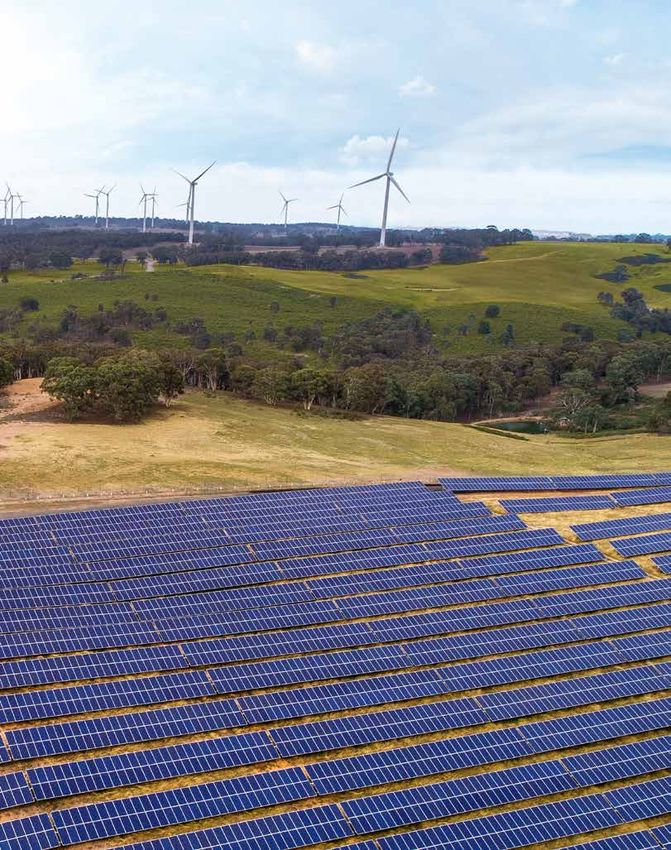
Cover image: Gullen Range Wind and Solar Farm, New South Wales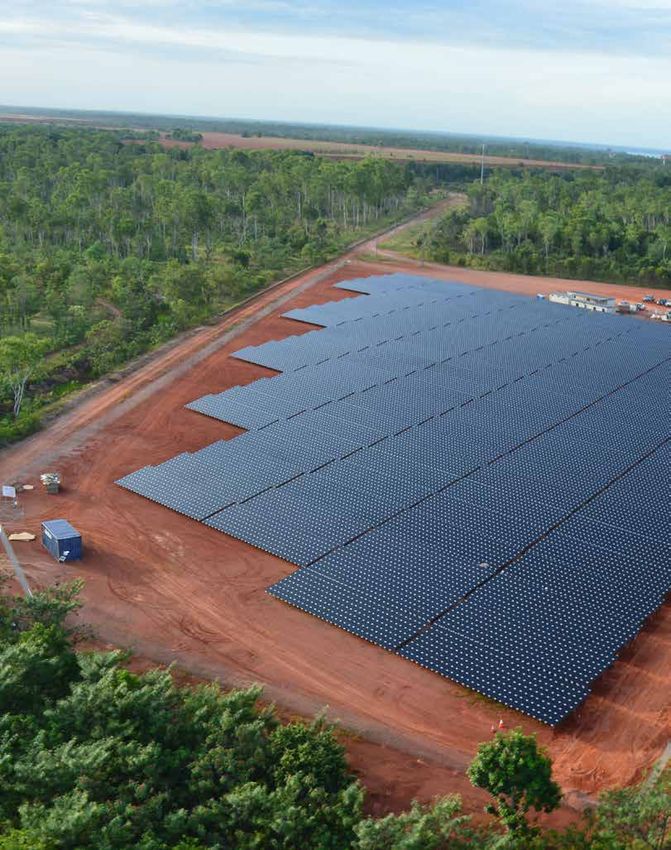
2017 was the biggest year
         for the industry since
         the iconic Snowy Hydro
         Scheme was finished

Image: Portland Wind Energy Project – Stage IV, Victoria

4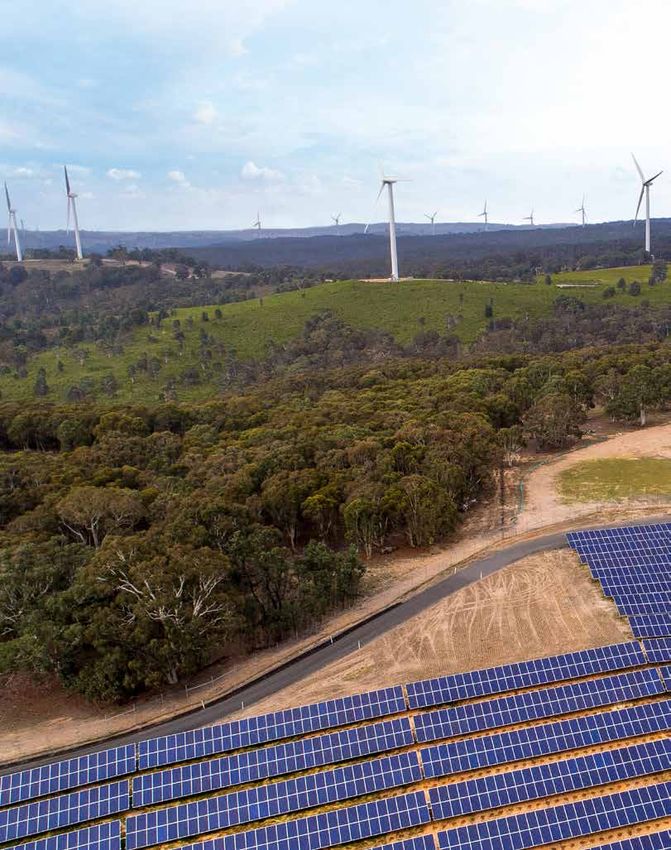
INTRODUCTION

                           Kane Thornton
                           Chief Executive,
                           Clean Energy Council

After a decade of stops and starts, 2017     extremely attractive investment, but         largest coal plants in the country simply
was the biggest year for the industry        it also means the unprecedented              dropping out when times get tough.
since the iconic Snowy Hydro Scheme          program of works is expected to              They are not getting any younger.
was finished more than half a century        reduce household power bills by
                                                                                          In other promising news, the Prime
ago. And it was a record-breaking year       hundreds of dollars every year.
                                                                                          Minister appears committed to the
on many fronts.                              We believe the next few years will be        expansion of the iconic Snowy Hydro
Not only did we see records falling          extremely busy as the industry builds out    Scheme. Snowy 2.0 could increase the
for both rooftop solar and large-scale       the RET. This is great news for Australian   scheme’s generation capacity by up
renewables, but the Clean Energy             small and medium businesses able to          to 2000 MW and, at full capacity, will
Regulator also announced that there          pivot into supplying goods and services      provide approximately 350,000 MWh
are enough projects now committed to         to this booming sector.                      of energy storage. It is also a good
meet the 2020 Renewable Energy                                                            complement to wind and solar, delivering
                                             The world’s biggest battery – built
Target (RET).                                                                             stable and affordable electricity that can
                                             after a Twitter conversation between
                                             Tesla’s Elon Musk and Australian tech        be dispatched on demand. Meanwhile,
More than 1100 MW of rooftop solar                                                        a number of companies are exploring
power capacity was installed during the      billionaire Mike Cannon-Brookes – is
                                             now up and running in South Australia        other new pumped hydro projects.
year, eclipsing the previous best in 2012.
                                             at Neoen’s Hornsdale Wind Farm. It has       As the momentum builds in 2018, I can’t
At the turn of the year, more than 50        already proven its worth, responding         help but feel energised and optimistic
large-scale wind and solar projects          quickly when the coal-fired Loy Yang         about the renewable energy sector and
were under construction or scheduled         power plant tripped and went offline,        the gift we are giving future generations
to start in the near future, representing    effortlessly outpacing traditional           of Australians.
more than 5300 MW of new generating          generators to help stabilise the
capacity, $10 billion in investment and      electricity system.
5750 new direct jobs.
                                             This was not the only time Australia’s
Heading into 2018, renewable energy          ageing coal-fired power stations
represented the lowest-cost type of new      struggled during the recent summer.
energy generation that can be built.         Temperature rises, demand spikes and
This not only makes wind and solar an        weather events have led to some of the

                                                                                                                                      5
EXECUTIVE SUMMARY

        2017 was an
        important
        turning point
        for the industry

Image: Snowtown 2 Wind Farm, South Australia

Approximately 700 MW of renewable              was a record for the rooftop solar         installed large-scale solar capacity
projects were completed and began              industry. Considerable growth also         reached 450 MW at the end of 2017,
generation in 2017. But with seven times       occurred in the medium-scale solar         which is a remarkable result considering
that amount either under construction          sector, with 131 projects adding 53 MW     that just 34 MW was installed at the
or with financial support at the end of        of new capacity. There is now 167 MW       end of 2014.
2017, the clean energy industry is on the      of cumulative capacity in the medium-      There was a tremendous amount of
verge of a major breakthrough.                 scale solar sector, representing an        activity in the wind sector in 2017, with
                                               increase of more than 500 per cent over    15 new wind farms either under
Large-scale wind and solar project
                                               the past five years.                       construction or financially committed at
activity pushed investment in Australia
                                                                                          the end of the year. The 547 MW of new
up 150 per cent to a record US$9 billion       The strong growth witnessed in the
                                                                                          capacity added in 2017 was the third
in 2017, and early in 2018, the Clean          small- and medium-scale solar sectors
                                                                                          highest amount added in the history of
Energy Regulator announced that there          has translated into increased
                                                                                          the Australian wind industry, bringing
were enough projects at a sufficiently         employment opportunities, with the         total generation capacity across the
advanced stage to meet the large-scale         number of new Clean Energy Council         country to 4816 MW.
Renewable Energy Target. This is a             Accredited Installers per month growing
remarkable achievement considering             by 60 per cent in 2017.                    For the first time ever, wind and hydro
that just over half of the target had                                                     generation contributed an almost
                                               Four new large-scale solar projects were   identical amount of electricity –
been met at the beginning of 2017.
                                               completed in 2017, with the largest        approximately 5.7 per cent each – to
Almost 1.1 GW of solar PV was installed        being the 50 MW plant built by Genex at    total national electricity generation
in the small-scale market in 2017, which       Kidston in North Queensland. Total         during the year.
6
ABOUT US

                                                                                     The Clean Energy
                                                                                     Council is the peak
                                                                                     body for the renewable
                                                                                     energy and energy
                                                                                     storage industry in
                                                                                     Australia. We represent
                                                                                     and work with hundreds
                                                                                     of leading businesses
                                                                                     operating in solar, wind,
                                                                                     hydro, bioenergy, energy
                                                                                     storage, geothermal
                                                                                     and marine along with
                                                                                     more than 5000 solar
                                                                                     and battery storage
                                                                                     installers.

                                                                                     We are committed to accelerating
                                                                                     the transformation of Australia’s
                                                                                     energy system to one that is smarter
                                                                                     and cleaner.
                                                                                     The Clean Energy Council leads and
                                                                                     supports the growth of the clean
                                                                                     energy industry in Australia through:
                                                                                     > shaping policy
                                                                                     > 	developing standards and
                                                                                       regulations and ensuring the
                                                                                       integrity of the industry
Electricity prices were never far from      coal-fired power station suddenly
                                                                                     > promoting the industry
the headlines in 2017, with                 went offline.
                                                                                     > 	providing a range of valuable
significant price rises putting
                                            In household storage, 12 per cent of       services to our members,
increasing pressure on households
                                            the 172,000 PV installations in 2017       customers and partners.
and businesses. While prices are
                                            included a battery, up from 5 per
expected to rise again in 2017-18,
                                            cent in 2016. According to solar
the Australian Electricity Market
                                            consultancy SunWiz, a total of
Commission predicts that residential
                                            28,000 battery systems had been
electricity prices will fall 6.2 per cent
                                            installed across Australia by the end
on average over the following two
                                            of 2017. On a state-by-state basis,
years as more wind and solar
                                            around 42 per cent of the nation’s
generation comes online.
                                            total storage installations are in New
The installation of the world’s largest     South Wales, with 19 per cent
lithium-ion battery in South Australia      located in Queensland, 17 per cent in
thrust energy storage into the              Victoria and 11 per cent in SA.
spotlight in 2017. As well as storing
energy from the nearby Hornsdale
Wind Farm and pumping it back into
the grid, the battery proved its
mettle in December by helping to
stabilise the grid after a large
                                                                                                                         7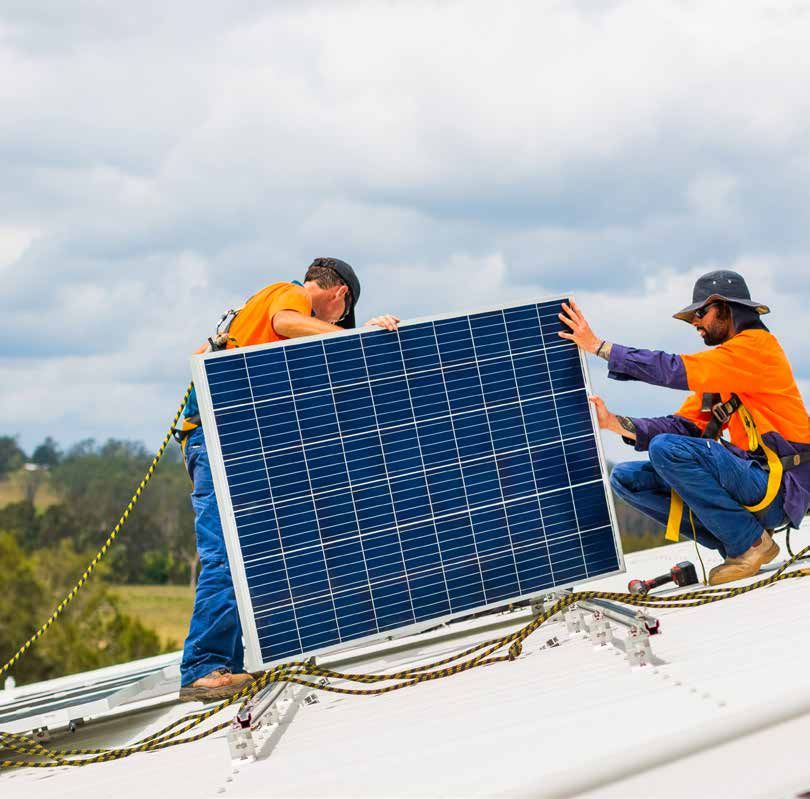
2017 SNAPSHOT

In 2017, approximately 700 MW of renewable projects were completed and began
generation. But with seven times that amount either under construction or with
financial support at the end of the year, this is just the beginning.

Although 2017 was a record year for the       of power helped to ease the strain on          While only a handful of large-scale
renewable energy sector, the percentage       the electricity network.                       solar projects were completed in 2017,
of renewable energy fell slightly from                                                       it is remarkable to note that 450 MW
                                              The big news in 2017 was the
17.3 per cent of Australia’s electricity in                                                  of capacity has now been built across
                                              construction and commissioning of the
2016 to 17 per cent last year. This was                                                      the country – up from just 34 MW at
                                              world’s largest lithium-ion battery
largely because of a significant decline                                                     the end of 2014. Another 21 big solar
                                              at South Australia’s Hornsdale Power
in hydro generation due to reduced                                                           projects were under construction at the
                                              Reserve. While this hit the headlines
rainfall in catchment areas.                                                                 beginning of 2018. Wind power also
                                              worldwide, it was just one of the many
                                                                                             had its third-biggest year (547 MW of
For the first time ever, wind and hydro       initiatives pursued or proposed by the
                                                                                             new capacity), with more than a dozen
generation contributed an almost              South Australian state government as
                                                                                             projects actively underway.
identical amount of electricity – each        it led the race towards a 21st century
around 5.7 per cent of the national total     energy system. What will happen
– during the year.                            following the change of government
                                              in March 2018 remains to be seen.
Rooftop solar, which experienced its
best ever year in 2017, continues to gain     Household battery activity is
momentum thanks to growing interest           accelerating around the country, but
from the commercial sector, as well           initiatives such as virtual power plants
as a growing number of households             and other government incentives are
investing in solar panels. Last year,         helping to stimulate growth. As prices
rooftop solar generated 3.4 per cent of       come down to a level where they
Australia’s power, a significant amount       become affordable for average home
that was often produced when it was           owners, large numbers of people are
most needed – during the middle of hot        expected to invest in domestic battery
summer days when every extra kilowatt         storage systems.

RENEWABLE ENERGY GENERATION1

    TECHNOLOGY                   GENERATION         PERCENTAGE             PERCENTAGE             EQUIVALENT NUMBER OF
                                 (GWh)              OF RENEWABLE           OF TOTAL               HOUSEHOLDS POWERED OVER
                                                    GENERATION             GENERATION             COURSE OF THE YEAR

    Hydro                        12,920             33.9%                  5.74%                  2,811,140

    Wind                         12,873             33.8%                  5.72%                  2,800,914

    Small-scale solar PV         7,723              20.3%                  3.43%                  1,680,412

    Bioenergy                    3,713              9.7%                   1.65%                  807,783

    Medium-scale solar PV        197                0.5%                   0.09%                  42,959

    Large-scale solar PV         695                1.8%                   0.31%                  151,243

    Solar thermal                16                 0.0%                   0.01%                  3383

    Geothermal                   1                  0.0%                   0.00%                  152

    TOTAL                        38,138             100%                   16.94%                 8,297,986

1	NEM Watch, Australian Energy Statistics 2017, ARENA, Clean Energy Council Renewable Energy Database, SunWiz. Note: some figures have
   been rounded. Figures do not include auxiliary load or transmission losses. Electricity generation equivalent in households
   is calculated using a weighted national average consumption level of 4.596 MWh (from AEMC, 2017 Residential Electricity Price Trends,
   18 December 2017).

8
RENEWABLE GENERATION                                ANNUAL ELECTRICITY                              RENEWABLE ENERGY
  BY TECHNOLOGY TYPE2                                GENERATION IN 20172                            PENETRATION BY STATE3

        Hydro                     33.9%                 Renewables                17%
                                                                                                          TAS                       88%
        Wind                      33.8%                 Fossil fuels              83%
                                                                                                          SA                        45%
        Small-scale solar PV      20.3%
                                                                                                          VIC                       16%
        Bioenergy                  9.7%
                                                                                                          WA                        14%
        Large-scale solar PV       1.8%
                                                                                                          NSW                        11%
        Medium-scale solar PV      0.5%
                                                                                                          QLD                        8%
        Solar thermal              0.1%

RENEWABLE ENERGY PENETRATION BY STATE3

 STATE                           TOTAL GENERATION         FOSSIL FUEL                  TOTAL RENEWABLE             PENETRATION OF
                                 (GWh)                    GENERATION                   GENERATION (GWh)            RENEWABLES
                                                          (GWh)

 TAS                             10,361                   1,208                        9,153                       88%

 SA                              13,243                   7,252                        5,991                       45%

 VIC                             49,610                   41,622                       7,988                       16%

 WA                              19,095                   16,371                       2,724                       14%

 NSW                             67,932                   60,601                       7,331                       11%

 QLD                             64,840                   59,856                       4,984                       8%

 NATIONAL                        225,082                  186,910                      38,172                      17%

2	NEM Watch, Australian Energy Statistics 2017, ARENA, Clean Energy Council Renewable Energy Database, SunWiz.
3	Total generation includes NEM and WEM data and small-scale solar PV. The ACT is part of the NSW region and there is no data for the small
   NT grid. Some of the Snowy Hydro Scheme in NSW is counted as Victorian generation by AEMO. Note: These figures are not the same as
   the total electricity generation as non-scheduled and off-grid generators are not included in this data (other than domestic solar). Source:
   NEM Watch, SunWiz, Clean Energy Regulator.

                                                                                                                                             9
2017 SNAPSHOT CONTINUED
RENEWABLE ENERGY PROJECTS COMPLETED IN 2017

 TECHNOLOGY         STATE      OWNER                                       PROJECT                   CAPACITY
                                                                                                     (MW)
 Bioenergy          WA         Worsley Alumina Refinery                    Worsley Multi Fuel        114
                                                                           Cogeneration Plant
 Bioenergy          QLD        Tong Park Piggery                           Tong Park                 1
 Bioenergy          VIC        Yarra Valley Water                          Rewaste Wollert           1
 Hybrid             SA         EDL                                         Coober Pedy Renewable     5
                                                                           Hybrid Project
 Hydro              QLD        Seqwater                                    Lake Somerset             4
 Solar PV           QLD        Genex                                       Kidston                   50
 Solar PV           QLD        Sunshine Coast Regional Council             Sunshine Coast            15
                                                                           Solar Farm
 Solar PV           QLD        Conergy                                     Lakeland Solar and        13
                                                                           Storage
 Solar PV           NSW        Goldwind Australia/BJC                      Gullen Range Solar Farm   10
 Solar PV/          SA         North Adelaide Waste Management Authority   NAWMA                     2
 Bioenergy
 Solar thermal      NSW        Vast Solar                                  Jemalong CSP Pilot        1
 Wind               VIC        RES                                         Ararat Wind Farm          240
 Wind               SA         Neoen/Megawatt Capital                      Hornsdale Stage 2         109
 Wind               SA         Neoen/Megawatt Capital                      Hornsdale Stage 3         100
 Wind               VIC        Windlab                                     Kiata Wind Farm           31
 Wind               TAS        Hydro-Electric Corporation                  Whitemark Power Station   4

          16
          renewable energy projects
                                                                      34
                                                                      renewable energy projects under
          completed in 2017                                           construction at the end of 2017

          701
          megawatt capacity
                                                                      2563
                                                                      megawatt capacity

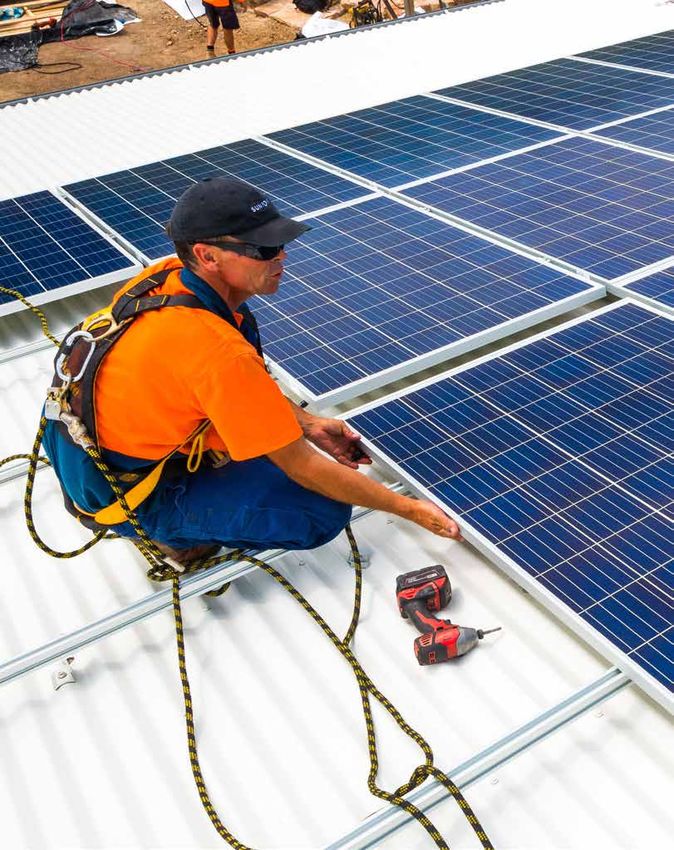
Image: Commercial solar installation, New South Wales

10
RENEWABLE ENERGY PROJECTS UNDER CONSTRUCTION AS OF 31 DECEMBER 20174
TECHNOLOGY STATE OWNER PROJECT CAPACITY (MW)
Bioenergy QLD MSF Tableland Mill 24
Solar PV SA Reach Solar Bungala 220
Solar PV QLD ESCO Pacific/Palisade Ross River 148
Solar PV QLD Sun Metals Sun Metals Solar Farm 116
Solar PV NSW Lighthouse Solar Clare 100
Solar PV QLD RES Emerald 72
Solar PV QLD Edify/Wirsol Hamilton 58
Solar PV QLD Edify/Wirsol Whitsunday 58
Solar PV NSW First Solar/Infigen Manildra 49
Solar PV QLD RATCH-Australia Collinsville 42
Solar PV NSW Neoen Dubbo 25
Solar PV QLD Canadian Solar Oakey 25
Solar PV WA APA Group Emu Downs 20
Solar PV QLD Lighthouse Solar Hughenden 20
Solar PV NSW Goldwind Australia White Rock 20
Solar PV QLD Windlab/Eurus Kennedy Energy Park 19
Solar PV QLD Canadian Solar Longreach 15
Solar PV QLD Ydot Projects Dunblane Solar Farm 11
Solar PV WA Carnegie/Lend Lease Northam 10
Solar PV NSW Pamada Upper Hunter Energy Park 10
Solar PV SA SSE Australia Whyalla Solar Farm Stage 1 6
Solar PV QLD Canadian Solar/Scouller Energy Normanton 5
Wind NSW CWP Renewables Sapphire 270
Wind NSW AGL Silverton 199
Wind QLD RATCH-Australia Mt Emerald (Arriga) 181
Wind NSW Goldwind Australia White Rock 175
Wind VIC ACCIONA Mt Gellibrand 132
Wind SA Engie Willogoleche Hill 119
Wind NSW Infigen Bodangora (Wellington) 113
Wind NSW Global Power Generation Crookwell 2 (Goulburn) 91
Wind VIC Pacific Hydro Crowlands 80
Wind VIC Tilt Renewables Salt Creek 58
Wind QLD Windlab/Eurus Hughenden 43
Wind VIC Pacific Hydro Yaloak 29
4 Clean Energy Council Renewable Energy Database, Clean Energy Council Member Survey, SunWiz Large-scale Lookout, AEMO.
116000
megawatts of
large-scale generation
needed by 2019 to
meet the RET
6532
megawatts of
large-scale generation
announced between
2016 and January 2018
Image: Weipa Solar Farm, Queensland
12INDUSTRY GEARS UP TO MEET
THE RENEWABLE ENERGY TARGET
Early in 2018, the Clean Energy The majority of this is either under Between the large-scale and
Regulator (CER) announced that there construction or already operating. rooftop solar sectors approximately $12
were enough projects at a sufficiently The rest is expected to begin billion of new private investment was
advanced stage to meet the large-scale construction in 2018. generated in 2017 from domestic and
Renewable Energy Target (RET).5 international capital.
The combination of a stable federal RET
The CER has previously estimated that and state government renewable energy The success of the RET in encouraging
approximately 6000 MW of large-scale schemes provided a strong incentive major new investment has shown
generation capacity would need to be for new project development in 2017. that the key to success lies in developing
announced and built between 2016 and Figures collated by the Clean Energy an effective policy and leaving it alone
2019 to meet the target of 33,000 GWh Council at the end of the year found the to let the market work. With renewable
of additional renewable energy by the projects under construction, completed energy now the lowest-cost type of new
end of the decade. or that had attracted finance in 2017 energy generation it is possible to build,
added up to $10 billion of investment, the industry has an excellent foundation
There has been 6532 MW of new
more than 5300 MW of generating for continued success.
large-scale generation firmly announced
capacity and almost 5750 new
between 2016 and the time of the
direct jobs.
CER announcement in January 2018.
Image: Parkes Solar Farm, NSW
5 Clean Energy Regulator, media release, Record year of investment means Australia’s 2020 Renewable Energy Target will be met,
23 January 2018.
13JOBS AND INVESTMENT IN RENEWABLE ENERGY BY STATE
LARGE-SCALE RENEWABLE ENERGY
PROJECTS UNDER CONSTRUCTION
OR STARTING IN 2018

                     30
                Megawatts
                $
                     67m
                Investment
                     100
                     Jobs

                     1111
                Megawatts
            $
                2850m
                Investment
                     1080      116
                     Jobs    Megawatts
                             $
                              280m
                             Investment
                              200
* As at April 2018             Jobs
2121
Megawatts
$
4091m
Investment
3196
Jobs
5600
1055
Megawatts
$
2214m
Investment
11,190m
1175
Jobs
6080
1166
Megawatts
$
1688m
Investment
330
JobsImage: Kidston Solar Farm, Queensland
INDUSTRY OUTLOOK

OUTLOOK FOR SMALL-SCALE RENEWABLE ENERGY
2017 was a record-breaking year for          the growth over the last few years.             Six key factors that will
rooftop solar, with almost 1.1 GW                                                            influence solar PV in 20187:
                                             In addition, households in outer suburbs
of rooftop PV installed in the
                                             and regional towns will continue to turn        1. Electricity
                                                                                                	          prices and
small-scale market.
                                             towards small-scale renewable energy               feed-in tariffs
And with power prices increasing further,    to help protect them from future                2. The
                                                                                                	  rate that electricity
it is safe to say the outlook is positive,   price hikes.                                       prices are rising
with many of the fundamentals in place
for another very strong year for the         Solar consultancy SunWiz says that with         3. PV system prices
solar industry.                              electricity prices set to remain high,
                                             good momentum in the sector and a               4. Awareness
Australian businesses are finding it         robust market, the residential and SME          5. Momentum
difficult to secure affordable long-term     market is “primed to continue” at more
contracts for their electricity, making                                                      6. Market robustness
                                             than 1.2 GW in 2018.6
solar and storage increasingly attractive
options – particularly with the range of     Combined with a record construction
finance options that are now available.      year for the large-scale part of the
This medium-scale section of the             market, solar is well positioned to be the
market has been driving a large part of      new goldrush out to 2020 and beyond.

CASE STUDY
MOOROOLBARK COMMUNITY MINI-GRID
                                                                                           The first test was conducted in May
                                                                                           2017 and involved successfully
                                                                                           separating eight homes from the
                                                                                           grid – six with solar and storage, two
                                                                                           without – and operating them as a
                                                                                           stand-alone solar and battery storage
                                                                                           powered mini-grid.
                                                                                           Towards the end of 2017, AusNet
                                                                                           took a group of 17 houses off-grid
                                                                                           for a total of nine hours, powered only
                                                                                           by the collective solar and battery
To the casual observer, the Melbourne        separation and stabilisation of the
                                                                                           storage systems installed on 14
suburb of Mooroolbark is just like any       system – on a community mini-grid
                                                                                           of the homes.
other middle-class commuter region,          using solar panels and batteries.
but something unique is happening in                                                       The project not only demonstrated
                                             The trial included a series of
one tree-lined street.                                                                     the effectiveness of residential
                                             scenarios to test how renewable and
                                                                                           renewable power, but it could also lead
In a ground-breaking trial, AusNet           community energy projects can be
                                                                                           to considerable savings for consumers.
Services worked with Greensync – who         efficiently integrated into the network,
built, operated and maintain the smart       and the benefits they can bring               The Mooroolbark mini-grid trial was
solar-storage home systems – and             to both consumers and the                     a joint winner of the 2017 Clean Energy
PowerTec – who manage the smooth             electricity grid.                             Council Innovation Award.

6	W Johnston, Renew Economy, 2018: Can Australian PV keep up record-breaking pace set in 2017?, 15 January 2018
   http://reneweconomy.com.au/2018-can-australian-pv-keep-record-breaking-pace-set-2017/ (accessed 6 March 2018).
7 Ibid.

18
STATE RENEWABLE ENERGY POLICES
At the end of 2017, no Consequently, state governments The fate of the policy is far from assured
national climate or energy have introduced a variety of policies after a decade of acrimonious political
to maximise their share of the billions debate and destabilisation in this area.
policy was in place of dollars in investment on offer from
to encourage affordable, While a strong and consistent national
renewable energy, as well as helping
policy would be preferable to navigating
reliable and clean electricity to reduce emissions. Debate and
a patchwork of individual jurisdictions,
after 2020. policy development will continue
these state and territory policy
throughout 2018 on the Federal
measures have been crucial to driving
Government’s proposed National
new investment in the absence of
Energy Guarantee (NEG).
federal policy leadership.
Image: Woodlawn Wind Farm, New South Wales
19INDUSTRY OUTLOOK CONTINUED
100%
of energy in the ACT to come
640
megawatts of power from
11
large-scale solar projects
from renewable sources four reverse auctions held approved by the NSW
by 2020 between 2012 and 2016 government in 2017
AUSTRALIAN CAPITAL TERRITORY NEW SOUTH WALES
The ACT has the most ambitious The feed-in tariffs awarded as part Although NSW does not have a
renewable energy target in the of the auctions are fixed for 20 specific renewable energy target, the
country, and is on track to deliver on years, helping to protect Canberra state government has set a long-
its goal of 100 per cent clean energy residents from sharp rises in term target for NSW to have zero
well before its 2020 deadline. wholesale electricity prices. net emissions by 2050, including in
its energy sector.
Four reverse auctions formed the The last project to be built under
centrepiece of its plan to meet the the scheme will be Union Fenosa’s As part of this goal, the
target – one for solar and three for Crookwell 2 Wind Farm, which is due government’s Climate Change Fund
wind. This process invited companies for completion in the second half Strategic Plan aims to double the
to bid on the construction of new of 2018. All the other projects have state’s level of renewable energy
wind and solar projects for the now been completed. capacity to more than 10,000 MW
lowest cost, resulting in the best by 2021.
The ACT also supported the
possible deal for taxpayers and the
installation of household battery NSW was one of the leading states
ACT Government.
storage through a competitive for new large-scale renewable
The ACT was the first state or grants process, which started in energy projects at the beginning
territory to run a reverse auction early 2016 with the government of 2018, with the government
scheme for new renewable energy, awarding three grants of $200,000 approving 11 large-scale solar
an idea that has since sparked to support the installation of energy plants in the previous 12
interest in other jurisdictions. The battery storage in 200 Canberra months. Notable projects currently
first reverse auction for 40 MW of homes and businesses. The Next under construction or beginning in
large-scale solar projects was held Generation Energy Storage Grants 2018 include the 170 MW Finley
in 2012 and 2013, followed by are facilitating one of the largest Solar Project in the Riverina, which
three 200 MW wind power reverse rollouts of household batteries will include half a million solar
auctions in 2014, 2015 and 2016. in the world. panels, the 270 MW Sapphire Wind
Farm in New England and the
co-located White Rock Wind and
Solar Farms, which will generate
almost 400 MW of renewable
energy upon completion.
Image: Mount Gellibrand Wind Farm, Victoria
2025%
of energy in Victoria to come
650
megawatts of power from a
50%
of energy in the Northern
from renewable sources by reverse auction, with 100 MW Territory to come from
2020, rising to 40% by 2025 for large-scale solar renewable sources by 2030
VICTORIA NORTHERN TERRITORY
The Victorian Government has The Victorian Government has also The Northern Territory has set itself
committed to two renewable energy announced the outcome of tenders a target of 50 per cent renewables
targets: 25 per cent by 2020 and 40 under its Renewable Certificate by 2030, an ambitious expansion
per cent by 2025. Purchasing Initiative, which considering that renewables only
involves the government procuring accounted for 4 per cent of its power
This will be supported by the
renewable energy certificates generation in 2017.
Victorian Renewable Energy Auction
directly from new Victorian projects.
Scheme, a reverse auction to fund In late 2017, an independent expert
The 31 MW Kiata Wind Farm and
650 MW of new renewable energy, panel produced the Roadmap to
the 132 MW Mt Gellibrand Wind
with 100 MW of this specifically for Renewables report, which provided
Farm were the successful projects
large-scale solar. The scheme is the 11 recommendations on how the NT
under the first stage of the initiative,
largest renewable energy reverse Government can achieve its target.
while the 88 MW Bannerton Solar
auction in Australia and will result in These included making renewable
Park and 34 MW Numurkah Solar
a significant increase in renewable energy a central pillar of the NT
Farm were awarded tenders under
energy projects in Victoria. Government’s economic policy and
the second stage of the competitive
a series of other financial, regulatory
It is a condition of the auction tender process.
and technical recommendations.
that the successful projects will
Some of the generation from these Meeting the 50 per cent renewable
begin commercial operation before
solar projects will be used to offset energy target will allow NT to move
the last quarter of 2020, with
the power used by Melbourne’s tram away from its reliance on gas and
an overarching goal of reducing
network. diesel, which currently accounts for
emissions by 16 per cent by 2035.
96 per cent of its energy generation.
21INDUSTRY OUTLOOK CONTINUED
100%
potential increase in capacity
1000
megawatts of wind and solar
in Tasmania under the ‘Battery projects seeking approvals in
of the Nation’ plan Western Australia in 2017
TASMANIA WESTERN AUSTRALIA
With its extensive hydro power for a 450 MW project, with the Western Australia has traditionally
network supplying more than 90 possibility of being expanded to lagged behind the eastern states
per cent of the state’s energy needs, 1000 MW if a second interconnector when it comes to renewable energy,
Tasmania has traditionally been is built to the mainland. This would but during 2017 more than 1000
Australia’s renewable energy leader. make the wind farm the largest MW of wind and solar projects were
in the Southern Hemisphere. seeking connection approvals and
In April 2017, Hydro Tasmania
Construction is underway at the finance in the state’s south-west.8
announced its ‘Battery of the
112 MW Granville Harbour and However, WA continues to be the
Nation’ plan, which could double
150 MW Cattle Hill Wind Farms. only state or territory in Australia
the state’s renewable energy
The Jim’s Plain Renewable Energy that hasn’t committed to a target
capacity from 2500 MW to 5000
Park will consist of up to 160 MW for renewable energy or zero net
MW through pumped hydro storage,
of wind, battery storage and other emissions.
wind farms and upgrades to existing
infrastructure.
hydro power facilities. The plan also In late 2017, the WA government
calls for a second interconnector Energy policy was one of the key announced that state-owned power
to be constructed to allow the issues during the Tasmanian state utility Synergy will set up a green
state to export its surplus energy election, which was eventually power fund with investment from
to the National Electricity Market won by incumbent Premier Will the Dutch Infrastructure Fund. This
(NEM). The Battery of the Nation Hodgman’s Liberal Party. During the is expected to work similarly to the
concept is currently undergoing campaign, the Liberal government Powering Australian Renewables
feasibility studies, but is an exciting made commitments to increase Fund set up by AGL, by providing an
prospect for an extensive increase Tasmania’s renewable generation by opportunity for investors to finance
in Tasmania’s renewable energy 1000 GWh by 2022 and promised to a portfolio of renewable assets to
capacity. reduce power prices by decoupling diversify risk and reduce costs.
Tasmanian electricity prices from
A number of new wind farms are The Australian Energy Market
the benchmarks set by the NEM.
under development in Tasmania, Operator estimates that another
with the state’s north-west being 700 MW of new renewable energy
touted as ‘Australia’s wind farm capacity will be required to meet
capital’. The Robbins Island WA’s share of the Renewable Energy
Renewable Energy Park is a proposal Target, and Western Power
8 G Parkinson, Renew Economy, Lower the drawbridge! WA prepares for wind and solar boom, 20 June 2017 http://reneweconomy.com.au/
lower-the-drawbridge-wa-prepares-for-wind-and-solar-boom-48290/ (accessed 11 April 2018).
2245%
of South Australia’s electricity
$100M
committed by the South
came from renewable sources Australian Liberal Party to a
in 2017 household battery program
offering means-tested grants
SOUTH AUSTRALIA
estimated in mid-2017 that more South Australia set an aspirational connectivity with the National
than 1000 MW of new projects are target of 50 per cent renewable Electricity Market and a $100 million
in the pipeline. energy by 2025, which it had almost household battery program offering
achieved in 2017, with 45 per cent of means-tested grants.
While Labor made promises to
the state’s electricity coming from
expand the state’s renewable energy The new Premier promised support
renewable sources.
uptake during the 2017 election for storage at the household
campaign, Premier Mark McGowan In March 2018 after 16 years of level, and pledged to build a new
and Energy Minister Ben Wyatt Labor in power, the state elected a interconnector to New South
have moved slowly on announcing Liberal government. The effect that Wales. He has also backed the
any state-based renewable energy this will have on renewable energy in solar thermal plant planned for
target or energy policy, but are the state is yet to be determined. Port Augusta.
coming under increased pressure
The Liberal party’s election Electranet is conducting extensive
to do so.9
campaign focused on: analysis about whether the
• affordable electricity proposed transmission line to NSW
• reliable renewable energy will be a positive for South Australia.
• empowering consumers Its report is due in June 2018.
• better value for taxpayers The clean energy industry would
• developing stronger connections like to recognise outgoing Premier
between South Australia and the Jay Weatherill and his government,
National Electricity Market. whose proactive approach to
securing private investment for
It also promised a reduction of $302 South Australia was critical to
a year in the average household transitioning the state toward
power bill. a cleaner, more reliable and
Two key elements of its energy affordable energy system.
policy were a $200 million
interconnection fund to improve
Image: Gordon Hydroelectric Power Station, Tasmania
9 G Philipson, Government News, WA urged to go it alone on renewables, 5 November 2017
https://www.governmentnews.com.au/2017/11/wa-urged-go-alone-renewables/ (accessed 11 April 2018).
23INDUSTRY OUTLOOK CONTINUED
50%
of energy in Queensland to
come from renewable sources
by 2030
QUEENSLAND
The Sunshine State has set a 50 Several areas of the state have up to more than the current 8200
per cent renewable energy target emerged as large-scale solar hubs, MW generated by coal-fired power
by 2030, and with Labor being including Townsville in North stations and was “further proof
returned to office in 2017, the state Queensland and the Darling Downs that Queensland does not need
government is working towards west of Toowoomba. a new coal-fired power station”.10
achieving it. The successful applicants will be
As part of its $1.16 billion Powering
announced in 2018.
In 2017, 8 per cent of Queensland’s Queensland plan, the government’s
electricity came from renewables, Renewables 400 initiative held a Queensland already has the largest
underlying the scale of the job reverse auction for up to 400 MW number of rooftop solar installations
at hand. But a variety of policies of new renewable energy capacity, of any state or territory, as well as
and programs support the including 100 MW of new storage. eight of the top 10 solar postcodes in
government’s ambition, Renewables 400 attracted 115 the country. Solar owners in regional
complementing the federal proposals from 79 businesses, areas have the option of being paid
Renewable Energy Target and adding up to more than 9000 MW of a time-varying feed-in tariff, which
other initiatives from the Australian new capacity – more than 20 times can pay them more during times
Renewable Energy Agency. All the amount needed. In a media when electricity is in short supply.
this is leading to a great deal of statement, Energy Minister Mark
project activity. Bailey said the proposals added
10 M Bailey, Queensland Government media release, ‘Renewables 400’ accelerates Queensland’s clean energy boom, 11 October 2017.
Image: Studland Bay WInd Farm, Tasmania
24“We were surprised at the prices we saw for wind, and shocked at the
prices we saw for solar”
– Meridian CEO Ed McManus, commenting on the low price of renewable
energy when negotiating PPAs for Powershop, Meridian’s retail arm
RENEWABLE ENERGY LONG-TERM ENERGY
COSTS CONTINUE TO FALL AND CLIMATE POLICY
The cost of renewable energy in Australia’s banks, businesses, major policy development and consultation
power purchasing agreements (PPAs) energy institutions and many process was still very much underway in
continues to fall, making it a highly governments have begun planning for the first quarter of 2018.
competitive option for businesses a renewable energy future, but there
Given the significant uncertainty and
seeking contracts for energy supplies. is still no long-term unifying energy or
relatively low level of ambition on clean
climate policy in place.
During 2017, Origin Energy sold the energy and emissions reduction from
Stockyard Hill Wind Farm to Goldwind In June 2017, Chief Scientist Dr the Federal Government, many state
Australia for $110 million and agreed Alan Finkel delivered a suite of governments have introduced their
to buy all the power generated by it for 50 recommendations to improve own policies and targets. This will help
less than $60/MWh.11 Australia’s energy security, which to secure job and investment benefits
became known in industry circles as from renewable energy projects as
Meridian Energy signed up for more
‘The Finkel Report’. The government well as helping Australia to meet its
than twice the amount of renewable
moved quickly to adopt 49 of these, emission reduction commitments.
energy it had intended in early
but ultimately voted to reject the
2018 while negotiating PPAs for its
primary recommendation – the
retail business Powershop Australia.
introduction of a Clean Energy Target
Powershop CEO Ed McManus said while
to take effect beyond 2020.
he couldn’t reveal the price of the deal,
“we were surprised at the prices we saw The policy had won the support
for wind, and shocked at the prices we of the energy sector, the business
saw for solar”. community, the clean energy industry
and the federal Labor Party. It was,
Asked whether the PPA prices matched
however, a backbench revolt within the
recent reports regarding Stockyard Hill
government itself that ultimately killed
or the sub-$70/MWh reported for solar,
off the idea.
Mr McManus said they were “at or
below what had been reported in the In place of a Clean Energy Target, the
media as one-offs”.12 Federal Government has proposed a
National Energy Guarantee (NEG) that
These kinds of arrangements will make
it claims will tackle the three big issues
renewable energy a more attractive
around energy: reliability, affordability
financial option for businesses.
and reduced emissions. However, the
11 S Vorrath and G Parkinson, Renew Economy, Origin stuns industry with record low price for 530MW wind farm, 8 May 2017
http://reneweconomy.com.au/origin-stuns-industry-with-record-low-price-for-530mw-wind-farm-70946/ (accessed 6 March 2018).
12 G Parkinson, Renew Economy, Powershop signs huge deal for solar, wind projects – “stunned” by low prices, 1 February 2018
https://reneweconomy.com.au/powershop-signs-huge-deal-for-solar-wind-projects-stunned-by-low-prices-11533/ (accessed 11 April 2018).
25EMPLOYMENT
Increased confidence has resulted in an
unprecedented level of industry activity. The
rooftop solar sector has reported a shortage
of qualified electricians in some areas.
The sector began 2017 confident Energy Council had grown to 4941.
that the policy uncertainty caused by This was slightly more than the 4824
the Abbott Government’s review of registered at the end of 2012, which
the Renewable Energy Target (RET) was the previous highest year for the
was in the past. And that confidence sector. The number of new accredited
continued to soar, delivering a record installers per month increased by
year for projects in large-scale wind 60 per cent in 2017 compared to
and solar as well as the rooftop solar the year before.
sector.
If the demand for solar continues NEW
By the end of 2017, many established throughout 2018 – and many of the ACCREDITED
solar retailers were reporting that the factors that drove the strong results INSTALLERS
increased level of activity sometimes in 2017 are still in place – the level PER MONTH
made it difficult to find enough of opportunity will lead to more
qualified electricians to complete all electricians doing the necessary
the work that was coming in, and training to expand into the solar sector. 2016
these market conditions helped trigger
Increased project activity for large- 60
a steady increase in the number of
scale wind and solar also resulted in
accredited solar installers.
a growing number of jobs in regional 2017
Having more work than your industry areas across the country.
can handle is mostly a good problem 96
It is expected that the unprecedented
to have, but it is one of the challenges
level of industry activity will create
that many solar businesses are actively
managing due to the record year.
By the end of 2017, the number of
major job opportunities and lead to a
substantial boost in numbers during
the next few years as the industry
60%
installers accredited with the Clean builds out the RET.
INCREASE
AVERAGE NEW CLEAN ENERGY COUNCIL-ACCREDITED
INSTALLERS REGISTERED PER MONTH
120
100
Average per month
80
60
40
20
0
2012 2013 2014 2015 2016 2017
Year
26Image: Commercial solar installation, New South Wales
27INVESTMENT
US$9B
investment
in large-scale
wind and solar
projects
in Australia –
a new record
150%
increase in
investment
in 2017
According to Bloomberg Several factors have contributed to this Globally, clean energy investment
New Energy Finance data, spike in investment: amounted to US$333.5 billion last
• the extraordinary cost reductions year. This was 3 per cent higher than
large-scale wind and solar 2016 and the second highest annual
achieved in renewable energy
project activity pushed • the stability and incentives provided figure ever – just 7 per cent less than
investment in Australia up by the 2020 Renewable Energy the record figure of US$360.3 billion
150 per cent to a record Target (RET) reported in 2015.
US$9 billion in 2017. • additional support from the China and the US led the way with
Australian Renewable Energy investments reaching US$136.2 billion
Agency and the Clean Energy and US$56.9 billion respectively.
Finance Corporation Renewable energy investments across
• various state and territory Europe fell in the face of uncertain
government initiatives. policy support.13
13 Bloomberg New Energy Finance, Runaway 53GW Solar Boom in China Pushed Global Clean Energy Investment Ahead in 2017,
16 January 2018 https://about.bnef.com/blog/runaway-53gw-solar-boom-in-china-pushed-global-clean-energy-investment-ahead-
in-2017/ (press release accessed 6 March 2018).
28US$333.5B CASE STUDY
WOMEN IN RENEWABLES
total worldwide investment
in renewable energy The Clean Energy Council has continued its
in 2017 commitment to supporting and encouraging female
representation in the industry through its Women in
Renewables initiative.
3% Three key programs have been can sign the pledge and make a
increase in investment introduced to target women at all commitment to being inclusive and
in 2017 stages of their career: the Women promoting the successes of women.
in Renewables Scholarship, Leaders’ More than 170 people have signed the
US$136.2B
Pledge and Speakers Guide. pledge so far and are striving to shape
both the future workplace and more
The 2017 Women in Renewables
diverse speaking panels and events
Chinese investment in Scholarship was awarded to Vanessa
across Australia.
renewable energy in 2017 Ratard, Senior Project Manager with
the remote engineering firm Ekistica. In support of the Clean Energy
Council’s commitment to the Leaders’
US$56.9B Among her many achievements,
Ms Ratard led the development of the
Pledge, we have also compiled
the industry’s first Speakers Guide,
US investment in Hybrid Power Generation for Off-Grid
highlighting the breadth of talented
renewable energy in 2017 Mines handbook for the Australian
women speakers from the renewables
Renewable Energy Agency.
industry. For more information, visit
Ms Ratard said the scholarship would cleanenergycouncil.org.au/women.
allow her to be a champion for women
in renewable energy, as well as play
her part in bridging the gender gap in
the renewables industry.
Now in its third year, the scholarship
provides support for a woman from
a Clean Energy Council member
company to complete the Australian
In terms of investment by the sector Institute of Company Directors’
worldwide, solar led the way, with an Foundations of Directorship course.
impressive 48 per cent of all clean
energy investment. Wind and energy- The Leaders’ Pledge demonstrates
smart technologies, such as battery the commitment of individuals
storage and smart meters, occupied and companies to the value and
second and third place respectively. importance of gender diversity.
Anyone who self-identifies as a leader
29ELECTRICITY PRICES
11% Affordability challenges continue across the National
Electricity Market, following significant price
national rise in rises over the past decade.
wholesale electricity
power prices in 2017 While electricity prices are expected In March 2017, Federal Treasurer
to increase further in 2017-18, there is Scott Morrison directed the Australian
relief in sight. The Australian Electricity Competition and Consumer
Market Commission (AEMC) predicts Commission (ACCC) to hold an
$1424 residential electricity prices will fall
6.2 per cent on average over the
following two years as more wind and
inquiry into the retail supply of
electricity and the competitiveness
of retail electricity markets.
average annual
solar generation comes online.14
electricity bill in In its preliminary report, released in
2016-17 According to the AEMC, the national September 2017, the ACCC found
average annual residential electricity that the average 2015–16 residential
bill in 2016-17 was $1424, up from electricity bill was $1524 (significantly
$1296 in the previous financial year. more than the AEMC’s reported $1296)
7% The prediction for 2017-18 is a further
rise to $1576, before falling to $1495 in
2018-19 and $1387 in 2019-2020.15
and was made up of: 48 per cent
network costs, 22 per cent wholesale
costs, 24 per cent retail and other costs
proportion of average
(including margins) and 7 per cent
electricity bill made The AEMC found wholesale electricity
environmental costs.16
up of environmental costs – the cost of generating power
costs – has been the single biggest driver A report by the Australian National
of residential electricity bill increases University showed that between 2006
recently. Earlier price trend reports had and 2016, electricity price rises were
identified network costs as the main highest in the states with relatively low
upward driver. High gas prices and levels of renewable energy and a high
the closure of several coal-fired plants reliance on gas and/or coal generation
combined to lift wholesale electricity (136 per cent in Queensland, 118 per
prices by almost 11 per cent nationally. cent in Victoria and 109 per cent in
New South Wales). In contrast, South
Insufficient new power generation
Australia, which now generates almost
over the past decade, primarily due to
half of its energy from renewables,
chronic policy uncertainty, has resulted
experienced a far lower electricity price
in increased prices. New supply has
rise (87 per cent) over the same period
failed to keep up with demand.
(see chart on page 32).
Electricity prices are made up of four
Despite a vocal minority suggesting
main components: network costs
that the RET is the main reason for the
(the poles and wires), generation
increase in electricity pricing, this is
costs (traditional or renewable),
simply not the case. In fact, the single
retail margins and environmental
biggest contributor to rising electricity
costs (primarily meeting the RET and
prices is the increasing cost of gas.
covering solar feed-in tariffs).
14 Australian Energy Market Commission, 2017 Residential Electricity Price Trends,
December 2017, p 173.
15 Ibid.
16 Australian Competition and Consumer Commission, Retail Electricity Pricing Inquiry
Preliminary report. September 2017, p 6.
30BREAKDOWN OF CHARGES IN DOMESTIC
ELECTRICITY BILLS, 2015–1616
NATIONAL
AVERAGE
ELECTRICITY
BILL
2016-17
$1424
Poles and wires 48% 2015-16
Electricity company costs 24%
Generating electricity 22% $1296
Environmental costs 7%
Analysis released last year suggests • Complicated
consumer information
9.9%
that Australians pay more to use the making it hard for people to easily
RISE
gas from our own reserves than the understand the options they have
residents and businesses in countries available and make smart choices
EXPECTED
to which we export.17 to reduce their bills.
NATIONAL
A range of other factors have The good news is that with the ACCC’s AVERAGE
contributed to price rises, including: final report due out this year, there ELECTRICITY
• A lack of national energy policy is likely to be political pressure to BILL
beyond 2020. This means business find practical, viable and meaningful
does not have the necessary measures to ease the burden on 2017-18
certainty to invest in the new
infrastructure.
Australian households and businesses.
$1576
Coupled with better affordability of
• Increased charges by energy small-scale solar panels and battery 2018-19
retailers for winning and billing storage, this should reduce costs for
customers. consumers and increase the flexibility $1495
• The retirement of coal-fired power of the national grid.
stations with not enough new 2019-20
power generation to replace them. $1387
• Game-playing by power plant
operators in the wholesale
electricity market and not enough
competition to help reduce prices.
17 I Verrender, ABC Online, The truth about soaring power prices: wind and solar not to blame, 25 September 2017
http://www.abc.net.au/news/2017-09-25/the-truth-about-soaring-power-prices/8979860, (accessed 7 March, 2018).
31ELECTRICITY PRICES CONTINUED
POWER PRICE INCREASES VS POWER FROM WIND AND SOLAR
QLD VIC NSW SA WA TAS
CONSUMER 136%
ELECTRICITY 118% 109%
BILLS18
87% 85%
Percentage 66%
increase from
2006-2016
WIND AND 48%
SOLAR
GENERATION
Percentage
increase from
2006-2016 3% 13% 12%
8% 6%
NATIONAL SUMMARY OF SUPPLY CHAIN COST COMPONENTS19
2016–17 2017–18 2018–19 2019–20
BASE YEAR CURRENT YEAR
c/kWh $/year c/kWh $/year c/kWh $/year c/kWh $/year
Residual 2.52 $116 2.87 $132 2.95 $135 3.03 $139
Environmental policies 2.01 $92 1.62 $74 1.78 $82 1.93 $89
LRET – LGC cost 0.65 $30 0.76 $35 0.89 $41 1.03 $47
SRES – STC cost 0.36 $17 0.32 $15 0.34 $15 0.32 $15
FIT schemes 0.85 $39 0.37 $17 0.37 $17 0.39 $18
Other state schemes 0.15 $7 0.16 $7 0.19 $9 0.20 $9
Wholesale 10.01 $460 13.23 $608 11.28 $518 8.81 $405
Regulated networks 13.63 $627 13.47 $619 13.57 $623 13.67 $628
Transmission 2.48 $114 2.36 $108 2.36 $108 2.39 $110
Distribution 11.15 $512 11.11 $511 11.21 $515 11.28 $518
TOTAL 28.16 $1,294 31.19 $1,433 29.58 $1,359 27.45 $1,261
18 B Phillips, ANU Centre for Social Research, Research Note: Household Energy Costs in Australia 2006 to 2016, February 2017.
19 Australian Energy Market Commission, 2017 Residential Electricity Price Trends Final Report, page viii.
20 J Elton-Pym, SBS News, Coalition to adopt 49 of 50 Finkel energy suggestions but undecided on clean energy target, 13 July 2017
https://www.sbs.com.au/news/coalition-to-adopt-49-of-50-finkel-energy-suggestions-but-undecided-on-clean-energy-target,
(accessed 7 March 2018).
32ENERGY SECURITY
In June 2017, Australia’s Chief Scientist However, the good news is that
Dr Alan Finkel handed down the renewable energy is stepping up to CASE STUDY
Blueprint for the Future, the final take the place of this ageing coal-fired LIDDELL POWER PLANT
report of the Independent Review into infrastructure. When the Loy Yang
the Future Security of the National power station failed in January 2018, In a move that sparked extensive
Electricity Market. the much-touted Tesla battery stepped political debate, AGL announced
into action, delivering 100 MW into plans to replace the Liddell coal-fired
Known colloquially as the Finkel
the national electricity grid in 140 power plant in the Hunter Valley
Review, it was the outcome of an
milliseconds.21 with a clean energy hub consisting
investigation into Australia’s energy of renewable energy, gas, batteries,
affordability and reliability that The Australian Electricity Market smart technology and demand
had begun as a result of South Operator (AEMO) has also been management.
Australia’s statewide blackout in focusing on using demand response to
September 2016. This decision came as the Turnbull
deal with extreme peaks of demand in
Government put pressure on AGL
In the report, Dr Finkel made 50 the power system. As part of this, AEMO
to extend the life of a plant that
recommendations – 49 of which were has joined forces with the Australian started operating in the early 1970s
accepted by the Federal Government. Renewable Energy Agency (ARENA) to and is mooted for closure in 2022.
The notable exception was the adoption fund 10 pilot projects under the demand
of a Clean Energy Target beyond 2020. response initiative to manage electricity The $1.36 billion project will include
supply during extreme peaks. new gas, wind and solar plants,
This means there is currently no stable along with a coal plant upgrade and
Federal Government energy and carbon This $35.7 million initiative will deliver a large battery. According to AGL,
strategy or policy past the end of the 200 MW of capacity by 2020, with 143 the electricity generated by the hub
decade. Debate and policy development MW to be available for the 2018-19 will cost 20 per cent less to produce
continues on the National Energy summer. Over three years, the pilot than extending Liddell’s life by five
Guarantee proposed by the Energy projects will be trialled in Victoria, South years. It will also cut AGL’s carbon
Security Board. Australia and New South Wales to free emissions by almost 18 per cent and
Some of the Finkel Review up temporary supply during extreme allow for ‘dispatchable’ clean energy
recommendations that were weather – such as prolonged summer during times of peak demand.
adopted included: heatwaves – and unplanned outages.22 Energy Minister Josh Frydenberg
• a plan for more battery storage Clean energy sources such as initially questioned how the plan
for renewables similar to the Tesla cogeneration, trigeneration and would address the 1000 MW
battery in South Australia solar can help reduce strain on the shortfall in baseload power on the
• development
of the Snowy 2.0 hydro electricity network during peak demand east coast caused by the closure of
scheme times. Energy efficiency measures Liddell. According to the Australian
• a new requirement that and demand management can also Energy Market Operator, the clean
coal-fired power stations provide make a big impact in reducing peak energy hub will adequately replace
at least three years’ notice before the coal plant, as long as AGL follows
demand. The effectiveness of solar
shutting down.20 through with all the investments it
was demonstrated by a heatwave in
has in the pipeline.24
During the summer of 2017-18, Queensland from 12-16 February 2018,
coal-fired power stations struggled to when the rooftop solar installed across AGL has argued that its planned
keep up with demand, with several the state provided between 400 MW renewable hub can do everything a
tripping and failing as age and heat and 585 MW per day to help meet a coal plant can do, but cleaner and
took their toll. record thirst for energy.23 more reliably.
21 AAP, news.com.au, That’s a record: South Australia’s Tesla battery responds to coal-fired plant failure, 21 December 2017
http://www.news.com.au/technology/environment/thats-a-record-south-australias-tesla-battery-responds-to-coalfired-plant-failure/news-
story/d9e02c0dbf6774ffea948a1b919f3b7f (accessed 14 February 2018).
22 ARENA/AEMO joint media release, AEMO and ARENA demand response trial to provide 200 megawatts of emergency reserves for extreme
peaks, 11 October 2018.
23 G Parkinson, Renew Economy, AEMO points to rooftop solar’s critical role in “remarkable” heat event, 1 March 2018
https://reneweconomy.com.au/aemo-points-to-rooftop-solars-critical-role-in-remarkable-heat-event-70187/ (accessed 11 April 2018).
24 A Zibelman, AEMO, Advice to the Commonwealth relating to AGL’s proposal to replace Liddell, 16 March 2018, p 8.
33You can also read


