Computing at the Large Hadron Collider in the CMS experiment - Daniel Bloch www.iphc.cnrs.fr/-cms.html
←
→
Page content transcription
If your browser does not render page correctly, please read the page content below
Computing at the
            Large Hadron Collider
           in the CMS experiment
www.iphc.cnrs.fr/-cms-.html

  Daniel Bloch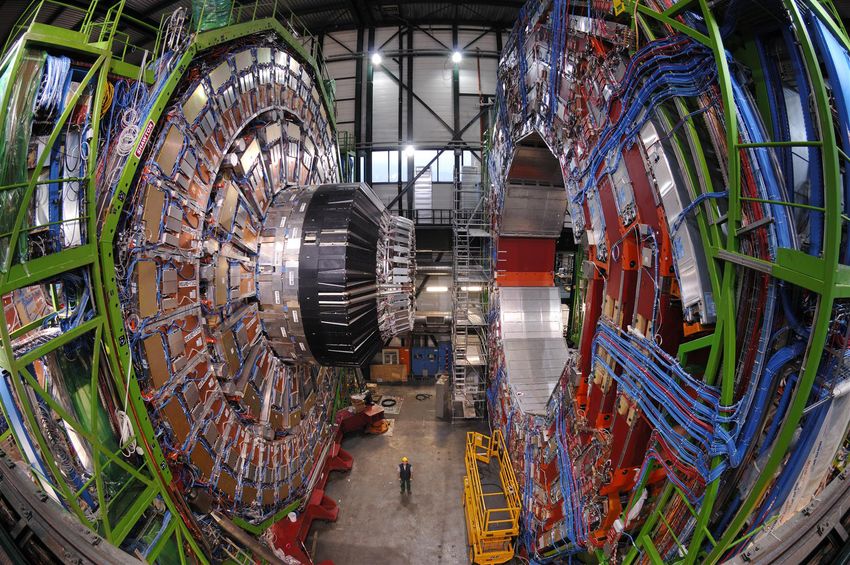
at the heart of matter

  électron : < ~10-20 m                         < ~10–20 m
                                     10–15 m
                    10–14 m
          10–10 m
>10–9 m

molecule   atom     nucleus   proton/neutron    quark
    chemistry                           particle physics
  electromagnetic interaction

                          strong interaction

                                      weak interaction

                                                             2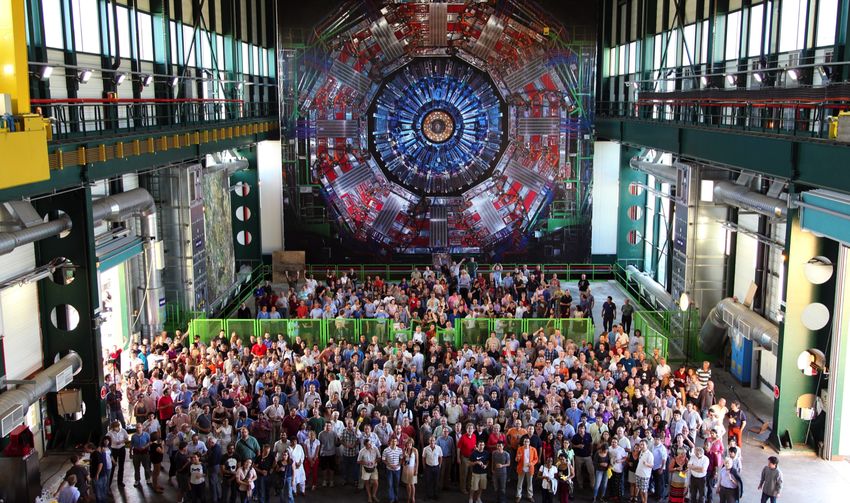
the standard model
§ Elaborated in years 1960-70
§ Describes both elementary particles (grouped in 3 families) and
electroweak (unifies em and weak int.) and strong interactions
§ Relies on symetry properties
(conservation laws)
§ Experimentally tested with great precision
(~10-3 for em and weak unification)
§ Higgs mecanism: to explain the origin
of particle masses
=> a new
particle:
Higgs boson:
discovered
at LHC
in 2012
3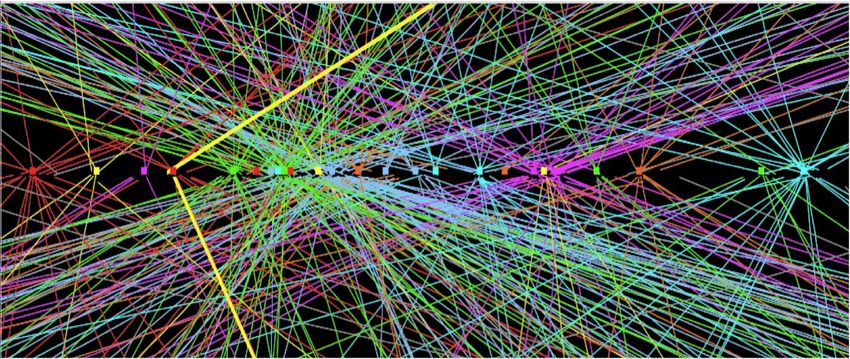
beyond standard model: supersymetry ?
dark matter candidate
§ Supersymetry (Susy) is an
elegant theory which ~
χ01 ~χ0
considers matter and 2
interaction particles on an
equal footing:
~χ0 χ~0
3 4
§ many new Susy particles ~±
are predicted, χ
but not their mass !
(+ many other parameters)
§ accessible at LHC ?
§ Susy would solve some of our fundamental questions:
§ the Higgs boson has been found, but why is it so light ?
§ the lightest Susy particle (neutral, weakly interacting) would be an
excellent candidate for dark matter
§ electroweak and strong interactions can be unified in Susy models
§ But there are also known complications with Susy:
§ not found yet ! It would be ``natural’’ to get it at TeV mass scale
§ the minimal Susy model is (amost) ruled out => the number of free
parameters may be large (between > 5 and up to 124 …)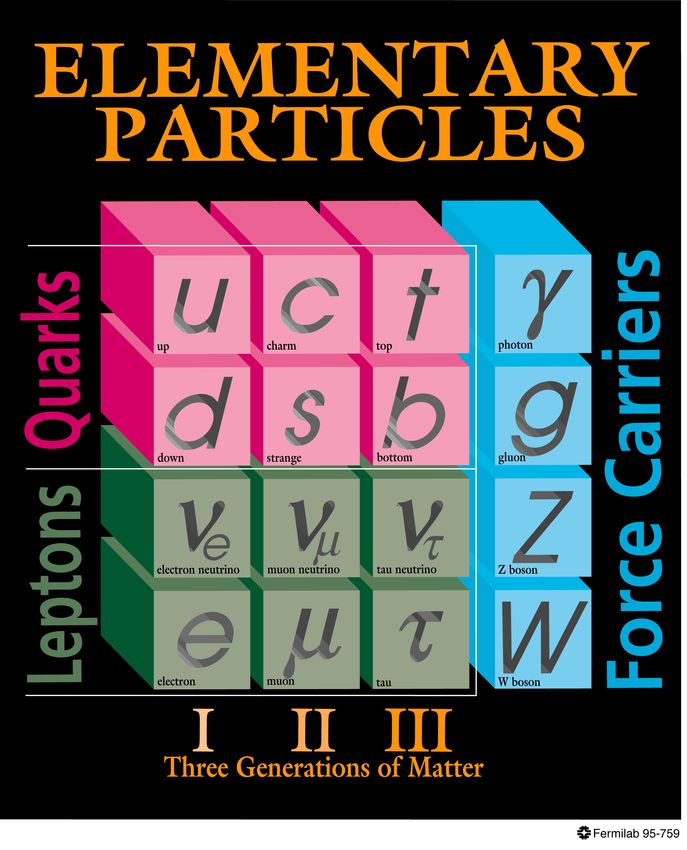
proton collisions at LHC
                                 •   2800 bunches of protons
                                 •   energy of each proton : 6.5 TeV

                                 •   100 billions protons / bunch
                                 •   beam crossing rate: 40 MHz

                                 • in the experiments at each
bunches

                         crossing:
                                   ~ 20-50 proton-proton collisions
                                   ~ 1500 particles produced
protons

                       • 1 billion interactions / second

                                 • impossible to record everything !
constituents

(quarks, gluons)
                                 • a Higgs boson to find
                                   within 5 billions of

                                   collisions…

                                                                           5
proton collisions at LHC
                                 •   2800 bunches of protons
                                 •   energy of each proton : 6.5 TeV

                                 •   100 billions protons / bunch
                                 •   beam crossing rate: 40 MHz

                                 • In the experiments at each
bunches

                         crossing:
                                   ~ 20-50 proton-proton collisions
                                   ~ 1500 particules prodiuced
protons

                       • 1 billion interactions / second

constituents

                                 • A Higgs boson to find

(quarks, gluons)                   within 5 billions of
                                   collisions…

                                                                       6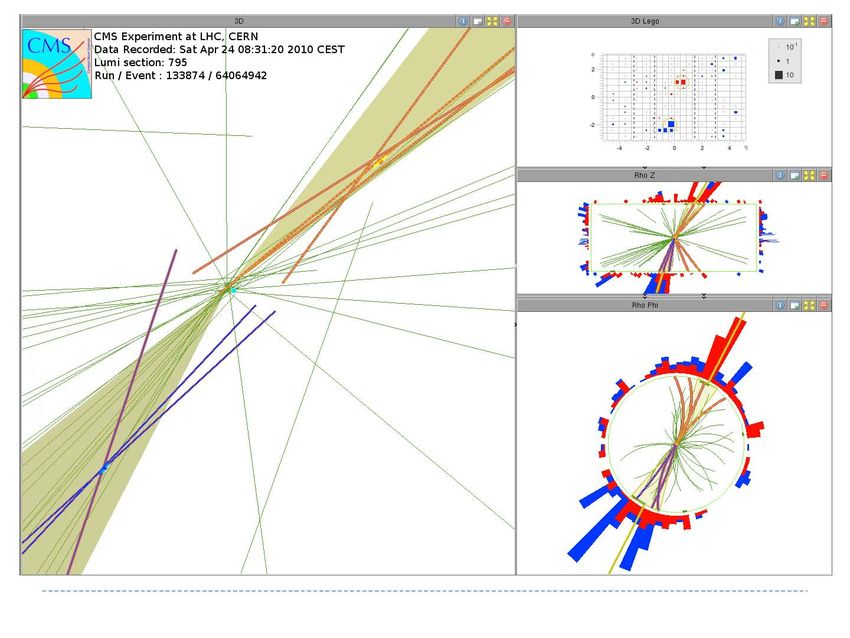
the CMS collaboration

                 •   38 countries
                 •   183 institutes
                 •   ~3000 scientists
                     (permanent,
                     post-doc, students)
                 •   ~100 French people

                                       7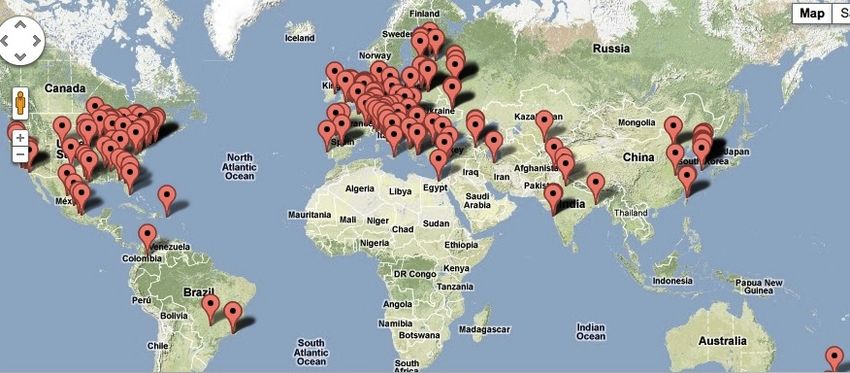
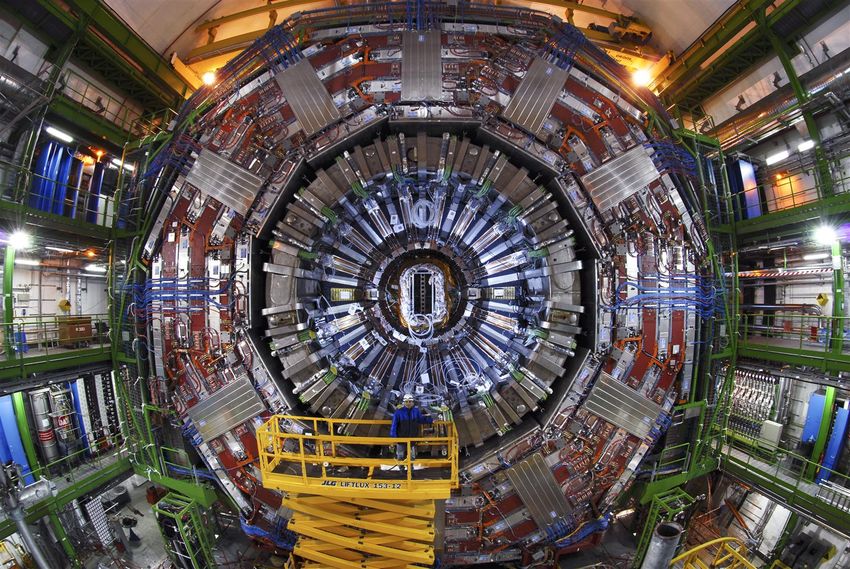
the CMS detector
as a 3D camera
of 14000 t, 29 m length, 15 m height
with 75 millions of pixels and taking
40 millions of pictures per second

                                        8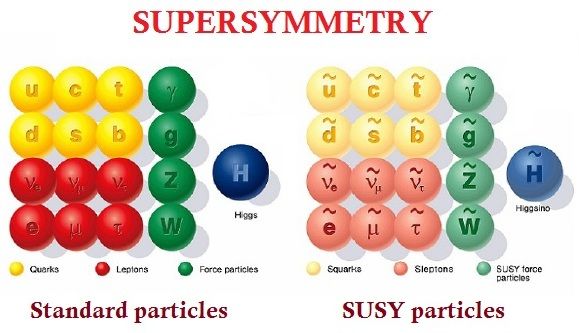
the CMS detector
concentric layers, each with well defined
detection purpose

                                 magnetic field 3.8 T
 Tracker
 reconstruct charged particles

 pixels : 100×150 µm2
 66M chanels, 1m2
 Silicon strips :
 9M chanels, 210 m2

                                                        9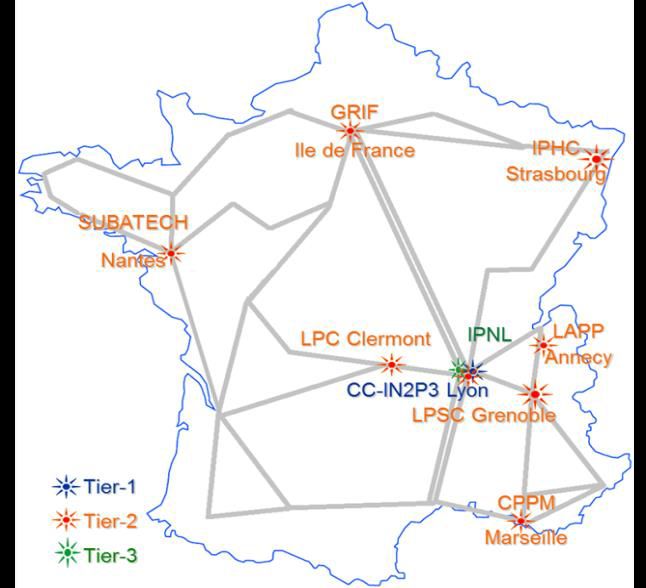
the CMS detector

Calorimeter(s)
Measure the energy of particles
(except muons and neutrinos)

em. (ECAL) :
76k cristals PbWO4
hadronic (HCAL) :
scintillators/Cu

                                     10
the CMS detector
Muon Detectors
11what happens during collisions ?
12trigger and data acquisition
1rst level trigger: 100 kHz high level trigger: 1 kHz (100 ms / event)
660 000 MB/s 600 MB/s
600
from all sub-detectors raw data
13first data reconstruction at CERN
7
800
30
600
14The World LHC Computing Grid
a worldwide net of many computing sites:
CERN
CERN çè national centers çè academic centers
Tier 0 Tiear 1 : 12 sites Tier 2 : 140 sites 15
the grid in France and at Strasbourg
CERN çè CC IN2P3 çè 8 sites
Tier 0 Tier 1 Tier 2
at IPHC Strasbourg:
• Tier 2 for CMS and Alice
• 15% of ressources for other
local usage (subatomic
physics, protéomic, bio-
informatics, …)
20M h of computing/year,
2000 slots,
CERN
1400 TB disk space
16
event size and reconstruction time
• depends on the intensity of the beams:
      •   superimposed interactions ~ 20 to 50
      •   => affects the size of the events and their reconstruction time !
•   event size ~0.2 to 0.9 MB
•   reconstruction time per event ~15-80 s
•   need also to generate and simulate data: ~50 s / events
•   total number of events per year (real data + simulated): 5 Billions

                                                                              17
CPU and disk needs
CPU DISK
TIER 0
CMS 6k cores 15 PB (+35 PB tape)
2015
TIER 1
CMS 25k cores 30 PB (+70 PB tape)
2015
TIER 2
CMS 60k cores 30 PB
2015
18event reconstruction
§ What we look for: § What we observe in the detector…
§ example of the production of a
Susy-top pair
§ experimental signature:
top-quark pair +MET
χ0
χ0
§ Information in calorimeters: ECAL,HCAL.
§ Trajectories of charged particles.
§ Muons (red line).
§ Missing Transverse Energy (MET: arrow).event reconstruction (cont)
• Jets of particles with
point of decay the trajectograph and
of a jet from b quark calorimeters
(accuracy ~100 µm)
• Identification of jet
from b decay
(« b-tagging ») with
pixel detector: distance
of decay flight
• Missing Tranverse
pp collision Energy (MET) :
point hermetic detectors =>
allows one to measure
the energy and
direction of invisible
particles (neutrino,
dark mater if any) in
the plane transverse to
the beam axis
20event reconstruction (cont)
Reconstruction
of jets
Rejection of
events from
pile-up pp int.
Identification Selection of jets
of the eventneed to reject the large background
§ from different processes, but giving a similar signature
§ can be :
§ Physical background (irreductible), with same final state
§ Instrumental background: due to badly reconstructed particles
jet electron
+ MET
jet
jet
jet
jet
§ need to define the sensitive variables to enhance the signal:
§ production rate (cross section).
§ invariant mass (or related quantities) of the initial particlesprocessing flow for a typical analysis
§ trigger: electron+jets or muon+jets or ee, eµ, µµ
rate ~200 Hz at 8 TeV (about 1/3 of all recorded events)
§ selection of the reconstructed events
and writing of reduced size information (Ttrees)
§ input, read on the Grid:
§ data: 500M events
§ simulation: Susy signal = 150M events, backgrounds = 150M events
§ overall size: 0.4 MB × 500M + 0.7 × 300M ~ 400 TB
§ processing time: 2 s / event
repeated 2-3 times after each new version of the data reconstruction
total: 1M hours of computing time
§ output, stored at IPHC on the Grid (can be used worldwide):
§ 100M data events, 150M simulated events
§ overall size: 30 TB with full information, 5 TB with reduced information
§ processing time (fast) : 2.5 ms / event on local cluster
=> ~200 hours for all data and simulation
but repeated many times (~10)search for the Susy-top § no Susy-top observed so far (at 8 TeV collision energy): set limits on its mass and on dark matter particle § need to go higher in energy: 13 TeV collisions from this year
You can also read


