COP26 Social justice enables climate ambition: unions set course for
←
→
Page content transcription
If your browser does not render page correctly, please read the page content below
#COP26
FRONTLINES BRIEFING

   Social justice enables climate
  ambition: unions set course for
               COP26
             ITUC COP26 priorities:

      1                   2                   3                  4
Climate            Human and            Climate           Industry
ambition with      labour rights:       finance:          policy and
Just Transition:                                          investment:
                   implement            provide climate   implement
raise climate
                   inclusive climate    finance to        strong industrial
ambition with
                   policies that        decarbonise the   policies and
Just Transition
                   respect and          Global South.     investment plans
policies and
                   promote human                          underpinning
measures in
                   and labour rights.                     the transition to
enhanced NDCs.
                                                          zero-emission
                                                          economies.
Contents

1. Social justice to stabilise the planet and a New Social Contract ...................................................................................... 3

2. COP26 must guarantee public safety and equitable participation ................................................................................. 6

3. Trade union demands for COP26 ............................................................................................................................................ 7

4. Unions mobilising for climate ambition ................................................................................................................................ 10

5. ITUC @ COP26 ............................................................................................................................................................................. .11
ITUC Frontlines Briefing: Climate Justice COP26 3

1. Social justice to stabilise
the planet and a New Social
Contract

Introduction by Sharan Burrow                              However, strong and sustained reductions in emissions
                                                           of carbon dioxide (CO2) and other greenhouse gases
As the impact of climate change is felt on a global        would limit climate change. While benefits for air
scale, it is clear that current policy commitments are     quality would come quickly, it could take 20-30 years
not enough to break with the dominant production and       to see global temperatures stabilise, according to the
consumption models in order to drive the transition to a   IPCC Working Group I report, Climate Change 2021:
zero-carbon economy. Despite efforts by trade unions       the Physical Science Basis.1 The report shows that
and environmental and social movements insisting on        emissions of greenhouse gases from human activities
addressing justice and climate ambition, more action       are responsible for approximately 1.1°C of warming
is needed to avert the catastrophic consequences of        since 1850-1900, and finds that averaged over the next
climate change.                                            20 years, global temperature is expected to reach or
                                                           exceed 1.5°C of warming. For 1.5°C of global warming,
The commitments of leaders to emission reductions by       there will be increasing heat waves, longer warm
2030 and to climate neutrality and net-zero emissions      seasons and shorter cold seasons. At 2°C of global
by 2050 not only fall short of moderating temperature      warming, heat extremes would more often reach critical
rises to 1.5 degrees but are not yet supported by          tolerance thresholds for agriculture and health.
effective policy measures to deliver them.

It is now that we need ambitious plans,
not tomorrow.

Scientists are observing changes in the Earth’s climate
in every region and across the whole climate system,
according to the latest Intergovernmental Panel on
Climate Change (IPCC) Report. Many of the changes
observed in the climate are unprecedented in thousands,
if not hundreds of thousands of years, and some of the
changes already set in motion – such as continued sea
level rise – are irreversible over hundreds to thousands
of years.

1 https://www.ipcc.ch/2021/08/09/ar6-wg1-20210809-pr/
4 ITUC Frontlines Briefing: Climate Justice COP26
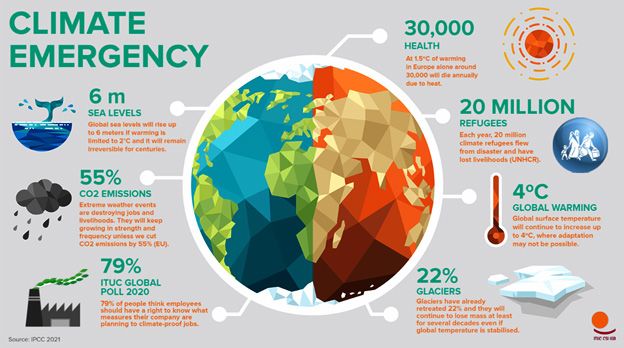
The impact of climate change if left unabated.
FAST FACT
The increasing impact of climate change is The global labour movement has climate policies at
disproportionately affecting the most vulnerable the centre of a vision for a fairer, more resilient society
people. Lives, livelihoods, health, and the quality of life for all, reflected in our five demands for a New Social
and of work were under threat prior to the COVID-19 Contract:
pandemic, but there is no doubt that resilience has
been further eroded. Without investment in jobs, Just 1. Creation of climate-friendly jobs with Just
Transition and universal social protection, the world’s Transition. Job-creating industrial transformation
people will only be at greater risk. plans are needed to achieve net-zero carbon
emissions, along with jobs in health, education,
The Covid-19 pandemic has taught us that we need care, energy and housing services and other
to take much better care of nature. The devastating quality public services.
spread of zoonotic diseases was made possible by
the devastation of our biodiversity and by industrial 2. Rights for all workers, regardless of their
agriculture practises. The pandemic has shown that we employment arrangements, to fulfil the promise
need to tackle the closely linked crises of inequality, of the ILO Centenary Declaration with its labour
biodiversity devastation and climate change in a protection floor including rights, maximum
coherent way. Integrating biodiversity protection will working hours, living minimum wages and
be crucial if we are serious about avoiding the same health and safety at work.
mistakes that led to the global pandemic.
3. Universal social protection that underpins
Without ’social justice’ and a New Social Contract, a Just Transition and builds resilience, and
we cannot build trust in the vital industrial transition establishment of a Global Social Protection
critical to stabilise the planet. Fund to build social protection systems for theITUC Frontlines Briefing: Climate Justice COP26 5 poorest countries. Unions are promoting and defending public pension and health systems based on solidarity. 4. Equality. End all discrimination due to income, race or gender, to ensure that all people can share in prosperity; the appalling concentration of wealth in the hands of a few at the expense of the many must be undone. 5. Inclusion and democratic participation. No one will be left behind. A new economic development model driven by a strong role for the state and a new relationship with private business must ensure inclusion through participatory democracy involving trade unions, communities, local authorities, business associations and all civil society.
6 ITUC Frontlines Briefing: Climate Justice COP26

2. COP26 must guarantee
public safety and equitable
and effective participation

Public safety.                                            Equitable and effective participation.

The safety of the participants, people in the UK and      The UK COP presidency has been slow and
in the countries that send participants to the COP is     untransparent in adapting the organisation of the
central to the delivery of a successful COP in Glasgow.   COP to the needs of people impacted by the COVID
                                                          pandemic. Any pandemic-motivated decisions to
Urgency of negotiations.                                  organise the conference in a (partly) digital way need
                                                          to take into account the equitable participation of all
The climate emergency does not allow for any              parties and non-party stakeholders and observers. All
further delays in action. The commitments in the Paris    parties, including the most vulnerable and civil society,
Agreement must be turned into real action. The 2021       should have their rightful voice at the COP. Attention
COP is a critical moment to demand that policymakers      to time zones and communication needs must be
are accountable for what they promised and raise          considered to make this possible. Transparency and
ambition.                                                 open negotiations will ensure the fairness and ambition
                                                          of the COP process and outcomes.
ITUC Frontlines Briefing: Climate Justice COP26 7
3. Trade union demands for
COP26
The COP26 in Glasgow must deliver on the needs • The ILO Just Transition Guidelines continue to
of the world and make major steps forward with be a framework to support governments, social
implementing ambitious climate policies. 2021 is the partners and stakeholders in this work. Countries
year for governments to align climate, economic, that have included Just Transition measures
social and labour demands. In addition to having the should implement them, guided by effective
US government back at the table, we need a renewed social dialogue processes.
energy by all governments in multilateral cooperation
as the only way to tackle the climate emergency • COP26 must recognise that climate justice
effectively and efficiently. and social justice are linked through the SDGs.
Common but differentiated responsibilities
1. Climate ambition with Just and global solidarity through finance and
Transition: raise climate ambition technology sharing should be backed by
universal social protection to build resilience
with Just Transition policies and against future global shocks. The pandemic
measures in enhanced NDCs. has made this evident, including the ever-
growing inequality within and between countries.
Countries must increase their ambition, setting new,
stronger NDCs (nationally determined contributions). Access to finance and technology transfer for
Many NDCs are falling short of the objectives of the developing countries is essential to address
Paris Agreement. The IPCC report is a stark reminder of climate change. Financing cannot become
the urgency to step up ambition. Wealthy countries must another form of indebtedness for the countries
substantially increase their climate finance contributions of the Global South and access to technology
for developing countries in order to enable a change of a new form of dependency. The commitments
course. Putting Just Transition at the heart of all climate of developed countries must be effective and
policies is the only way to raise ambition. Investing in based on dialogue, respecting the autonomy of
climate action can deliver good jobs and livelihoods for countries to define their policies. COP26 cannot
everyone. This requires: ignore the systemic flaws of our current economic
model, which jeopardises any effective climate
• ALL countries to introduce Just Transition policy.
measures and policies in their national climate
plans (NDCs) with effective participation of all
2. Human and labour rights: implement
social actors, including unions, as established by
inclusive climate policies that respect
the ILO principles of the Just Transition. Countries
that have not renewed their NDC commitments
and promote human and labour rights.
or that have done so without convening effective
Labour rights are human rights. They are central to our
social dialogue processes with the participation
Just Transition demands and need to be integrated in
of unions and social movements should consult
all aspects of the UNFCCC negotiations. Dealing with
unions about the approved measures and plans
the climate emergency is an opportunity to create good
and in the implementation.8 ITUC Frontlines Briefing: Climate Justice COP26
and decent jobs. This means that policymakers not only most finance is currently directed to mitigation projects.
need to talk about the jobs that will be created, but Governments need to agree on a comprehensive
they also need to engage with the organisations that and effective loss and damage financing instrument.
represent workers in order to guarantee that labour Finally, there is an urgent need to impose strict climate
rights are respected and decent work opportunities finance criteria that guarantee that financial support is
are created. This includes access to training and social additional and with no strings attached. The tendency
protection guarantees for workers whose jobs are to more and more ‘blended’ finance (less grants and
negatively impacted by the transition. Employment more loans) needs to be stopped.
plans need to be a foundation of climate plans.
Providing climate finance should focus on changing
The respect and promotion of labour and human the production and consumption model, not only on
rights is particularly relevant for the negotiations on decarbonisation. Mitigation and adaptation are much
NDCs, Article 6 (dealing with carbon markets and non- more than simply decarbonising the economy. All
market approaches), mitigation, climate finance, loss climate financing should be unconditional and must
and damage and on adaptation. All these items should respect democratic principles of self-determination
contain explicit reference to the respect of labour and and sovereignty of countries in decision-making.
human rights. Financing implies access to patents for technologies,
knowledge and development processes that are
The global trade union movement supports the Gender related to confronting climate change. In addition, it
Action Plan, agreed at COP25, which aims to advance implies eliminating trade and investment rules that
knowledge and understanding of gender-responsive restrict States from implementing active policies of
climate action. The work of the Local Communities reindustrialisation, transformation of the productive
and Indigenous Peoples Platform (LCIPP) also has our matrix, energy transition and democratisation.
support. When taking action to address climate change,
the respective obligations on, inter alia, the rights of OECD countries have an unfulfilled commitment to
indigenous peoples and local communities should be increase the amount of their official development
respected, promoted and considered. In this context, assistance (ODA) to 0.7% of their GDP and all countries
countries are urged to ratify and apply ILO Convention committed to the 17 Sustainable Development Goals by
No. 169 on Indigenous and Tribal Peoples. 2030 (SDGs). The lack of progress on both issues must
be addressed.
3. Climate finance: provide climate
finance to change the global 4. Industry policy and investment:
development model and decarbonise implement strong industrial policies
the Global South. and investment plans underpinning the
transition to zero-emission economies.
At the 2009 Copenhagen climate negotiations,
developed nations committed to provide “scaled up, Hard-to-abate industry sectors, such as steel, aluminium,
new and additional, predictable and adequate funding” cement, chemicals, aviation, shipping and trucking, are
to meet “a goal of mobilizing jointly US$100 billion responsible for nearly one-third of global greenhouse
per year by 2020 to address the needs of developing gas (GHG) emissions. These are products and services
countries”. In December 2020, the Independent Expert highly demanded by countries of the Global North that
Group on Climate Finance, mandated by the UN in many cases are strongly associated with extractive
Secretary-General, concluded that the US$100 billion processes and with violations of labour and community
goal for climate finance for developing countries will rights, especially in countries of the Global South. They
not be met in 2020 (based on currently available data). have a vital role to play in meeting the Paris Agreement
Significant extra effort by rich countries is needed, and objective of limiting global warming to well below 2°C
more support needs to go to climate adaptation, as and preferably to 1.5°C, compared to pre-industrialITUC Frontlines Briefing: Climate Justice COP26 9
levels. Industry transition road maps need to guide capture and storage). Negative emission technologies
the process of decarbonisation in all countries and involving carbon capture will be necessary to
sectors. Effective social dialogue processes are crucial stabilise the climate. However, they should only be
to helping workers, employers, governments and other implemented in hard-to-abate sectors and not serve
stakeholders manage change through the planning and to prolong the life of fossil fuel technologies. (Green)
implementation of Just Transition measures. Industrial hydrogen technologies should be assessed on their
and investment policies cannot be restricted to zero effective contribution to the Paris Agreement climate
emission plans. There are mechanisms and measures goals to achieve a climate-neutral world by 2050.
that are aimed at reducing emissions that reproduce
the same inequities in the system and therefore will Carbon capture projects should not put additional
deepen the social, climate and environmental crisis. burdens on countries in the Global South through
practices of land grabbing or the privatisation of
Climate change is on the investor agenda. In 2020, public spaces for BECCS. The same reservation needs
2,097 investors with US$97 trillion in assets completed to be applied to ‘nature-based solutions’ that are
the climate disclosure and reporting criteria of the implemented as carbon-offsetting projects. Climate
Principles for Responsible Investment (PRI). Other actions should in no way worsen the ongoing erosion
investor initiatives are stepping up pressure on the of biodiversity. The global labour movement welcomes
largest corporate greenhouse gas emitters. Still, public genuine nature-based solutions that combine climate
reporting and follow-up to the investor principles to with biodiversity protection (such as mangrove and
avoid greenwashing and more accountability in general wetlands restauration), stop deforestation and promote
is needed to ensure that all labour rights are respected reforestation. These projects are opportunities to create
and all investments are really climate friendly. A decent, formal, secure, quality green jobs.
global taxonomy for sustainable investments must be
implemented. These policies must be accompanied
by Just Transition plans and measures by companies
and in the sectors involved to create jobs and provide
capacity building and skills training. All industry and
investment plans should be 100% climate proof.
Governments have to provide a framework for
investments in breakthrough technologies such as
energy efficiency, renewable energy production,
electrification, green hydrogen, batteries and
others through support for research, innovation and
development. These plans should incorporate a critical
and complete evaluation of the life cycle of the projects
that includes their compatibility with the environment,
aspects related to technology transfer, as well as
respect for human and trade union rights and common
but differentiated responsibilities (CBDR), among
others.
No industry and investment plans should contain
net-zero loopholes. ‘Not-zero’ plans risk locking in
fossil fuel technologies through inappropriate use
of CCS (carbon capture and storage), CCU (carbon
capture and use) and BECCS (bioenergy with carbon10 ITUC Frontlines Briefing: Climate Justice COP26
4. Unions mobilising for
climate ambition
• Track your government’s commitments to climate ambition, Just Transition and social
dialogue in its enhanced NDC! Demand amendments to NDCs and national plans where
there are gaps.
• Organise, organise, organise! Encourage union representatives to speak to members about
climate action and Just Transition. Organise company Just Transition plans and make Just
Transition collective bargaining agreements at the company, sectoral and national level
• Follow up on the many initiatives that are being presented in the Climate- and Employment-
Proof Our Work (CEPOW) plans.
• Establish contacts with your government on the preparation for COP26 and share the trade
union demands for COP26.
• Get ready to be part of COP26, with a virtual or physical presence in Glasgow in November
2021.
• Participate at the “Global Day of Action for Climate Justice” on Saturday 6 November.
Decentralised mass mobilisations across the world will bring together movements to build
power for system change – from indigenous struggles to trade unions, from racial justice
groups to youth strikers. More info on https://cop26coalition.org/gda/
• Join the activities of the People’s Summit for Climate Justice that runs from 7-10th November. You can
join online from anywhere in the world, or in-person in Glasgow. More info on https://cop26coalition.
org/peoples-summit/ITUC Frontlines Briefing: Climate Justice COP26 11 5. ITUC @ COP26 All trade union members and activists are invited to participate at our “Trade Union Strategy Day” organised by the ITUC on Sunday 7 November from 9:30 to 17:30 at the University of Strathclyde in Glasgow. The event will be followed by a reception. We’ll provide digital access for those that cannot be present in Glasgow. An invitation with the details of the program will be send out later. Be sure you are registered on our ITUC Climate mailing list! https://ituc.microsoftcrmportals.com/SC1-ESP-Multi/?lang=EN. An overview of our union activities at COP26 in Glasgow can be found at: www.tinyurl.com/unions-cop26 The programme will be updated as new information becomes available.
Publisher responsible in law:
Sharan Burrow, General Secretary

ITUC
5 Bd du Roi Albert II, Bte 1, 1210-Brussels, Belgium
Tel: +32 2 224 0211 Fax : +32 2 201 5815
Email: press@ituc-csi.org Web: www.ituc-csi.org
You can also read


