CORONA IMMUNITAS NESTLÉ - SARS-COV-2 ANTIBODIES AMONG EMPLOYEES REPORT 1 2021 - UNIVERSITÉ DE FRIBOURG
←
→
Page content transcription
If your browser does not render page correctly, please read the page content below
Corona Immunitas Nestlé
SARS-CoV-2 antibodies among
employees

Report 1 - 2021
IMPRESSUM
© Institute of Family Medicine (IMF), University of Fribourg, June 2021

Partial reproduction authorized, except for commercial purposes, if the reference is mentioned.

DOI: 10.5281/zenodo.5037114

Data analysis and report writing:
Alexia Schmid1 MSc, Julie Dubois1 MA, Nathalie Piccardi3 PhD, Daniela Anker2 PhD, Arnaud Chiolero2
MD PhD, Stéphane Cullati2 PhD, Pierre-Yves Rodondi1 MD.
1 Institute of Family Medicine (IMF), University of Fribourg
2 Population Health Laboratory (#PopHealthLab), University of Fribourg
3 Clinical Innovation Lab, Nestlé Research, Vers-chez-les-Blanc

Conduct of the Corona Immunitas Nestlé study:
IMF: Alexia Schmid MSc, scientific collaborator; Julie Dubois MSc, scientific collaborator; Prof Pierre-
Yves Rodondi MD, director; Catherine Girard, superior administrative collaborator.
#PopHealthLab: Dr Daniela Anker PhD, postdoctoral researcher; Prof Arnaud Chiolero MD PhD,
director; Dr Stéphane Cullati PhD, senior lecturer.
Nestlé Research, Vers-chez-les-Blanc: Nathalie Piccardi PhD, operation manager at the Clinical
Innovation Lab; Maddalena Tasselli, clinical trial assistant; Sylviane Oguey-Araymon, clinical research
nurse; Rachel Ambiaux, clinical research nurse; Frederik Delodder, clinical research nurse; Karine
Groulx, clinical research nurse; Sandrine Wagnière, lab technician; Isabelle Puricelli, nurse.
Nestlé Nespresso, Romont: Janine Brodard, occupational health nurse; Jacques Holtz MD, occupational
health physician; Chantal Evraere, occupational health nurse.

Funding:
The national research program Corona Immunitas (www.corona-immunitas.ch) is led with the support
of the Swiss School of Public Health (SSPH+; https://ssphplus.ch). The Corona Immunitas Nestlé study
is funded by the Société des Produits Nestlé SA.

Suggested citation:
Schmid A, Dubois J, Piccardi N, Anker D, Chiolero A, Cullati S, Rodondi PY, on behalf of the Corona
Immunitas research group. Corona Immunitas Nestlé: SARS-CoV-2 antibodies among employees,
Report 1 - 2021, Institute of Family Medicine, University of Fribourg, 2021. doi: 10.5281/zenodo.5037114

Availability:
You can find this report on www.fricovid.ch, section Corona Immunitas.

                                                                   CORONA IMMUNITAS NESTLE          2
Abstract
▪   Corona Immunitas Nestlé is a longitudinal study conducted among employees at two Swiss sites of
    the company Nestlé, i.e., Nestlé Research in the canton of Vaud and Nespresso factory Romont in
    the canton of Fribourg. This report describes the baseline results of the study aiming at estimating
    the proportion of employees who have been infected with the SARS-CoV-2 and have developed
    antibodies at the time of the decline of the second wave until February 2021.
▪   The study has been initiated by the Institute of Family Medicine (IMF) and the Population Health
    Laboratory (#PopHealthLab) of the University of Fribourg within the framework of the national
    Corona Immunitas research program of the Swiss School of Public Health (SSPH+). The study is
    funded by Nestlé Research.
▪   Around 1300 employees have been invited to participate and 425 (33%) accepted to be part of the
    study (70% Nestlé Research and 30% Nespresso factory Romont; 52% women; age range between
    21 and 64 years old with a mean of 42 years). Participants completed a questionnaire and took a
    blood test to measure IgA and IgG antibodies against SARS-CoV-2. Study visits were carried out
    by trained Nestlé medical staff on work sites between December 8, 2020 and February 11, 2021.
▪   The proportion of individuals with antibodies, both work sites combined, was 17% (95% confidence
    interval (CI) 13% to 22%). The proportion was 17% (95% CI 12% to 22%) among employees
    working on Nestlé Research sites and 18% (95% CI 12% to 26%) among those working at the
    Nespresso factory in Romont.
▪   The second part of this study will be conducted in spring 2021 to assess the presence of antibodies
    among the same participants.

                                                                   CORONA IMMUNITAS NESTLE          3
stabilized during the summer months. By
Context and goal of the October 2020, cases started to increase again
study and the situation deteriorated rapidly; it was the
Assessing the proportion of the population that beginning of the second wave (Figure 1). Early
has been exposed to the severe acute January 2021, Swiss authorities reinstated the
respiratory syndrome coronavirus 2 (SARS- semi-lockdown and sanitary measures put in
CoV-2) provides reliable data to support political place during the first wave. At the time of writing
and public health authorities in pandemic- this report, the pandemic is still very present in
related decisions. Conducted within the national Switzerland.
program Corona Immunitas, initiated and
coordinated by the Swiss School of Public Infection and immune response to
Health (SSPH+), the main objective of the SARS-CoV-2
Corona Immunitas Nestlé study was to estimate
Transmission of SARS-CoV-2 occurs primarily
the proportion of Nestlé employees who have
from person-to-person close contact, mainly
been infected with SARS-CoV-2 and have
through respiratory droplets from an infected
developed antibodies.
person. The presence of SARS-CoV-2 on
contaminated surfaces represents another
A brief history of the pandemic possible route of transmission (4, 5).
The SARS-CoV-2 pandemic originated in
Wuhan, China, causing the novel coronavirus The immune response following a SARS-CoV-
disease 2019 (COVID-19) (1). The disease 2 infection is still unclear. Part of the response
spread rapidly around the world. On March 11, happens through the production of antibodies
2020, the World Health Organization declared a that appear a few days after infection (Figure
COVID-19 pandemic and announced a public 2). Several studies showed long term
health emergency of international concern (2). persistence of antibodies after infections in
most people (6, 7). It also remains possible that
In Switzerland, as the number of COVID-19 antibodies disappear rapidly in some
cases increased in March 2020, meaning the individuals, especially if symptoms have been
start of the first wave of the pandemic, the mild (8).
government decided to put the country into a
semi-lockdown; non-essential businesses were In this report, the objective was to estimate the
closed, and teleworking was largely proportion of Nestlé employees having
implemented (3). By mid-April, the number of developed antibodies against SARS-CoV-2 at
cases had declined, sanitary measures were the time of the decline of the second wave until
relaxed, and the epidemiological situation February 2021.
CORONA IMMUNITAS NESTLE 4Figure 1. Chronology of the pandemic in Switzerland. The graph shows the laboratory-confirmed cases
in Switzerland from 24.02.2020 to 06.04.2021, in absolute case numbers. It is important to note that the
number of tests performed has increased over time, since only hospitalized at-risk persons were tested
in the beginning of the pandemic (FOPH. Key figures Switzerland: laboratory-confirmed cases. FOPH;
2021 [Consulted on 06.04.2021].
Nestlé study
Figure 2. Simplified drawing of viral load, disease and antibody progression in a SARS-CoV-2 infection.
PCR (Polymerase Chain Reaction) detection is possible during acute infection, when the viral load is
high enough to be detectable. PCR testing is most often used within 10 days of symptom onset.
Antibodies appear a few days after infection and are detectable between 7 and 14 days after the onset
of symptoms. It is still unclear how long these antibodies remain detectable. (Figure adapted from Cevik
et al. (9))
possible
PCR detection
Serologic detection
possible
Presymptomatic phase
Viral load Antibodies
SARS-CoV-2
Severe disease
Mild to
moderate
disease
-5 0 5 10 15
Time since the onset of symptoms [days]
CORONA IMMUNITAS NESTLE 5On the national scale, this project includes more
Method than 40 studies in various regions of
The study Corona Immunitas Nestlé was Switzerland, using the same methodology, in
initiated by the Institute of Family Medicine the general population and in specific
(IMF) and the Population Health Laboratory subpopulations (e.g. health care workers, bus
(#PopHealthLab) of the University of Fribourg. drivers, construction workers, food retailers,
Laboratory tests were performed at the Nestlé food and beverage company, etc.). The
University Hospital of Lausanne (CHUV). The program is divided in several phases (Figure 3),
study protocol has been validated by the Ethics and the Nestlé study joined in the third phase.
Committees of cantons of Zurich and Vaud. The objective of the baseline part of this study
was to estimate the proportion of employees
This study is part of the national research who have been infected with the SARS-CoV-2
program Corona Immunitas (10) conducted by and have developed antibodies. The Nestlé
the Swiss School of Public Health (SSPH+, study is funded by the Société des Produits
www.corona-immunitas.ch/). Nestlé.
Figure 3. Corona Immunitas is a 5-phase program. Several cantons participate. The different cantons
or specific subpopulation studies may have joined the program in different phases. The Nestlé study
joined the program in phase III. Phases IV and V will probably take place in spring 2021 and autumn
2021 respectively (10).
Phases of the Corona Immunitas program
PHASE I Early assessment of the SARS-CoV-2 prevalence in highly affected cantons.
PHASE II Assessment of the antibody development in the Swiss population after the first peak of the pandemic.
PHASE III Evolution over time of the spread and the antibody levels between the first wave and the middle of the
second wave.
PHASE IV Evolution over time of spread of the SARS-CoV-2, antibody levels and vaccination needs (spring 2021).
PHASE V Assessment of antibody levels after the majority of the Swiss population has been vaccinated.
CORONA IMMUNITAS NESTLE 6Description of the Corona Immunitas the person has been infected by the SARS-
Nestlé study CoV-2 in the past (specificity of 99.7% and
This longitudinal study is conducted within a sensitivity of 96.6% post 15 days of infection)
specific subgroup of the Swiss population and (10, 11).
concerns two sites of the Nestlé company, i.e.,
Nestlé Research located in the canton of Vaud
Analyses
where employees could largely beneficiate from In this report, we focus on the cross-sectional,
teleworking during critical periods (waves), and baseline part of this longitudinal study. The
the Nespresso factory in Romont, located in the proportion of Nestlé employees with antibodies
canton of Fribourg, where most employees has been estimated with a Bayesian logistic
continued working on site to ensure the regression model, accounting for test
continuity of production. Participants are performance (false positive and false negative
employees working on Nestlé Research sites proportion).
(Vers-chez-les-Blanc (VCLB) and EPFL), and
employees of the Nespresso factory in Romont.
The study visits were carried out by the trained
Results
Nestlé medical staff on work sites, between A total of 1310 employees have been invited to
December 9, 2020 and February 11, 2021. The participate and 425 (33%) accepted to be part
participants had to give their consent, take a of the study. Of the 920 employees on Nestlé
blood test and complete a baseline Research sites invited to participate, 299 (33%)
questionnaire, reporting health status, were included. Of the 390 employees of
symptoms, other tests taken for SARS-CoV-2, Nespresso factory invited, 128 (33%) were
demographic questions, preventative measure included. Two participants have been excluded
behaviors, quality of life measures and changes because they did not fill out the baseline
in work conditions. questionnaire.
The measurement of IgG and IgA antibodies in Among the participants, 52% were women, the
the blood was performed using the SenASTrIS age range was from 21 to 64 years old with a
(Sensitive Anti-SARS-CoV-2 Spike Trimer mean of 42 years (standard deviation= 10) and
Immunoglobulin Serological) test developed by 21% had one or more vulnerability criteria.
the CHUV, the Swiss Federal Institute of Seventy-three percent of participants did some
Technology in Lausanne (EPFL) and the Swiss teleworking, during at least certain periods, full
Vaccine Center (10, 11). The presence of these time or part time, from the beginning of the
antibodies indicates with a high probability that pandemic (Table 1).
CORONA IMMUNITAS NESTLE 7Table 1. Characteristics of the participants. Vulnerability is defined according to the criteria of the
Federal Office of Public Health (12).
Individuals with Individuals without
Characteristics Total antibodies1 against antibodies against
the virus the virus
Number (%) 425 (100%) 78 (18%) 347 (82%)
Women 223 (52%) 38 (49%) 185 (53%)
Men 202 (48%) 40 (51%) 162 (47%)
Age [years], mean (standard deviation) 42 (10) 41 (11) 43 (10)
Education level, n (%)
Mandatory school 5 (1%) 2 (3%) 3 (1%)
Professional training 84 (20%) 16 (21%) 68 (20%)
Matura, baccalaureate, vocational
27 (6%) 6 (8%) 21 (6%)
baccalaureate
Higher technical college or university of
65 (15%) 16 (21%) 49 (14%)
applied science
University studies or polytechnic 244 (57%) 38 (49%) 206 (59%)
Nestlé sites, n (%)
Nestlé Research (VCLB, VD)2 299 (70%) 53 (68%) 246 (71%)
Nespresso factory (Romont, FR)2 126 (30%) 25 (32%) 101 (29%)
Teleworking, n (%)
Yes (concerned)3 310 (73%) 55 (71%) 255 (73%)
No (not concerned) 115 (27%) 23 (29%) 92 (27%)
Vulnerability criteria, n (%)
Cancer 0 (0%) 0 (0%) 0 (0%)
Diabetes 3 (1%) 1 (1%) 2 (1%)
Diseases and/or treatments that 2 (3 %) 4 (1%)
6 (1%)
weaken the immune system
Hypertension 19 (4%) 1 (1%) 18 (5%)
Cardiovascular disease 6 (1%) 1 (1%) 5 (1%)
Chronic respiratory disease 32 (8%) 3 (4%) 29 (8%)
Obesity 29 (7%) 10 (13%) 19 (5%)
Pregnant 4 (1%) 0 (0%) 4 (1%)
Individuals with one or more 88 (21%) 16 (21%) 72 (21%)
vulnerability criteria, n (%)
1
IgG, IgA or both types of antibodies
2
VCLB: Vers-chez-les-Blanc; EPFL: Swiss Federal Institute of Technology in Lausanne; VD: Vaud; FR: Fribourg
3
Number of employees who reported in the questionnaire that they were concerned by teleworking during at least certain
periods, full time or part time, from the beginning of the pandemic.
CORONA IMMUNITAS NESTLE 8The proportion of adults aged 20-64 years with Figure 6. Proportion of Nestlé employees with
IgG or IgA antibodies (i.e. IgG, IgA, or both antibodies (IgG+), by work sites and sex.
types of antibodies) in the sites of Nestlé
Research and Nespresso factory Romont 30%
combined was 17% (95% confidence interval
(CI) 13% to 22%) (Figure 5). The proportion of 20%
employees with antibodies working on the
Nestlé Research sites (17%; 95% CI 12% to 10% 15% 15% 15% 16% 14%
22%) was similar to that of employees at the
Nespresso factory Romont (18%; 95% CI 12% 0%
Women
Nespresso
Total
Men
Nestlé Research
to 26%). The proportion was similar among
women (16%; 95% CI 12% to 22%) and men
(18%; 95% CI 13% to 24%). Figures 6 and 7
show the proportion of adults with IgG (with or
without IgA) or with IgA (with or without IgG),
respectively. IgG+
Figure 5. Proportion of Nestlé employees with Figure 7. Proportion of Nestlé employees with
antibodies (IgG+ or IgA+), by work sites and antibodies (IgA+), by work sites and sex.
sex.
30%
30%
20%
20%
16% 15% 14%
17% 17% 18% 18%
16% 10% 15% 14%
10%
0%
0%
Women
Nespresso
Total
Nestlé Research
Men
Women
Nespresso
Total
Nestlé Research
Men
IgA+
IgG+ or IgA+
CORONA IMMUNITAS NESTLE 9Discussion
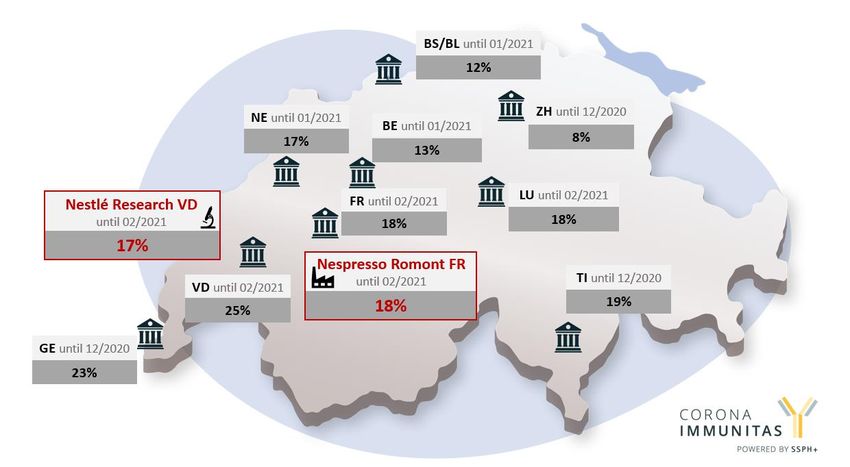
At the time of the decline of the second wave of age in the canton of Fribourg, where antibodies
the COVID-19 pandemic, 17% (95% CI 13% to were measured during the same period, i.e.,
22%) of Nestlé employees, both sites between December 2020 and February 2021
combined, had developed antibodies against (13, 14) (Figure 8).
SARS-CoV-2. More precisely, the proportion
was 17% (95% CI 12% to 22%) among There are few seroprevalence studies among
employees working on Nestlé Research sites in workers, the majority of them evaluating
the canton of Vaud, and 18% (95% CI 13% to seroprevalence among healthcare workers (15-
23%) among employees working at the 17). A study in Geneva showed large variations
Nespresso factory in Romont in the canton of in anti-SARS-CoV-2 antibody prevalence
Fribourg. among essential workers from diverse sectors
and occupations, reflecting a higher exposure in
These results are consistent with the some sectors such as the healthcare system,
observations made in the general population of and showing less evidence supporting that
the two respective cantons, with a prevalence of workers in other sectors faced a greater risk of
25 % (95% CI 21% to 29%) in adults aged 20 SARS-CoV-2 infection than the general
64 years in the canton of Vaud and a prevalence working-age population (18).
of 18 % (95% CI 13% to 23%) in adults of same
Figure 8. Prevalence (%) of antibodies (IgA+/IgG+) against SARS-CoV-2: situation at the end of
February 2021 in Switzerland and at Nestlé sites among adults aged 20-64 years (14).
CORONA IMMUNITAS NESTLE 10Box 1. Seroprevalence studies
When comparing seroprevalence between different studies, it is important to be aware of the tests
used, the methodology, as well as to consider the period during which the study was conducted in
relation to the evolution of the pandemic. For all studies conducted within the Corona Immunitas
program, a common test was used to facilitate comparison (10, 11). This test has a high sensitivity
(96.6%) even in individuals with mild infections, meaning that it generates few false negatives (people
incorrectly classified as negative), and high specificity (99.7%) to the SARS-CoV-2, meaning that it
generates few false positives (people incorrectly classified as positive) (11, 19). In addition,
comparability between the different regions is facilitated by conducting these studies during well-
defined periods and by using a similar methodology (questionnaires and serological test standardized
across study sites).
Limits and strengths of the study disappear over time, particularly in individuals
who have experienced pauci- or asymptomatic
This study has some limitations. Despite the
infections (21). Globally, the proportion of
use of an accurate test with high sensitivity and
people who have been infected with the virus
high specificity, the performance of tests
may be underestimated.
measuring antibodies remains imperfect and
includes the risk of false positive or false
The participation rate was around 33% among
negative results. In addition, the proportion of
the invited Nestlé employees. We did not
people with antibodies at the time of the study
explore the reasons for not participating. A large
may not accurately reflect the cumulative
part of the employees was mainly working from
infection rate in the company since the
home at the time of recruiting. It is likely,
beginning of the pandemic. Indeed, antibody
however, that people who believe they have
response may be weaker in individuals who
been infected (positive PCR test or symptoms)
have been infected by SARS-CoV-2 presenting
have greater motivation to participate, which
no or only mild symptoms (20). Additionally, as
could have increased the estimated
we conducted the study during the second wave
seroprevalence. Conversely, people who
of the pandemic, it is possible that the testing
already knew that they had been infected, with
happened before the antibodies became
a positive PCR testing, could have renounced
detectable in the blood of newly infected
to participate in the study.
individuals. Furthermore, antibodies may
CORONA IMMUNITAS NESTLE 11A major strength of this study is to allow a more is another major strength as it facilitates
comprehensive count of SARS-CoV-2 comparisons between the studies (Box 1).
infections that have occurred among the
employees since the beginning of the In the next part, this study aims to investigate
pandemic, compared to the count of laboratory- the kinetics of antibodies, i.e. to describe how
confirmed cases by PCR testing. PCR- antibodies evolve in the blood of the same
confirmed cases represent a smaller portion of individuals over time; more precisely whether
the infections due to limited testing (especially the antibodies disappear over time, and if there
in the beginning of the pandemic) and due to the were newly infected or vaccinated individuals.
majority of cases with few or no symptoms (19).
Health concerns
This phase of the study was conducted before
Assuming that there is immunity after infection,
vaccination was deployed in the cantons of
the current proportion of immune individuals in
Vaud and Fribourg. Since the observed
the population is still too low to slow the
population is workers aged 20-64 years and are
circulation of the virus and influence the
invited to be vaccinated later than the elderly, it
pandemic; a large part of the population is
can be assumed that the presence of antibodies
probably still susceptible to infection. Today, it
is related to a viral infection.
is difficult to determine a precise value to
achieve a herd immunity because of the very
This study used a SARS-CoV-2 test which was
dynamic evolution of the pandemic (23). It is
developed on a population-based sample, not
therefore important to remain vigilant against
on a clinical sample, thus limiting the risk of
the virus and to continue respecting the sanitary
spectrum bias (22).
measures recommended by the authorities.
Conducting a seroprevalence study within a
company helps understanding the situation in Next steps
the workplace, i.e. to estimate the levels of In order to assess the presence of antibodies
antibodies among the employees which could among Nestlé employees, the seroprevalence
help to adapt implemented measures. study will be repeated in spring 2021 (phase IV
of the Corona Immunitas program). The
The nationwide and coordinated organization of participants of the first part of this study will be
the Swiss Corona Immunitas research program invited for a second serological test.
CORONA IMMUNITAS NESTLE 1214. Swiss School of Public Health SSPH+.
References Corona Immunitas - Swiss research program;
www.corona-immunitas.ch. 2021 [Accessed on
1. Federal Office of Public Health FOPH. March 2021].
Coronavirus: Disease, symptoms, treatment. 15. Lumley SF, O'Donnell D, Stoesser NE,
FOPH; 2021 [Accessed on March 2021]. Matthews PC, Howarth A, Hatch SB, et al.
2. World Health Organization WHO. Antibody Status and Incidence of SARS-CoV-2
Listings of WHO’s response to COVID-19. Infection in Health Care Workers. N Engl J Med.
WHO; 2021 [Accessed on March 2021]. 2021 Feb;384(6):533-40.
3. Federal Office of Public Health FOPH. 16. Piccoli L, Ferrari P, Piumatti G, Jovic S,
Coronavirus: Situation in Switzerland 2021 Rodriguez BF, Mele F, et al. Risk assessment
[Accessed on March 2021]. and seroprevalence of SARS-CoV-2 infection in
4. World Health Organization (WHO). healthcare workers of COVID-19 and non-
Transmission of SARS-CoV-2: implications for COVID-19 hospitals in Southern Switzerland.
infection prevention precautions: scientific The Lancet Regional Health - Europe. 2021
brief.: WHO; July 2020. Feb;1:100013.
5. Marques M, Domingo JL. 17. Iversen K, Bundgaard H, Hasselbalch
Contamination of inert surfaces by SARS-CoV- RB, Kristensen JH, Nielsen PB, Pries-Heje M,
2: Persistence, stability and infectivity. A review. et al. Risk of COVID-19 in health-care workers
Environ Res. Dec 2020;193:110559. in Denmark: an observational cohort study.
6. Wajnberg A, Amanat F, Firpo A, Altman Lancet Infect Dis. 2020 Dec;20(12):1401-8.
DR, Bailey MJ, Mansour M, et al. Robust 18. Stringhini S ZM, Pullen N, de Mestral C,
neutralizing antibodies to SARS-CoV-2 Perez-Saez J, Dumont R, Picazio A,
infection persist for months. Science. 2020 Oct; Pennacchio F, Dibner Y, Yerly S, Baysson H,
eabd7728. Vuilleumier N, Balavoine JF, Bachmann D,
7. Dan JM, Mateus J, Kato Y, Hastie KM, Trono D, Pittet D, Chappuis F, Kherad O, Kaiser
Yu ED, Faliti CE, et al. Immunological memory L, Azman AS; SEROCoV-WORK + Study
to SARS-CoV-2 assessed for up to 8 months Group, Guessous I. Large variation in anti-
after infection. Science. 2021 Jan;371(6529). SARS-CoV-2 antibody prevalence among
8. Chen X, Pan Z, Yue S, Yu F, Zhang J, essential workers in Geneva, Switzerland. Nat
Yang Y, et al. Disease severity dictates SARS- Commun. 2021 Jun 8;12(1):3455. doi:
CoV-2-specific neutralizing antibody responses 10.1038/s41467-021-23796-4.
in COVID-19. Signal Transduct Target Ther. 19. Accorsi EK, Qiu X, Rumpler E,
2020 Sept;5(1):180. Kennedy-Shaffer L, Kahn R, Joshi K, et al. How
9. Cevik M, Kuppalli K, Kindrachuk J, to detect and reduce potential sources of biases
Peiris M. Virology, transmission, and in studies of SARS-CoV-2 and COVID-19. Eur
pathogenesis of SARS-CoV-2. BMJ. 2020 J Epidemiol. 2021 Feb;36(2):179-196.
Oct;371:m3862. 20. Long QX, Tang XJ, Shi QL, Li Q, Deng
10. West EA, Anker D, Amati R, Richard A, HJ, Yuan J, et al. Clinical and immunological
Wisniak A, Butty A, et al. Corona Immunitas: assessment of asymptomatic SARS-CoV-2
study protocol of a nationwide program of infections. Nat Med. 2020 June;26(8):1200-4.
SARS-CoV-2 seroprevalence and 21. Cox RJ, Brokstad KA. Not just
seroepidemiologic studies in Switzerland. Int J antibodies: B cells and T cells mediate immunity
Public Health. 2020 Oct:In press. to COVID-19. Nat Rev Immunol. 2020
11. Fenwick C, Croxatto A, Coste AT, Pojer Oct;20(10):581-2.
F, Andre C, Pellaton C, et al. Changes in SARS- 22. Puhan MA, Chiolero A, Fehr J, Cullati
CoV-2 Spike versus Nucleoprotein Antibody S, Corona Immunitas Research G. Overcoming
Responses Impact the Estimates of Infections spectrum bias for accurate SARS-CoV-2
in Population-Based Seroprevalence Studies. J seroprevalence estimates. BMJ.
Virol. 2020 Nov;JVI.01828-20. 2021/04/14;373:n917.
12. Federal Office of Public Health FOPH. 23. Nature. Five reasons why COVID herd
Coronavirus: People at especially high risk immunity is probably impossible. March 18,
2021 [Accessed on 2020 Oct]. 2021.
13. Anker D CA, Epure A, Magnin JL,
Schmid A, Carmeli C, Rodondi PY, Cullati S, au
nom du groupe de recherche Corona
Immunitas. Corona Immunitas Fribourg :
Immunité de la population, épisode 1/2020,
Laboratoire de santé des populations
(#PopHealthLab), Université de Fribourg.
CORONA IMMUNITAS NESTLE 13You can also read


