Developing Novel Treatments for Autoimmune Diseases - PATH TO CURES
←
→
Page content transcription
If your browser does not render page correctly, please read the page content below
A C C E L E R AT E D
                        PAT H T O C U R E S

Developing Novel Treatments for
         Autoimmune Diseases

                          W W W. L A N D O S B I O P H A R M A . C O M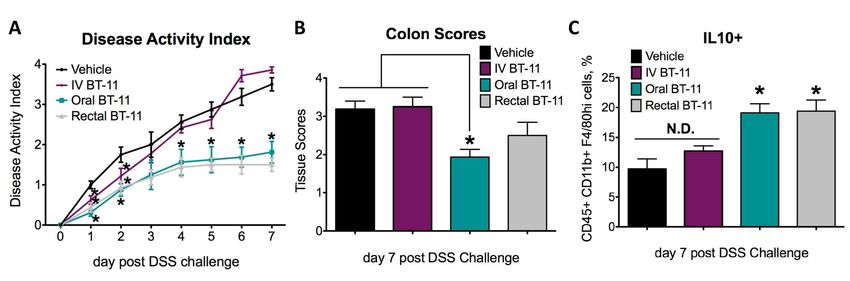
LANDOS STRENGTHS                                                                                  2

 Scientific, Clinical and                Expandable Oral                                 Financially Stable
 Business Leadership                    Therapeutic Pipeline                        Raised $10M Series A to advance
                                                                                            Lead to Phase 1

                                     TECHNOLOGY
                             First-in-class oral therapeutics with a unique MoA
                                              targeting LANCL2

   Advancing           Product Development                        Validation                      Strong IP
Lead Candidate                                            Strong animal pharmacology      Comp of Matter and Method
                      Successful PreIND for BT-11                                         of Use, Long patent life 2035
 in Crohn’s and                                           in 5 IBD models, toxicology
                         Into the clinic in 2018             and human translation
    Ulcerative                                                                             Possible Exit Strategy
      colitis                                                                                 IPO, M&A or Strategic
                                                                                           Alliance at the end of Ph. 2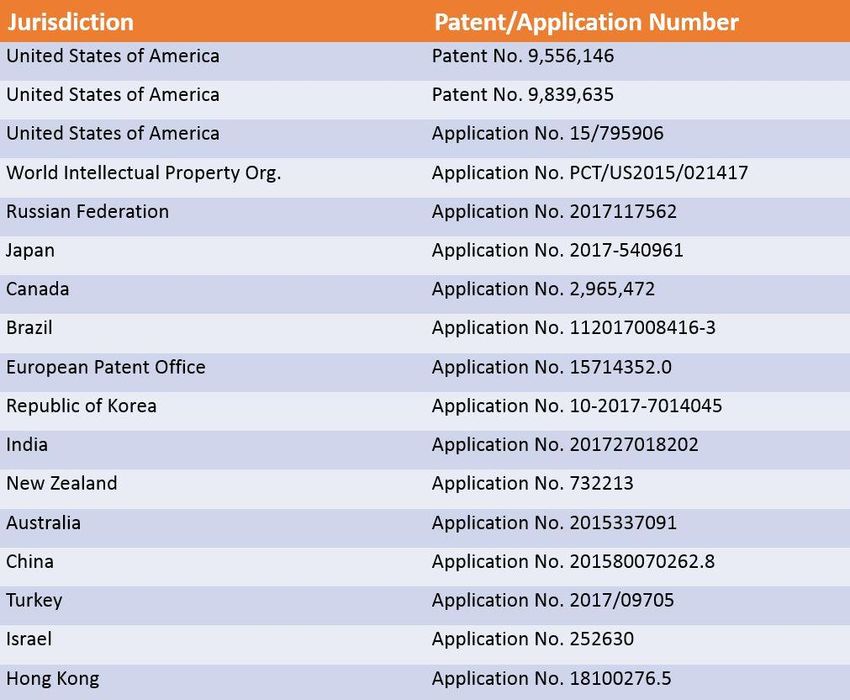
AGENDA                      3

• Unmet Clinical Needs in IBD

• Targeting LANCL2

• Landos Pipeline

• BT-11 Clinical Plan and Data

• Leadership Team

• Financials

• Investment Catalysts
CROHN’S DISEASE AND ULCERATIVE COLITIS                     4

           IBD afflicts 2 million in the U.S.
           and 5 million people worldwide

         5M afflicted
            $10B         70-90%
                        will require    100,000
           market                       hospitalizations
         25% growth      surgery
THE IBD MARKET: $10B – 25% GROWTH                                              5

                                                           Immunomodulators
Autoimmune disease           Others
                                                                (19%)
therapeutics market           (5%)
in U.S. is $100 billion

            Biologics
              (68%)
                                                                                5’ASA
                                                                                 (8%)

              Biological treatment dominates most of the market share. However, it is
           expected to drop 11 points, down to 57%, by 2026 due to safety concerns and
               emerging novel technologies with significant competitive advantages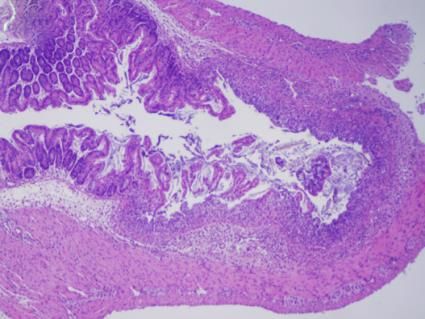
UNIQUE MOA: LANTHIONINE SYNTHETASE C-LIKE 2                           6

              BT-11                    HOW LANCL2 WORKS
                                       LANCL2 activation by BT-11 intercepts
                                       IBD at two levels: by decreasing the
             LANCL2                    production of inflammatory mediators
                                       (TNF⍺, IFNg, MCP1) and increasing anti-
                                       inflammatory molecules (IL-10, FOXP3) in
                                       the GI tract.
   AC
               cAMP         5’AMP              First in class compounds with oral
                                               ROA and local GI action
                                               BT-11, 48 scaffolds, and 3 billion
       PKA            ATP                      NCEs composition of matter claims
                                               allowed in USPT 9,556,146; 2017 &
                                               9,839,635 in 2018; 15 countries
             Activates IL-10 & FOXP3           Both method of use and
CREB                                           composition of matter claims for
             Inhibits TNF-⍺ & IFN-g            IBD, RA, T1D, T2D, and influenza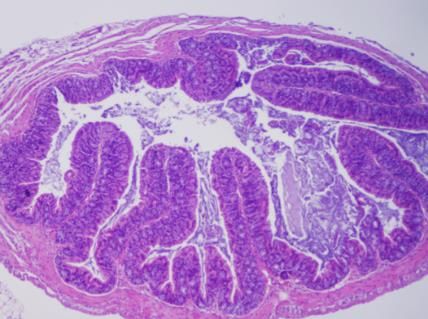
EXPANSIBLE THERAPEUTIC PIPELINE                                                      7

                             Preclinical     Preclinical IND-
 Product       Indication                                         Phase I Phase II
                               POC              enabling
  BT-11           CD                                                    *

  BT-11           UC
  BT-15           T2D
BT-ABA-5a         T2D
   ABA            T2D
    BT-
                  T1D
 12/INT10
 BT-110            Flu
  BT-13            RA

      •    BT-11 will complete CMC and GLP Tox by Q1 2018, file 2 INDs in 2018,
                          and complete Phase I by early 2019.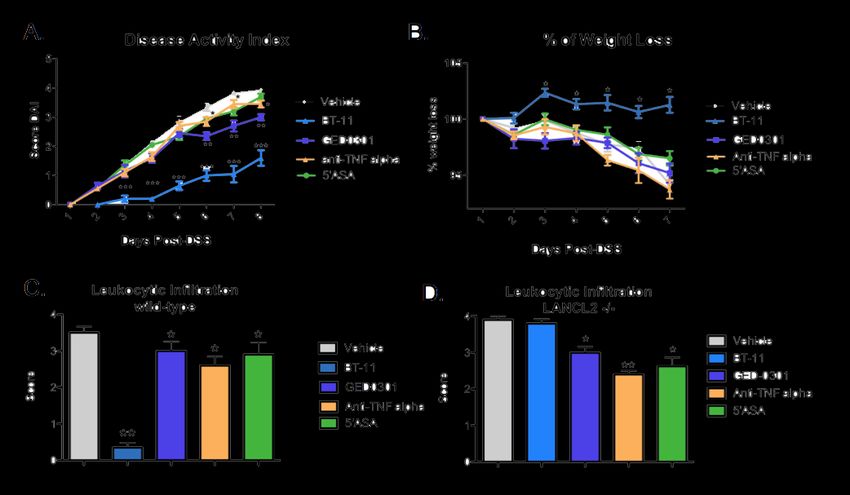
BT-11 TARGET PRODUCT PROFILE FOR CD & UC                                                               8

Product Name                                BT-11                               Lead Competitor (TNF-⍺ blockers)

                First: Treatment for alleviation of signs and symptoms and      Treatment to reduce signs and
                induction and maintenance of clinical remission in male and     symptoms and induce and maintain
   Prime        female adult patients with moderate to severe CD.               remission in adult patients with
 Therapeutic                                                                    moderate to severe CD or UC who
 Indications    Second: Treatment for alleviation of signs and symptoms and
                induction and maintenance of clinical remission in male and     have not responded to other
                female adult patients with moderate to severe UC.               therapies.

                Oral once-a-day dosing through a tablet until symptoms          I.V. infusion
ROA/Dosage
                alleviate (8 mg/kg in mouse models)
Formulation     Tablets (Phase 1 & 2)                                           Sterile powder for I.V. infusion

                Activation of the LANCL2 pathway                                Neutralization of TNF-⍺
Mechanism of
             Up-regulation = IL-10, FOXP3
   Action
                Down-regulation = TNF-⍺, IFNg, MCP-1, IL-6
                Efficacy in 5 validated mouse models (8 mg/kg)                  Variable degrees of efficacy in 3
   Efficacy
                                                                                mouse models
   Safety/      Benign safety profile up to 1,000 mg/kg p.o. in dogs and rats   Increased risk for cancer (T cell
 Tolerability   without dose-limiting safety issues.                            lymphoma), infection and death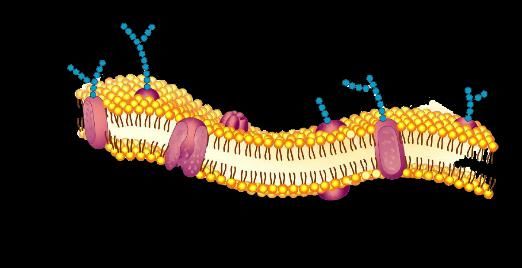
EFFICACY OF BT-11 IN 5 VALIDATED MOUSE MODELS OF IBD                              9

       Untreated : Inflamed               BT-11 Treated : Not Inflamed

    Oral BT-11 decreases gut inflammation by 90%, triggers 4x lesion reduction,
        and modulates inflammatory responses by up-regulating IL-10 and
                             down-regulating TNF-a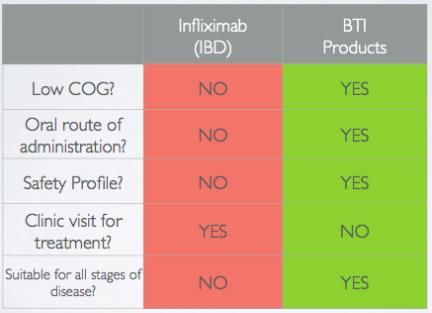
BT-11 TARGETS LANCL2 IN THE GI TRACT                                10

                                   Cmax = 28ng/mL
                                      t1/2 = 3.1hr
                                   Kel = -0.225 L/hr
                                    Vd = 3.38 L/kg

                   •   BT-11 systemic absorption is extremely low
                   •   No dose proportionality (80 to 500 mg/kg)
                   •   Limited systemic exposure
                   •   No accumulation in plasma
                   •   Volume of distribution is high
                   •   BT-11 in the colon and colonic contents is high
                   •   90% reduction of inflammation
                   •   BT-11 is stable to stomach and intestinal fluids
ORAL ROUTE OF ADMINISTRATION 11
In support of it local action in the GI tract, oral and rectal BT-11 administration
protects from IBD, but I.V. administration of BT-11 fails to protect from IBD.HUMAN TRANSLATIONAL DATA 12
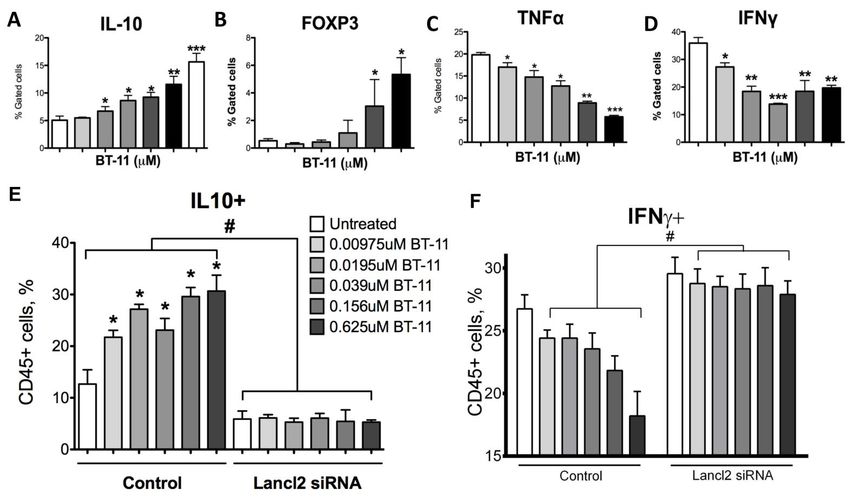
Treating human PBMCs from Crohn’s disease patients with increasing concentrations
of BT-11 ex vivo induced IL-10 production and expression of FOXP3 while suppressing
production of TNF⍺ and IFNgBT-11 HAS DEMONSTRATED BENIGN SAFETY PROFILE 13
BT-11 is negative in genotoxicity studies such as the Ames test up to 5,000
µg/plate; hERG screening
Single medium/high dose in rats (0 or 500 mg/kg) 7-day assessment &
recovery. Multiple Moderate dose in rats (0 or 80 mg/kg)
14-day assessment & recovery
DRF Studies in rats and dogs (0, 250, 500, and 1,000 mg/kg)
7-day assessment & recovery and safety pharmacology
28-day tox assessment & recovery in male and female rats (1,000 mg/kg)
GLP 12-week assessment & 2 week recovery in rats (complete) and dogs
(ongoing); 9 and 6 month dosing to support continuous dosing of BT-11
(post-IND). No dose-limiting safety issues.BT-11 OUTPERFORMS CURRENT DRUGS AND INDs 14
BT-11 CAN DISRUPT THE IBD Rx PARADIGM                            15

  Our data indicate that BT-11 could be steroid-, biologics-
                 and even surgery-sparing

                     6 MP
    5’ASA       Immunosuppresant                 TNFα blockers

                   BT-11 / LANDOS
                     technology

 Corticosteroids                 α4b7 blockers Surgery

            Current therapies are modestly successful
                   with undesired side effects
GO-TO-MARKET TIMELINE 16
2017 2018 2019 2020 2021 2022 2023 2024
IND File
Enabling INDs Phase 1 Phase 2a Phase 2b NDA
Series A Series B IPO Phase 3
$10M $30MLEADERSHIP TEAM 17
Josep Bassaganya-Riera Chris Garabedian
Chairman and CEO Corporate Advisor
20 years of business development and Currently Chairman and CEO of Xontogeny, a company
fundraising experience in leading biotech focused on the management of early stage life sciences
companies with innovative, large-scale companies from preclinical to clinical proof-of-concept.
translational programs. Preclinical and clinical Helped advance a new drug to market when he was the CEO
expertise in Crohn’s disease and ulcerative of Sarepta a $4B publicly traded company.
colitis. Has led large preclinical and clinical
programs in IBD (>$78M).
Simon J. Tulloch, MD
Raquel Hontecillas Senior Clinical Advisor
Chief Scientific Officer 25 years of pharmaceutical and biotech experience in
20 years of translational experience in the strategic business development, clinical development and
biotech industry focusing on infectious, R&D management, both in Europe and the USA. Secured a
immune-mediated, and metabolic diseases. $200 million R&D budget and grew the core business from
Managed an NIH-funded mucosal $700 million to $1 billion at Shire Pharmaceuticals; served
immunology program totaling $57M. as CMO of InfaCare, with successful Series A, B, and C fund
raising. He played a crucial role in NDA and taking Adderall
to market. He has been involved in filing over 17 INDs and
several NDAs.CLINICAL ADVISORY BOARD - IBD 18
FABIO COMINELLI, MD, PHD WILLIAM SANDBORN, MD
Crohn’s Disease Human Clinical Trials Crohn’s Disease Human Clinical Trials
Director of the UH Case Medical Center. Chief, Division of Gastroenterology and Professor of
20 years of experience with human clinical Medicine. He has over 20 years of experience with
trials for new therapeutics in Inflammatory human clinical trials for new Inflammatory Bowel
Bowel Disease Disease (IBD) therapeutics.
FRANCISCO A. SYLVESTER, MD JEAN-FREDERIC COLOMBEL, MD
Pediatric IBD Preclinical and Clinical Gastroenterology
Division Chief for Pediatric Gastroenterology at Director of the Helmsley IBD Center at Mount
UNC Caphel Hill and member of the CCFA Sinai, NYC. 20 years of experience in Crohn’s
Board of Trustees. Over 25 years of experience disease. Chair of the International
in chronic inflammatory diseases. Organization of Inflammatory Bowel Disease
(IOIBD).
DR. MARIA T. ABREU, MD
Preclinical and Clinical Gastroenterology
Faculty of University of Miami Health System.
Over 15 years of experience in IBD, specializing
in mucosa and associated intestinal microbiota
and expertise in precrlinical models and
clinical studies .FINANCING 19
IND-Enabling Studies: $2.5M
Series A (IND Enabling & Ph. I): $10M
GLP Toxicology Studies, Safety Pharmacology, Series B Fall 2018 (Ph. 2a, 2b): $30M
Drug ProductFormulation and CMC, IND Filing
CMC
Estimated time to file IND: 6 months
GLP Tox
Oral Continuous Dosing: $3M IND filing
Phase 1
Human Clinical Studies: $30M Phase 2a
Phase 2b
Phase 1, 2a, 2b
Estimated time to complete Phase 1: 1 year
The FDA has responded positively to the IND-enabling plan and
future clinical trials. Pre-IND meeting minutes available.PHASE 2 EXIT COMPARABLES 20
Plexxikon: Daiichi Sankyo $835M upfront with $130M in milestones
(SMALL MOLECULE)
Nogra Pharma: Celgene acquired Mongersen (GED0301) for $710M
upfront with $1.9B in development and sales milestones (ORALLY ACTIVE
AND LOCALLY ACTING SMALL MOLECULE)
Protagonist: J&J commits $990M for an oral Crohn’s drug PTG-200 targets
IL-23 receptor (ORAL PEPTIDE THERAPEUTIC)
Theravance: J&J launched a $1B partnership on the pan-JAK inhibitor (TD-
1473) with $100M cash upfront in a milestone-driven deal (ORALLY
ACTIVE AND LOCALLY ACTING SMALL MOLECULE)SUMMARY AND CONCLUSIONS 21
• Landos is uniquely positioned to develop oral,
first-in-class IBD therapeutics, a $10 billion
Start Ph. 1 market.
File 2 INDs by human clinical • Innovative MoA (LANCL2) with strong IP
Q2 2018 testing by protection (NCEs & target).
Q2 2018 • Strong animal pharmacology, MoA, toxicology,
and translational data.
Complete
• Committed leadership with autoimmune disease
Phase 2a
IPO by 2021 and biopharma industry experience ready to
studies execute therapeutic development plans.
by 2021
• Partnering with Xontogeny for incremental
operational expertise and access to talent.
• Raised $10M Series A from Perceptive Advisors
and seeking $30M for Series B financing.LANDOS
BIOPHARMA
JBR@landosbiopharma.com
www.landosbiopharma.com
@LandosBio
1800 Kraft Drive, Suite 216
Blacksburg, VA 24060APPENDIX 23
LANDOS – ACCELERATED PATH TO CURES 24
CURRENT IBD TREATMENT PARADIGM                                25

                                6 MP          TNFα blockers
   5’ASA                   Immunosuppresant

     Severity of disease

Corticosteroids                    α4b7 blockers   Surgery

      Biologics for IBD cost $40,000 to $50,000/patient/year
          Side effects include cancer, infection and death
CMC STUDIES IN THE NEXT 6 MONTHS 26
The CMC profile of BT-11 Drug Substance:
• Easy and inexpensive production with low COG
• Low solubility and low absorption
• Reproducible chemistry with only 4-step synthesis
• 99% purity even at lab scale
• Stable and scalable
The CMC profile of BT-11 Drug Product:
• Current formulation is a tablet
• No unusual risks for tablet formulation anticipated
• ROA for BT-11 will be oral in humans
• Exploring oral modified release formulation
• Site-directed release to improve efficacy/dose frequencyPhase 1/1 SAD Study 27
Phase/Study Population Design Outcomes Comments/Purpose
1/1 Up to 40 normal Single Ascending Safety, Establish maximum
healthy volunteers Dose tolerability, PK tolerated dose (MTD)
Study Type Phase 1 SAD Clinical Pharmacology Study
Study Title Single escalating dose study of tolerability and PK of BT-11 oral administration.
Objective The goal will be to establish the human single dose MTD.
Clinical Endpoints Primary: To monitor safety and tolerability
Secondary: PK profile and local bioavailability in humans
Subjects Normal healthy volunteers (NHV) aged 18-60, male or female
Study Drugs Single doses of BT-11 with control tablets administered in 4-5 cohorts of 8
Study Design Subjects will be randomized to BT-11 (n=6) or placebo (n=2) in 4-5 cohorts of escalating doses.
1/100th of NOAEL; 10 mg/kg and increasing twofold until maximum feasible dose (anticipated to
be 8 g as a single dose).
Number of subjects 8 NHV in 5 cohorts sequestered for 48 h
Dosing Period Single dose.
IE Criteria NHV aged 18-60, male or (functionally sterile) female.Phase 1/2 MAD Study 28
Phase/Study Population Design Outcomes Comments/Purpose
1/2 Up to 40 normal Multiple Safety, Establish maximum
healthy volunteers Ascending Dose tolerability, PK tolerated dose (MTD)
Study Type Phase 1 MAD Cinical Pharmacology Study
Study Title 7-d repeat escalating dose study of tolerability and PK of BT-11 oral administration.
Objective The goal will be to establish the human repeat dose MTD.
Clinical Endpoints Primary: To monitor safety and tolerability
Secondary: PK profile and local bioavailability in humans
Subjects 40 normal healthy volunteers (NHV) aged 18-60, male or female
Study Drugs 7-d dosing of BT-11 or placebo control tablets
Study Design Subjects will be randomized to BT-11 (n=8) or placebo (n=2) in 4 cohorts of escalating doses.
1/100th of NOAEL; 10 mg/kg and increasing twofold until maximum feasible dose (anticipated to
be 8 g as a single dose).
Number of subjects 40 NHV (10 NHV in 4 cohorts)
Dosing Period 7-d daily dosing
IE Criteria NHV aged 18-60, male or (functionally sterile) female.Power Calculations for BT-11 Clinical Trials 29 Based on preliminary results from human peripheral blood mononuclear cells, we estimate a minimum mean difference between vehicle and BT-11 to be 1.7 with a SD 1.8 for the main endpoint measures. For an alpha = 0.05 and a projected 40% increase in variance, a sample size ≥ 18 will achieve 81% statistical power in a two-tailed test. Most studies using CDAI use 50 patients per group. SES-CD has added statistical efficiency to 17-27 patients per group.
Phase 1b UC PK/Biomarker Study                                                                  30

Phase/Study          Population               Design                  Outcomes                Comments/Purpose
1b                   Up to 72 UC              DB, RCT, placebo-       Safety,                 Establish PK and
                     patients                 controlled 12-wk        tolerability, PK        biomarkers in UC

Study Type           Phase 1b UC Study
Study Title          12-wk study of tolerability and PK of BT-11 oral administration.

Objective            The goal will be to establish the PK profile and biomarkers in UC
Clinical Endpoints   Primary: To monitor safety and tolerability
                     Secondary: PK profile, biomarkers, and local bioavailability in humans
Subjects             72 UC patients aged 18-60, male or female
Study Drugs          12-wk dosing of BT-11 low dose (n=18), BT-11 medium dose (n=18), BT-11 high dose (n=18) or
                     placebo tablets (n=18)
Study Design         Subjects will be randomized to BT-11 at 8 mg/kg (n=10) or placebo (n=10), PK at d 1, d7; cytokines
                     (IFN-g, TNF-a, IL-6, IL-10) in PBMC and LPMC, CRP, and fecal calprotectin.
Number of subjects   72 mild to moderate UC patients

Dosing Period        12-wk daily dosing
IE Criteria          Mild to moderate UC patients aged 18-60, male or (functionally sterile) female.
Phase 2 CD Proof-of-Concept (POC) Study 31
Phase/Study Population Design Outcomes Comments/Purpose
2 130 moderate to DB, RCT placebo- Clinical remission, Establish POC efficacy
severe CD patients controlled 12-wk biomarkers, PK safety of BT-11 in CD
Study Type Dose Range Finding Study
Study Title Phase 2 randomized, double-blind placebo controlled, multicenter study to evaluate the
efficacy/safety of oral BT-11 in CD patients with moderate to severe disease.
Objective To establish POC efficacy and safety of orally administered BT-11 in CD patients.
Clinical Endpoints Co-Primary Endpoints are clinical remission based on: abdominal pain, stool frequency (PRO2) and
50% reduction SES-CD from baseline (endoscopic mucosal healing) at wk 12. Secondary Endpoints
are safety, PK modeling, and biomarkers.
Subjects 130 CD patients with moderate to severe disease aged 18-60, male or female
Study Drugs Oral once-a-day tablet dosing for 12 wk (proposed extension to 48 wk).
Study Design CD patients will be randomized to oral BT-11 (n=65) or placebo (n=65). Visits at baseline and d 45
and 90 to collect blood, feces and endoscopy. Extension to 48 wk of responders.
Number of subjects 130 patients with moderate to severe CD for 90 days.
Dosing Period 90-day daily dosing.
IE Criteria CD patients with moderate to severe diseases aged 18-60, male or female. SES-CD > 6Phase 2 UC Proof-of-Concept (POC) Study 32
Phase/Study Population Design Outcomes Comments/Purpose
2 130 moderate to DB, RCT placebo- Clinical remission, Establish POC efficacy
severe UC patients controlled 12-wk biomarkers, PK safety of BT-11 in CD
Study Type Dose Range Finding Study
Study Title Phase 2 randomized, double-blind placebo controlled, multicenter study to evaluate the
efficacy/safety of oral BT-11 in UC patients with moderate to severe disease.
Objective To establish POC efficacy and safety of orally administered BT-11 in UC patients.
Clinical Endpoints Co-Primary Endpoints are clinical remission based on: abdominal pain, rectal bleeding, and
reduction in MCS to 0-1 (endoscopic mucosal healing) at wk 12. Secondary Endpoints are safety,
PK modeling, and biomarkers.
Subjects 130 CD patients with moderate to severe disease aged 18-60, male or female
Study Drugs Oral once-a-day tablet dosing for 12 wk (proposed extension to 49 wk).
Study Design UC patients will be randomized to oral BT-11 (n=65) or placebo (n=65). Visits at baseline and d 45
and 90 to collect blood, feces and endoscopy. Extension to 48 wk of responders.
Number of subjects 130 patients with moderate to severe UC for 90 days.
Dosing Period 90-day daily dosing.
IE Criteria UC patients with moderate to severe disease (Mayo Score 6-12) at baseline with endoscopy score
>2, disease progression on ASA (Mesalamine failures) aged 18-60, male or female.BT-11 VERSUS STANDARD-OF-CARE 33
LANCL2-targeting BT-11 Biologics TNF-⍺ blockers
BT-11 will have an oral ROA Limited Efficacy
BT-11 will have lower COG VS Negative safety profile
BT-11 will have a better safety profile Expensive and IV ROABT-11 & LANCL2 PUBLICATIONS 34
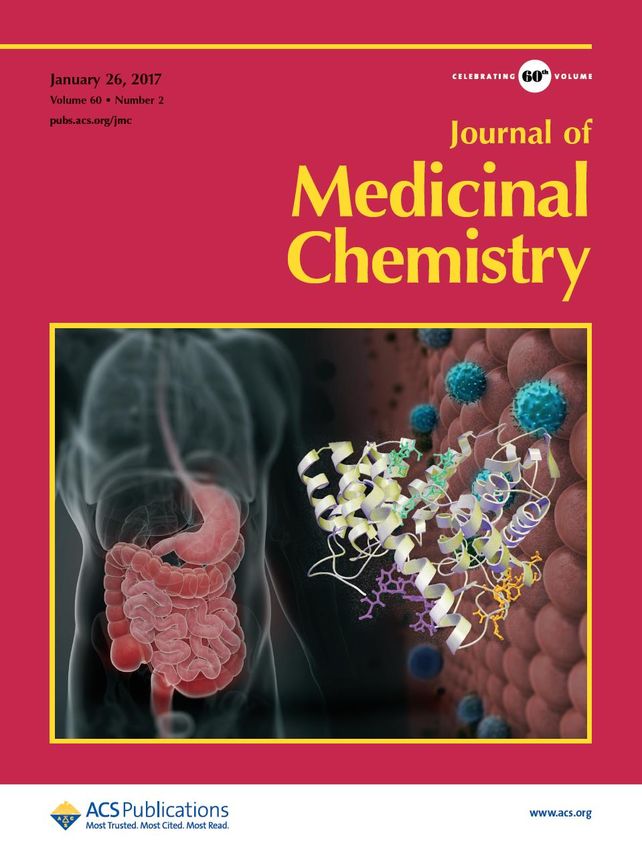
Carbo A, Gandour RD, Hontecillas R, Philipson N, Uren A, Bassaganya-
Riera J.
An N,N Bis(benzimidazolylpicolinoyl)piperazine (BT-11): A
Novel Lanthionine Synthetase C-Like 2-Based Therapeutic
for Inflammatory Bowel Disease.
J Med Chem. 2016 Nov 23;59(22):10113-10126. PubMed PMID: 27933891.
Activation of LANCL2 by BT-11 Ameliorates IBD by
Supporting Regulatory T Cell Stability through
Immunometabolic Mechanisms.
Inflammatory Bowel Diseases Journal. 2018. In pressBT-11/LANCL2 PUBLICATIONS 35 Leber A, Hontecillas R. Zoccoli-Rodriguez V, Bassaganya-Riera J. Activation of LANCL2 by BT-11 Ameliorates IBD by Supporting Regulatory T Cell Stability through Immunometabolic Mechanisms. Imflammatory Bowel Diseases. 2018 In press. Carbo A, Gandour RD, Hontecillas R, Philipson N, Uren A, Bassaganya-Riera J. An N,N Bis(benzimidazolylpicolinoyl)piperazine (BT-11): A Novel Lanthionine Synthetase C-Like 2-Based Therapeutic for Inflammatory Bowel Disease. J Med Chem. 2016 Nov 23;59(22):10113- 10126. PubMed PMID: 27933891. Bissel P, Boes K, Hinckley J, Jortner BS, Magnin-Bissel G, Were SR, Ehrich M, Carbo A, Philipson C, Hontecillas R, Philipson N, Gandour RD, Bassaganya-Riera J. Exploratory Studies With BT-11: A Proposed Orally Active Therapeutic for Crohn's Disease. Int J Toxicol. 2016 Sep;35(5):521-9. doi: 10.1177/1091581816646356. PubMed PMID: 27230993; PubMed Central PMCID: PMC5033715. Lu P, Hontecillas R, Philipson CW, Bassaganya-Riera J. Lanthionine synthetase component C-like 2: a new drug target for inflammatory diseases and diabetes. Curr Drug Targets. 2014 Jun;15(6):565-72. Review. PubMed PMID: 24628287. Lu P, Hontecillas R, Horne WT, Carbo A, Viladomiu M, Pedragosa M, Bevan DR, Lewis SN, Bassaganya-Riera J. Computational modeling- based discovery of novel classes of anti-inflammatory drugs that target lanthionine synthetase C-like 2. PLoS One. 2012;7(4):e34643. doi: 10.1371/journal.pone.0034643. PubMed PMID: 22509338; PubMed Central PMCID: PMC3324509. Bassaganya-Riera J, Guri AJ, Lu P, Climent M, Carbo A, Sobral BW, Horne WT, Lewis SN, Bevan DR, and Hontecillas R. ABA regulated inflammation via ligand-binding domain-independent activation of PPARg. J. Biol. Chem. 286(4):2505-16. Lu P, Bevan DR, Lewis SN, Hontecillas R, Bassaganya-Riera J. Molecular modeling of lanthionine synthetase C-like 2: a potential target for the discovery of novel type 2 diabetes prophylactics and therapeutics. J Mol Model. 2011 Mar;17(3):543-53. doi: 10.1007/s00894-010- 0748-y. PubMed PMID: 20512604.
PATENT LIST 36
You can also read


