Coronavirus BRIEFING NOTE #1 - Aviation and the Economy: Scenarios for Recovery - NACO
←
→
Page content transcription
If your browser does not render page correctly, please read the page content below
coronavirus
          BRIEFING NOTE #1
Aviation and the Economy: Scenarios for Recovery
                    March 26, 2020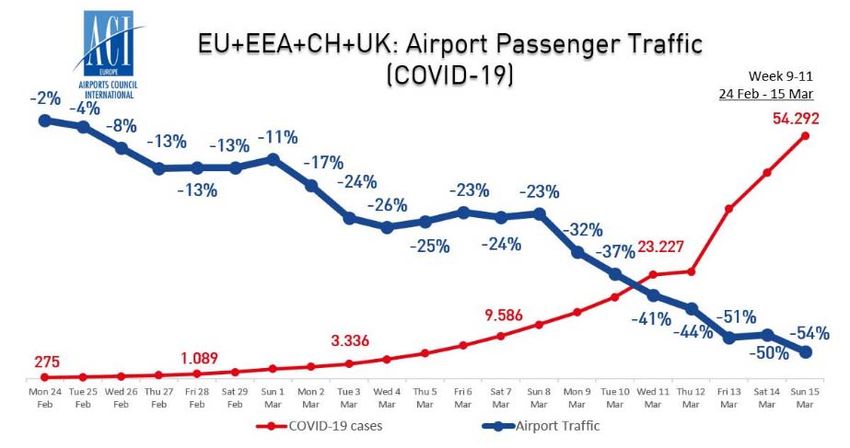
Coronavirus Briefing #1
                                                                                                                26 March 2020

 Coronavirus Briefing Note #1: Scenarios for Recovery
 26 March 2020

The spread of COVID-19 (the illness associated with this new strain of coronavirus) is having an unprecedent impact
on not just the aviation industry, but the global economy. While the immediate and most pressing concern is human
cost in terms of people’s health and the tragedy of escalating fatalities, COVID-19 has some profound implications for
nearly all businesses and industries.

This briefing note examines the impact of the COVID-19 outbreak to date and considers the outlook for economic and
traffic recovery when the outbreak is contained. Historical experience suggests that there will be a recovery at some
stage and, depending on how events develop, the “bounce back” may be quite rapid. While grappling with rapidly
changing events, the aviation industry, regulators and policy makers also need to be considering scenarios for how
traffic will develop over the rest of 2020 and beyond, and strategies that can be put in place.

How and when recovery occurs for an airport will depend on the characteristics of the market that an airport serves and
the carriers that operate there. Nevertheless, we have developed some initial scenarios to examine the potential
impacts this year and going into 2021, and applied to a generic airport, as shown in the chart below.

                                  Scenarios for Traffic Recovery in 2020 at a Generic Airport

 Summer Recovery                             Protracted Recovery                       Geographically Uneven Recovery
 Global restrictions start to be lifted in   Global restrictions remain in place for   Some parts of the world control the
 June.                                       extended period due to continued          outbreak and others do not (e.g.,
 Rapid build-up, but quite a lot of          flare ups.                                airports in North America have service
 summer traffic lost.                        Restrictions not lifted until September   within North America, but not to Europe
                                             – traffic at 50% of normal levels by      and Asia).
 Closing on full recovery by late
 2020/early 2021.                            December.                                 50% of passenger traffic lost –
                                             71% of passenger traffic lost –           full recovery by mid to late 2021.
 37% of passenger traffic lost.
                                             full recovery not until 2022 or 2023.

                                             Source: Consultant in-house analysis
                                                                                                                                 1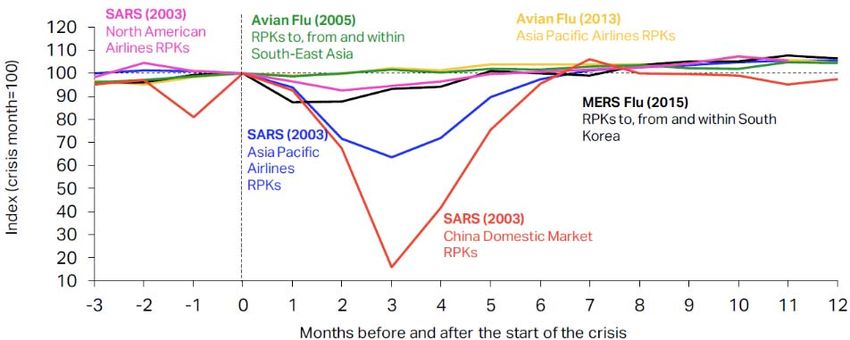
Coronavirus Briefing #1
                                                                                                    26 March 2020

Introduction
The spread of COVID-19 (the Coronavirus) is having an unprecedent impact on not just the aviation industry but the
global economy. While the immediate and most pressing concern is human cost in terms of people’s health and the
tragedy of escalating fatalities, COVID-19 has some profound implications for nearly all businesses and industries.
What started out as looking like a repeat of the SARS outbreak (2002/03) or Swine flu (2009/10), both of which had
relatively modest and short-lived impact on aviation and the economy, has escalated to a much larger emergency.

The situation is changing on an hourly basis and there remains considerable uncertainty as to how long this outbreak
will last and what will be the final impacts. This briefing note provides a summary of events to date and considers some
of the implications for our industry.Given the changing nature of this event, we will be sending out briefing notes on a
regular basis considering different aspects of the crisis.
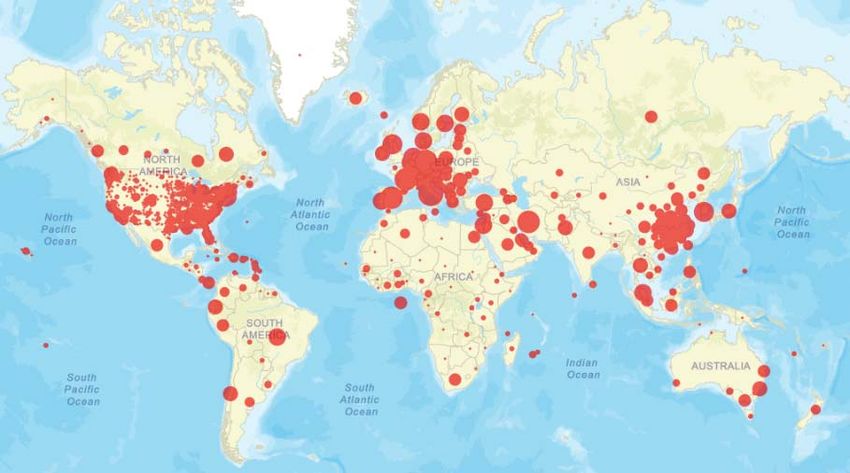
             Countries, territories or areas with reported confirmed cases of COVID-19, March 24, 2020

                                              Source: Johns Hopkins University

The Impact on Aviation
In an effort to stop or slow the spread of the outbreak, governments have responded with wide-ranging restrictions on
international travel of the sort that has not been seen during peace time. The U.S. has barred the entry of foreign
nationals who have travelled to China, Iran and the EU (including the UK and Ireland) and advised U.S. citizens to
avoid non-essential travel and closed its borders to non-essential travel. The EU and many other countries globally
have placed similar restrictions on both inbound and outbound travel.
The impact on aviation has been predictably catastrophic; ACI Europe reports that passenger traffic at European
airports has declined over 54% since late February, as of March 15. Often the data has not able to keep up with events
– we have been using flight tracking data to get real time information on the traffic declines, as shown in the charts on
the following page. As can be seen, European and Asian airports have seen aircraft operations decline by as much as
97%. Major Chinese airports, which began seeing reductions to operations in January and February, experienced
downturns of 90% or more compared to scheduled activity one year prior. In North America, Australia and New
Zealand, the declines have ranged from 28% to 72% but are expected to drop further as nearly all countries have
imposed restrictions of international travel and even travel within countries.

                                                                                                                 2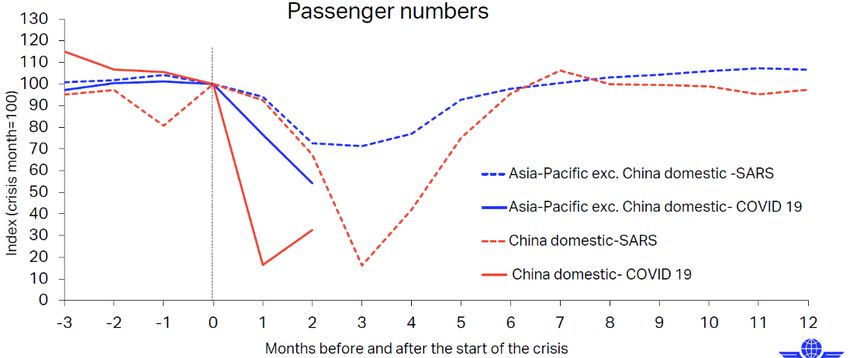
Coronavirus Briefing #1
                                                                                         26 March 2020

Passenger Traffic at European Airports

           Source: ACI Europe

 Flight Tracking Data: Asian Airports
          Source: FlightRadar24

                                      1,800
                                                                Beijing (PEK)
                                      1,600

                                      1,400                            Scheduled Flights Same Day in 2019
                                      1,200
                      Daily Flights

                                      1,000

                                       800

                                       600

                                       400                          ‐90% Year over Year
                                       200

                                         0
                                              24‐Feb   02‐Mar         09‐Mar         16‐Mar        23‐Mar

                                                                                                            3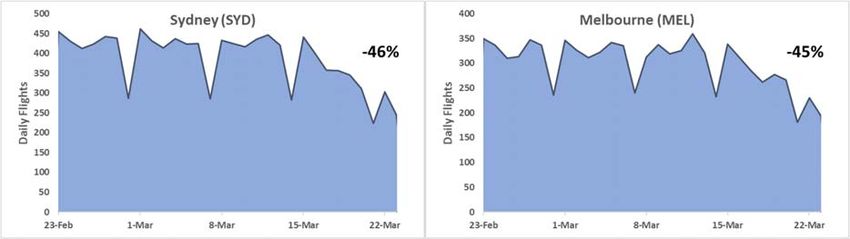
Coronavirus Briefing #1
                                                                                                            26 March 2020

                             Flight Tracking Data: European Airports
                                         Source: FlightRadar24

                                                                      700
                                                                                    London Heathrow (LHR)
                                                                      600
                                                                                                                ‐47%
                                                                      500
                                                      Daily Flights

                                                                      400

                                                                      300

                                                                      200

                                                                      100

                                                                        0
                                                                        19‐Feb   26‐Feb    04‐Mar   11‐Mar   18‐Mar

Flight Tracking Data: Australia/New Zealand Airports (Sydney, Melbourne, Auckland, and Wellington)
                                        Source: FlightRadar24

                                                                                                                        4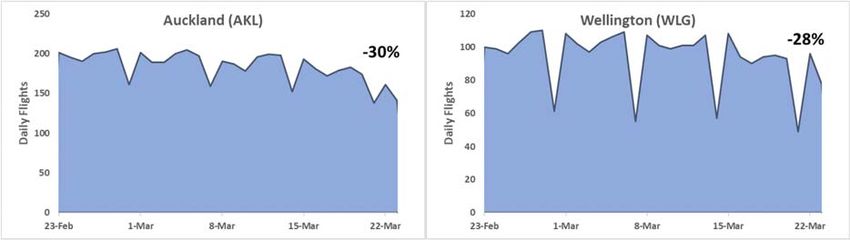
Coronavirus Briefing #1
                                                 26 March 2020

  Flight Tracking Data: U.S. Airports
           Source: FlightRadar24

Flight Tracking Data: Canadian Airports
           Source: FlightRadar24

                                                             5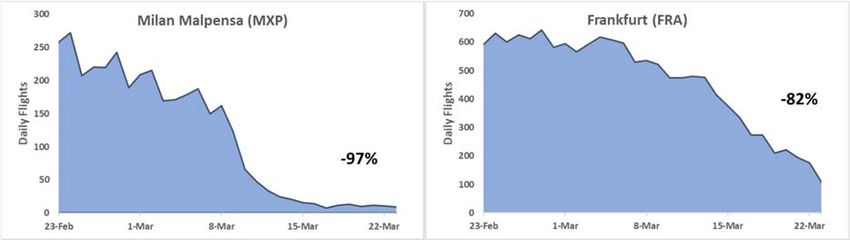
Coronavirus Briefing #1
                                                                                                       26 March 2020

As of March 26, as the pandemic continues to evolve, it is important to highlight the extreme fluidity of the situation in
terms of understanding and forecasting capacity changes over the next few months. Each airline will have different
strategies of implementing their capacity reductions. In one case, if an airline has announced a full shutdown of
operations, these schedule changes should be properly reflected in industry sources (such as OAG or Innovata) within
a week of announcement. The airline’s website will also reflect the service cancellations.

However, if the airline chooses to continue operations, but at a reduced capacity, industry schedule sources may not
properly reflect these changes, especially in the near term. For example, at the time of writing, an airline’s capacity
reduction plan for April 2020 may not be fully reflected in OAG and/or Innovata schedules at all. An airline may choose
to leave in an “overbuilt” schedule, one that has intentionally more flying than needed, so that the airline can tactically
cancel additional low-demand flights closer to the flying date. In this case, while OAG and/or Innovata may reflect a
drop of 30% in capacity for a particular airline, the reality may be that the airline will choose to reduce its capacity much
further.

As airlines continue to react to the worldwide pandemic, their capacity will continue to fluctuate based on each carrier’s
tactical strategy of capacity reduction. As airline network planners continue to respond to daily changes in travel
restrictions and falling demand, they will be busy continuously analysing the drop in demand and adjusting their flying
capacity accordingly. As such, air carriers will continuously adjust their flying in April, May, and the upcoming summer
months by either removing flights in advance and/or cancelling further flights closer to the flying date. For airports, it is
best to keep abreast of airline capacity by following carrier announcements closely and keeping in touch with local
airline station managers, in addition to checking industry sources. One thing that is certain – no matter which data
source is referenced, an airline’s planned flying capacity for the rest of 2020 will be continuously changing in the days,
weeks and months ahead.

                                                                                                                     6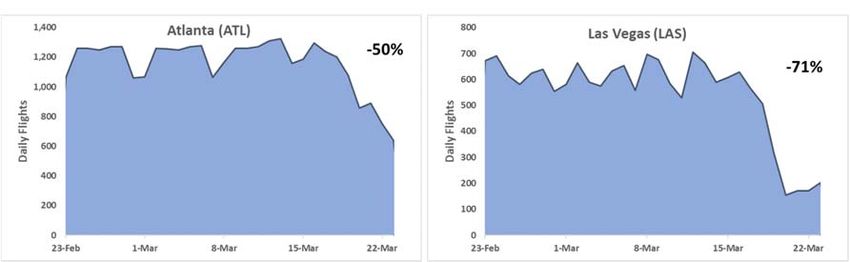
Coronavirus Briefing #1
                                                                                                                                                    26 March 2020

Government Response and Broader Economic Implications
How much aid will directed to the aviation industry is not yet clear. The U.S. package provides US$50 billion in aid to
airlines in the form of loans or loan guarantees. Governments in Europe, Canada, New Zealand and elsewhere are
also developing packages for airlines. Any sort of rescue package is likely to be conditional on reducing layoffs and
restricting payments to shareholders and executives.1 Many airlines have reduced their cash reserves in recent years
through share buybacks and dividend payments, and governments will not be inclined to reward these decisions,
particularly with many industries (and households) also asking for assistance.

Scenarios for Recovery
It is important to remember that the aviation market is resilient and has reverted to trend from previous shocks such as
9/11 and recessions, as illustrated in the charts below.

                                         Global Aviation has Reverted to a Growth Trend After Previous Shocks

                                                          4.5

                                                          4.0

                                                          3.5
                                                                                                                           Global
                                                                                                                          Financial
                                                                                                                            Crisis
                           Global Passengers (Billions)

                                                          3.0

                                                          2.5
                                                                                                                 9/11
                                                          2.0
                                                                                               Gulf War
                                                          1.5
                                                                       1979 Oil Shock
                                                          1.0

                                                          0.5

                                                          0.0
                                                                1973   1978      1983   1988      1993    1998     2003    2008       2013     2018

                                                                  Source: The World Bank
                  (International Civil Aviation Organization, Civil Aviation Statistics of the World and ICAO staff estimates), 1973-2018

However, the extent of the damage and speed of recovery for the industry are still hard to predict. In recent weeks,
countries around the world have adopted a set of drastic measures aimed at curbing down the spread of COVID-19.
However, these measures have been implemented without global coordination and the aviation and tourism industries
are left with a patchwork of border and travel ban policies. This patchwork is likely to affect the scope and speed of
industry recovery. IATA has examined the impact of previous disease outbreaks on aviation, most notably SARS, and
found that previous outbreaks lasted 1-3 months and traffic levels recovered in 6-7 months.

1
    https://www.ft.com/content/27bb17e2-6ac7-11ea-800d-da70cff6e4d3.

                                                                                                                                                                7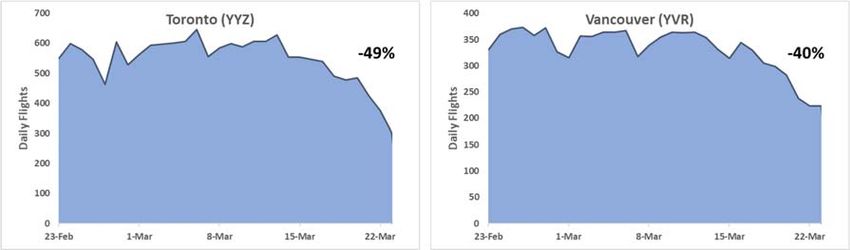
Coronavirus Briefing #1
                                                                                                        26 March 2020

                                     Impact of Past Disease Outbreaks on Aviation

                                                         Source: IATA

Clearly, we have moved well beyond the sort of impacts experienced in past events, with many airlines stopping all
operations and traffic at airports down over 95%. Recovery will come. Some of the first countries affected, such as
China and South Korea, appear to have got the outbreak under control and are seeing a decline in new cases. As a
result, there is some evidence of a traffic recovery. IATA reports that in these countried domestic air traffic is starting to
grow (although still well below pre-outbreak levels) and that yields in Chinese domestic air market are starting to
improve.
                      China and South Korea appear to be on the Other Side of the Pandemic

                                                    Source: New York Times

                                                                                                                      8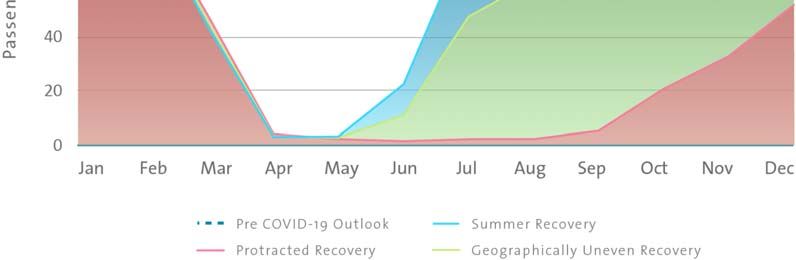
Coronavirus Briefing #1
                                                                                                     26 March 2020

                                Start of a Recovery in Chinese Domestic Air Traffic?

                 Traffic
               recovery

                                                        Source: IATA

The recovery when it comes will depend considerably on how the economy recovers. Economic forecasters Oxford
Economics have examined how the global economy may bounce back from this event. They suggest that once the
pandemic is under control, uncertainty will subside quickly. Households will begin raising discretionary spending back
to more typical levels, while firms will also increase output as supply constraints lift. In addition, money saved because
planned discretionary spending in 2020 did not occur, along with stimulus money from government and central banks,
will lead to heightened spending, accelerating the return-to-normality rebound.

                              World GDP Bouncing Back from the Pandemic Scenario

                                                  Source: Oxford Economics

                                                                                                                   9
Coronavirus Briefing #1
26 March 2020
How and when recovery occurs for an airport will depend on the characteristics of the markets that airport serves and
the carriers that operate there. To date, only one carrier has failed due to COVID-19 – Flybe, a UK regional carrier that
was already struggling. Other carriers will likely follow, depending on the nature of the government protection provided
(some governments have indicated that they want to avoid propping up carriers that were already failing). Where
carriers do fail, we would expect other carriers to fill some or all of that capacity, as we have seen before. However, the
nature of the traffic may change - when Hungarian flag carrier Malev failed 2012, low cost carriers such as Ryanair and
Wizz rapidly grew traffic volumes at Budapest Airport, and traffic recovered in less than a year, but services to long
haul destinations took a lot longer to return. Previous shocks have also precipitated industry consolidation and airport
de-hubbing, and there remains the potential for this to occur again. These topics will be considered in more detail in
future briefing notes.
We has developed some initial scenarios to examine the potential impacts this year and going into 2021, and applied
to a generic airport, as shown in the chart below.
1. Summer Recovery
Restrictions on air traffic and economic activity remain in place for much of April and May for most parts of the
globe but start to be lifted in June as cases subside. This would roughly match the timeline for case reduction
seen in China and South Korea to date. Traffic begins to recover in the summer, with carriers offering last
minute flights deals in order to generate cash (many carriers are already offering free cancellation or ticket
changes in order to encourage customers to make bookings now).
However, considerable summer traffic is lost due to passengers not making bookings earlier in the year as well
as an economic “hangover” from the government restrictions. Traffic and services gradually recover over the
balance of the year as confidence returns.
2. Protracted Recovery
Restrictions remain in place for an extended period as the outbreak continues to flare up in parts of the world.
Traffic levels do not start to recover until September when restrictions to some parts of the world are lifted
(e.g., domestic travel is permitted). There is a gradual traffic recovery as restrictions are lifted, with traffic
reaching around 50% of pre-event levels.
3. Geographically Uneven Recovery
Some parts of the world control and minimize the outbreak in a few months while other parts take considerably
longer. As a result, air service to some regions are resumed by flights, while others are tightly restricted. For
example, an airport in North America sees services resumed for flights within North America but restricted
to/from Europe and Asia.
10Coronavirus Briefing #1
26 March 2020
The scenarios are outlined in the chart below for a generic airport with some traffic seasonality. Under the Summer
Recovery scenario, passenger traffic in 2020 is 37% lower than expected traffic before the outbreak, with traffic
reverting to trend at some point in 2021. Under the Protracted Recovery scenario, the loss in passenger traffic in 71%
in 2020, with recovery to trend not occurring until 2022 or 2023. In the Geographically Uneven Recovery, the loss of
passenger traffic is 50% with full recovery not occurring until the later part of 2021.
Clearly, these scenarios are supposition, and not reflective of all eventual outcomes or individual airports. ACI North
America has also been examining this issue – their preliminary estimates for 2020 are that U.S. Airports will lose 244
million passengers in 2020 compared with pre-COVID-19 forecasts, a decline of 37%, with traffic down by 73%
between March and June.2 As a result, operating revenues are forecast to decline by nearly US$ 14 billion or 49%.
These scenarios focus on passenger traffic. The outlook for cargo is quite different – governments have not placed the
same restrictions on cargo, as the risk of COVID-19 transmission is very low and there is a compelling need to keep
supply chains open (not least for food and medicine). However, much of cargo is transported in the bellyhold of
passenger aircraft, many of which are now grounded. Carriers are planning to use their passenger aircraft for cargo
operations in the short term, American Airlines announced on March 19 that it will operate all-cargo flights to help keep
business moving.3 We will examine air cargo in a later briefing.
Scenarios for Traffic Recovery at a Generic Airport
Source: The Consultant’s in-house Analysis
2https://airportscouncil.org/wp-content/uploads/2020/03/Economic-Impact-of-Coronavirus-on-U.S.-Commercial-Airports.pdf.
3
http://news.aa.com/news/news-details/2020/American-Airlines-Announces-Cargo-Only-Flights-to-Help-Keep-Business-Moving-OPS-DIS-
03/default.aspx
11Coronavirus Briefing #1
26 March 2020
Summary
The impact of COVID-19 on aviation is profound and unprecedented. Events are unfolding rapidly and there is massive
uncertainty which is challenging to us all. Airlines and airports will have to take drastic steps to ensure the continuity of
their business and to ensure that they are well positioned when the recovery occurs.
Airports should be focused on financial contingency planning related to the potential scenarios for the airline traffic
activity. There are a variety of aspects of financial operations that need to be considered, including: ability to
temporarily reduce monthly operating expenses, terms of key leases and contracts that produce airport revenue,
flexibility with regard to debt repayment, and access to government aid. A less severe scenario may be addressed with
temporary adjustments, while a more severe scenario may require more significant structural changes. And, of course,
the regulatory, economic, and financial backdrop will be different for different regions of the world. We plan to expand
on these thoughts in an upcoming briefing note.
At InterVISTAS and NACO, we want to support your business in any way we can, and as part of that will be sending
regular updates which we hope you find of value. In future briefings, we plan to look at other aspects of this crisis –
airport financials, air cargo, potential structural changes to the industry, and implications for policy.
12Prepared by
InterVISTAS Consulting and NACO
info@InterVISTAS.com | info@naco.rhdhv.comYou can also read


