Coronavirus (COVID-19) Impact - deugro group
←
→
Page content transcription
If your browser does not render page correctly, please read the page content below

Coronavirus (COVID-19) Impact

                                                                                                          ISO 9001:2015
                                                                                                          ISO 14001:2015
                                                                                                          BS OHSAS 18001:2007

    Coronavirus (COVID-19) Impact – Update April 09, 2020   Rev # 0   deugro-group.com   April 09, 2020   Page 1 of 29
Index
Coronavirus (COVI D-19) Impact ‒ Execut ive S ummary                                                                        3

Ocean frei ght overvi ew                                                                                                    4
Blank sailings and longer t ransit t imes                                                                                   4
Commercial overview: Cont ainers                                                                                            5
B reakbulk and c hart ering                                                                                                 6
COV ID -19 port rest rict ions                                                                                              7
Equipment imbalance                                                                                                         7
Oil p rice impact                                                                                                           9
B eyond IMO 2020                                                                                                            9

Air frei ght overvi ew                                                                                                    10
Capac ity                                                                                                                 10
Rat e t rends                                                                                                             11
Intercont inent al air f reight t raff ic to and f rom Europe                                                             11

E U travel advice and border measures                                                                                     13

Rail Freight development                                                                                                  13

Current operational status of our branches                                                                                14

Country updates                                                                                                           15

Useful links                                                                                                              29

                             Coronavirus (COVID-19) Impact Report   Rev # 0   deugro-group.com   April 09, 2020   Page 2 of 29
Coronavirus (COVID-19) Impact
Update 4 | April 9, 2020

The coronavirus pandemic has been confirmed in over 180 countries globally since it was first discovered in
the Chinese city of Wuhan in late December 2019. In the fifth deugro group COVID-19 update, we are
f ocusing on the continued impacts the virus is having globally. We continue to closely monitor the global
situation and provide updates regarding logistics and supply chain activities geographically, also covering all
major modes of transportation. We are pleased to confirm that all deugro group global offices remain
operational and capable of supporting clients’ requirements.

The last week saw a significant growth in the number of infections, with the global number of cases
surpassing one million on April 2, and within a week increasing by a f urther 400,000. The USA has the
highest number of cases globally at over 380,000, and despite strict lockdown arrangements in force, the
total impact in Spain has seen cases beyond 140,000. Strict control measures on travel and social distancing
remain in place throughout Europe, the Middle East, India and South Africa.

Oil prices have remained down more than 50% year to date and their lowest for nearly two decades, with
WTI Crude remaining below 30 US dollars per barrel over the last week. This week’s OPEC and OPEC+
video conference meeting is planned for Thursday, April 9, with expectations that Saudi Arabia, Russia and
the USA may agree to cut oil output in the hope to curb the current oversupply in the market. Most
international oil companies announced significant CAPEX reductions for 2020 in the hope to reduce losses
and potentially reduce their oil production. Manufacturing industries remain severely impacted due to the
lockdown and social distancing, and restarting production in the months ahead could be a slow and difficult
process. This continues to heavily impact the global economy, with increasing unemployment levels and
governments providing unprecedented support in terms of fiscal stimulus packages for public and private
industries.
In China, lif e is getting back to normal as the country returns to work and people’s focus shifts towards
restarting the economy. According to official statistics, health authorities have reported only one new locally
transmitted case of COVID-19. In Wuhan, the center of the outbreak and the country’s worst-hit area, officials
on Monday, April 6, reported a fifth day without new cases. During the last week, we saw Japan declare a
state of emergency to curb the virus spread, along with Singapore seeing their largest ever daily increase in
COVID-19 cases on April 8. Singapore has banned all social gatherings as part of its latest restrictions to
help combat the spread of the virus; their health ministry’s plan will remain in effect until May 5.
Many US and European ports are operating as usual, but as the number of COVID -19 cases increases, the
impact on consumer habits and the effect of this on the supply chain and logistics demands will change. As
China restarts manufacturing and shipping goods from Asia, the demand for these goods when they reach
ports in Europe and the USA may have significantly decreased. This potential problem may result in the
requirement f or cargo to sit in containers at the port, incurring detention and storage costs. At the same time,
we are seeing shipping lines slowing down their sailing speed or traveling on longer routes in order to delay
the arrival of cargo.

As we continue to work through the COVID-19 pandemic, our number one aim is the safety and health of our
employees, clients and partners. We continue to adhere to and promote governments’ and health experts’
recommendations for personal, workplace and community health, working together with our employees to
support and protect them and their families and to prevent the spread of the virus, including complying with
social distancing requirements and implementing flexible and home working where possible.
As the last weeks have demonstrated that this situation continues to change very quickly, but we are
monitoring these developments closely in order to ensure safety, security and business continuity and to
reduce exposure to the virus.

Should you have any questions, please continue to engage with your local deugro contact, who will strive to
provide full support.

                            Coronavirus (COVID-19) Impact Report   Rev # 0   deugro-group.com   April 09, 2020   Page 3 of 29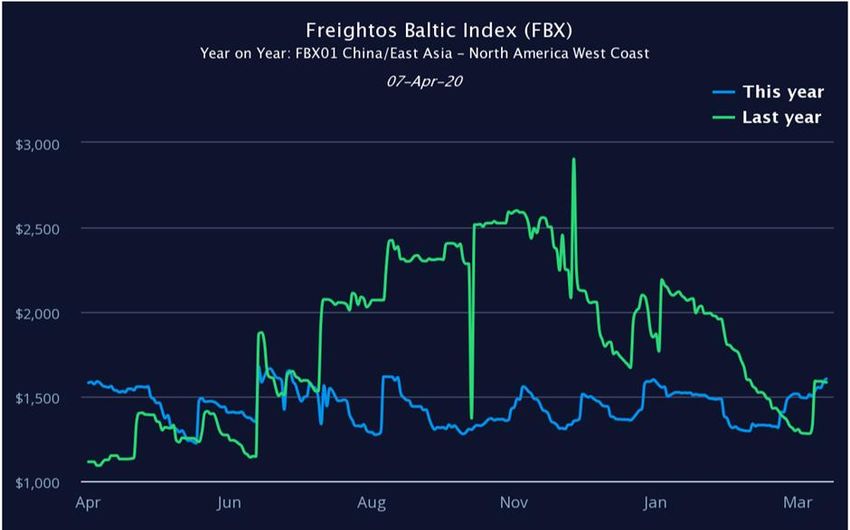
Ocean freight overview
As the COVID-19 pandemic continues and nations across the globe take measures to contain it, the impacts
on the supply chain have been dramatic and fast-changing. Over the past week, we saw disruptions continue
to accelerate. As governments extend lockdown periods, manufacturers are required to extend plant closures
and shipping lines to adjust their schedules. Port congestion continues to increase, and storage capacity is
becoming increasingly limited.

This is leading to uncertainties and lack of visibility regarding global demand for ocean freight transport. The
container market continues to remain volatile this week. This is due to container stock imbalance worldwide,
ongoing lockdowns, blank sailings and eroded service reliability. We believe that in order for markets to
stabilize, we need to see some combination of evidence of successful virus containment, clarity on the net
economic impact and a concerted global policy response.

The continuing recovery in the Asian markets is leading to some recovery of the freight rates for the East
Asia – North America and East Asia – Europe trade lanes.

Blank sailings and longer transit times

Blank sailing notices from carriers for April are being announced on a daily basis. While rapidly decreasing
f uel costs might tempt carriers to persist with this tactic as the primary defense for a little while longer, the
need to preserve cash may soon force lines to lay up vessels.

The sudden massive volume of blank sailings announced in recent days is set to create new records in terms
of the inactive containership fleet, which analysts at Alphaliner are now saying will exceed the 3 million TEU
mark f or the first time, meaning some 13% of the entire global box fleet will be out of work.

Among the carriers who have announced blank sailings this week are: Hapag Lloyd, APL, CMA CGM, ONE,
2M Carrier Alliance (MSC, Maersk).

This week’s Ocean Insights update lists 761 blank sailings across 396 services on three major trade lanes.
The actual number is likely to be higher since there is no detailed overview of blank sailings for smaller
intraregional services. It is expected that volume loss alone from the blank sailings will cost the top 15
carriers more than 6 billion US dollars in 2020, rendering the industry loss-making in 2020 and reversing the
prof it of 5.9 billion US dollars that the top 15 carriers earned combined last year.

MSC announced their new Suspension of Transit (SOT) program last week. This is a flexible cargo service
that will help to meet the imminent resumption of demand from Asia and ensure service continuity. It includes
container yard storage in six transshipment hubs across Asia, the Middle East, Europe, Africa and the
Americas, ensuring that goods can be shipped close to their destinations as soon as possible and providing
easier cargo flow for clients.

To mitigate the elevated risk of operating losses, shipping lines may consider off -hiring chartered tonnage
wherever possible and laying up owned units to preserve cash in the event of a prolonged demand downturn.

According to Drewry, cargo owners may expect significant service disruptions this year, with more blank
sailings and most likely a number of service suspensions.

Due to the unexpected reduction in fuel costs, shipping lines are extending round-trip voyages to absorb
capacity. This is causing longer transit times. For example, some carriers are opting for sailing via South
Af rica instead of the Suez due to low fuel and high Suez costs. Others are combining sailing schedules to the
east and west coast of the USA, which also causes a significant increase in transit times.

                             Coronavirus (COVID-19) Impact Report   Rev # 0   deugro-group.com   April 09, 2020   Page 4 of 29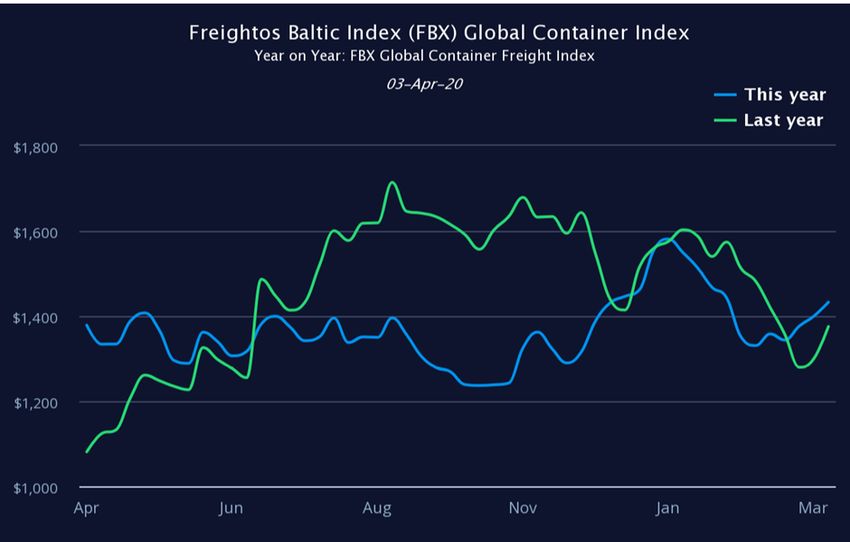
Commercial overview: Containers

The blank sailings implemented globally are leading to fully booked vessels , requiring longer booking times to
ensure space availability.

Due to this limited service availability, we are seeing volatile container f reight rates. This is shown in the year-
on-year comparison of the Freightos Baltic Global Container Index™ (FBX) as shown in the figure below. The
FBX is a set of indices that reflect ocean container transport spot freight rates across 12 global trade lanes.

            Figure 1: Year-on-year Freightos Baltic Global Container Freight Index™

The gradual restart of industrial activities in China has led to a f reight rate increase this week, reaching last
year’s levels of the China / East Asia – North America West Coast trade lane. This can be seen in the figure
below.

           Figure 2: Year-on-year FBX China / East Asia – North America West Coast freight index

                              Coronavirus (COVID-19) Impact Report   Rev # 0   deugro-group.com   April 09, 2020   Page 5 of 29
Breakbulk and chartering
Charter rates continue to be under pressure due to disrupted commodity supply and economic distress in
major demand centers. Rates are expected to remain volatile in April 2020 as many countries across the
globe continue to be under lockdown due to the COVID-19 outbreak, resulting in sluggish commodity trade.
The positive news for dry bulk ship owners is that the situation in China is normalizing. It seems the worst is
over f or China and the country’s economic activity will pick up pace over the next couple of months, giving a
positive outlook for the country’s steel production as well as iron ore and coal imports.
Breakbulk carriers are trying to increase freight rates from the Far East to Southeast Asia due to the fact that
the situation is not very transparent with regards to heavily infected areas, and what sort of an outcome that
has on available cargo. Carriers are a bit unsure if they will find sufficient cargo to export from Southeast Asia
to the next favorable loading position.
The Baltic Dry Index, which measures the cost of shipping goods around the world, continues to strengthen
in April because the gradual restart of industrial activity in China has led to improved demand for shipping
vessels. For the first quarter of 2020, however, the index slipped more than 40% since the rapid spread of
the coronavirus around the world led to shipping restrictions and weakened demand for dry bulk vessels.
Figure 3: Baltic Dry Index
Coronavirus (COVID-19) Impact Report Rev # 0 deugro-group.com April 09, 2020 Page 6 of 29COVID-19 port restrictions
With countries across the globe announcing further restrictions, which may also differ from one another,
keeping track of these for ships and crews is challenging.
To help making this easier, we would like to share the COVID-19 Port Restrictions Map produced by
Wilhelmsen Ships Service. It provides status updates twice per day of restrictions at a click on countries and
ports. Locations with updated information from within the last 24 hours are highlighted. The map can be
viewed at:
https://www.wilhelmsen.com/ships-agency/campaigns/coronavirus/coronavirus-map/
Figure 4: COVID-19 Port Restrictions Map by Wilhelmsen Ships Services
Equipment Imbalance
Carriers are rapidly reducing head haul capacity through blank sailings. This risks a shortage of equipment
being imported for backhaul volumes.
Container imbalance remains, with the majority of equipment surplus seen in Asia. Even though production in
Asia is steadily increasing, the reduction in demand in Europe and the USA is leading to further blank
sailings. With the shortage of equipment in Europe and the USA, shippers are facing a challenge with exports
as demand in China starts to recover.
The graph below shows an overview of the current container availability worldwide for calendar week 15. The
data is based on CAx (Container Availability Index).
Last week’s trend of the increasing deficit in equipment availability in Europe and USA continues. The main
change f rom week 14 is the resumed availability of all types of containers in India.
Coronavirus (COVID-19) Impact Report Rev # 0 deugro-group.com April 09, 2020 Page 7 of 29Region Port 20' DV 40' DV 40' HC
Shanghai
Qingdao
Asia
Singapore
Port Kelang
Genoa
Rotterdam
Europe
Antwerp
Hamburg
Africa Durban
Chicago
North America
Los Angeles
India Nhava Sheva
Figure 5: Calendar week 15 | Container availability worldwide (Source: xChange)
Red – Def icit of containers (incl. full and empty units, SOC and COC)
Green – Surplus of containers (incl. full and empty units, SOC and COC)
Coronavirus (COVID-19) Impact Report Rev # 0 deugro-group.com April 09, 2020 Page 8 of 29Oil price impact
The rapid spread of the coronavirus is weakening the short-term global economic outlook and oil demand,
resulting in a very large oversupply.
The oil market is under pressure from both shrinking demand and growing supply. Much lower economic
activity due to the unprecedented lockdowns in much of Europe, the USA and many other countries is
significantly reducing oil consumption. It is expected that demand will fall by several million barrels per day in
2020 compared with 2019.
Figure 6: Historical and forecasted crude oil bunker prices from 2010 to 2022 (Source: Maritime Strategies International)
Beyond IMO 2020
The introduction of a global 0.5% Sulphur cap on January 1, 2020 means that the vessels are now burning
Very Low Sulphur Fuel Oil (VLSFO) rather than the IFO 380 (Intermediate Fuel Oil) they were using last year.
Looking at the Ship and Bunker’s Global Top 20 Ports Index, which tracks bunker prices across 20 of the
world’s top bunkering markets, the monthly average VLSFO price for March was 351.50 US dollars per
metric ton. There was a sharp fall from January when the VLSFO price was higher, but as you can see from
Figure 6 above, the trend going forward for VLSFO is an upward increase.
The collapse of marine bunker prices was a surprise, so soon after the rise in costs caused by the IMO 2020
low sulf ur regulation. The rapid fall in the price of bunker was brought about by last month’s dramatic 50%
decline in the price of crude.
Coronavirus (COVID-19) Impact Report Rev # 0 deugro-group.com April 09, 2020 Page 9 of 29Air freight overview
The air f reight industry is enduring the heaviest impact by the spread of the coronavirus and by the
restrictions across the globe.
Airlines continue to follow stringent cost-saving measures and to have reduced and/or suspended flight
operations. It is estimated that at least 8,500 aircraft are currently parked and only around a quarter of the
global capacity is in operation. As a result of this situation, the available air freight space and capacity in the
market continue to be very limited and reduced or, in some cases, not available any longer. The severe cut in
capacity and the demand-driven requirements have led to a significant increase in air f reight rates and major
commercial fluctuations of rates.
The grounding of further aircraft continues as a consequence of further lockdowns and closures of
manuf acturing facilities in many countries. Cargo capacity remains limited, and the available space is being
prioritized for premium paying customers as well as medical and essential item shipments across the globe,
which of ten leads to goods classed “non-essential” being bumped off booked flights.
A number of airlines have started to make long-term business decisions to reduce capacity, flight operations
and administration by retiring aircraft permanently. This is because the recovery of the air f reight industry is
expected to take years and not return to pre-COVID-19 levels, global travel bans are expected to remain in
place f or several more months and the return for high demand for air travel will potentially take years to return
to “normal.”
The majority of international airports is still operational, even though international flights have been fully
suspended or extremely decreased to only a small number of flights, allowing only cargo and repatriation
services. Freight forwarding is still possible, but with very limited connections for all cargo.
Capacity
COVID-19 has led to a significant change in supply, considering that approximately 75% of the global
capacity is now freighter capacity, with only 25% belly capacity remaining in the market on international
passenger flights.
Most commercial air f reight carriers have temporarily stopped and/or reduced their passenger flights, which
has led to significant loss in cargo belly capacity as a contributor to cargo capacity on most of the main trade
lanes. Cargo transportation seems more robust than passenger traffic and remains in high demand for
medical supplies, food and other essential items. The transformation of airlines’ passenger aircraft into cargo
jets continues.
The situation of fully booked freighter operations will prevail until the end of May. Most aircraft are in the air
nearly nonstop or waiting to be processed at airports, which experience has shown leads to a backlog of
cargo for import and export loading activities.
Aircraf t availability for charters continues to be scarce; however, there are still options available for part
charters (20 MT and up), as well as full-charter cargo delivery in the event of a lack of capacity on scheduled
lanes. For smaller sized cargo that fits through belly-deck cargo doors, there is plenty of available options
using wide-body passenger aircraft (e.g. B777, B787, B767, A330) for cargo-only charters.
Heavy ramp aircraft suitable for project cargo (AN-124 and IL-76) are being used to move critical medical
goods, which is causing a continuous lack of capacity for any time-critical project cargo.
Coronavirus (COVID-19) Impact Report Rev # 0 deugro-group.com April 09, 2020 Page 10 of 29Rate trends
Air f reight rates continue to surge and change by the hour, since urgently needed medical supplies are
prioritized, with premium surcharges applied. Previously agreed rate and capacity agreements remain
suspended or are subject to an increase. For many routes, the validity of freight rates is tied to space
capacity at the point in time that the quote was provided, even for premium rates.
It has been noticed that noncritical general cargo is more often taken off planes again to make space for
(more profitable) critical goods.
Some carriers have introduced a stricter process of advance payments and penalties for cancellations,
putting added pressure on operations.
The backlog of cargo at its origins continues to grow, since space is tight and warehouses at destinations are
f illing up with cargo not collected by the consignees due to lack in consumer goods being purchased.
All charter prices are based on availability at the time of the scheduled uplift and are currently very fluid in line
with demand. Charter rates vary, but, in general, air charter rates are significantly more expensive than a few
months ago.
Intercontinental air freight traffic to and from Europe
As demand for medical equipment to fight the spread and impact of COVID -19 continues to increase, we are
seeing a similar situation to the previous weeks’ status for intercontinental air freight traffic to and from
Europe:
• Europe WESTBOUND (to North and South America): The situation remains critical and subject
to rate increases and scarce space availability as airlines continue with the reduction of their
f leets.
• Europe EASTBOUND (Europe to Far East): The situation remains critical and subject to rate
increases and scarce space availability as airlines continue with the reduction of their fleets. A
minimum of 10 days prenotice is required with most airlines.
• Far East to Europe: Enormous amount of demand for aid and relief charters, with rate levels
extremely high. Availability is very scarce and needs to be confirmed on a daily basis.
deugro’s dedicated air charter team is in constant communication with its strategic airline partners to
ensure access to the capacity required for our clients.
Coronavirus (COVID-19) Impact Report Rev # 0 deugro-group.com April 09, 2020 Page 11 of 29Intra-EU, cross-border cargo transfers
In the attempt to slow the spread of the coronavirus, EU countries and Russia have officially closed their
borders to all but essential travel. Cross-border trucking of cargo is possible, to allow keeping supply chains
open.
Many loading and unloading points are currently experiencing long waiting times due to extensive security
checks, reduced staff and shortened opening hours.
The transit time in pre- and on-carriage might be elongated slightly due to the reduced freight capacity, truck
availability, and extended processing times at border controls as well as the strict sanitary measures in place.
On the website covid-19.sixfold.com, you can easily monitor the
expected times that trucks are currently spending for crossing
intra-EU borders.
Figure 7: Sixfold website map with border crossing time (dated April 8, 2020)
The border crossing time is the average time that trucks spend in the border crossing corridor. These
corridors are approximately 10 kilometers long; their centers are displayed on the map.
Coronavirus (COVID-19) Impact Report Rev # 0 deugro-group.com April 09, 2020 Page 12 of 29EU travel advice and border measures
The EU travel restrictions remain in place, in the national governments’ attempt to contain the spread of the
coronavirus across Europe. All EU member states, except Ireland, and all Schengen-associated countries
(Iceland, Liechtenstein, Norway, Switzerland) have applied the restriction of non-essential travel from third
countries into the EU.
Below is a map showing various restrictions implemented by countries across Europe:
Figure 8: Restricted movement of people across the EU, except Ireland
Rail freight development
The lack of air freight capacity and ocean carriers seems to have triggered a shift of cargo movements to rail
f rom China to Europe. It is reported that rail traffic saw a year-to-year increase of 28% and the number of
departures (805 trains) and volumes (approx. 73,000 TEU) increased significantly in the month of March; a
record-breaking month since the history of Eurasian rail freight traffic.
Such developments demonstrate that the market is looking for and finding ways to increase cargo flows.
Coronavirus (COVID-19) Impact Report Rev # 0 deugro-group.com April 09, 2020 Page 13 of 29Current operational status of our branches
Figure 9: Current operational status of deugro branches (April 8, 2020)
Dark Gray – Branch operational, personnel working remotely from home
Medium Gray – Branch operational, staff on rotation
Blue – Branch operational, with no restrictions in place
Coronavirus (COVID-19) Impact Report Rev # 0 deugro-group.com April 09, 2020 Page 14 of 29Country updates
As some markets/countries are more in the spotlight due to the intensity of the virus spreading
or due to their importance in logistics, we want to provide an update for some of those markets
on the following pages.
It aly 16
Germany 16
Spain 17
Franc e 17
Denmark 17
Russia 18
United Kingdom 18
B enelux 18
Scandinavia 19
Sout hern Af ric a 20
B razil 21
Chile 21
P eru 21
United St ates of America 22
Canad a 22
China 23
Sout h Korea 24
Jap an 24
Indonesia 25
Myanmar 25
Singapore 26
Malaysia 26
Viet nam 27
Thailand 27
Ind ia 28
Middle East 28
Coronavirus (COVID-19) Impact Report Rev # 0 deugro-group.com April 09, 2020 Page 15 of 29Europe
Italy
All branches operational, with personnel working remotely from home
The Italian government announced the extension of the country lockdown of all non-essential industries and
services, with effect from March 23 until April 14.
No restrictions have been imposed for domestic cargo movements.
Although ports and airports are exempted from the coronavirus lockdown, nearly all cargo
suppliers will remain closed. All non-essential industrial and commercial production activities are
suspended.
Ports and terminals are exempted from the coronavirus lockdown and are running normally, with
little impacts or delays. Space is extremely limited, and vessels are overbooked.
Most passenger flights to/from Italy remain suspended, whereas cargo flights are operational with
reduced space availability.
Milano Linate Airport and Milano Malpensa Terminal 1 are temporarily closed.
Germany
All branches operational, with personnel working on rotation and remotely
Domestic transportation within Germany remains operational without any restrictions or impacts.
However, because some shippers and manufacturers are working with reduced staff numbers,
trucks may have extended waiting times for loading. Cross-border traffic is experiencing delays,
longer transit times as well as limited availability of trucks for all trade lanes due to additional
controls at German borders.
Presently, there are no changes in the performance of terminals in German ports, i.e. Hamburg,
Bremerhaven and Cuxhaven. However, some terminals are experiencing an increase in (full)
equipment remaining in the terminals because containers are not being collected from the
receivers.
We expect that space in the terminals in Germany will further reduce due to import containers that cannot be
cleared by customs and delivered to the factories, manufacturing yards or receivers due to potential closures
of said facilities and their warehouses in the coming days.
However, as fewer import containers from the Far East are expected to arrive in the ports in Germany in the
coming weeks, the terminals are confident that the current situation will improve soon and no major impacts
on perf ormance are to be expected.
Airports in Germany remain open and operational, with cargo flights dominating the activities. Due
to lack of belly space, most airlines require prenotices of up to 10 days.
Coronavirus (COVID-19) Impact Report Rev # 0 deugro-group.com April 09, 2020 Page 16 of 29Spain
Branch operational, with personnel working remotely from home
Freight transport remains exempted to guarantee economic activity and the supply chain.
Ports in Spain are maintaining their level of activity without major delays.
For general cargo, we note a clear decrease in the availability of standard containers. Shipping
lines have announced rate increases.
Airports remain operational for cargo shipments; however, this transportation mode is severely
af f ected by the cancellation of international passenger flights.
France
Branch operational, with personnel working remotely from home
Despite the lockdown of the entire country, no restrictions are in place for domestic cargo
transportation. Cross-border cargo transfer traffic is experiencing minor delays due to increased
border controls.
Labor shortage in ports and terminals continue to impact all port activities, as well as the increase
of blank sailings, equipment availability and vessel rotations.
All traf fic at Orly Airport is currently suspended, whereas Paris-Charles De Gaulle Airport is
operational with a focus on freight cargo flights.
Denmark
Branch operational, with personnel working remotely from home
Denmark’s borders remain closed, only allowing cross-border cargo transportation, which faces
small delays due to border checks. An increasing imbalance in markets is impacting the price of
transportation. Especially prices for imports from southern Europe are increasing due to lack of
equipment and drivers.
All ports are operationally, and deliveries of containers related to ocean freight transports
continue. Delays are expected at the suppliers’ loading facilities, as well as terminals, due to blank
sailings. An increase in rates in general due to a general imbalance, lack of equipment and lack of
sailings has already been implemented on the container market.
All airports remain operational, despite passenger flights being suspended, whereas cargo flights
are operational with reduced space availability.
Coronavirus (COVID-19) Impact Report Rev # 0 deugro-group.com April 09, 2020 Page 17 of 29Russia
All branches operational, with personnel working on rotation and remotely
As of March 30, Russia has temporarily restricted any movement by road, rail, foot and river and
at combined border-crossing points, including the overland section at the Russia‒Belarus border.
Restrictions do not apply for drivers and cross-border trucking of cargo.
There are currently no restrictions or impacts on ocean freight and port operations.
All regular and charter flights to other countries have been suspended.
United Kingdom
Branch operational, with personnel working remotely from home
No major disruptions in domestic or international road freight have been noticed so far. Equipment
and driver availability remain stable.
UK’s main ports (Felixstowe, Liverpool, Southampton and London Gateway) remain open. With
strict access and additional health controls in place, all ports are congested and lead times
slowing. Loading facilities and warehouses face space limitations and slower processing.
London Heathrow remains open for cargo business. British Airways is suspending all its flights to
and f rom London’s Gatwick Airport.
The airport ground handling company Dnata has furloughed a “large proportion” of its staff and will
implement new terminal handling charges in the UK starting on April 9.
Benelux
Branches operational (Rotterdam and Antwerp), with personnel working
remotely from home
No major disruptions in domestic or international road freight have been noticed so far. Equipment
and driver availability remain stable.
The Ports of Antwerp and Rotterdam are still operational with minor disruptions due to lack of
equipment. Special equipment needs to be booked at least three weeks in advance.
Coronavirus (COVID-19) Impact Report Rev # 0 deugro-group.com April 09, 2020 Page 18 of 29A continuous increase in blank sailings to the USA and Far East have been noticed, as well as reduced
scheduled sailings (bi-monthly, not weekly) on certain trade lanes from the northwest continent, which have
an impact on both space and equipment availability.
The Port of Antwerp continues to restrict external people and companies from entering their premises, i.e. no
surveyors, freight forwarders or cargo owners, in order to safeguard the staff currently working.
Airports are operating with limited capacity. Most international flights are suspended, whereby
cargo flights continue.
At Schiphol Airport, up to 90% of Air France-KLM group capacity has been cut, with just a few
scheduled services and repatriation flights operating.
Scandinavia
Branch operational, with personnel working remotely from home
No major disruptions in domestic or international road freight have been noticed so far.
The EU-wide trend of closing national borders and additional checks will result in longer transit
times in international trucking, and is expected to limit ferry connections available (lat ter
concerning mainly Finland).
No blank sailings have been announced for feeder services from Scandinavian countries so far.
The transit times to final destinations are, however, affected due to the blank sailings of shipping
lines on main voyages. Equipment imbalance affects transit times and has led to an increase in
rate levels.
All main airports remain operational with the majority of passenger flights suspended, affecting the
cargo freight sector. Compensatory services are limited, and the main solution will be road freight
to European hubs.
Coronavirus (COVID-19) Impact Report Rev # 0 deugro-group.com April 09, 2020 Page 19 of 29Africa
Southern Africa
Branch operational, with personnel working remotely from home
The government of South Africa decided to implement a national lockdown for the entire country starting on
March 27. This lockdown will end on April 17. All businesses, except those providing items for basic needs,
security and medical care, are closed. If operations can be maintained remotely, this is permissible.
Domestic road freight is only allowed to move essential goods such as pharmaceuticals, food,
coal, and household goods, and only through transporters who are registered and hold a
certif icate to carry essential goods. As international road freight only, essential goods are
permitted to be moved.
Other southern African countries are implementing different strategies to cope with the coronavirus impact:
Zimbabwe
The entire country has been in lockdown since March 30, until further notice, but will remain open for the
transport of essential equipment. If South Africa suspends any truck movements via Zimbabwe, there may be
too many police stops and additional costs.
Botswana
The country is still operating as normal; however, it is expected that a 14-day quarantine on all foreign drivers
will be imposed soon. The Kazungula ferry crossing is currently problematic, due to congestion and only one
f erry running, along with high water levels so ferries can only work limited hours per day.
DRC – Kasumbalesa/Lubumbashi
A border closure of two days early last week was implemented in order to impose restrictions and protocols
f or drivers arriving into DRC. This led to long delays, since the 48 hours turned into almost three days. There
is currently a 56-kilometer line for trucks trying to get to the Kasumbalesa border post.
Zambia
The country may impose a 14-day quarantine period on all foreign drivers.
Tanzania
The Tanduma border appears to be open for business. The government is hesitant to announce a f ull
lockdown.
Ports are only accepting essential cargo at the moment and requesting essential goods carrier
certif icates. Ports are also operating on skeleton staff, which has resulted in some delays.
All non-essential cargo is being taken to depots by carriers until after the lockdown period.
Shipping lines have established an integrated committee (SAPS, CUSTOMS, DOH, TPT) to expedite and
assist with processing genuine essential goods entering and leaving the port. No other goods are permitted
to enter the ports. Containers are being opened and checked randomly to confirm their content.
As per the South African government, no rate increases will be allowed during this time.
The mmajority of flights have been canceled, causing delays in receiving or exporting air f reight
cargo. Only essential goods are being allowed to be delivered, with clients being given the
certif icate of “essential service provider” as well as certain ITAC permits, which are being required.
Non-essential cargo is remaining with the handling agents.
Americas
Coronavirus (COVID-19) Impact Report Rev # 0 deugro-group.com April 09, 2020 Page 20 of 29Brazil
Branch operational, with personnel working remotely from home
All borders to neighboring countries are closed and entry is not permitted for all foreigners, with a
f ew exceptions.
Cargo f lows are not restricted, but trucking is limited, and delays are to be expected.
There are no presential customs officers available, and only clearance via the system is possible.
A special import customs scheme is currently taking significantly longer. Ports are operating
normally; no impact as of now at all on the operational side. Some port calls have been canceled
on the outbound, and the consolidation of volumes is targeted, mainly on RO/RO services.
All air traf fic routes are heavily impacted, because passenger flight capacity globally has
collapsed. Air freight cargo is only being accepted on the basis of priority bookings.
Rates f or the air freight are with very short validity and the price level is much higher.
Chile
Branch operational, with personnel working remotely from home
Borders to neighboring countries are closed for transit of people but remain open for the transfer
of general cargo with Peru, Argentina and Bolivia.
All ports are closed for entry/transit of people, but currently remain open for import/export of cargo.
Carriers and terminals have implemented a shift work system, therefore no major impact to
operational performance or rates has been experienced at this point.
All airports are operational for cargo transfer, while passenger traffic has been suspended at
almost all airports, which also brings commercial cargo flights to a standstill.
Freighter f lights are operational, but limited space and availability have caused rates to increase.
Peru
Branch operational, with personnel working remotely from home
All borders to neighboring countries remain closed, and domestic transportation is limited. Cross-
border transportation is restricted to movement during daytime hours only, with a curfew in place
af ter 6 p.m. All transported cargo must be accompanied with a customs form stating its origin, and
drivers need to be able to present work certification to authorities.
The majority of ports are fully functional, but staff shortages of 30‒45% at terminals are leading to
minor delays in handling operations.
All passenger air traffic is suspended; only cargo aircraft is allowed to land. Miami is used as a
hub airport for supplies and all foreign shipments.
Coronavirus (COVID-19) Impact Report Rev # 0 deugro-group.com April 09, 2020 Page 21 of 29United States of America
Branch operational, with personnel working remotely from home
There are no restrictions on road freight as of yet. Borders to Canada and Mexico remain open to
commercial traffic for essential goods. Several states have enacted complete lockdowns, and their
number is increasing. Most cargo vendors or receivers continue to work but are encountering
delays in loading/unloading operations due to staff shortages.
Most ocean terminals remain open and fully operational but operate with limited gate hours due to
low cargo volume caused by blank sailings. Vessels are fully booked and new bookings require
longer lead times due to increasing numbers of blank sailings to/from the USA.
Major airports remain open, despite reduced air traffic. Airlines are trying to compensate for lack of
capacity by increasingly utilizing passenger aircraft, which is leading to increasing rate levels
to/from the USA.
Canada
Branch operational, with personnel working remotely from home
International borders are open to commercial traffic with the CBSA customs office working to
f acilitate the movements of goods. There are currently no changes to any import/export
processes. Borders remain closed for non-essential goods. A shortage of drivers is becoming
more apparent, making securing loads to/from the USA difficult. Some breakbulk and heavy lift
trucking companies are no longer sending drivers to the USA.
Ports are still open and operating but starting to closely monitor the backlog of containers on the
dock since businesses are closed and not receiving freight.
The ports of Montreal, Halifax and Vancouver are running at full capacity and no vessel or rail
cancellations have been reported so far. Canada National Rail is ready to ramp up its capacity as
required to alleviate the pressure on long-haul truck drivers.
CBSA – Canada Customs
CBSA is making progress towards the expanded use of e-mail and fax in lieu of paper submissions of
commercial documentation. The f irst wave of ports to offer e-mail service will be Vancouver, Toronto,
Windsor, Montreal and Halifax. Additional offices will go online shortly. Commercial clients are encouraged to
communicate with their local CBSA office to determine their state of readiness and the best method currently
available.
Airports remain open, but domestic services, as well as cargo services, are extremely limited.
The only dedicated air freight cargo operator (Cargojet) is facing extremely high volumes of
health-care and essential supplies, which will potentially lead to road transportation having to take
the overf low from imports via the USA.
Coronavirus (COVID-19) Impact Report Rev # 0 deugro-group.com April 09, 2020 Page 22 of 29Asia and Far East
China
Branch operational, with personnel working on rotation
An increasing amount of production is being seen in China as workshops, fabrication yards and suppliers
resume work again and workers return to their workplaces. In Hubei Province, where COVID-19 started,
normal lif e has resumed with the lifting of certain lockdown restrictions. It is expected that the authorities will
lif t all remaining measures in place by April 8, 2020.
Inland trucking in China has been further restored up to about 95%, including transports between
provinces. Transport to and from Hubei Province is gradually being eased. People are allowed to
enter Wuhan City again but leaving is still restricted.
With production in China ramping up again after an extended shutdown at the start the year,
severe levels of congestion at the major ports are forecasted. To cover the high volume, larger
ships will be deployed to meet the expected upsurge in demand in April.
Container carriers continue to announce schedule changes and blank sailings at short notice. This increases
the risk that loaded containers may be blocked at their origin for some time, with potential container
demurrage/detention costs.
Equipment availability remains a core issue as well. For FCL, we see up to four weeks’ prenotice for space
and equipment allocation on certain trades. A recent development for FCL we are observing is that carriers
only give very short rate validity periods and rates are basically changing daily.
With regard to breakbulk services, fewer vessels are available as a result of lower demand. But the impact
should be evaluated on a case-by-case basis depending on the port of loading, on the cargo and trade lane.
Most airlines have implemented stringent cost-saving measures and, meanwhile, have announced
they will reduce their flights significantly and/or stop flight operations.
While the overall situation remains very volatile and uncertain in terms of air freight rates, space
and service availability, we are observing that several airlines will enhance their freight services
tof rom/ China in the coming weeks, which should have a positive impact. It is expected that for the coming
one to two weeks, the air freight options will remain severely limited and prices as well as service options will
remain highly dynamic.
Additionally, air f reight validity remains very short and more and more agents are asking for advance
payments for air f reight.
We continue to recommend a minimum of two weeks’ prenotice for air freight arrangements.
It is uncertain how long this situation will last, but most airlines are talking in terms of months in their
announcements and it is expected that this will last well into Q2/2020.
Coronavirus (COVID-19) Impact Report Rev # 0 deugro-group.com April 09, 2020 Page 23 of 29South Korea
Branch operational, with personnel working on rotation
Strict 14-day quarantine rules have been implemented for foreign visitors entering the country.
There are no specific restrictions for inland trucking within South Korea. However, there is an
increase in demand, which is why we suggest allowing for a one-week lead time to arrange
transport.
All international ports and terminals remain operational, without any major impacts or delays. Due
to the accident at Busan New Port on April 6, its seventh berth is expected to be out of order for a
couple of months until container bridges are restored.
Port congestion is a f actor leading to delays in the berthing of container vessels as well as in
container releases from the terminal. There is less space and fewer voyages due to blank sailings by most
container carriers. It takes longer to secure space, especially on the Far East to Europe and the Middle East
route. Carriers are demanding higher freight charges due to change of vessel partners or alliances.
International airports are operational. A drastic reduction in passenger flights remains. Freighters
continue to operate, with South Korea’s national airline deploying their passenger planes on
cargo-only routes. Air freight rates are increasing significantly depending on service route, and
over a week lead time is required to secure space.
Japan
Branch operational, with personnel working remotely from home
Japan’s government has declared a month-long state of emergency as of April 4. Despite the
restrictions this entails, across several prefectures, there are no restrictions on local transportation
in Japan as of yet. Many manufacturers for general goods suspended their production lines at the
end of March, until further notice. Manufacturing of oil and gas vendors still seems to be
operational, but limited due to shortages in staff.
All major ports are still fully operational; however, all trade lanes are impacted in terms of their
schedule, space and rates. Port congestion in the entire Southeast Asia region is increasing.
The cargo terminals are f ully operational, but impacted due to lack of space availability, reduced
schedules and an increase in air freight rates on all trades.
Coronavirus (COVID-19) Impact Report Rev # 0 deugro-group.com April 09, 2020 Page 24 of 29Indonesia
Branch operational, with personnel working on rotation
The impact on road freight remains limited; however, the situation could worsen should the
authorities implement a full lockdown of the city of Jakarta. This means cargo would not be able to
be trucked out of or into the Jakarta area and the Port of Tanjung Priok. Sudden road closures are
impacting current deliveries.
No major impacts on outgoing services have been experienced so far; however, because
Indonesia is mainly an import country, we have noticed vessel delays or cancellations at their
origins.
Reduction of capacity and services continues, since airlines have grounded most of their aircraft
f leet, heavily impacting cargo services and air freight levels. Increases in rate levels, or no service
availability, are common.
Myanmar
Branch operational, with personnel working remotely from home
Significant shortage of available drivers both due to the COVID-19 situation as well as due to
upcoming national holidays lasting from April 10 to 19. Movement is restricted over those days.
International road border crossing remains open with restrictions; longer waiting time at borders is
expected. Myanmar’s customs authorities allow only one person at a time in the customs office. Customs
of fices will be completely shut down during the upcoming national holiday period, with additional days off,
f rom April 8 to 19. Unlike previous years, there will be no possibility to work overtime during the Thingyan
holidays. Essential commodity 160 lines are now available with an online application for the import/export
license.
Ports are f ully operational, but sailing schedules are largely impacted by blank sailings at their origin. Rates
are f ollowing a similar trend to the rest of Southeast Asia, with increased prices and surcharges.
The Ministry of Transport issued a circular on March 29 stipulating the suspension of all
international flights to/from Myanmar. The suspension does not affect cargo and charter flights.
The loss of belly space will lead to increased rates as the availability of space becomes scarcer.
Impacts on the main airports (reduction of working hours, closures or delays, manpower, etc.) are
being f elt.
Coronavirus (COVID-19) Impact Report Rev # 0 deugro-group.com April 09, 2020 Page 25 of 29Singapore
Branch operational, with personnel working from home
Singapore has gone into partial lockdown from April 7 to May 4, 2020.
Only essential services are allowed to operate. Transport and logistics are part of essential services; hence,
deugro is registering with the government to operate with minimum office staff.
There are no bans on cargo trucking within Singapore, and we do not see any challenges in
operational capabilities at this time. The new lockdown situation is expected to slow down
communication of suppliers and subcontractors in the coming days.
The most affected trade lanes remain Europe, India and the USA, with rate levels increasing.
Despite port operations still running, carriers are increasing blank sailings and crews are not
allowed to disembark. Sailings to the Middle East remain fully booked, but intra-Asia services are
stable.
Terminals are operating as usual 24/7. However, passenger flights have been reduced drastically
and a significant portion of cargo space now occupies passenger planes’ belly holds. Rates are
quoted based on consignment details and space availability.
Malaysia
Branch operational, with personnel working on rotation
Despite restricted movement rules in place until April 14, domestic transport is still allowed, but the
government has strict measures in place based on a classification system. Non-essential and
essential goods need a permission letter from the respective ministry (MITI). Checks under the
Movement of Control Order (MCO) are common.
Main ports are operating as usual, but delays can be expected due to manpower reduction.
Terminals are operating as usual for cargo, yet passenger flights remain restricted. Space
availability is limited, and rates are higher than usual.
Coronavirus (COVID-19) Impact Report Rev # 0 deugro-group.com April 09, 2020 Page 26 of 29Vietnam
Branch operational, with personnel working from the office
Domestic transport is currently operating as normal. Cross-border and long-haul movements are
unstable, and trucking companies are reluctant to accept long-haul cargo. The reason being that
there are strict measures in place for health checks at the borders and a mandatory 14-day
quarantine f or drivers upon return.
Ports are operating as usual, with blank sailings on the increase, leading to space constraints.
Rate increases are expected for April as demand in China resumes and space reduces.
Vessel crews of arriving vessels must be checked for coronavirus infections by the port authority
during anchoring.
A significant impact on rates and space is seen due to major regional and international flight
cancellations that consist of nearly all air traffic. Limited freighter capacity remains. Pricing is
theref ore extremely volatile, depending on the trade lane, and we advise booking with an
increased lead time.
Thailand
Branch operational, with personnel working from the office
All border stations remain closed to foreigners and only allow commercial trucking, diplomats, ship
crew, pilots, etc. who have the prime minister’s approval to enter Thailand. If performing cross-
border trucking, they need to have proper identification to be permitted to cross and re-enter
Thailand. All Thai workers entering back into Thailand may be asked to quarantine themselves for
14 days. Throughout Thailand, there are 300+ major roadblocks testing people’s temperature for disease
control.
Trade lanes most impacted are ports in East Asia. Feeder ships have been canceling and
rescheduling due to restrictions and delays in other ports. There are empty sailings to Thailand
picking up single shipments. Special equipment is becoming more and more scarce; a situation
worsened by the continued slow pace of demand. There may be delays for berthing if a ship has
been previously quarantined due to the crew’s exposure to COVID-19.
All international border stations are closed to foreigners. Exceptions include commercial trucking,
diplomats, ship crew, pilots, etc. who have the prime minister’s approval to enter Thailand. Due to
f light cancellations, shortage of space availability should be expected.
Coronavirus (COVID-19) Impact Report Rev # 0 deugro-group.com April 09, 2020 Page 27 of 29India
Branch operational, with personnel working from home
The government of India imposed total lockdown/curfew in the country until mid-April. The
lockdown has also led to all states closing their borders, which has restricted road transportation
and led to a major shortage of truck drivers, causing delays in the entire transport chain.
Vessels originating from countries seen as high risk need to ender a mandatory 14-day
quarantine prior to berthing, resulting in an increase in congestion and delays in ports. Port
operations have not been officially suspended, but owing to restrictions on people’s movement, it
is getting difficult to find manpower resources like stevedores, etc. for port operations. An
increase in rates and blank sailings is expected for the entire month of April.
Domestic and international passenger flights have been suspended to any airport in India.
International cargo flights are permitted, but the restrictions on people’s movement are affecting
cargo handling operations. Capacity shortages will lead to increased rates, and delays are
f orecasted due to limited staff.
Middle East
Branches operational, with most personnel working from home and limited
operational staff in the office
All land borders are currently closed. Trucks/drivers can expect delays of three to four days due to
medical and security checks on the borders.
Domestic trucking of containers to the consignee yard is possible within UAE.
Major shipping lines continue to operate as normal in UAE, with the impact of blank sailings
increasing. The f eeders’ services have begun to be under pressure due to road closures and
disruptions in the region. The expected “pre-Ramadan rush” will potentially not take place this year
despite it being expected by many carriers.
The majority of airlines are not operating, except for f reighter flights.
Emirates Airlines and Etihad Airlines have converted their passenger flights to carry cargo only.
Freighter f lights are high in demand. Service to certain main airports has also been canceled, with
reduced fleet operations.
For any inquiries, bookings and more information, please get in touch with your
deugro contact or local deugro group office. They are available and ready to help.
https://deugro-group.com/contact/
Coronavirus (COVID-19) Impact Report Rev # 0 deugro-group.com April 09, 2020 Page 28 of 29Useful links
The links below are for information purposes only.
Number of confirmed cases worldwide
• gisanddata.maps.arcgis.com/apps/op Air freight – General updates
sdashboard/index.html#/bda7594740f
d40299423467b48e9ecf6 • www.aircargonews.net
• aircargoworld.com
• www.aircargoweek.com
Ocean freight – General updates • www.economist.com/business/2020/0
3/15/the-impact-of-covid-19-on-
• www.seatrade-maritime.com airlines
• www.tradewindsnews.com • www.aerotime.aero
• www.xeneta.com/blog • www.tacindex.com/
• www.theloadstar.com
• www.worldmaritimenews.com
• www.hellenicshippingnews.com Oil and fuel prices
• www.lloydslist.maritimeintelligence.inf
orma.com • www.shipandbunker.com
• www.oilprice.com
Ocean freight – Global port restrictions map
• www.wilhelmsen.com/ships- Policy tracker of government responses
agency/campaigns/coronavirus/coron
avirus-map/ • https://www.imf.org/en/Topics/imf-
and-covid19/Policy-Responses-to-
COVID-19#U
Ocean freight – Equipment availability
Note: Data as of April 1‒8, 2020
• www.container-xchange.com
Road transportation – General updates
• www.iru.org/
Coronavirus (COVID-19) Impact Report Rev # 0 deugro-group.com April 09, 2020 Page 29 of 29You can also read


