COVID-19: LATIN AMERICA
GUIDE FOR EMPLOYERS
←
→
Page content transcription
If your browser does not render page correctly, please read the page content below
COVID-19: LATIN AMERICA GUIDE FOR EMPLOYERS

INTRODUCTION
Today, across the globe, companies are trying to balance the many business challenges
that are occurring due to the global pandemic of the COVID-19 virus. Employers are
doing their best to take the necessary actions to protect their employees, but with local
laws and government regulations constantly changing, it is difficult to keep up with the
most important issues.

In this white paper, the ELA members from the Latin America region have provided
answers to the important questions regarding tax relief offered due to the pandemic. This
is a guide for employers to assist in making important decisions necessary to keep
business moving forward.

We hope that this paper helps you address key issues in your jurisdiction. As the situation
is constantly evolving, readers should take note that this publication is accurate as of 20
April 2020. Readers should also keep abreast of developments since the date of this
publication.

If you have additional questions or would like to request additional information, please
feel free to reach out to the contributors individually.

Copyright 2020 Employment Law Alliance, (ELA). The Employment Law Alliance is a global
consortium of more than 3000 labor, employment and immigration attorneys in over 100
countries. This publication is not intended to provide legal advice but rather information on legal
matters and employment law news of interest to our clients, colleagues and individuals who have
requested such information. Readers should seek specific legal advice before taking any action
with respect to the matters mentioned in this publication.

CONTENTS
t
           Argentina     Supplements

           Bolivia       United States

           Brazil

           Chile

           Costa Rica

           Colombia

           Ecuador

           El Salvador

           Guatemala

           Honduras

           México

           Nicaragua

           Panama

           Paraguay

           Peru

           Uruguay

           Venezuela
ARGENTINA
Q: What tax relief has been offered to Individuals?
A: The Federal Tax Authority (“AFIP”) issued General Resolution No. 4687/2020, which
establishes that individuals registered in the Simplified Regime for Tax Payers (“Monotributo”)
will neither be excluded, nor removed from such regime due to lack of payment during the
month of March.

Decree No. 316/2020, regulated by AFIP General Resolution No. 4690/2020, extended the term
for adhering to an installment plan up to 06/30/2020 (the original deadline was 03/31/2020).
Through this plan, taxpayers are entitled to the payment of several taxes owed in up to 120
monthly installments (depending on the tax). The plan applicable to the generality of taxes
allows to include taxes owed in 8 monthly installments (for taxpayers considered as Micro,
Small and Medium Size companies) and in 6 (for other taxpayers).

Q: What incentives or tax relief packages are available to small and large companies (please
define small and large businesses under the act)?
A: As said in point B. of the previous question, AFIP issued a resolution extending the term for
adhering to an installment plan up to 06/30/2020 (the original deadline was 03/31/2020).
Through this plan, taxpayers are entitled to the payment of several taxes owed in up to 120
monthly installments (depending on the tax). The plan applicable to the generality of taxes
allows to include taxes owed in 8 monthly installments (for taxpayers considered as Micro,
Small and Medium Size companies) and in 6 (for other taxpayers).

Q: What is required of employers to qualify for tax relief?
A: The Emergency Labor and Production Assistance Program provides two main reliefs for
employers, regarding the payment of social security contributions: a general deferral applicable
to all employers and a particular deferral intended for the employers who meet certain criteria
and are registered in the AFIP’s website regarding contributions to the Argentine Integrated
Social Security System (the “SIPA”, after its Spanish acronym).

The general deferrals postpones the deadline for the presentation and payment of the sworn
statement of contributions to social security corresponding to the period accrued March 2020,
until between April 16 and 18, 2020, according to each employer’s tax ID final number.

                                 ELA.LAW – Global HR Legal Solutions                               1
ARGENTINA
In addition, the particular deferral applies for employers who meet the following criteria:

   a) Carry out economic activities which are severely affected by the crisis.
   b) Have a relevant amount of employees who are included in the mandatory quarantine.
   c) Have a substantial decrease in their sales from March 20, 2020 onwards.

The Resolution establishes that beneficiaries can be those employers whose activities are listed
on the AFIP’s website https://www.afip.gob.ar/noticias/documentos/listadode-actividades-
afectadas.pdf.

The relief consists in the postponement of the deadline for payment of employer´s
contributions to SIPA for the period accrued March 2020 until between June 16 and 18, 2020,
according to each employer’s tax ID final number.

Q: Are there any federal or government backed loans, abatements, or incentives provided to
businesses?
A: The Central Bank launched government backed loans for Micro, Small and Medium
Enteprises (“MiPyMES, after its Spanish acronym), for them to be able to pay salaries during the
lockdown. These credits are granted by any bank and guaranteed by the National Government.
They have a maximum 24% annual interest rate.

MiPyMES are defined according to their annual revenues. Each economic sector (construction,
services, commerce, mining & industry and agriculture) has its own revenue limits defining each
category.

                                 ELA.LAW – Global HR Legal Solutions                               2
ARGENTINA
Q: Have there been any changes, extensions, or modifications of the tax filing deadlines for
individuals or corporations? If yes, when do they go in affect and how long will they stay in
affect?
A:
    A. By means of the General Resolution No. 4692/2020, AFIP established an extraordinary
        administrative recess from 03/18/2020 to 03/31/2020. During such recess, procedural
        terms does not count, unless AFIP, through a founded resolution, decides to enable the
       count of such procedural terms to protect any tax interest. In general, tax authorities of
       other levels of government established similar recesses. Judicial controversies terms
       have also been suspended in most jurisdictions until 4/26/2020.

   B. As general principle, employees in Argentina pay income tax levied on their
      remunerations exclusively through a withholding regime managed by the employer. In
       this regard, employees report personal allowances and deductions to the employer
       (Form 572), who is able to assess the withholdings to be made, both on a monthly and
       on a yearly basis. In turn, employer has to draft monthly, annual and final (in case of
       termination of employment) income tax assessments to be filed with the Federal Tax
       Authority (AFIP). To the annual assessment is able to be drafted and filed by employer, it
       is necessary that employees submit Form 572 reporting its annual allowances and
       deductions up to March 31 of the year following to the fiscal year being declared. In
       turn, the employer has to draft and submit the annual assessment until the last working
       day of April. Any income tax that, due the final assessment, has to be withheld in
       addition to the tax that was withheld on a monthly basis the prior year, will be withheld
       during the following month to the one in which the final assessment was filed. With
       regards to tax year 2019, AFIP extended the term for the employees to submit Form 572
       until 04/30/2020, for the employer to file the final assessment until 05/29/2020, and for
       the employer to make any withholding until 06/10/2020. The withholding made will be
       pay to AFIP at the end of June or first days of July.

                                 ELA.LAW – Global HR Legal Solutions                                3
ARGENTINA
C. On 31 March 2020, General Resolution 4689 (the Resolution), issued by AFIP on the
   basis of the Executive´s Branch Decree 260/2020, which enacted emergency measures
   related to the COVID-19 pandemic, was published in the Official Gazette. The Resolution
   amends General Resolution 4538 (as amended by General Resolution 4650 and 4680 -
   see Argentina-1, News 4 March 2020) to establish a special term for filing the transfer
   pricing annual tax return and related documentation as provided by General Resolution
   1122. The new term is from 18 May 2020 to22 May 2020, depending on the taxpayer's
   tax identification number, and affects tax years closed from 31 December 2018 to 30
   September 2019. The Resolution is in force as from 31 March 2020.

D. Decree No. 330/2020 extended the term in which individuals who have declared having
   assets abroad must repatriate at least 5% of its financial assets, in order not to be
   subject to the aggravated personal assets tax rate. The new term elapses on April 30,
   2020. Additionally, AFIP issued the General Resolution No. 4691/2020, by which extends
   the term for individuals that chose not to repatriate its assets to pay the advance
   payments established by Decree No. 99/2019 until May 6, 2020.

E. The Tax Authority of the Province of Buenos Aires (“ARBA”) issued Normative Resolution
   No. 12/2020, which extended the term during which it will not levy injunctions, seizures
   or foreclosures. Original term was elapsing on 03/31/2020, while new term elapses on
   05/31/2020.

F. By means of Normative Resolution No. 16/2020 ARBA also extended the deadline upon
   which entities and individuals must pay the third turnover tax advance payment of
   2020. The new deadline is set between 4 and 15 May 2020. Additionally, the turnover
   tax return deadline was extended until June, 2020.

G. ARBA also extended the deadline for the second annual instalment of the Real Estate
   Tax until May, 14 2020 (Normative Resolution No. 17/2020).

H. ARBA postponed the deadline for April monthly advance payments of instalment plans
   until June 10, 2020. Accordingly, May and June’s payments are postponed to July and
   August, respectively (Normative Resolution No. 24/2020).

                            ELA.LAW – Global HR Legal Solutions                               4
ARGENTINA
I. The Tax Authority of the City of Buenos Aires (“AGIP”) issued Resolutions No. 139/2020
   and 151/2020, which extended the term for the payment of taxes regarding appraisal in
   the valuation of properties for the months of March and April until 05/31/2020.

J. By means of Resolution No. 143/2020, AGIP also extended the deadline for instalment
   facility plans payments which are due between 03/20/2020 and 04/14/2020 and may
   only be paid personally until April 15, 2020.

K. AGIP also issued Resolution No. 161/2020, which extends the deadlines for the second
   annual instalment of the Vehicle License Tax and the fourth annual instalment of the
   Real Estate Tax until April 17, 2020.

L. AGIP extended by means of Resolution No. 164/2020 the term for those in charge of the
   National Automobile Property and Collateral Credit Registry (“Registro Nacional de la
   Propiedad Automotor y Créditos Prendarios”) to file their returns and deposit the
   amounts collected in their capacity as collecting agents of Stamp Tax, during March
   2020. The new deadline was set on April 27, 2020.

M. AGIP extended by means of Resolution No. 165/2020 the term for the Turnover Tax
   Return filings and the Turnover Tax third advance payment of 2020 until between April
   27 and May 4, 2020.

                                Marval O’Farrell & Mairal
                                 Av. Leandro N. Alem 882
                                (C1001AAQ) Buenos Aires
                                        Argentina

  Walter Keiniger

                            ELA.LAW – Global HR Legal Solutions                             5
BOLIVIA
Q: What tax relief has been offered to Individuals?
A: Two different types of tax relief were approved for individuals, distinguishing between
employees from public and private entities and self-employees.

Employees from public and private sectors were benefited with the extension of the period to
submit deduct bills under the Complementary Regime to the VAT (“RC-IVA” by its acronym in
Spanish). Resulting of the period extension, sworn statements and payments to the months of
February and March are extended until April 2020

On the other hand, self-employees may benefit from the use of bills of food, health related
services and goods and education to their close relatives (partner and sons) to deduct the tax
credit until December 2020.

Q: What incentives or tax relief packages are available to small and large companies (please
define small and large businesses under the act)?
A: Bolivian legislation has not defined a diverse treatment between small and large companies;
therefore all existing tax relief is equally throughout in accordance the following features:
Companies whose financial statements closed by 31 December 2019 may defer the submission
and payment of Business Profit Tax until 29 May 2020.

Submission of monthly taxes of February and March may be deferred until May 2019.
Payment facilities to the Business Profit Tax, provided a 50% initial payment is made. The
outstanding balance may be paid in three installments upon submission of request form until
the 17 June 2020.

Tax incentives to the upfront payment of the Business Profit Tax. Thus, every boliviano (BOB 1)
paid to the Business Profit Tax may be used to compensate Transaction Tax on a ratio of BOB
1.10 to Large and Principal Taxpayers and BOB 1.20 to the rest of taxpayers.

Companies’ donations to authorized health centers to fight COVID-19, must be done in cash
and be documentary supported to be used up until the 10% of the 2019’s net profit.

                                 ELA.LAW – Global HR Legal Solutions                              6
BOLIVIA
Determine the new tax base to the Transaction Tax, as it will be deducted from the taxable base
the VAT effectively paid during the same tax period.

0% Tariff Charge on the import of COVID-19 related goods.

Q: What is required of employers to qualify for tax relief?
A:

Q: Are there any federal or government backed loans, abatements, or incentives provided to
businesses?
A: There are two sorts of incentives to business. The first results from the full payment of the
Business Profit Tax until the 15 May 2020 thereupon compensate the Transaction Tax by adding
a 10% to Principal and Large Taxpayers and 20% to the rest of taxpayers.

Second incentive is related to the new taxable base of the Transaction Tax to be deducted from
the effectively paid VAT.

                                 ELA.LAW – Global HR Legal Solutions                               7
BOLIVIA
Q: Have there been any changes, extensions, or modifications of the tax filing deadlines for
individuals or corporations? If yes, when do they go in affect and how long will they stay in
affect?
A:
Moreno Baldivieso – Law Offices
Capitán Ravelo 2366 | PO Box 830
Bolivia
Rodrigo Burgos Fernandez
ELA.LAW – Global HR Legal Solutions 8BRAZIL
Q: What tax relief has been offered to Individuals?
A: The main tax reliefs that have been granted to individuals in Brazil, up to the present date,
can be summarized as follows:
• The establishment of an extraordinary settlement program for tax debts enrolled with
the outstanding debts list of the Federal Government, which enables individuals to pay
such debts in up to 97 months (Ordinance PGFN No. 7,820/2020);
• 60 days deadline’s extension for payment of the balance of the Individual Income Tax:
from April 30th to June 30th (Normative Ruling RFB No. 1,930/2020); and
• Ability for individuals to contract loans, from April 3rd to July 3rd, 2020, exempt from
the Tax on Financial Operations (IOF), whose maximum rate usually corresponds to
3.38% (Federal Decree No. 10,305/2020).
Q: What incentives or tax relief packages are available to small and large companies (please
define small and large businesses under the act)?
A: The Brazilian legislation does not provide an express definition, for tax purposes, of the
concepts of small and large companies. However, more favorable tax regimes are usually
granted to companies that earn, in each calendar year, a total gross revenue equal to or less
than BRL 4,800,000.00, such as the “Simples Nacional” regime, under which the companies
collect their taxes through a unified document of collection encompassing federal, state and
city taxes. Thus, assuming that “Simples Nacional” taxpayers are classified as small companies,
it is possible, by exclusion, to assume that the large companies, for tax purposes, are all those
that, due to their total annual gross revenue, cannot opt for the “Simples Nacional” regime,
because they surpass the BRL 4,800,000.00 limit.
Currently, there are several different relief packages concerning the taxes that, in Brazil, are
charged in three different spheres: federal, state and municipal. Although it is not possible to
list all benefits granted within the three different spheres of the Brazilian federation (that
encompasses 27 state and more than 5,000 cities), the most relevant packages from the federal
point of view are the following:
ELA.LAW – Global HR Legal Solutions 9BRAZIL
• Suspension (i) of Judicial litigation deadlines (STF’s Resolution No. 670/2020 and
CNJ’s Resolution No. 313/2020) and (ii) of the procedural deadlines and
administrative procedures within the Brazilian Federal Revenue Office (RFB’s
Ordinance No. 543/2020), the Attorney-General of the National Treasury Office
(Ordinance PGFN No. 7,821/2020) and the Administrative Tax Appeals Council –
CARF (CARF’s Ordinance No. 8,112/2020), which applies to all companies (small and
large business);
• Extension for additional 90 days of the validity term of tax clearance certificates
issued jointly by the Brazilian Federal Revenue Office and the Attorney-General of
the National Treasury Office, relating to federal taxes (Ordinance RFB/PGFN No.
555/2020); and
• 50% reduction of the tax rates of the contributions to the autonomous social
services, generally levied on the payroll, due in April, May and June of 2020
(Provisional Measure No. 932/2020).
Q: What is required of employers to qualify for tax relief?
A: As a rule, the tax relieves are not linked to any specific requirement from the employers.
However, there are other type of relief packages (labor, economic etc.) that may require the
companies to provide counterparts, such as the meeting of certain requirements, illustrated by
the following cases:
• A new emergency credit line has been announced to enable small and medium-sized
companies to pay their employees' salaries for two months at an interest rate of 3.75%
per year, and those small and medium-sized companies that contracting the new
emergency credit line must meet certain requirements, such as maintaining their staff
during the loan period and after sixty days from the payment of the last instalment of
the loan, do not firing their employees in this period (Provisional Measure No.
944/2020); and
ELA.LAW – Global HR Legal Solutions 10Brazil
• The possibility of suspending the employment contract of employees, during the state
of public calamity, for up to 04 (four) months, and the employer that use this instrument
must offer a virtual course or a program of professional qualification, directly or through
entities responsible for the professional qualification, with a duration equivalent to the
contractual suspension (Provisional Measure No. 927/2020).
Q: Are there any federal or government backed loans, abatements, or incentives provided to
businesses?
A: Daily, new types of tax incentives have been provided by the Government, among which we
can mention the following:
• The creation of a new emergency credit line, by the Central Bank, to enable small and
medium-size companies to pay their employees' salaries for two months at an interest
rate of 3.75% per year. In return, small and medium-size companies that contracting the
new emergency credit line must meet certain requirements, such as maintaining their
staff during the loan period and after sixty days from the payment of the last instalment
of the loan, do not firing their employees in this period (Provisional Measure No.
944/2020); and
• Temporary reduction to zero, by the Management Executive Committee of the Foreign
Trade Chamber, of the Import Duty (II) rate of certain medical and pharmaceutical
products aimed at combating Covid-19 (GECEX’s Resolution No. 22/2020).
Q: Have there been any changes, extensions, or modifications of the tax filing deadlines for
individuals or corporations? If yes, when do they go in affect and how long will they stay in
affect?
A: Yes, there have been changes in the tax filing deadlines for individuals and corporations. As
seen before, taxes in Brazil are charged in three spheres: federal, state and municipal. Although
it is not possible to list all the extensions of those tax filing deadlines, the most relevant from
the federal perspective are:
ELA.LAW – Global HR Legal Solutions 11BRAZIL
• Extension of the submission deadline of the Annual Individual Income Tax Return,
which must be sent to the tax authorities until June 30 th, 2020 – the former deadline
was April 30th, 2020 (Normative Instruction RFB No. 1,924/2020);
• Extension, to 30th June, 2020, the deadline for the submission of the Annual
Simplified Declaration – DAS, which former deadline was March 31st, 2020, and the
deadline for the submission of the Annual Simplified Statement for the Individual
Microentrepreneur – DAS-Simei, which former deadline was May 31st, 2020, which
are both filled by small companies (Resolution CGSN No. 153/2020); and
• Extension, to 21st July, 2020, of the submission deadline of the Federal Tax Debts
and Credits Statement (DCTF), concerning the months of April, May and June, and,
to 14th July, 2020, the deadline for the submission of the Digital Tax Bookkeeping of
the Contribution to PIS/PASEP, the Social Security Financing (Cofins) and the Social
Security Contribution on Revenues, concerning the months of April, May and June
(Normative Instruction RFB No. 1,932/2000).
In addition to all these modifications on the Brazilian tax obligations listed above, each state
and city is implementing different extensions in its own territories, in compliance with its
specific local legislation.
Demarest
Av. Pedroso de Morais 1201
São Paulo SP 05419-001
Demarest COVID-19 Resource Page
Brazil
Carlos Eduardo Orsolon
ELA.LAW – Global HR Legal Solutions 12CHILE
Q: What tax relief has been offered to Individuals?
A: By means of the Law No. 21,225 and the Decree No. 420, the following tax reliefs were
offered to individuals:
• A transitory reduction to 0% of the Stamp Tax rate for credit operations held between
April and September 2020.
• An early payment of income tax refunds requested by individuals who meet the
requirements for the SME regime (which entails an average gross income of less than
US$ 2,5 million). The refund is anticipated to be paid within April.
• A remission and refund of withholding tax on independent professionals for the months
of January and February 2020.The refund will be paid in the month of April.
• More flexibility to celebrate agreements for the payment of tax debts with the Treasury,
without interest or fines. This measure applies to taxpayer whose annual income does
not exceed approximately US$ 62,000.
• A total or partial remission of interest and penalties applied to tax returns filed after the
deadline or other procedures related to tax returns established in the income tax law or
VAT law, until September 30, 2020.
• A total or partial remission of the applicable interest on the payment of property tax on
real estate made after the deadline, until September 30, 2020.
Q: What incentives or tax relief packages are available to small and large companies (please
define small and large businesses under the act)?
A: Law 21,225 and the Decree Law No. 420 established the following tax reliefs applicable to
companies:
• A transitory reduction to 0% of the Stamp Tax rate for credit operations held between
April and September 2020.
• A remission of Monthly Provisional Payments (PPM) of annual corporate tax for the
months of April, May and June 2020.
• An advance payment of income tax refunds requested by companies that comply with
the requirements for the SME. The refund is anticipated to April.
ELA.LAW – Global HR Legal Solutions 13CHILE
• More flexibility to celebrate agreements for the payment of tax debt with the Chilean
General Treasury, without interest or fines. This measure applies to companies subject
to Corporate Tax whose annual income is less than approximately US$11.5 million.
Income of related entities is also considered.
• A total or partial remission of interest and penalties applied to tax returns filed after the
deadline or other procedures related to tax returns established in the income tax law
and VAT law, until September 30, 2020.
• A total or partial remission of the applicable interest on the payment of property tax on
real estate made after the deadline, until September 30, 2020.
Q: What is required of employers to qualify for tax relief?
A: No further requirements.
Q: Are there any federal or government backed loans, abatements, or incentives provided to
businesses?
A: Yes. By means of a bill, which is currently in discussion, the Government is proposing to
expand the Small Business Guarantee Fund (FOGAPE), with an expansion of state guarantees
for an amount up to US$ 3b, allowing to finance companies with annual sales up to
approximately US$ 33.5 million.
In general terms and according to the announcement, the financing to local companies will be
granted for an amount equivalent to 3 months of gross sales and it will be payable in
installments during a period of up to 48 months. Furthermore, companies will be able to
benefit from a 6 months period of grace on this financing.
ELA.LAW – Global HR Legal Solutions 14CHILE
Q: Have there been any changes, extensions, or modifications of the tax filing deadlines for
individuals or corporations? If yes, when do they go in affect and how long will they stay in
affect?
A: Yes, Decree No. 420 included the following:
• A deferral of the payment of VAT corresponding to the months of April, May and June
2020, under the following rules: (i) In the case of taxpayers who meet the requirements
for the SME regime, the deferred VAT will be distributed in 12 monthly installments,
equal and adjusted as from July 2020; (ii) in the case of taxpayers who exceed the
income level to qualify as SMEs above, but whose annual income is less than
approximately US$11.5 million, the deferred VAT will be distributed in 6 monthly
installments, equal and readjusted as from July 2020. The income obtained by related
entities will also be considered.
• A deferral of the payment of the property tax on real estate corresponding to the month
of April for: (i) taxpayer of Personal Income Tax and Labor Income Tax with properties
with a tax assessment under approximately US$150k and (ii) taxpayer of Corporate Tax
whose annual income is less than US$11.5 million. In the latter case, the income of
related entities is also considered.
The deferred contribution will be paid in three installments, equal and adjusted,
together with the following three contribution quotas.
• An extension of the deadline to pay the income tax declared by the taxpayers who meet
the requirements for the SME regime, until July 31, 2020.
• Extension of the deadline to opt for the tax regimes established in the article 14 of the
ITL, until July 31, 2020 (instead of within April).
ELA.LAW – Global HR Legal Solutions 15CHILE
Carey
Isidora Goyenechea 2800
43rd Floor
Las Condes, Santiago, Chile
Jessica Power Manuel José Garcés
ELA.LAW – Global HR Legal Solutions 16COSTA RICA
Q: What tax relief has been offered to Individuals?
A: Independent workers can use the moratorium granted by the Tax Authorities regarding VAT
and Income Tax. For the months of April, May and June, taxpayers are allowed to file the
monthly tax return, and not pay the tax collected. Regarding Income Tax, taxpayers can skip the
advanced payment to be done on June 30th.
It is important to keep in consideration that any amount not paid, must be paid to the Tax
Authorities by December 31st, 2020. Those taxpayers that anticipate that they will not be able
to make the payments by this date, must enter into a payment arrangement with the Tax
Authorities by October 15th, 2020.
Q: What incentives or tax relief packages are available to small and large companies (please
define small and large businesses under the act)?
A: All companies can use the moratorium granted by the Tax Authorities regarding VAT and
Income Tax. For the months of April, May and June, taxpayers are allowed to file the monthly
tax return, and not pay the tax collected. Regarding Income Tax, taxpayers can skip the
advanced payment to be done on June 30th.
It is important to keep in consideration that any amount not paid, must be paid to the Tax
Authorities by December 31st, 2020. Those taxpayers that anticipate that they will not be able
to make the payments by this date, must enter into a payment arrangement with the Tax
Authorities by October 15th, 2020.
In addition, it was established that commercial leasing of real estate would be VAT exempt
during April, May and June.
Q: What is required of employers to qualify for tax relief?
A: In order to take advantage of the moratorium, taxpayers do not need to apply to any
previous authorization.
ELA.LAW – Global HR Legal Solutions 17COSTA RICA
Q: Are there any federal or government backed loans, abatements, or incentives provided to
businesses?
A: There are no backed loans, abatements or incentives provided to business up to this point.
However, commercial banks have been working with debtor to adjust their payments. In
general, during the next three months, debtors can opt to not pay their monthly payment. Any
amount not paid would be capitalized to the total amount of the loan.
Q: Have there been any changes, extensions, or modifications of the tax filing deadlines for
individuals or corporations? If yes, when do they go in affect and how long will they stay in
affect?
A: No, there has been no extension or changes on the tax filing deadlines.
BLP
BLP Building, 4th Floor
Via Lindora Business Center
Radial Santa Ana – Belen, Km 3.
Santa Ana, San Jose, Costa Rica
Vittoria Di Gioacchino
ELA.LAW – Global HR Legal Solutions 18COLOMBIA
Q: What tax relief has been offered to Individuals?
A: Individuals must file their income tax return of fiscal year 2019 during the second semester
of 2020. Therefore, the Colombian government has not offered yet tax reliefs or tax extensions
for individuals.
Q: What incentives or tax relief packages are available to small and large companies (please
define small and large businesses under the act)?
A: The Colombian Government has recently enacted several measures to tackle the COVID-19
effects in the domestic economy. These measures have been focused, amongst others, on
postponing for the filing and payment of tax obligations. Special tax exemptions have also been
granted in respect to VAT on the import of certain medical equipment.
Additionally, the Colombian Government enacted an accelerated tax refund proceeding.
Taxpayers may request the refund of balances and the Colombian tax administration has to
approve or deny the tax refund within 15 days following the submission date. The regular
statutory term for the Colombian tax administration to approve or deny the refund of balances
is 50 days. Under the accelerated tax refund proceeding, requirements have been eased.
Q: What is required of employers to qualify for tax relief?
A: Tax extensions apply for almost all taxpayers. Specifically, taxpayers of the hotel industry,
entertainment industry, restaurants and commercial airlines are subject to special tax
extensions for VAT and income tax return purposes. The Colombian government granted a
special tax extension to said industries, since they may be the most affected by the COVID-19
effects.
Q: Are there any federal or government backed loans, abatements, or incentives provided to
businesses?
A: N/A
ELA.LAW – Global HR Legal Solutions 19COLOMBIA
Q: Have there been any changes, extensions, or modifications of the tax filing deadlines for
individuals or corporations? If yes, when do they go in affect and how long will they stay in
affect?
A: In general terms, the deadlines for the filing and payment of tax obligations have been
extended. The term for the filing of national tax obligations, such as VAT and income tax have
all been extended. In connection with municipal and in-state tax obligations, certain local
authorities have also granted extension for the filing and payment of tax returns (such as real
estate tax, income and trade tax and mobilization tax in Bogotá D.C.). It is expected that all in-
state authorities in Colombia are to extend the corresponding tax deadlines. The tax extensions
apply specifically for tax returns to be filed during the first semester of 2020. The deadlines of
tax returns of the second semester have not been extended yet.
Posse Herrera Ruiz
Cra 7 No. 71-52
Tower A 5th Floor
Bogota, Colombia
Juan David Velasco
ELA.LAW – Global HR Legal Solutions 20ECUADOR
Q: What tax relief has been offered to Individuals?
A: By means of the Executive Decree No. 1021 a 6-month deadline extension without interest
for the filling and payment of corporate income tax originally due in Abril and VAT originally due
in April, May and June, was introduced. During each of the first 2 months, following the original
deadline, 10% of the tax should be paid; and during the 3rd to 6th consecutive months, 20% of
the tax should be paid. Currently, the extension is only applicable to the following taxpayers:
1. Microenterprises.
2. Those domiciled in the Galápagos province.
3. Airlines.
4. Those dedicated to tourism.
5. Those dedicated to agriculture.
6. Regular exporters.
7. Those who obtain 50% or more of their income from the export of goods.
As announced by the Ministry of Finance, it is expected that additional taxpayers will be
included in the list of eligible taxpayers who can benefit from these extensions.
The terms of all administrative procedures with the tax and customs authorities as well as the
terms of statute of limitations of tax obligations have been suspended from March 16th to April
the 30th, as provided in the recently issued Internal Revenue System’s Resolution No. 28 and
the Customs Service’s Resolution No. 28. Similar measures have been adopted on a municipal
level.
Q: What incentives or tax relief packages are available to small and large companies (please
define small and large businesses under the act)?
A: The 6-month deadline extension for the filling and payment of corporate income tax and of
VAT originally due on April, May and June, without interest, is available for “microenterprises”.
A microenterprise is any productive unit holding 1 to 9 workers and yearly gross income under
USD$300,000.00, irrespective of their economic activity.
ELA.LAW – Global HR Legal Solutions 21ECUADOR
Q: What is required of employers to qualify for tax relief?
A: Any taxpayer who is included within the list of taxpayers eligible to qualify for the deferral
measure can benefit from it. The income tax and VAT returns are to be filled within the regular
term and payment is deferred automatically as described above.
Q: Are there any federal or government backed loans, abatements, or incentives provided to
businesses?
A: The Social Security Bank (BIESS)and the National Financial Corporation (CFN) have
announced a new credit line that will allow medium and small enterprises to obtain loans from
USD$25,000 to USD$100,000 at a 8,95% rate payable within 18 months.
Q: Have there been any changes, extensions, or modifications of the tax filing deadlines for
individuals or corporations? If yes, when do they go in affect and how long will they stay in
affect?
A: A very small general deadline extension for the filling and payment of corporate income tax
was introduced (no more than 5 days). However, a larger scale deferral is expected.
Pérez Bustamante & Ponce
Av. Republic of El Salvador N36-140
Mansión Blanca Building
Quito, Ecuador
Juan Gabriel Reyes
ELA.LAW – Global HR Legal Solutions 22EL SALVADOR
Q: What tax relief has been offered to Individuals?
A: Extension of payment of Income Tax for all taxpayers with a payment of less than US $
10,000, expanding the payment by up to a maximum of eight installments.
Q: What incentives or tax relief packages are available to small and large companies (please
define small and large businesses under the act)?
A: Only for the purposes of these special provisions, small businesses are considered small
taxpayers when they receive annual income of less than US $10,000.
Income Tax - For companies with income under US $10,000: Extension of payment obligation by
up to a maximum of eight installments.
Income Tax - For companies that provide tourism services: Extension of the payment of the
special contribution for the promotion of tourism and the payment of Income Tax to companies
in the tourism sector for up to one month, that do not exceed the amount of US $ 25,000.
Income Tax – For companies that provide the service of generation, transmission, distribution
and commercialization of electric energy, and telecommunications services: Extension of the
payment of the Income Tax for the fiscal year 2019 for a maximum of eight monthly
installments.
VAT and Import Duties – Complete tax exemption on import of essential food products,
medications and machines for respiratory diseases, and hygiene and cleaning products for the
duration of the COVID-19 emergency.
Q: What is required of employers to qualify for tax relief?
A: Companies must file a request to apply for the tax reliefs before the General Directorate of
Internal Taxes of the Ministry of Finance.
Q: Are there any federal or government backed loans, abatements, or incentives provided to
businesses?
A: The Executive branch has promised government backed loans with preferential interest rates
for the purposes of working capital and payroll payment.
ELA.LAW – Global HR Legal Solutions 23EL SALVADOR
Q: Have there been any changes, extensions, or modifications of the tax filing deadlines for
individuals or corporations? If yes, when do they go in affect and how long will they stay in
affect?
A: The obligations to file tax declarations for individuals and businesses remains the same. The
only extensions have been for the payment of the Income Tax resulting from the tax filing, and
only to Small Taxpayers, Tourism, Electric Power, Television, Internet and Telecommunication
Services. Tax reliefs are in affect as of March 20, 2020 and will stay in effect until the Legislative
Assembly declares the end of the national emergency caused by the COVID-19 pandemic.
BLP
Avante Building, Suite 9-10,
Madre Selva Urbanization
Antiguo Cuscatlán, La Libertad.
El Salvador
Ricardo Cevallos
ELA.LAW – Global HR Legal Solutions 24GUATEMALA
Q: What tax relief has been offered to Individuals?
A: a) Applicable to merchants: 2nd trimester’s payment of Solidarity Tax deferral to September
30, 2020. b) Applicable to individuals whose labor contracts have been suspended: exemption
of all taxes on the governmental relief funds that they are entitled to.
Q: What incentives or tax relief packages are available to small and large companies (please
define small and large businesses under the act)?
A: 2nd trimester’s payment of Solidarity Tax deferral to September 30, 2020. (Small businesses
have less than 80 employees on their payroll and a yearly income in the range of approximately
USD.70,000.00 – USD.1,375,000.00; large businesses will surpass any of those two criteria.)
Q: What is required of employers to qualify for tax relief?
A: a) In respect to the Solidarity’s Tax payment: No unjustified layoffs may occur. b) In respect
to the tax exemption on the governmental relief funds: labor contract’s suspension must have
been duly authorized by the Labor Ministry.
Q: Are there any federal or government backed loans, abatements, or incentives provided to
businesses?
A: Congress passed regulation providing funds for soft loans to be granted as work capital to
businesses, up to a maximum of USD.33,000.00.
Q: Have there been any changes, extensions, or modifications of the tax filing deadlines for
individuals or corporations? If yes, when do they go in affect and how long will they stay in
affect?
A: Deferral of filing and payment of tax obligations until the 15th of April (no extension of this
deferral has been issued).
ELA.LAW – Global HR Legal Solutions 25GUATEMALA
BLP
Diagonal 6 10-50, Zone 10,
Interamericas Building, North
Tower, Office 801
Guatemala City, Guatemala
Rogelio Muñoz
ELA.LAW – Global HR Legal Solutions 26HONDURAS
Q: What tax relief has been offered to Individuals?
A: An 8.5% discount is established for those taxpayers (individuals) who pay their
corresponding Income Tax returns before April 30.
Q: What incentives or tax relief packages are available to small and large companies (please
define small and large businesses under the act)?
A: An 8.5% discount is also established for those taxpayers (small and medium companies) who
pay their corresponding Income Tax returns before April 30, 2020.
On the other hand, an additional 10% incentive is deductible as a payroll expense for
companies (small, medium and large companies) that do not dismiss or suspend workers during
the period from March to December 2020.
Q: What is required of employers to qualify for tax relief?
A: For employers/companies to apply the 8.5% discount, corresponding Income Tax returns need
to file and pay their corresponding income Tax Returns before April 30, 2020.
Q: Are there any federal or government backed loans, abatements, or incentives provided to
businesses?
A: An additional 10% incentive is deductible as a payroll expense for companies(small, medium
and large companies) that do not dismiss or suspend workers during the period from March to
December 2020.
Q: Have there been any changes, extensions, or modifications of the tax filing deadlines for
individuals or corporations? If yes, when do they go in affect and how long will they stay in
affect?
A: An Extension of the term for the presentation of a statement of Income Tax, Solidarity
Contribution and Net Assets, Contribution of the Social Sector of the Economy, Specific Tax of
Single Income on Leasing or Rental of homes or Apartment Buildings, Special Tax on the
Operational Surplus of Private Universities and Learning Institutions such as Preschool, Primary
and Middle Schools, and the Social Contribution of the Cooperative Sector. (Individuals, Small
and Medium Companies)
ELA.LAW – Global HR Legal Solutions 27HONDURAS
An Extension until July 31, 2020 for the obligation to file the Annual Informative Sworn Statement
on Transfer Prices for the 2019 Fiscal Period (without fines / interest); the foregoing in application
for all taxpayers’ subject to the obligation to submit the transfer price declaration. (Small,
Medium and Large Companies)
The installments of the payments on account must be calculated at 75% of the amount of the
Income Tax determined for the fiscal period 2019 and will be payable on the last day of August,
October and December. (Small, Medium and Large Companies) installments of the payments on
account are normally calculated at 100% of the amount of the Income Tax determined for the
fiscal period.
An Extension in the presentation and payment of the Sales Tax declaration, for taxpayers who
do not operate during the state of emergency, being able to present the corresponding
declarations in the first 10 business days following the end of the emergency. However, the
Taxpayers who do operate will make their declarations according to law. (Small, Medium and
Large Companies).
BLP
Paseo Los Próceres.
Nova Tower 5th floor Suite 95-A.
Tegucigalpa, Honduras
Lilian López
ELA.LAW – Global HR Legal Solutions 28MÉXICO
Q: What tax relief has been offered to Individuals?
A: For federal purposes, none. Some local incentives are granted on each the state.
Q: What incentives or tax relief packages are available to small and large companies (please
define small and large businesses under the act)?
A: None
Q: What is required of employers to qualify for tax relief?
A: N/A
Q: Are there any federal or government backed loans, abatements, or incentives provided to
businesses?
A: Certain financial institutions have announced that they will grant grace periods to certain
credits of their clients. These periods go from 4 to 6 months depending on the bank and the
type of credit.
Q: Have there been any changes, extensions, or modifications of the tax filing deadlines for
individuals or corporations? If yes, when do they go in affect and how long will they stay in
affect?
A: Not for federal tax purposes, however local laws do provide reliefs.
Santamarina y Steta S.C.
Campos Elíseos #345 pisos 2 y 3,
Chapultepec Polanco, 11560,
Miguel Hidalgo Mexico City
Karina Robledo
ELA.LAW – Global HR Legal Solutions 29NICARAGUA
Q: What tax relief has been offered to Individuals?
A: No tax relief has been offered.
Q: What incentives or tax relief packages are available to small and large companies (please
define small and large businesses under the act)?
A: No incentives or tax relief packages have been made available to either small or large
companies due to the pandemic.
Q: What is required of employers to qualify for tax relief?
A: Not applicable, as no tax relief has been offered to employers.
Q: Are there any federal or government backed loans, abatements, or incentives provided to
businesses?
A: No, there are not.
Q: Have there been any changes, extensions, or modifications of the tax filing deadlines for
individuals or corporations? If yes, when do they go in affect and how long will they stay in
affect?
A: No, there have not.
BLP
Jean Paul Genie Avenue
Bank Avanz building, first floor.
Managua, Nicaragua
Ernesto Rizo
ELA.LAW – Global HR Legal Solutions 30PANAMA
Q: What tax relief has been offered to Individuals?
A:
• An extension to file tax returns for the fiscal year 2019, until May 30th, 2020; the
standard deadline is March 15th with the possibility for an extension until April 15 th.
• An extension of time (120 days) for the payment of certain taxes until July 17 th, 2020,
without giving rise to an accrual of interests nor penalties for late payments.
Q: What incentives or tax relief packages are available to small and large companies (please
define small and large businesses under the act)?
A:
• Micro, Small, Medium Companies as provided on Law 33 are granted a relief for those
with gross income in a given tax year not exceeding USD150,000.00 to be exempted the
first two years of the corporate income tax. The new Covid19 rule says that those Law
33 companies with said benefit ending either on the tax year 2019 or the tax year 2020
will be granted an additional year exempted of corporate income tax.
• The large companies enjoy a deferred tax payment period until July 17 th rather than
March 31st
• May file the corporate income tax return until May 30 th, 2020 instead of March 31st
which is the standard due date.
• The estimated income tax for fy 2020 as a standard should be no less than the tax
payable for fy 2019 but under the tax relief package the rule provides the taxpayers may
estimate less than 70% of the 2019 amount.
• Forgiveness of 85% of the interest, penalties, and surcharges and fines for delinquent
taxes arising until 30 June, 2019 as long as the amount of the entire tax liability is paid
no later than 31 December, 2020.
Q: What is required of employers to qualify for tax relief?
A: Not to have a tax evasion process in course.
Q: Are there any federal or government backed loans, abatements, or incentives provided to
businesses?
A: Not yet.
ELA.LAW – Global HR Legal Solutions 31PANAMA
Q: Have there been any changes, extensions, or modifications of the tax filing deadlines for
individuals or corporations? If yes, when do they go in affect and how long will they stay in
affect?
A: Yes, as explained above. These stay in effect until the National Emergency caused by COVID-
19 is over.
Morgan & Morgan
MMG Tower, 23rd Floor
Paseo del Mar Avenue, Costa del Este
Panama City, Republic of Panama
Amanda Barraza
ELA.LAW – Global HR Legal Solutions 32PARAGUAY
Q: What tax relief has been offered to Individuals?
A: The Executive Branch issued Decrees 3457, 3471, 3477, 3480, 3528, and 3529, dated March 16, 18, 20
and 23, and April 13, 2020, respectively, while the Tax Authority issued General Resolutions 44 to 51
between March 13 to April 13, 2020 and the Social Security Authority (IPS) issued Resolutions CA 003-
001, 018-030 and 023-017 dated January 14, and March 10 and 27, 2020. All of the aforementioned
regulations lay out the following tax and social security contributions reliefs plans for the current year,
as a response to the Coronavirus (Covid-19) Outbreak:
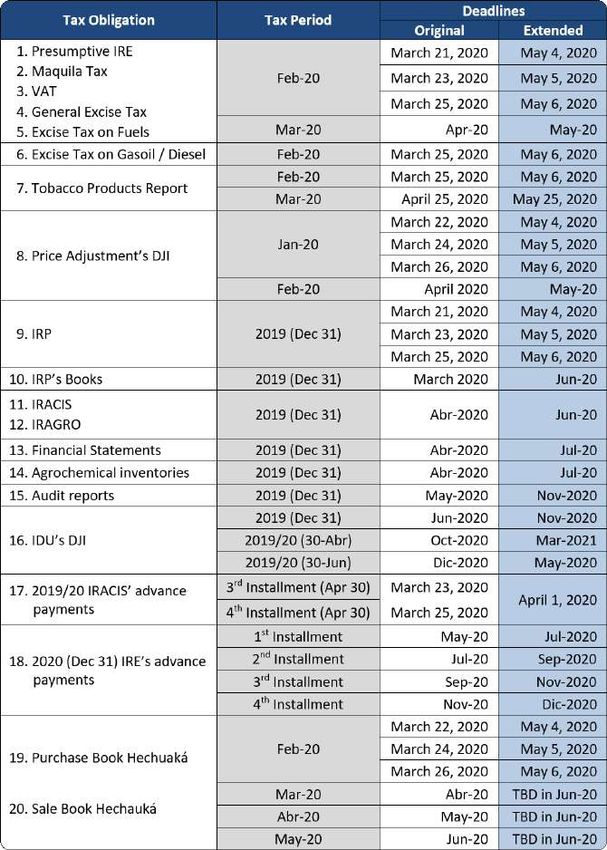
1. Taxes deferrals: Most tax filing and payment deadlines for the last three quarters of 2020 have
been extended. More development on this point can be found ahead.
2. Exemption of penalties for late filing: From March 23 to June 30, 2020, no penalties for late filing
(contraventions) will be applied to any taxpayers.
3. Interest free financing of 2019’s Income Taxes: An exceptional and transitory regime to pay in
installments 2019’s Income Taxes on Individuals (IRP), Agricultural Activities (IRAGRO) and
Commercial, Industrial and Services (IRACIS) was set in place by the end of the first quarter or
2020, subject to the following rules:
a. Minimum initial installment of 20% of the financed debt (tax, plus interest, plus fines),
which must be paid within 2 days of the financing filing.
b. Up to 5 monthly installments.
c. Interest rate of 0% on installment payments.
This installments regime is valid from March 16 to April 30, 2020 for the IRP, and from March 23
to May 31, 2020 for the IRAGRO and IRACIS.
4. Import duties exemption and VAT reduction: From March 18 to September 30, 2020 import
duties on all goods qualified as of first need during the Coronavirus (Covid-19) Outbreak is
exempted. From March 20 to June 30, 2020, VAT on such products is reduced from 10% to 5%.
ELA.LAW – Global HR Legal Solutions 33PARAGUAY
5. Withholding Tax on Dividends (IDU): The deadline for reporting and paying the IDU on the
distribution of dividends decided by Corporations from April 1 to July 31, 2020 is extended to
September 13, 2020, provided such dividends are not paid to shareholders before August 1,
2020. This tax relief does not apply to LLCs dividends.
6. Tax collection: From March 23 to June 30, 2020, no new tax debt certificates shall be issued, nor
new tax collection procedures shall be started.
7. Tax financing: From March 23 to June 30, 2020 the following rules have been adopted regarding
the general regime of tax installment payments:
a. The number of unpaid installments required to cancel the tax financing regime is
increased from 4 to 6, which means now overdue payments can go up to a maximum of
180 days, while before they could only go up to 120 days.
b. The requirement of not having any tax financing cancelled within the last 180 days, in
order to request a new tax financing plan is revoked. Therefore, a new tax financing plan
may be requested immediately after the previous one was cancelled.
8. Tax Compliance Certificates: Regarding Tax Compliance Certificates (the “TCC”) and Proofs of
Not Being a Taxpayer (the “PNBT”) the following has been established:
a. TCC s issued from March 12 to June 30, 2020 shall have a validity period of 90 days, in
contrast to the normal validity period of 30 days.
b. The amount for which bank and other credit institutions must demand the TCC or PNBT
from its clients to grant or renew credits has been increased, from more than 20
minimum wages (more than Gs. 43,856,780 or USD 6,762.24 to date) to Gs. 150,000,000
(or USD 23,128.37 to date), for concessions or renewals of credits made from March 23
to June 30, 2020.
9. Exemption of penalties for overdue payment of social security contributions: From April 13 to
June 30, 2020, late cash or installment payments of social security contributions due for the
months of March, April and May 2020 are not subject to any kind of penalty.
ELA.LAW – Global HR Legal Solutions 34PARAGUAY
10. Interest free financing of social security contributions: From April 13 to June 30, 2020, an
exceptional and transitory regime to pay social security contributions due for the months of
March, April and May 2020 was set in place, subject to the following rules:
a. Minimum initial installment of 5%.
b. Up to 18 monthly installments.
c. Interest rate of 0% on installment payments.
Q: What incentives or tax relief packages are available to small and large companies (please define
small and large businesses under the act)?
A: Article 5 of Law No. 4457/12, as well as article 4 of its regulatory Decree No. 11.453/13, classify
companies by size under the following 4 categories:
Company Staff Balance sheet total assets Last financial year turnover
and or
category headcount [only for the first financial year] [second financial year onward]
Micro ≤ 10 ≤ MW _100 ≤ PYG _.221.8 m ≤ USD _33.9 k ≤ PYG _.500 m ≤ USD _77.1 k
Small ≤ 30 ≤ MW _500 ≤ PYG 1,096.4 m ≤ USD 169.1 k ≤ PYG 2.500 m ≤ USD 385.5 k
Medium-sized ≤ 50 ≤ MW 1200 ≤ PYG 2,631.4 m ≤ USD 405.7 k ≤ PYG 6.000 m ≤ USD 925.1 k
Large > 50 > MW 1200 > PYG 2,631.4 m > USD 405.7 k > PYG 6.000 m > USD 925.1 k
Obs.: -MW stands for monthly minimum wage, which, according to Decree No. 2046/19, equals to PYG 2.192.839 as of July 2019. The amount increases on July of every year
according to inflation.
-Amounts round-up in millions (m) and thousands (k) are an approximate of the exact amounts.
-Exchange rate PYG 6,485.54 / USD 1.-
To date, the tax relief packages mentioned in the previous answer are the only ones available and they
are available for all taxpayers, regardless of whether they are a Micro, Small, Medium-sized (MSMEs) or
Large Enterprises.
Q: What is required of employers to qualify for tax relief?
A: In general, there are no special requirements to qualify for tax relief. Only for the interest free financing
of social security contributions is required that employers have fully payed all social security contributions
up to February 2020 to qualify for such relief.
ELA.LAW – Global HR Legal Solutions 35PARAGUAY
Q: Are there any federal or government backed loans, abatements, or incentives provided to
businesses?
A: The National Development Bank (BNF), a public bank, offers a short-term line of credit for operating
capital, until June 30, 2020, for MSMEs and large companies. The credit conditions, updated according
to a statement dated March 24, 2020, are as follows:
1. The credit limit according to the client's business category is:
a. Up to 25 minimum wages (PYG 54,820,975 or USD 8,452.80 to date) for Level 1 Micro
Enterprises, which are those that employ up to 10 people (owner included), an annual
turnover of up to PGY 500,000,000 (or USD 77,094.58), who are not taxpayers of the IRE-
Simple nor have a Municipal Patent.
b. Up to 50 minimum wages (PYG 109,641,950 or USD 16,905.60 to date) for Micro
Enterprises Level 2, which are those that employ up to 10 people (owner included), have
an annual turnover of up to PYG 500,000,000 (or USD 77,094.58), are taxpayers of the
IRE-Simple and have a Municipal Patent.
c. Up to PYG 600,000,000 (or USD 92,512.50) for Small Enterprises, understood as those that
employ up to 30 people (owner included) and an annual turnover of up to Gs
2,500,000,000 (or USD 385,472.91).
d. Up to PYG 5,000,000,000 (or USD 770,945.83) for Medium and Large Companies with
unsecured guarantee from the beneficiary (natural person) or joint co-debtorship of
managers and/or shareholders (all legal entities but Production Cooperatives). For larger
amount loans, the BNF will require guarantees to its satisfaction, that cover the excess
amount.
2. The annual interest rate will be 7% for operations in PYG, and 5% for operations in USD.
3. The term to repay the loan is up to 12 months.
4. The credit payment method will be a single payment of principal and interest at the end of the
period.
ELA.LAW – Global HR Legal Solutions 36PARAGUAY
5. The operation may be renewed only once, with the payment of at least 60% of the principal,
maintaining the original financial conditions (term and rate) for the new operation.
The BNF also grants credits to MSMEs to finance its payroll during the Covid-19 Outbreak with the
following conditions:
1. Up to PYG 328,000,000 (or USD 50,574.05 to date) or up to 10 times the amount of the entire
monthly payroll, whichever is lower.
2. The credit will only be granted in PYG.
3. The annual interest rate will be 7%.
4. The term to repay the loan is up to 12 months.
5. The credit payment method will be a single payment of principal and interest at the end of the
period
The Development Finance Agency (AFD) and the BNF announced in a press release of March 20, 2020
that they will make available to MSMEs the sum of PYG 600,000,000,000, a third of which was
contributed by the BNF, under the following conditions:
1. The resources will be made available to the public by the AFD, through the Financial Institutions
and Cooperatives.
2. The annual interest rates will be as follows:
a. For operations in PYG, the AFD will charge a 4.75% annual interest rate to Financial
Institutions and Cooperatives, who are obliged to not charge its clients more than 7%.
b. For operations in USD, the AFD will charge the Financial Institutions and Cooperatives a
4.50% annual interest rate, while the rate that these charge to its clients will be
determined by them, according to their credit policy.
ELA.LAW – Global HR Legal Solutions 37You can also read


