Democratic Engagement: Respecting, Protecting and Promoting Our Democracy - January 2019
←
→
Page content transcription
If your browser does not render page correctly, please read the page content below
Democratic
Engagement:
Respecting,
Protecting
and Promoting
Our Democracy

January 2019
Contents
FOREWORD                                                        4
DEMOCRATIC ENGAGEMENT IN 2018                                   6
The democratic engagement plan                                  6
Report card                                                     7

OUR DEMOCRACY IN 2019                                          15
Strategic approach                                             15
Planned activity in 2019                                       17
Respect our democracy                                          18
Protect our democracy                                          18
Promote our democracy                                          20
Research and insight                                           20
Interventions for frequent movers and homeless electors        21
Disability access                                              21
Reform of the annual canvass                                   21
National Democracy Week 2019                                   22
Suffrage centenary education projects: Democracy Ambassadors   23
Women’s suffrage secondary schools resource                    23
Anonymous registration                                         23
Overseas Electors Bill                                         23
Data protection and democratic engagement                      24

CONCLUSION                                                     25
ANNEX A                                                        26
National Democracy Week 2018                                   26

ANNEX B                                                        35
Suffrage centenary programme                                   35
Democratic Engagement: Respecting, Protecting and Promoting Our Democracy | January 2019

                                FOREWORD
                                The Democratic Engagement Plan, launched in December 2017,
                                was the first time that government had published a strategy for
                                building a democracy that works for everyone.

                                One year on from setting out our commitment to democratic
                                inclusion, we have revisited the pledges made in ‘Every Voice
                                Matters’ and mapped our progress against the prospectus of
                                activity that we laid out for 2018. We have made substantial
                                progress.
Chloe Smith MP
Minister for the constitution   As the minister responsible for democratic engagement I am
                                passionate about the real difference that our democracy makes
                                to individual lives and the difference that each individual makes
                                to our democracy. Every elector should have the opportunity to
                                have their say and it is the government’s role to ensure that the
                                system as a whole is accessible, secure and inclusive so that
                                they are able to do so. And now, perhaps more than ever, we
                                need to ensure that our democracy is robust, trusted and open
                                so that all those who are eligible can participate with confidence.

                                The case for democratic engagement is not only one of individual
                                rights but also of collective benefit: we help to secure our
                                democracy by respecting, protecting and promoting it for the
                                greater good.

                                In future I will be focused on three key elements that are vital to
                                the health of our democracy:

                                Respect: Confidence in our democracy is founded on the
                                principle that every elector’s voice matters and is considered to
                                hold equal weight. The government is committed to making our
                                democratic system fairer and one that retains respect.

                                Protect: We must maintain confidence in the integrity of our
                                electoral system and trust in our democracy. Last year the
                                government made it easier for survivors of domestic violence to
                                register to vote anonymously in order to help mitigate the risk of
                                former partners finding out their addresses. Voter ID pilots have
                                given electors confidence that their vote is theirs alone.

4
FOREWORD
Promote: We recognise that it is important for confidence and pride in our democracy to
make sure every voice is heard. That is why we launched the inaugural National Democracy
Week last July, delivered in conjunction with our partners, coinciding with the 90th anniversary
of women achieving equal suffrage. This partnership approach has also helped to deliver
education projects, make accessibility improvements and improve student registration
processes. Reform of the annual canvass is expected to reduce costs by £27 million a year
and the Overseas Electors Bill will end the current 15-year time limit on British expats voting
in the UK, fulfilling the manifesto commitment on delivering votes for life.
The achievements set out in this report are considerable but we will continue to champion
and defend our democracy with vigour.
The Democratic Engagement Plan set out the central role that partners play in our ambition
to tackle democratic exclusion. Government has a vital part to play in this endeavour, but we
are clear that our responsibilities are distinct from others’ and that organisations from local
and national governments, civil society and the wider electoral community each have specific
contributions to make that facilitate the effective functioning of our democracy.
Democracy in the United Kingdom has faced unprecedented developments over the last
few years and will continue to meet new and unpredictable circumstances in future. It is
a testament to our democratic system’s strength and flexibility that it rises to the difficult
and often rapidly emerging challenges with which it is confronted, as recent events have
confirmed. From major electoral events such as the EU referendum to the growing influence
of social media, we are experiencing a step-change in the relationship between people
and power. In an era of fast paced technological, economic and political change it is the
responsibility of us all to ensure that our democracy remains relevant to people’s lives and at
the very heart of our society.
It is essential to work together to tackle these challenges. Over the coming year we will
further explore our respective tools, levers, expertise and resources in order to refine our
collaborative model for promoting participation. Maintaining momentum and expanding reach
depends on continued improvements to our democratic system that government alone can
enact, but which are not sufficient in isolation. I hope that all of us with an interest in widening
engagement will work together to make our individual contributions greater than the sum of
our parts.
Chloe Smith MP
Minister for the Constitution
5Democratic Engagement: Respecting, Protecting and Promoting Our Democracy | January 2019
DEMOCRATIC ENGAGEMENT IN 2018
The democratic engagement plan
The government’s Democratic Engagement Plan, ‘Every Voice Matters’, was published in
December 2017. It charted a course towards a more inclusive democracy by identifying
and tackling those barriers that prevent some people - particularly those in under registered
groups - from participating in the democratic system.
The plan:
• set out the landscape of inclusion and exclusion, presenting evidence on voter
registration patterns and insight into the factors that influence this;
• analysed the major changes to the electoral system in recent years, from the
introduction of individual electoral registration in 2014 to the general election in 2017;
• explained the parallel approach to improving processes and enhancing engagement,
which includes digital development, modernising the canvass and maintaining
electoral integrity;
• pledged action to improve engagement among specific groups such as students,
survivors of domestic violence and disabled electors;
• presented snapshots of citizens’ experiences of our democracy from across the
United Kingdom;
• made commitments to specific democratic engagement activities and products in
conjunction with our partners and the wider electoral community; and
• examined the challenges and opportunities for boosting participation and pledged
specific actions to increase democratic engagement and voter registration.
This chapter demonstrates our progress against that plan.
6DEMOCRATIC ENGAGEMENT IN 2018
Report card
Action Progress
1. Research and Insight Disability access
In 2019 we will understand more about In 2018 we ran a Call for Evidence on
which groups are proportionally more likely access to elections aimed at understanding
to be under-represented on the registers the barriers disabled people face in
and why. registering to vote and in voting and how
A review undertaken in 2017/18 by Cabinet these can be addressed. We received 250
Office sought to collect available evidence responses from disabled people, charities
on barriers to registration, with a particular and organisations allowing us to identify
focus on the following under registered what is working and what needs to be
groups: improved to make our elections more
accessible.
• Young people / attainers Anonymous registration
• Frequent home movers In 2018 we changed the law to broaden
• Ethnic minority backgrounds the range of professionals able to provide
• People with long-standing an attestation allowing people to register
conditions or disability anonymously. These changes came into
• Other vulnerable groups such force in England, Wales and Northern
as victims of domestic abuse or Ireland on 7 March 2018 and in Scotland
homelessness on 1 April 2018. We have also expanded
the list of court orders to include Domestic
Violence Protection Orders and Female
Genital Mutilation Protection Orders. We
have made sure that guidance is in place
to clarify how the law has developed and
support service users. Cabinet Office
also added the link to the form on the
homepage of ‘Register To Vote’ to make it
more visible.
Overseas electors
In 2017 Glyn Davies introduced a Private
Members’ Bill on Overseas Electors.
Supported by the government, it passed its
second reading in the House of Commons
in February 2018 and passed committee
stage in November 2018. If the Overseas
Electors Bill becomes law, it will implement
votes for life in parliamentary elections for
British citizens overseas who have either
been previously resident or previously
registered to vote in the United Kingdom.
7Democratic Engagement: Respecting, Protecting and Promoting Our Democracy | January 2019
Student electoral registration
In 2017 we legislated to ensure that
student electoral registration is a core
condition of the new higher education
framework, as contained in the Higher
Education and Research Act 2017.
Ministerial guidance and Office for
Students (OfS) guidance published in
2018 reinforces Regulation 23 of the
Representation of the People (England and
Wales) Regulations 2001 – which requires
compliance with EROs’ requests for
data – and also obliges higher education
providers to promote electoral registration
among their student populations. The OfS
guidance highlights the importance of the
integrity of the electoral register, drawing
higher education providers’ attention to the
specific challenges of registering students,
such as insecure postal arrangements. The
government has committed to evaluating
the success of the OfS guidance after a
sufficient period, to assess whether the
ministerial guidance needs to be updated
to ensure an even more effective approach
to the electoral registration of students.
2. Atlas of Democratic Variation The Atlas has been developed and will be
An Atlas of Democratic Variation will be published in January 2019.
developed during 2018.
8DEMOCRATIC ENGAGEMENT IN 2018
3. Reform of the annual canvass The Electoral Commission committed to
Proposed changes to the annual canvass taking forward changes to its performance
will be supported by the Electoral management framework in line with
Commission’s performance management changes to the annual canvass.
framework, guidance, training and the right The Electoral Commission, Association of
mechanisms to support the sharing of Electoral Administrators and the Scottish
good practice. Assessors Association each has a role
in sharing good practice on effectively
delivering the annual canvass. Cabinet
Office is working closely with appropriate
stakeholders to ensure that changes to
guidance and training are aligned with
legislative changes that will reform the
way the annual canvass of electors is
conducted.
4. Canvass evaluation 2018 Both the Electoral Commission’s evaluation
The Electoral Commission’s evaluation of and Cabinet Office’s own evaluation of
the 2017 pilots will inform future changes the 2017 canvass pilots were published
to the canvass. in 2018. They have been used to inform
development of policy on canvass reform,
which has now been subject to public
consultation. The pilots have shown that
there are ways of reducing the costs and
administrative burden of the canvass – and
improving the citizen experience – while
maintaining the volume and quality of data
collected.
The respective evaluation reports can
be found on GOV.UK1 and the Electoral
Commission2 websites.
1 https://www.gov.uk/government/publications/piloting-alternative-electoral-canvassing-models
2 https://www.electoralcommission.org.uk/__data/assets/pdf_file/0006/244608/Annual-canvass-reform-pilot-scheme-evaluation.pdf
9Democratic Engagement: Respecting, Protecting and Promoting Our Democracy | January 2019
5. Improving inclusion and access 2018 Over the course of 2018 the government
We will make targeted interventions has implemented the pledges in the
to improve access, whether that is by Democratic Engagement Plan as part of
removing physical barriers, promoting our commitment to make our democracy
digital options, encouraging democratic as inclusive and accessible as possible. In
education or tackling exclusion arising from 2018 we have:
lack of awareness. • Made it easier to register to vote,
for example by enacting legislation
to protect survivors of domestic
abuse. We have also supported the
Electoral Office of Northern Ireland
as they have introduced a custom
digital service for their electors.
• Improved citizens’ experience of
democratic processes, developing
changes to the annual canvass
by piloting approaches with fewer
restrictions. In the future local
authorities will be more able to focus
on targeted democratic engagement
activities in their areas.
• Addressed physical barriers, with
the members of the government-
chaired Accessibility of Elections
Working Group reviewing Electoral
Commission guidance and training
materials to ensure polling stations
are accessible.
• Encouraged digital participation
through improvements to the
register to vote website. These
include developing an easy-read
guide in partnership with the Royal
MENCAP Charity which helps
citizens with learning difficulties
apply to register to vote.
• Enabled citizens from Northern
Ireland to use the IER digital service,
meaning that it now caters for all
home nations and British citizens
living abroad.
10DEMOCRATIC ENGAGEMENT IN 2018
• Promoted democratic education,
engagement and participation
through initiatives such as National
Democracy Week and the Suffrage
Centenary Programme (Annexes A
and B).
• Defended our democracy, in
particular through the evaluation of
ID pilots, which will be taken into
account and used to shape how
the final policy will look when it is
introduced.
• Run the ‘Your voice is yours alone’
campaign in partnership with
the Electoral Commission and
Crimestoppers, which aimed to
raise awareness of what constitutes
as electoral fraud and encourage
those who witness it to report it to
Crimestoppers.
6. Reducing duplicate applications to During 2018, action aimed at reducing
register duplicate applications, and the
We will work to make registration administrative burden they represent for
processes more accessible and address electoral administrators has included:
customer journeys in order to reduce • Continuous review of the website
duplicate applications, building on the before election periods, ensuring
success of the IER digital service which has information on the site is correctly
managed more than 37 million applications worded to continue driving down
since its launch in 2014. duplicate applications and relieve the
administrative burden for election
teams.
• Exploratory work understanding the
impact, scale and cost of processing
duplicate applications.
• Finding alternative solutions, which
could be implemented at a local
level to address duplicates.
11Democratic Engagement: Respecting, Protecting and Promoting Our Democracy | January 2019
7. ID pilot implementation In May 2018, pilots at local elections ran
Pilot schemes ahead of local elections in in Bromley, Gosport, Swindon, Watford
May 2018 will help to identify how and and Woking, testing a broad range of
when it would be best to introduce an ID photographic and non-photographic
requirement more widely. ID, including poll cards with scannable
barcodes.
The evaluation, conducted by the
independent Electoral Commission,
showed that the trials worked well, with the
overwhelming majority of people able to
show identification without difficulty.
The evaluation report can be found on the
Electoral Commission website3.
8. ID pilot communications evaluation In 2018 the results from the evaluation
In 2018 Cabinet Office Communications of the ID pilots showed that nearly 9 in
and the Electoral Commission advised and 10 people (86%) of people who voted
co-ordinated local authorities taking part at polling stations said they were aware
in the pilots, including awareness raising beforehand that they had to show
campaigns to encourage eligible voters to identification to vote at their polling station.
bring ID to polling stations.
3 https://www.electoralcommission.org.uk/find-information-by-subject/electoral-fraud/voter-identification-pilot-schemes
12DEMOCRATIC ENGAGEMENT IN 2018
9. National Democracy Week 2018 The first ever National Democracy Week
The first National Democracy Week (NDW) took place in July 2018. More than 50
ran from July 2 to 8 2018. It is the intention democratic engagement events hosted by
that NDW should develop and grow partners from local government and the
over the coming years, establishing an civil society sector ran across the United
effective model for promoting registration Kingdom. The NDW Awards recognised
and discussion about democracy even in winners that have made exceptional
periods where there are no widespread contributions to promoting participation.
elections. Media campaigns were undertaken by both
A National Democracy Week Council will: the Cabinet Office and partners. Regional
Advise on the activities and events needed press were presented with press notices
to achieve our aims. and case studies. Social media was also
used with #talkdemocracy and #NDW10
Take an active role in communicating with trending on Twitter.
and mobilising organisations across the
UK. The NDW Council met three times,
planning, developing and evaluating the
Consider how to measure success and activities and events which took place
reporting back on the week’s activities. throughout the week. Activities included
developing materials such as stakeholder
packs, judging awards nominations,
running events and evaluating the week.
Further information on NDW can be found
at Annex A.
13Democratic Engagement: Respecting, Protecting and Promoting Our Democracy | January 2019
10. Suffrage Centenary Programme Three projects were launched and delivered
To engage young people in the story of during the 2018 suffrage centenary year:
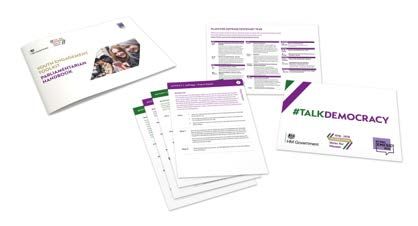
suffrage and its relevance to democratic Parliamentarian youth engagement toolkit.
processes with the aim of increasing Youth Democracy Ambassadors scheme.
their knowledge of UK democracy and Women’s suffrage secondary schools
its importance, and their democratic resource.
participation.
The parliamentarian toolkit was launched
during National Democracy Week, is
available online and has been downloaded
hundreds of times.
To date 48 groups have signed up to train
a total of 1,035 Democracy Ambassadors.
They are from across England and include
youth groups, social action projects and
after school clubs. We want to ensure
that young people from all demographics
become democracy ambassadors,
including those from lower-socio economic
backgrounds, Black and Minority Ethnicity
(BAME) backgrounds and those with
disabilities.
Over 300 schools have signed up to use
the women’s suffrage secondary schools
resource.
Further information can be found at
Annex B.
14OUR DEMOCRACY IN 2019
OUR DEMOCRACY IN 2019
Strategic approach
Meeting the challenges that our democracy faces - and reaching the many different groups
that it must serve - requires a coalition of partners.
Government works collaboratively with a range of experts across the public, private and civil
society sectors to protect, promote and respect our democracy. Together, we are greater
than the sum of our parts.
Crucially, every citizen has an active part to play in our democracy.
Government’s role is to create an environment for our democracy to thrive, with responsibility
for legislation, funding and promoting good practice.
Legislation
Government, with the UK Parliament and devolved administrations, can change the law to
sustain a flourishing democracy. When reforms require legislation - for example, the bill that
enabled individual electoral registration or the statutory instruments that amended the rules
on anonymous registration - only government can make this happen.
Funding
Government funds improvements to the electoral system, including modernising registration
and ensuring the system is fit for purpose, secure and sustainable. That is why we have
funded the introduction of the digital service, have taken steps to secure electoral integrity,
and continue to develop canvass reform. This includes action to boost democratic
participation through new initiatives such as the Democracy Ambassadors scheme for young
people.
Good practice
Government is committed to facilitating a democracy that works for everyone and has
delivered specific interventions to improve citizens’ experience. We are well placed to
convene the various parts of the electoral community to make best use of our evidence,
skills, knowledge, and resources. The Cabinet Office’s role includes supporting others’
capability to lead (and ultimately act independently) to encourage people to register, to
participate and to vote. For instance, the Cabinet Office published details of what works on
student registration - a brokering role that government undertook as part of implementing the
Higher Education and Research Act 2017.
This is distinct from interventions that local, statutory and voluntary partners are best placed
to lead, learn from and share. It is a valuable addition to, although no substitute for, the legal
duty of Electoral Registration Officers to maintain accurate and complete registers and the
legal duty of the Electoral Commission in maintaining performance standards.
15Democratic Engagement: Respecting, Protecting and Promoting Our Democracy | January 2019 Civil society Civil society groups know their audiences best. Over the last year our joint work with over 40 leading organisations with an interest in democratic engagement has proven that together we are greater than the sum of our parts with hundreds of people taking part in the inaugural National Democracy Week. The success of the week relied on the expertise of our partners in connecting with people in some of the most under-represented groups. Our partners agreed Cabinet Office’s convening role was crucial, and we will now work together to explore how we can support building capability, knowledge, skills and networks across the sector. Local authorities Local authorities are the ‘front line’ of our democracy. With local knowledge and relationships with local electors, local elections teams support the Electoral Registration Officer to maintain the electoral register, ensuring it is accurate and complete. The electoral community The Electoral Commission has a statutory responsibility for our elections and democratic participation. They work in partnership with bodies such as the Association of Electoral Administrators and the Society for Local Authority Chief Executives (SOLACE) who each represent their members. For example, the Electoral Commission is responsible for public awareness campaigns around major polls, Electoral Registration Officers’ (EROs) performance standards - assessing how effective EROs are in maintaining accurate and complete electoral registers, and annual assessments on the delivery of elections. Wider society Businesses, charities, media publications, academic institutions, political parties, social media platforms and many others are invested in our democracy. In a world of rapidly changing technology and shifting threats, we look to the relevant organisations to work with and support government and our citizens to protect, respect and promote our democracy. Whether it be tackling disinformation, promoting voter registration or explaining current affairs, many outside of government are helping to sustain a flourishing democracy. Citizens Every citizen owns our democracy, and has an active part to play in it. Whether it’s registering to vote to ensure you have your say, reporting electoral fraud because your vote is yours alone, standing as a local councillor, discussing with your friends, family or students on how government and UK Parliament works, each and every citizen has a role to play to protect, respect and promote our democracy. 16
OUR DEMOCRACY IN 2019

          Democratic engagement activity: exclusive and shared responsibilities

   Government                                                                            Electoral community
   Legislation* – Working with Parliament to                                                      Elections guidance
   change laws.                                                                                    Voting information
   Funding* – Including for elections, modernising                     Maintaining and updating the electoral register
   registration and democratic engagement.                                                Registering political parties
   Good practice – sharing examples arising from our                      Train, educate and support electoral teams
   targeted interventions.
   Convening – bringing together the electoral
   community so that we are more
   than the sum of our parts.
   Constitution Policy* – Including    Jointly owned activities
   franchise.                          Democratic engagement events
   IER Digital Service.                Research and insight work
                                       Communications activity Good practice
                                       identificationand sharing Piloting new
                                       interventionsand approaches
                                       Developing and producing products
                                       Maintaining electoral integrity

   Local authorities                                                                Civil society and people
   Running elections                                                                        Direct outreach to electors
   Maintaining complete and accurate registers                                 Advocacy for under registered groups
   Registration planning                                                  Registration drives and membership events
                                                                                                                 Voting

* Elements are devolved to Scottish and Welsh Governments, for example franchise policy.
  This report is produced by the UK Government in relation to its responsibilities.

Planned activity in 2019
There is a reason why the UK is admired around the world for our democracy. We have
worked for centuries to build it and continue to protect it from the ever-changing forces that
seek to threaten it.

We inspire countries across the globe not just because of our achievements - we have a
record number of people on the electoral register - but also because we demonstrate our
commitment to our democracy through action.

Cabinet Office is committed to ensuring an inclusive and accessible democracy, securing
democratic processes and running activities to drive engagement, including Votes for Life,
canvass reform and National Democracy Week.

                                                                                                                          17
Democratic Engagement: Respecting, Protecting and Promoting Our Democracy | January 2019 Government is acting to promote the integrity of our electoral system, defend it from hostile state activity and disinformation and increase the public’s confidence in democracy. We are committed to making voting more inclusive and fair because we want to preserve the principles that underpin our constitution. We are ensuring everyone can make their voice heard free from abuse, making voting easier and more accessible for vulnerable and under- represented groups, and introducing measures to protect electors’ votes. Building on our 2018 progress, and using the strategic approach set out here, this chapter summarises our plans for 2019. 1. Respect our democracy Having celebrated the year marking 100 years since some women first won the right to vote in the UK and the 90th anniversary of equal voting rights for men and women, we should not forget the sacrifices that got us to this point. While democracy thrives from robust, healthy debate, we know the risks that come when debate deteriorates into threats and intimidation designed to drive out honest differences. The government recognises that rising intimidation in public life is stopping talented people from standing for election and putting voters off politics. In 2019 the government will publish its response to the consultation, ‘Protecting the Debate: Intimidation, Influence and Information’ with a view to taking actions forward as quickly as possible. The consultation, which government launched in July 2018, was in response to the Committee on Standards in Public Life’s report ‘Intimidation in Public Life’ and it sought views on: a proposed new electoral offence of intimidation of candidates and campaigners; clarifying the electoral offence of undue influence of voters; and whether the requirement to have imprints should be extended to digital communications. The proposed new measures aim to protect voters, candidates and campaigners so they can make their choice at the ballot box or stand for public service without fear of being victims of misinformation or abuse. Confidence in our democracy is founded on the principle that every voter’s voice matters and is considered to hold equal weight. That is why the government is committed to making our democratic system fairer and one that retains respect. We are doing this by backing the independent and impartial reviews from the Boundary Commissions, which will deliver equal representation for voters across the UK at the next general election. 2. Protect our democracy There is currently no evidence that interference in UK democratic processes has successfully affected the outcome and our manual counting system is difficult, if not impossible, to manipulate through direct cyber attack. However, government cannot and should not be complacent about the threat and has long undertaken a wide range of activity to defend our democracy from those who wish to undermine or interfere in it. 18
OUR DEMOCRACY IN 2019

Key to this will be increasing transparency and accountability. The Cabinet Office are now
considering their response to the consultation on ‘Protecting the Debate: Intimidating,
Influence and Information’. This sought views on proposed changes to electoral law, including
the inclusion of imprints on digital campaign materials. The consultation closed on 28
October 2018 and the government is now carefully considering the submitted responses, in
order to decide on an appropriate course of action.

The government is grateful to the DCMS Select Committee for the valuable contribution
they have made to the public debate about disinformation and other online harms. The
committee’s interim report highlighted areas of concern to the government, UK Parliament
and the public. The government response to the interim report provided a consolidated
overview of our activity to tackle disinformation, online manipulation and a range of other
online harms identified in the interim report. DCMS, FCO, CO, DfiD, MoJ and DfE all
contributed. We look forward to the committee’s final report and will respond in due course.

The government also thanks the Information Commissioner for publishing her report, which
sets out details of the enforcement activity undertaken as a result of her investigation into the
use of personal data by political parties, data analytics companies, social media providers
and other organisations. The government will consider the report carefully, along with the
recommendations raised in the ICO’s July report ‘Democracy Disrupted? Personal information
and political influence’.

We will consider these reports alongside the Electoral Commission’s June 2018 report,
‘Digital campaigning: Increasing transparency for voters’, to ensure that all of these issues are
considered in the round.

Voter ID and additional measures to improve confidence in the postal vote process were
successfully tested at local elections in May 2018. The government has committed to
legislate to ensure that a form of identification must be presented before voting and is working
with local authority volunteers to deliver further successful pilots in 2019 to understand how
best to roll it out nationally. Working collaboratively with volunteer local authorities we can gain
a deeper understanding of how voter ID will work on a wider scale and what will work best for
voters.

For 2019 we have a greater number of authorities participating with greater diversity and
geographical spread. To verify that voters are who they say they are, each local authority in
the 2019 voter ID pilot scheme will test one of four models of voter ID:

      •   photo ID;
      •   photo and non-photo ID;
      •   traditional poll cards; and
      •   poll cards with scannable barcodes.
Postal voting pilots will also be trialled in two local authorities and a proxy pilot will be trialled
in one local authority.

                                                                                                     19
Democratic Engagement: Respecting, Protecting and Promoting Our Democracy | January 2019
The Cabinet Office is also engaging with a broad range of charities and civil society
organisations - including members of the Cabinet Office chaired Accessibility of Elections
Working Group - to ensure that the overall policy reflects the needs of all voters in the
UK. Local authorities will provide alternative methods of ID to individuals who do not have
a specified form of ID, free of charge, to ensure that everyone who is registered has the
opportunity to vote.
Voters in Pendle and Woking will be asked to show photo ID before they are given their ballot
papers. Broxtowe, Derby, North Kesteven and Braintree will require voters to present either
one form of photo ID or up to two forms of non-photo ID. Mid Sussex, Watford and North
West Leicestershire will test using poll cards as a means of identification.
In addition, Peterborough and Pendle will run a separate postal vote pilot, looking at the
security of postal votes and providing additional guidance in postal vote packs. Proxy
voters in Peterborough will also be required to show ID before they can vote. In 2018 Tower
Hamlets, Peterborough and Slough piloted measures to improve the integrity of the postal
vote process. The pilots issued enhanced information to postal vote applicants about
reporting electoral fraud and sampled random postal voters to verify the issue and return of
postal votes.
3. Promote our democracy
(i) Research and insight
In 2018 work began to scope ethnographic-centered user testing and qualitative
research projects aimed at enhancing our understanding of barriers to registration to
help more people to register to vote. These will focus in particular on people who self-
report as from ethnic minority backgrounds, those who move home frequently or live in
the private rented sector, and those who are homeless. We intend to use insight from
this work to design, user test and pilot interventions to improve registration that could
meet local authority and citizens needs.
In 2019 we intend to:
• take an informed and collaborative approach with local authorities and other
stakeholders such as the Electoral Commission and the Association of Electoral
Administrators;
• conduct qualitative in-depth interviews with local authorities and civil society
organisations who represent ethnic minority citizens, in order to identify the
characteristics that make some ethnic minority backgrounds less likely to register in
some areas; and
• use an ethnographic methodology to understand the day-to-day experiences of
those who live in the private rented sector and people who are homeless, so we can
adapt interventions to improve registration processes or these groups, so they better
fit their specific situations and existing interactions with government services.
20OUR DEMOCRACY IN 2019
In the year ahead, we will provide tools and techniques which aim to support capacity
among the electoral community and organisations across the UK, so they can
independently use complementary solutions that work for them and citizens in their area.
(ii) Interventions for frequent movers and homeless electors
Building on the success of suffrage centenary projects such as the Democracy
Ambassadors scheme, parliamentarian youth engagement toolkit and women’s
suffrage schools’ resource, we have launched a new project working with electoral
administrators to develop interventions for frequent movers and homeless electors. This
project will create and test targeted solutions which may have previously been too time
and resource intensive for electoral administrators to deliver.
We will seek volunteers from electoral services teams to pilot these interventions over a two-
month period. From this work we hope to provide a tangible body of evidence and effective
tools that will help reduce the cost and effort in registering these groups in the future.
(iii) Disability access
The Accessibility to Elections Working Group has planned for and is undertaking
work to deliver the actions, in reviewing Electoral Commission guidance including the
‘Handbook for Polling Station Staff’ and training materials for polling station staff to
improve the experience of disabled people within the polling station.
In January 2019 the working group will meet at the Royal National Institute of Blind
People (RNIB). This meeting will include a demonstration of technology that has the
potential to improve the support provided to voters with sight loss in polling stations,
with first-hand account of the benefits of using the different types of technology
provided by blind and partially sighted people.
Following this meeting the working group will undertake a more detailed assessment of
the most suitable options to increase the support available. The assessment will include
expert insight provided by the RNIB, the Royal Society for Blind Children, and the
members of the Working Group who represent the interests of voters with sight loss.
(iv) Reform of the annual canvass
The Scottish Government, Welsh Government and UK Government intend to introduce
reforms to the annual canvass across Great Britain. As elements of electoral registration
are devolved in Scotland and Wales, reforms are intended to be introduced jointly. We
have therefore worked very closely with the Devolved Administrations in Scotland and
Wales. We have also worked in close partnership with representatives from the Electoral
Commission, the Scottish Assessors Association and the Association of Electoral
Administrators.
The annual canvass is both expensive and heavily paper based, requiring each
property in a local authority area to receive three paper household enquiry Forms,
plus a household visit in order to gain a response during the canvass period. This
21Democratic Engagement: Respecting, Protecting and Promoting Our Democracy | January 2019
causes additional burdens on EROs. Having piloted alternative approaches during
2016 and 2017 with a range of local authorities’ areas, we have a wealth of evidence
that improvements can be put in place to streamline the process, reduce reliance on
paper, and target the properties which require activity without reducing the accuracy or
completeness of the electoral registers. Together, we have developed a blended model
for the reformed canvass by taking the successful elements of each approach and
refining the processes.
The new model has a data discernment step (where the electoral register is matched
against existing data) using both national and local data, at the start of the canvass.
This will enable EROs to identify those households where the individuals living at
the household remain unchanged, allowing them to target more resources at those
households where changes are most likely to have occured. The new model will allow a
mixture of communication methods (email, telephone and paper contacts) where most
appropriate. Greater discretion for Electoral Registration Officers to shape their canvass
to activities which best suit their local circumstances are key aspects of the proposals.
We have consulted on the new model proposals and will review them as appropriate
in the light of any feedback received during the consultation. Our intention is that
these significant reforms can be introduced ahead of the start of the canvass in 2020.
Legislation will be required during 2019 in the UK Parliament, the Scottish Parliament
and the National Assembly for Wales. It will be important for the three governments
to continue to work closely together on these important reforms so that electoral
administrators and citizens in all parts of Great Britain can benefit.
(v) National Democracy Week 2019
The inaugural National Democracy Week took place in 2018. The week aimed to
increase the number of people who engage with and participate in our democratic
process. This included those who are less likely to be registered to vote, such as young
people, those from ethnic minority backgrounds and home movers.
Following an assessment of National Democracy Week 2018 which examined the
successes and areas for future development (Annex A), current work is focused on the
development and implementation of National Democracy Week in 2019, scoping the
project’s future design, focus and key areas of delivery. At the heart of this model will
be a partner-led approach, putting civil society organisations, local authorities and their
respective networks in charge of activity.
Specifically we will work with our partners to develop a capability building plan for
democratic engagement activity. This aligns with the government’s strategic approach,
which is to focus on those areas where it uniquely can add value including, for example,
legislation, inter-governmental working, data sharing and convening. We will support
National Democracy Week and its future sustainability by investing knowledge and skills
in our partners to enable them to undertake those activities that they are best placed to
deliver.
22OUR DEMOCRACY IN 2019
(vi) Suffrage centenary education projects: Democracy Ambassadors
In 2018, in partnership with the youth charity Young Citizens, we developed a training
programme that teaches young people about democracy and how it relates to their lives.
In 2019, the programme will train 1,000 young people across England to become
Democracy Ambassadors, with each ambassador being tasked with engaging 100 of
their peers in turn. This will create a network of at least 100,000 young people who are
engaged with and talking about democracy. The first tranche of 49 delivery centres have
already signed up to the programme.
(vii) Women’s suffrage secondary schools resource
In 2018 we launched a resource for secondary schools to coincide with the centenary
of the Parliament (Qualification of Women) Act which allowed women to stand for
Parliament. Our ambition is that by the end of the project in March 2019 a large number
of secondary schools will have used the resource, with a further 2,000 signing up to
teach their students about the history of suffrage over the next five years.
(viii) Anonymous registration
We are committed to ensuring that survivors of domestic abuse have their voice heard.
With this in mind, we will be monitoring the impact of the new scheme. Developing
further awareness of the anonymous registration scheme by reaching out to key
stakeholders will help to ensure that more applicants are able to register with the
confidence that their details will be secure.
We will also look to develop awareness among those who may have different reasons
for not wanting their details to appear on a public register.
Everyone should be able to vote safely, regardless of personal circumstances. These
changes are an important step towards achieving this aim, and it is particularly fitting
that they were introduced in the year marking the 100th anniversary of the first British
women securing the right to vote.
(ix) Overseas Electors Bill
The Overseas Electors Bill, a Private Members’ Bill supported by the government,
passed its second reading in February 2018. The bill passed committee stage in the
House of Commons on 14 November. If the Overseas Electors Bill becomes law, it
will implement votes for life in parliamentary elections for British citizens overseas who
have either been previously eligible to vote or previously registered to vote in the United
Kingdom. The government will continue to work hard to secure the implementation of
these reforms ahead of the next general election in 2022, subject to parliamentary time.
23Democratic Engagement: Respecting, Protecting and Promoting Our Democracy | January 2019
(x) Data protection and democratic engagement
During the passage of the Data Protection Act 2018, concerns were raised that the
bill, as drafted, would prevent political parties from undertaking some of their existing
activities, which are key to effective democratic engagement. To address this concern,
the government introduced an amendment to clause 8 of the Data Protection Bill (now
act) to clarify that for political parties to process data from the electoral register for
reasons of democratic engagement is in the public interest. The Data Protection Act
received Royal Assent on 23 May 2018.
Following the passage of the Data Protection Act 2018, the government is committed
to ensuring that the new data protection regime continues to support democratic
engagement by political parties and elected representatives, and does not have any
unintended consequences. The Cabinet Office is currently considering amending
secondary legislation to ensure that it is consistent with the democratic engagement
provisions in the Data Protection Act.
24CONCLUSION
CONCLUSION
2018 was an important year for our democracy as it continues to adapt to new challenges.
There’s a lot to do in 2019 and beyond.
As set out in this report a number of major projects are on track and will deliver significant
benefits before the next scheduled general election in 2022. These changes will be felt
throughout the electoral system, from registering to vote to visiting a polling station. They will
provide a better experience for the citizen, improve accessibility, offer greater flexibility for
electoral administrators and keep our democracy secure.
Since the publication of the Democratic Engagement Plan in 2017, there has been real
progress. In a landscape which involves multiple stakeholders, there are competing pressures
to navigate and the smooth delivery of elections for citizens is an overriding priority. Finite
resources, including scarcity of parliamentary time, encourages us to think creatively. We are
finding new ways to help our democracy thrive and are continually searching for innovations
that encourage electors from every background and circumstance to get involved.
There remains more to do. We will continue to focus on the practical ways in which
government can assist in making registration and voting as simple as possible while
maintaining the integrity and security of the process.
Over the coming year we intend to maintain this momentum as we forge ahead with canvass
reform, measures to maintain the integrity of our elections, and work to promote inclusion
and accessibility. This is something that government cannot achieve alone: our partners
have a more important role to play than ever before. Our democratic engagement priority
for 2019 will be to pursue these goals on a strategic basis, guided by a clearly articulated
understanding of the respective roles of each part of the wider sector. This will include
our commitment to supporting the development of the electoral community as part of a
collaborative model that will drive targeted, local democratic engagement activity and use
best practice to help even more citizens.
25Democratic Engagement: Respecting, Protecting and Promoting Our Democracy | January 2019 ANNEX A National Democracy Week 2018 “Regardless of who we are or where we are from, we must work together to ensure that every member of society has an equal chance to participate in our democracy and to have their say.” Minister for the Constitution, Chloe Smith MP, 2018 National Democracy Week formed a key part of the Democratic Engagement Plan acting as a focal point for promoting democratic engagement as widely as possible. The week was held between 2 and 8 July 2018 to coincide with the 90th anniversary of women achieving equal suffrage. As a UK-wide event it brought together civil society organisations, local and national government and the wider electoral community to celebrate and promote democracy. The week aimed to engage with under- registered groups, to better understand the barriers they face, and to work with partners to ensure that every member of society who is entitled to do so has an equal chance to participate in the democratic process, ensuring these groups have their say. Partners worked collaboratively to develop events and activities designed to engage all potential electors, in particular under- registered groups who are less likely than others to be on the electoral register. 26
ANNEX A

Groups targeted in National Democracy Week

                                     LGBT groups
                  Local                                         People
                 authority                                   with learning
                   staff                                      disabilities

                                                                             Young
      BAME
                                   Target audiences                          adults
      groups
                                                                             14 / 25

                Survivors                                      Blind and
               of domestic                                      partially
                  abuse                  Local                  sighted
                                      communities

National Democracy Week
The project was partner-led and so a team of members was set up, known as the National
Democracy Week (NDW) Council. The council comprised a diverse range of civil society
organisations, from the LGBT Consortium, Mencap, UK Youth and Shout Out UK. The
council agreed to deliver a range of democratic engagement activities in the lead up and
during the week itself.

                                                                                           27
Democratic Engagement: Respecting, Protecting and Promoting Our Democracy | January 2019 Table 1: List of NDW Council members Association of Colleges Patchwork Foundation Association of Electoral Administrators RNIB Bite the Ballot Scope British Youth Council Scottish Assessors Association Citizens Advice Scottish Youth Parliament Community Organisers Shelter Democracy Club Shout Out UK Department for Education SOLACE Electoral Commission Step Up To Serve Electoral Office of Northern Ireland The Prince’s Trust Elevation Networks The Faith and Belief Forum (formerly 3FF) Faiths Forum for London UK Parliament Outreach and Engagement FCO Team LGBT Consortium UK Youth Mencap Universities UK Ministry of Defence UpRising My Life My Say Voice4Change England National Care Association Welsh Youth Parliament National Housing Federation Women’s Aid National Citizen Service YMCA Operation Black Vote 28
ANNEX A

Partners

                                   Electoral Community:
                                     AEA, SAA, EONI,
                                       EC, SOLACE

                                                                Civil Society Groups:
           Local Authorities:             40 Council
                                                                     More than 32
           20 Across England              Members
                                                                    across the UK

                                Government departments:
                                MOD, FCO, Welsh, Scottish,
                                Northern Ireland Government,
                                         GEO, NIO

In collaboration with partners, local authorities and other Cabinet Office-affiliated groups, five
key objectives were developed in order to guide democratic engagements activity during the
week. These focused on insights, knowledge, attitudes, behaviours and partner impact.

                                                                                                29
Democratic Engagement: Respecting, Protecting and Promoting Our Democracy | January 2019
Key objectives
Knowledge Attitudes Behaviours Insights Partner impact
increase in increase in those increase in the improved in working together,
understanding of who say they are likelihood of understanding of we are greater than
how to take part in more likely to registering to vote the barriers to the sum of our
local and national participate in democratic parts
decision making democratic engagement
decision making demonstrated
through qualitative
analysis of citizen
interactions
National Democracy Week Council and the electoral community
The NDW Council was formed to encourage stakeholder engagement
and to ensure agreement around purpose and objectives of the week,
offering the chance for all members to have their say and to shape how
NDW operated.
The council was composed of senior figures from across the electoral
community, with particular focus on delivery partners within the civil
society sector. This includes representation from organisations and
individuals with an interest in democratic engagement and expertise in
engaging different communities as shown in the diagram on page 29.
Local authority membership
National Democracy Week also brought to the fore the
potential for local authorities to make a direct impact
through democratic engagement activities in their area. The
Association of Electoral Administrators (AEA) and Society
of Local Authority Chief Executives (SOLACE) represented
the views of their local authority members on the National
Democracy Week Council. Valuation Joint Boards in
Scotland were represented by the Scottish Assessors
Association and Northern Ireland by the Electoral Office of
Northern Ireland (EONI).
The Cabinet Office built on relationships developed through ID pilots to facilitate activity
across 20 councils. This approach was welcomed by many of the local authorities. As
the ‘front line’ of our democracy with access to local electors and complete geographic
coverage, they have considerable scope for effective engagement work.
30ANNEX A
NDW Awards 2018
The Democracy Awards will recognise outstanding achievements in democratic
engagement and the Suffrage Centenary is a great opportunity to highlight the work so
many people are doing in this area, often without reward.
Minister for the Constitution, Chloe Smith MP, 2018
In July 2018, the Cabinet Office ran the National Democracy Week awards to recognise
the outstanding contributions from individuals and organisations that work tirelessly to
increase democratic engagement in the UK. The ceremony was hosted by the Minister for
the Constitution at the People’s History Museum in Manchester, the home of the suffrage
movement. The winners were delighted to accept their awards from:
• Minister for the Constitution, Chloe Smith;
• Convenor of the cross-party Centenary Action Group, Helen Pankhurst;
• Greater Manchester Lead for Young People and Social Cohesion, Rishi Shori;
• Director of One Million Mentors, Alveena Malik; and
• Trustee of the People’s History Museum, Martin Carr.
The winners were:
• Young Advocates of the Year – Michael Bryan, Dan Lawes of Youth Politics
(youthpolitics.org.uk) and Rachael Farrington of Voting Counts (votingcounts.org.uk);
• Diversity Champion of the Year – Harris Bokhari OBE, Patchwork Foundation
(patchworkfoundation.org.uk);
• Changemaker of the Year – My Life My Say (http://mylifemysay.org.uk); and
Collaboration of the Year – The People’s History Museum (phm.org.uk).
Evaluation
The evaluation showed the NDW had a positive impact and provided evidence on how
collaboration between a number of partners can promote democratic engagement.
Over 50 civil society groups and local authorities joined forces to run activities and reach
audiences across the UK, showing that by working together, we are greater than the sum of
our parts.
31Democratic Engagement: Respecting, Protecting and Promoting Our Democracy | January 2019 “National Democracy Week has helped put a spotlight on our Right to Vote campaign, founded by our survivor ambassador Mehala Osborne, which brought about legal changes to make voting in safety a reality for domestic abuse survivors. We’re delighted that Mehala Osborne was nominated for ‘Changemaker of the Year’ award for her tireless campaigning at the National Democracy Week Awards. By working with National Democracy Week, we have helped send out the powerful message to domestic abuse survivors that their voices matter and their right to vote should never be taken away.” Womens Aid, 2018 “Gravesham Borough Council gained from being involved in National Democracy Week by building internal and external working relationships with stakeholders including the Cabinet Office [and] Cohesion Plus.” Gravesham Borough Council NDW enabled both civil society groups and local authorities to further understand the barriers which people face to democratic engagement “[We] ... gained more ideas on barriers to participation. The events helped to give more insight on learning about target group which helps inform and shape what to do in future engagements.” Royal National Institute of Blind People, 2018 “The council has pledged to look into developing different work streams of engagement throughout the year, all focused on ensuring that groups facing barriers to democratic participation are recognised through face to face engagement.” Scarborough Borough Council, 2018 Partners communicated with their audiences through a range of creative communications ideas, generating debate on social media. This saw NDW’s official hashtag #TalkDemocracy trending on Twitter during the National Democracy Week Awards ceremony. 32
You can also read


