EA Guidance for Schools August 2021
←
→
Page content transcription
If your browser does not render page correctly, please read the page content below
EA Guidance for Schools
August 2021
On 18 August 2021 the Minister for Education issued revised COVID-19 guidance to all schools which
is available at the following link:
https://www.education-ni.gov.uk/coronavirus-covid-19-guidance-schools-and-educational-settings-
northern-ireland
For further advice and support on any aspect of this guidance principals should contact their Cross
Organisational Link Officer, or COVID-19 area of the EA website.
KEY MESSAGES
Social distancing remains in place as a key mitigation to virus transmission.
Schools should continue to endeavour to implement as much social distancing as is practical
where physical capacity and curriculum delivery permit.
DE expects to see the resumption of practical activities across the curriculum for all pupils
in 2021-22.
It is recommended that where practical, teachers and classroom assistants maintain 2m
social distance from children. However, it is acknowledged that particularly in primary and
special schools, classroom staff may be identified as close contacts.
Personal hand and respiratory hygiene measures remain a fundamental aspect of
preventing transmission of the virus.
Face coverings are recommended in some circumstances, (see phase specific guidance). If
any pupil is unable or unwilling to wear a face covering, they should not be denied access
to the full range of educational opportunities.
Schools are no longer required to operate a system of formal protective bubbles, but can
continue to exercise judgement on their use.
Schools are encouraged to maintain measures within the school so that the number of close
contacts is limited and their identification remains possible. This may include consistent
pupil groups, fixed classroom floor plans with named forward facing seating, and social
distancing, including in staff rooms and canteens.
Asymptomatic LFD testing should be encouraged for all staff and pupils in year 8-14.
In classrooms, staff may wear a face covering where they are not able to maintain a 2m
social distance from other staff or pupils and any staff who wish to wear a face covering at
other times are free to do so.
Outside of the classroom setting, where a 2m distance cannot be maintained all adults
should be encouraged to wear a face covering.
The use of ventilation, whether natural or by mechanical means, should be maximised as
far as practicable.
Schools are able to host both outdoor and indoor gatherings, including assemblies but
should consider their necessity. The maximum number in attendance should be based on
the risk assessment of the venue/room.
1|Page In-school meetings between school staff should still take place by tele-conference or video-
conference where possible.
When the weather is conducive, schools should seek to safely maximise their use of the
outdoor environment.
As confirmed by DE, further COVID-19 funding has been agreed by the Executive for 2021-
22. This funding will be earmarked for specific purposes and schools will be notified of
individual allocations.
EA will continue to work with you, and in conjunction with DE, to review the impact that
the situation is having on school budgets.
EOTAS Centres should follow school advice as appropriate to their phase.
The NI Executive and Department of Education will keep this position under review and it may be
revised and updated in the coming weeks.
The EA have prepared phase specific information on the following pages.
You only need to review the pages specific to your phase or setting.
Nursery Schools and Nursery Units Pages 3 - 11
Special Schools Pages 12 - 21
Primary Schools Pages 22 - 31
Post-Primary Schools Pages 32 - 41
Appendices Pages 42 - 45
2|Page1. NURSERY AND NURSERY UNITS
DE is no longer providing separate guidance documents for pre-school education settings and the
previous DE guidance for Pre-School Education Settings published on 5 March 2021 has been stood
down.
1.2 Common Questions for Nursery Schools and Nursery Units
AREA QUESTIONS ANSWERS
Staff Can normal duties All staff are expected to return to their normal
resume? duties unless they have a specific medical
exemption.
All staff are expected to follow public health and
Department of Education Guidelines when in
school.
Appropriate risk assessments should be in place
and followed by all teaching and support staff.
How do schools The approach for 2021-22 is consistent with the
access additional previous year, and the school’s annual budget and
staff if required? financial plan should be prepared on the basis of a
normal school year, with any costs related to
COVID-19 being separately identified.
Please continue to ensure that expenditure is
appropriately coded as the year progresses, as the
Department of Education will be required to give
an accurate account of how money has been
spent.
As confirmed by DE, further COVID-19 funding has
been agreed by the Executive for 2021-22. This
funding will be earmarked for specific purposes
and schools will be notified of individual
allocations.
EA will continue to work with you, and in
conjunction with DE, to review the impact that the
situation is having on school budgets.
NISTR teachers may be engaged where required.
If a school requires additional Classroom
Assistants, please contact the EA Emergency
Resourcing Team by emailing
Emergency.Resourcing@eani.org.uk All Covid
related expenditure should be recorded.
Are clinically On 12 April 2021 CEV staff were written to and
extremely informed by the Chief Medical Officer that they
vulnerable (CEV) should continue to work from home where this is
staff expected to be
possible. Where it is not possible to work from
home, staff can attend their workplace, provided
3|Pagein their preschool their employer has taken all reasonable measures
setting? to ensure social distancing in the place of work.
Principals/line managers should undertake a risk
assessment with the individual to assess and
control measures to reduce risk.
Based on the outcome of a risk assessment the
Principal/line manager and Employing Authority
reserve the right to request that clinically
extremely vulnerable staff do not attend the work
place. In this case the individual would continue
to receive normal pay and there would be no
impact on absence triggers or contractual sick pay.
Exceptional CEV Directives and Evidence
In exceptional circumstances an individual may be
directed by their GP or other medical specialist to
continue to self-isolate. In this exceptional case
the individual would continue to receive normal
pay and there would be no impact on absence
triggers or contractual sick pay. The Principal/line
manager and Employing Authority may request
evidence that a staff member has been advised to
shield or self-isolate.
The Government is regularly monitoring its
position on clinically extremely vulnerable
individuals.
Click here for advice and further information on
those considered Clinically Extremely Vulnerable.
The general restrictions which apply to everyone
must be followed
https://www.nidirect.gov.uk/articles/coronavirus
-covid-19-regulations-guidance-what-restrictions-
mean-you.
DE funded setting staff should consult with their
management committee about employment
matters.
Will I still be paid if I Most staff can return to the workplace as a result
am unable to of a relaxation of restrictions.
attend work and I In some cases staff may be directed to self -isolate
am not Clinically
as a precaution. Working from home should be
Extremely
Vulnerable? considered in all cases where the employee is fit to
do so. In these scenarios staff will continue to
receive normal pay with some noted exceptions
4|Pagee.g. staff who have opted to travel with quarantine
restrictions known to them/ the limits on normal
pay for COVID-19 sickness absence beyond 10
days.
Guidance on Absence, Pay and Staffing is under
review and will be published within a matter of
days as planned. In the meantime, the current
guidance remains extant.
In exceptional circumstances a CEV individual may
be directed by their GP or other medical specialist
to continue to self-isolate. If applicable, see CEV
Directives and Evidence above.
DE funded setting staff should consult with their
management committee about employment
matters.
Pupils Can normal All pupils are expected to return to normal
curricular activities curricular activities unless they have a specific
resume? medical exemption.
All staff are expected to support pupils to follow
public health and Department of Education
Guidelines when in school.
Appropriate risk assessments should be in place
and followed by all pupils and staff.
Guidance in relation to curriculum planning for
primary schools in 2021/22 is available at
Curriculum Planning Primary Schools and for post
primary schools at Curriculum Planning Post
Primary Schools. This is includes guidance in
relation to PE in the curriculum.
Schools will note that both indoor and outdoor PE
are permitted without COVID-19 related
restrictions on the numbers of participants.
Can Before- Schools are able to host both outdoor and indoor
school/after-school gatherings on the same basis as the Executive’s
activities, Extra- current guidance for non-domestic outdoor and
curricular activities indoor gatherings in other sectors.
and Inter-School Both indoor and outdoor extra-curricular activities
Sport and
can resume in educational settings.
Wraparound Care
Activities such as school clubs and indoor extra-
resume?
curricular sports can also resume.
Day educational visits and trips for pupils can
resume.
Wraparound care can also resume.
5|PageCan singing and Guidance on singing and the playing of
playing of instruments is regularly updated by the EA Music
instruments Service in the “Music Unlocked” document. For
resume? the latest guidance please go to:
https://musicservice.eani.org.uk/schools-
teachers/music-unlocked-guidance-schools
How should DE Circular 2021/16 refers
absences be Attendance should be recorded using normal
recorded? processes.
It is recognised that classes will still be disrupted in
the event of a confirmed case. Where a child is
self-isolating, but not ill the COVID-19 codes
should be used.
If a pupil is self-isolating and ill then they should be
marked as ill.
If a pupil refuses to take a PCR test they must self-
isolate for the full period and be marked as Code
H [other absence] and include a note to that effect
in SIMS.
COVID 19 specific attendance code options
include:
o Code (“Covid-19 illness confirmed
o Code) “Covid-19 illness suspected (only to
be used until PCR test result is known)
o Code {“Self-isolating due to vulnerable
pupil or household member” (only to be
used in exceptional circumstances and
where a letter from a health professional
has been provided)
o Code} “Required to self-isolate but no
evidence of learning from home” (only to
be used until PCR test result is known)
o Code [ “Required to self-isolate and is
learning from home” (only to be used
until PCR test result is known)
o Code] “Required to learn from home due
to social distancing rules imposed by DE
or school and informed by health
professional advice.
The above codes reflect current health guidance and
will be kept under review.
6|PageHow will targeted All Children and Young Peoples’ Services will, as far
services be as possible, operate normal delivery models of
delivered by support for children, continuing to conduct risk
Children and Young
assessments and adhere to government guidance
People’s Services?
as appropriate to ensure the safety of children,
schools and staff. Where possible, services
directly supporting young people will do so face-
to- face in accordance with presenting need and
risk assessment. Where applicable, prior to
delivering support, services will plan with the
school/setting and/or parents of children and
young people known to services to ensure risk is
minimised.
Advice, guidance and support to schools/settings
staff, and families will operate on a blend of
remote and face-to-face meetings as appropriate.
Home visits and home teaching will be delivered in
accordance with Executive directions on home
gatherings at the point of delivery. Services will
deliver in accordance with the needs of the young
person and risk assessment as appropriate.
A suite resources relevant to each service can be
found on EAs website.
Face Coverings Are pre-school In Nursery and Pre-School Settings children are
children required to recommended not to use face coverings because
wear face of the range of mitigation measures schools have
coverings? in place, the reduced rate of transmission to and
from children of this age.
Are staff in pre- In classrooms, staff may wear a face covering
school settings where they are not able to maintain a 2m social
required to wear distance from other staff or pupils and any staff
face coverings?
who wish to wear a face covering at other times
are free to do so.
Outside of the classroom setting, where a 2m
distance cannot be maintained all adults should be
encouraged to wear a face covering.
The EA’s Sensory Service has provided information
and advice on the impact of wearing face
What about deaf
and hearing coverings in schools for deaf children and young
impaired children? people. This can be found in the special schools
section of the DE guidance.
7|PageWho is exempt Schools should also be aware that some persons
from wearing Face are exempt from wearing face coverings and this
Coverings? should be treated sensitively.
Examples of reasonable excuses can be found here
Can a visor be worn Visors only protect the eyes and are only required
instead of a face where there is a risk of splashing. They are
covering? therefore only recommended for basic PPE when
worn with a mask, plastic apron and gloves, as
they do not offer the same protection as a mask or
face covering which cover the nose and the
mouth.
They offer little protection worn on their own and
are not recommended for routine use in schools.
Staff remain free to procure and wear them at
their own expense.
Covid19 Response Covid19 Risk Preschool settings must review and update their
Assessments risk assessments regularly to ensure compliance
and reflect any adaptations introduced to their
operations. The EA have reviewed and revised risk
assessment templates. These can be accessed
through C2K exchange Go to Exchange >
Resources > Covid19
If you do not have access to C2K Exchange please
email;
Covid-19@eani.org.uk
Operating Monday – Friday, 9am – 5pm.
Bubbles/ From 16 August, schools are no longer required to
Supporting Close operate a system of formal protective bubbles.
Contact Schools can individually determine if they wish to
Identification continue to use some/all of the principles of
bubbles.
Schools should consider how to support effective
contact tracing by encouraging pupils to remain
within a consistent group of pupils wherever
possible. Those within such groups will not be
expected to socially distance, however distancing
within classes should be maximised wherever
possible, based on physical capacity and the
activities that pupils are engaged in.
8|PageVentilation The use of ventilation, whether natural or by
mechanical means, should be maximised as far as
practicable.
School activities are encouraged to take place
outdoors wherever possible. Where activities take
place indoors, schools should seek to have doors
and windows open wherever possible.
Asymptomatic All staff are encouraged to self-administer an LFD
Testing test twice weekly and record the results on the
testing portal
https://www.gov.uk/report-covid19-result
Any staff member who has a positive LFD should
not come into school, should organise a PCR test
and they should self-isolate until the PCR result is
obtained.
Pre-school children are not expected to be tested.
Confirmed Cases The EA confirmed cases helpline and PHA support
and Close Contacts to preschool settings will be active from start of
term.
Definition of a Close
PHA COVID19 School Team phone number is 028
Contact is provided
9536 0484 and the online form can be downloaded
as Appendix 3 of
this document. from:
https://hscforms.hscni.net/education-cell-
online-form/
The EA suspected or confirmed cases contact
details are:
028 9041 8056 or confirmed.covid19@eani.org.uk
Both helplines operate Mon-Fri 8am-4pm and 10am to
2pm at weekends and Bank Holidays.
Close contacts who are children aged 4 and under:
Children under the age of 5 will not need to self-
isolate and a PCR test is recommended.
Parents of the pupils on the contact list should be
informed that their child is a close contact of a
confirmed case and they should arrange a PCR
test. In this age group testing is voluntary and
provided the child has no symptoms they do not
need to self-isolate and can attend nursery even if
9|Pagethey do not take a test. However, if they do
develop symptoms, they should stay at home, self-
isolate with their household and book a PCR test.
Close contact who are adult staff members (18 and
over):
Different self-isolation guidance applies
depending on vaccination status.
If fully vaccinated (i.e. 14 days have elapsed after
their 2nd dose of a UK-approved vaccine), they can
return to school straightaway, but are advised to
take a PCR test on day 2 since their last contact
with the case (or as soon as they have been
informed if it is already more than 2 days since
their contact) and another on Day 8.
Unvaccinated or partially vaccinated staff should
self-isolate for the full 10 day period since their last
contact with the case and book a PCR test. If an
unvaccinated or partially vaccinated person’s PCR
test is negative, they are still required to complete
initial 10 days of self-isolation.
School Transport When is school School Transport will operate as normal from 1st
transport September for pre-school pupils with SEN who
operating? receive transport assistance.
Children showing any symptoms of COVID-19
should not travel to school.
Vehicles will operate at normal capacity.
Cleaning Is enhanced The EA Cleaning Service have established Covid-19
cleaning still Cleaning Response Teams which are strategically
required? located throughout NI. Upon notification of a
confirmed case the Cleaning Service Locality
Manager will arrange an enhanced clean of the
affected area, which will include the use of
specialist sanitising equipment.
How do I contact EA Please contact the following e-mail address
Cleaning Services? with any queries relating to Covid:
cleaning.covid19@eani.org.uk
10 | P a g eWhen and how are The school meals service will operate as normal for
school meals each setting from 1st September.
available? Classroom based lunch service is no longer
required.
School Meals
Settings should continue to operate local
approaches that minimise interaction between
pupils at social and dining times.
How will Free From 1st September Free School Meals will return
School Meals be to normal provision. No direct payments will be
paid/provided? made unless schools are instructed to revert to
remote learning.
Where can I get The Nursery and Pre-School “Supporting Learning”
guidance on Portal provides guidance for staff. It is available at
supporting remote https://www.easds.org.uk/sds/portal2/
/ home learning?
Staff who have previously registered do not need to do
so again.
Staff wishing to register for the first time should use
the link below and the one-time Invite Code**:
a4815p
Online and
Remote Learning https://www.easds.org.uk/sds/portal2/createaccount
/
**Please note that this is a one-time use code and is
not your password. You will receive your password in
an email following creation of your account.
How can I evaluate All schools are reminded of the need to remain
our readiness for ready to revert to home learning if a class or larger
Home Learning? group are identified as close contacts.
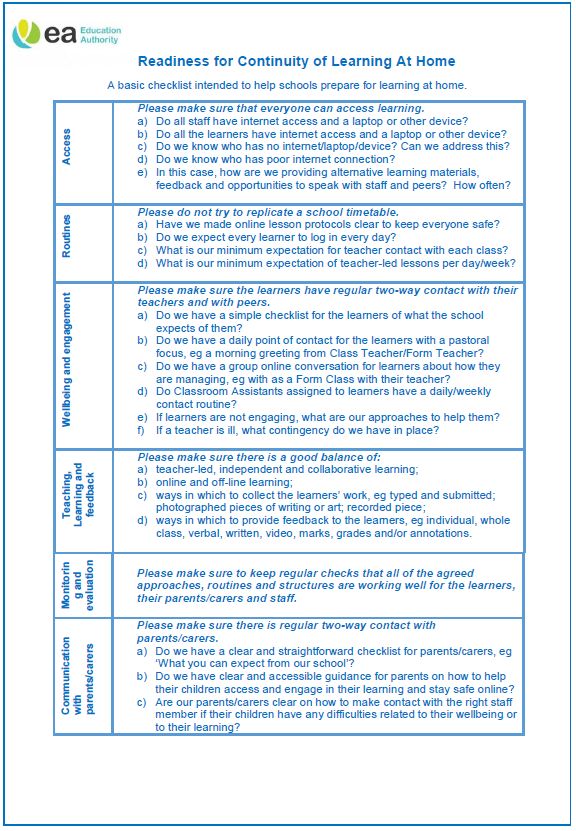
In early December EA provided a checklist on
readiness for home learning for all schools via the
C2K noticeboard. It is attached as Appendix Three
of this document for your information.
11 | P a g e2. SPECIAL SCHOOLS – This guidance should be read in conjunction with the DE revised
supplementary guidance for special schools
1.2 Common Questions for Special School Units
AREA QUESTION ANSWER
Staff Can normal duties All staff are expected to return to their normal
resume? duties unless they have a specific medical
exemption.
All staff are expected to follow public health and
Department of Education Guidelines when in
school.
Appropriate risk assessments should be in place
and followed by all teaching and support staff.
How do schools The approach for 2021-22 is consistent with the
access additional previous year, and the school’s annual budget and
staff if required? financial plan should be prepared on the basis of a
normal school year, with any costs related to
COVID-19 being separately identified.
Please continue to ensure that expenditure is
appropriately coded as the year progresses, as the
Department of Education will be required to give
an accurate account of how money has been
spent.
As confirmed by DE, further COVID-19 funding has
been agreed by the Executive for 2021-22. This
funding will be earmarked for specific purposes
and schools will be notified of individual
allocations.
EA will continue to work with you, and in
conjunction with DE, to review the impact that the
situation is having on school budgets.
NISTR teachers may be engaged where required.
If a school requires additional Classroom
Assistants, please contact the EA Emergency
Resourcing Team by emailing
Emergency.Resourcing@eani.org.uk
All Covid related expenditure should be recorded.
Are clinically Since 12 April 2021 CEV staff were written to and
extremely informed by the Chief Medical Officer that they
vulnerable (CEV) should continue to work from home where this is
staff expected to be
possible. Where it is not possible to work from
in their setting?
home, staff can attend their workplace, provided
their employer has taken all reasonable measures
to ensure social distancing in the place of work.
12 | P a g e Principals/line managers should undertake a risk
assessment with the individual to assess and
control measures to reduce risk.
Based on the outcome of a risk assessment the
Principal/line manager and Employing Authority
reserve the right to request that clinically
extremely vulnerable staff do not attend the work
place. In this case the individual would continue
to receive normal pay[1] and there would be no
impact on absence triggers or contractual sick pay.
Exceptional CEV Directives and Evidence
In exceptional circumstances an individual may be
directed by their GP or other medical specialist to
continue to self-isolate. In this exceptional case
the individual would continue to receive normal
pay and there would be no impact on absence
triggers or contractual sick pay. The Principal/line
manager and Employing Authority may request
evidence that a staff member has been advised to
shield or self-isolate.
The Government is regularly monitoring its
position on clinically extremely vulnerable
individuals.
Click here for advice and further information on
those considered Clinically Extremely Vulnerable.
The general restrictions which apply to everyone
must be followed
https://www.nidirect.gov.uk/articles/coronavirus
-covid-19-regulations-guidance-what-restrictions-
mean-you
DE funded setting staff should consult with their
management committee about employment
matters.
Will I still be paid if I Most staff can return to the workplace as a result
am unable to of a relaxation of restrictions.
attend work and I In some cases staff may be directed to self -isolate
am not Clinically
as a precaution. Working from home should be
Extremely
Vulnerable? considered in all cases where the employee is fit to
do so. In these scenarios staff will continue to
13 | P a g ereceive normal pay with some noted exceptions
e.g. staff who have opted to travel with quarantine
restrictions known to them/ the limits on normal
pay for COVID-19 sickness absence beyond 10
days.
Guidance on Absence, Pay and Staffing is under
review and will be published within a matter of
days as planned. In the meantime, the current
guidance remains extant.
In exceptional circumstances a CEV individual may
be directed by their GP or other medical specialist
to continue to self-isolate. If applicable, see CEV
Directives and Evidence above.
DE funded setting staff should consult with their
management committee about employment
matters.
Pupils Can normal All pupils are expected to return to normal
curricular activities curricular activities unless they have a specific
resume? medical exemption.
All staff are expected to support pupils to follow
public health and Department of Education
Guidelines when in school.
Appropriate risk assessments should be in place
and followed by all pupils and staff.
Guidance in relation to curriculum planning for
primary schools in 2021/22 is available at
Curriculum Planning Primary Schools and for post
primary schools at Curriculum Planning Post
Primary Schools. This is includes guidance in
relation to PE in the curriculum.
Schools will note that both indoor and outdoor PE
are permitted without COVID-19 related
restrictions on the numbers of participants.
Delivering 1:1 care When providing one-to-one care for SEN or
vulnerable pupils, adult to adult social distancing
should be maintained wherever possible, however
this can be relaxed where staff consistently remain
with a pupil or class, and an appropriate risk
assessment carried out.
In cases where staff are working closely with
children e.g. in carrying out Aerosol Generating
14 | P a g eProcedures the necessary PPE should be used in
line with guidance.
Can Before- Schools are able to host both outdoor and indoor
school/after-school gatherings on the same basis as the Executive’s
activities, Extra- current guidance for non-domestic outdoor and
curricular activities indoor gatherings in other sectors. Coronavirus
and Inter-School (COVID-19) regulations and guidance: what they
Sport and mean for you | nidirect
Wraparound Care
Both indoor and outdoor extra-curricular activities
resume?
can resume in educational settings.
Activities such as school clubs and indoor extra-
curricular sports can also resume.
Bilateral inter-schools sports can resume, allowing
schools to play competitive sports fixtures against
another school.
Day educational visits and trips for pupils can
resume.
Wraparound care can also resume.
Can singing and Guidance on singing and the playing of instruments is
playing of regularly updated by the EA Music Service in the
instruments “Music Unlocked” document. For the latest guidance
resume? please go to:
https://musicservice.eani.org.uk/schools-
teachers/music-unlocked-guidance-schools
How should DE Circular 2021/16 refers
absences be Attendance should be recorded using normal
recorded? processes.
It is recognised that classes will still be disrupted in
the event of a confirmed case. Where a child is
self-isolating, but not ill the COVID-19 codes
should be used.
If a pupil is self-isolating and ill then they should be
marked as ill.
If a pupil refuses to or is unable to take a PCR test
they must self-isolate for the full period and be
marked as Code H [other absence] and include a
note to that effect in SIMS.
COVID 19 specific attendance code options
include:
o Code ( “Covid-19 illness confirmed
15 | P a g eo Code ) “ Covid-19 illness suspected (only
to be used until PCR test result is known)
o Code { “ Self-isolating due to vulnerable
pupil or household member” (only to be
used in exceptional circumstances and
where a letter from a health professional
has been provided)
o Code } “Required to self-isolate but no
evidence of learning from home” (only to
be used until PCR test result is known)
o Code [ “Required to self-isolate and is
learning from home” (only to be used until
PCR test result is known)
o Code ] “ Approved activity - Required to
learn from home due to social distancing
rules imposed by DE or school and
informed by health professional advice
The above codes reflect current health guidance and
will be kept under review.
How will targeted All Children and Young Peoples’ Services will, as far
services be as possible, operate normal delivery models of
delivered by support for children, continuing to conduct risk
Children and Young
assessments and adhere to government guidance
People’s Services?
as appropriate to ensure the safety of children,
schools and staff. Where possible, services directly
supporting young people will do so face-to- face in
accordance with presenting need and risk
assessment. Where applicable, prior to delivering
support, services will plan with the school/setting
and/or parents of children and young people
known to services to ensure risk is minimised
Advice, guidance and support to schools/settings
staff, and families will operate on a blend of
remote and face-to-face meetings as appropriate.
Home visits and home teaching will be delivered in
accordance with Executive directions on home
gatherings at the point of delivery. Services will
deliver in accordance with the needs of the young
person and risk assessment as appropriate.
16 | P a g e A suite resources relevant to each service can be
found on EAs website.
Face Coverings Are children in It is recognised that in the special school
special schools environment that many children will meet the
required to wear definition of a reasonable excuse and so will be
face coverings? unable to wear a face covering.
Primary aged children are recommended not to
use face coverings on school premises.
Where possible within the context of special
school provision it is strongly recommended that
post-primary pupils wear a face covering at all
times when inside school buildings, including
classrooms, corridors and confined communal
spaces such as toilet areas (apply until 8 Oct,
subject to review).
However, for subjects where social distancing is
possible, such as drama in a large hall, face
coverings are no longer required.
It is mandatory for all post-primary school age
pupils to wear a face covering on all public and
school transport unless they have a reasonable
excuse not to and it is recognised that many
special school children will meet this definition.
Are staff in special In classrooms, staff may wear a face covering
schools required to where they are not able to maintain a 2m social
wear face distance from other staff or pupils and any staff
coverings? who wish to wear a face covering at other times
are free to do so.
Outside of the classroom setting, where a 2m
distance cannot be maintained all adults should be
encouraged to wear a face covering.
What about deaf The EA’s Sensory Service has provided information
and hearing and advice on the impact of wearing face
impaired children?
coverings in schools for deaf children and young
people. This can be found in the special schools
section of the DE guidance.
Who is exempt Schools should also be aware that some persons
from wearing Face are exempt from wearing face coverings and this
Coverings? should be treated sensitively.
Examples of reasonable excuses can be found here
17 | P a g eCan a visor be worn Visors only protect the eyes and are only required
as an alternative to where there is a risk of splashing. They are
a face covering? therefore only recommended for basic PPE when
worn with a mask, plastic apron and gloves, as
they do not offer the same protection as a mask or
face covering which cover the nose and the
mouth.
They offer little protection worn on their own and
are not recommended for routine use in schools.
Staff remain free to procure and wear them at
their own expense.
Covid19 Response Covid19 Risk Special schools must review and update their risk
Assessments assessments regularly to ensure compliance and
reflect any adaptations introduced to their
operations. The EA have reviewed and revised risk
assessment templates. These can be accessed
through C2K exchange Go to Exchange >
Resources > Covid19
If you do not have access to C2K Exchange please
email;
Covid-19@eani.org.uk
Operating Monday – Friday, 9am – 5pm.
Bubbles/ From 16 August, schools are no longer required to
Supporting Close operate a system of formal protective bubbles.
Contact Schools can individually determine if they wish to
Identification continue to use some/all of the principles of
bubbles.
Schools should consider how to support effective
contact tracing by encouraging pupils to remain
within a consistent group of pupils wherever
possible.
Ventilation The use of ventilation, whether natural or by
mechanical means, should be maximised as far as
practicable. School activities are encouraged to
take place outdoors wherever possible.
Where activities take place indoors, schools
should seek to have doors and windows open
wherever possible.
18 | P a g eAsymptomatic Weekly LAMP testing is available to all special
Testing school staff and pupils.
Confirmed Cases The EA confirmed cases helpline and PHA support
and Close Contacts to preschool settings will be active from start of
term.
Definition of a Close
PHA COVID19 School Team phone number is 028
Contact is provided
9536 0484 and the online form can be downloaded
as Appendix 3 of
this document. from: https://hscforms.hscni.net/education-cell-
online-form/
The EA suspected or confirmed cases contact
details are:
028 9041 8056 or
confirmed.covid19@eani.org.uk.
Both helplines operate Mon-Fri 8am-4pm and 10am to
2pm at weekends and Bank Holidays.
Close contacts who are pupils in any year from P1 to
Year 14
Parents of all those on the contact list should be
informed by the school that their child is a close
contact of a confirmed case. They should be
advised to self-isolate until they have taken a PCR
test.
If the PCR test is positive they should self-isolate
for 10 days from the onset of symptoms or, if they
have no symptoms, for 10 days from the test result
If the test is negative they can return to school,
however, if they do go on to develop new
symptoms, they should stay at home, self-isolate
with their household and book another PCR test.
Close contacts who are adult staff members (18 and
over)
Different self-isolation guidance applies
depending on vaccination status.
If fully vaccinated (i.e. 14 days have elapsed after
their 2nd dose of a UK-approved vaccine), they can
return to school straightaway, but are advised to
take a PCR test on day 2 since their last contact
with the case (or as soon as they have been
19 | P a g einformed if it is already more than 2 days since
their contact) and another on Day 8.
Unvaccinated or partially vaccinated staff should
self-isolate for the full 10 day period since their last
contact with the case and book a PCR test. If an
unvaccinated or partially vaccinated person’s PCR
test is negative, they are still required to complete
initial 10 days of self-isolation.
School Transport Is school transport School Transport will operate as normal from 1st
operating? September for all pupils with SEN who receive
transport assistance.
Children showing any symptoms of COVID-19
should not travel to school.
Vehicles will operate at normal capacity.
Schools must consult with Transport if they wish
to alter school timings which would impact upon
transport services.
Cleaning Is enhanced The EA Cleaning Service have established Covid-19
cleaning still Cleaning Response Teams which are strategically
required? located throughout NI. Upon notification of a
confirmed case the Cleaning Service Locality
Manager will arrange an enhanced clean of the
affected area, which will include the use of
specialist sanitising equipment.
How do I contact EA Please contact the following e-mail address with
Cleaning Services? any queries relating to Covid:
cleaning.covid19@eani.org.uk
Are School Meals The school meals service will operate as normal for
available? each setting from 1st September.
Classroom based lunch service is no longer
required
School Meals
Settings should continue to operate local
approaches that minimise interaction between
pupils at social and dining times.
How will Free From 1st September Free School Meals will return
School Meals be to normal provision. No direct payments will be
paid/provided? made unless schools are instructed to revert to
remote learning.
20 | P a g eWhere can I get The ‘Supporting Learning’ area in C2K provides access
guidance on to wide range of guidance documents, professional
supporting remote learning resources and information about forthcoming
/ home learning?
Teacher Professional Learning opportunities. The site
is updated regularly. It can be accessed through the
Online and
Remote Learning ‘Supporting Learning -TPL’ button on the home page
of My-School on C2K, readily identified by its rainbow
logo.
Guidance is available to assist settings in planning for
remote learning within the following DE and ETI
publications:
DE Remote Learning Circular 2021/01
ETI Effective practice in remote learning , a one-page,
quick glance document for schools.
21 | P a g e3. PRIMARY SCHOOLS
1.2 Common Questions for Primary School Units
AREA QUESTION ANSWER
Staff Can normal duties All staff are expected to return to their normal
resume? duties unless they have a specific medical
exemption.
All staff are expected to follow public health and
Department of Education Guidelines when in
school.
Appropriate risk assessments should be in place
and followed by all teaching and support staff.
How do schools The approach for 2021-22 is consistent with the
access additional previous year, and the school’s annual budget and
staff if required? financial plan should be prepared on the basis of a
normal school year, with any costs related to
COVID-19 being separately identified.
Please continue to ensure that expenditure is
appropriately coded as the year progresses, as the
Department of Education will be required to give
an accurate account of how money has been
spent.
As confirmed by DE, further COVID-19 funding has
been agreed by the Executive for 2021-22. This
funding will be earmarked for specific purposes
and schools will be notified of individual
allocations.
EA will continue to work with you, and in
conjunction with DE, to review the impact that the
situation is having on school budgets.
NISTR teachers may be engaged where required.
If a school requires additional Classroom
Assistants, please contact the EA Emergency
Resourcing Team by emailing
Emergency.Resourcing@eani.org.uk All Covid
related expenditure should be recorded.
Are clinically Since 12 April 2021 CEV staff were written to and
extremely informed by the Chief Medical Officer that they
vulnerable (CEV) should continue to work from home where this is
staff expected to be
possible. Where it is not possible to work from
in their primary
school setting? home, staff can attend their workplace, provided
their employer has taken all reasonable measures
to ensure social distancing in the place of work.
Principals/line managers should undertake a risk
assessment with the individual to assess and
control measures to reduce risk.
22 | P a g e Based on the outcome of a risk assessment the
Principal/line manager and Employing Authority
reserve the right to request that clinically
extremely vulnerable staff do not attend the work
place. In this case the individual would continue to
receive normal pay[1] and there would be no
impact on absence triggers or contractual sick pay.
Exceptional CEV Directives and Evidence
In exceptional circumstances an individual may be
directed by their GP or other medical specialist to
continue to self-isolate. In this exceptional case
the individual would continue to receive normal
pay and there would be no impact on absence
triggers or contractual sick pay. The Principal/line
manager and Employing Authority may request
evidence that a staff member has been advised to
shield or self-isolate.
The Government is regularly monitoring its
position on clinically extremely vulnerable
individuals.
Click here for advice and further information on
those considered Clinically Extremely Vulnerable.
The general restrictions which apply to everyone
must be followed
https://www.nidirect.gov.uk/articles/coronavirus
-covid-19-regulations-guidance-what-restrictions-
mean-you.
DE funded setting staff should consult with their
management committee about employment
matters.
Will I still be paid if I Most staff can return to the work place as a result
am unable to of a relaxation of restrictions.
attend work and I In some cases staff may be directed to self -isolate
am not Clinically
as a precaution. Working from home should be
Extremely
Vulnerable? considered in all cases where the employee is fit to
do so. In these scenarios staff will continue to
receive normal pay with some noted exceptions
e.g. staff who have opted to travel with quarantine
restrictions known to them/ the limits on normal
23 | P a g epay for COVID-19 sickness absence beyond 10
days.
Guidance on Absence, Pay and Staffing is under
review and will be published within a matter of
days as planned. In the meantime, the current
guidance remains extant.
In exceptional circumstances a CEV individual may
be directed by their GP or other medical specialist
to continue to self-isolate. If applicable, see CEV
Directives and Evidence above.
DE funded setting staff should consult with their
management committee about employment
matters.
Pupils Can normal All pupils are expected to return to normal
curricular activities curricular activities unless they have a specific
resume? medical exemption.
All staff are expected to support pupils to follow
public health and Department of Education
Guidelines when in school.
Appropriate risk assessments should be in place
and followed by all pupils and staff.
Guidance in relation to curriculum planning for
primary schools in 2021/22 is available at
Curriculum Planning Primary Schools and for post
primary schools at Curriculum Planning Post
Primary Schools. This is includes guidance in
relation to PE in the curriculum. DE recommends
that schools should provide pupils with at least 2
hours of curricular PE per week.
Schools will note that both indoor and outdoor PE
are permitted without COVID-19 related
restrictions on the numbers of participants.
Can Before- Schools are able to host both outdoor and indoor
school/after-school gatherings on the same basis as the Executive’s
activities, Extra- current guidance for non-domestic outdoor and
curricular activities indoor gatherings in other sectors. Coronavirus
and Inter-School (COVID-19) regulations and guidance: what they
Sport and mean for you | nidirect
Wraparound Care
Both indoor and outdoor extra-curricular activities
resume?
can resume
24 | P a g e Activities such as school clubs and indoor extra-
curricular sports can also resume
Bilateral inter-schools sports can resume, allowing
schools to play competitive sports fixtures against
another school
Day educational visits and trips for pupils can
resume.
Wraparound care can also resume
Can singing and Guidance on singing and the playing of instruments is
playing of regularly updated by the EA Music Service in the
instruments “Music Unlocked” document. For the latest guidance
resume? please go to:
https://musicservice.eani.org.uk/schools-
teachers/music-unlocked-guidance-schools
How should DE Circular 2021/16 refers
absences be Attendance should be recorded using normal
recorded? processes.
It is recognised that classes will still be disrupted in the
event of a confirmed case. Where a child is self-
isolating, but not ill the COVID-19 codes should be
used.
If a pupil is self-isolating and ill then they should be
marked as ill.
If a pupil refuses to take a PCR test they must self-
isolate for the full period and be marked as Code H
[other absence] and include a note to that effect in
SIMS.
COVID 19 specific attendance code options include:
o Code ( “Covid-19 illness confirmed
o Code ) “ Covid-19 illness suspected (only to be
used until PCR test result is known)
o Code { “ Self-isolating due to vulnerable pupil
or household member” (only to be used in
exceptional circumstances and where a letter
from a health professional has been provided)
o Code } “Required to self-isolate but no
evidence of learning from home” (only to be
used until PCR test result is known)
o Code [ “Required to self-isolate and is learning
from home” (only to be used until PCR test
result is known)
25 | P a g eo Code ] “ Required to learn from home due to
social distancing rules imposed by DE or school
and informed by health professional advice
The above codes reflect current health guidance and
will be kept under review.
How will targeted
services be All Children and Young Peoples’ Services will, as far
delivered by as possible, operate normal delivery models of
Children and Young
support for children, continuing to conduct risk
People’s Services?
assessments and adhere to government guidance
as appropriate to ensure the safety of children,
schools and staff. Where possible, services directly
supporting young people will do so face-to- face in
accordance with presenting need and risk
assessment. Where applicable, prior to delivering
support, services will plan with the school/setting
and/or parents of children and young people
known to services to ensure risk is minimised.
Advice, guidance and support to schools/settings
staff, and families will operate on a blend of
remote and face-to-face meetings as appropriate.
Home visits and home teaching will be delivered in
accordance with Executive directions on home
gatherings at the point of delivery. Services will
deliver in accordance with the needs of the young
person and risk assessment as appropriate.
A suite resources relevant to each service can be
found on EAs website.
Face Coverings Are children in Primary school children are recommended not to
primary schools use face coverings on school premises because of
schools required to the range of mitigation measures schools have in
wear face place and the reduced rate of transmission to and
coverings? from children of this age.
Primary age pupils are strongly encouraged to
wear a face covering on all public and schools
transport where they are able to do so.
26 | P a g eAre staff in primary In classrooms, staff are encouraged to wear a face
schools required to covering where they are not able to maintain a 2m
wear face social distance from other staff or pupils and any
coverings? staff who wish to wear a face covering at other
times are free to do so.
Outside of the classroom setting, where a 2m
distance cannot be maintained from other persons
either indoors or outdoors on a school site, all
adults should be encouraged to wear a face
covering. This includes communal staff areas and
for all adults visiting the school site.
The EA’s Sensory Service has provided information
and advice on the impact of wearing face
coverings in schools for deaf children and young
people. This can be found in the special schools
section of the DE guidance.
Schools should also be aware that some persons
Who is exempt are exempt from wearing face coverings and this
from wearing Face should be treated sensitively.
Coverings? Examples of reasonable excuses can be found here
Can visors be worn Visors only protect the eyes and are only required
as an alternative to where there is a risk of splashing. They are
face coverings? therefore only recommended for basic PPE when
worn with a mask, plastic apron and gloves, as
they do not offer the same protection as a mask
or face covering which cover the nose and the
mouth.
They offer little protection worn on their own and
are not recommended for routine use in schools.
Staff remain free to procure and wear them at
their own expense.
Covid19 Response Covid19 Risk Primary schools must review and update their risk
Assessments assessments regularly to ensure compliance and
reflect any adaptations introduced to their
operations. The EA have reviewed and revised risk
assessment templates. These can be accessed
through C2K exchange Go to Exchange >
Resources > Covid19
27 | P a g e If you do not have access to C2K Exchange please
email;
Covid-19@eani.org.uk
Operating Monday – Friday, 9am – 5pm.
Bubbles/ From 16 August, schools are no longer required to
Supporting Close operate a system of formal protective bubbles
Contact Schools can individually determine if they wish to
Identification continue to use some/all of the principles of
bubbles
Schools should consider how to support effective
contact tracing by encouraging pupils to remain
within a consistent group of pupils wherever
possible.
Ventilation The use of ventilation, whether natural or by
mechanical means, should be maximised as far as
practicable. School activities are encouraged to
take place outdoors wherever possible.
Where activities take place indoors, schools
should seek to have doors and windows open
wherever possible
Asymptomatic All staff are encouraged to self-administer an LFD
Testing test twice weekly and record the results on the
testing portal
https://www.gov.uk/report-covid19-result
Any staff member who has a positive LFT should
not come into school, should organise a PCR test
and they should self-isolate until the PCR result is
obtained.
Primary schools children are not expected to be
tested using LFD tests.
Confirmed Cases The EA confirmed cases helpline and PHA support
and Close Contacts to preschool settings will be active from start of
term.
Definition of a Close
PHA COVID19 School Team phone number is 028
Contact is provided
9536 0484 and the online form can be downloaded
as Appendix 3 of this
document. from: https://hscforms.hscni.net/education-cell-
online-form/
The EA suspected or confirmed cases contact
details are:
28 | P a g e 028 9041 8056 or
confirmed.covid19@eani.org.uk.
Both helplines operate Mon-Fri 8am-4pm and 10am to
2pm at weekends and Bank Holidays.
Close contacts who are pupils Y1 to Year 7
Parents of all those on the contact list should be
informed by the school that their child is a close
contact of a confirmed case. They should be
advised to self-isolate until they have taken a PCR
test.
If the PCR test is positive they should self-isolate
for 10 days from the onset of symptoms or, if they
have no symptoms, for 10 days from the test result
If the test is negative they can return to school,
however, if they do go on to develop new
symptoms, they should stay at home, self-isolate
with their household and book another PCR test.
Close contacts who are adult staff members (18 and
over)
Different self-isolation guidance applies
depending on vaccination status.
If fully vaccinated (i.e. 14 days have elapsed after
their 2nd dose of a UK-approved vaccine), they can
return to school straightaway, but are advised to
take a PCR test on day 2 since their last contact
with the case (or as soon as they have been
informed if it is already more than 2 days since
their contact) and another on Day 8.
Unvaccinated or partially vaccinated staff should
self-isolate for the full 10 day period since their last
contact with the case and book a PCR test. If an
unvaccinated or partially vaccinated person’s PCR
test is negative, they are still required to complete
initial 10 days of self-isolation.
School Transport Is school transport School Transport will operate as normal from 1st
operating? September for all pupils who are entitled to
transport assistance and vehicles will operate at
normal capacity.
29 | P a g e Translink will be returning to provision of the
normal school network from 1st September
onwards and pupils are advised to check the
Translink website for both dedicated school and
regular services as some journeys may have
altered since the last school term.
Children showing any symptoms of COVID-19
should not travel to school.
Schools must consult with Transport if they wish
to alter school timings which would impact upon
transport services.
Hired services for activities such as swimming has
recommenced and is subject to availability.
Cleaning Is enhanced The EA Cleaning Service have established Covid-19
cleaning still Cleaning Response Teams which are strategically
required? located throughout NI. Upon notification of a
confirmed case the Cleaning Service Locality
Manager will arrange an enhanced clean of the
affected area, which will include the use of
specialist sanitising equipment.
How do I contact EA Please contact the following e-mail address with
Cleaning Services? any queries relating to Covid:
cleaning.covid19@eani.org.uk
Are School Meals The school meals service will operate as normal for
available? each setting from 1st September.
Classroom based lunch service is no longer
required
School Meals
Settings should continue to operate local
approaches that minimise interaction between
pupils at social and dining times.
How will Free From 1st September Free School Meals will return
School Meals be to normal provision. No direct payments will be
paid/provided? made unless schools are instructed to revert to
remote learning.
30 | P a g eWhere can I get The ‘Supporting Learning’ area in C2K provides access
guidance on to wide range of guidance documents, professional
supporting remote learning resources and information about forthcoming
/ home learning?
Teacher Professional Learning opportunities. The site
is updated regularly. It can be accessed through the
Online and
Remote Learning ‘Supporting Learning -TPL’ button on the home page
of My-School on C2K, readily identified by its rainbow
logo.
Guidance is available to assist settings in planning for
remote learning within the following DE and ETI
publications:
DE Remote Learning Circular 2021/01
ETI Effective practice in remote learning , a one-page,
quick glance document for schools.
31 | P a g e4. POST PRIMARY SCHOOLS
1.2 Common Questions for Post Primary Schools
AREA QUESTION ANSWER
Staff Can normal duties All staff are expected to return to their normal
resume? duties unless they have a specific medical
exemption.
All staff are expected to follow public health and
Department of Education Guidelines when in
school.
Appropriate risk assessments should be in place
and followed by all teaching and support staff.
How do schools The approach for 2021-22 is consistent with the
access additional previous year, and the school’s annual budget and
staff if required? financial plan should be prepared on the basis of a
normal school year, with any costs related to
COVID-19 being separately identified.
Please continue to ensure that expenditure is
appropriately coded as the year progresses, as the
Department of Education will be required to give
an accurate account of how money has been
spent.
As confirmed by DE, further COVID-19 funding has
been agreed by the Executive for 2021-22. This
funding will be earmarked for specific purposes
and schools will be notified of individual
allocations.
EA will continue to work with you, and in
conjunction with DE, to review the impact that the
situation is having on school budgets.
NISTR teachers may be engaged where required.
If a school requires additional Classroom
Assistants, please contact the EA Emergency
Resourcing Team by emailing
Emergency.Resourcing@eani.org.uk All Covid
related expenditure should be recorded.
Are clinically Since 12 April 2021 CEV staff were written to and
extremely informed by the Chief Medical Officer that they
vulnerable (CEV) should continue to work from home where this is
staff expected to be possible. Where it is not possible to work from
in their preschool home, staff can attend their workplace, provided
setting? their employer has taken all reasonable measures
to ensure social distancing in the place of work.
Principals/line managers should undertake a risk
assessment with the individual to assess and
control measures to reduce risk.
32 | P a g e Based on the outcome of a risk assessment the
Principal/line manager and Employing Authority
reserve the right to request that clinically
extremely vulnerable staff do not attend the work
place. In this case the individual would continue
to receive normal pay[1] and there would be no
impact on absence triggers or contractual sick pay.
Exceptional CEV Directives and Evidence
In exceptional circumstances an individual may be
directed by their GP or other medical specialist to
continue to self-isolate. In this exceptional case
the individual would continue to receive normal
pay and there would be no impact on absence
triggers or contractual sick pay. The Principal/line
manager and Employing Authority may request
evidence that a staff member has been advised to
shield or self-isolate.
The Government is regularly monitoring its
position on clinically extremely vulnerable
individuals.
Click here for advice and further information on
those considered Clinically Extremely Vulnerable.
The general restrictions which apply to everyone
must be followed
https://www.nidirect.gov.uk/articles/coronavirus
-covid-19-regulations-guidance-what-restrictions-
mean-you.
DE funded setting staff should consult with their
management committee about employment
matters.
Will I still be paid if I Most staff can return to the workplace as a result
am unable to of a relaxation of restrictions.
attend work and I
am not Clinically In some cases staff may be directed to self -isolate
Extremely as a precaution. Working from home should be
Vulnerable? considered in all cases where the employee is fit to
do so. In these scenarios staff will continue to
receive normal pay with some noted exceptions
e.g. staff who have opted to travel with quarantine
restrictions known to them/ the limits on normal
33 | P a g eYou can also read


