ECommerce report EU4Digital: supporting digital economy and society in the Eastern Partnership Recommendations proposed for eCommerce environment ...
←
→
Page content transcription
If your browser does not render page correctly, please read the page content below

EU4Digital: supporting digital economy
and society in the Eastern Partnership

eCommerce report
Recommendations proposed for eCommerce
environment harmonisation in the EaP countries:
Republic of Moldova

23 December 2020
Disclaimer: The views and opinions expressed in this document are entirely those of the EY-led consortium and
do not reflect the official opinion of the European Commission. Neither the Commission, nor any person acting
on the Commission’s behalf may be held responsible for the content of the information contained in the document.

                                                                                                                   1
Table of Content
Table of Content .......................................................................................................................................... 2
1      Executive summary.............................................................................................................................. 3
    1.1       Objectives of the report ................................................................................................................... 3
    1.2       Scope of eCommerce study ............................................................................................................ 3
    1.3       Approach ........................................................................................................................................ 3
    1.4       The state of play in the Eastern partner countries............................................................................ 4
    1.5       The recommendations to harmonise eCommerce ........................................................................... 5
    1.6       The next steps and considerations .................................................................................................. 6
2      Introduction .......................................................................................................................................... 7
    2.1       Context ........................................................................................................................................... 7
    2.2       Objectives ...................................................................................................................................... 8
    2.3       Scope ............................................................................................................................................. 8
3      Methodology......................................................................................................................................... 9
    3.1       EU practice of cross-border eCommerce......................................................................................... 9
    3.2       Value chain of eCommerce ............................................................................................................10
    3.3       Approach of assessment in the Eastern partner countries ..............................................................11
4      Gap analysis report for the Republic of Moldova ..............................................................................16
    4.1       Gap analysis in eCommerce ecosystem area.................................................................................16
    4.2       Gap analysis in legal area ..............................................................................................................28
    4.3       Gap analysis in standards area ......................................................................................................44
    4.4       Summary of gap analysis...............................................................................................................50
5      Recommendations report for the Republic of Moldova.....................................................................54
    5.1       Ecosystem recommendations to eliminate the barriers for cross-border eCommerce......................55
    5.2       Legislation framework and standards recommendations to enable cross-border eCommerce with the
    EU        ......................................................................................................................................................65
6      The next steps and considerations ....................................................................................................70

                                                                                                                                                                    2
1 Executive summary
In the EU market, eCommerce presents opportunities for retailers from the different countries to grow
businesses and revenues. The EU market of eCommerce provides access to over 500 million consumers with
the eCommerce market worth more than $700 billion1 and an annual growth rate of 15% on average
domestically and exceeding 25% for cross-border eCommerce2. The EU, being the second biggest in the world
cross-border buyer of goods, established own eCommerce rules, processes, know-hows and ways for
engagement of stakeholders. The EU member states expect that these rules are considered and followed by
trading partners, including non-EU businesses. Otherwise, obstacles and barriers created by different rules in
the EU and third countries complicate eCommerce transactions.
To eliminate existing obstacles and barriers for pan-European eCommerce for citizens and businesses requires
the harmonisation of the digital environments among the Eastern partner countries and with the EU. This
includes harmonisation of eCommerce ecosystem and approximation to relevant EU legislation and standards.
1.1 Objectives of the report
The overall objective of the report is to provide recommendations to harmonise eCommerce among the Eastern
partner countries (in particular, the Republic of Moldova, hereafter, Moldova) and the EU in three areas:
ecosystem, legal framework and standards. This includes:
• Eliminating the barriers for cross-border eCommerce;
• Boosting cross-border eCommerce volume;
Preparing countries for the upcoming EU and global changes in eCommerce introduced in 2021.
1.2 Scope of eCommerce study
eCommerce in this study is understood as a sale of goods through electronic transactions carried out on
computer networks.
The study focuses on the B2C type of electronic exchange, but doesn’t exclude C2C, B2B and B2G exchange.
This focus is taken as the volume of B2C transactions is increasing in the EU, which is strengthened amid
COVID-19. In 2019, the number of EU enterprises using B2C transactions was higher than the number of EU
enterprises using B2B and B2G combined3. As B2C eCommerce is facing updates that will shape the area for
the next few years, this study aims to provide benefit to harmonise B2C area between the EU and the Eastern
partner countries. Also, it is important to note that the topics covered in this study, such as cross-border parcel
supply chain, interaction between parcel operators, logistics and the supporting areas of eCommerce legislation,
are valid both for B2C and B2B
The basis of the analysis is the EU baseline that consists mainly of the EU laws and standards regulating
eCommerce as well as best practices in eCommerce ecosystem development. The EU baseline also includes
international rules as the EU trades with the rest of the world and there are rules developed by global
cooperation (e.g. the Universal Postal Union network that enables eCommerce cross-border delivery, the
World Customs Organisation model for customs procedures).
In addition, the analysis is based mainly on the existing legislation, standards and ecosystem processes.
However, as the EU is in the process of major changes that impact eCommerce, the report is also focused on
the upcoming legislation (i.e. 2021 eCommerce package) that is defined and is to be implemented in 2021.
The report focuses on the eCommerce areas that are the most critical to be harmonised for cross-border
transactions. Harmonisation of these areas facilitates cross-border eCommerce transactions and reduce
obstacles for seamless cross-border trade.
1.3 Approach
The recommendations to harmonise eCommerce among the Eastern partner countries and the EU were
developed by performing the following activities by the EU4Digital central eCommerce experts and local experts
from the Eastern partner countries:
1
More at: https://www.digitalcommerce360.com/2019/05/09/the-delivery-preferences-of-european-online-shoppers/
2
More at: https://op.europa.eu/en/publication-detail/-/publication/1c50224c-574e-11e9-a8ed-01aa75ed71a1/language-en
3
Eurostat, Community survey on ICT usage and e-commerce in enterprises, 2019
3• Developed the EU state of play or the baseline for the assessment, which is structured around the
eCommerce value chain. The value chain describes the players, information and activities involved in
the supply, distribution, and post-sales activities of goods for the market. More than 100 key aspects in
legal, standards and eCommerce ecosystem areas are described across the value chain and the
baseline.
• Performed the state of play analysis of eCommerce in the Eastern partner countries by conducting
interviews, workshops and research. More than 50 stakeholders were involved across the Eastern
partner countries to provide inputs for analysis of the state of play of eCommerce. Among them the
ministries, customs and tax authorities, postal and logistics operators, marketplaces, business
associations, local experts.
• Provided professional opinion by the EU4Digital Facility experts on the key gaps for cross-border
eCommerce.
• Developed recommendations based on the EU practices aimed to boost eCommerce transactions
volume and address the necessary supportive measures for eCommerce to work. Key
recommendations for each Eastern partner country include specific actions to be considered on a
national level.
• Organised consultations and alignments with the national stakeholders.
1.4 The state of play in the Eastern partner countries
The Eastern partner countries have a varying level of digital commerce enablement. Comparing to the
eCommerce baseline, the analysis identified the key common gaps in the following areas provided in the table
below. Note that the overview below provides a summary of the most common gaps, while specific gaps are
explained in the chapter 4. Gap analysis report for the Republic of Moldova of this report.
Table 1: Summary of eCommerce common gaps for cross-border eCommerce in the Eastern partner countries comparing
to the EU baseline
No Area Key aspects that have gaps and challenges in the Eastern partner countries
Gaps in eCommerce ecosystem
• Usage of global marketplaces that operate in the EU is limited (reasons: long/expensive
delivery, cash-on-delivery preference, poor awareness).
Marketing and
1.
sales • Local marketplaces selling cross-border are not common, except certain national
platforms (reasons: long/expensive delivery, cash-on-delivery preference, poor
awareness).
Payment methods usage is different than in the EU due to still preferred cash-on-delivery
2. Payment payment method and common usage of local solutions rather than global that are popular for
the EU.
• Global private operators face challenge to maintain high eCommerce volumes creating
high rates for parcel delivery limiting involvement in eCommerce ecosystem.
3. Parcel delivery • Wide network of active postal offices is not aligned with the centralised approach that is
common in the EU and within the UPU.
• Delivery time is few days longer than in the EU, where delivery within 48 hours is common.
Limited4 awareness by stakeholders and only fragmented actions to prepare for changes in
The EU 2021
VAT (Import One Stop Shop, removal of exceptions), customs (Import Control System 2,
4. eCommerce
mandatory electronic declarations), harmonised ID (item level information exchanged via
package
harmonised IDs).
Gaps in eCommerce legal framework
5. Platforms Limited regulation of terms and conditions explaining ranking of goods on platforms.
• Limited regulation of postal security requirements for the provision of electronic advance
6. Parcel delivery
data for consignments of distance sales.
4
Limited means not regulated or not (partially) compatible with the EU rules or not implemented regulation.
4No Area Key aspects that have gaps and challenges in the Eastern partner countries
• Insufficient preparation for the EU VAT eCommerce package, including a special scheme
as regards certain value added tax obligations for distance sales of goods imported from
third territories or third countries to the EU that will be applied from 1 July 2021.
• Limited regulation of misleading commercial practices of paid advertisement, including
provisions indicating the cases when paid advertisement is considered as a misleading
commercial practice.
• Limited regulation of information requirements for distance contracts of digital content and
Consumer digital service, including definitions of digital content, digital service supplied by the trader
7.
protection to the consumer and personalised pricing on the basis of automated decision-making.
• Limited regulation on misleading omissions about consumer reviews of products, where
trader providing access to consumer reviews of products must inform the consumer about
whether and how the trader ensures that the published reviews originate from consumers
who have actually used or purchased the product.
Gaps in eCommerce standardisation aspects
• Limited technical specifications for secure, trustworthy and user-friendly opening systems
for parcel boxes for home use.
8. Interoperability • Limited requirements for electronic advanced data submission in postal operations in
domestic and international postal operations as a pre-requisite for digital customs or
transport security related declaration.
Limited standardisation of electronic advanced data semantic mapping of attributes of
Digital postal
9. commercial single items compliant to the UPU-WCO (the Universal Postal Union – the World
services
Customs Organisation) model from 2021.
The UN, the Limited standardisation of specifications for post, courier, express, parcel operators and
EU, the UPU: customs agents that transport eCommerce items from the country into the EU to prepare the
10.
electronic necessary electronic data lodging of digital customs pre-declarations on item level that will
exchange become mandatory from 1 July 2021 for items below a value of 150 EUR.
The UPU: Limited standardisation of EDI messaging to be exchanged between customs authority/border
11. technical agency to a postal operator, between destination postal operator and the origin postal operator
standards on risk assessment.
Lack of national eCommerce Trustmark certification scheme(s) which authenticates that an
eCommerce
eCommerce company established on the national territory has made a commitment to work in
12. websites trust
compliance with the Code of Conduct, guaranteeing ethical standards in the digital
mark
marketplace.
1.5 The recommendations to harmonise eCommerce
To address the identified gaps and challenges, the EU4Digital Facility prepared the recommendations for
harmonisation of eCommerce among the Eastern partner countries and with the EU. The overview is provided
in the table below. Note that the overview provides a summary of the recommendations, while specific
recommendations and action points are explained in the chapter 5. Recommendations report for the Republic
of Moldova of this report.
Table 2: Summary of eCommerce recommendations to harmonise cross-border eCommerce among the Eastern partner
countries and with the EU
No Recommendation Goal
Recommendations in eCommerce ecosystem
Cross-border sales volume increase as businesses in the
Eastern partner countries list and manage inventory of goods
Establish a virtual warehouse as a re-usable
1. for cross-border sale; and the national postal operators are
database to list goods for sale in the EU.
connected to the database to trigger cross-border delivery
once sales happen to deliver within 72 hours.
Establish national pavilion account(s) on the EU Cross-border sales volume increase as businesses in the
2.
marketplace(s) to list goods for sale in the EU. Eastern partner countries list goods for cross-border sale
5No Recommendation Goal
through a single national account and get support with
marketing.
National postal operators and parcel delivery operators use
Establish consolidated central distribution centralised networks for clearance, sorting and transportation
networks with centralised warehouses, fulfilment of parcels to the cross-border hubs (office of exchange) to
3.
and sorting facilities to enhance postal capacity enable daily dispatch abroad. The aim is to reduce delivery
for cross-border transportation. time for domestic and cross-border delivery of commercial
items.
The national postal operator and private sector parcel delivery
operators sign cooperation agreements to co-share the last
Establish co-sharing agreements and unified mile delivery and to dispatch cross-border consignments
4. parcel identifiers between the post and private within 24 hours from order (after handing over to postal
parcel operators. service provider). The aim is to establish co-sharing
agreements for delivery to ensure optimal usage of
infrastructure and postal rates.
Increased collaboration of the eCommerce ecosystem
Further strengthen the integration of the Eastern
stakeholders of the Eastern partner countries with the EU
5. partner countries eCommerce ecosystem actors
ecosystem actors though transfer of the EU knowledge and
into the EU networks.
practices.
Cross-border trade is possible as customs and taxes
Increase awareness and readiness (legal,
authorities, postal and logistics operators can seamlessly
systems, processes) of relevant stakeholders for
6. exchange electronic advanced data with the EU operators;
the 2021 changes in customs, taxes, security,
can use simplified procedures to pay taxes; use harmonised
parcel delivery areas.
ID to exchange information on an item level.
Recommendations in eCommerce legislation and standards frameworks
Improve the overall framework of eCommerce by
The legal framework and main standards related to
introducing fundamental principles and critical
7. eCommerce correspond to the EU general framework and the
requirements (electronic platforms, contracts and
consumers feel safe to shop on-line.
intermediation services, data protection).
Improve online marketing and electronic sales
capacities of traders to increase visibility (on-line Products of the Eastern partner countries are presented on
8. marketplaces, unfair commercial practices, price the marketplaces selling in the EU, clearly identifiable and
indication, trust mark, CE, products safety, promoted to the potential target segments.
intellectual property).
Improve compliance with electronic payment
Assure the maximum consumer protection when using
9. (liability for unauthorised payment, removal of
electronic payment on eCommerce platforms.
surcharges, customer authentication).
Improve safe placing of on-line orders Assure the maximum level of consumer and trader
10.
(governance of contracts by residence). contractual protection in case of contracts concluded on-line.
Improve the time of cross-border parcel delivery
(postal security requirements and standards for Allow processing of all cross-border data on parcels between
11. electronic advanced data, measures for quality of the Eastern partner countries and the EU countries in
delivery services, interfaces between the e- standardised electronic format in advance.
merchant and logistic operators).
Improve Online Alternative Dispute Resolution
mechanism (out-of-court resolution for domestic
Assure the maximum level of consumer support in case of
12. and cross-border) and transparency in case of
disputes and security incidents.
security incidents (communication of incidents,
complaints handling principles).
1.6 The next steps and considerations
The beneficiaries in the Eastern partner countries should use this report to consider implementing the
recommendations.
6• Recommendations in legal and standards areas include specific points for specific government
authorities to use as an input to make necessary changes.
• Recommendations in ecosystem area should be considered by the relevant government and non-
government ecosystem stakeholders, who should include the recommendations in national economy
development plans for practical actions.
In addition, this report is considered by the European Commission for possible activation of the
recommendations on bi-lateral and regional level.
The next step of the EU4Digital Facility is to launch a pilot to facilitate cross-border eCommerce.
Recommendation #1 of this report – Establish a virtual warehouse as a re-usable database to list goods for sale
in the EU and other Eastern Partnership countries – is confirmed to be a pilot solution, which will support
countries to list products on the foreign marketplaces and complete cross-border eCommerce transactions. The
pilot activity is scheduled to start in January 2021 and to be completed by April 2021. Updates on the activities
are published on eufordigital.eu.
2 Introduction
This analysis report of harmonisation of eCommerce among the Eastern partner countries and with the EU is
developed under the European Union’s regional facility "EU4Digital Facility: bringing the benefits of the
harmonised digital market to the Eastern Partnership countries”, thematic area of eTrade, eCommerce activity.
The aim of this activity is to harmonise cross-border eCommerce laws, standards and ecosystem among the
Eastern partner countries (Armenia, Azerbaijan, Belarus, Georgia, the Republic of Moldova and Ukraine) and
the EU, as well as piloting technical solution to support cross-border eCommerce.
Team: the report is developed by the team of experts from 10 countries.
The central team includes: Artūras Piliponis (EU4Digital Team Lead), Rūta Šalvytė-Tamošiūnienė (EU4Digital
Deputy Team Lead, eTrade Stream Lead), Walter Trezek (Chairman of the Universal Postal Union Consultative
Committee, Co-chair of e-logistics Working Committee of Ecommerce Europe), Vladimir Abramytchev (Team
Lead in European External Action Service and multiple eCommerce studies funded by the European
Commission), Jan Hyttel (Board member of GS1 and Transport Innovation Association in Lithuania), Volodymyr
Kovalenko (EU4Digital eCommerce expert).
The local country teams: Armenia - Vahagn Marukhyan; Azerbaijan - Anar Jafarzade; Belarus - Natallia Harbuz;
Georgia - Nino Esakia; Moldova - Alexandru Florea, Ionela Titirez; Ukraine - Oleksiy Shmuratko.
Acknowledgements: more than 50 stakeholders were involved across the Eastern partner countries to provide
inputs for analysis of the state of play of eCommerce. These inputs covered more than 100 aspects in legal,
standards and ecosystem areas covering the entire value chain of eCommerce – platforms, payments, order
placement, parcel delivery, customer protection. The involved stakeholders included the Ministries, customs
and taxes authorities, postal and logistics operators, marketplaces, business associations, local experts. The
stakeholders participated in consultation sessions to provide feedback and shape the final set of
recommendations to harmonise eCommerce. Involvement of a broad community of stakeholders makes the
recommendations actionable and relevant for the beneficiaries in the Eastern partner countries.
2.1 Context
eCommerce of the EU market presents opportunities for retailers from the different countries to grow businesses
and revenues. The EU market of eCommerce provides access to over 500 million consumers with the
eCommerce market worth more than $700 billion5 and an annual growth rate of 15% on average domestically
and exceeding 25% for cross-border eCommerce6. The EU, being the second biggest in the world cross-border
buyer of goods, established own eCommerce rules, processes, know-hows and ways for engagement of
stakeholders. The EU member states expect that these rules are considered and followed by trading partners,
including non-EU businesses. Otherwise, obstacles and barriers created by different rules in the EU and third
countries complicate eCommerce transactions.
To eliminate existing obstacles and barriers for pan-European eCommerce for citizens and businesses requires
the harmonisation of the digital environments among the Eastern partner countries and with the EU. This
includes harmonisation of eCommerce ecosystem and approximation to relevant EU legislation and standards.
5
More at: https://www.digitalcommerce360.com/2019/05/09/the-delivery-preferences-of-european-online-shoppers/
6
More at: https://op.europa.eu/en/publication-detail/-/publication/1c50224c-574e-11e9-a8ed-01aa75ed71a1/language-en
72.2 Objectives
To ensure harmonisation, the objective of this report is to provide recommendations to harmonise eCommerce
practices among the Eastern partner countries and the EU in three areas: ecosystem, legal framework and
standards.
Ecosystem recommendations have objectives to:
• Eliminate the barriers for cross-border eCommerce;
• Boost cross-border eCommerce volume;
• Prepare countries for the upcoming EU and global changes introduced in 2021.
Legal framework and standards recommendations have an objective to address the key aspects that must be
in place for cross-border eCommerce with the EU to work.
2.3 Scope
2.3.1 Framework of eCommerce
eCommerce is defined as sale of goods through electronic transactions carried out on computer networks.
eCommerce comprises the preparation of orders for goods using electronic interfaces. An electronic interface
should be understood as a device or programme, which allows two independent systems or the system and the
end user to communicate. This is a broad concept and could encompass a website, portal, gateway,
marketplace, or application program interface (API). Then, the orders are transmitted through computer
networks. The methods of placing of the order such as by telephone calls, facsimile or manually typed e-mail
are usually not considered as part of eCommerce. The payment and the ultimate delivery of the goods or
services do not have to be conducted online.
eCommerce can operate through websites (which allow online ordering or booking, for example using a
“shopping cart”), mobile applications operated on mobile telecommunications networks or through an exchange
of electronic messages or EDI messages (electronic data interchange).
The study focuses on the Business to Consumer (B2C) type of electronic exchange, but does not exclude C2C,
B2B and B2G exchanges. This focus is privileged as the volume of B2C transaction is increasing in the EU,
which is strengthened amid COVID-19. In 2019, the number of EU enterprises using B2C transactions was
higher than the number of EU enterprises using B2B and B2G combined7. As B2C eCommerce is facing updates
that will shape the area for the next few years, this study aims to provide benefit to harmonise B2C area between
the EU and the Eastern partner countries. Also, it is important to note that the topics covered in this study, such
as cross-border parcel supply chain, interaction between parcel operators, logistics and the supporting areas of
eCommerce legislation, are valid both for B2C and B2B.
The EU framework related to eCommerce and the best EU practices in the EU member states offer a
comprehensive structure to conduct harmonisation of national legal framework among the Eastern partner
countries and with the EU, both for goods and services. The EU baseline is historically more focused on online
purchase of physical goods as it occupies a major part in eCommerce transactions. In this study, eCommerce
is mainly considered as online purchase of goods and products in the form of merchandise. Many challenges
in eCommerce are associated with cross-border delivery of commercial items, which explains the priority of the
study on goods.
The study provides a holistic overview of the EU best practices and conducts a comprehensive assessment of
the main aspects of eCommerce in the Eastern partner countries. However, it does not treat in detail some
aspects, such as trust service, networks security, and cybercrime related to eCommerce, because they are
considered within EU4Digital Trust & Security component as well as the other project under EU4Digital Initiative
– “EU4Digital: Improving Cyber Resilience in the Eastern Partnership countries”.
2.3.2 Global perspective addressed
To harmonise eCommerce in the Eastern partner countries in line with the EU state of play, mainly the EU
regulations, directives and processes are described. To complement this description, rights and obligations set
by the global organisations, such as the Universal Postal Union (UPU) and the World Customs Organisation
(WCO), are covered as well. This global perspective on eCommerce has to be taken into consideration as the
EU member states trade with the Eastern partner countries and the rest of the world. As the EU trades with the
rest of the world, there are legislation and procedures developed by global cooperation (e.g. the UPU network
7
Eurostat, Community survey on ICT usage and e-commerce in enterprises, 2019
8that enables cross-border delivery within eCommerce, the WCO global model for customs requirements). Such
systems and procedures influence eCommerce legislation in the EU and the rest of the world.
2.3.3 The future state of play of eCommerce considered
The EU baseline being the basis for harmonisation mainly consists of the existing regulations, directives and
processes. However, as the EU is in the process of major changes that impact eCommerce, the report is also
focused on the upcoming legislation (i.e. 2021 eCommerce package) that is already defined and is to be
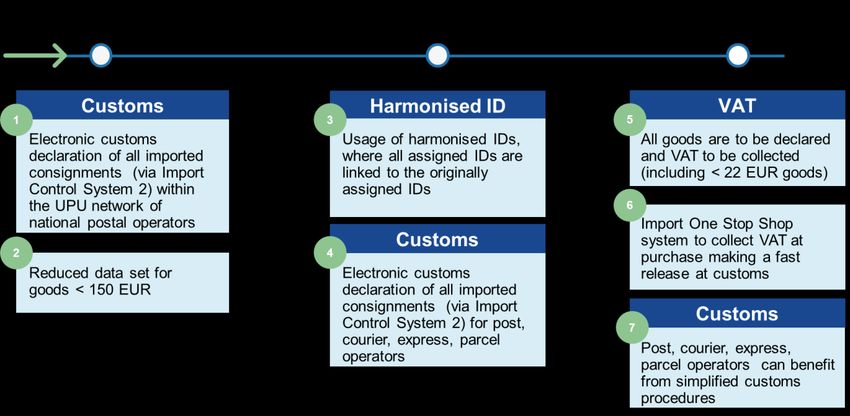
implemented in 2021. The changes are presented in the figure below.
Figure 1: Overview of the 2021 changes in eCommerce area
It is crucial for the Eastern partner countries to align to these changes, which is reflected in the recommendations
provided to the countries. Failing in doing so might lead to substantial challenges when trying to export goods
into the EU, even block trade completely.
2.3.4 Cross-border aspects in focus
This report is focused on the aspects important for cross-border eCommerce harmonisation. This is critical as
the EU is developing Digital Single Market8 and EU4Digital Facility is bringing the benefits of the harmonised
digital market to the Eastern Partnership countries. Thus, the report focuses on the eCommerce areas that are
the most critical to be harmonised for cross-border transactions. Harmonisation of these areas facilitates cross-
border eCommerce transactions and reduce obstacles for seamless cross-border trade.
3 Methodology
3.1 EU practice of cross-border eCommerce
The Digital Single Market Strategy of the European Commission targets to break down online barriers by
applying the four basic freedoms in the EC Treaty (goods, persons, services and capital) to allow people in the
EU countries to benefit from full access to goods and services offered online. The Strategy treats the aspects
of promoting cross-border access to products and online services, protecting online consumer rights and
facilitating cross-border parcels delivery. Its main focus is on ending unjustified cross-border barriers to
businesses in the EU.
The European Commission proposes several measures for ending unjustified cross-border barriers to
eCommerce. They spread out from making it easier for European consumers to shop online, making safer to
pay online, abolishing geo-blocking, facilitating parcel delivery. The measures have impact on online shopping
8
More at: https://eufordigital.eu/discover-eu/eu-digital-single-market/
9activities of consumers that range from searching products and services on web sites, through buying online,
paying, delivery, to providing customer support services.
The objective to eliminate existing obstacles and barriers for pan-European eCommerce for citizens and
businesses require the harmonisation of the digital environments among the Eastern partner countries and with
the EU. This includes the approximation to relevant EU legislation and standards, harmonisation of business
processes and data formats, and alignment of eCommerce ecosystems to enable cross-border eCommerce.
3.2 Value chain of eCommerce
The study uses the concept of a value chain to describe eCommerce domain and the interaction between the
eCommerce ecosystem of the EU member states and the Eastern partner countries. The proposed method
supports that all required eCommerce aspects are included in the study.
3.2.1 Value chain approach
eCommerce value chain describes the players, information and activities involved in the supply, distribution,
and post-sales activities of goods. The approach offers an insight about the flow of activities and processes
involved in any type of eCommerce cross-border trade between businesses, consumers and public entities. It
identifies the key commercial, logistical, regulatory and payment procedures applied in the eCommerce
international supply chain.
The value chain defines areas and boundaries of the legal framework, standards and ecosystem related to
eCommerce and provides a structure for describing the requirements for interoperable eCommerce exchange
among the Eastern partner countries and with the EU.
The lifecycle of an online purchase can involve the consumer accessing a network, searching for an online
trader, selecting the product he or she wants to purchase. The consumer enters information related to how he
intends to purchase the product and then place the order. From here, the lifecycle continues from the viewpoint
of the supplier who receives the order. The supplier locates the product, obtains the product from his inventory
(a warehouse, distribution or fulfilment centre), processes payment, ships the order to the consumer and
ultimately provides required customer support, such as handling of returns.
For the purpose of this study, the eCommerce value chain is broken down into six business processes:
marketing, sales, payment, placing order, delivering parcel, and customer support. These business processes
englobe the whole chain of required activities from marketing of a product online to providing customer services
after the product is delivered to the customer.
These key business processes are both cross-functional and cross-area in nature. Three functional perspectives
define the eCommerce value chain in this study: ecosystem, legislation and standards. The following Figure
shows the business processes of eCommerce value chain.
Figure 2: Business processes of the eCommerce value chain
The eCommerce value chain comprises both physical flows of items and digital flows of data. Electronic
exchange of information is necessary for operations such as tracking and tracing of items and payments.
• Marketing. eCommerce begins with marketing business processes that include different activities
conducted by traders to promote and advertise products and services online.
• Sales. eCommerce websites and marketplaces sell non-digital, digital products and services. The
consumer visits an online shop to search for an item. The eCommerce trader targets to organise the
most effective customer journey through the storefront or marketplace in order to present in an optimal
way products or services with the purpose to trigger a sale and placement of an online order by the
consumer.
• Payment. After the consumer selects an item to purchase, the online shop sends a request to the
customer to pay. Billing and payment comprise payment platforms used to process monetary
transactions made by consumers on the online shop. Electronic payment services are provided by
banks, payment processors, and online payment service providers.
10• Placing order. After the customer pays, payment confirmation and checkout are triggered. Following
checkout (submission of online order), payment placement is conducted, which in turn leads to an order.
Once a customer has placed an order, the trader provides an order confirmation to the consumer. It
contains contractual, order information and estimated shipping dates.
• Parcel delivery. The next stage in the eCommerce value chain is transporting the item to the
consumer’s final delivery destination. Successful delivery is confirmed when the consumer receives the
parcel. It triggers the customer’s confirmation of receipt.
• Customer service. Customer service consists of provision of support to customers before (orientation),
during (selection of item, purchase) and after purchase (after sale and post-delivery customer support).
It can be personal as well as automated. eCommerce trader offers the flexibility and scope to the
consumers to return an item in case it’s faulty or not of their choice. This makes the traders to support
a reverse supply chain of getting it back from the consumer to their warehouse.
3.3 Approach of assessment in the Eastern partner countries
Three functional perspectives are used in this study to define the EU baseline and to assess eCommerce state
of play in the Eastern partner countries: ecosystem, legislation and standards. The value chain guides the
assessment through questionnaires of three perspectives of eCommerce in the Eastern partner countries. It
facilitates the gathering of recommendations on harmonisation of certain areas to facilitate trade with the EU.
eCommerce ecosystem. The eCommerce value chain is operated by multiple players that interact through a
complex network or interconnected system. All together they form an eCommerce ecosystem. It can be defined
as a network of interconnected players and functions that comprise the full cycle of the buying and selling of
goods and services electronically.
Legislation. The eCommerce ecosystem players interact through a series of activities, and their relationships
may be either competition or cooperation. The overarching EU legal framework and the legislation of each EU
member state defines the legal rules of interaction between the eCommerce ecosystem players in the European
market.
Standards. A set of standards related to eCommerce provide guidelines and characteristics for activities or
their results, for common and repeated use. Standards provide individuals, businesses and organisations
involved in eCommerce value chain with a common basis for mutual understanding. The EU standards mainly
relate to products, services or systems.
3.3.1 eCommerce ecosystem
eCommerce ecosystem is formed by multiple players that interact along the eCommerce value chain. It is a
network of interconnected players and functions that cover the full cycle of the buying and selling of goods and
services electronically. The following table presents the ecosystem perspective of eCommerce. It shows the
main areas of the ecosystem that are associated to each business process of the eCommerce value chain.
Several areas are applicable to all business processes (the second row in the table). Other areas are applicable
to particular business processes. The table highlights the aspects of eCommerce ecosystem that are critical for
the cross-border electronic commerce activities between the EU member states and the Eastern partner
countries.
Table 3: Ecosystem perspective of the eCommerce value chain
Marketing Sales Payment Placing order Delivering parcel Customer service
Process of cross-border parcel supply chain and stakeholders involved
Security and trust through:
• Globally recognised barcodes
• Advanced payment security providers
• Clear return processes for purchased goods
• The EU eCommerce trust marks
• Goods control and surveillance by public regulatory bodies
• Alternative and online dispute resolution
• Review platforms for businesses and goods
• Insurance of transported goods
11Marketing Sales Payment Placing order Delivering parcel Customer service
Global, Common Electronic Role of the UPU Return process of
continental and solutions to payments in parcels damaged or
local eCommerce create platforms ecosystem: delivery rules wrong goods
platforms and integrate with
• Common in Common goods
operating in the other the EU delivery methods
EU stakeholders of payment and fulfilment
Rating of the ecosystem operations
methods
products Social media as a
marketplace for • Payment Delivery to
gateways remote and rural
influencers areas
and service
providers Goods tracking
Payment of and identification
cross-border via global IDs
taxes and Customs
stakeholders clearance
involved at every process and
stage changes in 2021
De-minimis in the
EU and changes
in 2021
The indicated areas summarise the EU eCommerce ecosystem baseline. It examines the current state of the
key areas of eCommerce ecosystem setup in the European Union / EEA market and take into account the
systems and procedures developed by global cooperation with the international organisations such as the
Universal Postal Union and the World Customs Organisation.
3.3.2 Legislation
The establishment of adequate legal framework can facilitate the take-up of cross-border eCommerce regionally
and also between the EU member states and the Eastern partner countries by reducing uncertainties, enhancing
trust and addressing potential harms.
The following table presents the legislative perspective of eCommerce. It indicates the main legal areas that are
associated to each business process of the eCommerce value chain. The priority areas highlight the best
practices of the EU legal framework in eCommerce. Several areas are applicable to all business processes (the
second horizontal row in the table). Other legal areas are proper to particular business processes. The focus is
on the legislative and regulatory aspects that are critical for the cross-border electronic commerce activities
between the EU member states and the Eastern partner countries.
Table 4: Legislation perspective of the eCommerce value chain
Marketing Sales Payment Placing order Parcel delivery Customer service
Net neutrality
Consumer protection, consumer rights
Redress and litigation, public enforcement
Injunctions
The Universal Postal Union regulations: items, data models
Data protection
Security of networks and information systems
Unfair Consumer sales Electronic Unfair contract Parcel delivery Consumer
commercial and guarantees payments terms customs alternative
practices Product safety Limit of payment Electronic formalities: dispute resolution
Price indication rules fees contracts excise goods, Consumer online
fees for customs dispute resolution
Online Rules for Prohibitions and procedures
marketplaces protection of restrictions of
intellectual import of goods Fiscal aspects of
parcel delivery:
12Marketing Sales Payment Placing order Parcel delivery Customer service
property and duties, VAT,
enforcement excise duties
Online Transparency of
pharmacies tariffs for cross-
Trademarks and border parcel
designs delivery
Postal security
measures for
cargo and mail
Import electronic
advance data
The indicated areas are presented in the EU legal baseline. It examines the current state of a number of key
areas of law and regulation for eCommerce in the European Union and takes into account the recommendations
of the international organisations such as the Universal Postal Union and the World Customs Organisation.
3.3.3 Standards
European Standards are a key component of the European Single Market. Although rather technical, they
represent one of the most important issues for the interoperability between businesses and public organisations.
They are crucial in facilitating cross-border trade and hence have high visibility among manufacturers and
suppliers of goods inside and outside Europe. Standards provide consumers, businesses, public administrations
and regulatory organisations with a common basis for mutual understanding and represent the state of the art
of business conduct.
The following table indicate the standards important for cross-border eCommerce. It codifies the best EU
practice based on the standards of the Universal Postal Union, the United Nations and the World Customs
Organisation. Several standards are applicable across all business processes of eCommerce value chain (the
second horizontal row). Other standards are applicable to particular business processes. The indicated
standards highlight the aspects that are the most critical for the cross-border electronic commerce activities
between the EU member states and the Eastern partner countries.
Table 5: Standards perspective of the eCommerce value chain
Marketing Sales Payment Placing order Delivering parcel Customer service
Stakeholder and Information exchanges based on WCO/UPU messaging model
Physical process and associated data
Information exchanges based on UN/EDIFACT syntax
Electronic advanced data exchange on item level
UPU electronic exchange standards
UPU technical standards
Information Distance to Interfaces for Quality of postal Complaints
available on access point of cross-border services handling
postal services postal services parcels principles for
Interoperability in postal services
International Open global Electronic Data postal operations
postal address networks and Interchange Damage to postal
component systems for between postal Digital postal items
postal operators handling services
Data definition organisations Re-forwarding
and encoding – Packaging for Measurement of
Identification of boxable items Electronic the transit time of Measurement of
postal items communication of end-to-end loss and
Product safety item information services substantial delay
Identification & in priority and
codification of Item level Method for first-class single
postal tracking measurement of piece mail
consignment information parcel transit time
13Marketing Sales Payment Placing order Delivering parcel Customer service
EU eCommerce Item messages for cross-border
websites trust with Customs parcels
marks Apertures of
Consignment
CE marking messages with private letter
carrier boxes and letter
plates
Messages
between postal Parcel boxes for
operators end use
Digital opening
and closing
systems for
parcel
receptacles
Requirements for
electronic
advanced data in
postal operations
The indicated standards are described in the EU baseline. Each of the standards represent a model specification
or a technical solution against which the actors of eCommerce ecosystem trade across-borders. The baseline
examines the status of standards related to eCommerce in the European Union and aligned to the
recommendations of the international organisations such as the European Committee for Standardisation (CEN)
and the UPU.
3.3.4 Data collection
Data collection in the Eastern partner countries was conducted by local research teams. A detailed methodology
for assessment of each of three areas using structured questionnaires facilitated interviews and data collection.
Each question corresponds to an evaluation criterion in the EU legal baseline for eCommerce. The questions
are grouped into several thematic categories, as presented in the following table.
Table 6: Thematic categories of three questionnaires used in the data collection
Legal Standards Ecosystem
Consumer protection Quality of services eCommerce platforms
Parcel delivery Interoperability Payments
Universal Postal Union Digital Postal Services Taxation
Logistics and supply chain
Security of networks and information Physical process and associated data
The process of cross-border sale in
systems Stakeholders and Information the EU
Geo-blocking Exchanges based on UN/EDIFACT
Data protection Stakeholder and Information
Electronic contracts Exchanges based on the EU customs
model
Electronic payments
UPU electronic exchange standards
Platforms
UPU technical standards
EU eCommerce websites trust marks
eCommerce and product safety
Terms and Definitions
3.3.5 Gaps analysis
Gaps analysis was focused on identifying differences in laws, standards and practices related to eCommerce
between the Eastern partner countries and with the EU. EU4Digital Facility developed gap analysis of
14eCommerce state of play in each country after comparing it to the EU baseline. The gap analysis covers three
areas – legislation, standards and eCommerce ecosystem.
Gap analysis report for the three areas follows the same approach. First, a particular aspect of the state of play
in the EU is indicated. Next to it, the state of play of this aspect in an Eastern partner country is summarised. In
conclusion, gaps comparing to the EU state of play and analysis of the challenges for cross-border eCommerce
are presented. In addition to the identified gaps, the EU4Digital Facility experts provide justification for
recommendations to harmonise cross-border eCommerce in each Eastern partner country with the EU.
eCommerce stakeholders of the Eastern partner countries, both from the public and private sectors, were
involved to assess the state of play by providing input to the local research teams, to review the collected data
and to give feedback on the identified gaps.
3.3.6 Recommendations
The identified gaps have different degree of impact on the cross-border eCommerce between the country and
the EU. Some gaps are important to address in order to boost eCommerce flows between the regions. Other
gaps serve to improve the conditions of eCommerce nationally and cross-border. Based on the identified gaps,
the EU4Digital Facility developed recommendations.
eCommerce ecosystem recommendations have objectives to:
• Eliminate the barriers for cross-border eCommerce;
• Boost cross-border eCommerce volume;
• Prepare countries for the upcoming EU and global changes introduced in 2021.
Legal framework and standards recommendations have an objective to address the key aspects that must
be in place for cross-border eCommerce with the EU to work.
The recommendations for each of the Eastern partner country include specific actions to be considered on a
national level. The recommendations are designed to provide practical and actionable inputs for the relevant
government and non-government stakeholders to make necessary changes and include in national economy
development plans.
In this document, the recommendations are presented starting from the overall eCommerce ecosystem aimed
to boost eCommerce transactions volume and following with recommendations in legal and standards areas,
which are supportive measures to reach the goal.
154 Gap analysis report for the Republic of Moldova
eCommerce stakeholders of Moldova were involved to assess the state of play and provided input for the local research teams, including:
• The Ministry of Economy and Infrastructure (including specialists in post and transport);
• The Customs Service;
• Posta Moldovei;
• Moldovan Association of Information and Communications Technology Companies;
• Moldova e-Governance Agency;
• Representatives of eCommerce marketplaces in Moldova.
Gaps are presented in three areas: eCommerce ecosystem, legislation framework and standards.
4.1 Gap analysis in eCommerce ecosystem area
The table below provides an overview of the identified gaps in ecosystem area in Moldova comparing to the state of play in the EU. The conclusions are
provided next to gaps as:
• ‘Similar practices as in the EU’ if the ecosystem area functions in a way that is similar to the EU or
• ‘Different practices than in the EU’ if the ecosystem area functions in a way that is different from the EU.
The table follows the structure of eCommerce ecosystem as presented in the EU baseline and covers the following areas:
• eCommerce platforms;
• Payments;
• Taxation;
• Logistics and supply chain.
The table is summarised in the section 4.4. Summary of gap analysis.
Gaps
ChallengesTable 7: Moldova: ecosystem gaps comparing to the EU eCommerce baseline
Gaps comparing to the EU baseline /
No State of play in the EU State of play in Moldova
Challenges
eCommerce platforms
1. There is a variety of the major global Availability of the global marketplaces: Similar practices as in the EU. The global
eCommerce platforms providing services in the eCommerce ecosystem players, such as
EU market, which enables cross-border • Customers make purchases on global marketplaces (e.g. marketplaces, are not directly available in
eCommerce in the EU. Using one of these Alibaba, eBay, Amazon, Joom). Moldova given the market size. It is not
platforms brings benefits to enter the market likely that the global marketplaces will
• For delivery, sellers and consumers use Posta
quickly and with relatively low costs. enter Moldova (similarly as in some of the
Moldovei/EMS or forwarding services such as pesoto.md,
EU countries).
Key aspects to consider for the Eastern partner bay.md.
countries: Global logistics players (such as DHL,
• Another way for sellers and customers to interact – is to use
UPS, TNT) entered the market to enable
• Increase awareness and communicate the a workaround, i.e. consumers use addresses of their
availability of the global marketplaces, but
benefits of activating cross-border family/friends located in the EU who ship the goods
it’s challenging for them to maintain high
eCommerce through the major global purchased from international marketplaces to Moldova
volumes, which influences high rates for
eCommerce platforms. (these shipments are generally done via regular bus or train parcel delivery.
routes).
• Also, assess accessibility of the global As a result, businesses and customers
eCommerce platforms in the market. • For businesses it is not common to directly sell through leverage workarounds to make the global
global marketplaces due to various challenges faced by marketplaces available, such as parcel
retailers in fulfilment and logistics (described below). forwarding services or even ordering inside
the EU and delivering items to Moldova by
public transport.
2. Usage of the global marketplaces: Different practices than in the EU.
Considering the limited
• Businesses do not sell on the key global marketplaces availability/presence of the global
because of: marketplaces in Moldova, their usage is
limited.
o Inefficient logistics: lack of presence of global
logistics providers and digital postal services that Businesses face challenges to deliver
are focused on exports (the existing ones are items to the EU due to the lower maturity of
expensive or slow). cross-border logistics ecosystem for
commercial items – although the global
o High rates9 charged by postal operators for the
logistics stakeholders are available, they
delivery of international postal items ranging
are not common to be used.
between 15 to 20 EUR to European countries in
Customers in Moldova find that the number
of goods available for Moldova on global
17Gaps comparing to the EU baseline /
No State of play in the EU State of play in Moldova
Challenges
comparison to rates as low as 3 EUR10 in some of marketplaces is limited, unless parcel
the closest EU countries, such as Romania. forwarding services are used of which
customers have to be aware and ready to
o Complicated customs formalities (customs pay extra and wait longer.
declarations). Cross-border returns rarely happen,
because they are treated as regular postal sending The state of play analysis shows that
with all respective rules and taxation. businesses and consumers in Moldova buy
and sell in the EU, but they find
• Customers use some of the key global marketplaces, but workarounds to do so (such as parcel
face challenges: forwarding services or even ordering inside
the EU and delivering items to Moldova by
o Shipping to Moldova is not an option for a large
variety of products. public transport).
o The time to get goods delivered can be up to three
weeks. Therefore, many consumers use
intermediate services for parcel forwarding.
o In case of goods return, the process is complex as
it follows the regular postal sending with all
respective rules and taxation.
3. In the EU, eCommerce marketplaces play an Local marketplaces selling cross-border: Different practices than in the EU. It is
important role in cross-border sales as they allow not common for local marketplaces in
SMEs to expand globally at reasonable cost. Such It is not common for local marketplaces to sell cross-border. Moldova to sell to the EU. Logistics
platforms provide support in payments, logistics, Because of the challenges described above. operations are slow and/or expensive,
localisation and other key areas of cross-border whereas EU ecosystem stakeholders
eCommerce. expect fast and lower cost delivery.
Key aspects to consider for the Eastern partner
countries: depending on audience, it may be the
most effective to engage with buyers on local
platforms.
9
Rates in MDL. 1 EUR = 19.6 MDL. Rates to each country are provided below:
Regular mail/Posta Moldovei: http://posta.md/files/Files/schimb%20tarife%202015/Anexa%20la%20ordin%2047%20-%20Tarife%20colete%20internat.%202015.pdf
Express mail/EMS: http://posta.md/files/Files/schimb%20tarife%202015/Anexa_nr._1_la_ord._48_din_17.03.2015_Tarife_pentru_expedierea_EMS_internationale.pdf
10
https://ecommercenews.eu/the-average-shipping-costs-in-europe/
18You can also read


